

- Market Size (2026)
- USD 880.0 Mn
- Forecast (2036)
- USD 1620.0 Mn
- CAGR (2026 to 2036)
- 6.3%
How big is Internal Gear Skiving Machine Market in 2026?
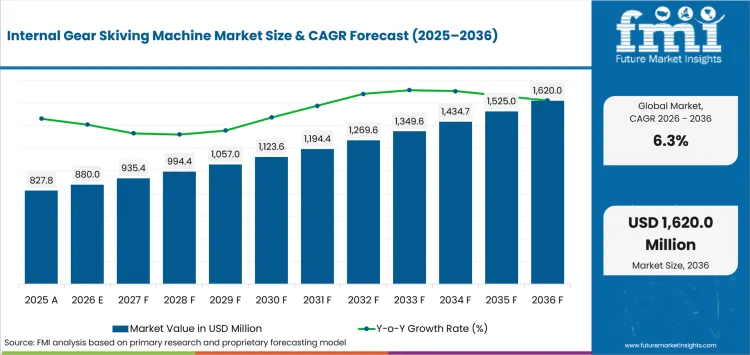
USD 880.0 million in 2026 and USD 1,620.0 million by 2036 at a 6.3% CAGR.
Demand for Internal Gear Skiving Machines is valued at USD 880.0 million in 2026 and is projected to reach USD 1,620.0 million by 2036, reflecting a CAGR of 6.3% across the forecast period. Growth is anchored in a specific manufacturing calculus rather than broad industrial expansion: skiving becomes the economical choice once a plant's internal gear volume is high enough to justify synchronized high-speed cutting, or once high-mix, low-volume production makes fixed broach tooling too rigid and costly to maintain. Purchasing decisions therefore trace back to part-family economics on the shop floor rather than headline capex cycles.
The market's trajectory is closely linked to the pace of electrification in drivetrains. Investment in [EV transmission systems](https://www.futuremarketinsights.com/reports/ev-transmission-system-market) is opening new ring-gear and planetary-drive programs that favor skiving's speed and flexibility over broaching or shaping. That said, adoption is gated by qualification cycles, since machine selection still depends on the exact gear module, tooth geometry and quality class required for each program, which slows conversion even where the economic case is favorable. Restraints also stem from the high upfront cost of skiving centers relative to conventional gear-cutting equipment, which keeps smaller job shops cautious.
Opportunities lie in multi-axis skiving platforms capable of handling mixed part families, along with tooling advances that shorten changeover time. Segment level dynamics span machine type, axis configuration, application and end-use industry, each reflecting different volume and precision thresholds. Regionally, economies with established automotive and industrial gearbox manufacturing bases are expected to lead consumption.
Key Takeaways of Internal Gear Skiving Machine Market
- The market is estimated at USD 880.0 million in 2026 and is forecast to reach USD 1,620.0 million by 2036 at a 6.3% CAGR.
- CNC Internal Gear Skiving Machines lead Machine Type with a 42.0% share because synchronized CNC control is central to cutter-workpiece kinematics and repeatable flank correction.
- Automotive Transmission Manufacturing leads Application at 38.0%, while Automotive Manufacturers hold 37.0% of End User demand.
- Direct Sales lead Distribution Channel at 44.0% since machine selection requires part trials and operator training.
- Fully Automatic Machines account for 39.0% of Automation Level demand as high machine cost increases the value of unattended loading and cycle consistency.
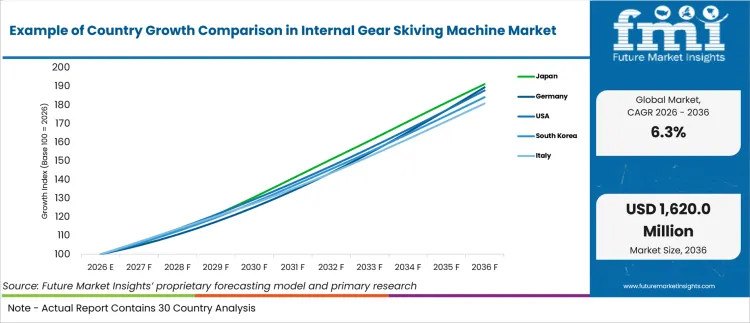
- Japan is an attractive market and is expected to grow at a 6.7% CAGR, followed by Germany at 6.6% and the USA at 6.5%.
- The main commercial constraint is process qualification across machine dynamics, cutter geometry, workholding and chip control and tool-life economics.
- Liebherr-Verzahntechnik GmbH, Gleason Corporation, Nidec Machine Tool Corporation and EMAG GmbH & Co. KG, Yamazaki Mazak Corporation, and DMG MORI Co., Ltd. compete through dedicated machines or integrated gear-cutting platforms.
Analyst Perspective
"Internal gear skiving is bought as a controlled process, not as a spindle specification. The machine must synchronize two rotating axes under cutting load, keep the cutter and workpiece stable, remove chips from an enclosed tooth space and reproduce the same flank after tool wear begins. Suppliers that combine machine design with cutter engineering, simulation, measurement and local service will secure the strongest programs and especially where buyers are replacing shaping or avoiding dedicated broaches."
- Nikhil Kaitwade, Principal Consultant, Future Market Insights
How is the Internal Gear Skiving Machine Market segmented?
The Internal Gear Skiving Machine industry is segmented by Machine Type, Application, End User, Distribution Channel, Automation Level and Region.
Why do CNC Internal Gear Skiving Machines lead the Machine Type category?
CNC Internal Gear Skiving Machines hold a 42.0% share in 2026.
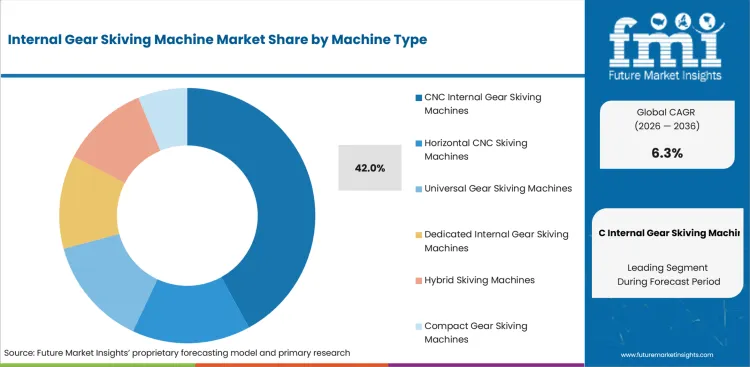
Horizontal CNC Skiving Machines suit shafts and workpieces that are easier to support along a horizontal axis. Vertical CNC Skiving Machines improve gravity-assisted loading and chip fall for ring-shaped parts. Universal Gear Skiving Machines serve job shops that need a wider workpiece envelope, while Multi-Axis Universal Machines add orientation freedom for complex part features. High-Precision Universal Machines are selected where the buyer needs tight profile and lead control without a dedicated high-volume line.
Why does Automotive Transmission Manufacturing lead the Application category?
Automotive Transmission Manufacturing represents a 38.0% share in 2026.
Passenger Vehicle Gears favor short cycle time and repeatability across large programs. Commercial Vehicle Gears involve heavier sections and longer life requirements, which increase attention to cutter load and machine rigidity. Industrial Machinery uses skiving where internal teeth appear in reducers, couplings, and indexing systems. Gearboxes and Power Transmission Systems create demand across industrial drives, material handling, and process equipment.
Why do Automotive Manufacturers lead the End User category?
Automotive Manufacturers hold a 37.0% share in 2026.
Passenger Vehicle OEMs prioritize scalable production and rapid launch support. Commercial Vehicle OEMs emphasize durability and lower-volume flexibility. Gear Manufacturing Companies buy skiving machines to serve several customers, while Custom Gear Manufacturers need faster setup and broader module coverage. Precision Gear Suppliers compete on consistent quality and may combine skiving with in-house metrology and hard finishing.
Why do Direct Sales lead the Distribution Channel category?
Direct Sales account for a 44.0% share in 2026.
Online B2B Platforms and Industrial E-Commerce Platforms mainly support discovery, requests for quotation, and standard accessories rather than final machine qualification. Manufacturer Websites are central for technical comparison and lead generation. Aftermarket Dealers serve installed machines, Machine Refurbishment Providers extend asset life, and Spare Parts Suppliers support spindles and controls and pumps and filters and peripheral equipment. The growing use of robots around high-value machine tools creates a direct link with the robotic CNC machine tending market because utilization improves when loading is decoupled from operator availability.
Why do Fully Automatic Machines lead the Automation Level category?
Fully Automatic Machines represent a 39.0% share in 2026.
Manual Machines and Conventional Gear Skiving Machines remain relevant for development work, repair, and low-volume production where labor is available. Entry-Level Machines lower the adoption threshold for smaller gear shops. Smart Industry 4.0 Machines connect production data with plant systems. IoT-Enabled Machines expose status, alarms, and maintenance information. AI-Based Process Monitoring uses cutting signatures and process history to identify abnormal conditions earlier. These functions sit within the broader industrial automation market, but their value depends on whether the plant can act on the captured data.
What are the drivers, restraints and opportunities in the Internal Gear Skiving Machine Market?
- Driver: Compact planetary drives and internal ring gears increase the need for a flexible process that can outperform shaping without committing to a dedicated broach for every design.
- Restraint: Tool design, machine dynamics, chip evacuation and workholding and thermal stability can delay qualification and weaken expected cost-per-part savings.
- Opportunity: Integrated machine-tool-process packages, in-machine measurement, automated loading and process monitoring can reduce the buyer's engineering burden.
Component geometry drives investment. Internal teeth cannot be produced by ordinary external hobbing, and modern reducers often place the ring gear close to shoulders or other features that limit cutter access. Skiving offers a continuous cutting action with high productivity, but the gain appears only when the machine and cutter remain synchronized under load. The buyer therefore compares the complete part route against shaping, broaching, milling and post-cut finishing.
Qualification creates the main restraint. Cutter geometry must match the gear and shaft-crossing angle. Workholding must resist cutting forces without distorting the ring. Chips must leave the internal tooth space without recutting the finished flank. Tool wear changes surface condition and geometry, so the promised cycle time has to be evaluated together with cutter life and resharpening logistics. ISO 1328-1 gives buyers and suppliers a common tolerance language for cylindrical gear flanks, while machine safety and guarding remain part of installation acceptance.
The opportunity lies in a lower-risk production system. Suppliers can combine process simulation, trial cutting, machine configuration and cutting tools and clamping and automation and measurement and training under one acceptance plan. In-machine probing and process monitoring can shorten the feedback loop between cutting and inspection. Remote diagnostics and local service reduce downtime after launch. This system approach raises the value of dedicated skiving machines and allows multi-tasking platforms to compete in high-mix production.
Which country CAGRs are covered in the Internal Gear Skiving Machine Market?
| Country | CAGR (2026 to 2036) |
|---|---|
| Japan | 6.7% |
| Germany | 6.6% |
| USA | 6.5% |
| South Korea | 6.3% |
| Italy | 6.1% |
| Canada | 5.9% |
| UK | 5.8% |
How do country-level CAGRs compare in the Internal Gear Skiving Machine Market?
The country rates span 0.9 percentage point, from 5.8% in the UK to 6.7% in Japan. The pattern is consistent with a capital-equipment market linked to replacement cycles and qualified production programs.
- Japan (6.7%), Germany (6.6%), and the USA (6.5%) form the upper band and separated by only 0.1 percentage point between neighbors. It reflects deep machine-tool and automotive supplier bases.
- South Korea matches the 6.3% global CAGR, with Italy close behind at 6.1% on the strength of its specialist component-manufacturing network.
- Canada (5.9%) and the UK (5.8%) close the range, where smaller installed bases and batch-oriented precision work moderate the pace of investment.
Comparable growth rates can produce different buying conditions because service reach, local machine-tool capacity, automation economics and application mix vary by country. Full report coverage includes North America, Latin America, Western Europe and Eastern Europe and East Asia and South Asia and Pacific and Middle East and Africa.
Country-wise Analysis
- Japan: The market is forecast at a 6.7% CAGR. Buyers have access to domestic machine tool and cutting-tool expertise, and they tend to evaluate spindle behavior, tool life and process capability and service response as one package. Automotive transmissions, robot reducers, and high-precision machinery support both dedicated and universal skiving platforms.
- Germany: The market is forecast at a 6.6% CAGR. The market is shaped by automotive suppliers, industrial gearbox makers, aerospace machining and a strong local machine tool ecosystem. High labor cost favors automated loading and process monitoring, while buyers expect detailed application engineering before acceptance.
- USA: The market is forecast at a 6.5% CAGR. Demand comes from large manufacturers and independent gear shops that serve several sectors. Turnkey installation, local spare parts, cutter resharpening and training and rapid field service can outweigh a small difference in machine price because a delayed launch affects multiple customer programs.
- South Korea: The market is forecast at a 6.3% CAGR. Automotive and high-volume precision manufacturing create a preference for automated cells with short takt time. Suppliers must demonstrate integration with existing line controls and stable operation across long production runs.
- Italy: The market is forecast at a 6.1% CAGR. Its machine tool sector and network of specialized component manufacturers support demand for flexible equipment. Smaller and mid-sized buyers often prefer universal or multi-tasking machines that can absorb changing part mixes without a dedicated line for every contract.
- Canada: The market is forecast at a 5.9% CAGR. Automotive and aerospace clusters provide technically demanding applications, but the market has a smaller installed base than the USA. Distributor coverage, cross-border service, and access to application engineers are therefore central to supplier selection.
- UK: The market is forecast at a 5.8% CAGR. Aerospace, specialist vehicles, motorsport and defense and precision engineering favor high-value parts produced in smaller batches. Multi-tasking systems gain attention where turning, milling, skiving and inspection can be completed without moving the component through several machines.
Who are the notable companies in the Internal Gear Skiving Machine Market?
Liebherr-Verzahntechnik GmbH, Gleason Corporation, Nidec Machine Tool Corporation and Klingelnberg GmbH and Yamazaki Mazak Corporation and DMG MORI Co., Ltd.
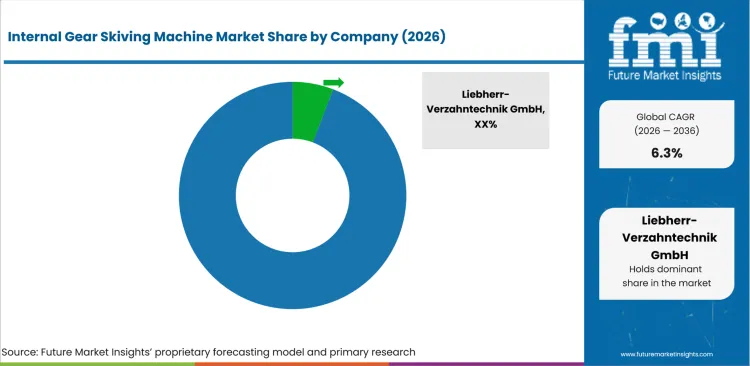
The competitive field includes dedicated gear-machine builders and multi-tasking CNC suppliers. Dedicated specialists compete through spindle rigidity, skiving-head design, cutter and process know-how and automation and gear-specific software. Multi-tasking suppliers compete by consolidating turning, milling, skiving and measurement for high-mix production. Local service coverage matters across both models because process tuning often continues after installation.
- Liebherr-Verzahntechnik GmbH, Gleason Corporation, Nidec Machine Tool Corporation and EMAG GmbH & Co. KG document dedicated skiving platforms or production machines.
- Yamazaki Mazak Corporation and DMG MORI Co., Ltd. position internal gear skiving within integrated multi-tasking machining centers.
- Klingelnberg GmbH, Reishauer AG, Samputensili S.p.A. and KAPP NILES GmbH & Co. KG support adjacent gear manufacturing, finishing, tooling and measurement or process-chain requirements.
Competitive Benchmarking: Internal Gear Skiving Machine Market
| Company | Documented capability | Primary buyer fit |
|---|---|---|
| Liebherr-Verzahntechnik GmbH | Dedicated LK skiving machines; Skiving3 package combines machine, tool, and process; hard-skiving and process-monitoring options | High-volume and high-precision internal gears needing a single accountable process supplier |
| Gleason Corporation | Power-skiving range for small to large gears; internal and external gears; automation and integrated cutter-resharpening options | Automotive, robotics, aerospace and job shops requiring broad machine-size coverage |
| Nidec Machine Tool Corporation | MSS300 Super Skiving Machine with high-rigidity structure, high-power synchronous spindles, and productivity focus | Repeat production where cutter life and stable high-load operation are central |
| EMAG GmbH & Co. KG | VSC 400 PS vertical pick-up platform; power skiving combined with turning and line-oriented automation | Automated cells for ring gears and other rotational components |
| Yamazaki Mazak Corporation | INTEGREX AG integrates skiving, hobbing, end milling and turning and five-axis machining and in-machine gear measurement | High-mix production seeking process consolidation rather than a dedicated gear machine |
| DMG MORI Co., Ltd. | gearSKIVING 2.0 technology cycle on turn-mill platforms; internal and external gears with software-led programming | Plants that want to add gear cutting to existing flexible machining capacity |
Key Developments in the Internal Gear Skiving Machine Market
- In September 2025, Liebherr presented the LK 280 DC gear skiving machine at EMO 2025. The company highlighted a rigid machine and workpiece-spindle design plus LHProcessMonitoring for early detection of raw-part variation, tool wear, and process anomalies.
- In April 2025, Gleason exhibited the 100PS Power Skiving Machine at CIMT in Beijing. The official event material positioned the platform for internal and external gears, robotic parts, and optional conversion to hobbing.
- In May 2025, Yamazaki Mazak showcased the INTEGREX i-250H AG at DMTX in New Delhi. The machine belongs to Mazak's Auto Gear platform, which integrates gear skiving with other machining and measurement functions.
- In May 2024, DMG MORI released a Technology Excellence session on gear cutting that featured gearSKIVING 2.0 and complete machining of gear parts on the NTX 2500 platform.
- In April 2024, EMAG documented the VSC 400 PS as an automated power-skiving machine designed for integration into production lines or existing systems.
Internal Gear Skiving Machine Market - Report Scope
| Coverage field | Report scope |
|---|---|
| Market breakdown | Machine Type, Application, End User and Distribution Channel and Automation Level and Region |
| Quantitative units | Revenue USD Million and CAGR in %. |
| Market definition | Revenue includes first-sale manufacturer revenue from new internal gear skiving machines and multi-tasking machines sold with documented internal gear skiving capability, including factory-installed options and integrated automation supplied as part of the machine order. Revenue from standalone used machines, unrelated gear grinders, and cutting tools sold without a machine is excluded. |
| Regions covered | North America; Latin America; Western Europe; Eastern Europe; East Asia; South Asia and Pacific; Middle East and Africa |
| Countries covered | Japan, Germany, USA and South Korea and Italy and Canada and UK and more than twenty-five additional countries in the full report |
| Key companies profiled | Liebherr-Verzahntechnik GmbH; Gleason Corporation; Nidec Machine Tool Corporation; Klingelnberg GmbH; Yamazaki Mazak Corporation; DMG MORI Co., Ltd.; EMAG GmbH & Co. KG; Reishauer AG; Samputensili S.p.A.; KAPP NILES GmbH & Co. KG |
| Forecast period | 2026 to 2036 |
| Approach | Hybrid bottom-up and top-down sizing using manufacturer revenue, machine shipments, configuration and price checks and end-use capital expenditure indicators and replacement cycles and buyer-side validation |
Internal Gear Skiving Machine Market - Research Methodology
| Method | Approach |
|---|---|
| Primary Research | FMI engages gear machine manufacturers, cutting-tool suppliers, automation integrators and gear producers and automotive and aerospace manufacturing teams and machine tool distributors and plant engineering leaders and procurement professionals and subject-matter experts. |
| Desk Research | The review covers official machine tool statistics, national manufacturing data, trade-body releases and ISO standards and company filings and first-party product documentation and official event material and verified company announcements. |
| Market Sizing and Forecasting | The model reconciles machine revenue, estimated unit shipments, machine size and configuration mix and automation content and replacement demand and end-use capital expenditure and country manufacturing indicators and expected program launches. |
| Data Validation | Supplier-side findings are cross-checked with buyer requirements, channel evidence, installed-base behavior and application economics and country-level manufacturing conditions. |
| Forecast Governance | Market values, segment shares, and country CAGRs are reviewed for mathematical consistency. High-risk claims are retained only when supported by a traceable primary source or a clearly identified FMI estimate. |
Internal Gear Skiving Machine Market by Segments
Internal Gear Skiving Machine Market segmented by Machine Type:
- CNC Internal Gear Skiving Machines
- Horizontal CNC Skiving Machines
- Vertical CNC Skiving Machines
- Universal Gear Skiving Machines
- Multi-Axis Universal Machines
- High-Precision Universal Machines
- Dedicated Internal Gear Skiving Machines
- Automotive Gear Machines
- Aerospace Gear Machines
- Hybrid Skiving Machines
- Skiving & Hobbing Combination Machines
- Skiving & Grinding Combination Machines
- Compact Gear Skiving Machines
- Bench-Type Machines
- Small Footprint Machines
Internal Gear Skiving Machine Market segmented by Application:
- Automotive Transmission Manufacturing
- Passenger Vehicle Gears
- Commercial Vehicle Gears
- Industrial Machinery
- Gearboxes
- Power Transmission Systems
- Aerospace Components
- Aircraft Gear Systems
- Helicopter Transmission Gears
- Precision Engineering
- Robotics Components
- High-Precision Mechanical Parts
- Energy Equipment
- Wind Turbine Gear Components
- Heavy Equipment Gears
Internal Gear Skiving Machine Market segmented by End User:
- Automotive Manufacturers
- Passenger Vehicle OEMs
- Commercial Vehicle OEMs
- Gear Manufacturing Companies
- Custom Gear Manufacturers
- Precision Gear Suppliers
- Industrial Equipment Manufacturers
- Machinery OEMs
- Power Transmission Equipment Manufacturers
- Aerospace Manufacturers
- Aircraft Component Suppliers
- Defense Equipment Manufacturers
- Research & Technical Institutes
- Engineering Research Centers
- Technical Universities
Internal Gear Skiving Machine Market segmented by Distribution Channel:
- Direct Sales
- OEM Contracts
- Project-Based Sales
- Authorized Distributors
- Regional Distributors
- Global Machine Tool Dealers
- Industrial Equipment Suppliers
- Machine Tool Integrators
- Value-Added Resellers
- Online B2B Platforms
- Manufacturer Websites
- Industrial E-Commerce Platforms
- Aftermarket Dealers
- Machine Refurbishment Providers
- Spare Parts Suppliers
Internal Gear Skiving Machine Market segmented by Automation Level:
- Fully Automatic Machines
- CNC Automated Systems
- Robotic Loading Systems
- Semi-Automatic Machines
- Operator-Assisted Systems
- Automated Tool Change Systems
- Manual Machines
- Conventional Gear Skiving Machines
- Entry-Level Machines
- Smart Industry 4.0 Machines
- IoT-Enabled Machines
- AI-Based Process Monitoring
Internal Gear Skiving Machine Market segmented by Region:
- North America
- Latin America
- Western Europe
- Eastern Europe
- East Asia
- South Asia and Pacific
- Middle East and Africa
Internal Gear Skiving Machine Market by Region:
- North America
- United States
- Canada
- Mexico
- Latin America
- Brazil
- Chile
- Rest of Latin America
- Western Europe
- Germany
- United Kingdom
- Italy
- Spain
- France
- Nordics
- Benelux
- Rest of Western Europe
- Eastern Europe
- Russia
- Poland
- Hungary
- Balkan and Baltic States
- Rest of Eastern Europe
- East Asia
- China
- Japan
- South Korea
- South Asia and Pacific
- India
- ASEAN
- Australia and New Zealand
- Rest of South Asia and Pacific
- Middle East and Africa
- Kingdom of Saudi Arabia
- Other GCC Countries
- Türkiye
- South Africa
- Other African Union Countries
- Rest of Middle East and Africa
Research Sources and Bibliography
- International Organization for Standardization. ISO 1328-1:2013, Cylindrical gears - ISO system of flank tolerance classification - Part 1.
- International Organization for Standardization. ISO 16090-1, Machine tools safety - Machining centres, milling machines and transfer machines.
- Japan Machine Tool Builders' Association. Machine Tool Statistics and Monthly Machine Tool Orders, accessed July 2026.
- VDW, German Machine Tool Builders' Association. Bottomed out - First quarter sees increase in orders for machine tool industry, 23 June 2026.
- AMT - The Association for Manufacturing Technology. US Manufacturing Technology Orders and manufacturing technology releases, accessed July 2026.
- UCIMU-SISTEMI PER PRODURRE. Italian Machines Tool Industry in 2025, accessed July 2026.
- Ministry of Trade, Industry and Resources, Republic of Korea. Industry and automotive manufacturing releases, accessed July 2026.
- Statistics Canada. Monthly Survey of Manufacturing, 2025-2026 releases.
- Society of Motor Manufacturers and Traders. UK Automotive Industry Facts and vehicle production releases, accessed July 2026.
- Liebherr-Verzahntechnik GmbH. Gear skiving machines and Skiving3 technology package, accessed July 2026.
- Liebherr-Verzahntechnik GmbH. Innovation meets precision - Liebherr at EMO 2025.
- Gleason Corporation. Power Skiving machines and the Gleason Power Skiving Approach, accessed July 2026.
- Gleason Corporation. CIMT 2025 official event page, April 2025.
- Nidec Machine Tool Corporation. Super Skiving Machine MSS300, accessed July 2026.
- EMAG GmbH & Co. KG. Power Skiving on the VSC 400 PS - Fast, flexible, efficient and 3 April 2024.
- Yamazaki Mazak Corporation. INTEGREX AG hybrid multi-tasking machines with gear cutting and measurement, accessed July 2026.
- Yamazaki Mazak Corporation. DMTX 2025 official event page, May 2025.
- DMG MORI Co., Ltd. gearSKIVING 2.0 technology cycle, accessed July 2026.
- DMG MORI Co., Ltd. Gear Cutting for Everyone - Technology Excellence Days Pfronten 2024, 13 May 2024.
This Report Answers
- What is the Internal Gear Skiving Machine Market size in 2026 and what value is forecast for 2036?
- Why do CNC Internal Gear Skiving Machines hold the leading Machine Type share?
- How do buyers compare skiving against shaping, broaching, hobbing and milling and grinding?
- Which internal gear applications can justify a dedicated skiving machine?
- Why do Automotive Transmission Manufacturing and Automotive Manufacturers lead their respective segments?
- How do fully automatic cells change machine utilization and cost per part?
- What process risks can delay acceptance of an internal gear skiving machine?
- How do country growth rates differ across Japan, Germany, USA and South Korea and Italy and Canada and UK?
- Which suppliers provide dedicated skiving machines and which offer multi-tasking platforms?
- What should procurement and manufacturing engineering teams verify during a part trial?
Frequently Asked Questions
How big is the Internal Gear Skiving Machine Market in 2026?
The internal gear skiving machine market is valued at USD 880.0 million in 2026 and is forecast to reach USD 1620.0 million by 2036. Growth is supported by plants with enough internal gear volume to justify synchronized high-speed cutting over fixed broach tooling in high-mix production programs.
What is the CAGR of the Internal Gear Skiving Machine Market from 2026 to 2036?
The internal gear skiving machine market grows at a CAGR of 6.3% between 2026 and 2036, driven by compact planetary drives and internal ring gears that need a flexible cutting process, while tool design and workholding qualification can delay expected cost-per-part savings.
Which machine type leads the Internal Gear Skiving Machine Market?
CNC internal gear skiving machines lead the internal gear skiving machine market by machine type, holding 42.0% share in 2026 because synchronized CNC control is central to cutter-workpiece kinematics and repeatable flank correction across production programs.
How much will the Internal Gear Skiving Machine Market add between 2026 and 2036?
The internal gear skiving machine market is set to add USD 740.0 million between 2026 and 2036, growing from USD 880.0 million to USD 1620.0 million as automotive transmission programs and EV ring-gear production expand demand for synchronized skiving platforms worldwide.
Who are the leading companies in the Internal Gear Skiving Machine Market?
Six companies lead the internal gear skiving machine market, including Liebherr-Verzahntechnik, Gleason Corporation, Nidec Machine Tool Corporation, Klingelnberg, Yamazaki Mazak Corporation, and DMG MORI, competing through dedicated skiving platforms and integrated multi-tasking machining centers.
Preview the report firsthand - request a free sample
Get SampleGet the brochure for pricing and purchase details.
Get PDFTable of Content
- Key Takeaways
- Market Size and CAGR
- Top Growth Driver
- Fastest Growing Segment
- Leading Region
- Key Companies
- Emerging Opportunities
- Executive Summary
- Global Market Outlook
- Demand-side Trends
- Supply-side Trends
- Technology Roadmap Analysis
- Analysis and Recommendations
- Analyst Perspective (What is happening? Why now? What should investors know?)
- Key Questions Answered
- How large is the market?
- What is the CAGR?
- What are key trends?
- Which region dominates?
- Who are the leaders?
- Market Overview
- Market Coverage / Taxonomy
- Market Definition / Scope / Limitations
- Research Methodology
- Chapter Orientation
- Analytical Lens and Working Hypotheses
- Market Structure, Signals, and Trend Drivers
- Benchmarking and Cross-market Comparability
- Market Sizing, Forecasting, and Opportunity Mapping
- Research Design and Evidence Framework
- Desk Research Programme (Secondary Evidence)
- Expert Input and Fieldwork (Primary Evidence)
- Tooling, Models, and Reference Databases
- Data Engineering and Model Build
- Quality Assurance and Audit Trail
- Market Background
- Market Dynamics (Drivers, Restraints, Opportunity, Trends)
- Scenario Forecast (Optimistic, Likely, Conservative)
- Impact Analysis
- AI Impact
- Sustainability Impact
- Regulatory Impact
- Technology Impact
- Consumer / Buyer Analysis
- Purchase Drivers
- Adoption Barriers
- Buyer Journey
- Opportunity Map Analysis
- Product Life Cycle Analysis
- Supply Chain Analysis
- Investment Feasibility Matrix
- Value Chain Analysis
- PESTLE and Porter's Analysis
- Regulatory Landscape
- Regional Parent Market Outlook
- Production and Consumption Statistics
- Import and Export Statistics
- Global Market Analysis and Forecast, 2021 to 2036
- Historical Market Size Value (USD Million) Analysis, 2021 to 2025
- Current and Future Market Size Value (USD Million) Projections, 2026 to 2036
- Y-o-Y Growth Trend Analysis
- Absolute $ Opportunity Analysis
- Global Market Pricing Analysis, 2021 to 2036
- Global Market Analysis and Forecast, By Machine Type, 2021 to 2036
- Introduction / Key Findings
- Historical Market Size Value (USD Million) Analysis By Machine Type, 2021 to 2025
- Current and Future Market Size Value (USD Million) Analysis and Forecast By Machine Type, 2026 to 2036
- CNC Internal Gear Skiving Machines
- Horizontal CNC Skiving Machines
- Universal Gear Skiving Machines
- Dedicated Internal Gear Skiving Machines
- Hybrid Skiving Machines
- Compact Gear Skiving Machines
- CNC Internal Gear Skiving Machines
- Y-o-Y Growth Trend Analysis By Machine Type, 2021 to 2025
- Absolute $ Opportunity Analysis By Machine Type, 2026 to 2036
- Global Market Analysis and Forecast, By Application, 2021 to 2036
- Introduction / Key Findings
- Historical Market Size Value (USD Million) Analysis By Application, 2021 to 2025
- Current and Future Market Size Value (USD Million) Analysis and Forecast By Application, 2026 to 2036
- Automotive Transmission Manufacturing
- Industrial Machinery
- Aerospace Components
- Precision Engineering
- Energy Equipment
- Automotive Transmission Manufacturing
- Y-o-Y Growth Trend Analysis By Application, 2021 to 2025
- Absolute $ Opportunity Analysis By Application, 2026 to 2036
- Global Market Analysis and Forecast, By End User, 2021 to 2036
- Introduction / Key Findings
- Historical Market Size Value (USD Million) Analysis By End User, 2021 to 2025
- Current and Future Market Size Value (USD Million) Analysis and Forecast By End User, 2026 to 2036
- Automotive Manufacturers
- Gear Manufacturing Companies
- Industrial Equipment Manufacturers
- Aerospace Manufacturers
- Research & Technical Institutes
- Automotive Manufacturers
- Y-o-Y Growth Trend Analysis By End User, 2021 to 2025
- Absolute $ Opportunity Analysis By End User, 2026 to 2036
- Global Market Analysis and Forecast, By Distribution Channel, 2021 to 2036
- Introduction / Key Findings
- Historical Market Size Value (USD Million) Analysis By Distribution Channel, 2021 to 2025
- Current and Future Market Size Value (USD Million) Analysis and Forecast By Distribution Channel, 2026 to 2036
- Direct Sales
- Authorized Distributors
- Online B2B Platforms
- Direct Sales
- Y-o-Y Growth Trend Analysis By Distribution Channel, 2021 to 2025
- Absolute $ Opportunity Analysis By Distribution Channel, 2026 to 2036
- Global Market Analysis and Forecast, By Automation Level, 2021 to 2036
- Introduction / Key Findings
- Historical Market Size Value (USD Million) Analysis By Automation Level, 2021 to 2025
- Current and Future Market Size Value (USD Million) Analysis and Forecast By Automation Level, 2026 to 2036
- Fully Automatic Machines
- Semi-Automatic Machines
- Manual Machines
- Smart Industry 4.0 Machines
- Fully Automatic Machines
- Y-o-Y Growth Trend Analysis By Automation Level, 2021 to 2025
- Absolute $ Opportunity Analysis By Automation Level, 2026 to 2036
- Global Market Analysis and Forecast, By Region, 2021 to 2036
- Introduction
- Historical Market Size Value (USD Million) Analysis By Region, 2021 to 2025
- Current Market Size Value (USD Million) Analysis and Forecast By Region, 2026 to 2036
- North America
- Latin America
- Western Europe
- Eastern Europe
- East Asia
- South Asia and Pacific
- Middle East & Africa
- Market Attractiveness Analysis By Region
- North America Market Analysis and Forecast, By Country, 2021 to 2036
- Historical Market Size Value (USD Million) Trend Analysis By Market Taxonomy, 2021 to 2025
- Market Size Value (USD Million) Forecast By Market Taxonomy, 2026 to 2036
- By Country
- USA
- Canada
- By Machine Type
- By Application
- By End User
- By Distribution Channel
- By Automation Level
- By Country
- Market Attractiveness Analysis
- By Country
- By Machine Type
- By Application
- By End User
- By Distribution Channel
- By Automation Level
- Key Takeaways
- Latin America Market Analysis and Forecast, By Country
- Historical Market Size Value (USD Million) Trend Analysis By Market Taxonomy, 2021 to 2025
- Market Size Value (USD Million) Forecast By Market Taxonomy, 2026 to 2036
- By Country
- Brazil
- Mexico
- Chile
- Rest of Latin America
- By Machine Type
- By Application
- By End User
- By Distribution Channel
- By Automation Level
- By Country
- Market Attractiveness Analysis
- By Country
- By Machine Type
- By Application
- By End User
- By Distribution Channel
- By Automation Level
- Key Takeaways
- Western Europe Market Analysis and Forecast, By Country
- Historical Market Size Value (USD Million) Trend Analysis By Market Taxonomy, 2021 to 2025
- Market Size Value (USD Million) Forecast By Market Taxonomy, 2026 to 2036
- By Country
- Germany
- UK
- Italy
- Spain
- France
- Nordic
- BENELUX
- Rest of Western Europe
- By Machine Type
- By Application
- By End User
- By Distribution Channel
- By Automation Level
- By Country
- Market Attractiveness Analysis
- By Country
- By Machine Type
- By Application
- By End User
- By Distribution Channel
- By Automation Level
- Key Takeaways
- Eastern Europe Market Analysis and Forecast, By Country
- Historical Market Size Value (USD Million) Trend Analysis By Market Taxonomy, 2021 to 2025
- Market Size Value (USD Million) Forecast By Market Taxonomy, 2026 to 2036
- By Country
- Russia
- Poland
- Hungary
- Balkan & Baltic
- Rest of Eastern Europe
- By Machine Type
- By Application
- By End User
- By Distribution Channel
- By Automation Level
- By Country
- Market Attractiveness Analysis
- By Country
- By Machine Type
- By Application
- By End User
- By Distribution Channel
- By Automation Level
- Key Takeaways
- East Asia Market Analysis and Forecast, By Country
- Historical Market Size Value (USD Million) Trend Analysis By Market Taxonomy, 2021 to 2025
- Market Size Value (USD Million) Forecast By Market Taxonomy, 2026 to 2036
- By Country
- China
- Japan
- South Korea
- By Machine Type
- By Application
- By End User
- By Distribution Channel
- By Automation Level
- By Country
- Market Attractiveness Analysis
- By Country
- By Machine Type
- By Application
- By End User
- By Distribution Channel
- By Automation Level
- Key Takeaways
- South Asia and Pacific Market Analysis and Forecast, By Country
- Historical Market Size Value (USD Million) Trend Analysis By Market Taxonomy, 2021 to 2025
- Market Size Value (USD Million) Forecast By Market Taxonomy, 2026 to 2036
- By Country
- India
- ASEAN
- Australia & New Zealand
- Rest of South Asia and Pacific
- By Machine Type
- By Application
- By End User
- By Distribution Channel
- By Automation Level
- By Country
- Market Attractiveness Analysis
- By Country
- By Machine Type
- By Application
- By End User
- By Distribution Channel
- By Automation Level
- Key Takeaways
- Middle East & Africa Market Analysis and Forecast, By Country
- Historical Market Size Value (USD Million) Trend Analysis By Market Taxonomy, 2021 to 2025
- Market Size Value (USD Million) Forecast By Market Taxonomy, 2026 to 2036
- By Country
- Kingdom of Saudi Arabia
- Other GCC Countries
- Türkiye
- South Africa
- Other African Union
- Rest of Middle East & Africa
- By Machine Type
- By Application
- By End User
- By Distribution Channel
- By Automation Level
- By Country
- Market Attractiveness Analysis
- By Country
- By Machine Type
- By Application
- By End User
- By Distribution Channel
- By Automation Level
- Key Takeaways
- Key Countries Market Analysis
- USA
- Pricing Analysis
- Market Share Analysis, 2025
- By Machine Type
- By Application
- By End User
- By Distribution Channel
- By Automation Level
- Canada
- Pricing Analysis
- Market Share Analysis, 2025
- By Machine Type
- By Application
- By End User
- By Distribution Channel
- By Automation Level
- Mexico
- Pricing Analysis
- Market Share Analysis, 2025
- By Machine Type
- By Application
- By End User
- By Distribution Channel
- By Automation Level
- Brazil
- Pricing Analysis
- Market Share Analysis, 2025
- By Machine Type
- By Application
- By End User
- By Distribution Channel
- By Automation Level
- Chile
- Pricing Analysis
- Market Share Analysis, 2025
- By Machine Type
- By Application
- By End User
- By Distribution Channel
- By Automation Level
- Germany
- Pricing Analysis
- Market Share Analysis, 2025
- By Machine Type
- By Application
- By End User
- By Distribution Channel
- By Automation Level
- UK
- Pricing Analysis
- Market Share Analysis, 2025
- By Machine Type
- By Application
- By End User
- By Distribution Channel
- By Automation Level
- Italy
- Pricing Analysis
- Market Share Analysis, 2025
- By Machine Type
- By Application
- By End User
- By Distribution Channel
- By Automation Level
- Spain
- Pricing Analysis
- Market Share Analysis, 2025
- By Machine Type
- By Application
- By End User
- By Distribution Channel
- By Automation Level
- France
- Pricing Analysis
- Market Share Analysis, 2025
- By Machine Type
- By Application
- By End User
- By Distribution Channel
- By Automation Level
- India
- Pricing Analysis
- Market Share Analysis, 2025
- By Machine Type
- By Application
- By End User
- By Distribution Channel
- By Automation Level
- ASEAN
- Pricing Analysis
- Market Share Analysis, 2025
- By Machine Type
- By Application
- By End User
- By Distribution Channel
- By Automation Level
- Australia & New Zealand
- Pricing Analysis
- Market Share Analysis, 2025
- By Machine Type
- By Application
- By End User
- By Distribution Channel
- By Automation Level
- China
- Pricing Analysis
- Market Share Analysis, 2025
- By Machine Type
- By Application
- By End User
- By Distribution Channel
- By Automation Level
- Japan
- Pricing Analysis
- Market Share Analysis, 2025
- By Machine Type
- By Application
- By End User
- By Distribution Channel
- By Automation Level
- South Korea
- Pricing Analysis
- Market Share Analysis, 2025
- By Machine Type
- By Application
- By End User
- By Distribution Channel
- By Automation Level
- Russia
- Pricing Analysis
- Market Share Analysis, 2025
- By Machine Type
- By Application
- By End User
- By Distribution Channel
- By Automation Level
- Poland
- Pricing Analysis
- Market Share Analysis, 2025
- By Machine Type
- By Application
- By End User
- By Distribution Channel
- By Automation Level
- Hungary
- Pricing Analysis
- Market Share Analysis, 2025
- By Machine Type
- By Application
- By End User
- By Distribution Channel
- By Automation Level
- Kingdom of Saudi Arabia
- Pricing Analysis
- Market Share Analysis, 2025
- By Machine Type
- By Application
- By End User
- By Distribution Channel
- By Automation Level
- Türkiye
- Pricing Analysis
- Market Share Analysis, 2025
- By Machine Type
- By Application
- By End User
- By Distribution Channel
- By Automation Level
- South Africa
- Pricing Analysis
- Market Share Analysis, 2025
- By Machine Type
- By Application
- By End User
- By Distribution Channel
- By Automation Level
- USA
- Market Structure Analysis
- Competition Dashboard
- Competition Benchmarking
- Market Share Analysis of Top Players
- By Regional
- By Machine Type
- By Application
- By End User
- By Distribution Channel
- By Automation Level
- Emerging Startups
- Innovation Benchmarking
- Competition Analysis
- Competition Deep Dive
- Liebherr-Verzahntechnik GmbH
- Overview
- Product Portfolio
- Profitability by Market Segments
- Sales Footprint
- Strategy Overview
- Marketing Strategy
- Product Strategy
- Channel Strategy
- Gleason Corporation
- Nidec Machine Tool Corporation
- EMAG GmbH & Co. KG
- Samputensili S.p.A.
- Yamazaki Mazak Corporation
- DMG MORI Co. Ltd.
- Klingelnberg GmbH
- Reishauer AG
- Liebherr-Verzahntechnik GmbH
- Case Studies
- Success Stories
- Recent Developments
- Competition Deep Dive
- Assumptions & Acronyms Used


