

- Industry Size (2025)
- USD 0.9 Bn
- Forecast (2035)
- USD 4.6 Bn
- CAGR (2025 to 2035)
- 17.1%
Demand for Data As A Service in Japan Forecast and Outlook 2025 to 2035
In 2025, demand for data as a service in Japan stands at USD 0.9 billion and is projected to reach USD 4.6 billion by 2035 at a CAGR of 17.1%. Early growth reflects rising enterprise reliance on externally sourced data for market intelligence, financial modeling, supply chain visibility, and risk assessment. Manufacturing firms, trading houses, and financial institutions are core early adopters as they integrate third-party datasets into forecasting and decision-making frameworks. Cloud-native business platforms and analytics environments accelerate uptake by lowering integration friction. Data demand centers on consumer behavior, mobility patterns, price benchmarking, and macroeconomic indicators. Initial contracts remain concentrated among large enterprises with mature data governance structures and established compliance protocols.
After 2030, expansion shifts toward operational and sector-specific data usage rather than strategic analytics alone. Demand rises from about USD 2.1 billion in 2030 toward USD 4.6 billion by 2035 as retail chains, logistics groups, healthcare networks, and smart city operators scale real-time data consumption. Application breadth widens across predictive maintenance, traffic management, fraud detection, and demand sensing. Small and mid-sized firms enter the market through subscription-based data exchanges and API-driven access models. Procurement focus moves toward data reliability, update frequency, localization accuracy, and regulatory alignment under Japan data protection law. Value growth in later years reflects rising data volume per user, not only new customer formation.
Quick Stats of the Demand for Data As A Service in Japan
- Demand for Data As A Service in Japan Value (2025): USD 0.9 billion
- Demand for Data As A Service in Japan Forecast Value (2035): USD 4.6 billion
- Demand for Data As A Service in Japan Forecast CAGR (2025-2035): 17.1%
- Demand for Data As A Service in Japan Leading Pricing Model: Volume Based Pricing (35%)
- Demand for Data As A Service in Japan Key Growth Regions: Kyushu & Okinawa, Kanto, Kansai, Chubu, Tohoku, Rest of Japan
- Demand for Data As A Service in Japan Top Providers: Microsoft Azure, Amazon Web Services, Google Cloud Platform, IBM Cloud, HP Enterprise Services
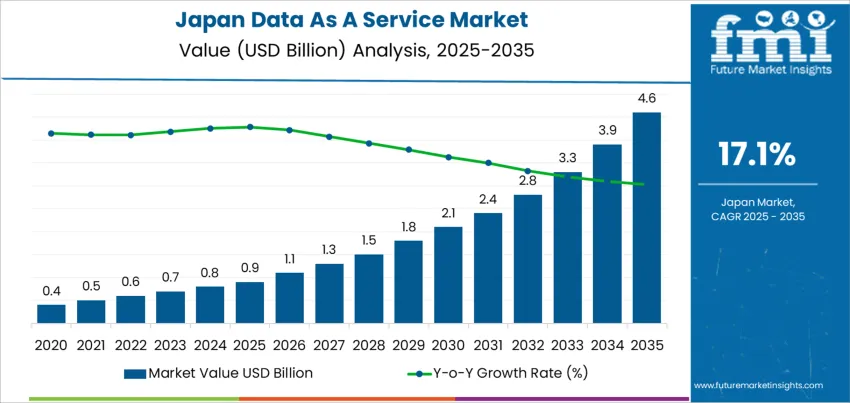
What is the Demand Forecast for Data As A Service in Japan through 2035?
Demand for Data As A Service in Japan increases from USD 0.9 billion in 2025 to USD 2.1 billion by 2030, adding USD 1.2 billion in absolute value within five years. This phase reflects the transition of enterprise data usage from internally generated datasets toward externally sourced, API-driven data streams used for pricing intelligence, risk scoring, location analytics, and consumer behavior modeling. Growth is driven by financial services, digital commerce, logistics optimization, and smart city programs that rely on continuous data ingestion rather than static databases. Expansion during this period is platform-led, with cloud-native data exchanges, subscription-based datasets, and sector-specific data marketplaces becoming standard procurement tools rather than experimental services.
From 2030 to 2035, the market expands sharply from USD 2.1 billion to USD 4.6 billion, adding a substantial USD 2.5 billion in the second half of the decade. This back weighted acceleration reflects deeper embedding of DaaS into automated decision systems, AI training pipelines, predictive maintenance platforms, and real-time supply chain orchestration. As synthetic data generation, cross-border data products, and regulatory-compliant data sharing frameworks mature, value per enterprise deployment rises significantly. Data As A Service shifts from a supporting analytics input into a core production asset for Japanese industries, driving structurally high demand growth through 2035.
Data As A Service (DaaS) Industry in Japan Key Takeaways
| Metric | Value |
|---|---|
| Industry Value (2025) | USD 0.9 billion |
| Forecast Value (2035) | USD 4.6 billion |
| Forecast CAGR (2025–2035) | 17.1% |
How Is the Demand for Data-as-a-Service (DaaS) Evolving in the USA?
The demand for DaaS in the USA has grown as companies shift from building in-house data infrastructure toward subscribing to cloud-based data services that offer flexibility, scalability, and consistent data quality. Many firms managing large volumes of structured and unstructured data-in retail, finance, healthcare, logistics, and marketing find it more efficient to access aggregated datasets or data pipelines via APIs rather than maintain local storage and analytics stacks. The DaaS model helps reduce capital expenditure and maintenance efforts while providing real-time access to cleaned, standardized data. Rising adoption of cloud platforms and distributed work-models reinforced use of DaaS for data sharing, analytics, and decision support across distributed teams.
Future growth of DaaS in the USA will likely accelerate as businesses deepen reliance on real-time analytics, machine learning, and data-driven decision-making. Demand will expand from established sectors into newer segments such as IoT-enabled manufacturing, telehealth, and e-commerce, where data velocity and accuracy matter. Providers may increasingly bundle enrichment, compliance screening, and analytics capabilities-making DaaS part of larger enterprise data strategies rather than standalone utility. Barriers remain: data privacy regulations, security and compliance expectations, and organizational resistance to outsourcing data control. Success will depend on improving data governance frameworks, transparent data licensing, and integration of DaaS with enterprise systems.
How Are Pricing Model and Deployment Model Structuring the Demand for Data As A Service in Japan?
The demand for Data As A Service in Japan is structured by pricing model and deployment model. Volume based pricing accounts for 35% of total demand, followed by data type based models, quantity based pricing, and pay as per use structures adopted across different enterprise use cases. By deployment model, public cloud represents 50.0% of total adoption, followed by private cloud and hybrid cloud environments. Demand behavior is shaped by data consumption intensity, scalability requirements, compliance management, and integration with enterprise analytics systems. These segments reflect how cost predictability and infrastructure preferences influence DaaS adoption across banking, manufacturing, retail, mobility, and public sector data operations in Japan.
Why Does Volume Based Pricing Lead the DaaS Pricing Demand in Japan?
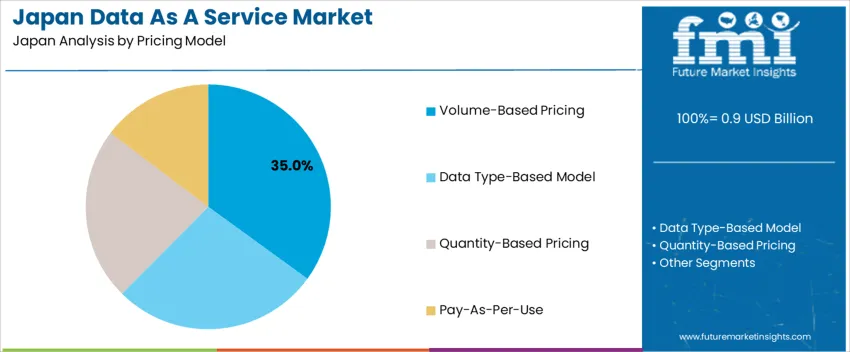
Volume based pricing accounts for 35% of total DaaS demand in Japan due to its cost predictability and alignment with large scale enterprise data consumption patterns. Organizations that rely on continuous access to structured and unstructured datasets prefer volume based contracts to stabilize monthly operating expenses. Financial institutions, telecom operators, and manufacturing firms use high volumes of market data, customer behavior datasets, and operational intelligence feeds that require predictable pricing for budget planning. Volume based models also simplify vendor procurement and long term contract negotiation under standardized data usage thresholds.
Volume based pricing further supports automation driven analytics platforms that operate continuously without requiring per query cost calculation. Data ingestion pipelines operating at scale benefit from predictable unit pricing that avoids transaction driven billing volatility. Enterprises also favor this model for regulatory reporting workloads that require persistent data feeds. These budgeting control, processing continuity, and contract stability factors sustain volume based pricing as the leading DaaS pricing model in Japan.
Why Does Public Cloud Dominate the DaaS Deployment Demand in Japan?
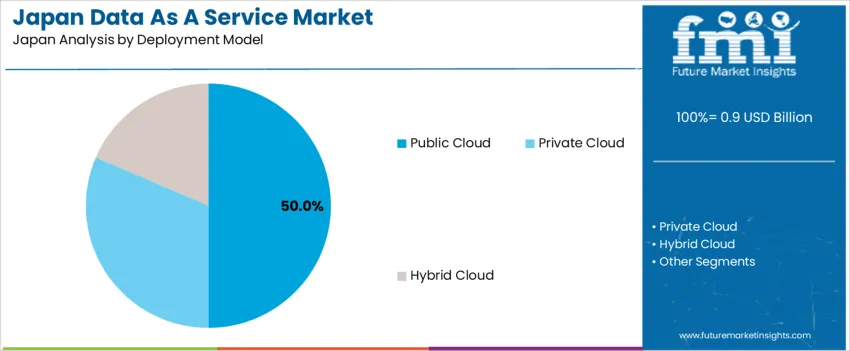
Public cloud deployment accounts for 50.0% of total DaaS demand in Japan due to its scalability, rapid provisioning, and lower infrastructure ownership burden. Public platforms allow enterprises to access large datasets without maintaining dedicated in house storage or computing environments. This model supports fast onboarding of new data services for analytics, machine learning, and business intelligence workloads. Organizations benefit from elastic resource allocation that adjusts to fluctuations in data processing demand across reporting cycles and business seasons.
Public cloud deployment also simplifies cross location data access for distributed teams and multi-site operations. Built in security controls, access management systems, and compliance certifications support regulated industry adoption. Smaller enterprises and digital native firms favor public cloud DaaS due to limited internal IT staffing and lower upfront capital requirements. These scalability, accessibility, and cost efficiency advantages position public cloud as the dominant deployment model for Data As A Service in Japan.
Why Is Data as a Service in Japan Being Treated as an Operational Utility Rather Than an Innovation Product?
Demand for Data as a Service in Japan is driven by its integration into routine business operations rather than experimental analytics programs. Enterprises depend on external data streams for pricing benchmarks, logistics visibility, credit screening, and demand forecasting across manufacturing, finance, and retail. Many firms prefer subscription data access over in-house data engineering due to skilled labor shortages in analytics roles. DaaS functions as a plug-in utility that feeds ERP, supply chain, and risk systems without internal data infrastructure buildout. This positions DaaS as operational backbone infrastructure rather than a discretionary digital upgrade.
How Do Manufacturing Networks and Supply Chain Visibility Shape DaaS Usage?
Japans dense supplier hierarchies and just-in-time production models rely heavily on near-real-time data exchange. Automotive, electronics, and precision equipment producers use DaaS for shipment tracking, inventory balancing, and supplier risk monitoring across multi-tier networks. External datasets covering port congestion, freight movement, and component availability feed production planning systems directly. Earthquake and typhoon exposure also increases reliance on predictive risk data services. These highly synchronized industrial ecosystems depend on DaaS to stabilize output under fluctuating logistics and procurement conditions.
What Data Governance Culture and Contractual Controls Restrain Market Acceleration?
DaaS expansion in Japan is restrained by conservative data governance norms, strict client confidentiality culture, and cautious contractual risk management. Enterprises require detailed verification of data lineage, accuracy, and usage rights before procurement. Long vendor assessment cycles delay deployment, especially in regulated sectors such as banking and healthcare. Japan-based firms also impose tight access controls on externally sourced datasets to avoid unintended data leakage. These governance and risk controls slow rapid scaling even though functional dependence on external data continues to grow steadily.
How Are AI Deployment, Smart Cities, and Financial Risk Models Reshaping Future Demand?
Future DaaS demand in Japan is shifting toward AI training data, urban infrastructure optimization, and real-time financial modeling. Smart city programs depend on mobility, energy, and environmental datasets delivered through DaaS platforms. Financial institutions use alternative data for credit scoring, fraud detection, and market behavior modeling. Manufacturing firms apply DaaS to predictive maintenance and yield forecasting. As automation deepens, DaaS is becoming the fuel layer that feeds machine decision engines. This signals a transition from human-driven analytics toward system-driven data consumption across Japanese industry.
What is the Demand for Data As A Service DaaS in Japan by Region?
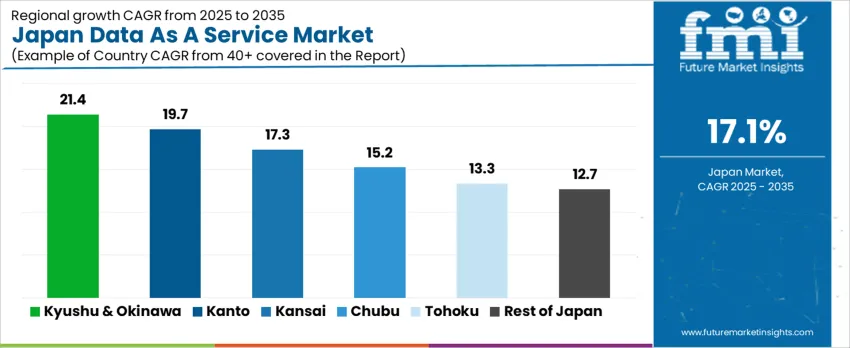
| Region | CAGR (%) |
|---|---|
| Kyushu & Okinawa | 21.4% |
| Kanto | 19.7% |
| Kansai | 17.3% |
| Chubu | 15.2% |
| Tohoku | 13.3% |
| Rest of Japan | 12.7% |
The demand for data as a service in Japan is expanding rapidly across all regions, led by Kyushu & Okinawa at a 21.4% CAGR. Growth in this region is supported by rising cloud adoption among small and mid-sized enterprises, digital transformation of regional industries, and growing use of outsourced data platforms. Kanto follows at 19.7%, driven by large scale enterprise analytics, financial services, technology firms, and smart city initiatives. Kansai records 17.3% growth, supported by manufacturing digitization and commercial data integration. Chubu at 15.2% reflects steady uptake in automotive, industrial, and logistics sectors. Tohoku and Rest of Japan, at 13.3% and 12.7%, show stable growth supported by gradual adoption of cloud based data services across regional enterprises.
How Is Digital Services Expansion Driving DaaS Demand in Kyushu And Okinawa?
Growth across Kyushu and Okinawa reflects a CAGR of 21.4% through 2035 for data as a service demand, supported by rapid cloud migration among regional enterprises, expansion of smart manufacturing programs, and rising adoption of data driven logistics platforms. Automotive components, electronics assembly, and port based trade operations rely on outsourced data feeds for forecasting and operations planning. Regional governments also expand open data programs for transport and disaster management. Demand remains project driven and integration focused, with service adoption tied to digital modernization initiatives across manufacturing clusters and regional infrastructure operators.
- Smart manufacturing drives structured data outsourcing
- Port logistics relies on real time data feeds
- Government open data programs expand usage scope
- Cloud migration supports third party data integration
What Is Sustaining Strong DaaS Adoption Momentum in Kanto?
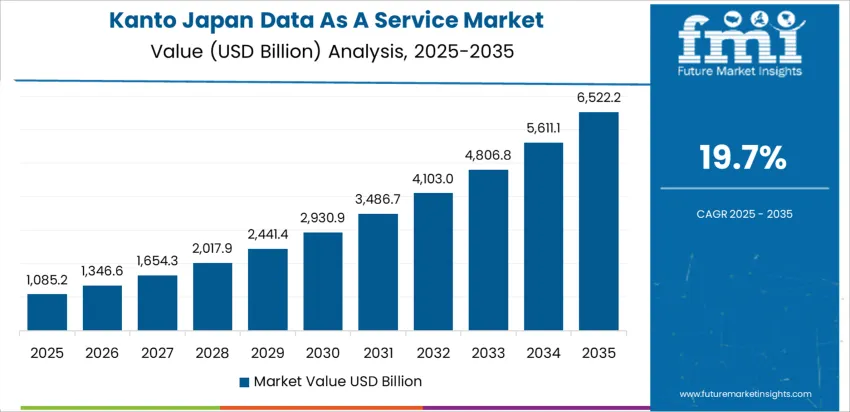
Kanto records a CAGR of 19.7% through 2035 for data as a service demand, supported by dense concentration of financial institutions, digital platforms, and enterprise software users. Banks, insurers, and fintech operators consume large volumes of real time market, customer, and transaction data. Retail chains and ecommerce platforms apply DaaS for pricing analytics and demand forecasting. Artificial intelligence development also increases reliance on external data pipelines. Demand remains scale driven and continuous, shaped by platform based business models and high frequency data consumption across urban digital economy ecosystems.
- Financial services anchor high frequency data usage
- Ecommerce platforms drive analytics based subscriptions
- Artificial intelligence training increases dataset volumes
- Enterprise software integration sustains continuous demand
Why Is Kansai Emerging as a Strong Secondary Hub for DaaS?
Kansai shows a CAGR of 17.3% through 2035 for data as a service demand, driven by manufacturing digitalization, regional supply chain coordination, and growing cybersecurity analytics usage. Electronics, machinery, and consumer goods producers apply external datasets for demand sensing and procurement optimization. Healthcare analytics platforms also expand use of structured data services for population health studies. Regional technology startups build industry specific data products for logistics and production planning. Demand remains operations focused, with steady growth tied to manufacturing optimization and regional business analytics deployment.
- Manufacturing optimization drives structured data purchases
- Healthcare analytics supports secondary adoption growth
- Logistics planning relies on external data feeds
- Regional startups expand vertical specific data services
How Is Industrial Digitization Supporting DaaS Demand in Chubu?
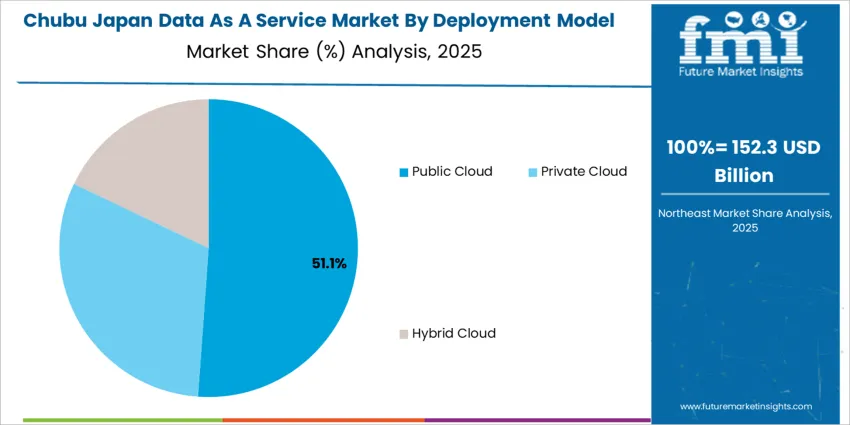
Chubu reflects a CAGR of 15.2% through 2035 for data as a service demand, supported by automotive production analytics, industrial IoT deployment, and smart factory monitoring programs. Tier one suppliers and assembly plants use DaaS for predictive maintenance, quality tracking, and inventory optimization. Energy management and grid monitoring also rely on continuous data streams. Enterprise systems integrate third party datasets into manufacturing execution platforms. Demand remains engineering led and throughput focused, guided by measurable efficiency gains in production planning and asset utilization across large industrial facilities.
- Automotive analytics anchors primary data consumption
- Predictive maintenance supports recurring data streams
- Energy monitoring adds utility sector demand
- Factory execution systems integrate third party datasets
What Is Driving Measured DaaS Growth Across Tohoku?
Tohoku posts a CAGR of 13.3% through 2035 for data as a service demand, shaped by public sector digital transformation, agricultural data adoption, and gradual enterprise cloud usage. Precision farming platforms apply weather, soil, and satellite datasets for yield management. Regional utilities use DaaS for infrastructure monitoring and service planning. Small and mid-sized enterprises adopt data subscriptions at a controlled pace due to budget limits. Demand remains necessity driven and project specific, with adoption paced by government funding cycles and regional industry modernization efforts.
- Precision agriculture supports specialized data demand
- Public infrastructure monitoring uses outsourced datasets
- Budget limits slow enterprise wide adoption
- Government funding drives project based deployments
Why Does the Rest of Japan Show Steady but Lower Velocity DaaS Uptake?
Across the rest of Japan, expansion records a CAGR of 12.7% through 2035 for data as a service demand, supported by retail analytics usage, municipal smart city pilots, and moderate cloud conversion among small enterprises. Data subscriptions focus on consumer behavior, transport planning, and environmental monitoring. Limited digital workforce availability restricts advanced analytics deployment. Regional service providers emphasize standardized data products over customized solutions. Demand remains steady and application specific, guided by gradual enterprise digitization and controlled public sector technology investment across smaller urban and rural markets.
- Retail analytics sustains baseline subscription volumes
- Smart city pilots add localized data usage
- Workforce limitations restrict advanced deployment
- Standardized data products dominate regional offerings
What Is Driving the Demand for Data as a Service (DaaS) in Japan and Who Are the Key Providers Shaping the Market?
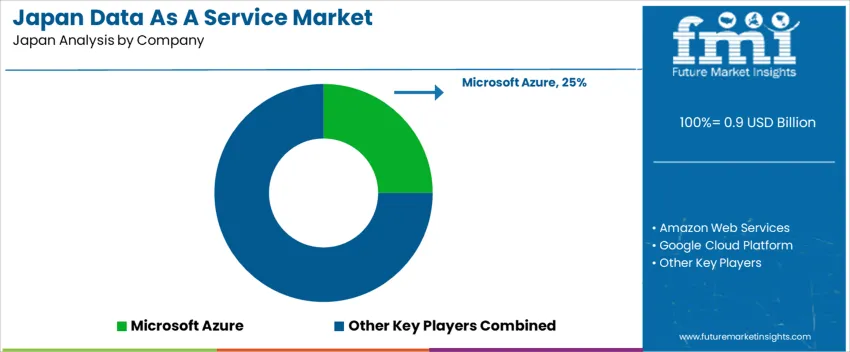
Demand for DaaS in Japan is growing as companies across industries adopt cloud based data strategies to improve agility, reduce infrastructure cost, and gain real time insights. Organizations face rising volumes of structured and unstructured data, from internal operations, IoT, logistics, customer behaviour and compliance records. The combination of remote work, distributed teams and digital transformation increases need for scalable, on demand access to data. Advances in analytics, AI, and big data processing further push firms toward DaaS platforms that can deliver clean, integrated data streams. Domestic investments in data center infrastructure and cloud regulatory compliance encourage Japanese enterprises to trust global cloud providers.
Major providers active in the Japanese DaaS ready market (also shaping uptake in USA and globally) include Microsoft Azure, Amazon Web Services (AWS), Google Cloud Platform (GCP), IBM Cloud and HP Enterprise Services. These firms supply cloud infrastructure, data storage and data delivery platforms, managed data pipelines, APIs and analytics support. Azure, AWS and GCP lead via broad global cloud ecosystems that support scale, security, and advanced analytics integration. IBM Cloud and HP Enterprise Services cater to enterprise customers needing hybrid cloud solutions, compliance, and legacy system integration. Together they enable firms to adopt DaaS without large capital expenditure, helping standardize data access and analytics across sectors.
Key Players in Data as a Service (DaaS) Industry in Japan
- Microsoft Azure
- Amazon Web Services
- Google Cloud Platform
- IBM Cloud
- HP Enterprise Services
Scope of the Report
| Items | Values |
|---|---|
| Quantitative Units (2025) | USD billion |
| Pricing Model | Volume Based Pricing, Data Type-Based Model, Quantity-Based Pricing, Pay-As-Per-Use |
| Deployment Model | Public Cloud, Private Cloud, Hybrid Cloud |
| Region | Kyushu & Okinawa, Kanto, Kansai, Chubu, Tohoku, Rest of Japan |
| Countries Covered | Japan |
| Key Companies Profiled | Microsoft Azure, Amazon Web Services (AWS), Google Cloud Platform (GCP), IBM Cloud, HP Enterprise Services |
| Additional Attributes | Dollar by sales by pricing model, Dollar by sales by deployment model, Dollar by sales by region, Regional CAGR, Cloud adoption trends, Enterprise digital transformation, IoT and manufacturing data consumption, Real-time analytics integration, Smart city and logistics applications, Subscription and API-based data delivery, Regulatory compliance under Japan data protection law, AI and predictive modeling integration, Platform scalability and reliability, Small and mid-sized enterprise uptake, Sector-specific data usage (finance, retail, healthcare, mobility) |
Data as a Service (DaaS) Industry in Japan Segmentation
Pricing Model:
- Volume Based Pricing
- Data Type-Based Model
- Quantity-Based Pricing
- Pay-As-Per-Use
Deployment Model:
- Public Cloud
- Private Cloud
- Hybrid Cloud
Region:
- Kyushu & Okinawa
- Kanto
- Kansai
- Chubu
- Tohoku
- Rest of Japan
Frequently Asked Questions
How big is the demand for data as a service in Japan in 2025?
The demand for data as a service in Japan is estimated to be valued at USD 0.9 billion in 2025.
What will be the size of data as a service in Japan in 2035?
The market size for the data as a service in Japan is projected to reach USD 4.6 billion by 2035.
How much will be the demand for data as a service in Japan growth between 2025 and 2035?
The demand for data as a service in Japan is expected to grow at a 17.1% CAGR between 2025 and 2035.
What are the key product types in the data as a service in Japan?
The key product types in data as a service in Japan are volume‑based pricing, data type-based model, quantity-based pricing and pay-as-per-use.
Which deployment model segment is expected to contribute significant share in the data as a service in Japan in 2025?
In terms of deployment model, public cloud segment is expected to command 50.0% share in the data as a service in Japan in 2025.
Preview the report firsthand - request a free sample
Get SampleGet the brochure for pricing and purchase details.
Get PDFTable of Content
- Executive Summary
- Japan Market Outlook
- Demand-side Trends
- Supply-side Trends
- Technology Roadmap Analysis
- Analysis and Recommendations
- Market Overview
- Market Coverage / Taxonomy
- Market Definition / Scope / Limitations
- Market Background
- Market Dynamics
- Drivers
- Restraints
- Opportunity
- Trends
- Scenario Forecast
- Demand in Optimistic Scenario
- Demand in Likely Scenario
- Demand in Conservative Scenario
- Opportunity Map Analysis
- Product Life Cycle Analysis
- Supply Chain Analysis
- Investment Feasibility Matrix
- Value Chain Analysis
- PESTLE and Porter’s Analysis
- Regulatory Landscape
- Regional Parent Market Outlook
- Production and Consumption Statistics
- Import and Export Statistics
- Market Dynamics
- Japan Market Analysis 2020 to 2024 and Forecast, 2025 to 2035
- Historical Market Size Value (USD Million) Analysis, 2020 to 2024
- Current and Future Market Size Value (USD Million) Projections, 2025 to 2035
- Y-o-Y Growth Trend Analysis
- Absolute $ Opportunity Analysis
- Japan Market Pricing Analysis 2020 to 2024 and Forecast 2025 to 2035
- Japan Market Analysis 2020 to 2024 and Forecast 2025 to 2035, By Pricing Model
- Introduction / Key Findings
- Historical Market Size Value (USD Million) Analysis By Pricing Model , 2020 to 2024
- Current and Future Market Size Value (USD Million) Analysis and Forecast By Pricing Model , 2025 to 2035
- Volume‑Based Pricing
- Data Type-Based Model
- Quantity-Based Pricing
- Pay-As-Per-Use
- Y-o-Y Growth Trend Analysis By Pricing Model , 2020 to 2024
- Absolute $ Opportunity Analysis By Pricing Model , 2025 to 2035
- Japan Market Analysis 2020 to 2024 and Forecast 2025 to 2035, By Deployment Model
- Introduction / Key Findings
- Historical Market Size Value (USD Million) Analysis By Deployment Model, 2020 to 2024
- Current and Future Market Size Value (USD Million) Analysis and Forecast By Deployment Model, 2025 to 2035
- Public Cloud
- Private Cloud
- Hybrid Cloud
- Y-o-Y Growth Trend Analysis By Deployment Model, 2020 to 2024
- Absolute $ Opportunity Analysis By Deployment Model, 2025 to 2035
- Market Structure Analysis
- Competition Dashboard
- Competition Benchmarking
- Market Share Analysis of Top Players
- By Regional
- By Pricing Model
- By Deployment Model
- Competition Analysis
- Competition Deep Dive
- Microsoft Azure
- Overview
- Product Portfolio
- Profitability by Market Segments (Product/Age /Sales Channel/Region)
- Sales Footprint
- Strategy Overview
- Marketing Strategy
- Product Strategy
- Channel Strategy
- Amazon Web Services
- Google Cloud Platform
- IBM Cloud
- HP Enterprise Services
- Microsoft Azure
- Competition Deep Dive
- Assumptions & Acronyms Used
- Research Methodology


