

- Industry Size (2026)
- USD 7.7 Bn
- Forecast (2036)
- USD 55.0 Bn
- CAGR (2026 to 2036)
- 21.7%
Demand for Data As A Service (DaaS) in USA 2025 to 2035
Demand for data as a service in the USA is valued at USD 7.7 billion in 2025 and is projected to reach USD 55.0 billion by 2035, expanding at a CAGR of 21.7%. Growth in demand is being shaped by enterprise dependence on externally sourced, continuously refreshed datasets that support forecasting, risk modeling, personalization, and operational planning. Consumption is being driven by subscription based delivery models as internal data acquisition and maintenance costs continue to rise.
Financial services, retail, healthcare, logistics, and media organizations are prioritizing real time and near real time access to structured, unstructured, and alternative data feeds. API led integration is being treated as a baseline requirement rather than a premium feature. Competitive positioning is being influenced by data accuracy, refresh cadence, lineage transparency, and regulatory readiness. Platform ecosystems supported by Amazon Web Services, Snowflake, and Google Cloud are accelerating commercial deployment. Buyer preference is shifting toward curated, use case focused datasets with predictable pricing and strong governance controls.
Quick Stats for USA Data As A Service (DaaS) Demand
- USA Data As A Service (DaaS) Sales Value (2025): USD 7.7 billion
- USA Data As A Service (DaaS) Forecast Value (2035): USD 55.0 billion
- USA Data As A Service (DaaS) Forecast CAGR (2025 to 2035): 21.7%
- Leading Category in USA Data As A Service (DaaS) Demand: Volume Based Pricing
- Key Growth Regions in USA Data As A Service (DaaS) Demand: West USA, South USA, Northeast USA
- Top Players in USA Data As A Service (DaaS) Demand: Microsoft Azure, Amazon Web Services, Google Cloud Platform, IBM Cloud, Hewlett Packard Enterprise
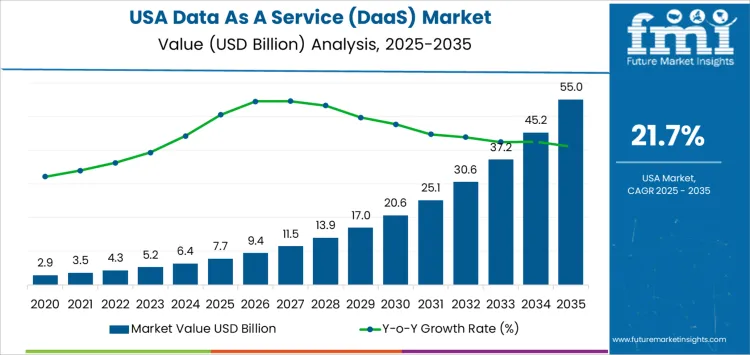
What is the Growth Forecast for Data As A Service (DaaS) Industry in USA through 2035?
Growth contribution for demand for Data as a Service (DaaS) in the United States is concentrated within large enterprises adopting cloud-based data delivery to replace internal storage and analytics systems. Finance, retail, and technology sectors provide the strongest contribution due to high data volume requirements and ongoing digital transformation programs. These industries drive the majority of early forecast-period momentum because they rely on continuous access to real-time data for operational decisions, risk modeling, and customer analytics.
Small and mid-sized organizations increase their contribution over time as subscription-based pricing lowers adoption barriers. Expansion of compliance-related data services in healthcare and government sectors adds steady incremental growth. Public cloud vendors offering integrated data platforms accelerate spending through bundled service models. Structured data initially dominates contribution levels, but growth shifts gradually toward unstructured and external data sources supporting artificial intelligence, cybersecurity, and regulatory reporting. The contribution index shows broadening participation across industries while core enterprise adopters remain the primary revenue drivers. Scalability and integration with advanced analytics maintain sustained influence on the overall demand trajectory.
USA Data As A Service (DaaS) Key Takeaways
| Metric | Value |
|---|---|
| USA Data As A Service (DaaS) Sales Value (2025) | USD 7.7 billion |
| USA Data As A Service (DaaS) Forecast Value (2035) | USD 55.0 billion |
| USA Data As A Service (DaaS) Forecast CAGR (2025-2035) | 21.7% |
Why is the Demand for Data as a Service in the USA Growing?
Demand for Data as a Service in the USA is increasing because organizations require scalable access to structured and unstructured data without expanding internal infrastructure. Businesses in finance, healthcare and retail use cloud based data delivery to support analytics, compliance reporting and real time decision making. Many companies operate hybrid and distributed work environments, so DaaS platforms provide centralized data availability that improves operational continuity across multiple locations.
Growth in digital transformation encourages enterprises to rely on external data providers for industry intelligence, fraud detection and customer behaviour analysis. Cloud service adoption continues to rise, and subscription based data delivery reduces upfront investment while allowing flexible capacity adjustments. Startups and small enterprises benefit from on demand access to specialized datasets that would be costly to collect independently. Constraints include data security concerns, integration complexity with legacy systems and the need for strong governance policies to ensure accuracy and privacy. Some organizations delay adoption until internal teams gain sufficient skills with advanced analytics tools. Variability in data quality and format standards may also influence provider selection and long term USAge in highly regulated sectors.
Which Pricing and Deployment Models Lead Demand for Data-as-a-Service (DaaS) in the USA?
Demand for Data-as-a-Service in the United States is influenced by cloud modernization, accelerated digital transformation, and enterprise-wide use of real-time analytics. Organizations increasingly adopt outsourced data delivery models to reduce infrastructure overhead and improve data accessibility across dispersed teams. Growth is driven by banking, retail, telecom, and public-sector investments in scalable datasets. USA enterprises emphasize API-based delivery, zero-maintenance storage, and secure, compliance-oriented data availability for operational and predictive decision-making.
By Pricing Model, Volume-Based Pricing Holds the Largest Share
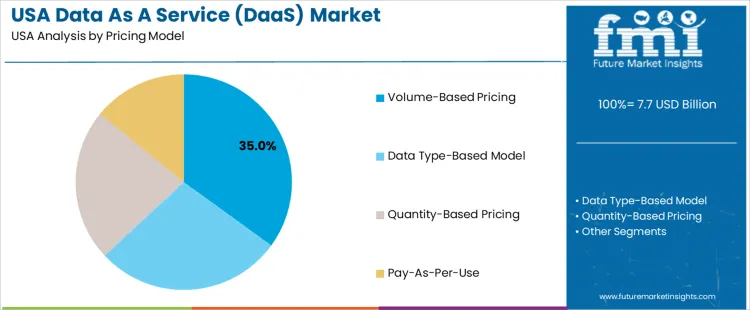
Volume-based pricing represents 35.0%, driven by high consumption enterprises such as e-commerce, BFSI, and digital media where data requirements scale continuously with customer engagement and transaction activities. It enables predictable billing and aligns cost with data throughput. Data-type-based pricing supports organizations purchasing specialized datasets like geospatial or consumer behavior intelligence for targeted analytics use cases. Quantity-based pricing is chosen when storage or record counts define spending caps, enabling tighter procurement control in compliance-heavy sectors. Pay-as-per-use models attract smaller businesses and variable-load applications where cost needs to directly track consumption spikes. Pricing adoption patterns reflect USA enterprise demand for elasticity, transparent billing, and reduced capital expenditure on internal data repositories.
Key Points:
- Volume-based pricing leads due to scalable, predictable enterprise USAge
- Data-type and quantity-based pricing align with specialized data requirements
- Pay-as-use supports agility for small and rapidly growing users
By Deployment Model, Public Cloud Represents the Largest Share
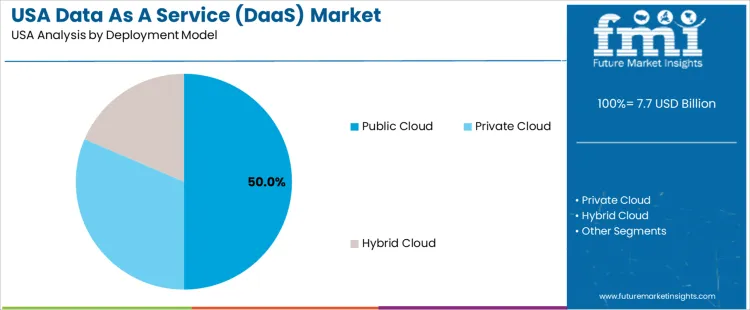
Public cloud deployment accounts for 50.0%, supported by multi-tenant, cost-efficient data delivery and seamless integration with existing SaaS and PaaS ecosystems. It accelerates access to third-party datasets and analytics without hardware ownership. Private cloud remains important across government and regulated industries prioritizing tighter data control and security assurance. Hybrid cloud adoption grows among large enterprises combining legacy data centers with flexible cloud storage to manage sensitive and high-volume data concurrently. USA end users increasingly evaluate cybersecurity maturity, sovereign storage rules, and latency performance when selecting deployment environments. Public cloud leadership reflects its enablement of cross-platform analytics and simplified nationwide deployment across distributed organizations.
Key Points:
- Public cloud dominates due to cost efficiency and interoperability
- Private cloud retains value for compliance and secure environments
- Hybrid models support transition from legacy systems to scalable cloud delivery
What are the Drivers, Restraints, and Key Trends of the Demand for Data as a Service (DaaS) in the USA?
Growth of cloud-first strategies, increased need for real time analytics and expansion of subscription-based data procurement are driving demand.
In the United States, Data as a Service adoption rises as enterprises in retail, healthcare and financial services modernize infrastructure to reduce dependence on legacy on-premise data warehouses. Organizations require real time data feeds to support automated decision making in supply chain optimization, telehealth monitoring and fraud detection. Subscription access to external datasets helps companies respond quickly to fast-changing consumer behavior without building large data-collection operations. Federal and state digital transformation initiatives encourage secure data interoperability across agencies and regulated industries. Startups and mid-sized firms use DaaS platforms to scale analytics without hiring extensive in-house engineering teams. These operational and agility advantages support reliable procurement of cloud-delivered data solutions.
Concerns about data privacy compliance, rising cybersecurity demands and cost unpredictability restrain demand.
Companies handling personal or financial data must ensure compliance with state-level privacy regulations such as CCPA, which increases vendor evaluation efforts and legal review timelines. Continuous data streaming and multi cloud integrations expand the cybersecurity threat surface, leading some enterprises to delay DaaS onboarding until risk mitigation frameworks are established. Subscription pricing tied to consumption can create budget uncertainty, especially for organizations lacking mature USAge forecasting. Legacy system dependencies in healthcare and government agencies also slow full replacement of on-premise analytics environments. These regulatory and operational challenges moderate rapid expansion within highly controlled sectors.
Shift toward industry specific data products, increased alignment with AI training requirements and rising investment in edge enabled data delivery define key trends.
DaaS providers package domain relevant datasets for sectors such as automotive, pharmaceuticals and insurance to reduce cleansing workloads and accelerate deployment. AI developers purchase labeled and governed data that improves model accuracy while supporting auditing requirements. Edge delivery models emerge in manufacturing and logistics where low latency data access supports automation and safety systems. API based data marketplaces grow as enterprises combine internal and external sources for customer intelligence and risk scoring. These developments indicate sustained, scalability driven demand for Data as a Service across the United States digital economy.
Analysis of the Demand for Data as a Service (DaaS) in the USA by Region
Demand for data as a service (DaaS) in the United States continues rising as enterprises shift toward subscription-based access to cloud-managed data sources supporting analytics, governance, and interoperability. Companies reduce legacy storage burdens and accelerate decision cycles by utilizing continuously updated datasets through secured APIs. Broader adoption of artificial intelligence, automation, and multi-cloud architectures increases demand for scalable, real-time data delivery. Vendor selection focuses on compliance frameworks, integration flexibility, latency control, and cost predictability. West USA leads growth at 24.9% CAGR, followed by South USA at 22.3%, Northeast USA at 19.9%, and Midwest USA at 17.3%, reflecting regional data-center presence and digital transformation adoption rates.
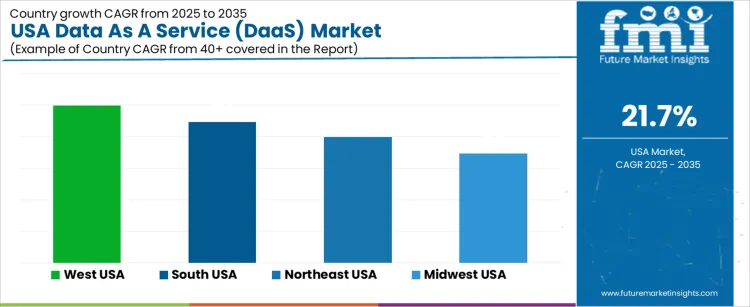
| Region | CAGR (2025-2035) |
|---|---|
| West USA | 24.9% |
| South USA | 22.3% |
| Northeast USA | 19.9% |
| Midwest USA | 17.3% |
How is the West USA driving demand for Data as a Service?
West USA demonstrates 24.9% CAGR, supported by strong cloud-computing ecosystems centered in California and Washington. Technology firms, fintech platforms, and online service providers deploy DaaS models to standardize large-scale data integration across AI-driven products. Enterprises offload data-management workloads to cloud-native companies that deliver reliability and automation without extensive capital expenditure. Regional innovation clusters rely on real-time operational data for improving product analytics and user experience monitoring. Procurement teams value multi-cloud alignment that prevents service dependency risks. Regulatory teams evaluate data-residency controls and encryption standards to maintain customer-trust expectations across distributed systems and subscription platforms.
- Cloud-native corporate base accelerating demand volumes
- AI and analytics requiring real-time data pipelines
- Multi-cloud integration preventing vendor lock-in
- Compliance frameworks reinforcing procurement confidence
How is the South USA shaping DaaS adoption?
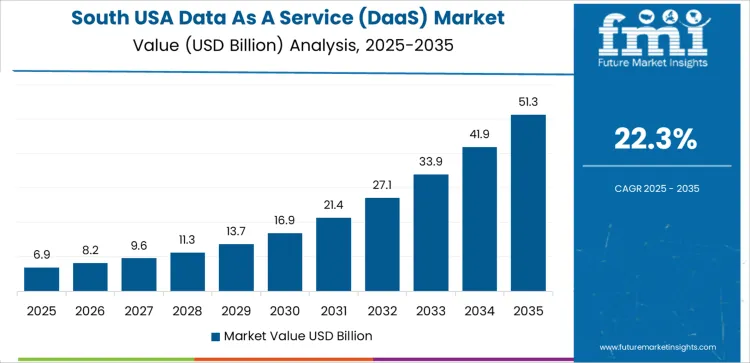
South USA records 22.3% CAGR, driven by expanding digital-infrastructure investments across Texas, Georgia, and Florida. Business-services companies subscribe to curated datasets to support governance, risk scoring, and customer-insights modeling. Retailers and logistics operations utilize DaaS to align inventory forecasting with regional movement patterns. Data-sharing frameworks link health-system networks to improve workflow visibility across growing suburban populations. Procurement emphasizes flexible subscription tiers that scale with peak data-usage events. Technology workforce development initiatives strengthen adoption among mid-size organizations applying DaaS tools for operational modernization.
- Digital-infrastructure growth supporting cloud transitions
- Retail and logistics enterprises expanding use cases
- Healthcare networks improving insight availability
- Subscription scalability encouraging cost-effective adoption
How is the Northeast USA influencing enterprise use?
Northeast USA posts 19.9% CAGR, influenced by financial-services, insurance, and pharmaceutical industries located in New York, New Jersey, and Massachusetts. Organizations manage regulated datasets requiring strong encryption, identity governance, and audit-readiness capabilities integrated into subscription models. Risk-analysis teams rely on external data feeds for compliance decisioning and fraud detection. Advanced-research sectors deploy DaaS to unify clinical and laboratory data for accelerated analysis cycles. Distributed office presence creates demand for standardized data access across collaborative networks. Vendor evaluations emphasize resilience certifications, secure API frameworks, and interoperability with enterprise resource systems.
- Regulated industries driving secure data-delivery needs
- Fraud-modeling and compliance analytics benefiting from external feeds
- R&D programs leveraging faster data coordination
- Interoperability expectations shaping procurement standards
How is the Midwest USA contributing to national growth?
Midwest USA expands at 17.3% CAGR, reflecting digital transformation among manufacturing companies, healthcare systems, and financial cooperatives across Illinois, Ohio, and Michigan. Industrial operators subscribe to DaaS pipelines that connect production data with predictive-maintenance analytics. Hospitals integrate third-party datasets into population-health models to strengthen care-coordination goals. Regional banks apply DaaS services for credit-risk insights that support lending-decision efficiency. Procurement focuses on predictable subscription costs, minimal on-premise complexity, and supplier-supported onboarding. Workforce skilling initiatives help accelerate USAge beyond basic reporting toward automation-aligned capabilities.
- Industrial and healthcare networks adopting integrated datasets
- Risk-intelligence tools improving lending workflows
- Predictable subscription pricing guiding budgeting
- Vendor onboarding support enabling operational expansion
What does the competitive landscape for Data-as-a-Service (DaaS) demand in the United States look like?
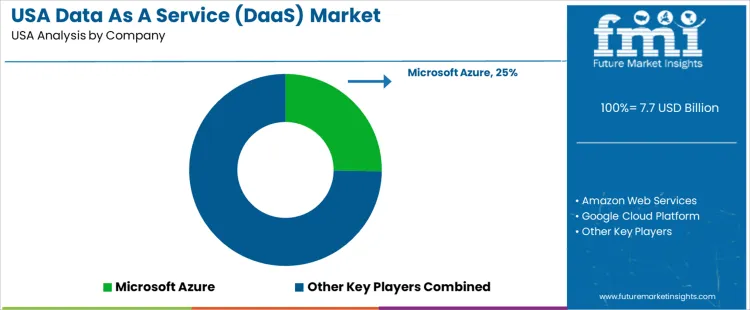
Data-as-a-Service in the United States supports enterprise analytics, artificial intelligence deployment, multi-cloud migration, and real-time operational intelligence. Organizations rely on external data platforms to reduce infrastructure complexity, expand access to governed datasets, and accelerate insight generation across large business units. Buyers prioritize integration with existing cloud strategies, standardized security frameworks, and compliance readiness for regulated sectors such as healthcare, finance, and public services. Microsoft Azure maintains a leading position, driven by widespread enterprise adoption of managed data services aligned with established cloud ecosystems.
Amazon Web Services maintains strong participation through scalable storage, analytics, and managed data-exchange services used in high-growth technology sectors. Google Cloud Platform focuses on AI-ready data architecture, serving customers that prioritize advanced analytics and open-source alignment. IBM Cloud addresses demand in highly regulated sectors with data-security frameworks embedded into hybrid-cloud deployments. Hewlett Packard Enterprise (HPE) supports organizations maintaining on-premises and edge computing environments that require cloud-style data consumption without full migration to public providers. Competitive positioning in the United States depends on workload performance, multi-cloud data portability, governance automation, and continued availability of managed services that reduce operational burden while supporting enterprise-scale data accessibility.
Key Players in USA Data As A Service (DaaS) Demand
- Microsoft Azure
- Amazon Web Services
- Google Cloud Platform
- IBM Cloud
- Hewlett Packard Enterprise Services
Scope of the Report
| Items | Values |
|---|---|
| Quantitative Units | USD billion |
| Pricing Model | Volume-Based Pricing, Data Type-Based Model, Quantity-Based Pricing, Pay-As-Per-Use |
| Deployment Model | Public Cloud, Private Cloud, Hybrid Cloud |
| Regions Covered | West USA, South USA, Northeast USA, Midwest USA |
| Key Companies Profiled | Microsoft Azure, Amazon Web Services, Google Cloud Platform, IBM Cloud, Hewlett Packard Enterprise Services |
| Additional Attributes | Dollar sales by pricing model and deployment model; enterprise cloud adoption maturity and data monetization trends; regional demand influenced by digital transformation and IT modernization; integration with analytics, AI/ML, and real-time intelligence platforms; competitive differentiation through data security compliance, latency performance, scalable storage, and API-based data delivery for USA-based corporations and service providers. |
USA Data As A Service (DaaS) Demand by Segments
Pricing Model:
- Volume‑Based Pricing
- Data Type-Based Model
- Quantity-Based Pricing
- Pay-As-Per-Use
Deployment Model:
- Public Cloud
- Private Cloud
- Hybrid Cloud
Region:
- West USA
- South USA
- Northeast USA
- Midwest USA
Frequently Asked Questions
How big is the demand for data as a service (DaaS) in USA in 2025?
The demand for data as a service (DaaS) in USA is estimated to be valued at USD 7.7 billion in 2025.
What will be the size of data as a service (DaaS) in USA in 2035?
The market size for the data as a service (DaaS) in USA is projected to reach USD 55.0 billion by 2035.
How much will be the demand for data as a service (DaaS) in USA growth between 2025 and 2035?
The demand for data as a service (DaaS) in USA is expected to grow at a 21.7% CAGR between 2025 and 2035.
What are the key product types in the data as a service (DaaS) in USA?
The key product types in data as a service (DaaS) in USA are volume‑based pricing, data type-based model, quantity-based pricing and pay-as-per-use.
Which deployment model segment is expected to contribute significant share in the data as a service (DaaS) in USA in 2025?
In terms of deployment model, public cloud segment is expected to command 50.0% share in the data as a service (DaaS) in USA in 2025.
Preview the report firsthand - request a free sample
Get SampleGet the brochure for pricing and purchase details.
Get PDFTable of Content
- Executive Summary
- USA Market Outlook
- Demand-side Trends
- Supply-side Trends
- Technology Roadmap Analysis
- Analysis and Recommendations
- Market Overview
- Market Coverage / Taxonomy
- Market Definition / Scope / Limitations
- Market Background
- Market Dynamics
- Drivers
- Restraints
- Opportunity
- Trends
- Scenario Forecast
- Demand in Optimistic Scenario
- Demand in Likely Scenario
- Demand in Conservative Scenario
- Opportunity Map Analysis
- Product Life Cycle Analysis
- Supply Chain Analysis
- Investment Feasibility Matrix
- Value Chain Analysis
- PESTLE and Porter’s Analysis
- Regulatory Landscape
- Regional Parent Market Outlook
- Production and Consumption Statistics
- Import and Export Statistics
- Market Dynamics
- USA Market Analysis 2020 to 2024 and Forecast, 2025 to 2035
- Historical Market Size Value (USD Million) Analysis, 2020 to 2024
- Current and Future Market Size Value (USD Million) Projections, 2025 to 2035
- Y-o-Y Growth Trend Analysis
- Absolute $ Opportunity Analysis
- USA Market Pricing Analysis 2020 to 2024 and Forecast 2025 to 2035
- USA Market Analysis 2020 to 2024 and Forecast 2025 to 2035, By Pricing Model
- Introduction / Key Findings
- Historical Market Size Value (USD Million) Analysis By Pricing Model , 2020 to 2024
- Current and Future Market Size Value (USD Million) Analysis and Forecast By Pricing Model , 2025 to 2035
- Volume‑Based Pricing
- Data Type-Based Model
- Quantity-Based Pricing
- Pay-As-Per-Use
- Y-o-Y Growth Trend Analysis By Pricing Model , 2020 to 2024
- Absolute $ Opportunity Analysis By Pricing Model , 2025 to 2035
- USA Market Analysis 2020 to 2024 and Forecast 2025 to 2035, By Deployment Model
- Introduction / Key Findings
- Historical Market Size Value (USD Million) Analysis By Deployment Model, 2020 to 2024
- Current and Future Market Size Value (USD Million) Analysis and Forecast By Deployment Model, 2025 to 2035
- Public Cloud
- Private Cloud
- Hybrid Cloud
- Y-o-Y Growth Trend Analysis By Deployment Model, 2020 to 2024
- Absolute $ Opportunity Analysis By Deployment Model, 2025 to 2035
- Market Structure Analysis
- Competition Dashboard
- Competition Benchmarking
- Market Share Analysis of Top Players
- By Regional
- By Pricing Model
- By Deployment Model
- Competition Analysis
- Competition Deep Dive
- Microsoft Azure
- Overview
- Product Portfolio
- Profitability by Market Segments (Product/Age /Sales Channel/Region)
- Sales Footprint
- Strategy Overview
- Marketing Strategy
- Product Strategy
- Channel Strategy
- Amazon Web Services
- Google Cloud Platform
- IBM Cloud
- HP Enterprise Services
- Microsoft Azure
- Competition Deep Dive
- Assumptions & Acronyms Used
- Research Methodology


