

- Market Size (2026)
- USD 512.9 Mn
- Forecast (2036)
- USD 999.6 Mn
- CAGR (2026 to 2036)
- 6.9%
How big is Keto-Analogue Nutrition Products Market in 2026?
USD 512.9 Million in 2026 and USD 999.6 Million by 2036 at a 6.9% CAGR.
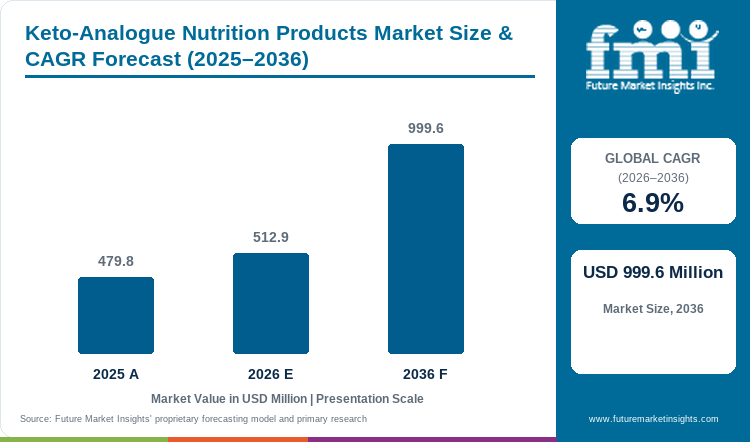
Sales of keto-analogue nutrition products are estimated to grow at a 6.9% CAGR from USD 512.9 million in 2026 to USD 999.6 million by 2036. The market was valued at USD 479.8 million in 2025. Demand comes mainly from non-dialysis CKD care, where these products are used alongside protein-restricted diets under specialist supervision. That gives the category a repeat-use model, but only when patients can keep up with both the diet and the dosing routine.
Growth does not follow the same path in every country. The market depends on how patients enter renal care, how nutrition is managed, and whether the product remains practical once treatment moves back home. Keto-analogue products sit within the wider clinical nutrition market, but they address a much narrower use case tied to CKD stage, dietary management, and specialist oversight.
Key Takeaways
- The market is projected to rise from USD 479.8 Million in 2025 to USD 512.9 Million in 2026 and USD 999.6 Million by 2036 at a 6.9% CAGR.
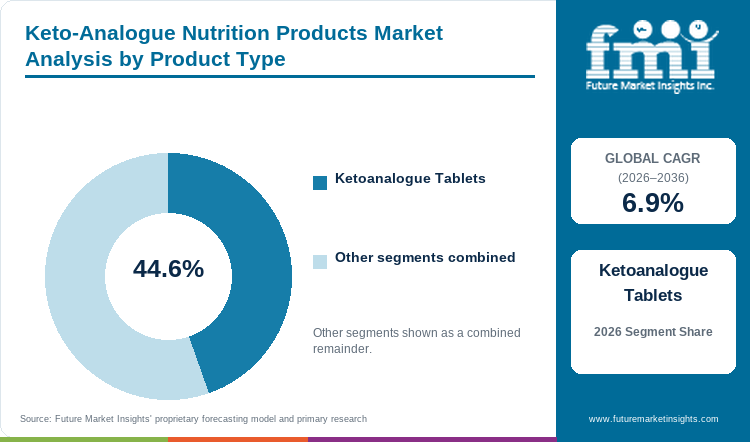
- Ketoanalogue Tablets lead Product Type with 44.6% share in 2026 because standardized oral dosing fits pharmacy dispensing and long-term home use.
- CKD Stage 3b-4 (Delaying Dialysis) accounts for 47.0% of Indication revenue, while Very-Low-Protein Diet leads Diet Pairing with 53.8% share.
- Homecare represents 53.9% of End User revenue and Hospital Pharmacy holds 47.5% of Sales Channel revenue, reflecting specialist initiation followed by daily management outside the hospital.
- Country forecasts range from 5.2% CAGR in Japan to 7.3% in South Korea. Pill burden and the difficulty of maintaining a restrictive diet remain important limits on persistence.
- Fresenius Kabi, Alniche Life Sciences, Rivpra Formulation, Conical Pharmaceuticals, Nilsan Pharmaceuticals, and NephLong are notable participants across branded therapy, multi-format formulations, manufacturing, and specialist nutrition.
Analyst Perspective
“Keto-analogue growth depends on whether patients can stay with the regimen. The product may enter the pathway through a nephrologist, but repeat demand is decided at home, where the patient has to manage both the protein target and the daily dose. Formats that reduce that burden can improve persistence without changing the clinical use case.”
- Anurag Sharma, Principal Consultant, Future Market Insights
How is the keto-analogue nutrition products market segmented?
Product Type, Indication, Diet Pairing, End User, Sales Channel, and Region
The Keto-Analogue Nutrition Products Market is segmented by Product Type into Ketoanalogue Tablets, Ketoanalogue + Low-Protein Food Bundles, Amino Acid / KA Blends, and Others. By Indication, the market covers CKD Stage 3b-4 (Delaying Dialysis), CKD Stage 5 (Non-Dialysis), and Others. Diet Pairing includes Very-Low-Protein Diet, Low-Protein Diet, and Others. End User includes Homecare, Nephrology Clinics & Hospitals, and Others. Sales Channel covers Hospital Pharmacy, Retail Pharmacy, Online, Institutional Tender, and Others. Regional analysis covers North America, Latin America, Western Europe, Eastern Europe, East Asia, South Asia & Pacific, and Middle East & Africa.
Why do Ketoanalogue Tablets lead demand within the Product Type category?
Ketoanalogue Tablets work well in a structured CKD nutrition plan because the dose is separate from the patient’s everyday food. Clinicians can adjust the diet without changing the finished product, while pharmacies can dispense the same standardized format over long periods. The weakness is pill burden. When several tablets are needed around meals, dosage strength and ease of use become part of the product’s commercial value.
- Ketoanalogue Tablets account for 44.6% of Product Type revenue in 2026.
- Fresenius Kabi markets Ketosteril as an oral ketoanalogue product for CKD use alongside a protein-restricted diet in the pre-dialysis period.
Why does CKD Stage 3b-4 (Delaying Dialysis) lead demand within the Indication category?
CKD Stage 3b-4 (Delaying Dialysis) leads because it sits in the period when conservative care still has room to shape the patient’s routine before dialysis begins. Keto-analogue products have a clearer role here as part of a diet-plus-product plan. The segment converts into repeat sales only when patients can maintain the prescribed eating pattern and continue the oral regimen over time.
- CKD Stage 3b-4 (Delaying Dialysis) represents 47.0% of Indication revenue in 2026.
- The segment’s commercial value comes from repeat use during a defined pre-dialysis care period rather than from the full CKD population.
Why does Very-Low-Protein Diet lead demand within the Diet Pairing category?
Very-Low-Protein Diet is the pairing where the role of ketoanalogues is most distinct. The diet reduces intact protein intake, while ketoanalogue products provide nitrogen-free precursors of selected essential amino acids. That is different from the broader amino acids market, where the product is usually bought for a different nutrition purpose.
- Very-Low-Protein Diet accounts for 53.8% of Diet Pairing revenue in 2026.
- Repeat demand depends on whether patients can stay with both the prescribed diet and the product routine.
Why does Homecare lead demand within the End User category?
Homecare leads because most of the work happens between clinic visits. Patients or caregivers manage meals and oral dosing day after day, while the clinical team reviews progress periodically. This is different from the enteral nutrition market, where feeding equipment and formula delivery can become part of the care setup. In keto-analogue use, the bigger challenge is keeping a simple oral routine workable for months rather than days.
- Homecare accounts for 53.9% of End User revenue in 2026.
- Replenishment frequency, swallowing convenience, and the patient’s ability to maintain the prescribed routine directly affect repeat use.
Why does Hospital Pharmacy lead demand within the Sales Channel category?
Hospital Pharmacy matters because treatment often starts close to nephrology services, where the patient’s diet and product plan are first set. Formularies and procurement decisions can influence which brand is available at that point. Even when later purchases move to retail or home channels, the hospital can still shape the product that becomes part of the patient’s routine.
- Hospital Pharmacy accounts for 47.5% of Sales Channel revenue in 2026.
- Fresenius reported in 2025 that volume-based procurement for Ketosteril in China affected its Nutrition business, showing how institutional purchasing can alter product economics.
What are the drivers, restraints and opportunities in the Keto-Analogue Nutrition Products Market?
Specialist pre-dialysis use supports recurring demand, regimen burden limits persistence, and lower-burden dosage forms create room for suppliers to improve long-term home use.
- Driver: A defined pre-dialysis nutrition pathway creates repeat demand when selected CKD patients continue a specialist-managed diet and keto-analogue regimen.
- Restraint: Repeated dosing and restrictive eating patterns can reduce the number of patients who sustain the regimen.
- Opportunity: Higher-strength tablets, sachets, powders, and oral liquids can reduce practical dosing friction while keeping use inside a specialist-managed care pathway.
Demand starts when dietary management becomes a defined protein-restriction program supported by a keto-analogue product. Because the product is taken with daily meals, the purchase can repeat for as long as the regimen continues. The commercial opportunity is therefore tied to persistence, not simply to the number of people diagnosed with CKD.
The harder part begins after treatment starts. Patients may have to manage several tablets around meals while also changing long-standing food habits. If the routine becomes difficult to follow, repeat use can fall even when the product remains available. That makes day-to-day usability a real competitive issue rather than a minor product feature.
The clearest opportunity is to make the regimen easier without changing the clinical use case. Double-strength tablets can cut pill count, while sachets, powders, and liquids can help patients who struggle with repeated tablets. This is similar to the broader medical nutrition market, where the value of a product often depends on whether people can keep using it outside the clinic.
Which country CAGRs are profiled in the Keto-Analogue Nutrition Products Market?
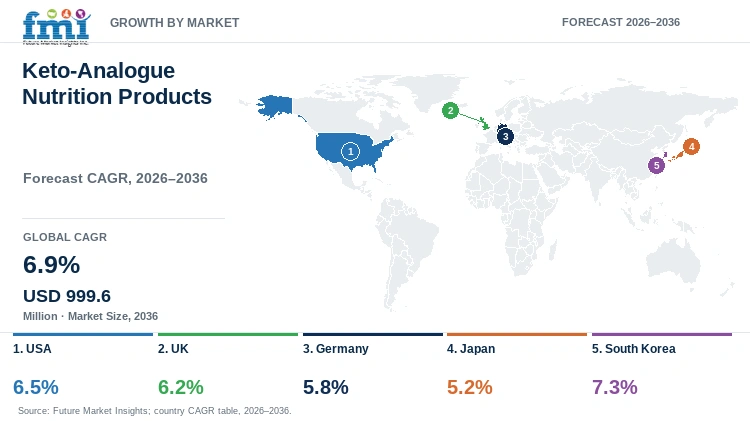
| Country | CAGR |
|---|---|
| USA | 6.5% |
| UK | 6.2% |
| Germany | 5.8% |
| Japan | 5.2% |
| South Korea | 7.3% |
How do country-level CAGRs compare in the Keto-Analogue Nutrition Products Market?
The five profiled countries span 2.1 percentage points, from 5.2% CAGR in Japan to 7.3% in South Korea. USA is projected at 6.5%, followed by the UK at 6.2% and Germany at 5.8%. The difference is not just about market size. It also reflects how early patients enter renal care, how specialist nutrition is organized, and how easily a product can move from initiation to repeat home use.
- South Korea is 0.8 percentage points above USA. Early-diagnosis activity in 2026 has increased attention on identifying CKD before kidney failure, which can lengthen the period in which patients are evaluated for conservative care.
- USA is 0.3 percentage points above UK. The market includes a physician-supervised medical-food route alongside conventional finished keto-analogue products, giving suppliers more than one route into long-term home use.
- UK is 0.4 percentage points above Germany. Specialist dietetic care has a defined role within the kidney-care workforce, making access to renal nutrition expertise important for product conversion.
- Germany is 0.6 percentage points above Japan. A large CKD population exists alongside a much smaller dialysis population, so the commercially relevant opportunity for keto-analogue products remains concentrated in the pre-dialysis group.
- Japan is projected at 5.2%. The national dietary framework includes a dedicated CKD section, keeping renal nutrition inside a structured diet-management system.
Country-wise Analysis
- USA: Demand is projected to expand at 6.5% CAGR from 2026 to 2036. The market supports both conventional finished formulations and physician-supervised specialist nutrition models. NephLong’s medical-food route shows how ketoanalogues can sit inside an ongoing nutrition plan rather than a general supplement purchase. The commercial challenge is keeping that plan intact as care shifts from specialist initiation to routine home use.
- UK: Sales are forecast to rise at 6.2% CAGR from 2026 to 2036. Specialist kidney care gives dietetics a clear place alongside pharmacy, nursing, and other clinical roles. For suppliers, that makes the connection between nephrology and dietetic care more important than broad retail visibility.
- Germany: Demand is projected to grow at 5.8% CAGR from 2026 to 2036. Germany has a large CKD population, but keto-analogue products address only the smaller group managed before dialysis with a defined diet-plus-product regimen. The opportunity is therefore concentrated rather than population-wide.
- Japan: The market is forecast to grow at 5.2% CAGR from 2026 to 2036. Renal nutrition sits within a formal dietary framework, so keto-analogue products have to fit into structured diet management rather than compete as general nutrition products. That keeps the market closely tied to supervised use.
- South Korea: Demand is projected to rise at 7.3% CAGR from 2026 to 2036. Early-diagnosis activity has put more attention on identifying CKD before kidney failure. That can widen the window for conservative nutrition management, although product use still depends on specialist direction.
Who are the notable companies in the Keto-Analogue Nutrition Products Market?
Fresenius Kabi, Alniche Life Sciences, Rivpra Formulation, Conical Pharmaceuticals, Nilsan Pharmaceuticals, and NephLong are notable participants in the Keto-Analogue Nutrition Products Market.
Competition is about making the regimen workable, not simply offering another tablet. Fresenius Kabi anchors the category with Ketosteril, while Alniche Life Sciences adds standard and double-strength formats. Rivpra Formulation competes across tablets, powder, and oral suspension. Conical Pharmaceuticals and Nilsan Pharmaceuticals participate through finished formulations, and NephLong uses a physician-supervised medical-food model in the USA. Upstream formulation still connects the category with the specialty amino acids market, but finished-product competition is decided much closer to the patient through dosing, prescribing, and dispensing.
- Branded CKD therapy: Fresenius Kabi and Alniche Life Sciences compete through named keto-analogue products designed for use with protein-restricted CKD management.
- Multi-format formulation: Rivpra Formulation offers tablet, powder, and oral suspension routes that address different administration needs.
- Specialist supply models: Conical Pharmaceuticals, Nilsan Pharmaceuticals, and NephLong participate through finished formulations, manufacturing channels, or physician-supervised nutrition.
Competitive Benchmarking: Keto-Analogue Nutrition Products Market
| Company | Direct Keto-Analogue Product | Dosage-Form Breadth | Diet-Protocol Integration | Geographic / Channel Reach |
|---|---|---|---|---|
| Fresenius Kabi | High | Medium | High | High |
| Alniche Life Sciences | High | High | High | Medium |
| Rivpra Formulation | High | High | High | High |
| Conical Pharmaceuticals | High | Medium | Medium | Medium |
| Nilsan Pharmaceuticals | High | Medium | Medium | Low |
| NephLong | High | Medium | High | Medium |
Scoring basis: Direct Keto-Analogue Product reflects a marketed finished product containing ketoanalogues for CKD-related nutrition. Dosage-Form Breadth reflects the range of finished formats offered. Diet-Protocol Integration reflects explicit positioning with protein-restricted or physician-supervised nutrition. Geographic / Channel Reach reflects documented access through multiple markets, institutional routes, or specialist channels. High indicates broad documented capability, Medium indicates narrower capability, and Low indicates a more limited footprint.
Key Developments in the Keto-Analogue Nutrition Products Market
- In August 2025, Fresenius reported that volume-based procurement for Ketosteril in China affected Nutrition revenue and operating performance, showing the commercial impact institutional tenders can have on an established keto-analogue product.
- In October 2025, India’s CDSCO renal expert committee asked Stanford Laboratories to submit a multicenter Phase III trial protocol for a proposed alpha-ketoanalogue formulation after declining a clinical-trial waiver.
- In 2026, Rivpra Formulation promoted alpha ketoanalogue oral suspension alongside tablet and powder formats, expanding dosage-form choice for patients facing high tablet burden or swallowing difficulty.
Key Players in the Keto-Analogue Nutrition Products Market
Branded CKD Keto-Analogue Therapies
- Fresenius Kabi
- Alniche Life Sciences
Multi-Format and Contract Formulation
- Rivpra Formulation
- Conical Pharmaceuticals
- Nilsan Pharmaceuticals
Medical Food and Specialist Nutrition
- NephLong
Keto-Analogue Nutrition Products Market - Report Scope
| Coverage field | Report scope |
|---|---|
| Market breakdown | By Product Type, Indication, Diet Pairing, End User, Sales Channel, and Region |
| Quantitative Units | USD Million |
| Market Definition | Revenue from finished keto-analogue nutrition products sold for non-dialysis CKD within the listed segments. Scope includes standalone tablets, keto-analogue plus low-protein food bundles, and amino acid / keto-analogue blends when the keto-analogue offer is the sold unit. It excludes general renal formulas, dialysis nutrition, isolated API sales, and low-protein foods sold without a keto-analogue component. |
| Regions Covered | North America; Latin America; Western Europe; Eastern Europe; East Asia; South Asia & Pacific; Middle East & Africa |
| Countries Covered | USA, UK, Germany, Japan, South Korea, and more than twenty-five additional countries in the full report |
| Key Companies Profiled | Fresenius Kabi, Alniche Life Sciences, Rivpra Formulation, Conical Pharmaceuticals, Nilsan Pharmaceuticals, NephLong |
| Forecast Period | 2026 to 2036 |
| Approach | FMI applies a hybrid bottom-up and top-down sizing approach using product revenue, channel structure, clinical-use conditions, and country adoption patterns. |
Keto-Analogue Nutrition Products Market - Research Methodology
| Method | Approach |
|---|---|
| Primary Research | FMI engages nephrology product managers, pharmacists, distributors, renal dietitians, hospital procurement teams, and other market participants. Discussions examine prescribing workflow, dosing burden, channel economics, tender access, and repeat use. |
| Desk Research | The review covers regulator decisions, procurement information, company product documentation, health-system developments, and first-party business disclosures relevant to keto-analogue use. |
| Market Sizing and Forecasting | A hybrid model combines product-level revenue with segment mix, channel structure, country conditions, and adoption patterns. The model distinguishes clinically eligible pre-dialysis use from the wider CKD population. |
| Data Validation | Findings are cross-checked across independent source types. Adjacent renal nutrition, isolated API sales, dialysis nutrition, and duplicated revenue are excluded from the market boundary. |
Keto-Analogue Nutrition Products Market by Segments
Keto-Analogue Nutrition Products Market segmented by Product Type:
- Ketoanalogue Tablets
- Ketoanalogue + Low-Protein Food Bundles
- Amino Acid / KA Blends
- Others
Keto-Analogue Nutrition Products Market segmented by Indication:
- CKD Stage 3b-4 (Delaying Dialysis)
- CKD Stage 5 (Non-Dialysis)
- Others
Keto-Analogue Nutrition Products Market segmented by Diet Pairing:
- Very-Low-Protein Diet
- Low-Protein Diet
- Others
Keto-Analogue Nutrition Products Market segmented by End User:
- Homecare
- Nephrology Clinics & Hospitals
- Others
Keto-Analogue Nutrition Products Market segmented by Sales Channel:
- Hospital Pharmacy
- Retail Pharmacy
- Online
- Institutional Tender
- Others
Keto-Analogue Nutrition Products Market by Region
- North America
- United States
- Canada
- Latin America
- Brazil
- Mexico
- Argentina
- Chile
- Western Europe
- Germany
- France
- United Kingdom
- Italy
- Spain
- Benelux
- Nordics
- Eastern Europe
- Poland
- Czech Republic
- Romania
- Hungary
- East Asia
- China
- Japan
- South Korea
- South Asia & Pacific
- India
- ASEAN
- Australia and New Zealand
- Middle East & Africa
- GCC Countries
- South Africa
- Turkiye
- Israel
Research Sources and Bibliography
- Kidney Disease: Improving Global Outcomes (KDIGO). (2024). KDIGO 2024 Clinical Practice Guideline for the Evaluation and Management of Chronic Kidney Disease.
- National Kidney Foundation and Academy of Nutrition and Dietetics. (2020). KDOQI Clinical Practice Guideline for Nutrition in Chronic Kidney Disease: 2020 Update.
- Fresenius. (2025). Annual Report 2025.
- Fresenius Kabi. Ketosteril Product Information.
- Central Drugs Standard Control Organisation (CDSCO). (2025, October 14). Recommendations of the SEC (Renal) made in its 10th/25 Meeting.
- Alniche Life Sciences. Ketoalfa: Alpha Ketoanalogues Product Information.
- Alniche Life Sciences. KETOALFA-DS: Alpha Ketoanalogues Product Information.
- Rivpra Formulation Pvt. Ltd. Alpha Ketoanalogue Product Portfolio: Tablets, Powder and Oral Suspension.
- Conical Pharmaceuticals. Alpha Ketoanalogue Tablet (Keto-CKD) Product Information.
- Nilsan Pharmaceuticals Pvt. Ltd. Alpha Ketoanalogues & Essential Amino Acids Tablets (Alpha-Ketalogue) Product Information.
- NephLong. Keto Nephron: Alpha-Ketoanalogue Medical Food for CKD Stages 3-5.
- Kidney Care UK. (2024). How Can a Kidney Dietitian Help Me?
- Japanese Society of Nephrology. (2024). CKD Clinical Practice Guide 2024.
This Report Answers
- What is the Keto-Analogue Nutrition Products Market size in 2026 and 2036?
- Why do Ketoanalogue Tablets lead the Product Type category?
- Why does CKD Stage 3b-4 (Delaying Dialysis) account for 47.0% of Indication revenue?
- Why does Very-Low-Protein Diet account for 53.8% of Diet Pairing revenue?
- Why does Homecare represent 53.9% of End User revenue?
- How does Hospital Pharmacy shape access to keto-analogue products?
- How do growth rates differ across USA, UK, Germany, Japan and South Korea?
- Which companies compete through branded products, dosage-form breadth, and specialist nutrition models?
Frequently Asked Questions
What is driving growth in the Keto-Analogue Nutrition Products Market?
Growth comes from repeat use within specialist-managed, non-dialysis CKD nutrition programs. Demand becomes recurring when a patient stays on the protein-restricted diet and continues the keto-analogue regimen at home.
Who are the key players in the Keto-Analogue Nutrition Products Market?
Notable companies include Fresenius Kabi, Alniche Life Sciences, Rivpra Formulation, Conical Pharmaceuticals, Nilsan Pharmaceuticals, and NephLong. Their positions differ by product format, diet integration, manufacturing role, and route to the patient.
What notable restraint affects the Keto-Analogue Nutrition Products Market?
Persistence is the main restraint. Repeated dosing and a restrictive dietary routine can be difficult to maintain, which can reduce repeat use even after a product has entered the care pathway.
Why should executives track the Keto-Analogue Nutrition Products Market?
The category combines a repeat-use product model with a tightly defined pre-dialysis pathway. Revenue depends on whether manufacturers can make dosing and access easier without pushing the product beyond its specialist nutrition use case.
What business problem does the Keto-Analogue Nutrition Products Market address?
Keto-analogue products support nutrition plans in which selected non-dialysis CKD patients reduce intact dietary protein while using a finished product designed to work with that diet.
What should nephrology procurement and clinical nutrition teams evaluate?
Teams should assess product composition, daily dose burden, intended diet pairing, patient suitability, dispensing route, and whether the routine can be maintained at home.
Preview the report firsthand - request a free sample
Get SampleGet the brochure for pricing and purchase details.
Get PDFTable of Content
- How big is Keto-Analogue Nutrition Products Market in 2026?
- Key Takeaways
- Analyst Perspective
- How is the keto-analogue nutrition products market segmented?
- Why do Ketoanalogue Tablets lead demand within the Product Type category?
- Why does CKD Stage 3b-4 (Delaying Dialysis) lead demand within the Indication category?
- Why does Very-Low-Protein Diet lead demand within the Diet Pairing category?
- Why does Homecare lead demand within the End User category?
- Why does Hospital Pharmacy lead demand within the Sales Channel category?
- What are the drivers, restraints and opportunities in the Keto-Analogue Nutrition Products Market?
- Which country CAGRs are profiled in the Keto-Analogue Nutrition Products Market?
- How do country-level CAGRs compare in the Keto-Analogue Nutrition Products Market?
- Who are the notable companies in the Keto-Analogue Nutrition Products Market?
- Competitive Benchmarking: Keto-Analogue Nutrition Products Market
- Key Developments in the Keto-Analogue Nutrition Products Market
- Key Players in the Keto-Analogue Nutrition Products Market
- Branded CKD Keto-Analogue Therapies
- Multi-Format and Contract Formulation
- Medical Food and Specialist Nutrition
- Keto-Analogue Nutrition Products Market - Report Scope
- Keto-Analogue Nutrition Products Market - Research Methodology
- Keto-Analogue Nutrition Products Market by Segments
- Keto-Analogue Nutrition Products Market segmented by Product Type:
- Keto-Analogue Nutrition Products Market segmented by Indication:
- Keto-Analogue Nutrition Products Market segmented by Diet Pairing:
- Keto-Analogue Nutrition Products Market segmented by End User:
- Keto-Analogue Nutrition Products Market segmented by Sales Channel:
- Keto-Analogue Nutrition Products Market by Region
- Research Sources and Bibliography
- This Report Answers
- Frequently Asked Questions
- Competitive Landscape


