

- Market Size (2026)
- USD 7.6 Bn
- Forecast (2036)
- USD 18.0 Bn
- CAGR (2026 to 2036)
- 9.0%
How big is Lab Automation & Specimen-Handling Robotics Market in 2026?
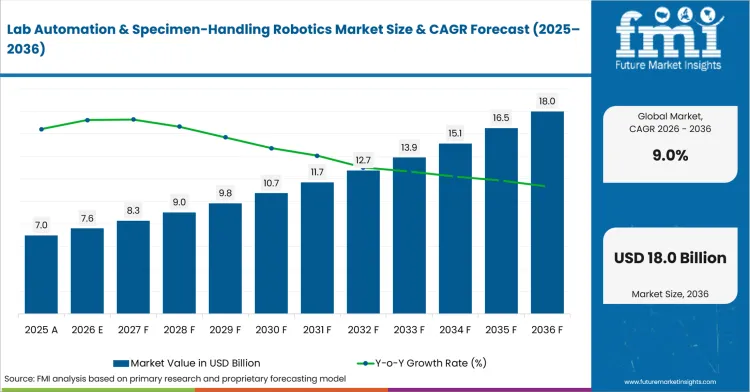
USD 7.6 billion in 2026 and USD 18.0 billion by 2036 at a 9.0% CAGR.
Demand for lab automation & specimen-handling robotics is projected to increase valuation from USD 7.6 billion in 2026 to USD 18.0 billion by 2036, at 9.0% CAGR as laboratories increasingly link liquid handling with controlled specimen movement. Workforce constraints are reinforcing this shift toward integrated automation. The American Society for Clinical Pathology reported in October 2025 that 10 of 17 surveyed laboratory departments recorded higher retirement rates. That workforce pressure raises the value of systems that sustain repeatable processing across evening and weekend schedules.
National adoption paths differ as clinical rules and research scale shape the business case for automation. United States laboratories usually require documented method transfer and service records under CLIA oversight for regulated testing. Chinese genomics programs place greater weight on high-volume preparation and storage across large sample collections. Automata announced a USD 45 million Series C round in January 2026 to expand its integrated robotics and control software. This investment shows that capital is being directed toward workcells that connect physical handling with one scheduling layer. Facility managers therefore compare interface support and recovery plans with instrument output across the expected operating life. Clinical sequencing workflows may favor platforms that preserve specimen identity from extraction through library preparation.
Key Takeaways of Lab Automation & Specimen-Handling Robotics Market
- Demand for lab automation and specimen-handling robotics is driven by staffing pressure and stricter documentation needs, with connected workcells protecting throughput and specimen identity across regulated workflows.
- By component, hardware is expected to lead with 60.0% share in 2026, due to capital spending on robotic arms and storage devices.
- Clinical diagnostics is the dominant application segment, projected to hold 38.0% share in 2026, driven by recurring specimen volumes and fixed reporting schedules.
- Liquid handling workstations are estimated to lead the product category with 34.0% share in 2026, remaining the practical entry point for automation through broad use across diagnostic and research assays.
- Software and services gain value as laboratories coordinate instruments from different manufacturers under one scheduling layer, reducing avoidable handling differences that could weaken downstream results.
- The United States and European Union are expected to lead adoption at 9.5% and 8.5% CAGR respectively, while Japan and India follow different paths through surveillance sequencing and national genomic resource programs.
- Competition centers on Hamilton Company, Tecan Group, Thermo Fisher Scientific, Beckman Coulter Life Sciences, Automata, Biosero, MGI Tech, and Yaskawa Electric, with vendors differentiating through liquid handling integration, phased automation service networks, and mixed-equipment coordination software.
Analyst Perspective
"Laboratory automation delivers measurable value when every stage of specimen handling remains accurate, traceable, and coordinated across the testing workflow rather than when individual instruments operate faster in isolation. Laboratories are investing in systems that simplify integration with existing analyzers, preserve sample integrity through every transfer, and reduce implementation risk during routine operations. Vendors that combine workflow expertise with dependable service, interoperability, and long-term application support are expected to strengthen their position as laboratories expand connected automation environments."
- Anurag Sharma, Principal Analyst at Future Market Insights
Source: FMI's proprietary forecasting model and primary research
How is the Lab Automation & Specimen-Handling Robotics Market segmented?
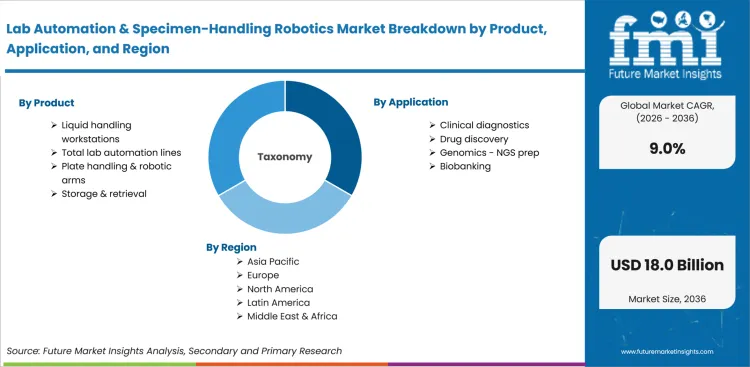
The industry is segmented by product, application, component, end user, sales channel, and region.
The report evaluates five commercial dimensions that shape automation decisions across clinical and research facilities. Product coverage compares liquid handling workstations with integrated lines and robotic storage systems used across different laboratory scales. Application analysis separates clinical diagnostics from discovery work and genomics preparation that have distinct handling needs. Component coverage distinguishes physical equipment from scheduling software and technical services that support connected operation. End-user analysis examines hospitals and pharmaceutical companies alongside academic institutions and contract research organizations across varied facility types. Sales channels compare direct purchases with distributor support and managed access for facilities that need different capital structures. This structure links equipment choices with laboratory information systems that govern data exchange and workflow control.
What supports demand for liquid handling workstations within the product category?
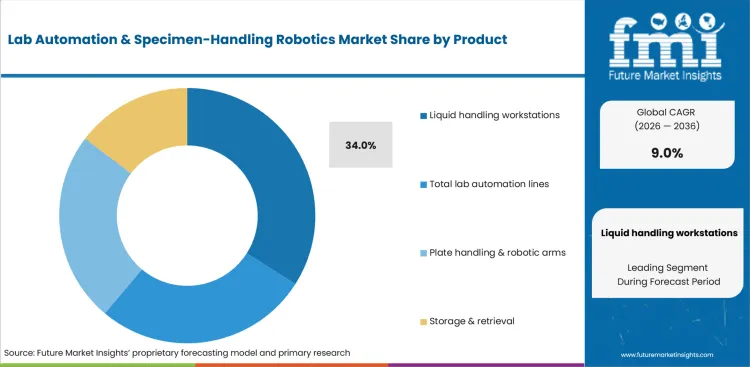
Liquid handling workstations give laboratories a practical first step toward repeatable automation without rebuilding the complete facility. Beckman Coulter Life Sciences announced the Biomek i3 in December 2025 with 15 standard deck positions and five flexible positions. The configuration shows how compact platforms can support multi-step assays while leaving room for later device additions. This modular path protects capital by allowing verified capacity to expand alongside measured workload growth.
- By product, liquid handling workstations are forecast to represent 34.0% of revenue in 2026 through use across diagnostic and research assays. They automate pipetting first and can accept readers or plate movers during later expansion. This staged purchase path lowers project risk for laboratories facing uncertain volumes and changing assay requirements.
- Research laboratories are expected to favor configurable workstations that support several assay formats without extensive floor changes. Service packages gain commercial value by supporting method updates and device additions throughout the instrument life.
How does clinical diagnostics shape demand within the application category?
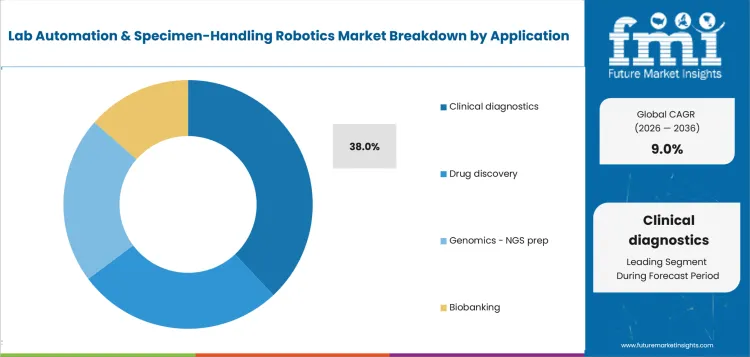
Clinical diagnostics requires dependable specimen processing across recurring test schedules and fixed reporting duties that affect patient care. Beckman Coulter Life Sciences and HSE announced in September 2025 that their automated nucleic acid workflow can process 96 samples in as little as 20 minutes. The figure explains why laboratories assess turnaround time together with extraction consistency across each routine batch. Speed creates commercial value once the complete method remains controlled and documented throughout patient testing.
- In 2026, clinical diagnostics is estimated to hold 38.0% of application revenue due to recurring specimen volumes and documented quality requirements. Hospital and reference laboratories operate fixed reporting windows that reward continuous processing across daily and overnight schedules. The segment therefore favors systems that combine throughput with traceable identity and repeatable preparation.
- Molecular laboratories are anticipated to add automation as assay menus broaden and manual preparation becomes harder to standardize. Automation providers must support method transfer and ongoing service so technical performance becomes dependable routine output across changing assay menus.
How is hardware positioned within the component category?
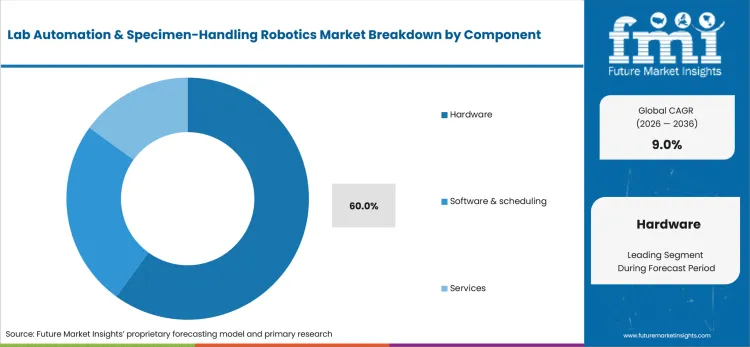
A complete workcell needs instruments and physical safety systems that make hardware the main cost category. Biosero announced a USD 15.2 million integrated automation agreement in September 2025 for a global pharmaceutical customer. The project runs from September 2025 through the end of 2026 across a complex automation program. Its scale shows that coordinated robotics can become a facility investment rather than a single instrument purchase.
- Hardware is projected to account for 60.0% of component revenue in 2026 due to spending on robotic arms and storage devices. These assets determine physical throughput and available capacity across the connected workcell. Their cost remains prominent even as software gains a larger role in scheduling and performance monitoring.
- Pharmaceutical laboratories are expected to add plate movers and safety enclosures as workcells expand beyond one liquid handler. Verified handoffs can protect uptime and reduce integration disputes during installation or later workflow changes.
What are the drivers, restraints, and opportunities in the Lab Automation & Specimen-Handling Robotics Market?
Staffing pressure supports connected workflows. Validation work can slow smaller projects. Scheduling software creates service revenue across installed instruments.
- Driver: Staffing pressure and assay volume support connected specimen workflows that reduce repeated manual transfers during extended operating schedules.
- Restraint: Method validation and instrument interfaces can extend installation schedules for smaller regulated laboratories with limited internal engineering support.
- Opportunity: Scheduling software and service contracts can expand recurring revenue across mixed instrument fleets throughout the installed equipment life.
Staffing pressure supports adoption by making reliable unattended processing more valuable across extended laboratory schedules. Hamilton Company acquired UK Robotics and Trisonic Discovery in July 2025 to combine liquid handling with robotic integration and Revolution scheduling software. The transaction shows that automation companies are building control layers around complete workcells rather than selling isolated instruments. Clinical and biopharma facilities may favor this model since one accountable partner can reduce delays across installation and support.
Validation creates friction by requiring automated methods to remain suitable for the final clinical use. The Centers for Disease Control and Prevention stated in September 2024 that test complexity is assessed against seven criteria under CLIA. Modified methods default to high complexity and require qualified personnel with suitable quality controls for routine operation. This burden can delay returns for smaller laboratories that lack internal validation staff or spare instruments for parallel testing.
Workflow software creates an opening for software providers that can coordinate existing instruments without forcing a complete hardware replacement. A shared scheduler can manage queues and recovery steps across liquid handlers or storage devices from several manufacturers. The automated cell culture outlook illustrates how long-running biological processes depend on timed transfers and clear exception handling. Commercial advantage should favor platforms that reduce integration work while giving facility managers one service route for operating problems.
Which country CAGRs are profiled in the Lab Automation & Specimen-Handling Robotics Market?
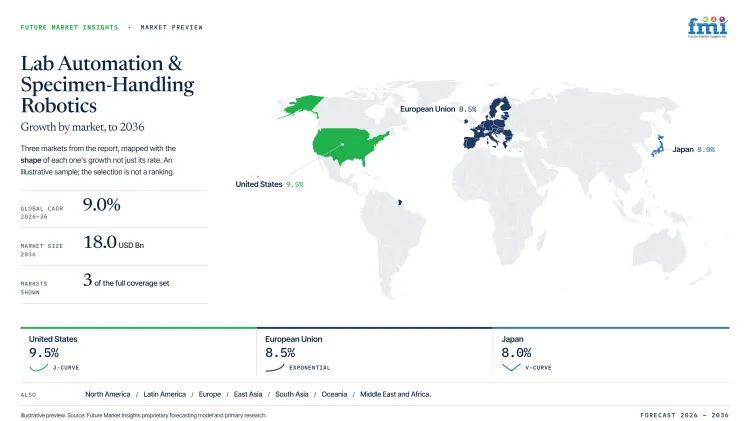
| Country | CAGR |
|---|---|
| United States | 9.5% |
| European Union | 8.5% |
| Japan | 8.0% |
Source: FMI's proprietary forecasting model and primary research
How do country-level CAGRs compare in the Lab Automation & Specimen-Handling Robotics Market?
The comparison spans 1.5 percentage points, showing a narrowly distributed growth outlook across the lab automation & specimen-handling robotics market. The United States leads at 9.5% CAGR, followed by the European Union at 8.5% and Japan at 8.0%. The modest variation suggests that laboratories in all three markets are steadily expanding automation, while differences in laboratory infrastructure, diagnostic workloads and capital investment shape the pace of adoption.
- The United States records the highest CAGR at 9.5%. Clinical laboratories are expanding the use of robotic specimen-handling systems to automate sample transport, sorting, labeling and processing, helping improve workflow efficiency, reduce manual handling and maintain consistent laboratory operations as testing volumes increase.
- The European Union follows with a CAGR of 8.5%, remaining 1.0 percentage point behind the United States. Hospitals and diagnostic laboratories continue incorporating automation into specimen management workflows to improve turnaround times and strengthen traceability. Adoption varies across member states because laboratory networks, healthcare funding and modernization priorities differ throughout the region.
- Japan posts a CAGR of 8.0%, just 0.5 percentage points below the European Union. Laboratory operators are integrating robotic handling platforms into testing environments where precise specimen movement, reduced processing errors and continuous workflow operation are becoming increasingly important for high-throughput diagnostics.
Comparable CAGRs do not necessarily produce identical commercial opportunities. Differences in laboratory automation maturity, diagnostic testing demand, regulatory requirements and healthcare investment strategies influence purchasing decisions and long-term market development. The full report provides country-level CAGR analysis across North America, Latin America, Europe, East Asia, South Asia, Oceania and the Middle East and Africa.
Country-wise Analysis
- United States laboratories are connecting specimen preparation with sequencing records across large national research programs. Demand is forecast to rise at 9.5% CAGR from 2026 to 2036 as regulated facilities expand automated extraction and library preparation. Data from the All of Us Research Program placed the February 2025 short-read whole-genome sample count at 414,830 with SNP and indel data. That scale requires controlled identity checks across extraction and storage so a handling error does not weaken downstream analysis. Clinical networks therefore place value on service response and method documentation alongside instrument speed. Platforms that connect specimen movement with audit records may gain preference during multi-site purchasing decisions.
- European Union laboratories must align automation projects with changing evidence and documentation duties for in vitro diagnostic devices. Adoption is estimated to expand at 8.5% CAGR from 2026 to 2036 as facilities update validated workflows under the IVDR. The European Commission reported in December 2025 that four EU reference laboratories were designated for high-risk in vitro diagnostic devices, with conformity-assessment work scheduled to begin on 1 May 2026. These laboratories must coordinate testing and assessment methods across the new network, which raises the value of repeatable specimen preparation and traceable data exchange. Tecan Group can benefit from this demand through workcell integration that connects instruments and scheduling software. Local service teams may gain preference by helping laboratories document method changes and maintain consistent performance across sites.
- Japan links laboratory automation demand with surveillance programs that coordinate testing across many medical institutions. In Japan, demand is predicted to advance at 8.0% CAGR from 2026 to 2036 through controlled sample preparation and robotic handling. The Ministry of Health, Labour and Welfare reported in July 2026 that 136 institutions participated as of September 2025 and 898 Enterobacterales isolates underwent whole-genome sequencing. The network requires consistent labeling and transfer practices so results remain comparable across participating sites. Yaskawa Electric Corporation supplies biomedical robots for laboratory pretreatment and genome analysis tasks that need repeatable motion. Service teams that support safe integration with existing instruments may gain an advantage in hospital projects.
Who are the notable companies in the Lab Automation & Specimen-Handling Robotics Market?
Thermo Fisher Scientific, Hamilton Company, Tecan Group, Beckman Coulter Life Sciences, Automata, MGI Tech, Yaskawa Electric Corporation, and Biosero are profiled in the competitive analysis.
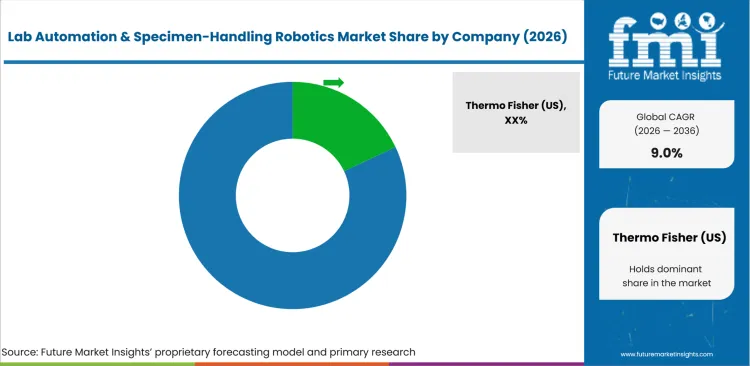
Instrument companies and integration specialists compete to connect devices within scheduled workcells. Thermo Fisher Scientific and Beckman Coulter Life Sciences support phased automation through established liquid handling portfolios. Hamilton Company and Tecan Group add workflow control or robotic integration across mixed instruments. Automata and Biosero coordinate equipment through orchestration software, while MGI Tech and Yaskawa Electric Corporation focus on preparation or movement tasks. The sample storage systems shows why selection now covers retrieval accuracy and software support alongside pipetting performance.
- Hamilton Company and Tecan Group pair liquid handling with scheduling and robotic integration for complex workcells. Their commercial value depends on one control layer across several connected instruments. Support teams must resolve interface failures without delaying regulated assay schedules across facilities.
- Thermo Fisher Scientific and Beckman Coulter Life Sciences support phased automation through established liquid handling portfolios. Laboratories can automate one method first and expand from proven performance under familiar service arrangements. Later device additions can increase contract value as test volumes change.
- Automata and Biosero coordinate mixed equipment through workcell software and physical device integration. The liquid handling performance tests outlook reinforces the need to compare repeatability across connected instruments. Commercial success depends on clear recovery procedures and dependable support during routine operation.
- MGI Tech supplies automated preparation and storage systems for sequencing laboratories with repeated sample batches. Yaskawa Electric Corporation provides biomedical robots for pretreatment and genome analysis movement.
Competitive Benchmarking: Lab Automation & Specimen-Handling Robotics Market
| Company | Liquid Handling | Specimen Movement | Workflow Software | Geographic Reach |
|---|---|---|---|---|
| Thermo Fisher Scientific | High | Medium | Medium | Global |
| Hamilton Company | High | High | High | Global |
| Tecan Group | High | High | High | Global |
| Beckman Coulter Life Sciences | High | Medium | Medium | Global |
| Automata | Medium | High | High | Europe and North America |
| MGI Tech | High | Medium | Medium | Global |
| Yaskawa Electric Corporation | Low | High | Low | Global |
| Biosero | Low | High | High | International |
Scoring basis: High indicates broad direct coverage across the assessed capability and a relevant product portfolio. Medium reflects narrower coverage or support delivered through integration partners within the assessed laboratory workcell category. Low identifies limited direct coverage for the capability considered in this competitive comparison across companies.
Source: FMI analysis based on official company product pages and dated corporate announcements.
Key Developments in the Lab Automation & Specimen-Handling Robotics Market
- In December 2025, Tecan Group completed the acquisition of Wako Automation assets that included Director scheduling software and selected hardware modules. The transaction expanded Tecan Group's ability to design robotic workcells for biopharma laboratories with complex scheduling needs. This broader scope can reduce coordination risk during projects that combine several instruments under one control layer. The development shows why workflow software now affects company selection alongside liquid handling hardware during complex workcell projects.
- In March 2026, Hamilton Company announced a co-marketing agreement with Aplex Bio to automate hyperplex PCR assay kits on Hamilton liquid handling platforms. The workflow can detect and quantify up to 100 molecular markers within a single automated reaction well. The agreement gives molecular laboratories a defined route for combining assay chemistry with automated setup. This approach may reduce method development work and clarify technical support for complex testing programs.
- In January 2025, Biosero announced a collaboration with BD to integrate robotic laboratory automation with flow cytometry systems. The arrangement can change tens or potentially hundreds of multiwell plates without repeated operator handling. This connection gives research laboratories a practical way to extend unattended cytometry runs across recurring batches. Clear service responsibility between the automation layer and analytical instrument remains necessary for dependable routine operation.
- In January 2026, Automata announced a partnership with CellVoyant for closed-loop cell culture workflows that can operate continuously. The companies reported up to an eightfold yield improvement and more than 85% lower cell derivation cost in the stated workflow. The partnership combines robotics with data-guided decisions across extended cell culture processes and repeated operating cycles. Broader commercial use depends on repeatable performance across cell lines and documented recovery from process exceptions.
Key Players in the Lab Automation & Specimen-Handling Robotics Market
Integrated automation and instrument companies
- Thermo Fisher Scientific
- Hamilton Company
- Tecan Group
- Beckman Coulter Life Sciences
Workcell orchestration specialists
- Automata
- Biosero
Genomics and specimen-handling robotics
- MGI Tech
- Yaskawa Electric Corporation
Lab Automation & Specimen-Handling Robotics Market - Report Scope
| Coverage field | Report scope |
|---|---|
| Market breakdown | Product, application, component, end user, sales channel, and region. |
| Quantitative units | Revenue in USD Million, CAGR in %. |
| Market definition | Automated instruments, robotic devices, scheduling software, storage systems, and services used to handle laboratory specimens or coordinate related workflows. |
| Regions covered | North America, Latin America, Europe, East Asia, South Asia, Oceania, Middle East and Africa. |
| Countries covered | United States, Canada, Brazil, Mexico, Germany, United Kingdom, France, China, Japan, South Korea, India, Australia, GCC countries, and South Africa. |
| Key companies profiled | Thermo Fisher Scientific, Hamilton Company, Tecan Group, Beckman Coulter Life Sciences, Automata, MGI Tech, Yaskawa Electric Corporation, and Biosero. |
| Forecast period | 2026 to 2036. |
| Research approach | Revenue estimation is based on segment-wise demand assessment, country adoption modeling, analysis of company-level evidence, and primary interviews conducted across clinical and life science laboratory settings. |
Source: Future Market Insights (FMI) analysis, based on proprietary forecasting model and primary research
Lab Automation & Specimen-Handling Robotics Market - Research Methodology
| Method | Approach |
|---|---|
| Primary Research | FMI analysts gathered input from manufacturers, service providers, technology developers, distributors, end users, procurement teams, and subject-matter experts. Interviews examined purchasing decisions, product or service evaluation, adoption barriers, approval requirements, pricing considerations, and expectations for technical or commercial support. Respondents were also asked what evidence is required before a trial, pilot, or initial order develops into regular purchasing. |
| Desk Research | Desk research covered government statistics, regulatory publications, trade data, industry associations, technical literature, standards, company filings, product information, and official corporate announcements. Sources were reviewed for relevance, publication date, geographic coverage, and consistency with the defined market scope. Claims relating to performance, applications, approvals, capacity, investment, and commercial activity were retained only when supported by credible public evidence. |
| Market Sizing and Forecasting | The market model combined the baseline value with historical performance, segment structure, pricing and volume indicators, adoption levels, company participation, and country-level demand conditions. Forecast assumptions considered economic activity, investment trends, regulatory developments, technology adoption, purchasing cycles, supply availability, and barriers to wider market use. Segment and regional estimates were reconciled before the final market total was calculated. |
| Data Validation | Estimates were checked against multiple independent indicators, including public data, company activity, trade patterns, industry developments, and findings from primary interviews. Validation also tested whether products, services, applications, and company revenues fell within the defined market boundaries. Adjacent categories, unsupported claims, overlapping revenues, and activities without direct market relevance were excluded to reduce double counting and maintain consistency across segments and countries. |
Source: Future Market Insights (FMI) analysis, based on proprietary forecasting model and primary research
Lab Automation & Specimen-Handling Robotics Market by Segments
Lab Automation & Specimen-Handling Robotics Market segmented by Product:
- Liquid handling workstations
- Total laboratory automation lines
- Plate handling and robotic arms
- Storage and retrieval systems
Lab Automation & Specimen-Handling Robotics Market segmented by Application:
- Clinical diagnostics
- Drug discovery and screening
- Genomics and NGS sample preparation
- Biobanking and sample management
Lab Automation & Specimen-Handling Robotics Market segmented by Component:
- Hardware
- Software and scheduling
- Services
Lab Automation & Specimen-Handling Robotics Market segmented by End User:
- Hospital and reference laboratories
- Pharmaceutical and biotechnology companies
- Academic and research institutions
- Contract research organizations
Lab Automation & Specimen-Handling Robotics Market segmented by Sales Channel:
- Direct sales
- Distributors
- Service contracts
- Leasing and managed access
Lab Automation & Specimen-Handling Robotics Market by Region:
- North America
- United States
- Canada
- Latin America
- Brazil
- Mexico
- Argentina
- Rest of Latin America
- Europe
- Germany
- United Kingdom
- France
- Italy
- Spain
- Nordic Countries
- Benelux
- Rest of Europe
- East Asia
- China
- Japan
- South Korea
- South Asia
- India
- ASEAN
- Rest of South Asia
- Oceania
- Australia
- New Zealand
- Middle East and Africa
- GCC Countries
- South Africa
- Israel
- Türkiye
- Rest of Middle East and Africa
Research Sources and Bibliography
- American Society for Clinical Pathology. (2025, October). AI, retirements, and staffing gaps: Findings from the 2024 vacancy survey. American Society for Clinical Pathology.
- All of Us Research Program. (2025, February). All of Us genomic quality report, C2024Q3R9 version 8. National Institutes of Health.
- Automata. (2026, January). Automata raises USD 45 million in Series C funding. Automata.
- Beckman Coulter Life Sciences. (2025, December). Biomek i3 benchtop liquid handler. Beckman Coulter Life Sciences.
- Beckman Coulter Life Sciences. (2025, September). Automated nucleic acid quantification and purification through liquid handling. Beckman Coulter Life Sciences.
- Biosero. (2025, September). Biosero to deliver USD 15.2 million integrated lab automation solutions for a global pharmaceutical customer. Biosero.
- Hamilton Company. (2025, July). Hamilton Company acquires UK Robotics and Trisonic Discovery. Hamilton Company.
- Centers for Disease Control and Prevention. (2024, September). Test complexities. Centers for Disease Control and Prevention.
- State Council Information Office of the People's Republic of China. (2025, April). Covid-19 prevention, control and origins tracing. State Council Information Office.
- European Commission. (2025, December). Commission designates new EU reference laboratories for high-risk in vitro diagnostic medical devices. European Commission.
- Ministry of Health, Labour and Welfare of Japan. (2026, July). Nippon AMR One Health Report 2025. Government of Japan.
- Press Information Bureau. (2025, April). GenomeIndia project data and whole-genome resource. Government of India.
- Thermo Fisher Scientific. (2026). Automated liquid handling instruments and systems. Thermo Fisher Scientific.
- Tecan Group. (2026). Fluent automated workstation. Tecan Group.
- Beckman Coulter Life Sciences. (2026). Automated liquid handlers. Beckman Coulter Life Sciences.
- Automata. (2026). LINQ laboratory automation platform. Automata.
- MGI Tech. (2024, January). MGI Tech expands its laboratory automation product line. MGI Tech.
- Yaskawa Electric Corporation. (2026). Biomedical and laboratory robotics applications. Yaskawa Electric Corporation.
- Biosero. (2026). Green Button Go laboratory automation software. Biosero.
- Tecan Group. (2025, December). Tecan expands robotic workcell offering with acquisition of Wako Automation assets. Tecan Group.
- Hamilton Company. (2026, March). Hamilton and Aplex Bio announce co-marketing agreement for hyperplex PCR assay automation. Hamilton Company.
- Biosero. (2025, January). Biosero announces collaboration with BD. Biosero.
- Automata. (2026, January). Automata and CellVoyant announce strategic partnership for closed-loop cell culture workflows. Automata.
- MGI Tech. (2026). Automated sample preparation and laboratory management systems. MGI Tech.
This bibliography is provided for reader reference and uses primary government, standards-body, official trade body, and company sources.
This Report Answers
- What market value is estimated for 2026 and 2036?
- What CAGR is projected from 2026 to 2036?
- Which product and application segments account for the stated 2026 shares?
- How do staffing pressure and method validation affect automation investment?
- Why do country growth rates differ across the profiled laboratory systems?
- Which official programs are increasing specimen preparation and storage needs?
- Which companies compete through instruments or workflow orchestration?
- What capabilities separate integrated workcell providers from single-function companies?
- What should laboratory managers examine before approving an automation project?
Frequently Asked Questions
What is driving growth in the Lab Automation & Specimen-Handling Robotics Market?
Clinical and research laboratories face staffing pressure as specimen volumes rise across longer operating schedules. Scheduled robotic systems reduce manual transfers and support consistent throughput across connected diagnostic and research workflows.
Who are the key players in the Lab Automation & Specimen-Handling Robotics Market?
Thermo Fisher Scientific and Hamilton Company provide broad automation portfolios across clinical and research laboratory workflows. Tecan Group and Beckman Coulter Life Sciences compete through liquid handling systems with integration support services.
What is a notable restraint in the Lab Automation & Specimen-Handling Robotics Market?
Method validation and interface work can extend installation schedules across regulated facilities that process patient tests. Smaller sites may struggle to justify capital spending against limited volumes and specialized service costs.
Why should executives track the Lab Automation & Specimen-Handling Robotics Market?
Automation changes laboratory capacity and the cost of maintaining consistent specimen processing across longer operating schedules. Connected systems can create recurring software and service revenue beyond the original laboratory hardware purchase.
What business problem does the Lab Automation & Specimen-Handling Robotics Market address?
Laboratory automation addresses repetitive specimen handling that limits throughput and creates avoidable operating variation across facilities. Robotic systems coordinate physical transfers and preserve sample identity across extended diagnostic and research workflows.
What should laboratory managers evaluate before selecting a provider?
Laboratory managers should compare method support and software interfaces with hardware performance across expected operating workflows. Contracts need clear responsibility for service and recovery for each instrument connected within the workcell.
What limits return on investment for laboratory automation purchases?
Low utilization weakens returns if a workcell processes fewer samples than the approved business case assumed. Integration delays and specialized service costs can reduce savings throughout the first commercial operating period.
What supports long-term commercial confidence in this market?
Reliable performance across changing assay volumes supports confidence in laboratory automation investments across diverse facilities. Documented service and open interfaces provide a practical basis for expanding connected workflows over time.
Preview the report firsthand - request a free sample
Get SampleGet the brochure for pricing and purchase details.
Get PDFTable of Content
- Key Takeaways
- Market Size and CAGR
- Top Growth Driver
- Fastest Growing Segment
- Leading Region
- Key Companies
- Emerging Opportunities
- Executive Summary
- Global Market Outlook
- Demand-side Trends
- Supply-side Trends
- Technology Roadmap Analysis
- Analysis and Recommendations
- Analyst Perspective (What is happening? Why now? What should investors know?)
- Key Questions Answered
- How large is the market?
- What is the CAGR?
- What are key trends?
- Which region dominates?
- Who are the leaders?
- Market Overview
- Market Coverage / Taxonomy
- Market Definition / Scope / Limitations
- Research Methodology
- Chapter Orientation
- Analytical Lens and Working Hypotheses
- Market Structure, Signals, and Trend Drivers
- Benchmarking and Cross-market Comparability
- Market Sizing, Forecasting, and Opportunity Mapping
- Research Design and Evidence Framework
- Desk Research Programme (Secondary Evidence)
- Expert Input and Fieldwork (Primary Evidence)
- Tooling, Models, and Reference Databases
- Data Engineering and Model Build
- Quality Assurance and Audit Trail
- Market Background
- Market Dynamics (Drivers, Restraints, Opportunity, Trends)
- Scenario Forecast (Optimistic, Likely, Conservative)
- Impact Analysis
- AI Impact
- Sustainability Impact
- Regulatory Impact
- Technology Impact
- Consumer / Buyer Analysis
- Purchase Drivers
- Adoption Barriers
- Buyer Journey
- Opportunity Map Analysis
- Product Life Cycle Analysis
- Supply Chain Analysis
- Investment Feasibility Matrix
- Value Chain Analysis
- PESTLE and Porter's Analysis
- Regulatory Landscape
- Regional Parent Market Outlook
- Production and Consumption Statistics
- Import and Export Statistics
- Global Market Analysis and Forecast, 2021 to 2036
- Historical Market Size Value (USD Bn) Analysis, 2021 to 2025
- Current and Future Market Size Value (USD Bn) Projections, 2026 to 2036
- Y-o-Y Growth Trend Analysis
- Absolute $ Opportunity Analysis
- Global Market Pricing Analysis, 2021 to 2036
- Global Market Analysis and Forecast, By Product, 2021 to 2036
- Introduction / Key Findings
- Historical Market Size Value (USD Bn) Analysis By Product, 2021 to 2025
- Current and Future Market Size Value (USD Bn) Analysis and Forecast By Product, 2026 to 2036
- Liquid handling workstations
- Total lab automation lines
- Plate handling & robotic arms
- Storage & retrieval
- Liquid handling workstations
- Y-o-Y Growth Trend Analysis By Product, 2021 to 2025
- Absolute $ Opportunity Analysis By Product, 2026 to 2036
- Global Market Analysis and Forecast, By Application, 2021 to 2036
- Introduction / Key Findings
- Historical Market Size Value (USD Bn) Analysis By Application, 2021 to 2025
- Current and Future Market Size Value (USD Bn) Analysis and Forecast By Application, 2026 to 2036
- Clinical diagnostics
- Drug discovery
- Genomics - NGS prep
- Biobanking
- Clinical diagnostics
- Y-o-Y Growth Trend Analysis By Application, 2021 to 2025
- Absolute $ Opportunity Analysis By Application, 2026 to 2036
- Global Market Analysis and Forecast, By Component, 2021 to 2036
- Introduction / Key Findings
- Historical Market Size Value (USD Bn) Analysis By Component, 2021 to 2025
- Current and Future Market Size Value (USD Bn) Analysis and Forecast By Component, 2026 to 2036
- Hardware
- Software & scheduling
- Services
- Hardware
- Y-o-Y Growth Trend Analysis By Component, 2021 to 2025
- Absolute $ Opportunity Analysis By Component, 2026 to 2036
- Global Market Analysis and Forecast, By End User, 2021 to 2036
- Introduction / Key Findings
- Historical Market Size Value (USD Bn) Analysis By End User, 2021 to 2025
- Current and Future Market Size Value (USD Bn) Analysis and Forecast By End User, 2026 to 2036
- Hospital & reference labs
- Pharma & biotech
- Academic & research
- CROs
- Hospital & reference labs
- Y-o-Y Growth Trend Analysis By End User, 2021 to 2025
- Absolute $ Opportunity Analysis By End User, 2026 to 2036
- Global Market Analysis and Forecast, By Sales Channel, 2021 to 2036
- Introduction / Key Findings
- Historical Market Size Value (USD Bn) Analysis By Sales Channel, 2021 to 2025
- Current and Future Market Size Value (USD Bn) Analysis and Forecast By Sales Channel, 2026 to 2036
- Direct
- Distributors
- Service contracts
- Leasing
- Direct
- Y-o-Y Growth Trend Analysis By Sales Channel, 2021 to 2025
- Absolute $ Opportunity Analysis By Sales Channel, 2026 to 2036
- Global Market Analysis and Forecast, By Region, 2021 to 2036
- Introduction
- Historical Market Size Value (USD Bn) Analysis By Region, 2021 to 2025
- Current Market Size Value (USD Bn) Analysis and Forecast By Region, 2026 to 2036
- North America
- Latin America
- Western Europe
- Eastern Europe
- East Asia
- South Asia and Pacific
- Middle East & Africa
- Market Attractiveness Analysis By Region
- North America Market Analysis and Forecast, By Country, 2021 to 2036
- Historical Market Size Value (USD Bn) Trend Analysis By Market Taxonomy, 2021 to 2025
- Market Size Value (USD Bn) Forecast By Market Taxonomy, 2026 to 2036
- By Country
- USA
- Canada
- By Product
- By Application
- By Component
- By End User
- By Sales Channel
- By Country
- Market Attractiveness Analysis
- By Country
- By Product
- By Application
- By Component
- By End User
- By Sales Channel
- Key Takeaways
- Latin America Market Analysis and Forecast, By Country
- Historical Market Size Value (USD Bn) Trend Analysis By Market Taxonomy, 2021 to 2025
- Market Size Value (USD Bn) Forecast By Market Taxonomy, 2026 to 2036
- By Country
- Brazil
- Mexico
- Chile
- Rest of Latin America
- By Product
- By Application
- By Component
- By End User
- By Sales Channel
- By Country
- Market Attractiveness Analysis
- By Country
- By Product
- By Application
- By Component
- By End User
- By Sales Channel
- Key Takeaways
- Western Europe Market Analysis and Forecast, By Country
- Historical Market Size Value (USD Bn) Trend Analysis By Market Taxonomy, 2021 to 2025
- Market Size Value (USD Bn) Forecast By Market Taxonomy, 2026 to 2036
- By Country
- Germany
- UK
- Italy
- Spain
- France
- Nordic
- BENELUX
- Rest of Western Europe
- By Product
- By Application
- By Component
- By End User
- By Sales Channel
- By Country
- Market Attractiveness Analysis
- By Country
- By Product
- By Application
- By Component
- By End User
- By Sales Channel
- Key Takeaways
- Eastern Europe Market Analysis and Forecast, By Country
- Historical Market Size Value (USD Bn) Trend Analysis By Market Taxonomy, 2021 to 2025
- Market Size Value (USD Bn) Forecast By Market Taxonomy, 2026 to 2036
- By Country
- Russia
- Poland
- Hungary
- Balkan & Baltic
- Rest of Eastern Europe
- By Product
- By Application
- By Component
- By End User
- By Sales Channel
- By Country
- Market Attractiveness Analysis
- By Country
- By Product
- By Application
- By Component
- By End User
- By Sales Channel
- Key Takeaways
- East Asia Market Analysis and Forecast, By Country
- Historical Market Size Value (USD Bn) Trend Analysis By Market Taxonomy, 2021 to 2025
- Market Size Value (USD Bn) Forecast By Market Taxonomy, 2026 to 2036
- By Country
- China
- Japan
- South Korea
- By Product
- By Application
- By Component
- By End User
- By Sales Channel
- By Country
- Market Attractiveness Analysis
- By Country
- By Product
- By Application
- By Component
- By End User
- By Sales Channel
- Key Takeaways
- South Asia and Pacific Market Analysis and Forecast, By Country
- Historical Market Size Value (USD Bn) Trend Analysis By Market Taxonomy, 2021 to 2025
- Market Size Value (USD Bn) Forecast By Market Taxonomy, 2026 to 2036
- By Country
- India
- ASEAN
- Australia & New Zealand
- Rest of South Asia and Pacific
- By Product
- By Application
- By Component
- By End User
- By Sales Channel
- By Country
- Market Attractiveness Analysis
- By Country
- By Product
- By Application
- By Component
- By End User
- By Sales Channel
- Key Takeaways
- Middle East & Africa Market Analysis and Forecast, By Country
- Historical Market Size Value (USD Bn) Trend Analysis By Market Taxonomy, 2021 to 2025
- Market Size Value (USD Bn) Forecast By Market Taxonomy, 2026 to 2036
- By Country
- Kingdom of Saudi Arabia
- Other GCC Countries
- Türkiye
- South Africa
- Other African Union
- Rest of Middle East & Africa
- By Product
- By Application
- By Component
- By End User
- By Sales Channel
- By Country
- Market Attractiveness Analysis
- By Country
- By Product
- By Application
- By Component
- By End User
- By Sales Channel
- Key Takeaways
- Key Countries Market Analysis
- USA
- Pricing Analysis
- Market Share Analysis, 2025
- By Product
- By Application
- By Component
- By End User
- By Sales Channel
- Canada
- Pricing Analysis
- Market Share Analysis, 2025
- By Product
- By Application
- By Component
- By End User
- By Sales Channel
- Mexico
- Pricing Analysis
- Market Share Analysis, 2025
- By Product
- By Application
- By Component
- By End User
- By Sales Channel
- Brazil
- Pricing Analysis
- Market Share Analysis, 2025
- By Product
- By Application
- By Component
- By End User
- By Sales Channel
- Chile
- Pricing Analysis
- Market Share Analysis, 2025
- By Product
- By Application
- By Component
- By End User
- By Sales Channel
- Germany
- Pricing Analysis
- Market Share Analysis, 2025
- By Product
- By Application
- By Component
- By End User
- By Sales Channel
- UK
- Pricing Analysis
- Market Share Analysis, 2025
- By Product
- By Application
- By Component
- By End User
- By Sales Channel
- Italy
- Pricing Analysis
- Market Share Analysis, 2025
- By Product
- By Application
- By Component
- By End User
- By Sales Channel
- Spain
- Pricing Analysis
- Market Share Analysis, 2025
- By Product
- By Application
- By Component
- By End User
- By Sales Channel
- France
- Pricing Analysis
- Market Share Analysis, 2025
- By Product
- By Application
- By Component
- By End User
- By Sales Channel
- India
- Pricing Analysis
- Market Share Analysis, 2025
- By Product
- By Application
- By Component
- By End User
- By Sales Channel
- ASEAN
- Pricing Analysis
- Market Share Analysis, 2025
- By Product
- By Application
- By Component
- By End User
- By Sales Channel
- Australia & New Zealand
- Pricing Analysis
- Market Share Analysis, 2025
- By Product
- By Application
- By Component
- By End User
- By Sales Channel
- China
- Pricing Analysis
- Market Share Analysis, 2025
- By Product
- By Application
- By Component
- By End User
- By Sales Channel
- Japan
- Pricing Analysis
- Market Share Analysis, 2025
- By Product
- By Application
- By Component
- By End User
- By Sales Channel
- South Korea
- Pricing Analysis
- Market Share Analysis, 2025
- By Product
- By Application
- By Component
- By End User
- By Sales Channel
- Russia
- Pricing Analysis
- Market Share Analysis, 2025
- By Product
- By Application
- By Component
- By End User
- By Sales Channel
- Poland
- Pricing Analysis
- Market Share Analysis, 2025
- By Product
- By Application
- By Component
- By End User
- By Sales Channel
- Hungary
- Pricing Analysis
- Market Share Analysis, 2025
- By Product
- By Application
- By Component
- By End User
- By Sales Channel
- Kingdom of Saudi Arabia
- Pricing Analysis
- Market Share Analysis, 2025
- By Product
- By Application
- By Component
- By End User
- By Sales Channel
- Türkiye
- Pricing Analysis
- Market Share Analysis, 2025
- By Product
- By Application
- By Component
- By End User
- By Sales Channel
- South Africa
- Pricing Analysis
- Market Share Analysis, 2025
- By Product
- By Application
- By Component
- By End User
- By Sales Channel
- USA
- Market Structure Analysis
- Competition Dashboard
- Competition Benchmarking
- Market Share Analysis of Top Players
- By Regional
- By Product
- By Application
- By Component
- By End User
- By Sales Channel
- Emerging Startups
- Innovation Benchmarking
- Competition Analysis
- Competition Deep Dive
- Thermo Fisher (US)
- Overview
- Product Portfolio
- Profitability by Market Segments
- Sales Footprint
- Strategy Overview
- Marketing Strategy
- Product Strategy
- Channel Strategy
- Hamilton (CH-US)
- Tecan (CH)
- Yaskawa Biomedical (JP)
- Thermo Fisher (US)
- Case Studies
- Success Stories
- Recent Developments
- Competition Deep Dive
- Assumptions & Acronyms Used


