

- Market Size (2026)
- USD 780.6 Mn
- Forecast (2036)
- USD 1397.9 Mn
- CAGR (2026 to 2036)
- 6.0%
How big is the Locator Transmitters Market size?
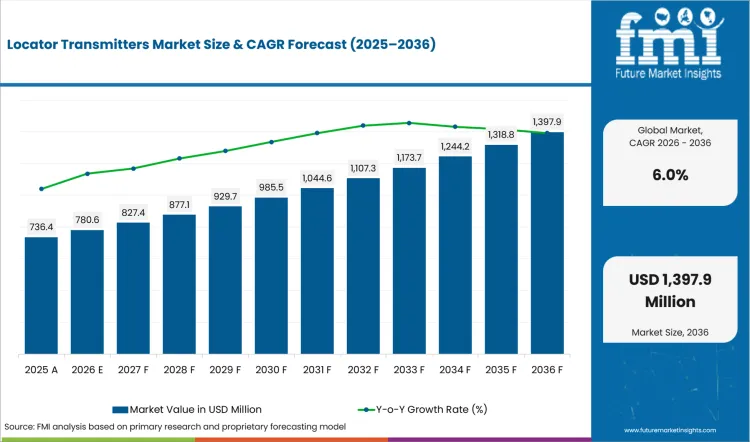
USD 780.6 million in 2026 and USD 1,397.9 million by 2036 at a 6.0% CAGR.
Demand for locator transmitters is projected to expand at 6.0% CAGR between 2026 and 2036, increasing valuation from USD 780.6 million in 2026 to USD 1,397.9 million by 2036. Locating underground pipes and cables requires clear signals to help crews avoid accidentally striking buried utility lines. Finding the correct target line quickly is proving to be more important as telecom networks expand into new areas. In November 2025, the International Telecommunication Union reported for 5G networks covering an estimated 55% of people in 2025. Extensive network expansion encourages utility crews to choose transmitters offering strong tone clarity and controlled power output for cable and duct work.
Equipment preferences vary across international regions based on local project environments. Field teams in India and China favor portable units and direct-connection support to handle fast network additions. Crews in the UK and Germany prioritize frequency selection and trace accuracy to navigate dense underground routes safely. A report from the Common Ground Alliance in August 2025 noted the top 10 root causes accounted for 85% of reported damages in 2024. High accident numbers push field organizations to scrutinize trace practices and require strong damage-prevention evidence.
Key Takeaways of Locator Transmitters Market
- Demand for locator transmitters is driven by utility teams connecting target-line energizing with excavation readiness and route verification, with account decisions reflecting frequency coverage and field support records.
- By output power, 1-5 W transmitters are expected to lead with 38.0% share in 2026, backed by routine field use and balanced signal strength.
- Cable locating is the dominant application segment, projected to hold 38.0% share in 2026, reflected by electric utility and telecom route identification needs.
- Multi-frequency transmitters are estimated to lead the technology category with 33.0% share in 2026, led by crews needing frequency choice across distance and ground conditions.
- Direct connection and induction pairing capability remain critical to supplier evaluation, as telecom contractors and water/wastewater teams need simple, durable units suited to varied tracing tasks.
- India, China, and Australia are expected to form the higher-growth country tier, advancing at 7.8%, 7.0%, and 5.5% CAGR respectively through 2036, supported by telecom expansion, 5G network density, and fiber upgrades.
- Competition centers on Radiodetection, Subsite Electronics, RIDGID, Leica Geosystems, Tempo Communications, and MALA, with vendors differentiating through transmitter-receiver systems, field equipment breadth, and training/service support.
Analyst Perspective
"Utility contractors rely on locator transmitters to reduce excavation risk and improve confidence before digging begins, making dependable field performance more important than hardware specifications alone. Equipment selection is influenced by signal stability, ease of deployment, and consistent trace accuracy across varying ground conditions and utility networks. Manufacturers that support customers with practical operator training, durable product design, and responsive field service are expected to strengthen long-term relationships as underground infrastructure projects continue to expand."
- Nikhil Kaitwade, Principal Consultant for Testing Equipment at Future Market Insights
Source: Future Market Insights analysis, 2026.
How is the Locator Transmitters Market segmented?
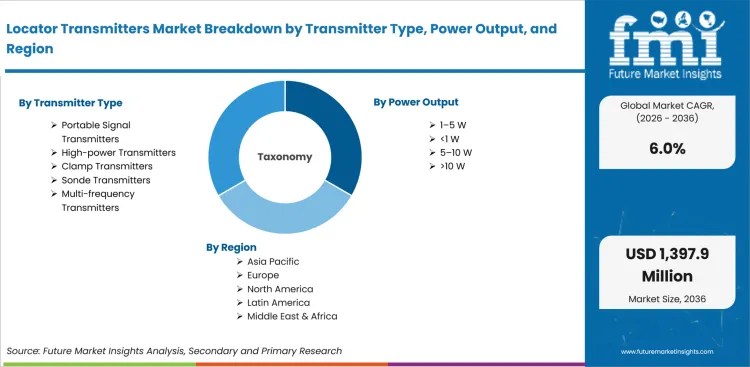
The locator transmitters market is segmented by transmitter type, power output, frequency range, application, end use, and region.
The locator transmitters industry segmentation includes transmitter type, power output, frequency range, application, end use, and region. Transmitter type coverage includes portable signal transmitters, high-power transmitters, clamp transmitters, sonde transmitters, and multi-frequency transmitters. Power output coverage includes below 1 W, 1-5 W, 5-10 W, and above 10 W. Frequency range coverage includes low frequency, medium frequency, high frequency, and multi-frequency. Application coverage includes cable locating, pipe locating, fault finding, and sewer or duct tracing. End use coverage includes electric utilities, telecom, water and wastewater, contract locators, and oil and gas. Regional coverage includes North America, Latin America, Europe, East Asia, South Asia, Oceania, and Middle East and Africa.
How do portable signal transmitters support transmitter type?
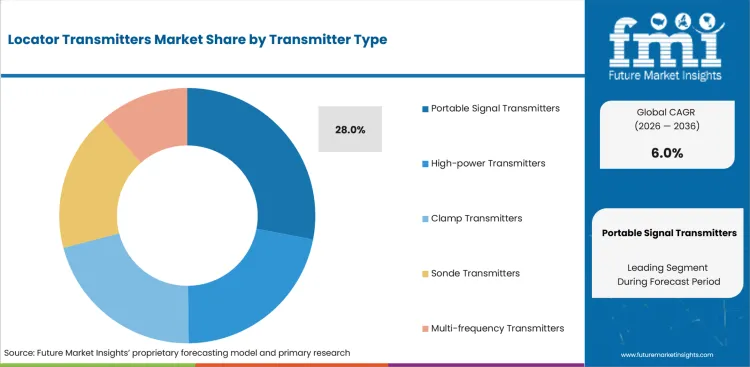
Portable signal transmitters are anticipated to support demand as field crews need equipment carried between substations and contractor sites. Lighter setup workflows help crews connect or induce a signal before route tracing begins. NBN Co stated in August 2025 noting more than 805,000 premises had upgraded to full fiber, promoting portable locator use during access-network conversion.
- Based on transmitter type, portable signal transmitters are likely to account for 28.0% share in 2026 owing to mobile field work and quick setup needs. Field teams select portable units for changing access conditions across pipe and duct jobs.
- Sonde transmitters and multi-frequency transmitters serve different site conditions. Portable signal transmitters draw equipment-list priority since crews need repeatable output and easy receiver pairing across multiple jobsites.
How does 1-5 W shape power output demand?
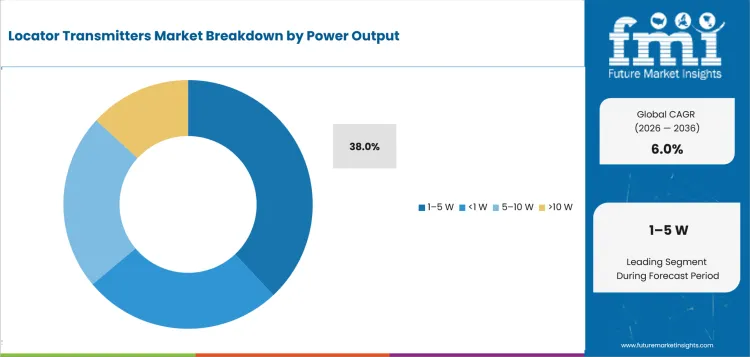
C.Scope stated in its April 2025 XL4 range brochure claiming signal generator and transmitter features include 1 watt power and 2 to 4 power levels, reflecting practical output bands remain central to field tool selection. Field teams compare battery performance and trace stability before adding transmitter families to approved equipment lists. 1-5 W transmitters are expected to guide purchasing as routine locating work needs enough signal strength without excessive power draw.
- 1-5 W is anticipated to hold 38.0% share of output in 2026, led by routine cable and pipe locating requirements. Equipment makers secure account approval through output records supporting common service distances and daily field use.
- 5-10 W and above 10 W ranges serve shorter traces or difficult ground conditions. 1-5 W receives considerable sourcing review as teams compare tone strength and setup simplicity across general utility work.
Why is multi-frequency positioned within frequency range?
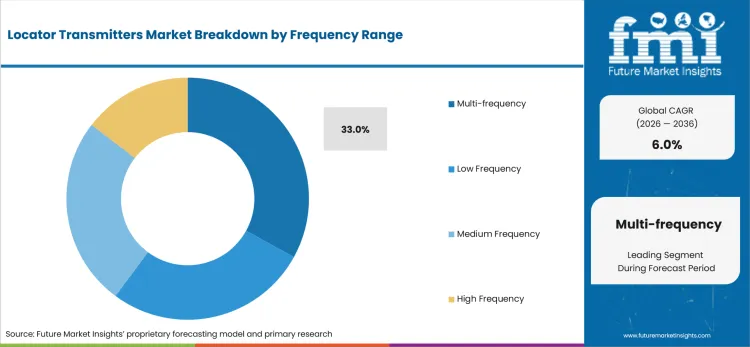
Multi-frequency capability is estimated to influence transmitter selection as underground conditions change by material and interference risk. Operators assess lower and higher frequency options before choosing a setting suited to target-line behavior. Vivax-Metrotech stated in September 2024 announcing Loc3 Series 5-watt and 10-watt transmitters offer selectable frequencies from 98 Hz to 200 kHz, highlighting frequency choice for varied cable and pipe locating tasks.
- By frequency range, multi-frequency is forecast to garner 33.0% share in 2026 due to varied utility routes and difficult signal environments. Utility accounts prioritize frequency choice supported by clear controls and receiver compatibility.
- Low frequency and high frequency formats serve specific trace needs. Multi-frequency designs move higher in selection since one transmitter line is expected to support multiple job conditions.
How does cable locating influence application demand?
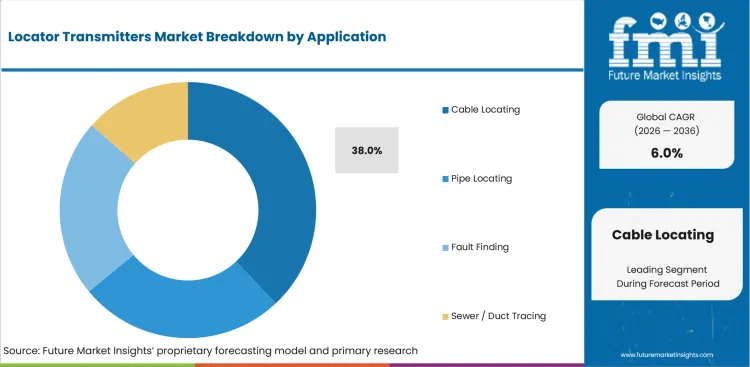
Common Ground Alliance reported in August 2025 announcing 196,977 unique damage reports from 2024, reinforcing field demand for transmitter-led identification before ground disturbance. Cable locating is projected to support transmitter as electric utilities and telecom contractors need target-line confirmation before maintenance and excavation.
- Cable locating is predicted to account for 38.0% share in 2026, backed by utility cables and telecom route work. Sourcing teams favor transmitters offering controlled tone transfer and reliable pairing with receivers.
- Pipe locating and sewer or duct tracing retain commercial use across service teams. Cable locating attracts account attention on transmitter evidence reducing incorrect-line selection risk.
Why do electric utilities lead end use demand?
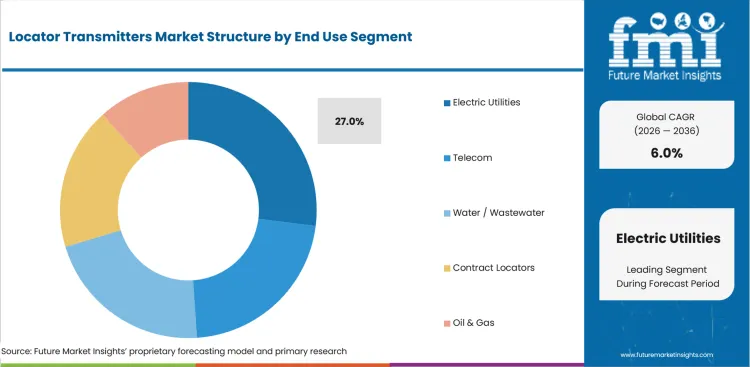
Electric utilities are anticipated to support locator transmitter led by distribution corridors requiring cable tracing and route confirmation. Maintenance crews are likely to assess direct connection safety and receiver response before selecting field equipment. USA Energy Information Administration reported in April 2026 recording 143.0 million residential electricity customers in 2024, underscoring the scale of electric utility service work connected to cable identification.
- In 2026, electric utilities are estimated to capture 27.0% share in 2026 since being driven by underground cable maintenance and service continuity needs. Equipment vendors earn approval once transmitter formats support field procedures and documentation.
- Contract locators and oil and gas accounts serve different field environments. Electric utilities receive stronger planning focus as crews require repeatable signal output during cable maintenance and fault support work.
What are the drivers, restraints, and opportunities in the Locator Transmitters Market?
Demand advances through utility repair needs and service-based deployment. Adoption faces approval delays from output consistency concerns and budget timing.
- Driver: Utility and telecom crews are qualifying locator transmitters for safer target-line energizing before site work.
- Restraint: Adoption slows if weak grounding or unclear receiver pairing reduces trace confidence.
- Opportunity: Multi-frequency units and portable designs are opening demand for clearer line separation across crowded underground routes.
Underground utility work increasingly requires precise power targeting to safely identify buried utility lines. International Telecommunication Union reported in November 2025 stating around 3 billion 5G mobile subscriptions worldwide in 2025. Considerable growth across telecom pathways forces field crews to carefully prepare and map out cable traces.
Locating underground lines becomes significantly harder when workers encounter crowded networks or flawed equipment configurations. Common Ground Alliance stated in August 2025 noting its national damage-prevention index rose from 94.0 to 96.7 in 2024. Widespread crowding beneath the streets requires utility teams to focus heavily on trace verification and strict field safety discipline.
Significantly expanding fiber networks open new pathways for equipment growth as utility companies require detailed route records. Ofcom reported in May 2026 announcing full-fiber connections increased by 1.8 million to 12.4 million. Installing massive numbers of high-speed lines creates a strong requirement for paired tracking tools across crowded service areas.
What country CAGRs are profiled in the Locator Transmitters Market?
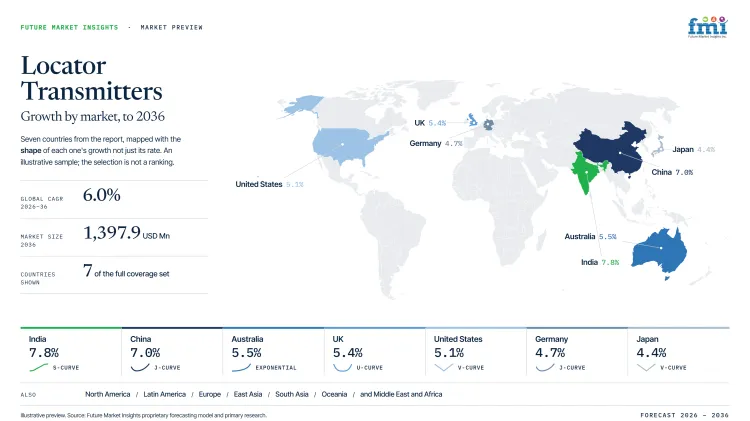
| Country | CAGR |
|---|---|
| India | 7.8% |
| China | 7.0% |
| Australia | 5.5% |
| UK | 5.4% |
| United States | 5.1% |
| Germany | 4.7% |
| Japan | 4.4% |
Source: Future Market Insights analysis, 2026.
How do country-level CAGRs compare in the Locator Transmitters Market?
The country comparison spans 3.4 percentage points and reveals three distinct growth bands across the locator transmitters market. India and China form the leading tier with a 0.8-point difference between them. Australia, the United Kingdom and the United States create a closely aligned middle group within a 0.4-point range. Germany and Japan complete the comparison, separated by only 0.3 percentage points. The variation reflects differences in underground utility development, infrastructure renewal and adoption of utility locating technologies.
- India leads the comparison with a CAGR of 7.8%. Expansion of underground power, water and telecommunications networks is increasing the use of locator transmitters that help contractors accurately identify buried utilities before excavation and maintenance activities begin.
- China follows at 7.0%, trailing India by 0.8 percentage points. Ongoing construction of urban utility corridors and transport infrastructure continues to encourage wider deployment of utility locating equipment that improves excavation accuracy and reduces the risk of cable or pipeline damage.
- Australia records a CAGR of 5.5%, placing it 1.5 percentage points below China. Demand reflects continued investment in utility maintenance, mining infrastructure and underground asset management, where locator transmitters support efficient field operations and network verification.
- The United Kingdom reaches 5.4%, only 0.1 percentage points behind Australia. Replacement of aging utility infrastructure and greater emphasis on safe excavation practices are reinforcing the use of locating technologies across construction and maintenance projects.
- At 5.1%, the United States remains 0.3 percentage points below the United Kingdom. Utility operators and contractors are increasingly incorporating locator transmitters into asset detection workflows to improve mapping accuracy and minimize service interruptions during excavation.
- Germany posts a CAGR of 4.7%, standing 0.4 percentage points behind the United States. Market activity is associated with modernization of underground utility networks and broader use of precision locating equipment across civil engineering and infrastructure projects.
- Japan completes the comparison with a CAGR of 4.4%, just 0.3 percentage points below Germany. Demand is linked to routine inspection of underground infrastructure, utility maintenance programs and construction practices that prioritize accurate asset identification before ground disturbance.
Comparable CAGRs can still produce different market entry conditions. Differences in underground utility density, infrastructure investment, excavation regulations and asset management practices influence technology adoption and long-term commercial opportunities. The full report provides country-level CAGR analysis across North America, Latin America, Europe, East Asia, South Asia, Oceania and the Middle East and Africa.
Country-wise Analysis
Locator transmitters adoption is expected to be guided by telecom route additions and underground asset density. India and China are likely to connect demand with network expansion and local field service needs. Australia and United States accounts are anticipated to connect adoption with fiber work and contractor locating. Germany and Japan are projected to connect demand with careful site practices and dense underground networks.
- India locator transmitter sector is projected to grow at 7.8% CAGR through 2036, reflected by telecom expansion and utility field activity. Press Information Bureau stated in February 2026 noting telecom service providers had installed 5.18 lakh 5G base transceiver stations by December 2025, supporting wider cable locating needs around new network assets.
- China field crews are expected to favor transmitters supporting controlled signal output across dense underground corridors. Sales in China are forecast to expand at 7.0% CAGR from 2026 to 2036, helped by infrastructure depth and receiver-pairing needs. State Council information service reported in January 2026 announcing China had 4.838 million 5G base stations by the end of 2025, reinforcing transmitter use around telecom and utility route tracing.
- Australia locator transmitter demand is likely to be shaped by fiber upgrades and utility service distances. Australian Communications and Media Authority reported in February 2026 recording nearly 373,000 non-NBN fixed services in operation in June 2025, highlighting trace needs across mixed access networks and contractor routes. Industry in Australia is anticipated to grow at 5.5% CAGR during the forecast period, backed by dispersed field work and network conversion activity.
- UK buyers are expected to prefer equipment supporting full-fiber route verification and utility maintenance in congested underground areas. Demand in UK is estimated to scale at 5.4% CAGR from 2026 to 2036, driven by telecom route work and repair coordination. Ofcom reported in May 2026 stating full fiber was available to 24.9 million residential premises or 82% of homes, strengthening transmitter needs around cable route confirmation.
- The market in United States is projected to increase at 5.1% CAGR during the assessment period, guided by telecom maintenance and contract locator activity. USA Energy Information Administration reported in October 2025 listing 1,230,416 MW of net summer capacity in 2024, reinforcing electric network scale linked to cable identification and maintenance support.
- Germany accounts are likely to assess transmitters through documentation quality and receiver compatibility across cable and fiber routes. German Federal Network Agency stated in June 2026 reporting active fiber connections increased from 5.3 million at end-2024 to 6.4 million at end-2025, supporting route tracing needs during fiber buildout and service work. Locator transmitters sector in Germany is forecast to expand at 4.7% CAGR between 2026 and 2036.
- Japan locator transmitter industry is expected to rise 4.4% CAGR during the study period, shaped by dense access networks and careful utility work. Statistics Bureau of Japan reported in 2025 stating 5G mobile phone access subscriptions reached 92.367 million at end-March 2024, reinforcing transmitter use around telecom cable identification and urban service routes.
-
Who are the notable companies in the Locator Transmitters Market?
Radiodetection, Vivax-Metrotech, Subsite Electronics, RIDGID, C.Scope, Leica Geosystems, Sewerin, Schonstedt, Tempo Communications, and MALA are expected to shape demand.
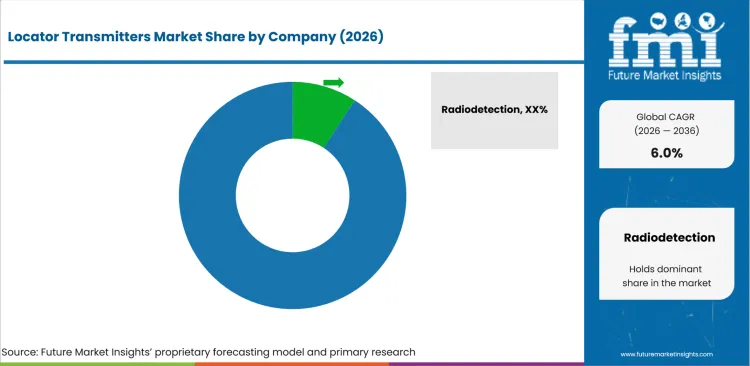
Competition in locator transmitters is anticipated to center on transmitter-receiver pairing and regional service reach. Account teams are likely to compare suppliers through output evidence and ability to support repeat field programs after initial approval. Radiodetection and Subsite Electronics are expected to receive review attention for utility locating knowledge and transmitter portfolios. RIDGID and Leica Geosystems are projected to compete through field equipment breadth and channel depth. Sewerin and MALA are estimated to support account demand led by adjacent detection tools and application guidance.
- Radiodetection and Subsite Electronics are expected to gain account attention based on utility locating portfolios and transmitter-receiver knowledge. Field system depth is likely to promote programs needing frequency selection and route documentation discipline.
- RIDGID and Leica Geosystems are anticipated to compete led by field equipment service and channel support. Engineering service and channel depth are projected to improve acceptance as contractors review setup files before approval.
- Sewerin and MALA are forecast to support demand through adjacent detection applications. Utility detection knowledge is expected to help accounts compare equipment compatibility and jobsite support.
- Specialist and regional suppliers are estimated to gain review strength driven by customization and service proximity. Supplier access is likely to improve as equipment buyers need validated locating support for narrow field programs.
Competitive Benchmarking: Locator Transmitters Market
| Company | Portfolio Depth | Transmitter Format Match | Application Support | Service Reach |
|---|---|---|---|---|
| Radiodetection | High | High | High | Global |
| Vivax-Metrotech | High | High | High | Global |
| Subsite Electronics | High | High | High | Regional/Global |
| RIDGID | Medium | Medium | High | Global |
| C.Scope | Medium | High | Medium | Regional/Global |
| Leica Geosystems | Medium | Medium | High | Global |
| Sewerin | Medium | Medium | Medium | Regional/Global |
| Schonstedt | Medium | Medium | Medium | Global |
| Tempo Communications | Medium | Medium | Medium | Regional/Global |
| MALA | Medium | Low | Medium | Regional/Global |
Source: Future Market Insights competitive analysis, 2026.
Key Developments in the Locator Transmitters Market
- In March 2025, Vivax-Metrotech expanded its online training center for locator and transmitter users. Vivax-Metrotech stated in March 2025 its training center covered vLoc3 Series and mapping tools among others, improving field setup guidance for transmitter and receiver users.
- In June 2025, Radiodetection introduced mapping bundles for selected locator systems. Radiodetection stated in June 2025 PointMan Pro and Point One Nav bundles were available with compatible SG Series locators, improving route documentation for underground utility work.
- In December 2025, C.Scope detailed Li-ion battery pack options for cable avoidance tools and signal generators. C.Scope stated in December 2025 signal generator and transmitter battery packs offer 5.2 Ah capacity and up to 10 hours battery life, supporting longer field use for locating crews.
Key Players in the Locator Transmitters Market
Utility locating and transmitter system suppliers
- Radiodetection
- Vivax-Metrotech
- Subsite Electronics
Field tool and detection equipment suppliers
- RIDGID
- C.Scope
- Leica Geosystems
Application and adjacent detection specialists
- Sewerin
- Schonstedt
- Tempo Communications
- MALA
Custom and account-specific locating suppliers
- Pipehorn
- Goldak
- Fisher Research Labs
Locator Transmitters Market - Report Scope
| Coverage field | Report scope |
|---|---|
| Market breakdown | Locator transmitters market breakdown by transmitter type, power output, frequency range, application, end use, and region |
| Quantitative Units | USD million in 2026 to USD million by 2036, at a CAGR |
| Market Definition | Locator transmitters are portable, high-power, clamp, sonde, or multi-frequency devices used to place a traceable signal on underground cables, pipes, ducts, and utility routes before locating or fault work begins. |
| Regions Covered | North America, Latin America, Europe, East Asia, South Asia, Oceania, and Middle East and Africa |
| Countries Covered | United States, China, Germany, Japan, India, Australia, United Kingdom, Canada, Brazil, Mexico, France, Italy, Spain, ASEAN, New Zealand, GCC countries, South Africa, and Türkiye |
| Key Companies Profiled | Radiodetection, Vivax-Metrotech, Subsite Electronics, RIDGID, C.Scope, Leica Geosystems, Sewerin, Schonstedt, Tempo Communications, and MALA |
| Forecast Period | 2026 to 2036 |
| Approach | Hybrid bottom-up and top-down methodology using segment share, country CAGR, telecom route activity, utility maintenance intensity, transmitter output profile, supplier portfolio depth, and channel exposure |
Source: Future Market Insights analysis, 2026.
Locator Transmitters Market - Research Methodology
| Method | Approach |
|---|---|
| Primary Research | FMI analysts gathered input from manufacturers, service providers, technology developers, distributors, end users, sourcing teams, and subject-matter experts. Interviews examined purchasing decisions, product or service evaluation, adoption barriers, approval requirements, pricing considerations, and expectations for technical or commercial support. Respondents were also asked what evidence is required before a trial, pilot, or initial order develops into regular purchasing. |
| Desk Research | Desk research covered government statistics, regulatory publications, trade data, industry associations, technical literature, standards, company filings, product information, and official corporate announcements. Sources were reviewed for relevance, publication date, geographic coverage, and consistency with the defined market scope. Claims relating to performance, applications, approvals, capacity, investment, and commercial activity were retained only when supported by credible public evidence. |
| Market Sizing and Forecasting | The market model combined the baseline value with historical performance, segment structure, pricing and volume indicators, adoption levels, company participation, and country-level demand conditions. Forecast assumptions considered economic activity, investment trends, regulatory developments, technology adoption, purchasing cycles, supply availability, and barriers to wider market use. Segment and regional estimates were reconciled before the final market total was calculated. |
| Data Validation | Estimates were checked against multiple independent indicators, including public data, company activity, trade patterns, industry developments, and findings from primary interviews. Validation also tested whether products, services, applications, and company revenues fell within the defined market boundaries. Adjacent categories, unsupported claims, overlapping revenues, and activities without direct market relevance were excluded to reduce double counting and maintain consistency across segments and countries. |
Source: Future Market Insights analysis, 2026.
Locator Transmitters Market by Segments
Locator Transmitters Market segmented by Transmitter Type:
- Portable signal transmitters
- High-power transmitters
- Clamp transmitters
- Sonde transmitters
- Multi-frequency transmitters
Locator Transmitters Market segmented by Power Output:
- Below 1 W
- 1-5 W
- 5-10 W
- Above 10 W
Locator Transmitters Market segmented by Frequency Range:
- Low frequency
- Medium frequency
- High frequency
- Multi-frequency
Locator Transmitters Market segmented by Application:
- Cable locating
- Pipe locating
- Fault finding
- Sewer or duct tracing
Locator Transmitters Market segmented by End Use:
- Electric utilities
- Telecom
- Water and wastewater
- Contract locators
- Oil and gas
Locator Transmitters Market by Region:
- North America
- United States
- Canada
- Latin America
- Brazil
- Mexico
- Argentina
- Europe
- Germany
- United Kingdom
- France
- Italy
- Spain
- East Asia
- China
- Japan
- South Korea
- South Asia and Pacific
- India
- Thailand
- Indonesia
- Oceania
- Australia
- New Zealand
- Middle East and Africa
- GCC countries
- South Africa
- Türkiye
Research Sources and Bibliography
- Australian Communications and Media Authority. (2026, February 10). Trends and developments in telecommunications 2024-25.
- Common Ground Alliance. (2025, August 28). CGA DIRT report highlights concerning levels of damages to buried utilities and signals need for industry-wide changes.
- C.Scope International. (2025, April). XL4 range comparison tables.
- C.Scope International. (2025, December 4). Li-ion battery pack V4.
- German Federal Network Agency. (2026, June 5). Telecoms annual report 2025.
- International Telecommunication Union. (2025, November 17). ITU Facts and Figures 2025 shows steady progress and deep divides in connectivity development.
- NBN Co. (2025, August 12). NBN Co meets guidance targets and nationwide network upgrades remain on track.
- Ofcom. (2026, May 13). Connected Nations update: Spring 2026.
- Press Information Bureau, Government of India. (2026, February 5). Expansion and status of 5G services.
- Radiodetection. (2025, June 3). New mapping bundles now available: PointMan Pro and Point One Nav with Radiodetection locators.
- State Council Information Office of China. (2026, January 28). China's 5G base stations top 4.83 million by end of 2025.
- Statistics Bureau of Japan. (2025). Statistical handbook of Japan 2025.
- USA Energy Information Administration. (2025, October 16). Electric Power Annual 2024.
- USA Energy Information Administration. (2026, April 14). 2024 Residential Utility Disconnections Report.
- Vivax-Metrotech. (2024, September 23). Loc3 Series 5-Watt and 10-Watt transmitter product pages.
- Vivax-Metrotech. (2025, March 3). Training center.
This bibliography is provided for reader reference and is not exhaustive. The full report contains the complete reference list and detailed citations.
This Report Answers
- What segments shape demand across transmitter type, power output, frequency range, application, and end use?
- How do field crews evaluate locator transmitters before adding approved equipment families?
- How do country CAGRs differ across profiled markets?
- What companies compete through transmitter technology depth and application service?
- How does FMI validate forecasts using a hybrid bottom-up and top-down approach?
- What factors do account teams address before larger account expansion?
- How do frequency records and trace evidence affect supplier selection?
- What limits return on investment for account teams adding locator transmitters to field programs?
- How do training files and field response records influence account approval?
- What supplier capabilities improve long-term account confidence?
Frequently Asked Questions
What is supporting demand in the locator transmitters market?
Demand is likely to be supported by utility and telecom crews needing controlled signals on buried target lines before excavation or route verification. Accounts are expected to prefer transmitter suppliers combining frequency choice and field training support.
Who are the key players in the locator transmitters market?
Key companies are anticipated to include Radiodetection, Vivax-Metrotech, Subsite Electronics, RIDGID, C.Scope, Leica Geosystems, Sewerin, Schonstedt, Tempo Communications, and MALA. Competition is likely to be based on transmitter portfolio depth and regional service coverage.
What is a restraint in the locator transmitters market?
Setup proof burden acts as a practical restraint for locator transmitters since buyers need grounding evidence and receiver response before wider equipment use. Accounts slow adoption if transmitters lack training files or service response needed for field approval.
Why do executives need to track the locator transmitters market?
Executives are expected to track the market as locating decisions affect excavation safety and utility service continuity. Factors such as damage-prevention discipline and repeat purchase confidence shape buyer reviews.
What business problem does the locator transmitters market address?
Market demand addresses field programs needing safer target-line confirmation and documented setup support across underground utility work. Utility crews and contractors need transmitter formats energizing buried assets and supporting receiver-based route verification.
What do account teams evaluate before selecting suppliers?
Account teams are likely to evaluate output range and repeat-order reliability before supplier approval. Frequency choice and service response are expected to guide final supplier review.
What limits return on investment for purchasing teams?
Return on investment weakens if trace performance or account acceptance is not proven before field rollout. Setup delays and repeat locate work reduce expected margin gains.
How do suppliers build long-term account confidence?
Suppliers build account confidence by providing consistent transmitter quality and application evidence specific to locator transmitters. Training records and responsive field support are expected to influence repeat-order trust.
Preview the report firsthand - request a free sample
Get SampleGet the brochure for pricing and purchase details.
Get PDFTable of Content
- Key Takeaways
- Market Size and CAGR
- Top Growth Driver
- Fastest Growing Segment
- Leading Region
- Key Companies
- Emerging Opportunities
- Executive Summary
- Global Market Outlook
- Demand-side Trends
- Supply-side Trends
- Technology Roadmap Analysis
- Analysis and Recommendations
- Analyst Perspective (What is happening? Why now? What should investors know?)
- Key Questions Answered
- How large is the market?
- What is the CAGR?
- What are key trends?
- Which region dominates?
- Who are the leaders?
- Market Overview
- Market Coverage / Taxonomy
- Market Definition / Scope / Limitations
- Research Methodology
- Chapter Orientation
- Analytical Lens and Working Hypotheses
- Market Structure, Signals, and Trend Drivers
- Benchmarking and Cross-market Comparability
- Market Sizing, Forecasting, and Opportunity Mapping
- Research Design and Evidence Framework
- Desk Research Programme (Secondary Evidence)
- Expert Input and Fieldwork (Primary Evidence)
- Tooling, Models, and Reference Databases
- Data Engineering and Model Build
- Quality Assurance and Audit Trail
- Market Background
- Market Dynamics (Drivers, Restraints, Opportunity, Trends)
- Scenario Forecast (Optimistic, Likely, Conservative)
- Impact Analysis
- AI Impact
- Sustainability Impact
- Regulatory Impact
- Technology Impact
- Consumer / Buyer Analysis
- Purchase Drivers
- Adoption Barriers
- Buyer Journey
- Opportunity Map Analysis
- Product Life Cycle Analysis
- Supply Chain Analysis
- Investment Feasibility Matrix
- Value Chain Analysis
- PESTLE and Porter's Analysis
- Regulatory Landscape
- Regional Parent Market Outlook
- Production and Consumption Statistics
- Import and Export Statistics
- Global Market Analysis and Forecast, 2021 to 2036
- Historical Market Size Value (USD Million) & Volume (Unit) Analysis, 2021 to 2025
- Current and Future Market Size Value (USD Million) & Volume (Unit) Projections, 2026 to 2036
- Y-o-Y Growth Trend Analysis
- Absolute $ Opportunity Analysis
- Global Market Pricing Analysis, 2021 to 2036
- Global Market Analysis and Forecast, By Transmitter Type, 2021 to 2036
- Introduction / Key Findings
- Historical Market Size Value (USD Million) & Volume (Unit) Analysis By Transmitter Type, 2021 to 2025
- Current and Future Market Size Value (USD Million) & Volume (Unit) Analysis and Forecast By Transmitter Type, 2026 to 2036
- Portable Signal Transmitters
- High-power Transmitters
- Clamp Transmitters
- Sonde Transmitters
- Multi-frequency Transmitters
- Portable Signal Transmitters
- Y-o-Y Growth Trend Analysis By Transmitter Type, 2021 to 2025
- Absolute $ Opportunity Analysis By Transmitter Type, 2026 to 2036
- Global Market Analysis and Forecast, By Power Output, 2021 to 2036
- Introduction / Key Findings
- Historical Market Size Value (USD Million) & Volume (Unit) Analysis By Power Output, 2021 to 2025
- Current and Future Market Size Value (USD Million) & Volume (Unit) Analysis and Forecast By Power Output, 2026 to 2036
- 1-5 W
- <1 W
- 5-10 W
- >10 W
- 1-5 W
- Y-o-Y Growth Trend Analysis By Power Output, 2021 to 2025
- Absolute $ Opportunity Analysis By Power Output, 2026 to 2036
- Global Market Analysis and Forecast, By Frequency Range, 2021 to 2036
- Introduction / Key Findings
- Historical Market Size Value (USD Million) & Volume (Unit) Analysis By Frequency Range, 2021 to 2025
- Current and Future Market Size Value (USD Million) & Volume (Unit) Analysis and Forecast By Frequency Range, 2026 to 2036
- Multi-frequency
- Low Frequency
- Medium Frequency
- High Frequency
- Multi-frequency
- Y-o-Y Growth Trend Analysis By Frequency Range, 2021 to 2025
- Absolute $ Opportunity Analysis By Frequency Range, 2026 to 2036
- Global Market Analysis and Forecast, By Application, 2021 to 2036
- Introduction / Key Findings
- Historical Market Size Value (USD Million) & Volume (Unit) Analysis By Application, 2021 to 2025
- Current and Future Market Size Value (USD Million) & Volume (Unit) Analysis and Forecast By Application, 2026 to 2036
- Cable Locating
- Pipe Locating
- Fault Finding
- Sewer / Duct Tracing
- Cable Locating
- Y-o-Y Growth Trend Analysis By Application, 2021 to 2025
- Absolute $ Opportunity Analysis By Application, 2026 to 2036
- Global Market Analysis and Forecast, By End Use, 2021 to 2036
- Introduction / Key Findings
- Historical Market Size Value (USD Million) & Volume (Unit) Analysis By End Use, 2021 to 2025
- Current and Future Market Size Value (USD Million) & Volume (Unit) Analysis and Forecast By End Use, 2026 to 2036
- Electric Utilities
- Telecom
- Water / Wastewater
- Contract Locators
- Oil & Gas
- Electric Utilities
- Y-o-Y Growth Trend Analysis By End Use, 2021 to 2025
- Absolute $ Opportunity Analysis By End Use, 2026 to 2036
- Global Market Analysis and Forecast, By Region, 2021 to 2036
- Introduction
- Historical Market Size Value (USD Million) & Volume (Unit) Analysis By Region, 2021 to 2025
- Current Market Size Value (USD Million) & Volume (Unit) Analysis and Forecast By Region, 2026 to 2036
- North America
- Latin America
- Western Europe
- Eastern Europe
- East Asia
- South Asia and Pacific
- Middle East & Africa
- Market Attractiveness Analysis By Region
- North America Market Analysis and Forecast, By Country, 2021 to 2036
- Historical Market Size Value (USD Million) & Volume (Unit) Trend Analysis By Market Taxonomy, 2021 to 2025
- Market Size Value (USD Million) & Volume (Unit) Forecast By Market Taxonomy, 2026 to 2036
- By Country
- USA
- Canada
- By Transmitter Type
- By Power Output
- By Frequency Range
- By Application
- By End Use
- By Country
- Market Attractiveness Analysis
- By Country
- By Transmitter Type
- By Power Output
- By Frequency Range
- By Application
- By End Use
- Key Takeaways
- Latin America Market Analysis and Forecast, By Country
- Historical Market Size Value (USD Million) & Volume (Unit) Trend Analysis By Market Taxonomy, 2021 to 2025
- Market Size Value (USD Million) & Volume (Unit) Forecast By Market Taxonomy, 2026 to 2036
- By Country
- Brazil
- Mexico
- Chile
- Rest of Latin America
- By Transmitter Type
- By Power Output
- By Frequency Range
- By Application
- By End Use
- By Country
- Market Attractiveness Analysis
- By Country
- By Transmitter Type
- By Power Output
- By Frequency Range
- By Application
- By End Use
- Key Takeaways
- Western Europe Market Analysis and Forecast, By Country
- Historical Market Size Value (USD Million) & Volume (Unit) Trend Analysis By Market Taxonomy, 2021 to 2025
- Market Size Value (USD Million) & Volume (Unit) Forecast By Market Taxonomy, 2026 to 2036
- By Country
- Germany
- UK
- Italy
- Spain
- France
- Nordic
- BENELUX
- Rest of Western Europe
- By Transmitter Type
- By Power Output
- By Frequency Range
- By Application
- By End Use
- By Country
- Market Attractiveness Analysis
- By Country
- By Transmitter Type
- By Power Output
- By Frequency Range
- By Application
- By End Use
- Key Takeaways
- Eastern Europe Market Analysis and Forecast, By Country
- Historical Market Size Value (USD Million) & Volume (Unit) Trend Analysis By Market Taxonomy, 2021 to 2025
- Market Size Value (USD Million) & Volume (Unit) Forecast By Market Taxonomy, 2026 to 2036
- By Country
- Russia
- Poland
- Hungary
- Balkan & Baltic
- Rest of Eastern Europe
- By Transmitter Type
- By Power Output
- By Frequency Range
- By Application
- By End Use
- By Country
- Market Attractiveness Analysis
- By Country
- By Transmitter Type
- By Power Output
- By Frequency Range
- By Application
- By End Use
- Key Takeaways
- East Asia Market Analysis and Forecast, By Country
- Historical Market Size Value (USD Million) & Volume (Unit) Trend Analysis By Market Taxonomy, 2021 to 2025
- Market Size Value (USD Million) & Volume (Unit) Forecast By Market Taxonomy, 2026 to 2036
- By Country
- China
- Japan
- South Korea
- By Transmitter Type
- By Power Output
- By Frequency Range
- By Application
- By End Use
- By Country
- Market Attractiveness Analysis
- By Country
- By Transmitter Type
- By Power Output
- By Frequency Range
- By Application
- By End Use
- Key Takeaways
- South Asia and Pacific Market Analysis and Forecast, By Country
- Historical Market Size Value (USD Million) & Volume (Unit) Trend Analysis By Market Taxonomy, 2021 to 2025
- Market Size Value (USD Million) & Volume (Unit) Forecast By Market Taxonomy, 2026 to 2036
- By Country
- India
- ASEAN
- Australia & New Zealand
- Rest of South Asia and Pacific
- By Transmitter Type
- By Power Output
- By Frequency Range
- By Application
- By End Use
- By Country
- Market Attractiveness Analysis
- By Country
- By Transmitter Type
- By Power Output
- By Frequency Range
- By Application
- By End Use
- Key Takeaways
- Middle East & Africa Market Analysis and Forecast, By Country
- Historical Market Size Value (USD Million) & Volume (Unit) Trend Analysis By Market Taxonomy, 2021 to 2025
- Market Size Value (USD Million) & Volume (Unit) Forecast By Market Taxonomy, 2026 to 2036
- By Country
- Kingdom of Saudi Arabia
- Other GCC Countries
- Türkiye
- South Africa
- Other African Union
- Rest of Middle East & Africa
- By Transmitter Type
- By Power Output
- By Frequency Range
- By Application
- By End Use
- By Country
- Market Attractiveness Analysis
- By Country
- By Transmitter Type
- By Power Output
- By Frequency Range
- By Application
- By End Use
- Key Takeaways
- Key Countries Market Analysis
- USA
- Pricing Analysis
- Market Share Analysis, 2025
- By Transmitter Type
- By Power Output
- By Frequency Range
- By Application
- By End Use
- Canada
- Pricing Analysis
- Market Share Analysis, 2025
- By Transmitter Type
- By Power Output
- By Frequency Range
- By Application
- By End Use
- Mexico
- Pricing Analysis
- Market Share Analysis, 2025
- By Transmitter Type
- By Power Output
- By Frequency Range
- By Application
- By End Use
- Brazil
- Pricing Analysis
- Market Share Analysis, 2025
- By Transmitter Type
- By Power Output
- By Frequency Range
- By Application
- By End Use
- Chile
- Pricing Analysis
- Market Share Analysis, 2025
- By Transmitter Type
- By Power Output
- By Frequency Range
- By Application
- By End Use
- Germany
- Pricing Analysis
- Market Share Analysis, 2025
- By Transmitter Type
- By Power Output
- By Frequency Range
- By Application
- By End Use
- UK
- Pricing Analysis
- Market Share Analysis, 2025
- By Transmitter Type
- By Power Output
- By Frequency Range
- By Application
- By End Use
- Italy
- Pricing Analysis
- Market Share Analysis, 2025
- By Transmitter Type
- By Power Output
- By Frequency Range
- By Application
- By End Use
- Spain
- Pricing Analysis
- Market Share Analysis, 2025
- By Transmitter Type
- By Power Output
- By Frequency Range
- By Application
- By End Use
- France
- Pricing Analysis
- Market Share Analysis, 2025
- By Transmitter Type
- By Power Output
- By Frequency Range
- By Application
- By End Use
- India
- Pricing Analysis
- Market Share Analysis, 2025
- By Transmitter Type
- By Power Output
- By Frequency Range
- By Application
- By End Use
- ASEAN
- Pricing Analysis
- Market Share Analysis, 2025
- By Transmitter Type
- By Power Output
- By Frequency Range
- By Application
- By End Use
- Australia & New Zealand
- Pricing Analysis
- Market Share Analysis, 2025
- By Transmitter Type
- By Power Output
- By Frequency Range
- By Application
- By End Use
- China
- Pricing Analysis
- Market Share Analysis, 2025
- By Transmitter Type
- By Power Output
- By Frequency Range
- By Application
- By End Use
- Japan
- Pricing Analysis
- Market Share Analysis, 2025
- By Transmitter Type
- By Power Output
- By Frequency Range
- By Application
- By End Use
- South Korea
- Pricing Analysis
- Market Share Analysis, 2025
- By Transmitter Type
- By Power Output
- By Frequency Range
- By Application
- By End Use
- Russia
- Pricing Analysis
- Market Share Analysis, 2025
- By Transmitter Type
- By Power Output
- By Frequency Range
- By Application
- By End Use
- Poland
- Pricing Analysis
- Market Share Analysis, 2025
- By Transmitter Type
- By Power Output
- By Frequency Range
- By Application
- By End Use
- Hungary
- Pricing Analysis
- Market Share Analysis, 2025
- By Transmitter Type
- By Power Output
- By Frequency Range
- By Application
- By End Use
- Kingdom of Saudi Arabia
- Pricing Analysis
- Market Share Analysis, 2025
- By Transmitter Type
- By Power Output
- By Frequency Range
- By Application
- By End Use
- Türkiye
- Pricing Analysis
- Market Share Analysis, 2025
- By Transmitter Type
- By Power Output
- By Frequency Range
- By Application
- By End Use
- South Africa
- Pricing Analysis
- Market Share Analysis, 2025
- By Transmitter Type
- By Power Output
- By Frequency Range
- By Application
- By End Use
- USA
- Market Structure Analysis
- Competition Dashboard
- Competition Benchmarking
- Market Share Analysis of Top Players
- By Regional
- By Transmitter Type
- By Power Output
- By Frequency Range
- By Application
- By End Use
- Emerging Startups
- Innovation Benchmarking
- Competition Analysis
- Competition Deep Dive
- Radiodetection
- Overview
- Product Portfolio
- Profitability by Market Segments
- Sales Footprint
- Strategy Overview
- Marketing Strategy
- Product Strategy
- Channel Strategy
- Vivax-Metrotech
- Subsite Electronics
- RIDGID
- C.Scope
- Leica Geosystems
- Sewerin
- Schonstedt
- Tempo Communications
- MALA
- Radiodetection
- Case Studies
- Success Stories
- Recent Developments
- Competition Deep Dive
- Assumptions & Acronyms Used


