

- Industry Size (2026)
- USD USD 503.4 Mn
- Forecast (2036)
- USD 804.4 Mn
- CAGR (2026 to 2036)
- 4.8%
Locomotive Pantographs Market Forecast and Outlook By FMI
In 2025, the locomotive pantographs market was valued at USD 480.3 million. Based on Future Market Insights' analysis, demand is estimated to grow to USD 503.4 million in 2026 and USD 804.4 million by 2036. FMI projects a CAGR of 4.8% during the forecast period.
Absolute dollar growth of USD 301.1 million over the decade reflects infrastructure-linked expansion tied to railway electrification programmes across India, the Middle East, and Southeast Asia. Carbon and graphite contact strip technology is displacing copper alloy in high-speed and metro applications due to lower catenary wire wear and reduced maintenance frequency. Condition monitoring systems such as Transmission Dynamics' PANDAS-V are enabling predictive maintenance that reduces unplanned pantograph failures.
As Pascal Schweitzer, President of Wabtec Transit, stated regarding the acquisition of Kompozitum, 'The addition of Kompozitum allows Wabtec to improve the manufacturing efficiency, quality, and competitiveness of its industry leading pantograph portfolio.' [1]
India (6.5% CAGR) leads growth through aggressive railway electrification, with West Central Railway issuing large-scale tenders for high-reach pantographs in January 2026. China (5.5% CAGR) benefits from high-speed rail network expansion and metro construction. Germany (4.2% CAGR) grows through DB Netz catenary modernization and next-generation pantograph certification. Japan (3.8% CAGR) contributes through Shinkansen fleet renewal and carbon strip innovation. The United Kingdom (4.0% CAGR) is driven by HS2 and Network Rail overhead line electrification.
Locomotive Pantographs Market Market Definition
The locomotive pantographs market covers the manufacture, sale, and aftermarket replacement of current collection devices mounted on electric locomotives, EMUs, metro cars, and high-speed trains to draw power from overhead catenary systems. Products include single-arm, double-arm, and diamond-type pantographs with carbon/graphite, copper alloy, or composite contact strips.
Locomotive Pantographs Market Market Inclusions
The report covers global and regional market sizes by revenue for the 2026 to 2036 forecast period. It includes segmental breakdowns by type, application, and contact strip material. OEM versus aftermarket channel analysis, condition monitoring integration tracking, and electrification programme pipeline analysis are included.
Locomotive Pantographs Market Market Exclusions
The scope excludes third-rail current collection shoes, trolley poles, and non-electric locomotive traction systems. Overhead catenary wire and support structures are outside scope unless sold as integrated pantograph-catenary packages.
Locomotive Pantographs Market Research Methodology
- Primary Research: Interviews were conducted with pantograph manufacturers, railway operators, catenary maintenance contractors, carbon contact strip suppliers, and railway procurement authorities across Europe, India, China, and Japan.
- Desk Research: Railway electrification programme budgets, tender databases from Indian Railways and European operators, rolling stock order books, and railway industry association publications supported demand benchmarking.
- Market-Sizing and Forecasting: A hybrid model combined top-down electrified route-kilometre expansion with bottom-up pantograph unit demand per rolling stock type and replacement cycle data, validated against manufacturer order backlogs.
- Data Validation and Update Cycle: Outputs undergo anomaly screening, variance checks across electrification programme milestones and rolling stock delivery datasets, and structured peer review prior to release.
Summary of Locomotive Pantographs Market
- Value Chain Power Concentration
- Market power in locomotive pantographs is concentrated among three European manufacturers:
- Schunk
- Wabtec (via Stemmann-Technik and Kompozitum)
- SBS Feintechnik
- These firms control the majority of certified pantograph designs approved for European, Indian, and Chinese high-speed rail networks.
- Railway operators typically negotiate multi-year framework agreements.
- Pantograph-catenary compatibility certification limits supplier switching mid-contract.
- Market power in locomotive pantographs is concentrated among three European manufacturers:
- Sourcing Fragility
- Critical dependency on high-purity carbon and graphite contact strips.
- Fewer than ten globally qualified carbon strip suppliers.
- Rare earth materials required for pantograph actuator motors.
- Wabtec’s acquisition of Kompozitum aimed to internalize carbon material capability and reduce supply chain risk.
- Brand & Compliance Barriers
- Railway safety certifications and interoperability standards create entry barriers.
- European Technical Specifications for Interoperability (TSI) approval timelines: 18–36 months.
- Indian Research Designs and Standards Organisation (RDSO) approval also requires extended certification cycles.
- Manufacturers maintaining parallel certifications (EN, RDSO, JIS) gain access to broader global project pipelines.
- Geographic Leverage
- India: Fastest-growing market driven by 100% electrification target and large-scale tenders.
- China: Sustained demand from metro and high-speed rail expansion.
- Europe: Replacement and modernization-driven market with next-generation pantograph upgrades.
- Japan: Technology exporter; carbon strip innovations developed for Shinkansen deployed globally.
- Strategic Imperatives Through 2036
- Invest in carbon-composite contact strip technology.
- Integrate advanced condition monitoring systems.
- Maintain multi-standard railway safety certifications.
- Engage early in electrification programme tenders to secure long-term project access.
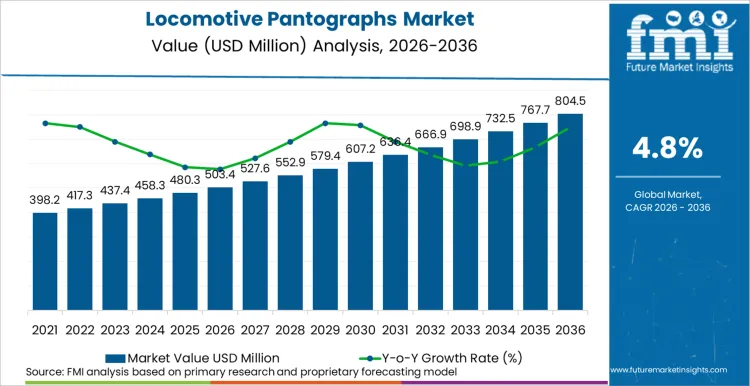
Key Industry Highlights in the Locomotive Pantographs Market
Rising Railway Electrification Projects Fueling Pantograph Demand
Governments around the world are making significant strides in railway electrification as part of efforts to reduce carbon emissions, improve energy efficiency, and decrease dependence on fossil fuels. Over 40% of global rail networks are currently electrified, with major economies like India, China, and Germany heavily investing in expanding electrified rail systems.
India, in particular, has set an ambitious goal to achieve 100% rail electrification by 2030, further fueling demand for advanced pantograph technologies. As of 2023, China, with its already vast electrified rail network, continues to lead globally in railway electrification efforts, with ongoing initiatives aimed at expanding high-speed and freight rail networks.
These electrification projects are a driving force behind the demand for high-performance locomotive pantographs, which play a crucial role in enabling efficient power transmission from overhead lines to locomotives.
As more countries embrace electrification, especially in emerging markets like India and China, the need for robust pantograph systems will continue to rise, supporting the global growth of the locomotive pantographs market.
In Europe, countries like Germany are also spearheading electrification efforts through their Green Deal, which aims to reduce carbon emissions by transitioning to cleaner rail operations. This trend will drive substantial growth in the locomotive pantograph market, as advanced pantographs are essential for the efficient operation of electrified rail systems.
Expansion of High-Speed Rail Networks Driving Pantograph Innovation
High-speed rail networks are rapidly expanding across Asia and Europe, creating a growing demand for advanced pantograph systems capable of handling higher speeds and ensuring reliable power transmission. Countries like China, Japan, France, and Spain are heavily investing in high-speed rail infrastructure to meet the increasing demand for efficient, sustainable transportation.
In China, the government has committed to expanding its high-speed rail network to more than 50,000 kilometers by 2035, making it the world’s largest high-speed rail system.
Similarly, France’s TGV and Japan’s Shinkansen systems are expanding to accommodate more passengers, boosting the need for cutting-edge pantographs that can ensure stable and efficient power transmission at speeds exceeding 300 km/h.
The adoption of lightweight, aerodynamic pantographs designed for high-speed trains is critical to ensuring minimal energy consumption and optimal performance. These pantographs must also incorporate features such as active damping mechanisms to minimize the effects of vibrations at high speeds, ensuring a smooth and stable ride.
The growing demand for high-speed rail in countries like China and Japan is driving the market for pantographs, with manufacturers focusing on developing new, more efficient systems. The growing reliance on high-speed rail as a sustainable alternative to air and road transportation is expected to further boost the locomotive pantograph market in the coming years.
Government Sustainability Initiatives Accelerating Electric Locomotive Adoption
Governments worldwide are increasingly focused on reducing the environmental impact of transportation, with many setting aggressive sustainability goals to combat climate change. As part of these efforts, many nations are transitioning from diesel to electric locomotives, which are more energy-efficient and have a lower carbon footprint.
The European Union's Green Deal, which aims to achieve carbon neutrality by 2050, is a prime example of such sustainability initiatives. Under this deal, the EU is making significant investments in electrified rail systems to reduce the carbon footprint of transportation.
In China, the government’s commitment to achieving carbon neutrality by 2060 is accelerating the adoption of electric rail systems, pushing rail operators to replace diesel locomotives with electric alternatives. This shift is creating a surge in demand for pantographs, as electric trains require these devices to efficiently collect power from overhead lines.
The transition to electric rail systems is also happening in other parts of the world, including North America, where countries like Canada and the USA market are modernizing their rail infrastructure to meet sustainability goals.
As more governments set similar goals, the demand for efficient pantographs will rise, further supporting the growth of the locomotive pantograph market. With their ability to facilitate the transition to electric rail systems, pantographs will be in high demand as governments continue to prioritize sustainability in transportation.
Technological Advancements Enhancing Pantograph Performance and Reliability
Technological advancements in pantograph design and materials are making modern pantographs more efficient, reliable, and cost-effective, which is encouraging widespread adoption across various rail systems. Innovations such as the use of lightweight materials, including carbon fiber and advanced alloys, are making pantographs more durable and less prone to wear, thus reducing maintenance costs for operators.
Additionally, the development of smart sensors and active damping systems is enhancing the performance of pantographs, allowing for better power transmission, improved stability, and reduced vibrations during high-speed operations.
Modern pantographs also feature real-time monitoring capabilities, which enable operators to track their performance and detect any issues before they become critical.
This feature helps ensure the longevity of pantographs and reduces downtime, contributing to more efficient rail operations. Furthermore, automated height adjustment systems are being integrated into pantographs to ensure optimal contact with the overhead lines, improving power transmission and preventing damage to both the pantograph and the rail infrastructure.
These technological advancements are particularly important in high-speed rail and metro systems, where reliability and performance are critical. As rail operators seek to improve operational efficiency and reduce costs, these innovations are driving the adoption of advanced pantograph systems, leading to strong market growth in the locomotive pantographs sector.
Comparison of Historical vs Future Outlook on Locomotive Pantographs Sales
The global locomotive pantograph market experienced steady growth from 2020 to 2024 due to several key factors. During this period, incremental electrification projects were initiated, but the pace was gradual, with many regions focusing on upgrading existing rail systems rather than launching aggressive new ones.
The COVID-19 pandemic led to disruptions in manufacturing, transportation, and infrastructure projects, slowing the progress of rail electrification initiatives and creating a more stable demand for pantographs. Additionally, regional projects, such as the modernization of metro networks or localized electrification efforts, contributed to steady growth rather than rapid expansion.
However, from 2026 to 2036, the market is expected to experience a sharp increase in growth. One of the primary drivers will be the acceleration of global electrification efforts, with countries like India aiming for 100% rail electrification by 2030, while China and other nations continue to expand their electrified networks.
This will lead to a significant surge in pantograph demand, especially as freight and high-speed rail networks expand. The ongoing growth of high-speed rail projects, particularly in China, Japan, France, and Spain, will further drive the need for high-performance pantographs that can handle speeds exceeding 300 km/h.
Analysis of Competitive Landscape in the Locomotive Pantographs Market
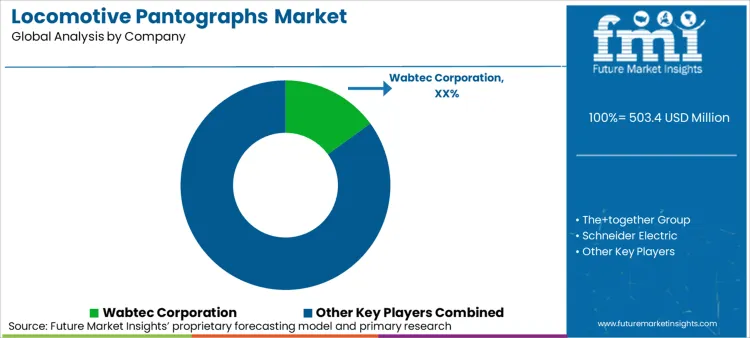
Tier 1 companies include industry leaders with annual revenues exceeding USD 20 million. These companies are currently capturing a significant share of 50% to 55%. These frontrunners are characterized by high production capacity and a wide product portfolio.
They are distinguished by extensive expertise in manufacturing and a broad geographical reach, underpinned by a robust consumer base. The firms provide a wide range of products and utilize the latest technology to meet regulatory standards.
Prominent companies within this tier I players include Wabtec Corporation, The+together Group, Schneider Electric, HeidelbergCement and Others.
Tier 2 companies encompass most of the small-scale enterprises operating within the regional sphere and catering to specialized needs with revenues between USD 10-20 million. These businesses are notably focused on meeting local demand and are hence categorized within the Tier 2 segment. They are small-scale participants with limited geographical presence.
In this context, Tier 2 is acknowledged as an informal sector, indicating a segment distinguished by a lack of extensive organization and formal structure in comparison to the structured one.
Tier II Players such as New Flyer Industries, CRRC Corporation, Knorr Bremse, Bombardier And others have been considered in this tier where they are projected to account for 20-25% of the overall market.
Tier 3 includes the majority of small-scale companies operating at the local presence and serving niche having revenue below USD 10 million. These companies are notably oriented towards fulfilling local demands and are consequently classified within the tier 3 share segment.
They are small-scale players and have limited geographical reach. The manufacturers such as Tier III Players such as Hitachi Rail, Mitsubishi Electric and others are expected to hold 15-20% of the share.
Analysis of Top Countries, Producing, Using, and Distributing Locomotive Pantographs
The below table shows the estimated growth rates of the top three countries. China, India, and Germany are set to record higher CAGRs of 6.1%, 5.7%, and 5.4% respectively, through 2035.
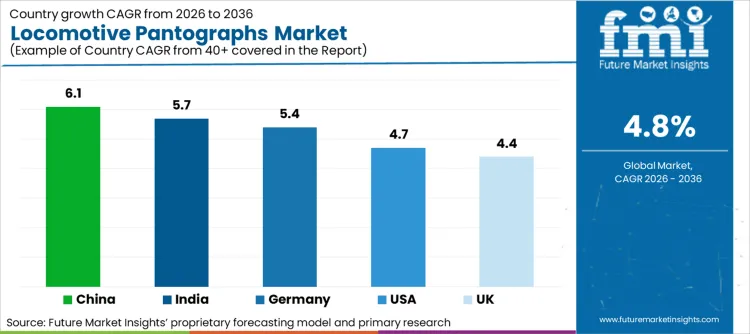
| Countries | CAGR 2026 to 2036 |
|---|---|
| China | 6.1% |
| India | 5.7% |
| Germany | 5.4% |
| USA | 4.7% |
| UK | 4.4% |
China’s Rapid Rail Expansion Driving Locomotive Pantograph Market Growth
The China locomotive pantographs market is poised to exhibit a CAGR of 6.1% during the assessment period. It is expected to attain a valuation of USD 184.4 Million by 2035.
China’s rapid growth in the locomotive pantographs market is fueled by several key factors. The country has one of the largest and most advanced rail networks in the world, with a focus on expanding high-speed rail, which requires high-performance pantographs.
China’s Belt and Road Initiative (BRI) is further accelerating this demand by connecting more countries and developing international railway corridors, thus increasing the need for reliable pantograph systems. The government’s commitment to achieving carbon neutrality by 2060 has also led to increased investments in electrified rail infrastructure, further driving the need for advanced pantographs.
India's Ambitious Electrification Plans Boosting Pantograph Demand
India’s locomotive pantographs market is seeing significant growth due to the country’s ambitious railway electrification plans. The Indian government aims to achieve 100% electrification of its rail network by 2030, which is set to substantially increase demand for pantographs.
Moreover, the development of the Vande Bharat semi-high-speed trains, which are expected to replace many existing trains, further drives the need for advanced pantographs capable of supporting these modern systems.
India’s growing urbanization is also pushing the expansion of metro and light rail systems, such as those in Delhi, Mumbai, and Bengaluru, all of which require efficient pantograph solutions. The combination of electrification targets, high-speed rail projects, and urban expansion positions India as a key growth driver in the locomotive pantographs market.
Sales of locomotive pantographs in India are projected to soar at a CAGR of around 5.7% during the assessment period. The total valuation in the country is anticipated to reach USD 94.4 Million by 2035.
Germany’s Sustainable Rail Initiatives Fueling Locomotive Pantograph Growth
The Germany locomotive pantographs market size is projected to reach USD 54.8 Million by 2035. Over the assessment period, Locomotive Pantographs in the Germany is set to rise at 5.4% CAGR
Germany's strong growth in the locomotive pantographs market is a result of the country’s long-standing commitment to rail infrastructure modernization and sustainability. The country is a leader in high-speed rail development and is investing heavily in upgrading its freight rail systems.
The German government’s participation in the European Union’s Green Deal, which aims to reduce emissions and promote sustainable transport, is encouraging further electrification of rail networks, thus boosting the demand for pantographs.
Germany’s continued expansion of the ICE (InterCity Express) trains and the development of the Trans-European Transport Networks (TEN-T) program are key contributors to the rising need for efficient pantograph systems.
Locomotive Pantographs Industry Analysis by Key Categories
The section explains the growth trends of the leading segments in the industry. In terms of Arm type, the Single-Arm Pantographs will likely disseminate and generate a share of around 74.7% in 2035.
Based on Trains Type, the High-Speed Trains segment is projected to hold a share of 42.2% in 2035. The analysis would enable potential clients to make effective business decisions for investment purposes.
Aerodynamic Efficiency, Lightweight Design, and Cost-Effectiveness Driving the Dominance of Single-Arm Pantographs in the Locomotive Pantograph Market
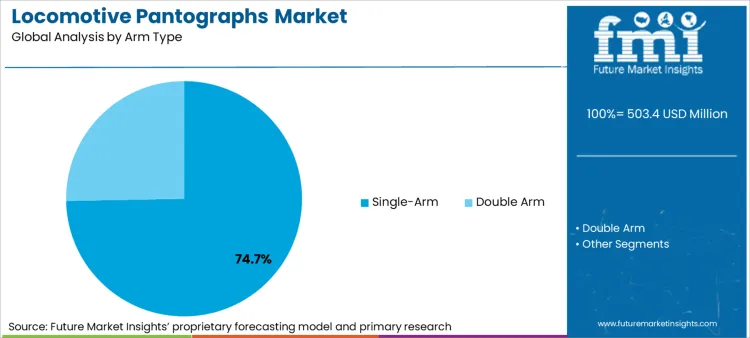
| Segment | Value Share |
|---|---|
| Single-Arm Pantographs (Arm Type) | 74.7% |
Single-arm pantographs are the dominant type in the locomotive pantograph market due to their superior aerodynamic efficiency, lightweight design, and reduced maintenance costs.
These pantographs are particularly preferred for high-speed rail applications, as their streamlined design minimizes air resistance, allowing trains to achieve greater speeds and energy efficiency.
Single-arm pantographs are also more durable and cost-effective, as they have fewer components compared to double-arm pantographs, resulting in lower production and maintenance expenses. They are commonly used in high-speed rail networks, with over 80% of high-speed trains globally equipped with this type of pantograph.
Additionally, single-arm pantographs offer space efficiency and greater reliability in adverse weather conditions, making them the preferred choice for rail operators aiming for optimal performance and reduced operational costs. This combination of factors has established the single-arm pantograph as the leading solution in the market.
High-Speed Trains Lead the Locomotive Pantograph Market Driven by Demand for Efficiency and Sustainability
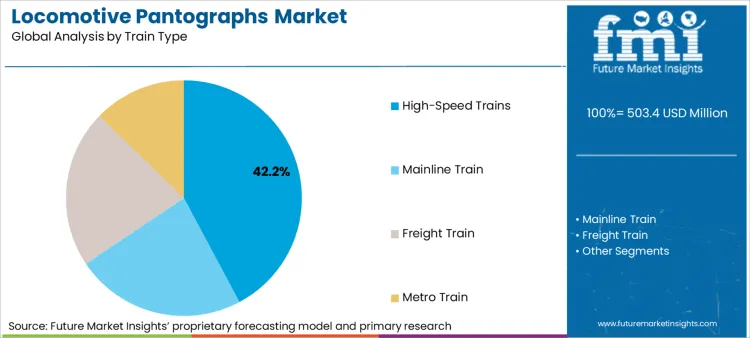
| Segment | Value Share |
|---|---|
| High-Speed Trains (Train Type) | 42.2% |
High-speed trains dominate the locomotive pantograph market due to their growing adoption in global rail networks, driven by the need for efficient, long-distance, and rapid travel.
The demand for high-speed rail is particularly strong in countries like China, Japan, France, and Spain, where extensive high-speed rail infrastructure is in place. These trains require advanced pantographs capable of operating at speeds exceeding 300 km/h, which increases the demand for high-performance pantographs.
High-speed trains represent over 42% of the total pantograph market share, and their market share is expected to grow further due to increasing government investments in high-speed rail projects.
The advanced design of these trains demands pantographs with superior aerodynamic properties, lightweight structures, and higher reliability, driving the preference for single-arm pantographs.
Additionally, with governments globally focusing on sustainable transportation and reducing carbon emissions, high-speed trains are seen as a clean alternative to air and road travel, further contributing to their market dominance.
Leading Suppliers, Distributors, and Manufacturers of Locomotive Pantographs Market
Hydrogen Bus Market's main players like Toyota Motor Corporation, Hyundai Motor Group, Ballard Power Systems, Cummins Inc., and Daimler AG are sprouting the innovation sector via strategic partnerships tying to R&D.
These corporations are fuels cell technologies and drive costs down while making it easier for transit companies to adopt buses. Toyota introduced a new fleet of buses in Japan market that run on renewable hydrogen, providing higher fuel efficiency and better range.
Ballard Power Systems has joined forces with Euro-transit companies on the fuel cell urban bus program. New entrants are replenishing the market, producing goods locally, and providing cutting-edge solutions, thereby injecting competition into the market as well as its expansion..
Significant players are further introducing new products to address the increasing need for cutting-edge solutions in various end-use sectors. Geographic expansion is another important strategy that is being embraced by reputed companies. Start-ups are likely to emerge in the sector through 2035, thereby making it more competitive.
Key companies are investing in continuous research for producing new products and increasing their production capacity to meet end-user demand. They are also showing an inclination toward adopting strategies, including acquisitions, partnerships, mergers, and facility expansions to strengthen their footprint.
Recent Developments
- The report includes full coverage of key trends from competitive benchmarking. Some of the recent developments covered in the report:
- In February 2026, Transmission Dynamics expanded the global rollout of its PANDAS-V monitoring system, using on-board AI accelerators for edge processing of pantograph-catenary contact images and sensor data. [1]
- In January 2026, West Central Railway (India) issued large-scale tenders for high-reach pantographs to support electrified fleet expansion across Indian Railways. [2]
- In 2025, Wabtec acquired Kompozitum and Minuet Relays to integrate carbon material expertise and relay technology into its pantograph portfolio. [3]
- In 2025, Schunk Transit Systems expanded its carbon contact strip production capacity to meet rising demand from Asian high-speed rail operators. [4]
- In 2025, Network Rail (UK) advanced overhead line electrification works for the Midland Main Line, generating pantograph procurement activity. [5]
Leading Global Locomotive Pantograph Brands
- Wabtec Corporation
- The+together Group
- Schneider Electric
- HeidelbergCement
- New Flyer Industries
- CRRC Corporation
- KnorrBremse
- Bombardier
- Hitachi Rail
- Mitsubishi Electric
Scope of the Report
| Items | Values |
|---|---|
| Quantitative Units | USD 503.4 million (2026) to USD 804.4 million (2036), at a CAGR of 4.8% |
| Market Definition | Covers manufacture, sale, and aftermarket replacement of current collection devices for electric locomotives, EMUs, metro, and high-speed rail. |
| Type Segmentation | Single Arm, Double Arm, Diamond |
| Application Segmentation | Electric Locomotives, EMUs, Metro/Light Rail, High-Speed Rail |
| Regions Covered | North America, Latin America, Europe, East Asia, South Asia, Oceania, Middle East and Africa |
| Countries Covered | India, China, Germany, France, United Kingdom, Japan, South Korea, Italy, Spain, United States, Brazil and 30 plus countries |
| Key Companies Profiled | Schunk Transit Systems, Wabtec Corporation, SBS Feintechnik, Mersen, Transmission Dynamics, CRRC, Morgan Advanced Materials, Toyo Denki Seizo, Faiveley Transport, Sécheron |
| Forecast Period | 2026 to 2036 |
| Approach | Hybrid top-down and bottom-up modeling validated through primary interviews with pantograph manufacturers, railway operators, and catenary maintenance contractors |
Locomotive Pantographs Industry Analyzed by Key Investment Segments
By Arm Type:
Arm Type included in the study are Single Arm Pantograph and Double Arm Pantograph.
By Shape:
Shape included in the study are Diamond Shape (For DC rakes) and Bow Type (For both AC & DC).
By Train Type:
By Train Type included in the study are High-Speed Train, Mainline Train, Freight Train, Metro Train and Others.
By Region:
The report covers key regions, including North America, Latin America, Western Europe, Eastern Europe, East Asia, South Asia, and the Middle East and Africa (MEA).
This Report Addresses
- Market intelligence for railway component procurement and electrification programme planning
- Market size estimation and 10-year revenue forecasts from 2026 to 2036
- Growth opportunity mapping across single-arm, double-arm, and diamond pantograph types
- Segment and regional revenue forecasts covering locomotives, EMUs, metro, and high-speed rail
- Competition strategy assessment including carbon strip technology and multi-standard certification
- Condition monitoring and predictive maintenance technology tracking
- Regulatory impact analysis covering TSI, RDSO, and JIS railway safety certification
- Market report delivery in PDF, Excel, PPT, and interactive dashboard formats
Bibliography
- [1] Transmission Dynamics. (2026). PANDAS-V Monitoring System Global Rollout. February 2026.
- [2] Indian Railways / West Central Railway. (2026). Pantograph Tender Notices. January 2026.
- [3] Wabtec. (2025). Acquisition of Kompozitum and Minuet Relays.
- [4] Schunk Transit Systems. (2025). Carbon Contact Strip Capacity Expansion.
- [5] Network Rail. (2025). Midland Main Line Electrification Programme.
- [6] RDSO. (2025). Indian Railway Standards for Pantographs.
- [7] UIC. (2025). International Union of Railways: TSI Compliance Standards.
- [8] ERA. (2025). European Railway Agency: Technical Specifications for Interoperability.
- [9] CRRC. (2025). Rolling Stock and Component Annual Report.
- [10] World Bank. (2025). Railway Electrification Investment Report.
- [11] Future Market Insights. (2026). Locomotive Pantographs Market Report.
- [12] Future Market Insights. (2025). Railway Components Market.
Frequently Asked Questions
How large is the locomotive pantographs market in 2026?
The global market is estimated at USD 503.4 million in 2026.
What will the market size be by 2036?
The market is projected to reach USD 804.4 million by 2036.
What is the expected CAGR?
Demand is expected to grow at a CAGR of 4.8% between 2026 and 2036.
Which type leads?
Single-arm pantographs hold the largest share, standard on most new EMU and high-speed rail platforms.
Which country is growing fastest?
India at 6.5% CAGR, driven by railway electrification targets and large-scale tender activity.
What contact strip material is gaining share?
Carbon/graphite composite strips are displacing copper alloy in high-speed and metro applications due to lower catenary wear.
Preview the report firsthand - request a free sample
Get SampleGet the brochure for pricing and purchase details.
Get PDFTable of Content
- Global Market Outlook
- Demand-side Trends
- Supply-side Trends
- Market Overview
- Market Coverage / Taxonomy
- Market Definition / Scope / Limitations
- Research Methodology
- Chapter Orientation
- Analytical Lens and Working Hypotheses
- Market Structure, Signals, and Trend Drivers
- Benchmarking and Cross-market Comparability
- Market Sizing, Forecasting, and Opportunity Mapping
- Research Design and Evidence Framework
- Desk Research Programme (Secondary Evidence)
- Company Annual and Sustainability Reports
- Peer-reviewed Journals and Academic Literature
- Corporate Websites, Product Literature, and Technical Notes
- Earnings Decks and Investor Briefings
- Statutory Filings and Regulatory Disclosures
- Technical White Papers and Standards Notes
- Expert Input and Fieldwork (Primary Evidence)
- Primary Modes
- Qualitative Interviews and Expert Elicitation
- Quantitative Surveys and Structured Data Capture
- Blended Approach
- Why Primary Evidence is Used
- Field Techniques
- Interviews
- Surveys
- Focus Groups
- Observational and In-context Research
- Social and Community Interactions
- Stakeholder Universe Engaged
- C-suite Leaders
- Board Members
- Presidents and Vice Presidents
- R&D and Innovation Heads
- Technical Specialists
- Domain Subject-matter Experts
- Scientists
- Physicians and Other Healthcare Professionals
- Governance, Ethics, and Data Stewardship
- Research Ethics
- Data Integrity and Handling
- Primary Modes
- Tooling, Models, and Reference Databases
- Data Engineering and Model Build
- Data Acquisition and Ingestion
- Cleaning, Normalisation, and Verification
- Synthesis, Triangulation, and Analysis
- Quality Assurance and Audit Trail
- Desk Research Programme (Secondary Evidence)
- Market Background
- Market Dynamics
- Drivers
- Restraints
- Opportunity
- Trends
- Scenario Forecast
- Demand in Optimistic Scenario
- Demand in Likely Scenario
- Demand in Conservative Scenario
- Opportunity Map Analysis
- Product Life Cycle Analysis
- Supply Chain Analysis
- Investment Feasibility Matrix
- Value Chain Analysis
- PESTLE and Porter’s Analysis
- Regulatory Landscape
- Regional Parent Market Outlook
- Production and Consumption Statistics
- Import and Export Statistics
- Market Dynamics
- Global Market Analysis 2021 to 2025 and Forecast, 2026 to 2036
- Historical Market Size Value (USD Million) Analysis, 2021 to 2025
- Current and Future Market Size Value (USD Million) Projections, 2026 to 2036
- Y-o-Y Growth Trend Analysis
- Absolute $ Opportunity Analysis
- Global Market Pricing Analysis 2021 to 2025 and Forecast 2026 to 2036
- Global Market Analysis 2021 to 2025 and Forecast 2026 to 2036, By Arm Type
- Introduction / Key Findings
- Historical Market Size Value (USD Million) Analysis By Arm Type , 2021 to 2025
- Current and Future Market Size Value (USD Million) Analysis and Forecast By Arm Type , 2026 to 2036
- Single-Arm
- Double Arm
- Single-Arm
- Y-o-Y Growth Trend Analysis By Arm Type , 2021 to 2025
- Absolute $ Opportunity Analysis By Arm Type , 2026 to 2036
- Global Market Analysis 2021 to 2025 and Forecast 2026 to 2036, By Train Type
- Introduction / Key Findings
- Historical Market Size Value (USD Million) Analysis By Train Type, 2021 to 2025
- Current and Future Market Size Value (USD Million) Analysis and Forecast By Train Type, 2026 to 2036
- High-Speed Trains
- Mainline Train
- Freight Train
- Metro Train
- High-Speed Trains
- Y-o-Y Growth Trend Analysis By Train Type, 2021 to 2025
- Absolute $ Opportunity Analysis By Train Type, 2026 to 2036
- Global Market Analysis 2021 to 2025 and Forecast 2026 to 2036, By Region
- Introduction
- Historical Market Size Value (USD Million) Analysis By Region, 2021 to 2025
- Current Market Size Value (USD Million) Analysis and Forecast By Region, 2026 to 2036
- North America
- Latin America
- Western Europe
- Eastern Europe
- East Asia
- South Asia and Pacific
- Middle East & Africa
- Market Attractiveness Analysis By Region
- North America Market Analysis 2021 to 2025 and Forecast 2026 to 2036, By Country
- Historical Market Size Value (USD Million) Trend Analysis By Market Taxonomy, 2021 to 2025
- Market Size Value (USD Million) Forecast By Market Taxonomy, 2026 to 2036
- By Country
- USA
- Canada
- Mexico
- By Arm Type
- By Train Type
- By Country
- Market Attractiveness Analysis
- By Country
- By Arm Type
- By Train Type
- Key Takeaways
- Latin America Market Analysis 2021 to 2025 and Forecast 2026 to 2036, By Country
- Historical Market Size Value (USD Million) Trend Analysis By Market Taxonomy, 2021 to 2025
- Market Size Value (USD Million) Forecast By Market Taxonomy, 2026 to 2036
- By Country
- Brazil
- Chile
- Rest of Latin America
- By Arm Type
- By Train Type
- By Country
- Market Attractiveness Analysis
- By Country
- By Arm Type
- By Train Type
- Key Takeaways
- Western Europe Market Analysis 2021 to 2025 and Forecast 2026 to 2036, By Country
- Historical Market Size Value (USD Million) Trend Analysis By Market Taxonomy, 2021 to 2025
- Market Size Value (USD Million) Forecast By Market Taxonomy, 2026 to 2036
- By Country
- Germany
- UK
- Italy
- Spain
- France
- Nordic
- BENELUX
- Rest of Western Europe
- By Arm Type
- By Train Type
- By Country
- Market Attractiveness Analysis
- By Country
- By Arm Type
- By Train Type
- Key Takeaways
- Eastern Europe Market Analysis 2021 to 2025 and Forecast 2026 to 2036, By Country
- Historical Market Size Value (USD Million) Trend Analysis By Market Taxonomy, 2021 to 2025
- Market Size Value (USD Million) Forecast By Market Taxonomy, 2026 to 2036
- By Country
- Russia
- Poland
- Hungary
- Balkan & Baltic
- Rest of Eastern Europe
- By Arm Type
- By Train Type
- By Country
- Market Attractiveness Analysis
- By Country
- By Arm Type
- By Train Type
- Key Takeaways
- East Asia Market Analysis 2021 to 2025 and Forecast 2026 to 2036, By Country
- Historical Market Size Value (USD Million) Trend Analysis By Market Taxonomy, 2021 to 2025
- Market Size Value (USD Million) Forecast By Market Taxonomy, 2026 to 2036
- By Country
- China
- Japan
- South Korea
- By Arm Type
- By Train Type
- By Country
- Market Attractiveness Analysis
- By Country
- By Arm Type
- By Train Type
- Key Takeaways
- South Asia and Pacific Market Analysis 2021 to 2025 and Forecast 2026 to 2036, By Country
- Historical Market Size Value (USD Million) Trend Analysis By Market Taxonomy, 2021 to 2025
- Market Size Value (USD Million) Forecast By Market Taxonomy, 2026 to 2036
- By Country
- India
- ASEAN
- Australia & New Zealand
- Rest of South Asia and Pacific
- By Arm Type
- By Train Type
- By Country
- Market Attractiveness Analysis
- By Country
- By Arm Type
- By Train Type
- Key Takeaways
- Middle East & Africa Market Analysis 2021 to 2025 and Forecast 2026 to 2036, By Country
- Historical Market Size Value (USD Million) Trend Analysis By Market Taxonomy, 2021 to 2025
- Market Size Value (USD Million) Forecast By Market Taxonomy, 2026 to 2036
- By Country
- Kingdom of Saudi Arabia
- Other GCC Countries
- Turkiye
- South Africa
- Other African Union
- Rest of Middle East & Africa
- By Arm Type
- By Train Type
- By Country
- Market Attractiveness Analysis
- By Country
- By Arm Type
- By Train Type
- Key Takeaways
- Key Countries Market Analysis
- USA
- Pricing Analysis
- Market Share Analysis, 2025
- By Arm Type
- By Train Type
- Canada
- Pricing Analysis
- Market Share Analysis, 2025
- By Arm Type
- By Train Type
- Mexico
- Pricing Analysis
- Market Share Analysis, 2025
- By Arm Type
- By Train Type
- Brazil
- Pricing Analysis
- Market Share Analysis, 2025
- By Arm Type
- By Train Type
- Chile
- Pricing Analysis
- Market Share Analysis, 2025
- By Arm Type
- By Train Type
- Germany
- Pricing Analysis
- Market Share Analysis, 2025
- By Arm Type
- By Train Type
- UK
- Pricing Analysis
- Market Share Analysis, 2025
- By Arm Type
- By Train Type
- Italy
- Pricing Analysis
- Market Share Analysis, 2025
- By Arm Type
- By Train Type
- Spain
- Pricing Analysis
- Market Share Analysis, 2025
- By Arm Type
- By Train Type
- France
- Pricing Analysis
- Market Share Analysis, 2025
- By Arm Type
- By Train Type
- India
- Pricing Analysis
- Market Share Analysis, 2025
- By Arm Type
- By Train Type
- ASEAN
- Pricing Analysis
- Market Share Analysis, 2025
- By Arm Type
- By Train Type
- Australia & New Zealand
- Pricing Analysis
- Market Share Analysis, 2025
- By Arm Type
- By Train Type
- China
- Pricing Analysis
- Market Share Analysis, 2025
- By Arm Type
- By Train Type
- Japan
- Pricing Analysis
- Market Share Analysis, 2025
- By Arm Type
- By Train Type
- South Korea
- Pricing Analysis
- Market Share Analysis, 2025
- By Arm Type
- By Train Type
- Russia
- Pricing Analysis
- Market Share Analysis, 2025
- By Arm Type
- By Train Type
- Poland
- Pricing Analysis
- Market Share Analysis, 2025
- By Arm Type
- By Train Type
- Hungary
- Pricing Analysis
- Market Share Analysis, 2025
- By Arm Type
- By Train Type
- Kingdom of Saudi Arabia
- Pricing Analysis
- Market Share Analysis, 2025
- By Arm Type
- By Train Type
- Turkiye
- Pricing Analysis
- Market Share Analysis, 2025
- By Arm Type
- By Train Type
- South Africa
- Pricing Analysis
- Market Share Analysis, 2025
- By Arm Type
- By Train Type
- USA
- Market Structure Analysis
- Competition Dashboard
- Competition Benchmarking
- Market Share Analysis of Top Players
- By Regional
- By Arm Type
- By Train Type
- Competition Analysis
- Competition Deep Dive
- Wabtec Corporation
- Overview
- Product Portfolio
- Profitability by Market Segments (Product/Age /Sales Channel/Region)
- Sales Footprint
- Strategy Overview
- Marketing Strategy
- Product Strategy
- Channel Strategy
- The+together Group
- Schneider Electric
- HeidelbergCement
- New Flyer Industries
- CRRC Corporation
- Wabtec Corporation
- Competition Deep Dive
- Assumptions & Acronyms Used


