

- Market Size (2026)
- USD 1062.3 Mn
- Forecast (2036)
- USD 2379.8 Mn
- CAGR (2026 to 2036)
- 8.4%
How big is Low-Glycemic Noodles Market in 2026?
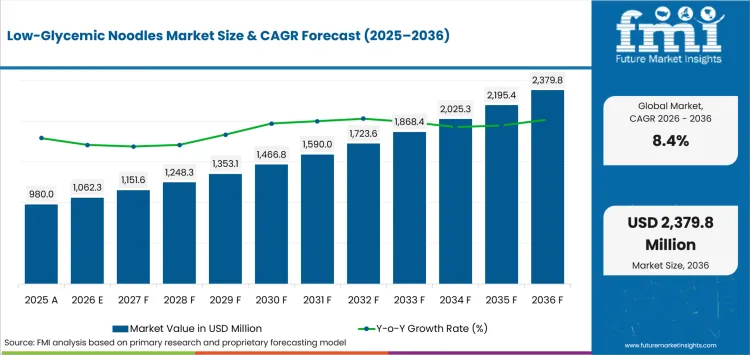
USD 1,062.3 million in 2026 and USD 2379.8 million by 2036 at a 8.4% CAGR.
The low-glycemic noodles market is projected to grow at an 8.4% CAGR from USD 1062.3 million in 2026 to USD 2379.8 million by 2036. The market was valued at USD 980.0 million in 2025 and is expected to add USD 1317.5 million in value over the forecast period.
Demand is being pulled by a practical nutrition problem: people who monitor glucose still want familiar noodle meals. NIDDK explains that dietary carbohydrates are converted to glucose and can raise blood glucose. The agency also notes that carbohydrate counting is one common meal-planning method for people with diabetes. That mechanism gives low-glycemic noodles a clear purchase job. They must preserve a recognizable eating occasion while changing carbohydrate quality, available carbohydrate or digestion rate. In January 2026, CDC reported that 40.1 million people in the United States had diagnosed or undiagnosed diabetes in 2023. It also estimated 115.2 million US adults with prediabetes. For brands, the commercial test is not whether consumers understand the health issue. It is whether a lower-glycemic noodle can deliver credible nutrition cues with taste, texture and preparation close enough to conventional routines to earn repeat purchase.
Country conversion will follow different paths. In the USA, broad diabetes awareness coincides with active grocery launches and a large online market. The UK combines a well-developed health retail channel with close scrutiny of product claims and value. Germany has a large diagnosed diabetes population, but suppliers still need a format that fits a mature pasta and noodle aisle without feeling clinical. Japan presents a different task because buyers already have deep familiarity with noodle textures and meal conventions. ZENB addressed that point in February 2025 by launching a yellow-pea spaghetti designed specifically for Japanese retail stores. South Korea adds a further contrast because public nutrition guidance emphasizes carbohydrate quality within a diet where carbohydrates remain a major energy source. Across these markets, interest converts into purchase when validated glycemic positioning is matched by a local format, accessible channel and acceptable eating experience.
Key Takeaways of Low-Glycemic Noodles Market
- By base ingredient, Konjac / Shirataki is estimated to account for 30.9% in 2026 due to its low-digestible-carbohydrate fiber structure; by diet claim, Diabetic-Friendly is estimated to account for 28.6% in 2026 driven by its direct shopping cue for consumers managing post-meal glucose and carbohydrate intake.
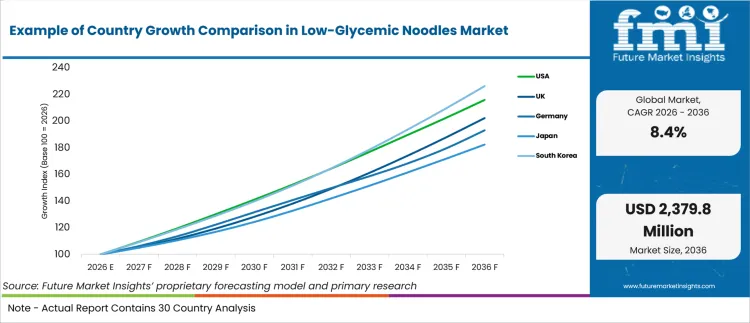
- Among the key countries, South Korea leads at an 8.5% CAGR, followed by USA (8.0%), UK (7.3%), Germany (6.8%), and Japan (6.2%) from 2026 to 2036.
- By product type, Dried Noodles are estimated to account for 34.7% in 2026 because shelf stability supports conventional grocery merchandising, pantry replenishment, and lower preparation friction compared with wet noodle formats.
- Texture, odor, and preparation differences constrain repeat adoption because alternative base ingredients can produce unfamiliar mouthfeel, require a drain-and-rinse step, or deliver cooking results that deviate from conventional noodle expectations.
- Miracle Noodle, Slendier, Better Than Foods, and NOoodle compete through konjac-centered low-carb platforms emphasizing fiber-based formulation and texture refinement. ZENB, Banza, Explore Cuisine, and Liviva deliver legume and protein-led dried pasta platforms built around pantry-stable shapes and familiar cooking routines. It's Skinny and Palmini address convenience and vegetable-based alternatives for rapid meal occasions.
Analyst Perspective
"Low-glycemic noodles must support a credible glycemic-positioning claim while still delivering the portion, mouthfeel and preparation convenience expected from the category. Suppliers that pair ingredient transparency with familiar eating quality can reduce the trial-to-repeat barrier."
- Nandini Roy Choudhury, Principal Consultant, Future Market Insights
How is the Low-Glycemic Noodles Market segmented?
The low-glycemic noodles market is segmented by base ingredient, product type, diet claim, glycemic index, sales channel, and region.
Base Ingredient separates products by the carbohydrate or fiber architecture that shapes digestion and texture. Product Type distinguishes pantry-stable noodles from wet, instant, ready-meal and frozen formats. Diet Claim captures the purchase language used to connect products with diabetic-friendly, low-carb, gluten-free, vegan or clean-label needs. Glycemic Index organizes products by measured or assigned GI bands within the low-glycemic range. Sales Channel shows where consumers or foodservice buyers encounter the product and how much education the purchase requires.
What makes Konjac / Shirataki central to the base ingredient category?
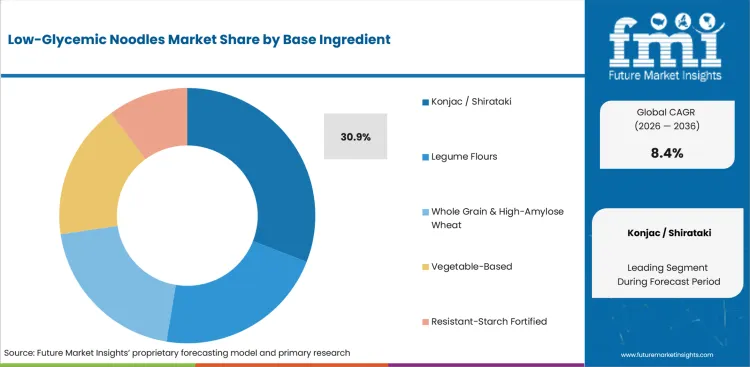
Konjac / Shirataki leads because its product architecture starts with soluble-fiber-rich konjac rather than a conventional starch-heavy flour. That makes the format naturally compatible with low available carbohydrate positioning while preserving a recognizable noodle shape. Miracle Noodle lists water and konjac flour as the core ingredients in its shirataki products. The strength of the segment is therefore structural rather than claim-led. Suppliers can formulate around a fiber matrix and then compete on texture, odor control, preparation and sauce absorption. The main commercial challenge is reducing the sensory distance from wheat or rice noodles without losing the carbohydrate profile that gives konjac its role in the category.
- Konjac / Shirataki represents 30.9% of Base Ingredient in 2026, supported by a low-digestible-carbohydrate structure and established use across wet noodle forms.
- In March 2025, It's Skinny presented ready-to-eat pasta meals made with its signature konjac noodles, showing how the ingredient can move from a specialist noodle pouch into a full convenience occasion.
Why do dried noodles lead the product type category?
Dried Noodles lead because shelf stability reduces handling friction for retailers and households. The format fits standard pantry storage, parcel delivery and recurring online orders. It also gives brands more freedom to use legume flour, resistant starch or protein-rich blends that behave like conventional dry pasta. A 2017 Horticulturae study on dried konjac noodles found that rehydration conditions changed tensile strength and elongation. Longer hot-water hydration made the samples softer. The finding shows why dried formats need texture engineering as well as shelf stability. Commercially, a successful product has to deliver a familiar cooking result without the liquid pouch and rinsing routine associated with many wet shirataki products.
- Dried Noodles account for 34.7% of Product Type in 2026 because shelf stability supports conventional grocery merchandising and lower-friction replenishment.
- In April 2026, Banza launched Wheat Protein Pasta in three dried shapes and began a nationwide US retail rollout, reinforcing the role of pantry-stable formats in mainstream better-for-you pasta placement.
How does diabetic-friendly positioning lead the diet claim category?
Diabetic-Friendly leads because it translates a technical nutrition objective into a direct shopping cue. People managing diabetes often monitor carbohydrate intake and post-meal glucose response. NIDDK notes that carbohydrate counting is a common meal-planning approach for people with diabetes. That creates demand for products that make carbohydrate quality easier to assess at the shelf. The claim alone is not enough. Products still need substantiated nutrition information, appropriate portion guidance and a format consumers can integrate into familiar meals. Brands with credible GI evidence or clearly disclosed carbohydrate and fiber profiles can reduce the information burden without turning the product into a medicalized purchase.
- Diabetic-Friendly holds 28.6% of Diet Claim in 2026 because it gives the clearest decision cue to shoppers managing post-meal glucose or carbohydrate intake.
- In February 2026, Banza published guidance stating that its Chickpea Pasta and Brown Rice Pasta had been glycemic-index tested and fell within the low-GI range. The disclosure shows how a blood-sugar-oriented purchase cue can be paired with product-level testing.
What supports GI <=40 within the glycemic index category?
GI <=40 leads because it offers the strongest numerical separation from the upper end of the low-GI range. Buyers who already understand glycemic index can use the threshold as a compact comparison signal. ISO 26642:2010 provides a standardized method for determining GI and recommends criteria for classifying foods by glycemic response. A low number is commercially useful only when the underlying product remains acceptable as food. Formulators therefore need to balance resistant starch, legume flour, fiber or alternative vegetable structures against cooking performance. The segment benefits when measured evidence is easy to communicate and the product does not require consumers to trade away texture or meal versatility.
- GI <=40 represents 44.2% of Glycemic Index in 2026, giving the leading band a clear evidence-led position for consumers seeking the lowest GI tier in the market taxonomy.
- In February 2026, Banza stated that its Chickpea and Brown Rice Pastas had been glycemic-index tested and fell within the low-GI range. The example illustrates how product-level testing can make glycemic positioning more comparable at the shelf.
What drives supermarkets & hypermarkets in the sales channel category?
Supermarkets & Hypermarkets lead because low-glycemic noodles increasingly need to win beside conventional pantry staples rather than only inside specialist diet channels. Physical grocery creates repeated visibility and lets buyers compare shape, ingredient list, nutrition panel and price in one trip. That favors products with packaging that explains the glycemic proposition quickly. It also rewards formats that store and cook like familiar noodles. Banza planned nationwide placement of its Wheat Protein Pasta across major US retailers from April 2026. The rollout included Kroger and Whole Foods Market. The commercial logic is simple: broader retail reach increases purchase opportunities. Only products with clear shelf communication and dependable replenishment can convert that access into repeat volume.
- Supermarkets & Hypermarkets account for 32.6% of Sales Channel in 2026 because mainstream grocery combines product discovery, comparison and habitual replenishment.
- In February 2025, ZENB introduced a retail-exclusive yellow-pea spaghetti for supermarkets and convenience stores in Japan, moving a legume-based alternative beyond an online-first route to market.
What are the drivers, restraints and opportunities in the Low-Glycemic Noodles Market?
Demand is supported by glucose-management needs, while sensory and preparation differences can restrain repeat purchase, and validated mainstream convenience formats create the clearest expansion opportunity.
- Driver: Growing need to manage post-meal glucose without abandoning familiar noodle meals.
- Restraint: Texture, odor and preparation differences can limit the appeal of some alternative noodle formats.
- Opportunity: Validated low-GI noodles in dried and ready-to-eat formats can move further into mainstream grocery and foodservice.
Metabolic-Health Demand Supports Lower-Glycemic Noodles
The driver begins with a health-management task rather than a taste trend. CDC reported in January 2026 that 40.1 million people in the USA had diagnosed or undiagnosed diabetes in 2023. NIDDK explains that carbohydrates are converted to glucose and can raise blood glucose. Consumers who act on that knowledge do not necessarily want to stop eating noodles. They want an easier way to fit a familiar meal into a carbohydrate-aware routine. This pushes manufacturers toward konjac, legume flours, resistant starch and other formulations that alter carbohydrate exposure while keeping recognizable shapes and preparation methods. The revenue effect appears when a health need changes a routine purchase rather than creating only occasional trial.
Texture and Claim Credibility Can Limit Adoption
The restraint is most visible at the eating and preparation stage. Better Than Foods notes that traditional konjac can be translucent, rubbery and strongly odored. Its newer konjac range was designed to avoid a drain-and-rinse step. A 2023 Foods study evaluating konjac glucomannan in yellow alkaline noodles also treated texture and water absorption as formulation outcomes. Together, these sources show why the nutrition proposition can be strong while eating performance still needs engineering. Wet packaging can add another unfamiliar step. These frictions do not remove demand, but they raise the threshold for repeat use. Suppliers need better texture, neutral aroma and simpler preparation before low-glycemic noodles can become routine pantry items rather than products reserved for tightly managed diets.
Ingredient Transparency Supports Repeat Purchase
The opportunity is to combine verified glycemic positioning with formats that already fit mainstream shopping behavior. In April 2026, Banza expanded a protein-forward dried pasta line across major US retailers. In March 2025, It's Skinny introduced ready-to-eat konjac pasta meals that reduce the preparation burden further. These actions point to two addressable occasions: pantry replacement and rapid meal assembly. Brands are best placed to capture the opening when they can provide measured GI or equivalent nutrition evidence, then translate that proof into conventional shapes and convenient cooking. The opportunity is therefore broader use frequency, not simply more diet claims on the same specialist pouch.
Which country CAGRs are profiled in the Low-Glycemic Noodles Market?
| Country | CAGR |
|---|---|
| USA | 8.0% |
| UK | 7.3% |
| Germany | 6.8% |
| Japan | 6.2% |
| South Korea | 8.5% |
How do country-level CAGRs compare in the Low-Glycemic Noodles Market?
The five-country growth range spans 2.3 percentage points, from 8.5% in South Korea to 6.2% in Japan. South Korea and USA form the upper-growth group at 8.5% and 8.0%. UK sits in the middle at 7.3%. Germany at 6.8% and Japan at 6.2% form a slower-growth band. The pattern does not indicate relative market size. It shows how quickly demand is expected to expand under different nutrition needs, retail structures and product-fit conditions.
- South Korea leads USA by 0.5 percentage points. The small gap means channel execution and local meal compatibility can matter more than headline growth-rate separation.
- USA leads UK by 0.7 percentage points. The US case combines a large identified diabetes and prediabetes population with active better-for-you pasta launches in national grocery.
- UK leads Germany by 0.5 percentage points. Both markets require credible nutrition positioning, but retailer fit and consumer willingness to trade from conventional pasta can set the pace.
- Germany leads Japan by 0.6 percentage points. Japan remains commercially relevant because local brands can adapt legume noodles to established noodle expectations even at a lower forecast CAGR.
CAGR should be read as a pace measure rather than an absolute opportunity ranking. Supplier decisions also depend on diabetes burden and the maturity of specialty nutrition channels. Local noodle habits and evidence expectations also shape conversion. The cost of educating shoppers matters as well. The broader report therefore evaluates country growth together with product architecture and channel access. It also considers the friction that separates initial trial from repeat purchase.
Country-wise Analysis
- USA: Consumers can encounter low-glycemic noodles through mainstream grocery, e-commerce and health-oriented retail, which makes shelf communication and repeat availability critical. Demand for low-glycemic noodles in USA is forecast to expand at 8.0% CAGR from 2026 to 2036. In January 2026, CDC reported 40.1 million people with diagnosed or undiagnosed diabetes in 2023 and 115.2 million adults with prediabetes. The friction is a crowded better-for-you aisle where nutrition claims alone do not guarantee repeat purchase. Suppliers need measured evidence, familiar cooking behavior and national replenishment. Banza's April 2026 retail rollout illustrates how product proof and broad distribution can be paired.
- UK: UK buyers can move between supermarkets, specialist health stores and online channels, so brands must maintain a consistent proposition across very different purchase environments. Demand for low-glycemic noodles in UK is forecast to expand at 7.3% CAGR from 2026 to 2036. In April 2026, the Office for Health Improvement and Disparities updated England's diabetes profile with 2024 to 2025 National Diabetes Audit and Quality and Outcomes Framework data. The local friction is proving value in a market where shoppers already face many high-fiber, gluten-free and low-carb alternatives. Suppliers need clear glycemic evidence, straightforward preparation and reliable supermarket or health-store availability.
- Germany: German consumers encounter a mature pasta category and a structured health-information environment, so low-glycemic products need to feel nutritionally credible without looking like a narrow therapeutic substitute. Demand for low-glycemic noodles in Germany is forecast to expand at 6.8% CAGR from 2026 to 2036. In July 2025, the Robert Koch Institute reported that 10.3% of adults in Germany had physician-diagnosed diabetes in 2024. The friction is product substitution: alternative texture or unfamiliar ingredients can slow repeat buying even when the health rationale is clear. Suppliers should favor dried formats, transparent nutrition panels and cooking performance close to conventional pasta.
- Japan: Japanese noodle buyers have strong format expectations, which makes texture, strand size and recipe versatility central to adoption. Demand for low-glycemic noodles in Japan is forecast to expand at 6.2% CAGR from 2026 to 2036. In December 2025, the Ministry of Health, Labour and Welfare estimated about 11 million people strongly suspected of having diabetes in its 2024 National Health and Nutrition Survey. The friction is not lack of noodle familiarity but the risk that alternative ingredients feel unlike the expected meal. Suppliers need localized shapes and channels. ZENB's February 2025 retail-exclusive yellow-pea spaghetti shows that route.
- South Korea: South Korean nutrition guidance treats carbohydrates as a major energy source and emphasizes lower-GI choices for glucose management. Demand for low-glycemic noodles in South Korea is forecast to expand at 8.5% CAGR from 2026 to 2036. In December 2025, KDCA reported adult diabetes prevalence of 9.4% for 2023 and noted that only 24.2% of affected adults met glucose-control criteria in 2019 to 2021. KDCA nutrition guidance also recommends lower-GI carbohydrate choices for blood-glucose management. The friction is fitting the proposition into familiar dishes. Suppliers should adapt noodle texture, seasoning compatibility and pack instructions for local meal occasions.
Who are the notable companies in the Low-Glycemic Noodles Market?
Miracle Noodle, Slendier, ZENB, Banza, Explore Cuisine, It's Skinny, Better Than Foods, NOoodle, Liviva, and Palmini are the notable companies profiled in this market.
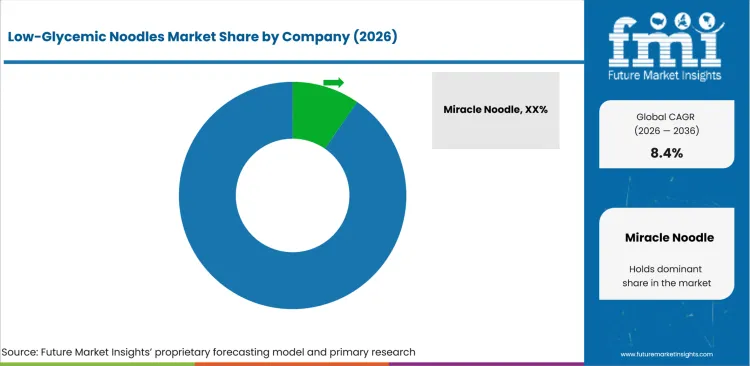
Competition is organized around how each brand solves the starch-replacement problem. Konjac-centered brands such as Miracle Noodle, Slendier, Better Than Foods and NOoodle emphasize a fiber-based base ingredient and very low available carbohydrate. Another group uses pantry-stable alternatives. It includes ZENB, Banza, Explore Cuisine and Liviva. These companies compete through legume, protein or dried shirataki formats that fit a pantry-pasta routine. It's Skinny and Palmini push convenience or vegetable-based substitution. The strategic difference is therefore not simply ingredient choice. It is the ability to combine glycemic relevance with conventional texture, credible labeling and repeatable access through grocery or online channels.
- Konjac-Centered Low-Carb Platforms: Miracle Noodle, Slendier, Better Than Foods and NOoodle compete around fiber-based noodles plus preparation and texture refinement.
- Legume and Protein-Led Dried Pasta Platforms: ZENB, Banza, Explore Cuisine and Liviva compete through pantry-stable shapes, protein or fiber density and familiar cooking routines.
- Convenience and Vegetable-Based Alternatives: It's Skinny and Palmini extend the market through ready-meal occasions or hearts-of-palm substitution that reduces reliance on flour-based noodles.
Competitive Benchmarking: Low-Glycemic Noodles Market
| Company | Glycemic-Position Evidence | Low-Glycemic Format Breadth | Retail & Online Access | Geographic Reach |
|---|---|---|---|---|
| Miracle Noodle | Medium | High | High | United States; direct online and national retail |
| Slendier | Medium | High | Medium | Australia, United Kingdom, United States and online markets |
| ZENB | Medium | High | Medium | Japan; prior US market presence and current Japanese retail |
| Banza | High | High | High | United States with nationwide grocery distribution |
| Explore Cuisine | Medium | High | Medium | North America, United Kingdom and other regional online storefronts |
| It's Skinny | Medium | High | High | United States via Amazon, Publix, Kroger and direct channels |
| Better Than Foods | Medium | High | Medium | United Kingdom grocery, health-store and direct channels |
| NOoodle | Medium | Medium | Medium | United States; documented QVC, HSN, Costco and supermarket history |
| Liviva | Medium | High | High | United States and Canada with multiple grocery chains plus online |
| Palmini | Medium | High | Medium | United States plus documented online availability in several international markets |
Scoring basis: Glycemic-Position Evidence rates High where measured GI or equivalent product-level evidence is publicly disclosed, Medium where formulation and nutrition documentation support a direct low-carbohydrate or low-GI position, and Unscored where public evidence is insufficient. Low-Glycemic Format Breadth rates the number and diversity of relevant noodle formats within the stated market boundary. Retail & Online Access rates documented availability across mainstream grocery and direct or e-commerce routes. High indicates broad documented capability. Medium indicates credible but narrower capability. Low is reserved for a documented limitation, while unavailable public information is left Unscored.
Key Developments in the Low-Glycemic Noodles Market
- In April 2026, Banza launched Wheat Protein Pasta and Wheat Protein Mac & Cheese. The pasta combined semolina wheat with chickpeas and entered Rotini, Penne and Elbow shapes, with a nationwide rollout across major US retailers from April. The development broadens the market into a more conventional wheat eating experience while keeping the product inside a nutrition-led alternative pasta portfolio.
- In August 2025, ZENB began a collaboration with Alisan Park Cafe in Tokyo that featured ZENB noodle dishes and on-site product sales. The program used yellow-pea noodles in several meal occasions, including pasta and Asian-style dishes. The action gives ZENB a foodservice demonstration channel where consumers can trial legume-based noodles before buying packaged products, reducing the gap between product education and direct eating experience.
- In March 2025, It's Skinny debuted ready-to-eat pasta meals built around its konjac noodles. The range included Truffle Parm, Cacio e Pepe and Velvety Cheddar formats and was designed for rapid preparation. The company also highlighted availability through Amazon, Publix and Kroger. The development moves low-carbohydrate konjac noodles beyond a base ingredient or pouch format into a complete meal occasion with less preparation friction.
- In February 2025, ZENB announced a retail-exclusive ZENB Spaghetti made from yellow peas for Japanese supermarkets and convenience stores. The product was designed around a chewy spaghetti texture and conventional seven-minute boiling routine. The launch shifted an online-first legume pasta proposition into physical retail and made the product easier to compare with conventional noodles at the point of purchase.
Key Players in the Low-Glycemic Noodles Market
Konjac-Centered Low-Carb Platforms
- Miracle Noodle
- Slendier
- Better Than Foods
- NOoodle
Legume and Protein-Led Dried Pasta Platforms
- ZENB
- Banza
- Explore Cuisine
- Liviva
Convenience and Vegetable-Based Alternatives
- It's Skinny
- Palmini
Low-Glycemic Noodles Market - Report Scope
| Coverage field | Report scope |
|---|---|
| Market breakdown | By Base Ingredient, Product Type, Diet Claim, Glycemic Index, Sales Channel, and Region. |
| Quantitative Units | USD million. |
| Market Definition | Revenue includes branded or manufacturer sales of low-glycemic noodles and noodle-like pasta products within the stated ingredient, product, diet-claim, GI and channel taxonomy. Packaged ready-meal noodle SKUs are included. Restaurant meal bill value, adjacent rice or bread substitutes and downstream finished-product revenue outside the defined noodle product are excluded. |
| Regions Covered | North America; Latin America; Western Europe; Eastern Europe; East Asia; South Asia and Pacific; Middle East and Africa |
| Countries Covered | USA, UK, Germany, Japan, South Korea, and more than twenty-five additional countries in the full report |
| Key Companies Profiled | Miracle Noodle, Slendier, ZENB, Banza, Explore Cuisine, It's Skinny, Better Than Foods, NOoodle, Liviva, Palmini |
| Forecast Period | 2026 to 2036 |
| Approach | FMI applies a hybrid bottom-up and top-down sizing approach that reconciles product-level revenues with channel, country and segment demand indicators. |
Low-Glycemic Noodles Market - Research Methodology
| Method | Approach |
|---|---|
| Primary Research | Structured discussions with manufacturers, distributors, retailers, foodservice operators, category buyers and subject-matter specialists are used to test product definitions, channel behavior, pricing logic, purchase triggers and adoption frictions. |
| Desk Research | Public-health statistics, food and nutrition guidance, glycemic-index standards, peer-reviewed technical evidence, company product documentation, retail availability and dated company announcements are reviewed for direct relevance to the market boundary. |
| Market Sizing and Forecasting | Base-year value, segment structure, country growth profiles, product mix, channel mix, product availability and adoption conditions are reconciled within a hybrid sizing framework. Forecast assumptions reflect conversion from specialty use toward broader retail and foodservice availability. |
| Data Validation | Findings are cross-checked across independent source types where possible. Adjacent pasta, rice, meal, supplement or restaurant revenue is excluded when it falls outside the defined revenue boundary. Duplicate product revenue and unsupported share claims are removed. |
Low-Glycemic Noodles Market by Segments
Low-Glycemic Noodles Market segmented by Base Ingredient:
- Konjac / Shirataki
- Legume Flours
- Whole Grain & High-Amylose Wheat
- Vegetable-Based
- Resistant-Starch Fortified
Low-Glycemic Noodles Market segmented by Product Type:
- Dried Noodles
- Fresh / Wet Noodles
- Instant Formats
- Ready Meals
- Frozen
Low-Glycemic Noodles Market segmented by Diet Claim:
- Diabetic-Friendly
- Keto / Low-Carb
- Gluten-Free
- Vegan
- Clean Label
Low-Glycemic Noodles Market segmented by Glycemic Index:
- GI <=40
- GI 41-50
- GI 51-55
Low-Glycemic Noodles Market segmented by Sales Channel:
- Supermarkets & Hypermarkets
- Online Retail
- Pharmacies & Health Stores
- Specialty Stores
- Foodservice
Low-Glycemic Noodles Market by Region:
- North America
- United States
- Canada
- Latin America
- Brazil
- Mexico
- Argentina
- Chile
- Western Europe
- Germany
- France
- United Kingdom
- Italy
- Spain
- Benelux
- Nordics
- Eastern Europe
- Poland
- Czech Republic
- Romania
- Hungary
- East Asia
- China
- Japan
- South Korea
- South Asia and Pacific
- India
- ASEAN
- Australia and New Zealand
- Middle East and Africa
- GCC Countries
- South Africa
- Türkiye
- Israel
Research Sources and Bibliography
- International Organization for Standardization (2010, October). ISO 26642:2010 - Food products - Determination of the glycaemic index (GI) and recommendation for food classification.
- National Institute of Diabetes and Digestive and Kidney Diseases (2023, October). Healthy Living with Diabetes.
- Centers for Disease Control and Prevention (2026, January 21). National Diabetes Statistics Report.
- Office for Health Improvement and Disparities (2026, April 8). Diabetes profile update: April 2026.
- Robert Koch Institute (2025, July 2). Diabetes mellitus: prevalence (from 18 years).
- Ministry of Health, Labour and Welfare, Japan (2025, December 2). 2024 National Health and Nutrition Survey Results.
- Korea Disease Control and Prevention Agency (2025, December 29). 2025 Chronic Disease Status and Issues.
- Korea Disease Control and Prevention Agency (2026, July 28). How to Eat Carbohydrates Healthfully.
- Banza (2026, February 18). Does Pasta Raise Blood Sugar? What You Need To Know.
- Banza (2026, April 1). Banza Launches Wheat Protein Pasta, Powered by Chickpeas.
- It's Skinny (2025, March 4). It's Skinny Debuts Ready-to-Eat Pasta Meals at Natural Products Expo West Show.
- ZENB (2025, February 13). ZENB Spaghetti Announced as a Retail-Exclusive Yellow-Pea Pasta in Japan.
- ZENB (2025, August 28). ZENB Begins Collaboration with Alisan Park Cafe.
- Wang et al. (2023, September 26). Application of Konjac Glucomannan with Chitosan Coating in Yellow Alkaline Noodles.
- Impaprasert et al. (2016, December 30). Rehydration and Textural Properties of Dried Konjac Noodles: Effect of Alkaline and Some Gelling Agents.
This bibliography is provided for reader reference and is not exhaustive. The full report contains the complete reference list and detailed citations.
This Report Answers
- What is the Low-Glycemic Noodles Market size in 2026 and how large is it forecast to be by 2036?
- What metabolic-health and food-choice pressures support demand for low-glycemic noodles?
- Why does Konjac / Shirataki hold the leading position in Base Ingredient?
- How do Dried Noodles influence purchase frequency and downstream channel demand?
- Why does Diabetic-Friendly lead the Diet Claim category?
- How do growth rates differ across USA, UK, Germany, Japan and South Korea?
- Which companies compete through konjac, legume, protein-led or vegetable-based noodle formats?
- What sensory and preparation frictions can slow repeat adoption?
- What should retail and food category decision-makers evaluate before purchasing or listing low-glycemic noodles?
Frequently Asked Questions
How big is the Low-Glycemic Noodles Market in 2026?
The low-glycemic noodles market is valued at USD 1062.3 million in 2026.
What is the CAGR of the Low-Glycemic Noodles Market from 2026 to 2036?
The low-glycemic noodles market is projected to grow at a CAGR of 8.4% between 2026 and 2036.
Which base ingredient segment leads the Low-Glycemic Noodles Market?
Konjac / Shirataki is projected to account for 30.9% of the base ingredient category in 2026.
How much value will the Low-Glycemic Noodles Market add between 2026 and 2036?
The market is expected to add USD 1317.5 million in value between 2026 and 2036.
Which companies are active in the Low-Glycemic Noodles Market?
Key companies operating in the market include Miracle Noodle, Slendier, ZENB, Banza, Explore Cuisine, It's Skinny, Better Than Foods, NOoodle, Liviva, and Palmini.
Preview the report firsthand - request a free sample
Get SampleGet the brochure for pricing and purchase details.
Get PDFTable of Content
- Key Takeaways
- Market Size and CAGR
- Top Growth Driver
- Fastest Growing Segment
- Leading Region
- Key Companies
- Emerging Opportunities
- Executive Summary
- Global Market Outlook
- Demand-side Trends
- Supply-side Trends
- Technology Roadmap Analysis
- Analysis and Recommendations
- Analyst Perspective (What is happening? Why now? What should investors know?)
- Key Questions Answered
- How large is the market?
- What is the CAGR?
- What are key trends?
- Which region dominates?
- Who are the leaders?
- Market Overview
- Market Coverage / Taxonomy
- Market Definition / Scope / Limitations
- Research Methodology
- Chapter Orientation
- Analytical Lens and Working Hypotheses
- Market Structure, Signals, and Trend Drivers
- Benchmarking and Cross-market Comparability
- Market Sizing, Forecasting, and Opportunity Mapping
- Research Design and Evidence Framework
- Desk Research Programme (Secondary Evidence)
- Expert Input and Fieldwork (Primary Evidence)
- Tooling, Models, and Reference Databases
- Data Engineering and Model Build
- Quality Assurance and Audit Trail
- Market Background
- Market Dynamics (Drivers, Restraints, Opportunity, Trends)
- Scenario Forecast (Optimistic, Likely, Conservative)
- Impact Analysis
- AI Impact
- Sustainability Impact
- Regulatory Impact
- Technology Impact
- Consumer / Buyer Analysis
- Purchase Drivers
- Adoption Barriers
- Buyer Journey
- Opportunity Map Analysis
- Product Life Cycle Analysis
- Supply Chain Analysis
- Investment Feasibility Matrix
- Value Chain Analysis
- PESTLE and Porter's Analysis
- Regulatory Landscape
- Regional Parent Market Outlook
- Production and Consumption Statistics
- Import and Export Statistics
- Global Market Analysis and Forecast, 2021 to 2036
- Historical Market Size Value (USD Million) Analysis, 2021 to 2025
- Current and Future Market Size Value (USD Million) Projections, 2026 to 2036
- Y-o-Y Growth Trend Analysis
- Absolute $ Opportunity Analysis
- Global Market Pricing Analysis, 2021 to 2036
- Global Market Analysis and Forecast, By Base Ingredient, 2021 to 2036
- Introduction / Key Findings
- Historical Market Size Value (USD Million) Analysis By Base Ingredient, 2021 to 2025
- Current and Future Market Size Value (USD Million) Analysis and Forecast By Base Ingredient, 2026 to 2036
- Konjac / Shirataki
- Legume Flours
- Whole Grain & High-Amylose Wheat
- Vegetable-Based
- Resistant-Starch Fortified
- Konjac / Shirataki
- Y-o-Y Growth Trend Analysis By Base Ingredient, 2021 to 2025
- Absolute $ Opportunity Analysis By Base Ingredient, 2026 to 2036
- Global Market Analysis and Forecast, By Product Type, 2021 to 2036
- Introduction / Key Findings
- Historical Market Size Value (USD Million) Analysis By Product Type, 2021 to 2025
- Current and Future Market Size Value (USD Million) Analysis and Forecast By Product Type, 2026 to 2036
- Dried Noodles
- Fresh / Wet Noodles
- Instant Formats
- Ready Meals
- Frozen
- Dried Noodles
- Y-o-Y Growth Trend Analysis By Product Type, 2021 to 2025
- Absolute $ Opportunity Analysis By Product Type, 2026 to 2036
- Global Market Analysis and Forecast, By Diet Claim, 2021 to 2036
- Introduction / Key Findings
- Historical Market Size Value (USD Million) Analysis By Diet Claim, 2021 to 2025
- Current and Future Market Size Value (USD Million) Analysis and Forecast By Diet Claim, 2026 to 2036
- Diabetic-Friendly
- Keto / Low-Carb
- Gluten-Free
- Vegan
- Clean Label
- Diabetic-Friendly
- Y-o-Y Growth Trend Analysis By Diet Claim, 2021 to 2025
- Absolute $ Opportunity Analysis By Diet Claim, 2026 to 2036
- Global Market Analysis and Forecast, By Glycemic Index, 2021 to 2036
- Introduction / Key Findings
- Historical Market Size Value (USD Million) Analysis By Glycemic Index, 2021 to 2025
- Current and Future Market Size Value (USD Million) Analysis and Forecast By Glycemic Index, 2026 to 2036
- GI <=40
- GI 41-50
- GI 51-55
- GI <=40
- Y-o-Y Growth Trend Analysis By Glycemic Index, 2021 to 2025
- Absolute $ Opportunity Analysis By Glycemic Index, 2026 to 2036
- Global Market Analysis and Forecast, By Sales Channel, 2021 to 2036
- Introduction / Key Findings
- Historical Market Size Value (USD Million) Analysis By Sales Channel, 2021 to 2025
- Current and Future Market Size Value (USD Million) Analysis and Forecast By Sales Channel, 2026 to 2036
- Supermarkets & Hypermarkets
- Online Retail
- Pharmacies & Health Stores
- Specialty Stores
- Foodservice
- Supermarkets & Hypermarkets
- Y-o-Y Growth Trend Analysis By Sales Channel, 2021 to 2025
- Absolute $ Opportunity Analysis By Sales Channel, 2026 to 2036
- Global Market Analysis and Forecast, By Region, 2021 to 2036
- Introduction
- Historical Market Size Value (USD Million) Analysis By Region, 2021 to 2025
- Current Market Size Value (USD Million) Analysis and Forecast By Region, 2026 to 2036
- North America
- Latin America
- Western Europe
- Eastern Europe
- East Asia
- South Asia and Pacific
- Middle East & Africa
- Market Attractiveness Analysis By Region
- North America Market Analysis and Forecast, By Country, 2021 to 2036
- Historical Market Size Value (USD Million) Trend Analysis By Market Taxonomy, 2021 to 2025
- Market Size Value (USD Million) Forecast By Market Taxonomy, 2026 to 2036
- By Country
- USA
- Canada
- By Base Ingredient
- By Product Type
- By Diet Claim
- By Glycemic Index
- By Sales Channel
- By Country
- Market Attractiveness Analysis
- By Country
- By Base Ingredient
- By Product Type
- By Diet Claim
- By Glycemic Index
- By Sales Channel
- Key Takeaways
- Latin America Market Analysis and Forecast, By Country
- Historical Market Size Value (USD Million) Trend Analysis By Market Taxonomy, 2021 to 2025
- Market Size Value (USD Million) Forecast By Market Taxonomy, 2026 to 2036
- By Country
- Brazil
- Mexico
- Chile
- Rest of Latin America
- By Base Ingredient
- By Product Type
- By Diet Claim
- By Glycemic Index
- By Sales Channel
- By Country
- Market Attractiveness Analysis
- By Country
- By Base Ingredient
- By Product Type
- By Diet Claim
- By Glycemic Index
- By Sales Channel
- Key Takeaways
- Western Europe Market Analysis and Forecast, By Country
- Historical Market Size Value (USD Million) Trend Analysis By Market Taxonomy, 2021 to 2025
- Market Size Value (USD Million) Forecast By Market Taxonomy, 2026 to 2036
- By Country
- Germany
- UK
- Italy
- Spain
- France
- Nordic
- BENELUX
- Rest of Western Europe
- By Base Ingredient
- By Product Type
- By Diet Claim
- By Glycemic Index
- By Sales Channel
- By Country
- Market Attractiveness Analysis
- By Country
- By Base Ingredient
- By Product Type
- By Diet Claim
- By Glycemic Index
- By Sales Channel
- Key Takeaways
- Eastern Europe Market Analysis and Forecast, By Country
- Historical Market Size Value (USD Million) Trend Analysis By Market Taxonomy, 2021 to 2025
- Market Size Value (USD Million) Forecast By Market Taxonomy, 2026 to 2036
- By Country
- Russia
- Poland
- Hungary
- Balkan & Baltic
- Rest of Eastern Europe
- By Base Ingredient
- By Product Type
- By Diet Claim
- By Glycemic Index
- By Sales Channel
- By Country
- Market Attractiveness Analysis
- By Country
- By Base Ingredient
- By Product Type
- By Diet Claim
- By Glycemic Index
- By Sales Channel
- Key Takeaways
- East Asia Market Analysis and Forecast, By Country
- Historical Market Size Value (USD Million) Trend Analysis By Market Taxonomy, 2021 to 2025
- Market Size Value (USD Million) Forecast By Market Taxonomy, 2026 to 2036
- By Country
- China
- Japan
- South Korea
- By Base Ingredient
- By Product Type
- By Diet Claim
- By Glycemic Index
- By Sales Channel
- By Country
- Market Attractiveness Analysis
- By Country
- By Base Ingredient
- By Product Type
- By Diet Claim
- By Glycemic Index
- By Sales Channel
- Key Takeaways
- South Asia and Pacific Market Analysis and Forecast, By Country
- Historical Market Size Value (USD Million) Trend Analysis By Market Taxonomy, 2021 to 2025
- Market Size Value (USD Million) Forecast By Market Taxonomy, 2026 to 2036
- By Country
- India
- ASEAN
- Australia & New Zealand
- Rest of South Asia and Pacific
- By Base Ingredient
- By Product Type
- By Diet Claim
- By Glycemic Index
- By Sales Channel
- By Country
- Market Attractiveness Analysis
- By Country
- By Base Ingredient
- By Product Type
- By Diet Claim
- By Glycemic Index
- By Sales Channel
- Key Takeaways
- Middle East & Africa Market Analysis and Forecast, By Country
- Historical Market Size Value (USD Million) Trend Analysis By Market Taxonomy, 2021 to 2025
- Market Size Value (USD Million) Forecast By Market Taxonomy, 2026 to 2036
- By Country
- Kingdom of Saudi Arabia
- Other GCC Countries
- Türkiye
- South Africa
- Other African Union
- Rest of Middle East & Africa
- By Base Ingredient
- By Product Type
- By Diet Claim
- By Glycemic Index
- By Sales Channel
- By Country
- Market Attractiveness Analysis
- By Country
- By Base Ingredient
- By Product Type
- By Diet Claim
- By Glycemic Index
- By Sales Channel
- Key Takeaways
- Key Countries Market Analysis
- USA
- Pricing Analysis
- Market Share Analysis, 2025
- By Base Ingredient
- By Product Type
- By Diet Claim
- By Glycemic Index
- By Sales Channel
- Canada
- Pricing Analysis
- Market Share Analysis, 2025
- By Base Ingredient
- By Product Type
- By Diet Claim
- By Glycemic Index
- By Sales Channel
- Mexico
- Pricing Analysis
- Market Share Analysis, 2025
- By Base Ingredient
- By Product Type
- By Diet Claim
- By Glycemic Index
- By Sales Channel
- Brazil
- Pricing Analysis
- Market Share Analysis, 2025
- By Base Ingredient
- By Product Type
- By Diet Claim
- By Glycemic Index
- By Sales Channel
- Chile
- Pricing Analysis
- Market Share Analysis, 2025
- By Base Ingredient
- By Product Type
- By Diet Claim
- By Glycemic Index
- By Sales Channel
- Germany
- Pricing Analysis
- Market Share Analysis, 2025
- By Base Ingredient
- By Product Type
- By Diet Claim
- By Glycemic Index
- By Sales Channel
- UK
- Pricing Analysis
- Market Share Analysis, 2025
- By Base Ingredient
- By Product Type
- By Diet Claim
- By Glycemic Index
- By Sales Channel
- Italy
- Pricing Analysis
- Market Share Analysis, 2025
- By Base Ingredient
- By Product Type
- By Diet Claim
- By Glycemic Index
- By Sales Channel
- Spain
- Pricing Analysis
- Market Share Analysis, 2025
- By Base Ingredient
- By Product Type
- By Diet Claim
- By Glycemic Index
- By Sales Channel
- France
- Pricing Analysis
- Market Share Analysis, 2025
- By Base Ingredient
- By Product Type
- By Diet Claim
- By Glycemic Index
- By Sales Channel
- India
- Pricing Analysis
- Market Share Analysis, 2025
- By Base Ingredient
- By Product Type
- By Diet Claim
- By Glycemic Index
- By Sales Channel
- ASEAN
- Pricing Analysis
- Market Share Analysis, 2025
- By Base Ingredient
- By Product Type
- By Diet Claim
- By Glycemic Index
- By Sales Channel
- Australia & New Zealand
- Pricing Analysis
- Market Share Analysis, 2025
- By Base Ingredient
- By Product Type
- By Diet Claim
- By Glycemic Index
- By Sales Channel
- China
- Pricing Analysis
- Market Share Analysis, 2025
- By Base Ingredient
- By Product Type
- By Diet Claim
- By Glycemic Index
- By Sales Channel
- Japan
- Pricing Analysis
- Market Share Analysis, 2025
- By Base Ingredient
- By Product Type
- By Diet Claim
- By Glycemic Index
- By Sales Channel
- South Korea
- Pricing Analysis
- Market Share Analysis, 2025
- By Base Ingredient
- By Product Type
- By Diet Claim
- By Glycemic Index
- By Sales Channel
- Russia
- Pricing Analysis
- Market Share Analysis, 2025
- By Base Ingredient
- By Product Type
- By Diet Claim
- By Glycemic Index
- By Sales Channel
- Poland
- Pricing Analysis
- Market Share Analysis, 2025
- By Base Ingredient
- By Product Type
- By Diet Claim
- By Glycemic Index
- By Sales Channel
- Hungary
- Pricing Analysis
- Market Share Analysis, 2025
- By Base Ingredient
- By Product Type
- By Diet Claim
- By Glycemic Index
- By Sales Channel
- Kingdom of Saudi Arabia
- Pricing Analysis
- Market Share Analysis, 2025
- By Base Ingredient
- By Product Type
- By Diet Claim
- By Glycemic Index
- By Sales Channel
- Türkiye
- Pricing Analysis
- Market Share Analysis, 2025
- By Base Ingredient
- By Product Type
- By Diet Claim
- By Glycemic Index
- By Sales Channel
- South Africa
- Pricing Analysis
- Market Share Analysis, 2025
- By Base Ingredient
- By Product Type
- By Diet Claim
- By Glycemic Index
- By Sales Channel
- USA
- Market Structure Analysis
- Competition Dashboard
- Competition Benchmarking
- Market Share Analysis of Top Players
- By Regional
- By Base Ingredient
- By Product Type
- By Diet Claim
- By Glycemic Index
- By Sales Channel
- Emerging Startups
- Innovation Benchmarking
- Competition Analysis
- Competition Deep Dive
- Miracle Noodle
- Overview
- Product Portfolio
- Profitability by Market Segments
- Sales Footprint
- Strategy Overview
- Marketing Strategy
- Product Strategy
- Channel Strategy
- Slendier
- ZENB
- Banza
- Explore Cuisine
- It's Skinny
- Better Than Foods
- NOoodle
- Liviva
- Palmini
- Miracle Noodle
- Case Studies
- Success Stories
- Recent Developments
- Competition Deep Dive
- Assumptions & Acronyms Used


