

- Market Size (2026)
- USD 3.7 Bn
- Forecast (2036)
- USD 6.8 Bn
- CAGR (2026 to 2036)
- 6.4%
How big is Low-Sodium Seasonings Market in 2026?
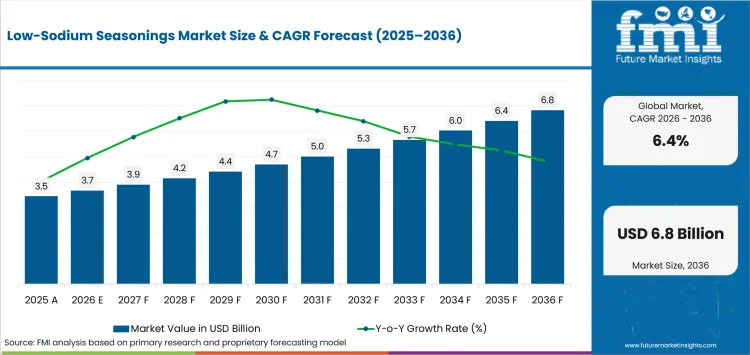
USD 3.7 billion in 2026 and USD 6.8 billion by 2036 at a 6.4% CAGR.
The low-sodium seasonings market is projected to grow at a 6.4% CAGR, from USD 3.7 billion in 2026 to USD 6.8 billion by 2036. The market was valued at USD 3.5 billion in 2025 and is expected to add USD 3.3 billion in value over the forecast period.
Reformulation of processed and commercially prepared food is the clearest bridge from nutrition policy to seasoning spend. The USA Food and Drug Administration reported in August 2024 that more than 70% of sodium intake in the USA comes from sodium added during food manufacturing and commercial food preparation. Its proposed Phase II targets extend the pressure on food companies to lower category-level sodium. That makes low-sodium seasonings a formulation tool rather than a stand-alone health claim. Buyers compare salt substitutes and savory systems on taste parity first. They then test label fit and process performance. Purchases become repeatable when a supplier can hold flavor intensity at the required reduction level across scaled production.
Country conditions change the pace of conversion. USA manufacturers work against explicit category targets while UK suppliers operate within a long-running voluntary salt-reduction framework. Germany adds a technical constraint because federal product monitoring links reformulation to food safety and consumer expectations. Japan presents a persistent public-health gap: its health ministry reported in December 2025 that average salt intake was 9.6 g per day against a 7 g target. South Korea reinforces the same direction through a national healthy-eating campaign centered on lighter seasoning. Across these markets, interest becomes revenue only when a seasoning passes sensory validation and fits the buyer's production process at acceptable cost.
Key Takeaways Low-Sodium Seasonings Market
- Processed-food reformulation and public-health sodium-reduction programs increase seasoning reformulation intensity because removing salt exposes taste, preservation, and texture gaps that require validated low-sodium systems.
- By product type, Salt Substitutes are projected to account for 27.6% in 2026 due to their direct, measurable path to ingredient-level sodium replacement; by application, Processed Foods are forecast to represent 25.8% in 2026 driven by centralized formulation decisions embedded in recurring industrial production.
- In 2026, the 25–30% Reduced sodium level segment is expected to lead with a 33.3% share because it delivers material label-level improvement while limiting the sensory restoration burden on formulators.
- By form, Powder is forecast to represent 38.2% in 2026, supported by its compatibility with dry blending, seasoning application, and standardized dosing across high-volume food production.
- Taste continuity and functional performance constrain deeper sodium cuts because salt removal can weaken savory intensity, alter preservation, and affect texture in ways that require application-specific reformulation evidence before buyer adoption.
- McCormick and Ajinomoto provide consumer-facing branded seasoning formats for retail and culinary sodium-reduction programs globally. Kerry, Givaudan, DSM-Firmenich, and Symrise supply taste modulation and savory reconstruction systems for food manufacturers. ofi (Olam), Tate & Lyle, and Angel Yeast deliver ingredient and yeast-extract platforms for industrial-scale seasoning reformulation.
Analyst Perspective
"Low-sodium seasoning demand becomes commercial only when a supplier can lower sodium without disrupting taste, preservation, texture or routine production handling. Buyers will favour systems that prove sensory performance at their own reduction target and recipe scale."
- Nandini Roy Choudhury, Principal Consultant, Future Market Insights
How is the Low-Sodium Seasonings Market segmented?
The low-sodium seasonings market is segmented by product type, sodium reduction level, application, form, sales channel, and region.
Product Type separates direct salt replacements from herb, spice and savory systems. Sodium Reduction Level distinguishes the depth of reformulation a product is designed to achieve. Application captures whether the seasoning is used in manufactured foods, home cooking, snacks, meat and seafood, or foodservice. Form separates powder and granule handling from liquid, paste and other delivery formats. Sales Channel distinguishes mainstream grocery access from B2B supply, online retail, convenience stores and specialty health outlets.
How do processed foods shape the application category?
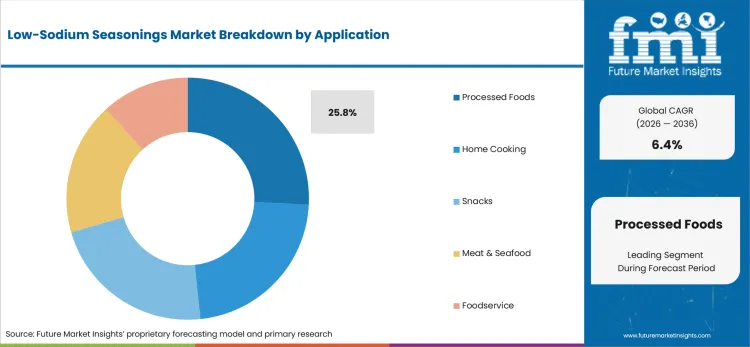
Processed Foods concentrate the commercial need because sodium is often built into recipes before the product reaches the consumer. Seasoning choices can therefore affect large production runs and repeated purchase volumes. Manufacturers also control formulation centrally, which allows a validated low-sodium system to be deployed across multiple batches or variants. The application is not limited to saltiness. Buyers may need flavor enhancement or functional support as sodium is removed. This creates room for blended solutions that combine direct reduction with savory recovery. Scale matters only after the supplier proves that the reformulated product still performs through processing and shelf life.
- Processed Foods represent 25.8% of the market in 2026. The segment leads because formulation decisions are embedded in recurring industrial production and can translate into sustained seasoning purchases.
- The FDA reported in August 2024 that more than 70% of USA sodium intake comes from sodium added during food manufacturing and commercial preparation. Its Phase II draft targets therefore focus directly on reformulation in processed and prepared foods.
What makes salt substitutes central to the product type category?
Salt Substitutes give formulators the most direct path to lowering sodium because the product is selected specifically to replace part of the salty function in a recipe. That makes the buying test easy to define: buyers can measure sodium reduction against a control and then assess flavor quality. The segment also fits staged reformulation programs because a manufacturer can alter the salt system before redesigning the wider seasoning profile. When a deeper cut exposes bitterness or weak savory impact, complementary umami and herb systems become more important. The leading position therefore reflects a clear formulation job rather than broad flavor variety.
- Salt Substitutes account for 27.6% of the market in 2026. Their role is strongest where buyers want a measurable ingredient-level sodium replacement before changing the rest of the flavor system.
- Tate & Lyle stated in March 2017 that its sodium-reduction solutions could lower sodium while retaining important salt functionality. The company also emphasized that preservation, bonding and texture can complicate simple salt removal.
Why does 25-30% reduced lead the sodium reduction level category?
A 25-30% reduction offers a commercially useful middle ground between nutrition improvement and sensory continuity. Buyers can make a material label-level change while limiting the intensity of taste restoration required. This level is especially practical for snacks and other products where saltiness arrives early in the eating experience. It also supports stepwise reformulation because manufacturers can establish consumer acceptance before attempting deeper cuts. The technical burden rises as sodium removal changes flavor delivery or product function. A moderate reduction level therefore attracts programs that need visible progress without creating an entirely new sensory identity.
- 25-30% Reduced holds a 33.3% share in 2026. The band aligns with programs that seek material sodium reduction while keeping the formulation close to an established consumer benchmark.
- Kerry reported in April 2024 that BBQ-seasoned chips formulated at 500 mg sodium per 100 g were evaluated against a 700 mg control. The reduced-sodium chips delivered comparable saltiness and consumer liking in Kerry's sensory work.
What supports powder within the form category?
Powder is easy to meter and blend into dry seasoning systems. It can also be applied to surface-seasoned foods through common snack processing steps. This handling flexibility makes the format attractive to spice blenders and food manufacturers that need a repeatable dosing protocol. Powder also allows salt substitutes, yeast extracts, herbs and taste modulators to be combined into a single dry system. The key commercial advantage is not convenience alone. It is the ability to validate one blend and then integrate it into existing dry-mix operations with limited equipment change. Moisture-sensitive or liquid applications may still favor other forms.
- Powder holds a 38.2% share in 2026. Its leadership reflects compatibility with dry blending, seasoning application and standardized dosing across high-volume food production.
- Salt of the Earth announced in May 2020 that its Mediterranean Umami Powder could be used as a drop-in replacement in snack seasonings. The company described dusting, tumbling and oil-slurry use as supported application routes.
What drives supermarkets & hypermarkets within the sales channel category?
Supermarkets & Hypermarkets give branded low-sodium seasonings a high-visibility route into routine household purchasing. Shoppers can compare salt-free mixes and reduced-sodium blends beside familiar seasoning formats. That matters because adoption often starts with a simple recipe substitution rather than a specialized health-store trip. Grocery distribution also supports repeat buying once a blend fits everyday cooking behavior. B2B supply remains more important for industrial reformulation volumes, while online channels can widen assortment. Mainstream stores lead because they combine product discovery with established shopping frequency and category adjacency. The strongest retail offers make the sodium proposition obvious without making flavor use more complicated.
- Supermarkets & Hypermarkets account for 35.7% of the market in 2026. Their position is supported by routine grocery traffic and direct comparison with conventional seasonings.
- McCormick announced in April 2023 that five salt-free vegan seasoning products would enter grocery stores nationwide in the USA. Two seasoning blends were rolled out to grocery stores nationwide and Amazon, while three salt-free recipe mixes followed later that summer.
What are the drivers, restraints and opportunities in the Low-Sodium Seasonings Market?
Processed-food reformulation drives demand while taste and functionality constrain deeper cuts, and integrated savory systems create the clearest expansion path.
- Driver: Category-level sodium reduction programs push manufacturers to reformulate products that contribute materially to dietary sodium.
- Restraint: Removing salt can weaken taste or change preservation, bonding and texture functions in certain foods.
- Opportunity: Suppliers can combine salt replacement with herbs, yeast extracts and taste modulation to protect flavor at higher reduction levels.
Sodium-Reduction Programs Raise Reformulation Demand
The driver is most visible where authorities translate nutrition goals into food-category targets. Public Health England published 2024 salt-reduction targets in September 2020 across more than 100 food groups. That framework directs manufacturers toward repeated reformulation rather than one-off health positioning. Seasoning suppliers benefit when buyers need a lower-sodium option that can be inserted into an existing recipe and measured against a target. The commercial result is a structured specification process: sodium performance must be demonstrated first, then the product must survive sensory and operational validation. Demand is strongest where that process becomes part of routine portfolio renovation.
Taste and Functional Performance Limit Deeper Cuts
The main restraint appears when sodium removal affects more than saltiness. Tate & Lyle noted in March 2017 that salt can function as a preservative, bonding agent and texture modifier in addition to supplying taste. A lower-sodium seasoning can therefore solve the flavor problem while leaving a separate process problem unresolved. Even when product safety is not affected, an unfamiliar taste profile can slow repeat purchasing. This friction becomes more severe at deeper reduction levels because off-notes and weak flavor intensity become harder to mask. Suppliers need application testing that addresses the buyer's full recipe rather than only the seasoning blend.
Integrated Savory Systems Expand Commercial Options
The opportunity is to sell integrated sodium-reduction systems instead of isolated replacement ingredients. ofi stated in August 2023 that herbs can contribute color, fragrance and taste and can potentially replace some sodium-driven flavor. Its new Egyptian herb facility was designed to serve savory and culinary customers through a broader spice network. Similar logic applies to yeast extracts and taste modulators. A supplier that combines direct sodium reduction with savory depth can support a wider set of reformulation thresholds. The addressable opening is largest among processed-food and foodservice buyers that want one validated system rather than several ingredients that require separate optimization.
Which country CAGRs are profiled in the Low-Sodium Seasonings Market?
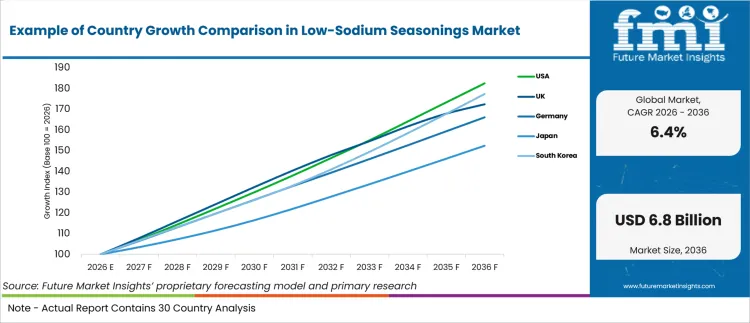
| Country | CAGR |
|---|---|
| USA | 6.2% |
| UK | 5.6% |
| Germany | 5.2% |
| Japan | 4.3% |
| South Korea | 5.9% |
How do country-level CAGRs compare in the Low-Sodium Seasonings Market?
The five profiled countries span a 1.9 percentage-point range from USA at 6.2% to Japan at 4.3% from 2026 to 2036. USA and South Korea form the fastest band with only a 0.3-point gap. UK and Germany occupy a middle band at 5.6% and 5.2%. Japan sits below that group. The pattern suggests that policy pressure alone does not determine adoption pace. Suppliers also need workable reformulation routes and a channel that can convert nutrition goals into recurring seasoning purchases. These CAGRs describe growth rates rather than absolute country market size.
- USA at 6.2% exceeds South Korea at 5.9% by 0.3 percentage points. The narrow gap supports parallel investment in application support rather than a major difference in market-entry timing.
- South Korea at 5.9% exceeds UK at 5.6% by 0.3 percentage points. Suppliers can treat both as active reformulation markets while tailoring claims and channel execution to local nutrition programs.
- UK at 5.6% exceeds Germany at 5.2% by 0.4 percentage points. The difference is modest, so technical fit and customer qualification are likely to matter more than the headline growth gap.
- Germany at 5.2% exceeds Japan at 4.3% by 0.9 percentage points. Japan still offers recurring demand, but suppliers should expect a slower forecast pace and stronger emphasis on sensory continuity.
CAGR should be used as a timing signal rather than a proxy for revenue scale. A lower-growth country can still contain attractive customers if reformulation is technically demanding or if purchase volumes are concentrated among large food manufacturers. The wider report therefore considers country regulation, product monitoring, taste expectations and purchasing channels alongside the forecast rates.
Country-wise Analysis
- USA food manufacturers and foodservice operators buy sodium-reduction systems against product-category specifications and brand-level sensory benchmarks. Demand for Low-Sodium Seasonings in USA is forecast to expand at 6.2% CAGR from 2026 to 2036. The FDA stated in August 2024 that more than 70% of USA sodium intake comes from manufacturing and commercial preparation, and it issued proposed Phase II category targets. The local friction is uneven technical headroom across food categories. Suppliers need application-specific evidence that proves sodium reduction without weakening taste or process performance.
- UK manufacturers and retailers operate within a mature voluntary reformulation framework that makes category targets familiar to technical teams. Demand for Low-Sodium Seasonings in UK is forecast to expand at 5.6% CAGR from 2026 to 2036. Public Health England published salt targets for 2024 in September 2020 across more than 100 food groups. The main friction is that the achievable reduction varies by recipe and consumer expectation. Suppliers can win by supporting staged reformulation and by documenting sensory performance at the buyer's exact target level.
- Germany combines public-health pressure with a demanding technical discussion about what reformulation can safely achieve. Demand for Low-Sodium Seasonings in Germany is forecast to expand at 5.2% CAGR from 2026 to 2036. The Max Rubner-Institut reported in June 2024 that salt reduction remained insufficient in several monitored product groups. It also highlighted technological challenges, food safety and consumer expectations in target-setting work. Reformulation can intersect with iodized-salt policy as well. Suppliers should support category-specific trials and show how lower-sodium systems fit existing safety and nutrition requirements.
- Japan buyers have a clear public-health reason to reduce salt but still need products that preserve familiar savory intensity. Demand for Low-Sodium Seasonings in Japan is forecast to expand at 4.3% CAGR from 2026 to 2036. The Ministry of Health, Labour and Welfare reported in December 2025 that average salt intake was 9.6 g per day. That was the lowest level in twelve years but remained above the Healthy Japan 21 target of 7 g. The commercial friction is taste acceptance during deeper cuts. Suppliers should emphasize gradual reduction and validated umami support.
- South Korea links sodium reduction with consumer-facing healthy-eating communication and lighter seasoning. Demand for Low-Sodium Seasonings in South Korea is forecast to expand at 5.9% CAGR from 2026 to 2036. The Ministry of Food and Drug Safety designated March 31 as 'Samsamhan Day' in March 2025 to encourage reduced sodium intake nationwide. Awareness does not automatically specify how food companies should reformulate. Suppliers therefore need locally relevant seasoning systems that preserve taste in home-style and foodservice applications while making the reduction easy to communicate.
Who are the notable companies in the Low-Sodium Seasonings Market?
McCormick, Kerry, Ajinomoto, ofi (Olam), DSM-Firmenich, Tate & Lyle, Angel Yeast, Givaudan, Symrise, and Salt of the Earth are the notable companies profiled in this market.
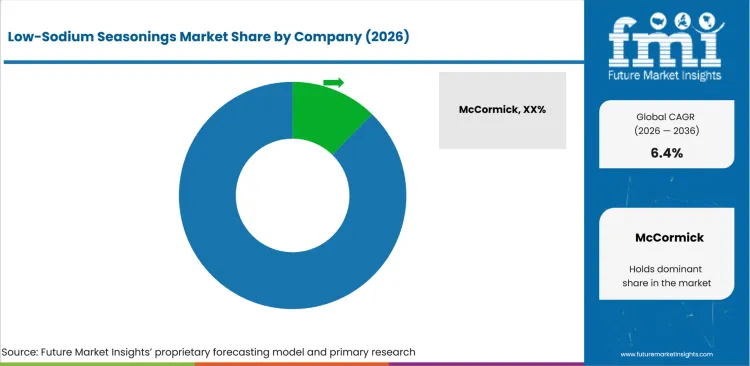
Competition separates into consumer-facing seasoning brands, B2B taste-system providers and ingredient platforms. McCormick, Ajinomoto and Salt of the Earth connect sodium reduction with recognizable seasoning formats or specialist salty-taste solutions. Kerry, DSM-Firmenich, Givaudan and Symrise compete by helping food developers rebuild flavor after sodium is removed. Their value rises when buyers need sensory work across several applications. ofi (Olam), Tate & Lyle and Angel Yeast approach the problem from ingredient platforms such as herbs, functional sodium-reduction technology and yeast extracts. The groups overlap in practice, but buyers still distinguish them by the primary job they solve: retail seasoning access, formulation support or ingredient-system depth.
- Consumer and branded seasoning specialists: McCormick, Ajinomoto and Salt of the Earth compete through recognizable seasoning formats, direct sodium-reduction propositions and access to household or specialist culinary users.
- Taste modulation and savory systems providers: Kerry, DSM-Firmenich, Givaudan and Symrise compete through sensory science, savory reconstruction and application support for food manufacturers.
- Ingredient, spice and yeast-extract platforms: ofi (Olam), Tate & Lyle and Angel Yeast compete through ingredient functionality that can be built into customer seasoning systems at industrial scale.
Competitive Benchmarking: Low-Sodium Seasonings Market
| Company | Sodium-Reduction Formulation | Savory Taste Modulation | Application & Seasoning Coverage | Geographic Reach |
|---|---|---|---|---|
| McCormick | Medium | Medium | High | Global; strong branded retail reach |
| Kerry | High | High | High | Global B2B food and beverage reach |
| Ajinomoto | High | High | High | Global; strong Asia and savory-food presence |
| ofi (Olam) | Medium | Medium | High | Global ingredient and spice network |
| DSM-Firmenich | High | High | High | Global taste and ingredient network |
| Tate & Lyle | High | Medium | Medium | Global specialty-ingredient reach |
| Angel Yeast | High | High | High | International yeast-extract reach |
| Givaudan | High | High | High | Global taste and wellbeing network |
| Symrise | High | High | High | Global taste and nutrition network |
| Salt of the Earth | High | High | Medium | International specialist reach |
Key Developments in the Low-Sodium Seasonings Market
- In April 2023, McCormick launched five salt-free vegan seasoning products with Tabitha Brown. The range included two seasoning blends and three recipe mixes, which marked the company's first salt-free recipe mixes. Grocery distribution across the USA put low-sodium positioning into a mainstream seasoning aisle. The development widened direct consumer access to salt-free formats without requiring shoppers to move into a specialist health channel.
- In August 2023, ofi (Olam) opened a herb processing facility in Beni-Suef, Egypt for global savory and culinary customers. The site was designed to process herbs and connect with ofi innovation centers. The company also identified herbs as a potential flavor replacement for some sodium. The investment increases supply and formulation capacity for herb-led seasoning systems that can support sodium reduction in processed foods, sauces and foodservice applications.
- In June 2024, Angel Yeast presented reduced-salt yeast-extract solutions at SNACKEX 2024. The company positioned its savory yeast-extract range for snacks and other applications where reduced sodium still requires strong flavor. This market-facing activity shows how fermentation-based savory ingredients are moving beyond background flavor into explicit sodium-reduction propositions. It also increases direct competition with salt substitutes and broader taste-modulation systems for snack reformulation projects.
- In May 2020, Salt of the Earth launched Mediterranean Umami Powder for sodium reduction in snacks. The company described the powder as a drop-in seasoning replacement that could support a 40% sodium reduction in tested snack use. It also outlined dusting, tumbling and oil-slurry application routes. The development gave seasoning blenders a dry-format option that combines salty perception and umami support inside common snack-processing workflows.
Key Players in the Low-Sodium Seasonings Market
Consumer and Branded Seasoning Specialists
- McCormick
- Ajinomoto
- Salt of the Earth
Taste Modulation and Savory Systems Providers
- Kerry
- DSM-Firmenich
- Givaudan
- Symrise
Ingredient, Spice and Yeast-Extract Platforms
- ofi (Olam)
- Tate & Lyle
- Angel Yeast
Low-Sodium Seasonings Market - Report Scope
| Coverage field | Report scope |
| Market breakdown | By Product Type, Sodium Reduction Level, Application, Form, Sales Channel, and Region. |
| Quantitative Units | Revenue in USD billion and CAGR in %. |
| Market Definition | The market includes revenue from formulated seasoning products and ingredient systems sold specifically to reduce or eliminate sodium while delivering seasoning functionality or savory taste. Downstream finished-food revenue and adjacent flavor ingredients not sold for low-sodium seasoning use are excluded. |
| Regions Covered | North America; Latin America; Western Europe; Eastern Europe; East Asia; South Asia and Pacific; Middle East and Africa |
| Countries Covered | USA, UK, Germany, Japan, South Korea, and more than twenty-five additional countries in the full report |
| Key Companies Profiled | McCormick, Kerry, Ajinomoto, ofi (Olam), DSM-Firmenich, Tate & Lyle, Angel Yeast, Givaudan, Symrise, Salt of the Earth |
| Forecast Period | 2026 to 2036 |
| Approach | A hybrid bottom-up and top-down sizing approach reconciles supplier participation with product, application, channel and country demand indicators inside the defined revenue boundary. |
Low-Sodium Seasonings Market - Research Methodology
| Method | Approach |
| Primary Research | FMI structures primary discussions around seasoning manufacturers, ingredient suppliers, distributors, food formulators, foodservice buyers and retail participants. Topics cover product specifications, sodium-reduction targets, purchasing criteria, channel conditions and formulation barriers. |
| Desk Research | Review covers government nutrition guidance, national reformulation programs, company filings and newsroom releases, public technical documentation, trade information and standards-related material. Evidence is retained only when it supports the defined market scope or explains a directly relevant buying condition. |
| Market Sizing and Forecasting | A hybrid bottom-up and top-down framework reconciles supplier participation with demand indicators, application mix, channel structure and country conditions. Forecast assumptions consider reformulation intensity, substitution within the defined scope and adoption of sodium-reduction seasoning systems. |
| Data Validation | Cross-checks reconcile the revenue boundary and prevent double counting. Downstream finished-food revenue is excluded. Adjacent categories and unsupported claims are removed before final synthesis. |
Low-Sodium Seasonings Market by Segments
Low-Sodium Seasonings Market segmented by Product Type:
- Salt Substitutes
- Herb & Spice Blends
- Umami / Yeast-Extract Seasonings
- Liquid Seasonings
- Low-Sodium Seasoning Mixes
- Others
Low-Sodium Seasonings Market segmented by Sodium Reduction Level:
- 25-30% Reduced
- 31-50% Reduced
- 51-75% Reduced
- More than 75% Reduced
- Sodium-Free
Low-Sodium Seasonings Market segmented by Application:
- Processed Foods
- Home Cooking
- Snacks
- Meat & Seafood
- Foodservice
Low-Sodium Seasonings Market segmented by Form:
- Powder
- Granules
- Liquid
- Paste
- Others
Low-Sodium Seasonings Market segmented by Sales Channel:
- Supermarkets & Hypermarkets
- B2B / Foodservice Supply
- Online Retail
- Convenience Stores
- Specialty Health Stores
Low-Sodium Seasonings Market by Region:
- North America
- United States
- Canada
- Latin America
- Brazil
- Mexico
- Argentina
- Chile
- Western Europe
- Germany
- France
- United Kingdom
- Italy
- Spain
- Benelux
- Nordics
- Eastern Europe
- Poland
- Czech Republic
- Romania
- Hungary
- East Asia
- China
- Japan
- South Korea
- South Asia and Pacific
- India
- ASEAN
- Australia and New Zealand
- Middle East and Africa
- GCC Countries
- South Africa
- Türkiye
- Israel
Research Sources and Bibliography
- USA Food and Drug Administration (2024, August 15). FDA Announces Milestone in Sodium Reduction Efforts, Issues Draft Guidance with Lower Target Levels for Certain Foods.
- Public Health England (2020, September 7). Salt reduction: targets for 2024.
- Max Rubner-Institut (2024, June 18). Gemeinsame Pressemitteilung BMEL und MRI: Produktmonitoring 2023 zeigt zu geringe Reduktionsbemuehungen der Lebensmittelwirtschaft.
- Ministry of Health, Labour and Welfare, Japan (2025, December 2). Results of the 2024 National Health and Nutrition Survey.
- Ministry of Food and Drug Safety, Republic of Korea (2025, March 31). MFDS Holds a Healthy Eating Campaign on 'Samsamhan Day'.
- McCormick & Company (2023, April 18). McCormick and Tabitha Brown Expand Partnership to Launch Five New Salt Free Vegan Seasoning Products.
- Kerry (2024, April 8). Rethink & Reinvent: Navigating Sodium Reduction in Salty Snacks.
- Ajinomoto Co., Inc. (2024, September 10). World's First Utilization of Transcutaneous Electrical Stimulation to Enhance Saltiness in Various Low-Salt Foods: Development of 'Electric Seasoning'.
- ofi (2023, August 10). New ofi herb processing facility to meet growing demand and expand innovation capabilities.
- DSM-Firmenich (2024, October 21). dsm-firmenich embodies healthier, more delicious & better for people and planet at Fi Europe 2024.
- Tate & Lyle (2017, March 7). Reduced sodium content promotes heart health.
- Angel Yeast (2024, June 19). Angel Yeast's High Protein and Innovative Yeast Extract Solutions Shine at SNACKEX 2024.
- Givaudan (2021, February 18). Givaudan launches ground-breaking AI tools for next generation product development.
- Symrise (2021, April 8). Presenting symlife taste balancing solutions that bring great taste to good-for-you products.
- Salt of the Earth (2020, May 21). New Mediterranean Umami Powder Cuts Salt in Snacks.
This bibliography is provided for reader reference and is not exhaustive. The full report contains the complete reference list and detailed citations.
This Report Answers
- What is the Low-Sodium Seasonings Market size in 2026 and what is the forecast size by 2036?
- What processed-food and public-health pressures support demand for low-sodium seasonings?
- Why do Salt Substitutes hold the leading position within Product Type?
- How does the 25-30% Reduced segment influence formulation strategy and downstream demand?
- Why do Processed Foods hold the leading position within Application?
- How do growth rates differ across USA, UK, Germany, Japan and South Korea from 2026 to 2036?
- Which companies compete through branded seasonings, taste modulation and ingredient platforms?
- What sensory and functional constraints can limit sodium-reduction adoption?
- What should food formulators and procurement teams evaluate before purchasing a low-sodium seasoning system?
Frequently Asked Questions
How big is the Low-Sodium Seasonings Market in 2026?
The low-sodium seasonings market is valued at USD 3.7 billion in 2026.
What is the CAGR of the Low-Sodium Seasonings Market from 2026 to 2036?
The low-sodium seasonings market is projected to grow at a CAGR of 6.4% between 2026 and 2036.
Which product type segment leads the Low-Sodium Seasonings Market?
Salt Substitutes are projected to account for 27.6% of the product type category in 2026.
How much value will the Low-Sodium Seasonings Market add between 2026 and 2036?
The market is expected to add USD 3.2 billion in value between 2026 and 2036.
Which companies are active in the Low-Sodium Seasonings Market?
Key companies operating in the market include McCormick, Kerry, Ajinomoto, ofi (Olam), DSM-Firmenich, Tate & Lyle, Angel Yeast, Givaudan, Symrise, and Salt of the Earth.
Preview the report firsthand - request a free sample
Get SampleGet the brochure for pricing and purchase details.
Get PDFTable of Content
- Key Takeaways
- Market Size and CAGR
- Top Growth Driver
- Fastest Growing Segment
- Leading Region
- Key Companies
- Emerging Opportunities
- Executive Summary
- Global Market Outlook
- Demand-side Trends
- Supply-side Trends
- Technology Roadmap Analysis
- Analysis and Recommendations
- Analyst Perspective (What is happening? Why now? What should investors know?)
- Key Questions Answered
- How large is the market?
- What is the CAGR?
- What are key trends?
- Which region dominates?
- Who are the leaders?
- Market Overview
- Market Coverage / Taxonomy
- Market Definition / Scope / Limitations
- Research Methodology
- Chapter Orientation
- Analytical Lens and Working Hypotheses
- Market Structure, Signals, and Trend Drivers
- Benchmarking and Cross-market Comparability
- Market Sizing, Forecasting, and Opportunity Mapping
- Research Design and Evidence Framework
- Desk Research Programme (Secondary Evidence)
- Expert Input and Fieldwork (Primary Evidence)
- Tooling, Models, and Reference Databases
- Data Engineering and Model Build
- Quality Assurance and Audit Trail
- Market Background
- Market Dynamics (Drivers, Restraints, Opportunity, Trends)
- Scenario Forecast (Optimistic, Likely, Conservative)
- Impact Analysis
- AI Impact
- Sustainability Impact
- Regulatory Impact
- Technology Impact
- Consumer / Buyer Analysis
- Purchase Drivers
- Adoption Barriers
- Buyer Journey
- Opportunity Map Analysis
- Product Life Cycle Analysis
- Supply Chain Analysis
- Investment Feasibility Matrix
- Value Chain Analysis
- PESTLE and Porter's Analysis
- Regulatory Landscape
- Regional Parent Market Outlook
- Production and Consumption Statistics
- Import and Export Statistics
- Global Market Analysis and Forecast, 2021 to 2036
- Historical Market Size Value (USD Billion) Analysis, 2021 to 2025
- Current and Future Market Size Value (USD Billion) Projections, 2026 to 2036
- Y-o-Y Growth Trend Analysis
- Absolute $ Opportunity Analysis
- Global Market Pricing Analysis, 2021 to 2036
- Global Market Analysis and Forecast, By Product Type, 2021 to 2036
- Introduction / Key Findings
- Historical Market Size Value (USD Billion) Analysis By Product Type, 2021 to 2025
- Current and Future Market Size Value (USD Billion) Analysis and Forecast By Product Type, 2026 to 2036
- Salt Substitutes
- Herb & Spice Blends
- Umami / Yeast-Extract Seasonings
- Liquid Seasonings
- Low-Sodium Seasoning Mixes
- Others
- Salt Substitutes
- Y-o-Y Growth Trend Analysis By Product Type, 2021 to 2025
- Absolute $ Opportunity Analysis By Product Type, 2026 to 2036
- Global Market Analysis and Forecast, By Sodium Reduction Level, 2021 to 2036
- Introduction / Key Findings
- Historical Market Size Value (USD Billion) Analysis By Sodium Reduction Level, 2021 to 2025
- Current and Future Market Size Value (USD Billion) Analysis and Forecast By Sodium Reduction Level, 2026 to 2036
- 25-30% Reduced
- 31-50% Reduced
- 51-75% Reduced
- More than 75% Reduced
- Sodium-Free
- 25-30% Reduced
- Y-o-Y Growth Trend Analysis By Sodium Reduction Level, 2021 to 2025
- Absolute $ Opportunity Analysis By Sodium Reduction Level, 2026 to 2036
- Global Market Analysis and Forecast, By Application, 2021 to 2036
- Introduction / Key Findings
- Historical Market Size Value (USD Billion) Analysis By Application, 2021 to 2025
- Current and Future Market Size Value (USD Billion) Analysis and Forecast By Application, 2026 to 2036
- Processed Foods
- Home Cooking
- Snacks
- Meat & Seafood
- Foodservice
- Processed Foods
- Y-o-Y Growth Trend Analysis By Application, 2021 to 2025
- Absolute $ Opportunity Analysis By Application, 2026 to 2036
- Global Market Analysis and Forecast, By Form, 2021 to 2036
- Introduction / Key Findings
- Historical Market Size Value (USD Billion) Analysis By Form, 2021 to 2025
- Current and Future Market Size Value (USD Billion) Analysis and Forecast By Form, 2026 to 2036
- Powder
- Granules
- Liquid
- Paste
- Others
- Powder
- Y-o-Y Growth Trend Analysis By Form, 2021 to 2025
- Absolute $ Opportunity Analysis By Form, 2026 to 2036
- Global Market Analysis and Forecast, By Sales Channel, 2021 to 2036
- Introduction / Key Findings
- Historical Market Size Value (USD Billion) Analysis By Sales Channel, 2021 to 2025
- Current and Future Market Size Value (USD Billion) Analysis and Forecast By Sales Channel, 2026 to 2036
- Supermarkets & Hypermarkets
- B2B / Foodservice Supply
- Online Retail
- Convenience Stores
- Specialty Health Stores
- Supermarkets & Hypermarkets
- Y-o-Y Growth Trend Analysis By Sales Channel, 2021 to 2025
- Absolute $ Opportunity Analysis By Sales Channel, 2026 to 2036
- Global Market Analysis and Forecast, By Region, 2021 to 2036
- Introduction
- Historical Market Size Value (USD Billion) Analysis By Region, 2021 to 2025
- Current Market Size Value (USD Billion) Analysis and Forecast By Region, 2026 to 2036
- North America
- Latin America
- Western Europe
- Eastern Europe
- East Asia
- South Asia and Pacific
- Middle East & Africa
- Market Attractiveness Analysis By Region
- North America Market Analysis and Forecast, By Country, 2021 to 2036
- Historical Market Size Value (USD Billion) Trend Analysis By Market Taxonomy, 2021 to 2025
- Market Size Value (USD Billion) Forecast By Market Taxonomy, 2026 to 2036
- By Country
- USA
- Canada
- By Product Type
- By Sodium Reduction Level
- By Application
- By Form
- By Sales Channel
- By Country
- Market Attractiveness Analysis
- By Country
- By Product Type
- By Sodium Reduction Level
- By Application
- By Form
- By Sales Channel
- Key Takeaways
- Latin America Market Analysis and Forecast, By Country
- Historical Market Size Value (USD Billion) Trend Analysis By Market Taxonomy, 2021 to 2025
- Market Size Value (USD Billion) Forecast By Market Taxonomy, 2026 to 2036
- By Country
- Brazil
- Mexico
- Chile
- Rest of Latin America
- By Product Type
- By Sodium Reduction Level
- By Application
- By Form
- By Sales Channel
- By Country
- Market Attractiveness Analysis
- By Country
- By Product Type
- By Sodium Reduction Level
- By Application
- By Form
- By Sales Channel
- Key Takeaways
- Western Europe Market Analysis and Forecast, By Country
- Historical Market Size Value (USD Billion) Trend Analysis By Market Taxonomy, 2021 to 2025
- Market Size Value (USD Billion) Forecast By Market Taxonomy, 2026 to 2036
- By Country
- Germany
- UK
- Italy
- Spain
- France
- Nordic
- BENELUX
- Rest of Western Europe
- By Product Type
- By Sodium Reduction Level
- By Application
- By Form
- By Sales Channel
- By Country
- Market Attractiveness Analysis
- By Country
- By Product Type
- By Sodium Reduction Level
- By Application
- By Form
- By Sales Channel
- Key Takeaways
- Eastern Europe Market Analysis and Forecast, By Country
- Historical Market Size Value (USD Billion) Trend Analysis By Market Taxonomy, 2021 to 2025
- Market Size Value (USD Billion) Forecast By Market Taxonomy, 2026 to 2036
- By Country
- Russia
- Poland
- Hungary
- Balkan & Baltic
- Rest of Eastern Europe
- By Product Type
- By Sodium Reduction Level
- By Application
- By Form
- By Sales Channel
- By Country
- Market Attractiveness Analysis
- By Country
- By Product Type
- By Sodium Reduction Level
- By Application
- By Form
- By Sales Channel
- Key Takeaways
- East Asia Market Analysis and Forecast, By Country
- Historical Market Size Value (USD Billion) Trend Analysis By Market Taxonomy, 2021 to 2025
- Market Size Value (USD Billion) Forecast By Market Taxonomy, 2026 to 2036
- By Country
- China
- Japan
- South Korea
- By Product Type
- By Sodium Reduction Level
- By Application
- By Form
- By Sales Channel
- By Country
- Market Attractiveness Analysis
- By Country
- By Product Type
- By Sodium Reduction Level
- By Application
- By Form
- By Sales Channel
- Key Takeaways
- South Asia and Pacific Market Analysis and Forecast, By Country
- Historical Market Size Value (USD Billion) Trend Analysis By Market Taxonomy, 2021 to 2025
- Market Size Value (USD Billion) Forecast By Market Taxonomy, 2026 to 2036
- By Country
- India
- ASEAN
- Australia & New Zealand
- Rest of South Asia and Pacific
- By Product Type
- By Sodium Reduction Level
- By Application
- By Form
- By Sales Channel
- By Country
- Market Attractiveness Analysis
- By Country
- By Product Type
- By Sodium Reduction Level
- By Application
- By Form
- By Sales Channel
- Key Takeaways
- Middle East & Africa Market Analysis and Forecast, By Country
- Historical Market Size Value (USD Billion) Trend Analysis By Market Taxonomy, 2021 to 2025
- Market Size Value (USD Billion) Forecast By Market Taxonomy, 2026 to 2036
- By Country
- Kingdom of Saudi Arabia
- Other GCC Countries
- Türkiye
- South Africa
- Other African Union
- Rest of Middle East & Africa
- By Product Type
- By Sodium Reduction Level
- By Application
- By Form
- By Sales Channel
- By Country
- Market Attractiveness Analysis
- By Country
- By Product Type
- By Sodium Reduction Level
- By Application
- By Form
- By Sales Channel
- Key Takeaways
- Key Countries Market Analysis
- USA
- Pricing Analysis
- Market Share Analysis, 2025
- By Product Type
- By Sodium Reduction Level
- By Application
- By Form
- By Sales Channel
- Canada
- Pricing Analysis
- Market Share Analysis, 2025
- By Product Type
- By Sodium Reduction Level
- By Application
- By Form
- By Sales Channel
- Mexico
- Pricing Analysis
- Market Share Analysis, 2025
- By Product Type
- By Sodium Reduction Level
- By Application
- By Form
- By Sales Channel
- Brazil
- Pricing Analysis
- Market Share Analysis, 2025
- By Product Type
- By Sodium Reduction Level
- By Application
- By Form
- By Sales Channel
- Chile
- Pricing Analysis
- Market Share Analysis, 2025
- By Product Type
- By Sodium Reduction Level
- By Application
- By Form
- By Sales Channel
- Germany
- Pricing Analysis
- Market Share Analysis, 2025
- By Product Type
- By Sodium Reduction Level
- By Application
- By Form
- By Sales Channel
- UK
- Pricing Analysis
- Market Share Analysis, 2025
- By Product Type
- By Sodium Reduction Level
- By Application
- By Form
- By Sales Channel
- Italy
- Pricing Analysis
- Market Share Analysis, 2025
- By Product Type
- By Sodium Reduction Level
- By Application
- By Form
- By Sales Channel
- Spain
- Pricing Analysis
- Market Share Analysis, 2025
- By Product Type
- By Sodium Reduction Level
- By Application
- By Form
- By Sales Channel
- France
- Pricing Analysis
- Market Share Analysis, 2025
- By Product Type
- By Sodium Reduction Level
- By Application
- By Form
- By Sales Channel
- India
- Pricing Analysis
- Market Share Analysis, 2025
- By Product Type
- By Sodium Reduction Level
- By Application
- By Form
- By Sales Channel
- ASEAN
- Pricing Analysis
- Market Share Analysis, 2025
- By Product Type
- By Sodium Reduction Level
- By Application
- By Form
- By Sales Channel
- Australia & New Zealand
- Pricing Analysis
- Market Share Analysis, 2025
- By Product Type
- By Sodium Reduction Level
- By Application
- By Form
- By Sales Channel
- China
- Pricing Analysis
- Market Share Analysis, 2025
- By Product Type
- By Sodium Reduction Level
- By Application
- By Form
- By Sales Channel
- Japan
- Pricing Analysis
- Market Share Analysis, 2025
- By Product Type
- By Sodium Reduction Level
- By Application
- By Form
- By Sales Channel
- South Korea
- Pricing Analysis
- Market Share Analysis, 2025
- By Product Type
- By Sodium Reduction Level
- By Application
- By Form
- By Sales Channel
- Russia
- Pricing Analysis
- Market Share Analysis, 2025
- By Product Type
- By Sodium Reduction Level
- By Application
- By Form
- By Sales Channel
- Poland
- Pricing Analysis
- Market Share Analysis, 2025
- By Product Type
- By Sodium Reduction Level
- By Application
- By Form
- By Sales Channel
- Hungary
- Pricing Analysis
- Market Share Analysis, 2025
- By Product Type
- By Sodium Reduction Level
- By Application
- By Form
- By Sales Channel
- Kingdom of Saudi Arabia
- Pricing Analysis
- Market Share Analysis, 2025
- By Product Type
- By Sodium Reduction Level
- By Application
- By Form
- By Sales Channel
- Türkiye
- Pricing Analysis
- Market Share Analysis, 2025
- By Product Type
- By Sodium Reduction Level
- By Application
- By Form
- By Sales Channel
- South Africa
- Pricing Analysis
- Market Share Analysis, 2025
- By Product Type
- By Sodium Reduction Level
- By Application
- By Form
- By Sales Channel
- USA
- Market Structure Analysis
- Competition Dashboard
- Competition Benchmarking
- Market Share Analysis of Top Players
- By Regional
- By Product Type
- By Sodium Reduction Level
- By Application
- By Form
- By Sales Channel
- Emerging Startups
- Innovation Benchmarking
- Competition Analysis
- Competition Deep Dive
- McCormick
- Overview
- Product Portfolio
- Profitability by Market Segments
- Sales Footprint
- Strategy Overview
- Marketing Strategy
- Product Strategy
- Channel Strategy
- Kerry
- Ajinomoto
- ofi (Olam)
- DSM-Firmenich
- Tate & Lyle
- Angel Yeast
- Givaudan
- Symrise
- Salt of the Earth
- McCormick
- Case Studies
- Success Stories
- Recent Developments
- Competition Deep Dive
- Assumptions & Acronyms Used


