
- Market Size (2026)
- USD 77.3 Mn
- Forecast (2036)
- USD 322.8 Mn
- CAGR (2026 to 2036)
- 15.4%
How big is the Magnetorheological Fluids Market in 2026?
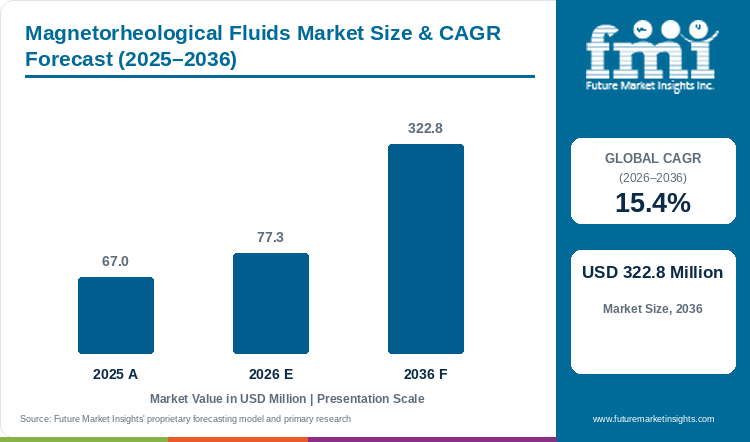
The Magnetorheological Fluids Market is projected to reach USD 322.8 million by 2036, growing at a 15.4% CAGR from 2026 to 2036. The market is estimated at USD 77.3 million in 2026. The market was valued at USD 67.0 million in 2025. Vehicle engineering provides the nearest demand signal. On 24 June 2026, Materials Research Express published a laboratory comparison of five commercial magnetorheological fluids for automotive brakes. It covered rheometer tests, particle imaging and sedimentation over 200 days [4]. On 1 April 2026, Smart Materials and Structures published a prototype linear damper for passenger cars. The damper uses a rotary magnetorheological brake and reached 1,890 N against a 2,000 N target [14].
Magnetorheological fluid is bought for what it does in a device. It is a suspension of iron particles in oil that stiffens within milliseconds when a magnetic field is applied. Autocar Professional described the fluid in MagneRide dampers as a synthetic oil carrying tiny iron particles, with a field aligning the particles to raise damping force [2]. Each damper, brake or clutch holds only a small volume, so buyers pay for particle loading, carrier oil and stability, not for litres. The iron powder that supplies the particles is a separate raw material market. Liquids Research gives one grade at 80% packing by weight, with a flash point of 190 degrees Celsius [5]. ARUS MR Tech gives 84% solids by weight for its RHEOTEC+ fluid [6].
Key Market Trends & Insights
- On 24 June 2026, Materials Research Express published a benchmark of five commercial fluids for automotive brakes. It measured maximum yield stress at 0.8 tesla between 35 kPa and 80 kPa [4]. It followed sedimentation for 200 days, and the best fluid showed 2% separation [4].
- Sedimentation and yield stress remain the main technical bottleneck. A review in Rheologica Acta dated 9 January 2026 treats both as open challenges with new directions [12]. A systematic review published on 16 January 2026 covers magnetorheological dampers as semi-active replacements for passive aircraft landing gear dampers [13].
- Touch feedback is emerging as a use outside vehicles. Discover Robotics published a geared haptic actuator built on 3D-printed magnetorheological clutches on 7 April 2026 [15]. Kurimoto has promoted its SoftMRF fluid for tactile presentation since announcing practical use on 9 October 2015 [8].
Regional Highlights
- North America: Parker took over the LORD business, which it described as the largest global supplier of commercial magnetorheological fluids. LORD was also the exclusive fluid supplier to BWI for MagneRide. The deal closed in late October 2019 [1].
- Continental Europe: MagneRide dampers appear on the Audi S3, the third-generation Audi TT, the Ferrari F12 and the Lamborghini Huracan. European performance and premium cars are therefore central to fluid demand [2].
- United Kingdom: Liquids Research was founded in 1990. It operates from the Mentec Technology Centre, a science park in Bangor, North Wales [5]. It sells its magnetorheological grades through an online shop priced in euro, pounds and US dollars [5].
Magnetorheological Fluids Market Size and Forecast
Table 1: Magnetorheological Fluids Market Size and Forecast
| Market size and forecast | Value |
|---|---|
| Market size in 2025 | USD 67.0 million |
| Estimated market size in 2026 | USD 77.3 million |
| Projected market size by 2036 | USD 322.8 million |
| CAGR from 2026 to 2036 | 15.4% |
Source: Future Market Insights analysis of the magnetorheological fluids market, 2026.
Analyst Perspective
“Magnetorheological fluid is a small market that is judged on repeatability. A damper maker does not choose a fluid for its list price. It chooses one that stays suspended for years, keeps drag low when the field is off and gives the same yield stress from batch to batch. The 2026 benchmark shows how wide the spread between commercial fluids still is, which is why qualification, not price, decides who wins. Suppliers that document sedimentation and temperature range for each grade are better placed. So are those that ship small lots quickly to prototype teams. Both beat suppliers selling on a headline yield stress alone.”
- Nikhil Kaitwade, Principal Consultant, FMI
How is the Magnetorheological Fluids Market segmented?
- By application: Automotive, Aerospace & Defense, Consumer Electronics, Industrial Machinery, Construction & Infrastructure and Other Applications
- By region: North America and Europe
Why does Automotive lead by Application in the Magnetorheological Fluids Market in 2026?
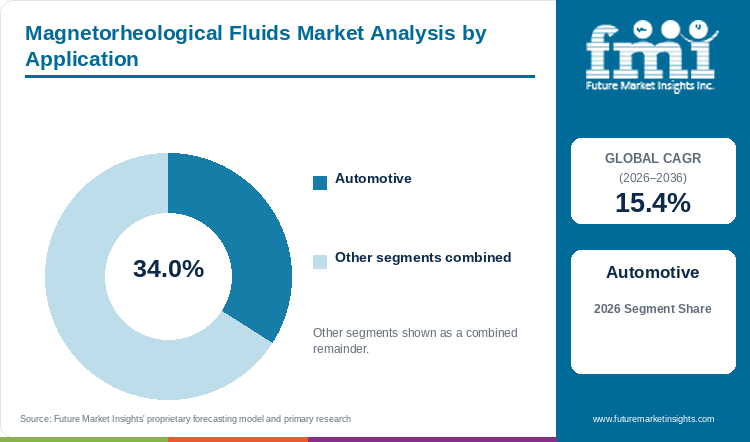
Automotive is estimated to account for 34.0% of the Magnetorheological Fluids Market by application in 2026. The commercial route into cars is the MagneRide semi-active suspension, first introduced in 2002 on the Cadillac Seville STS [2]. The third-generation design uses two coils per damper piston. These cut switch-off time from 25 milliseconds to 13 milliseconds, and BWI Group, the system maker, expected 300,000 cars to carry the system in 2015 [2]. The same article lists the Audi S3, the third-generation Audi TT, the Ferrari F12, the Lamborghini Huracan and the Vauxhall VXR8 GTS among the cars using it [2]. The fluid supply chain is concentrated. When Parker announced the LORD acquisition in 2019, LORD described itself as the largest global supplier of commercial magnetorheological fluids. It said the fluids were used mainly in automotive suspensions, and that it was the exclusive fluid supplier to BWI [1]. Research is now pushing the same fluid into braking and compact dampers. The June 2026 benchmark tested LORD's MRF132DG against fluids from CK-Material, Fraunhofer, Liquid Research and Somagnar [4]. It lists the MRF132DG at 81.0% solids and a density of 2.95 to 3.15 grams per cubic centimetre [4]. A paper published on 1 April 2026 describes a screw-driven rotary-brake damper for passenger cars [14]. A 2025 study in Physics of Fluids reported that a damper using carbon-nanotube-coated iron particles produced 1,505 N against 1,005 N for a commercial fluid [19]. Each result gives a fluid supplier a reason to qualify a new grade.
Table 2: Application, 2026 Share
| Leading Share | 2026 market share |
|---|---|
| Automotive | 34.0% |
| All Other Segments Combined Share | 66.0% |
Source: Future Market Insights analysis of the magnetorheological fluids market, 2026.
What are the key drivers, restraints and opportunities?
Driver
Semi-active suspension programmes. Automotive demand rests on dampers that change stiffness in milliseconds without moving parts in the valve. The third-generation MagneRide design cut switch-off time from 25 milliseconds to 13 milliseconds [2]. The same article's model list spans mainstream, performance and exotic brands [2]. Each new platform that adopts the damper needs qualified fluid for the life of the vehicle. A single design win therefore produces repeat orders. LORD's exclusive supply to BWI, as described in 2019, shows how closely the fluid and damper businesses are tied [1].
Aerospace, structures and defence research. Luong's systematic review, published on 16 January 2026, sets out how magnetorheological dampers can replace passive landing gear dampers with semi-active control [13]. It compares the main models and control methods [13]. For buildings, a bibliometric study published on 11 September 2026 counted 409 Web of Science publications on magnetorheological dampers for seismic control from 1996 to 2025 [16]. It found that the United States and China are the leading contributors [16]. ARUS MR Tech names structural dampers for tall buildings, bridge protection, MR cannon dampers, body armour and landing gear dampers as applications for its fluids [7]. These uses are small in volume today, but they rely on qualified, long-life fluid.
Restraint
Sedimentation and off-state drag. Particles heavier than the carrier oil settle. A thicker oil slows settling but raises drag when the field is off. The June 2026 benchmark followed static samples for 200 days. It found only 2% separated fluid in the best case and about 15% in another [4]. It noted that higher carrier-oil viscosity improves stability but increases off-state drag, which is undesirable for brakes [4]. A review in Rheologica Acta, published on 9 January 2026, lists sedimentation and yield stress as challenges that still need new directions [12]. Until a grade solves both, designers will keep specifying conservative duty cycles.
Wide spread between grades. The same benchmark measured maximum yield stress at 0.8 tesla of 80 kPa, 63 kPa, 50 kPa, 44 kPa and 35 kPa across five commercial fluids [4]. The authors could only infer particle size distribution from electron microscopy, because manufacturers do not disclose it [4]. Specification pages show the same spread in detail. Liquids Research gives rheology only on request [5], and ARUS MR Tech's fluid page gives no grade-level figures [21]. Buyers must run their own tests. That lengthens qualification and rewards suppliers with a track record.
Opportunity
Haptics and consumer devices. Kurimoto's SoftMRF page positions its nano magnetorheological fluid for tactile presentation that vibration motors cannot reproduce [8]. It lists adoption in welfare equipment in 2016 and in virtual reality activities in 2017 [8]. A delta-type haptic device built from three twin-driven fluid actuators reached an average force error of 0.1 N, according to a paper published on 3 March 2025 [18]. Consumer Electronics holds 15.0% of the market in 2026, so new tactile products would add volume to a segment of that size. Readers tracking adjacent components can compare the magnetic materials market.
New particle chemistries and polishing fluids. Adjacent research in 2025 and 2026 covers coated particles, aqueous carriers and surfactants. That work sits outside the oil-carrier market counted here. A 1 July 2026 paper in Physics of Fluids studied carbonyl iron suspensions in water with a Triton X-100 surfactant, and fitted them to a Herschel-Bulkley model [20]. In optics, QED Technologies markets magnetorheological finishing for the final stages of optical fabrication [11]. A paper published on 1 September 2026 reported roughness on Zerodur optics falling from 68.96 nm to 0.88 nm after the polishing fluid was tuned [17]. Another 2026 study varied only the fluid composition when finishing a bio-zirconium alloy [22]. Makers of optical coatings and precision optics buy the finishing service or the fluid that goes with it.
Magnetorheological Fluids Market by Country (2026 to 2036)
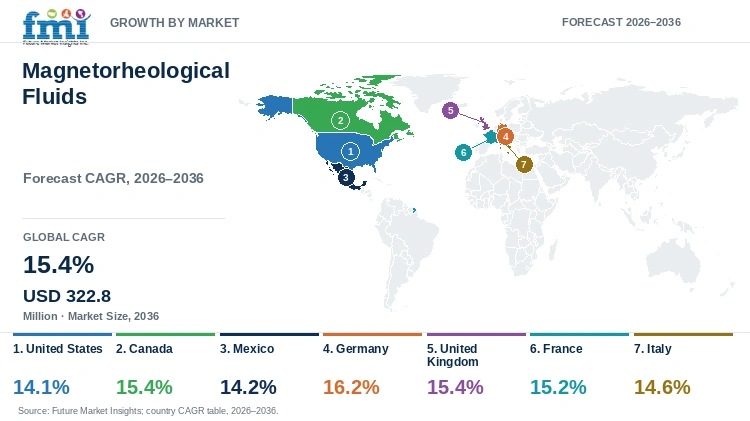
Table 3: Magnetorheological Fluids Market Country Growth Forecast
| Country | CAGR, 2026 to 2036 |
|---|---|
| United States | 14.1% |
| Canada | 15.4% |
| Mexico | 14.2% |
| Germany | 16.2% |
| United Kingdom | 15.4% |
| France | 15.2% |
| Italy | 14.6% |
Source: Future Market Insights analysis of the magnetorheological fluids market, 2026.
United States
The United States combines a large damper supply chain with a research base. Parker, a US company, completed its LORD acquisition in late October 2019 [1]. The 2019 coverage described LORD as the exclusive fluid supplier to BWI for MagneRide [1]. MagneRide entered production on the Cadillac Seville STS in 2002 [2].
Research output points the same way. The September 2026 bibliometric study found that the United States and China lead publication on magnetorheological dampers for seismic control [16]. A Purdue Research Foundation patent for a cell-based magnetorheological apparatus with a flexible elastomer body was filed on 31 August 2022. It was published on 2 March 2023 and again as US12422016B2 on 23 September 2025 [10]. Its claims cover cavities filled with fluid whose stiffness changes under a magnetic field. The design needs only small fluid volumes.
For buyers, US demand is weighted toward automotive programmes and defence and aerospace development. Fluid supply is dominated by one large catalogue. A second source has to be qualified deliberately.
Canada
Canadian buyers draw on suppliers that ship across borders. ARUS MR Tech sells RHEOTEC+ in 250 ml, 500 ml and 1 litre packs [6]. Liquids Research runs an online shop that prices in euro, pounds and US dollars [5]. Packs of this size suit laboratories, university teams and prototype builds.
Climate shapes specification. Liquids Research gives an operating range of minus 40 to 140 degrees Celsius for its hydrocarbon grades [5]. ARUS MR Tech gives minus 40 to plus 150 degrees Celsius for RHEOTEC+ [6]. For a Canadian vehicle or outdoor structural application, cold-start behaviour is a qualification item. Confirm the minus 40 degree lower limit against site conditions.
Aerospace is the second-largest application, at 20.0% of the market in 2026. The January 2026 landing gear review describes how semi-active magnetorheological dampers could replace passive ones [13]. Canadian aerospace suppliers following that work will need fluid with documented temperature range and sedimentation data before any flight-hardware trial. Better-documented suppliers are therefore better placed.
Mexico
Mexico's fluid demand follows vehicle and machinery programmes, not local fluid production. It arrives as finished dampers, brakes and clutches, and as fluid bought from suppliers that serve North American platforms. LORD was the exclusive fluid supplier to BWI for MagneRide, as described in 2019 [1]. The fluid in any MagneRide damper reaching the region therefore traces back to that chain.
A second route comes from Asian catalogue suppliers. ARUS MR Tech also sells dampers, steering dampers, control electronics and a syringe demonstration kit [23]. Small engineering teams can test a fluid in a working device without building the hardware first. The company states that its product is formulated and engineered in Italy and made in India [23].
Industrial Machinery accounts for 12.0% of the market in 2026. ARUS MR Tech names heavy machinery, actuators and robotics as uses for RHEOTEC+ [6]. For plants in Mexico, the commercial question is whether a local integrator will stock fluid and spares. An online supplier that sells by the litre covers prototypes. Series production needs a contract with delivery terms and a documented shelf life.
Germany
Germany is the fastest-growing profiled country at 16.2%, ahead of Canada and the United Kingdom at 15.4%. Premium cars such as the Audi S3 use MagneRide dampers [2]. The June 2026 benchmark included a custom Fraunhofer fluid. It had the highest yield stress of the five at 80 kPa, an 88.0% solids content, and only 2% separated fluid after 200 days [4].
The same benchmark shows what German buyers will likely demand. The authors said the Fraunhofer fluid was the clear choice when braking force is the only priority [4]. They also noted that higher carrier-oil viscosity raises off-state drag [4]. For a brake, drag is a cost every time the vehicle moves. A supplier therefore has to publish both numbers.
Suppliers outside Germany can still win here by shipping prototype volumes. Liquids Research prices in euros [5]. Research on fluid chemistry is also growing. Physics of Fluids published a study of carbon-nanotube-coated iron particles in 2025 [19]. German tier-one suppliers will likely qualify more than one fluid source for each damper platform. They will also ask for sedimentation data over months, not days.
United Kingdom
Liquids Research is the main fluid maker in the United Kingdom. Professor K. O'Grady and Dr S. W. Charles founded it in 1990 [5]. It works from the Mentec Technology Centre in Bangor, North Wales [5]. It lists two thixotropic hydrocarbon-based grades [5].
MRHCCS4-A has 70% packing by weight and a density of 2.49 grams per cubic centimetre. MRHCCS4-B has 80% packing and a density of 3.08 grams per cubic centimetre. Both have a flash point of 190 degrees Celsius and an operating range of minus 40 to 140 degrees Celsius [5]. The company names seat suspensions and exercise equipment as MR-fluid uses [5]. Its broader list for magnetic liquids adds rotary shaft seals for vacuum systems, bearing protection and loudspeaker performance, which may involve ferrofluids rather than these MR grades [5]. These are small industrial and consumer niches, not one large programme.
The Vauxhall VXR8 GTS is among the cars that use MagneRide [2]. A UK catalogue supplier that prices in pounds suits university groups and motorsport teams. High-volume vehicle programmes stay with the large system makers.
France
France sits between two supply routes. One is the large US-linked damper supply chain. The other is the smaller catalogue suppliers that sell to engineering teams. Liquids Research prices in euros through its online shop [5], and ARUS MR Tech sells packs from 250 ml to 1 litre [6]. Either route lets a French laboratory or tier-two supplier buy fluid without a long contract.
French demand sits mainly in aerospace and structures. The January 2026 review of magnetorheological landing gear dampers describes the control and modelling work needed before the concept reaches service [13]. The September 2026 bibliometric study counts 409 publications on seismic dampers over 30 years [16]. Aerospace & Defense holds 20.0% of the market in 2026, and Construction & Infrastructure 10.0%.
French buyers will likely focus on documented performance, not a named brand. Sedimentation data over time and temperature limits decide qualification. The June 2026 benchmark shows that these figures differ widely, even among established commercial fluids [4].
Italy
Italy's link to the market runs through performance cars and formulation. The Ferrari F12 and the Lamborghini Huracan both appear among MagneRide cars [2]. Italian supercar programmes are therefore among the best-known users of magnetorheological dampers.
ARUS MR Tech states that its product is formulated and engineered in Italy and made in India [23]. The RHEOTEC+ product page gives 84% solid content by weight and a density of 3.10 to 3.30 grams per millilitre [6]. It also gives a flash point above 180 degrees Celsius and a viscosity of 0.24 pascal seconds at 40 degrees Celsius [6].
Low-volume, high-value vehicle programmes anchor demand. They buy small volumes of qualified fluid and pay for custom behaviour. A supplier that adjusts particle loading and carrier oil for a damper maker gains more in Italy than one selling a single catalogue grade.
Who are the notable companies in the Magnetorheological Fluids Market?
Notable companies in the Magnetorheological Fluids Market include Parker Hannifin Corp, QED Technologies, Liquids Research Ltd, ARUS MR Tech, Kurimoto, Ltd. and CK Materials Lab Co., Ltd.
The end use decides how each company competes. Parker, through LORD, supplies the automotive damper chain. The 2019 coverage described LORD as the largest global supplier and the exclusive fluid supplier to BWI [1]. Its MRF132DG appeared in the June 2026 benchmark at 81.0% solids [4]. QED Technologies sells fluid as part of a magnetorheological finishing process. Its website lists Q-flex and Q-forge finishing machines and a separate fluids page [11]. Its C30 cerium-based fluid, announced on 6 August 2014, was designed for roughness approaching 1 angstrom and a useful life of about three weeks [3].
Catalogue sellers compete on grade documentation and pack size. Liquids Research gives two hydrocarbon grades with packing, density, flash point and temperature range. It states that rheology data is available on contact [5]. ARUS MR Tech offers four fluids: DAMPRO+, MAGNAFLO+, SMARTEC+ and RHEOTEC+ [21]. Only RHEOTEC+ has full figures, including a maximum yield stress of about 69 kPa [6]. The other two benchmark fluids were Somagnar's MS-R and CK-Material's MCR-C1R. MS-R has 81.0% solids and a density of 3.4 grams per cubic centimetre. MCR-C1R has a density of 2.7 to 3.0 grams per cubic centimetre [4].
Device-led companies use the fluid as a component. Kurimoto announced practical use of its nano magnetorheological fluid SoftMRF on 9 October 2015 and positions it for haptics [8]. Its patent application, filed on 24 March 2022 and published on 9 May 2024, covers a rotating device with the fluid between a rotor and a case [9]. The application uses fluorine oil as the dispersion medium to reduce degradation [9]. Damper and brake makers form a separate group. They buy fluid in volume and judge it on repeatability.
Key Developments in the Magnetorheological Fluids Market
- On 24 June 2026, Materials Research Express published a benchmark of five commercial magnetorheological fluids for automotive brakes. The fluids were CK-Material MCR-C1R, a Fraunhofer custom fluid, LORD MRF132DG, Liquid Research MRHCCS4-B and Somagnar MS-R [4].
- On 16 January 2026, Machines published a systematic review of magnetorheological dampers in aircraft landing gear, covering structural design, damper models and control methods [13].
- On 1 April 2026, Smart Materials and Structures published a compact magnetorheological damper for passenger cars. It reached 1,890 N, about 94.5% of its 2,000 N design target [14].
- On 7 April 2026, Discover Robotics published a highly geared haptic actuator using 3D-printed magnetorheological clutches [15].
Key Players in the Magnetorheological Fluids Market
- Parker Hannifin Corp
- QED Technologies
- Liquids Research Ltd
- ARUS MR Tech
- Kurimoto, Ltd.
- CK Materials Lab Co., Ltd.
- Somagnar
Magnetorheological Fluids Market Report Scope
Table 4: Magnetorheological Fluids Market Report Scope
| Coverage field | Report scope |
|---|---|
| Market definition | Magnetorheological fluids, suspensions of magnetically polarisable particles in a carrier oil whose flow resistance changes under a magnetic field, measured by value of sales to end-use applications |
| Application | Automotive, Aerospace & Defense, Consumer Electronics, Industrial Machinery, Construction & Infrastructure, Other Applications |
| Regions and profiled countries | North America and Europe. Profiled countries: United States, Canada, Mexico, Germany, United Kingdom, France and Italy |
| Companies covered | Parker Hannifin Corp, QED Technologies, Liquids Research Ltd, ARUS MR Tech, Kurimoto, Ltd., CK Materials Lab Co., Ltd., Somagnar |
| Forecast period | 2026 to 2036, with 2025 as the historical base year |
| Quantitative Units | USD million |
Source: Future Market Insights analysis of the magnetorheological fluids market, 2026.
Magnetorheological Fluids Market by Segments
Magnetorheological Fluids Market segmented by Application:
- Automotive
- Aerospace & Defense
- Consumer Electronics
- Industrial Machinery
- Construction & Infrastructure
- Other Applications
Magnetorheological Fluids Market by Region
- North America
- Europe
- United States
- Canada
- Mexico
- Germany
- United Kingdom
- France
- Italy
Research Sources and Bibliography
- [1] Magnetics Magazine. (2019, November 18). Parker boosts its magnetics technology portfolio with acquisition of LORD, world's biggest supplier of magneto-rheological fluids. https://magneticsmag.com/parker-boosts-its-magnetics-technology-portfolio-with-3-6-billion-acquisition-of-lord-worlds-biggest-supplier-of-magneto-rheological-fluids/
- [2] Crosse, J. (2014, October 29). MagneRide suspension: Design, development and applications. Autocar Professional. https://www.autocarpro.in/feature/design-development-applications-magneride-suspension-6686
- [3] Hoyng, C. (2014, August 6). Optical Fabrication Materials: New MRF fluid focuses in on 1 A roughness. Laser Focus World. https://www.laserfocusworld.com/optics/article/16550090/optical-fabrication-materials-new-mrf-fluid-focuses-in-on-1-a-roughness
- [4] Imberti, G., de Carvalho Pinheiro, H., Carello, M., Tsantilis, L., & Sethi, R. (2026, June 24). Experimental characterization and performance benchmarking of magneto-rheological fluids for automotive brakes. Materials Research Express. https://iopscience.iop.org/article/10.1088/2053-1591/ae7ce9
- [5] Liquids Research Ltd. (n.d.). Magneto-rheological fluids. https://www.liquidsresearch.com/magnetorheological-fluids
- [6] ARUS MR Tech. (n.d.). AMT RHEOTEC+ magnetorheological fluid. https://arusmrtech.com/product/rheotec/
- [7] ARUS MR Tech. (n.d.). Application. https://arusmrtech.com/application/
- [8] Kurimoto, Ltd. (n.d.). SoftMRF. https://www01.kurimoto.co.jp/softmrf/
- [9] Kurimoto, Ltd. (2024, May 9). Magneto rheological fluid device (US 2024/0151291 A1). https://patents.google.com/patent/US20240151291A1/en
- [10] Purdue Research Foundation. (2025, September 23). Magnetorheological fluid cell systems and methods (US 12422016 B2). https://patents.google.com/patent/US12422016B2/en
- [11] QED Technologies. (n.d.). Magnetorheological finishing systems and fluids. https://qedtech.com/
- [12] Mousa, R. Y. K., Ibrahim, M. Z., Hayyan, A., & Hizaddin, H. F. (2026, January 9). Sedimentation and yield stress of magnetorheological fluids; challenges and new directions. Rheologica Acta. https://doi.org/10.1007/s00397-025-01536-5
- [13] Luong, Q.-V. (2026, January 16). Application of magnetorheological damper in aircraft landing gear: A systematic review. Machines. https://www.mdpi.com/2075-1702/14/1/106
- [14] Le, Z. Z. H., Diep, B. T., Hoang, K. P., Diep, M. H., Li, W., & Nguyen, Q. H. (2026, April). A linear damper for automotive application based on rotary magnetorheological brake. Smart Materials and Structures. https://doi.org/10.1088/1361-665x/ae5ee2
- [15] Lhommeau, P., & Plante, J.-S. (2026, April 7). A highly-geared haptic actuator using 3D printed magnetorheological clutches. Discover Robotics. https://doi.org/10.1007/s44430-026-00019-3
- [16] Sahin, O. (2026, September 11). A bibliometric analysis of magnetorheological damper applications for seismic structural control in civil engineering. Buildings. https://www.mdpi.com/2075-5309/16/18/3625
- [17] Berry, A., Singh, A. K., & Mishra, V. (2026, September). Magnetorheological finishing with optimized polishing fluid for enhanced surface integrity and optical performance of 3D Zerodur optics. Surface Topography: Metrology and Properties. https://doi.org/10.1088/2051-672x/ae9f74
- [18] Kikuchi, T., Ikeda, A., & Abe, I. (2025, March 3). Design and performance evaluation with an open-loop force controller for a delta-type haptic device with magnetorheological fluid actuator. Actuators. https://doi.org/10.3390/act14030122
- [19] Yang, X., Li, X., Zhu, J., & Li, D. (2025, February). Preparation of magnetorheological fluid and its application in a magnetorheological damper. Physics of Fluids. https://doi.org/10.1063/5.0253418
- [20] Maurya, C. S. (2026, July). Field-induced rheology of surfactant-stabilized aqueous magnetorheological fluids. Physics of Fluids. https://doi.org/10.1063/5.0336378
- [21] ARUS MR Tech. (n.d.). Magnetorheological (MR) fluid. https://arusmrtech.com/magnetorheological-mr-fluid/
- [22] Chaurasiya, S., & Chaurasia, A. (2026, May 20). Magnetorheological polishing fluid to investigate wettability's impact on super finishing of bio-material. Surface Engineering. https://doi.org/10.1177/02670844261453213
- [23] ARUS MR Tech. (n.d.). Home. https://arusmrtech.com/
Table of Content
Table of Content
- Key Takeaways
- Market Size and CAGR
- Top Growth Driver
- Fastest Growing Segment
- Leading Region
- Key Companies
- Emerging Opportunities
- Executive Summary
- Global Market Outlook
- Demand-side Trends
- Supply-side Trends
- Technology Roadmap Analysis
- Analysis and Recommendations
- Analyst Perspective (What is happening? Why now? What should investors know?)
- Key Questions Answered
- How large is the market?
- What is the CAGR?
- What are key trends?
- Which region dominates?
- Who are the leaders?
Read More...
- Market Overview
- Market Coverage / Taxonomy
- Market Definition / Scope / Limitations
- Research Methodology
- Chapter Orientation
- Analytical Lens and Working Hypotheses
- Market Structure, Signals, and Trend Drivers
- Benchmarking and Cross-market Comparability
- Market Sizing, Forecasting, and Opportunity Mapping
- Research Design and Evidence Framework
- Desk Research Programme (Secondary Evidence)
- Expert Input and Fieldwork (Primary Evidence)
- Tooling, Models, and Reference Databases
- Data Engineering and Model Build
- Quality Assurance and Audit Trail
- Market Background
- Market Dynamics (Drivers, Restraints, Opportunity, Trends)
- Scenario Forecast (Optimistic, Likely, Conservative)
- Impact Analysis
- AI Impact
- Sustainability Impact
- Regulatory Impact
- Technology Impact
- Consumer / Buyer Analysis
- Purchase Drivers
- Adoption Barriers
- Buyer Journey
- Opportunity Map Analysis
- Product Life Cycle Analysis
- Supply Chain Analysis
- Investment Feasibility Matrix
- Value Chain Analysis
- PESTLE and Porter's Analysis
- Regulatory Landscape
- Regional Parent Market Outlook
- Production and Consumption Statistics
- Import and Export Statistics
- Global Market Analysis and Forecast, 2021 to 2036
- Historical Market Size Value (USD Million) Analysis, 2021 to 2025
- Current and Future Market Size Value (USD Million) Projections, 2026 to 2036
- Y-o-Y Growth Trend Analysis
- Absolute $ Opportunity Analysis
- Global Market Pricing Analysis, 2021 to 2036
- Global Market Analysis and Forecast, By Application, 2021 to 2036
- Introduction / Key Findings
- Historical Market Size Value (USD Million) Analysis By Application, 2021 to 2025
- Current and Future Market Size Value (USD Million) Analysis and Forecast By Application, 2026 to 2036
- Automotive
- Aerospace & Defense
- Consumer Electronics
- Industrial Machinery
- Construction & Infrastructure
- Other Applications
- Y-o-Y Growth Trend Analysis By Application, 2021 to 2025
- Absolute $ Opportunity Analysis By Application, 2026 to 2036
- Global Market Analysis and Forecast, By Region, 2021 to 2036
- Introduction
- Historical Market Size Value (USD Million) Analysis By Region, 2021 to 2025
- Current Market Size Value (USD Million) Analysis and Forecast By Region, 2026 to 2036
- North America
- Europe
- Market Attractiveness Analysis By Region
- North America Market Analysis and Forecast, By Country, 2021 to 2036
- Historical Market Size Value (USD Million) Trend Analysis By Market Taxonomy, 2021 to 2025
- Market Size Value (USD Million) Forecast By Market Taxonomy, 2026 to 2036
- By Country
- By Application
- Market Attractiveness Analysis
- By Country
- By Application
- Key Takeaways
- Europe Market Analysis and Forecast, By Country
- Historical Market Size Value (USD Million) Trend Analysis By Market Taxonomy, 2021 to 2025
- Market Size Value (USD Million) Forecast By Market Taxonomy, 2026 to 2036
- By Country
- United States
- Canada
- Mexico
- Germany
- United Kingdom
- France
- Italy
- By Application
- By Country
- Market Attractiveness Analysis
- By Country
- By Application
- Key Takeaways
- Key Countries Market Analysis
- United States
- Pricing Analysis
- Market Share Analysis, 2025
- By Application
- Canada
- Pricing Analysis
- Market Share Analysis, 2025
- By Application
- Mexico
- Pricing Analysis
- Market Share Analysis, 2025
- By Application
- Germany
- Pricing Analysis
- Market Share Analysis, 2025
- By Application
- United Kingdom
- Pricing Analysis
- Market Share Analysis, 2025
- By Application
- Italy
- Pricing Analysis
- Market Share Analysis, 2025
- By Application
- France
- Pricing Analysis
- Market Share Analysis, 2025
- By Application
- United States
- Market Structure Analysis
- Competition Dashboard
- Competition Benchmarking
- Market Share Analysis of Top Players
- By Regional
- By Application
- Emerging Startups
- Innovation Benchmarking
- Competition Analysis
- Competition Deep Dive
- Parker Hannifin Corp
- Overview
- Product Portfolio
- Profitability by Market Segments
- Sales Footprint
- Strategy Overview
- Marketing Strategy
- Product Strategy
- Channel Strategy
- QED Technologies
- Liquids Research Ltd
- ARUS MR Tech
- Kurimoto, Ltd.
- CK Materials Lab Co., Ltd.
- Somagnar
- Parker Hannifin Corp
- Case Studies
- Success Stories
- Recent Developments
- Competition Deep Dive
- Assumptions & Acronyms Used
List of Tables
- Table 1: Global Market Value (USD Million) Forecast by Region, 2021 to 2036
- Table 2: Global Market Value (USD Million) Forecast by Application, 2021 to 2036
- Table 3: North America Market Value (USD Million) Forecast by Country, 2021 to 2036
- Table 4: North America Market Value (USD Million) Forecast by Application, 2021 to 2036
- Table 5: Europe Market Value (USD Million) Forecast by Country, 2021 to 2036
- Table 6: Europe Market Value (USD Million) Forecast by Application, 2021 to 2036
List of Figures
- Figure 1: Global Market Pricing Analysis
- Figure 2: Global Market Value (USD Million) Forecast 2021-2036
- Figure 3: Global Market Value Share and BPS Analysis by Application, 2026 and 2036
- Figure 4: Global Market Y-o-Y Growth Comparison by Application, 2026-2036
- Figure 5: Global Market Attractiveness Analysis by Application
- Figure 6: Global Market Value (USD Million) Share and BPS Analysis by Region, 2026 and 2036
- Figure 7: Global Market Y-o-Y Growth Comparison by Region, 2026-2036
- Figure 8: Global Market Attractiveness Analysis by Region
- Figure 9: North America Market Incremental Dollar Opportunity, 2026-2036
- Figure 10: Europe Market Incremental Dollar Opportunity, 2026-2036
- Figure 11: North America Market Value Share and BPS Analysis by Country, 2026 and 2036
- Figure 12: North America Market Value Share and BPS Analysis by Application, 2026 and 2036
- Figure 13: North America Market Y-o-Y Growth Comparison by Application, 2026-2036
- Figure 14: North America Market Attractiveness Analysis by Application
- Figure 15: Europe Market Value Share and BPS Analysis by Country, 2026 and 2036
- Figure 16: Europe Market Value Share and BPS Analysis by Application, 2026 and 2036
- Figure 17: Europe Market Y-o-Y Growth Comparison by Application, 2026-2036
- Figure 18: Europe Market Attractiveness Analysis by Application
- Figure 19: Global Market - Tier Structure Analysis
- Figure 20: Global Market - Company Share Analysis
Frequently Asked Questions
How big is the magnetorheological fluids market in 2026?
The Magnetorheological Fluids Market is estimated at USD 77.3 million in 2026, up from USD 67.0 million in 2025. It is projected to reach USD 322.8 million by 2036, a 15.4% CAGR from 2026 to 2036.
Which application leads the magnetorheological fluids market?
Automotive leads with 34.0% of the market in 2026. MagneRide dampers entered production on the Cadillac Seville STS in 2002, and the third-generation design cut switch-off time from 25 milliseconds to 13 milliseconds [2]. LORD was described in 2019 as the exclusive fluid supplier to BWI for the system [1].
Which other applications matter?
Aerospace & Defense holds 20.0%, Consumer Electronics 15.0%, Industrial Machinery 12.0%, Construction & Infrastructure 10.0% and Other Applications 9.0%. Research on landing gear dampers was reviewed on 16 January 2026 [13], and a September 2026 study counted 409 publications on seismic dampers [16].
Which profiled country is forecast to grow fastest?
Germany has the highest forecast CAGR of the seven profiled countries at 16.2% from 2026 to 2036, ahead of Canada and the United Kingdom at 15.4% each. The Audi S3 is among cars using MagneRide dampers [2].
What technical limits affect supply and adoption?
Sedimentation and off-state drag are the main limits. A benchmark published on 24 June 2026 followed five commercial fluids for 200 days. It found 2% separated fluid in the best case and about 15% in another [4]. It also measured maximum yield stress of 35 kPa to 80 kPa at 0.8 tesla [4]. A review dated 9 January 2026 also lists sedimentation and yield stress as open challenges [12].
What should a buyer check when choosing a fluid?
Check solid content, density, temperature range and flash point against the product specification. Then ask for sedimentation data. Liquids Research lists 70% and 80% packing by weight, with a range of minus 40 to 140 degrees Celsius [5]. ARUS MR Tech gives 84% solids by weight for RHEOTEC+, with a range of minus 40 to plus 150 degrees Celsius [6]. Because rheology is often given only on request [5], run a qualification test in your own device.
Preview the report firsthand - request a free sample
Get SampleGet the brochure for pricing and purchase details.
Get PDF
