

- Market Size (2026)
- USD 277.4 Mn
- Forecast (2036)
- USD 644.8 Mn
- CAGR (2026 to 2036)
- 8.8%
How big is the Mango Ripening Controls Market in 2026?
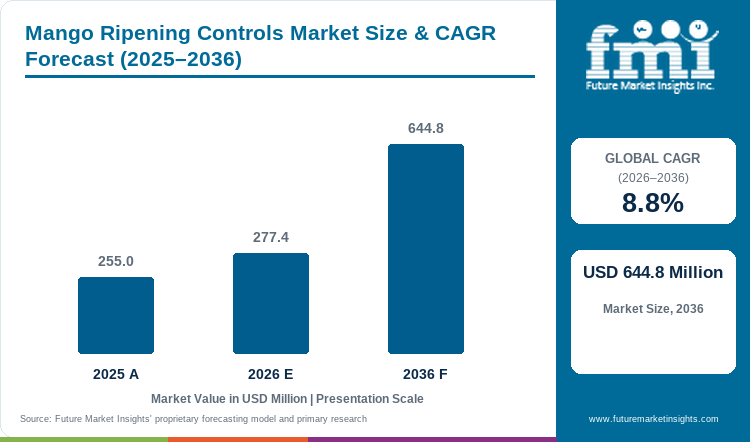
The mango ripening controls market is estimated to be valued at USD 277.4 Million in 2026, up from USD 255 Million in 2025 and is projected to grow to USD 644.8 Million by 2036.
Sales of mango ripening controls are projected to increase at an 8.8% CAGR through 2036. Demand is expected to grow owing to the increasing focus of packhouses and exporters on maintaining saleable mango quality during extended post-harvest distribution. Suppliers of mango ripening control systems are widely focusing on coatings, ethylene-management systems, and other ripening technologies to preserve firmness and appearance whilst fitting existing harvest and handling processes.
Demand differs across the 30+ countries covered, as import procedures along with phytosanitary conditions continue to influence treatment practices. The USA, UK, Japan, and South Korea each impose stricter market-entry and handling requirements that affect the timing and application of ripening controls. To handle this, manufacturers are demonstrating that their treatments work alongside mandatory procedures while maintaining fruit quality and traceability. Commercial success will continue to depend on effective packhouse performance, predictable application, and documentation till 2036.
Key Takeaways
- Edible coatings are predicted to account for 47.4% of product type revenue in 2026.
- Pome & stone fruit is expected to represent 35.7% of commodity demand in 2026 due to demand for controlled post-harvest handling.
- Packhouses hold 38.9% of application point revenue in 2026, as treatment consistency becomes important at commercial throughput.
- Packhouses and exporters prioritize controls that maintain firmness, appearance, and saleable quality during longer distribution cycles.
- Key players include AgroFresh, Apeel Sciences, Hazel Technologies, DECCO (UPL), Pace International (AgroFresh), Xeda International, Citrosol, and Fomesa Fruitech (Citrosol group).
- Country-specific requirements can affect treatment timing and limit the usable control window.
Analyst Perspective
“Packhouse teams should judge a ripening control by one test. Does it survive quarantine treatment and full line speed at the same time? A shelf-life claim alone is not enough. Suppliers that prove crop-specific results and make export compliance simpler are the ones that get called back after the trial.”
- Nandini Roy Choudhury, Principal Consultant, Future Market Insights
How is the mango ripening controls market segmented?
The mango ripening controls market in the FMI report is segmented by 6 categories including Product Type, Commodity, Application Point, Technology Base, Sales Channel, and Region.
In terms of product type, the market includes edible coatings, active sachets and liners, wash and drench treatments, storage-room treatments, and others. The commodity segment spans pome and stone fruit, citrus, berries and grapes, tropical fruit, vegetables, and others. In terms of application point, it tracks packhouses, storage facilities, transit and retail, and others. The technology base segment groups biological or microbial, plant-extract-based, mineral and wax-based, and other solutions. Sales channels include packhouse suppliers, post-harvest service providers, direct sales, and others.
What makes Edible Coatings central to the Product Type category?
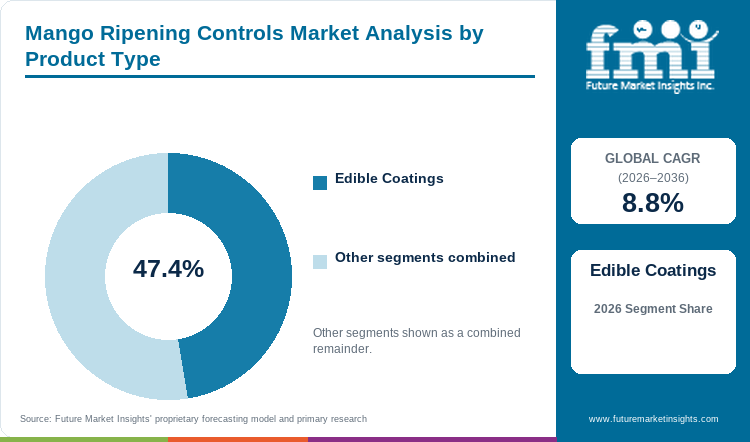
Edible coatings are predicted to stay formidable during the forecast period, as packhouses continue to adopt them to reduce water loss and modify gas exchange without a dedicated storage-room treatment cycle. High compatibility, along with easy integration into existing line steps when dosage and drying conditions are controlled, will be the key factor for adoption.
- Demand will increase as coatings combine direct surface protection with compatibility across high-throughput post-harvest workflows.
- Edible coatings will account for 47.4% of product type revenue in 2026.
Why does Pome and Stone Fruit lead the Commodity segment?
Pome and stone fruit are leading the commodity segment as per the analysis from FMI. Packhouses are already running well-established treatment programs for apples, pears, peaches, and plums. Suppliers’ ability to combine decay control, storage management, and surface treatment will continue to increase the demand for adopting these methods.
- Pome & stone fruit is estimated to hold 35.7% of commodity revenue in 2026.
- Long storage cycles make ripening and decay control a routine purchase for these crops.
How does the Packhouse shape the Application Point segment?
The packhouse is the primary post-harvest point where fruit is sorted, washed, and treated at scale. Operators will continue to apply wash chemistry, coatings, and automated dosing in one place before shipment. Checking and recording treatment is much easier here than in transit. As a result, primary spending on ripening controls will continue to happen at this stage.
- Packhouses are expected to hold 38.9% of application point revenue in 2026.
- Products that fit existing wash and coating equipment get approved faster than those that need new machinery.
What supports Biological / Microbial adoption?
Adoption of biological and microbial technology will continue to increase, as it gives packhouses other ways to control decay. Buyers want first-hand proof that these products work consistently under real packing and storage conditions. Crop-specific test results and clear handling steps will be the key for winning repeat orders.
- Biological / microbial technologies are projected to account for 40.4% of technology base revenue in 2026.
- Demand is driven by the shift toward lower-residue decay control.
What drives Packhouse Suppliers in the Sales Channel category?
Packhouse suppliers will continue to be the leading sales channel in the mango ripening controls market. High demand is expected from packhouse suppliers, as they help reduce downtime and let buyers see value beyond unit price. As per FMI, direct sales channels will not be able to match this service level during short packing seasons.
- Packhouse suppliers are projected to hold 40.0% of sales channel revenue in 2026.
- Service providers gain share where packhouses prefer to outsource treatment work.
What are the drivers, restraints, and opportunities?
Record trade volumes will continue to increase demand for arrival-quality control, whilst quarantine rules will narrow the treatment window, and biological and package-level formats will continue to open new treatment points.
- Driver: Larger and longer mango trade flows raise the cost of fruit that ripens too early or unevenly before it reaches the buyer.
- Restraint: Treatments must fit crop physiology, destination quarantine procedures, and residue or labeling rules before they can be used at scale.
- Opportunity: Biological products and package-level barriers can widen the number of lots and handlers able to apply ripening control consistently.
Record import volumes raise the cost of poor arrival quality
Mango trade continues to grow faster than the handling capacity built around it. USDA’s Economic Research Service, in its July 2026 Fruit and Tree Nuts Outlook, recorded 2025 US fresh mango imports at a record high, and per capita availability climbed to 3.8 pounds, more than double the 2000-2002 average of 1.8 pounds. Growth will continue to bring challenges. The same report noted that Peruvian shipments fell in the 2025/26 season after warm nights reduced flowering and a cold spell in late 2025 delayed fruit ripening. Weather swings make arrival dates harder to predict, so importers hold fruit longer or reroute it.
Quarantine and labeling rules narrow the treatment window
A control can work on the fruit and still fail commercially. USDA APHIS guidance on phytosanitary treatments states that imported commodities require chemical or physical treatment at certified facilities, with the method set by origin, commodity, packaging, and port. Mango often receives hot-water or vapor heat treatment before shipment, and any ripening control must work after that step without damaging the peel. Japan showed how sharp the risk can be in March 2026, when its Plant Protection Station suspended exports of fresh Indian mangoes to Japan after an inspection found that designated facilities did not meet the agreed conditions, including disinfection. Labeling adds a separate hurdle.
In August 2025, The Packer reported on H.R. 4737, the “Apeel Reveal Act of 2025” introduced by Rep. Marlin Stutzman, which proposes mandatory disclosure of certain produce coatings, and noted that Southern California natural grocer Jimbo’s had stopped carrying Apeel-treated produce. None of this removes demand, but suppliers must record each step and show that their product adds no new compliance risk.
Biological and package-level formats widen the addressable base
The biggest opening lies in making controls easier to validate and easier to run. Biological fungicides serve buyers that are cutting conventional residues; the Biotalys-AgroFresh partnership announced in May 2025 to develop protein-based (AGROBODY™) post-harvest biofungicides targets that group directly. Package-level barriers move protection closer to the carton, which helps smaller packers that lack a full treatment line. Ethylene-control sachets and ethylene-control produce liners can add ripening control inside the pack without new liquid-handling equipment. In November 2025, Hazel Technologies expanded its partnership with QFresh Lab to cover packaging-film work, post-harvest physiology, and laboratory testing. Faster trials mean more lots can receive the same treatment.
Which country CAGRs are profiled?
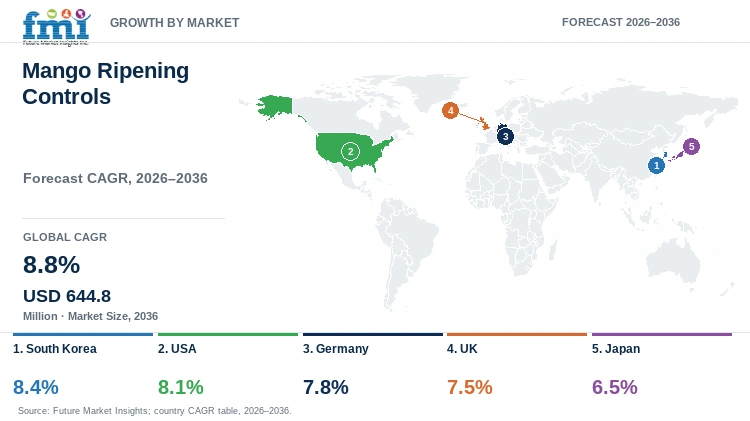
| Country | CAGR, 2026 to 2036 |
|---|---|
| South Korea | 8.4% |
| USA | 8.1% |
| Germany | 7.8% |
| UK | 7.5% |
| Japan | 6.5% |
How do country-level CAGRs compare?
In terms of the countries covered, the five profiled countries are projected to grow at CAGRs between 6.5% and 8.4%, a gap of 1.9 points. Growth projections for South Korea and the USA till 2036 are above 8%. Germany and the UK sit in the high 7s. Japan trails because its quarantine rules on imported fruit are tighter. A faster rate does not always mean a bigger revenue pool.
- South Korea’s registered-orchard system rewards suppliers whose coatings and sachets can be applied at approved foreign packhouses.
- The USA combines record import volume with origin-specific quarantine steps that ripening controls must work around.
- Germany rewards suppliers that can show measurable shrink reduction inside retailer and wholesaler waste programs.
- UK buyers depend heavily on imports and weigh supplier assurance and retailer specifications closely.
- Japan places the most weight on compatibility with prescribed heat or vapor treatment and on source eligibility.
The full FMI report provides country-level CAGR analysis across North America, Latin America, Western Europe, Eastern Europe, East Asia, South Asia and Pacific, and the Middle East and Africa.
Country Outlook
- Demand for mango ripening controls in the USA is forecast to grow at an 8.1% CAGR from 2026 to 2036, due to record import volume. USDA’s Economic Research Service reported that fresh mango imports reached 1.32 billion pounds in 2025, with Mexico supplying 63%. Import volume in the first five months of 2026 was flat, as higher Mexican shipments offset a weaker Peruvian season. USDA APHIS requires prescribed treatment for certain origins and ports, so the local challenge is making ripening management work after that quarantine step.
- Sales in the UK are forecasted to increase at a 7.5% CAGR through 2036, primarily by heavy dependence on imported produce. Defra’s Food Statistics Pocketbook (updated July 2026) states that fruit and vegetables remain the UK’s largest food import group by value, at about £15 billion, well ahead of meat (£8.3 billion) and beverages (£7.5 billion). This reliance will continue to raise the value of arrival-quality controls, but it will also add friction regarding supplier checks and retailer specifications.
- Germany is estimated to post a 7.8% CAGR during the forecast period, tied to retail and wholesale programs that measure food waste. The Federal Environment Agency (Umweltbundesamt) reports that about 7% of Germany’s food waste arises in retail. Suppliers must still meet EU product and residue rules, and buyers want proof of lower shrink, not a broad green claim.
- Adoption of mango ripening controls in Japan is all set to expand at a 6.5% CAGR through 2036, primarily due to strict plant quarantine conditions. Japan’s Plant Protection Station announced on March 30, 2026 that exports of fresh Indian mangoes to Japan were suspended because designated facilities failed to meet the agreed conditions, which include disinfection. Fruit covered by phytosanitary certificates issued on or after March 25 faced return or destruction. That leaves little room for another treatment after required disinfection.
- Demand in South Korea is all set to grow at an 8.4% CAGR through 2036, driven by import routes relying on registered foreign orchards and packhouses. The Animal and Plant Quarantine Agency (APQA) publishes lists of approved Pakistani mango orchards and packhouses each season and maintains similar lists for Thai mangoes.
Who are the notable companies in the mango ripening controls market?
AgroFresh, Apeel Sciences, Hazel Technologies, DECCO (UPL), Xeda International, Citrosol, and Fomesa Fruitech are a few of the notable companies in the mango ripening controls market, out of many players covered by FMI. Pace International is a part of AgroFresh, whilst Fomesa Fruitech has been part of the Citrosol group.
The mango ripening controls market is moderately consolidated, with companies competing through ripening and atmosphere control, surface coatings, or integrated packhouse treatment systems. Many players overlap across these strategy groups, so buyers choose suppliers based on crop fit, line compatibility, and on-site technical support. Leading companies are growing through wider product portfolios, distribution agreements, and service-led packhouse programs.
- Direct Ripening and Atmosphere Control: AgroFresh, Hazel Technologies, and Fomesa Fruitech compete through ethylene management or storage-condition tools alongside broader post-harvest programs.
- Surface Barrier and Coating Systems: Apeel Sciences, DECCO (UPL), and Pace International emphasize coatings that manage moisture loss or respiratory exchange at the produce surface.
- Integrated Packhouse Treatment Platforms: Xeda International and Citrosol differentiate through treatment equipment and process-control capability that can be embedded in packing operations.
Competitive Benchmarking
| Company | Ripening & Atmosphere Control | Coating & Surface Barrier Depth | Packhouse Treatment Integration | Geographic Reach |
|---|---|---|---|---|
| AgroFresh | High | High | High | Global, with strong Americas and Europe presence |
| Apeel Sciences | Medium | High | Medium | North America and selected international produce programs |
| Hazel Technologies | High | Medium | Medium | North America with international produce programs |
| DECCO (UPL) | Medium | High | High | Americas, Europe, Africa, and Asia |
| Pace International | Medium | High | High | North America and Latin America with export-oriented programs |
| Xeda International | Medium | High | High | Europe and international post-harvest markets |
| Citrosol | High | High | High | Europe, South America, Africa, and selected Asian markets |
| Fomesa Fruitech | High | High | High | Europe and international packhouse markets |
Scoring basis: Ripening & Atmosphere Control measures documented ability to manage ethylene response or storage atmosphere. Coating & Surface Barrier Depth measures the breadth of documented film or coating capability for produce. Packhouse Treatment Integration measures documented equipment and dosing support or line-level treatment integration. High indicates broad and clearly documented capability; Medium indicates credible but narrower coverage; Low would indicate a documented limitation. Geographic Reach reflects evidenced commercial or service activity relevant to post-harvest treatment, not corporate-office location alone.
Key Developments
- In November 2025, Hazel Technologies, Inc. expanded its partnership with QFresh Lab (announced November 3, 2025). The expanded scope goes beyond film support for Hazel’s Breatheway packaging to include post-harvest physiology expertise and laboratory testing.
- In June 2025, AgroFresh signed an exclusive global distribution agreement with Nabaco for NatuWrap®, a food-grade protective barrier for fruits and vegetables (announced June 18, 2025).
Key Players
Direct Ripening and Atmosphere Control
- AgroFresh
- Hazel Technologies
- Fomesa Fruitech
Surface Barrier and Coating Systems
- Apeel Sciences
- DECCO (UPL)
- Pace International
Integrated Packhouse Treatment Platforms
- Xeda International
- Citrosol
Report Scope and Methodology
| Coverage field | Report scope |
|---|---|
| Market breakdown | Product Type, Commodity, Application Point, Technology Base, Sales Channel, Region |
| Quantitative units | USD Million |
| Market definition | Revenue includes post-harvest ripening-control products and treatments sold within the stated product, commodity, application-point, technology-base, and channel universe. It covers coatings, active sachets and liners, wash and drench treatments, storage-room treatments, and related controls used to manage ripening, senescence, moisture loss, or decay. Downstream fresh-produce revenue and adjacent substitute products are excluded. |
| Regions covered | North America, Latin America, Western Europe, Eastern Europe, East Asia, South Asia and Pacific, Middle East and Africa |
| Countries covered | USA, UK, Germany, Japan, South Korea, and more than 25 additional countries in the full report |
| Key companies profiled | AgroFresh, Apeel Sciences, Hazel Technologies, DECCO (UPL), Pace International, Xeda International, Citrosol, Fomesa Fruitech |
| Forecast period | 2026 to 2036 |
| Approach | FMI applies a hybrid bottom-up and top-down market-sizing approach. Product-level adoption and pricing are reconciled with commodity, channel, country, and supplier evidence. |
Research Methodology
| Method | Approach |
|---|---|
| Primary research | Structured discussions with manufacturers, packhouse suppliers, post-harvest service providers, distributors, produce operators, procurement teams, and subject-matter experts test adoption triggers, purchase frictions, treatment fit, and pricing behavior. |
| Desk research | Review of government trade and quarantine statistics, regulator notices, peer-reviewed post-harvest literature, company filings, product documentation, and dated corporate announcements. Commercial market-research publisher estimates are excluded as factual evidence. |
| Market sizing and forecasting | Product penetration, pricing patterns, commodity exposure, application point, channel behavior, and country operating conditions are reconciled within the approved market boundary to establish the base and forecast path. |
| Data validation | Facts, dates, and company statements are cross-checked across independent and first-party evidence where appropriate. Double counting, downstream fresh-produce revenue, adjacent cold-chain revenue, and unsupported company claims are excluded. |
Mango Ripening Controls Market by Segments
Mango Ripening Controls Market Segmented by Product Type
- Edible Coatings
- Active Sachets & Liners
- Wash & Drench Treatments
- Storage-Room Treatments
- Others
Mango Ripening Controls Market Segmented by Commodity
- Pome & Stone Fruit
- Citrus
- Berries & Grapes
- Tropical Fruit
- Vegetables
- Others
Mango Ripening Controls Market Segmented by Application Point
- Packhouse
- Storage Facility
- Transit & Retail
- Others
Mango Ripening Controls Market Segmented by Technology Base
- Biological / Microbial
- Plant-Extract-Based
- Mineral & Wax-Based
- Others
Mango Ripening Controls Market Segmented by Sales Channel
- Packhouse Suppliers
- Post-Harvest Service Providers
- Direct Sales
- Others
Mango Ripening Controls Market Segmented by Region
- North America
- United States
- Canada
- Latin America
- Brazil
- Mexico
- Argentina
- Chile
- Western Europe
- Germany
- France
- United Kingdom
- Italy
- Spain
- Benelux
- Nordics
- Eastern Europe
- Poland
- Czech Republic
- Romania
- Hungary
- East Asia
- China
- Japan
- South Korea
- South Asia and Pacific
- India
- ASEAN
- Australia and New Zealand
- Middle East and Africa
- GCC Countries
- South Africa
- Türkiye
- Israel
Research Sources and Bibliography
- Weber, C., Wakefield, H., & Wechsler, S. J., USDA Economic Research Service (2026, July 23). Fruit and Tree Nuts Outlook: July 2026 (FTS-385).
- USDA Animal and Plant Health Inspection Service (last modified 2026, September 2). Phytosanitary Treatments - Imported Commodities.
- Department for Environment, Food & Rural Affairs (Defra) (updated 2026, July 29). Food Statistics in Your Pocket.
- Umweltbundesamt (German Environment Agency) (updated 2025, October 27). Lebensmittelabfälle [Food waste].
- Plant Protection Station, Ministry of Agriculture, Forestry and Fisheries of Japan (2026, March 30). [Suspension of exports of fresh Indian mango fruit to Japan].
- U.S. Congress (2025). H.R. 4737 - Apeel Reveal Act of 2025, 119th Congress.
- Strailey, J., The Packer (2025, August 5). Apeel Sciences Addresses ‘Widespread Misinformation’ About Its Company, Products.
- FreshFruitPortal (2025, August 6). Apeel Sciences responds to Federal Labeling Bill.
- Business Standard (2026, May 29). Japan suspends Indian mango imports after 20 years over inspection concerns.
- Business Recorder (2026, June 13). Three additional mango export facilities: TDAP facilitates registration with APQA-S Korea.
- AgroFresh (2026, April 28). AgroFresh Opens New Asia Pacific R&D Center in Yangling, China.
- AgroFresh (2026, March 10). AgroFresh to Demonstrate Leading Portfolio of Citrus Protection Solutions at Citrus Showcase.
- AgroFresh (2025, June 18). AgroFresh Expands Global Post-Harvest Solutions Portfolio with NatuWrap® in Exclusive Distribution Agreement with Nabaco®.
- AgroFresh (2025, May 21). Biotalys and AgroFresh partner to protect fresh produce.
- Hazel Technologies, Inc. (2025, November 3). Hazel Technologies, Inc. Expands Partnership with QFresh Lab.
- DECCO Postharvest (2025, September 23). DECCO Expands Global Footprint with New Plant in Valencia, Spain.
- Xeda International / Postharvest.biz (2025, October 27). Xeda Ibérica showcased its innovations in automation and fruit labeling at Fruit Attraction 2025.
- Xeda International / Poscosecha.com (2026, June 12). Cinco décadas de evolución tecnológica al servicio de la poscosecha.
- Citrosol / Postharvest.biz (2025, November 27). Citrosol shares its advances in avocado preservation at the 7th Latin American Avocado Congress in Peru.
- Citrosol / Postharvest.biz (2026, May 21). Citrosol Presents Citrocide System at the Pepper Technical Conference 2026.
- Citrosol / Postharvest.biz (2025, November 6). Citrosol strengthens its international expansion strategy with its subsidiary in Uruguay.
This bibliography is provided for reader reference and is not exhaustive. The full report contains the complete reference list and detailed citations.
This Report Answers
- What is the Mango Ripening Controls Market size in 2026 and 2036?
- Which post-harvest and supply-chain pressures support demand for mango ripening controls?
- Why do Edible Coatings hold the leading Product Type position?
- How does Pome & Stone Fruit influence demand across the Commodity axis?
- Why does Packhouse hold the leading Application Point position?
- How do growth rates differ across the USA, UK, Germany, Japan, and South Korea?
- How do profiled companies differ by ripening control, coating, and packhouse integration?
- Which validation, residue, and phytosanitary frictions limit adoption?
- What should packhouse procurement and post-harvest teams evaluate before purchase?
Frequently Asked Questions
How big is the mango ripening controls market expected to be in 2026?
The mango ripening controls market is expected to reach USD 277.4 million in 2026 and USD 644.8 million by 2036. Growth follows the need to hold saleable quality across longer and less predictable shipping schedules.
What is the CAGR of the mango ripening controls market from 2026 to 2036?
The mango ripening controls market is projected to grow at an 8.8% CAGR from 2026 to 2036. Expansion depends on repeatable performance at line speed and on compatibility with destination quarantine procedures.
Which product type holds the largest share?
Edible coatings are expected to hold 47.4% of product type revenue in 2026. Line application gives surface protection without a separate storage-room treatment cycle.
Which application point leads the market?
Packhouses are projected to account for 38.9% of application point revenue in 2026. The packing line is the first point where dosing, concentration, and records can be controlled together.
Which country is expected to grow fastest?
South Korea is forecast to grow at an 8.4% CAGR through 2036, followed by the USA at 8.1%. Japan is the slowest of the five profiled countries at 6.5%, reflecting strict quarantine conditions on imported fruit.
Which companies are active in the mango ripening controls market?
Profiled companies include AgroFresh, Apeel Sciences, Hazel Technologies, DECCO (UPL), Pace International, Xeda International, Citrosol, and Fomesa Fruitech. They compete through ethylene management, coatings, packhouse equipment, and technical service.
Preview the report firsthand - request a free sample
Get SampleGet the brochure for pricing and purchase details.
Get PDFTable of Content
- Key Takeaways
- Market Size and CAGR
- Top Growth Driver
- Fastest Growing Segment
- Leading Region
- Key Companies
- Emerging Opportunities
- Executive Summary
- Global Market Outlook
- Demand-side Trends
- Supply-side Trends
- Technology Roadmap Analysis
- Analysis and Recommendations
- Analyst Perspective (What is happening? Why now? What should investors know?)
- Key Questions Answered
- How large is the market?
- What is the CAGR?
- What are key trends?
- Which region dominates?
- Who are the leaders?
- Market Overview
- Market Coverage / Taxonomy
- Market Definition / Scope / Limitations
- Research Methodology
- Chapter Orientation
- Analytical Lens and Working Hypotheses
- Market Structure, Signals, and Trend Drivers
- Benchmarking and Cross-market Comparability
- Market Sizing, Forecasting, and Opportunity Mapping
- Research Design and Evidence Framework
- Desk Research Programme (Secondary Evidence)
- Expert Input and Fieldwork (Primary Evidence)
- Tooling, Models, and Reference Databases
- Data Engineering and Model Build
- Quality Assurance and Audit Trail
- Market Background
- Market Dynamics (Drivers, Restraints, Opportunity, Trends)
- Scenario Forecast (Optimistic, Likely, Conservative)
- Impact Analysis
- AI Impact
- Sustainability Impact
- Regulatory Impact
- Technology Impact
- Consumer / Buyer Analysis
- Purchase Drivers
- Adoption Barriers
- Buyer Journey
- Opportunity Map Analysis
- Product Life Cycle Analysis
- Supply Chain Analysis
- Investment Feasibility Matrix
- Value Chain Analysis
- PESTLE and Porter's Analysis
- Regulatory Landscape
- Regional Parent Market Outlook
- Production and Consumption Statistics
- Import and Export Statistics
- Global Market Analysis and Forecast, 2021 to 2036
- Historical Market Size Value (USD Million) Analysis, 2021 to 2025
- Current and Future Market Size Value (USD Million) Projections, 2026 to 2036
- Y-o-Y Growth Trend Analysis
- Absolute $ Opportunity Analysis
- Global Market Pricing Analysis, 2021 to 2036
- Global Market Analysis and Forecast, By Product Type, 2021 to 2036
- Introduction / Key Findings
- Historical Market Size Value (USD Million) Analysis By Product Type, 2021 to 2025
- Current and Future Market Size Value (USD Million) Analysis and Forecast By Product Type, 2026 to 2036
- Edible Coatings
- Active Sachets & Liners
- Wash & Drench Treatments
- Storage-Room Treatments
- Others
- Y-o-Y Growth Trend Analysis By Product Type, 2021 to 2025
- Absolute $ Opportunity Analysis By Product Type, 2026 to 2036
- Global Market Analysis and Forecast, By Commodity, 2021 to 2036
- Introduction / Key Findings
- Historical Market Size Value (USD Million) Analysis By Commodity, 2021 to 2025
- Current and Future Market Size Value (USD Million) Analysis and Forecast By Commodity, 2026 to 2036
- Pome & Stone Fruit
- Citrus
- Berries & Grapes
- Tropical Fruit
- Vegetables
- Others
- Y-o-Y Growth Trend Analysis By Commodity, 2021 to 2025
- Absolute $ Opportunity Analysis By Commodity, 2026 to 2036
- Global Market Analysis and Forecast, By Application Point, 2021 to 2036
- Introduction / Key Findings
- Historical Market Size Value (USD Million) Analysis By Application Point, 2021 to 2025
- Current and Future Market Size Value (USD Million) Analysis and Forecast By Application Point, 2026 to 2036
- Packhouse
- Storage Facility
- Transit & Retail
- Others
- Y-o-Y Growth Trend Analysis By Application Point, 2021 to 2025
- Absolute $ Opportunity Analysis By Application Point, 2026 to 2036
- Global Market Analysis and Forecast, By Technology Base, 2021 to 2036
- Introduction / Key Findings
- Historical Market Size Value (USD Million) Analysis By Technology Base, 2021 to 2025
- Current and Future Market Size Value (USD Million) Analysis and Forecast By Technology Base, 2026 to 2036
- Biological / Microbial
- Plant-Extract-Based
- Mineral & Wax-Based
- Others
- Y-o-Y Growth Trend Analysis By Technology Base, 2021 to 2025
- Absolute $ Opportunity Analysis By Technology Base, 2026 to 2036
- Global Market Analysis and Forecast, By Sales Channel, 2021 to 2036
- Introduction / Key Findings
- Historical Market Size Value (USD Million) Analysis By Sales Channel, 2021 to 2025
- Current and Future Market Size Value (USD Million) Analysis and Forecast By Sales Channel, 2026 to 2036
- Packhouse Suppliers
- Post-Harvest Service Providers
- Direct Sales
- Others
- Y-o-Y Growth Trend Analysis By Sales Channel, 2021 to 2025
- Absolute $ Opportunity Analysis By Sales Channel, 2026 to 2036
- Global Market Analysis and Forecast, By Region, 2021 to 2036
- Introduction
- Historical Market Size Value (USD Million) Analysis By Region, 2021 to 2025
- Current Market Size Value (USD Million) Analysis and Forecast By Region, 2026 to 2036
- North America
- Latin America
- Western Europe
- Eastern Europe
- East Asia
- South Asia and Pacific
- Middle East and Africa
- Market Attractiveness Analysis By Region
- North America Market Analysis and Forecast, By Country, 2021 to 2036
- Historical Market Size Value (USD Million) Trend Analysis By Market Taxonomy, 2021 to 2025
- Market Size Value (USD Million) Forecast By Market Taxonomy, 2026 to 2036
- By Country
- United States
- Canada
- By Product Type
- By Commodity
- By Application Point
- By Technology Base
- By Sales Channel
- By Country
- Market Attractiveness Analysis
- By Country
- By Product Type
- By Commodity
- By Application Point
- By Technology Base
- By Sales Channel
- Key Takeaways
- Latin America Market Analysis and Forecast, By Country
- Historical Market Size Value (USD Million) Trend Analysis By Market Taxonomy, 2021 to 2025
- Market Size Value (USD Million) Forecast By Market Taxonomy, 2026 to 2036
- By Country
- Brazil
- Mexico
- Argentina
- Chile
- By Product Type
- By Commodity
- By Application Point
- By Technology Base
- By Sales Channel
- By Country
- Market Attractiveness Analysis
- By Country
- By Product Type
- By Commodity
- By Application Point
- By Technology Base
- By Sales Channel
- Key Takeaways
- Western Europe Market Analysis and Forecast, By Country
- Historical Market Size Value (USD Million) Trend Analysis By Market Taxonomy, 2021 to 2025
- Market Size Value (USD Million) Forecast By Market Taxonomy, 2026 to 2036
- By Country
- Germany
- France
- United Kingdom
- Italy
- Spain
- Benelux
- Nordics
- By Product Type
- By Commodity
- By Application Point
- By Technology Base
- By Sales Channel
- By Country
- Market Attractiveness Analysis
- By Country
- By Product Type
- By Commodity
- By Application Point
- By Technology Base
- By Sales Channel
- Key Takeaways
- Eastern Europe Market Analysis and Forecast, By Country
- Historical Market Size Value (USD Million) Trend Analysis By Market Taxonomy, 2021 to 2025
- Market Size Value (USD Million) Forecast By Market Taxonomy, 2026 to 2036
- By Country
- Poland
- Czech Republic
- Romania
- Hungary
- By Product Type
- By Commodity
- By Application Point
- By Technology Base
- By Sales Channel
- By Country
- Market Attractiveness Analysis
- By Country
- By Product Type
- By Commodity
- By Application Point
- By Technology Base
- By Sales Channel
- Key Takeaways
- East Asia Market Analysis and Forecast, By Country
- Historical Market Size Value (USD Million) Trend Analysis By Market Taxonomy, 2021 to 2025
- Market Size Value (USD Million) Forecast By Market Taxonomy, 2026 to 2036
- By Country
- China
- Japan
- South Korea
- By Product Type
- By Commodity
- By Application Point
- By Technology Base
- By Sales Channel
- By Country
- Market Attractiveness Analysis
- By Country
- By Product Type
- By Commodity
- By Application Point
- By Technology Base
- By Sales Channel
- Key Takeaways
- South Asia and Pacific Market Analysis and Forecast, By Country
- Historical Market Size Value (USD Million) Trend Analysis By Market Taxonomy, 2021 to 2025
- Market Size Value (USD Million) Forecast By Market Taxonomy, 2026 to 2036
- By Country
- India
- ASEAN
- Australia and New Zealand
- By Product Type
- By Commodity
- By Application Point
- By Technology Base
- By Sales Channel
- By Country
- Market Attractiveness Analysis
- By Country
- By Product Type
- By Commodity
- By Application Point
- By Technology Base
- By Sales Channel
- Key Takeaways
- Middle East and Africa Market Analysis and Forecast, By Country
- Historical Market Size Value (USD Million) Trend Analysis By Market Taxonomy, 2021 to 2025
- Market Size Value (USD Million) Forecast By Market Taxonomy, 2026 to 2036
- By Country
- GCC Countries
- South Africa
- Türkiye
- Israel
- By Product Type
- By Commodity
- By Application Point
- By Technology Base
- By Sales Channel
- By Country
- Market Attractiveness Analysis
- By Country
- By Product Type
- By Commodity
- By Application Point
- By Technology Base
- By Sales Channel
- Key Takeaways
- Key Countries Market Analysis
- United States
- Pricing Analysis
- Market Share Analysis, 2025
- By Product Type
- By Commodity
- By Application Point
- By Technology Base
- By Sales Channel
- Canada
- Pricing Analysis
- Market Share Analysis, 2025
- By Product Type
- By Commodity
- By Application Point
- By Technology Base
- By Sales Channel
- Mexico
- Pricing Analysis
- Market Share Analysis, 2025
- By Product Type
- By Commodity
- By Application Point
- By Technology Base
- By Sales Channel
- Brazil
- Pricing Analysis
- Market Share Analysis, 2025
- By Product Type
- By Commodity
- By Application Point
- By Technology Base
- By Sales Channel
- Chile
- Pricing Analysis
- Market Share Analysis, 2025
- By Product Type
- By Commodity
- By Application Point
- By Technology Base
- By Sales Channel
- Germany
- Pricing Analysis
- Market Share Analysis, 2025
- By Product Type
- By Commodity
- By Application Point
- By Technology Base
- By Sales Channel
- United Kingdom
- Pricing Analysis
- Market Share Analysis, 2025
- By Product Type
- By Commodity
- By Application Point
- By Technology Base
- By Sales Channel
- Italy
- Pricing Analysis
- Market Share Analysis, 2025
- By Product Type
- By Commodity
- By Application Point
- By Technology Base
- By Sales Channel
- Spain
- Pricing Analysis
- Market Share Analysis, 2025
- By Product Type
- By Commodity
- By Application Point
- By Technology Base
- By Sales Channel
- France
- Pricing Analysis
- Market Share Analysis, 2025
- By Product Type
- By Commodity
- By Application Point
- By Technology Base
- By Sales Channel
- India
- Pricing Analysis
- Market Share Analysis, 2025
- By Product Type
- By Commodity
- By Application Point
- By Technology Base
- By Sales Channel
- ASEAN
- Pricing Analysis
- Market Share Analysis, 2025
- By Product Type
- By Commodity
- By Application Point
- By Technology Base
- By Sales Channel
- Australia and New Zealand
- Pricing Analysis
- Market Share Analysis, 2025
- By Product Type
- By Commodity
- By Application Point
- By Technology Base
- By Sales Channel
- China
- Pricing Analysis
- Market Share Analysis, 2025
- By Product Type
- By Commodity
- By Application Point
- By Technology Base
- By Sales Channel
- Japan
- Pricing Analysis
- Market Share Analysis, 2025
- By Product Type
- By Commodity
- By Application Point
- By Technology Base
- By Sales Channel
- South Korea
- Pricing Analysis
- Market Share Analysis, 2025
- By Product Type
- By Commodity
- By Application Point
- By Technology Base
- By Sales Channel
- Poland
- Pricing Analysis
- Market Share Analysis, 2025
- By Product Type
- By Commodity
- By Application Point
- By Technology Base
- By Sales Channel
- Hungary
- Pricing Analysis
- Market Share Analysis, 2025
- By Product Type
- By Commodity
- By Application Point
- By Technology Base
- By Sales Channel
- Türkiye
- Pricing Analysis
- Market Share Analysis, 2025
- By Product Type
- By Commodity
- By Application Point
- By Technology Base
- By Sales Channel
- South Africa
- Pricing Analysis
- Market Share Analysis, 2025
- By Product Type
- By Commodity
- By Application Point
- By Technology Base
- By Sales Channel
- United States
- Market Structure Analysis
- Competition Dashboard
- Competition Benchmarking
- Market Share Analysis of Top Players
- By Regional
- By Product Type
- By Commodity
- By Application Point
- By Technology Base
- By Sales Channel
- Emerging Startups
- Innovation Benchmarking
- Competition Analysis
- Competition Deep Dive
- AgroFresh
- Overview
- Product Portfolio
- Profitability by Market Segments
- Sales Footprint
- Strategy Overview
- Marketing Strategy
- Product Strategy
- Channel Strategy
- Apeel Sciences
- Hazel Technologies
- DECCO (UPL)
- Pace International
- Xeda International
- Citrosol
- Fomesa Fruitech
- AgroFresh
- Case Studies
- Success Stories
- Recent Developments
- Competition Deep Dive
- Assumptions & Acronyms Used


