

- Market Size (2026)
- USD 0.6 Bn
- Forecast (2036)
- USD 1.3 Bn
- CAGR (2026 to 2036)
- 8.5%
How big is Maternal DHA-Fortified Nutrition Market in 2026?
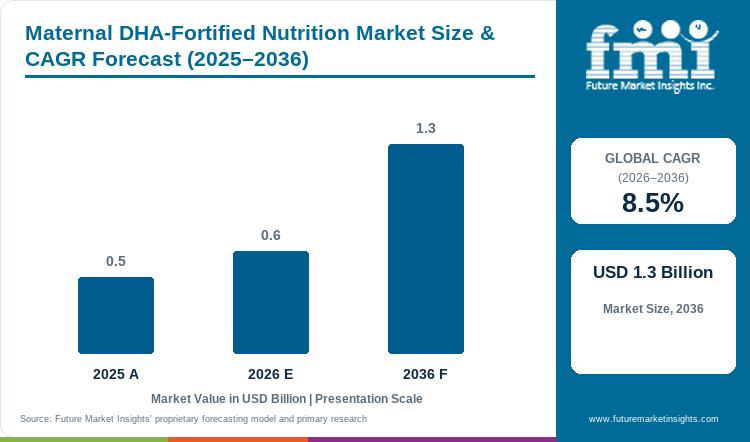
USD 0.6 Billion in 2026 and USD 1.3 Billion by 2036 at a 8.5% CAGR.
The Maternal DHA-Fortified Nutrition market stood at USD 0.5 Billion in 2025, is estimated at USD 0.6 Billion in 2026, and is forecast to reach USD 1.3 Billion by 2036 at a 8.5% CAGR from 2026 to 2036.
Demand is moving from a general prenatal-vitamin decision toward a more explicit DHA dose and source decision. The NIH Office of Dietary Supplements identifies DHA as critical to fetal brain and eye development.
It also notes expert guidance for at least 250 mg per day of DHA plus EPA for women of childbearing age, with an additional 100 to 200 mg of DHA during pregnancy. The dietary route alone remains inconsistent.
FDA and EPA guidance recommends 8 to 12 ounces of lower-mercury fish each week, while pregnant consumers average about 4.2 ounces. That gap supports repeat purchases of measured-dose maternal DHA products, especially when shoppers want plant-based sourcing or wish to avoid fish-related sensory concerns.
Commercial conversion therefore depends on making source and dose simple to compare. Purity evidence and daily-use convenience also need to be obvious.
Country behavior differs because public guidance frames DHA and fish intake in different ways. Germany gives a direct 200 mg daily DHA target for pregnancy and recommends supplementation when fatty sea fish is not eaten regularly.
The UK favors a food-first message and places limits on oily fish, while also warning pregnant consumers against fish liver oil because of retinol.
Japan uses a broader n-3 fatty-acid reference instead of a pregnancy-specific DHA target, which makes product communication more dependent on conservative claims and clear labeling.
South Korea has refreshed national nutrient reference standards that explicitly include EPA+DHA among the revised macronutrient benchmarks. Across these markets, interest becomes a purchase when the product fits local guidance. Consumers also need to verify dose and source without adding excessive pill burden.
Key Takeaways
- The market is estimated at USD 0.6 Billion in 2026 and is forecast to reach USD 1.3 Billion by 2036 at a 8.5% CAGR.
- Algal DHA (Vegan) leads the Source category in 2026. Prenatal DHA Softgels lead Product Type in 2026.
- Pregnancy leads the Life Stage category in 2026. The 200-300 mg range leads the DHA Dose category in 2026. Online / DTC leads Sales Channel in 2026.
- Driver: Maternal DHA guidance and low fish intake create a measurable nutrient gap that can be addressed through recurring supplementation.
- Restraint: Product variation, sensory burden, and uncertainty about source or label accuracy can delay purchase and reduce repeat use.
- Opportunity: Concentrated algal DHA and alternative delivery formats can widen eligibility while reducing pill burden and fish-related sensory concerns. South Korea has the highest profiled country CAGR at 8.9%, compared with Japan at 6.6%.
Analyst Perspective
Revenue capture will favor offers that turn clinical relevance into an easy daily routine with credible quality signals. A clear DHA amount should be visible without requiring consumers to infer it from total fish oil or total omega-3 content.
- Nandini Roy Choudhury, Principal Consultant, Future Market Insights
How is the Maternal DHA-Fortified Nutrition Market segmented?
The market is segmented by Source, Product Type, Life Stage, DHA Dose, and Sales Channel.
Source distinguishes algae-derived nutrition from marine-oil alternatives and shapes vegan eligibility, sensory profile, and contaminant perceptions. Product Type separates dedicated DHA softgels from prenatal multivitamins and fortified foods or drinks.
Life Stage reflects when the maternal nutrition routine begins and whether it continues after delivery. DHA Dose captures the amount delivered per daily serving and the extent to which products align with common clinical guidance.
Sales Channel separates education-led direct purchasing from pharmacy, grocery, and specialist retail discovery. These axes are commercially linked, but each addresses a different question in the purchase decision.
What makes Algal DHA (Vegan) central to the Source category?
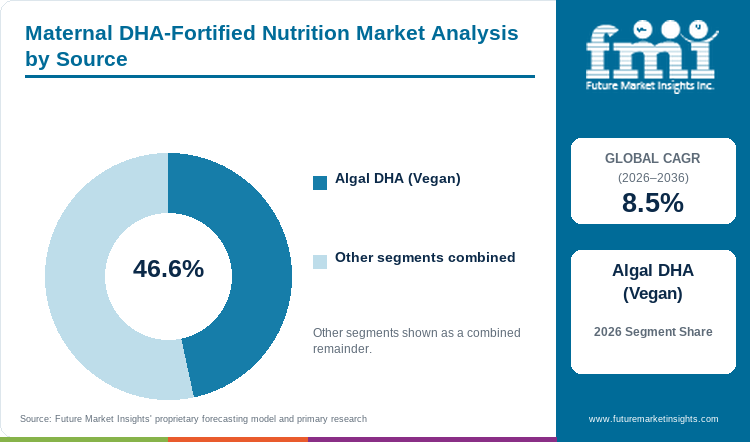
Algal DHA (Vegan) leads because it separates the nutrient from fish as the production source. That distinction matters for vegetarian and vegan consumers and for buyers who associate marine oils with fishy taste or ocean-borne contaminant concerns.
Controlled algal production also gives formulators a direct route to concentrated DHA without relying on fish oil as an intermediary. The mechanism is therefore eligibility plus formulation control rather than a simple sustainability message.
Fish Oil DHA remains important where consumers accept marine sourcing and value familiar omega-3 formats. Krill Oil serves a narrower marine-oil proposition. Other sources compete where cost or specialized formulation needs justify them.
- Algal DHA (Vegan) accounts for 46.6% of the Source category in 2026, supported by plant-based eligibility and direct DHA production from microalgae.
- In December 2024, BASF technical information specified a Schizochytrium-derived DHA Algal Oil with a minimum DHA concentration of 380 mg/g for human nutrition.
Why does Prenatal DHA Softgels lead the Product Type category?
Prenatal DHA Softgels lead because concentrated lipid ingredients fit naturally into a measured oil-based dosage form. The format can deliver a defined daily DHA amount while limiting the need to reformulate a full prenatal multivitamin.
It also lets brands offer fish oil and algal oil options within the same familiar delivery architecture. DHA-Fortified Prenatal Multis reduce the number of separate products a consumer takes, yet capsule space and nutrient interactions can restrict DHA loading.
Fortified foods and drinks can improve convenience for consumers who dislike capsules, but they must control taste and oxidation. Serving consistency also matters. Softgels therefore retain an advantage when dose precision is the first buying test.
- Prenatal DHA Softgels account for 43.8% of Product Type in 2026, reflecting a strong fit between concentrated oils and repeat daily dosing.
- In November 2025, DSM-Firmenich (life's DHA) described a high-concentration algal oil that enables a maternal softgel delivering 350 mg DHA per serving without a fishy sensory profile.
How does Pregnancy anchor the Life Stage category?
Pregnancy is the central life stage because fetal neural and visual development creates the clearest reason to add a defined DHA routine. NIH guidance connects pregnancy with additional DHA intake on top of baseline DHA plus EPA intake.
That makes pregnancy the point where general omega-3 awareness becomes a specific maternal product decision. Preconception purchasing can start earlier among consumers preparing for pregnancy, while lactation extends use when mothers want continued DHA intake during breastfeeding.
Those stages remain commercially important because they lengthen the replenishment window. Pregnancy still concentrates the most explicit clinical attention and the broadest range of prenatal formulations, which supports its leadership in the life-stage mix.
- Pregnancy accounts for 46.9% of the Life Stage category in 2026 because pregnancy guidance creates a direct and recurring DHA purchase trigger.
- In August 2026, Ritual expanded its Essential Prenatal into Costco locations nationwide in the USA; the formula includes 350 mg of algal DHA per daily serving.
What supports 200-300 mg in the DHA Dose category?
The 200-300 mg range leads because it maps closely to widely used maternal DHA reference points while keeping the daily serving compact. Germany recommends 200 mg DHA per day during pregnancy and advises supplementation when fatty sea fish is not eaten regularly.
NIH summarizes expert guidance that adds 100 to 200 mg DHA during pregnancy to a baseline DHA plus EPA intake target. This creates a practical formulation zone that is easy for clinicians and consumers to recognize.
Higher-dose products can serve consumers seeking more concentrated omega-3 intake or those with low baseline status. The leading band remains the clearest point of alignment between guidance, label communication, and convenient daily use.
- The 200-300 mg range accounts for 51.0% of the DHA Dose category in 2026, reflecting its close fit with common maternal DHA recommendations.
- On September 1, 2026, Nature Made's product page listed a postnatal multivitamin format with 200 mg DHA per daily softgel. This illustrates continued use of the 200 mg reference point after pregnancy.
What drives Online / DTC in the Sales Channel category?
Online / DTC leads because maternal DHA purchases benefit from detailed education and predictable replenishment. A product page can explain source and DHA amount in more depth than a crowded shelf label. It can also document testing, serving size, and life-stage positioning.
Direct channels also support subscriptions, which fit a product intended for daily use over several months. Retail Pharmacy remains influential when consumers want professional proximity or immediate access.
Supermarkets and hypermarkets add convenience and price visibility, while specialty stores can support premium or vegan discovery. The online advantage is strongest when brands must explain why a specific source or dose is worth a repeat purchase rather than compete only on bottle price.
- Online / DTC accounts for 36.9% of Sales Channel in 2026, supported by education-rich product pages and replenishment models for daily maternal use.
- On September 1, 2026, Needed's product page offered Prenatal Omega-3 with high-potency fish and vegan microalgal options. The page supports source and dose comparison at the point of purchase.
What are the drivers, restraints, and opportunities in the Maternal DHA-Fortified Nutrition Market?
Guideline-linked DHA needs support repeat demand, while dose and quality uncertainty can slow conversion, and high-concentration algal formats create room for easier daily use.
- Driver: Maternal DHA guidance and low fish intake create a measurable nutrient gap that can be addressed through recurring supplementation.
- Restraint: Product variation, sensory burden, and uncertainty about source or label accuracy can delay purchase and reduce repeat use.
- Opportunity: Concentrated algal DHA and alternative delivery formats can widen eligibility while reducing pill burden and fish-related sensory concerns.
Pregnancy guidance turns DHA from a general wellness ingredient into a nutrient with a measurable maternal use case. NIH identifies DHA as critical to fetal brain and eye development and summarizes expert recommendations for additional DHA intake during pregnancy.
FDA and EPA also report that pregnant consumers average about 4.2 ounces of fish each week versus the recommended 8 to 12 ounces. That dietary gap does not guarantee supplement use, but it gives clinicians and brands a concrete reason to discuss measured DHA intake.
Repeat revenue follows when consumers can translate guidance into a daily product that fits diet preferences and remains tolerable throughout pregnancy.
The main restraint appears at product selection and repeat use rather than at awareness alone. Prenatal formulations vary widely in ingredients and doses.
The NIH Office of Dietary Supplements summarizes a 2023 U.S. Government Accountability Office test in which 11 of 12 over-the-counter prenatal supplements had at least one tested nutrient outside acceptable label deviations.
The finding was not specific to DHA, but it strengthens the commercial importance of third-party verification and clear specifications in maternal nutrition. Fish-derived products can also face odor, aftertaste or source concerns.
These frictions raise comparison effort and can make consumers abandon a product before a full replenishment cycle develops.
High-concentration algal DHA creates an addressable opening because it can combine plant-based sourcing with more flexible product design. In November 2025, DSM-Firmenich (life's DHA) described maternal application concepts that deliver 350 mg DHA in an all-in-one softgel or two gummy servings, plus 250 mg smart chews.
The commercial value is not the higher dose by itself. It is the ability to meet a clear DHA target in formats that reduce fishy sensory cues and can lower pill burden.
Ingredient suppliers and maternal brands that pair concentrated oils or powders with transparent dose labeling are best placed to convert vegan, fish-averse, and adherence-sensitive demand into repeat purchases.
Which country CAGRs are profiled in the Maternal DHA-Fortified Nutrition Market?
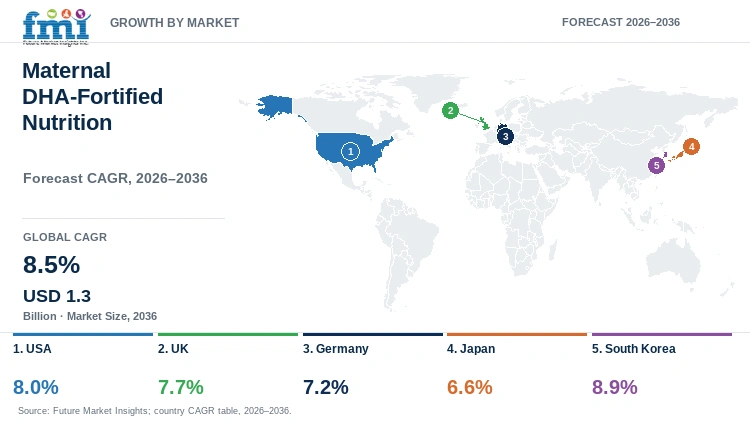
| Country | CAGR |
|---|---|
| USA | 8.0% |
| UK | 7.7% |
| Germany | 7.2% |
| Japan | 6.6% |
| South Korea | 8.9% |
How do country-level CAGRs compare in the Maternal DHA-Fortified Nutrition Market?
The five profiled country CAGRs span 2.3 percentage points from South Korea at 8.9% to Japan at 6.6%. South Korea forms the top growth band. USA and UK sit in an upper-middle band at 8.0% and 7.7%. Germany and Japan form a more moderate growth pair at 7.2% and 6.6%.
These rates describe pace rather than absolute revenue. The commercial meaning lies in how quickly suppliers may need to add channel coverage, localize guidance, or refine source and dose communication as maternal DHA routines become more established.
- South Korea exceeds USA by 0.9 percentage points, which supports earlier investment in localized education and product claims that align with national nutrient references.
- USA exceeds UK by 0.3 percentage points, a narrow gap that shifts attention toward channel economics and quality differentiation rather than headline growth alone.
- UK exceeds Germany by 0.5 percentage points, with the stronger rate offset by a more food-first public message that requires careful supplement positioning.
- Germany exceeds Japan by 0.6 percentage points, reflecting a clearer pregnancy-specific DHA reference in Germany while Japan uses a broader n-3 framework and tighter claims scrutiny.
CAGR alone cannot determine the quality of an opportunity. A slower-growing country can still contain a larger installed consumer base or a more efficient retail route. Supplier economics also depend on price architecture and trust signals.
Local labeling requirements can matter just as much as whether maternal guidance points directly to DHA supplementation. The full geographic view therefore combines growth rate with channel structure and evidence requirements before prioritizing market entry or expansion.
Country-wise Analysis
- USA: Maternal DHA is purchased largely as a self-pay supplement through retail and direct digital channels. Clinicians also influence the choice. Demand for Maternal DHA-Fortified Nutrition in the USA is forecast to expand at 8.0% CAGR from 2026 to 2036. FDA and EPA guidance states that pregnant adults should eat 8 to 12 ounces of lower-mercury fish weekly, yet the reported average is about 4.2 ounces. The local friction is not only low intake; shoppers must also distinguish DHA dose and product quality across many prenatal options. Suppliers need clear DHA labeling, credible testing signals and convenient replenishment across online and retail channels.
- UK: Maternal nutrition purchasing in the UK is shaped by a strong food-first message. Supplements are available through pharmacies and supermarkets as well as online channels. Demand for Maternal DHA-Fortified Nutrition in the UK is forecast to expand at 7.7% CAGR from 2026 to 2036. The NHS fish guidance page was reviewed on June 26, 2026 and advises no more than two portions of oily fish weekly for women who are pregnant or planning pregnancy. It also advises against fish liver oil during pregnancy because of vitamin A. Suppliers must therefore separate DHA supplementation from fish liver oil, explain source and dose carefully and avoid implying that a supplement replaces a balanced diet.
- Germany: German purchasing is supported by unusually explicit maternal DHA guidance, which makes the nutrient amount easier for consumers and health professionals to discuss. Demand for Maternal DHA-Fortified Nutrition in Germany is forecast to expand at 7.2% CAGR from 2026 to 2036. Current DGE guidance states that pregnant women should receive 200 mg DHA per day and recommends supplementation when fatty sea fish is not eaten regularly. The friction is that supplementation is conditional on dietary behavior rather than automatically required for every pregnancy. Suppliers can win by offering clearly labeled 200 to 300 mg options, plant-based alternatives and concise education that links product use to the consumer's actual fish intake.
- Japan: Japanese buyers operate within a nutrition framework that is less centered on a pregnancy-specific DHA target and more cautious about supplement claims. Demand for Maternal DHA-Fortified Nutrition in Japan is forecast to expand at 6.6% CAGR from 2026 to 2036. The 2025 Japanese Dietary Reference Intakes set an n-3 fatty-acid adequate intake of 1.7 g per day for pregnant and lactating women. The 2025 edition applies for the five-year period beginning in fiscal 2025. Suppliers need conservative substantiation and locally appropriate labeling. They also need to distinguish total n-3 intake from the DHA amount delivered by the product.
- South Korea: South Korean supplement buying combines strong digital discovery with close attention to nationally published nutrient standards. Demand for Maternal DHA-Fortified Nutrition in South Korea is forecast to expand at 8.9% CAGR from 2026 to 2036. On December 31, 2025 the Korean Nutrition Society reported a revision of the 2025 Korean Dietary Reference Intakes. The updated macronutrient standards include EPA+DHA. The friction is a crowded supplement environment where nutrient claims can become difficult to compare. Suppliers need locally aligned dose communication, strong provenance and a channel mix that connects online education with trusted retail access.
Who are the notable companies in the Maternal DHA-Fortified Nutrition Market?
Nordic Naturals and DSM-Firmenich (life's DHA) are profiled. Ritual and Needed are also covered. Pharmavite (Nature Made) and Carlson Labs are also covered. Wiley's Finest and BASF complete the notable-company set.
Competition is organized around three different routes to revenue. Nordic Naturals, Ritual, and Needed sell maternal DHA directly to consumers. They differentiate through source choice and dose transparency as well as pregnancy-focused education.
Pharmavite (Nature Made), Carlson Labs, and Wiley's Finest compete through established supplement brands with dedicated prenatal or maternal omega-3 products. DSM-Firmenich (life's DHA) and BASF sit further upstream. They provide DHA ingredient systems for softgels and gummies.
The same platform logic can extend to powders and fortified foods or beverages. These positions are not directly interchangeable. Consumer brands need efficient acquisition and repeat purchase. Established supplement companies need broad shelf access and trusted quality signals.
Ingredient suppliers compete on concentration and source. Application flexibility and documentation determine how easily formulators can carry the ingredient into maternal products.
- Consumer-facing maternal specialists: Nordic Naturals, Ritual and Needed compete through life-stage positioning, source transparency and direct education.
- Established supplement brands: Pharmavite (Nature Made), Carlson Labs, and Wiley's Finest compete through recognizable supplement formats and dedicated maternal omega-3 lines.
- Ingredient platforms: DSM-Firmenich (life's DHA) and BASF compete through algal or omega-3 ingredients designed for formulation into maternal supplements and nutrition products.
Competitive Benchmarking: Maternal DHA-Fortified Nutrition Market
| Company | Maternal DHA Portfolio Depth | Algal DHA Source Capability | Dose & Delivery Flexibility | Geographic Reach |
|---|---|---|---|---|
| Nordic Naturals | Medium | High | Medium | United States DTC; broader reach not assessed |
| DSM-Firmenich (life's DHA) | High | High | High | Global ingredient and formulation reach |
| Ritual | Medium | High | Medium | United States DTC and national retail |
| Needed | Medium | High | Medium | United States-focused DTC and specialty access |
| Pharmavite (Nature Made) | Medium | Low | Medium | Broad United States retail, pharmacy, and e-commerce |
| Carlson Labs | Medium | Low | Medium | United States-focused retail and e-commerce |
| Wiley's Finest | Medium | Low | Medium | United States-focused DTC and retail |
| BASF | High | High | High | Germany-origin DHA ingredient; broader BASF reach |
Scoring basis: Maternal DHA Portfolio Depth measures the documented breadth of maternal-positioned DHA offerings or ingredient applications. Algal DHA Source Capability measures documented access to algae-derived DHA for finished products or formulation systems.
Dose & Delivery Flexibility measures the ability to support more than one dose level or delivery format. High indicates broad documented capability, while Medium indicates credible but narrower coverage. Low is reserved for a documented material limitation.
Unavailable public information is left Low rather than treated as Low.
Key Developments in the Maternal DHA-Fortified Nutrition Market
- In August 2026, Ritual expanded Essential Prenatal into Costco locations nationwide in the USA. The formula includes algal Omega-3 DHA and is sold as a two-month supply in the club channel. The move materially widens physical retail access for a product that also has a strong direct-digital identity. It increases pressure on maternal DHA brands to coordinate price and education across DTC and mass retail.
- During November 2025 DSM-Firmenich (life's DHA) detailed new high-concentration maternal DHA application formats. Its B54-O100 oil supports a maternal softgel delivering 350 mg DHA while B31 powder supports gummies with 350 mg across two servings. The company also described 250 mg smart chews. These formats reduce the trade-off between a meaningful DHA dose and consumer-friendly delivery. This can improve formulation options for maternal brands.
- During May 2025 Pharmavite (Nature Made) opened a USD 250 million manufacturing and research facility in New Albany, Ohio. The 225,000-square-foot site expands Nature Made gummy production and includes a Gummies Innovation Center of Excellence. This investment reaches beyond maternal DHA and strengthens capacity for consumer-friendly supplement formats that can influence prenatal and maternal nutrition design.
Key Players in the Maternal DHA-Fortified Nutrition Market
Consumer-Facing Maternal DHA Specialists
- Nordic Naturals
- Ritual
- Needed
Established Supplement Brands with Maternal Omega-3 Lines
- Pharmavite (Nature Made)
- Carlson Labs
- Wiley's Finest
Ingredient Platforms for Maternal Formulation
- DSM-Firmenich (life's DHA)
- BASF
Maternal DHA-Fortified Nutrition Market - Report Scope
| Coverage field | Report scope |
|---|---|
| Market breakdown | Source; Product Type; Life Stage; DHA Dose; Sales Channel |
| Quantitative Units | USD Billion |
| Market Definition | Revenue from maternal DHA-fortified nutrition products sold within the defined Source, Product Type, Life Stage, DHA Dose, and Sales Channel universe. The scope excludes general adult omega-3 products, prenatal products without DHA, infant nutrition, adjacent substitutes, and downstream value added beyond the defined maternal DHA transaction boundary. |
| Regions Covered | North America; Latin America; Western Europe; Eastern Europe; East Asia; South Asia and Pacific; Middle East and Africa |
| Countries Covered | USA, UK, Germany, Japan, South Korea, and more than twenty-five additional countries in the full report |
| Key Companies Profiled | Nordic Naturals, DSM-Firmenich (life's DHA), Ritual, Needed, Pharmavite (Nature Made), Carlson Labs, Wiley's Finest, BASF |
| Forecast Period | 2026 to 2036 |
| Approach | Hybrid bottom-up and top-down sizing that reconciles product-level revenue signals, channel activity, ingredient-to-finished-product boundaries, country demand conditions, and forecast assumptions while avoiding double counting. |
Maternal DHA-Fortified Nutrition Market - Research Methodology
| Method | Approach |
|---|---|
| Primary Research | FMI consults maternal-nutrition market participants and domain specialists. Discussions cover source preferences and barriers to repeat use. The research tests purchase criteria and adoption barriers. |
| Desk Research | FMI reviews government nutrition guidance and dietary standards. Company documentation supports product configuration and scope. Sources are retained when they support the defined market boundary. |
| Market Sizing and Forecasting | FMI reconciles product and channel signals with country demand. Forecasts reflect DHA formats and maternal nutrition guidance. Country conditions and channel structure are checked against the revenue boundary. |
| Data Validation | Findings are checked against independent evidence. The estimate excludes upstream ingredient duplication and adjacent nutrition categories. Unsupported company rankings and out-of-scope downstream value are removed. |
Maternal DHA-Fortified Nutrition Market by Segments
Maternal DHA-Fortified Nutrition Market segmented by Source:
- Algal DHA (Vegan)
- Fish Oil DHA
- Krill Oil
- Others
Maternal DHA-Fortified Nutrition Market segmented by Product Type:
- Prenatal DHA Softgels
- DHA-Fortified Prenatal Multis
- DHA-Fortified Foods & Drinks
- Others
Maternal DHA-Fortified Nutrition Market segmented by Life Stage:
- Pregnancy
- Lactation
- Preconception
Maternal DHA-Fortified Nutrition Market segmented by DHA Dose:
- 200-300 mg
- 300-600 mg
- >600 mg
Maternal DHA-Fortified Nutrition Market segmented by Sales Channel:
- Online / DTC
- Retail Pharmacy
- Supermarkets & Hypermarkets
- Specialty & Health Stores
- Others
Maternal DHA-Fortified Nutrition Market by Region:
- North America
- United States
- Canada
- Latin America
- Brazil
- Mexico
- Argentina
- Chile
- Western Europe
- Germany
- France
- United Kingdom
- Italy
- Spain
- Benelux
- Nordics
- Eastern Europe
- Poland
- Czech Republic
- Romania
- Hungary
- East Asia
- China
- Japan
- South Korea
- South Asia and Pacific
- India
- ASEAN
- Australia and New Zealand
- Middle East and Africa
- GCC Countries
- South Africa
- Türkiye
- Israel
Research Sources and Bibliography
- National Institutes of Health, Office of Dietary Supplements (Accessed 2026, September 1). Dietary Supplements and Life Stages: Pregnancy - Health Professional Fact Sheet.
- U.S. Food and Drug Administration (Accessed 2026, September 1). Questions & Answers from the FDA/EPA Advice about Eating Fish for Those Who Might Become or Are Pregnant or Breastfeeding and Children Ages 1 to 11 Years.
- National Health Service (2026, June 26). Fish and shellfish.
- German Nutrition Society (DGE) (Accessed 2026, September 1). Handlungsempfehlungen - Ernährung in der Schwangerschaft.
- Ministry of Health, Labour and Welfare, Japan (2025). Dietary Reference Intakes for Japanese, 2025 Edition.
- Korean Nutrition Society (2025, December 31). Press release - Revision of the 2025 Korean Dietary Reference Intakes.
- DSM-Firmenich (2025, November 28). Science-driven solutions for maternal nutrition: Closing the gaps from preconception to postpartum.
- Ritual (2026, August 3). Essential Prenatal is now available at Costco locations nationwide.
- Pharmavite (2025, May 8). Pharmavite, Maker of Nature Made Vitamins, Opens $250 Million Production Facility in New Albany, Ohio.
- BASF (2024, December). DHA Algal Oil - Technical Information Human Nutrition.
- Nordic Naturals (Accessed 2026, September 1). Vegan Prenatal DHA.
- Needed (Accessed 2026, September 1). Prenatal Omega-3 DHA+EPA.
- Nature Made (Accessed 2026, September 1). Postnatal Multi + 200 mg DHA Softgels.
- Carlson Labs (Accessed 2026, September 1). Mom's DHA.
- Wiley's Finest (Accessed 2026, September 1). Prenatal DHA.
This bibliography is provided for reader reference and is not exhaustive. The full report contains the complete reference list and detailed citations.
This Report Answers
- What is the size of the Maternal DHA-Fortified Nutrition Market in 2026 and what value is forecast for 2036?
- Which maternal nutrition and dietary-intake pressures support recurring demand for DHA-fortified products?
- Why does Algal DHA (Vegan) hold the leading position within the Source category?
- How do Prenatal DHA Softgels influence dose delivery and repeat maternal use?
- Why does Pregnancy hold the leading position within the Life Stage category?
- How do the profiled country growth rates compare for the Maternal DHA-Fortified Nutrition market?
- Which companies compete as consumer maternal brands, established supplement companies, or DHA ingredient platforms?
- What quality, adherence, sensory and claims frictions can limit adoption or repeat purchase?
Frequently Asked Questions
What is driving growth in the Maternal DHA-Fortified Nutrition Market?
Growth is supported by pregnancy-specific DHA guidance and a persistent gap between recommended fish intake and actual consumption for many pregnant consumers. Repeat demand increases when a product offers a clear DHA amount in a source and format that consumers can tolerate daily.
Who are the key players in the Maternal DHA-Fortified Nutrition Market?
Nordic Naturals, DSM-Firmenich and Ritual are among the profiled companies. Other suppliers listed under Key Players serve maternal supplement brands and ingredient platforms.
What notable restraint affects the Maternal DHA-Fortified Nutrition Market?
Product comparison is difficult because prenatal formulations vary in nutrient composition and dose, while source and verification signals add another layer of choice. Fishy sensory effects and pill burden can reduce conversion, while uncertainty about label quality can cause consumers to stop before repeat purchasing becomes established.
Why should executives track the Maternal DHA-Fortified Nutrition Market?
The market sits at the intersection of maternal nutrition guidance, fast-growing direct channels and a shift toward algal DHA and more convenient delivery formats. Executives need to understand which source, dose and channel combinations can sustain repeat use rather than generate only trial.
What business problem does the Maternal DHA-Fortified Nutrition Market address?
The market gives women in preconception, pregnancy or lactation a measured way to add DHA when diet alone may not reliably deliver the intended amount. It also gives formulators a route to serve vegan, fish-averse and convenience-focused consumers with maternal-specific products.
What should product teams evaluate in the Maternal DHA-Fortified Nutrition Market?
Product teams should first compare the DHA amount per daily serving with the algal or marine source. They should then evaluate sensory profile and dosage form alongside verification evidence, local claim requirements, and the channel's ability to support predictable replenishment.
What limits return on investment in the Maternal DHA-Fortified Nutrition Market?
Return can be diluted by high customer-acquisition costs and weak replenishment, while excess pill burden or formulation instability can erode the value of a price premium. Brands also lose efficiency when quality documentation or claim language has to be rebuilt late for each country.
What supports long-term commercial confidence in the Maternal DHA-Fortified Nutrition Market?
Durable confidence comes from the continuing biological relevance of DHA in pregnancy and the presence of formal dietary guidance across major markets. Commercial durability is strongest where suppliers can pair that need with transparent dosing, credible quality control, and formats that consumers will use consistently.
Preview the report firsthand - request a free sample
Get SampleGet the brochure for pricing and purchase details.
Get PDFTable of Content
- Key Takeaways
- Market Size and CAGR
- Top Growth Driver
- Fastest Growing Segment
- Leading Region
- Key Companies
- Emerging Opportunities
- Executive Summary
- Global Market Outlook
- Demand-side Trends
- Supply-side Trends
- Technology Roadmap Analysis
- Analysis and Recommendations
- Analyst Perspective (What is happening? Why now? What should investors know?)
- Key Questions Answered
- How large is the market?
- What is the CAGR?
- What are key trends?
- Which region dominates?
- Who are the leaders?
- Market Overview
- Market Coverage / Taxonomy
- Market Definition / Scope / Limitations
- Research Methodology
- Chapter Orientation
- Analytical Lens and Working Hypotheses
- Market Structure, Signals, and Trend Drivers
- Benchmarking and Cross-market Comparability
- Market Sizing, Forecasting, and Opportunity Mapping
- Research Design and Evidence Framework
- Desk Research Programme (Secondary Evidence)
- Expert Input and Fieldwork (Primary Evidence)
- Tooling, Models, and Reference Databases
- Data Engineering and Model Build
- Quality Assurance and Audit Trail
- Market Background
- Market Dynamics (Drivers, Restraints, Opportunity, Trends)
- Scenario Forecast (Optimistic, Likely, Conservative)
- Impact Analysis
- AI Impact
- Sustainability Impact
- Regulatory Impact
- Technology Impact
- Consumer / Buyer Analysis
- Purchase Drivers
- Adoption Barriers
- Buyer Journey
- Opportunity Map Analysis
- Product Life Cycle Analysis
- Supply Chain Analysis
- Investment Feasibility Matrix
- Value Chain Analysis
- PESTLE and Porter's Analysis
- Regulatory Landscape
- Regional Parent Market Outlook
- Production and Consumption Statistics
- Import and Export Statistics
- Global Market Analysis and Forecast, 2021 to 2036
- Historical Market Size Value (USD Billion) Analysis, 2021 to 2025
- Current and Future Market Size Value (USD Billion) Projections, 2026 to 2036
- Y-o-Y Growth Trend Analysis
- Absolute $ Opportunity Analysis
- Global Market Pricing Analysis, 2021 to 2036
- Global Market Analysis and Forecast, By Source, 2021 to 2036
- Introduction / Key Findings
- Historical Market Size Value (USD Billion) Analysis By Source, 2021 to 2025
- Current and Future Market Size Value (USD Billion) Analysis and Forecast By Source, 2026 to 2036
- Algal DHA (Vegan)
- Fish Oil DHA
- Krill Oil
- Others
- Y-o-Y Growth Trend Analysis By Source, 2021 to 2025
- Absolute $ Opportunity Analysis By Source, 2026 to 2036
- Global Market Analysis and Forecast, By Product Type, 2021 to 2036
- Introduction / Key Findings
- Historical Market Size Value (USD Billion) Analysis By Product Type, 2021 to 2025
- Current and Future Market Size Value (USD Billion) Analysis and Forecast By Product Type, 2026 to 2036
- Prenatal DHA Softgels
- DHA-Fortified Prenatal Multis
- DHA-Fortified Foods & Drinks
- Others
- Y-o-Y Growth Trend Analysis By Product Type, 2021 to 2025
- Absolute $ Opportunity Analysis By Product Type, 2026 to 2036
- Global Market Analysis and Forecast, By Life Stage, 2021 to 2036
- Introduction / Key Findings
- Historical Market Size Value (USD Billion) Analysis By Life Stage, 2021 to 2025
- Current and Future Market Size Value (USD Billion) Analysis and Forecast By Life Stage, 2026 to 2036
- Pregnancy
- Lactation
- Preconception
- Y-o-Y Growth Trend Analysis By Life Stage, 2021 to 2025
- Absolute $ Opportunity Analysis By Life Stage, 2026 to 2036
- Global Market Analysis and Forecast, By DHA Dose, 2021 to 2036
- Introduction / Key Findings
- Historical Market Size Value (USD Billion) Analysis By DHA Dose, 2021 to 2025
- Current and Future Market Size Value (USD Billion) Analysis and Forecast By DHA Dose, 2026 to 2036
- 200-300 mg
- 300-600 mg
- >600 mg
- Y-o-Y Growth Trend Analysis By DHA Dose, 2021 to 2025
- Absolute $ Opportunity Analysis By DHA Dose, 2026 to 2036
- Global Market Analysis and Forecast, By Sales Channel, 2021 to 2036
- Introduction / Key Findings
- Historical Market Size Value (USD Billion) Analysis By Sales Channel, 2021 to 2025
- Current and Future Market Size Value (USD Billion) Analysis and Forecast By Sales Channel, 2026 to 2036
- Online / DTC
- Retail Pharmacy
- Supermarkets & Hypermarkets
- Specialty & Health Stores
- Others
- Y-o-Y Growth Trend Analysis By Sales Channel, 2021 to 2025
- Absolute $ Opportunity Analysis By Sales Channel, 2026 to 2036
- Global Market Analysis and Forecast, By Region, 2021 to 2036
- Introduction
- Historical Market Size Value (USD Billion) Analysis By Region, 2021 to 2025
- Current Market Size Value (USD Billion) Analysis and Forecast By Region, 2026 to 2036
- North America
- Latin America
- Western Europe
- Eastern Europe
- East Asia
- South Asia and Pacific
- Middle East and Africa
- Market Attractiveness Analysis By Region
- North America Market Analysis and Forecast, By Country, 2021 to 2036
- Historical Market Size Value (USD Billion) Trend Analysis By Market Taxonomy, 2021 to 2025
- Market Size Value (USD Billion) Forecast By Market Taxonomy, 2026 to 2036
- By Country
- United States
- Canada
- By Source
- By Product Type
- By Life Stage
- By DHA Dose
- By Sales Channel
- By Country
- Market Attractiveness Analysis
- By Country
- By Source
- By Product Type
- By Life Stage
- By DHA Dose
- By Sales Channel
- Key Takeaways
- Latin America Market Analysis and Forecast, By Country
- Historical Market Size Value (USD Billion) Trend Analysis By Market Taxonomy, 2021 to 2025
- Market Size Value (USD Billion) Forecast By Market Taxonomy, 2026 to 2036
- By Country
- Brazil
- Mexico
- Argentina
- Chile
- By Source
- By Product Type
- By Life Stage
- By DHA Dose
- By Sales Channel
- By Country
- Market Attractiveness Analysis
- By Country
- By Source
- By Product Type
- By Life Stage
- By DHA Dose
- By Sales Channel
- Key Takeaways
- Western Europe Market Analysis and Forecast, By Country
- Historical Market Size Value (USD Billion) Trend Analysis By Market Taxonomy, 2021 to 2025
- Market Size Value (USD Billion) Forecast By Market Taxonomy, 2026 to 2036
- By Country
- Germany
- France
- United Kingdom
- Italy
- Spain
- Benelux
- Nordics
- By Source
- By Product Type
- By Life Stage
- By DHA Dose
- By Sales Channel
- By Country
- Market Attractiveness Analysis
- By Country
- By Source
- By Product Type
- By Life Stage
- By DHA Dose
- By Sales Channel
- Key Takeaways
- Eastern Europe Market Analysis and Forecast, By Country
- Historical Market Size Value (USD Billion) Trend Analysis By Market Taxonomy, 2021 to 2025
- Market Size Value (USD Billion) Forecast By Market Taxonomy, 2026 to 2036
- By Country
- Poland
- Czech Republic
- Romania
- Hungary
- By Source
- By Product Type
- By Life Stage
- By DHA Dose
- By Sales Channel
- By Country
- Market Attractiveness Analysis
- By Country
- By Source
- By Product Type
- By Life Stage
- By DHA Dose
- By Sales Channel
- Key Takeaways
- East Asia Market Analysis and Forecast, By Country
- Historical Market Size Value (USD Billion) Trend Analysis By Market Taxonomy, 2021 to 2025
- Market Size Value (USD Billion) Forecast By Market Taxonomy, 2026 to 2036
- By Country
- China
- Japan
- South Korea
- By Source
- By Product Type
- By Life Stage
- By DHA Dose
- By Sales Channel
- By Country
- Market Attractiveness Analysis
- By Country
- By Source
- By Product Type
- By Life Stage
- By DHA Dose
- By Sales Channel
- Key Takeaways
- South Asia and Pacific Market Analysis and Forecast, By Country
- Historical Market Size Value (USD Billion) Trend Analysis By Market Taxonomy, 2021 to 2025
- Market Size Value (USD Billion) Forecast By Market Taxonomy, 2026 to 2036
- By Country
- India
- ASEAN
- Australia and New Zealand
- By Source
- By Product Type
- By Life Stage
- By DHA Dose
- By Sales Channel
- By Country
- Market Attractiveness Analysis
- By Country
- By Source
- By Product Type
- By Life Stage
- By DHA Dose
- By Sales Channel
- Key Takeaways
- Middle East and Africa Market Analysis and Forecast, By Country
- Historical Market Size Value (USD Billion) Trend Analysis By Market Taxonomy, 2021 to 2025
- Market Size Value (USD Billion) Forecast By Market Taxonomy, 2026 to 2036
- By Country
- GCC Countries
- South Africa
- Türkiye
- Israel
- By Source
- By Product Type
- By Life Stage
- By DHA Dose
- By Sales Channel
- By Country
- Market Attractiveness Analysis
- By Country
- By Source
- By Product Type
- By Life Stage
- By DHA Dose
- By Sales Channel
- Key Takeaways
- Key Countries Market Analysis
- United States
- Pricing Analysis
- Market Share Analysis, 2025
- By Source
- By Product Type
- By Life Stage
- By DHA Dose
- By Sales Channel
- Canada
- Pricing Analysis
- Market Share Analysis, 2025
- By Source
- By Product Type
- By Life Stage
- By DHA Dose
- By Sales Channel
- Mexico
- Pricing Analysis
- Market Share Analysis, 2025
- By Source
- By Product Type
- By Life Stage
- By DHA Dose
- By Sales Channel
- Brazil
- Pricing Analysis
- Market Share Analysis, 2025
- By Source
- By Product Type
- By Life Stage
- By DHA Dose
- By Sales Channel
- Chile
- Pricing Analysis
- Market Share Analysis, 2025
- By Source
- By Product Type
- By Life Stage
- By DHA Dose
- By Sales Channel
- Germany
- Pricing Analysis
- Market Share Analysis, 2025
- By Source
- By Product Type
- By Life Stage
- By DHA Dose
- By Sales Channel
- United Kingdom
- Pricing Analysis
- Market Share Analysis, 2025
- By Source
- By Product Type
- By Life Stage
- By DHA Dose
- By Sales Channel
- Italy
- Pricing Analysis
- Market Share Analysis, 2025
- By Source
- By Product Type
- By Life Stage
- By DHA Dose
- By Sales Channel
- Spain
- Pricing Analysis
- Market Share Analysis, 2025
- By Source
- By Product Type
- By Life Stage
- By DHA Dose
- By Sales Channel
- France
- Pricing Analysis
- Market Share Analysis, 2025
- By Source
- By Product Type
- By Life Stage
- By DHA Dose
- By Sales Channel
- India
- Pricing Analysis
- Market Share Analysis, 2025
- By Source
- By Product Type
- By Life Stage
- By DHA Dose
- By Sales Channel
- ASEAN
- Pricing Analysis
- Market Share Analysis, 2025
- By Source
- By Product Type
- By Life Stage
- By DHA Dose
- By Sales Channel
- Australia and New Zealand
- Pricing Analysis
- Market Share Analysis, 2025
- By Source
- By Product Type
- By Life Stage
- By DHA Dose
- By Sales Channel
- China
- Pricing Analysis
- Market Share Analysis, 2025
- By Source
- By Product Type
- By Life Stage
- By DHA Dose
- By Sales Channel
- Japan
- Pricing Analysis
- Market Share Analysis, 2025
- By Source
- By Product Type
- By Life Stage
- By DHA Dose
- By Sales Channel
- South Korea
- Pricing Analysis
- Market Share Analysis, 2025
- By Source
- By Product Type
- By Life Stage
- By DHA Dose
- By Sales Channel
- Poland
- Pricing Analysis
- Market Share Analysis, 2025
- By Source
- By Product Type
- By Life Stage
- By DHA Dose
- By Sales Channel
- Hungary
- Pricing Analysis
- Market Share Analysis, 2025
- By Source
- By Product Type
- By Life Stage
- By DHA Dose
- By Sales Channel
- Türkiye
- Pricing Analysis
- Market Share Analysis, 2025
- By Source
- By Product Type
- By Life Stage
- By DHA Dose
- By Sales Channel
- South Africa
- Pricing Analysis
- Market Share Analysis, 2025
- By Source
- By Product Type
- By Life Stage
- By DHA Dose
- By Sales Channel
- United States
- Market Structure Analysis
- Competition Dashboard
- Competition Benchmarking
- Market Share Analysis of Top Players
- By Regional
- By Source
- By Product Type
- By Life Stage
- By DHA Dose
- By Sales Channel
- Emerging Startups
- Innovation Benchmarking
- Competition Analysis
- Competition Deep Dive
- Nordic Naturals
- Overview
- Product Portfolio
- Profitability by Market Segments
- Sales Footprint
- Strategy Overview
- Marketing Strategy
- Product Strategy
- Channel Strategy
- DSM-Firmenich (life's DHA)
- Ritual
- Needed
- Pharmavite (Nature Made)
- Carlson Labs
- Wiley's Finest
- BASF
- Nordic Naturals
- Case Studies
- Success Stories
- Recent Developments
- Competition Deep Dive
- Assumptions & Acronyms Used


