

- Market Size (2026)
- USD 0.58 Bn
- Forecast (2036)
- USD 1.17 Bn
- CAGR (2026 to 2036)
- 7.3%
Infant DHA Ingredients Market Size, Market Forecast and Outlook By FMI
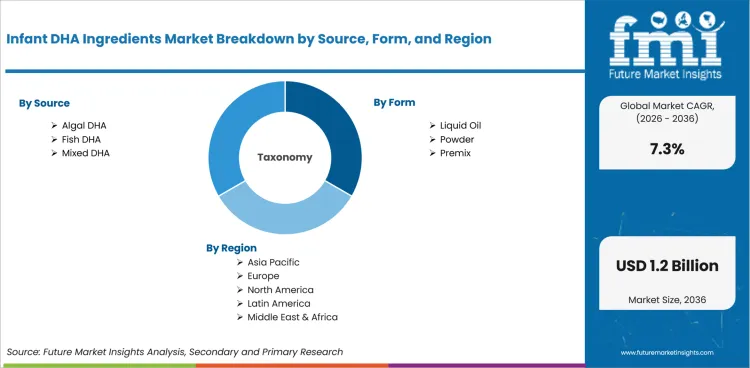
USD 0.58 billion in 2026 and USD 1.17 billion by 2036 at a 7.3% CAGR.
The infant DHA ingredients industry value is forecast to grow from USD 0.54 billion in 2025 to USD 1.17 billion by 2036 at 7.3% CAGR as formula makers shift DHA sourcing toward controlled infant-grade lipids. Algal DHA is forecast to represent 64.0% share in 2026 because fermentation supply lowers odor risk and supports traceability. Infant formula is expected to secure 72.0% share in 2026, led by standard and premium recipes that require nutrient documentation.
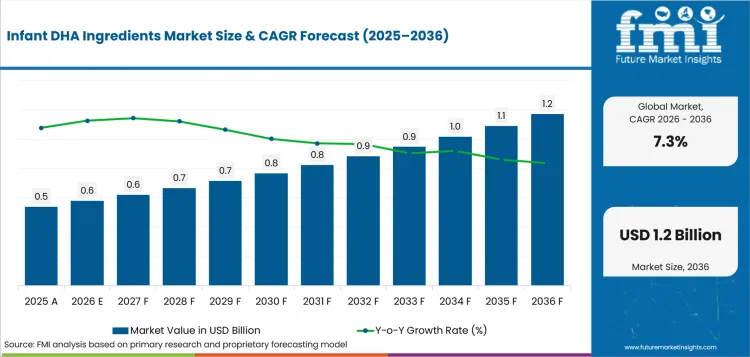
Infant DHA Ingredients Market Overview: Size and Forecast
- 2026 Market Size: USD 0.58 billion
- 2036 Market Size: USD 1.17 billion
- Forecast CAGR: 7.3% from 2026 to 2036
- Leading Source: Algal DHA
- Algal DHA Share in 2026: 64.0%
- Leading Application: Infant Formula
- Infant Formula Share in 2026: 72.0%
- Fastest-growing Country: China
- China CAGR: 8.6% by 2036
Summary of the Infant DHA Ingredients Market
- Demand and Growth Drivers
- Formula makers are expected to keep DHA in premium recipes as infant nutrition claims move toward brain and eye support.
- Algal DHA is projected to outpace fish DHA with 64.0% source share in 2026 due to traceability and odor control.
- Powder formats are expected to gain share where dry blending and export premix supply lower handling risk.
- China and India are projected to track above the global CAGR as local formula makers broaden pediatric lipid portfolios.
- Product and Segment View
- Algal DHA is expected to lead the Source segment with 64.0% share in 2026 as buyers seek controlled fermentation supply.
- Liquid Oil is projected to lead the Form segment with 57.0% share in 2026 with direct dosing into formula fat systems.
- 40-50% DHA is expected to lead the Concentration segment with 52.0% share in 2026 as it balances potency and handling.
- Infant Formula is projected to lead the Application segment with 72.0% share in 2026 through standard and premium recipes.
- Direct OEM is expected to lead the Sales Channel segment with 61.0% share in 2026 since formula makers need regulatory files.
- Geography and Competitive Outlook
- China is forecast at 8.6% CAGR through 2036 as local brands upgrade infant formula recipes and supply documentation.
- India is projected to record 8.4% CAGR through 2036 with urban pediatric nutrition and domestic ingredient sourcing.
- The United States is expected to expand at 6.8% CAGR through 2036 with FDA review activity shaping supplier qualification.
- The infant formula ingredients category frames DHA as a small but high-value lipid input.
- The Asia Pacific algae omega category shows why regional fermentation supply matters for infant nutrition buyers.
- Analyst Opinion
- Nandini Roy Choudhury, Principal Consultant for Food and Beverage at FMI, observes, “Infant DHA ingredients are moving from a claim ingredient into a supplier-risk decision. Formula makers are asking for infant-use clearance, ARA pairing records and audit support before price discussions. Suppliers with high DHA concentration and neutral taste should gain stronger repeat qualification.”
Regulatory control is the main pressure point for infant DHA ingredients as formula makers review nutrient levels and supplier safety files. FDA stated in May 2024 that infant formula rules require minimum amounts for 30 nutrients and maximum amounts for 10 nutrients. Documented checks matter before DHA oils, powders or premixes reach infant nutrition buyers. FDA GRN 1236 in March 2026 described algal oil with at least 40% DHA for infant formula use at a maximum of 0.5% of total fat as DHA. That gives suppliers a clearer route to compete on concentration, ARA pairing and dossier quality.
Which factors support expansion in the infant DHA ingredients market?
Finished DHA ingredient revenue and formula documentation support market value across regulated nutrition channels.
- Market value is supported by algal DHA oil revenue before powder and premix channels add incremental sales.
- Supplier pricing reflects fermentation inputs and purification losses before concentration bands affect repeat buying.
- Revenue improves as brands shift DHA from optional claims into standard formula fat systems.
- Buyer trust rises as technical files make source, concentration and ARA pairing easier to compare.
Why is the infant DHA ingredients market growing?
Formula makers are using algal DHA in premium recipes as odor neutrality and traceability improve buyer confidence.
Growth outlook has become more structured as infant DHA moves from claim support into qualification-led procurement. FDA held an expert panel on infant formula in June 2025 as part of nutrient review work. That event reinforced how closely infant formula inputs are watched in the United States. WHO and UNICEF reported in July 2024 that 48.0% of infants under six months were exclusively breastfed worldwide. Formula makers therefore position DHA as part of a closer breast milk alignment strategy where local rules permit. The baby food category gives DHA suppliers wider access to early-life products beyond starter formula.
How is the infant DHA ingredients market segmented?
The infant DHA ingredients industry is segmented by source, form, concentration, application and sales channel.
- Algal DHA is projected to account for 64.0% of source demand in 2026 as fermentation gives buyers cleaner sensory control.
- Liquid Oil is expected to lead by form with 57.0% share in 2026 due to direct dosing in fat blends.
- 40-50% DHA ingredients are anticipated to hold 52.0% of concentration demand in 2026 with potency suited to infant formula use.
- Infant Formula buyers are projected to direct 72.0% of application demand toward standard and premium formula recipes in 2026.
- Direct OEM channels are expected to represent 61.0% of sales in 2026 where technical documentation drives supplier selection.
Why does algal DHA lead the infant DHA ingredients market?
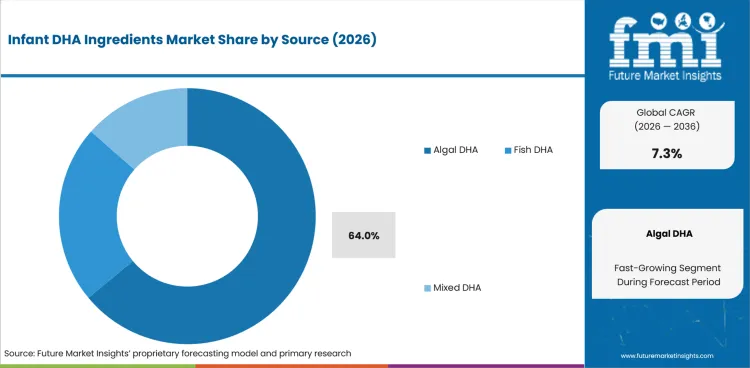
- Algal DHA is projected to account for 64.0% share in 2026, influenced by controlled fermentation and low odor risk.
- Fish DHA remains relevant where price and marine sourcing familiarity still guide procurement.
Which form leads the infant DHA ingredients market?
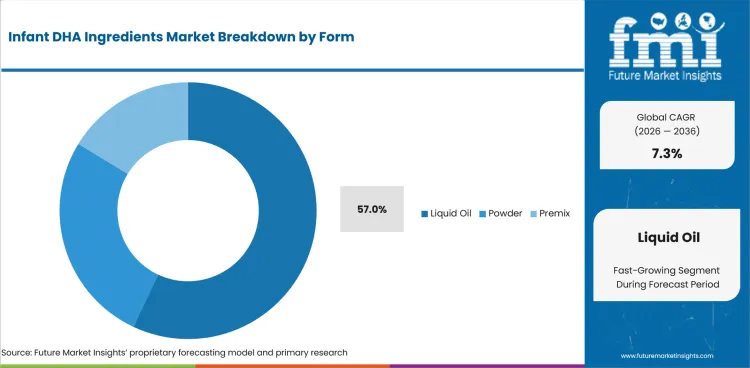
- Liquid Oil is estimated to hold 57.0% share in 2026 through direct dosing into formula fat systems.
- Powder formats gain use as premix suppliers reduce oxidation risk and improve dry blending.
Which concentration leads the infant DHA ingredients market?
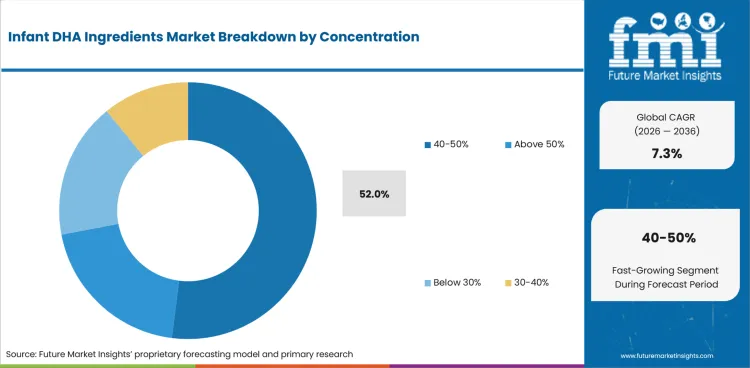
- 40-50% DHA is anticipated to represent 52.0% share in 2026 through balanced potency and manageable processing needs.
- Above 50% DHA products serve premium projects where lower dose volume offsets higher input cost.
Which application leads the infant DHA ingredients market?
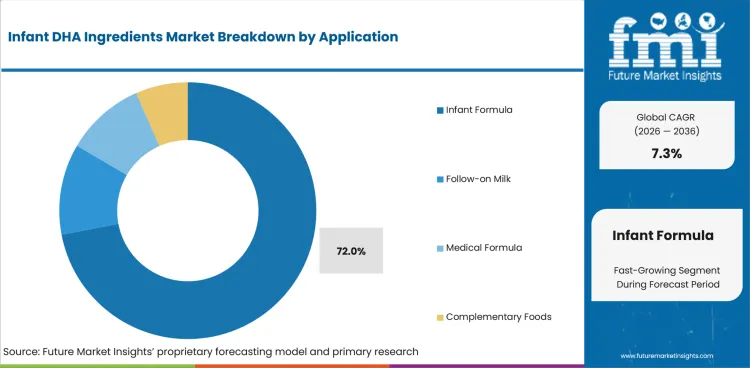
- Infant Formula is expected to account for 72.0% share in 2026, led by defined use in starter and premium recipes.
- Medical Formula uses smaller volumes but needs stricter safety records and traceability.
Which sales channel leads the infant DHA ingredients market?
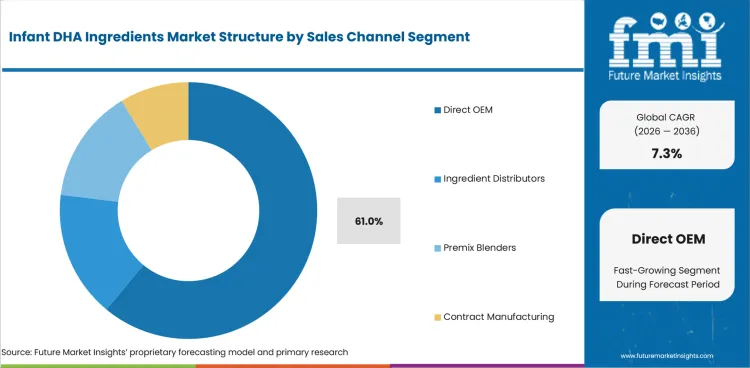
- Direct OEM is projected to hold 61.0% share in 2026 as formula companies buy DHA with technical dossiers.
- Ingredient distributors remain relevant in smaller countries where local customs support and smaller batch access matter.
What are the drivers, restraints, and opportunities in the infant DHA ingredients market?
Algal source switching and infant formula documentation support growth while cost and qualification cycles restrain wider use.
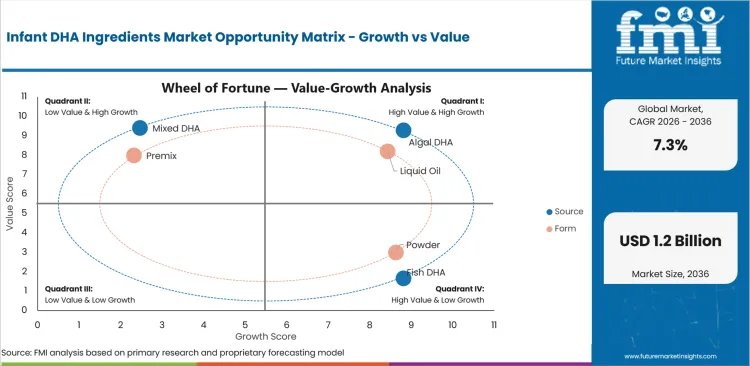
- Driver: Algal fermentation supports source switching as formula makers seek cleaner odor and lower contaminant screening burden.
- Driver: Infant formula nutrient review raises supplier qualification needs and favors companies with prepared technical files.
- Restraint: Price volatility restrains smaller formula makers since infant-grade DHA requires purification and stability testing.
- Opportunity: Powdered DHA creates a premix route for exporters that need controlled oxidation and dry blending.
- Opportunity: Organic algal DHA can support premium European formula projects when supplier files meet certification needs.
Infant DHA Ingredients Market Demand Outlook
Demand outlook is moving toward formula-grade DHA sources that can prove infant-use suitability before commercial rollout. EFSA confirmed in January 2025 that oil from Schizochytrium limacinum is safe for use in infant and follow-on formula under specified conditions. ISDI guidance in July 2024 noted that if DHA is added in follow-up formula, the minimum should be 20 mg per 100 kcal and ARA should be at the same level or higher. Companies serving the omega-3 value chain can use those requirements to prioritize concentration bands, oxidation control and regulatory files instead of relying on broad nutrition claims.
Buyer Route and Infant-use Qualification Analysis
Formula makers, premix blenders and specialty nutrition brands form the main buying pool for infant DHA ingredients. Their purchase decisions are shaped by infant-use history, sensory stability and audit-ready supplier records. In May 2025, FDA began a nutrient review for infant formula under Operation Stork Speed. That matters because any DHA source change can create added review work for formula teams. The broader EPA DHA omega-3 ingredients category still supports scale because purification and concentration systems serve several nutrition channels. Infant formula remains the stricter buyer group because recipe changes must protect nutrient delivery, taste and documentation before commercial switching.
Dossier Depth and Formula Performance Analysis
Procurement teams compare infant DHA suppliers by dossier depth, batch traceability and formulation support. FDA’s February 2026 infant formula manufacturer page says producers must comply with Federal Food, Drug, and Cosmetic Act requirements and FDA implementing regulations. That gives buyers a clear reason to review supplier paperwork before price. Algal DHA also supports a cleaner sourcing story because suppliers can reduce fish-oil odor concerns and contaminant-screening exposure. Progress Biotech’s February 2026 EU organic DHA milestone adds a practical signal because it gives organic infant formula developers a compliant algal DHA route. Buyers will still require stability data in fat blends and dry premixes before they treat price as the deciding factor.
Which countries are growing fastest in the infant DHA ingredients market?
China 8.6% CAGR, India 8.4% CAGR, South Korea 7.4% CAGR, United States 6.8% CAGR, Germany 6.7% CAGR, France 6.5% CAGR, United Kingdom 6.4% CAGR, and Japan 5.9% CAGR through 2036.
.webp "Top Country Growth Comparison Infant Dha Ingredients Market Cagr (2026 2036)")
| Country | CAGR |
|---|---|
| China | 8.6% |
| India | 8.4% |
| South Korea | 7.4% |
| United States | 6.8% |
| Germany | 6.7% |
| France | 6.5% |
| United Kingdom | 6.4% |
| Japan | 5.9% |
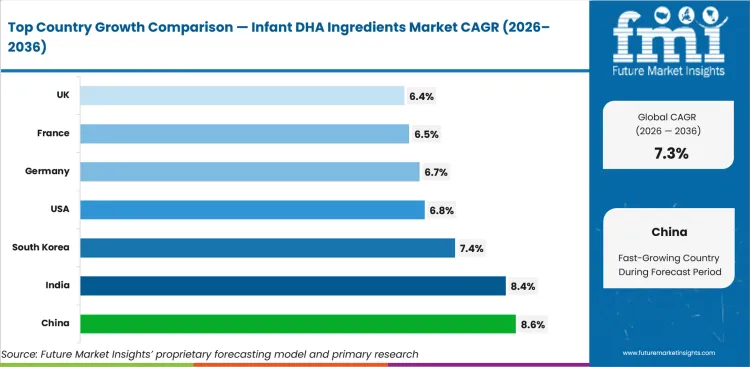
Source: Future Market Insights, 2026.
How do country-level CAGRs compare in the infant DHA ingredients market?
China leads selected-country growth while Japan records the most cautious expansion outlook among profiled markets.
- China is forecast to record 8.6% CAGR by 2036 as domestic formula brands upgrade DHA systems.
- India is projected to expand at 8.4% CAGR through 2036 with urban pediatric nutrition and distributor-led access.
- South Korea is expected to grow at 7.4% CAGR by 2036 as premium formulas support value growth.
- The United States is forecast to post 6.8% CAGR through 2036 as FDA review shapes supplier qualification.
- Germany is projected to grow at 6.7% CAGR through 2036 with organic and premium formula lines.
- France is estimated to rise at 6.5% CAGR by 2036 as pharmacy-linked formula channels support higher-value ingredients.
- The United Kingdom is expected to advance at 6.4% CAGR through 2036 with retailer trust and label discipline.
- Japan is projected to record 5.9% CAGR through 2036 as quality expectations offset weaker birth trends.
How fast is the infant DHA ingredients market growing in United States?
A 6.8% CAGR through 2036 reflects formula documentation needs and premium DHA sourcing across United States channels.
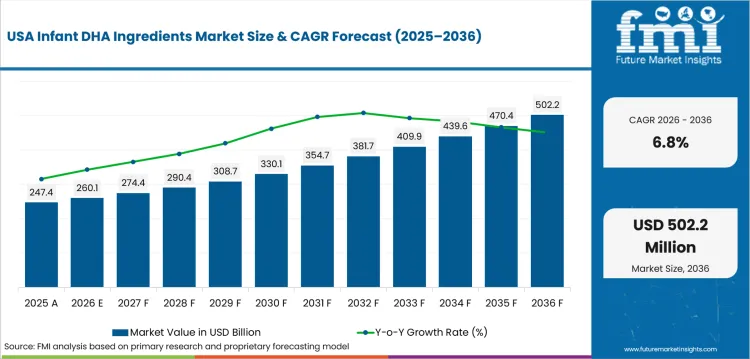
Country Market Snapshot Table
| Parameter | Value |
|---|---|
| Market Size in 2025 (Value) | USD 94.0 million |
| Market Size in 2026 (Value) | USD 100.4 million |
| Market Forecast in 2036 (Value) | USD 193.8 million |
| CAGR (2026 to 2036) | 6.8% |
| Years Considered | 2021 to 2036 |
| Base Year | 2025 |
| Forecast Period | 2026 to 2036 |
| Units Considered | Value (USD million) |
| Leading Sub-Region | Northeast and Midwest formula corridors |
United States Infant DHA Ingredients Market Outlook
United States infant DHA ingredient demand is influenced by formula qualification, local buyer standards and the need for traceable DHA sources. Algal DHA is easier to position when suppliers can support infant-use documentation and low sensory impact.
Retail and formula manufacturing teams are expected to favor suppliers with concentration control and complete technical files. Brands with stable oil quality and reliable premix support should gain early qualification confidence.
Key Growth Drivers
- NCHS reported 3.63 million U.S. births in 2024. This keeps the formula qualification pool large for infant DHA suppliers.
- FDA stated in May 2024 that infant formula rules require minimum amounts for 30 nutrients. This makes DHA review part of formal nutrient control.
- Specialty formula makers need DHA oils with safety files because medical recipes face tighter ingredient review.
- Direct OEM buying favors suppliers with GRAS records and technical support for USA formula plants.
Key Restraints
- USDA ERS reported that food-at-home prices increased 2.3% in 2025. This limits full cost pass-through for premium formula inputs.
- Supplier switching remains slow because formula plants need validation before changing infant lipid inputs.
- Value formula ranges leave limited room for high-concentration algal DHA unless dose savings offset price.
What makes United States unique
United States is unique because infant DHA ingredient buying is shaped by local formula rules, supplier documentation and the balance between birth trends and premium nutrition positioning.
Key Companies
- DSM-firmenich
- Corbion
- BASF
- CABIO Biotech
- KD Pharma
Sales & Marketing Channels
- Direct OEM sales
- Premix blender partnerships
- Regulatory dossier support
- Specialty formula manufacturer outreach
- Distributor coverage for smaller brands
Country Segment Breakdown Table
| Segment | Sub-Segments |
|---|---|
| By Source | Algal DHA · Fish DHA · Mixed DHA |
| By Form | Liquid Oil · Powder · Premix |
| By Concentration | Below 30% · 30-40% · 40-50% · Above 50% |
| By Application | Infant Formula · Follow-on Milk · Medical Formula · Complementary Foods |
| By Sales Channel | Direct OEM · Ingredient Distributors · Premix Blenders · Contract Manufacturing |
| Key Sub-Regions Covered, Urban Retail Clusters | Northeast infant nutrition corridor · Midwest dairy and formula plants · California specialty nutrition hubs · Texas and Southeast distribution routes |
Frequently Asked Questions
How fast is United States infant DHA ingredients market growing?
Sales in United States are forecast to expand at 6.8% CAGR from 2026 to 2036, guided by formula documentation needs.
Who leads United States infant DHA ingredients market?
DSM-firmenich, Corbion, BASF, CABIO Biotech compete based on infant nutrition documentation, DHA concentration and channel reach.
What is driving adoption in United States infant DHA ingredients market?
Premium formula reformulation and supplier traceability are driving adoption across infant nutrition channels.
What is the infant DHA ingredients market outlook in United States?
A 6.8% CAGR through 2036 is supported by premium formula demand and supplier qualification needs.
How fast is the infant DHA ingredients market growing in United Kingdom?
A 6.4% CAGR through 2036 reflects formula documentation needs and premium DHA sourcing across United Kingdom channels.
Country Market Snapshot Table
| Parameter | Value |
|---|---|
| Market Size in 2025 (Value) | USD 48.0 million |
| Market Size in 2026 (Value) | USD 51.1 million |
| Market Forecast in 2036 (Value) | USD 95.1 million |
| CAGR (2026 to 2036) | 6.4% |
| Years Considered | 2021 to 2036 |
| Base Year | 2025 |
| Forecast Period | 2026 to 2036 |
| Units Considered | Value (USD million) |
| Leading Sub-Region | London and Midlands retail corridors |
United Kingdom Infant DHA Ingredients Market Outlook
United Kingdom infant DHA ingredient demand is influenced by formula qualification, local buyer standards and the need for traceable DHA sources. Algal DHA is easier to position when suppliers can support infant-use documentation and low sensory impact.
Retail and formula manufacturing teams are expected to favor suppliers with concentration control and complete technical files. Brands with stable oil quality and reliable premix support should gain early qualification confidence.
Key Growth Drivers
- ONS reported 594.7 thousand live births in England and Wales in 2024. This sustains a qualified base for premium formula ingredients.
- UK retained nutrition law specifies DHA in infant formula at 20 mg to 50 mg per 100 kcal. This gives suppliers a defined formulation target.
- Follow-on milk products create added DHA use beyond starter formula in regulated retail channels.
- Retailer scrutiny favors suppliers that can prove traceability and stable sensory performance.
Key Restraints
- CMA reported in February 2025 that some infant formula prices had risen by over 25.0% in recent years. This keeps premium ingredient pricing under review.
- Imported ingredient dependence exposes buyers to currency and freight swings.
- High living costs make premium formula price increases harder to pass through.
What makes United Kingdom unique
United Kingdom is unique because infant DHA ingredient buying is shaped by local formula rules, supplier documentation and the balance between birth trends and premium nutrition positioning.
Key Companies
- DSM-firmenich
- BASF
- Progress Biotech
- AAK-linked supply routes
Sales & Marketing Channels
- Direct brand supply
- Retailer-approved supplier files
- Distributor networks
- Premix supply contracts
- Organic formula ingredient channels
Country Segment Breakdown Table
| Segment | Sub-Segments |
|---|---|
| By Source | Algal DHA · Fish DHA · Mixed DHA |
| By Form | Liquid Oil · Powder · Premix |
| By Concentration | Below 30% · 30-40% · 40-50% · Above 50% |
| By Application | Infant Formula · Follow-on Milk · Medical Formula · Complementary Foods |
| By Sales Channel | Direct OEM · Ingredient Distributors · Premix Blenders · Contract Manufacturing |
| Key Sub-Regions Covered, Urban Retail Clusters | London · Midlands · North West England · Scotland urban retail clusters · Wales pharmacy routes |
Frequently Asked Questions
How fast is United Kingdom infant DHA ingredients market growing?
Sales in United Kingdom are forecast to expand at 6.4% CAGR from 2026 to 2036, guided by formula documentation needs.
Who leads United Kingdom infant DHA ingredients market?
DSM-firmenich, BASF, Progress Biotech, AAK-linked supply routes compete based on infant nutrition documentation, DHA concentration and channel reach.
What is driving adoption in United Kingdom infant DHA ingredients market?
Premium formula reformulation and supplier traceability are driving adoption across infant nutrition channels.
What is the infant DHA ingredients market outlook in United Kingdom?
A 6.4% CAGR through 2036 is supported by premium formula demand and supplier qualification needs.
How fast is the infant DHA ingredients market growing in Germany?
A 6.7% CAGR through 2036 reflects formula documentation needs and premium DHA sourcing across Germany channels.
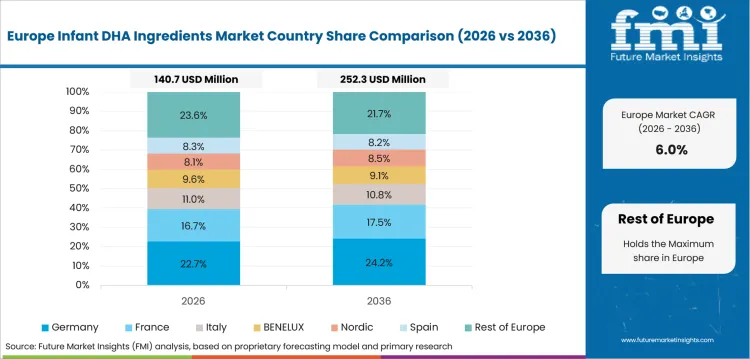
Country Market Snapshot Table
| Parameter | Value |
|---|---|
| Market Size in 2025 (Value) | USD 56.0 million |
| Market Size in 2026 (Value) | USD 59.8 million |
| Market Forecast in 2036 (Value) | USD 114.4 million |
| CAGR (2026 to 2036) | 6.7% |
| Years Considered | 2021 to 2036 |
| Base Year | 2025 |
| Forecast Period | 2026 to 2036 |
| Units Considered | Value (USD million) |
| Leading Sub-Region | Bavaria and North Rhine-Westphalia formula corridors |
Germany Infant DHA Ingredients Market Outlook
Germany infant DHA ingredient demand is influenced by formula qualification, local buyer standards and the need for traceable DHA sources. Algal DHA is easier to position when suppliers can support infant-use documentation and low sensory impact.
Retail and formula manufacturing teams are expected to favor suppliers with concentration control and complete technical files. Brands with stable oil quality and reliable premix support should gain early qualification confidence.
Key Growth Drivers
- Destatis reported 677.1 thousand live births in Germany in 2024. This supports a sizable base for infant nutrition qualification.
- EU formula law specifies DHA in infant formula at 20 mg to 50 mg per 100 kcal. This supports demand for controlled DHA ingredients.
- Organic formula lines create demand for certified algal DHA ingredients with stronger supplier files.
- German export links support ingredient qualification for wider European supply.
Key Restraints
- Bundesbank reported German HICP inflation at 2.7% in May 2026. This keeps price review active for premium formula inputs.
- Audit-heavy buying slows new supplier entry and lengthens sales cycles.
- Private-label formula competition pressures premium ingredient pricing.
What makes Germany unique
Germany is unique because infant DHA ingredient buying is shaped by local formula rules, supplier documentation and the balance between birth trends and premium nutrition positioning.
Key Companies
- DSM-firmenich
- BASF
- KD Pharma
- Polaris
- Progress Biotech
Sales & Marketing Channels
- Direct OEM supply
- Organic formula ingredient supply
- Technical documentation support
- European distributor networks
- Premix blender partnerships
Country Segment Breakdown Table
| Segment | Sub-Segments |
|---|---|
| By Source | Algal DHA · Fish DHA · Mixed DHA |
| By Form | Liquid Oil · Powder · Premix |
| By Concentration | Below 30% · 30-40% · 40-50% · Above 50% |
| By Application | Infant Formula · Follow-on Milk · Medical Formula · Complementary Foods |
| By Sales Channel | Direct OEM · Ingredient Distributors · Premix Blenders · Contract Manufacturing |
| Key Sub-Regions Covered, Urban Retail Clusters | Bavaria · North Rhine-Westphalia · Baden-Württemberg · Lower Saxony dairy routes · Hamburg import corridors |
Frequently Asked Questions
How fast is Germany infant DHA ingredients market growing?
Sales in Germany are forecast to expand at 6.7% CAGR from 2026 to 2036, guided by formula documentation needs.
Who leads Germany infant DHA ingredients market?
DSM-firmenich, BASF, KD Pharma, Polaris compete based on infant nutrition documentation, DHA concentration and channel reach.
What is driving adoption in Germany infant DHA ingredients market?
Premium formula reformulation and supplier traceability are driving adoption across infant nutrition channels.
What is the infant DHA ingredients market outlook in Germany?
A 6.7% CAGR through 2036 is supported by premium formula demand and supplier qualification needs.
How fast is the infant DHA ingredients market growing in France?
A 6.5% CAGR through 2036 reflects formula documentation needs and premium DHA sourcing across France channels.
Country Market Snapshot Table
| Parameter | Value |
|---|---|
| Market Size in 2025 (Value) | USD 42.0 million |
| Market Size in 2026 (Value) | USD 44.7 million |
| Market Forecast in 2036 (Value) | USD 83.9 million |
| CAGR (2026 to 2036) | 6.5% |
| Years Considered | 2021 to 2036 |
| Base Year | 2025 |
| Forecast Period | 2026 to 2036 |
| Units Considered | Value (USD million) |
| Leading Sub-Region | Paris region and western dairy corridors |
France Infant DHA Ingredients Market Outlook
France infant DHA ingredient demand is influenced by formula qualification, local buyer standards and the need for traceable DHA sources. Algal DHA is easier to position when suppliers can support infant-use documentation and low sensory impact.
Retail and formula manufacturing teams are expected to favor suppliers with concentration control and complete technical files. Brands with stable oil quality and reliable premix support should gain early qualification confidence.
Key Growth Drivers
- INSEE reported 660.8 thousand babies born in France in 2024. This keeps infant nutrition demand relevant despite weaker long-term volume.
- EU formula law specifies DHA in infant formula at 20 mg to 50 mg per 100 kcal. This supports supplier demand for compliant DHA oils.
- Pharmacy-linked formula channels support higher trust requirements for DHA sources and supplier documentation.
- Premium infant nutrition brands value low-odor algal oils in delicate recipes.
Key Restraints
- Service-Public reported annual inflation at 0.9% in France in 2025. This limits price-led revenue uplift for premium formula inputs.
- Retail and pharmacy price pressure limits premium DHA inclusion in low-cost lines.
- Lower birth cohorts make premium positioning more important than broad volume expansion.
What makes France unique
France is unique because infant DHA ingredient buying is shaped by local formula rules, supplier documentation and the balance between birth trends and premium nutrition positioning.
Key Companies
- DSM-firmenich
- BASF
- Polaris
- Progress Biotech
- Ingredia-linked routes
Sales & Marketing Channels
- Formula brand supply
- Pharmacy-linked nutrition channels
- Organic formula networks
- Premix distributors
- Specialty nutrition procurement
Country Segment Breakdown Table
| Segment | Sub-Segments |
|---|---|
| By Source | Algal DHA · Fish DHA · Mixed DHA |
| By Form | Liquid Oil · Powder · Premix |
| By Concentration | Below 30% · 30-40% · 40-50% · Above 50% |
| By Application | Infant Formula · Follow-on Milk · Medical Formula · Complementary Foods |
| By Sales Channel | Direct OEM · Ingredient Distributors · Premix Blenders · Contract Manufacturing |
| Key Sub-Regions Covered, Urban Retail Clusters | Île-de-France · Brittany · Pays de la Loire · Auvergne-Rhône-Alpes · Hauts-de-France |
Frequently Asked Questions
How fast is France infant DHA ingredients market growing?
Sales in France are forecast to expand at 6.5% CAGR from 2026 to 2036, guided by formula documentation needs.
Who leads France infant DHA ingredients market?
DSM-firmenich, BASF, Polaris, Progress Biotech compete based on infant nutrition documentation, DHA concentration and channel reach.
What is driving adoption in France infant DHA ingredients market?
Premium formula reformulation and supplier traceability are driving adoption across infant nutrition channels.
What is the infant DHA ingredients market outlook in France?
A 6.5% CAGR through 2036 is supported by premium formula demand and supplier qualification needs.
How fast is the infant DHA ingredients market growing in Japan?
A 5.9% CAGR through 2036 reflects formula documentation needs and premium DHA sourcing across Japan channels.
Country Market Snapshot Table
| Parameter | Value |
|---|---|
| Market Size in 2025 (Value) | USD 38.0 million |
| Market Size in 2026 (Value) | USD 40.2 million |
| Market Forecast in 2036 (Value) | USD 71.4 million |
| CAGR (2026 to 2036) | 5.9% |
| Years Considered | 2021 to 2036 |
| Base Year | 2025 |
| Forecast Period | 2026 to 2036 |
| Units Considered | Value (USD million) |
| Leading Sub-Region | Kanto and Kansai infant nutrition corridors |
Japan Infant DHA Ingredients Market Outlook
Japan infant DHA ingredient demand is influenced by formula qualification, local buyer standards and the need for traceable DHA sources. Algal DHA is easier to position when suppliers can support infant-use documentation and low sensory impact.
Retail and formula manufacturing teams are expected to favor suppliers with concentration control and complete technical files. Brands with stable oil quality and reliable premix support should gain early qualification confidence.
Key Growth Drivers
- MHLW reported 686.1 thousand live births in Japan in 2024. This keeps DHA demand value-led rather than volume-led.
- Statistics Bureau reported Japan's child population at 13.83 million in 2024. This gives pediatric nutrition brands a defined consumer base.
- Local quality expectations favor suppliers with strong stability and sensory records.
- Follow-on milk creates a second use case for infant DHA ingredients.
Key Restraints
- Statistics Bureau reported Japan food prices rose 6.8% in 2025. This raises formula cost sensitivity and limits premium DHA pass-through.
- Long qualification cycles make new supplier entry slow and costly.
- Trading-house dependence can add time before smaller suppliers reach formula makers.
What makes Japan unique
Japan is unique because infant DHA ingredient buying is shaped by local formula rules, supplier documentation and the balance between birth trends and premium nutrition positioning.
Key Companies
- DSM-firmenich
- BASF Japan
- KD Pharma Japan routes
- Nippon Suisan-linked omega supply
- Maruha Nichiro-linked omega supply
Sales & Marketing Channels
- Direct formula manufacturer supply
- Trading house distribution
- Pharmacy nutrition channels
- Premix supply
- Specialty pediatric nutrition channels
Country Segment Breakdown Table
| Segment | Sub-Segments |
|---|---|
| By Source | Algal DHA · Fish DHA · Mixed DHA |
| By Form | Liquid Oil · Powder · Premix |
| By Concentration | Below 30% · 30-40% · 40-50% · Above 50% |
| By Application | Infant Formula · Follow-on Milk · Medical Formula · Complementary Foods |
| By Sales Channel | Direct OEM · Ingredient Distributors · Premix Blenders · Contract Manufacturing |
| Key Sub-Regions Covered, Urban Retail Clusters | Kanto · Kansai · Chubu · Kyushu · Hokkaido nutrition channels |
Frequently Asked Questions
How fast is Japan infant DHA ingredients market growing?
Sales in Japan are forecast to expand at 5.9% CAGR from 2026 to 2036, guided by formula documentation needs.
Who leads Japan infant DHA ingredients market?
DSM-firmenich, BASF Japan, KD Pharma Japan routes, Nippon Suisan-linked omega supply compete based on infant nutrition documentation, DHA concentration and channel reach.
What is driving adoption in Japan infant DHA ingredients market?
Premium formula reformulation and supplier traceability are driving adoption across infant nutrition channels.
What is the infant DHA ingredients market outlook in Japan?
A 5.9% CAGR through 2036 is supported by premium formula demand and supplier qualification needs.
How fast is the infant DHA ingredients market growing in China?
A 8.6% CAGR through 2036 reflects formula documentation needs and premium DHA sourcing across China channels.
Country Market Snapshot Table
| Parameter | Value |
|---|---|
| Market Size in 2025 (Value) | USD 122.0 million |
| Market Size in 2026 (Value) | USD 132.5 million |
| Market Forecast in 2036 (Value) | USD 302.8 million |
| CAGR (2026 to 2036) | 8.6% |
| Years Considered | 2021 to 2036 |
| Base Year | 2025 |
| Forecast Period | 2026 to 2036 |
| Units Considered | Value (USD million) |
| Leading Sub-Region | Eastern coastal formula manufacturing clusters |
China Infant DHA Ingredients Market Outlook
China infant DHA ingredient demand is influenced by formula qualification, local buyer standards and the need for traceable DHA sources. Algal DHA is easier to position when suppliers can support infant-use documentation and low sensory impact.
Retail and formula manufacturing teams are expected to favor suppliers with concentration control and complete technical files. Brands with stable oil quality and reliable premix support should gain early qualification confidence.
Key Growth Drivers
- NBS reported 9.54 million newborns in China in 2024. This gives infant DHA suppliers the largest profiled demand pool.
- USDA FAS reported that liquid infant formula products need SAMR registration from December 2025. This raises demand for stronger technical dossiers.
- Local formula registration pushes buyers toward suppliers with complete technical files.
- Chinese approvals for algal DHA widen supplier access to infant nutrition manufacturers.
Key Restraints
- NBS reported China's CPI remained flat in 2025. This limits price-led revenue uplift for premium formula inputs.
- Price competition limits the use of very high-cost DHA inputs in mass formulas.
- Domestic brands require local regulatory support before approving new imported DHA sources.
What makes China unique
China is unique because infant DHA ingredient buying is shaped by local formula rules, supplier documentation and the balance between birth trends and premium nutrition positioning.
Key Companies
- CABIO Biotech
- Runke Bioengineering
- Kingdomway Nutrition
- DSM-firmenich China
- Corbion China
Sales & Marketing Channels
- Direct formula OEM supply
- Domestic premix blenders
- Regulatory filing support
- Cross-border ingredient importers
- E-commerce linked nutrition brands
Country Segment Breakdown Table
| Segment | Sub-Segments |
|---|---|
| By Source | Algal DHA · Fish DHA · Mixed DHA |
| By Form | Liquid Oil · Powder · Premix |
| By Concentration | Below 30% · 30-40% · 40-50% · Above 50% |
| By Application | Infant Formula · Follow-on Milk · Medical Formula · Complementary Foods |
| By Sales Channel | Direct OEM · Ingredient Distributors · Premix Blenders · Contract Manufacturing |
| Key Sub-Regions Covered, Urban Retail Clusters | Yangtze River Delta · Pearl River Delta · Shandong dairy corridors · Beijing-Tianjin-Hebei · Chengdu-Chongqing |
Frequently Asked Questions
How fast is China infant DHA ingredients market growing?
Sales in China are forecast to expand at 8.6% CAGR from 2026 to 2036, guided by formula documentation needs.
Who leads China infant DHA ingredients market?
CABIO Biotech, Runke Bioengineering, Kingdomway Nutrition, DSM-firmenich China compete based on infant nutrition documentation, DHA concentration and channel reach.
What is driving adoption in China infant DHA ingredients market?
Premium formula reformulation and supplier traceability are driving adoption across infant nutrition channels.
What is the infant DHA ingredients market outlook in China?
A 8.6% CAGR through 2036 is supported by premium formula demand and supplier qualification needs.
How fast is the infant DHA ingredients market growing in South Korea?
A 7.4% CAGR through 2036 reflects formula documentation needs and premium DHA sourcing across South Korea channels.
Country Market Snapshot Table
| Parameter | Value |
|---|---|
| Market Size in 2025 (Value) | USD 26.0 million |
| Market Size in 2026 (Value) | USD 27.9 million |
| Market Forecast in 2036 (Value) | USD 57.0 million |
| CAGR (2026 to 2036) | 7.4% |
| Years Considered | 2021 to 2036 |
| Base Year | 2025 |
| Forecast Period | 2026 to 2036 |
| Units Considered | Value (USD million) |
| Leading Sub-Region | Seoul capital area and premium nutrition corridors |
South Korea Infant DHA Ingredients Market Outlook
South Korea infant DHA ingredient demand is influenced by formula qualification, local buyer standards and the need for traceable DHA sources. Algal DHA is easier to position when suppliers can support infant-use documentation and low sensory impact.
Retail and formula manufacturing teams are expected to favor suppliers with concentration control and complete technical files. Brands with stable oil quality and reliable premix support should gain early qualification confidence.
Key Growth Drivers
- Korea.net reported 238.3 thousand births in South Korea in 2024. This supports a compact premium formula base.
- The Ministry of Data and Statistics reported 254.5 thousand live births in 2025. This gives premium formula brands a second-year recovery signal.
- Imported quality cues strengthen algal DHA supplier positioning in premium infant nutrition.
- Toddler nutrition products provide another channel for DHA powder and premix use.
Key Restraints
- MOEF reported CPI rose 2.4% year on year in November 2025. This limits premium formula pricing room.
- Local distributor dependence can slow technical support for smaller brands.
- Small cohorts mean suppliers need high-value applications rather than volume-only sales plans.
What makes South Korea unique
South Korea is unique because infant DHA ingredient buying is shaped by local formula rules, supplier documentation and the balance between birth trends and premium nutrition positioning.
Key Companies
- DSM-firmenich Korea
- BASF Korea
- KD Pharma-linked distributors
- Korea premix blenders
- Local formula manufacturers
Sales & Marketing Channels
- Premium formula brand supply
- Trading company distribution
- Pharmacy nutrition channels
- E-commerce nutrition retail
- Premix blender contracts
Country Segment Breakdown Table
| Segment | Sub-Segments |
|---|---|
| By Source | Algal DHA · Fish DHA · Mixed DHA |
| By Form | Liquid Oil · Powder · Premix |
| By Concentration | Below 30% · 30-40% · 40-50% · Above 50% |
| By Application | Infant Formula · Follow-on Milk · Medical Formula · Complementary Foods |
| By Sales Channel | Direct OEM · Ingredient Distributors · Premix Blenders · Contract Manufacturing |
| Key Sub-Regions Covered, Urban Retail Clusters | Seoul Capital Area · Busan · Daegu · Daejeon · Gwangju premium retail corridors |
Frequently Asked Questions
How fast is South Korea infant DHA ingredients market growing?
Sales in South Korea are forecast to expand at 7.4% CAGR from 2026 to 2036, guided by formula documentation needs.
Who leads South Korea infant DHA ingredients market?
DSM-firmenich Korea, BASF Korea, KD Pharma-linked distributors, Korea premix blenders compete based on infant nutrition documentation, DHA concentration and channel reach.
What is driving adoption in South Korea infant DHA ingredients market?
Premium formula reformulation and supplier traceability are driving adoption across infant nutrition channels.
What is the infant DHA ingredients market outlook in South Korea?
A 7.4% CAGR through 2036 is supported by premium formula demand and supplier qualification needs.
How fast is the infant DHA ingredients market growing in India?
A 8.4% CAGR through 2036 reflects formula documentation needs and premium DHA sourcing across India channels.
Country Market Snapshot Table
| Parameter | Value |
|---|---|
| Market Size in 2025 (Value) | USD 62.0 million |
| Market Size in 2026 (Value) | USD 67.2 million |
| Market Forecast in 2036 (Value) | USD 150.5 million |
| CAGR (2026 to 2036) | 8.4% |
| Years Considered | 2021 to 2036 |
| Base Year | 2025 |
| Forecast Period | 2026 to 2036 |
| Units Considered | Value (USD million) |
| Leading Sub-Region | West and South India pediatric nutrition corridors |
India Infant DHA Ingredients Market Outlook
India infant DHA ingredient demand is influenced by formula qualification, local buyer standards and the need for traceable DHA sources. Algal DHA is easier to position when suppliers can support infant-use documentation and low sensory impact.
Retail and formula manufacturing teams are expected to favor suppliers with concentration control and complete technical files. Brands with stable oil quality and reliable premix support should gain early qualification confidence.
Key Growth Drivers
- The Registrar General of India reported 25.21 million registered births in 2023. This creates a large long-term pediatric nutrition pool.
- FSSAI's January 2024 infant nutrition compendium cites compliance across seven IMS Act sections. This favors suppliers with stronger documentation.
- Urban pediatric nutrition channels support premium DHA formula launches.
- Premix blenders help smaller formula brands add DHA without complex handling.
Key Restraints
- PIB reported January 2025 food inflation of 6.31% in rural markets and 5.53% in urban markets. This raises cost sensitivity for premium infant nutrition.
- Price-sensitive buyers limit DHA inclusion in value formula lines.
- Regulatory and documentation support varies across smaller ingredient distributors.
What makes India unique
India is unique because infant DHA ingredient buying is shaped by local formula rules, supplier documentation and the balance between birth trends and premium nutrition positioning.
Key Companies
- DSM-firmenich India
- BASF India
- KD Pharma-linked supply routes
- Indian premix blenders
- Domestic pediatric nutrition manufacturers
Sales & Marketing Channels
- Premix blender partnerships
- Direct formula manufacturer supply
- Ingredient distributor networks
- Regulatory documentation support
- Pediatric nutrition channel support
Country Segment Breakdown Table
| Segment | Sub-Segments |
|---|---|
| By Source | Algal DHA · Fish DHA · Mixed DHA |
| By Form | Liquid Oil · Powder · Premix |
| By Concentration | Below 30% · 30-40% · 40-50% · Above 50% |
| By Application | Infant Formula · Follow-on Milk · Medical Formula · Complementary Foods |
| By Sales Channel | Direct OEM · Ingredient Distributors · Premix Blenders · Contract Manufacturing |
| Key Sub-Regions Covered, Urban Retail Clusters | Maharashtra · Gujarat · Karnataka · Tamil Nadu · Delhi-NCR · Telangana |
Frequently Asked Questions
How fast is India infant DHA ingredients market growing?
Sales in India are forecast to expand at 8.4% CAGR from 2026 to 2036, guided by formula documentation needs.
Who leads India infant DHA ingredients market?
DSM-firmenich India, BASF India, KD Pharma-linked supply routes, Indian premix blenders compete based on infant nutrition documentation, DHA concentration and channel reach.
What is driving adoption in India infant DHA ingredients market?
Premium formula reformulation and supplier traceability are driving adoption across infant nutrition channels.
What is the infant DHA ingredients market outlook in India?
A 8.4% CAGR through 2036 is supported by premium formula demand and supplier qualification needs.
Competitive Landscape and Strategic Positioning
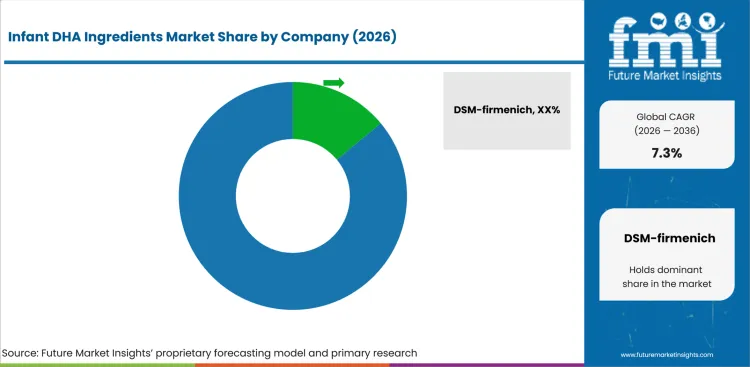
Who are the leading companies in the infant DHA ingredients market?
DSM-firmenich, Corbion, BASF, CABIO Biotech, Progress Biotech, Runke Bioengineering, KD Pharma Group, Polaris, Kingdomway Nutrition, and Algarithm Ingredients are key companies in the infant DHA ingredients market.
- Global infant lipid suppliers compete through infant formula dossier depth, regulatory support, and portfolio breadth.
- Algal DHA specialists compete through fermentation scale, infant-use documentation, and sensory stability.
- Omega-3 processing specialists compete through concentration, purification, quality systems, and customer-specific support.
- Entry barriers remain high because infant formula buyers require safety files, traceability records, plant audits, and long qualification cycles.
The infant DHA ingredients market is moderately concentrated because infant-use documentation limits the number of suppliers that can serve formula buyers at scale. Global suppliers compete on regulatory depth before they compete on price. Infant formula buyers need DHA oils that fit infant use levels, manufacturing processes, and finished formula stability requirements.
DSM-firmenich leads on brand recognition and infant lipid portfolio breadth. Its October 2024 launch of life’sDHA B54-0100 gives the company a higher-potency algal DHA option with 545 mg pure DHA per gram. This strengthens its position in algal DHA and premium nutrition applications.
Regulatory access is another source of advantage. Corbion’s July 2025 Chinese approvals for algae-derived omega-3 DHA products gave the company a stronger route into China’s human nutrition sector. CABIO’s USA Food and Drug Administration-linked activity around algal oil for infant formula shows how Chinese suppliers are moving toward global documentation standards. Smaller specialists can win where the buying problem is narrow. Organic DHA suppliers serve European formula brands that need certified inputs, while Polaris and KD Pharma support customers that value omega-3 processing knowledge and specialty quality.
How do top infant DHA ingredients companies compare?
DSM-firmenich and Corbion score strongest on infant formula dossier depth and algal DHA fermentation scale, while specialist suppliers compete through sensory stability, organic positioning, and regional customer access.
| Company | Infant Formula Dossier Depth | Algal DHA Fermentation Scale | Sensory Stability Support | Geographic Footprint |
|---|---|---|---|---|
| DSM-firmenich | High | High | Strong | Global |
| Corbion | High | High | Strong | Global |
| BASF | Strong | Medium | Strong | Global |
| CABIO Biotech | Strong | High | Medium | China and Global |
| Progress Biotech | Strong | Medium | Strong | Europe and Global |
| Runke Bioengineering | Medium | High | Medium | China and Export |
| KD Pharma Group | Medium | Medium | Strong | Global |
| Polaris | Medium | Medium | Strong | Europe and Export |
| Kingdomway Nutrition | Medium | Medium | Medium | China and Export |
| Algarithm Ingredients | Medium | Medium | Strong | North America |
Source: Future Market Insights competitive analysis, 2026. Ratings reflect relative positioning based on infant formula dossier depth, algal DHA fermentation scale, and sensory stability support.
Key Developments in Infant DHA Ingredients Market
- In October 2024, DSM-firmenich launched life’sDHA B54-0100 with 545 mg pure DHA per gram. The launch supports higher-potency algal DHA use in nutrition products.
- In July 2025, Corbion secured Chinese regulatory approvals for algae-derived omega-3 DHA products in human and animal nutrition. This improved its China-facing customer access.
- In August 2025, the USA Food and Drug Administration issued a supplemental response tied to CABIO algal oil with at least 35.0% DHA for preterm infant formula use. This strengthened infant-use documentation.
- In January 2025, the European Food Safety Authority published a safety opinion for Schizochytrium limacinum oil in infant and follow-on formula. This gave European buyers another formal review point.
Who are the key players in the infant DHA ingredients market?
Key companies participating in the infant DHA ingredients market include:
Global Infant Lipid Suppliers
- DSM-firmenich
- Corbion
- BASF
Specialist Algal DHA Suppliers
- CABIO Biotech
- Progress Biotech
- Runke Bioengineering
Omega-3 Processing Specialists
- KD Pharma Group
- Polaris
- Kingdomway Nutrition
- Algarithm Ingredients
Infant DHA Ingredients Market - Report Scope
| Item | Value |
|---|---|
| Market size by 2036 | USD 1.17 billion |
| Growth rate | 7.3% CAGR from 2026 to 2036 |
| Forecast period | 2026 to 2036 |
| Base year value (2025) | USD 0.54 billion |
| By source | Algal DHA, fish DHA, mixed DHA |
| By form | Liquid oil, powder, premix |
| By concentration | Below 30%, 30-40%, 40-50%, above 50% |
| By application | Infant formula, follow-on milk, medical formula, complementary foods |
| By sales channel | Direct OEM, ingredient distributors, premix blenders, contract manufacturing |
| Regions covered | North America, Latin America, Europe, East Asia, South Asia and Pacific, Middle East and Africa |
| Countries covered | United States, United Kingdom, Germany, France, Japan, China, South Korea, India |
| Key companies profiled | DSM-firmenich, Corbion, BASF, CABIO Biotech, Progress Biotech, Runke Bioengineering, KD Pharma Group, Polaris |
| Approach | Bottom-up product-boundary approach using DHA inclusion rates, formula output pools, supplier documentation, ingredient pricing, and country-level infant nutrition demand |
Source: Future Market Insights, 2026.
Infant DHA Ingredients Market - Scope & Definition
| Attribute | Detail |
|---|---|
| Market Definition | Commercially sold DHA ingredients used in infant formula and related early-life nutrition products, including algal DHA oils, fish-derived DHA oils, DHA powders, and premixes supplied to formula manufacturers |
| Functions Covered | Brain and eye development support, infant lipid fortification, regulated nutrient delivery, fat-blend dosing, and premix inclusion |
| Applications Covered | Infant formula, follow-on milk, medical formula, complementary foods, and related early-life nutrition products |
| End-Use Industries | Infant formula industry, pediatric nutrition industry, specialty medical nutrition, ingredient premix manufacturing, and early-life nutrition manufacturing |
| Grades Covered | Liquid oil, powder, premix, below 30% DHA, 30-40% DHA, 40-50% DHA, and above 50% DHA ingredient formats |
| Inclusions | All commercially sold DHA ingredients supplied for infant formula and early-life nutrition use across sources, forms, concentration bands, applications, and sales channels |
| Exclusions | Finished infant formula, maternal DHA capsules, adult omega-3 supplements, aquaculture oils, animal feed inputs, cosmetic lipids, and broad algae products not sold into infant nutrition |
Infant DHA Ingredients Market - Research Methodology
| Method | Description |
|---|---|
| Primary Research | FMI analyst interviews with infant formula manufacturers, ingredient procurement teams, premix blenders, regulatory consultants, DHA suppliers, and distribution partners across key markets |
| Desk Research | Review of infant formula nutrient rules, FDA GRAS notices, EFSA opinions, national birth statistics, company technical information, patents, and official regulatory documents related to DHA ingredients |
| Market Sizing & Forecasting | Bottom-up product-boundary approach using formula output pools, DHA inclusion rates, ingredient prices, source segmentation, application demand, and country-level infant nutrition trends |
| Data Validation | Cross-verification using regulatory filings, supplier portfolios, formula category demand, birth cohort data, buyer qualification practices, and omega-3 ingredient value chain checks |
Infant DHA Ingredients Market Breakdown by Source, Form, Concentration, Application, Sales Channel, and Region
Infant DHA Ingredients Market Segmented by Source
- Algal DHA
- Fish DHA
- Mixed DHA
Infant DHA Ingredients Market Segmented by Form
- Liquid Oil
- Powder
- Premix
Infant DHA Ingredients Market Segmented by Concentration
- Below 30%
- 30-40%
- 40-50%
- Above 50%
Infant DHA Ingredients Market Segmented by Application
- Infant Formula
- Follow-on Milk
- Medical Formula
- Complementary Foods
Infant DHA Ingredients Market Segmented by Sales Channel
- Direct OEM
- Ingredient Distributors
- Premix Blenders
- Contract Manufacturing
Infant DHA Ingredients Market by Region
- North America
- United States
- Canada
- Mexico
- Latin America
- Brazil
- Chile
- Rest of Latin America
- Western Europe
- Germany
- UK
- Italy
- Spain
- France
- Nordic
- BENELUX
- Rest of Western Europe
- Eastern Europe
- Russia
- Poland
- Hungary
- Balkan and Baltic
- Rest of Eastern Europe
- East Asia
- China
- Japan
- South Korea
- South Asia and Pacific
- India
- ASEAN
- Australia and New Zealand
- Rest of South Asia and Pacific
- Middle East and Africa
- Kingdom of Saudi Arabia
- Other GCC Countries
- Turkiye
- South Africa
- Other African Union
Research Sources and Bibliography
- Centers for Disease Control and Prevention. (2025, July 24). NVSS birth data. National Center for Health Statistics.
- USA Food and Drug Administration. (2024, May 17). Handling infant formula safely: What you need to know.
- USA Department of Agriculture, Economic Research Service. (2026, May 22). Food Price Outlook: Summary findings.
- Office for National Statistics. (2025, July 1). Births in England and Wales: 2024.
- Office for National Statistics. (2026, May 27). Births in England and Wales: 2025.
- Competition and Markets Authority. (2025, February 14). Infant formula and follow-on formula market study final report.
- National Archives. (2026). Commission Delegated Regulation (EU) 2016/127.
- Federal Statistical Office of Germany. (2025, July 17). Live births and deaths. Destatis.
- Federal Statistical Office of Germany. (2025, July 17). Decline in fertility rate slowed significantly in 2024. Destatis.
- Bundesbank. (2026, May 21). Harmonised Index of Consumer Prices.
- Institut national de la statistique et des études économiques. (2025, July 29). Births in 2024.
- Institut national de la statistique et des études économiques. (2026, January 13). Demographic report 2025.
- Service-Public.fr. (2026, May). Inflation - Consumer price index: What is the trend?
- Ministry of Health, Labour and Welfare. (2026). General welfare and labour: Vital statistics in Japan 2024.
- Statistics Bureau of Japan. (2025). Statistical handbook of Japan 2025.
- Statistics Bureau of Japan. (2026, January 23). Consumer Price Index Japan 2025.
- National Bureau of Statistics of China. (2025, January 17). China's newborns rise in 2024, first time in years.
- USA Department of Agriculture, Foreign Agricultural Service. (2026, April 2). FAIRS country report annual: China.
- National Bureau of Statistics of China. (2026, January 10). Consumer Price Index in December 2025.
- Korea.net. (2025, February 27). 2024 fertility rate of 0.75 marks first growth in 9 years.
- Ministry of Data and Statistics. (2026, February 25). Preliminary results of birth and death statistics in 2025.
- Ministry of Economy and Finance. (2025, December). November 2025 consumer price index.
- Office of the Registrar General of India. (2025, October). Report on vital statistics of India based on the Civil Registration System 2023.
- Food Safety and Standards Authority of India. (2024, January 4). Food Safety and Standards Regulations for food for infant nutrition.
- Press Information Bureau. (2025, February 12). Consumer Price Index numbers on base 2012=100 for rural, urban and combined for January 2025.
- European Food Safety Authority. (2025, January 22). Safety of oil from Schizochytrium limacinum for use in infant and follow-on formula. EFSA Journal.
- International Special Dietary Foods Industries. (2024, July 10). ISDI guidance on the new Codex Standard for follow-up formula for older infants and product for young children.
- World Health Organization. (2024, July 31). On World Breastfeeding Week, UNICEF and WHO call for equal access to breastfeeding support.
- dsm-firmenich. (2024, October 23). dsm-firmenich expands its life's portfolio with life'sDHA B54-0100.
- Corbion. (2025, July 8). Corbion secures Chinese regulatory approvals for algae-derived omega-3 DHA products in human and animal nutrition.
- USA Food and Drug Administration. (2025, August 8). GRAS notice supplemental response letter.
- USA Food and Drug Administration. (2026, March 18). GRN No. 1236: Algal oil.
- USA Food and Drug Administration. (2025, June 4). FDA expert panel on infant formula.
This bibliography is provided for reader reference and is not exhaustive. The full report contains the complete reference list and detailed citations.
This Report Answers
- What is the global Infant DHA Ingredients Market size in 2026 and how large is it forecast to become by 2036?
- What CAGR is expected for infant DHA ingredients between 2026 and 2036?
- Which DHA source is expected to lead the market in 2026 and why does it hold the lead?
- Which application uses the largest share of infant DHA ingredients in formula production?
- What market forces are shifting demand from fish DHA toward algal DHA sources?
- How do formula regulation and nutrient review affect supplier qualification for DHA ingredients?
- Which countries are expected to grow fastest in the Infant DHA Ingredients Market?
- Which companies are most relevant in infant DHA ingredients and what capabilities separate them?
- What products are included and excluded from the Infant DHA Ingredients Market definition?
- How does FMI size and forecast infant DHA ingredients across countries and segments?
Frequently Asked Questions
What is the global market demand for Infant DHA Ingredients Market in 2026?
In 2026, the global Infant DHA Ingredients Market is expected to be worth USD 0.58 billion with infant formula as the main application.
What is the forecast value of the Infant DHA Ingredients Market by 2036?
By 2036, the Infant DHA Ingredients Market is projected to reach USD 1.17 billion as algal DHA gains wider formula use.
What CAGR is projected for the Infant DHA Ingredients Market?
The Infant DHA Ingredients Market is projected to expand at a 7.3% CAGR from 2026 to 2036 across global demand.
Which source segment leads the Infant DHA Ingredients Market?
Algal DHA is projected to lead with 64.0% share in 2026 as buyers prefer traceable fermentation and low-odor ingredient supply.
Which application leads infant DHA ingredient demand?
Infant Formula is expected to account for 72.0% share in 2026 as DHA is used in standard and premium formula recipes.
Why is China the fastest-growing selected country?
China is forecast at 8.6% CAGR through 2036 as local formula brands upgrade DHA systems and strengthen regulatory files.
What is included in the Infant DHA Ingredients Market?
The market includes algal DHA oils, fish DHA oils, DHA powders and premixes used in infant formula and early-life nutrition products.
How did FMI forecast the Infant DHA Ingredients Market?
FMI used birth cohorts, formula use rates, DHA inclusion ranges, country regulation and supplier portfolio validation to build the forecast.
Which DHA source is best for infant formula?
Algal DHA is usually preferred for premium infant formula since it offers controlled fermentation, lower odor and traceability that support infant-use documentation.
How much do infant DHA ingredients cost for formula makers?
Prices vary by concentration, source and volume. Infant-grade algal DHA normally costs more than broad fish oil due to purification and safety documentation.
Preview the report firsthand - request a free sample
Get SampleGet the brochure for pricing and purchase details.
Get PDFTable of Content
- Executive Summary
- Global Market Outlook
- Demand to side Trends
- Supply to side Trends
- Technology Roadmap Analysis
- Analysis and Recommendations
- Market Overview
- Market Coverage / Taxonomy
- Market Definition / Scope / Limitations
- Research Methodology
- Chapter Orientation
- Analytical Lens and Working Hypotheses
- Market Structure, Signals, and Trend Drivers
- Benchmarking and Cross-market Comparability
- Market Sizing, Forecasting, and Opportunity Mapping
- Research Design and Evidence Framework
- Desk Research Programme (Secondary Evidence)
- Company Annual and Sustainability Reports
- Peer-reviewed Journals and Academic Literature
- Corporate Websites, Product Literature, and Technical Notes
- Earnings Decks and Investor Briefings
- Statutory Filings and Regulatory Disclosures
- Technical White Papers and Standards Notes
- Trade Journals, Industry Magazines, and Analyst Briefs
- Conference Proceedings, Webinars, and Seminar Materials
- Government Statistics Portals and Public Data Releases
- Press Releases and Reputable Media Coverage
- Specialist Newsletters and Curated Briefings
- Sector Databases and Reference Repositories
- FMI Internal Proprietary Databases and Historical Market Datasets
- Subscription Datasets and Paid Sources
- Social Channels, Communities, and Digital Listening Inputs
- Additional Desk Sources
- Expert Input and Fieldwork (Primary Evidence)
- Primary Modes
- Qualitative Interviews and Expert Elicitation
- Quantitative Surveys and Structured Data Capture
- Blended Approach
- Why Primary Evidence is Used
- Field Techniques
- Interviews
- Surveys
- Focus Groups
- Observational and In-context Research
- Social and Community Interactions
- Stakeholder Universe Engaged
- C-suite Leaders
- Board Members
- Presidents and Vice Presidents
- R&D and Innovation Heads
- Technical Specialists
- Domain Subject-matter Experts
- Scientists
- Physicians and Other Healthcare Professionals
- Governance, Ethics, and Data Stewardship
- Research Ethics
- Data Integrity and Handling
- Primary Modes
- Tooling, Models, and Reference Databases
- Desk Research Programme (Secondary Evidence)
- Data Engineering and Model Build
- Data Acquisition and Ingestion
- Cleaning, Normalisation, and Verification
- Synthesis, Triangulation, and Analysis
- Quality Assurance and Audit Trail
- Market Background
- Market Dynamics
- Drivers
- Restraints
- Opportunity
- Trends
- Scenario Forecast
- Demand in Optimistic Scenario
- Demand in Likely Scenario
- Demand in Conservative Scenario
- Opportunity Map Analysis
- Product Life Cycle Analysis
- Supply Chain Analysis
- Investment Feasibility Matrix
- Value Chain Analysis
- PESTLE and Porter’s Analysis
- Regulatory Landscape
- Regional Parent Market Outlook
- Production and Consumption Statistics
- Import and Export Statistics
- Market Dynamics
- Global Market Analysis 2021 to 2025 and Forecast, 2026 to 2036
- Historical Market Size Value (USD Million) Analysis, 2021 to 2025
- Current and Future Market Size Value (USD Million) Projections, 2026 to 2036
- Y to o to Y Growth Trend Analysis
- Absolute $ Opportunity Analysis
- Global Market Pricing Analysis 2021 to 2025 and Forecast 2026 to 2036
- Global Market Analysis 2021 to 2025 and Forecast 2026 to 2036, By Source
- Introduction / Key Findings
- Historical Market Size Value (USD Million) Analysis By Source , 2021 to 2025
- Current and Future Market Size Value (USD Million) Analysis and Forecast By Source , 2026 to 2036
- Algal DHA
- Fish DHA
- Mixed DHA
- Algal DHA
- Y to o to Y Growth Trend Analysis By Source , 2021 to 2025
- Absolute $ Opportunity Analysis By Source , 2026 to 2036
- Global Market Analysis 2021 to 2025 and Forecast 2026 to 2036, By Form
- Introduction / Key Findings
- Historical Market Size Value (USD Million) Analysis By Form, 2021 to 2025
- Current and Future Market Size Value (USD Million) Analysis and Forecast By Form, 2026 to 2036
- Liquid Oil
- Powder
- Premix
- Liquid Oil
- Y to o to Y Growth Trend Analysis By Form, 2021 to 2025
- Absolute $ Opportunity Analysis By Form, 2026 to 2036
- Global Market Analysis 2021 to 2025 and Forecast 2026 to 2036, By Concentration
- Introduction / Key Findings
- Historical Market Size Value (USD Million) Analysis By Concentration, 2021 to 2025
- Current and Future Market Size Value (USD Million) Analysis and Forecast By Concentration, 2026 to 2036
- 40-50%
- Above 50%
- Below 30%
- 30-40%
- 40-50%
- Y to o to Y Growth Trend Analysis By Concentration, 2021 to 2025
- Absolute $ Opportunity Analysis By Concentration, 2026 to 2036
- Global Market Analysis 2021 to 2025 and Forecast 2026 to 2036, By Application
- Introduction / Key Findings
- Historical Market Size Value (USD Million) Analysis By Application, 2021 to 2025
- Current and Future Market Size Value (USD Million) Analysis and Forecast By Application, 2026 to 2036
- Infant Formula
- Follow-on Milk
- Medical Formula
- Complementary Foods
- Infant Formula
- Y to o to Y Growth Trend Analysis By Application, 2021 to 2025
- Absolute $ Opportunity Analysis By Application, 2026 to 2036
- Global Market Analysis 2021 to 2025 and Forecast 2026 to 2036, By Sales Channel
- Introduction / Key Findings
- Historical Market Size Value (USD Million) Analysis By Sales Channel, 2021 to 2025
- Current and Future Market Size Value (USD Million) Analysis and Forecast By Sales Channel, 2026 to 2036
- Direct OEM
- Ingredient Distributors
- Premix Blenders
- Contract Manufacturing
- Direct OEM
- Y to o to Y Growth Trend Analysis By Sales Channel, 2021 to 2025
- Absolute $ Opportunity Analysis By Sales Channel, 2026 to 2036
- Global Market Analysis 2021 to 2025 and Forecast 2026 to 2036, By Region
- Introduction
- Historical Market Size Value (USD Million) Analysis By Region, 2021 to 2025
- Current Market Size Value (USD Million) Analysis and Forecast By Region, 2026 to 2036
- North America
- Latin America
- Western Europe
- Eastern Europe
- East Asia
- South Asia and Pacific
- Middle East & Africa
- Market Attractiveness Analysis By Region
- North America Market Analysis 2021 to 2025 and Forecast 2026 to 2036, By Country
- Historical Market Size Value (USD Million) Trend Analysis By Market Taxonomy, 2021 to 2025
- Market Size Value (USD Million) Forecast By Market Taxonomy, 2026 to 2036
- By Country
- USA
- Canada
- Mexico
- By Source
- By Form
- By Concentration
- By Application
- By Sales Channel
- By Country
- Market Attractiveness Analysis
- By Country
- By Source
- By Form
- By Concentration
- By Application
- By Sales Channel
- Key Takeaways
- Latin America Market Analysis 2021 to 2025 and Forecast 2026 to 2036, By Country
- Historical Market Size Value (USD Million) Trend Analysis By Market Taxonomy, 2021 to 2025
- Market Size Value (USD Million) Forecast By Market Taxonomy, 2026 to 2036
- By Country
- Brazil
- Chile
- Rest of Latin America
- By Source
- By Form
- By Concentration
- By Application
- By Sales Channel
- By Country
- Market Attractiveness Analysis
- By Country
- By Source
- By Form
- By Concentration
- By Application
- By Sales Channel
- Key Takeaways
- Western Europe Market Analysis 2021 to 2025 and Forecast 2026 to 2036, By Country
- Historical Market Size Value (USD Million) Trend Analysis By Market Taxonomy, 2021 to 2025
- Market Size Value (USD Million) Forecast By Market Taxonomy, 2026 to 2036
- By Country
- Germany
- UK
- Italy
- Spain
- France
- Nordic
- BENELUX
- Rest of Western Europe
- By Source
- By Form
- By Concentration
- By Application
- By Sales Channel
- By Country
- Market Attractiveness Analysis
- By Country
- By Source
- By Form
- By Concentration
- By Application
- By Sales Channel
- Key Takeaways
- Eastern Europe Market Analysis 2021 to 2025 and Forecast 2026 to 2036, By Country
- Historical Market Size Value (USD Million) Trend Analysis By Market Taxonomy, 2021 to 2025
- Market Size Value (USD Million) Forecast By Market Taxonomy, 2026 to 2036
- By Country
- Russia
- Poland
- Hungary
- Balkan & Baltic
- Rest of Eastern Europe
- By Source
- By Form
- By Concentration
- By Application
- By Sales Channel
- By Country
- Market Attractiveness Analysis
- By Country
- By Source
- By Form
- By Concentration
- By Application
- By Sales Channel
- Key Takeaways
- East Asia Market Analysis 2021 to 2025 and Forecast 2026 to 2036, By Country
- Historical Market Size Value (USD Million) Trend Analysis By Market Taxonomy, 2021 to 2025
- Market Size Value (USD Million) Forecast By Market Taxonomy, 2026 to 2036
- By Country
- China
- Japan
- South Korea
- By Source
- By Form
- By Concentration
- By Application
- By Sales Channel
- By Country
- Market Attractiveness Analysis
- By Country
- By Source
- By Form
- By Concentration
- By Application
- By Sales Channel
- Key Takeaways
- South Asia and Pacific Market Analysis 2021 to 2025 and Forecast 2026 to 2036, By Country
- Historical Market Size Value (USD Million) Trend Analysis By Market Taxonomy, 2021 to 2025
- Market Size Value (USD Million) Forecast By Market Taxonomy, 2026 to 2036
- By Country
- India
- ASEAN
- Australia & New Zealand
- Rest of South Asia and Pacific
- By Source
- By Form
- By Concentration
- By Application
- By Sales Channel
- By Country
- Market Attractiveness Analysis
- By Country
- By Source
- By Form
- By Concentration
- By Application
- By Sales Channel
- Key Takeaways
- Middle East & Africa Market Analysis 2021 to 2025 and Forecast 2026 to 2036, By Country
- Historical Market Size Value (USD Million) Trend Analysis By Market Taxonomy, 2021 to 2025
- Market Size Value (USD Million) Forecast By Market Taxonomy, 2026 to 2036
- By Country
- Kingdom of Saudi Arabia
- Other GCC Countries
- Turkiye
- South Africa
- Other African Union
- Rest of Middle East & Africa
- By Source
- By Form
- By Concentration
- By Application
- By Sales Channel
- By Country
- Market Attractiveness Analysis
- By Country
- By Source
- By Form
- By Concentration
- By Application
- By Sales Channel
- Key Takeaways
- Key Countries Market Analysis
- USA
- Pricing Analysis
- Market Share Analysis, 2025
- By Source
- By Form
- By Concentration
- By Application
- By Sales Channel
- Canada
- Pricing Analysis
- Market Share Analysis, 2025
- By Source
- By Form
- By Concentration
- By Application
- By Sales Channel
- Mexico
- Pricing Analysis
- Market Share Analysis, 2025
- By Source
- By Form
- By Concentration
- By Application
- By Sales Channel
- Brazil
- Pricing Analysis
- Market Share Analysis, 2025
- By Source
- By Form
- By Concentration
- By Application
- By Sales Channel
- Chile
- Pricing Analysis
- Market Share Analysis, 2025
- By Source
- By Form
- By Concentration
- By Application
- By Sales Channel
- Germany
- Pricing Analysis
- Market Share Analysis, 2025
- By Source
- By Form
- By Concentration
- By Application
- By Sales Channel
- UK
- Pricing Analysis
- Market Share Analysis, 2025
- By Source
- By Form
- By Concentration
- By Application
- By Sales Channel
- Italy
- Pricing Analysis
- Market Share Analysis, 2025
- By Source
- By Form
- By Concentration
- By Application
- By Sales Channel
- Spain
- Pricing Analysis
- Market Share Analysis, 2025
- By Source
- By Form
- By Concentration
- By Application
- By Sales Channel
- France
- Pricing Analysis
- Market Share Analysis, 2025
- By Source
- By Form
- By Concentration
- By Application
- By Sales Channel
- India
- Pricing Analysis
- Market Share Analysis, 2025
- By Source
- By Form
- By Concentration
- By Application
- By Sales Channel
- ASEAN
- Pricing Analysis
- Market Share Analysis, 2025
- By Source
- By Form
- By Concentration
- By Application
- By Sales Channel
- Australia & New Zealand
- Pricing Analysis
- Market Share Analysis, 2025
- By Source
- By Form
- By Concentration
- By Application
- By Sales Channel
- China
- Pricing Analysis
- Market Share Analysis, 2025
- By Source
- By Form
- By Concentration
- By Application
- By Sales Channel
- Japan
- Pricing Analysis
- Market Share Analysis, 2025
- By Source
- By Form
- By Concentration
- By Application
- By Sales Channel
- South Korea
- Pricing Analysis
- Market Share Analysis, 2025
- By Source
- By Form
- By Concentration
- By Application
- By Sales Channel
- Russia
- Pricing Analysis
- Market Share Analysis, 2025
- By Source
- By Form
- By Concentration
- By Application
- By Sales Channel
- Poland
- Pricing Analysis
- Market Share Analysis, 2025
- By Source
- By Form
- By Concentration
- By Application
- By Sales Channel
- Hungary
- Pricing Analysis
- Market Share Analysis, 2025
- By Source
- By Form
- By Concentration
- By Application
- By Sales Channel
- Kingdom of Saudi Arabia
- Pricing Analysis
- Market Share Analysis, 2025
- By Source
- By Form
- By Concentration
- By Application
- By Sales Channel
- Turkiye
- Pricing Analysis
- Market Share Analysis, 2025
- By Source
- By Form
- By Concentration
- By Application
- By Sales Channel
- South Africa
- Pricing Analysis
- Market Share Analysis, 2025
- By Source
- By Form
- By Concentration
- By Application
- By Sales Channel
- USA
- Market Structure Analysis
- Competition Dashboard
- Competition Benchmarking
- Market Share Analysis of Top Players
- By Regional
- By Source
- By Form
- By Concentration
- By Application By Sales Channel
- Competition Analysis
- Competition Deep Dive
- DSM-firmenich
- Overview
- Product Portfolio
- Profitability by Market Segments (Product/Age /Sales Channel/Region)
- Sales Footprint
- Strategy Overview
- Marketing Strategy
- Product Strategy
- Channel Strategy
- Corbion
- BASF
- CABIO Biotech
- Progress Biotech
- Runke Bioengineering
- KD Pharma Group
- Polaris
- Kingdomway Nutrition
- Algarithm Ingredients
- DSM-firmenich
- Competition Deep Dive
- Assumptions & Acronyms Used


