

- Industry Size (2026)
- USD 540.96 Mn
- Forecast (2036)
- USD 996.55 Mn
- CAGR (2026 to 2036)
- 6.3%
Medical Pendant Market Size, Market Forecast and Outlook By FMI
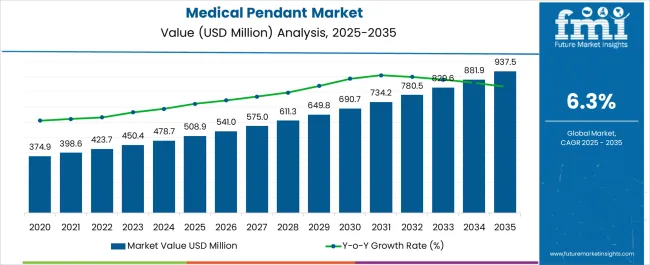
The medical pendant market was valued at USD 508.9 Million in 2025, projected to reach USD 540.96 Million in 2026, and is forecast to expand to USD 996.55 Million by 2036 at a 6.3% CAGR. Operating room modernization programs and intensive care unit expansion projects are the primary procurement catalysts for ceiling-mounted medical pendant systems that consolidate gas supply, electrical power, data connectivity, and equipment mounting into ergonomic articulated arm configurations. Surgical teams increasingly require pendant systems capable of supporting heavy monitors, camera heads, and insufflation equipment while maintaining full 360-degree rotation without compromising sterile field boundaries.
Summary of Medical Pendant Market
- Market valuation is expected to climb to USD 996.55 million by 2036.
- The industry is expected to expand at 6.3% annually from 2026 through 2036.
- The 2025 baseline valuation came in at USD 508.9 million.
- The ten-year outlook presents a cumulative growth opportunity of USD 455.59. million.
- Single Arm Movable Pendant leads by Product Type with 27.3% share in 2026, driven by spatial flexibility and load capacity in standard operating rooms.
- Surgery leads by Application with 36.8% share in 2026.
- The market is an operating room infrastructure category where load capacity, gas delivery certification, and digital integration capabilities define procurement specifications.
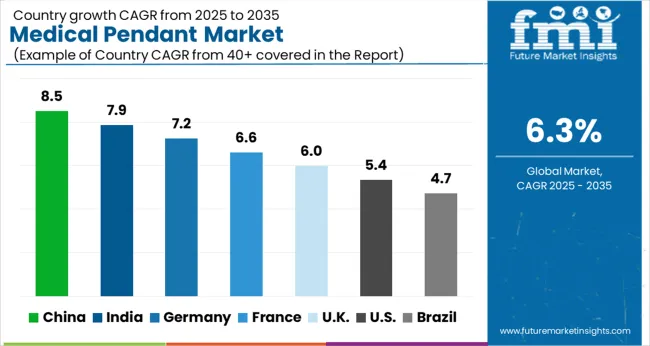
- Among key countries, China leads at 8.5% CAGR, followed by India at 7.9%, Germany at 7.2%, France at 6.6%, the UK at 6.0%, the USA at 5.4%, and Brazil at 4.7%.
Absolute dollar opportunity over the forecast period amounts to USD Million 455.59, reflecting both new installation demand from hospital construction and retrofit demand from operating theatre renovation programs. As per FMI, single arm movable pendants hold the leading share at 27.3%, driven by their balance of load capacity and spatial flexibility in standard-sized operating rooms. Double and multi-arm configurations are gaining specification in hybrid operating rooms and catheterization laboratories where multiple equipment arrays must be positioned simultaneously. Integration of medical gas monitoring, alarm systems, and digital connectivity modules into pendant control panels is becoming a standard tender requirement across tertiary care facility procurements.
Country-level growth trajectories reflect operating room construction activity and facility modernization investment. China leads at 8.5% CAGR as county-level hospital construction under the Healthy China 2030 initiative mandates integrated OR pendant systems in all new surgical suites. India follows at 7.9%, supported by Pradhan Mantri Swasthya Suraksha Yojana funding new medical college hospital construction with modern operating theatre specifications. Germany advances at 7.2% through hospital energy efficiency mandates that include OR infrastructure upgrades. France grows at 6.6% driven by Groupement Hospitalier de Territoire shared surgical facility investments. The United Kingdom expands at 6.0% as NHS trust capital programs renew aging operating theatre infrastructure. The United States grows at 5.4% on ambulatory surgical center proliferation and hybrid OR construction. Brazil records 4.7% growth tied to SUS hospital modernization programs.
Medical Pendant Market Key Takeaways
| Metric | Details |
|---|---|
| Industry Size (2026) | USD 540.96 Million |
| Industry Value (2036) | USD 996.55 Million |
| CAGR (2026 to 2036) | 6.3% |
Source: Future Market Insights, 2026
Medical Pendant Market Definition
Medical pendants are ceiling-mounted articulated arm systems designed to deliver medical gases, electrical power, data connectivity, and equipment mounting points to clinical workstations in operating rooms, intensive care units, endoscopy suites, and anaesthesia stations. The market covers single arm movable pendants, fixed pendants, fixed retractable pendants, and double multi-arm movable configurations.
Medical Pendant Market Inclusions
Market scope includes global and regional revenue sizing for medical pendant systems, forecast projections from 2026 to 2036, segmentation by product type and application, country-level demand analysis, and competitive landscape assessment of pendant system manufacturers.
Medical Pendant Market Exclusions
The scope excludes wall-mounted medical gas outlets sold separately, standalone surgical light booms without gas and power integration, ceiling-mounted IV pole systems, and general-purpose industrial articulated arms.
Medical Pendant Market Research Methodology
- Primary Research: Analysts conducted structured interviews with product manufacturers, hospital procurement managers, clinical specialists, and distribution channel partners to map purchasing decision pathways and technology adoption cycles.
- Desk Research: Data collection aggregated regulatory filing databases, national health expenditure reports, device approval registries, and published clinical outcomes across major markets.
- Market-Sizing and Forecasting: Baseline values derive from a hybrid bottom-up and top-down methodology, cross-referencing company revenue disclosures with regional health expenditure data and product utilization rates.
- Data Validation and Update Cycle: Projections are tested against publicly reported financial guidance from leading companies and verified through quarterly update cycles incorporating the most recent regulatory and clinical evidence.
Why is the Medical Pendant Market Growing?
The medical pendant market is showing strong growth momentum, supported by the increasing demand for advanced healthcare infrastructure and the rising focus on improving surgical efficiency and patient safety. Medical pendants are being increasingly integrated into operating rooms, intensive care units, and diagnostic centers to enable effective management of space, equipment, and cables, ensuring seamless workflow and improved hygiene standards. Rapid hospital expansions, rising surgical volumes, and continuous investments in upgrading healthcare facilities are creating favorable conditions for market growth.
The shift toward minimally invasive surgeries and the increasing adoption of technologically advanced medical devices are further boosting demand. The ability of medical pendants to support multiple utilities, including electrical, gas supply, and data communication lines, is making them indispensable in modern clinical environments.
With governments and private healthcare providers investing heavily in smart hospitals and digital healthcare ecosystems, the market is poised for sustained growth The increasing preference for modular and customizable pendant systems is expected to strengthen the market outlook in the coming years.
Segmental Analysis
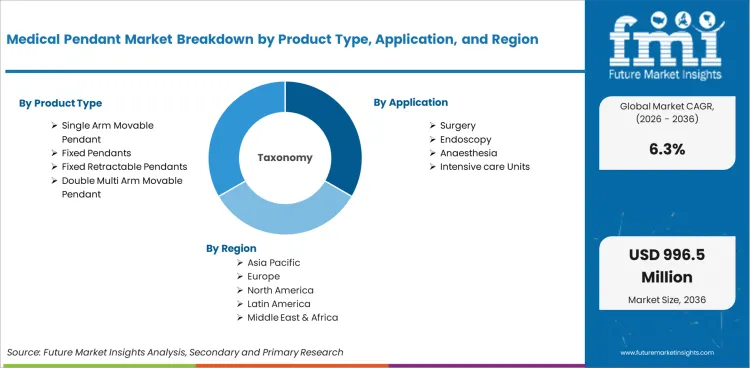
The medical pendant market is segmented by product type, application, and geographic regions. By product type, medical pendant market is divided into Single Arm Movable Pendant, Fixed Pendants, Fixed Retractable Pendants, and Double Multi Arm Movable Pendant. In terms of application, medical pendant market is classified into Surgery, Endoscopy, Anaesthesia, and Intensive care Units. Regionally, the medical pendant industry is classified into North America, Latin America, Western Europe, Eastern Europe, Balkan & Baltic Countries, Russia & Belarus, Central Asia, East Asia, South Asia & Pacific, and the Middle East & Africa.
Insights into the Single Arm Movable Pendant Product Type Segment
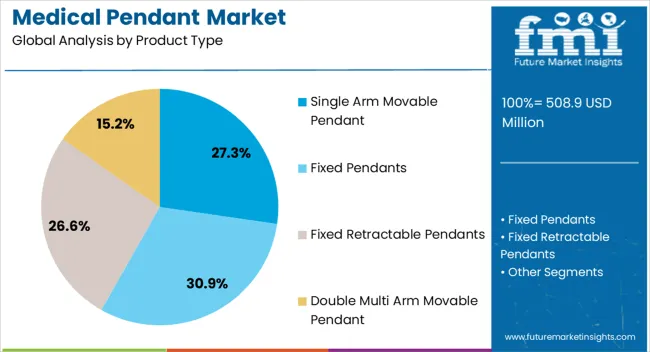
The single arm movable pendant segment is projected to hold 27.3% of the medical pendant market revenue share in 2026, making it a leading product type. Its strong market position is being reinforced by the flexibility and ease of positioning it provides within clinical environments, allowing healthcare professionals to adjust equipment placement efficiently during surgeries and treatments. The design of single arm movable pendants enables better space utilization, reducing clutter and enhancing safety in operating theaters and intensive care units.
Increasing adoption is also being driven by their cost-effectiveness compared to more complex pendant systems, making them attractive for hospitals and surgical centers with budget constraints. The segment is benefiting from advancements in ergonomic designs that improve ease of use while supporting multiple utilities such as medical gases, power supply, and data connections.
Their ability to integrate seamlessly with various surgical and diagnostic setups without extensive infrastructure modifications further enhances their adoption With healthcare facilities prioritizing efficiency, safety, and adaptability, the single arm movable pendant segment is expected to continue playing a central role in shaping market growth.
Insights into the Surgery Application Segment
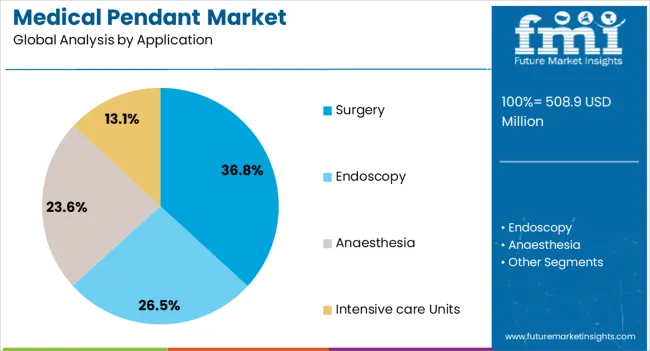
The surgery application segment is anticipated to account for 36.8% of the medical pendant market revenue share in 2026, establishing itself as the dominant application area. Its leadership is being driven by the increasing number of surgical procedures worldwide and the demand for efficient operating room management solutions. Medical pendants in surgical settings are essential for supporting heavy equipment, enabling flexible positioning of devices, and ensuring the availability of utilities such as medical gases and electrical connections within easy reach of the surgical team.
This improves workflow efficiency, reduces risks associated with cable clutter, and enhances overall safety during critical operations. The segment is also benefiting from the growing adoption of advanced surgical procedures, including minimally invasive and robotic-assisted surgeries, which require precise equipment management and reliable support structures.
Hospitals and specialty clinics are investing in surgical pendants to optimize space, improve ergonomics, and ensure compliance with international hygiene standards With rising surgical volumes, greater focus on patient safety, and increasing investments in modernizing operating theaters, the surgery application segment is expected to remain the largest contributor to market revenues.
Market Overview
Restraints & Challenges
Medical pendants' high prices may have a detrimental effect on the industry's expansion. A medical pendant is an expensive capital item to buy. Medical pendant adoption is hampered by their high procurement costs, particularly in developing economies. For instance, a multi-arm pendant often costs more than USD 2,000. A high-end fixed pendant or an ICU bridge pendant costs roughly USD 8,000 and up to purchase. These are merely the upfront charges for the gadget; ongoing maintenance expenses raise the overall cost of these units. Additionally, in low-middle-income nations, most medical professionals are discouraged from purchasing the product due to the expensive cost of the equipment. As a result, the device's high price may limit the expansion of the medical pendant sector.
The medical pendant systems provide appropriate positioning of medical equipment, terminal units, medical gas, specialty and electrical services. Medical pendant systems are mounted on the ceiling with the robust carcass system consisting of stainless steel flanges and supporting rods.
Medical pendant is the compact system with various configurations to fulfill exact requirements of hospital. Medical pendants have various number of arms which can be help to accommodate all electrical services, medical gas, data communication services and facilitating equipment management.
Incoming electrical and gas services from ceiling to minimize the cable clutter provide a safer and cleaner place for the movement and activity of medical professional teams. The movable arm of medical pendant system allows it to be located at exactly where it is most suitable for the operating team and these arms cover the requirement of any operation theatre.
Medical pendants make medical tasks and procedures easier, while ensuring safety while placing monitoring equipment. Medical pendants are designed to maximize space in the operation theatre for operations and critical care areas to improve accessibility around the patient bed thereby enabling healthcare staff to deliver effective patient care.
Medical Pendant Market: Drivers and Restraints
The primary factor for the growth of global medical pendant market is growing awareness in the healthcare professionals andrequirement of safe and low risk work space for medical staff. Medical pendant systems are highly useful in operation theatres or in intensive care unit.
The growth of medical pendant market is primarily attributed to accurate and effective results in various application areas such as surgeries and endoscopy. Major factor which limits the growth of the global medical pendant market is high cost of medical pendant system setup and unavailability of skilled nursing staff.
Medical Pendant Market: Overview
Medical pendant systems are designed to remove standing devices from the operation floor around the patient bed. The unique design of medical pendant systems enables mounting of a number of medical devices in a compact space. The maximum range of movement enables quick, easy positioning of service and provides safety control while minimizing the infection risk. Medical pendant systems decrease the visual impact in the patient environment, increasing the capacity of equipment load and improving equipment access.
Medical pendant systems allow various devices to be connected with it such as electrical supply, lighting, communication equipment, gas and liquid supply and rail system for installations of equipment. Medical pendant systems design enable different combinations and resources that fulfill the special needs and expectations of operating rooms in hospitals.
Fixed Retractable Pendants and Double Multi Arm Movable Pendant product type segments are expected to register highest CAGRs in terms of value owing to faster adoption among the medical communities worldwide.
Medical Pendant Market: Region-wise Outlook
The global medical pendantsystem market is expected to register a healthy CAGR for the forecast period. Depending on geographic region, global medical pendant systemmarket is segmented into seven key regions: North America, South America, Eastern Europe, Western Europe, Asia Pacific, Japan, and Middle East & Africa.
North America held largest share in the global market of medical pendant systemfollowed by Europe, Japan and Asia Pacific owing to the need for increasing the standard of healthcare infrastructure coupled with substantial investments. The developing nations in APAC and MEA hold huge potential for growth in the global medical pendant systemmarket, due to the convenience it offers in hospitals and ambulatory surgical centers.
Medical Pendant Market: Key Players
Some of the key participating global players in medical pendant systemsmarket are ELEKTRA HELLAS, Starkstrom, Ondal, Hipac, Beacon Medaes, Unicorn Medicals, Medilon, Uttam, Medimax, Brandon Medical.
The research report presents a comprehensive assessment of the market and contains thoughtful insights, facts, historical data, and statistically supported and industry-validated market data. It also contains projections using a suitable set of assumptions and methodologies. The research report provides analysis and information according to categories such as market segments, geographies, types, technology and applications.
The report covers exhaustive analysis on
- Market Segments
- Market Dynamics
- Market Size
- Supply & Demand
- Current Trends/Issues/Challenges
- Competition & Companies involved
- Technology
- Value Chain
Regional analysis includes
- North America (USA, Canada)
- Latin America (Mexico, Brazil, Rest of Latin America)
- Western Europe (Germany, Italy, UK, Spain, France, Rest of Western Europe)
- Eastern Europe (Poland, Russia, Rest of Eastern Europe)
- Asia Pacific (China, India, ASEAN, Australia & New Zealand)
- Japan
- Middle East and Africa (GCC, S. Africa, Rest of MEA)
The report is a compilation of first-hand information, qualitative and quantitative assessment by industry analysts, inputs from industry experts and industry participants across the value chain. The report provides in-depth analysis of parent market trends, macro-economic indicators and governing factors along with market attractiveness as per segments. The report also maps the qualitative impact of various market factors on market segments and geographies.
Analysis of Medical Pendant Market By Key Countries
.webp "Top Country Growth Comparison Medical Pendant Market Cagr (2026 2036)")
| Country | CAGR |
|---|---|
| China | 8.5% |
| India | 7.9% |
| Germany | 7.2% |
| France | 6.6% |
| UK | 6.0% |
| USA | 5.4% |
| Brazil | 4.7% |
Source: FMI analysis based on primary research and proprietary forecasting model
Country-wise Analysis
The Medical Pendant Market is expected to register a CAGR of 6.3% during the forecast period, exhibiting varied country level momentum. China leads with the highest CAGR of 8.5%, followed by India at 7.9%. Developed markets such as Germany, France, and the UK continue to expand steadily, while the USA is likely to grow at consistent rates. Brazil posts the lowest CAGR at 4.7%, yet still underscores a broadly positive trajectory for the global Medical Pendant Market. In 2024, Germany held a dominant revenue in the Western Europe market and is expected to grow with a CAGR of 7.2%. The USA Medical Pendant Market is estimated to be valued at USD 181.7 million in 2026 and is anticipated to reach a valuation of USD 306.1 million by 2036. Sales are projected to rise at a CAGR of 5.4% over the forecast period between 2026 and 2036. While Japan and South Korea markets are estimated to be valued at USD 26.7 million and USD 15.6 million respectively in 2026.
Key Players in the Medical Pendant Market
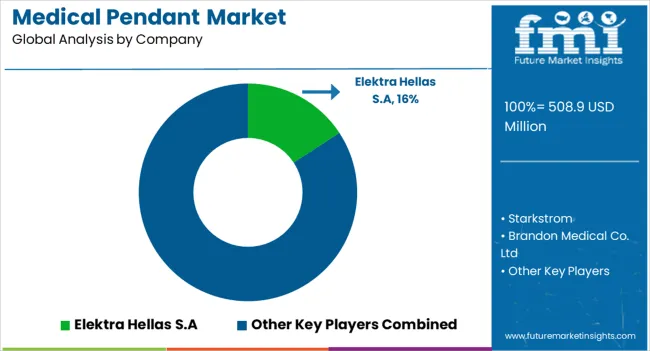
- Elektra Hellas S.A
- Starkstrom
- Brandon Medical Co. Ltd
- Skytron LLC
- Surgiris
- BeaconMedaes
- MEDIMAXKOREA
- Tedisel Medical
- Ondal Medical Systems GmbH
- Megasan Medikal
Scope of the Report
| Metric | Value |
|---|---|
| Quantitative Units | USD Million 540.96 to USD Million 996.55, at a CAGR of 6.3% |
| Market Definition | Medical pendants are ceiling-mounted articulated arm systems designed to deliver medical gases, electrical power, data connectivity, and equipment mounting points to clinical workstations in operating rooms, intensive care units, endoscopy suites, and anaesthesia stations. The market covers single arm movable pendants, fixed pendants, fixed retractable pendants, and double multi-arm movable configurations. |
| Segmentation | Product Type (Single Arm Movable Pendant, Fixed Pendants, Fixed Retractable Pendants, Double Multi Arm Movable Pendant), Application (Surgery, Endoscopy, Anaesthesia, Intensive Care Units), and Region |
| Regions Covered | North America, Latin America, Europe, East Asia, South Asia, Oceania, Middle East & Africa |
| Countries Covered | China, India, Germany, France, UK, USA, Brazil, and 40 plus countries |
| Key Companies Profiled | Elektra Hellas S.A, Starkstrom, Brandon Medical Co. Ltd, Skytron LLC, Surgiris, BeaconMedaes, MEDIMAXKOREA, Tedisel Medical, Ondal Medical Systems GmbH, Megasan Medikal |
| Forecast Period | 2026 to 2036 |
| Approach | Forecasting models apply a hybrid bottom-up and top-down methodology starting with company-level revenue and regional health expenditure benchmarks to project adoption and growth trajectories. |
Medical Pendant Market by Segments
Product Type:
- Single Arm Movable Pendant
- Fixed Pendants
- Fixed Retractable Pendants
- Double Multi Arm Movable Pendant
Application:
- Surgery
- Endoscopy
- Anaesthesia
- Intensive care Units
Region:
- North America
- USA
- Canada
- Mexico
- Latin America
- Brazil
- Chile
- Rest of Latin America
- Western Europe
- Germany
- UK
- Italy
- Spain
- France
- Nordic
- BENELUX
- Rest of Western Europe
- Eastern Europe
- Russia
- Poland
- Hungary
- Balkan & Baltic
- Rest of Eastern Europe
- East Asia
- China
- Japan
- South Korea
- South Asia and Pacific
- India
- ASEAN
- Australia & New Zealand
- Rest of South Asia and Pacific
- Middle East & Africa
- Kingdom of Saudi Arabia
- Other GCC Countries
- Turkiye
- South Africa
- Other African Union
- Rest of Middle East & Africa
Bibliography
- 1. World Health Organization. (2024). WHO guidelines on health-care facility design: Operating room infrastructure standards. WHO.
- 2. International Organization for Standardization. (2024). ISO 7396-1: Medical gas pipeline systems, pipeline systems for compressed medical gases and vacuum. ISO.
- 3. National Health Commission, China. (2024). Hospital construction standards: Operating room and ICU pendant system specifications. NHC.
- 4. Ministry of Health and Family Welfare, India. (2025). PMSSY Phase IV: Medical college hospital construction equipment standards. MoHFW.
- 5. European Committee for Standardization. (2024). EN 7396-1: Medical gas pipeline systems, pendant and ceiling service unit requirements. CEN.
- 6. Joint Commission. (2025). Environment of care standards: Operating room utility system management. Joint Commission.
This bibliography is provided for reader reference. The full Future Market Insights report contains the complete reference list with primary research documentation.
Frequently Asked Questions
How large is the demand for Medical Pendant in the global market in 2026?
Demand for medical pendant in the global market is estimated to be valued at USD Million 540.96 in 2026.
What will be the market size of Medical Pendant in the global market by 2036?
Market size for medical pendant is projected to reach USD Million 996.55 by 2036.
What is the expected demand growth for Medical Pendant in the global market between 2026 and 2036?
Demand for medical pendant is expected to grow at a CAGR of 6.3% between 2026 and 2036.
Which Product Type is poised to lead global sales by 2026?
Single Arm Movable Pendant accounts for 27.3% share in 2026.
How is the Medical Pendant market segmented by Application?
Surgery leads by Application with 36.8% share in 2026.
Which country is projected to grow fastest in the Medical Pendant market?
China is projected to grow at a CAGR of 8.5% during 2026 to 2036.
What is included in the scope of this Medical Pendant market report?
Market scope includes global and regional revenue sizing for medical pendant systems, forecast projections from 2026 to 2036, segmentation by product type and application, country-level demand analysis, and competitive landscape assessment of pendant system manufacturers.
What is excluded from the scope of this report?
The scope excludes wall-mounted medical gas outlets sold separately, standalone surgical light booms without gas and power integration, ceiling-mounted IV pole systems, and general-purpose industrial articulated arms.
Preview the report firsthand - request a free sample
Get SampleGet the brochure for pricing and purchase details.
Get PDFTable of Content
- Executive Summary
- Global Market Outlook
- Demand-side Trends
- Supply-side Trends
- Technology Roadmap Analysis
- Analysis and Recommendations
- Market Overview
- Market Coverage / Taxonomy
- Market Definition / Scope / Limitations
- Research Methodology
- Chapter Orientation
- Analytical Lens and Working Hypotheses
- Market Structure, Signals, and Trend Drivers
- Benchmarking and Cross-market Comparability
- Company Annual and Sustainability Reports
- Peer-reviewed Journals and Academic Literature
- Corporate Websites, Product Literature, and Technical Notes
- Earnings Decks and Investor Briefings
- Statutory Filings and Regulatory Disclosures
- Technical White Papers and Standards Notes
- Trade Journals, Industry Magazines, and Analyst Briefs
- Conference Proceedings, Webinars, and Seminar Materials
- Government Statistics Portals and Public Data Releases
- Press Releases and Reputable Media Coverage
- Specialist Newsletters and Curated Briefings
- Sector Databases and Reference Repositories
- FMI Internal Proprietary Databases and Historical Market Datasets
- Subscription Datasets and Paid Sources
- Social Channels, Communities, and Digital Listening Inputs
- Additional Desk Sources
- Expert Input and Fieldwork (Primary Evidence)
- Primary Modes
- Qualitative Interviews and Expert Elicitation
- Quantitative Surveys and Structured Data Capture
- Blended Approach
- Why Primary Evidence is Used
- Field Techniques
- Interviews
- Surveys
- Focus Groups
- Observational and In-context Research
- Social and Community Interactions
- Stakeholder Universe Engaged
- C-suite Leaders
- Board Members
- Presidents and Vice Presidents
- R&D and Innovation Heads
- Technical Specialists
- Domain Subject-matter Experts
- Scientists
- Physicians and Other Healthcare Professionals
- Governance, Ethics, and Data Stewardship
- Research Ethics
- Data Integrity and Handling
- Primary Modes
- Tooling, Models, and Reference Databases
- Data Engineering and Model Build
- Data Acquisition and Ingestion
- Cleaning, Normalisation, and Verification
- Synthesis, Triangulation, and Analysis
- Quality Assurance and Audit Trail
- Market Background
- Market Dynamics
- Drivers
- Restraints
- Opportunity
- Trends
- Scenario Forecast
- Demand in Optimistic Scenario
- Demand in Likely Scenario
- Demand in Conservative Scenario
- Opportunity Map Analysis
- Product Life Cycle Analysis
- Supply Chain Analysis
- Investment Feasibility Matrix
- Value Chain Analysis
- PESTLE and Porter’s Analysis
- Regulatory Landscape
- Regional Parent Market Outlook
- Production and Consumption Statistics
- Import and Export Statistics
- Market Dynamics
- Global Market Analysis 2021 to 2025 and Forecast, 2026 to 2036
- Historical Market Size Value (USD Million) Analysis, 2021 to 2025
- Current and Future Market Size Value (USD Million) Projections, 2026 to 2036
- Y-o-Y Growth Trend Analysis
- Absolute $ Opportunity Analysis
- Global Market Pricing Analysis 2021 to 2025 and Forecast 2026 to 2036
- Global Market Analysis 2021 to 2025 and Forecast 2026 to 2036, By Product Type
- Introduction / Key Findings
- Historical Market Size Value (USD Million) Analysis By Product Type , 2021 to 2025
- Current and Future Market Size Value (USD Million) Analysis and Forecast By Product Type , 2026 to 2036
- Single Arm Movable Pendant
- Fixed Pendants
- Fixed Retractable Pendants
- Double Multi Arm Movable Pendant
- Single Arm Movable Pendant
- Y-o-Y Growth Trend Analysis By Product Type , 2021 to 2025
- Absolute $ Opportunity Analysis By Product Type , 2026 to 2036
- Global Market Analysis 2021 to 2025 and Forecast 2026 to 2036, By Application
- Introduction / Key Findings
- Historical Market Size Value (USD Million) Analysis By Application, 2021 to 2025
- Current and Future Market Size Value (USD Million) Analysis and Forecast By Application, 2026 to 2036
- Surgery
- Endoscopy
- Anaesthesia
- Intensive care Value (USD Million)s
- Surgery
- Y-o-Y Growth Trend Analysis By Application, 2021 to 2025
- Absolute $ Opportunity Analysis By Application, 2026 to 2036
- Global Market Analysis 2021 to 2025 and Forecast 2026 to 2036, By Region
- Introduction
- Historical Market Size Value (USD Million) Analysis By Region, 2021 to 2025
- Current Market Size Value (USD Million) Analysis and Forecast By Region, 2026 to 2036
- North America
- Latin America
- Western Europe
- Eastern Europe
- East Asia
- South Asia and Pacific
- Middle East & Africa
- Market Attractiveness Analysis By Region
- North America Market Analysis 2021 to 2025 and Forecast 2026 to 2036, By Country
- Historical Market Size Value (USD Million) Trend Analysis By Market Taxonomy, 2021 to 2025
- Market Size Value (USD Million) Forecast By Market Taxonomy, 2026 to 2036
- By Country
- USA
- Canada
- Mexico
- By Product Type
- By Application
- By Country
- Market Attractiveness Analysis
- By Country
- By Product Type
- By Application
- Key Takeaways
- Latin America Market Analysis 2021 to 2025 and Forecast 2026 to 2036, By Country
- Historical Market Size Value (USD Million) Trend Analysis By Market Taxonomy, 2021 to 2025
- Market Size Value (USD Million) Forecast By Market Taxonomy, 2026 to 2036
- By Country
- Brazil
- Chile
- Rest of Latin America
- By Product Type
- By Application
- By Country
- Market Attractiveness Analysis
- By Country
- By Product Type
- By Application
- Key Takeaways
- Western Europe Market Analysis 2021 to 2025 and Forecast 2026 to 2036, By Country
- Historical Market Size Value (USD Million) Trend Analysis By Market Taxonomy, 2021 to 2025
- Market Size Value (USD Million) Forecast By Market Taxonomy, 2026 to 2036
- By Country
- Germany
- UK
- Italy
- Spain
- France
- Nordic
- BENELUX
- Rest of Western Europe
- By Product Type
- By Application
- By Country
- Market Attractiveness Analysis
- By Country
- By Product Type
- By Application
- Key Takeaways
- Eastern Europe Market Analysis 2021 to 2025 and Forecast 2026 to 2036, By Country
- Historical Market Size Value (USD Million) Trend Analysis By Market Taxonomy, 2021 to 2025
- Market Size Value (USD Million) Forecast By Market Taxonomy, 2026 to 2036
- By Country
- Russia
- Poland
- Hungary
- Balkan & Baltic
- Rest of Eastern Europe
- By Product Type
- By Application
- By Country
- Market Attractiveness Analysis
- By Country
- By Product Type
- By Application
- Key Takeaways
- East Asia Market Analysis 2021 to 2025 and Forecast 2026 to 2036, By Country
- Historical Market Size Value (USD Million) Trend Analysis By Market Taxonomy, 2021 to 2025
- Market Size Value (USD Million) Forecast By Market Taxonomy, 2026 to 2036
- By Country
- China
- Japan
- South Korea
- By Product Type
- By Application
- By Country
- Market Attractiveness Analysis
- By Country
- By Product Type
- By Application
- Key Takeaways
- South Asia and Pacific Market Analysis 2021 to 2025 and Forecast 2026 to 2036, By Country
- Historical Market Size Value (USD Million) Trend Analysis By Market Taxonomy, 2021 to 2025
- Market Size Value (USD Million) Forecast By Market Taxonomy, 2026 to 2036
- By Country
- India
- ASEAN
- Australia & New Zealand
- Rest of South Asia and Pacific
- By Product Type
- By Application
- By Country
- Market Attractiveness Analysis
- By Country
- By Product Type
- By Application
- Key Takeaways
- Middle East & Africa Market Analysis 2021 to 2025 and Forecast 2026 to 2036, By Country
- Historical Market Size Value (USD Million) Trend Analysis By Market Taxonomy, 2021 to 2025
- Market Size Value (USD Million) Forecast By Market Taxonomy, 2026 to 2036
- By Country
- Kingdom of Saudi Arabia
- Other GCC Countries
- Turkiye
- South Africa
- Other African Union
- Rest of Middle East & Africa
- By Product Type
- By Application
- By Country
- Market Attractiveness Analysis
- By Country
- By Product Type
- By Application
- Key Takeaways
- Key Countries Market Analysis
- USA
- Pricing Analysis
- Market Share Analysis, 2025
- By Product Type
- By Application
- Canada
- Pricing Analysis
- Market Share Analysis, 2025
- By Product Type
- By Application
- Mexico
- Pricing Analysis
- Market Share Analysis, 2025
- By Product Type
- By Application
- Brazil
- Pricing Analysis
- Market Share Analysis, 2025
- By Product Type
- By Application
- Chile
- Pricing Analysis
- Market Share Analysis, 2025
- By Product Type
- By Application
- Germany
- Pricing Analysis
- Market Share Analysis, 2025
- By Product Type
- By Application
- UK
- Pricing Analysis
- Market Share Analysis, 2025
- By Product Type
- By Application
- Italy
- Pricing Analysis
- Market Share Analysis, 2025
- By Product Type
- By Application
- Spain
- Pricing Analysis
- Market Share Analysis, 2025
- By Product Type
- By Application
- France
- Pricing Analysis
- Market Share Analysis, 2025
- By Product Type
- By Application
- India
- Pricing Analysis
- Market Share Analysis, 2025
- By Product Type
- By Application
- ASEAN
- Pricing Analysis
- Market Share Analysis, 2025
- By Product Type
- By Application
- Australia & New Zealand
- Pricing Analysis
- Market Share Analysis, 2025
- By Product Type
- By Application
- China
- Pricing Analysis
- Market Share Analysis, 2025
- By Product Type
- By Application
- Japan
- Pricing Analysis
- Market Share Analysis, 2025
- By Product Type
- By Application
- South Korea
- Pricing Analysis
- Market Share Analysis, 2025
- By Product Type
- By Application
- Russia
- Pricing Analysis
- Market Share Analysis, 2025
- By Product Type
- By Application
- Poland
- Pricing Analysis
- Market Share Analysis, 2025
- By Product Type
- By Application
- Hungary
- Pricing Analysis
- Market Share Analysis, 2025
- By Product Type
- By Application
- Kingdom of Saudi Arabia
- Pricing Analysis
- Market Share Analysis, 2025
- By Product Type
- By Application
- Turkiye
- Pricing Analysis
- Market Share Analysis, 2025
- By Product Type
- By Application
- South Africa
- Pricing Analysis
- Market Share Analysis, 2025
- By Product Type
- By Application
- USA
- Market Structure Analysis
- Competition Dashboard
- Competition Benchmarking
- Market Share Analysis of Top Players
- By Regional
- By Product Type
- By Application
- Competition Analysis
- Competition Deep Dive
- Elektra Hellas S.A
- Overview
- Product Portfolio
- Profitability by Market Segments (Product/Age /Sales Channel/Region)
- Sales Footprint
- Strategy Overview
- Marketing Strategy
- Product Strategy
- Channel Strategy
- Starkstrom
- Brandon Medical Co. Ltd
- Skytron LLC
- Surgiris
- BeaconMedaes
- MEDIMAXKOREA
- Tedisel Medical
- Ondal Medical Systems GmbH
- Megasan Medikal
- Elektra Hellas S.A
- Competition Deep Dive
- Assumptions & Acronyms Used


