

- Market Size (2026)
- USD 1.2 Bn
- Forecast (2036)
- USD 2.7 Bn
- CAGR (2026 to 2036)
- 8.4%
How big is Medical Suspension Bridge Market size?
USD 1.2 billion in 2026 and USD 2.7 billion by 2036 at an 8.4% CAGR.
Sales of medical suspension bridge are estimated to rise at 8.4% CAGR through 2036, increasing valuation from USD 1.2 billion in 2026 to USD 2.7 billion by 2036. Ceiling-mounted bridge systems enable healthcare personnel to consolidate essential electrical wiring and infusion hardware around active care zones. The Ambulatory Surgery Center Association recorded more than 6,300 Medicare-certified facilities during May 2026. An expanding base of outpatient surgery centers naturally widens the addressable market for compact operating room technology. Translating this facility growth into actual bridge purchases depends entirely on dedicated capital funding for new room construction or scheduled hardware replacements.
Hospital groups in the United States and Germany depend on certified load capacity records and seamlessly coordinated utility interfaces as primary sourcing criterias. Purchasing teams throughout Japan and the United Kingdom seek compact installation layouts and demand transparent documentation of long-term service access. Department of Health and Social Care highlighted 46 active hospital schemes under England’s New Hospital Programme during July 2026. Multi-site infrastructure investments like these create significant specification opportunities for standardized ceiling supply layouts across entirely new clinical spaces.
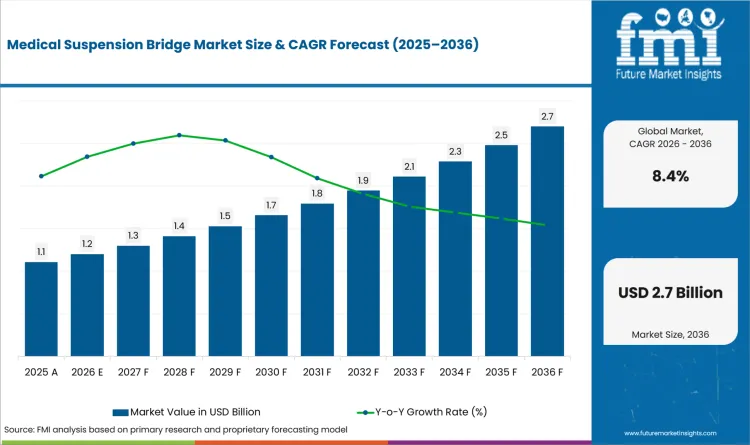
Key Takeaways for the Medical Suspension Bridge Market
- Demand for medical suspension bridges is driven by hospital construction and floor-free equipment organization across high-acuity care spaces.
- Mounting type is forecast to garner 68.0% share of configuration in 2026, driven by ceiling coordination and fixed structural planning across operating rooms and ICUs.
- Hospitals are estimated to lead end-use industry with 62.0% share in 2026, backed by recurring room upgrades and concentrated medical-utility requirements.
- Structural coordination and extended project schedules represent principal barriers, since ceiling loads and utility interfaces require approval across several technical teams.
- Competition focusses on Getinge, Stryker, KLS Martin Group, Tedisel Iberica SL, Silbermann, BenQ Medical Technology Corp., Jiangsu Rooe Medical Technology Co., Ltd., and EXPERT MEDICAL, with providers differentiating based on ceiling supply design and service coverage.
Analyst Perspective
“Ceiling-mounted bridge systems improve critical-care workflows by organizing utilities and equipment above patient zones. Hospital teams examine utility interfaces and maintenance access during equipment review. Durable adoption follows documented installation quality and dependable service support.”
- Anurag Sharma, Principal Analyst for Healthcare at Future Market Insights
How is Medical Suspension Bridge Market segmented?
The medical suspension bridge industry is segmented by product type, configuration, end-use application, end-use industry, buyer type, distribution channel, and region.
The medical suspension bridge sector is segmented by product type, configuration, end-use application, end-use industry, buyer type, distribution channel, and region. Product type includes suspension bridge systems, equipment pendants, and integrated boom systems. Configuration includes mounting type, mobility, and load capacity. End-use application spans operating rooms, intensive care units (ICUs), emergency departments, recovery rooms (PACU), endoscopy suites, catheterization laboratories, interventional radiology suites, and trauma centers. End-use industry covers hospitals, ambulatory surgery centers (ASCs), specialty clinics, academic and teaching hospitals, and military and veterans healthcare facilities. Buyer type includes government healthcare providers, private hospital chains, independent hospitals, ambulatory surgery center operators, group purchasing organizations (GPOs), and healthcare infrastructure developers. Distribution channel covers direct sales by manufacturers, medical equipment distributors, healthcare infrastructure integrators, engineering, procurement, and construction (EPC) contractors, and hospital equipment dealers. Regional coverage includes North America, Europe, East Asia, South Asia and Pacific, Latin America, and Middle East and Africa.
Why do suspension bridge systems lead product type demand?
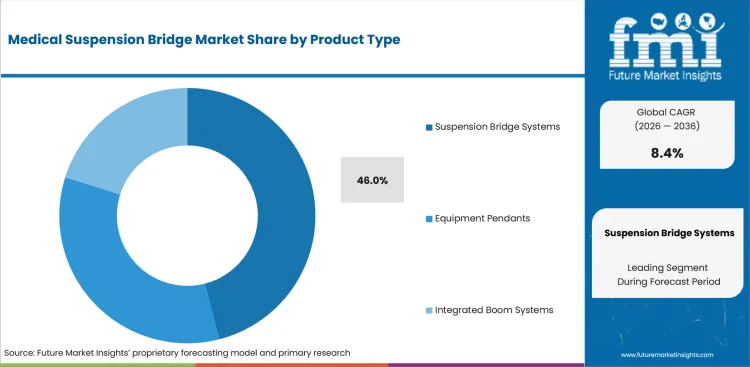
Suspension bridge systems centralize data connections and equipment supports above critical-care work zones. Ceiling-based service distribution reduces floor obstruction and allows clinical teams to position devices near patients. New South Wales Health Infrastructure reported 12 operating theatres for Prince of Wales Hospital in April 2024, expanding room capacity requiring coordinated overhead utilities. Integrated rail systems also support accessories without adding separate floor stands. Hospital approval rests on verified load capacity and maintenance access.
- Suspension bridge systems are estimated to hold 46.0% share of product type in 2026, led by consolidated service distribution across operating rooms and intensive-care spaces. Buyers examine structural calculations and utility coordination during room-design approval.
- Equipment pendants serve focused anesthesia and utility functions through compact service heads. Integrated boom systems address rooms requiring motorized or modular equipment positioning under defined clinical layouts.
What makes mounting type central to configuration selection?
Mounting type determines usable movement range and service-routing requirements. Ceiling-mounted systems preserve floor access around beds and procedure tables. Queensland Government reported capacity for more than 100 new procedures each month in June 2025, reinforcing structural planning for ceiling-mounted imaging systems. Wall-mounted layouts support rooms facing restricted overhead structure or limited ceiling work. Early coordination with architects and engineering teams reduces late redesign across medical gases and electrical services.
- By configuration, mounting type is predicted to represent 68.0% share in 2026 since being influenced by its direct effect on room clearance and equipment positioning. Hospital planners compare ceiling capacity and wall conditions during project design.
- Mobility and load capacity shape daily usability across rotating and motorized systems. Equipment weight and accessory plans guide selection among light-duty or medium-duty, and heavy-duty configurations.
Why do operating rooms lead end-use application demand?
Operating rooms require concentrated access to anesthesia services and medical gases. Surgical booms help organize equipment above procedure zones and reduce cable exposure across floor paths. Government of British Columbia reported construction across 15 new operating rooms in June 2025, increasing demand for flexible equipment and service distribution. Room layouts also require controlled movement around surgical tables and imaging systems. Equipment approval relies on tested clearances and dependable positioning across planned procedures.
- Operating rooms are anticipated to account for 38.0% share in 2026, backed by dense service requirements around surgical tables. Clinical engineering teams review load testing and movement limits during acceptance.
- Intensive care units (ICUs) require adaptable bridge layouts across pediatric and neonatal care spaces. Emergency departments and specialty procedure suites favor compact systems supporting prompt equipment access without obstructing patient movement.
What supports hospitals across end-use industry demand?
Hospitals combine emergency departments and specialist procedure areas within one estate. Central engineering teams often standardize outlets and service requirements across multiple rooms. Australian Institute of Health and Welfare recorded 704 public hospitals in January 2026, illustrating the installed facility base supporting room-equipment renewal. Renovation projects also require equipment compatible with existing structural and utility conditions. Service coverage gains importance through maintenance and later configuration changes.
- In 2026, hospitals are likely to secure 62.0% share due to concentrated demand across surgical and high-acuity departments. Multi-room projects favor suppliers offering coordinated design and installation support.
- Ambulatory surgery centers (ASCs) emphasize compact layouts and efficient room turnover across same-day procedures. Academic & teaching hospitals and military & veterans healthcare facilities apply distinct approval and service requirements.
Why do government healthcare providers lead buyer type demand?
Government healthcare providers purchase medical suspension bridges through formal capital planning and documented technical specifications. Public projects require alignment across facility planners and financial reviewers. Australian Government Department of Health, Disability and Ageing reported 98 additional beds for the Flinders Medical Centre expansion in June 2026, illustrating multi-area equipment demand inside government-funded facilities.
- Based on buyer type, government healthcare providers are projected to hold 33.0% share in 2026 owing to public hospital construction and renovation programs. Formal tenders favor suppliers presenting verified compliance records and clear installation scope.
- Private hospital chains and independent hospitals compare room standardization with local service access. Group purchasing organizations (GPOs), and healthcare infrastructure developers focus on delivery coordination across defined project portfolios.
How does direct sales by manufacturers shape distribution channel demand?
Direct sales by manufacturers connects product design with installation support and technical acceptance. Complex room projects benefit from direct access to engineering teams during specification changes. Getinge reported products sold across more than 135 countries in March 2026, demonstrating manufacturer-led reach for direct technical service. Manufacturer involvement also supports accessory selection and service planning across installed systems. Distributor routes remain useful for local coverage and smaller equipment packages.
- Direct sales by manufacturers are estimated to capture 41.0% share in 2026, guided by project-specific engineering and installation coordination. Direct engagement helps resolve design questions during hospital review.
- Medical equipment distributors and hospital equipment dealers extend local sales and service access. Healthcare infrastructure integrators and EPC (engineering, procurement & construction) Contractors coordinate suspension systems within complete hospital construction packages.
What are drivers, restraints, and opportunities in Medical Suspension Bridge Market?
Hospital renewal supports demand across surgical and intensive-care projects. Structural coordination slows conversion across complex ceilings and utility networks.
- Driver: Surgical and critical-care rooms require organized access to electricity and infusion equipment. Floor-free layouts improve equipment placement and preserve staff movement around patients.
- Restraint: Structural loads and utility interfaces require coordination across architecture and installation teams. Late design changes extend approval schedules and increase rework exposure.
- Opportunity: Modular bridges support accessory changes and future equipment additions across evolving care spaces. Verified installation records help suppliers extend approved designs across multi-room hospital programs.
Operating-room capacity creates a direct installed base for ceiling supply systems. NHS England published its Quarter 4 2025 to 26 facilities workbook in May 2026, recording 3,448 operating theatres across reporting organizations, including independent-sector capacity. Room numbers translate into commercial demand through funded refurbishment or replacement of established equipment. Standardized bridge specifications help hospital groups manage repeated room configurations.
Estate failures increase technical scrutiny during hospital equipment upgrades. National Audit Office reported approximately 5,400 annual NHS clinical service incidents linked to property and infrastructure failures in January 2025. Such disruption encourages careful review of ceiling structure, utility connections, and maintenance access prior to installation. Weak coordination raises acceptance risk and delays room handover.
New healthcare construction creates entry points for configurable suspension systems. USA Department of Health and Human Services selected 7 new or expanded healthcare facility projects in November 2025. Early project participation allows suppliers to align structural loads and service outlets with room plans. Commercial conversion requires inclusion inside funded equipment packages and approved technical schedules.
How are country CAGRs aligned in Medical Suspension Bridge Market?
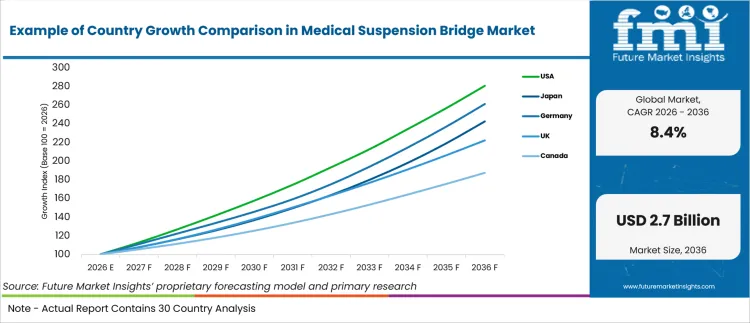
| Country or Market | CAGR |
|---|---|
| USA | 10.9% |
| Germany | 10.1% |
| Japan | 9.3% |
| UK | 8.3% |
| Brazil | 7.9% |
| Canada | 6.5% |
| Australia | 6.1% |
Source: Future Market Insights analysis, 2026.
How do country-level CAGRs compare in Medical Suspension Bridge Market?
The country comparison shows a gradual step-down in growth across the markets covered. The United States and Germany occupy the upper end of the range, followed by Japan in the next position. The United Kingdom and Brazil form a closely grouped middle tier. Canada and Australia complete the comparison with lower growth rates. The 4.8 percentage-point spread shows that the listed markets share a positive growth outlook, although their relative positions reflect different levels of market momentum.
- The United States and Germany lead the comparison and establish North America and Europe as the notable growth centers among the markets shown.
- Japan follows the leading pair and maintains a limited gap from Germany across the forecast period.
- The United Kingdom and Brazil form the next growth band and record a relatively narrow difference within the middle tier.
- Canada and Australia complete the disclosed comparison, with Australia recording the lowest CAGR among the listed markets.
- The pattern resembles a gradual downward slope instead of a sharp separation between higher-growth and lower-growth markets.
Markets with broadly similar CAGRs are likely to present different entry conditions due to technical approval practices and service availability. The full report provides country-level analysis across North America, Europe, East Asia, South Asia and Pacific, Latin America, and Middle East and Africa.
Country-wise Analysis
- Demand in the United States is projected to expand at 10.9% CAGR from 2026 to 2036, led by hospital network scale and recurring surgical-suite upgrades. American Hospital Association listed 6,100 hospitals in February 2026, providing a deep installed base for room standardization and replacement planning. Supplier success rests on certified load testing and installation control across multi-site systems.
- Sector in Germany is likely to scale at 10.1% CAGR by 2036, hospital renovation and specification-led purchasing. German Federal Statistical Office reported 6.5% annual growth in in-patient health service prices during October 2025, reinforcing attention to lifecycle cost and dependable maintenance access. Engineering documentation and outlet standardization shape supplier review across public and private projects.
- Formal equipment tenders place Japan as expected to increase at 9.3% CAGR during the study period, led by a documentation-intensive purchasing process. Japan External Trade Organization published an operating-room medical-equipment tender for one set in November 2025, reflecting formal specification and fulfillment controls. Suppliers benefit from precise technical submissions and dependable local service arrangements.
- Sales in the United Kingdom are anticipated to rise at 8.3% CAGR during the assessment period as hospital estate renewal creates room-equipment planning cycles. Government Property Function recorded 150 million NHS attendances during 2024 to 2025, increasing pressure on heavily used clinical infrastructure. Suspension-bridge opportunities advance through funded renovations designed to protect room availability and simplify maintenance.
- Industry in Brazil is predicted to expand at 7.9% CAGR from 2026 to 2036, driven by specialist hospital investment and operating-room modernization. National Institute of Traumatology and Orthopedics reported 21 operating rooms in its 2024 physical structure, illustrating concentrated surgical infrastructure within a major public institution. Local installation support and adaptable service configurations improve project suitability.
- Provincial hospital activity in Canada is estimated to grow at 6.5% CAGR during the forecast period, influenced by continuing acute-care equipment renewal. Canadian Institute for Health Information reported 3.14 million acute inpatient hospitalizations during 2024-25 in its February 19, 2026 release. High clinical activity supports room-upgrade needs through capital plans and technical-equipment replacement schedules.
- Adoption in Australia is set to scale at 6.1% CAGR, helped by room renewal across public and private hospitals. Australian Institute of Health and Welfare recorded 12.8 million hospitalizations during 2024 to 2025 in its May 2026 update. Sustained hospital activity encourages equipment planning designed to protect floor access and supports changing care requirements.
Who are notable companies in Medical Suspension Bridge Market?
Getinge, Stryker, KLS Martin Group, Tedisel Iberica SL, Silbermann, BenQ Medical Technology Corp., Jiangsu Rooe Medical Technology Co., Ltd., and EXPERT MEDICAL are notable companies shaping competition.
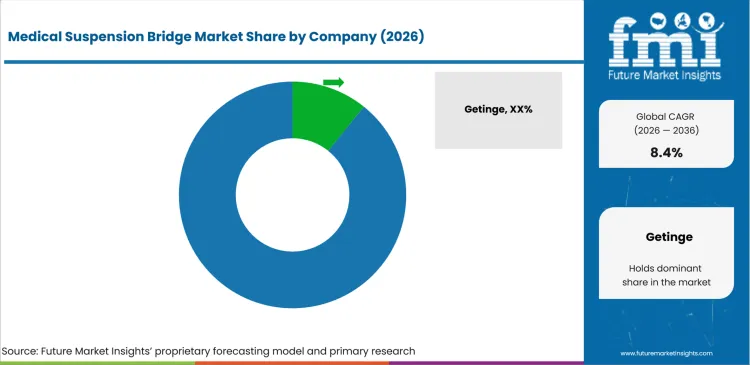
Competition for the sector centers on medical-utility integration and installation support. Global suppliers combine operating room equipment with room-planning and service capabilities. Specialist manufacturers focus on suspended bridges and configurable accessory systems. Hospital teams assess technical documentation and local service access during final company review. Official portfolios confirm active ceiling supply and pendant offerings across profiled companies.
- Getinge and Stryker compete based on integrated operating-room portfolios and established service networks. Buyers compare equipment coordination and long-term support across multi-room projects.
- KLS Martin Group and Tedisel Iberica SL compete depending on ceiling supply units and configurable suspended systems. Application engineering supports adaptation across operating rooms and intensive-care spaces.
- Silbermann and BenQ Medical Technology Corp. address hospital projects requiring bridge and pendant configurations. Regional service access influences installation planning and acceptance support.
- Jiangsu Rooe Medical Technology Co., Ltd. and EXPERT MEDICAL serve buyers seeking focused ceiling-supply portfolios. Price review remains secondary to structural documentation and reliable project execution.
Competitive Benchmarking: Medical Suspension Bridge Market
| Company | Suspension Bridge Portfolio | Operating Room Integration | Installation Support | Service Reach |
|---|---|---|---|---|
| Getinge | High | High | High | Global |
| Stryker | High | High | High | Global |
| KLS Martin Group | High | Medium | High | Multi-regional |
| Tedisel Iberica SL | High | High | High | Multi-regional |
| Silbermann | High | Medium | Medium | International |
| BenQ Medical Technology Corp. | Medium | High | Medium | International |
| Jiangsu Rooe Medical Technology Co., Ltd. | Medium | Medium | Medium | International |
| EXPERT MEDICAL | Medium | Medium | Focused | International |
Source: Future Market Insights competitive analysis, 2026.
Key Developments in Medical Suspension Bridge Market
- In April 2025, BenQ Medical Technology Corp. introduced a range of medical pendants from its newly completed China manufacturing facility. Expanded pendant availability strengthens hospital access to ceiling-mounted equipment across integrated operating-room projects.
- In November 2025, Stryker presented its S-Series Equipment Boom within the iSuite operating-room system. Ceiling-mounted shelves organize equipment and reduce floor-level cords across surgical workflows.
- In July 2026, Reinsberg Group completed the acquisition of Tedisel Medical and added its ceiling-mounted systems to a larger hospital-infrastructure portfolio. Expanded production and international coverage improve support for operating-room and intensive-care bridge projects.
Medical Suspension Bridge Market Report Scope
| Coverage field | Report scope |
|---|---|
| Market breakdown | Medical suspension bridge market breakdown includes Product Type, Configuration, End-use Application, End-use Industry, Buyer Type, Distribution Channel, and Region. |
| Quantitative Units | Revenue in USD billion and CAGR In %. |
| Market Definition | Medical suspension bridges include ceiling-mounted bridge systems, pendants, and integrated booms distributing medical gases, electricity, data, monitors, infusion equipment, and accessories around operating-room and intensive-care beds. |
| Regions Covered | North America, Europe, East Asia, South Asia and Pacific, Latin America, Middle East and Africa. |
| Countries Covered | USA, Germany, Japan, UK, Brazil, Canada, Australia, and additional countries covered through regional analysis. |
| Key Companies Profiled | Getinge, Stryker, KLS Martin Group, Tedisel Iberica SL, Silbermann, BenQ Medical Technology Corp., Jiangsu Rooe Medical Technology Co., Ltd., EXPERT MEDICAL. |
| Forecast Period | 2026 to 2036 |
| Approach | Hybrid bottom-up and top-down methodology uses segment shares and country CAGRs. Company activity, hospital projects, and buyer adoption support final market reconciliation. |
Source: Future Market Insights analysis, 2026.
Medical Suspension Bridge Market - Research Methodology
| Method | Approach |
|---|---|
| Primary Research | FMI analysts gathered input from manufacturers, service providers, technology developers, distributors, end users, procurement teams, and subject-matter experts. Interviews examined purchasing decisions, product or service evaluation, adoption barriers, approval requirements, pricing considerations, and expectations for technical or commercial support. Respondents were also asked what evidence is required before a trial, pilot, or initial order develops into regular purchasing. |
| Desk Research | Desk research covered government statistics, regulatory publications, trade data, industry associations, technical literature, standards, company filings, product information, and official corporate announcements. Sources were reviewed for relevance, publication date, geographic coverage, and consistency with the defined market scope. Claims relating to performance, applications, approvals, capacity, investment, and commercial activity were retained only when supported by credible public evidence. |
| Market Sizing and Forecasting | The market model combined the baseline value with historical performance, segment structure, pricing and volume indicators, adoption levels, company participation, and country-level demand conditions. Forecast assumptions considered economic activity, investment trends, regulatory developments, technology adoption, purchasing cycles, supply availability, and barriers to wider market use. Segment and regional estimates were reconciled before the final market total was calculated. |
| Data Validation | Estimates were checked against multiple independent indicators, including public data, company activity, trade patterns, industry developments, and findings from primary interviews. Validation also tested whether products, services, applications, and company revenues fell within the defined market boundaries. Adjacent categories, unsupported claims, overlapping revenues, and activities without direct market relevance were excluded to reduce double counting and maintain consistency across segments and countries. |
Source: Future Market Insights analysis, 2026.
Medical Suspension Bridge Market by Segments
Medical Suspension Bridge Market segmented by Product Type:
- Suspension Bridge Systems
- Equipment Pendants
- Integrated Boom Systems
Medical Suspension Bridge Market segmented by Configuration:
- Mounting Type
- Mobility
- Load Capacity
Medical Suspension Bridge Market segmented by End-use Application:
- Operating Rooms
- Intensive Care Units (ICUs)
- Emergency Departments
- Recovery Rooms (PACU)
- Endoscopy Suites
- Catheterization Laboratories
- Interventional Radiology Suites
- Trauma Centers
Medical Suspension Bridge Market segmented by End-use Industry:
- Hospitals
- Ambulatory Surgery Centers (ASCs)
- Specialty Clinics
- Academic & Teaching Hospitals
- Military & Veterans Healthcare Facilities
Medical Suspension Bridge Market segmented by Buyer Type:
- Government Healthcare Providers
- Private Hospital Chains
- Independent Hospitals
- Ambulatory Surgery Center Operators
- Group Purchasing Organizations (GPOs)
- Healthcare Infrastructure Developers
Medical Suspension Bridge Market segmented by Distribution Channel:
- Direct Sales by Manufacturers
- Medical Equipment Distributors
- Healthcare Infrastructure Integrators
- EPC (Engineering, Procurement & Construction) Contractors
- Hospital Equipment Dealers
Medical Suspension Bridge Market segmented by Region:
- North America
- United States
- Canada
- Latin America
- Brazil
- Mexico
- Argentina
- Chile
- Western Europe
- Germany
- France
- United Kingdom
- Italy
- Spain
- Benelux
- Nordics
- Eastern Europe
- Poland
- Czech Republic
- Romania
- Hungary
- East Asia
- China
- Japan
- South Korea
- South Asia and Pacific
- India
- ASEAN
- Australia and New Zealand
- Middle East and Africa
- GCC Countries
- South Africa
- Türkiye
- Israel
Research Sources and Bibliography
- Ambulatory Surgery Center Association. (2026, May 6). Medicare savings from use of ambulatory surgery centers.
- Department of Health and Social Care. (2026, July 8). New Hospital Programme annual report: financial year 2025 to 2026.
- NHS England. (2026, May). Operating theatres in NHS organisations in England, Quarter 4 2025-26.
- National Audit Office. (2025, January 22). Maintaining public service facilities.
- USA Department of Health and Human Services. (2025, November 19). Indian Health Service Joint Venture Construction Program selects new projects.
- American Hospital Association. (2026, February). Fast facts on USA hospitals, 2026.
- German Federal Statistical Office. (2025, November 12). Inflation rate at +2.3% in October 2025.
- Japan External Trade Organization. (2025, November 7). Operating room medical equipment 1 set.
- Government Property Function. (2026, May 5). Government Estate - Annual Data Publication 2024-25.
- National Institute of Traumatology and Orthopedics. (2024). EN.
- Canadian Institute for Health Information. (2026, February 19). Hospital stays in Canada, 2024-2025.
- Australian Institute of Health and Welfare. (2026, May 22). Hospitalisations and patient days.
- BenQ Medical Technology Corp. (2025, April 14). 2025 CMEF(China Medical Equipment Fair) Concludes Successfully.
- Stryker. (2025, November 10). What does an operating room look like? Look inside Stryker’s iSuite.
- Tedisel Medical. (2026, July 15). Reinsberg Group strengthens its position in Spain and in infrastructural products with the acquisition of Tedisel Medical.
- New South Wales Health Infrastructure. (2024, April). Creating state-of-the-art operating theatres in the ASB.
- Queensland Government. (2025, June 20). Australian-first operating theatre to boost surgery capacity at Townsville University Hospital.
- Government of British Columbia. (2025, June 23). Construction begins on operating rooms at Vancouver General Hospital.
- Australian Institute of Health and Welfare. (2026, January 23). Public hospitals and beds.
- Australian Government Department of Health, Disability and Ageing. (2026, June 12). Milestone reached for Flinders Medical Centre expansion.
- Getinge. (2026, March 26). Getinge publishes Annual Report for 2025.
This bibliography coverage supports reader reference and is not exhaustive. The full report documentation contains detailed source records.
This Report Answers
- How do segments influence demand across product type and configuration with end-use coverage?
- What criteria guide hospital planners evaluating medical suspension bridges prior to project approval?
- Why do country CAGRs differ across profiled countries for medical suspension bridge?
- What companies compete through ceiling supply design and installation support?
- How are forecasts validated through bottom-up and top-down analysis using independent indicators?
- What evidence supports hospital review prior to multi-room equipment installation?
- Why do structural loads and utility interfaces influence system selection?
- How do extended construction schedules limit return across installation and room commissioning?
- How do service records influence approval across engineering and clinical teams?
- What company capabilities improve long-term confidence and repeat project participation?
Frequently Asked Questions
How big is the Medical Suspension Bridge Market in 2026?
The medical suspension bridge market is valued at USD 1.2 billion in 2026 and is forecast to reach USD 2.7 billion by 2036. Growth is supported by hospital construction activity and the expanding installed base of surgical and high-acuity care rooms that generate recurring demand for ceiling-mounted utility distribution systems across operating rooms and intensive care units.
What is the CAGR of the Medical Suspension Bridge Market from 2026 to 2036?
The medical suspension bridge market grows at a CAGR of 8.4% between 2026 and 2036, supported by hospital groups adopting ceiling-mounted bridge systems once structural approvals and utility coordination are completed within funded room construction or scheduled hardware replacement programs across surgical and critical care departments.
Which configuration leads the Medical Suspension Bridge Market?
Mounting type accounts for 68.0% of the medical suspension bridge market by configuration in 2026, driven by ceiling-mounted systems that preserve floor access around procedure tables and beds while allowing clinical and engineering teams to route medical gases, electrical services, and data connections through a single coordinated overhead structure.
How much will the Medical Suspension Bridge Market add between 2026 and 2036?
The medical suspension bridge market is set to add USD 1.5 billion between 2026 and 2036, growing from USD 1.2 billion to USD 2.7 billion as ceiling-mounted bridge and pendant systems enter funded equipment packages across a widening base of hospital construction, operating room expansion, and intensive care renovation programs.
Who are the leading companies in the Medical Suspension Bridge Market?
Notable companies competing in the medical suspension bridge market include Getinge, Stryker, KLS Martin Group, Tedisel Iberica SL, Silbermann, BenQ Medical Technology Corp., Jiangsu Rooe Medical Technology Co., Ltd., and EXPERT MEDICAL, differentiating through ceiling supply design, operating room integration depth, installation support capability, and the geographic reach of their service networks.
Preview the report firsthand - request a free sample
Get SampleGet the brochure for pricing and purchase details.
Get PDFTable of Content
- Key Takeaways
- Market Size and CAGR
- Top Growth Driver
- Fastest Growing Segment
- Leading Region
- Key Companies
- Emerging Opportunities
- Executive Summary
- Global Market Outlook
- Demand-side Trends
- Supply-side Trends
- Technology Roadmap Analysis
- Analysis and Recommendations
- Analyst Perspective (What is happening? Why now? What should investors know?)
- Key Questions Answered
- How large is the market?
- What is the CAGR?
- What are key trends?
- Which region dominates?
- Who are the leaders?
- Market Overview
- Market Coverage / Taxonomy
- Market Definition / Scope / Limitations
- Research Methodology
- Chapter Orientation
- Analytical Lens and Working Hypotheses
- Market Structure, Signals, and Trend Drivers
- Benchmarking and Cross-market Comparability
- Market Sizing, Forecasting, and Opportunity Mapping
- Research Design and Evidence Framework
- Desk Research Programme (Secondary Evidence)
- Expert Input and Fieldwork (Primary Evidence)
- Tooling, Models, and Reference Databases
- Data Engineering and Model Build
- Quality Assurance and Audit Trail
- Market Background
- Market Dynamics (Drivers, Restraints, Opportunity, Trends)
- Scenario Forecast (Optimistic, Likely, Conservative)
- Impact Analysis
- AI Impact
- Sustainability Impact
- Regulatory Impact
- Technology Impact
- Consumer / Buyer Analysis
- Purchase Drivers
- Adoption Barriers
- Buyer Journey
- Opportunity Map Analysis
- Product Life Cycle Analysis
- Supply Chain Analysis
- Investment Feasibility Matrix
- Value Chain Analysis
- PESTLE and Porter's Analysis
- Regulatory Landscape
- Regional Parent Market Outlook
- Production and Consumption Statistics
- Import and Export Statistics
- Global Market Analysis and Forecast, 2021 to 2036
- Historical Market Size Value (USD Billion) Analysis, 2021 to 2025
- Current and Future Market Size Value (USD Billion) Projections, 2026 to 2036
- Y-o-Y Growth Trend Analysis
- Absolute $ Opportunity Analysis
- Global Market Pricing Analysis, 2021 to 2036
- Global Market Analysis and Forecast, By Product Type, 2021 to 2036
- Introduction / Key Findings
- Historical Market Size Value (USD Billion) Analysis By Product Type, 2021 to 2025
- Current and Future Market Size Value (USD Billion) Analysis and Forecast By Product Type, 2026 to 2036
- Suspension Bridge Systems
- Ceiling-Mounted Suspension Bridges
- Wall-Mounted Suspension Bridges
- Single-Arm Suspension Bridges
- Double-Arm Suspension Bridges
- Multi-Arm Suspension Bridges
- Equipment Pendants
- Anesthesia Pendants
- Surgical Pendants
- Endoscopy Pendants
- ICU Pendants
- Utility Pendants
- Integrated Boom Systems
- Fixed Boom Systems
- Motorized Boom Systems
- Modular Boom Systems
- Suspension Bridge Systems
- Y-o-Y Growth Trend Analysis By Product Type, 2021 to 2025
- Absolute $ Opportunity Analysis By Product Type, 2026 to 2036
- Global Market Analysis and Forecast, By Configuration, 2021 to 2036
- Introduction / Key Findings
- Historical Market Size Value (USD Billion) Analysis By Configuration, 2021 to 2025
- Current and Future Market Size Value (USD Billion) Analysis and Forecast By Configuration, 2026 to 2036
- Mounting Type
- Ceiling-Mounted
- Wall-Mounted
- Mobility
- Fixed Systems
- Rotating Systems
- Motorized Systems
- Load Capacity
- Light-Duty (<150 kg)
- Medium-Duty (150-300 kg)
- Heavy-Duty (>300 kg)
- Mounting Type
- Y-o-Y Growth Trend Analysis By Configuration, 2021 to 2025
- Absolute $ Opportunity Analysis By Configuration, 2026 to 2036
- Global Market Analysis and Forecast, By End-use Application, 2021 to 2036
- Introduction / Key Findings
- Historical Market Size Value (USD Billion) Analysis By End-use Application, 2021 to 2025
- Current and Future Market Size Value (USD Billion) Analysis and Forecast By End-use Application, 2026 to 2036
- Operating Rooms
- General Surgery
- Hybrid Operating Rooms
- Specialty Operating Rooms
- Intensive Care Units (ICUs)
- Adult ICU
- Pediatric ICU
- Neonatal ICU (NICU)
- Emergency Departments
- Recovery Rooms (PACU)
- Endoscopy Suites
- Catheterization Laboratories
- Interventional Radiology Suites
- Trauma Centers
- Operating Rooms
- Y-o-Y Growth Trend Analysis By End-use Application, 2021 to 2025
- Absolute $ Opportunity Analysis By End-use Application, 2026 to 2036
- Global Market Analysis and Forecast, By End-use Industry, 2021 to 2036
- Introduction / Key Findings
- Historical Market Size Value (USD Billion) Analysis By End-use Industry, 2021 to 2025
- Current and Future Market Size Value (USD Billion) Analysis and Forecast By End-use Industry, 2026 to 2036
- Hospitals
- Public Hospitals
- Private Hospitals
- Specialty Hospitals
- Ambulatory Surgery Centers (ASCs)
- Specialty Clinics
- Academic & Teaching Hospitals
- Military & Veterans Healthcare Facilities
- Hospitals
- Y-o-Y Growth Trend Analysis By End-use Industry, 2021 to 2025
- Absolute $ Opportunity Analysis By End-use Industry, 2026 to 2036
- Global Market Analysis and Forecast, By Buyer Type, 2021 to 2036
- Introduction / Key Findings
- Historical Market Size Value (USD Billion) Analysis By Buyer Type, 2021 to 2025
- Current and Future Market Size Value (USD Billion) Analysis and Forecast By Buyer Type, 2026 to 2036
- Government Healthcare Providers
- Private Hospital Chains
- Independent Hospitals
- Ambulatory Surgery Center Operators
- Group Purchasing Organizations (GPOs)
- Healthcare Infrastructure Developers
- Government Healthcare Providers
- Y-o-Y Growth Trend Analysis By Buyer Type, 2021 to 2025
- Absolute $ Opportunity Analysis By Buyer Type, 2026 to 2036
- Global Market Analysis and Forecast, By Distribution Channel
- Introduction / Key Findings
- Historical Market Size Value (USD Billion) Analysis By Distribution Channel, 2021 to 2025
- Current and Future Market Size Value (USD Billion) Analysis and Forecast By Distribution Channel, 2026 to 2036
- Direct Sales by Manufacturers
- Medical Equipment Distributors
- Healthcare Infrastructure Integrators
- EPC (Engineering, Procurement & Construction) Contractors
- Hospital Equipment Dealers
- Direct Sales by Manufacturers
- Y-o-Y Growth Trend Analysis By Distribution Channel, 2021 to 2025
- Absolute $ Opportunity Analysis By Distribution Channel, 2026 to 2036
- Global Market Analysis and Forecast, By Region, 2021 to 2036
- Introduction
- Historical Market Size Value (USD Billion) Analysis By Region, 2021 to 2025
- Current Market Size Value (USD Billion) Analysis and Forecast By Region, 2026 to 2036
- North America
- Latin America
- Western Europe
- Eastern Europe
- East Asia
- South Asia and Pacific
- Middle East & Africa
- Market Attractiveness Analysis By Region
- North America Market Analysis and Forecast, By Country, 2021 to 2036
- Historical Market Size Value (USD Billion) Trend Analysis By Market Taxonomy, 2021 to 2025
- Market Size Value (USD Billion) Forecast By Market Taxonomy, 2026 to 2036
- By Country
- USA
- Canada
- By Product Type
- By Configuration
- By End-use Application
- By End-use Industry
- By Buyer Type
- By Distribution Channel
- By Country
- Market Attractiveness Analysis
- By Country
- By Product Type
- By Configuration
- By End-use Application
- By End-use Industry
- By Buyer Type
- By Distribution Channel
- Key Takeaways
- Latin America Market Analysis and Forecast, By Country
- Historical Market Size Value (USD Billion) Trend Analysis By Market Taxonomy, 2021 to 2025
- Market Size Value (USD Billion) Forecast By Market Taxonomy, 2026 to 2036
- By Country
- Brazil
- Mexico
- Chile
- Rest of Latin America
- By Product Type
- By Configuration
- By End-use Application
- By End-use Industry
- By Buyer Type
- By Distribution Channel
- By Country
- Market Attractiveness Analysis
- By Country
- By Product Type
- By Configuration
- By End-use Application
- By End-use Industry
- By Buyer Type
- By Distribution Channel
- Key Takeaways
- Western Europe Market Analysis and Forecast, By Country
- Historical Market Size Value (USD Billion) Trend Analysis By Market Taxonomy, 2021 to 2025
- Market Size Value (USD Billion) Forecast By Market Taxonomy, 2026 to 2036
- By Country
- Germany
- UK
- Italy
- Spain
- France
- Nordic
- BENELUX
- Rest of Western Europe
- By Product Type
- By Configuration
- By End-use Application
- By End-use Industry
- By Buyer Type
- By Distribution Channel
- By Country
- Market Attractiveness Analysis
- By Country
- By Product Type
- By Configuration
- By End-use Application
- By End-use Industry
- By Buyer Type
- By Distribution Channel
- Key Takeaways
- Eastern Europe Market Analysis and Forecast, By Country
- Historical Market Size Value (USD Billion) Trend Analysis By Market Taxonomy, 2021 to 2025
- Market Size Value (USD Billion) Forecast By Market Taxonomy, 2026 to 2036
- By Country
- Russia
- Poland
- Hungary
- Balkan & Baltic
- Rest of Eastern Europe
- By Product Type
- By Configuration
- By End-use Application
- By End-use Industry
- By Buyer Type
- By Distribution Channel
- By Country
- Market Attractiveness Analysis
- By Country
- By Product Type
- By Configuration
- By End-use Application
- By End-use Industry
- By Buyer Type
- By Distribution Channel
- Key Takeaways
- East Asia Market Analysis and Forecast, By Country
- Historical Market Size Value (USD Billion) Trend Analysis By Market Taxonomy, 2021 to 2025
- Market Size Value (USD Billion) Forecast By Market Taxonomy, 2026 to 2036
- By Country
- China
- Japan
- South Korea
- By Product Type
- By Configuration
- By End-use Application
- By End-use Industry
- By Buyer Type
- By Distribution Channel
- By Country
- Market Attractiveness Analysis
- By Country
- By Product Type
- By Configuration
- By End-use Application
- By End-use Industry
- By Buyer Type
- By Distribution Channel
- Key Takeaways
- South Asia and Pacific Market Analysis and Forecast, By Country
- Historical Market Size Value (USD Billion) Trend Analysis By Market Taxonomy, 2021 to 2025
- Market Size Value (USD Billion) Forecast By Market Taxonomy, 2026 to 2036
- By Country
- India
- ASEAN
- Australia & New Zealand
- Rest of South Asia and Pacific
- By Product Type
- By Configuration
- By End-use Application
- By End-use Industry
- By Buyer Type
- By Distribution Channel
- By Country
- Market Attractiveness Analysis
- By Country
- By Product Type
- By Configuration
- By End-use Application
- By End-use Industry
- By Buyer Type
- By Distribution Channel
- Key Takeaways
- Middle East & Africa Market Analysis and Forecast, By Country
- Historical Market Size Value (USD Billion) Trend Analysis By Market Taxonomy, 2021 to 2025
- Market Size Value (USD Billion) Forecast By Market Taxonomy, 2026 to 2036
- By Country
- Kingdom of Saudi Arabia
- Other GCC Countries
- Türkiye
- South Africa
- Other African Union
- Rest of Middle East & Africa
- By Product Type
- By Configuration
- By End-use Application
- By End-use Industry
- By Buyer Type
- By Distribution Channel
- By Country
- Market Attractiveness Analysis
- By Country
- By Product Type
- By Configuration
- By End-use Application
- By End-use Industry
- By Buyer Type
- By Distribution Channel
- Key Takeaways
- Key Countries Market Analysis
- USA
- Pricing Analysis
- Market Share Analysis, 2025
- By Product Type
- By Configuration
- By End-use Application
- By End-use Industry
- By Buyer Type
- By Distribution Channel
- Canada
- Pricing Analysis
- Market Share Analysis, 2025
- By Product Type
- By Configuration
- By End-use Application
- By End-use Industry
- By Buyer Type
- By Distribution Channel
- Mexico
- Pricing Analysis
- Market Share Analysis, 2025
- By Product Type
- By Configuration
- By End-use Application
- By End-use Industry
- By Buyer Type
- By Distribution Channel
- Brazil
- Pricing Analysis
- Market Share Analysis, 2025
- By Product Type
- By Configuration
- By End-use Application
- By End-use Industry
- By Buyer Type
- By Distribution Channel
- Chile
- Pricing Analysis
- Market Share Analysis, 2025
- By Product Type
- By Configuration
- By End-use Application
- By End-use Industry
- By Buyer Type
- By Distribution Channel
- Germany
- Pricing Analysis
- Market Share Analysis, 2025
- By Product Type
- By Configuration
- By End-use Application
- By End-use Industry
- By Buyer Type
- By Distribution Channel
- UK
- Pricing Analysis
- Market Share Analysis, 2025
- By Product Type
- By Configuration
- By End-use Application
- By End-use Industry
- By Buyer Type
- By Distribution Channel
- Italy
- Pricing Analysis
- Market Share Analysis, 2025
- By Product Type
- By Configuration
- By End-use Application
- By End-use Industry
- By Buyer Type
- By Distribution Channel
- Spain
- Pricing Analysis
- Market Share Analysis, 2025
- By Product Type
- By Configuration
- By End-use Application
- By End-use Industry
- By Buyer Type
- By Distribution Channel
- France
- Pricing Analysis
- Market Share Analysis, 2025
- By Product Type
- By Configuration
- By End-use Application
- By End-use Industry
- By Buyer Type
- By Distribution Channel
- India
- Pricing Analysis
- Market Share Analysis, 2025
- By Product Type
- By Configuration
- By End-use Application
- By End-use Industry
- By Buyer Type
- By Distribution Channel
- ASEAN
- Pricing Analysis
- Market Share Analysis, 2025
- By Product Type
- By Configuration
- By End-use Application
- By End-use Industry
- By Buyer Type
- By Distribution Channel
- Australia & New Zealand
- Pricing Analysis
- Market Share Analysis, 2025
- By Product Type
- By Configuration
- By End-use Application
- By End-use Industry
- By Buyer Type
- By Distribution Channel
- China
- Pricing Analysis
- Market Share Analysis, 2025
- By Product Type
- By Configuration
- By End-use Application
- By End-use Industry
- By Buyer Type
- By Distribution Channel
- Japan
- Pricing Analysis
- Market Share Analysis, 2025
- By Product Type
- By Configuration
- By End-use Application
- By End-use Industry
- By Buyer Type
- By Distribution Channel
- South Korea
- Pricing Analysis
- Market Share Analysis, 2025
- By Product Type
- By Configuration
- By End-use Application
- By End-use Industry
- By Buyer Type
- By Distribution Channel
- Russia
- Pricing Analysis
- Market Share Analysis, 2025
- By Product Type
- By Configuration
- By End-use Application
- By End-use Industry
- By Buyer Type
- By Distribution Channel
- Poland
- Pricing Analysis
- Market Share Analysis, 2025
- By Product Type
- By Configuration
- By End-use Application
- By End-use Industry
- By Buyer Type
- By Distribution Channel
- Hungary
- Pricing Analysis
- Market Share Analysis, 2025
- By Product Type
- By Configuration
- By End-use Application
- By End-use Industry
- By Buyer Type
- By Distribution Channel
- Kingdom of Saudi Arabia
- Pricing Analysis
- Market Share Analysis, 2025
- By Product Type
- By Configuration
- By End-use Application
- By End-use Industry
- By Buyer Type
- By Distribution Channel
- Türkiye
- Pricing Analysis
- Market Share Analysis, 2025
- By Product Type
- By Configuration
- By End-use Application
- By End-use Industry
- By Buyer Type
- By Distribution Channel
- South Africa
- Pricing Analysis
- Market Share Analysis, 2025
- By Product Type
- By Configuration
- By End-use Application
- By End-use Industry
- By Buyer Type
- By Distribution Channel
- USA
- Market Structure Analysis
- Competition Dashboard
- Competition Benchmarking
- Market Share Analysis of Top Players
- By Regional
- By Product Type
- By Configuration
- By End-use Application
- By End-use Industry
- By Buyer Type
- By Distribution Channel
- Emerging Startups
- Innovation Benchmarking
- Competition Analysis
- Competition Deep Dive
- Getinge
- Overview
- Product Portfolio
- Profitability by Market Segments
- Sales Footprint
- Strategy Overview
- Marketing Strategy
- Product Strategy
- Channel Strategy
- Stryker
- KLS Martin Group
- Tedisel Iberica SL
- Silbermann
- BenQ Medical Technology Corp.
- Jiangsu Rooe Medical Technology Co., Ltd.
- EXPERT MEDICAL
- WestMedGroup
- SKSurgitech
- Others
- Getinge
- Case Studies
- Success Stories
- Recent Developments
- Competition Deep Dive
- Assumptions & Acronyms Used


