

- Market Size (2026)
- USD 1051.4 Mn
- Forecast (2036)
- USD 4842.1 Mn
- CAGR (2026 to 2036)
- 16.5%
How big is Medical Technology Regulatory Modernization and Innovation Pathways Market in 2026?
USD 1051.4 million in 2026 and USD 4842.1 million by 2036 at a 16.5% CAGR.
Demand for medical technology regulatory modernization and innovation pathways are anticipated to expand at 16.5% CAGR from 2026 to 2036, pushing the market size from USD 1051.4 million in 2026 to USD 4842.1 million by 2036. Regulatory agencies are replacing isolated document exchanges with lifecycle expectations that connect evidence planning and post-market oversight. The FDA device guidance program listed updated 2025 requirements across AI lifecycle management and electronic submission processes. Regulatory information management systems increasingly preserve one approved product record across submissions and health-authority interactions. Adjacent medical device technologies raise evidence demands because connected functions can alter product risk throughout commercial use. Manufacturers therefore invest in reusable data structures and accountable review workflows instead of treating each filing as an isolated project.
National pathways create different commercial tests even though manufacturers often begin with the same global evidence package. United States programs increasingly align review with coverage planning while European authorities emphasize registration transparency and post-market duties. The MHRA reported in June 2026 that its AI Airlock phase completed seven case studies across distinct medical-device use cases. The controlled setting helps developers test digital health platforms against regulatory questions without representing a general authorization route. Japan and South Korea require local applications plus country-specific operating support that influences regulatory affairs outsourcing service design. Commercial success depends on local representation and maintenance capacity alongside submission software and clinical evidence expertise across regional programs.
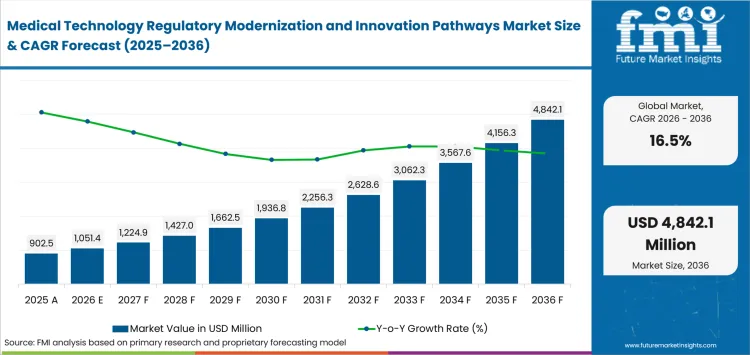
Key Takeaways of Medical Technology Regulatory Modernization and Innovation Pathways Market
- Demand for regulatory modernization and innovation pathways is driven by the need to connect evidence decisions with controlled lifecycle records across several health authorities, supported by lifecycle regulation and digital submission requirements.
- By pathway type, regulatory modernization programs hold the leading share at 33.4% in 2026, attributable to their ability to coordinate several approval and compliance activities under one operating structure.
- Artificial intelligence-based regulatory solutions lead the technology category at 33.0% share in 2026, supported by their role in document review and change assessment across growing submission portfolios.
- Medical device approval management accounts for 30.4% application share in 2026, owing to its position at the main authorization decision linking technical documentation with review status.
- Medical device manufacturers lead end-user demand at 33.7% share in 2026, driven by their direct responsibility for product authorization and lifecycle compliance, reinforced by mandatory evidence ownership under frameworks like EUDAMED.
- The USA, Germany, and South Korea record CAGRs of 18.9%, 17.6%, and 16.6% respectively through 2036, while the UK and Japan retain established institutions with local documentation and market-entry routes shaping implementation speed.
- Competition centers on Veeva Systems, Rimsys, IQVIA, ArisGlobal, Oracle Life Sciences, MasterControl, Parexel, and Freyr Solutions, with vendors differentiating through device regulatory information depth, combined quality/life-sciences platforms, and specialist regional service coverage.
Analyst Perspective
Harmonized rules like QMSR alignment with ISO 13485 give manufacturers a cleaner regulatory structure, but they can't repair incomplete product records or unresolved quality ownership that predates the framework, so the real value shows up only where organizations already have named owners for evidence updates. The scale of FDA-authorized AI-enabled devices means document-review automation is now handling meaningful submission volume, yet the systems that hold up under audit are the ones preserving validation logs that let a specialist reconstruct exactly how a recommendation was reached, not just the ones that flag inconsistencies fastest. Smaller manufacturers face a harder tradeoff than the market share numbers suggest, since mandatory frameworks like EUDAMED's newly required modules assume internal governance capacity that many can't yet staff, making managed services less a preference than a near-term necessity.
-Anurag Sharma, Principal Analyst at Future Market Insights
Source: FMI's proprietary forecasting model and primary research
How is the Medical Technology Regulatory Modernization and Innovation Pathways Market segmented?
The market is segmented by Pathway Type and Technology alongside Application and End User categories across the defined regions.
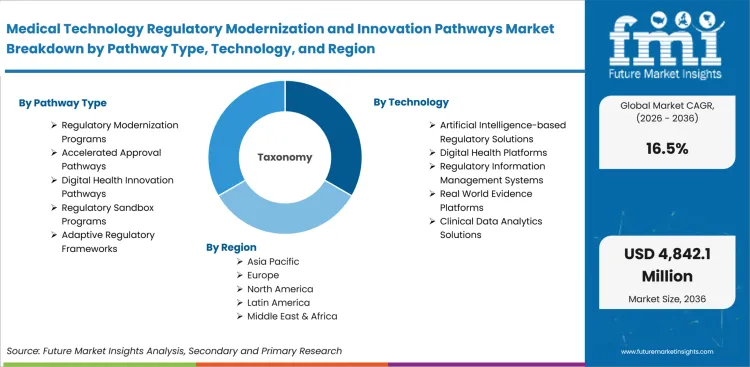
The segmentation framework separates regulatory pathway design from enabling technology and the operational application managed through each system. Pathway Type covers modernization programs and accelerated routes alongside sandboxes and adaptive frameworks used by regulators. Technology distinguishes AI-based regulatory solutions from digital platforms and regulatory information management systems used across global portfolios. Application analysis follows approval management through commercialization and post-market surveillance across quality and evidence functions. End User categories separate device manufacturers from digital health companies and pharmaceutical groups alongside agencies and research organizations. Regional analysis compares adoption conditions across countries with different review systems and local representation requirements.
How do regulatory modernization programs shape the pathway type category?
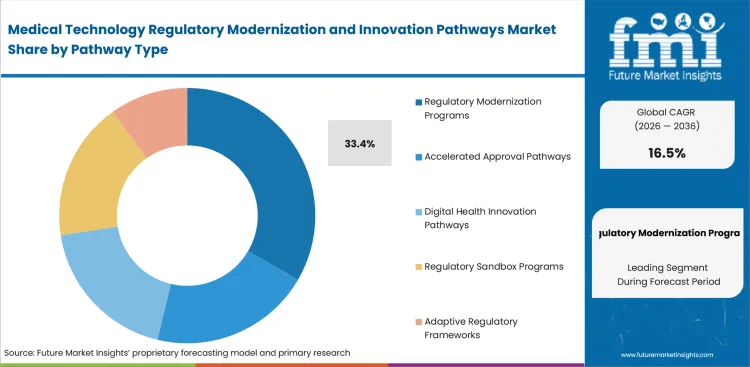
Regulatory modernization programs consolidate submission rules and quality obligations around a defined product lifecycle rather than separate administrative checkpoints. The FDA confirmed in February 2026 that QMSR incorporates ISO 13485:2016 and uses an updated inspection process for finished-device manufacturers. The QMSR alignment gives medical devices companies a clearer basis for connecting design controls with regulatory records across commercial markets. Program value depends on consistent data ownership because harmonized rules cannot repair incomplete product records or unresolved quality responsibilities.
- Regulatory modernization programs are projected to hold 33.4% share in 2026, attributable to their ability to coordinate several approval and compliance activities. The programs create a common operating structure for submissions and quality evidence without removing product-specific review requirements.
- Medical device manufacturers adopt modernization programs to reduce repeated document preparation across registrations and lifecycle changes. Adoption remains strongest among organizations that assign named owners for evidence updates and health-authority commitments across each product family.
How do artificial intelligence-based regulatory solutions shape the technology category?
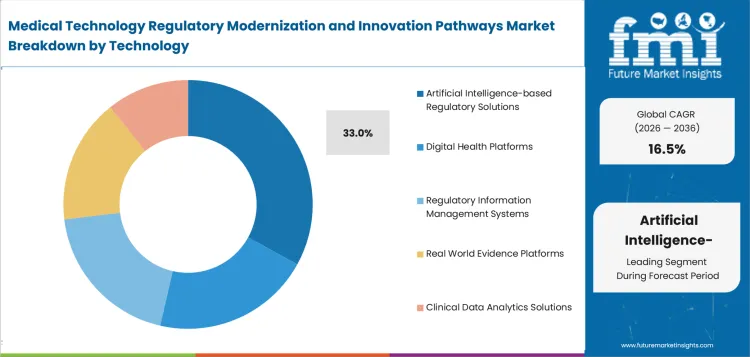
Regulatory teams use AI-based solutions to classify documents and detect missing evidence across growing submission portfolios. The FDA stated in January 2025 that it had authorized more than 1,000 AI-enabled devices through established premarket pathways. The authorization scale increases the need for artificial intelligence in healthcare controls that preserve validation records and explain material workflow decisions. Commercial systems must separate assisted review from final regulatory judgment so accountable specialists retain authority over every submitted claim.
- Artificial intelligence-based regulatory solutions are estimated to represent 33.0% share in 2026, supported by their role in document review and change assessment. The share reflects workload concentration around repetitive evidence tasks rather than automated replacement of qualified regulatory professionals.
- Global regulatory groups adopt AI tools to identify inconsistencies across product records and authority correspondence. Practical adoption requires validated data access plus review logs that allow specialists to reconstruct each recommendation during an audit.
How does medical device approval Management shape the application category?
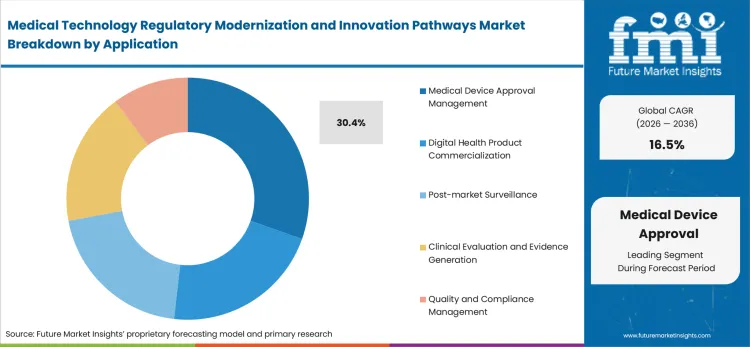
Medical device approval management connects classification and evidence planning with submission assembly and authority responses across one controlled process. The FDA issued final real-world evidence guidance in December 2025 for regulatory decision-making involving medical devices. The final guidance strengthens demand for eClinical solutions that preserve data provenance and documented fitness across each intended regulatory use. Approval platforms create value through evidence reuse while keeping jurisdiction-specific forms and reviewer questions inside the correct application record.
- In 2026, medical device approval management is forecast to account for 30.4% share, owing to its position at the main authorization decision. Each managed application links technical documentation with review status and authority correspondence across the defined submission pathway.
- Manufacturers adopt approval management platforms to coordinate global dossiers while preserving country-specific evidence decisions and authority responses. Adoption improves as local affiliates reuse approved content and retain responsibility for classification plus language requirements.
How do medical device Manufacturers shape the end user category?
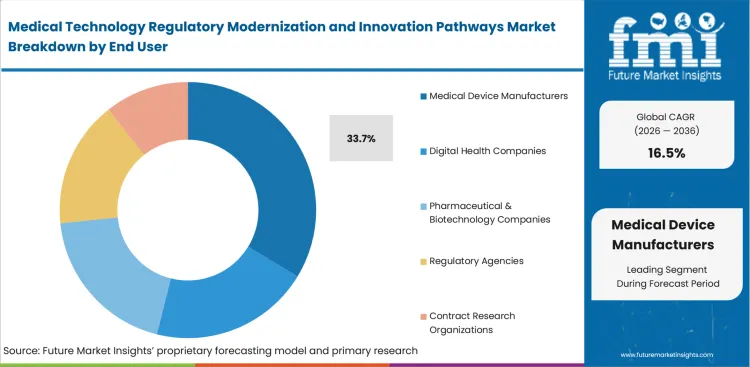
Medical device manufacturers carry direct responsibility for product registration and quality evidence across the complete commercial lifecycle. Four EUDAMED modules became mandatory during May 2026 for actor registration and device records alongside certificates and market surveillance. Manufacturers therefore need real world evidence solutions that connect approved product data with post-market signals and corrective actions. Operating value depends on internal governance because database compliance requires accurate ownership across regulatory and quality functions.
- By end user, medical device manufacturers are projected to hold 33.7% share in 2026, driven by their direct responsibility for product authorization and lifecycle compliance. The position reflects mandatory evidence ownership rather than a broader spending claim across every regulated healthcare company.
- Large manufacturers adopt integrated systems to coordinate product families across several health authorities and manufacturing sites. Smaller manufacturers often begin with managed services because specialized staff and local representation remain difficult to maintain internally.
What are the drivers, restraints, and opportunities in the Medical Technology Regulatory Modernization and Innovation Pathways Market?
Regulatory lifecycle complexity supports modernization demand while fragmented evidence and changing national rules constrain implementation across global device portfolios.
- Driver: Structured lifecycle rules increase demand for systems that coordinate evidence updates and controlled regulatory submissions.
- Restraint: Fragmented data and changing jurisdictional requirements raise validation costs across global product portfolios and regional teams.
- Opportunity: Coordinated regulatory and coverage pathways can shorten uncertainty for selected innovative medical devices and reimbursement planning.
Structured lifecycle guidance supports market growth by giving manufacturers a defined process for controlled software changes. The FDA issued final predetermined change control plan guidance in August 2025 for AI-enabled device software functions. Clear modification plans help regulatory teams evaluate iterative products without treating every approved change as an unrelated submission. Investment in centralized systems becomes defensible once regulatory leaders can connect planned updates with validation evidence and approval status.
Fragmented evidence remains a material restraint because regulatory records often sit across disconnected quality and clinical systems. The European Commission proposed targeted MDR and IVDR simplification during December 2025 while the existing rules remained binding. Manufacturers must therefore maintain current compliance and prepare for possible procedural changes across future applications. Device cybersecurity testing adds further documentation needs because software risk evidence must remain connected with design changes and post-market monitoring.
Earlier coordination creates an opportunity for companies developing devices with uncertain evidence and reimbursement pathways. The FDA reported in July 2026 that 133 devices were enrolled in the Total Product Life Cycle Advisory Program pilot. Program participation can improve evidence planning through earlier engagement without guaranteeing authorization or commercial coverage. Providers of pharmacovigilance systems can support this opening by linking safety records with submission commitments and accountable follow-up actions.
Which country CAGRs are profiled in the Medical Technology Regulatory Modernization and Innovation Pathways Market?
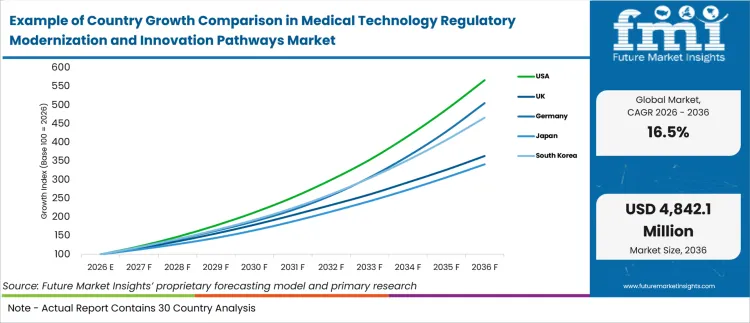
| Country | CAGR |
|---|---|
| USA | 18.9% |
| UK | 13.8% |
| Germany | 17.6% |
| Japan | 13.1% |
| South Korea | 16.6% |
How do country-level CAGRs compare in the Medical Technology Regulatory Modernization and Innovation Pathways Market?
The USA and Germany form a compact upper cluster while South Korea sits nearby with only a moderate separation. The UK and Japan create a closely aligned lower group and remain positioned apart from the upper cluster. The overall spread between the first and last country is 5.8 percentage points which indicates meaningful variation without creating a highly fragmented landscape. This pattern reflects differences in regulatory modernization activity and innovation pathway utilization rather than a simple distinction between established and emerging healthcare systems. The comparison suggests that policy reform intensity and the adoption of flexible approval mechanisms are shaping market development at different rates.
- The USA holds a notable position within the comparison as regulatory agencies continue to expand innovation-oriented review frameworks and adaptive approval approaches for medical technologies.
- Germany remains close to the USA in CAGR terms yet follows a distinct route through coordinated regulatory alignment and strong integration of advanced medical technologies into healthcare delivery.
- South Korea occupies a separate position between the upper and lower groups as ongoing digital health initiatives and regulatory modernization programs support broader innovation access.
- The UK is closely aligned with Japan in CAGR terms but reflects a different development model centered on regulatory flexibility and accelerated pathways designed to improve market access efficiency.
- Japan maintains a measured position within the comparison as innovation adoption is supported through structured regulatory reforms that balance technological advancement with established evaluation standards.
Comparable CAGRs across these countries do not imply identical market conditions or commercialization pathways. Differences in regulatory readiness, approval requirements, institutional adoption practices and stakeholder training needs can produce distinct entry environments even when growth rates are closely spaced. The full report provides country-level CAGR analysis across North America, Latin America, Europe, East Asia, South Asia, Oceania and the Middle East and Africa.
Country-wise Analysis
- United States device companies operate within a large federal review system that now connects selected breakthrough products with earlier coverage coordination. The USA is projected to expand at 18.9% CAGR from 2026 to 2036, supported by digital submissions and specialized regulatory services. CMS and FDA announced the RAPID pathway during April 2026 for certain Class II and Class III Breakthrough Devices. Domestic consultants and software providers offer extensive support routes across major medical-technology centers and hospital networks. The direct enabler is earlier evidence alignment while the material friction remains separate authorization and payment decision-making.
- United Kingdom manufacturers face separate Great Britain requirements alongside continuing access considerations across Northern Ireland and European markets. The UK is forecast to record 13.8% CAGR through 2036, shaped by post-market reform and controlled innovation testing. New post-market surveillance rules entered force during June 2025 and strengthened incident reporting plus corrective-action duties. Local authorized representation and specialist consulting provide workable maintenance routes for overseas manufacturers and ongoing reporting. Public procurement offers a direct enabler while fragmented jurisdictional obligations create additional documentation and training costs.
- German manufacturers combine established engineering capacity with European conformity assessment and a national digital-health reimbursement pathway. Germany is expected to advance at 17.6% CAGR during the forecast period, underpinned by formal evidence requirements and experienced service providers. BfArM reported in January 2026 that 246 DiGA applications included 188 provisional and 58 final pathway applications. The direct enabler is a defined national review route supported by local regulatory specialists and software providers. The material friction is coordinating national digital-health evidence with MDR duties and EUDAMED records across product portfolios.
- Japanese device entry depends on risk classification and a local marketing authorization holder for many foreign manufacturers. Japan is estimated to post 13.1% CAGR from 2026 to 2036, influenced by experienced regulators and structured international cooperation. PMDA reported during May 2025 that 323 participants attended its ASEAN-Japan medical-device regulatory symposium in person. Training networks and established domestic distributors create a direct adoption enabler for supported products and device categories. Long service distances and Japanese documentation requirements can increase maintenance costs for smaller overseas developers.
- South Korean digital-device manufacturers operate within a dense hospital system and a dedicated national digital medical product framework. South Korea is forecast to expand at 16.6% CAGR through 2036, enabled by advanced digital infrastructure and concentrated specialist care. MFDS issued Notice Number 2025-25 during April 2025 for approval and evaluation of digital medical products. Local license holders and technically trained distributors provide a direct route for installation plus regulatory maintenance. The material friction is aligning product classification and technical documentation with local quality-system obligations across each product family.
Who are the notable companies in the Medical Technology Regulatory Modernization and Innovation Pathways Market?
Veeva Systems, IQVIA, Oracle Life Sciences, Parexel, ArisGlobal, Rimsys, Freyr Solutions, and MasterControl form the verified competitive roster.
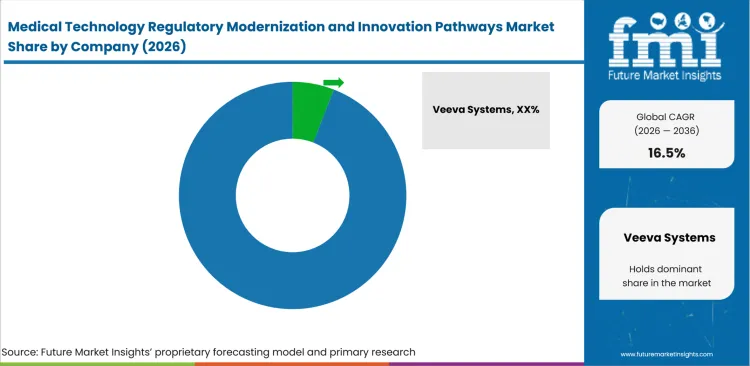
Competition combines dedicated medtech regulatory platforms with broader life-sciences software and specialist consulting organizations with regional operations. Veeva Systems and Rimsys emphasize unified device regulatory records across registrations and submissions plus lifecycle changes. IQVIA and ArisGlobal connect regulatory workflows with quality and broader life-sciences data services plus safety processes. Oracle Life Sciences and MasterControl offer adjacent data or quality platforms that support defined regulatory activities. Parexel and Freyr Solutions compete through expert services plus country coverage rather than a single software proposition. Commercial selection depends on exact lifecycle coverage and device specialization alongside implementation support across the intended regions.
- Veeva Systems and IQVIA provide structured regulatory information management for submissions and lifecycle records across device portfolios. Rimsys concentrates on medtech workflows and connects product data with global registrations plus unique device identification requirements. Their competitive test is whether one controlled record reduces manual reconciliation across regulatory and quality teams.
- Oracle Life Sciences and ArisGlobal provide broader life-sciences platforms that connect regulatory functions with safety and evidence data. MasterControl emphasizes medical-device quality workflows including documents and audits alongside corrective actions and training controls. Broader life-sciences platforms compete through integration depth rather than identical product boundaries across every regulatory task.
- Parexel and Freyr Solutions support regulatory strategy and submissions through specialist service teams across multiple regions. Freyr discloses medical-device consulting coverage across more than 120 countries while Parexel combines device expertise with wider consulting operations. Service selection depends on local representation and response capacity alongside ownership of the underlying regulatory data.
Competitive Benchmarking: Medical Technology Regulatory Modernization and Innovation Pathways Market
| Company | Regulatory Lifecycle Coverage | Medical Device Specialization | Workflow Automation | Geographic Reach |
|---|---|---|---|---|
| Veeva Systems | High | High | High | High |
| IQVIA | High | High | High | High |
| Oracle Life Sciences | Medium | Medium | High | High |
| Parexel | High | Medium | Medium | High |
| ArisGlobal | High | Medium | High | High |
| Rimsys | High | High | High | Medium |
| Freyr Solutions | High | High | Medium | High |
| MasterControl | Medium | High | High | High |
Key Developments in the Medical Technology Regulatory Modernization and Innovation Pathways Market
- In Q1 2026, IQVIA released SmartSolve RIM as an AI-enabled regulatory management solution for medical devices and other life-sciences products. The platform covers submissions and approvals alongside renewals and certificate storage within one connected system. The development expands IQVIA participation from regulatory services toward a more integrated operating platform for teams managing global product lifecycles.
- In January 2026, Oracle announced the Oracle Life Sciences AI Data Platform for pharmaceutical and medical-device organizations. The platform connects owned data with external sources and Oracle Health real-world records across research and post-market safety activities. The release strengthens Oracle participation in evidence infrastructure while leaving product-specific regulatory decisions with qualified manufacturers and health authorities.
- In September 2025, Rimsys launched Rimsys AI as embedded agents designed for medtech regulatory workflows. The company positioned the agents inside authorized customer data and established operating processes rather than as a disconnected assistant. The development broadens workflow automation across repetitive regulatory tasks while preserving specialist review and controlled decision records across global portfolios worldwide.
Key Players in the Medical Technology Regulatory Modernization and Innovation Pathways Market
Dedicated Regulatory Platform Providers
- Veeva Systems
- IQVIA
- Rimsys
Life Sciences Platform Providers
- Oracle Life Sciences
- ArisGlobal
- MasterControl
Regulatory Services Providers
- Parexel
- Freyr Solutions
Medical Technology Regulatory Modernization and Innovation Pathways Market - Report Scope
| Coverage field | Report scope |
|---|---|
| Market breakdown | Pathway Type; Technology; Application; End User; and region. |
| Market Definition | Platforms and specialist services used to modernize medical-device regulatory pathways and manage evidence across approvals and lifecycle compliance. |
| Regions Covered | North America; Latin America; Western Europe; Eastern Europe; East Asia; South Asia and Pacific; and Middle East and Africa. |
| Countries Covered | USA; UK; Germany; Japan; and South Korea, with additional country coverage available in the full report. |
| Key Companies Profiled | Veeva Systems; IQVIA; Oracle Life Sciences; Parexel; ArisGlobal; Rimsys; Freyr Solutions; and MasterControl. |
| Forecast Period | 2026 to 2036. |
| Approach | Hybrid bottom-up and top-down market sizing supported by primary research and authoritative desk research. |
Medical Technology Regulatory Modernization and Innovation Pathways Market - Research Methodology
| Method | Approach |
|---|---|
| Primary Research | FMI analysts gathered input from manufacturers, service providers, technology developers, distributors, end users, sourcing teams, and subject-matter experts. Interviews examined purchasing decisions, product or service evaluation, adoption barriers, approval requirements, pricing considerations, and expectations for technical or commercial support. Respondents were also asked what evidence is required before a trial, pilot, or initial order develops into regular purchasing. |
| Desk Research | Desk research covered government statistics, regulatory publications, trade data, industry associations, technical literature, standards, company filings, product information, and official corporate announcements. Sources were reviewed for relevance, publication date, geographic coverage, and consistency with the defined market scope. Claims relating to performance, applications, approvals, capacity, investment, and commercial activity were retained only when supported by credible public evidence. |
| Market Sizing and Forecasting | The market model combined the baseline value with historical performance, segment structure, pricing and volume indicators, adoption levels, company participation, and country-level demand conditions. Forecast assumptions considered economic activity, investment trends, regulatory developments, technology adoption, purchasing cycles, supply availability, and barriers to wider market use. Segment and regional estimates were reconciled before the final market total was calculated. |
| Data Validation | Estimates were checked against multiple independent indicators, including public data, company activity, trade patterns, industry developments, and findings from primary interviews. Validation also tested whether products, services, applications, and company revenues fell within the defined market boundaries. Adjacent categories, unsupported claims, overlapping revenues, and activities without direct market relevance were excluded to reduce double counting and maintain consistency across segments and countries. |
Medical Technology Regulatory Modernization and Innovation Pathways Market by Segments
Medical Technology Regulatory Modernization and Innovation Pathways Market segmented by Pathway Type:
- Regulatory Modernization Programs
- Accelerated Approval Pathways
- Digital Health Innovation Pathways
- Regulatory Sandbox Programs
- Adaptive Regulatory Frameworks
Medical Technology Regulatory Modernization and Innovation Pathways Market segmented by Technology:
- Artificial Intelligence-based Regulatory Solutions
- Digital Health Platforms
- Regulatory Information Management Systems
- Real World Evidence Platforms
- Clinical Data Analytics Solutions
Medical Technology Regulatory Modernization and Innovation Pathways Market segmented by Application:
- Medical Device Approval Management
- Digital Health Product Commercialization
- Post-market Surveillance
- Clinical Evaluation and Evidence Generation
- Quality and Compliance Management
Medical Technology Regulatory Modernization and Innovation Pathways Market segmented by End User:
- Medical Device Manufacturers
- Digital Health Companies
- Pharmaceutical & Biotechnology Companies
- Regulatory Agencies
- Contract Research Organizations
Medical Technology Regulatory Modernization and Innovation Pathways Market by Region:
- North America
- United States
- Canada
- Latin America
- Brazil
- Mexico
- Argentina
- Chile
- Western Europe
- Germany
- France
- United Kingdom
- Italy
- Spain
- Benelux
- Nordics
- Eastern Europe
- Poland
- Czech Republic
- Romania
- Hungary
- East Asia
- China
- Japan
- South Korea
- South Asia and Pacific
- India
- ASEAN
- Australia and New Zealand
- Middle East and Africa
- GCC Countries
- South Africa
- Türkiye
- Israel
Research Sources and Bibliography
- USA Food and Drug Administration. (2026). Devices guidances.
- Medicines and Healthcare products Regulatory Agency. (2026, June 9). AI Airlock pilot programme: Phase 2 report.
- USA Food and Drug Administration. (2026, February 2). Quality Management System Regulation (QMSR).
- USA Food and Drug Administration. (2025, January 6). FDA issues comprehensive draft guidance for developers of artificial intelligence-enabled medical devices.
- USA Food and Drug Administration. (2025, December). Use of real-world evidence to support regulatory decision-making for medical devices.
- European Commission. (2026). EUDAMED overview.
- USA Food and Drug Administration. (2025, August). Marketing submission recommendations for a predetermined change control plan for artificial intelligence-enabled device software functions.
- European Commission. (2025, December 16). Simpler and more effective rules for medical devices: Commission proposal for a targeted revision.
- USA Food and Drug Administration. (2026, July 1). Total Product Life Cycle Advisory Program (TAP).
- USA Food and Drug Administration. (2026, April 23). CMS and FDA announce RAPID coverage pathway to accelerate patient access to life-changing medical devices.
- Medicines and Healthcare products Regulatory Agency. (2025, June 16). New post-market surveillance rules for medical devices come into force.
- Federal Institute for Drugs and Medical Devices. (2026, January 14). Digital health applications: Application statistics.
- Pharmaceuticals and Medical Devices Agency. (2025, May 14). ASEAN-Japan Medical Devices Regulatory Symposium 2025 report.
- Ministry of Food and Drug Safety. (2025, April 15). Regulation on approval, certification, reporting, review, and evaluation of digital medical products, Notice No. 2025-25.
- Veeva Systems. (2026). Regulatory information management: Veeva MedTech.
- IQVIA. (2026, May 22). IQVIA SmartSolve RIM.
- Oracle. (2026, January 29). Oracle Life Sciences AI Data Platform unites data and agentic intelligence to accelerate medical breakthroughs and drive commercial success.
- Parexel. (2026). Regulatory consulting and submissions services.
- ArisGlobal. (2025, March 19). ArisGlobal announces LifeSphere Unify, NavaX Insights, and Advanced Compliance Docs.
- Rimsys. (2025, September 3). Rimsys announces Rimsys AI to eliminate repetitive tasks and enhance decision-making for MedTech regulatory teams.
- Freyr Solutions. (2026). Medical device regulatory consulting services.
- MasterControl. (2026). Medical device QMS software.
The bibliography provides a concise reader reference rather than the complete source list used for the full report. The full report contains the complete reference list and detailed citations for every retained analytical claim.
This Report Answers
- How large is the medical technology regulatory modernization and innovation pathways market in 2026 and 2036?
- Which regulatory changes support investment in modernization platforms and specialist services?
- Why do Regulatory Modernization Programs hold the leading Pathway Type share during 2026?
- How do AI-based regulatory solutions change document review and lifecycle management?
- Why does Medical Device Approval Management hold the leading Application share during 2026?
- How do country growth rates differ across the USA, UK, Germany, Japan, and South Korea?
- Which companies provide regulatory platforms and specialist services for medical-device manufacturers?
- What limits integration across regulatory and quality information systems?
- How can earlier health-authority engagement improve evidence planning for innovative devices?
Frequently Asked Questions
How big is the Medical Technology Regulatory Modernization and Innovation Pathways Market in 2026?
The medical technology regulatory modernization and innovation pathways market is valued at USD 1051.4 million in 2026 and is forecast to reach USD 4842.1 million by 2036. Growth reflects regulatory agencies replacing isolated document exchanges with lifecycle expectations that connect evidence planning and post-market oversight.
What is the CAGR of the Medical Technology Regulatory Modernization and Innovation Pathways Market from 2026 to 2036?
The medical technology regulatory modernization and innovation pathways market grows at a CAGR of 16.5% between 2026 and 2036, supported by structured lifecycle rules that increase demand for systems coordinating evidence updates and controlled regulatory submissions across product changes.
Which pathway type leads the Medical Technology Regulatory Modernization and Innovation Pathways Market?
Regulatory modernization programs account for 33.4% of the medical technology regulatory modernization and innovation pathways market by pathway type in 2026, attributable to their ability to coordinate several approval and compliance activities within a common operating structure.
How much will the Medical Technology Regulatory Modernization and Innovation Pathways Market add between 2026 and 2036?
The medical technology regulatory modernization and innovation pathways market is set to add USD 3790.7 million between 2026 and 2036, growing from USD 1051.4 million to USD 4842.1 million as lifecycle governance platforms extend across a widening base of device manufacturers worldwide.
Who are the leading companies in the Medical Technology Regulatory Modernization and Innovation Pathways Market?
Five companies lead the medical technology regulatory modernization and innovation pathways market, including Veeva Systems, Rimsys, IQVIA, ArisGlobal, and Oracle Life Sciences, competing through device regulatory information management, regulatory workflows, and broader life-sciences data capabilities.
Preview the report firsthand - request a free sample
Get SampleGet the brochure for pricing and purchase details.
Get PDFTable of Content
- Key Takeaways
- Market Size and CAGR
- Top Growth Driver
- Fastest Growing Segment
- Leading Region
- Key Companies
- Emerging Opportunities
- Executive Summary
- Global Market Outlook
- Demand-side Trends
- Supply-side Trends
- Technology Roadmap Analysis
- Analysis and Recommendations
- Analyst Perspective (What is happening? Why now? What should investors know?)
- Key Questions Answered
- How large is the market?
- What is the CAGR?
- What are key trends?
- Which region dominates?
- Who are the leaders?
- Market Overview
- Market Coverage / Taxonomy
- Market Definition / Scope / Limitations
- Research Methodology
- Chapter Orientation
- Analytical Lens and Working Hypotheses
- Market Structure, Signals, and Trend Drivers
- Benchmarking and Cross-market Comparability
- Market Sizing, Forecasting, and Opportunity Mapping
- Research Design and Evidence Framework
- Desk Research Programme (Secondary Evidence)
- Expert Input and Fieldwork (Primary Evidence)
- Tooling, Models, and Reference Databases
- Data Engineering and Model Build
- Quality Assurance and Audit Trail
- Market Background
- Market Dynamics (Drivers, Restraints, Opportunity, Trends)
- Scenario Forecast (Optimistic, Likely, Conservative)
- Impact Analysis
- AI Impact
- Sustainability Impact
- Regulatory Impact
- Technology Impact
- Consumer / Buyer Analysis
- Purchase Drivers
- Adoption Barriers
- Buyer Journey
- Opportunity Map Analysis
- Product Life Cycle Analysis
- Supply Chain Analysis
- Investment Feasibility Matrix
- Value Chain Analysis
- PESTLE and Porter's Analysis
- Regulatory Landscape
- Regional Parent Market Outlook
- Production and Consumption Statistics
- Import and Export Statistics
- Global Market Analysis and Forecast, 2021 to 2036
- Historical Market Size Value (USD Million) Analysis, 2021 to 2025
- Current and Future Market Size Value (USD Million) Projections, 2026 to 2036
- Y-o-Y Growth Trend Analysis
- Absolute $ Opportunity Analysis
- Global Market Pricing Analysis, 2021 to 2036
- Global Market Analysis and Forecast, By Pathway Type, 2021 to 2036
- Introduction / Key Findings
- Historical Market Size Value (USD Million) Analysis By Pathway Type, 2021 to 2025
- Current and Future Market Size Value (USD Million) Analysis and Forecast By Pathway Type, 2026 to 2036
- Regulatory Modernization Programs
- Accelerated Approval Pathways
- Digital Health Innovation Pathways
- Regulatory Sandbox Programs
- Adaptive Regulatory Frameworks
- Regulatory Modernization Programs
- Y-o-Y Growth Trend Analysis By Pathway Type, 2021 to 2025
- Absolute $ Opportunity Analysis By Pathway Type, 2026 to 2036
- Global Market Analysis and Forecast, By Technology, 2021 to 2036
- Introduction / Key Findings
- Historical Market Size Value (USD Million) Analysis By Technology, 2021 to 2025
- Current and Future Market Size Value (USD Million) Analysis and Forecast By Technology, 2026 to 2036
- Artificial Intelligence-based Regulatory Solutions
- Digital Health Platforms
- Regulatory Information Management Systems
- Real World Evidence Platforms
- Clinical Data Analytics Solutions
- Artificial Intelligence-based Regulatory Solutions
- Y-o-Y Growth Trend Analysis By Technology, 2021 to 2025
- Absolute $ Opportunity Analysis By Technology, 2026 to 2036
- Global Market Analysis and Forecast, By Application, 2021 to 2036
- Introduction / Key Findings
- Historical Market Size Value (USD Million) Analysis By Application, 2021 to 2025
- Current and Future Market Size Value (USD Million) Analysis and Forecast By Application, 2026 to 2036
- Medical Device Approval Management
- Digital Health Product Commercialization
- Post-market Surveillance
- Clinical Evaluation and Evidence Generation
- Quality and Compliance Management
- Medical Device Approval Management
- Y-o-Y Growth Trend Analysis By Application, 2021 to 2025
- Absolute $ Opportunity Analysis By Application, 2026 to 2036
- Global Market Analysis and Forecast, By End User, 2021 to 2036
- Introduction / Key Findings
- Historical Market Size Value (USD Million) Analysis By End User, 2021 to 2025
- Current and Future Market Size Value (USD Million) Analysis and Forecast By End User, 2026 to 2036
- Medical Device Manufacturers
- Digital Health Companies
- Pharmaceutical & Biotechnology Companies
- Regulatory Agencies
- Contract Research Organizations
- Medical Device Manufacturers
- Y-o-Y Growth Trend Analysis By End User, 2021 to 2025
- Absolute $ Opportunity Analysis By End User, 2026 to 2036
- Global Market Analysis and Forecast, By Region, 2021 to 2036
- Introduction
- Historical Market Size Value (USD Million) Analysis By Region, 2021 to 2025
- Current Market Size Value (USD Million) Analysis and Forecast By Region, 2026 to 2036
- North America
- Latin America
- Western Europe
- Eastern Europe
- East Asia
- South Asia and Pacific
- Middle East & Africa
- Market Attractiveness Analysis By Region
- North America Market Analysis and Forecast, By Country, 2021 to 2036
- Historical Market Size Value (USD Million) Trend Analysis By Market Taxonomy, 2021 to 2025
- Market Size Value (USD Million) Forecast By Market Taxonomy, 2026 to 2036
- By Country
- USA
- Canada
- By Pathway Type
- By Technology
- By Application
- By End User
- By Country
- Market Attractiveness Analysis
- By Country
- By Pathway Type
- By Technology
- By Application
- By End User
- Key Takeaways
- Latin America Market Analysis and Forecast, By Country
- Historical Market Size Value (USD Million) Trend Analysis By Market Taxonomy, 2021 to 2025
- Market Size Value (USD Million) Forecast By Market Taxonomy, 2026 to 2036
- By Country
- Brazil
- Mexico
- Chile
- Rest of Latin America
- By Pathway Type
- By Technology
- By Application
- By End User
- By Country
- Market Attractiveness Analysis
- By Country
- By Pathway Type
- By Technology
- By Application
- By End User
- Key Takeaways
- Western Europe Market Analysis and Forecast, By Country
- Historical Market Size Value (USD Million) Trend Analysis By Market Taxonomy, 2021 to 2025
- Market Size Value (USD Million) Forecast By Market Taxonomy, 2026 to 2036
- By Country
- Germany
- UK
- Italy
- Spain
- France
- Nordic
- BENELUX
- Rest of Western Europe
- By Pathway Type
- By Technology
- By Application
- By End User
- By Country
- Market Attractiveness Analysis
- By Country
- By Pathway Type
- By Technology
- By Application
- By End User
- Key Takeaways
- Eastern Europe Market Analysis and Forecast, By Country
- Historical Market Size Value (USD Million) Trend Analysis By Market Taxonomy, 2021 to 2025
- Market Size Value (USD Million) Forecast By Market Taxonomy, 2026 to 2036
- By Country
- Russia
- Poland
- Hungary
- Balkan & Baltic
- Rest of Eastern Europe
- By Pathway Type
- By Technology
- By Application
- By End User
- By Country
- Market Attractiveness Analysis
- By Country
- By Pathway Type
- By Technology
- By Application
- By End User
- Key Takeaways
- East Asia Market Analysis and Forecast, By Country
- Historical Market Size Value (USD Million) Trend Analysis By Market Taxonomy, 2021 to 2025
- Market Size Value (USD Million) Forecast By Market Taxonomy, 2026 to 2036
- By Country
- China
- Japan
- South Korea
- By Pathway Type
- By Technology
- By Application
- By End User
- By Country
- Market Attractiveness Analysis
- By Country
- By Pathway Type
- By Technology
- By Application
- By End User
- Key Takeaways
- South Asia and Pacific Market Analysis and Forecast, By Country
- Historical Market Size Value (USD Million) Trend Analysis By Market Taxonomy, 2021 to 2025
- Market Size Value (USD Million) Forecast By Market Taxonomy, 2026 to 2036
- By Country
- India
- ASEAN
- Australia & New Zealand
- Rest of South Asia and Pacific
- By Pathway Type
- By Technology
- By Application
- By End User
- By Country
- Market Attractiveness Analysis
- By Country
- By Pathway Type
- By Technology
- By Application
- By End User
- Key Takeaways
- Middle East & Africa Market Analysis and Forecast, By Country
- Historical Market Size Value (USD Million) Trend Analysis By Market Taxonomy, 2021 to 2025
- Market Size Value (USD Million) Forecast By Market Taxonomy, 2026 to 2036
- By Country
- Kingdom of Saudi Arabia
- Other GCC Countries
- Türkiye
- South Africa
- Other African Union
- Rest of Middle East & Africa
- By Pathway Type
- By Technology
- By Application
- By End User
- By Country
- Market Attractiveness Analysis
- By Country
- By Pathway Type
- By Technology
- By Application
- By End User
- Key Takeaways
- Key Countries Market Analysis
- USA
- Pricing Analysis
- Market Share Analysis, 2025
- By Pathway Type
- By Technology
- By Application
- By End User
- Canada
- Pricing Analysis
- Market Share Analysis, 2025
- By Pathway Type
- By Technology
- By Application
- By End User
- Mexico
- Pricing Analysis
- Market Share Analysis, 2025
- By Pathway Type
- By Technology
- By Application
- By End User
- Brazil
- Pricing Analysis
- Market Share Analysis, 2025
- By Pathway Type
- By Technology
- By Application
- By End User
- Chile
- Pricing Analysis
- Market Share Analysis, 2025
- By Pathway Type
- By Technology
- By Application
- By End User
- Germany
- Pricing Analysis
- Market Share Analysis, 2025
- By Pathway Type
- By Technology
- By Application
- By End User
- UK
- Pricing Analysis
- Market Share Analysis, 2025
- By Pathway Type
- By Technology
- By Application
- By End User
- Italy
- Pricing Analysis
- Market Share Analysis, 2025
- By Pathway Type
- By Technology
- By Application
- By End User
- Spain
- Pricing Analysis
- Market Share Analysis, 2025
- By Pathway Type
- By Technology
- By Application
- By End User
- France
- Pricing Analysis
- Market Share Analysis, 2025
- By Pathway Type
- By Technology
- By Application
- By End User
- India
- Pricing Analysis
- Market Share Analysis, 2025
- By Pathway Type
- By Technology
- By Application
- By End User
- ASEAN
- Pricing Analysis
- Market Share Analysis, 2025
- By Pathway Type
- By Technology
- By Application
- By End User
- Australia & New Zealand
- Pricing Analysis
- Market Share Analysis, 2025
- By Pathway Type
- By Technology
- By Application
- By End User
- China
- Pricing Analysis
- Market Share Analysis, 2025
- By Pathway Type
- By Technology
- By Application
- By End User
- Japan
- Pricing Analysis
- Market Share Analysis, 2025
- By Pathway Type
- By Technology
- By Application
- By End User
- South Korea
- Pricing Analysis
- Market Share Analysis, 2025
- By Pathway Type
- By Technology
- By Application
- By End User
- Russia
- Pricing Analysis
- Market Share Analysis, 2025
- By Pathway Type
- By Technology
- By Application
- By End User
- Poland
- Pricing Analysis
- Market Share Analysis, 2025
- By Pathway Type
- By Technology
- By Application
- By End User
- Hungary
- Pricing Analysis
- Market Share Analysis, 2025
- By Pathway Type
- By Technology
- By Application
- By End User
- Kingdom of Saudi Arabia
- Pricing Analysis
- Market Share Analysis, 2025
- By Pathway Type
- By Technology
- By Application
- By End User
- Türkiye
- Pricing Analysis
- Market Share Analysis, 2025
- By Pathway Type
- By Technology
- By Application
- By End User
- South Africa
- Pricing Analysis
- Market Share Analysis, 2025
- By Pathway Type
- By Technology
- By Application
- By End User
- USA
- Market Structure Analysis
- Competition Dashboard
- Competition Benchmarking
- Market Share Analysis of Top Players
- By Regional
- By Pathway Type
- By Technology
- By Application
- By End User
- Emerging Startups
- Innovation Benchmarking
- Competition Analysis
- Competition Deep Dive
- Veeva Systems
- Overview
- Product Portfolio
- Profitability by Market Segments
- Sales Footprint
- Strategy Overview
- Marketing Strategy
- Product Strategy
- Channel Strategy
- IQVIA
- Oracle Health Sciences
- Parexel
- Medidata Solutions
- ArisGlobal
- Rimsys
- Freyr Solutions
- Dassault Systèmes
- MasterControl
- Veeva Systems
- Case Studies
- Success Stories
- Recent Developments
- Competition Deep Dive
- Assumptions & Acronyms Used


