

- Market Size (2026)
- USD 4.4 Bn
- Forecast (2036)
- USD 10.2 Bn
- CAGR (2026 to 2036)
- 8.8%
How big is Medical Reference Apps Market in 2026?
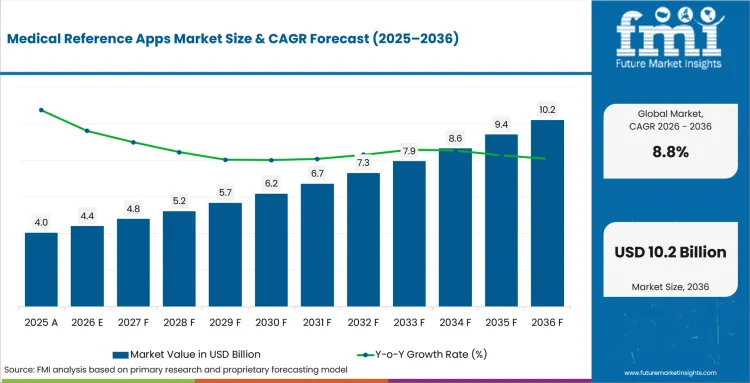
USD 4.4 billion in 2026 and USD 10.2 billion by 2036 at an 8.8% CAGR.
Demand for medical reference apps is projected to expand at an 8.8% CAGR between 2026 and 2036, increasing valuation from USD 4.4 billion in 2026 to USD 10.2 billion by 2036. Paid products combine drug references and disease guidance with calculators used during diagnosis or treatment planning. Their commercial value depends on whether clinicians can inspect the source behind an answer during patient care. The USA Food and Drug Administration issued final Clinical Decision Support Software guidance in January 2026 and clarified the boundary between non-device reference functions and regulated device software. The regulatory boundary rewards clinical decision support systems that preserve clear evidence pathways beside each answer. Medication management systems provide a related workflow for current drug checks during prescribing and medication reconciliation.
Commercial routes differ between individual subscriptions and health-system licenses because each model assigns access control and support differently. Sales in Brazil depend on Portuguese guidance that reflects national treatment protocols, while Japanese deployments require domestic-language evidence and local support. United States health systems apply broader security and integration reviews before one license reaches several departments. Individual subscriptions can spread through mHealth solutions when clinicians need portable access outside enterprise contracts. Electronic medical records increase the value of embedded references by placing guidance beside patient context. Publishers therefore need separate commercial plans for consumer-style access and institution-controlled deployment across health systems. Expansion slows if users must repeat searches across disconnected systems or cannot identify who maintains each clinical answer.
Key Takeaways of Medical Reference Apps Market
- Paid adoption depends on reliable answers at the point of care and visible editorial controls that protect clinical trust during repeated use.
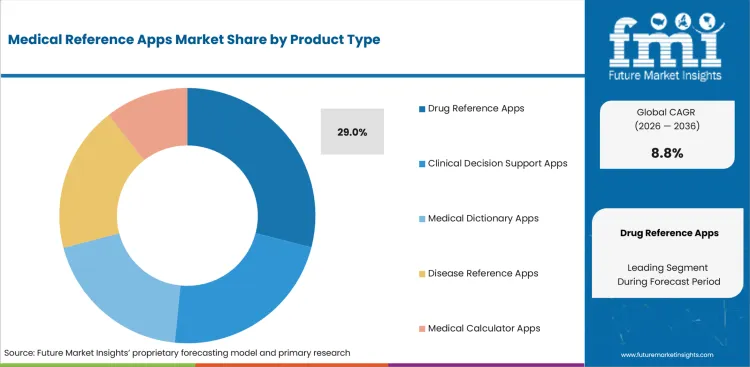
- Drug reference apps are expected to account for 29.0% of product type revenue in 2026, supported by recurring medication checks across prescribing and reconciliation workflows.
- Clinical decision making is projected to capture 33.0% by application in 2026, reflecting the need for traceable evidence during diagnosis and treatment planning.
- Hospitals are forecast to represent 35.0% in 2026, owing to shared licensing and central access control across departments.
- Free professional references and weak workflow integration can reduce renewal value even if an application provides broad clinical content.
- Wolters Kluwer, Elsevier, BMJ Group, Medscape (WebMD), Doximity, VisualDx, athenahealth, and MDCalc focus on different combinations of evidence depth and workflow access.
Analyst Perspective
“Clinical reference applications earn institutional value when they shorten a real care decision without hiding the evidence behind the answer. Hospitals need rapid updates for medicines and treatment guidance, but they also need clear editorial ownership and secure access across departments. Publishers that combine traceable content with practical mobile and record-system access can defend renewal against free clinical resources.”
- Anurag Sharma, Principal Analyst, Future Market Insights
How is the Medical Reference Apps Market segmented?
The medical reference apps industry is segmented by product type, application, end user, distribution channel, platform, and region.
The segmentation framework separates what clinicians purchase, why they use it, who controls access, how the product reaches users, and which platform carries the content. Product type distinguishes drug and disease references from calculators and broader decision-support applications used during different professional questions. Application analysis separates diagnosis and treatment decisions from education, documentation, and evidence review across active clinical workflows. End-user categories compare hospital contracts with access purchased by physicians, nurses, students, and research organizations. Distribution channels cover app stores, enterprise licenses, subscription platforms, healthcare IT partners, and online software marketplaces. Platform analysis distinguishes mobile, cloud, web, desktop, and offline delivery for different access and connectivity conditions. Regional analysis compares governance, language, integration, service conditions, and commercial delivery routes across national health systems.
What supports demand for drug reference apps within the product type category?
Medication decisions require current dosing and interaction information that clinicians can inspect during prescribing and medication reconciliation. Clinicians also need every answer tied to reviewed monographs and visible source material during care. Wolters Kluwer added UpToDate Lexidrug content to UpToDate Expert AI in November 2025 and connected structured drug information with conversational clinical search. The integration places medication evidence inside e-prescribing workflows without separating a drug question from the patient’s wider treatment context.
- Based on product type, drug reference apps are projected to account for 29.0% in 2026 due to recurring dosing and interaction checks across clinical workflows. Their position reflects repeated use during prescribing and medication reconciliation rather than occasional topic searches. Broad coverage strengthens value by giving clinicians one route for contraindications and dose adjustments during time-sensitive treatment decisions.
- Physicians and pharmacists are expected to favor drug reference apps during repeated medication checks at the point of care. Current monographs and visible update dates help hospital teams assess clinical reliability before wider access. Free medication resources limit pricing power unless paid applications shorten search time or improve confidence during high-volume prescribing.
How does clinical decision making shape demand within the application category?
Uncertain diagnoses and treatment choices often require evidence from several content types during one clinical encounter. Hospital teams value concise answers that link back to complete guidance and peer-reviewed material during clinical review. Institutional reviewers also need verification controls that show how an answer was assembled and which full-text sources support it. Elsevier expanded ClinicalKey AI in February 2026 with full-text content and verification controls across more than 300 hospitals worldwide. The expansion gives health systems a direct basis for assessing answer traceability and security across clinical decision support apps.
- By application, clinical decision making is forecast to represent 33.0% share in 2026 driven by repeated diagnosis and treatment questions during active patient care. The segment gains commercial value by helping clinicians compare options without leaving the immediate care workflow. Its position depends on recent evidence that users can inspect independently before applying a recommendation.
- Hospital departments are expected to adopt clinical decision tools that narrow options without replacing professional judgment or local review. Wider use requires clear citations and current content alongside privacy controls for shared clinical environments. Department leaders can expand access once they can review usage patterns and correct weak answers through a defined governance route.
How do hospitals influence demand within the end-user category?
Hospital contracts can extend one reference platform across departments that otherwise depend on different textbooks and local documents. Enterprise use requires shared authentication and governance plus integration with clinical systems used throughout patient care. A common evidence layer helps clinical committees apply the same reference standards across locations and specialties. Digital healthcare transformation projects gain more value from a shared evidence layer than from isolated individual subscriptions.
- Hospitals are set to lead the end-user category with 35.0% share in 2026 due to shared licensing and central access control across clinical departments. Institutional contracts spread editorial costs across larger user groups and standardize access rules throughout the health system. Renewal depends on visible use and service quality rather than the number of available topics alone.
- Hospital groups are purchasing reference platforms that connect clinical content with authentication and department-level analytics. Wolters Kluwer reported in June 2025 that early-release UpToDate Enterprise Edition reached 40 EMEA systems and more than 350 North American health systems. The deployment base shows how shared access reduces repeated searches across several disconnected clinical systems. Smaller facilities may retain individual licenses if integration costs exceed the measured value of central administration.
What keeps mobile app stores ahead within the distribution channel category?
App stores give clinicians a familiar route to discover and install reference tools without waiting for an enterprise software project. The channel works best for products that provide immediate value and maintain clear subscription controls. Downloads become commercially useful when mobile access supports repeated clinical questions rather than occasional browsing. Elsevier announced a new ClinicalKey AI mobile app for Apple and Android users in March 2025 alongside expanded record and prescribing integrations. The combined release ties app-store distribution to repeated clinical use across active patient-care workflows worldwide.
- Mobile app stores are likely to capture 36.0% share in 2026 attributable to familiar discovery and subscription routes for individual clinicians. Rapid installation and direct account management reinforce the channel’s position across personal devices used during professional work. Hospital security policies can reduce its value if unmanaged applications cannot enter approved clinical workflows or share authorized patient context.
- Individual clinicians are expected to favor app-store access for reference use across clinics and teaching settings. Responsive design and dependable update delivery support repeated professional use through personal mobile devices during daily care. Publishers must convert downloads into trusted clinical engagement because installation counts alone do not establish subscription value or professional reliance across recurring renewal periods.
Which operating mechanism supports mobile applications within the platform category?
Clinicians often search reference content while moving between consultation rooms and teaching settings during daily care. Mobile access becomes valuable when it returns focused answers without requiring clinicians to open a separate workstation. Portable delivery also needs secure account controls because users may switch between personal and institutional devices. Hospitals therefore assess clinical mobility beside identity management and content-update reliability across shared devices and professional accounts.
- The platform category is forecast to be led by mobile applications at 38.0% share in 2026 due to portable point-of-care access across changing clinical locations. Wolters Kluwer announced in February 2025 that AI-enhanced search was available through the UpToDate mobile app. The release reinforces mobile delivery for short clinical questions while hospitals retain control over content and user accounts.
- Clinicians are expected to favor mobile applications for rapid questions that do not require opening a separate workstation. Offline access and saved topics can extend professional use across facilities that have uneven connectivity. Hospital adoption remains limited if device security and account controls cannot protect reference access across personal and shared hardware during daily care.
What are the drivers, restraints, and opportunities in the Medical Reference Apps Market?
Frequent clinical change supports demand; governance requirements slow institutional approval; secure content integration provides a practical expansion route.
- Driver: Frequent treatment and medication changes increase the value of references that publish reviewed updates without long delays.
- Restraint: Hospital approval slows if an application cannot document editorial ownership and responsible clinical governance.
- Opportunity: Secure content connections can place governed references inside records and prescribing software already used during patient care.
Treatment and medication changes place a continuing update burden on clinical reference libraries used during patient care. The USA Food and Drug Administration reported that its Center for Drug Evaluation and Research approved 46 novel drugs during 2025. Every approval adds indications and safety information that drug references must review and publish through a controlled editorial process. Digital health platforms can convert that work into renewal value through visible content dates and dependable medication guidance.
Hospital approval slows if a clinical application cannot explain who owns its content and how recommendations are reviewed. Clinical leaders and information-security teams need clear ownership evidence during every formal enterprise software assessment. The UK Government Digital Service published good-practice principles in January 2025 covering safety and security alongside transparency and accountability. Applications that cannot document those controls face narrower deployments and longer contract reviews across regulated health systems and clinical departments.
Clinical reference content gains wider use inside records and prescribing software already open during patient care. Wolters Kluwer launched UpToDate Connect in October 2025 so digital health platforms could embed evidence-based clinical content through an API. The connection gives publishers a route to reach more clinical questions through healthcare APIs without asking staff to start a separate search. Commercial value depends on preserving license control and source visibility across every connected clinical application.
Which country CAGRs are profiled in the Medical Reference Apps Market?
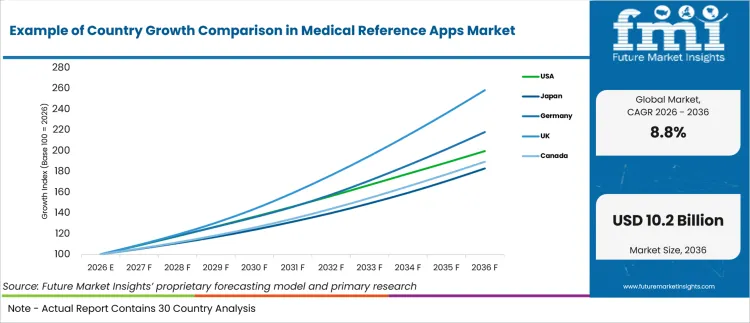
| Country | CAGR |
|---|---|
| Brazil | 10.3% |
| UK | 10.0% |
| Australia | 8.8% |
| Germany | 8.1% |
| USA | 7.1% |
| Canada | 6.6% |
| Japan | 6.2% |
How do country-level CAGRs compare in theMedical Reference Apps Market?
The country forecasts form a gradual progression rather than separate growth tiers across the medical reference apps market. National guidance and formal purchasing rules keep Brazil and the UK closely aligned through a need for current clinical content. Australia and Germany rely more heavily on connected records that favor institution-controlled access across established health systems. The USA and Canada have broad digital foundations, yet fragmented systems and free alternatives raise the proof required for paid renewal. Japan follows a narrower route centered on domestic-language evidence and local support for enterprise software. Similar rates therefore conceal different integration costs and sales models across each national expansion plan.
- Brazil’s national protocols create a practical need for references that connect medicines with diagnosis-specific eligibility criteria across public care pathways.
- The UK outlook reflects formal digital purchasing expectations that reward transparent evidence and documented governance during institutional approval.
- Australia combines connected health records with dispersed care delivery, so mobile references require dependable synchronization and national interoperability.
- Germany’s electronic patient record expands medication context inside routine care, but privacy and integration requirements raise implementation effort.
- United States health systems support broad enterprise use, although numerous free references increase the proof required for paid renewal.
- Canadian physicians need point-of-care access across disconnected systems, yet provincial variation complicates integration and national account management.
- Japan requires localized evidence and domestic-language support, which creates a narrower entry route for global clinical reference platforms.
Comparable CAGRs do not produce identical entry conditions because national approval and integration routes differ. Country-specific content governance and service plans determine whether early institutional accounts can expand at commercial scale. The full report provides country-level CAGR analysis across North America, Latin America, Europe, East Asia, South Asia, Oceania and the Middle East and Africa.
Country-wise Analysis
- Brazilian clinicians work within national therapeutic protocols that connect diagnoses with medicines and define additional patient eligibility criteria. Conitec launched an interactive medicines-by-ICD and PCDT panel in September 2025 for faster access to Ministry of Health recommendations. Brazil is estimated to post a 10.3% CAGR over the forecast period for medical reference apps, supported by frequent consultation of national treatment protocols. The panel gives medical reference applications a direct role in locating public-system guidance during care decisions. Conitec notes that the tool does not replace complete protocols because age and treatment history can change eligibility. Commercial products need Portuguese content and regular protocol maintenance before hospital groups can extend access across wider clinical teams.
- United Kingdom health organizations evaluate digital clinical tools through formal safety and governance requirements during institutional purchasing. Medical reference apps demand in the UK is forecast to rise at 10.0% CAGR over the forecast period, underpinned by structured digital purchasing rules. Product teams must show how content is reviewed and how clinical users can inspect the evidence behind each answer. The Government Digital Service published AI purchasing guidance for health and care in January 2025 to support product evaluation. The guidance gives NHS organizations a defined review route for safety and explainability, but local integration and information-security checks remain material frictions. Medical reference publishers need clear accountability and evidence trails to expand from individual subscriptions into wider health-system contracts.
- Australian care teams increasingly receive pathology and imaging reports through My Health Record across public and private settings. Connected information can place current guidance beside new clinical results during consultations and follow-up care. The Australian medical reference apps sector is projected to record 8.8% CAGR during the assessment period, reinforced by connected-care workflows and wider report availability. The Australian Digital Health Agency reported in July 2026 that weekly consumer views exceeded three million after Share by Default reforms. National infrastructure provides the adoption enabler, yet dispersed services and uneven software readiness raise implementation effort across smaller practices. Commercial offers need dependable mobile synchronization without assuming that every facility uses the same record workflow.
- German practices and hospitals now use the national electronic patient record as a shared route for medication information. Adoption of medical reference apps in Germany is estimated to expand at 8.1% CAGR through 2036, aided by nationwide electronic patient records. The medication list connects with electronic prescriptions and gives drug references a natural context during treatment decisions. The Federal Ministry of Health reported in April 2025 that nationwide ePA use began on April 29 and mandatory provider use followed in October. National coverage strengthens the integration route, but privacy controls and system compatibility remain material deployment frictions. Local support teams must resolve connection problems without interrupting dependable reference access during routine clinical care. Publishers need German-language content and tested record connections across practices that use different technical environments.
- United States hospitals combine individual subscriptions with enterprise licenses that require governance and certified health-information connections. Large health systems provide scale, but numerous free references increase the proof required for paid renewal. ASTP/ONC approved updated 2025 interoperability standards in June 2025 for certified health IT modules. The USA’s medical reference apps outlook is anticipated to advance at 7.1% CAGR over the assessment period, influenced by broad digital infrastructure and fragmented purchasing. The standards give software developers a route for exchanging patient context through established clinical systems. Fragmented hospital contracts remain a material friction because one integration model cannot cover every account. Publishers need clear content differentiation and technical support before paid access can expand across national health-system groups.
- Canadian physicians often need patient information held outside their main practice system during referrals and cross-provider care. Canada Health Infoway reported in March 2026 that most patient information remained siloed in unconnected systems and limited point-of-care access. In Canada, medical reference apps demand is predicted to advance at 6.6% CAGR through 2036 owing to unresolved point-of-care information gaps. Digital records provide an adoption base, but provincial workflows and incomplete interoperability prevent one national integration model. Reference applications can reduce search friction by working independently and accepting context from available local systems. Service planning must account for regional differences in health-system technology and local contract ownership across provinces. Publishers should use flexible licensing and province-specific integration before committing support resources across the country.
- Japanese hospitals require domestic-language clinical context and careful validation for reference software used across professional teams. Medical reference app sales in Japan are forecast to expand at 6.2% CAGR by 2036, shaped by domestic-language evidence and hospital review requirements. Global libraries provide broad evidence, yet domestic terminology and institution-specific approval can lengthen enterprise purchasing cycles. Elsevier Japan launched ClinicalKey AI for physicians in June 2025 with Japanese availability and licensed clinical content. The launch provides a direct local access route, but hospital review and integration support remain material frictions. Local account teams also need to explain content updates in terms that clinical committees can review. Market entry should combine domestic clinical support with technical assistance rather than rely on a global subscription alone.
Who are the notable companies in the Medical Reference Apps Market?
Wolters Kluwer, Elsevier, BMJ Group, Medscape (WebMD), Doximity, VisualDx, athenahealth, and MDCalc are notable companies shaping the medical reference apps market.
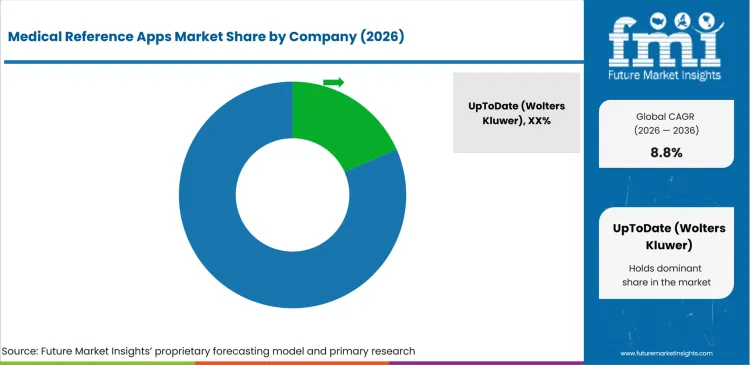
The market has a concentrated enterprise tier and a broader specialist tier built around focused clinical tasks. Wolters Kluwer and Elsevier compete through large evidence libraries and hospital integration, while BMJ Group combines guidance with comorbidity support. Medscape and Doximity use professional networks to place answers inside platforms already visited by clinicians. VisualDx and MDCalc compete through specialized image-based diagnosis and clinical calculation workflows used during patient care. athenahealth connects medication and decision support with ambulatory software through the epocrates and athenaOne clinical platforms. New entrants need a narrow clinical advantage or a differentiated distribution route because general reference coverage already faces strong free and paid alternatives.
- Wolters Kluwer and Elsevier provide broad reference libraries with medication content and enterprise integration across many specialties. BMJ Group competes through evidence-based guidance and comorbidity support used during complex point-of-care treatment decisions. Hospital groups compare editorial depth and workflow access before selecting one platform for shared institutional use.
- Medscape and Doximity distribute clinical information through professional networks that support frequent engagement across large clinician communities. VisualDx adds image-based diagnostic support through a professionally validated content library used across clinical specialties. Their commercial models depend on placing useful reference functions inside communities already used during repeated care decisions.
- athenahealth and MDCalc focus on medication or calculation tools used during short prescribing and risk-assessment decisions. Their narrower scope can support repeated workflow use without the implementation effort associated with broad enterprise libraries. Commercial expansion depends on connecting each specialized function with clear evidence and dependable mobile access for clinicians.
Competitive Benchmarking: Medical Reference Apps Market
| Company | Clinical Reference Depth | Medication and Decision Tools | Workflow and Mobile Integration | Geographic Reach |
|---|---|---|---|---|
| Wolters Kluwer | High | High | High | Global |
| Elsevier | High | High | High | Global |
| BMJ Group | High | Medium | High | Global |
| Medscape (WebMD) | High | High | High | Global |
| Doximity | Medium | Medium | High | United States |
| VisualDx | Medium | Medium | High | Global |
| athenahealth | Medium | High | High | United States |
| MDCalc | Medium | High | Medium | Global |
Scoring basis: Clinical reference depth is High for broad expert-reviewed coverage across many specialties and Medium for a verified but narrower library. Low requires documented clinical support that remains limited to one specialty or a narrowly defined reference function. Medication and decision tools are High for extensive drug information or broad calculation sets and Medium for a narrower direct function. Low requires a documented tool set that remains limited to a small range of clinical decisions. Workflow and mobile integration are High for embedded connections plus mobile delivery and Medium for one strong access route. Low requires a verified integration limited to one workflow, while geographic reach records the documented commercial footprint.
Key Developments in the Medical Reference Apps Market
- In June 2026, Elsevier acquired Wellsheet to connect ClinicalKey AI evidence with patient context from electronic health records. The acquired platform was already deployed across 139 United States hospital sites and integrated with major record systems. Elsevier plans to place verified guidance inside established clinical workflows instead of requiring a separate search. The transaction strengthens competition around governed answers that combine patient data with traceable clinical evidence.
- In August 2025, Doximity announced the completed acquisition of Pathway Medical and added Pathway's AI-powered clinical reference platform and structured medical dataset covering guidelines, drugs, and landmark trials. The transaction placed Pathway’s medical corpus inside Doximity’s clinician workflow products and extended evidence-based answers beside documentation and other daily functions. The acquisition narrows the separation between professional networking and point-of-care reference access across Doximity’s verified clinician network.
- In May 2026, VisualDx announced a partnership with Perplexity to add clinician-validated medical images to generative health answers. The integration provides visual context for conditions that are difficult to explain through text alone and links users to differential diagnosis resources and source material for further clinical review. Commercial value depends on maintaining image quality and clear clinical boundaries across every generated answer.
- In July 2026, BMJ Group expanded the BMJ Best Practice Comorbidities Manager across 75 acute clinical topics for United States workflows. The update combines acute-condition guidance with evidence for coexisting diseases inside one integrated point-of-care clinical resource. Hospital clinicians can compare patient-specific treatment trade-offs without consulting several separate single-disease references during complex care. The expansion strengthens BMJ Group’s role in institutional guidance for difficult treatment decisions involving several medical conditions.
Medical Reference Apps Market - Report Scope
| Coverage field | Report scope |
|---|---|
| Market breakdown | Product Type, Application, End User, Distribution Channel, Platform, and Region. |
| Quantitative Units | Revenue in USD Billion and CAGR in %. |
| Market Definition | Paid mobile and web clinical reference applications covering drugs, diseases, diagnosis, treatment, procedures, calculators, guidelines, and point-of-care decision information. |
| Regions Covered | North America, Latin America, Western Europe, Eastern Europe, East Asia, South Asia and Pacific, and Middle East and Africa. |
| Countries Covered | Brazil, UK, Australia, Germany, USA, Canada, and Japan. |
| Key Companies Profiled | Wolters Kluwer, Elsevier, BMJ Group, Medscape (WebMD), Doximity, VisualDx, athenahealth, and MDCalc. |
| Forecast Period | 2026 to 2036. |
| Approach | Hybrid bottom-up and top-down market sizing supported by primary interviews and official desk research. |
Medical Reference Apps Market - Research Methodology
| Method | Approach |
|---|---|
| Primary Research | FMI analysts gathered input from manufacturers, service providers, technology developers, distributors, end users, procurement teams, and subject-matter experts. Interviews examined purchasing decisions, product or service evaluation, adoption barriers, approval requirements, pricing considerations, and expectations for technical or commercial support. Respondents were also asked what evidence is required before a trial, pilot, or initial order develops into regular purchasing. |
| Desk Research | Desk research covered government statistics, regulatory publications, trade data, industry associations, technical literature, standards, company filings, product information, and official corporate announcements. Sources were reviewed for relevance, publication date, geographic coverage, and consistency with the defined market scope. Claims relating to performance, applications, approvals, capacity, investment, and commercial activity were retained only when supported by credible public evidence. |
| Market Sizing and Forecasting | The market model combined the baseline value with historical performance, segment structure, pricing and volume indicators, adoption levels, company participation, and country-level demand conditions. Forecast assumptions considered economic activity, investment trends, regulatory developments, technology adoption, purchasing cycles, supply availability, and barriers to wider market use. Segment and regional estimates were reconciled before the final market total was calculated. |
| Data Validation | Estimates were checked against multiple independent indicators, including public data, company activity, trade patterns, industry developments, and findings from primary interviews. Validation also tested whether products, services, applications, and company revenues fell within the defined market boundaries. Adjacent categories, unsupported claims, overlapping revenues, and activities without direct market relevance were excluded to reduce double counting and maintain consistency across segments and countries. |
Medical Reference Apps Market by Segments
Medical Reference Apps Market segmented by Product Type:
- Drug Reference Apps
- Drug Interaction Checkers
- Dosage Reference Apps
- Clinical Decision Support Apps
- Diagnosis Support Apps
- Treatment Recommendation Apps
- Medical Dictionary Apps
- Medical Terminology
- Anatomy Reference
- Disease Reference Apps
- Infectious Disease Reference
- Chronic Disease Reference
- Medical Calculator Apps
- Dose Calculators
- Risk Assessment Calculators
Medical Reference Apps Market segmented by Application:
- Clinical Decision Making
- Diagnosis Support
- Treatment Planning
- Drug Information
- Medication Safety
- Prescription Guidance
- Medical Education
- Student Learning
- Continuing Medical Education
- Patient Care Management
- Bedside Reference
- Case Documentation
- Research and Evidence-Based Medicine
- Literature Search
- Clinical Guidelines
Medical Reference Apps Market segmented by End User:
- Hospitals
- Public Hospitals
- Private Hospitals
- Physicians
- General Practitioners
- Specialist Physicians
- Medical Students
- Undergraduate Students
- Postgraduate Residents
- Nursing Professionals
- Registered Nurses
- Nurse Practitioners
- Research Organizations
- Medical Universities
- Clinical Research Institutes
Medical Reference Apps Market segmented by Distribution Channel:
- Mobile App Stores
- Apple App Store
- Google Play Store
- Direct Enterprise Licensing
- Hospital Licensing
- Health System Contracts
- Subscription Platforms
- Monthly Subscription
- Annual Subscription
- Healthcare IT Partners
- EHR Vendors
- Health Information Providers
- Online Software Marketplaces
- B2B Software Platforms
- Digital Health Marketplaces
Medical Reference Apps Market segmented by Platform:
- Mobile Applications
- iOS Applications
- Android Applications
- Cloud-Based Platforms
- Public Cloud
- Private Cloud
- Web-Based Applications
- Browser-Based Platforms
- Progressive Web Apps
- Desktop Applications
- Windows Applications
- macOS Applications
- Offline Applications
- Local Database Apps
- Hybrid Offline Apps
Medical Reference Apps Market by Region:
- North America
- United States
- Canada
- Latin America
- Brazil
- Mexico
- Argentina
- Chile
- Western Europe
- Germany
- France
- United Kingdom
- Italy
- Spain
- Benelux
- Nordics
- Eastern Europe
- Poland
- Czech Republic
- Romania
- Hungary
- East Asia
- China
- Japan
- South Korea
- South Asia and Pacific
- India
- ASEAN
- Australia and New Zealand
- Middle East and Africa
- GCC Countries
- South Africa
- Türkiye
- Israel
Research Sources and Bibliography
- USA Food and Drug Administration. (2026, January 29). Clinical Decision Support Software.
- USA Food and Drug Administration. (2026, January). Novel Drug Approvals for 2025.
- Wolters Kluwer. (2025, November 24). Wolters Kluwer adds UpToDate Lexidrug’s comprehensive drug information to GenAI-powered clinical decision support, UpToDate Expert AI.
- Elsevier. (2026, February 18). Elsevier expands ClinicalKey AI with unrivaled full-text knowledge base and technology upgrades to help clinicians make decisions with confidence.
- Wolters Kluwer. (2025, June 4). Wolters Kluwer launches AI-enhanced UpToDate Enterprise Edition in EMEA.
- Elsevier. (2025, March 4). Elsevier announces expansion to their flagship clinical decision support solution, ClinicalKey AI.
- Wolters Kluwer. (2025, February 26). Wolters Kluwer to showcase AI-powered UpToDate Enterprise Edition at HIMSS.
- Government Digital Service. (2025, January 27). A guide to good practice for digital and data-driven health technologies.
- Wolters Kluwer. (2025, October 15). Wolters Kluwer helps digital health platforms seamlessly embed trusted clinical content with new UpToDate Connect.
- Comissão Nacional de Incorporação de Tecnologias no Sistema Único de Saúde. (2025, September 22). Novo painel da Conitec facilita consulta de medicamentos e códigos da CID-10 no SUS.
- Government Digital Service. (2025, January 30). A buyer’s guide to AI in health and care.
- Australian Digital Health Agency. (2026, July 8). Australians already seeing the benefits of sharing health information by default.
- Bundesministerium für Gesundheit. (2025, April 28). ePA für alle startet morgen.
- Spurlock, S., & Turi, L. (2025, June 30). Advancements in Health IT: ASTP/ONC’s Approved SVAP Standards for 2025.
- Canada Health Infoway. (2026, March 20). Electronic Access to and Exchange of Patient Information Among Physicians Practising in Canada.
- Elsevier Japan Co., Ltd. (2025, June 27). エルゼビア・ジャパン、医師向けに生成AI搭載の 最先端臨床リファレンスツール「ClinicalKey AI」を日本で発売.
- Elsevier. (2026, June 3). Elsevier acquires Wellsheet to close the gap between patient data and clinical evidence at the point of care.
- Doximity. (2025, August 7). Doximity Acquires Pathway, a Leader in AI Clinical Reference.
- VisualDx. (2026, May 5). VisualDx and Perplexity Partner to Bring Clinician-Trusted Medical Imagery into Generative AI.
- BMJ Group. (2026, July 17). BMJ Best Practice expands USA comorbidity decision support across 75 topics to strengthen clinical decision-making.
- WebMD. (2025, November 18). Medscape Disrupts Medical AI with Industry-First Trusted Medical Intelligence Powering Clinical Precision for 13+ Million HCPs Globally.
- Wolters Kluwer. (2025, September 24). Wolters Kluwer’s new UpToDate Expert AI provides clinicians and health systems with the fast, reliable GenAI clinical decision support they need.
- athenahealth. (2025, September 9). athenahealth Unveils Next Generation AI-Native EHR Solution to Simplify Clinician Experience for Ambulatory Practices.
- MDCalc Team. (2025, December 2). MDCalc Announces New Quality Rating System for Clinical Algorithms.
- VisualDx. (2025, June 13). VisualDx Successfully Completes SOC 2 Audit.
This bibliography is provided for reader reference and is not exhaustive. The full report contains the complete reference list and detailed citations
This Report Answers
- How large is the medical reference apps market in 2026 to 2036?
- Which clinical workflow creates the most reliable demand for paid reference applications?
- Why do drug reference apps retain a material position within the product type category?
- How do hospitals evaluate governance and integration during enterprise reference purchases?
- Which operating barriers can reduce subscription renewal across individual and institutional channels?
- How do national guidance and interoperability conditions change country-level commercial entry routes?
- Which companies compete through broad evidence platforms and which focus on specialized clinical tools?
- Which recent launches and transactions are changing access to evidence-based clinical answers?
Frequently Asked Questions
How big is the Medical Reference Apps Market in 2026?
The medical reference apps market is valued at USD 4.4 billion in 2026 and is forecast to reach USD 10.2 billion by 2036. Growth is supported by clinicians requiring reliable, evidence-traceable answers at the point of care and health systems adopting shared licensing across departments to standardize clinical reference access.
What is the CAGR of the Medical Reference Apps Market from 2026 to 2036?
The medical reference apps market grows at a CAGR of 8.8% between 2026 and 2036, supported by frequent treatment and medication updates that increase the value of references publishing reviewed clinical guidance without long delays, once visible editorial controls and workflow integration convert institutional adoption into dependable subscription renewal.
Which product type leads the Medical Reference Apps Market?
Drug reference apps account for 29.0% of the medical reference apps market by product type in 2026, driven by recurring dosing and interaction checks across prescribing and medication reconciliation workflows where current monographs and visible update dates help hospital teams assess clinical reliability before extending access across departments.
How much will the Medical Reference Apps Market add between 2026 and 2036?
The medical reference apps market is set to add USD 5.8 billion between 2026 and 2036, growing from USD 4.4 billion to USD 10.2 billion as governed clinical reference content enters records, prescribing software, and mobile workflows across an expanding base of hospital systems and individual clinician subscriptions in regulated national markets.
Who are the leading companies in the Medical Reference Apps Market?
Eight companies shape the medical reference apps market, including Wolters Kluwer, Elsevier, BMJ Group, Medscape (WebMD), Doximity, VisualDx, athenahealth, and MDCalc, competing through broad evidence libraries, enterprise workflow integration, professional network distribution, image-based diagnostic support, and specialized medication and clinical calculation tools across global and domestic clinical channels.
Preview the report firsthand - request a free sample
Get SampleGet the brochure for pricing and purchase details.
Get PDFTable of Content
- Key Takeaways
- Market Size and CAGR
- Top Growth Driver
- Fastest Growing Segment
- Leading Region
- Key Companies
- Emerging Opportunities
- Executive Summary
- Global Market Outlook
- Demand-side Trends
- Supply-side Trends
- Technology Roadmap Analysis
- Analysis and Recommendations
- Analyst Perspective (What is happening? Why now? What should investors know?)
- Key Questions Answered
- How large is the market?
- What is the CAGR?
- What are key trends?
- Which region dominates?
- Who are the leaders?
- Market Overview
- Market Coverage / Taxonomy
- Market Definition / Scope / Limitations
- Research Methodology
- Chapter Orientation
- Analytical Lens and Working Hypotheses
- Market Structure, Signals, and Trend Drivers
- Benchmarking and Cross-market Comparability
- Market Sizing, Forecasting, and Opportunity Mapping
- Research Design and Evidence Framework
- Desk Research Programme (Secondary Evidence)
- Expert Input and Fieldwork (Primary Evidence)
- Tooling, Models, and Reference Databases
- Data Engineering and Model Build
- Quality Assurance and Audit Trail
- Market Background
- Market Dynamics (Drivers, Restraints, Opportunity, Trends)
- Scenario Forecast (Optimistic, Likely, Conservative)
- Impact Analysis
- AI Impact
- Sustainability Impact
- Regulatory Impact
- Technology Impact
- Consumer / Buyer Analysis
- Purchase Drivers
- Adoption Barriers
- Buyer Journey
- Opportunity Map Analysis
- Product Life Cycle Analysis
- Supply Chain Analysis
- Investment Feasibility Matrix
- Value Chain Analysis
- PESTLE and Porter's Analysis
- Regulatory Landscape
- Regional Parent Market Outlook
- Production and Consumption Statistics
- Import and Export Statistics
- Global Market Analysis and Forecast, 2021 to 2036
- Historical Market Size Value (USD Billion) Analysis, 2021 to 2025
- Current and Future Market Size Value (USD Billion) Projections, 2026 to 2036
- Y-o-Y Growth Trend Analysis
- Absolute $ Opportunity Analysis
- Global Market Pricing Analysis, 2021 to 2036
- Global Market Analysis and Forecast, By Product Type, 2021 to 2036
- Introduction / Key Findings
- Historical Market Size Value (USD Billion) Analysis By Product Type, 2021 to 2025
- Current and Future Market Size Value (USD Billion) Analysis and Forecast By Product Type, 2026 to 2036
- Drug Reference Apps
- Drug Interaction Checkers
- Dosage Reference Apps
- Clinical Decision Support Apps
- Diagnosis Support Apps
- Treatment Recommendation Apps
- Medical Dictionary Apps
- Medical Terminology
- Anatomy Reference
- Disease Reference Apps
- Infectious Disease Reference
- Chronic Disease Reference
- Medical Calculator Apps
- Dose Calculators
- Risk Assessment Calculators
- Drug Reference Apps
- Y-o-Y Growth Trend Analysis By Product Type, 2021 to 2025
- Absolute $ Opportunity Analysis By Product Type, 2026 to 2036
- Global Market Analysis and Forecast, By Application, 2021 to 2036
- Introduction / Key Findings
- Historical Market Size Value (USD Billion) Analysis By Application, 2021 to 2025
- Current and Future Market Size Value (USD Billion) Analysis and Forecast By Application, 2026 to 2036
- Clinical Decision Making
- Diagnosis Support
- Treatment Planning
- Drug Information
- Medication Safety
- Prescription Guidance
- Medical Education
- Student Learning
- Continuing Medical Education
- Patient Care Management
- Bedside Reference
- Case Documentation
- Research & Evidence-Based Medicine
- Literature Search
- Clinical Guidelines
- Clinical Decision Making
- Y-o-Y Growth Trend Analysis By Application, 2021 to 2025
- Absolute $ Opportunity Analysis By Application, 2026 to 2036
- Global Market Analysis and Forecast, By End User, 2021 to 2036
- Introduction / Key Findings
- Historical Market Size Value (USD Billion) Analysis By End User, 2021 to 2025
- Current and Future Market Size Value (USD Billion) Analysis and Forecast By End User, 2026 to 2036
- Hospitals
- Public Hospitals
- Private Hospitals
- Physicians
- General Practitioners
- Specialist Physicians
- Medical Students
- Undergraduate Students
- Postgraduate Residents
- Nursing Professionals
- Registered Nurses
- Nurse Practitioners
- Research Organizations
- Medical Universities
- Clinical Research Institutes
- Hospitals
- Y-o-Y Growth Trend Analysis By End User, 2021 to 2025
- Absolute $ Opportunity Analysis By End User, 2026 to 2036
- Global Market Analysis and Forecast, By Distribution Channel, 2021 to 2036
- Introduction / Key Findings
- Historical Market Size Value (USD Billion) Analysis By Distribution Channel, 2021 to 2025
- Current and Future Market Size Value (USD Billion) Analysis and Forecast By Distribution Channel, 2026 to 2036
- Mobile App Stores
- Apple App Store
- Google Play Store
- Direct Enterprise Licensing
- Hospital Licensing
- Health System Contracts
- Subscription Platforms
- Monthly Subscription
- Annual Subscription
- Healthcare IT Partners
- EHR Vendors
- Health Information Providers
- Online Software Marketplaces
- B2B Software Platforms
- Digital Health Marketplaces
- Mobile App Stores
- Y-o-Y Growth Trend Analysis By Distribution Channel, 2021 to 2025
- Absolute $ Opportunity Analysis By Distribution Channel, 2026 to 2036
- Global Market Analysis and Forecast, By Platform, 2021 to 2036
- Introduction / Key Findings
- Historical Market Size Value (USD Billion) Analysis By Platform, 2021 to 2025
- Current and Future Market Size Value (USD Billion) Analysis and Forecast By Platform, 2026 to 2036
- Mobile Applications
- iOS Applications
- Android Applications
- Cloud-Based Platforms
- Public Cloud
- Private Cloud
- Web-Based Applications
- Browser-Based Platforms
- Progressive Web Apps
- Desktop Applications
- Windows Applications
- macOS Applications
- Offline Applications
- Local Database Apps
- Hybrid Offline Apps
- Mobile Applications
- Y-o-Y Growth Trend Analysis By Platform, 2021 to 2025
- Absolute $ Opportunity Analysis By Platform, 2026 to 2036
- Global Market Analysis and Forecast, By Region, 2021 to 2036
- Introduction
- Historical Market Size Value (USD Billion) Analysis By Region, 2021 to 2025
- Current Market Size Value (USD Billion) Analysis and Forecast By Region, 2026 to 2036
- North America
- Latin America
- Western Europe
- Eastern Europe
- East Asia
- South Asia and Pacific
- Middle East & Africa
- Market Attractiveness Analysis By Region
- North America Market Analysis and Forecast, By Country, 2021 to 2036
- Historical Market Size Value (USD Billion) Trend Analysis By Market Taxonomy, 2021 to 2025
- Market Size Value (USD Billion) Forecast By Market Taxonomy, 2026 to 2036
- By Country
- USA
- Canada
- By Product Type
- By Application
- By End User
- By Distribution Channel
- By Platform
- By Country
- Market Attractiveness Analysis
- By Country
- By Product Type
- By Application
- By End User
- By Distribution Channel
- By Platform
- Key Takeaways
- Latin America Market Analysis and Forecast, By Country
- Historical Market Size Value (USD Billion) Trend Analysis By Market Taxonomy, 2021 to 2025
- Market Size Value (USD Billion) Forecast By Market Taxonomy, 2026 to 2036
- By Country
- Brazil
- Mexico
- Chile
- Rest of Latin America
- By Product Type
- By Application
- By End User
- By Distribution Channel
- By Platform
- By Country
- Market Attractiveness Analysis
- By Country
- By Product Type
- By Application
- By End User
- By Distribution Channel
- By Platform
- Key Takeaways
- Western Europe Market Analysis and Forecast, By Country
- Historical Market Size Value (USD Billion) Trend Analysis By Market Taxonomy, 2021 to 2025
- Market Size Value (USD Billion) Forecast By Market Taxonomy, 2026 to 2036
- By Country
- Germany
- UK
- Italy
- Spain
- France
- Nordic
- BENELUX
- Rest of Western Europe
- By Product Type
- By Application
- By End User
- By Distribution Channel
- By Platform
- By Country
- Market Attractiveness Analysis
- By Country
- By Product Type
- By Application
- By End User
- By Distribution Channel
- By Platform
- Key Takeaways
- Eastern Europe Market Analysis and Forecast, By Country
- Historical Market Size Value (USD Billion) Trend Analysis By Market Taxonomy, 2021 to 2025
- Market Size Value (USD Billion) Forecast By Market Taxonomy, 2026 to 2036
- By Country
- Russia
- Poland
- Hungary
- Balkan & Baltic
- Rest of Eastern Europe
- By Product Type
- By Application
- By End User
- By Distribution Channel
- By Platform
- By Country
- Market Attractiveness Analysis
- By Country
- By Product Type
- By Application
- By End User
- By Distribution Channel
- By Platform
- Key Takeaways
- East Asia Market Analysis and Forecast, By Country
- Historical Market Size Value (USD Billion) Trend Analysis By Market Taxonomy, 2021 to 2025
- Market Size Value (USD Billion) Forecast By Market Taxonomy, 2026 to 2036
- By Country
- China
- Japan
- South Korea
- By Product Type
- By Application
- By End User
- By Distribution Channel
- By Platform
- By Country
- Market Attractiveness Analysis
- By Country
- By Product Type
- By Application
- By End User
- By Distribution Channel
- By Platform
- Key Takeaways
- South Asia and Pacific Market Analysis and Forecast, By Country
- Historical Market Size Value (USD Billion) Trend Analysis By Market Taxonomy, 2021 to 2025
- Market Size Value (USD Billion) Forecast By Market Taxonomy, 2026 to 2036
- By Country
- India
- ASEAN
- Australia & New Zealand
- Rest of South Asia and Pacific
- By Product Type
- By Application
- By End User
- By Distribution Channel
- By Platform
- By Country
- Market Attractiveness Analysis
- By Country
- By Product Type
- By Application
- By End User
- By Distribution Channel
- By Platform
- Key Takeaways
- Middle East & Africa Market Analysis and Forecast, By Country
- Historical Market Size Value (USD Billion) Trend Analysis By Market Taxonomy, 2021 to 2025
- Market Size Value (USD Billion) Forecast By Market Taxonomy, 2026 to 2036
- By Country
- Kingdom of Saudi Arabia
- Other GCC Countries
- Türkiye
- South Africa
- Other African Union
- Rest of Middle East & Africa
- By Product Type
- By Application
- By End User
- By Distribution Channel
- By Platform
- By Country
- Market Attractiveness Analysis
- By Country
- By Product Type
- By Application
- By End User
- By Distribution Channel
- By Platform
- Key Takeaways
- Key Countries Market Analysis
- USA
- Pricing Analysis
- Market Share Analysis, 2025
- By Product Type
- By Application
- By End User
- By Distribution Channel
- By Platform
- Canada
- Pricing Analysis
- Market Share Analysis, 2025
- By Product Type
- By Application
- By End User
- By Distribution Channel
- By Platform
- Mexico
- Pricing Analysis
- Market Share Analysis, 2025
- By Product Type
- By Application
- By End User
- By Distribution Channel
- By Platform
- Brazil
- Pricing Analysis
- Market Share Analysis, 2025
- By Product Type
- By Application
- By End User
- By Distribution Channel
- By Platform
- Chile
- Pricing Analysis
- Market Share Analysis, 2025
- By Product Type
- By Application
- By End User
- By Distribution Channel
- By Platform
- Germany
- Pricing Analysis
- Market Share Analysis, 2025
- By Product Type
- By Application
- By End User
- By Distribution Channel
- By Platform
- UK
- Pricing Analysis
- Market Share Analysis, 2025
- By Product Type
- By Application
- By End User
- By Distribution Channel
- By Platform
- Italy
- Pricing Analysis
- Market Share Analysis, 2025
- By Product Type
- By Application
- By End User
- By Distribution Channel
- By Platform
- Spain
- Pricing Analysis
- Market Share Analysis, 2025
- By Product Type
- By Application
- By End User
- By Distribution Channel
- By Platform
- France
- Pricing Analysis
- Market Share Analysis, 2025
- By Product Type
- By Application
- By End User
- By Distribution Channel
- By Platform
- India
- Pricing Analysis
- Market Share Analysis, 2025
- By Product Type
- By Application
- By End User
- By Distribution Channel
- By Platform
- ASEAN
- Pricing Analysis
- Market Share Analysis, 2025
- By Product Type
- By Application
- By End User
- By Distribution Channel
- By Platform
- Australia & New Zealand
- Pricing Analysis
- Market Share Analysis, 2025
- By Product Type
- By Application
- By End User
- By Distribution Channel
- By Platform
- China
- Pricing Analysis
- Market Share Analysis, 2025
- By Product Type
- By Application
- By End User
- By Distribution Channel
- By Platform
- Japan
- Pricing Analysis
- Market Share Analysis, 2025
- By Product Type
- By Application
- By End User
- By Distribution Channel
- By Platform
- South Korea
- Pricing Analysis
- Market Share Analysis, 2025
- By Product Type
- By Application
- By End User
- By Distribution Channel
- By Platform
- Russia
- Pricing Analysis
- Market Share Analysis, 2025
- By Product Type
- By Application
- By End User
- By Distribution Channel
- By Platform
- Poland
- Pricing Analysis
- Market Share Analysis, 2025
- By Product Type
- By Application
- By End User
- By Distribution Channel
- By Platform
- Hungary
- Pricing Analysis
- Market Share Analysis, 2025
- By Product Type
- By Application
- By End User
- By Distribution Channel
- By Platform
- Kingdom of Saudi Arabia
- Pricing Analysis
- Market Share Analysis, 2025
- By Product Type
- By Application
- By End User
- By Distribution Channel
- By Platform
- Türkiye
- Pricing Analysis
- Market Share Analysis, 2025
- By Product Type
- By Application
- By End User
- By Distribution Channel
- By Platform
- South Africa
- Pricing Analysis
- Market Share Analysis, 2025
- By Product Type
- By Application
- By End User
- By Distribution Channel
- By Platform
- USA
- Market Structure Analysis
- Competition Dashboard
- Competition Benchmarking
- Market Share Analysis of Top Players
- By Regional
- By Product Type
- By Application
- By End User
- By Distribution Channel
- By Platform
- Emerging Startups
- Innovation Benchmarking
- Competition Analysis
- Competition Deep Dive
- UpToDate (Wolters Kluwer)
- Overview
- Product Portfolio
- Profitability by Market Segments
- Sales Footprint
- Strategy Overview
- Marketing Strategy
- Product Strategy
- Channel Strategy
- Medscape
- Lexicomp
- VisualDx
- Doximity
- Epocrates
- BMJ Best Practice
- ClinicalKey
- MDCalc
- Skyscape Medical Resources
- UpToDate (Wolters Kluwer)
- Case Studies
- Success Stories
- Recent Developments
- Competition Deep Dive
- Assumptions & Acronyms Used


