

- Market Size (2026)
- USD 484.2 Mn
- Forecast (2036)
- USD 819.3 Mn
- CAGR (2026 to 2036)
- 5.4%
How big is Microblading Pigments & Supplies Market in 2026?
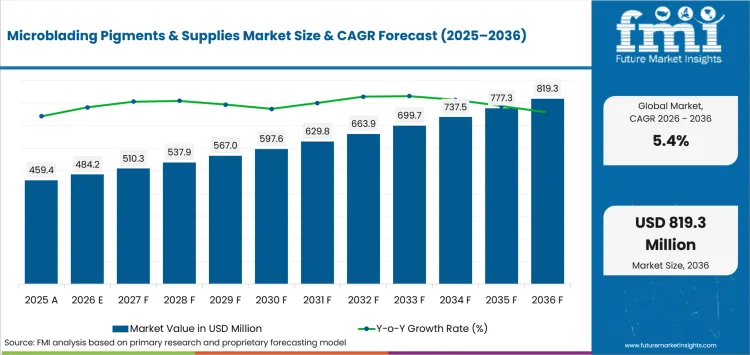
USD 484.2 million in 2026 and USD 819.3 million by 2036 at a 5.4% CAGR.
Demand for microblading pigments & supplies is projected to expand at 5.4% CAGR between 2026 and 2036, increasing valuation from USD 484.2 million in 2026 to USD 819.3 million by 2036. Professional demand increasingly favors pigments and tools that can be qualified before skin penetration instead of shade range alone. The German Federal Institute for Risk Assessment placed microblading and permanent makeup within the tattooing-purpose definition in its May 2025 guidance. Chemical restrictions and product records therefore influence which pigment ranges professional channels can carry.
Country rules determine whether a qualified assortment can reach a salon, clinic, or licensed practitioner base. England’s Department of Health and Social Care recorded 11,848 consultation responses in August 2025, with 69% agreeing to a proposed green-tier category that explicitly included micropigmentation, microblading, and nanoblading. The consultation itself did not create the licence, but it shows how practitioner standards can reshape the addressable channel before consumer interest changes.
Key Takeaways
- Practitioners reorder product lines that clearly document pigment composition and batch identity alongside single-use inputs and equipment compatibility.
- Based on product type, core professional range is projected to account for 48.0% of revenue in 2026 due to repeat brow procedures needing a workable shade set.
- In 2026, hair salons are expected to lead the end user category with 38.0% share because existing beauty appointments give eligible operators a ready client base.
- Core equipment is projected to hold 47.0% of offering revenue in 2026 owing to the platform decision that governs later cartridge and workflow compatibility.
- Practitioner licensing and premises registration can narrow professional account access because pigment restrictions and hygiene rules increase onboarding work.
- Some of the key players in this market include Tina Davies Professional, Perma Blend, Microbeau, Swiss Color, Nouveau Contour, PhiAcademy, K.B Pro, and amiea.
Analyst Perspective
"Microblading offers should be compared on the cost of a compliant treatment cycle instead of the purchase price of one bottle or tool. Commercial value comes from pigment records and device compatibility that reduce rework while making professional replenishment easier to manage."
- Rahul Pandita, Principal Consultant, Future Market Insights
How is the microblading pigments & supplies market segmented?
The market is assessed by product type, end user, offering, price tier, and sales channel.
Product type covers core professional range, premium & specialist range, and entry & value range. End users include hair salons, spas & wellness centers, nail salons, medspas & clinics, and barbershops. Offering covers core equipment, consumables & refills, and accessories. Price tier separates mid-range, economy, and premium products. Sales channels comprise professional distributors, direct sales, and B2B e-commerce.
Why do hair salons lead the end user category?
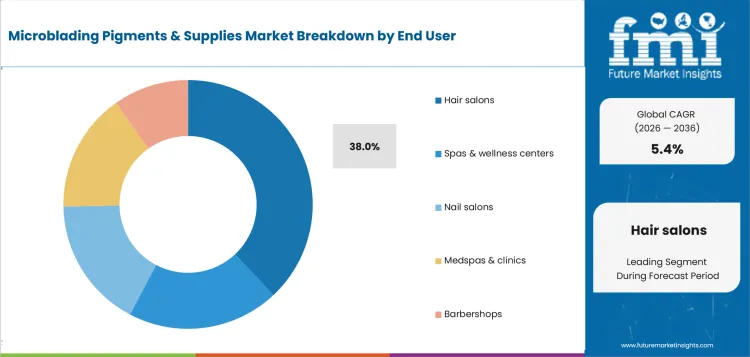
Hair salons can place brow services inside existing appointments where trained beauty professionals may perform skin-pigmentation procedures. Existing salon services give eligible operators a client base while treatment rooms still need local hygiene clearance.
- In 2026, hair salons are expected to lead the end user category with 38.0% share because repeat beauty appointments lower the cost of finding eligible brow clients.
- Dubai Municipality moved salon oversight toward more data-led controls by unveiling the Smart Salon Project with Montaji+ in October 2025. The program links product testing with hygiene monitoring, so distributors serving those salons need inspection-ready records before routine replenishment becomes straightforward.
What makes core professional range central to the product type category?
Core professional assortments cover routine brow consultations without forcing artists to stock specialist-only pigments. Repeat clients expose shade and handling drift between orders.
- By product type, core professional range is estimated to hold 48.0% in 2026 owing to a working shade set that fits repeat brow procedures.
- Professional line reviews increasingly include formulation records before artists accept a pigment range. In September 2025, BfR documented 320 participants with tattoos or permanent makeup and noted medical complications among 5% of tattooed participants. The finding does not attribute harm to a specific pigment but strengthens the case for clear composition and aftercare information.
How does core equipment influence selection within the offering category?
Core equipment fixes the application route before pigment and replacement orders begin. Manual brow tools and digital PMU machines require different cartridge, barrier and technique checks.
- Core equipment is projected to hold 47.0% of offering revenue in 2026 owing to the platform decision that governs later consumable compatibility.
- Equipment selection determines the validation route for needles and application devices used in semi-permanent makeup. The UK consultation document published in August 2025 describes sterile single-use needles and identifies digital machines or handheld tools for ombré brows. That split makes equipment qualification an early purchasing step instead of a later refill decision.
What drives professional distributors within the sales channel category?
Professional distributors reduce repeated product screening when artists source pigments, cartridges and procedure consumables from several brands. The same channel also serves scalp micropigmentation supplies, so import documentation can be reviewed alongside routine replenishment.
- Based on sales channel, professional distributors are projected to account for 41.0% in 2026 due to consolidated ordering and one accountable screening route.
- South Korea tightened distributor screening in June 2025 after MFDS brought tattoo pigments under hygiene-product controls with business reporting, import inspection standards and hygiene education. Distributors that understand those requirements can reject noncompliant imported lines before they reach professional accounts.
What are the drivers, restraints and opportunities in the Microblading Pigments & Supplies Market?
Safety-led product qualification increases professional purchasing while fragmented practitioner rules delay channel conversion and formal licensing routes widen the eligible account base.
- Driver: Microbial and traceability risk increases demand for controlled pigments, sealed consumables and source documentation.
- Restraint: Training and licensing rules differ by jurisdiction, so a compliant product line can still lose eligible professional accounts.
- Opportunity: Formal practitioner routes can turn documented assortments and local education into repeat professional orders.
Microbial control reaches the purchase decision because contaminated ink can expose artists and clients to avoidable treatment risk. In May 2025, the FDA identified two Sacred Tattoo Ink products contaminated with pathogenic microorganisms and advised artists and retailers not to use or sell them. Professional accounts therefore screen batch identity and source accountability earlier, shifting repeat orders toward lines with clearer handling records.
Professional eligibility narrows demand before a pigment or device reaches commercial comparison. France’s health ministry updated its guidance in February 2025 to require renewable hygiene certification with 21 hours of initial training for permanent-makeup practitioners. Brands entering France must build around qualified operators and compliant treatment settings, which can lengthen channel onboarding even where client interest is active.
South Korea has a clearer route for licensed nonmedical tattoo practice, but implementation still determines how quickly new professional accounts appear. The September 2025 Tattooist Act requires a national exam and annual hygiene education alongside registered premises and treatment records after a two-year preparation period. Brands that prepare product documentation and artist education before activation can reduce avoidable qualification work once licensing starts.
Which country CAGRs are profiled in the Microblading Pigments & Supplies Market?
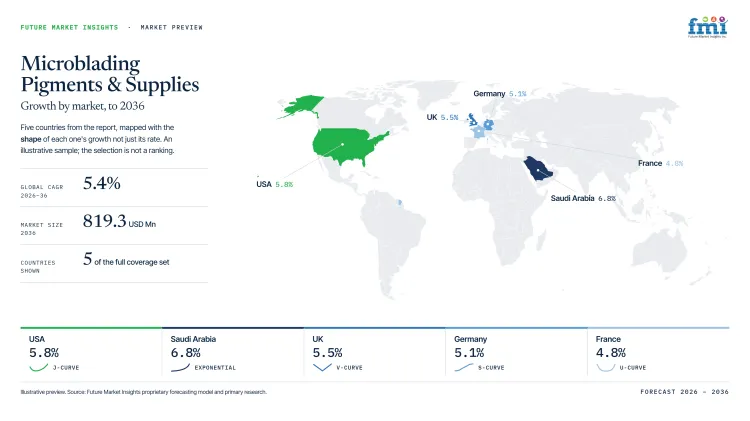
| Country | CAGR |
|---|---|
| Saudi Arabia | 6.8% |
| UAE | 6.5% |
| South Korea | 6.1% |
| USA | 5.8% |
| UK | 5.5% |
| Germany | 5.1% |
| France | 4.8% |
| Japan | 4.5% |
How do country-level CAGRs compare in the Microblading Pigments & Supplies Market?
The forecasts span 2.3 percentage points, with Saudi Arabia and the UAE forming the upper group before South Korea. The USA and UK occupy the middle. Germany and France form a lower pair ahead of Japan, and the narrow spread points to differences in professional access and account activation instead of current market scale.
- Saudi Arabia concentrates growth in licensed urban salons.
- UAE salon density shortens distributor service routes.
- South Korea gives brands preparation time before licensing.
- USA distribution expands faster than practice rules converge.
- UK training keeps professional replenishment commercially visible.
- Germany rewards documentation-heavy pigment assortment decisions.
- France raises the value of local technical support.
- Japan concentrates demand inside clinic procurement channels.
Comparable CAGRs therefore carry different account-activation costs. The full report provides country-level CAGR analysis for North America, Latin America, Western Europe, Eastern Europe, East Asia, South Asia and Pacific, and Middle East and Africa.
Country-wise Analysis
- Saudi beauty operators enter professional accounts through formal municipal requirements for women’s salons and body-care centers in major urban beauty districts, making facility eligibility part of product screening before distributors activate new customers. Saudi Arabia is projected to expand at 6.8% CAGR through 2036, with the Ministry of Municipalities and Housing specifying sterilization, single-use tools, chair spacing and separate home-service licensing in May 2025. The licensed salon base gives documented pigments and equipment a clear route to brow services, but incomplete facility records can delay listings and force brands to provide Arabic documentation plus local verification before regular replenishment begins.
- Dubai concentrates professional beauty activity in inspected salons, giving distributors a dense service route where client turnover and service density can shorten local replenishment routes while raising expectations for product identity, treatment-room records and routine hygiene control. Dubai Municipality issued Version 4 of its Ideal Salon Technical Guidelines on July 7, 2025, with an A classification without violations forming part of the higher-standard route. The UAE market is forecast to grow at 6.5% CAGR through 2036 due to organized beauty channels, yet weak documentation can extend onboarding and require more distributor support before pigments and tools enter regular professional replenishment.
- South Korean importers now screen tattoo pigments against a clearer hygiene-product regime for imported professional lines before the licensed nonmedical practitioner route becomes fully operational, so product control starts ahead of broader channel conversion. Korea Policy Briefing confirmed in January 2026 that tattoo pigments had been managed as hygiene goods since June 14, 2025, giving importers a defined product-control baseline while practitioner licensing is prepared. Microblading pigments & supplies demand is projected to record 6.1% CAGR through 2036 because brands can prepare compliant assortments early, though near-term conversion still depends on existing professional channels and documented import controls during the licensing transition.
- United States brands can distribute pigments and equipment nationally through professional and online channels, but practitioner and premises rules remain largely state or local, so product availability does not create uniform service eligibility. The FDA’s color-additive database was updated on August 14, 2026 and states that no color additives are listed for injection into tattoos or permanent makeup, keeping formulation review central to product screening. The USA is forecast to post 5.8% CAGR over the assessment period given deep professional distribution, while national sales teams still need local practice guidance and separate product records because one compliance message cannot cover every professional account.
- UK product distribution is national, yet many skin-pigmentation businesses qualify locally through council registration of practitioners and premises despite strong national awareness of permanent-makeup services, which makes account activation vary materially from one authority to another. Telford & Wrekin Council stated on January 3, 2025 that semi-permanent makeup and microblading require registration for the operator and premises, including any additional location used for treatment. The UK sector is projected to progress at 5.5% CAGR through 2036 on a mature beauty-service base, though companies need location-specific onboarding guidance before treating distributor reach as usable practitioner coverage and before routine local replenishment can begin.
- German artists and distributors give ingredient records unusual weight because tattoo-ink restrictions place formulation review inside routine line selection for pigments sold through specialist professional channels and structured artist education programs. BfR published a February 2025 clinical study involving 24 volunteers that traced liquid tattoo-ink components through blood and urine sampling, reinforcing the need for better exposure data during professional product assessment. Demand in Germany is forecast to rise at 5.1% CAGR over the assessment period attributable to mature PMU channels, though unfamiliar formulations can require extra toxicology answers before distributors commit shelf space, training resources or repeat orders.
- French permanent-makeup operators work inside a hygiene and client-information regime that treats skin-penetrating pigmentation as regulated tattooing, so professional access depends on certification and declared treatment settings. France is expected to register 4.8% CAGR through 2036 as its established beauty-service base converts through qualified practitioners, while the health ministry’s February 2025 guidance sets 21 hours of initial hygiene training with seven practical hours and five-year renewal. Those requirements give trained artists a clear route to operate, but they narrow the immediately eligible account pool and make French-language documentation plus distributor education more valuable than a broad catalogue with limited professional-use support.
- Japan routes art makeup through medical practice, shifting pigment and equipment demand toward clinics and reducing the role of ordinary salon accounts in eyebrow micropigmentation. The Ministry of Health, Labour and Welfare stated on August 15, 2025 that inserting pigment to draw eyebrows or other cosmetic features is a medical act and cannot be performed professionally by unlicensed practitioners. Microblading pigments & supplies sales is forecast to advance at 4.5% CAGR through 2036 because medically compliant programs provide a defined channel, though the narrower practitioner pool favors companies already serving clinical settings and keeps salon-led expansion limited unless the legal treatment boundary changes.
Who are the notable companies in the Microblading Pigments & Supplies Market?
Tina Davies Professional, Perma Blend, Microbeau, Swiss Color, Nouveau Contour, PhiAcademy, K.B Pro, and amiea are notable companies serving this market.
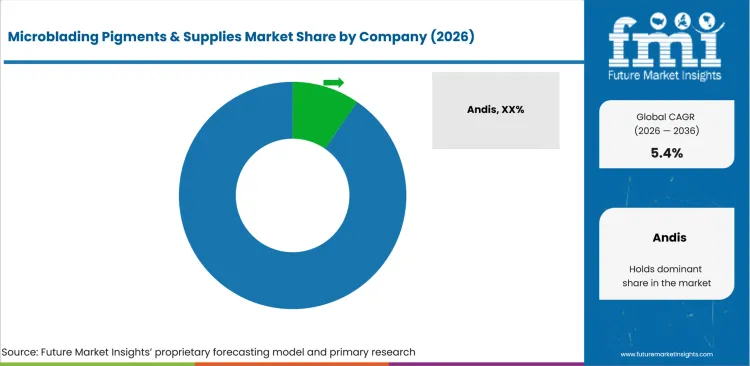
Competition separates pigment specialists, PMU machine makers, integrated system brands and education-led platforms. The wider beauty and wellness sector provides channel context, but entry here depends on evidence for skin-implantation products plus credible artist support.
- Tina Davies Professional, Perma Blend and Swiss Color focus on professional pigments with artist education and procedure accessories.
- Microbeau, Nouveau Contour and amiea center their portfolios on digital PMU equipment with cartridges, needles or pigments.
- PhiAcademy and K.B Pro use structured training to shape product adoption. K.B Pro also sells pigments and distributes Nouveau Contour in the UK.
Competitive Benchmarking: Microblading Pigments & Supplies Market
| Company | Professional Product Breadth | Safety & Quality Controls | Education & Artist Support | Geographic Reach |
|---|---|---|---|---|
| Tina Davies Professional | High | Medium | High | Global |
| Perma Blend | Medium | High | High | Global |
| Microbeau | Medium | High | Medium | International |
| Swiss Color | High | High | High | 60+ countries |
| Nouveau Contour | High | High | High | Global |
| PhiAcademy | Medium | Medium | High | Global |
| K.B Pro | High | Medium | High | United Kingdom and international training |
| amiea | High | High | Medium | Global |
High professional product breadth requires at least three verified microblading or PMU product categories. Medium breadth requires two verified categories whereas Low breadth covers one documented category only. High safety and quality control requires formal certification or compliance evidence plus documented product control. Medium reflects one formal route whereas Low relies on basic documented quality statements. High education and artist support requires structured training plus continuing support for working artists. Medium covers one support route whereas Low is limited to basic instructional resources. Geographic reach records documented sales or training regions and is not assigned a score.
Key Developments in the Microblading Pigments & Supplies Market
- In January 2026, Perma Blend documented its collaboration with Paulina Osinkowska on the LUXE Ombré Brow Set and its accompanying educational color chart.
- In July 2025, PhiAcademy introduced the BB Stroke workshop with Branko Babic, using a specialized blade machine with live-model practice and a treatment kit.
- In January 2025, Nouveau Contour launched True Black within its organic pigment line for eyeliner work, emphasizing color stability, pigment concentration and coverage.
Key Players in the Microblading Pigments & Supplies Market
Pigment and Procedure Supply Specialists
- Tina Davies Professional
- Perma Blend
- Swiss Color
Integrated PMU Equipment and Pigment Platforms
- Microbeau
- Nouveau Contour
- amiea
Education-Led PMU Platforms
- PhiAcademy
- K.B Pro
Microblading Pigments & Supplies Market - Report Scope
| Coverage field | Report scope |
|---|---|
| Market breakdown | By product type, end user, offering, price tier, sales channel and region. |
| Quantitative Units | USD million. |
| Market Definition | Professional pigments, microblading or PMU application equipment, cartridges or blades, consumables, accessories, and related supplies used for eyebrow micropigmentation workflows. |
| Regions Covered | North America, Latin America, Western Europe, Eastern Europe, East Asia, South Asia and Pacific, and Middle East and Africa. |
| Countries Covered | Saudi Arabia, United Arab Emirates, South Korea, United States, United Kingdom, Germany, France, Japan, and 20+ countries included in the full report. |
| Key Companies Profiled | Tina Davies Professional, Perma Blend, Microbeau, Swiss Color, Nouveau Contour, PhiAcademy, K.B Pro, amiea. |
| Forecast Period | 2026 to 2036. |
| Approach | Primary and secondary research with market triangulation. |
Microblading Pigments & Supplies Market - Research Methodology
| Method | Approach |
|---|---|
| Primary Research | FMI analysts gathered input from manufacturers, service providers, technology developers, distributors, end users, procurement teams, and subject-matter experts. Interviews examined purchasing decisions, product or service evaluation, adoption barriers, approval requirements, pricing considerations, and expectations for technical or commercial support. Respondents were also asked what evidence is required before a trial, pilot, or initial order develops into regular purchasing. |
| Desk Research | Desk research covered government statistics, regulatory publications, trade data, industry associations, technical literature, standards, company filings, product information, and official corporate announcements. Sources were reviewed for relevance, publication date, geographic coverage, and consistency with the defined market scope. Claims relating to performance, applications, approvals, capacity, investment, and commercial activity were retained only when supported by credible public evidence. |
| Market Sizing and Forecasting | The market model combined the baseline value with historical performance, segment structure, pricing and volume indicators, adoption levels, company participation, and country-level demand conditions. Forecast assumptions considered economic activity, investment trends, regulatory developments, technology adoption, purchasing cycles, supply availability, and barriers to wider market use. Segment and regional estimates were reconciled before the final market total was calculated. |
| Data Validation | Estimates were checked against multiple independent indicators, including public data, company activity, trade patterns, industry developments, and findings from primary interviews. Validation also tested whether products, services, applications, and company revenues fell within the defined market boundaries. Adjacent categories, unsupported claims, overlapping revenues, and activities without direct market relevance were excluded to reduce double counting and maintain consistency across segments and countries. |
Microblading Pigments & Supplies Market by Segments
Microblading Pigments & Supplies Market segmented by Product Type:
- Core professional range
- Premium & specialist range
- Entry & value range
Microblading Pigments & Supplies Market segmented by End User:
- Hair salons
- Spas & wellness centers
- Nail salons
- Medspas & clinics
- Barbershops
Microblading Pigments & Supplies Market segmented by Offering:
- Core equipment
- Consumables & refills
- Accessories
Microblading Pigments & Supplies Market segmented by Price Tier:
- Mid-range
- Economy
- Premium
Microblading Pigments & Supplies Market segmented by Sales Channel:
- Professional distributors
- Direct sales
- B2B e-commerce
Microblading Pigments & Supplies Market by Region:
- North America
- United States
- Canada
- Latin America
- Brazil
- Mexico
- Argentina
- Chile
- Western Europe
- Germany
- France
- United Kingdom
- Italy
- Spain
- Benelux
- Nordics
- Eastern Europe
- Poland
- Czech Republic
- Romania
- Hungary
- East Asia
- China
- Japan
- South Korea
- South Asia and Pacific
- India
- ASEAN
- Australia and New Zealand
- Middle East and Africa
- GCC Countries
- South Africa
- Türkiye
- Israel
Research Sources and Bibliography
- German Federal Institute for Risk Assessment. (2025, May 6). Frequently asked questions about tattoo inks.
- Department of Health and Social Care. (2025, August 7). The licensing of non-surgical cosmetic procedures in England: consultation response.
- German Federal Institute for Risk Assessment. (2025, September 11). Tattoos: research on the possible increased risk of chronic diseases is needed.
- Dubai Municipality. (2025, October 27). Product safety at Beautyworld Middle East 2025.
- Department of Health and Social Care. (2025, August 7). The licensing of non-surgical cosmetic procedures in England: consultation document.
- Ministry of Food and Drug Safety, Republic of Korea. (2025, June 13).
- USA Food and Drug Administration. (2025, May 7). FDA advises consumers, tattoo artists, and retailers to avoid using or selling certain Sacred Tattoo Ink.
- Ministère du Travail, de la Santé, des Solidarités et des Familles. (2025, February 25). FAQ - Tatouage par effraction cutanée et perçage corporel.
- Korea Policy Briefing. (2025, September 26).
- Ministry of Municipalities and Housing, Saudi Arabia. (2025, May 14). MOMAH announces updated requirements for women’s beauty salons and relaxation and body care centers.
- Dubai Municipality. (2025, July 15). Technical Guidelines (75) for Ideal Salons.
- Korea Policy Briefing. (2026, January 28).
- USA Food and Drug Administration. (2026, August 14). Regulatory Status of Color Additives.
- Telford & Wrekin Council. (2025, January 3). Acupuncture, tattooing, semi-permanent skin colouring, cosmetic piercing and electrolysis.
- German Federal Institute for Risk Assessment. (2025, February 4). Tattoo inks: How much colour gets into the body?
- Ministère de la Santé, de la Famille, de l’Autonomie et des Personnes handicapées. (2025, February 25). Tatouage et piercing.
- Ministry of Health, Labour and Welfare, Japan. (2025, August 15).
- Tina Davies Professional. (n.d.). About us.
- Perma Blend. (n.d.). About us.
- Microbeau International. (n.d.). About us.
- Swiss Color. (n.d.). Trainer training.
- Nouveau Contour. (n.d.). About Nouveau Contour.
- PhiAcademy. (n.d.). PhiAcademy courses.
- K.B Pro. (n.d.). About K.B Pro.
- amiea. (n.d.). The world of amiea.
- Perma Blend. (2026, January 16). The Story Behind the Ombré Brow Set.
- PhiAcademy. (2025, July 4). Master BB Stroke with Branko Babic: The Exclusive Workshop.
- Nouveau Contour. (2025, January 15). Discover True Black: Intense Black. Perfect Coverage. 100% Organic.
- Swiss Color. (2026, January 12). The dual concept of the SC Universal Dual 3.0.
- Perma Blend. (2025, November 10). New Look, Same Trusted Formula: Meet the Updated Evenflo Packaging.
- Swiss Color. (2025, July 31). 5 Shades of Black - which pigment for which application?
- PhiAcademy. (2025, May 22). PhiBrows, Basic Live Training in London, 22 May 2025.
- PhiAcademy. (2025, May 8). PhiBrows, Basic Live Training in Monterrey, 8 May 2025.
This bibliography is provided for reader reference and is not exhaustive. The full report contains the complete reference list and detailed citations
This Report Answers
- How large is the microblading pigments & supplies market in 2026 and 2036?
- Which conditions turn safety documentation into professional demand?
- Why does core professional range lead product type?
- Why do hair salons lead end-user demand?
- Why does core equipment lead offering revenue?
- Why do professional distributors lead sales-channel revenue?
- How do profiled country CAGRs compare through 2036?
- Which companies serve pigments, PMU equipment, tools, and training?
Frequently Asked Questions
How big is the Microblading Pigments & Supplies Market in 2026?
The microblading pigments & supplies market is valued at USD 484.2 million in 2026 and is projected to reach USD 819.3 million by 2036. Professional purchasing increasingly depends on documented pigments and equipment that fits the intended treatment workflow.
What is the CAGR of the Microblading Pigments & Supplies Market from 2026 to 2036?
The microblading pigments & supplies market is projected to grow at a CAGR of 5.4% between 2026 and 2036. Repeat purchasing increases as documented PMU supplies reach eligible professional settings with predictable replenishment.
Which product type leads the Microblading Pigments & Supplies Market?
The core professional range segment is expected to hold 48.0% of product type revenue in the microblading pigments & supplies market in 2026, supported by repeat-use brow assortments. Working artists need broad shade coverage without carrying specialist-only pigment inventory for routine brow appointments.
Which countries are projected to record the highest growth in the Microblading Pigments & Supplies Market?
Saudi Arabia is projected to grow at 6.8% CAGR, followed by the UAE at 6.5% and South Korea at 6.1% through 2036. Formal salon channels and clearer practitioner routes underpin the faster country profiles.
Which companies are active in the Microblading Pigments & Supplies Market?
Key companies operating in the market include Tina Davies Professional, Perma Blend, Microbeau, Swiss Color, Nouveau Contour, PhiAcademy, K.B Pro, and amiea. Their positions differ by pigments, PMU equipment, artist education, quality controls and geographic reach.
Preview the report firsthand - request a free sample
Get SampleGet the brochure for pricing and purchase details.
Get PDFTable of Content
- Key Takeaways
- Market Size and CAGR
- Top Growth Driver
- Fastest Growing Segment
- Leading Region
- Key Companies
- Emerging Opportunities
- Executive Summary
- Global Market Outlook
- Demand-side Trends
- Supply-side Trends
- Technology Roadmap Analysis
- Analysis and Recommendations
- Analyst Perspective (What is happening? Why now? What should investors know?)
- Key Questions Answered
- How large is the market?
- What is the CAGR?
- What are key trends?
- Which region dominates?
- Who are the leaders?
- Market Overview
- Market Coverage / Taxonomy
- Market Definition / Scope / Limitations
- Research Methodology
- Chapter Orientation
- Analytical Lens and Working Hypotheses
- Market Structure, Signals, and Trend Drivers
- Benchmarking and Cross-market Comparability
- Market Sizing, Forecasting, and Opportunity Mapping
- Research Design and Evidence Framework
- Desk Research Programme (Secondary Evidence)
- Expert Input and Fieldwork (Primary Evidence)
- Tooling, Models, and Reference Databases
- Data Engineering and Model Build
- Quality Assurance and Audit Trail
- Market Background
- Market Dynamics (Drivers, Restraints, Opportunity, Trends)
- Scenario Forecast (Optimistic, Likely, Conservative)
- Impact Analysis
- AI Impact
- Sustainability Impact
- Regulatory Impact
- Technology Impact
- Consumer / Buyer Analysis
- Purchase Drivers
- Adoption Barriers
- Buyer Journey
- Opportunity Map Analysis
- Product Life Cycle Analysis
- Supply Chain Analysis
- Investment Feasibility Matrix
- Value Chain Analysis
- PESTLE and Porter's Analysis
- Regulatory Landscape
- Regional Parent Market Outlook
- Production and Consumption Statistics
- Import and Export Statistics
- Global Market Analysis and Forecast, 2021 to 2036
- Historical Market Size Value (USD Million) Analysis, 2021 to 2025
- Current and Future Market Size Value (USD Million) Projections, 2026 to 2036
- Y-o-Y Growth Trend Analysis
- Absolute $ Opportunity Analysis
- Global Market Pricing Analysis, 2021 to 2036
- Global Market Analysis and Forecast, By Product Type, 2021 to 2036
- Introduction / Key Findings
- Historical Market Size Value (USD Million) Analysis By Product Type, 2021 to 2025
- Current and Future Market Size Value (USD Million) Analysis and Forecast By Product Type, 2026 to 2036
- Core professional range
- Premium & specialist range
- Entry & value range
- Core professional range
- Y-o-Y Growth Trend Analysis By Product Type, 2021 to 2025
- Absolute $ Opportunity Analysis By Product Type, 2026 to 2036
- Global Market Analysis and Forecast, By End User, 2021 to 2036
- Introduction / Key Findings
- Historical Market Size Value (USD Million) Analysis By End User, 2021 to 2025
- Current and Future Market Size Value (USD Million) Analysis and Forecast By End User, 2026 to 2036
- Hair salons
- Spas & wellness centers
- Nail salons
- Medspas & clinics
- Barbershops
- Hair salons
- Y-o-Y Growth Trend Analysis By End User, 2021 to 2025
- Absolute $ Opportunity Analysis By End User, 2026 to 2036
- Global Market Analysis and Forecast, By Offering, 2021 to 2036
- Introduction / Key Findings
- Historical Market Size Value (USD Million) Analysis By Offering, 2021 to 2025
- Current and Future Market Size Value (USD Million) Analysis and Forecast By Offering, 2026 to 2036
- Core equipment
- Consumables & refills
- Accessories
- Core equipment
- Y-o-Y Growth Trend Analysis By Offering, 2021 to 2025
- Absolute $ Opportunity Analysis By Offering, 2026 to 2036
- Global Market Analysis and Forecast, By Price Tier, 2021 to 2036
- Introduction / Key Findings
- Historical Market Size Value (USD Million) Analysis By Price Tier, 2021 to 2025
- Current and Future Market Size Value (USD Million) Analysis and Forecast By Price Tier, 2026 to 2036
- Mid-range
- Economy
- Premium
- Mid-range
- Y-o-Y Growth Trend Analysis By Price Tier, 2021 to 2025
- Absolute $ Opportunity Analysis By Price Tier, 2026 to 2036
- Global Market Analysis and Forecast, By Sales Channel, 2021 to 2036
- Introduction / Key Findings
- Historical Market Size Value (USD Million) Analysis By Sales Channel, 2021 to 2025
- Current and Future Market Size Value (USD Million) Analysis and Forecast By Sales Channel, 2026 to 2036
- Professional distributors
- Direct sales
- B2B e-commerce
- Professional distributors
- Y-o-Y Growth Trend Analysis By Sales Channel, 2021 to 2025
- Absolute $ Opportunity Analysis By Sales Channel, 2026 to 2036
- Global Market Analysis and Forecast, By Region, 2021 to 2036
- Introduction
- Historical Market Size Value (USD Million) Analysis By Region, 2021 to 2025
- Current Market Size Value (USD Million) Analysis and Forecast By Region, 2026 to 2036
- North America
- Latin America
- Western Europe
- Eastern Europe
- East Asia
- South Asia and Pacific
- Middle East & Africa
- Market Attractiveness Analysis By Region
- North America Market Analysis and Forecast, By Country, 2021 to 2036
- Historical Market Size Value (USD Million) Trend Analysis By Market Taxonomy, 2021 to 2025
- Market Size Value (USD Million) Forecast By Market Taxonomy, 2026 to 2036
- By Country
- USA
- Canada
- By Product Type
- By End User
- By Offering
- By Price Tier
- By Sales Channel
- By Country
- Market Attractiveness Analysis
- By Country
- By Product Type
- By End User
- By Offering
- By Price Tier
- By Sales Channel
- Key Takeaways
- Latin America Market Analysis and Forecast, By Country
- Historical Market Size Value (USD Million) Trend Analysis By Market Taxonomy, 2021 to 2025
- Market Size Value (USD Million) Forecast By Market Taxonomy, 2026 to 2036
- By Country
- Brazil
- Mexico
- Chile
- Rest of Latin America
- By Product Type
- By End User
- By Offering
- By Price Tier
- By Sales Channel
- By Country
- Market Attractiveness Analysis
- By Country
- By Product Type
- By End User
- By Offering
- By Price Tier
- By Sales Channel
- Key Takeaways
- Western Europe Market Analysis and Forecast, By Country
- Historical Market Size Value (USD Million) Trend Analysis By Market Taxonomy, 2021 to 2025
- Market Size Value (USD Million) Forecast By Market Taxonomy, 2026 to 2036
- By Country
- Germany
- UK
- Italy
- Spain
- France
- Nordic
- BENELUX
- Rest of Western Europe
- By Product Type
- By End User
- By Offering
- By Price Tier
- By Sales Channel
- By Country
- Market Attractiveness Analysis
- By Country
- By Product Type
- By End User
- By Offering
- By Price Tier
- By Sales Channel
- Key Takeaways
- Eastern Europe Market Analysis and Forecast, By Country
- Historical Market Size Value (USD Million) Trend Analysis By Market Taxonomy, 2021 to 2025
- Market Size Value (USD Million) Forecast By Market Taxonomy, 2026 to 2036
- By Country
- Russia
- Poland
- Hungary
- Balkan & Baltic
- Rest of Eastern Europe
- By Product Type
- By End User
- By Offering
- By Price Tier
- By Sales Channel
- By Country
- Market Attractiveness Analysis
- By Country
- By Product Type
- By End User
- By Offering
- By Price Tier
- By Sales Channel
- Key Takeaways
- East Asia Market Analysis and Forecast, By Country
- Historical Market Size Value (USD Million) Trend Analysis By Market Taxonomy, 2021 to 2025
- Market Size Value (USD Million) Forecast By Market Taxonomy, 2026 to 2036
- By Country
- China
- Japan
- South Korea
- By Product Type
- By End User
- By Offering
- By Price Tier
- By Sales Channel
- By Country
- Market Attractiveness Analysis
- By Country
- By Product Type
- By End User
- By Offering
- By Price Tier
- By Sales Channel
- Key Takeaways
- South Asia and Pacific Market Analysis and Forecast, By Country
- Historical Market Size Value (USD Million) Trend Analysis By Market Taxonomy, 2021 to 2025
- Market Size Value (USD Million) Forecast By Market Taxonomy, 2026 to 2036
- By Country
- India
- ASEAN
- Australia & New Zealand
- Rest of South Asia and Pacific
- By Product Type
- By End User
- By Offering
- By Price Tier
- By Sales Channel
- By Country
- Market Attractiveness Analysis
- By Country
- By Product Type
- By End User
- By Offering
- By Price Tier
- By Sales Channel
- Key Takeaways
- Middle East & Africa Market Analysis and Forecast, By Country
- Historical Market Size Value (USD Million) Trend Analysis By Market Taxonomy, 2021 to 2025
- Market Size Value (USD Million) Forecast By Market Taxonomy, 2026 to 2036
- By Country
- Kingdom of Saudi Arabia
- Other GCC Countries
- Türkiye
- South Africa
- Other African Union
- Rest of Middle East & Africa
- By Product Type
- By End User
- By Offering
- By Price Tier
- By Sales Channel
- By Country
- Market Attractiveness Analysis
- By Country
- By Product Type
- By End User
- By Offering
- By Price Tier
- By Sales Channel
- Key Takeaways
- Key Countries Market Analysis
- USA
- Pricing Analysis
- Market Share Analysis, 2025
- By Product Type
- By End User
- By Offering
- By Price Tier
- By Sales Channel
- Canada
- Pricing Analysis
- Market Share Analysis, 2025
- By Product Type
- By End User
- By Offering
- By Price Tier
- By Sales Channel
- Mexico
- Pricing Analysis
- Market Share Analysis, 2025
- By Product Type
- By End User
- By Offering
- By Price Tier
- By Sales Channel
- Brazil
- Pricing Analysis
- Market Share Analysis, 2025
- By Product Type
- By End User
- By Offering
- By Price Tier
- By Sales Channel
- Chile
- Pricing Analysis
- Market Share Analysis, 2025
- By Product Type
- By End User
- By Offering
- By Price Tier
- By Sales Channel
- Germany
- Pricing Analysis
- Market Share Analysis, 2025
- By Product Type
- By End User
- By Offering
- By Price Tier
- By Sales Channel
- UK
- Pricing Analysis
- Market Share Analysis, 2025
- By Product Type
- By End User
- By Offering
- By Price Tier
- By Sales Channel
- Italy
- Pricing Analysis
- Market Share Analysis, 2025
- By Product Type
- By End User
- By Offering
- By Price Tier
- By Sales Channel
- Spain
- Pricing Analysis
- Market Share Analysis, 2025
- By Product Type
- By End User
- By Offering
- By Price Tier
- By Sales Channel
- France
- Pricing Analysis
- Market Share Analysis, 2025
- By Product Type
- By End User
- By Offering
- By Price Tier
- By Sales Channel
- India
- Pricing Analysis
- Market Share Analysis, 2025
- By Product Type
- By End User
- By Offering
- By Price Tier
- By Sales Channel
- ASEAN
- Pricing Analysis
- Market Share Analysis, 2025
- By Product Type
- By End User
- By Offering
- By Price Tier
- By Sales Channel
- Australia & New Zealand
- Pricing Analysis
- Market Share Analysis, 2025
- By Product Type
- By End User
- By Offering
- By Price Tier
- By Sales Channel
- China
- Pricing Analysis
- Market Share Analysis, 2025
- By Product Type
- By End User
- By Offering
- By Price Tier
- By Sales Channel
- Japan
- Pricing Analysis
- Market Share Analysis, 2025
- By Product Type
- By End User
- By Offering
- By Price Tier
- By Sales Channel
- South Korea
- Pricing Analysis
- Market Share Analysis, 2025
- By Product Type
- By End User
- By Offering
- By Price Tier
- By Sales Channel
- Russia
- Pricing Analysis
- Market Share Analysis, 2025
- By Product Type
- By End User
- By Offering
- By Price Tier
- By Sales Channel
- Poland
- Pricing Analysis
- Market Share Analysis, 2025
- By Product Type
- By End User
- By Offering
- By Price Tier
- By Sales Channel
- Hungary
- Pricing Analysis
- Market Share Analysis, 2025
- By Product Type
- By End User
- By Offering
- By Price Tier
- By Sales Channel
- Kingdom of Saudi Arabia
- Pricing Analysis
- Market Share Analysis, 2025
- By Product Type
- By End User
- By Offering
- By Price Tier
- By Sales Channel
- Türkiye
- Pricing Analysis
- Market Share Analysis, 2025
- By Product Type
- By End User
- By Offering
- By Price Tier
- By Sales Channel
- South Africa
- Pricing Analysis
- Market Share Analysis, 2025
- By Product Type
- By End User
- By Offering
- By Price Tier
- By Sales Channel
- USA
- Market Structure Analysis
- Competition Dashboard
- Competition Benchmarking
- Market Share Analysis of Top Players
- By Regional
- By Product Type
- By End User
- By Offering
- By Price Tier
- By Sales Channel
- Emerging Startups
- Innovation Benchmarking
- Competition Analysis
- Competition Deep Dive
- Andis
- Overview
- Product Portfolio
- Profitability by Market Segments
- Sales Footprint
- Strategy Overview
- Marketing Strategy
- Product Strategy
- Channel Strategy
- Wahl
- Henkel
- L'Oreal
- Takara Belmont
- REM UK
- Wella Company
- Conair
- Gharieni Group
- Kao Corporation
- Andis
- Case Studies
- Success Stories
- Recent Developments
- Competition Deep Dive
- Assumptions & Acronyms Used


