

- Market Size (2026)
- USD 127.3 Mn
- Forecast (2036)
- USD 192.1 Mn
- CAGR (2026 to 2036)
- 4.2%
How big is Scalp Micropigmentation Supplies Market in 2026?
USD 127.3 million in 2026 and USD 192.1 million by 2036 at a 4.2% CAGR.
Demand for scalp micropigmentation supplies is projected to expand at 4.2% CAGR between 2026 and 2036, increasing valuation from USD 127.3 million to USD 192.1 million. Procedure consideration among hair-loss patients brings studios and clinics closer to equipment and consumable purchasing decisions. A September 2025 Korean Dermatological Association study found 10.3% of 126 dermatology outpatients without prior SMP had seriously considered the procedure. The single-center result is not a prevalence estimate, but it documents active consideration within a relevant hair-loss population.
Country conversion depends on practitioner eligibility and how professional venues document compliance during routine pigment-implantation services. England provides a useful policy signal for invasive pigmentation supplies sold into professional beauty settings. The Department of Health and Social Care reported in August 2025 that 57% of consultation respondents supported requiring specified practitioner qualifications. Qualification rules can influence professional outlets even when consumer interest is already present across the market.
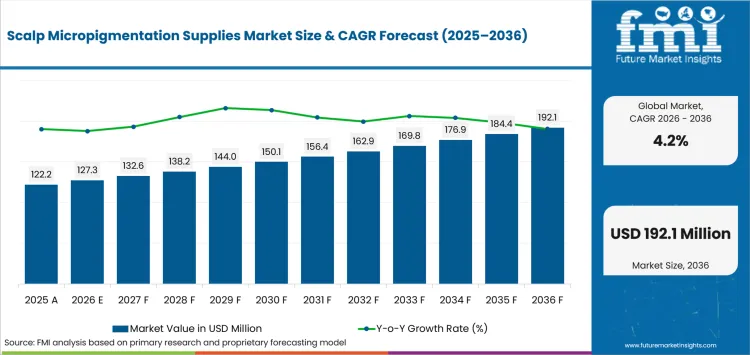
Key Takeaways of Scalp Micropigmentation Supplies Market
- Procedure demand supports equipment placement first and then repeat purchases of cartridges, pigments and hygiene-related consumables across follow-up sessions.
- Based on product type, core professional range is projected to account for 46.0% in 2026 due to dependable control without specialist-system pricing.
- By end user, hair salons are estimated to hold 32.0% in 2026 owing to routine hair consultations that can precede scalp-camouflage services.
- In 2026, core equipment is expected to lead offering with 42.0% share because installed hardware governs cartridge compatibility and needle control.
- Variable practitioner rules and pigment-safety controls slow purchasing where venues cannot confirm legal eligibility or document safe handling before adding procedures.
- Some of the key players in this market include Microbeau International, Kwadron PMU, BIOTEK, amiea, Perma Blend, Folicule, FYT Supplies, and Hanafy Pigments.
Analyst Perspective
"Professional SMP programs perform better commercially when one machine platform supports predictable dot placement and repeat cartridge replenishment across touch-up schedules. Margin protection depends on verified pigment batches and local compliance support because a cancelled session costs more than a small unit-price saving."
- Rahul Pandita, Principal Consultant, Future Market Insights
How is the Scalp Micropigmentation Supplies Market segmented?
The market is segmented by product type, end user, offering, price tier, sales channel and region.
Product type covers core professional range, premium & specialist range and entry & value range. End user includes hair salons, spas & wellness centers, nail salons, medspas & clinics and barbershops. Offering covers core equipment, consumables & refills and accessories. Price tier comprises mid-range, economy and premium. Sales channel includes professional distributors, direct sales and B2B e-commerce.
Why do professional distributors lead the sales channel category?
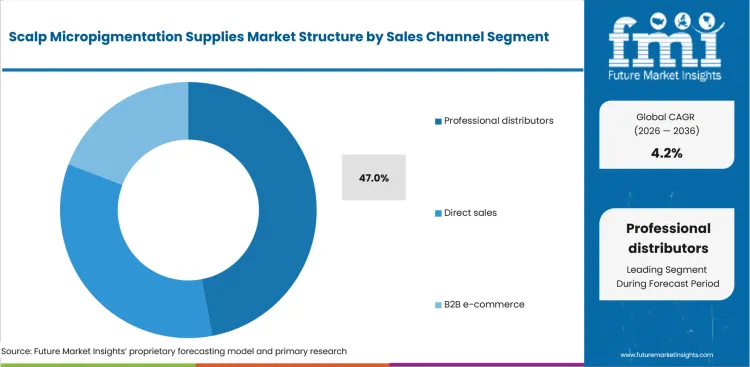
Professional distributors matter once practitioners standardize machine and cartridge specifications across routine orders from working studios. Their role resembles specialist distribution in hair care products but carries greater traceability requirements for invasive-use supplies.
- Professional distributors are expected to account for 47.0% of sales-channel demand in 2026, attributable to authenticity checks and faster replacement of compatible consumables.
- Arkansas Department of Health draft rules dated May 2025 explicitly place scalp micropigmentation within permanent cosmetics and require regulated professional training. Formal operating routes increase the value of traceable distribution because studios must match invasive-use supplies to licensed services.
Why does core professional range lead the product type category?
Core professional systems suit studios that need consistent control across repeat sessions without purchasing every specialist feature. The category also competes with hair-restoration robotics for capital attention inside broader hair-restoration businesses and specialist clinics.
- By product type, core professional range is estimated to hold 46.0% in 2026 owing to a workable balance between procedure control and equipment cost.
- Australia’s national training register updated its hairdressing and beauty services package in February 2025 with a dedicated unit titled “Provide cosmetic tattoo for scalp micropigmentation.” Formal training increases the value of professional systems that behave predictably during supervised practice and later client sessions.
Why do hair salons lead the end user category?
Hair salons already manage consultations about thinning and scalp appearance, which can shorten the route from concern to a booked camouflage service. Their overlap with professional hair care products also creates familiar distributor relationships for owners adding adjacent scalp services.
- Hair salons are set to lead the end-user category with 32.0% share in 2026, driven by existing appointment systems and repeat hair-focused client contact.
- A USA Department of Labor job order posted in July 2025 listed scalp micropigmentation among procedures performed by a Florida salon’s permanent-makeup artist. The listing places SMP inside a broader professional salon service model beside established beauty appointments.
Why does core equipment lead the offering category?
Core equipment establishes needle control and cartridge fit before recurring consumables become useful during routine client sessions. Operators comparing SMP with other cosmetic surgery products therefore treat device reliability as an initial qualification decision.
- Core equipment is projected to hold 42.0% of offering demand in 2026, supported by the hardware platform required for repeatable pigment implantation.
- Virginia’s June 2025 proposed tattooing rules added scalp micropigmentation to permanent-cosmetics training requirements and specified practical performances within the curriculum. Formal equipment instruction increases the value of systems that remain predictable during supervised practice and later client sessions.
What are the drivers, restraints and opportunities in the Scalp Micropigmentation Supplies Market?
Repeat professional procedures support replenishment demand, while pigment-safety controls raise qualification costs and formal practitioner rules create room for documented supply systems.
- Driver: Repeat treatment and touch-up activity links every installed machine to recurring demand for compatible cartridges and pigments.
- Restraint: Microbial contamination risk increases documentation and batch-control work for pigments placed through the skin barrier.
- Opportunity: Clearer practitioner licensing can shift informal purchasing toward traceable equipment and consumable channels with documented training support.
Qualified studios convert procedure demand into recurring orders once permanent-cosmetics requirements permit them to perform scalp micropigmentation. New Jersey Department of Health guidance last reviewed in March 2025 requires SMP practitioners to complete a 100-hour permanent-cosmetics course and document experience before approval. This qualification route gives studios a clearer base for machine standardization and repeat consumable purchases as SMP sits beside hair regrowth treatments in hair-loss service planning.
Pigment risk affects purchasing before a practitioner compares unit price or available shade range across professional supply channels. In May 2025 FDA surveillance found two tattoo inks contaminated with harmful bacteria and reinforced batch-record scrutiny around invasive pigment workflows. Weak documentation can delay product approval even where machine performance meets operator expectations and local demand is already established.
Formal licensing can shift fragmented practitioner demand toward professional channels that require documented training and traceable supplies. South Korea enacted the Tattooist Act in October 2025 with an October 2027 effective date, establishing a licensing route plus hygiene and safety obligations for tattoo businesses. Distributors can prepare compliant product bundles and training materials before implementation so eligible practitioners can convert licensing status into repeat purchasing more efficiently.
Which country CAGRs are profiled in the Scalp Micropigmentation Supplies Market?
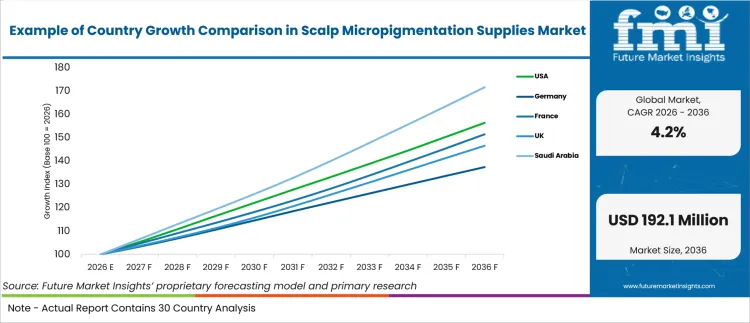
| Country | CAGR |
|---|---|
| Saudi Arabia | 5.5% |
| United States | 4.6% |
| France | 4.2% |
| Japan | 3.6% |
| Germany | 3.2% |
How do country-level CAGRs compare in the Scalp Micropigmentation Supplies Market?
The five-country range spans 2.3 percentage points and separates Saudi Arabia from two closer groups. Saudi Arabia stands apart at 5.5% while the United States and France form the middle band. Japan and Germany remain closer because practitioner eligibility and pigment controls weigh more heavily on routine orders.
- Saudi Arabia gains pace from salon chairs licensing rules that formalize hygiene expectations.
- United States channels remain fragmented because practitioner rules differ across local jurisdictions.
- France ties service expansion to formal hygiene training requirements for skin-penetrating procedures.
- Japan restricts hair-depicting pigment implantation to medical practice and physician-led purchasing channels.
- Germany applies mature REACH controls that increase pigment documentation during professional qualification.
Similar growth rates therefore produce different entry costs and channel requirements across these markets. The full report provides country-level CAGR analysis across North America, Latin America, Europe, East Asia, South Asia, Oceania and the Middle East and Africa.
Country-wise Analysis
- Saudi professional beauty venues operate under municipal licensing rules that increasingly specify sterilization and single-use tools across inspected service areas. The Ministry of Municipalities updated salon requirements in May 2025 and Saudi Arabia is projected to grow at 5.5% CAGR during the forecast period. Formal salon channels give distributors a clear route for hygiene documentation and routine replenishment across equipment and consumables. Procedure-specific authorization remains the principal friction for scalp procedures because general beauty licensing does not establish permission for every invasive service. Entrants therefore need traceable records and licensed-channel support that local inspectors can review without reconstructing product histories across several intermediaries.
- United States studios work under state and local rules that differ across invasive pigmentation services and professional beauty settings. Virginia’s final tattooing regulations published in December 2025 explicitly place scalp micropigmentation within permanent cosmetic tattooing and require practitioner licensing. United States demand is forecast to rise at 4.6% CAGR by 2036 as professional access expands across qualified studios. National distribution makes equipment and compatible tattoo needles widely available, yet channel support must account for local licensing and sanitation requirements. Distributors entering multiple states therefore need jurisdiction-specific compliance guidance and traceable consumable records instead of treating one state approval route as a national operating standard.
- French practitioners work within formal hygiene and safety training rules for skin-penetrating tattoo activities across professional settings. Practitioner records give distributors a clear qualification route before a salon expands into additional invasive appearance services. The Ministry of Health updated tattooing and body-piercing guidance in February 2025 with national information on hygiene training requirements. France is estimated to post 4.2% CAGR over the assessment period as established beauty channels widen professional service menus.
- Japan treats pigment insertion that depicts natural structures such as hair as a medical act within physician-led service settings. Scalp micropigmentation supply demand is forecast to expand at 3.6% CAGR over the forecast period as qualified medical providers add camouflage services alongside established alopecia treatment pathways. The Ministry of Health clarified this interpretation in August 2025 and explicitly included hair among represented body structures. Qualified medical channels provide a compliant route for equipment selection and documented consumable use during repeat treatment cycles. The restricted practitioner base remains a challenge as distributors need technical service coverage and stable cartridge availability across eligible clinics outside major metropolitan areas.
- Pigment documentation shapes purchasing in Germany before a studio tests a new formulation within the country’s mature tattoo and permanent-makeup rules. Established EU distribution gives professional venues access to tested formulations and specialist technical support. Germany is anticipated to record 3.2% CAGR between 2026 and 2036 as demand develops within this regulated supply structure. The Federal Institute for Risk Assessment updated its tattoo-ink guidance in May 2025 and reiterated health concerns for substances injected into skin. REACH restrictions remain the main friction because entrants need formulation records that venues can verify during routine replenishment decisions before repeat scalp-procedure purchasing.
Who are the notable companies in the Scalp Micropigmentation Supplies Market?
Microbeau International, Kwadron PMU, BIOTEK, amiea, Perma Blend, Folicule, FYT Supplies, and Hanafy Pigments are the notable companies profiled in this market.
Competition spans broad PMU system manufacturers, SMP-specific pigment specialists and cartridge companies with different qualification strengths. These companies also compete for practitioner attention beside artificial hair integration services and other hair-appearance routes. Entry barriers depend on documented compatibility and professional channel support because practitioners repeatedly purchase small consumables around a selected machine and pigment workflow.
- Broad PMU platforms include Microbeau International, Kwadron PMU, BIOTEK and amiea across machines, cartridges or pigments serving professional micropigmentation workflows.
- Perma Blend and Hanafy Pigments supply professional pigment platforms while Folicule carries the clearest dedicated SMP positioning among this group.
- FYT Supplies competes through SMP cartridge formats and professional tattoo channels that place repeat needle purchases close to working practitioners.
Competitive Benchmarking: Scalp Micropigmentation Supplies Market
| Company | Supply Category Breadth | SMP Specialization | Professional Channel Support | Geographic Reach |
|---|---|---|---|---|
| Microbeau International | High | High | High | North America and international reseller markets |
| Kwadron PMU | High | High | High | Europe and international PMU markets |
| BIOTEK | High | High | High | Europe and international professional markets |
| amiea | High | Medium | High | Europe and international distributor markets |
| Perma Blend | Low | Medium | High | North America and international PMU distributor markets |
| Folicule | Medium | High | Medium | North America and international SMP artist markets |
| FYT Supplies | Low | High | Medium | Canada, United States and international tattoo channels |
| Hanafy Pigments | Medium | High | High | North America, Europe and international PMU channels |
Scoring basis: High supply-category breadth requires three documented supply classes while Medium requires two and Low identifies one focused class. High SMP specialization requires explicit scalp-focused equipment or consumables while Medium reflects broader PMU relevance and Low denotes no dedicated positioning. High professional-channel support requires structured distribution plus education or service support while Medium records one professional route and Low denotes narrower direct sales.
Key Developments in the Scalp Micropigmentation Supplies Market
- In August 2026, Perma Blend introduced LUXE Lite as a lighter-load addition to its professional pigment portfolio for buildable permanent-makeup color control.
- In November 2025, amiea introduced the Pulse wireless PMU machine with SensiDrive modes and universal cartridge compatibility for professional micropigmentation work.
- In September 2025, Kwadron PMU introduced the VELURE wireless machine with adjustable stroke and cordless operation for professional micropigmentation procedures.
Key Players in the Scalp Micropigmentation Supplies Market
Integrated PMU Systems and Consumables
- Microbeau International
- Kwadron PMU
- BIOTEK
- amiea
SMP Pigment and Cartridge Specialists
- Folicule
- FYT Supplies
- Hanafy Pigments
Professional Pigment Platform
- Perma Blend
Scalp Micropigmentation Supplies Market - Report Scope
| Coverage field | Report scope |
|---|---|
| Market breakdown | By product type, end user, offering, price tier, sales channel and region. |
| Quantitative Units | USD million. |
| Market Definition | Professional machines, cartridges, pigments, refills and supporting supplies used in scalp micropigmentation procedures. |
| Regions Covered | North America, Latin America, Europe, East Asia, South Asia and Pacific, and Middle East and Africa. |
| Countries Covered | Saudi Arabia, United States, France, Japan, Germany, and 20+ countries included in the full report. |
| Key Companies Profiled | Microbeau International, Kwadron PMU, BIOTEK, amiea, Perma Blend, Folicule, FYT Supplies, and Hanafy Pigments. |
| Forecast Period | 2026 to 2036. |
| Approach | Primary and secondary research with market triangulation. |
Scalp Micropigmentation Supplies Market - Research Methodology
| Method | Approach |
|---|---|
| Primary Research | FMI analysts gathered input from manufacturers, service providers, technology developers, distributors, end users, procurement teams, and subject-matter experts. Interviews examined purchasing decisions, product or service evaluation, adoption barriers, approval requirements, pricing considerations, and expectations for technical or commercial support. Respondents were also asked what evidence is required before a trial, pilot, or initial order develops into regular purchasing. |
| Desk Research | Desk research covered government statistics, regulatory publications, trade data, industry associations, technical literature, standards, company filings, product information, and official corporate announcements. Sources were reviewed for relevance, publication date, geographic coverage, and consistency with the defined market scope. Claims relating to performance, applications, approvals, capacity, investment, and commercial activity were retained only when supported by credible public evidence. |
| Market Sizing and Forecasting | The market model combined the baseline value with historical performance, segment structure, pricing and volume indicators, adoption levels, company participation, and country-level demand conditions. Forecast assumptions considered economic activity, investment trends, regulatory developments, technology adoption, purchasing cycles, supply availability, and barriers to wider market use. Segment and regional estimates were reconciled before the final market total was calculated. |
| Data Validation | Estimates were checked against multiple independent indicators, including public data, company activity, trade patterns, industry developments, and findings from primary interviews. Validation also tested whether products, services, applications, and company revenues fell within the defined market boundaries. Adjacent categories, unsupported claims, overlapping revenues, and activities without direct market relevance were excluded to reduce double counting and maintain consistency across segments and countries. |
Scalp Micropigmentation Supplies Market by Segments
Scalp Micropigmentation Supplies Market segmented by Product Type:
- Core professional range
- Premium & specialist range
- Entry & value range
Scalp Micropigmentation Supplies Market segmented by End User:
- Hair salons
- Spas & wellness centers
- Nail salons
- Medspas & clinics
- Barbershops
Scalp Micropigmentation Supplies Market segmented by Offering:
- Core equipment
- Consumables & refills
- Accessories
Scalp Micropigmentation Supplies Market segmented by Price Tier:
- Mid-range
- Economy
- Premium
Scalp Micropigmentation Supplies Market segmented by Sales Channel:
- Professional distributors
- Direct sales
- B2B e-commerce
Scalp Micropigmentation Supplies Market by Region:
- North America
- United States
- Canada
- Latin America
- Brazil
- Mexico
- Argentina
- Chile
- Western Europe
- Germany
- France
- United Kingdom
- Italy
- Spain
- Benelux
- Nordics
- Eastern Europe
- Poland
- Czech Republic
- Romania
- Hungary
- East Asia
- China
- Japan
- South Korea
- South Asia and Pacific
- India
- ASEAN
- Australia and New Zealand
- Middle East and Africa
- GCC Countries
- South Africa
- Türkiye
- Israel
Research Sources and Bibliography
- Kim, M. J., & Kim, H. S. (2025, September 4). Perceptions and Experiences of Scalp Micropigmentation Among Dermatology Outpatients With Hair Loss: A Survey-Based Study.
- Department of Health and Social Care. (2025, August 7).The licensing of non-surgical cosmetic procedures in England: consultation response.
- Australian Government, training.gov.au. (2025, February 4).SHB Hairdressing and Beauty Services Training Package.
- USA Department of Labor. (2025, July 22).Cosmetology Salons.
- Virginia Register of Regulations. (2025, June 16).Vol. 41 Iss. 22 (Proposed) 18VAC41-50, Tattooing Regulations June 16, 2025.
- Arkansas Department of Health. (2025, May 27).Cosmo and Body Art Rules 17CARpt.54-Markup updated.
- New Jersey Department of Health. (2025, March 28). Body Art.
- USA Food and Drug Administration. (2025, May 7).FDA advises consumers, tattoo artists, and retailers to avoid using or selling certain Sacred Tattoo Ink products contaminated with microorganisms.
- Korea Ministry of Government Legislation. (2025, October 28).Tattooist Act, Act No. 21070.
- Ministry of Municipalities and Housing. (2025, May 14).MOMAH announces updated requirements for women’s beauty salons and relaxation and body care centers.
- Virginia Register of Regulations. (2025, December 1).Vol. 42 Iss. 8 (Final) 18VAC41-50, Tattooing Regulations December 01, 2025.
- French Ministry of Health. (2025, February 25).FAQ - Tatouage par effraction cutanée et perçage corporel.
- Ministry of Health, Labour and Welfare. (2025, August 15).Handling of cosmetic medical care and interpretation of art makeup as a medical act.
- German Federal Institute for Risk Assessment. (2025, May 6).Questions and answers about tattoo inks.
- Microbeau International. (2026).Frequently asked questions.Retrieved August 17, 2026.
- Kwadron PMU. (2026).PMU products and professional accessories.Retrieved August 17, 2026.
- BIOTEK. (2026).BIOTEK official website.Retrieved August 17, 2026.
- amiea. (2026).The world of amiea.Retrieved August 17, 2026.
- Perma Blend. (2026).Professional pigment portfolio.Retrieved August 17, 2026.
- Folicule. (2026).Folicule scalp micropigmentation ink and aftercare.Retrieved August 17, 2026.
- FYT Supplies. (2026).FYT professional tattoo and SMP supplies.Retrieved August 17, 2026.
- Hanafy Pigments. (2026).Frequently asked questions.Retrieved August 17, 2026.
- Perma Blend. (2026, August 7).The Perma Blend portfolio of pigments: Classic vs. LUXE vs. Evenflo vs. LUXE Lite.
- amiea. (2025, November 20).Introducing amiea Pulse.
- Kwadron PMU. (2025, September 26).Velure - the newest PMU machine from Kwadron.
- Microbeau International. (2026, April).SMP artists of the month: Flux S Max Oudwood.
- Folicule. (2026, April 8).Folicule and Hanafy Pigments partnership announcement.
- Hanafy Australia. (2025, April 22).Mineral line now available for sale!
This bibliography is provided for reader reference and is not exhaustive. The full report contains the complete reference list and detailed citations.
This Report Answers
- What are the 2026 and 2036 values for the scalp micropigmentation supplies market?
- What supports repeat demand for professional SMP equipment and consumables?
- Why does core professional range hold 46.0% of product type demand in 2026?
- How do hair salons influence downstream demand for scalp micropigmentation supplies?
- Why does core equipment lead the offering category?
- How do growth rates differ across Saudi Arabia, the United States, France, Japan and Germany?
- Which companies compete across professional SMP machines, pigments and cartridge supply?
- Which compliance conditions delay wider professional adoption?
- How should distributors assess recurring revenue after equipment placement?
Frequently Asked Questions
How big is the Scalp Micropigmentation Supplies Market in 2026?
USD 127.3 million in 2026 and USD 192.1 million by 2036, the Scalp Micropigmentation Supplies Market is expected to expand as professional studios and clinics adopt machines, cartridges, pigments, and hygiene-related supplies for recurring scalp micropigmentation procedures and follow-up sessions across established beauty and medical service settings.
What is the CAGR of the Scalp Micropigmentation Supplies Market from 2026 to 2036?
4.2% CAGR is expected for the Scalp Micropigmentation Supplies Market between 2026 and 2036, with growth supported by recurring demand for cartridges, pigments, and related consumables following equipment placement. Professional training requirements and practitioner eligibility also shape purchasing decisions across salons, clinics, barbershops, and specialist SMP service providers.
Which end user leads the scalp micropigmentation supplies market?
Hair salons are projected to account for 32.0% of the market in 2026. Their dominance is driven by regular consultations with clients experiencing hair thinning and established relationships with professional beauty-product distributors.
Which sales channel leads the scalp micropigmentation supplies market?
Professional distributors are projected to account for 47.0% of the market in 2026. Their leadership is supported by product authenticity verification, technical support, and the traceability requirements associated with invasive-use professional supplies.
Which countries are projected to record the highest growth in the scalp micropigmentation supplies market?
Saudi Arabia is projected to grow at a CAGR of 5.5%, followed by the United States at 4.6% and France at 4.2% through 2036. Growth is influenced by professional licensing frameworks, hygiene requirements, practitioner qualification standards, and expanding salon-based service offerings.
Which companies are active in the scalp micropigmentation supplies market?
Key companies operating in the market include Microbeau International, Kwadron PMU, BIOTEK, amiea, Perma Blend, Folicule, FYT Supplies, and Hanafy Pigments. These companies compete through professional SMP machines, pigments, cartridge systems, distributor networks, and practitioner support programs.
Preview the report firsthand - request a free sample
Get SampleGet the brochure for pricing and purchase details.
Get PDFTable of Content
- Key Takeaways
- Market Size and CAGR
- Top Growth Driver
- Fastest Growing Segment
- Leading Region
- Key Companies
- Emerging Opportunities
- Executive Summary
- Global Market Outlook
- Demand-side Trends
- Supply-side Trends
- Technology Roadmap Analysis
- Analysis and Recommendations
- Analyst Perspective (What is happening? Why now? What should investors know?)
- Key Questions Answered
- How large is the market?
- What is the CAGR?
- What are key trends?
- Which region dominates?
- Who are the leaders?
- Market Overview
- Market Coverage / Taxonomy
- Market Definition / Scope / Limitations
- Research Methodology
- Chapter Orientation
- Analytical Lens and Working Hypotheses
- Market Structure, Signals, and Trend Drivers
- Benchmarking and Cross-market Comparability
- Market Sizing, Forecasting, and Opportunity Mapping
- Research Design and Evidence Framework
- Desk Research Programme (Secondary Evidence)
- Expert Input and Fieldwork (Primary Evidence)
- Tooling, Models, and Reference Databases
- Data Engineering and Model Build
- Quality Assurance and Audit Trail
- Market Background
- Market Dynamics (Drivers, Restraints, Opportunity, Trends)
- Scenario Forecast (Optimistic, Likely, Conservative)
- Impact Analysis
- AI Impact
- Sustainability Impact
- Regulatory Impact
- Technology Impact
- Consumer / Buyer Analysis
- Purchase Drivers
- Adoption Barriers
- Buyer Journey
- Opportunity Map Analysis
- Product Life Cycle Analysis
- Supply Chain Analysis
- Investment Feasibility Matrix
- Value Chain Analysis
- PESTLE and Porter's Analysis
- Regulatory Landscape
- Regional Parent Market Outlook
- Production and Consumption Statistics
- Import and Export Statistics
- Global Market Analysis and Forecast, 2021 to 2036
- Historical Market Size Value (USD Million) Analysis, 2021 to 2025
- Current and Future Market Size Value (USD Million) Projections, 2026 to 2036
- Y-o-Y Growth Trend Analysis
- Absolute $ Opportunity Analysis
- Global Market Pricing Analysis, 2021 to 2036
- Global Market Analysis and Forecast, By Product Type, 2021 to 2036
- Introduction / Key Findings
- Historical Market Size Value (USD Million) Analysis By Product Type, 2021 to 2025
- Current and Future Market Size Value (USD Million) Analysis and Forecast By Product Type, 2026 to 2036
- Core professional range
- Premium & specialist range
- Entry & value range
- Core professional range
- Y-o-Y Growth Trend Analysis By Product Type, 2021 to 2025
- Absolute $ Opportunity Analysis By Product Type, 2026 to 2036
- Global Market Analysis and Forecast, By End User, 2021 to 2036
- Introduction / Key Findings
- Historical Market Size Value (USD Million) Analysis By End User, 2021 to 2025
- Current and Future Market Size Value (USD Million) Analysis and Forecast By End User, 2026 to 2036
- Hair salons
- Spas & wellness centers
- Nail salons
- Medspas & clinics
- Barbershops
- Hair salons
- Y-o-Y Growth Trend Analysis By End User, 2021 to 2025
- Absolute $ Opportunity Analysis By End User, 2026 to 2036
- Global Market Analysis and Forecast, By Offering, 2021 to 2036
- Introduction / Key Findings
- Historical Market Size Value (USD Million) Analysis By Offering, 2021 to 2025
- Current and Future Market Size Value (USD Million) Analysis and Forecast By Offering, 2026 to 2036
- Core equipment
- Consumables & refills
- Accessories
- Core equipment
- Y-o-Y Growth Trend Analysis By Offering, 2021 to 2025
- Absolute $ Opportunity Analysis By Offering, 2026 to 2036
- Global Market Analysis and Forecast, By Price Tier, 2021 to 2036
- Introduction / Key Findings
- Historical Market Size Value (USD Million) Analysis By Price Tier, 2021 to 2025
- Current and Future Market Size Value (USD Million) Analysis and Forecast By Price Tier, 2026 to 2036
- Mid-range
- Economy
- Premium
- Mid-range
- Y-o-Y Growth Trend Analysis By Price Tier, 2021 to 2025
- Absolute $ Opportunity Analysis By Price Tier, 2026 to 2036
- Global Market Analysis and Forecast, By Sales Channel, 2021 to 2036
- Introduction / Key Findings
- Historical Market Size Value (USD Million) Analysis By Sales Channel, 2021 to 2025
- Current and Future Market Size Value (USD Million) Analysis and Forecast By Sales Channel, 2026 to 2036
- Professional distributors
- Direct sales
- B2B e-commerce
- Professional distributors
- Y-o-Y Growth Trend Analysis By Sales Channel, 2021 to 2025
- Absolute $ Opportunity Analysis By Sales Channel, 2026 to 2036
- Global Market Analysis and Forecast, By Region, 2021 to 2036
- Introduction
- Historical Market Size Value (USD Million) Analysis By Region, 2021 to 2025
- Current Market Size Value (USD Million) Analysis and Forecast By Region, 2026 to 2036
- North America
- Latin America
- Western Europe
- Eastern Europe
- East Asia
- South Asia and Pacific
- Middle East & Africa
- Market Attractiveness Analysis By Region
- North America Market Analysis and Forecast, By Country, 2021 to 2036
- Historical Market Size Value (USD Million) Trend Analysis By Market Taxonomy, 2021 to 2025
- Market Size Value (USD Million) Forecast By Market Taxonomy, 2026 to 2036
- By Country
- USA
- Canada
- By Product Type
- By End User
- By Offering
- By Price Tier
- By Sales Channel
- By Country
- Market Attractiveness Analysis
- By Country
- By Product Type
- By End User
- By Offering
- By Price Tier
- By Sales Channel
- Key Takeaways
- Latin America Market Analysis and Forecast, By Country
- Historical Market Size Value (USD Million) Trend Analysis By Market Taxonomy, 2021 to 2025
- Market Size Value (USD Million) Forecast By Market Taxonomy, 2026 to 2036
- By Country
- Brazil
- Mexico
- Chile
- Rest of Latin America
- By Product Type
- By End User
- By Offering
- By Price Tier
- By Sales Channel
- By Country
- Market Attractiveness Analysis
- By Country
- By Product Type
- By End User
- By Offering
- By Price Tier
- By Sales Channel
- Key Takeaways
- Western Europe Market Analysis and Forecast, By Country
- Historical Market Size Value (USD Million) Trend Analysis By Market Taxonomy, 2021 to 2025
- Market Size Value (USD Million) Forecast By Market Taxonomy, 2026 to 2036
- By Country
- Germany
- UK
- Italy
- Spain
- France
- Nordic
- BENELUX
- Rest of Western Europe
- By Product Type
- By End User
- By Offering
- By Price Tier
- By Sales Channel
- By Country
- Market Attractiveness Analysis
- By Country
- By Product Type
- By End User
- By Offering
- By Price Tier
- By Sales Channel
- Key Takeaways
- Eastern Europe Market Analysis and Forecast, By Country
- Historical Market Size Value (USD Million) Trend Analysis By Market Taxonomy, 2021 to 2025
- Market Size Value (USD Million) Forecast By Market Taxonomy, 2026 to 2036
- By Country
- Russia
- Poland
- Hungary
- Balkan & Baltic
- Rest of Eastern Europe
- By Product Type
- By End User
- By Offering
- By Price Tier
- By Sales Channel
- By Country
- Market Attractiveness Analysis
- By Country
- By Product Type
- By End User
- By Offering
- By Price Tier
- By Sales Channel
- Key Takeaways
- East Asia Market Analysis and Forecast, By Country
- Historical Market Size Value (USD Million) Trend Analysis By Market Taxonomy, 2021 to 2025
- Market Size Value (USD Million) Forecast By Market Taxonomy, 2026 to 2036
- By Country
- China
- Japan
- South Korea
- By Product Type
- By End User
- By Offering
- By Price Tier
- By Sales Channel
- By Country
- Market Attractiveness Analysis
- By Country
- By Product Type
- By End User
- By Offering
- By Price Tier
- By Sales Channel
- Key Takeaways
- South Asia and Pacific Market Analysis and Forecast, By Country
- Historical Market Size Value (USD Million) Trend Analysis By Market Taxonomy, 2021 to 2025
- Market Size Value (USD Million) Forecast By Market Taxonomy, 2026 to 2036
- By Country
- India
- ASEAN
- Australia & New Zealand
- Rest of South Asia and Pacific
- By Product Type
- By End User
- By Offering
- By Price Tier
- By Sales Channel
- By Country
- Market Attractiveness Analysis
- By Country
- By Product Type
- By End User
- By Offering
- By Price Tier
- By Sales Channel
- Key Takeaways
- Middle East & Africa Market Analysis and Forecast, By Country
- Historical Market Size Value (USD Million) Trend Analysis By Market Taxonomy, 2021 to 2025
- Market Size Value (USD Million) Forecast By Market Taxonomy, 2026 to 2036
- By Country
- Kingdom of Saudi Arabia
- Other GCC Countries
- Türkiye
- South Africa
- Other African Union
- Rest of Middle East & Africa
- By Product Type
- By End User
- By Offering
- By Price Tier
- By Sales Channel
- By Country
- Market Attractiveness Analysis
- By Country
- By Product Type
- By End User
- By Offering
- By Price Tier
- By Sales Channel
- Key Takeaways
- Key Countries Market Analysis
- USA
- Pricing Analysis
- Market Share Analysis, 2025
- By Product Type
- By End User
- By Offering
- By Price Tier
- By Sales Channel
- Canada
- Pricing Analysis
- Market Share Analysis, 2025
- By Product Type
- By End User
- By Offering
- By Price Tier
- By Sales Channel
- Mexico
- Pricing Analysis
- Market Share Analysis, 2025
- By Product Type
- By End User
- By Offering
- By Price Tier
- By Sales Channel
- Brazil
- Pricing Analysis
- Market Share Analysis, 2025
- By Product Type
- By End User
- By Offering
- By Price Tier
- By Sales Channel
- Chile
- Pricing Analysis
- Market Share Analysis, 2025
- By Product Type
- By End User
- By Offering
- By Price Tier
- By Sales Channel
- Germany
- Pricing Analysis
- Market Share Analysis, 2025
- By Product Type
- By End User
- By Offering
- By Price Tier
- By Sales Channel
- UK
- Pricing Analysis
- Market Share Analysis, 2025
- By Product Type
- By End User
- By Offering
- By Price Tier
- By Sales Channel
- Italy
- Pricing Analysis
- Market Share Analysis, 2025
- By Product Type
- By End User
- By Offering
- By Price Tier
- By Sales Channel
- Spain
- Pricing Analysis
- Market Share Analysis, 2025
- By Product Type
- By End User
- By Offering
- By Price Tier
- By Sales Channel
- France
- Pricing Analysis
- Market Share Analysis, 2025
- By Product Type
- By End User
- By Offering
- By Price Tier
- By Sales Channel
- India
- Pricing Analysis
- Market Share Analysis, 2025
- By Product Type
- By End User
- By Offering
- By Price Tier
- By Sales Channel
- ASEAN
- Pricing Analysis
- Market Share Analysis, 2025
- By Product Type
- By End User
- By Offering
- By Price Tier
- By Sales Channel
- Australia & New Zealand
- Pricing Analysis
- Market Share Analysis, 2025
- By Product Type
- By End User
- By Offering
- By Price Tier
- By Sales Channel
- China
- Pricing Analysis
- Market Share Analysis, 2025
- By Product Type
- By End User
- By Offering
- By Price Tier
- By Sales Channel
- Japan
- Pricing Analysis
- Market Share Analysis, 2025
- By Product Type
- By End User
- By Offering
- By Price Tier
- By Sales Channel
- South Korea
- Pricing Analysis
- Market Share Analysis, 2025
- By Product Type
- By End User
- By Offering
- By Price Tier
- By Sales Channel
- Russia
- Pricing Analysis
- Market Share Analysis, 2025
- By Product Type
- By End User
- By Offering
- By Price Tier
- By Sales Channel
- Poland
- Pricing Analysis
- Market Share Analysis, 2025
- By Product Type
- By End User
- By Offering
- By Price Tier
- By Sales Channel
- Hungary
- Pricing Analysis
- Market Share Analysis, 2025
- By Product Type
- By End User
- By Offering
- By Price Tier
- By Sales Channel
- Kingdom of Saudi Arabia
- Pricing Analysis
- Market Share Analysis, 2025
- By Product Type
- By End User
- By Offering
- By Price Tier
- By Sales Channel
- Türkiye
- Pricing Analysis
- Market Share Analysis, 2025
- By Product Type
- By End User
- By Offering
- By Price Tier
- By Sales Channel
- South Africa
- Pricing Analysis
- Market Share Analysis, 2025
- By Product Type
- By End User
- By Offering
- By Price Tier
- By Sales Channel
- USA
- Market Structure Analysis
- Competition Dashboard
- Competition Benchmarking
- Market Share Analysis of Top Players
- By Regional
- By Product Type
- By End User
- By Offering
- By Price Tier
- By Sales Channel
- Emerging Startups
- Innovation Benchmarking
- Competition Analysis
- Competition Deep Dive
- Takara Belmont
- Overview
- Product Portfolio
- Profitability by Market Segments
- Sales Footprint
- Strategy Overview
- Marketing Strategy
- Product Strategy
- Channel Strategy
- Kao Corporation
- Henkel
- Wella Company
- L'Oreal
- REM UK
- Wahl
- Andis
- Gharieni Group
- Conair
- Takara Belmont
- Case Studies
- Success Stories
- Recent Developments
- Competition Deep Dive
- Assumptions & Acronyms Used


