

- Industry Size (2026)
- USD 1.2 Bn
- Forecast (2036)
- USD 1.8 Bn
- CAGR (2026 to 2036)
- 5.0%
Brow Tools Market Forecast and Outlook By FMI
In 2025, the global brow tools market was valued at approximately USD 1.1 billion. Based on Future Market Insights' analysis, demand for brow tools is estimated to grow to USD 1.2 billion in 2026 and is projected to reach approximately USD 1.8 billion by 2036. FMI projects a CAGR of approximately 5.0% during the forecast period.
Absolute dollar growth of USD 0.8 billion over the decade signals steady expansion driven by rising consumer focus on precision grooming, influence of digital beauty content, and expanding retail channel penetration. Despite market saturation in mature regions and competition from low-cost substitutes, major brow tool manufacturers sustain momentum through material innovation, ergonomic design, and brand differentiation.
Summary of Brow Tools Market
- Brow Tools Market Definition: The industry covers specialized grooming tools for eyebrow shaping and maintenance, including tweezers, scissors, razors, and brushes for personal and professional use.
- Demand Drivers in the Market:
- Social media beauty trends drive consumer interest in precision grooming.
- DIY grooming culture reduces salon dependency for routine maintenance.
- E-commerce expands access to specialized and professional-grade tools.
- Key Segments Analyzed in the FMI Report:
- Product Type: Tweezers lead with 40.0% share.
- Application: Personal use dominates at 65.0% share.
- Geography: Asia Pacific leads growth; North America maintains steady demand.
- Analyst Opinion at FMI: Rahul Pandita, Principal Consultant for Consumer Products at Future Market Insights, opines, "In the updated version of the Brow Tools Market Report for 2026 to 2036, beauty brand strategists and retail buyers will find insights into how ergonomic design and material quality are driving premiumization and how social media influence is accelerating product adoption cycles. Besides this, my findings point at market saturation in mature regions and the emergence of sustainable, recyclable packaging as a key differentiator."
- Strategic Implications/Executive Takeaways:
- Shift focus from basic tools to ergonomically designed, precision-engineered products.
- Treat material quality (stainless steel) and tip alignment as critical differentiators.
- Prioritize e-commerce and social media marketing for direct-to-consumer reach.
- Methodology:
- Validated through retail sales data and consumer beauty trends.
- Zero reliance on speculative third-party market research reports.
- Based on verifiable beauty industry statistics and salon professional surveys.
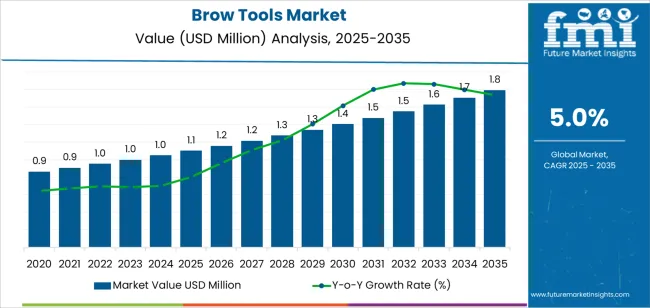
As Anastasia Soare, Founder & CEO of Anastasia Beverly Hills, noted regarding continuous product innovation in the brow category, “Technology changes all the time, so I want to be on top of everything. Every lab that comes up with eyebrow products, I think I'm the first one they send it to.” [1]
China (6.8% projected) and India (6.3% projected) drive new opportunities through expanding beauty retail networks and rising interest in grooming accessories among younger consumers. Germany (5.8% projected) and Brazil (5.3% projected) contribute via precision engineering and strong consumer engagement.
Brow Tools Market Definition
Brow tools encompass a range of specialized grooming implements designed for eyebrow shaping, maintenance, and styling. This includes tweezers for precise hair removal, eyebrow scissors for trimming, eyebrow razors for shaping and defining, and eyebrow brushes and spoolies for grooming and blending products. These tools serve both personal use (individual consumers performing DIY grooming at home) and commercial use (professional salons, spas, and beauty studios). The market is characterized by product differentiation based on material quality (stainless steel, coated alloys), ergonomic design, precision engineering, and integration with broader beauty and cosmetics offerings.
Brow Tools Market Inclusions
The report includes a comprehensive analysis of market dynamics, featuring Global and Regional Market Sizes (Volume and Value) and a 10-year Forecast (2026-2036). It covers segmental breakdowns by product type (Tweezers, Eyebrow Scissors, Eyebrow Razors, Eyebrow Brushes and Spoolies, Others), application (Personal Use, Commercial Use), and geographic regions.
Brow Tools Market Exclusions
The scope excludes general-purpose grooming tools not specifically designed for eyebrows, cosmetic products (pencils, powders, gels) without tool functionality, and electric grooming devices beyond basic trimmers.
Brow Tools Market Research Methodology
- Primary Research: Interviews were conducted with beauty tool manufacturers, salon professionals, retail buyers, and beauty influencers across major regions. Materials engineers clarified stainless steel and coating technologies.
- Desk Research: Beauty industry reports, retail sales data, and corporate financial filings supported volume benchmarking.
- Market-Sizing and Forecasting: A hybrid top-down and bottom-up model was developed. Demand was reconstructed from beauty product sales, consumer grooming trends, and professional salon counts, then validated against manufacturer shipment data.
- Data Validation and Update Cycle: Outputs undergo anomaly screening, variance checks across production and trade datasets, and structured peer review prior to release.
Segmental Analysis
Brow Tools Market Analysis by Product Type
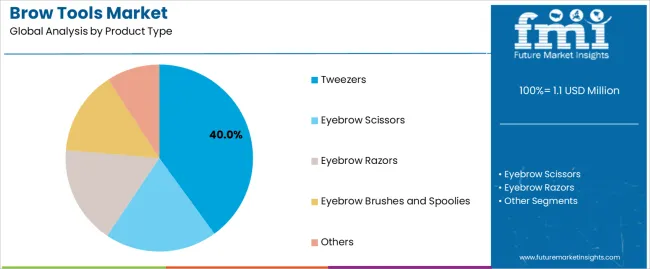
Based on FMI’s brow tools market report, tweezers are estimated to hold 40.0% share in 2026. Growth in tweezers comes from their widespread use as a primary tool for eyebrow shaping, grooming, and maintenance, offering precision control and versatility essential in both personal care routines and professional beauty applications.
- Functional Aesthetics: Fides Baldesberger, CEO of Rubis Switzerland, attributes the sector’s growth to the migration of watchmaking precision into beauty tools, noting, “Aesthetics are essentially the result of function: from the perfection with which the tweezers fulfil their respective purpose, from the precision with which they were created.” [2]
- Supply Chain Digitization: Manufacturers such as Zwilling Beauty Group, parent of Tweezerman, are strengthening logistics resilience through digital infrastructure upgrades, stating, “With the help of a digital customer portal, the plants were able to keep track of delivery quantities at all times, ensuring an uninterrupted flow of materials.” [3]
- Cross-Category Expansion: Retail groups are leveraging pet-care premiumization to create new tweezer use cases, highlighting that, “On average, pet owners spend around 1,400 US dollars a year on a dog, ideal conditions for the market launch of the Pet Collection, which includes fur brushes, scissors, nail clippers, and tick tweezers.” [3]
Brow Tools Market Analysis by Application
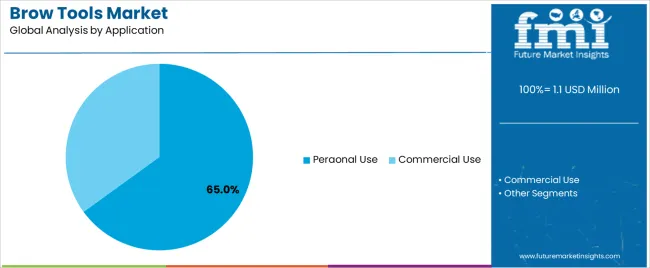
Personal use is estimated to hold 65.0% share in 2026, supported by the normalization of at-home grooming practices, strong retail accessibility, and rising consumer confidence in DIY beauty routines. The segment’s dominance reflects a structural migration from salon-dependent maintenance to tool-enabled self-care, reinforced by social media education and affordable, precision-engineered instruments.
- Routine Simplification: Jess Hunt, Co-founder of REFY Beauty, explains consumer adoption dynamics, stating, “We wanted to simplify that process and create something that truly worked for everyone. That's how Brow Sculpt was born, a world-first product designed to hold your brows in place, with all the tools you need to create any brow style you like.” [4]
- Holistic Integration: Vanita Parti, Founder of Blink Brow Bar, frames personal brow care within a wellness-oriented narrative, noting, “I brow pinch, trust me it makes the world of difference in mood, skin and brow health. Then I follow with Blink Brow Boost Growth Serum and Blink Lash Boost which help deliver peptides to hair follicles and boost hair growth.” [5]
- Authenticity Demand: Consumer preferences are shifting toward natural aesthetics, reinforcing tool-based enhancement strategies rather than heavy cosmetic concealment. As articulated by Jess Hunt, “REFY is all about simplifying, making beauty approachable and unintimidating. The one transforming makeup tip I swear by is less is more. Focus on enhancing your natural features rather than covering them.” [4]
Brow Tools Market Drivers, Restraints, and Opportunities
Future Market Insights analysis that historical patterns point at a mature but evolving personal care category where brow tools are benefiting from increased consumer focus on defined facial features and professional-quality results at home, now accelerated by digital beauty content and e-commerce accessibility. Estimated valuation in 2026 represents the "precision grooming adoption phase" as consumers invest in higher-quality tools for improved results.
While competition from low-cost substitutes and market saturation in developed regions limit margins, the trend toward premiumization and sustainable design creates opportunities for differentiated products, resulting in steady mid-single-digit growth aligned with broader beauty and personal care trends.
- Digital Beauty Influence: Social media platforms and beauty influencers drive consumer awareness of eyebrow shaping techniques and the tools required to achieve professional results, increasing demand for specialized products.
- DIY Grooming Culture: Rising preference for at-home grooming reduces salon dependency for routine maintenance, driving personal use segment growth for accessible, high-quality tools.
- Premiumization Trend: Consumers increasingly seek professional-grade tools with superior materials (stainless steel, coated alloys) and ergonomic designs that enhance precision and comfort.
Regional Analysis
Based on the regional analysis, the brow tools market is segmented into East Asia, Europe, North America, South Asia, Latin America, and Middle East & Africa across 40+ countries. The full report also offers market attractiveness analysis based on regional trends.
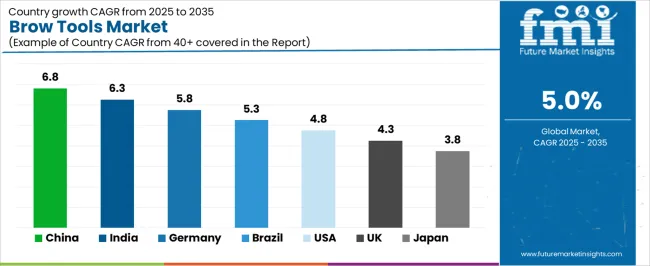
| Country | CAGR (2026 to 2036) |
|---|---|
| India | 6.3% |
| China | 6.8% |
| Brazil | 5.3% |
| United States | 4.8% |
| Germany | 5.8% |
| United Kingdom | 4.3% |
Source: Future Market Insights (FMI) analysis, based on proprietary forecasting model and primary research
North America Brow Tools Market Analysis
North America is characterized by prestige beauty consolidation and digital-first distribution models that elevate precision grooming tools into higher-margin accessory categories. Market growth is reinforced by omnichannel retail partnerships, influencer-led tutorials, and hybrid brow products that integrate tools with setting or conditioning formulas. Key players expanding distribution depth include Estée Lauder Companies and specialty retailers such as Ulta Beauty, which are investing heavily in experiential merchandising and digital commerce integration.
- United States: Demand for brow tools in the United States is projected to rise at 4.8% CAGR through 2036. Growth is supported by prestige beauty share gains and expanded digital retail channels, including Amazon and TikTok Shop partnerships, which broaden consumer reach and accelerate conversion rates in grooming accessories. [6]
FMI’s report includes a detailed analysis of growth in the North American region, along with a country-wise assessment that includes the United States and Canada. Readers can also find regional trends, retail channel evolution, and category-level performance across different segments and countries in North America.
Asia Pacific Brow Tools Market Analysis
Asia Pacific remains the global growth engine, supported by rapid urbanization, rising disposable income, and the expansion of specialized beauty retail networks. Product innovation cycles are shortening as multinational beauty houses accelerate launch cadence in China and India to capture high-growth consumer cohorts.
- China: Leading with a 6.8% CAGR, China’s market is benefiting from accelerated product launches and premium accessory positioning. L'Oréal reported sequential organic growth acceleration in 2025, supported by improved beauty market conditions and strong second-half recovery in China, reinforcing demand for precision grooming accessories aligned with premium cosmetics portfolios. [7]
- India: Domestic demand is advancing at a 6.3% CAGR, supported by rapid physical and digital retail expansion. Nykaa has expanded to 265 beauty stores across 90 cities and strengthened rapid-delivery infrastructure, increasing accessibility and SKU penetration for grooming tools across Tier 1 and Tier 2 urban centers. [8]
The full report analyzes the brow tools market across East and South Asia from 2021 to 2036, covering retail penetration, pricing trends, and consumer behavior shifts in China, Japan, South Korea, India, Indonesia, Malaysia, and Thailand. The assessment highlights trends shaping premiumization and tool-based beauty routines in the region.
Latin America Brow Tools Market Analysis
Latin America is emerging as a high-potential beauty accessories market, driven by social media influence, urban youth demographics, and premium grooming adoption. Retailers are expanding curated assortments to capture demand for precision tools aligned with natural brow styling trends.
- Brazil: A projected 5.3% CAGR through 2036 is supported by growing beauty consumption among urban middle-class consumers and expansion of specialty retail formats. Rising digital engagement and influencer-led tutorials are accelerating consumer education around precision grooming tools.
The report provides detailed analysis for Brazil, Mexico, Argentina, Chile, Peru, and the Rest of Latin America. Readers can find information about pricing dynamics, retail channel development, and category growth drivers influencing the Latin American market.
Europe Brow Tools Market Analysis
Europe represents a mature yet innovation-led market where growth is tied to premium assortment refresh, design precision, and brand repositioning following structural reorganizations within major consumer goods groups. Emphasis on quality engineering and aesthetic durability aligns with consumer preference for long-lasting grooming tools.
- Germany: Demand in Germany is projected to rise at 5.8% CAGR through 2036. Market stability follows corporate restructuring among leading beauty and consumer goods players such as Henkel, which has emphasized disciplined innovation and profitability resilience amid volatile conditions. [9]
- United Kingdom: The UK market is expected to grow at 4.3% CAGR through 2036, supported by emphasis on assortment newness and enhanced in-store and digital experiences that drive higher accessory attachment rates within prestige beauty retail environments. [10]
FMI’s analysis of the European brow tools market includes country-wise assessments covering Germany, France, Italy, the United Kingdom, Spain, Nordic countries, Benelux, and the Rest of Europe. Readers can review regulatory context, premiumization trends, and retail channel evolution shaping growth across the region.
Competitive Aligners for Market Players
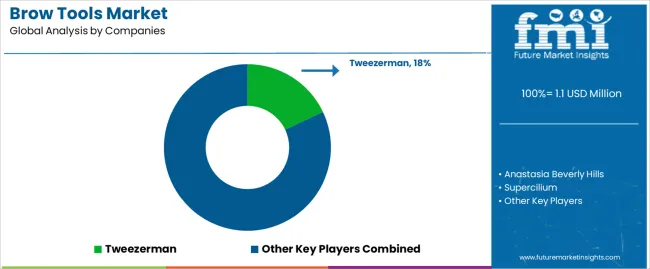
The brow tools market remains fragmented at the brand level, yet competitive power is concentrated among a limited group of precision-engineered manufacturers and globally scaled beauty accessory brands capable of meeting strict retailer quality and compliance standards. While numerous regional OEM suppliers operate across Asia and Europe, only established players consistently secure premium shelf placement across specialty chains and digital marketplaces. Core competitive variable is performance reliability at scale rather than short-term promotional pricing.
Vertical integration into stainless steel processing, in-house tip alignment calibration, and automated edge grinding enables tighter tolerance control and lower defect rates. Precision in slant geometry, tension balance, and tip symmetry directly influences consumer satisfaction and repeat purchase behavior. Brands without proprietary engineering capabilities often compete on price, increasing exposure to margin compression and retailer substitution during assortment reviews.
Retail concentration reinforces buyer leverage. Major distributors such as Sephora and Ulta Beauty multi-source suppliers to prevent dependency and demand exclusive SKUs, marketing collaboration, and ESG transparency. Sustained market position depends on logistics efficiency, documented material safety compliance, and consistent tool durability across large production volumes.
Recent Developments
- In May 2025, recent developments include E.l.f. Beauty’s $1 billion acquisition of Hailey Bieber’s Rhode brand, strengthening its skincare portfolio, expanding into prestige retail channels, and supporting continued long-term growth strategy [11].
- In January 2026, Rare Beauty expanded into all 1,500+ Ulta Beauty stores and Ulta.com nationwide, marking its first major retail expansion since launch and introducing exclusive kits alongside its bestselling products [12].
Key Players in Brow Tools Market
- Tweezerman
- Anastasia Beverly Hills
- Benefit Cosmetics
- Supercilium
- Joey Healy Eyebrow Studio
- Charlotte Tilbury
- Rare Beauty
- L'Oréal Paris
- KAI Corporation
- Green Bell Co., Ltd.
- EXCEL
- LAMELA
- FLYCO
- Revlon, Inc.
- e.l.f. Beauty, Inc.
- NYX Professional Makeup
- Maybelline New York
- Sephora Collection
- Ulta Beauty Collection
- MAC Cosmetics
Scope of the Report
| Metric | Value |
|---|---|
| Quantitative Units | USD 1.2 billion (2026) to USD 1.8 billion (2036), at a CAGR of 5.0% |
| Market Definition | The brow tools market comprises the global production and trade of specialized grooming implements designed for eyebrow shaping, trimming, and styling, including tweezers, scissors, razors, and brushes used for both personal and professional applications, differentiated by material quality, ergonomic design, and precision engineering. |
| Product Type Segmentation | Tweezers, Eyebrow Scissors, Eyebrow Razors, Eyebrow Brushes and Spoolies, Others |
| Application Segmentation | Personal Use, Commercial Use |
| Application Coverage | Hair Removal and Shaping, Trimming, Styling and Blending, Precision Definition, Grooming Maintenance |
| Regions Covered | North America, Latin America, Europe, East Asia, South Asia, Middle East & Africa, Eastern Europe |
| Countries Covered | United States, Canada, Mexico, Brazil, Argentina, Germany, United Kingdom, France, Italy, Spain, Switzerland, China, Japan, South Korea, India, Pakistan, Bangladesh, Australia, GCC Countries, Turkey, South Africa, Russia, Poland, Czech Republic and 30+ countries |
| Key Companies Profiled | Tweezerman, Anastasia Beverly Hills, Benefit Cosmetics, Charlotte Tilbury, Rare Beauty, L'Oréal Paris, KAI Corporation, Green Bell Co., Ltd., Revlon, Inc., e.l.f. Beauty, Inc., Sephora Collection, Ulta Beauty Collection |
| Forecast Period | 2026 to 2036 |
| Approach | Hybrid top-down and bottom-up market modeling validated through primary interviews with beauty tool manufacturers, salon professionals, and retail buyers, supported by retail sales benchmarking, shipment analysis, and structured data validation checks. |
Brow Tools Market Analysis by Segments
Product Type:
- Tweezers
- Slant Tip Tweezers
- Point Tip Tweezers
- Flat Tip Tweezers
- Precision/Electronic Tweezers
- Eyebrow Scissors
- Straight Scissors
- Curved Scissors
- Safety Tip Scissors
- Eyebrow Razors
- Disposable Razors
- Reusable Razors with Replaceable Blades
- Precision Trimmers
- Eyebrow Brushes and Spoolies
- Angled Brushes
- Spoolie Brushes
- Dual-Ended Tools
- Others (Combination Kits, Stencils, Guides)
Application:
- Personal Use
- At-Home Grooming
- Travel/Portable Kits
- Commercial Use
- Professional Salons
- Spas and Beauty Studios
- Makeup Artists
Region:
- East Asia
- China
- Japan
- South Korea
- Taiwan
- Rest of East Asia
- Europe
- Germany
- United Kingdom
- France
- Italy
- Spain
- Switzerland
- Nordic
- BENELUX
- Rest of Europe
- North America
- United States
- Canada
- Mexico
- South Asia
- India
- Pakistan
- Bangladesh
- Rest of South Asia
- Latin America
- Brazil
- Argentina
- Chile
- Rest of Latin America
- Middle East & Africa
- GCC Countries
- Turkey
- South Africa
- Rest of Middle East & Africa
- Eastern Europe
- Russia
- Poland
- Czech Republic
- Rest of Eastern Europe
Bibliography
- Anastasia Beverly Hills Founder Anastasia Soare on New Book Raising Brows. (2025). Forbes.
- Rubis AG. (2025). The best that can be in tweezers: 60 years of Rubis.
- Werhahn Group. (2025). Annual report 2024.
- Space NK. (2025). Jess Hunt: REFY interview.
- Parti, V. (2025). Inside my makeup bag. Country & Town House.
- Estée Lauder Companies Inc. (2026). Reports fiscal 2026 second quarter results. TradingView News.
- L’Oréal Group. (2025). 2025 annual results press release.
- Nykaa. (2025). Press release.
- RetailDetail. (2025). Henkel lowers expectations for 2025.
- Ulta Beauty, Inc. (2025). Ulta Beauty announces third quarter fiscal 2025 results.
- Retail Dive. (2025). E.l.f. Beauty to acquire Hailey Bieber’s Rhode for $1B.
- Premium Beauty News. (2025). Selena Gomez’s Rare Beauty expands to Ulta Beauty across the USA.
This bibliography is provided for reader reference and is not exhaustive. The full report contains the complete reference list and detailed citations.
This Report Addresses
- Market intelligence to enable structured strategic decision-making across mature and emerging brow tools markets
- Market size estimation and 10-year revenue forecasts from 2026 to 2036, supported by validated beauty retail data and consumer trends
- Growth opportunity mapping across product types and applications with emphasis on tweezers and personal use segments
- Segment and regional revenue forecasts covering all major product categories and geographic regions
- Competition strategy assessment including product quality, brand reputation, and distribution strength benchmarking
- Technology roadmap tracking including ergonomic design, material innovation, and sustainable packaging
- Regulatory impact analysis covering product safety standards and material certifications
- Market report delivery in PDF, Excel, PPT, and interactive dashboard formats for executive and operational use
Frequently Asked Questions
How large is the demand for Brow Tools in the global market in 2026?
Demand for brow tools in the global market is estimated to be valued at USD 1.2 million in 2026.
What will be the market size of Brow Tools in the global market by 2036?
The brow tools market is projected to reach approximately USD 1.8 million by 2036.
What is the expected demand growth for Brow Tools in the global market between 2026 and 2036?
Demand for brow tools is expected to grow at a CAGR of 5.0% between 2026 and 2036.
Which Product Type is poised to lead global sales by 2026?
Tweezers are expected to be the dominant product type, capturing approximately 40.0% of global market share in 2026 due to their precision and versatility.
How significant is the role of Personal Use in driving Brow Tools adoption in 2026?
Personal use represents the leading application segment, projected to hold around 65.0% share of the total market in 2026 as DIY grooming gains traction.
What is driving Brow Tools demand in the United States?
Growth in the United States is driven by prestige beauty expansion, digital retail penetration, and influencer-led consumer education around precision grooming.
What is the United States growth outlook in this report?
The United States is projected to grow at a CAGR of 4.8% during 2026 to 2036.
Why is Asia Pacific described as the growth engine in this report?
Asia Pacific leads growth due to expanding beauty retail networks, rising disposable income, and accelerated product launch cycles in China and India.
What is China’s growth outlook in this report?
China is projected to expand at a CAGR of 6.8% during 2026 to 2036.
What is India’s growth outlook in this report?
India is projected to grow at a CAGR of 6.3% during 2026 to 2036.
What is Germany’s growth outlook in this report?
Germany is expected to grow at a CAGR of 5.8% during the forecast period.
What is Brazil’s growth outlook in this report?
Brazil is projected to expand at a CAGR of 5.3% between 2026 and 2036.
What is the United Kingdom’s growth outlook in this report?
The United Kingdom is expected to grow at a CAGR of 4.3% during the forecast period.
What materials are strategically important for product differentiation in this market?
Stainless steel and coated-alloy materials are strategically important due to their durability, precision alignment, and ergonomic performance.
What is included in the scope of this Brow Tools market report?
The scope covers product type segmentation, application analysis, regional forecasts, competitive benchmarking, and a 10-year revenue projection from 2026 to 2036.
What is excluded from the scope of this report?
General-purpose grooming tools, cosmetic products without tool functionality, and advanced electric grooming devices are excluded from the scope.
What does market forecast mean in this report?
Market forecast refers to a model-based projection built on validated retail data, consumer trends, and manufacturer shipment analysis for strategic planning.
How does FMI build and validate the Brow Tools market forecast?
The forecast is developed using hybrid top-down and bottom-up modeling validated through primary interviews, retail benchmarking, and structured data verification.
What does zero reliance on speculative third-party market research mean here?
It indicates that projections are based on primary interviews, verifiable retail statistics, and documented industry data rather than unverified syndicated estimates.
Preview the report firsthand - request a free sample
Get SampleGet the brochure for pricing and purchase details.
Get PDFTable of Content
- Executive Summary
- Global Market Outlook
- Demand-side Trends
- Supply-side Trends
- Technology Roadmap Analysis
- Analysis and Recommendations
- Market Overview
- Market Coverage / Taxonomy
- Market Definition / Scope / Limitations
- Research Methodology
- Chapter Orientation
- Analytical Lens and Working Hypotheses
- Market Structure, Signals, and Trend Drivers
- Benchmarking and Cross-market Comparability
- Market Sizing, Forecasting, and Opportunity Mapping
- Research Design and Evidence Framework
- Desk Research Programme (Secondary Evidence)
- Company Annual and Sustainability Reports
- Peer-reviewed Journals and Academic Literature
- Corporate Websites, Product Literature, and Technical Notes
- Earnings Decks and Investor Briefings
- Statutory Filings and Regulatory Disclosures
- Technical White Papers and Standards Notes
- Trade Journals, Industry Magazines, and Analyst Briefs
- Conference Proceedings, Webinars, and Seminar Materials
- Government Statistics Portals and Public Data Releases
- Press Releases and Reputable Media Coverage
- Specialist Newsletters and Curated Briefings
- Sector Databases and Reference Repositories
- FMI Internal Proprietary Databases and Historical Market Datasets
- Subscription Datasets and Paid Sources
- Social Channels, Communities, and Digital Listening Inputs
- Additional Desk Sources
- Expert Input and Fieldwork (Primary Evidence)
- Primary Modes
- Qualitative Interviews and Expert Elicitation
- Quantitative Surveys and Structured Data Capture
- Blended Approach
- Why Primary Evidence is Used
- Field Techniques
- Interviews
- Surveys
- Focus Groups
- Observational and In-context Research
- Social and Community Interactions
- Stakeholder Universe Engaged
- C-suite Leaders
- Board Members
- Presidents and Vice Presidents
- R&D and Innovation Heads
- Technical Specialists
- Domain Subject-matter Experts
- Scientists
- Physicians and Other Healthcare Professionals
- Governance, Ethics, and Data Stewardship
- Research Ethics
- Data Integrity and Handling
- Primary Modes
- Tooling, Models, and Reference Databases
- Desk Research Programme (Secondary Evidence)
- Data Engineering and Model Build
- Data Acquisition and Ingestion
- Cleaning, Normalisation, and Verification
- Synthesis, Triangulation, and Analysis
- Quality Assurance and Audit Trail
- Market Background
- Market Dynamics
- Drivers
- Restraints
- Opportunity
- Trends
- Scenario Forecast
- Demand in Optimistic Scenario
- Demand in Likely Scenario
- Demand in Conservative Scenario
- Opportunity Map Analysis
- Product Life Cycle Analysis
- Supply Chain Analysis
- Investment Feasibility Matrix
- Value Chain Analysis
- PESTLE and Porter’s Analysis
- Regulatory Landscape
- Regional Parent Market Outlook
- Production and Consumption Statistics
- Import and Export Statistics
- Market Dynamics
- Global Market Analysis 2021 to 2025 and Forecast, 2026 to 2036
- Historical Market Size Value (USD Billion) Analysis, 2021 to 2025
- Current and Future Market Size Value (USD Billion) Projections, 2026 to 2036
- Y-o-Y Growth Trend Analysis
- Absolute $ Opportunity Analysis
- Global Market Pricing Analysis 2021 to 2025 and Forecast 2026 to 2036
- Global Market Analysis 2021 to 2025 and Forecast 2026 to 2036, By Product Type
- Introduction / Key Findings
- Historical Market Size Value (USD Billion) Analysis By Product Type , 2021 to 2025
- Current and Future Market Size Value (USD Billion) Analysis and Forecast By Product Type , 2026 to 2036
- Tweezers
- Eyebrow Scissors
- Eyebrow Razors
- Tweezers
- Y-o-Y Growth Trend Analysis By Product Type , 2021 to 2025
- Absolute $ Opportunity Analysis By Product Type , 2026 to 2036
- Global Market Analysis 2021 to 2025 and Forecast 2026 to 2036, By Application
- Introduction / Key Findings
- Historical Market Size Value (USD Billion) Analysis By Application, 2021 to 2025
- Current and Future Market Size Value (USD Billion) Analysis and Forecast By Application, 2026 to 2036
- Personal Use
- Commercial Use
- Personal Use
- Y-o-Y Growth Trend Analysis By Application, 2021 to 2025
- Absolute $ Opportunity Analysis By Application, 2026 to 2036
- Global Market Analysis 2021 to 2025 and Forecast 2026 to 2036, By Region
- Introduction
- Historical Market Size Value (USD Billion) Analysis By Region, 2021 to 2025
- Current Market Size Value (USD Billion) Analysis and Forecast By Region, 2026 to 2036
- North America
- Latin America
- Western Europe
- Eastern Europe
- East Asia
- South Asia and Pacific
- Middle East & Africa
- Market Attractiveness Analysis By Region
- North America Market Analysis 2021 to 2025 and Forecast 2026 to 2036, By Country
- Historical Market Size Value (USD Billion) Trend Analysis By Market Taxonomy, 2021 to 2025
- Market Size Value (USD Billion) Forecast By Market Taxonomy, 2026 to 2036
- By Country
- USA
- Canada
- Mexico
- By Product Type
- By Application
- By Country
- Market Attractiveness Analysis
- By Country
- By Product Type
- By Application
- Key Takeaways
- Latin America Market Analysis 2021 to 2025 and Forecast 2026 to 2036, By Country
- Historical Market Size Value (USD Billion) Trend Analysis By Market Taxonomy, 2021 to 2025
- Market Size Value (USD Billion) Forecast By Market Taxonomy, 2026 to 2036
- By Country
- Brazil
- Chile
- Rest of Latin America
- By Product Type
- By Application
- By Country
- Market Attractiveness Analysis
- By Country
- By Product Type
- By Application
- Key Takeaways
- Western Europe Market Analysis 2021 to 2025 and Forecast 2026 to 2036, By Country
- Historical Market Size Value (USD Billion) Trend Analysis By Market Taxonomy, 2021 to 2025
- Market Size Value (USD Billion) Forecast By Market Taxonomy, 2026 to 2036
- By Country
- Germany
- UK
- Italy
- Spain
- France
- Nordic
- BENELUX
- Rest of Western Europe
- By Product Type
- By Application
- By Country
- Market Attractiveness Analysis
- By Country
- By Product Type
- By Application
- Key Takeaways
- Eastern Europe Market Analysis 2021 to 2025 and Forecast 2026 to 2036, By Country
- Historical Market Size Value (USD Billion) Trend Analysis By Market Taxonomy, 2021 to 2025
- Market Size Value (USD Billion) Forecast By Market Taxonomy, 2026 to 2036
- By Country
- Russia
- Poland
- Hungary
- Balkan & Baltic
- Rest of Eastern Europe
- By Product Type
- By Application
- By Country
- Market Attractiveness Analysis
- By Country
- By Product Type
- By Application
- Key Takeaways
- East Asia Market Analysis 2021 to 2025 and Forecast 2026 to 2036, By Country
- Historical Market Size Value (USD Billion) Trend Analysis By Market Taxonomy, 2021 to 2025
- Market Size Value (USD Billion) Forecast By Market Taxonomy, 2026 to 2036
- By Country
- China
- Japan
- South Korea
- By Product Type
- By Application
- By Country
- Market Attractiveness Analysis
- By Country
- By Product Type
- By Application
- Key Takeaways
- South Asia and Pacific Market Analysis 2021 to 2025 and Forecast 2026 to 2036, By Country
- Historical Market Size Value (USD Billion) Trend Analysis By Market Taxonomy, 2021 to 2025
- Market Size Value (USD Billion) Forecast By Market Taxonomy, 2026 to 2036
- By Country
- India
- ASEAN
- Australia & New Zealand
- Rest of South Asia and Pacific
- By Product Type
- By Application
- By Country
- Market Attractiveness Analysis
- By Country
- By Product Type
- By Application
- Key Takeaways
- Middle East & Africa Market Analysis 2021 to 2025 and Forecast 2026 to 2036, By Country
- Historical Market Size Value (USD Billion) Trend Analysis By Market Taxonomy, 2021 to 2025
- Market Size Value (USD Billion) Forecast By Market Taxonomy, 2026 to 2036
- By Country
- Kingdom of Saudi Arabia
- Other GCC Countries
- Turkiye
- South Africa
- Other African Union
- Rest of Middle East & Africa
- By Product Type
- By Application
- By Country
- Market Attractiveness Analysis
- By Country
- By Product Type
- By Application
- Key Takeaways
- Key Countries Market Analysis
- USA
- Pricing Analysis
- Market Share Analysis, 2025
- By Product Type
- By Application
- Canada
- Pricing Analysis
- Market Share Analysis, 2025
- By Product Type
- By Application
- Mexico
- Pricing Analysis
- Market Share Analysis, 2025
- By Product Type
- By Application
- Brazil
- Pricing Analysis
- Market Share Analysis, 2025
- By Product Type
- By Application
- Chile
- Pricing Analysis
- Market Share Analysis, 2025
- By Product Type
- By Application
- Germany
- Pricing Analysis
- Market Share Analysis, 2025
- By Product Type
- By Application
- UK
- Pricing Analysis
- Market Share Analysis, 2025
- By Product Type
- By Application
- Italy
- Pricing Analysis
- Market Share Analysis, 2025
- By Product Type
- By Application
- Spain
- Pricing Analysis
- Market Share Analysis, 2025
- By Product Type
- By Application
- France
- Pricing Analysis
- Market Share Analysis, 2025
- By Product Type
- By Application
- India
- Pricing Analysis
- Market Share Analysis, 2025
- By Product Type
- By Application
- ASEAN
- Pricing Analysis
- Market Share Analysis, 2025
- By Product Type
- By Application
- Australia & New Zealand
- Pricing Analysis
- Market Share Analysis, 2025
- By Product Type
- By Application
- China
- Pricing Analysis
- Market Share Analysis, 2025
- By Product Type
- By Application
- Japan
- Pricing Analysis
- Market Share Analysis, 2025
- By Product Type
- By Application
- South Korea
- Pricing Analysis
- Market Share Analysis, 2025
- By Product Type
- By Application
- Russia
- Pricing Analysis
- Market Share Analysis, 2025
- By Product Type
- By Application
- Poland
- Pricing Analysis
- Market Share Analysis, 2025
- By Product Type
- By Application
- Hungary
- Pricing Analysis
- Market Share Analysis, 2025
- By Product Type
- By Application
- Kingdom of Saudi Arabia
- Pricing Analysis
- Market Share Analysis, 2025
- By Product Type
- By Application
- Turkiye
- Pricing Analysis
- Market Share Analysis, 2025
- By Product Type
- By Application
- South Africa
- Pricing Analysis
- Market Share Analysis, 2025
- By Product Type
- By Application
- USA
- Market Structure Analysis
- Competition Dashboard
- Competition Benchmarking
- Market Share Analysis of Top Players
- By Regional
- By Product Type
- By Application
- Competition Analysis
- Competition Deep Dive
- Tweezerman
- Overview
- Product Portfolio
- Profitability by Market Segments (Product/Age /Sales Channel/Region)
- Sales Footprint
- Strategy Overview
- Marketing Strategy
- Product Strategy
- Channel Strategy
- Anastasia Beverly Hills
- Benefit Cosmetics
- Supercilium
- Joey Healy Eyebrow Studio
- Charlotte Tilbury
- Rare Beauty
- Tweezerman
- Competition Deep Dive
- Assumptions & Acronyms Used


