
- Market Size (2026)
- USD 708.8 Mn
- Forecast (2036)
- USD 1100.7 Mn
- CAGR (2026 to 2036)
- 4.5%
How big is the Middle East veterinary vaccines market in 2026?
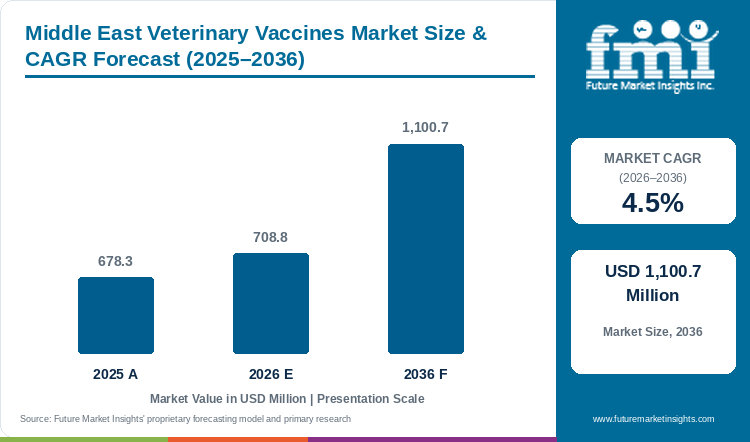
The market was estimated at USD 678.3 million in 2025 and is expected to reach USD 708.8 million in 2026. It is forecast to grow at a CAGR of 4.5% from 2026 to 2036 and reach USD 1,100.7 million by 2036.
Vaccine purchasing in the Middle East connects disease prevention with the practical demands of animal production and veterinary care. A livestock authority procuring for a field campaign, a poultry hatchery and a companion-animal hospital each need different products and delivery arrangements. The report’s growth outlook therefore rests on several purchasing channels with distinct specifications. Regional recommendations place vaccine quality and FMD strain matching alongside stronger laboratories and surveillance. Those requirements influence which products can serve a programme and how suppliers support an order. The broader animal healthcare market provides the adjoining medicines and services through which farms and veterinary providers organise continuing animal care.
Key Market Trends & Insights
- Live attenuated vaccines form a substantial part of the estimated vaccine-type mix, while veterinary hospitals are a significant purchasing channel under the separate end-user classification.
- Quality assurance, surveillance and laboratory coordination influence specifications for regional FMD and PPR programmes.
- Poultry suppliers differentiate through vaccine portfolios, hatchery services and delivery equipment as well as the biological product.
Country Highlights
- The United Arab Emirates and Saudi Arabia are projected to lead the country growth outlook for 2026-2036.
- Türkiye’s SAT1 response and Sudan’s conflict-related distribution constraints create different requirements for vaccine supply and supporting services.
Market Size & Forecast
Table 1: Middle East Veterinary Vaccines Market Size and Forecast (USD million), 2025 to 2036
| Market size and forecast | Value |
|---|---|
| 2025 Value | USD 678.3 million |
| Estimated market size in 2026 | USD 708.8 million |
| Projected market size by 2036 | USD 1,100.7 million |
| CAGR (2026-2036) | 4.5% |
What shapes the market beyond its headline growth?
The estimated market value brings together purchases whose timing and commercial purpose vary considerably. A public campaign can require coordinated deliveries across an implementation period, whereas a veterinary hospital must keep a suitable range available for continuing care. A poultry producer can connect vaccine procurement with hatchery operations and successive production cycles. These buyers evaluate an offer against the activity it must support. Product price remains relevant, but the resulting purchase also depends on an acceptable indication, a workable presentation and the supplier’s ability to meet agreed delivery requirements.
Disease information changes the content of that specification. WOAH reported first occurrences of FMD SAT1 in Israel and Palestine in 2026. A new disease notification can increase attention to preparedness, sample testing and suitable supply. Before procurement, veterinary assessment has to establish the requirement and the purchasing organisation has to secure funding and arrange delivery. The time needed for those steps affects when manufacturers and distributors receive an order and how much stock they commit to the programme.
The region also contains different combinations of public procurement, domestic production and international supply. Saudi Arabia’s 2026 vaccine-production memorandum concerns industrial cooperation, while Sudan’s emergency response illustrates a supply system operating around damaged infrastructure. The implications for suppliers differ: industrial partnerships demand technical and organisational commitments; emergency delivery requires practical coordination across an accessible route. The global veterinary vaccines market provides a wider setting for the technologies and manufacturers serving these needs, while individual country programmes determine the actual purchasing specification.
Table 2: Supporting Industry Indicators and Their Commercial Relevance
| Indicator | Data point | Why it matters | Source |
|---|---|---|---|
| Regional prevention priorities | 2025 roadmap addresses quality-assured vaccine supply, laboratories and FMD matching | Connects technical evidence with procurement specifications | |
| FMD SAT1 notifications | Israel and Palestine reported first occurrences in 2026 | Informs preparedness and surveillance requirements | |
| Abu Dhabi programme | 2025-2026 campaign distinguishes diseases, species and holding types | Creates differentiated scheduling and product requirements | |
| Saudi industrial cooperation | Veterinary vaccine localization MoU signed in June 2026 | Supports evaluation of production and antigen-bank partnerships | |
| Sudan delivery conditions | Conflict damaged services; FAO describes imports and cold-chain support | Makes access and distribution central to supply execution |
Demand Intensity Analysis
Demand intensity depends on how a prevention requirement becomes a funded and deliverable purchase. Organised programmes can concentrate ordering around campaign windows, while hospitals and other veterinary providers require replenishment linked to their service activity. The breadth of the order also matters. A customer may need several disease-specific products, yet its purchasing department can consolidate logistics and documentation. Suppliers then have to maintain the distinction between each product specification while managing the combined commercial relationship.
The principal constraints appear at different stages. A programme can have a clearly identified animal population but limited delivery capacity, or a supplier can have an appropriate product while commercial terms are still being agreed. Inventory management connects the two. Deliveries that run ahead of use occupy storage and working capital; deliveries that arrive after scheduled activity can disrupt the programme. Staged purchasing can align stock with the buyer’s intended field activity, provided the delivery route remains workable. Disease surveillance contributes to the technical definition of demand, and the veterinary diagnostics market supports that information flow through testing and associated services.
Table 3: Demand Metrics and Their Bases
| Demand intensity metric | Value | Basis |
|---|---|---|
| Market value | USD 678.3 million | Estimated 2025 value . Baseline revenue estimate |
| Market value | USD 708.8 million | 2026 estimate . Opening market value for the forecast period |
| Forecast value | USD 1,100.7 million | 2036 forecast value . Endpoint of the market outlook |
| Market growth | 4.5% CAGR | 2026-2036 forecast . Compound annual market growth |
| Live attenuated vaccines | Estimated 45.0% | Vaccine-type classification, 2026 forecast . Technology mix |
| Veterinary hospitals | Estimated 42.0% | Separate end-user classification, 2026 forecast . Delivery-channel mix |
Analyst Perspective
For veterinary vaccine buyers in the Middle East, a supplier's catalogue becomes commercially useful when each disease and species requirement is matched to a workable supply arrangement. Agreeing product release, storage and onward delivery during procurement helps receiving organisations plan their resources and gives suppliers a basis for continuing business as programmes develop.
- Anurag Sharma, Principal Consultant, FMI
How is the Middle East veterinary vaccines market segmented?
The report covers vaccine type, animal, disease indication, end user and country. Its vaccine-type categories are Live attenuated vaccines and Other vaccine types; animal coverage comprises Livestock and Companion animals; end users are Veterinary hospitals and Other veterinary providers. The country profiles cover the United Arab Emirates, Saudi Arabia, Türkiye, Jordan and Sudan. Disease discussion addresses the different programme requirements associated with FMD, PPR and poultry-specific indications. These dimensions describe different aspects of the same market, so a technology category and an end-user category serve separate analytical purposes.
How do live attenuated vaccines lead demand by vaccine type?
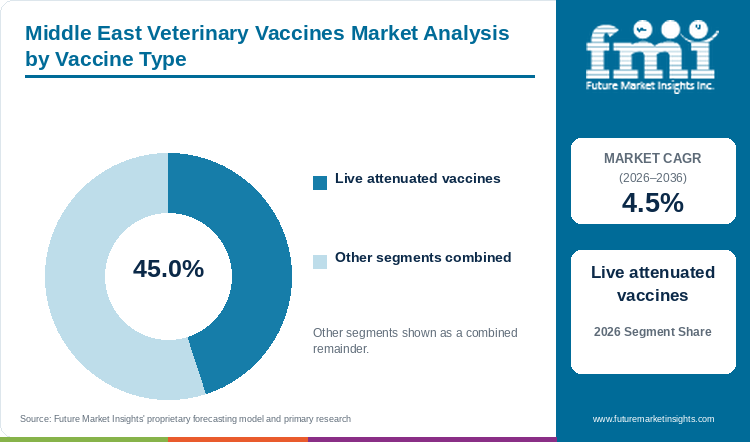
Live attenuated vaccines are expected to remain the leading individual vaccine type, accounting for an estimated 45.0% of market revenue in 2026.
Live attenuated products enter disease-specific purchasing programmes through individual authorised indications. An order identifies the intended species and product before quantities and commercial terms are agreed. JOVAC’s catalogue, for example, names separate Newcastle disease, infectious bronchitis and infectious bursal disease products, showing how a supplier organises poultry offers around defined requirements. Each entry gives the buyer a starting point for discussing presentation, delivery and the documentation that will accompany supply.
The relevant purchasing question is how an individual product fits the programme’s operations. Presentation, required handling and the documentation accompanying supply influence the practical comparison. Buyers considering a change of supplier must assess the complete product specification and the support needed to introduce it into their own arrangements.
- Disease and species requirements determine which catalogue entries can enter a purchasing comparison.
- Handling and product documentation affect the work involved in changing suppliers.
How do other vaccine types broaden the available product mix?
Other vaccine types give buyers additional product formats for distinct programme requirements.
Official portfolios show that the market contains more than one technology route. MSD’s Middle East documentation describes Nobilis H9N2+ND P as an inactivated product for chickens, while Boehringer Ingelheim’s US documentation describes VAXXITEK HVT+IBD as an HVT-based vector vaccine in a frozen presentation. These examples establish different company capabilities, with country-specific availability governed by the relevant local product arrangements.
For a commercial buyer, the consequence is a more detailed comparison than a choice between corporate brands. A frozen presentation makes the receiving and storage arrangement part of the assessment before an order is confirmed. A product linked to hatchery operations also places the purchasing discussion at a different point in the production chain from a product supplied to another care setting. A supplier entering a new account therefore needs to explain the operational requirements of its particular offer, alongside the disease and species specification.
- Technology diversity expands the questions a buyer asks about presentation and programme fit.
- A documented international portfolio provides a starting point for local product assessment.
How does livestock lead vaccine demand by animal type?
Livestock is expected to account for an estimated 64.0% of market revenue by animal type in 2026. Livestock purchases connect vaccine supply with the organisation of herd and flock health programmes.
Farms and public authorities can organise demand around groups of animals, locations and planned field activity. Abu Dhabi’s campaign explicitly distinguishes sheep, goats and cattle and separates traditional holdings from commercial cattle farms. The procurement implication is that a campaign can contain several different product and distribution requirements within one administrative programme.
The commercial contract must connect the biological product with that operating plan. Agreed delivery dates, product identity and the division of responsibilities between central storage and field distribution affect whether the order can support scheduled work. This creates demand for suppliers capable of describing their commitments at each handover, especially when the buyer coordinates several implementing teams.
- Programme design can create several product requirements within a single purchasing relationship.
- Delivery responsibilities become material when stock moves from central storage to field teams.
How do companion-animal providers organise vaccine availability?
Companion-animal vaccine procurement is closely connected with continuing veterinary care.
A provider serving individual animals needs a product range appropriate to the services it offers and the appointments it expects to perform. This creates a different inventory problem from a time-limited livestock campaign. A broader range can support more care requirements, while slow-moving stock occupies space and purchasing funds. The useful supply arrangement combines clear product information with replenishment that fits the provider’s activity.
Indian Immunologicals’ company presentation lists canine vaccines alongside its livestock biological products, demonstrating that suppliers can operate across both animal categories. For the purchasing organisation, catalogue breadth can simplify account administration, although each product still carries its own specification and handling requirements. Account convenience therefore has value when the underlying product fit is established.
- Provider activity and product breadth shape the inventory held for continuing care.
- A supplier spanning animal categories can offer account convenience across distinct product requirements.
How do veterinary hospitals lead vaccine demand by end user?
Veterinary hospitals are expected to remain the leading individual end-user segment, accounting for an estimated 42.0% of market revenue in 2026, within a broader delivery network of animal-health programmes and veterinary providers.
Hospitals bring procurement close to the clinical decisions that determine which products will be needed. Their purchasing staff must translate planned activity into available stock while managing storage and cash commitments. This makes reliable replenishment commercially important even when an individual order is smaller than a public campaign contract.
The supplier relationship also involves the quality of information accompanying an order. Clear product identification, consistent documentation and an accessible technical contact help a hospital manage routine purchasing and queries. Where a group operates several locations, central buying may need to accommodate different activity at each site. The resulting demand is for a supply service that supports continuity across the network without forcing every location to hold the same inventory.
- Replenishment reliability supports the hospital’s planned care activity.
- Several locations can share procurement while retaining different stock requirements.
How can other veterinary providers serve different programme needs?
Other veterinary providers connect vaccine supply with care delivered outside hospital purchasing systems.
This category can involve purchasing arrangements tied to field services and other animal-health activity within the report’s scope. Regional recommendations call for coordination between veterinary services and private actors in vaccine delivery. A provider participating in such arrangements needs a supply offer suited to its actual role: ordering products, receiving them, or supporting their onward distribution.
Commercial terms become clearer when those tasks are specified. A customer responsible for multiple delivery points may value distribution support, while another may mainly need predictable access to a narrow product range. Suppliers can respond with a defined service commitment that reflects the buyer’s work. That approach also helps separate the cost of the vaccine from the cost of reaching the place where it is required.
- The provider’s role determines which delivery and support services have commercial value.
- Clear responsibility for onward distribution improves the comparison of supply offers.
Why do disease indications require separate purchasing specifications?
Disease indications determine the technical purpose of a purchase across the report’s animal categories.
FMD and PPR have distinct biological and programme contexts. WOAH identifies PPR as a disease of domestic small ruminants and wild artiodactyls. FMD procurement places specific emphasis on the relationship between circulating virus and vaccine strains. Poultry portfolios address their own indications, including Newcastle disease and infectious bursal disease. These requirements create separate product comparisons even where a buyer deals with the same manufacturer.
The purchasing consequence is a need for an unambiguous specification before quantities, lead times and price are settled. A generic requirement for a veterinary vaccine leaves essential commercial questions unanswered. Disease-specific ordering allows the buyer and supplier to define the product and the associated service around a clear purpose.
- FMD, PPR and poultry indications create different product requirements.
- A precise indication reduces uncertainty when a programme compares supply commitments.
What are the drivers, restraints and opportunities in the Middle East veterinary vaccines market?
Surveillance findings can change antigen requirements, while funding and staffing constraints limit the vaccine purchasing commitments that regional animal health programmes can deliver. Suppliers have opportunities to support defined vaccination tasks through technical services and to strengthen supply continuity where sourcing or production plans align with demand and delivery requirements.
How does surveillance change the commercial specification?
A surveillance result can alter which antigen or product specification a programme needs. The regional roadmap links sample collection, laboratory networks and FMD vaccine matching. Commercially, that connection makes access to relevant technical information part of product planning. Suppliers need to understand the programme’s specified requirement before committing production or inventory. Buyers also benefit from a clear route between veterinary assessment and the tender or order, so that a technical change is reflected accurately in the requested supply.
Where do financing and delivery restrain purchasing?
The need for prevention can exceed the resources available to implement it. The roadmap identifies limited investment in some regional animal-health systems, and Jordan’s budget documentation records staffing and funding constraints within its livestock programme. A purchasing organisation facing those conditions has to align the order with the activity it can finance and deliver. Suppliers may encounter requests for smaller or phased commitments, additional distribution work, or coordination with implementing partners. These are practical commercial constraints even where the disease need is well established.
How can technical services create a distinct supplier opportunity?
Poultry offers illustrate the opportunity to support the work surrounding vaccine use. Ceva’s regional website presents health monitoring, vaccination services and equipment alongside its products. Such services can give buyers a more coherent operational offer when they address a defined task within a hatchery or production business. Their economic value depends on the work covered and the responsibilities agreed. A service bundle becomes easier to assess when the customer can identify which activities it replaces or supports and what resources it still needs to provide.
What makes supply continuity an opportunity for investment?
The Saudi localization agreement and Sudan’s emergency imports show different reasons to examine supply continuity. One concerns developing industrial cooperation; the other concerns maintaining access after disruption to national veterinary capacity. For manufacturers and distribution partners, both involve commitments beyond a catalogue listing. Investment has to connect a production or sourcing plan with demand, technical requirements and a workable delivery system. The opportunity is strongest where those elements can support continuing orders, with enough operational clarity to justify the resources assigned.
How does the country outlook compare?
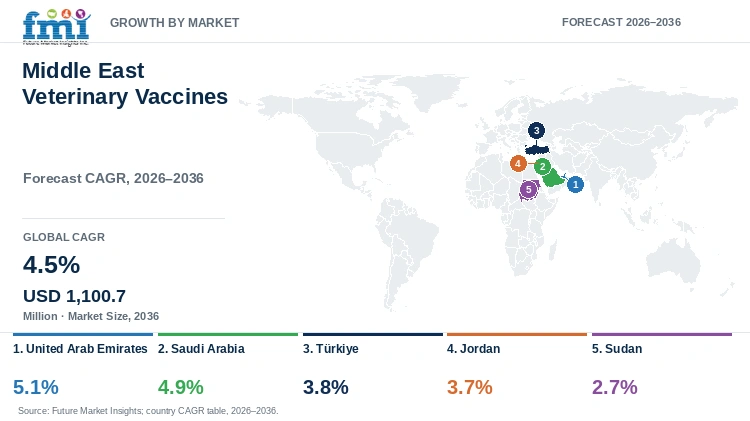
The country outlook covers the 2026-2036 forecast period. The United Arab Emirates and Saudi Arabia lead the profiled growth rates, while Türkiye, Jordan and Sudan have distinct operating conditions affecting how procurement is organised. Country analysis combines those forecast measures with documented local programmes and developments. The comparison covers both commercial expansion and the different work needed to supply each market.
Table 4: Country Growth Outlook and Local Procurement Context
| Country | Forecast CAGR, 2026-2036, and operating context |
|---|---|
| United Arab Emirates | 5.1% . Abu Dhabi’s organised 2025-2026 livestock campaign |
| Saudi Arabia | 4.9% . June 2026 cooperation on veterinary vaccine localization |
| Türkiye | 3.8% . SAT1 field response, sample collection and monitoring |
| Jordan | 3.7% . Livestock protection, vaccination and laboratory functions in ministry programmes |
| Sudan | 2.7% . Emergency imports and distribution amid damaged veterinary infrastructure |
How can suppliers support recurring vaccine purchases in the United Arab Emirates?
Abu Dhabi’s organised livestock programme gives suppliers a concrete example of the coordination involved in the UAE, which is projected to lead the country outlook at a 5.1% CAGR from 2026 to 2036. ADAFSA’s campaign for the 2025-2026 season addresses PPR, FMD and CCPP, with separate arrangements for different species and holding types.
That structure creates a purchasing need for accurate product allocation and dependable delivery against the programme calendar. A supplier discussing repeat business has to establish which products the order covers and where stock will enter the delivery network. The buyer’s ability to coordinate several activities also makes clear documentation useful at each handover. For commercial planning across the UAE, the Abu Dhabi example illustrates how an organised programme can support continuing relationships around specified requirements, while the commitments for each customer remain tied to its own programme and procurement arrangements.
How does programme fit shape vaccine purchasing in Saudi Arabia?
Saudi Arabia’s projected 4.9% CAGR from 2026 to 2036 places it behind the UAE in the country outlook. An additional industrial dimension emerged in June 2026, when the National Livestock and Fisheries Development Program, AniVax and Boehringer Ingelheim signed an MoU on veterinary vaccine localization.
The announced cooperation includes an antigen bank and technical exchange. For prospective supply partners, this broadens the commercial discussion from imported finished products to the capabilities needed to develop local production arrangements. A manufacturer considering that route must connect technical responsibilities with the diseases and strains prioritised by the programme. Buyers evaluating future supply can likewise examine the proposed manufacturing and support structure. The agreement establishes a cooperation agenda; purchasing opportunities develop through the particular projects, products and implementation commitments that follow from it.
How can disease information inform vaccine procurement in Türkiye?
Türkiye’s SAT1 response demonstrates the close connection between field information and vaccine programme management in a market with a projected 3.8% CAGR from 2026 to 2036. In November 2025, the agriculture ministry described coordinated vaccination, quarantine, inspections and regular sample collection, with genetic monitoring of the virus.
For commercial planning, that operating structure places importance on a clear link between the programme’s evolving technical requirement and the available supply. A supplier needs to understand the requested specification and delivery commitment within that response. The ministry’s coordination of field teams and laboratories also shows why a product discussion can involve several operational stakeholders. An offer becomes more useful when it addresses the actual handovers between technical assessment, ordering and distribution. Disease information then informs a defined procurement requirement that manufacturers and distribution partners can evaluate.
How do different animal-care customers shape the opportunity in Jordan?
Jordan’s 2025 ministry budget documentation connects livestock protection with vaccination and laboratory services, providing institutional context for the country’s projected 3.7% CAGR from 2026 to 2036. It also identifies resource constraints and partnership approaches within livestock services.
These conditions give commercial importance to the customer’s delivery role and available resources. A supplier serving a programme has to establish whether the purchaser needs only product supply or also assistance with distribution and technical coordination. Private veterinary customers can have a different ordering pattern from an organised livestock activity. Separating those requirements helps the supplier size its commitments and allows the buyer to compare a clearly defined service. The opportunity in Jordan therefore involves matching the supply offer to the work being undertaken, including the practical capacity of the organisation responsible for implementation.
How do delivery and storage requirements affect vaccine purchasing in Sudan?
Delivery access is central to Sudan’s vaccine procurement outlook, alongside the projected 2.7% CAGR from 2026 to 2036. FAO’s September 2026 account describes damaged veterinary infrastructure and the loss of production capacity at the Soba laboratory, together with imported vaccines, cold-chain support and distribution through a corridor from Chad into Darfur.
For a supplier or implementing partner, the commercial commitment has to reflect the accessible route and the handovers required to maintain supply. The cost and timing of transport can affect whether an order is workable even when the product itself is available. Coordination with the receiving organisation is particularly important where access conditions change. This gives logistics and storage arrangements a direct role in procurement assessment. The documented experience also shows why restored veterinary capacity and continuing access to external supply are linked to the practical reach of animal-health programmes.
Who are the notable companies in the Middle East veterinary vaccines market?
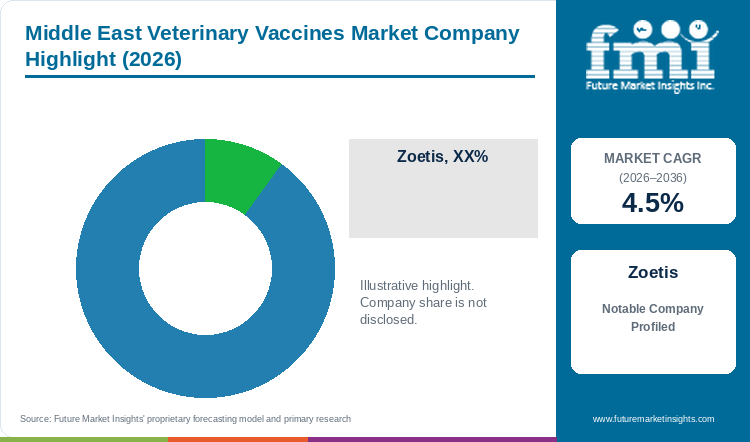
The named participant roster comprises Zoetis, Merck Animal Health, Boehringer Ingelheim, Ceva Santé Animale, JOVAC, Vaxxinova, Indian Immunologicals, Elanco and HIPRA. Their documented portfolios illustrate different areas of competition. Poultry offers include conventional and newer vaccine technologies, with some companies also presenting equipment, monitoring and service programmes. Indian Immunologicals’ presentation adds examples of distinct FMD, PPR and canine products. Product availability and authorisation are determined within the market where an order is placed.
A manufacturer offering several poultry products can support a broader catalogue discussion, while a business combining vaccines and equipment can address the work surrounding administration. These offers create different account relationships. A customer buying a product may organise the operating process internally; one purchasing equipment or services also agrees responsibilities for those activities. The benchmark therefore connects the documented offer with the disease, species and delivery requirement being discussed, so that the commercial commitment reflects the work included.
Competitive Benchmarking: Middle East Veterinary Vaccines Market
Table 5: Company Capabilities Benchmark
| Company | Relevant offer | Commercial capability |
|---|---|---|
| Zoetis | US guide: Poulvac, Poulvac Procerta and Embrex BioDevices | Vaccine portfolio with hatchery equipment |
| Merck Animal Health | MSD Middle East Nobilis H9N2+ND P documentation | Defined inactivated poultry product |
| Boehringer Ingelheim | VAXXITEK HVT+IBD vector product in US documentation | Technology and presentation requirements |
| Ceva Santé Animale | Regional poultry vaccines, monitoring and vaccination services | Breadth of operational support |
| JOVAC | NDV, IB H120 and IBD D78 catalogue entries | Disease-specific poultry catalogue |
| Vaxxinova | VAXXON live, immune-complex and inactivated poultry products | Programme breadth across poultry categories |
| Indian Immunologicals | Raksha Ovac, Raksha PPR and canine products | Separate livestock and companion-animal roles |
| Elanco | Brazilian AviPro Salmonella VAC E product page | Specific live poultry vaccine capability |
| HIPRA | AVISAN MULTI and related devices and digital services | Product and supporting operational services |
Key Developments
- At the April 2025 Middle East roadmap meeting, FAO and WOAH participants developed recommendations on vaccine quality, laboratory cooperation and FMD matching. Their commercial relevance lies in more explicit technical and quality requirements for procurement.
- WOAH’s August 2026 update recorded FMD SAT1 events, including first occurrences in Israel and Palestine during 2026. The development increased the relevance of preparedness and suitable vaccine specifications for veterinary authorities.
- On 22 June 2026, Saudi Arabia’s vaccine localization MoU established a cooperation agenda involving public-sector, local and international participants. It creates a basis for technical and industrial discussions around future supply.
- On 25 September 2026, FAO announced a further livestock vaccination campaign in Sudan. The programme builds on emergency sourcing and delivery work, making distribution access a material consideration for participating suppliers.
Key Players in the Middle East Veterinary Vaccines Market
- Zoetis
- Merck Animal Health
- Boehringer Ingelheim
- Ceva Santé Animale
- JOVAC
- Vaxxinova
- Indian Immunologicals
- Elanco
- HIPRA
Middle East Veterinary Vaccines Market - Report Scope
Table 6: Report Scope
| Coverage field | Report scope |
|---|---|
| Forecast period | 2026 to 2036 |
| Quantitative Units | USD million |
| Base-year assessment | 2025 estimated market value; 2026 forecast segment shares |
| Vaccine type | Live attenuated and other veterinary vaccine types |
| Animals | Livestock and companion animals |
| Disease indication | Disease-specific veterinary vaccine requirements |
| End users | Veterinary hospitals and other animal-health providers |
| Countries | United Arab Emirates, Saudi Arabia, Türkiye, Jordan, Sudan and other covered markets |
| Country growth basis | Forecast CAGRs for 2026 to 2036 |
| Company coverage | Zoetis; Merck Animal Health; Boehringer Ingelheim; Ceva Santé Animale; JOVAC; Vaxxinova; Indian Immunologicals; Elanco; HIPRA |
Research Methodology
Table 7: Method and Approach
| Method | Approach |
|---|---|
| Market baseline | Use the 2025 market value as the historical baseline and 2026 forecast segment shares |
| Headline forecast | Assess market growth over the 2026-2036 forecast period |
| Country analysis | Assess country growth over the 2026-2036 forecast period |
| Operating context | Review official disease, programme and government material |
| Company assessment | Compare documented products and associated services |
| Commercial analysis | Examine specification, purchasing channel, delivery and programme fit |
The assessment uses the 2025 market value as its historical baseline and presents market forecasts for 2026-2036, including 2026 segment-share estimates and country growth rates. The headline market CAGR is 4.5% for 2026-2036. Official disease and programme material supplies the operating context, while company documentation supports the assessment of product roles and associated services.
Market by Segments
By Vaccine Type
- Live attenuated vaccines
- Other vaccine types
By Animal
- Livestock
- Companion animals
By End User
- Veterinary hospitals
- Other veterinary providers
By Country
- United Arab Emirates
- Saudi Arabia
- Türkiye
- Jordan
- Sudan
Research Sources and Bibliography
- [1] World Organisation for Animal Health. The spread of foot-and-mouth disease to new areas. August 2026.
- [2] FAO and WOAH. Middle East Roadmaps Meeting for FMD and PPR: Recommendations. 2025.
- [3] Food and Agriculture Organization. Rapid risk assessment: foot-and-mouth disease.
- [4] World Organisation for Animal Health. Guidelines for PPR prevention in wildlife populations.
- [5] Abu Dhabi Agriculture and Food Safety Authority. (1 September 2025). ADAFSA launches 17th annual livestock vaccination campaign in Abu Dhabi, targeting over 2.2 million sheep, goats and cattle, until May 2026.
- [6] Saudi Press Agency. (22 June 2026). Saudi Arabia signs tripartite MoU to localize veterinary vaccine production.
- [7] Republic of Türkiye, Ministry of Agriculture and Forestry. (4 November 2025). Şap (SAT1) hastalığıyla mücadelede Türkiye kontrollü şekilde ilerliyor.
- [8] Food and Agriculture Organization of the United Nations. (25 September 2026). Sudan: FAO launches nationwide livestock vaccination campaign to protect food security and livelihoods amid conflict.
- [9] Jordan Bio-industries Center (JOVAC). (n.d.). Products: veterinary vaccine catalogue.
- [10] Hashemite Kingdom of Jordan, General Budget Department. (2025). Ministry of Agriculture, chapter 2201, programme and budget documentation.
- [11] MSD Animal Health Middle East. (2020). Nobilis H9N2+ND P: product information.
- [12] Boehringer Ingelheim Animal Health USA. (n.d.). VAXXITEK HVT+IBD vaccine: product information.
- [13] Ceva Santé Animale. (n.d.). Ceva Poultry Middle East: vaccines, health monitoring, vaccination services and equipment.
- [14] Vaxxinova. (n.d.). Product portfolio: poultry vaccines.
- [15] Indian Immunologicals Limited. (2024). Company presentation and animal-health product portfolio.
- [16] HIPRA. (n.d.). AVISAN MULTI and related poultry services.
- [17] Zoetis. (n.d.). U.S. poultry product guide: vaccines and Embrex BioDevices.
- [18] Elanco Animal Health Brazil. (n.d.). AviPro Salmonella VAC E: product information.
This Report Answers
- How does the market progress from its 2025 estimate to the 2036 forecast?
- How do vaccine technology, animal category and end user affect purchasing?
- What distinguishes the five profiled country opportunities?
- How do surveillance, quality assurance and distribution influence supplier selection?
- Which documented company capabilities address different procurement needs?
Table of Content
- Key Takeaways
- Market Size and CAGR
- Top Growth Driver
- Fastest Growing Segment
- Leading Region
- Key Companies
- Emerging Opportunities
- Executive Summary
- Global Market Outlook
- Demand-side Trends
- Supply-side Trends
- Technology Roadmap Analysis
- Analysis and Recommendations
- Analyst Perspective (What is happening? Why now? What should investors know?)
- Key Questions Answered
- How large is the market?
- What is the CAGR?
- What are key trends?
- Which region dominates?
- Who are the leaders?
Read More...
- Market Overview
- Market Coverage / Taxonomy
- Market Definition / Scope / Limitations
- Research Methodology
- Chapter Orientation
- Analytical Lens and Working Hypotheses
- Market Structure, Signals, and Trend Drivers
- Benchmarking and Cross-market Comparability
- Market Sizing, Forecasting, and Opportunity Mapping
- Research Design and Evidence Framework
- Desk Research Programme (Secondary Evidence)
- Expert Input and Fieldwork (Primary Evidence)
- Tooling, Models, and Reference Databases
- Data Engineering and Model Build
- Quality Assurance and Audit Trail
- Market Background
- Market Dynamics (Drivers, Restraints, Opportunity, Trends)
- Scenario Forecast (Optimistic, Likely, Conservative)
- Impact Analysis
- AI Impact
- Sustainability Impact
- Regulatory Impact
- Technology Impact
- Consumer / Buyer Analysis
- Purchase Drivers
- Adoption Barriers
- Buyer Journey
- Opportunity Map Analysis
- Product Life Cycle Analysis
- Supply Chain Analysis
- Investment Feasibility Matrix
- Value Chain Analysis
- PESTLE and Porter's Analysis
- Regulatory Landscape
- Regional Parent Market Outlook
- Production and Consumption Statistics
- Import and Export Statistics
- Global Market Analysis and Forecast, 2021 to 2036
- Historical Market Size Value (USD Million) Analysis, 2021 to 2025
- Current and Future Market Size Value (USD Million) Projections, 2026 to 2036
- Y-o-Y Growth Trend Analysis
- Absolute $ Opportunity Analysis
- Global Market Pricing Analysis, 2021 to 2036
- Global Market Analysis and Forecast, By Vaccine Type, 2021 to 2036
- Introduction / Key Findings
- Historical Market Size Value (USD Million) Analysis By Vaccine Type, 2021 to 2025
- Current and Future Market Size Value (USD Million) Analysis and Forecast By Vaccine Type, 2026 to 2036
- Live attenuated vaccines
- Other vaccine types
- Y-o-Y Growth Trend Analysis By Vaccine Type, 2021 to 2025
- Absolute $ Opportunity Analysis By Vaccine Type, 2026 to 2036
- Global Market Analysis and Forecast, By Animal, 2021 to 2036
- Introduction / Key Findings
- Historical Market Size Value (USD Million) Analysis By Animal, 2021 to 2025
- Current and Future Market Size Value (USD Million) Analysis and Forecast By Animal, 2026 to 2036
- Livestock
- Companion animals
- Y-o-Y Growth Trend Analysis By Animal, 2021 to 2025
- Absolute $ Opportunity Analysis By Animal, 2026 to 2036
- Global Market Analysis and Forecast, By End User, 2021 to 2036
- Introduction / Key Findings
- Historical Market Size Value (USD Million) Analysis By End User, 2021 to 2025
- Current and Future Market Size Value (USD Million) Analysis and Forecast By End User, 2026 to 2036
- Veterinary hospitals
- Other veterinary providers
- Y-o-Y Growth Trend Analysis By End User, 2021 to 2025
- Absolute $ Opportunity Analysis By End User, 2026 to 2036
- Global Market Analysis and Forecast, By Country, 2021 to 2036
- Introduction / Key Findings
- Historical Market Size Value (USD Million) Analysis By Country, 2021 to 2025
- Current and Future Market Size Value (USD Million) Analysis and Forecast By Country, 2026 to 2036
- United Arab Emirates
- Saudi Arabia
- Türkiye
- Jordan
- Sudan
- Y-o-Y Growth Trend Analysis By Country, 2021 to 2025
- Absolute $ Opportunity Analysis By Country, 2026 to 2036
- Key Countries Market Analysis
- United Arab Emirates
- Pricing Analysis
- Market Share Analysis, 2025
- By Vaccine Type
- By Animal
- By End User
- By Country
- Saudi Arabia
- Pricing Analysis
- Market Share Analysis, 2025
- By Vaccine Type
- By Animal
- By End User
- By Country
- Türkiye
- Pricing Analysis
- Market Share Analysis, 2025
- By Vaccine Type
- By Animal
- By End User
- By Country
- Jordan
- Pricing Analysis
- Market Share Analysis, 2025
- By Vaccine Type
- By Animal
- By End User
- By Country
- Sudan
- Pricing Analysis
- Market Share Analysis, 2025
- By Vaccine Type
- By Animal
- By End User
- By Country
- United Arab Emirates
- Market Structure Analysis
- Competition Dashboard
- Competition Benchmarking
- Market Share Analysis of Top Players
- By Regional
- By Vaccine Type
- By Animal
- By End User
- By Country
- Emerging Startups
- Innovation Benchmarking
- Competition Analysis
- Competition Deep Dive
- Zoetis
- Overview
- Product Portfolio
- Profitability by Market Segments
- Sales Footprint
- Strategy Overview
- Marketing Strategy
- Product Strategy
- Channel Strategy
- Merck Animal Health
- Boehringer Ingelheim
- Ceva Santé Animale
- JOVAC
- Vaxxinova
- Indian Immunologicals
- Elanco
- HIPRA
- Zoetis
- Case Studies
- Success Stories
- Recent Developments
- Competition Deep Dive
- Assumptions & Acronyms Used
List of Tables
- Table 1: Global Market Value (USD Million) Forecast by Region, 2021 to 2036
- Table 2: Global Market Value (USD Million) Forecast by Vaccine Type, 2021 to 2036
- Table 3: Global Market Value (USD Million) Forecast by Animal, 2021 to 2036
- Table 4: Global Market Value (USD Million) Forecast by End User, 2021 to 2036
- Table 5: Global Market Value (USD Million) Forecast by Country, 2021 to 2036
List of Figures
- Figure 1: Global Market Pricing Analysis
- Figure 2: Global Market Value (USD Million) Forecast 2021-2036
- Figure 3: Global Market Value Share and BPS Analysis by Vaccine Type, 2026 and 2036
- Figure 4: Global Market Y-o-Y Growth Comparison by Vaccine Type, 2026-2036
- Figure 5: Global Market Attractiveness Analysis by Vaccine Type
- Figure 6: Global Market Value Share and BPS Analysis by Animal, 2026 and 2036
- Figure 7: Global Market Y-o-Y Growth Comparison by Animal, 2026-2036
- Figure 8: Global Market Attractiveness Analysis by Animal
- Figure 9: Global Market Value Share and BPS Analysis by End User, 2026 and 2036
- Figure 10: Global Market Y-o-Y Growth Comparison by End User, 2026-2036
- Figure 11: Global Market Attractiveness Analysis by End User
- Figure 12: Global Market Value Share and BPS Analysis by Country, 2026 and 2036
- Figure 13: Global Market Y-o-Y Growth Comparison by Country, 2026-2036
- Figure 14: Global Market Attractiveness Analysis by Country
- Figure 15: Global Market Value (USD Million) Share and BPS Analysis by Region, 2026 and 2036
- Figure 16: Global Market Y-o-Y Growth Comparison by Region, 2026-2036
- Figure 17: Global Market Attractiveness Analysis by Region
- Figure 18: Global Market - Tier Structure Analysis
- Figure 19: Global Market - Company Share Analysis
Frequently Asked Questions
How large is the market in 2026?
The Middle East veterinary vaccines market is estimated at USD 708.8 million in 2026. Purchases span livestock programmes, companion-animal care and other veterinary uses, with product selection and delivery arrangements shaped by the species, indication and purchasing organisation.
What is the 2036 forecast?
The market is forecast to reach USD 1,100.7 million by 2036 at a 4.5% CAGR from 2026 to 2036. The country outlook covers the same forecast period.
Which vaccine type is forecast to hold a notable share in 2026?
Live attenuated vaccines are forecast to represent an estimated 45.0% of the vaccine-type classification in 2026. Veterinary hospitals are forecast to represent an estimated 42.0% under the separate end-user classification in the same year.
Which country leads the forecast outlook?
The United Arab Emirates is projected to lead the profiled countries at a 5.1% CAGR for 2026 to 2036, followed by Saudi Arabia.
Does the market include poultry products?
Veterinary vaccines serve several animal populations, including poultry-specific prevention needs. The related poultry vaccines market examines that product setting in more detail. Documented poultry offers in this report include live, inactivated, vector and immune-complex formats. [11][12][14]
Which companies are covered?
The companies covered are Zoetis, Merck Animal Health, Boehringer Ingelheim, Ceva Santé Animale, JOVAC, Vaxxinova, Indian Immunologicals, Elanco and HIPRA. Their product and service examples span livestock, companion-animal and poultry requirements, with regional documents and explicitly identified overseas portfolios illustrating different capabilities.
Preview the report firsthand - request a free sample
Get SampleGet the brochure for pricing and purchase details.
Get PDF
