

- Industry Size (2026)
- USD 3.9 Bn
- Forecast (2036)
- USD 7.5 Bn
- CAGR (2026 to 2036)
- 6.8%
Veterinary Metabolic Disease Treatment Market Forecast and Outlook 2026 to 2036
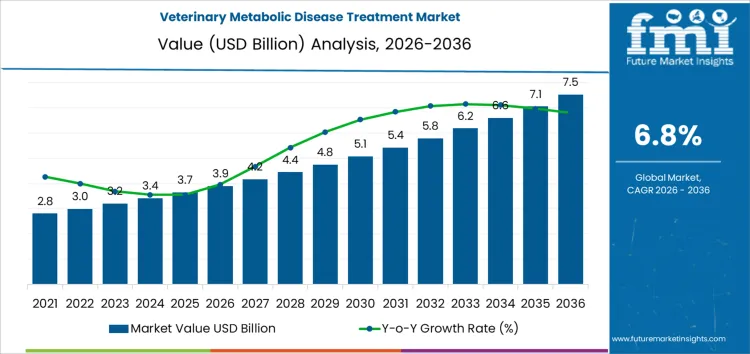
The veterinary metabolic disease treatment market is expected to be valued at USD 3.9 billion in 2026, reach USD 7.5 billion by 2036, and expand at a CAGR of 6.8%. Demand is anchored in the need to manage metabolic imbalances that directly affect productivity, fertility, and survival across both companion animals and food-producing livestock. Disorders linked to energy metabolism, mineral deficiency, and endocrine dysfunction impose measurable economic and welfare costs, particularly during physiologically stressful periods such as early lactation, rapid growth, or aging. Treatment adoption is driven by clinical necessity rather than discretionary spending, with veterinarians prioritizing interventions that stabilize biochemical pathways, prevent secondary complications, and protect long-term performance outcomes.
Clinical practice patterns show that uptake is shaped more by monitoring intensity and management discipline than by episodic disease spikes. Expanded use of blood profiling, transition-period screening, and body condition tracking enables earlier identification of subclinical metabolic stress, prompting preventive or corrective intervention before productivity losses escalate.
Livestock operations integrate hormonal support, injectable therapies, and nutritional supplementation into structured herd protocols, while companion animal care focuses on chronic management of obesity-related and endocrine disorders through sustained therapy. Purchasing decisions emphasize dosing reliability, safety across life stages, and compatibility with ongoing monitoring requirements. Growth remains steady as preventive care models mature and metabolic control becomes embedded within routine veterinary health management rather than reactive treatment alone.
Quick Stats for Veterinary Metabolic Disease Treatment Market
- Veterinary Metabolic Disease Treatment Market Value (2026): USD 3.9 billion
- Veterinary Metabolic Disease Treatment Market Forecast Value (2036): USD 7.5 billion
- Veterinary Metabolic Disease Treatment Market Forecast CAGR 2026 to 2036: 6.8%
- Leading Product Category by Utilization: Hormonal therapies
- Fastest-Growing Countries: India, China, Brazil, USA, UK
- Top Players in Global Demand: Zoetis, MSD Animal Health, Elanco, Ceva
Veterinary Metabolic Disease Treatment Market Key Takeaways
| Metric | Value |
|---|---|
| Market Value (2026) | USD 3.9 billion |
| Market Forecast Value (2036) | USD 7.5 billion |
| Forecast CAGR 2026 to 2036 | 6.8% |
Why is the Demand for Veterinary Metabolic Disease Treatment Growing?
Demand for veterinary metabolic disease treatments is increasing as clinicians and livestock specialists address a rising incidence of metabolic disorders that affect productivity, reproduction, and overall herd health in both companion animals and production species. In dairy cattle, conditions such as ketosis, milk fever, and displaced abomasum compromise feed intake, milk yield, and post-partum recovery, prompting veterinarians to integrate therapeutic interventions that restore metabolic balance and prevent cascading health issues. Pet owners and small animal practitioners are also responding to growing rates of obesity-linked disorders, endocrine dysfunctions, and nutrient metabolism abnormalities in dogs and cats. Treatment protocols that combine targeted nutrient support, hormonal modulation, and corrective therapy are specified to support glucose regulation, lipid metabolism, and endocrine stability. Procurement teams in veterinary hospitals and clinics emphasize products with clear dosing guidelines, safety profiles suited to species and life stage, and stability under varied storage conditions to support consistent therapeutic delivery.
Growth in animal production efficiency programs and heightened owner awareness of preventive animal health reinforce uptake of metabolic disease treatments that align with herd performance goals and long-term well-being. Livestock enterprises increasingly integrate metabolic monitoring as part of precision management frameworks, using biochemical indicators to detect subclinical conditions and deploy timely interventions that reduce mortality and culling risk. Companion animal veterinarians apply evidence-based protocols that combine dietary modification, supplemental nutrients, and medical therapy to manage chronic metabolic conditions with minimized adverse effects. Distribution networks and veterinary formularies support product availability, enabling rapid response when metabolic imbalance is detected. These veterinary-specific clinical and operational demands are contributing to sustained demand growth in the veterinary metabolic disease treatment market.
How Is the Veterinary Metabolic Disease Treatment Market Segmented by Product Type, Application, and End User?
Demand for veterinary metabolic disease treatment is shaped by intensive production systems, transition-period stress, and productivity preservation priorities. Management approaches focus on stabilizing metabolic pathways, correcting deficiencies, and preventing recurrence during high-risk physiological stages. Adoption aligns with herd monitoring practices, early detection protocols, and veterinary-guided intervention thresholds. Treatment selection weighs speed of metabolic correction, administration practicality, and compatibility with farm workflows. Segmentation clarifies how therapy class, disease presentation, and delivery channel influence utilization patterns, purchasing concentration, and treatment execution across veterinary metabolic care.
Which Product Category Drives Utilization in Veterinary Metabolic Disease Treatment?
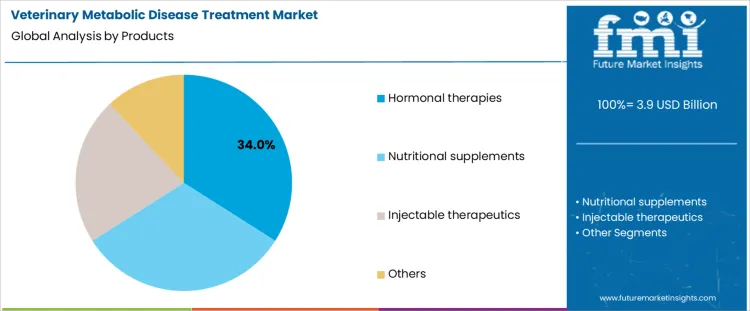
Utilization centers on hormonal therapies at 34.0%, reflecting their role in rapidly correcting endocrine-driven metabolic imbalances. These therapies support calcium regulation, energy mobilization, and hormonal signaling during critical production phases. Clinical use prioritizes fast physiological response under veterinary supervision. Nutritional supplements at 32.0% address mineral and energy deficiencies through preventive and supportive regimens integrated into feed programs. Injectable therapeutics at 22.0% provide targeted intervention when oral intake is compromised. Other products at 12.0% serve niche or adjunctive roles. Product segmentation reflects emphasis on therapies delivering immediate metabolic stabilization alongside structured nutritional support.
Key Points
- Hormonal therapies enable rapid correction of metabolic disruptions.
- Nutritional supplements support preventive and maintenance strategies.
- Injectables address acute intake or absorption limitations.
How Do Disease-Specific Factors Shape Application-Level Treatment Demand?
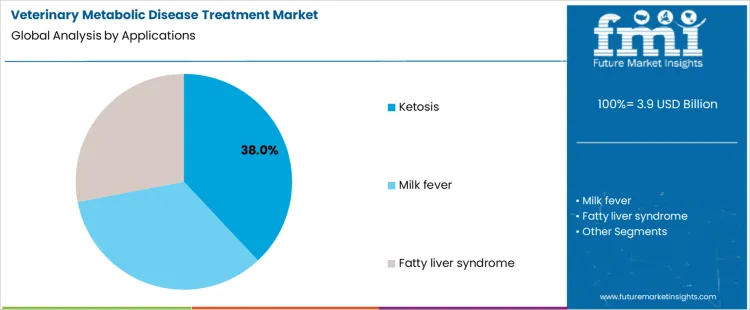
Treatment demand concentrates around ketosis at 38.0%, driven by negative energy balance during early lactation. Reduced feed intake and elevated production stress increase intervention frequency. Milk fever at 34.0% requires prompt calcium management to prevent neuromuscular complications. Fatty liver syndrome at 28.0% involves gradual metabolic overload requiring longer monitoring and supportive therapy. Application segmentation highlights how disease onset timing, physiological impact, and recovery duration influence treatment intensity and protocol selection within veterinary metabolic management.
Key Points
- Ketosis requires rapid energy balance restoration.
- Milk fever management focuses on calcium regulation.
- Fatty liver treatment emphasizes sustained metabolic support.
Which End User Channels Influence Treatment Delivery Most Strongly?
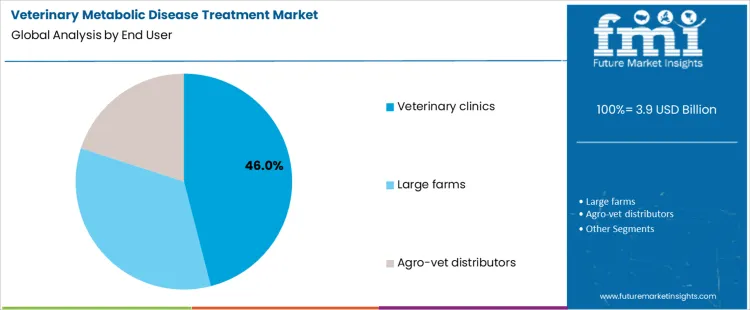
Veterinary clinics account for 46.0% of treatment delivery due to their role in diagnosis, protocol selection, and supervised administration. Clinical oversight ensures appropriate therapy choice and dosing accuracy. Large farms at 34.0% implement treatments directly through trained staff under veterinary guidance, prioritizing operational continuity. Agro-vet distributors at 20.0% support supply access and logistical availability across production regions. End-user segmentation reflects concentration where expertise, herd scale, and distribution reach jointly determine treatment utilization across veterinary metabolic disease care.
Key Points
- Clinics guide diagnosis and therapy selection.
- Large farms execute treatments at operational scale.
- Distributors ensure consistent product availability.
What are the Key Dynamics in the Veterinary Metabolic Disease Treatment Market?
Demand for veterinary metabolic disease treatments reflects need to manage chronic disorders affecting energy balance, endocrine regulation, and nutrient utilization in companion and production animals. Adoption concentrates in veterinary clinics, specialty hospitals, and herd health programs. Global scope aligns with rising diagnosis of diabetes, obesity, ketosis, and mineral imbalances. Usage centers on pharmaceuticals, nutritional interventions, and hormone-based therapies integrated into long-term disease management protocols.
How do disease chronicity and diagnostic capability shape adoption?
Metabolic diseases require sustained control rather than episodic intervention, driving structured treatment plans. Demand increases where routine screening and blood chemistry testing enable early detection before irreversible organ damage occurs. Companion animal care emphasizes glycemic control, weight management, and endocrine stabilization to preserve quality of life. Livestock operations focus on metabolic balance to protect productivity during high-risk periods such as early lactation or rapid growth. Treatment selection integrates pharmaceuticals with diet formulation and management changes. Veterinary oversight remains central to dose adjustment and monitoring. Adoption reflects reliance on measurable biomarkers and continuous management to limit disease progression and secondary complications.
How do compliance burden, monitoring intensity, and cost exposure influence market scalability?
Long-term treatment requires consistent owner or producer adherence, increasing variability in outcomes. Demand sensitivity rises where monitoring frequency adds clinical visits and laboratory expense. Injectable or insulin-based therapies introduce handling and storage challenges. Nutritional interventions require sustained feed compliance and formulation control. Regulatory oversight affects use of hormonal and metabolic agents in food animals. Economic constraints limit adoption in low-margin production systems. Disease heterogeneity reduces protocol standardization. Scalability remains constrained by need for ongoing monitoring, adherence variability, and cost tolerance across diverse veterinary care settings.
How Is Demand for Veterinary Metabolic Disease Treatments Evolving Globally?
Demand for veterinary metabolic disease treatments is expanding globally as livestock and companion animal care emphasizes productivity, longevity, and preventive health. Disorders related to energy imbalance, mineral deficiency, and endocrine disruption require sustained pharmacologic and nutritional intervention. Veterinary protocols increasingly integrate diagnostics, supplementation, and long-term management. Organized supply chains and cold-chain reliability influence access. Growth rates in India at 8.1%, China at 7.9%, Brazil at 7.6%, USA at 6.5%, and the UK at 6.3% indicate steady expansion driven by intensification of animal management, preventive care adoption, and protocol discipline rather than episodic disease spikes.

| Country | CAGR (%) |
|---|---|
| India | 8.1% |
| China | 7.9% |
| Brazil | 7.6% |
| USA | 6.5% |
| UK | 6.3% |
What Is Driving Uptake of Veterinary Metabolic Disease Treatments in India?

Veterinary metabolic disease treatment demand in India is growing at a CAGR of 8.1%, reflecting dairy intensification and nutritional management priorities. Periparturient disorders in high-yield cattle increase need for calcium, energy, and mineral therapies. Cooperative dairies promote early intervention to stabilize milk output. Veterinary extension services expand access to injectables and oral supplements. Feed variability elevates metabolic risk across herds. Growth aligns with productivity protection and herd stabilization rather than expansion of specialty therapeutics.
- Periparturient disorder management in dairy herds
- Cooperative-led early intervention programs
- Veterinary extension improving treatment reach
- Feed variability increasing metabolic risk
Why Is China Sustaining Growth in Veterinary Metabolic Disease Treatment Use?
Demand for veterinary metabolic disease treatments in China is expanding at a CAGR of 7.9%, supported by herd consolidation and standardized nutrition protocols. Large dairy operations implement routine metabolic monitoring to prevent productivity losses. Integrated veterinary services enable timely corrective treatment. Domestic manufacturing ensures steady supply of injectables and supplements. Performance benchmarking reinforces protocol adherence. Growth reflects scale-driven efficiency and preventive management rather than rising disease incidence.
- Consolidated herds enabling routine monitoring
- Integrated veterinary and nutrition services
- Reliable domestic product supply
- Performance benchmarking driving compliance
How Is Brazil Supporting Expansion of Veterinary Metabolic Disease Treatments?
Veterinary metabolic disease treatment demand in Brazil is growing at a CAGR of 7.6%, influenced by extensive production systems and climate variability. Mineral imbalance and energy deficits affect cattle performance across grazing cycles. Producers adopt supplementation and corrective therapies to protect weight gain and fertility. Veterinary outreach supports protocol use in large herds. Genetic improvement programs increase nutritional precision needs. Growth reflects environmental exposure management and operational scale rather than intensive pharmaceutical escalation.
- Climate-driven mineral and energy imbalances
- Supplementation to protect performance metrics
- Veterinary outreach across extensive systems
- Genetics programs increasing nutritional precision
What Factors Are Driving Veterinary Metabolic Disease Treatment Growth in United States?
Veterinary metabolic disease treatment demand in the United States is expanding at a CAGR of 6.5%, driven by data-led herd management and preventive care. Dairy operations monitor metabolic markers to reduce transition-period losses. Companion animal practices address obesity and endocrine disorders through long-term therapy. Diagnostic testing supports targeted intervention. Strong veterinary infrastructure ensures adherence. Growth reflects management precision and chronic care continuity rather than expansion of acute treatment volumes.
- Transition-period metabolic monitoring in dairy
- Chronic endocrine management in companion animals
- Diagnostic-guided targeted intervention
- Robust veterinary service infrastructure
Why Is the UK Showing Measured Growth in Veterinary Metabolic Disease Treatments?
Demand for veterinary metabolic disease treatments in United Kingdom is growing at a CAGR of 6.3%, shaped by welfare standards and evidence-based practice. Grazing systems require careful mineral and energy balance management. Veterinary guidance emphasizes prevention and targeted supplementation. Regulatory oversight influences prudent product use. Cost sensitivity moderates adoption speed. Growth remains measured, reflecting disciplined application and productivity focus rather than aggressive intensification.
- Welfare-driven preventive management emphasis
- Grazing system mineral balance requirements
- Evidence-based veterinary prescribing
- Cost sensitivity moderating treatment intensity
What is the competitive landscape of demand for the veterinary metabolic disease treatment market globally?
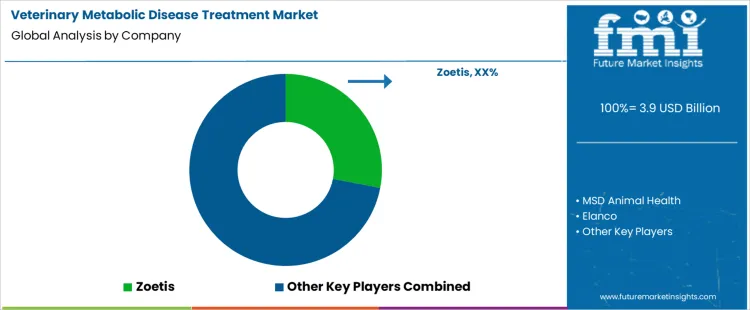
Demand for veterinary metabolic disease treatments is shaped by rising diagnosis of endocrine and metabolic disorders in companion animals and livestock. Veterinarians evaluate glycemic control reliability, dosing precision, safety margins, and suitability for chronic administration. Buyer assessment considers species-specific indications, monitoring requirements, formulation stability, and owner compliance feasibility. Procurement behavior reflects clinic formularies, long-term therapy continuity, and alignment with diagnostic testing workflows. Purchasing decisions emphasize predictable therapeutic response, regulatory labeling clarity, and availability across distribution channels. Trend in the veterinary metabolic disease treatment market shows steady growth tied to aging animal populations and proactive disease screening.
Zoetis leads competitive positioning through established metabolic therapeutics supported by strong veterinary familiarity and global distribution. MSD Animal Health competes with endocrine and metabolic solutions integrated within comprehensive animal health portfolios. Elanco supports demand by offering treatments aligned with chronic disease management in companion and production animals. Ceva participates by supplying accessible metabolic therapies supported by practical dosing formats and clinic-level support. Competitive differentiation centers on clinical reliability, long-term safety confidence, supply consistency, and depth of veterinary engagement.
Key Players in the Veterinary Metabolic Disease Treatment Market
- Zoetis
- MSD Animal Health
- Elanco
- Ceva
- Others
Scope of the Report
| Items | Values |
|---|---|
| Quantitative Units | USD billion |
| Products | Hormonal therapies; Nutritional supplements; Injectable therapeutics; Others |
| Applications | Ketosis; Milk fever; Fatty liver syndrome |
| End User | Veterinary clinics; Large farms; Agro-vet distributors |
| Regions Covered | Asia Pacific, Europe, North America, Latin America, Middle East & Africa |
| Countries Covered | India, China, Brazil, USA, UK, and 40+ countries |
| Key Companies Profiled | Zoetis; MSD Animal Health; Elanco; Ceva; Others |
| Additional Attributes | Dollar sales by product type, application, end user, and sales channel; metabolic stabilization efficacy across ketosis, milk fever, and fatty liver management protocols; role of injectable therapies and nutritional supplementation in rapid recovery; dosing compliance and on-farm administration practices; veterinary supervision requirements and residue compliance; procurement dynamics driven by large farm herd health programs and agro-vet distributor networks. |
Veterinary Metabolic Disease Treatment Market by Segment
Products:
- Hormonal therapies
- Nutritional supplements
- Injectable therapeutics
- Others
Applications:
- Ketosis
- Milk fever
- Fatty liver syndrome
End User:
- Veterinary clinics
- Large farms
- Agro-vet distributors
Region:
- Asia Pacific
- China
- Japan
- South Korea
- India
- Australia & New Zealand
- ASEAN
- Rest of Asia Pacific
- Europe
- Germany
- United Kingdom
- France
- Italy
- Spain
- Nordic
- BENELUX
- Rest of Europe
- North America
- United States
- Canada
- Mexico
- Latin America
- Brazil
- Chile
- Rest of Latin America
- Middle East & Africa
- Kingdom of Saudi Arabia
- Other GCC Countries
- Turkey
- South Africa
- Other African Union
- Rest of Middle East & Africa
Bibliography
- Food and Agriculture Organization of the United Nations. (2025). Livestock metabolic disorders: Prevention, diagnosis, and nutritional management in dairy and beef production systems. FAO Animal Production and Health Division.
- World Organisation for Animal Health. (2025). Terrestrial Animal Health Code: Chapter 7.9 – Metabolic and endocrine disease management in livestock (2025 revision). WOAH.
- European Food Safety Authority. (2024). Scientific opinion on animal health and welfare implications of metabolic disorders in food-producing animals. EFSA Journal, 22(8), e07891.
Frequently Asked Questions
How big is the veterinary metabolic disease treatment market in 2026?
The global veterinary metabolic disease treatment market is estimated to be valued at USD 3.9 billion in 2026.
What will be the size of veterinary metabolic disease treatment market in 2036?
The market size for the veterinary metabolic disease treatment market is projected to reach USD 7.5 billion by 2036.
How much will be the veterinary metabolic disease treatment market growth between 2026 and 2036?
The veterinary metabolic disease treatment market is expected to grow at a 6.8% CAGR between 2026 and 2036.
What are the key product types in the veterinary metabolic disease treatment market?
The key product types in veterinary metabolic disease treatment market are hormonal therapies, nutritional supplements, injectable therapeutics and others.
Which applications segment to contribute significant share in the veterinary metabolic disease treatment market in 2026?
In terms of applications, ketosis segment to command 38.0% share in the veterinary metabolic disease treatment market in 2026.
Preview the report firsthand - request a free sample
Get SampleGet the brochure for pricing and purchase details.
Get PDFTable of Content
- Executive Summary
- Global Market Outlook
- Demand-side Trends
- Supply-side Trends
- Technology Roadmap Analysis
- Analysis and Recommendations
- Market Overview
- Market Coverage / Taxonomy
- Market Definition / Scope / Limitations
- Market Background
- Market Dynamics
- Drivers
- Restraints
- Opportunity
- Trends
- Scenario Forecast
- Demand in Optimistic Scenario
- Demand in Likely Scenario
- Demand in Conservative Scenario
- Opportunity Map Analysis
- Product Life Cycle Analysis
- Supply Chain Analysis
- Investment Feasibility Matrix
- Value Chain Analysis
- PESTLE and Porter’s Analysis
- Regulatory Landscape
- Regional Parent Market Outlook
- Production and Consumption Statistics
- Import and Export Statistics
- Market Dynamics
- Global Market Analysis 2021 to 2025 and Forecast, 2026 to 2036
- Historical Market Size Value (USD Million) Analysis, 2021 to 2025
- Current and Future Market Size Value (USD Million) Projections, 2026 to 2036
- Y-o-Y Growth Trend Analysis
- Absolute $ Opportunity Analysis
- Global Market Pricing Analysis 2021 to 2025 and Forecast 2026 to 2036
- Global Market Analysis 2021 to 2025 and Forecast 2026 to 2036, By Products
- Introduction / Key Findings
- Historical Market Size Value (USD Million) Analysis By Products , 2021 to 2025
- Current and Future Market Size Value (USD Million) Analysis and Forecast By Products , 2026 to 2036
- Hormonal therapies
- Nutritional supplements
- Injectable therapeutics
- Others
- Hormonal therapies
- Y-o-Y Growth Trend Analysis By Products , 2021 to 2025
- Absolute $ Opportunity Analysis By Products , 2026 to 2036
- Global Market Analysis 2021 to 2025 and Forecast 2026 to 2036, By Applications
- Introduction / Key Findings
- Historical Market Size Value (USD Million) Analysis By Applications, 2021 to 2025
- Current and Future Market Size Value (USD Million) Analysis and Forecast By Applications, 2026 to 2036
- Ketosis
- Milk fever
- Fatty liver syndrome
- Ketosis
- Y-o-Y Growth Trend Analysis By Applications, 2021 to 2025
- Absolute $ Opportunity Analysis By Applications, 2026 to 2036
- Global Market Analysis 2021 to 2025 and Forecast 2026 to 2036, By End User
- Introduction / Key Findings
- Historical Market Size Value (USD Million) Analysis By End User, 2021 to 2025
- Current and Future Market Size Value (USD Million) Analysis and Forecast By End User, 2026 to 2036
- Veterinary clinics
- Large farms
- Agro-vet distributors
- Veterinary clinics
- Y-o-Y Growth Trend Analysis By End User, 2021 to 2025
- Absolute $ Opportunity Analysis By End User, 2026 to 2036
- Global Market Analysis 2021 to 2025 and Forecast 2026 to 2036, By Region
- Introduction
- Historical Market Size Value (USD Million) Analysis By Region, 2021 to 2025
- Current Market Size Value (USD Million) Analysis and Forecast By Region, 2026 to 2036
- North America
- Latin America
- Western Europe
- Eastern Europe
- East Asia
- South Asia and Pacific
- Middle East & Africa
- Market Attractiveness Analysis By Region
- North America Market Analysis 2021 to 2025 and Forecast 2026 to 2036, By Country
- Historical Market Size Value (USD Million) Trend Analysis By Market Taxonomy, 2021 to 2025
- Market Size Value (USD Million) Forecast By Market Taxonomy, 2026 to 2036
- By Country
- USA
- Canada
- Mexico
- By Products
- By Applications
- By End User
- By Country
- Market Attractiveness Analysis
- By Country
- By Products
- By Applications
- By End User
- Key Takeaways
- Latin America Market Analysis 2021 to 2025 and Forecast 2026 to 2036, By Country
- Historical Market Size Value (USD Million) Trend Analysis By Market Taxonomy, 2021 to 2025
- Market Size Value (USD Million) Forecast By Market Taxonomy, 2026 to 2036
- By Country
- Brazil
- Chile
- Rest of Latin America
- By Products
- By Applications
- By End User
- By Country
- Market Attractiveness Analysis
- By Country
- By Products
- By Applications
- By End User
- Key Takeaways
- Western Europe Market Analysis 2021 to 2025 and Forecast 2026 to 2036, By Country
- Historical Market Size Value (USD Million) Trend Analysis By Market Taxonomy, 2021 to 2025
- Market Size Value (USD Million) Forecast By Market Taxonomy, 2026 to 2036
- By Country
- Germany
- UK
- Italy
- Spain
- France
- Nordic
- BENELUX
- Rest of Western Europe
- By Products
- By Applications
- By End User
- By Country
- Market Attractiveness Analysis
- By Country
- By Products
- By Applications
- By End User
- Key Takeaways
- Eastern Europe Market Analysis 2021 to 2025 and Forecast 2026 to 2036, By Country
- Historical Market Size Value (USD Million) Trend Analysis By Market Taxonomy, 2021 to 2025
- Market Size Value (USD Million) Forecast By Market Taxonomy, 2026 to 2036
- By Country
- Russia
- Poland
- Hungary
- Balkan & Baltic
- Rest of Eastern Europe
- By Products
- By Applications
- By End User
- By Country
- Market Attractiveness Analysis
- By Country
- By Products
- By Applications
- By End User
- Key Takeaways
- East Asia Market Analysis 2021 to 2025 and Forecast 2026 to 2036, By Country
- Historical Market Size Value (USD Million) Trend Analysis By Market Taxonomy, 2021 to 2025
- Market Size Value (USD Million) Forecast By Market Taxonomy, 2026 to 2036
- By Country
- China
- Japan
- South Korea
- By Products
- By Applications
- By End User
- By Country
- Market Attractiveness Analysis
- By Country
- By Products
- By Applications
- By End User
- Key Takeaways
- South Asia and Pacific Market Analysis 2021 to 2025 and Forecast 2026 to 2036, By Country
- Historical Market Size Value (USD Million) Trend Analysis By Market Taxonomy, 2021 to 2025
- Market Size Value (USD Million) Forecast By Market Taxonomy, 2026 to 2036
- By Country
- India
- ASEAN
- Australia & New Zealand
- Rest of South Asia and Pacific
- By Products
- By Applications
- By End User
- By Country
- Market Attractiveness Analysis
- By Country
- By Products
- By Applications
- By End User
- Key Takeaways
- Middle East & Africa Market Analysis 2021 to 2025 and Forecast 2026 to 2036, By Country
- Historical Market Size Value (USD Million) Trend Analysis By Market Taxonomy, 2021 to 2025
- Market Size Value (USD Million) Forecast By Market Taxonomy, 2026 to 2036
- By Country
- Kingdom of Saudi Arabia
- Other GCC Countries
- Turkiye
- South Africa
- Other African Union
- Rest of Middle East & Africa
- By Products
- By Applications
- By End User
- By Country
- Market Attractiveness Analysis
- By Country
- By Products
- By Applications
- By End User
- Key Takeaways
- Key Countries Market Analysis
- USA
- Pricing Analysis
- Market Share Analysis, 2025
- By Products
- By Applications
- By End User
- Canada
- Pricing Analysis
- Market Share Analysis, 2025
- By Products
- By Applications
- By End User
- Mexico
- Pricing Analysis
- Market Share Analysis, 2025
- By Products
- By Applications
- By End User
- Brazil
- Pricing Analysis
- Market Share Analysis, 2025
- By Products
- By Applications
- By End User
- Chile
- Pricing Analysis
- Market Share Analysis, 2025
- By Products
- By Applications
- By End User
- Germany
- Pricing Analysis
- Market Share Analysis, 2025
- By Products
- By Applications
- By End User
- UK
- Pricing Analysis
- Market Share Analysis, 2025
- By Products
- By Applications
- By End User
- Italy
- Pricing Analysis
- Market Share Analysis, 2025
- By Products
- By Applications
- By End User
- Spain
- Pricing Analysis
- Market Share Analysis, 2025
- By Products
- By Applications
- By End User
- France
- Pricing Analysis
- Market Share Analysis, 2025
- By Products
- By Applications
- By End User
- India
- Pricing Analysis
- Market Share Analysis, 2025
- By Products
- By Applications
- By End User
- ASEAN
- Pricing Analysis
- Market Share Analysis, 2025
- By Products
- By Applications
- By End User
- Australia & New Zealand
- Pricing Analysis
- Market Share Analysis, 2025
- By Products
- By Applications
- By End User
- China
- Pricing Analysis
- Market Share Analysis, 2025
- By Products
- By Applications
- By End User
- Japan
- Pricing Analysis
- Market Share Analysis, 2025
- By Products
- By Applications
- By End User
- South Korea
- Pricing Analysis
- Market Share Analysis, 2025
- By Products
- By Applications
- By End User
- Russia
- Pricing Analysis
- Market Share Analysis, 2025
- By Products
- By Applications
- By End User
- Poland
- Pricing Analysis
- Market Share Analysis, 2025
- By Products
- By Applications
- By End User
- Hungary
- Pricing Analysis
- Market Share Analysis, 2025
- By Products
- By Applications
- By End User
- Kingdom of Saudi Arabia
- Pricing Analysis
- Market Share Analysis, 2025
- By Products
- By Applications
- By End User
- Turkiye
- Pricing Analysis
- Market Share Analysis, 2025
- By Products
- By Applications
- By End User
- South Africa
- Pricing Analysis
- Market Share Analysis, 2025
- By Products
- By Applications
- By End User
- USA
- Market Structure Analysis
- Competition Dashboard
- Competition Benchmarking
- Market Share Analysis of Top Players
- By Regional
- By Products
- By Applications
- By End User
- Competition Analysis
- Competition Deep Dive
- Zoetis
- Overview
- Product Portfolio
- Profitability by Market Segments (Product/Age /Sales Channel/Region)
- Sales Footprint
- Strategy Overview
- Marketing Strategy
- Product Strategy
- Channel Strategy
- MSD Animal Health
- Elanco
- Ceva
- Others
- Zoetis
- Competition Deep Dive
- Assumptions & Acronyms Used
- Research Methodology


