

- Market Size (2026)
- USD 8.7 Bn
- Forecast (2036)
- USD 15.7 Bn
- CAGR (2026 to 2036)
- 6.0%
How big is Mining Equipment Rental Market in 2026?
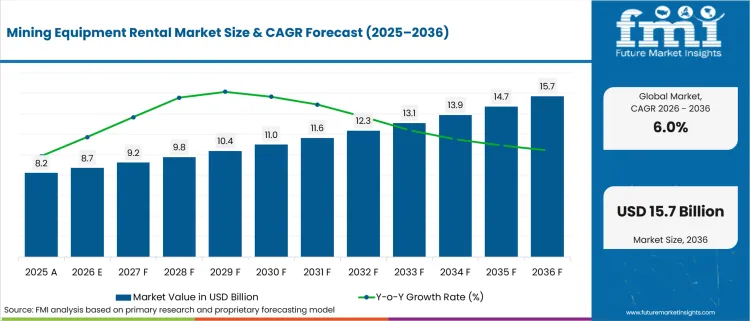
USD 8.7 billion in 2026 and USD 15.7 billion by 2036 at a 6.0% CAGR.
Demand for Mining Equipment Rental Market is projected to expand at 6.0% CAGR between 2026 and 2036. FMI estimates that demand will rise from USD 8.7 billion in 2026 to USD 15.7 billion by 2036, reflecting a 6.0% CAGR. Displayed values are rounded, while the CAGR is calculated from underlying unrounded FMI estimates. The spending pool includes rental contracts and managed equipment services for machinery used in mine development, production, mineral processing and exploration and quarrying within the defined taxonomy.
Ownership is harder to justify when a drill, crusher, telehandler or auxiliary earthmover is required for a short development phase and a shutdown and seasonal output or a temporary production increase. Rental converts the machine into a timed operating input. The fleet-mix decision therefore sits beside the Mobile Mining Equipment Market, where machine selection must fit the haul cycle and mine plan rather than a generic fleet standard.
Key Takeaways of Mining Equipment Rental Market
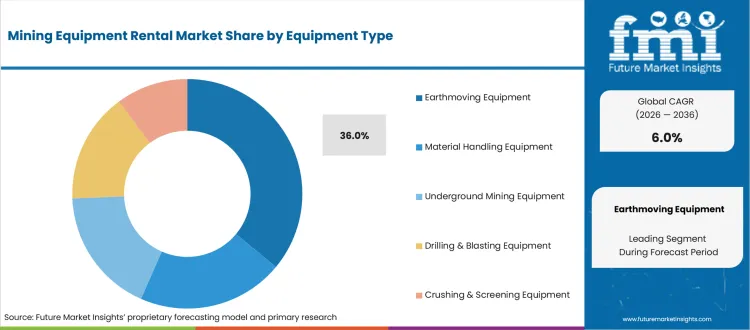
- Earthmoving Equipment leads Equipment Type with a 36.0% share because it is used across overburden removal, bench preparation, haul-road work and stockpiles and mine development.
- Surface Mining holds 41.0% of Application demand, while Mining Companies account for 45.0% of End User demand.
- Australia records the highest profiled country CAGR at 6.5%, followed by Canada at 6.3% and the USA at 6.2%.
- Uptime guarantees, field service coverage, parts availability and mobilization time and mine-site qualification determine contract value.
- Managed fleet services can capture more spending when telematics, condition-based maintenance and replacement equipment are tied to production outcomes.
- United Rentals, Sunbelt Rentals, Herc Holdings and Caterpillar and Komatsu and Epiroc and Sandvik and MacAllister Machinery and SMS Equipment and Hastings Deering are among the leading companies.
Analyst Perspective
"Mining equipment rental is an uptime contract before it is a machine transaction. A mine can accept a higher rental rate when the provider carries mobilization risk, parts availability, condition monitoring and replacement capacity. Suppliers that price by utilization while proving site compliance will secure longer contracts; suppliers that compete only on daily rates remain exposed when a specialized machine sits idle or fails during a production window."
- Anurag Sharma, Principal Consultant, Future Market Insights
How is the Mining Equipment Rental Market segmented?
The Mining Equipment Rental Market is segmented by Equipment Type, Application, End User, Distribution Channel, Rental Type and Region.
Why does Earthmoving Equipment lead the Equipment Type category?
Earthmoving Equipment holds a 36.0% share in 2026.
Excavators provide flexible digging and loading capacity, but bucket selection, reach and breakout force and truck matching must fit the material. Bulldozers handle ripping, pushing, grading and dump maintenance although undercarriage wear can dominate operating cost. This utilization pattern also connects earthmoving rentals with the Surface Mining Equipment Market, where fleet availability follows stripping schedules and haul-road condition.
Why does Surface Mining lead the Application category?
Surface Mining accounts for a 41.0% share in 2026.
Open-pit mining favors large earthmoving fleets, production support machines, drill rigs and mobile processing equipment. Strip mining adds repeated overburden movement and reclamation work. Oversized machines can be expensive to mobilize and may require site-specific transport permits or assembly.
Why do Mining Companies lead the End User category?
Mining Companies represent a 45.0% share in 2026.
Large Mining Companies can bundle several sites or machine classes and may require common telematics, safety documentation and maintenance reporting. Mid-Sized Mining Companies have less fleet redundancy, so they often place greater value on a provider that can replace a failed machine quickly. Remote sites may still sit outside normal branch economics.
Why do Direct Rental Providers lead the Distribution Channel category?
Direct Rental Providers hold a 43.0% share in 2026.
Equipment Dealers, including Authorized Dealers and Regional Dealers, are strong where the rental depends on OEM parts and trained technicians and warranty processes or mine-specific modifications. OEM Rental Programs add Manufacturer Rental Services and Certified Fleet Programs for buyers that want documented machine condition and direct technical escalation. Their constraint is narrower brand choice.
Why does Long-Term Rental lead the Rental Type category?
Long-Term Rental accounts for a 39.0% share in 2026.
Short-Term Rental, including Daily Rental and Weekly Rental, fits shutdowns and breakdown cover and trial work and temporary civil tasks. Its apparent flexibility can be offset by high mobilization cost and limited machine availability. Rent-to-Own arrangements use Lease Purchase Agreements or Finance-to-Own Programs when a customer expects sustained use but wants to defer ownership. These contracts require clear treatment of maintenance history, purchase price and residual value.
What are the drivers, restraints and opportunities in the Mining Equipment Rental Market?
- Driver: Mine development and production peaks favor access to equipment without permanent ownership of a peak-sized fleet.
- Restraint: Mobilization, wear, parts and site compliance can erase rental savings for specialized machines with low utilization.
- Opportunity: Managed fleets with telematics, condition-based maintenance and replacement guarantees can convert rental into a production service.
Which country CAGRs are profiled in the Mining Equipment Rental Market?
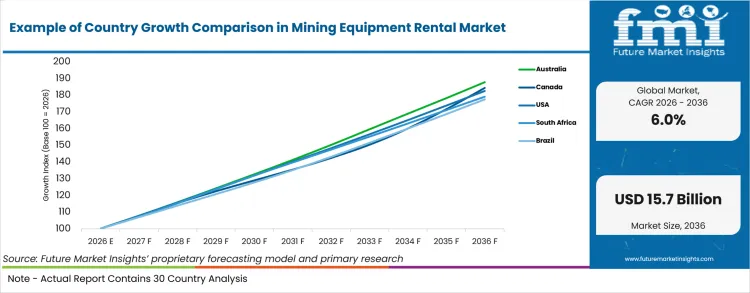
| Country | FMI CAGR, 2026 to 2036 |
|---|---|
| Australia | 6.5% |
| Canada | 6.3% |
| USA | 6.2% |
| South Africa | 6.0% |
| Brazil | 5.9% |
| Japan | 5.7% |
| Germany | 5.6% |
Country-wise Analysis
- Australia: The Australian Government's Resources and Energy Quarterly tracks a large export-oriented resource sector with long project distances. Surface mines often require high-hour support fleets, drill packages and temporary development capacity. Rental providers gain an advantage when they can place technicians, parts and replacement machines close to remote operations. Autonomous equipment orders also raise the value of certified technical support.
- Canada: Mining assets are dispersed across provinces and territories, with cold-weather duty and remote access shaping equipment choice. Long transport lanes favor annual or multi-year agreements over frequent machine swaps. Providers must prove winterization, parts planning, field-service reach and the ability to support underground as well as surface fleets.
- USA: A large branch-based rental industry supports fast access to earthmoving and material-handling equipment. Mining contracts still require mine-specific controls. MSHA continues to treat powered haulage as a major safety concern, so inspection records, braking systems and visibility aids and operator procedures and defect response influence supplier qualification.
- South Africa: Demand spans deep underground mines, open-cast operations, quarrying and contract mining. Capital discipline supports rental, but high machine hours and demanding ground conditions increase maintenance exposure. Providers with rebuild capability, technician depth and parts availability can protect uptime better than brokers that only source equipment.
- Brazil: Iron ore, industrial minerals and quarrying create demand across remote mining corridors and regional aggregate sites. Official mineral statistics give operators clearer production and investment reference points, but logistics remain decisive. Dealer-backed rentals are better placed when transport, tires, wear parts and service must be coordinated over long distances.
- Japan: The domestic mining base is smaller than in the other profiled countries. Rental demand is more closely tied to quarrying, tunnelling, civil rock work and specialist drilling and overseas project support. Buyers place weight on machine condition, compact dimensions, maintenance precision and documented change control.
- Germany: Lignite, salt, industrial minerals and aggregates and quarrying support a mature equipment base. Strict safety and environmental expectations extend qualification for engines, noise, dust controls and maintenance documentation. Rental fits temporary quarry capacity and infrastructure work, but a smaller domestic extraction base limits the rate compared with Australia or Canada.
Who are the notable companies in the Mining Equipment Rental Market?
United Rentals, Sunbelt Rentals, H&E Equipment Services and Caterpillar.
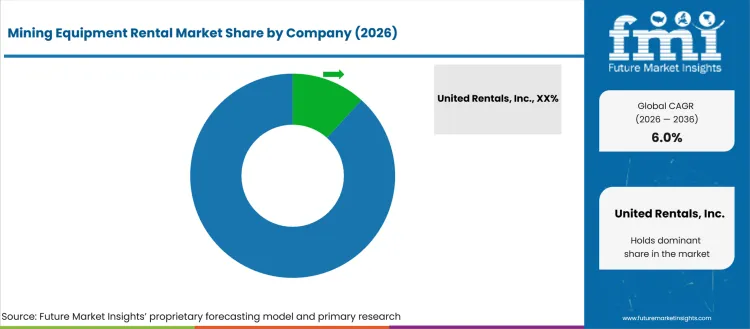
Competition is divided among large general rental networks, mining OEMs with dealer-backed service and regional heavy-equipment specialists. General rental providers offer branch density and broad fleet access. OEM platforms compete through mine-class equipment, parts, trained technicians and software and certified maintenance. Regional dealers are important where remote-site service and machine configuration determine whether a contract performs.
- United Rentals, Sunbelt Rentals and Herc Holdings combine broad fleet access with branch-based industrial account coverage.
- Caterpillar, Komatsu, Epiroc and Sandvik connect mine-class equipment with parts and field service and automation capability and lifecycle support.
- MacAllister Machinery, SMS Equipment and Hastings Deering provide regional dealer support where remote-site service and machine configuration determine contract performance.
Competitive Benchmarking: Mining Equipment Rental Market
| Company | Commercial position | Evidence-based rental advantage |
|---|---|---|
| United Rentals, Inc. | Large general rental platform | Broad fleet classes, specialty services, branch-based replacement capacity and standardized account processes for industrial customers. |
| Sunbelt Rentals, Inc. | General equipment rental network | One-stop construction and industrial rental model with wide fleet availability, service support and account coverage. |
| H&E Equipment Services, Inc. | Legacy USA equipment rental platform | Earthmoving and material-handling fleet with branch-based account support; the platform changed ownership in 2025. |
| Caterpillar Inc. | Mining OEM and Cat Rental ecosystem | Mine-class equipment, dealer parts, field service and product data and rental access through the Cat dealer network. |
| Komatsu Ltd. | Mining OEM with dealer support | Surface and underground equipment, autonomous haulage capability, machine technology and dealer-backed maintenance. |
| Epiroc AB | Specialist mining equipment OEM | Drilling, loading and haulage equipment with automation, electrification and aftermarket support and service agreements. |
| Sandvik AB | Underground mining specialist | Hard-rock equipment, battery-electric fleets, automation capability and lifecycle service for underground operations. |
| MacAllister Machinery Co., Inc. | Regional Cat dealer and rental provider | Mining machines, off-highway trucks, rental inventory and parts and field service for regional customers. |
| SMS Equipment Inc. | Komatsu dealer and mine-support provider | Short- and long-term heavy equipment rental, remote mine support, technology integration and lifecycle service. |
| Hastings Deering Pty Ltd. | Regional Cat dealer and service provider | Mining fleet access, regional field service, parts support and surface or underground application coverage. |
Key Developments in the Mining Equipment Rental Market
- In April 2025, Epiroc announced its largest-ever contract, valued at SEK 2.2 billion over five years, to supply Fortescue in Australia with a fleet of fully autonomous and electric surface mining equipment. The order illustrates how automation capability and lifecycle support are entering fleet qualification.
- In November 2024, Caterpillar successfully demonstrated the fully autonomous operation of its Cat 777 off-highway truck at Luck Stone's Bull Run quarry, its first autonomous deployment in the aggregates industry.
- In March 2025, Caterpillar announced a collaboration with Luminar Technologies to integrate LiDAR technology into its next-generation autonomous haulage solution. New machine platforms and autonomy partnerships can expand the pool available to dealer-backed rental and managed fleet programs.
- In July 2025, Komatsu and Nevada Gold Mines launched a first-of-its-kind deployment of Komatsu's FrontRunner Autonomous Haulage System in the United States, automating a fleet of large-class haul trucks across surface operations. The deployment shows the importance of dealer and OEM integration, commissioning and site support for autonomous-ready equipment.
Mining Equipment Rental Market - Report Scope
| Coverage field | Report scope |
|---|---|
| Market breakdown | Equipment Type, Application, End User and Distribution Channel and Rental Type and Region |
| Quantitative units | Revenue in USD Billion and CAGR in %. |
| Market definition | Revenue includes rental contracts and managed equipment services for mining-related machinery within the defined segmentation universe. It excludes outright equipment sales, used-equipment sales and finance interest that is not included in a rental fee. |
| Regions covered | North America; Latin America; Western Europe; Eastern Europe; East Asia; South Asia and Pacific; Middle East and Africa |
| Countries covered | Australia, Canada, USA and South Africa and Brazil and Japan and Germany and more than thirty additional countries in the full report |
| Key companies profiled | United Rentals, Inc.; Sunbelt Rentals, Inc.; H&E Equipment Services, Inc.; Caterpillar Inc.; Komatsu Ltd.; Epiroc AB; Sandvik AB; MacAllister Machinery Co., Inc.; SMS Equipment Inc.; Hastings Deering Pty Ltd. |
| Forecast period | 2026 to 2036 |
| Approach | Hybrid bottom-up and top-down sizing using rental revenue, rental fleet value, utilization and rate checks and equipment mix and mine activity and contractor demand and buyer-side validation. |
| Rounding | Displayed market values are rounded. CAGR is calculated from underlying unrounded FMI estimates. |
Mining Equipment Rental Market - Research Methodology
| Method | Approach |
|---|---|
| Primary Research | FMI engages rental providers, mining OEMs, authorized dealers and mining companies and contract miners and procurement teams and mine planners and maintenance managers and safety professionals and subject-matter experts. |
| Desk Research | The review covers mine-safety regulation, official mineral statistics, national resource publications and relevant standards and company filings and first-party product documentation and official press releases and trade-body material. |
| Market Sizing and Forecasting | The model reconciles provider rental revenue, rental fleet value, utilization and daily and period rates and equipment mix and application demand and contract duration and mine activity and country-level operating indicators. |
| Data Validation | Supplier-side findings are cross-checked with buyer interviews, dealer evidence, contract structures and application requirements and country conditions and mathematical consistency checks. |
Mining Equipment Rental Market by Segments
Mining Equipment Rental Market segmented by Equipment Type:
- Earthmoving Equipment
- Excavators
- Bulldozers
- Material Handling Equipment
- Wheel Loaders
- Telehandlers
- Underground Mining Equipment
- Underground Loaders
- Underground Trucks
- Drilling & Blasting Equipment
- Drill Rigs
- Rock Breakers
- Crushing & Screening Equipment
- Mobile Crushers
- Mobile Screening Plants
Mining Equipment Rental Market segmented by Application:
- Surface Mining
- Open-Pit Mining
- Strip Mining
- Underground Mining
- Hard Rock Mining
- Soft Rock Mining
- Mineral Processing
- Crushing Operations
- Screening Operations
- Exploration Activities
- Geological Surveying
- Core Drilling
- Quarrying
- Aggregate Quarrying
- Stone Quarrying
Mining Equipment Rental Market segmented by End User:
- Mining Companies
- Large Mining Companies
- Mid-Sized Mining Companies
- Mining Contractors
- Mine Development Contractors
- Contract Mining Companies
- Construction & Infrastructure Companies
- Tunnel Construction
- Infrastructure Development
- Government & Public Sector
- Geological Survey Agencies
- Public Mining Enterprises
- Exploration Companies
- Mineral Exploration Firms
- Geological Consultants
Mining Equipment Rental Market segmented by Distribution Channel:
- Direct Rental Providers
- Long-Term Rental Contracts
- Short-Term Rental Contracts
- Equipment Dealers
- Authorized Dealers
- Regional Dealers
- OEM Rental Programs
- Manufacturer Rental Services
- Certified Fleet Programs
- Online Rental Platforms
- Digital Rental Portals
- B2B Equipment Marketplaces
- Equipment Brokers
- Independent Rental Brokers
- Fleet Management Companies
Mining Equipment Rental Market segmented by Rental Type:
- Long-Term Rental
- Annual Rental Agreements
- Multi-Year Contracts
- Short-Term Rental
- Daily Rental
- Weekly Rental
- Rent-to-Own
- Lease Purchase Agreements
- Finance-to-Own Programs
- Project-Based Rental
- Mining Expansion Projects
- Seasonal Mining Operations
- Managed Equipment Services
- Fleet Management Services
- Full-Service Rental Solutions
Mining Equipment Rental Market by Region:
- North America
- United States
- Canada
- Mexico
- Latin America
- Brazil
- Chile
- Rest of Latin America
- Western Europe
- Germany
- United Kingdom
- Italy
- Spain
- France
- Nordics
- Benelux
- Rest of Western Europe
- Eastern Europe
- Russia
- Poland
- Hungary
- Balkan and Baltic States
- Rest of Eastern Europe
- East Asia
- China
- Japan
- South Korea
- South Asia and Pacific
- India
- ASEAN
- Australia and New Zealand
- Rest of South Asia and Pacific
- Middle East and Africa
- Kingdom of Saudi Arabia
- Other GCC Countries
- Türkiye
- South Africa
- Other African Union Countries
- Rest of Middle East and Africa
Research Sources and Bibliography
- European Rental Association, Reasons to Rent. Rental economics and risk allocation.
- European Rental Association, Sustainability. Equipment rental and circular-use principles.
- International Organization for Standardization, ISO 17757:2019. Safety requirements for autonomous and semi-autonomous earth-moving and mining machinery systems.
- US Mine Safety and Health Administration, Powered Haulage Safety. Mine-equipment safety priorities.
- US Mine Safety and Health Administration, Safety Topics. Inspection and safe-equipment guidance.
- Australian Government Department of Industry, Science and Resources, Resources and Energy Quarterly and June 2026. Resource-sector production and outlook context.
- Natural Resources Canada, Mining Data, Statistics and Analysis. Canadian mining activity and asset context.
- Natural Resources Canada, Minerals and Metals Facts. National minerals and mining indicators.
- Minerals Council South Africa, Facts and Figures. South African mining-sector operating context.
- Agência Nacional de Mineração, Anuário Mineral Brasileiro 2025. Brazilian mineral-production statistics.
- Federal Institute for Geosciences and Natural Resources, Raw Materials in Germany and Europe. German raw-material and extraction context.
- Japan Organization for Metals and Energy Security, Annual Report. Japanese resource and technical program context.
- United Rentals, Official Investor Relations. Company and rental-platform information.
- Sunbelt Rentals, US Business. Rental network and service model.
- Caterpillar, Cat Rental Store Industries. Rental access and industry coverage.
- Caterpillar, Next-Generation Cat 775 Preview, April 2025. Product and autonomy development.
- Komatsu, Mining Advancements at MINExpo 2024. Mining equipment and technology portfolio.
- Epiroc, Autonomous Surface Mining Equipment Order in Australia, January 2025. Verified company development.
- Sandvik, Record Battery-Electric Mining Equipment Order, April 2025. Verified company development.
- Komatsu, Nevada Gold Mines Autonomous Haulage Partnership, July 2025. Verified company development.
- MacAllister Machinery, Mining Industry Solutions. Mining rental and support capability.
- SMS Equipment, Surface Mining Solutions. Rental, service and mine-support capability.
- Hastings Deering, Mining Industry Solutions. Surface and underground mining support.
This bibliography is provided for reader reference and is not exhaustive. The full report contains the complete reference list and detailed citations.
This Report Answers
- What is the Mining Equipment Rental Market size in 2026, and what value is forecast for 2036?
- Why does Earthmoving Equipment hold the leading position within Equipment Type?
- How do open-pit, underground, processing and exploration and quarrying applications change rental economics?
- Why do Mining Companies account for the largest share of End User demand?
- What makes Direct Rental Providers central to mine-equipment sourcing?
- Why do Long-Term Rental agreements lead the Rental Type category?
- How do Australia, Canada, USA and South Africa and Brazil and Japan and Germany differ in forecast growth?
- Which suppliers combine fleet access with mine-class equipment, field service, parts or technology support?
- How do mobilization, wear, remote-site logistics and safety qualification affect return on rental spending?
- What should procurement and mine-operations teams include in a service-level agreement?
Frequently Asked Questions
How big is the Mining Equipment Rental Market in 2026?
The mining equipment rental market is valued at USD 8.7 billion in 2026 and is forecast to reach USD 15.7 billion by 2036. Growth is supported by mine development, production and processing operators converting machinery into a timed operating input instead of a permanent owned fleet.
What is the CAGR of the Mining Equipment Rental Market from 2026 to 2036?
The mining equipment rental market grows at a CAGR of 6.0% between 2026 and 2036, supported by mine development and production peaks that favor timed equipment access over permanent ownership of a peak-sized fleet across surface, processing and exploration operations.
Which equipment type leads the Mining Equipment Rental Market?
Earthmoving Equipment leads the mining equipment rental market with a 36.0% share in 2026, because it is used across overburden removal, bench preparation, haul-road work, stockpiles and mine development, giving providers recurring utilization across multiple phases of a mine's operating cycle.
How much will the Mining Equipment Rental Market add between 2026 and 2036?
The mining equipment rental market is set to add USD 7.0 billion between 2026 and 2036, growing from USD 8.7 billion to USD 15.7 billion as mine development, production and processing operators expand rental and managed-fleet contracts across surface and underground operations worldwide.
Who are the leading companies in the Mining Equipment Rental Market?
The mining equipment rental market is led by 10 companies, including United Rentals, Sunbelt Rentals, Herc Holdings, Caterpillar, Komatsu, Epiroc, Sandvik, MacAllister Machinery, SMS Equipment and Hastings Deering, competing through fleet access, mine-class equipment, parts availability and field-service coverage.
Preview the report firsthand - request a free sample
Get SampleGet the brochure for pricing and purchase details.
Get PDFTable of Content
- Key Takeaways
- Market Size and CAGR
- Top Growth Driver
- Fastest Growing Segment
- Leading Region
- Key Companies
- Emerging Opportunities
- Executive Summary
- Global Market Outlook
- Demand-side Trends
- Supply-side Trends
- Technology Roadmap Analysis
- Analysis and Recommendations
- Analyst Perspective (What is happening? Why now? What should investors know?)
- Key Questions Answered
- How large is the market?
- What is the CAGR?
- What are key trends?
- Which region dominates?
- Who are the leaders?
- Market Overview
- Market Coverage / Taxonomy
- Market Definition / Scope / Limitations
- Research Methodology
- Chapter Orientation
- Analytical Lens and Working Hypotheses
- Market Structure, Signals, and Trend Drivers
- Benchmarking and Cross-market Comparability
- Market Sizing, Forecasting, and Opportunity Mapping
- Research Design and Evidence Framework
- Desk Research Programme (Secondary Evidence)
- Expert Input and Fieldwork (Primary Evidence)
- Tooling, Models, and Reference Databases
- Data Engineering and Model Build
- Quality Assurance and Audit Trail
- Market Background
- Market Dynamics (Drivers, Restraints, Opportunity, Trends)
- Scenario Forecast (Optimistic, Likely, Conservative)
- Impact Analysis
- AI Impact
- Sustainability Impact
- Regulatory Impact
- Technology Impact
- Consumer / Buyer Analysis
- Purchase Drivers
- Adoption Barriers
- Buyer Journey
- Opportunity Map Analysis
- Product Life Cycle Analysis
- Supply Chain Analysis
- Investment Feasibility Matrix
- Value Chain Analysis
- PESTLE and Porter's Analysis
- Regulatory Landscape
- Regional Parent Market Outlook
- Production and Consumption Statistics
- Import and Export Statistics
- Global Market Analysis and Forecast, 2021 to 2036
- Historical Market Size Value (USD Billion) Analysis, 2021 to 2025
- Current and Future Market Size Value (USD Billion) Projections, 2026 to 2036
- Y-o-Y Growth Trend Analysis
- Absolute $ Opportunity Analysis
- Global Market Pricing Analysis, 2021 to 2036
- Global Market Analysis and Forecast, By Equipment Type, 2021 to 2036
- Introduction / Key Findings
- Historical Market Size Value (USD Billion) Analysis By Equipment Type, 2021 to 2025
- Current and Future Market Size Value (USD Billion) Analysis and Forecast By Equipment Type, 2026 to 2036
- Earthmoving Equipment
- Excavators
- Bulldozers
- Material Handling Equipment
- Wheel Loaders
- Telehandlers
- Underground Mining Equipment
- Underground Loaders
- Underground Trucks
- Drilling & Blasting Equipment
- Drill Rigs
- Rock Breakers
- Crushing & Screening Equipment
- Mobile Crushers
- Mobile Screening Plants
- Earthmoving Equipment
- Y-o-Y Growth Trend Analysis By Equipment Type, 2021 to 2025
- Absolute $ Opportunity Analysis By Equipment Type, 2026 to 2036
- Global Market Analysis and Forecast, By Application, 2021 to 2036
- Introduction / Key Findings
- Historical Market Size Value (USD Billion) Analysis By Application, 2021 to 2025
- Current and Future Market Size Value (USD Billion) Analysis and Forecast By Application, 2026 to 2036
- Surface Mining
- Open-Pit Mining
- Strip Mining
- Underground Mining
- Hard Rock Mining
- Soft Rock Mining
- Mineral Processing
- Crushing Operations
- Screening Operations
- Exploration Activities
- Geological Surveying
- Core Drilling
- Quarrying
- Aggregate Quarrying
- Stone Quarrying
- Surface Mining
- Y-o-Y Growth Trend Analysis By Application, 2021 to 2025
- Absolute $ Opportunity Analysis By Application, 2026 to 2036
- Global Market Analysis and Forecast, By End User, 2021 to 2036
- Introduction / Key Findings
- Historical Market Size Value (USD Billion) Analysis By End User, 2021 to 2025
- Current and Future Market Size Value (USD Billion) Analysis and Forecast By End User, 2026 to 2036
- Mining Companies
- Large Mining Companies
- Mid-Sized Mining Companies
- Mining Contractors
- Mine Development Contractors
- Contract Mining Companies
- Construction & Infrastructure Companies
- Tunnel Construction
- Infrastructure Development
- Government & Public Sector
- Geological Survey Agencies
- Public Mining Enterprises
- Exploration Companies
- Mineral Exploration Firms
- Geological Consultants
- Mining Companies
- Y-o-Y Growth Trend Analysis By End User, 2021 to 2025
- Absolute $ Opportunity Analysis By End User, 2026 to 2036
- Global Market Analysis and Forecast, By Distribution Channel, 2021 to 2036
- Introduction / Key Findings
- Historical Market Size Value (USD Billion) Analysis By Distribution Channel, 2021 to 2025
- Current and Future Market Size Value (USD Billion) Analysis and Forecast By Distribution Channel, 2026 to 2036
- Direct Rental Providers
- Long-Term Rental Contracts
- Short-Term Rental Contracts
- Equipment Dealers
- Authorized Dealers
- Regional Dealers
- OEM Rental Programs
- Manufacturer Rental Services
- Certified Fleet Programs
- Online Rental Platforms
- Digital Rental Portals
- B2B Equipment Marketplaces
- Equipment Brokers
- Independent Rental Brokers
- Fleet Management Companies
- Direct Rental Providers
- Y-o-Y Growth Trend Analysis By Distribution Channel, 2021 to 2025
- Absolute $ Opportunity Analysis By Distribution Channel, 2026 to 2036
- Global Market Analysis and Forecast, By Rental Type, 2021 to 2036
- Introduction / Key Findings
- Historical Market Size Value (USD Billion) Analysis By Rental Type, 2021 to 2025
- Current and Future Market Size Value (USD Billion) Analysis and Forecast By Rental Type, 2026 to 2036
- Long-Term Rental
- Annual Rental Agreements
- Multi-Year Contracts
- Short-Term Rental
- Daily Rental
- Weekly Rental
- Rent-to-Own
- Lease Purchase Agreements
- Finance-to-Own Programs
- Project-Based Rental
- Mining Expansion Projects
- Seasonal Mining Operations
- Managed Equipment Services
- Fleet Management Services
- Full-Service Rental Solutions
- Long-Term Rental
- Y-o-Y Growth Trend Analysis By Rental Type, 2021 to 2025
- Absolute $ Opportunity Analysis By Rental Type, 2026 to 2036
- Global Market Analysis and Forecast, By Region, 2021 to 2036
- Introduction
- Historical Market Size Value (USD Billion) Analysis By Region, 2021 to 2025
- Current Market Size Value (USD Billion) Analysis and Forecast By Region, 2026 to 2036
- North America
- Latin America
- Western Europe
- Eastern Europe
- East Asia
- South Asia and Pacific
- Middle East & Africa
- Market Attractiveness Analysis By Region
- North America Market Analysis and Forecast, By Country, 2021 to 2036
- Historical Market Size Value (USD Billion) Trend Analysis By Market Taxonomy, 2021 to 2025
- Market Size Value (USD Billion) Forecast By Market Taxonomy, 2026 to 2036
- By Country
- USA
- Canada
- By Equipment Type
- By Application
- By End User
- By Distribution Channel
- By Rental Type
- By Country
- Market Attractiveness Analysis
- By Country
- By Equipment Type
- By Application
- By End User
- By Distribution Channel
- By Rental Type
- Key Takeaways
- Latin America Market Analysis and Forecast, By Country
- Historical Market Size Value (USD Billion) Trend Analysis By Market Taxonomy, 2021 to 2025
- Market Size Value (USD Billion) Forecast By Market Taxonomy, 2026 to 2036
- By Country
- Brazil
- Mexico
- Chile
- Rest of Latin America
- By Equipment Type
- By Application
- By End User
- By Distribution Channel
- By Rental Type
- By Country
- Market Attractiveness Analysis
- By Country
- By Equipment Type
- By Application
- By End User
- By Distribution Channel
- By Rental Type
- Key Takeaways
- Western Europe Market Analysis and Forecast, By Country
- Historical Market Size Value (USD Billion) Trend Analysis By Market Taxonomy, 2021 to 2025
- Market Size Value (USD Billion) Forecast By Market Taxonomy, 2026 to 2036
- By Country
- Germany
- UK
- Italy
- Spain
- France
- Nordic
- BENELUX
- Rest of Western Europe
- By Equipment Type
- By Application
- By End User
- By Distribution Channel
- By Rental Type
- By Country
- Market Attractiveness Analysis
- By Country
- By Equipment Type
- By Application
- By End User
- By Distribution Channel
- By Rental Type
- Key Takeaways
- Eastern Europe Market Analysis and Forecast, By Country
- Historical Market Size Value (USD Billion) Trend Analysis By Market Taxonomy, 2021 to 2025
- Market Size Value (USD Billion) Forecast By Market Taxonomy, 2026 to 2036
- By Country
- Russia
- Poland
- Hungary
- Balkan & Baltic
- Rest of Eastern Europe
- By Equipment Type
- By Application
- By End User
- By Distribution Channel
- By Rental Type
- By Country
- Market Attractiveness Analysis
- By Country
- By Equipment Type
- By Application
- By End User
- By Distribution Channel
- By Rental Type
- Key Takeaways
- East Asia Market Analysis and Forecast, By Country
- Historical Market Size Value (USD Billion) Trend Analysis By Market Taxonomy, 2021 to 2025
- Market Size Value (USD Billion) Forecast By Market Taxonomy, 2026 to 2036
- By Country
- China
- Japan
- South Korea
- By Equipment Type
- By Application
- By End User
- By Distribution Channel
- By Rental Type
- By Country
- Market Attractiveness Analysis
- By Country
- By Equipment Type
- By Application
- By End User
- By Distribution Channel
- By Rental Type
- Key Takeaways
- South Asia and Pacific Market Analysis and Forecast, By Country
- Historical Market Size Value (USD Billion) Trend Analysis By Market Taxonomy, 2021 to 2025
- Market Size Value (USD Billion) Forecast By Market Taxonomy, 2026 to 2036
- By Country
- India
- ASEAN
- Australia & New Zealand
- Rest of South Asia and Pacific
- By Equipment Type
- By Application
- By End User
- By Distribution Channel
- By Rental Type
- By Country
- Market Attractiveness Analysis
- By Country
- By Equipment Type
- By Application
- By End User
- By Distribution Channel
- By Rental Type
- Key Takeaways
- Middle East & Africa Market Analysis and Forecast, By Country
- Historical Market Size Value (USD Billion) Trend Analysis By Market Taxonomy, 2021 to 2025
- Market Size Value (USD Billion) Forecast By Market Taxonomy, 2026 to 2036
- By Country
- Kingdom of Saudi Arabia
- Other GCC Countries
- Türkiye
- South Africa
- Other African Union
- Rest of Middle East & Africa
- By Equipment Type
- By Application
- By End User
- By Distribution Channel
- By Rental Type
- By Country
- Market Attractiveness Analysis
- By Country
- By Equipment Type
- By Application
- By End User
- By Distribution Channel
- By Rental Type
- Key Takeaways
- Key Countries Market Analysis
- USA
- Pricing Analysis
- Market Share Analysis, 2025
- By Equipment Type
- By Application
- By End User
- By Distribution Channel
- By Rental Type
- Canada
- Pricing Analysis
- Market Share Analysis, 2025
- By Equipment Type
- By Application
- By End User
- By Distribution Channel
- By Rental Type
- Mexico
- Pricing Analysis
- Market Share Analysis, 2025
- By Equipment Type
- By Application
- By End User
- By Distribution Channel
- By Rental Type
- Brazil
- Pricing Analysis
- Market Share Analysis, 2025
- By Equipment Type
- By Application
- By End User
- By Distribution Channel
- By Rental Type
- Chile
- Pricing Analysis
- Market Share Analysis, 2025
- By Equipment Type
- By Application
- By End User
- By Distribution Channel
- By Rental Type
- Germany
- Pricing Analysis
- Market Share Analysis, 2025
- By Equipment Type
- By Application
- By End User
- By Distribution Channel
- By Rental Type
- UK
- Pricing Analysis
- Market Share Analysis, 2025
- By Equipment Type
- By Application
- By End User
- By Distribution Channel
- By Rental Type
- Italy
- Pricing Analysis
- Market Share Analysis, 2025
- By Equipment Type
- By Application
- By End User
- By Distribution Channel
- By Rental Type
- Spain
- Pricing Analysis
- Market Share Analysis, 2025
- By Equipment Type
- By Application
- By End User
- By Distribution Channel
- By Rental Type
- France
- Pricing Analysis
- Market Share Analysis, 2025
- By Equipment Type
- By Application
- By End User
- By Distribution Channel
- By Rental Type
- India
- Pricing Analysis
- Market Share Analysis, 2025
- By Equipment Type
- By Application
- By End User
- By Distribution Channel
- By Rental Type
- ASEAN
- Pricing Analysis
- Market Share Analysis, 2025
- By Equipment Type
- By Application
- By End User
- By Distribution Channel
- By Rental Type
- Australia & New Zealand
- Pricing Analysis
- Market Share Analysis, 2025
- By Equipment Type
- By Application
- By End User
- By Distribution Channel
- By Rental Type
- China
- Pricing Analysis
- Market Share Analysis, 2025
- By Equipment Type
- By Application
- By End User
- By Distribution Channel
- By Rental Type
- Japan
- Pricing Analysis
- Market Share Analysis, 2025
- By Equipment Type
- By Application
- By End User
- By Distribution Channel
- By Rental Type
- South Korea
- Pricing Analysis
- Market Share Analysis, 2025
- By Equipment Type
- By Application
- By End User
- By Distribution Channel
- By Rental Type
- Russia
- Pricing Analysis
- Market Share Analysis, 2025
- By Equipment Type
- By Application
- By End User
- By Distribution Channel
- By Rental Type
- Poland
- Pricing Analysis
- Market Share Analysis, 2025
- By Equipment Type
- By Application
- By End User
- By Distribution Channel
- By Rental Type
- Hungary
- Pricing Analysis
- Market Share Analysis, 2025
- By Equipment Type
- By Application
- By End User
- By Distribution Channel
- By Rental Type
- Kingdom of Saudi Arabia
- Pricing Analysis
- Market Share Analysis, 2025
- By Equipment Type
- By Application
- By End User
- By Distribution Channel
- By Rental Type
- Türkiye
- Pricing Analysis
- Market Share Analysis, 2025
- By Equipment Type
- By Application
- By End User
- By Distribution Channel
- By Rental Type
- South Africa
- Pricing Analysis
- Market Share Analysis, 2025
- By Equipment Type
- By Application
- By End User
- By Distribution Channel
- By Rental Type
- USA
- Market Structure Analysis
- Competition Dashboard
- Competition Benchmarking
- Market Share Analysis of Top Players
- By Regional
- By Equipment Type
- By Application
- By End User
- By Distribution Channel
- By Rental Type
- Emerging Startups
- Innovation Benchmarking
- Competition Analysis
- Competition Deep Dive
- United Rentals, Inc.
- Overview
- Product Portfolio
- Profitability by Market Segments
- Sales Footprint
- Strategy Overview
- Marketing Strategy
- Product Strategy
- Channel Strategy
- Sunbelt Rentals, Inc.
- H&E Equipment Services, Inc.
- Caterpillar Inc.
- Komatsu Ltd.
- Epiroc AB
- Sandvik AB
- MacAllister Machinery Co., Inc.
- SMS Equipment Inc.
- Hastings Deering Pty Ltd.
- United Rentals, Inc.
- Case Studies
- Success Stories
- Recent Developments
- Competition Deep Dive
- Assumptions & Acronyms Used


