

- Industry Size (2026)
- USD 3.4 Bn
- Forecast (2036)
- USD 6 Bn
- CAGR (2026 to 2036)
- 5.80%
Mouthwash Tablets Market Forecast and Outlook 2026 to 2036
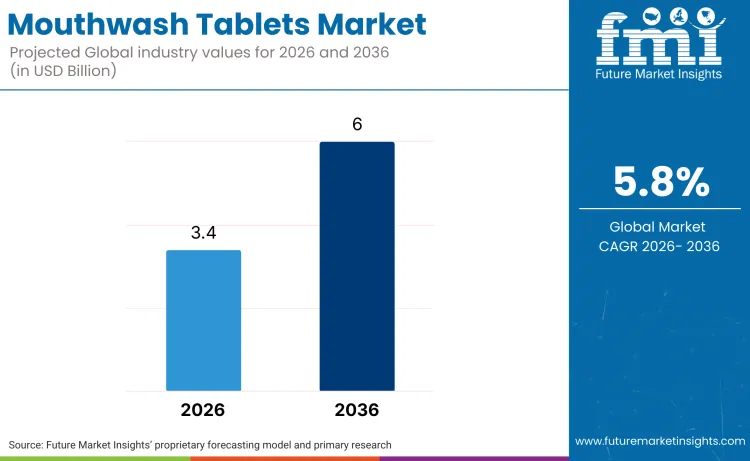
The mouthwash tablets market is valued at USD 3.4 billion in 2026 and is projected to reach USD 6.0 billion by 2036, expanding at a 5.8% CAGR, supported by steady changes in oral care behavior. Consumers are increasingly favoring products that fit daily routines, frequent travel, and sustainability preferences. Mouthwash tablets address several structural limitations of liquid mouthwash, including reliance on plastic bottles, higher transport weight, and alcohol-based formulations that can limit suitability for repeated use. Product activity between 2024 and 2026 points to growing emphasis on waterless formats, alcohol-free systems, and functional ingredients such as hydroxyapatite and xylitol, which support enamel care and gentler oral hygiene. Established oral care brands are extending into solid and unit-dose formats to protect relevance, while newer brands continue to shape awareness through compostable packaging and simplified ingredient profiles.
Broader consumer attitudes toward waterless personal care is shaping how the mouthwash tablets category is developing. As Cecilia Gates, CEO of Gates Creative, explains, "There are so many factors to waterless beauty. It’s more eco-conscious, from the fact that you can likely reduce some packaging… it’s more relevant to how people live their lives because people right now are so mobile and on-the-go. It feels more like a movement, a way society can go, than a trend." Future Market Insights observes that online retail is playing a critical role in market expansion, as mouthwash tablets are easy to ship, store, and replenish through subscription models. Wider acceptance of solid personal care formats, along with growing emphasis on plastic reduction and everyday convenience, is expected to support repeat usage, broader brand participation, and sustained value growth through 2036.
Summary of the Mouthwash Tablets Market
What Is Growth Outlook for the Mouthwash Tablets Market as per Future Market Insights Projection?
Future Market Insights projects the mouthwash tablets market to grow at a CAGR of 5.8% from 2026 to 2036, expanding from USD 3.4 billion in 2026 to USD 6.0 billion by 2036.
How Do FMI Analysts Perceive the Mouthwash Tablets Market to Evolve?
FMI analysts perceive the market evolving from niche, convenience-led alternatives toward routine, preventive oral care solutions integrated into daily hygiene practices.
Which Country Holds Largest Share in the Global Mouthwash Tablets Market?
China holds the largest share of the global mouthwash tablets market by value.
How Large Will the Mouthwash Tablets Market Be by 2036?
The global mouthwash tablets market is estimated to reach USD 6.0 billion by 2036.
How Future Market Insights Defines the Mouthwash Tablets Market?
The mouthwash tablets market comprises commercially sold solid oral care products formulated as tablets, intended to be dissolved in water for mouth rinsing in routine or therapeutic oral hygiene.
What Are Globally Unique Trends Shaping the Mouthwash Tablets Market?
Globally unique trends include waterless oral care adoption, formulation discipline for daily use, and integration of tablets into preventive oral hygiene systems.
Mouthwash Tablets Market Key Takeaways
| Metric | Details |
|---|---|
| Industry Size (2026) | USD 3.4 billion |
| Industry Value (2036) | USD 6 billion |
| CAGR (2026-2036) | 5.80% |
Source: Future Market Insights (FMI) analysis, based on proprietary forecasting model and primary research
Why is the Demand for Mouthwash Tablets Growing?
Safety requirements for mouthwash tablets are becoming more stringent as these products move from occasional use toward daily oral care routines. As per Future Market Insights, regulators and retailers are placing greater emphasis on ingredient quality, dosage accuracy, and long-term oral tolerance. Early tablet products often relied on basic formulations, which limited consumer confidence for regular use. That approach is now difficult to sustain as brands seek wider retail acceptance. Larger oral care companies such as Colgate-Palmolive and Kenvue have responded by strengthening alcohol-free positioning, microbiome-friendly formulations, and internal quality standards across their oral care portfolios.
Product launches from newer players highlight the same direction. Brands like Hello Products and The Humble Co. have focused on tablet formats using carefully controlled ingredient systems to avoid irritation and taste instability. Functional ingredients such as hydroxyapatite and xylitol require consistent purity in waterless formats, leaving little room for formulation shortcuts. FMI notes that companies able to maintain tight formulation control and supplier validation are better positioned to scale beyond niche audiences. As mouthwash tablets shift from trial products to routine use, compliance capability and formulation discipline are increasingly separating scalable brands from smaller experimental entrants.
How is the Mouthwash Tablets Market Segmented?
The mouthwash tablets market is segmented by type and application, reflecting how these products are used rather than how they are formulated. By type, the market is categorized into therapeutic mouthwash tablets and cosmetic mouthwash tablets. Therapeutic variants are designed to address specific oral health concerns such as plaque control, sensitivity management, or gum care, while cosmetic mouthwash tablets focus on breath freshness and routine hygiene. By application, demand is divided between household use and hospital and dental clinic settings, capturing differences in frequency, supervision, and intended outcomes.
As per Future Market Insights, the segmentation landscape is shifting from purely cosmetic use toward functional and preventive oral care. Earlier growth was driven largely by freshness and convenience. The outlook toward 2036 favors products positioned for regular oral health maintenance, especially alcohol-free and gentle formulations suitable for repeated daily use. This shift is influencing how brands prioritize therapeutic claims, ingredient transparency, and clinical relevance across both home and professional environments.
Why does Therapeutic Mouthwash hold a leading share by type?
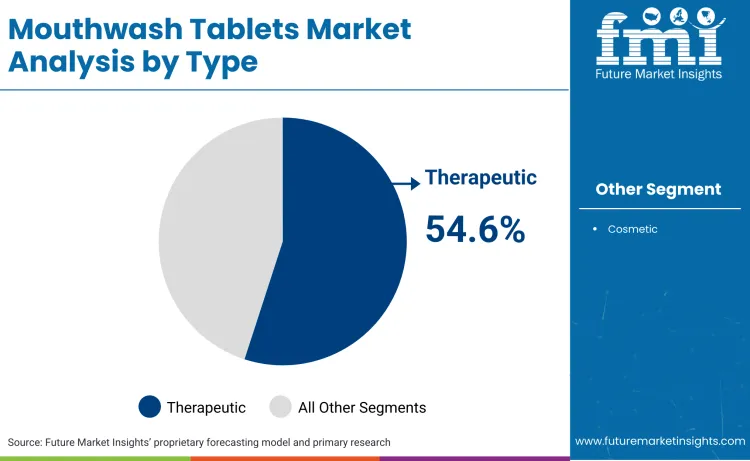
Therapeutic mouthwash tablets account for a 54.6% share in 2026, driven by rising demand for products that support daily oral health beyond breath control. Consumers increasingly prefer tablets that help manage plaque buildup, enamel strength, and gum comfort while remaining mild enough for frequent use. Waterless tablet formats allow precise dosing of active ingredients, improving consistency compared to liquid alternatives. This reliability supports trust among users who integrate therapeutic tablets into morning and evening routines. As oral care shifts toward prevention rather than reactive treatment, therapeutic formats are gaining stronger adoption than cosmetic-only options.
Why does Household application dominate overall demand?
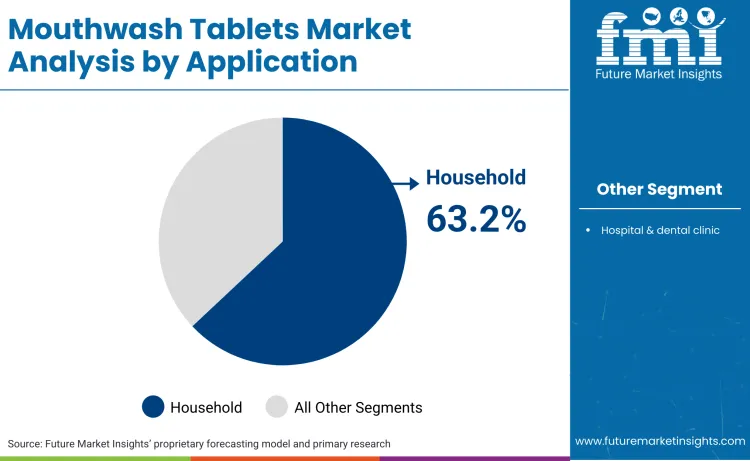
Household use represents a 63.2% share, reflecting the growing integration of mouthwash tablets into everyday oral hygiene routines. These products are easy to store, lightweight, and convenient for travel, making them well suited for regular daily use without professional supervision. Alcohol-free formulations further encourage adoption across different age groups by improving oral comfort and reducing irritation risks associated with frequent use. While hospitals and dental clinics utilize mouthwash tablets primarily for supervised care or short-term hygiene protocols, repeat consumption is largely concentrated in home settings. According to Future Market Insights, the transition of tablets from trial or occasional products toward routine replacements for liquid mouthwash is reinforcing consistent household demand. As consumer familiarity and confidence increase, household application continues to serve as the primary driver of volume growth, supporting stable market expansion through the forecast period.
What Trends Are Shaping Industry Evolution Through Waterless Oral Care Formats?
Waterless oral care formats are gaining traction as manufacturers look to reduce reliance on plastic packaging, liquid transport, and preservative-heavy formulations. Mouthwash tablets offer consistent dosing, longer shelf life, and lower logistics intensity compared to liquid mouthwash. As per Future Market Insights, tablet formats also simplify formulation stability by removing water, which reduces microbial risk and the need for alcohol-based preservatives. Brands are prioritizing solid formats that support daily use while aligning with sustainability goals. This shift is positioning mouthwash tablets as a long-term alternative rather than a novelty product within routine oral hygiene.
How Is Portfolio Consolidation Creating Stronger Oral Care Platforms?
Portfolio consolidation is strengthening competitive positioning by allowing companies to combine oral health credibility with innovation in solid formats. Large consumer health players are expanding beyond traditional liquids by integrating tablet and unit-dose solutions into existing oral care portfolios. This approach focuses on capability expansion rather than volume alone. Brands gain better control over formulation standards, distribution reach, and consumer education. According to FMI, consolidation enables companies to apply established trust and clinical positioning to newer formats, accelerating acceptance of mouthwash tablets across household and professional channels.
Why Is Formulation Optimization Driving Ingredient and Format Innovation?
Cost pressure and safety expectations are pushing manufacturers to refine tablet formulations without compromising performance. Tablet formats require precise ingredient balance to maintain taste, dissolution speed, and oral comfort. Suppliers are developing optimized blends using functional ingredients such as hydroxyapatite and xylitol to deliver therapeutic benefits with minimal complexity. FMI notes that this focus on formulation efficiency supports scalability while keeping products suitable for daily use. As margins tighten and competition increases, formulation discipline is becoming a key driver of innovation in the mouthwash tablets market.
What is the Country-wise Outlook for the Mouthwash Tablets Market?
Against the global CAGR of 5.8%, growth patterns for mouthwash tablets vary clearly by country, reflecting differences in consumer behavior, oral care maturity, and adoption of solid formats. China leads with a 7.8% CAGR, followed by India at 7.2%, both outperforming the global average as waterless and alcohol-free oral care gains traction. Germany records a 6.6% CAGR, supported by sustainability-driven purchasing and strong pharmacy-led adoption. Brazil grows at 6.0%, broadly in line with the global pace, while the United States posts 5.5%, reflecting steady but mature demand. The United Kingdom reaches 4.9%, and Japan trails at 4.3%, shaped by conservative switching behavior and strong loyalty to liquid formats.
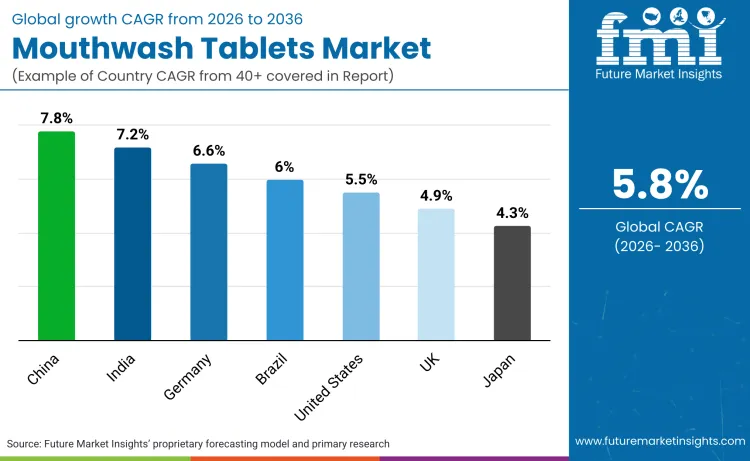
| Country | CAGR (2026 to 2036) |
|---|---|
| China | 7.8% |
| India | 7.2% |
| Germany | 6.6% |
| Brazil | 6% |
| United States | 5.5% |
| UK | 4.9% |
| Japan | 4.3% |
Source: FMI historical analysis and forecast data.
Why is China emerging as the fastest-growing market for mouthwash tablets?
China’s 7.8% CAGR is being driven by rapid acceptance of waterless personal care products and strong consumer familiarity with ingredient-focused hygiene solutions. Urban consumers are comfortable adopting new formats that fit travel-heavy lifestyles and small living spaces. Mouthwash tablets align well with China’s e-commerce-first purchasing behavior, where compact, lightweight products perform better in subscriptions and repeat orders. Both domestic and international brands are actively introducing alcohol-free and enamel-care tablet formulations, increasing choice and visibility. Growth is driven less by population expansion and more by higher usage frequency and active switching from liquid mouthwash to solid alternatives.
What is supporting strong growth in India?
India’s 7.2% growth is supported by changing oral care habits among younger and urban consumers. Mouthwash tablets appeal due to their portability, lower packaging waste, and suitability for daily routines. Tablets are increasingly positioned as affordable across multiple price tiers, helping adoption beyond premium segments. Online platforms play a major role by expanding access and enabling trial purchases. Rising awareness of alcohol-free and gentle oral care supports regular use, especially in cities where travel, work routines, and climate conditions increase demand for convenient hygiene solutions.
Why is Germany showing stronger growth in mouthwash tablets?
Germany records a 6.6% CAGR due to strong sustainability awareness and structured oral care consumption. Consumers show willingness to adopt solid formats that reduce plastic usage while maintaining strict safety and quality expectations. Pharmacy-led distribution supports trust in new formats, especially those positioned for daily oral health rather than cosmetic freshness. Tablets benefit from alignment with environmental priorities and demand for precise dosing. Adoption is steady and deliberate, driven by informed purchasing decisions rather than impulse buying, keeping Germany consistently above the global growth rate.
Why is Brazil showing steady growth in mouthwash tablet adoption?
Brazil’s mouthwash tablets market is expanding at a 6.0% CAGR, supported by climate-related oral care needs and rising middle-income consumption. Warm temperatures and high humidity increase demand for frequent freshness and hygiene, making compact tablet formats suitable for daily routines. Consumers value portability and ease of storage, especially for work and travel. Growing access through online platforms and pharmacies is improving trial and repeat usage. Tablets are increasingly viewed as practical additions to regular oral care rather than occasional alternatives, supporting consistent adoption across urban population centers.
Why is growth in the United States more gradual?
The United States records a 5.5% CAGR, reflecting steady but selective adoption of mouthwash tablets. Growth is driven mainly by travelers, sustainability-focused consumers, and digital-first shoppers seeking convenient formats. Tablets are often used as supplements rather than replacements for liquid mouthwash, which remains firmly established in household routines. High brand loyalty to liquid formats slows widespread switching. Adoption continues through niche segments, subscription channels, and specialty retail, resulting in stable growth without rapid format displacement.
What is the Competitive Outlook for the Mouthwash Tablets Market?
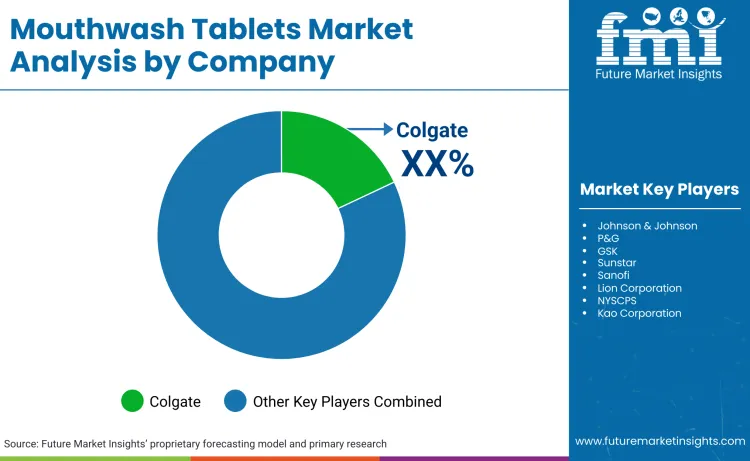
The competitive landscape for mouthwash tablets is led by established oral care and consumer health companies that are extending beyond liquid formats to protect long-term relevance. Players such as Colgate-Palmolive, Johnson & Johnson, Procter & Gamble, and GSK benefit from strong brand trust, clinical credibility, and wide retail access. Colgate currently holds an early lead with a 0.1 share, reflecting its ability to test solid oral care formats while leveraging existing oral health equity. Competitive strength in this market is less about tablet volume today and more about portfolio optionality and innovation readiness.
Future Market Insights observes that competition is shifting toward formulation discipline, safety positioning, and format diversification rather than rapid scale. Companies such as Sunstar, Sanofi, Lion Corporation, and Kao Corporation are approaching tablets as extensions of therapeutic and preventive oral care rather than cosmetic add-ons. At the same time, regional and wellness-led players including Veimeizi, Amway, Guilin Sanjin Pharmaceutical Company Limited, and Twin Lotus are driving niche adoption through natural positioning and alternative ingredients. FMI notes that competitive advantage will increasingly depend on formulation reliability, compliance readiness, and the ability to integrate tablets into broader oral care systems rather than standalone products.
Recent Developments:
- In October 2025, Bite introduced its upgraded Nano-Foam Mouthwash Tablet Series featuring micro-aerated dispersal technology. Bite stated through its official newsroom that the reformulation improves tablet dissolution speed and flavor stability, supporting daily-use adoption across travel and sustainability-driven consumer groups.
- In July 2025, Huppy expanded its production capacity in California by adding new tablet compression lines to scale output of its fluoride-free and nano-hydroxyapatite, based oral care tablets. The investment was disclosed through Huppy’s official press updates and supports rising North American demand for waterless mouthwash formats.
Key Players in Mouthwash Tablets Market
- Colgate
- Johnson & Johnson
- P&G
- GSK
- Sunstar
- Sanofi
- Lion Corporation
- NYSCPS
- Kao Corporation
- Veimeizi
- Amway
- Guilin Sanjin Pharmaceutical Company Limited
- Twin Lotus
Market Definition
The mouthwash tablets market represents revenue generated from the sale of solid oral care products formulated as tablets and intended to be dissolved in water for mouth rinsing. As defined in this analysis, the market measures commercially sold mouthwash tablets positioned for routine oral hygiene, preventive care, or therapeutic support. Market sizing captures finished product sales across consumer and professional channels and is evaluated by type, application, and geography, with values expressed in USD billion.
The market includes therapeutic and cosmetic mouthwash tablets designed for household use as well as hospital and dental clinic applications. Products formulated with functional ingredients such as hydroxyapatite, xylitol, fluoride alternatives, and alcohol-free systems are included when they are marketed explicitly as mouthwash tablets. Revenue generated through online retail, pharmacies and drug stores, specialty oral care outlets, and mass retail channels is counted. Geographic coverage spans North America, Europe, East Asia, South Asia, Latin America, and the Middle East & Africa.
The market excludes liquid mouthwash products, oral sprays, lozenges, chewing gums, toothpaste tablets, and other solid oral care formats not intended for mouth rinsing. Bulk ingredient sales, contract manufacturing services, packaging supply, logistics, and distribution services are not included. Medical treatments, prescription-only oral therapeutics, dental procedures, and professional services fall outside the scope. Regulatory programs, marketing expenditures, and research activities referenced contextually are not treated as market revenue.
Scope of the Report
| Items | Values |
|---|---|
| Quantitative Units (2026) | USD 3.4 billion |
| Type | Therapeutic Mouthwash; Cosmetic Mouthwash |
| Application | Household; Hospital & Dental Clinic |
| Regions Covered | North America, Europe, Asia Pacific, Latin America, Middle East & Africa |
| Countries Covered | United States, United Kingdom, Germany, India, China, and 35+ countries |
| Key Companies Profiled | Colgate, Johnson & Johnson, P&G, GSK, Sunstar, Sanofi, Lion Corporation, NYSCPS, Kao Corporation, Veimeizi, Amway, Guilin Sanjin Pharmaceutical Company Limited, Twin Lotus |
| Additional Attributes | Dollar sales by type and application, regional demand patterns across developed and emerging markets, competitive landscape dynamics among global oral care brands, formulation format innovation in tablet-based oral hygiene, clean-label and fluoride-free positioning strategies, cost optimization across tablet compression and packaging processes, supply chain resilience for active ingredients and excipients, regulatory compliance for OTC oral care products, private-label expansion in pharmacy and online channels, sustainability-focused packaging adoption, and brand differentiation through flavor and functional efficacy portfolios |
Source: FMI historical analysis and forecast data.
Mouthwash Tablets Market by Segments
By Type:
- Therapeutic mouthwash
- Cosmetic mouthwash
By Application:
- Household
- Hospital & dental clinic
Region:
- Asia Pacific
- China
- Japan
- South Korea
- India
- Australia & New Zealand
- ASEAN
- Rest of Asia Pacific
- Europe
- Germany
- United Kingdom
- France
- Italy
- Spain
- Nordic
- BENELUX
- Rest of Europe
- North America
- United States
- Canada
- Mexico
- Latin America
- Brazil
- Chile
- Rest of Latin America
- Middle East & Africa
- Kingdom of Saudi Arabia
- Other GCC Countries
- Turkey
- South Africa
- Other African Union
- Rest of Middle East & Africa
Bibliography
- British Dental Journal. (2023). Preventive oral care trends and daily hygiene product evolution. British Dental Journal, 234(9), 657-663.
- Cosmetics & Toiletries. (2023). Formulation challenges in waterless personal care products. Cosmetics & Toiletries, 138(6), 38-45.
- Journal of Cleaner Production. (2024). Environmental impact reduction through solid and waterless consumer product formats. Journal of Cleaner Production, 418, 139865.
- United Nations Environment Programme. (2023). Single-use plastics and sustainable alternatives in consumer goods. UNEP Publications.
- Harvard Business Review. (2023). Portfolio consolidation and innovation strategy in consumer health markets. Harvard Business Review Press.
Frequently Asked Questions
What is the current global market size for mouthwash tablets?
The global mouthwash tablets market is valued at USD 3.4 billion in 2026, reflecting growing adoption across household and clinical oral care applications.
What is the projected Compound Annual Growth Rate (CAGR) for the mouthwash tablets market through 2036?
Market sales are projected to expand at a 5.8% CAGR between 2026 and 2036.
Which product type accounts for the largest share of demand?
Therapeutic mouthwash tablets lead demand with a 54.6% share, supported by their use in oral hygiene maintenance and clinical settings.
What are the key regulatory or market challenges affecting adoption?
Compliance with OTC oral care regulations, ingredient safety standards, and labeling requirements remains a key challenge across major regions.
Who are the leading companies operating in the mouthwash tablets market?
Key players include Colgate, Johnson & Johnson, P&G, GSK, Sunstar, Sanofi, Lion Corporation, Kao Corporation, Amway, and Twin Lotus.
Preview the report firsthand - request a free sample
Get SampleGet the brochure for pricing and purchase details.
Get PDFTable of Content
- Executive Summary
- Global Market Outlook
- Demand Side Trends
- Supply Side Trends
- Technology Roadmap Analysis
- Analysis and Recommendations
- Market Overview
- Market Coverage / Taxonomy
- Market Definition / Scope / Limitations
- Research Methodology
- Chapter Orientation
- Analytical Lens and Working Hypotheses
- Market Structure, Signals, and Trend Drivers
- Benchmarking and Cross-market Comparability
- Market Sizing, Forecasting, and Opportunity Mapping
- Research Design and Evidence Framework
- Desk Research Programme (Secondary Evidence)
- Company Annual and Sustainability Reports
- Peer-reviewed Journals and Academic Literature
- Corporate Websites, Product Literature, and Technical Notes
- Earnings Decks and Investor Briefings
- Statutory Filings and Regulatory Disclosures
- Technical White Papers and Standards Notes
- Trade Journals, Industry Magazines, and Analyst Briefs
- Conference Proceedings, Webinars, and Seminar Materials
- Government Statistics Portals and Public Data Releases
- Press Releases and Reputable Media Coverage
- Specialist Newsletters and Curated Briefings
- Sector Databases and Reference Repositories
- FMI Internal Knowledge Base and Historical Datasets
- Subscription Datasets and Paid Sources
- Social Channels, Communities, and Digital Listening Inputs
- Additional Desk Sources
- Expert Input and Fieldwork (Primary Evidence)
- Primary Modes
- Qualitative Interviews and Expert Elicitation
- Quantitative Surveys and Structured Data Capture
- Blended Approach
- Why Primary Evidence is Used
- Field Techniques
- Interviews
- Surveys
- Focus Groups
- Observational and In-context Research
- Social and Community Interactions
- Stakeholder Universe Engaged
- C-suite Leaders
- Board Members
- Presidents and Vice Presidents
- R&D and Innovation Heads
- Technical Specialists
- Domain Subject-matter Experts
- Scientists
- Physicians and Other Healthcare Professionals
- Governance, Ethics, and Data Stewardship
- Research Ethics
- Data Integrity and Handling
- Primary Modes
- Tooling, Models, and Reference Databases
- Desk Research Programme (Secondary Evidence)
- Data Engineering and Model Build
- Data Acquisition and Ingestion
- Cleaning, Normalisation, and Verification
- Synthesis, Triangulation, and Analysis
- Quality Assurance and Audit Trail
- Market Background
- Market Dynamics
- Drivers
- Restraints
- Opportunity
- Trends
- Scenario Forecast
- Demand in Optimistic Scenario
- Demand in Likely Scenario
- Demand in Conservative Scenario
- Opportunity Map Analysis
- Product Life Cycle Analysis
- Supply Chain Analysis
- Investment Feasibility Matrix
- Value Chain Analysis
- PESTLE and Porter's Analysis
- Regulatory Landscape
- Regional Parent Market Outlook
- Production and Consumption Statistics
- Import and Export Statistics
- Market Dynamics


