
- Market Size (2026)
- USD 413.9 Mn
- Forecast (2036)
- USD 979.7 Mn
- CAGR (2026 to 2036)
- 9.0%
How big is the Multiblock Copolymers Market in 2026?
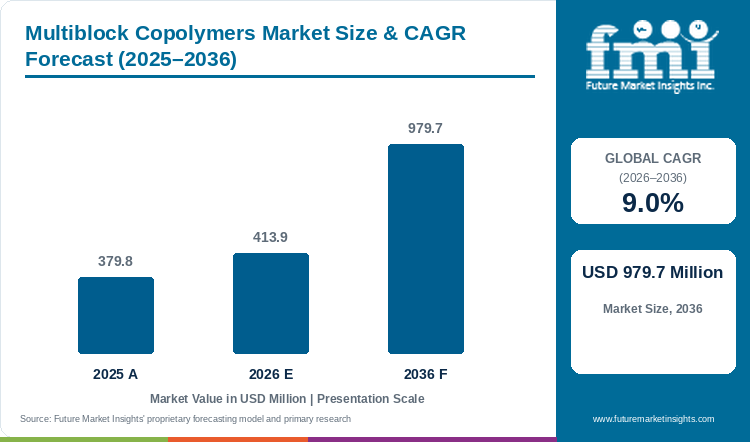
The Multiblock Copolymers Market is projected to reach USD 979.7 million by 2036. The forecast CAGR is 9.0% from 2026 to 2036. The market is estimated at USD 413.9 million in 2026. The market was valued at USD 379.8 million in 2025. On 5 November 2026 Arkema reported that its Advanced Materials segment was stable in the third quarter. New business in its HPP line offset a challenging performance additives market [1]. In July the company said the same line gained momentum in the second quarter [2]. Erwoan Pezron, senior vice president of Arkema's high performance polymers business line, said the completed February 2024 Pebax expansion gives the company a chance to meet growing demand [3].
Packaging rules and recycled-content pressure now shape grade choice. Regulation (EU) 2025/40 has been in force since 11 February 2025. It applies from 12 August 2026, when the 1994 Packaging Directive was generally repealed. It aims to make all packaging on the EU market recyclable in an economically viable way by 2030 [16]. It limits PFAS in food-contact packaging above set thresholds [16]. In the United Kingdom, packaging components with less than 30% recycled plastic are taxable at GBP 228.82 per tonne from 1 April 2026 [17]. Arkema's Pebax Rnew is derived from castor seeds [4]. Covestro's Desmopan CQ range covers bio-circular, recycled and bio-based categories [7]. The bio-based elastomers market follows the same shift.
Key Market Trends & Insights
- On 4 March 2026 trade press reported that BASF had started commercial production of Elastollan flame-retardant thermoplastic polyurethane at its Shanghai facility. The plant had made halogen-free flame-retardant grades since localising them in 2023. The new grades target cables for industrial automation, robotics and electric vehicle charging infrastructure [6].
- Recycled and bio-sourced grades are moving into main product lines. Mitsubishi Chemical's performance polymer department lists TEFABLOC TG styrenic elastomers with up to 67% recycled content in the TG SI R02 grade [12]. The TG SI A06 75A grade contains 40% bio-sourced content [12]. Arkema said in January 2022 that Pebax Rnew has a carbon footprint up to 50% lower than other elastomers on the market [4].
- Ownership of a major polyurethane supplier is changing. On 20 March 2026 XRG submitted a formal squeeze-out request for the remaining minority shares of Covestro AG. The request sets cash compensation at EUR 59.46 per share [9].
Regional Highlights
- North America: Arkema makes Pebax elastomers at Birdsboro, Pennsylvania, and also at Serquigny in France [3][4]. The US Department of Energy backs the BOTTLE consortium, which works on chemical upcycling and recyclable-by-design plastics [26].
- Continental Europe: Regulation (EU) 2025/40 applies from 12 August 2026 [16]. Arkema started a new Pebax facility at Serquigny on 1 February 2024, raising global elastomer capacity by 40% [3]. Covestro and ALBIS marked 60 years of partnership at Fakuma 2026, according to a release dated 15 October 2026 [8].
- United Kingdom: plastic packaging with less than 30% recycled plastic is taxed at GBP 228.82 per tonne from 1 April 2026 [17]. Manufacturers and importers of 10 tonnes or more of finished components must register [17].
Multiblock Copolymers Market Size and Forecast
Table 1: Multiblock Copolymers Market Size and Forecast
| Market size and forecast | Value |
|---|---|
| Market size in 2025 | USD 379.8 million |
| Estimated market size in 2026 | USD 413.9 million |
| Projected market size by 2036 | USD 979.7 million |
| CAGR from 2026 to 2036 | 9.0% |
Source: Future Market Insights analysis of the multiblock copolymers market, 2026.
Analyst Perspective
“Multiblock copolymers are bought for what the hard and soft segments do together. Most buyers are still developing new formulations. Buyers test whether a laboratory result survives scale-up and a recycling requirement. Buyers who document the block chemistry, recycled content and plant of origin move faster from sampling to a purchase order. Suppliers that can show all three will hold their positions as packaging rules tighten.”
- Nikhil Kaitwade, Principal Consultant, FMI
How is the Multiblock Copolymers Market segmented?
- By product: Styrenic and Olefinic Block Copolymers (TPS/TPO), Thermoplastic Polyurethanes (TPU), Copolyester Elastomers (TPC), Polyether Block Amides (PEBA) and Others
- By application: Research and Development, Automotive, Electronics and Packaging
- By region: North America and Europe
Why do Styrenic and Olefinic Block Copolymers (TPS/TPO) lead by Product in the Multiblock Copolymers Market in 2026?
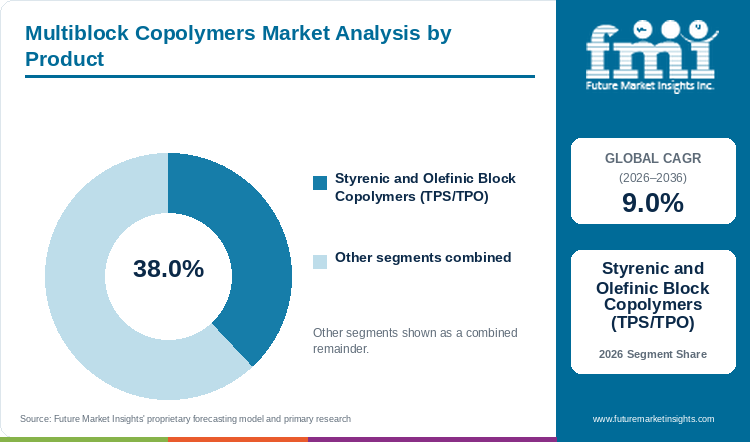
Styrenic and Olefinic Block Copolymers (TPS/TPO) are estimated to account for 38.0% of the Multiblock Copolymers Market by product in 2026. A 2025 perspective in ACS Polymers Au describes these materials as built from several chemically distinct segments [23]. Soft segments with a low glass transition temperature give elasticity. Hard segments act as physical cross-linking points [23]. Changing the segment mix moves hardness and strength, so one family can serve many uses. Mitsubishi Chemical's MCPP business shows the breadth of the family. Its TEFABLOC TG SI R02 and R03 styrenic grades come in a hardness range of 45 to 80 Shore A. They bond to polyolefins and are described as meeting European rules on human skin contact [12]. Uses include bodycare items, tools and furniture [12]. Dow's INFUSE olefin block copolymers combine crystalline hard and amorphous soft blocks [15]. They serve footwear midsoles, automotive parts, medical devices, hygiene films and building membranes [15]. Recycling is still a limitation. Only 25% of global thermoplastic elastomer waste is being recycled, and mechanical recycling erodes properties over time [23]. Recycled-content grades such as TG SI R02 are one supplier response [12].
Table 2: Product, 2026 Share
| Leading Share | 2026 market share |
|---|---|
| Styrenic and Olefinic Block Copolymers (TPS/TPO) | 38.0% |
| All Other Segments Combined Share | 62.0% |
Source: Future Market Insights analysis of the multiblock copolymers market, 2026.
Why does Research and Development lead by Application in the Multiblock Copolymers Market in 2026?
Research and Development is estimated to account for 42.0% of the Multiblock Copolymers Market by application in 2026. The published literature shows the laboratory work behind this segment. A 2020 paper in Polymers reported a new poly(ether-block-amide) family built from PA10T/10I hard segments and polyethylene glycol soft segments [25]. Its melting points were 217.1 to 233.9 degrees Celsius, and its tensile strengths were 21.9 to 41.1 MPa [25]. The samples outperformed Pebax 5533 in high-temperature bending tests [25]. A February 2026 paper in the same journal compared a bio-based poly(butylene furanoate)-polyether elastomer with a petroleum-derived equivalent [24]. Each was filled at 5 wt.% with giant reed, spirulina biomass or volcanic stone dust [24]. Public funding adds to laboratory-scale work on recyclable plastics. The BOTTLE consortium, funded by the US Department of Energy, develops chemical upcycling strategies for today's plastics [26]. It aims to make future plastics recyclable by design [26]. Producers also invest before a grade is sold. BASF's Elastollan 1400 ether-based TPU series, announced on 10 October 2024, followed more than two years of research [5]. The series was offered as experimental grades for sampling [5]. BASF links its discrete glass transition temperature and extended viscoelastic plateau to dimensional stability over a wide thermal range [5].
Table 3: Application, 2026 Share
| Leading Share | 2026 market share |
|---|---|
| Research and Development | 42.0% |
| All Other Segments Combined Share | 58.0% |
Source: Future Market Insights analysis of the multiblock copolymers market, 2026.
What are the key drivers, restraints and opportunities?
Driver
Recycled and renewable content. Buyers ask for documented origin. Covestro's Desmopan CQ range includes bio-circular, recycled and bio-based categories, with bio-based content determined per ASTM D6866 [7]. A ski boot case study claims a carbon footprint reduction of up to 30% [7]. BASF says its Elastollan 1400 series can have a carbon footprint up to 30% lower than comparable TPU grades at Shore 80 A [5]. MCPP lists recycled content of up to 67% in TEFABLOC TG SI R02 [12].
Demanding mechanical and electrical uses. Evonik lists Vestamid E, a PA12 and polyether elastomer, for sports shoe soles, low-noise gears, spray hoses and brake booster lines [10]. The company cites extreme elasticity, rebound resilience, chemical resistance and cold flexibility [10]. BASF's flame-retardant Elastollan grades target cables for industrial automation, robotics and electric vehicle charging [6]. That cable use ties into the wire and cable materials market. Arkema names smartphones and flexible screens, medical equipment and sports as end markets for Pebax [3].
Restraint
Recycling difficulty. Multiblock designs are harder to recover than single-polymer plastics. Sha and co-authors note that thermoplastic elastomers usually combine several chemically distinct segments [23]. That makes them more complex to synthesise and recycle [23]. Only 25% of global thermoplastic elastomer waste is recycled [23]. Packaging buyers will test grades against the EU's 2030 recyclability aim [16].
Trade and rule uncertainty. On 1 July 2026 the United States said it did not agree to renew the USMCA in its current form. The agreement remains in force [20]. A comment period for the 2027 joint review closes on 12 January 2027 [22]. Reporting duties also differ by country. Canada postponed phases 2 and 3 of its Federal Plastics Registry in a notice published on 14 March 2026 [18]. The UK applies a 30% recycled-content threshold [17]. Each regime asks for different data, which adds compliance work for suppliers selling across borders.
Opportunity
Bio-circular and low-carbon grades. Arkema's Pebax Rnew is made from castor seeds and, according to the company, can be fully recycled [4]. Covestro's Desmopan CQ and BASF's Elastollan 1400 make similar footprint claims for polyurethanes [5][7]. For film applications, see the TPE films and sheets market.
Chemically recyclable designs. The ACS Polymers Au perspective presents chemical recycling, which returns polymers to monomers, as a route to polymer sustainability [23]. The authors call this infinite material recyclability without quality degradation [23]. Suppliers with a validated route for polyurethane, copolyester or controlled-sequence polyolefin elastomers could target packaging buyers facing EU recyclability rules [16].
Multiblock Copolymers Market by Country (2026 to 2036)
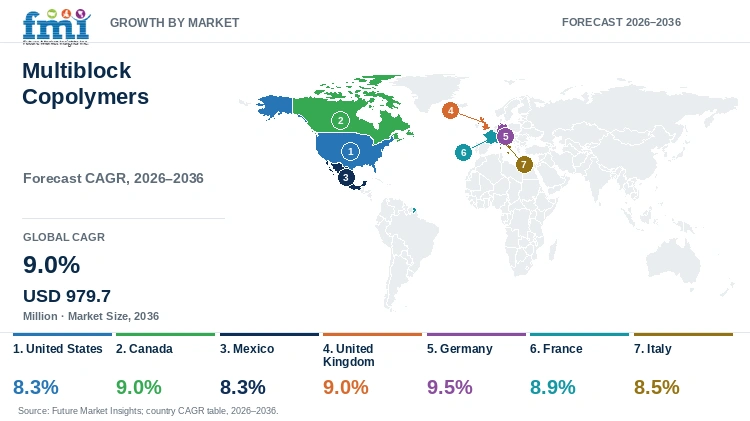
Table 4: Multiblock Copolymers Market Country Growth Forecast
| Country | CAGR, 2026 to 2036 |
|---|---|
| United States | 8.3% |
| Canada | 9.0% |
| Mexico | 8.3% |
| United Kingdom | 9.0% |
| Germany | 9.5% |
| France | 8.9% |
| Italy | 8.5% |
Source: Future Market Insights analysis of the multiblock copolymers market, 2026.
United States
Dow describes INFUSE olefin block copolymers as built from crystalline hard and amorphous soft blocks [15]. Uses include footwear midsoles, automotive parts, medical devices, hygiene films and building membranes [15]. Arkema makes Pebax at Birdsboro, Pennsylvania. In 2022 it said it would keep producing many of these materials there while Serquigny expanded [4].
Public research funding adds to the Research and Development share in the United States. The US Department of Energy backs the BOTTLE consortium. Its work covers deconstruction, building blocks, redesign, modelling and analysis of plastics [26].
Trade terms are unsettled. On 1 July 2026 the United States said it did not agree to renew the USMCA in its current form [20]. On 2 October 2026 it opened comments on the 2027 joint review, due by 12 January 2027 [22]. Importers of elastomers moving across the Mexican or Canadian border should keep origin and change-in-law clauses in supply contracts.
Canada
Canada's Federal Plastics Registry requires producers that place plastic packaging, electronic and electrical equipment or single-use items on the market to report [19]. Producers handling less than 1,000 kg a year are exempt. Resin manufacturers do not report for 2025 and 2026 [19].
A Canada Gazette notice of 14 March 2026 postponed the reporting due date for phases 2 and 3 [18]. Producers continue to report for calendar years 2025 and 2026 [18]. As a result, data requests reach elastomer suppliers through their converter customers, not through direct filing.
The reporting system was scheduled to go offline for maintenance and modernisation from 31 October 2026. The last date to review or amend 2024 and 2025 reports was 30 October 2026 [19]. Suppliers selling packaging grades into Canada should hold composition and recycled-content records ready for the modernised platform.
Mexico
Automobiles are one of the topics in the US and Mexico negotiations under the USMCA joint review. USTR announced on 17 July 2026 that the third bilateral round would start on 21 July 2026 in Mexico City [21]. The round covers steel and aluminum, automobiles, economic security, labor, agriculture and electronic payment services [21].
Automotive is the application closest to those talks. Evonik lists spray hoses and brake booster lines among Vestamid E uses [10]. BASF aims its Elastollan 1400 TPU at tubes, hoses, profiles and cable sheathing [5].
The agreement stays in force during the review [20]. Buyers of elastomer compounds for vehicle parts in Mexico should keep a second source outside the region until the review settles.
United Kingdom
The Plastic Packaging Tax rate is GBP 228.82 per tonne from 1 April 2026 [17]. Packaging with less than 30% recycled plastic is taxable.
Businesses must register if they expect to import or make 10 tonnes or more of finished plastic packaging components within 30 days [17]. They must also register if they reached that volume in the previous 12 months [17]. The guidance was last updated on 12 February 2026.
A packaging elastomer sold into the UK competes on recycled content as well as performance. Suppliers with documented recycled content, such as MCPP's TEFABLOC TG range [12], can help converters stay above the 30% recycled-plastic level [17]. Bio-based content alone does not count toward that threshold [17].
Germany
Covestro AG is changing ownership. XRG initiated the transfer of minority shares on 9 January 2026 [9]. It submitted a formal squeeze-out request on 20 March 2026, with cash compensation of EUR 59.46 per share [9]. Covestro raised its 2026 EBITDA forecast on 9 July 2026 [9].
Covestro describes Desmopan as a thermoplastic polyurethane with alternating flexible and rigid segments that needs no plasticiser [7]. A release dated 15 October 2026 celebrates 60 years of partnership with ALBIS, linked to Fakuma 2026 in Friedrichshafen [8]. In that release, Covestro names e-mobility, healthcare, more sustainable packaging and recycled or renewable feedstocks as future focus areas [8].
Evonik published its third-quarter 2026 report on 3 November 2026. It indicated that 2026 operating profit will likely sit in the upper half of its guidance range [11]. Germany has the highest forecast CAGR of the seven profiled countries, at 9.5%. Buyers there can set Covestro's polyurethane offers against Evonik's polyamide-polyether offer when qualifying a second source.
France
Arkema started its new Pebax facility at Serquigny on 1 February 2024, raising global Pebax elastomer capacity by 40% [3]. The unit can make both the bio-circular Pebax Rnew range and classic grades [3]. The investment cut the plant's water consumption by 25% [3].
Arkema reported third-quarter 2026 EBITDA of EUR 332 million, up 7.0%, on sales of EUR 2.4 billion [1]. The company confirmed capital expenditure below EUR 600 million [1]. It expects slightly higher full-year EBITDA at constant exchange rates [1]. Second-quarter EBITDA was EUR 391 million, against EUR 364 million a year earlier [2]. The company plans a 3% workforce reduction in 2026 through natural attrition [1].
Arkema lists sports and leisure, consumer goods such as smartphones and flexible screens, and medical equipment as Pebax end markets [3][4]. Castor-based grades made in France give European buyers a regional source for bio-based specifications.
Italy
Celanese completed its acquisition of most of DuPont's Mobility & Materials business on 1 November 2022 [14]. EU competition authorities required it to divest its own thermoplastic copolyester business [14]. The divestiture covered the Ferrara, Italy production facility and the Pibiflex and Riteflex brands [14].
Regulation (EU) 2025/40 applies from 12 August 2026 [16]. Italian converters of elastomeric films and closures need supplier declarations that meet its 2030 recyclability aim and its PFAS limits [16].
Buyers of copolyester elastomers in Italy should confirm the current plant and legal owner behind any Ferrara-origin grade. Those lines were part of the divestiture required in 2022 [14].
Who are the notable companies in the Multiblock Copolymers Market?
Notable companies in the Multiblock Copolymers Market include Arkema S.A., BASF SE, Covestro AG, Evonik Industries AG and Mitsubishi Chemical Corporation.
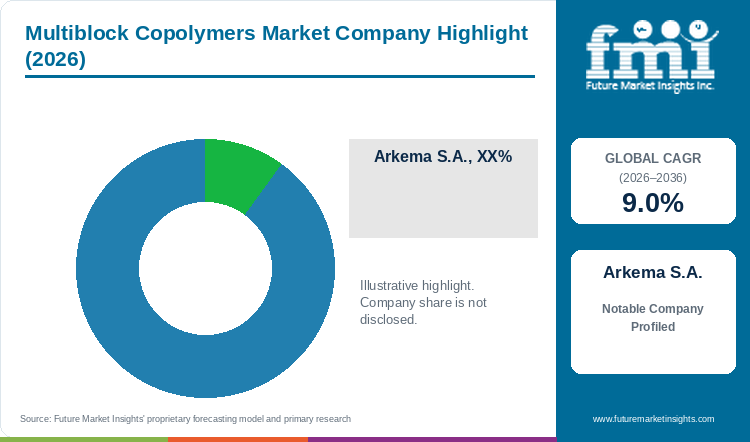
Block chemistry determines which suppliers compete directly. Evonik states that Vestamid E combines PA12 and polyether segments [10]. Arkema's Pebax is the benchmark that a 2020 study used when it measured new poly(ether-block-amide)s [25]. BASF and Covestro sell thermoplastic polyurethanes, where Covestro describes alternating flexible and rigid segments [5][7]. Mitsubishi Chemical's MCPP business sells styrenic TEFABLOC grades [12], and Dow sells olefin block copolymers [15]. Celanese acquired a thermoplastic copolyester range in 2022 [14]. Readers can follow that segment in the thermoplastic ester elastomer market. In share terms, BASF leads with 11.5%, ahead of Arkema at 10.1%, Covestro at 7.8%, Evonik at 6.9% and Mitsubishi Chemical at 6.1%.
Documented sustainability is the second basis of competition. Arkema promotes Pebax Rnew from castor seeds, with a footprint up to 50% lower than other elastomers [4]. Covestro sells Desmopan CQ in three categories [7]. BASF claims up to 30% lower footprint for Elastollan 1400 at Shore 80 A [5]. MCPP lists recycled content of 51 to 52% in TG SI R03 and up to 67% in TG SI R02 [12]. Claims differ in basis, so buyers need the method behind each figure as well as the number.
Capacity and ownership add a further basis for comparison. Arkema raised Pebax capacity by 40% at Serquigny [3]. BASF added flame-retardant Elastollan production in Shanghai [6]. XRG has requested a squeeze-out of Covestro's minority shares [9], and Celanese was required to divest Ferrara [14]. Arkema's third-quarter 2026 report shows its Advanced Materials segment stable, with new HPP business offsetting weaker additives [1].
Key Developments in the Multiblock Copolymers Market
- On 5 November 2026 Arkema reported third-quarter EBITDA of EUR 332 million, up 7.0%. New HPP business offset a challenging performance additives market in Advanced Materials [1].
- On 4 March 2026 trade press reported that BASF had started commercial production of Elastollan flame-retardant TPU in Shanghai [6]. The facility already made halogen-free grades localised there in 2023 [6].
- On 20 March 2026 XRG submitted a formal squeeze-out request for Covestro AG's minority shares at EUR 59.46 per share [9].
- On 3 November 2026 Evonik published its third-quarter report. It indicated that 2026 operating profit will likely sit in the upper half of its guidance range [11].
Key Players in the Multiblock Copolymers Market
- Arkema S.A.
- BASF SE
- Covestro AG
- Evonik Industries AG
- Mitsubishi Chemical Corporation
- Celanese Corporation
- Dow Inc.
Multiblock Copolymers Market Report Scope
Table 5: Multiblock Copolymers Market Report Scope
| Coverage field | Report scope |
|---|---|
| Market definition | Polymers whose chains alternate chemically distinct hard and soft segments, measured by value of sales to end-use applications |
| Product | Styrenic and Olefinic Block Copolymers (TPS/TPO), Thermoplastic Polyurethanes (TPU), Copolyester Elastomers (TPC), Polyether Block Amides (PEBA), Others |
| Application | Research and Development, Automotive, Electronics, Packaging |
| Regions and profiled countries | North America and Europe (profiled countries: United States, Canada, Mexico, Germany, United Kingdom, France, Italy) |
| Companies covered | Arkema S.A., BASF SE, Covestro AG, Evonik Industries AG, Mitsubishi Chemical Corporation, Celanese Corporation, Dow Inc. |
| Forecast period | 2026 to 2036, with 2025 as the historical base year |
| Quantitative Units | USD million |
Source: Future Market Insights analysis of the multiblock copolymers market, 2026.
Multiblock Copolymers Market by Segments
Multiblock Copolymers Market segmented by Product:
- Styrenic and Olefinic Block Copolymers (TPS/TPO)
- Thermoplastic Polyurethanes (TPU)
- Copolyester Elastomers (TPC)
- Polyether Block Amides (PEBA)
- Others
Multiblock Copolymers Market segmented by Application:
- Research and Development
- Automotive
- Electronics
- Packaging
Multiblock Copolymers Market by Region
- North America
- Europe
- United States
- Canada
- Mexico
- Germany
- United Kingdom
- France
- Italy
Research Sources and Bibliography
- [1] Arkema. (2026, November 5). Third-quarter 2026 results. https://www.arkema.com/global/en/media/newslist/news/global/investorrelations/2026/20261105-third-quarter-2026-results/
- [2] Arkema. (2026, July 30). Second-quarter 2026 results. https://www.arkema.com/usa/en/media/news/global/investorrelations/2026/20260730--second-quarter-2026-results/
- [3] European Rubber Journal. (2024, February 6). Arkema completes 40% increase in elastomers production capacity. https://www.european-rubber-journal.com/article/2094979/arkema-completes-40-increase-in-elastomers-production-capacity
- [4] Arkema. (2022, January 17). Arkema to increase its global Pebax elastomers production capacity by 25%. https://pebaxpowered.arkema.com/en/newslist/news/global/corporate/2022/20220117-arkema-to-increase-global-pebax-capacity/
- [5] BASF. (2024, October 10). BASF introduces new Elastollan 1400 TPU series. https://www.basf.com/global/en/media/news-releases/2024/10/p-24-295
- [6] The Machine Maker. (2026, March 4). BASF launches commercial production of Elastollan FR TPU in Shanghai. https://themachinemaker.com/news/basf-launches-commercial-production-of-elastollan-fr-tpu-in-shanghai/
- [7] Covestro. (n.d.). Desmopan thermoplastic polyurethane. https://solutions.covestro.com/en/brands/desmopan
- [8] Covestro. (2026, October 15). Covestro and ALBIS celebrate 60 years of partnership at Fakuma 2026. https://www.covestro.com/press/covestro-and-albis-celebrate-60-years-of-partnership-at-fakuma-2026/
- [9] Covestro AG. (n.d.). Investors: results and news. https://www.covestro.com/en/investors
- [10] Evonik. (n.d.). VESTAMID polyamides. https://www.evonik.com/en/company/businesslines/hp/polyamides/vestamid.html
- [11] Evonik. (2026, November 3). Investor relations: third-quarter 2026 report. https://www.evonik.com/en/investor-relations.html
- [12] Mitsubishi Chemical, Performance Polymer Department (MCPP). (n.d.). TEFABLOC TG, TPE with renewable carbon. https://www.mcpp-global.com/en/mcpp-english-europe/products/product/tefabloctm-tg-tpe-with-renewable-carbon/
- [13] Mitsubishi Chemical, Performance Polymer Department (MCPP). (n.d.). About MCPP. https://www.mcpp-global.com/en/mcpp-asia/about-us/
- [14] European Rubber Journal. (2022, November 2). Celanese completes 11bn acquisition of DuPont's mobility and materials business. https://www.european-rubber-journal.com/article/2092324/celanese-completes-11bn-acquisition-of-dupont-s-mobility-and-materials-business
- [15] Dow. (n.d.). INFUSE olefin block copolymers. https://www.dow.com/en-us/brand/infuse.html
- [16] European Commission. (n.d.). Packaging waste. https://environment.ec.europa.eu/topics/waste-and-recycling/packaging-waste_en
- [17] HM Revenue and Customs. (2026, February 12). Plastic Packaging Tax: steps to take. https://www.gov.uk/guidance/check-if-you-need-to-register-for-plastic-packaging-tax
- [18] Government of Canada. (2026, March 14). Canada Gazette, Part I, Volume 160, Number 11: Government notices. https://gazette.gc.ca/rp-pr/p1/2026/2026-03-14/html/notice-avis-eng.html
- [19] Environment and Climate Change Canada. (n.d.). Federal Plastics Registry. https://www.canada.ca/en/environment-climate-change/services/managing-reducing-waste/reduce-plastic-waste/federal-plastics-registry.html
- [20] Office of the United States Trade Representative. (2026, July). Ambassador Greer issues statement on the USMCA joint review. https://ustr.gov/about/policy-offices/press-office/press-releases/2026/july/ambassador-greer-issues-statement-usmca-joint-review
- [21] Office of the United States Trade Representative. (2026, July 17). United States and Mexico to convene in Mexico City for third bilateral negotiating round related to the joint review of the USMCA. https://ustr.gov/about/policy-offices/press-office/press-releases/2026/july/united-states-and-mexico-convene-mexico-city-third-bilateral-negotiating-round-related-joint-review
- [22] Office of the United States Trade Representative. (2026, October 2). USTR seeks public comment on the 2027 joint review of USMCA. https://ustr.gov/about/policy-offices/press-office/press-releases/2026/october/ustr-seeks-public-comment-2027-joint-review-usmca
- [23] Sha, Y., Sun, W., Ding, S., Ye, P., Zhang, Y., and Jia, P. (2025, July 11). Performance-guided design of chemically recyclable polymeric materials: a case study on thermoplastic elastomers. ACS Polymers Au, 5(5), 432-444. https://doi.org/10.1021/acspolymersau.5c00033
- [24] Paszkiewicz, S., Ortega, Z., Irska, I., Walkowiak, K., Piasecki, A., and Barczewski, M. (2026, February 19). Role of bio-based and petroleum-origin monomers on the tailoring of thermoplastic elastomer properties and structure as a matrix for composites with plant-based and inorganic fillers. Polymers, 18(4), 513. https://doi.org/10.3390/polym18040513
- [25] Tong, X., Wang, Z., Zhang, M.-L., Wang, X.-J., Zhang, G., Long, S.-R., and Yang, J. (2020, December 27). Synthesis, characterization and non-isothermal crystallization kinetics of a new family of poly(ether-block-amide)s based on nylon 10T/10I. Polymers, 13(1), 72. https://doi.org/10.3390/polym13010072
- [26] BOTTLE Consortium. (n.d.). Bio-Optimized Technologies to keep Thermoplastics out of Landfills and the Environment. https://bottle.org/
Table of Content
Table of Content
- Key Takeaways
- Market Size and CAGR
- Top Growth Driver
- Fastest Growing Segment
- Leading Region
- Key Companies
- Emerging Opportunities
- Executive Summary
- Global Market Outlook
- Demand-side Trends
- Supply-side Trends
- Technology Roadmap Analysis
- Analysis and Recommendations
- Analyst Perspective (What is happening? Why now? What should investors know?)
- Key Questions Answered
- How large is the market?
- What is the CAGR?
- What are key trends?
- Which region dominates?
- Who are the leaders?
Read More...
- Market Overview
- Market Coverage / Taxonomy
- Market Definition / Scope / Limitations
- Research Methodology
- Chapter Orientation
- Analytical Lens and Working Hypotheses
- Market Structure, Signals, and Trend Drivers
- Benchmarking and Cross-market Comparability
- Market Sizing, Forecasting, and Opportunity Mapping
- Research Design and Evidence Framework
- Desk Research Programme (Secondary Evidence)
- Expert Input and Fieldwork (Primary Evidence)
- Tooling, Models, and Reference Databases
- Data Engineering and Model Build
- Quality Assurance and Audit Trail
- Market Background
- Market Dynamics (Drivers, Restraints, Opportunity, Trends)
- Scenario Forecast (Optimistic, Likely, Conservative)
- Impact Analysis
- AI Impact
- Sustainability Impact
- Regulatory Impact
- Technology Impact
- Consumer / Buyer Analysis
- Purchase Drivers
- Adoption Barriers
- Buyer Journey
- Opportunity Map Analysis
- Product Life Cycle Analysis
- Supply Chain Analysis
- Investment Feasibility Matrix
- Value Chain Analysis
- PESTLE and Porter's Analysis
- Regulatory Landscape
- Regional Parent Market Outlook
- Production and Consumption Statistics
- Import and Export Statistics
- Global Market Analysis and Forecast, 2021 to 2036
- Historical Market Size Value (USD Million) Analysis, 2021 to 2025
- Current and Future Market Size Value (USD Million) Projections, 2026 to 2036
- Y-o-Y Growth Trend Analysis
- Absolute $ Opportunity Analysis
- Global Market Pricing Analysis, 2021 to 2036
- Global Market Analysis and Forecast, By Product, 2021 to 2036
- Introduction / Key Findings
- Historical Market Size Value (USD Million) Analysis By Product, 2021 to 2025
- Current and Future Market Size Value (USD Million) Analysis and Forecast By Product, 2026 to 2036
- Styrenic and Olefinic Block Copolymers (TPS/TPO)
- Thermoplastic Polyurethanes (TPU)
- Copolyester Elastomers (TPC)
- Polyether Block Amides (PEBA)
- Others
- Y-o-Y Growth Trend Analysis By Product, 2021 to 2025
- Absolute $ Opportunity Analysis By Product, 2026 to 2036
- Global Market Analysis and Forecast, By Application, 2021 to 2036
- Introduction / Key Findings
- Historical Market Size Value (USD Million) Analysis By Application, 2021 to 2025
- Current and Future Market Size Value (USD Million) Analysis and Forecast By Application, 2026 to 2036
- Research and Development
- Automotive
- Electronics
- Packaging
- Y-o-Y Growth Trend Analysis By Application, 2021 to 2025
- Absolute $ Opportunity Analysis By Application, 2026 to 2036
- Global Market Analysis and Forecast, By Region, 2021 to 2036
- Introduction
- Historical Market Size Value (USD Million) Analysis By Region, 2021 to 2025
- Current Market Size Value (USD Million) Analysis and Forecast By Region, 2026 to 2036
- North America
- Europe
- Market Attractiveness Analysis By Region
- North America Market Analysis and Forecast, By Country, 2021 to 2036
- Historical Market Size Value (USD Million) Trend Analysis By Market Taxonomy, 2021 to 2025
- Market Size Value (USD Million) Forecast By Market Taxonomy, 2026 to 2036
- By Country
- By Product
- By Application
- Market Attractiveness Analysis
- By Country
- By Product
- By Application
- Key Takeaways
- Europe Market Analysis and Forecast, By Country
- Historical Market Size Value (USD Million) Trend Analysis By Market Taxonomy, 2021 to 2025
- Market Size Value (USD Million) Forecast By Market Taxonomy, 2026 to 2036
- By Country
- United States
- Canada
- Mexico
- Germany
- United Kingdom
- France
- Italy
- By Product
- By Application
- By Country
- Market Attractiveness Analysis
- By Country
- By Product
- By Application
- Key Takeaways
- Key Countries Market Analysis
- United States
- Pricing Analysis
- Market Share Analysis, 2025
- By Product
- By Application
- Canada
- Pricing Analysis
- Market Share Analysis, 2025
- By Product
- By Application
- Mexico
- Pricing Analysis
- Market Share Analysis, 2025
- By Product
- By Application
- Germany
- Pricing Analysis
- Market Share Analysis, 2025
- By Product
- By Application
- United Kingdom
- Pricing Analysis
- Market Share Analysis, 2025
- By Product
- By Application
- Italy
- Pricing Analysis
- Market Share Analysis, 2025
- By Product
- By Application
- France
- Pricing Analysis
- Market Share Analysis, 2025
- By Product
- By Application
- United States
- Market Structure Analysis
- Competition Dashboard
- Competition Benchmarking
- Market Share Analysis of Top Players
- By Regional
- By Product
- By Application
- Emerging Startups
- Innovation Benchmarking
- Competition Analysis
- Competition Deep Dive
- Arkema S.A.
- Overview
- Product Portfolio
- Profitability by Market Segments
- Sales Footprint
- Strategy Overview
- Marketing Strategy
- Product Strategy
- Channel Strategy
- BASF SE
- Covestro AG
- Evonik Industries AG
- Mitsubishi Chemical Corporation
- Celanese Corporation
- Dow Inc.
- Arkema S.A.
- Case Studies
- Success Stories
- Recent Developments
- Competition Deep Dive
- Assumptions & Acronyms Used
List of Tables
- Table 1: Global Market Value (USD Million) Forecast by Region, 2021 to 2036
- Table 2: Global Market Value (USD Million) Forecast by Product, 2021 to 2036
- Table 3: Global Market Value (USD Million) Forecast by Application, 2021 to 2036
- Table 4: North America Market Value (USD Million) Forecast by Country, 2021 to 2036
- Table 5: North America Market Value (USD Million) Forecast by Product, 2021 to 2036
- Table 6: North America Market Value (USD Million) Forecast by Application, 2021 to 2036
- Table 7: Europe Market Value (USD Million) Forecast by Country, 2021 to 2036
- Table 8: Europe Market Value (USD Million) Forecast by Product, 2021 to 2036
- Table 9: Europe Market Value (USD Million) Forecast by Application, 2021 to 2036
List of Figures
- Figure 1: Global Market Pricing Analysis
- Figure 2: Global Market Value (USD Million) Forecast 2021-2036
- Figure 3: Global Market Value Share and BPS Analysis by Product, 2026 and 2036
- Figure 4: Global Market Y-o-Y Growth Comparison by Product, 2026-2036
- Figure 5: Global Market Attractiveness Analysis by Product
- Figure 6: Global Market Value Share and BPS Analysis by Application, 2026 and 2036
- Figure 7: Global Market Y-o-Y Growth Comparison by Application, 2026-2036
- Figure 8: Global Market Attractiveness Analysis by Application
- Figure 9: Global Market Value (USD Million) Share and BPS Analysis by Region, 2026 and 2036
- Figure 10: Global Market Y-o-Y Growth Comparison by Region, 2026-2036
- Figure 11: Global Market Attractiveness Analysis by Region
- Figure 12: North America Market Incremental Dollar Opportunity, 2026-2036
- Figure 13: Europe Market Incremental Dollar Opportunity, 2026-2036
- Figure 14: North America Market Value Share and BPS Analysis by Country, 2026 and 2036
- Figure 15: North America Market Value Share and BPS Analysis by Product, 2026 and 2036
- Figure 16: North America Market Y-o-Y Growth Comparison by Product, 2026-2036
- Figure 17: North America Market Attractiveness Analysis by Product
- Figure 18: North America Market Value Share and BPS Analysis by Application, 2026 and 2036
- Figure 19: North America Market Y-o-Y Growth Comparison by Application, 2026-2036
- Figure 20: North America Market Attractiveness Analysis by Application
- Figure 21: Europe Market Value Share and BPS Analysis by Country, 2026 and 2036
- Figure 22: Europe Market Value Share and BPS Analysis by Product, 2026 and 2036
- Figure 23: Europe Market Y-o-Y Growth Comparison by Product, 2026-2036
- Figure 24: Europe Market Attractiveness Analysis by Product
- Figure 25: Europe Market Value Share and BPS Analysis by Application, 2026 and 2036
- Figure 26: Europe Market Y-o-Y Growth Comparison by Application, 2026-2036
- Figure 27: Europe Market Attractiveness Analysis by Application
- Figure 28: Global Market - Tier Structure Analysis
- Figure 29: Global Market - Company Share Analysis
Frequently Asked Questions
How big is the multiblock copolymers market in 2026?
The Multiblock Copolymers Market is estimated at USD 413.9 million in 2026, up from USD 379.8 million in 2025. It is projected to reach USD 979.7 million by 2036, a 9.0% CAGR from 2026 to 2036.
Which segments lead the multiblock copolymers market?
Styrenic and Olefinic Block Copolymers (TPS/TPO) lead by product with 38.0% in 2026. Research and Development leads by application with 42.0%. A 2025 ACS Polymers Au perspective describes thermoplastic elastomers as soft elastic segments joined to hard segments that act as physical cross-links [23]. A 2020 Polymers paper reports a new poly(ether-block-amide) family tested against Pebax 5533 [25].
Which other segments matter?
By product, Thermoplastic Polyurethanes (TPU) hold 22.0%, Copolyester Elastomers (TPC) 16.0%, Polyether Block Amides (PEBA) 13.0% and Others 11.0%. By application, Automotive holds 25.0%, Electronics 18.0% and Packaging 15.0%. Evonik lists brake booster lines among Vestamid E uses [10]. BASF's flame-retardant Elastollan grades target electric vehicle charging cables [6].
Which profiled country is forecast to grow fastest?
Germany has the highest forecast CAGR of the seven profiled countries at 9.5% from 2026 to 2036. Canada and the United Kingdom follow at 9.0% each, and France at 8.9%. Covestro raised its 2026 EBITDA forecast on 9 July 2026 [9]. Evonik indicates that 2026 operating profit is likely to sit in the upper half of its guidance range [11].
Which rules affect packaging grades?
Regulation (EU) 2025/40 applies from 12 August 2026 and aims for recyclable packaging on the EU market by 2030 [16]. The United Kingdom taxes plastic packaging with less than 30% recycled plastic at GBP 228.82 per tonne from 1 April 2026 [17]. Canada postponed phases 2 and 3 of its Federal Plastics Registry in a notice published on 14 March 2026 [18].
What should a buyer check when choosing a grade?
Check the block chemistry first. It sets hardness, temperature range and recycling route. Examples include PA12 with polyether segments for Vestamid E [10]. Alternating flexible and rigid segments suit Desmopan [7]. Styrenic grades from 45 to 80 Shore A suit TEFABLOC TG [12]. Then ask for the method behind any footprint or recycled-content claim. Confirm the plant of origin too.
Preview the report firsthand - request a free sample
Get SampleGet the brochure for pricing and purchase details.
Get PDF
