

- Industry Size (2025)
- USD 327696.7 Mn
- Forecast (2035)
- USD 538888.9 Mn
- CAGR
- 5.1 (2025 to 2035)
Thermoplastic Ester Elastomer (TPEE) Market Outlook 2025 to 2035
The thermoplastic ester elastomer (TPEE) is a high-performance copolyester-based thermoplastic elastomers that are flexible, durable, and chemical-resistant and are dynamic. Structurally reinforced thermo plastic elastomers (TPEEs) can be used in a wide range of applications (from automotive parts and electrical insulation to industrial hoses, sporting equipment, and consumer electronics) due to their excellent fatigue resistant properties, heat stability, and recyclability. Market growth is driven by rising demand for light-weight and strong materials, especially in the automotive and electronics sectors, coupled with rising adoption of sustainable and recyclable thermoplastic solutions.
In 2025, the global TPEE market is projected to reach approximately USD 327,696.7 million, with expectations to grow to around USD 538,888.9 million by 2035, reflecting a Compound Annual Growth Rate (CAGR) of 5.1% during the forecast period.
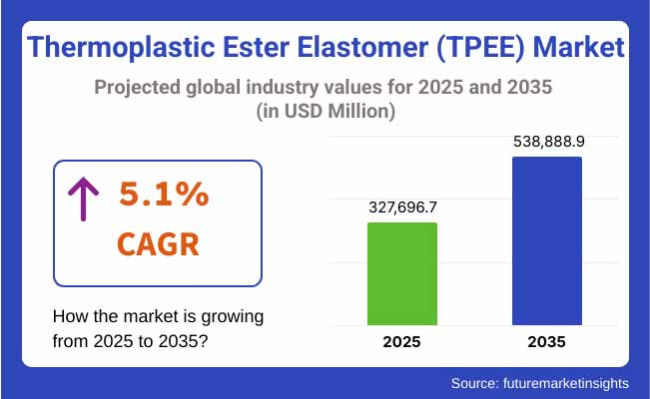
The projected CAGR highlights the increased demand for thermoplastic substitutions for vulcanized rubber, expanding use of TPEE in electric vehicles and intelligent devices, and rising importance of biodegradable engineering plastics.
Regional Market Trends
North America
The TPEE market share segments aided by the automotive technology, aerospace engineering, and the demand for high response polymers. As far as TPEE applications, it is leaders in wire and cable insulation, air ducts and light automotive components. Demand is also getting support from EV growth and from 3D printing applications.
Europe
Europe is a developed and mature technical market with Germany, France, and Italy being leaders in automotive, medical device, and industrial assets. A focus on sustainability and a circular economy in the region is driving demand for recyclable and heat-resistant polymers, and TPEEs have a strong position in this market. Moreover, the regulations imposed by the European Union for material safety and emissions have together been fuelling TPEE uptake in transport and E&E applications.
Asia-Pacific
Asia-Pacific is projected to be the fastest-growing region, driven by increasing automotive manufacturing, electronics production, and booming industrialization in China, India, South Korea, and Japan. The established, low-cost manufacturing bases in the region and the supportive government policies along with the growing investment in EV infrastructure drive TPEE usage from automotive components in under the hood to cable jackets and flexible tubing.
Challenges and Opportunities
Challenges
High Production Costs and Limited Processing Infrastructure
The global thermoplastic ester elastomer (TPEE) market faces challenges in high cost production of specialized polymers, as the fabrication requires raw materials (such as Polybutylene Terephthalate) and high energy utilization in processing. Additionally, few processing facilities and bespoke extrusion equipment hamper TPEE application for small and middle-sized producers domestically in developing countries. Recyclability issues and variable performance in extreme environments also limit full adoption across all applications.
Opportunities
Demand in Lightweighting, High-Performance, and Sustainable Applications
TPEE has rubber-like flexibility and excellent thermoplastic processing benefits, making it an ideal candidate for applications requiring durability, resilience, chemical resistance, and temperature stability. Demand for high-performance elastomers like TPEE is being driven by strong growth in automotive lightweighting, intelligent consumer electronics, wire & cable insulation, sporting goods, and industrial robotics. In addition, advancements in bio-based TPEE grades and enhanced recyclability are opening doors for sustainable product development.
Shifts in the TPEE Market from 2020 to 2024 and Future Trends 2025 to 2035
From 2020 to 2024, demand stability emerged in automotive and industrial sectors, but adoption was restricted by price sensitivity and the absence of mass-scale suppliers. The COVID-19 pandemic has underscored the use of the material in tubing, protective wear and flexible connectors for medical devices, though supply chain issues and energy lockouts have affected cost-competitiveness, he said.
Shift towards bio engineered TPEE grades, use of material formulation using AI, and wider application in renewable energy, EVs, 3D printing will result in influx of TPEE grades in 2025 to 2035 market segment. Continuous production has growing industry support, and TPEE will be the material of choice for next-generation dynamic applications where flexibility, strength, and processability is critical.
Market Shifts: A Comparative Analysis 2020 to 2024 vs. 2025 to 2035
| Market Shift | 2020 to 2024 Trends |
|---|---|
| Regulatory Landscape | Compliance with RoHS, REACH, and FDA standards for specific applications |
| Technology Innovations | Growth in conventional TPEE processing for automotive, wires, and tubing |
| Market Adoption | Common in automotive bellows, fuel line coverings, and cable jackets |
| Sustainability Trends | Emerging interest in lightweighting and reusability |
| Market Competition | Led by DuPont (Hytrel), BASF (Elastollan), DSM, Celanese, LG Chem, Sabic |
| Consumer Trends | Demand for heat- and fatigue-resistant materials in mobility and electrical applications |
| Market Shift | 2025 to 2035 Projections |
|---|---|
| Regulatory Landscape | Stricter mandates on carbon footprint, end-of-life recyclability, and bio-based content |
| Technology Innovations | Advancements in bio-based TPEEs, AI-optimized compounding, and additive manufacturing |
| Market Adoption | Expansion into EV interiors, flexible electronics, industrial robotics, and medical-grade TPEEs |
| Sustainability Trends | Widespread adoption of bio-TPEEs, closed-loop recycling, and circular design integration |
| Market Competition | Rise of bio-polymer innovators, specialty compounders, and regional players focused on green elastomers |
| Consumer Trends | Growth in soft-touch consumer goods, sustainable packaging, and wearable tech applications |
Country-wise Outlook
United States
The USA TPEE market grows with demand from automotive, industrial & consumer goods. TPEE excels with mechanical strength, fatigue resistance, and flexibility and is well suited for applications in connectors, hoses, and under-the-hood components.
As industries shift towards lightweight, energy-efficient vehicles and sustainable manufacturing practices, the use of TPEE is catching on as a recyclable and high-performance substitute for conventional thermoset materials. Furthermore, the presence of prominent polymer manufacturers and advancements in bio-based TPEE grades are further contributing to the market growth.
| Country | CAGR (2025 to 2035) |
|---|---|
| USA | 5.4% |
United Kingdom
Growing applications in electrical component, sportswear, and medical devices account for the steady growth of the UK TPEE market. The country’s focus on sustainable development and material circularity in manufacturing is driving the switch to recyclable engineering thermoplastics such as TPEE.
The market is also benefitting from increasing demand in EV component manufacturing, 3D printing filaments, and advanced textiles. Regulatory compliance with REACH and growing uptake of environmentally friendly polymers are driving innovation in the UK TPEE market.
| Country | CAGR (2025 to 2035) |
|---|---|
| UK | 4.9% |
European Union
The European Union (EU) TPEE market is on a moderate but steady growth path, led by the automotive sector's growing dependence on high-performance elastomers for light-weighting and thermal resistance.
Germany, France and Italy are key markets as these nations have solid manufacturing bases. This is being driven by EU regulations relating to recyclability, carbon emissions and sustainable product development and resulting in the use of TPEE in a growing number of engineering applications from conveyor belts and seals to energy efficient appliances.
| Region | CAGR (2025 to 2035) |
|---|---|
| EU | 4.8% |
Japan
Demand growth in precision electronics, automotive components and specialty fibers is driving growth in Japan's TPEE Power & Tape market. Performance polymers like TPEE are attracting interest among Japanese OEMs, largely because of the reputation this market has for high-quality engineering and stringent material standards.
There is also a growing variety of firms developing their core products for small, durable, and flexible components in the robotics and electronics sectors, encouraged by the country pushing for material sustainability and smaller products.
| Country | CAGR (2025 to 2035) |
|---|---|
| Japan | 5.1% |
South Korea
The TPEE market in South Korea is a growing region, supported by growing electronics, EV, and industrial machinery industries. As a result, the adoption of TPEE is aided by the flexibility and durability offered by these polymers in the production of cable insulation, gaskets and precision parts in addition to their recyclability factor.
Booming polymer blending, bio-based TPEE development, as well as TPEE integration in smart textile and wearable technologies in the nation will lay the foundations of sustained opportunities in the market in the long run.
| Country | CAGR (2025 to 2035) |
|---|---|
| South Korea | 5.0% |
Segmentation Outlook
Pharmaceutical-Grade Coumarin Gains Traction for Therapeutic and Medicinal Benefits
Owing to its anticoagulant, anti-inflammatory, and antimicrobial activities, pharmaceutical-grade coumarin is gaining high demand. It is widely used in drug development for cardiovascular diseases, blood clot prevention, and cancer therapy.
One of the most common uses of pharmaceutical-grade coumarin is in creating anticoagulant medications like warfarin which are often used to prevent blood clots, strokes, and deep vein thrombosis (DVT). Coumarin-derived pharmaceuticals have gained considerable momentum due to a growing incidence of cardiovascular ailments and thrombosis-related disorders.
In addition, coumarin derivatives have been indicated in oncology research to possess anticancer activity, which has culminated in their addition to a clinical drug formulation for the inhibition of tumor growth and for immune modulation. With more clinical trials and money flowing into natural compound-based medicine, the pharmaceutical sector is expected to grow.
Coumarin has many medicinal uses, but the high-level toxicity potential at high doses requires strict regulatory guidelines for pharmaceutical-grade coumarin use. The FDA and EMA require extensive safety testing and dose limits to ensure no negative impacts on health. Suppliers are focusing on advanced purification techniques and synthetic manipulations to enhance the efficacy of medicines and compliance with safety regulations.
Cosmetic-Grade Coumarin Gains Popularity for Fragrances and Personal Care Products
Cosmetic grade coumarin has emerged as an important ingredient that can be used in perfumery, skin care and personal care products. It’s warm, sweet and vanilla-like scent has made it a fragrance booster of choice in what perfumes, deodorants and scented lotions that are high-end.
Growing demand for natural and botanical ingredients in cosmetic products is one of the primary factors boosting the growth of cosmetic-grade coumarin market. Some premium fragrance players utilize coumarin not just as a scent modifier, which ties in to the quality and longevity of the fragrance, but coumarin is also used as a fixative.
In addition, the mild antimicrobial and soothing properties of coumarin make it a beneficial component for soaps, body wash and cosmetic cream. A further boost to the uptake of naturally occurring coumarin extracts is the growing demand for organic and herbal skincare propelling the organic and herbal skincare market.
But allergic responses and regulatory limits have challenged the cosmetic-grade segment. Some countries, including in the European Union, have set usage limits on coumarin levels in skin care and fragrances because of the concern about potential skin sensitization. To mitigate these challenges, companies are developing low-concentration products and synthetic coumarin substitutes, while maintaining scent characteristics.
Perfumery & Fragrance Segment Expands with Rising Demand for Luxury and Natural Scents
Perfumery and the fragrance sector remains the largest coumarin market, applying its sweet, warm, spicy and vanilla-like fragrance character to create mature, lasting fragrances.
Due to its ability to persist and deepen fragrances, coumarin can be found in many upscale perfumes, colognes, deodorants, and home fragrances sold by both mass market fragrance brands and luxury perfume houses. It is a very widely used blending compound in the perfume fragrances of oriental, fougère and floral, leaving perfumes the low note of elegance and luxury.
The rise in natural and botanical perfumery at the same time has led to increased demand for coumarin from tonka beans, lavender, and cinnamon bark. Manufacturers are therefore searching for biodegradable or plant-based coumarins formulations due to an upsurge in demand from consumers for sustainable and environmentally friendly fragrance ingredients.
Although esthetically important within perfumery, restrictions worldwide on maximum coumarin concentrations have led to the search for synthetic alternatives, as well as reformulated perfumes that are acceptable in safety assessments while still retaining desirable olfactory characteristics.
Active Pharma Ingredients (API) Drive Demand for Coumarin in Drug Formulations
Coumarin has been recognized as an essential active pharmaceutical ingredient (API) in drug formulations due to its biomedical relevance. Coumarin is also one of the best representatives in the drug industry because of the large number of drugs developed and used for anti-inflammation, antifungal and anticoagulant activities.
The market for coumarin derivatives APIs was further boosted by rising use of natural bioactive compounds in drug discovery. Novel therapeutic potentials, including antiviral, antitumor, and neuroprotection, are ongoing investigations by scientists, thus, widening coumarin's therapeutic horizon.
However, side effects, dose-dependent toxicity, and stringent approval criteria require carefully constructed formulation development. Manufacturers are investing in synthetic modifications and targeted drug delivery systems to enhance the efficacy and safety profile of Coumarin in drugs.
Competitive Outlook
With the increasing demand in automotive and industrial applications, high flexibility, chemical resistance, and temperature stability properties, thermoplastic ester elastomer (TPEE) has become a material of choice among OEMs in the automotive, industrial, electrical, and consumer goods sectors contributing to their systematic growth.
TPEE combines the utility of thermoset rubber with the processing benefit of thermoplastics. Growth drivers include light weighting in the automobile sector, electronics demand for high-performance materials, and increased use of recyclable and sustainable polymers.
Market Share Analysis by Key Players
| Company/Organization Name | Estimated Market Share (%) |
|---|---|
| DuPont de Nemours, Inc. (now Celanese) | 18-22% |
| LG Chem Ltd. | 14-18% |
| SABIC | 12-16% |
| Mitsubishi Chemical Group Corporation | 10-14% |
| DSM Engineering Materials | 8-12% |
| Others | 26-32% |
Key Company & Market Offerings
| Company/Organization Name | Key Offerings/Activities |
|---|---|
| DuPont (Celanese) | Offers Hytrel® TPEE grades for automotive, wire & cable, and industrial parts with excellent elasticity and durability. |
| LG Chem Ltd. | Develops high-performance TPEEs for engine parts, air ducts, and flexible components in automotive and electronics. |
| SABIC | Provides sustainable and recyclable TPEE solutions, focusing on lightweight and energy-efficient applications. |
| Mitsubishi Chemical Group | Produces TPEEs for applications requiring high heat resistance and fatigue performance, especially in consumer goods and power tools. |
| DSM Engineering Materials | Supplies Arnitel® TPEEs, known for biobased content and low VOC emissions, widely used in medical, sports, and automotive industries. |
Key Market Insights
DuPont (Celanese) (18-22%)
DuPont’s Hytrel® product line has long been a benchmark in the TPEE market, offering excellent flex fatigue resistance, toughness, and chemical resistance across demanding applications like CVJ boots, bellows, and hoses.
LG Chem Ltd. (14-18%)
LG Chem focuses on cost-effective and performance-driven TPEE compounds, providing tailored formulations for engine compartments, air ventilation systems, and mobile devices.
SABIC (12-16%)
SABIC delivers eco-conscious TPEE solutions compatible with automated manufacturing and high-volume consumer goods, with strong initiatives in circular polymer technologies.
Mitsubishi Chemical Group (10-14%)
Mitsubishi produces heat-stable, oil-resistant TPEEs, supplying to tools, textile machinery, and electronic connectors that require prolonged mechanical performance.
DSM Engineering Materials (8-12%)
DSM’s Arnitel® brand emphasizes sustainability and bio-based content, supporting environmentally conscious customers in healthcare, wearables, and filtration systems.
Other Key Players (26-32% Combined)
Numerous regional and emerging players contribute to the market with specialty formulations and application-specific solutions, including:
- BASF SE (Offers TPEE elastomers for electronic housings and precision mechanical parts)
- Evonik Industries AG (Focuses on TPEEs for flexible tubing and sealing systems)
- RTP Company (Custom-engineered TPEE compounds for niche industrial applications)
- Chang Chun Group (TPEE for adhesive layers and flexible electronics)
- S&E Specialty Polymers (TPEE solutions for automotive under-the-hood components and cable jacketing)
Thermoplastic Ester Elastomer (TPEE) Market Segmentation
By Grade:
- Injection Molding Grade
- Extrusion Grade
- Blow Molding Grade
- Others
By Application:
- Automotive Components
- Industrial Products
- Consumer Products
By Region:
- North America
- Latin America
- East Asia
- South Asia & Pacific
- Eastern Europe
- Western Europe
- Middle East & Africa
Frequently Asked Questions
What was the overall size of the thermoplastic ester elastomer (TPEE) market in 2025?
The overall market size for thermoplastic ester elastomer (TPEE) market was USD 327,696.7 million in 2025.
How big the thermoplastic ester elastomer (TPEE) market is expected in 2035?
The thermoplastic ester elastomer (TPEE) market is expected to reach USD 538,888.9 million in 2035.
What will drive the demand for thermoplastic ester elastomer (TPEE) market during the forecast period?
Increasing demand for lightweight, durable, and recyclable materials in automotive, consumer goods, and industrial applications, along with advancements in processing technologies, will drive market growth.
List the top 5 countries contributing in thermoplastic ester elastomer (TPEE) market?
The top 5 countries which drives the development of Thermoplastic ester elastomer (TPEE) market are USA, European Union, Japan, South Korea and UK
Which sgment in type is expected to lead thermoplastic ester elastomer (TPEE) market?
Pharmaceutical-grade coumarin expected to grow to command significant share over the assessment period.
Preview the report firsthand - request a free sample
Get SampleGet the brochure for pricing and purchase details.
Get PDFTable of Content
- Executive Summary
- Industry Introduction, including Taxonomy and Market Definition
- Market Trends and Success Factors, including Macro-economic Factors, Market Dynamics, and Recent Industry Developments
- Global Market Demand Analysis 2020 to 2024 and Forecast 2025 to 2035, including Historical Analysis and Future Projections
- Global Market Analysis 2020 to 2024 and Forecast 2025 to 2035
- Grade
- Application
- Global Market Analysis 2020 to 2024 and Forecast 2025 to 2035, By Grade
- Injection Molding Grade
- Extrusion Grade
- Blow Molding Grade
- Others
- Global Market Analysis 2020 to 2024 and Forecast 2025 to 2035, By Application
- Automotive Components
- Industrial Products
- Consumer Products
- Global Market Analysis 2020 to 2024 and Forecast 2025 to 2035, By Region
- North America
- Latin America
- East Asia
- South Asia & Pacific
- Eastern Europe
- Western Europe
- Middle East & Africa
- North America Sales Analysis 2020 to 2024 and Forecast 2025 to 2035, by Key Segments and Countries
- Latin America Sales Analysis 2020 to 2024 and Forecast 2025 to 2035, by Key Segments and Countries
- East Asia Sales Analysis 2020 to 2024 and Forecast 2025 to 2035, by Key Segments and Countries
- South Asia & Pacific Sales Analysis 2020 to 2024 and Forecast 2025 to 2035, by Key Segments and Countries
- Eastern Europe Sales Analysis 2020 to 2024 and Forecast 2025 to 2035, by Key Segments and Countries
- Western Europe Sales Analysis 2020 to 2024 and Forecast 2025 to 2035, by Key Segments and Countries
- Middle East & Africa Sales Analysis 2020 to 2024 and Forecast 2025 to 2035, by Key Segments and Countries
- Sales Forecast 2025 to 2035 by Grade and Application for 30 Countries
- Competition Outlook, including Market Structure Analysis, Company Share Analysis by Key Players, and Competition Dashboard
- Company Profile
- DuPont
- DSM
- Toyobo
- Taiwan Changchun
- Celanese
- SK Chemicals
- SABIC
- Mitsubishi Chemical
- Radici Group
- Sunshine Plastics


