

- Industry Size (2025)
- USD 120.9 Mn
- Forecast (2035)
- USD 250.3 Mn
- CAGR (2025 to 2035)
- 7.6%
Elastomer Gels Market Forecast and Outlook 2025 to 2035
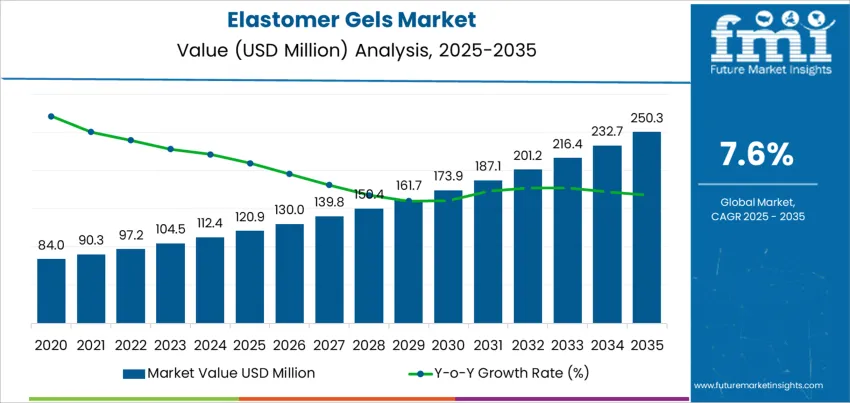
The elastomer gel market is valued at USD 120.9 million in 2025 and is expected to reach USD 250.3 million by 2035, growing at a CAGR of 7.6%. Growth in the early years is driven by steady demand in color cosmetics, skincare, and hair styling, where brands want smooth texture, a soft touch, and better spreadability. Elastomer gels help products feel lighter on the skin while improving shine control and blurring effects, which keeps adoption strong across many beauty formats.
A major portion of early demand comes from face primers, matte foundations, and soft-focus powders, as these categories rely on ingredients that help makeup glide well and stay on longer. Through 2030, the elastomer gel market increases at a consistent pace rather than through sudden jumps. Growth comes from new shade launches, product line extensions, and stable shelf placement across mass and premium brands. As beauty companies continue to focus on sensory performance, smoother application, and comfortable wear, elastomer gels remain a reliable choice in long-wear makeup and advanced skincare formulas.
Quick Stats of the Elastomer Gels Market
- Elastomer Gels Market Value (2025): USD 120.9 million
- Elastomer Gels Market Forecast Value (2035): USD 250.3 million
- Elastomer Gels Market Forecast CAGR (2025 to 2035): 7.6%
- Leading Product Form in Elastomer Gels Market: Powder (14.7%)
- Key Growth Regions in Elastomer Gels Market: Asia Pacific, Europe
- Top Players in Elastomer Gels Market: BASF SE, Croda International, Evonik Industries, Symrise (incl. IFF/Givaudan actives), Dow / Dow Inc., Ashland, Clariant, Seppic / Others
What is the Growth Forecast for the Elastomer Gels Market through 2035?
From 2030 onward, climb velocity accelerates moderately as elastomer gels gain wider footing in hybrid makeup skin care products and professional cosmetic systems. Market value advances from about USD 173.9 million in 2030 toward USD 250.3 million by 2035 as higher gel loading is used to deliver blur effects, oil control, and sensory cushioning in multifunctional products. Hair sculpting gels and styling creams add incremental demand through improved hold without stiffness. Industrial use remains limited but stable in specialty coatings and sealant modifiers. Producers focus on crosslink density control, solvent compatibility, and batch consistency to support faster throughput. The velocity of market ascent remains linked to formulation refresh cycles and sustained consumer preference for smooth texture finishes.
The global elastomer gels market expands from USD 120.9 million in 2025 to USD 161.7 million by 2030, adding USD 40.8 million in the first half of the forecast period. During this phase, manufacturer dominance remains moderately concentrated, with a limited group of large specialty silicone and polymer producers controlling formulation-grade elastomer networks used in skincare textures, primers, and hybrid makeup products.
These dominant suppliers leverage proprietary crosslinking technologies, rheology control, and cosmetic-grade compliance to secure long-term contracts with major beauty brands. Smaller regional formulators participate mainly as blenders rather than core polymer innovators, which limits their upstream pricing power. Dominance in this phase is therefore driven more by material science and performance consistency than by sheer production scale.
From 2030 to 2035, the market advances from USD 161.7 million to USD 250.3 million, generating a larger USD 88.6 million expansion as manufacturer dominance intensifies. Large integrated producers strengthen control through portfolio expansion into low-cyclo, ultra-light, and sensory-engineered elastomer gels tailored for climate-resilient cosmetics and dermatology-linked products.
Smaller suppliers face progressive erosion as premium brands consolidate sourcing toward suppliers that can guarantee batch uniformity, regulatory compliance across regions, and formulation support. By 2035, the dominance curve steepens in favor of a narrow tier of manufacturers that command both technology depth and volume scalability, shaping long-term pricing structure and innovation direction across the elastomer gels value chain.
Elastomer Gels Industry Key Takeaways
| Metric | Value |
|---|---|
| Industry Value (2025) | USD 120.9 million |
| Forecast Value (2035) | USD 250.3 million |
| Forecast CAGR (2025 to 2035) | 7.6% |
How Is the Elastomer Gels Market Developing Across Personal Care, Medical, and Industrial Applications?
The elastomer gels market developed from the need for materials that combine the elasticity of rubber with the softness and flow control of gels. Early commercial use emerged in personal care, where formulators required ingredients that could thicken oils, suspend pigments, and deliver a smooth, cushion like sensory feel without stiffness. Silicone based elastomer gels became central to primers, foundations, sunscreens, and serums because they blur skin texture, improve spreadability, and stabilize emulsions. Outside cosmetics, medical and industrial users adopted elastomer gels for vibration damping, controlled release matrices, and soft contact interfaces where both flexibility and structural stability are required. This combination of rheology control and tactile performance established elastomer gels as functional structuring agents rather than passive fillers.
Future growth of the elastomer gels market will be shaped by demand for high performance textures, hybrid cosmetic formats, and soft functional materials in medical devices. In beauty and personal care, growth will continue in long wear makeup, water resistant sunscreens, and sensory driven skincare where elastomer gels control slip, payoff, and film formation. Medical expansion will depend on use in wound care interfaces, transdermal systems, and cushioning components. Barriers include regulatory pressure on certain silicone chemistries, cost sensitivity in mass market formulations, and substitution risk from bio based or polymer gel alternatives. Long term expansion will depend on how well producers balance sensory performance, regulatory alignment, and cross sector utility.
How Are End Use Application and Product Form Structuring the Demand for Elastomer Gels?
The demand for elastomer gels is structured by end use application and product form. Skin care represents 8.2% of total demand, followed by body care, hair care, sun care, color cosmetics, men grooming, baby and kids care, and dermocosmetic and professional care. By product form, powder accounts for 14.7% of total consumption, followed by granules and agglomerates, flakes, pellets and prills, liquid solutions, high active concentrates, dispersions and suspensions, emulsions, pastes, gels, wax or solid block formats, and oils. Demand behavior is shaped by texture engineering requirements, viscosity modulation capability, sensory finish control, and compatibility with silicone and non-silicone formulation systems.
Why Does Skin Care Lead the Elastomer Gels End Use Demand?
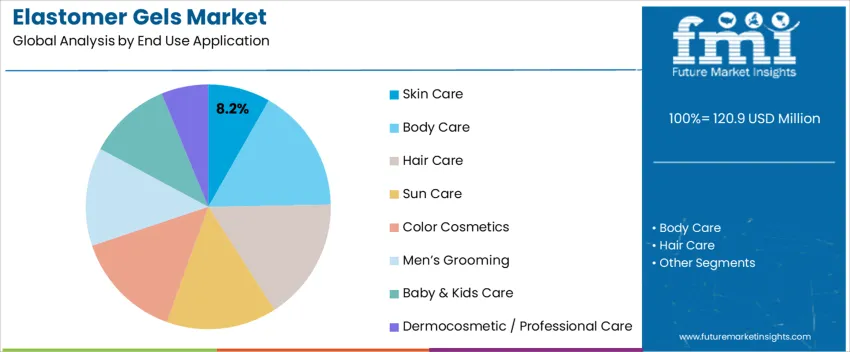
Skin care accounts for 8.2% of total elastomer gel demand due to their role in creating cushioned, soft focus textures that improve product sensory performance without adding greasiness. Elastomer gels are widely used in primers, blurring creams, anti-aging serums, and instant line smoothing products where surface feel and application glide directly influence consumer perception. These gels provide a silky slip while filling micro-irregularities on the skin surface, producing a visible smoothing effect.
Skin care formulators rely on elastomer gels to stabilize emulsion viscosity while maintaining a lightweight finish. They also reduce tackiness in high humectant systems and improve spread uniformity of actives and pigments. Their non-migrating structure allows consistent performance under humidity and heat exposure. These texture refinement capabilities, visual smoothing effects, and formulation stabilization roles sustain skin care as the leading end use segment within elastomer gels demand.
Why Does Powder Lead the Elastomer Gels Product Form Demand?
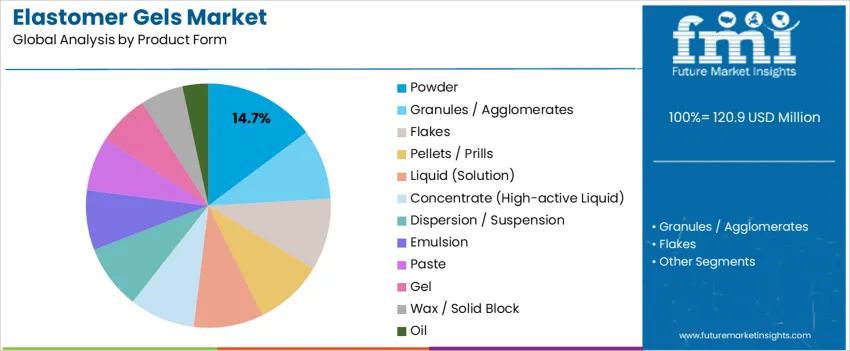
Powder accounts for 14.7% of total elastomer gel demand due to its superior handling control, storage stability, and flexibility in reconstitution during formulation. Powdered elastomer gels allow manufacturers to activate gel structure at specific process stages, which improves batch-to-batch repeatability of texture, viscosity, and suspension behavior. Low moisture exposure reduces the risk of premature swelling or microbial degradation during long-term storage.
Powder form also supports precise modulation of slip, cushion, and thickness across creams, gels, and hybrid systems. It integrates efficiently into both anhydrous and water-based formulations without causing phase separation. Packaging in moisture-barrier containers preserves flow properties and dispersion efficiency during transport. These processing control advantages, shelf life stability, and formulation precision factors position powder as the leading product form within the elastomer gels demand structure.
How Are Elastomer Gels Changing How Products Touch Skin, Electronics, And Mechanical Parts?
Elastomer gels have become the material of choice wherever contact must be soft, conformable, and dimensionally stable. They sit between liquids and solids, keeping shape while flowing enough to fill gaps and irregular surfaces. In electronics, they cushion delicate components against vibration and impact while avoiding pump-out that plagues greases. Medical pads, dressings, and sensor interfaces use gels to maintain gentle contact with skin over long periods. Automotive and appliance makers apply them to quiet rattle points and isolate vibration. Demand is driven by this ability to manage touch, pressure, and motion simultaneously.
Why Do Designers Reach for Elastomer Gels When Cushioning and Control Need to Coexist?
Product designers use elastomer gels when foams, rubbers, and oils fail to satisfy opposing mechanical needs. Foams compress but lose support over time, while rubbers resist compression yet feels harsh. Oils flow into gaps but migrate out of position. Gels bridge these behaviors by holding a defined shape while redistributing load gradually under stress. This is crucial in pressure-relief cushions, gaming and control grips, hearing protection, and optical connectors. The market grows because gels allow engineers to fine tune comfort, damping, and recovery without rebuilding surrounding structures.
What Material and Processing Constraints Keep Elastomer Gels Out of Some High-Volume Uses?
Despite their versatility, elastomer gels bring constraints that limit broad substitution. Many silicones based gels require controlled mixing, degassing, and cure cycles that do not fit fast, low-cost production lines. Their tacky surfaces attract dust and fibers unless encapsulated, adding design complexity. Mechanical strength is lower than full elastomers, so unsupported gels can tear or creep under prolonged load. Raw material cost often exceeds that of commodity rubbers or plastics. These factors confine elastomer gel use to assemblies where performance gain compensates for processing and material expense.
Where Is Demand Concentrating as Wearables, Haptics, And Sealing Systems Evolve?
Demand for elastomer gels is concentrating in three active areas: wearables, haptic interfaces, and advanced sealing. Wearable health devices need long-term, low-irritation contact layers that follow body movement without losing sensor coupling. Haptic systems use gels to tune vibration transfer so feedback feels controlled rather than harsh. Sealing in lighting, battery packs, and communication hardware uses gels to maintain ingress protection while allowing rework and thermal cycling. These applications treat elastomer gels as engineered interface media that govern how forces, signals, and environments move across boundaries.
What Is the Global Growth Outlook for the Elastomer Gels Industry by Country?
| Country | CAGR (%) |
|---|---|
| India | 10.2 |
| China | 9.4 |
| Japan | 8.7 |
| UK | 7.9 |
| Germany | 7.2 |
| USA | 6.4 |
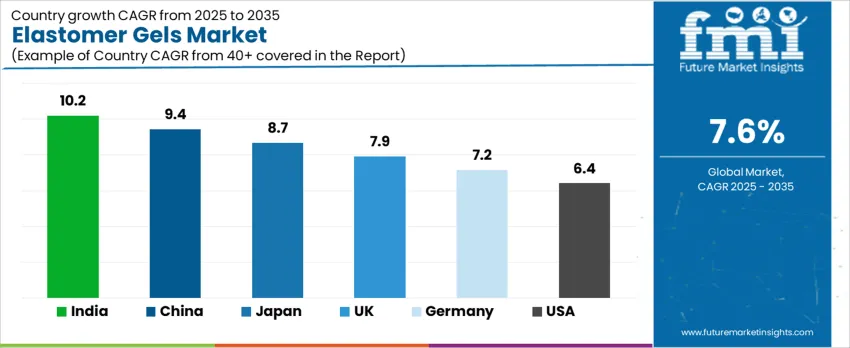
The elastomer gels industry is showing steady global expansion across personal care, medical devices, adhesives, and specialty materials markets, with India at a 10.2% CAGR. Growth in India is supported by rising demand from cosmetics, dermatology products, and flexible adhesives used in packaging and hygiene applications. China follows at 9.4%, driven by large-scale production of personal care products, industrial sealants, and pressure-sensitive adhesives.
Japan at 8.7% reflects stable adoption in premium cosmetics, medical gels, and specialty coating formulations. The UK and Germany record 7.9% and 7.2% growth, supported by steady use in biomedical products, cosmetics, and performance adhesives. The USA at 6.4% reflects a mature but steadily advancing market driven by medical gels, specialty tapes, and advanced personal care formulations.
What Is Driving Elastomer Gel Demand in India Personal Care and Pharmaceuticals?
Expansion in India is progressing at a CAGR of 10.2% through 2035 for elastomer gels demand, driven by rising production of cosmetic textures, topical pharmaceuticals, and dermatology grade skincare products. Elastomer gels are widely used in primers, sunscreens, anti acne treatments, and transdermal gel bases for smooth sensory feel and controlled release. Contract manufacturing for domestic and export brands strengthens volume demand. Imports dominate high performance grades, while local blending supports mass products. Demand remains formulation driven and retail aligned, shaped by strong cosmetics consumption, expanding medical topical usage, and rapid ecommerce growth.
- Cosmetic primers and sunscreens anchor base demand
- Dermatology gels support medical grade consumption
- Contract manufacturing strengthens export oriented output
- Import based sourcing dominates high performance grades
How Is China Scaling Industrial Consumption of Elastomer Gels?
Growth in China reflects a CAGR of 9.4% through 2035 for elastomer gels utilization, supported by large scale personal care manufacturing, pharmaceutical topical production, and private label beauty expansion. Elastomer gels are applied in face primers, massage gels, wound healing products, and aesthetic treatment formulations. Domestic chemical processing ensures stable bulk supply and pricing control. Export oriented cosmetic manufacturers sustain continuous offtake. Demand remains production driven and volume oriented, aligned with mass skincare output, steady pharmaceutical topical growth, and rapid private brand turnover across beauty and healthcare manufacturing chains.
- Mass skincare production sustains bulk gel consumption
- Wound care products support pharmaceutical usage
- Domestic processing stabilizes large volume availability
- Export oriented production strengthens continuous demand
Why Does Japan Sustain Premium Demand for High Performance Elastomer Gels?
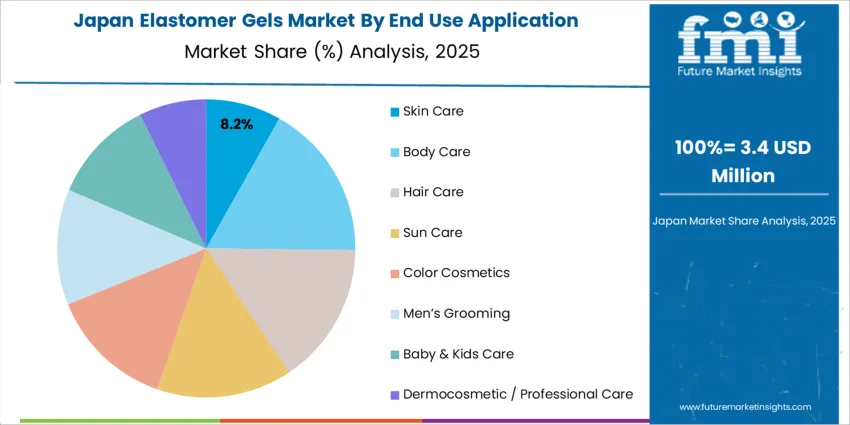
Demand in Japan is increasing at a CAGR of 8.7% through 2035 for elastomer gels usage, supported by premium cosmetics, regulated dermaceuticals, and advanced skincare science. Elastomer gels are used in blurring primers, skin tightening serums, and controlled release cosmetic actives. Domestic formulators emphasize ultra smooth texture and low irritation performance. Dermatology aligned beauty brands favor elastomer systems for uniform skin feel. Demand stays quality driven and performance focused, supported by aging population skincare needs, steady premium product launches, and high consumer trust in skin science driven formulations.
- Blurring primers drive premium cosmetic usage
- Dermaceutical skincare supports regulated consumption
- Domestic formulation stabilizes texture consistency
- Sensitive skin products sustain repeat demand
What Is Supporting Elastomer Gel Market Expansion in the United Kingdom?
Growth in the UK is advancing at a CAGR of 7.9% through 2035 for elastomer gels demand, supported by clean beauty innovation, professional salon skincare adoption, and growing interest in hybrid cosmetic textures. Elastomer gels appear in face primers, cooling body gels, and post treatment skincare products. Independent beauty brands and aesthetic clinics drive steady usage. Imports dominate sourcing due to limited domestic gel polymer production. Demand remains retail driven and texture focused, shaped by rising preference for lightweight formulations, steady clinic based procedures, and strong online beauty retail performance.
- Face primers and body gels anchor retail demand
- Aesthetic clinics support professional usage
- Clean beauty brands drive formulation innovation
- Imported sourcing dominates national supply
How Is Germany Integrating Elastomer Gels into Regulated Skincare and Medical Topicals?
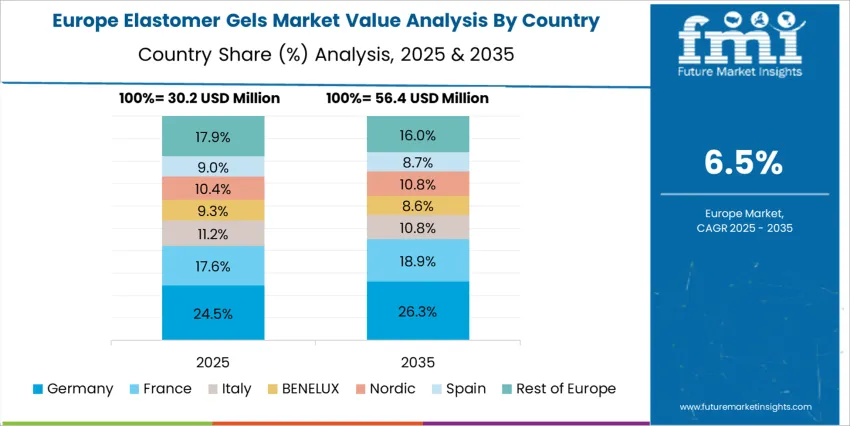
Growth in Germany reflects a CAGR of 7.2% through 2035 for elastomer gel consumption, driven by pharmacy grade cosmetics, regulated wound care products, and certified dermaceutical manufacturing. Elastomer gels are applied in scar treatment creams, cooling medical gels, and post procedural skincare. Strict testing and labeling standards govern material selection and supplier qualification. Imports remain the primary supply route. Demand stays quality focused and regulation aligned, supported by preventive skin health practices, controlled cosmetic usage, and steady expansion of medical grade topical formulations across pharmacy and clinical distribution channels.
- Wound care and scar gels drive regulated demand
- Pharmacy grade skincare sustains stable consumption
- Compliance standards shape supplier qualification
- Medical retail supports predictable long term usage
What Is Driving Measured Elastomer Gel Growth in the United States?
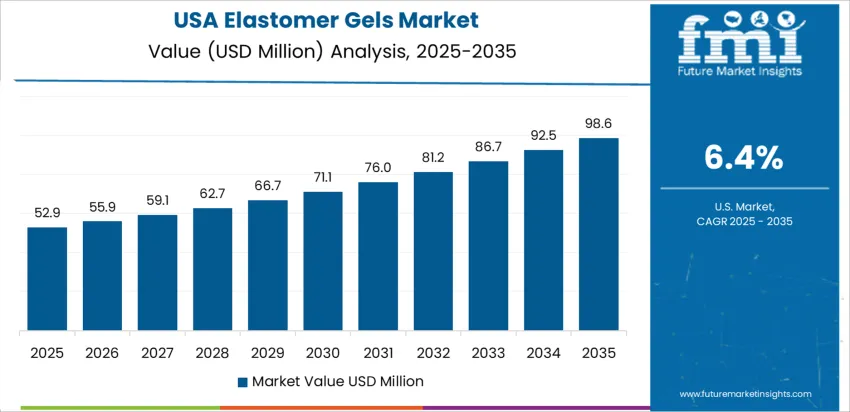
Expansion in the United States is moving at a CAGR of 6.4% through 2035 for elastomer gels demand, supported by mass cosmetics production, sports recovery gels, and dermatology clinic procedures. Elastomer gels appear in face primers, muscle relief gels, sunscreen bases, and anti-aging topical. Professional skincare brands and mass retail labels both contribute to volume consumption. Imports supply much of the high performance material. Demand remains application driven and formulation diverse, shaped by steady personal care sales, consistent sports injury recovery demand, and stable aesthetic treatment activity.
- Face primers anchor mass cosmetic demand
- Sports recovery gels support therapeutic usage
- Professional skincare brands drive clinic level adoption
- Import dependence dominates high performance sourcing
What is the Competitive Reach Score for Elastomer Gel Market?
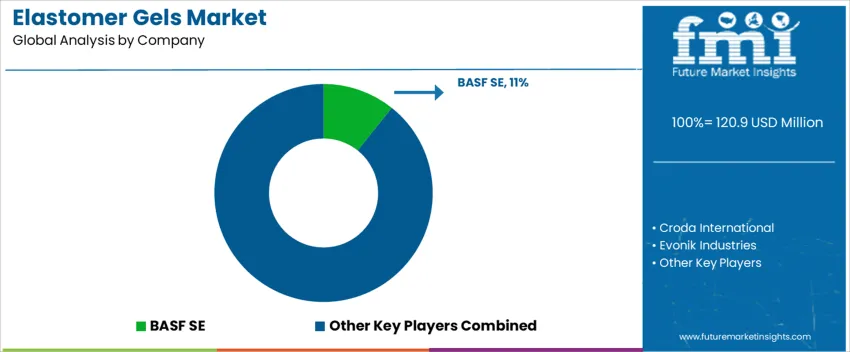
The competitive reach of the elastomer gel market can best be described as "moderately high." Large specialty chemical and ingredients firms such as BASF SE, Croda International, Evonik Industries, Symrise (including its IFF/Givaudan actives division), Dow Inc., Ashland and Clariant operate globally with broad distribution and supply chain networks. Their scale and ability to supply standard grades give them wide geographic coverage and strong market presence. At the same time, many smaller or specialized suppliers also compete especially in niche, premium, or application specific elastomer gel grades. This mix of major global players and smaller niche firms means the market has broad reach but no single firm holds dominance everywhere.
Large suppliers tend to secure contracts with major personal care, medical, electronics and industrial buyers. Their capacity to meet regulatory, quality, and volume requirements provides them a stable base. Smaller firms maintain reach through flexibility supplying specialized or customized gel grades and offering formulation support. As a result, geographic and end use segments remain somewhat fragmented, allowing multiple suppliers to coexist with overlapping coverage. Overall, the market’s combination of scale, supplier diversity, and end use breadth supports a moderately high competitive reach structure, where many buyers have access to multiple credible vendors worldwide.
Key Players in the Elastomer Gels Market
- BASF SE
- Croda International
- Evonik Industries
- Symrise (incl. IFF/Givaudan actives)
- Dow / Dow Inc.
- Ashland
- Clariant
- Seppic
- Others
Scope of the report
| Items | Values |
|---|---|
| Quantitative Units (2025) | USD million |
| End-Use Applications | Skin Care, Body Care, Hair Care, Sun Care, Color Cosmetics, Men’s Grooming, Baby & Kids Care, Dermocosmetic / Professional Care |
| Product Forms | Powder, Granules/Agglomerates, Flakes, Pellets/Prills, Liquid (Solution), Concentrate (High-active Liquid), Dispersion/Suspension, Emulsion, Paste, Gel, Wax / Solid Block, Oil |
| Regions Covered | Asia Pacific, Europe, North America, Latin America, Middle East & Africa |
| Countries Covered | China, Japan, South Korea, India, Australia & New Zealand, ASEAN, Germany, United Kingdom, France, Italy, Spain, Nordic, BENELUX, USA, Canada, Mexico, Brazil, Chile, Saudi Arabia, Turkey, South Africa, plus 40+ additional countries globally |
| Key Companies Profiled | BASF SE, Croda International, Evonik Industries, Symrise (incl. IFF/Givaudan actives), Dow Inc., Ashland, Clariant, Seppic, Lubrizol, Lonza, Inolex |
| Additional Attributes | Dollar by sales breakdown by region, country, end-use, and product form; global growth projections; multi-sector adoption (cosmetic, nutraceutical, functional food); extract bioactivity profiling; iodine and polyphenol standardization; contract harvesting; vertical integration; supply chain stability; regulatory compliance; sensory and bioavailability performance |
Elastomer Gels Market Segmentation
End Use Application:
- Skin Care
- Body Care
- Hair Care
- Sun Care
- Color Cosmetics
- Men’s Grooming
- Baby & Kids Care
- Dermocosmetic / Professional Care
Product Form:
- Powder
- Granules / Agglomerates
- Flakes
- Pellets / Prills
- Liquid (Solution)
- Concentrate (High-active Liquid)
- Dispersion / Suspension
- Emulsion
- Paste
- Gel
- Wax / Solid Block
- Oil
Region
-
Asia Pacific
- China
- Japan
- South Korea
- India
- Australia & New Zealand
- ASEAN
- Rest of Asia Pacific
-
Europe
- Germany
- United Kingdom
- France
- Italy
- Spain
- Nordic
- BENELUX
- Rest of Europe
-
North America
- United States
- Canada
- Mexico
-
Latin America
- Brazil
- Chile
- Rest of Latin America
-
Middle East & Africa
- Kingdom of Saudi Arabia
- Other GCC Countries
- Turkey
- South Africa
- Other African Union
- Rest of Middle East & Africa
Frequently Asked Questions
How big is the elastomer gels market in 2025?
The global elastomer gels market is estimated to be valued at USD 120.9 million in 2025.
What will be the size of elastomer gels market in 2035?
The market size for the elastomer gels market is projected to reach USD 250.3 million by 2035.
How much will be the elastomer gels market growth between 2025 and 2035?
The elastomer gels market is expected to grow at a 7.6% CAGR between 2025 and 2035.
What are the key product types in the elastomer gels market?
The key product types in elastomer gels market are skin care, body care, hair care, sun care, color cosmetics, men’s grooming, baby & kids care and dermocosmetic / professional care.
Which product form segment to contribute significant share in the elastomer gels market in 2025?
In terms of product form , powder segment to command 14.7% share in the elastomer gels market in 2025.
Preview the report firsthand - request a free sample
Get SampleGet the brochure for pricing and purchase details.
Get PDFTable of Content
- Executive Summary
- Global Market Outlook
- Demand-side Trends
- Supply-side Trends
- Technology Roadmap Analysis
- Analysis and Recommendations
- Market Overview
- Market Coverage / Taxonomy
- Market Definition / Scope / Limitations
- Market Background
- Market Dynamics
- Drivers
- Restraints
- Opportunity
- Trends
- Scenario Forecast
- Demand in Optimistic Scenario
- Demand in Likely Scenario
- Demand in Conservative Scenario
- Opportunity Map Analysis
- Product Life Cycle Analysis
- Supply Chain Analysis
- Investment Feasibility Matrix
- Value Chain Analysis
- PESTLE and Porter’s Analysis
- Regulatory Landscape
- Regional Parent Market Outlook
- Production and Consumption Statistics
- Import and Export Statistics
- Market Dynamics
- Global Market Analysis 2020 to 2024 and Forecast, 2025 to 2035
- Historical Market Size Value (USD Million) Analysis, 2020 to 2024
- Current and Future Market Size Value (USD Million) Projections, 2025 to 2035
- Y-o-Y Growth Trend Analysis
- Absolute $ Opportunity Analysis
- Global Market Pricing Analysis 2020 to 2024 and Forecast 2025 to 2035
- Global Market Analysis 2020 to 2024 and Forecast 2025 to 2035, By End Use Application
- Introduction / Key Findings
- Historical Market Size Value (USD Million) Analysis By End Use Application , 2020 to 2024
- Current and Future Market Size Value (USD Million) Analysis and Forecast By End Use Application , 2025 to 2035
- Skin Care
- Body Care
- Hair Care
- Sun Care
- Color Cosmetics
- Men’s Grooming
- Baby & Kids Care
- Dermocosmetic / Professional Care
- Y-o-Y Growth Trend Analysis By End Use Application , 2020 to 2024
- Absolute $ Opportunity Analysis By End Use Application , 2025 to 2035
- Global Market Analysis 2020 to 2024 and Forecast 2025 to 2035, By Product Form
- Introduction / Key Findings
- Historical Market Size Value (USD Million) Analysis By Product Form, 2020 to 2024
- Current and Future Market Size Value (USD Million) Analysis and Forecast By Product Form, 2025 to 2035
- Powder
- Granules / Agglomerates
- Flakes
- Pellets / Prills
- Liquid (Solution)
- Concentrate (High-active Liquid)
- Dispersion / Suspension
- Emulsion
- Paste
- Gel
- Wax / Solid Block
- Y-o-Y Growth Trend Analysis By Product Form, 2020 to 2024
- Absolute $ Opportunity Analysis By Product Form, 2025 to 2035
- Global Market Analysis 2020 to 2024 and Forecast 2025 to 2035, By Region
- Introduction
- Historical Market Size Value (USD Million) Analysis By Region, 2020 to 2024
- Current Market Size Value (USD Million) Analysis and Forecast By Region, 2025 to 2035
- North America
- Latin America
- Western Europe
- Eastern Europe
- East Asia
- South Asia and Pacific
- Middle East & Africa
- Market Attractiveness Analysis By Region
- North America Market Analysis 2020 to 2024 and Forecast 2025 to 2035, By Country
- Historical Market Size Value (USD Million) Trend Analysis By Market Taxonomy, 2020 to 2024
- Market Size Value (USD Million) Forecast By Market Taxonomy, 2025 to 2035
- By Country
- USA
- Canada
- Mexico
- By End Use Application
- By Product Form
- By Country
- Market Attractiveness Analysis
- By Country
- By End Use Application
- By Product Form
- Key Takeaways
- Latin America Market Analysis 2020 to 2024 and Forecast 2025 to 2035, By Country
- Historical Market Size Value (USD Million) Trend Analysis By Market Taxonomy, 2020 to 2024
- Market Size Value (USD Million) Forecast By Market Taxonomy, 2025 to 2035
- By Country
- Brazil
- Chile
- Rest of Latin America
- By End Use Application
- By Product Form
- By Country
- Market Attractiveness Analysis
- By Country
- By End Use Application
- By Product Form
- Key Takeaways
- Western Europe Market Analysis 2020 to 2024 and Forecast 2025 to 2035, By Country
- Historical Market Size Value (USD Million) Trend Analysis By Market Taxonomy, 2020 to 2024
- Market Size Value (USD Million) Forecast By Market Taxonomy, 2025 to 2035
- By Country
- Germany
- UK
- Italy
- Spain
- France
- Nordic
- BENELUX
- Rest of Western Europe
- By End Use Application
- By Product Form
- By Country
- Market Attractiveness Analysis
- By Country
- By End Use Application
- By Product Form
- Key Takeaways
- Eastern Europe Market Analysis 2020 to 2024 and Forecast 2025 to 2035, By Country
- Historical Market Size Value (USD Million) Trend Analysis By Market Taxonomy, 2020 to 2024
- Market Size Value (USD Million) Forecast By Market Taxonomy, 2025 to 2035
- By Country
- Russia
- Poland
- Hungary
- Balkan & Baltic
- Rest of Eastern Europe
- By End Use Application
- By Product Form
- By Country
- Market Attractiveness Analysis
- By Country
- By End Use Application
- By Product Form
- Key Takeaways
- East Asia Market Analysis 2020 to 2024 and Forecast 2025 to 2035, By Country
- Historical Market Size Value (USD Million) Trend Analysis By Market Taxonomy, 2020 to 2024
- Market Size Value (USD Million) Forecast By Market Taxonomy, 2025 to 2035
- By Country
- China
- Japan
- South Korea
- By End Use Application
- By Product Form
- By Country
- Market Attractiveness Analysis
- By Country
- By End Use Application
- By Product Form
- Key Takeaways
- South Asia and Pacific Market Analysis 2020 to 2024 and Forecast 2025 to 2035, By Country
- Historical Market Size Value (USD Million) Trend Analysis By Market Taxonomy, 2020 to 2024
- Market Size Value (USD Million) Forecast By Market Taxonomy, 2025 to 2035
- By Country
- India
- ASEAN
- Australia & New Zealand
- Rest of South Asia and Pacific
- By End Use Application
- By Product Form
- By Country
- Market Attractiveness Analysis
- By Country
- By End Use Application
- By Product Form
- Key Takeaways
- Middle East & Africa Market Analysis 2020 to 2024 and Forecast 2025 to 2035, By Country
- Historical Market Size Value (USD Million) Trend Analysis By Market Taxonomy, 2020 to 2024
- Market Size Value (USD Million) Forecast By Market Taxonomy, 2025 to 2035
- By Country
- Kingdom of Saudi Arabia
- Other GCC Countries
- Turkiye
- South Africa
- Other African Union
- Rest of Middle East & Africa
- By End Use Application
- By Product Form
- By Country
- Market Attractiveness Analysis
- By Country
- By End Use Application
- By Product Form
- Key Takeaways
- Key Countries Market Analysis
- USA
- Pricing Analysis
- Market Share Analysis, 2024
- By End Use Application
- By Product Form
- Canada
- Pricing Analysis
- Market Share Analysis, 2024
- By End Use Application
- By Product Form
- Mexico
- Pricing Analysis
- Market Share Analysis, 2024
- By End Use Application
- By Product Form
- Brazil
- Pricing Analysis
- Market Share Analysis, 2024
- By End Use Application
- By Product Form
- Chile
- Pricing Analysis
- Market Share Analysis, 2024
- By End Use Application
- By Product Form
- Germany
- Pricing Analysis
- Market Share Analysis, 2024
- By End Use Application
- By Product Form
- UK
- Pricing Analysis
- Market Share Analysis, 2024
- By End Use Application
- By Product Form
- Italy
- Pricing Analysis
- Market Share Analysis, 2024
- By End Use Application
- By Product Form
- Spain
- Pricing Analysis
- Market Share Analysis, 2024
- By End Use Application
- By Product Form
- France
- Pricing Analysis
- Market Share Analysis, 2024
- By End Use Application
- By Product Form
- India
- Pricing Analysis
- Market Share Analysis, 2024
- By End Use Application
- By Product Form
- ASEAN
- Pricing Analysis
- Market Share Analysis, 2024
- By End Use Application
- By Product Form
- Australia & New Zealand
- Pricing Analysis
- Market Share Analysis, 2024
- By End Use Application
- By Product Form
- China
- Pricing Analysis
- Market Share Analysis, 2024
- By End Use Application
- By Product Form
- Japan
- Pricing Analysis
- Market Share Analysis, 2024
- By End Use Application
- By Product Form
- South Korea
- Pricing Analysis
- Market Share Analysis, 2024
- By End Use Application
- By Product Form
- Russia
- Pricing Analysis
- Market Share Analysis, 2024
- By End Use Application
- By Product Form
- Poland
- Pricing Analysis
- Market Share Analysis, 2024
- By End Use Application
- By Product Form
- Hungary
- Pricing Analysis
- Market Share Analysis, 2024
- By End Use Application
- By Product Form
- Kingdom of Saudi Arabia
- Pricing Analysis
- Market Share Analysis, 2024
- By End Use Application
- By Product Form
- Turkiye
- Pricing Analysis
- Market Share Analysis, 2024
- By End Use Application
- By Product Form
- South Africa
- Pricing Analysis
- Market Share Analysis, 2024
- By End Use Application
- By Product Form
- USA
- Market Structure Analysis
- Competition Dashboard
- Competition Benchmarking
- Market Share Analysis of Top Players
- By Regional
- By End Use Application
- By Product Form
- Competition Analysis
- Competition Deep Dive
- BASF SE
- Overview
- Product Portfolio
- Profitability by Market Segments (Product/Age /Sales Channel/Region)
- Sales Footprint
- Strategy Overview
- Marketing Strategy
- Product Strategy
- Channel Strategy
- Croda International
- Evonik Industries
- Symrise (incl. IFF/Givaudan actives)
- Dow / Dow Inc.
- Ashland
- Clariant
- Seppic
- Others
- BASF SE
- Competition Deep Dive
- Assumptions & Acronyms Used
- Research Methodology


