

- Market Size (2026)
- USD 5.6 Bn
- Forecast (2036)
- USD 18.7 Bn
- CAGR (2026 to 2036)
- 12.8%
How big is NGS-Based RNA Sequencing Market in 2026?
USD 5.6 billion in 2026 and USD 18.7 billion by 2036 at a 12.8% CAGR.
Demand for NGS-based RNA sequencing is projected to expand at 12.8% CAGR between 2026 and 2036, from USD 5.6 billion to USD 18.7 billion. Large transcriptomics technologies programs depend on sample quality and library design for retaining intended transcript classes. In February 2025, Illumina and Broad Clinical Labs announced a collaboration intended to build a five-billion-cell atlas within three years. That scale raises recurring demand for library kits and computational processing across participating laboratories worldwide.
National adoption differs with cohort access and governance for transcript interpretation across research or clinical settings. Genomics England reported 7,840 RNA-seq samples from 7,829 rare-disease participants in its January 2026 resource. Linking RNA evidence with genomic records supports clinical NGS data analysis, while countries without repositories depend heavily on academic cores or service laboratories.
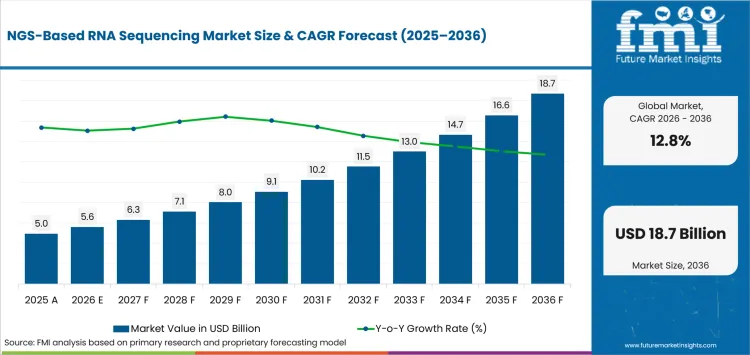
Key Takeaways of NGS-Based RNA Sequencing Market
- Transcript-level studies increase recurring workflow demand as research teams compare expression and cellular states across larger cohorts.
- Consumables & reagents are projected to account for 49.0% of product type demand in 2026 due to run-specific inputs.
- Bulk RNA sequencing is estimated to capture 45.0% of sequencing type demand in 2026 owing to established cohort protocols.
- Gene expression profiling is anticipated to represent 38.0% of application demand in 2026 because it supports direct sample comparisons.
- RNA degradation and specialist analysis requirements delay comparable results across multi-site research programs and larger sample batches.
- Illumina, Inc., Thermo Fisher Scientific Inc., Pacific Biosciences, Oxford Nanopore Technologies, BGI Genomics, QIAGEN N.V., Agilent Technologies and Takara Bio Inc. serve the market.
Analyst Perspective
"RNA sequencing economics depend on the proportion of samples that survive preparation and produce interpretable transcript evidence across the intended cohort. Laboratories should compare sample compatibility, library bias and analysis support before committing to a platform or service model."
- Anurag Sharma, Principal Consultant, Future Market Insights
How is the NGS-Based RNA Sequencing Market segmented?
The NGS-based RNA sequencing market is segmented by product type, sequencing type, application, end user, workflow and region.
Product type includes consumables & reagents, instruments, software & analytics and services. Sequencing type covers bulk RNA sequencing, single-cell RNA sequencing, small RNA sequencing and others. Applications include gene expression profiling, cancer research, drug discovery & development and others. End users include academic & research institutes, pharmaceutical & biotechnology companies, hospitals & diagnostic laboratories and others. Workflow covers sample preparation, library preparation, sequencing and data analysis.
Why do consumables & reagents lead demand within the product type category?
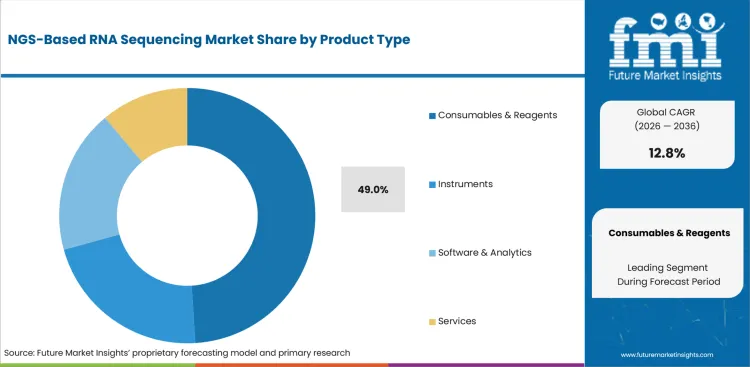
Consumables & reagents provide run-specific materials from RNA isolation through library construction for every sequencing batch. Their recurring use links DNA and RNA extraction quality with dependable throughput across shared research programs and multi-site sample collections.
- By product type, consumables & reagents are estimated to hold 49.0% in 2026 owing to repeated replacement of assay-specific kits and sequencing reagents.
- Core laboratories replace extraction materials and library components for each project while installed sequencers support many studies. Consistent reagent lots reduce preparation variation and protect comparability across batches submitted by different research groups and external service partners.
What keeps bulk RNA sequencing ahead within the sequencing type category?
Bulk RNA sequencing measures average transcript abundance across tissues or pooled samples within established experimental designs. It supports treatment comparisons and time-series studies without requiring individual-cell separation across every sample, which keeps preparation and analysis manageable for larger cohorts.
- In 2026, bulk RNA sequencing is expected to lead sequencing type with 45.0% share because established protocols support larger cohorts.
- Research teams select total RNA or mRNA sequencing according to transcript coverage and sample quality requirements. Established pipelines reduce design complexity for routine comparisons, while cellular separation or long-read methods remain reserved for questions requiring added resolution across archived cohorts.
How does gene expression profiling lead the application category?
Gene expression profiling converts sequencing reads into comparable measurements of biological activity across controlled samples. The application supports disease research and precision medicine genomics by identifying expression differences that guide biomarker review, pathway selection and later experimental validation.
- The gene expression profiling segment is likely to capture 38.0% share in 2026 attributable to broad experimental relevance across disease and functional studies.
- BGI-Research reported in February 2025 that a soybean atlas combined bulk RNA sequencing across 314 organ samples. Bulk data established the expression baseline while single-nucleus and spatial methods added cellular and location detail across comparative research settings.
Why are academic & research institutes the leading end user?
Academic & research institutes conduct exploratory disease and functional genomics studies across varied biological sample types. NIH reported in January 2024 that HuBMAP involved more than 400 researchers from 60 institutions, so shared projects require flexible access to bulk and single-cell methods.
- Academic & research institutes are set to lead the end user category with 41.0% share in 2026 due to diverse research programs.
- University cores distribute sequencing costs across many projects and preserve specialist preparation and analysis support. Purchasing depends on sample diversity, shared instrument capacity and protocols that remain comparable across collaborating institutions and external service partners.
What are the drivers, restraints and opportunities in the NGS-Based RNA Sequencing Market?
Larger transcriptome programs increase workflow demand while RNA quality and interpretation burden constrain reproducible scale. Native-RNA and long-read methods extend commercial routes beyond conventional cohort-level expression analysis.
- Driver: Larger cellular atlases increase recurring demand for coordinated sample preparation and sequencing analysis across participating laboratories.
- Restraint: RNA degradation and library bias reduce cross-sample comparability unless laboratories maintain consistent quality controls throughout each project.
- Opportunity: Native-RNA methods extend sequencing use toward isoform analysis and quality testing for mRNA manufacturing workflows.
Cellular atlases expand recurring workflow demand
Large atlas programs require laboratories to coordinate sample handling and computational review across millions of cells. BGI-Research launched the 10 Billion Cells Alliance with 18 institutions in August 2025, linking shared protocols with recurring demand for single-cell analysis systems and services.
Sample variability raises reproducibility costs
RNA quality can deteriorate during collection, storage and extraction before biological differences are measured reliably. Laboratories apply NGS workflow quality control to input integrity and library complexity across each batch. Weak controls increase repeat runs and analyst review, raising cost per usable result as cohorts expand.
Native-RNA workflows extend commercial use
Long-read and native-RNA methods recover full-length isoforms or modification signals that conventional gene counts cannot resolve. Oxford Nanopore and Lonza launched a direct-RNA workflow in May 2026 that can reduce eligible mRNA testing from weeks to less than one day, extending bioinformatics platforms into controlled manufacturing quality review.
Which country CAGRs are profiled in the NGS-Based RNA Sequencing Market?
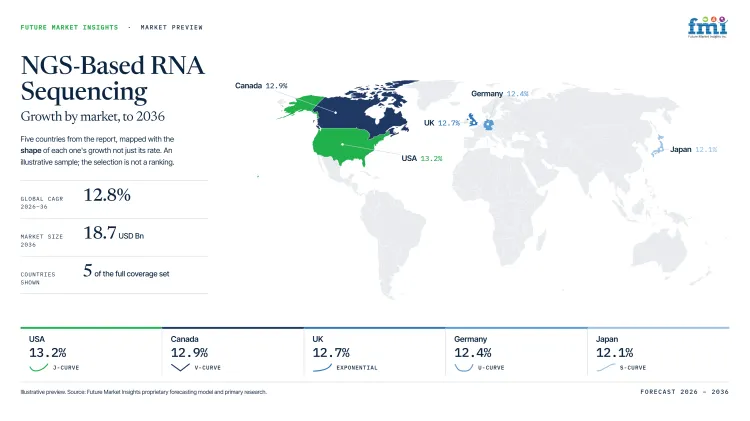
| Country | CAGR |
|---|---|
| South Korea | 13.9% |
| USA | 13.2% |
| UK | 12.7% |
| Germany | 12.4% |
| Japan | 12.1% |
How do country-level CAGRs compare in the NGS-Based RNA Sequencing Market?
The profiled forecasts span 1.8 percentage points across five assessed countries. The narrow range makes local operating conditions more useful than unsupported ranking language for commercial planning.
- South Korea reflects national bioinformation resources that support shared analysis across institutional research programs.
- The USA combines broad sequencing access with clinical and academic networks that generate varied transcriptome studies.
- The UK connects rare-disease RNA evidence with established genomic records and coordinated participant cohorts.
- Germany uses multi-platform core facilities for method comparison and specialist transcriptomics support across research centers.
- Japan supports selected single-cell programs although new workflows face demanding qualification requirements for routine adoption.
Country CAGR describes forecast pace rather than current market size or installed sequencing volume within each country. The full report assesses operating differences across standard regions and more than thirty covered countries.
Country-wise Analysis
- South Korean universities and government laboratories use national biobank resources for immune-response and population studies, reducing the need for each institution to build separate sequencing data infrastructure and specialist analysis capacity across several public health programs. Adoption of NGS-based RNA sequencing in South Korea is estimated to expand at 13.9% CAGR through 2036, supported by shared datasets that provide material for method development and cross-institution comparison across institutional research programs. Korean-language training and dependable instrument service remain necessary for recurring consumables and analysis orders across participating laboratories.
- United States research centers combine public repositories with commercial sequencing capacity across academic and biotechnology clusters, supporting oncology and translational studies that involve varied sample types and read depths with different validation requirements. The United States NGS-based RNA sequencing sector is projected to record 13.2% CAGR during the assessment period, reinforced by broad access and established research networks across major laboratory clusters and shared core facilities. NCI reported in April 2024 that PERCEPTION models covered 44 FDA-approved cancer drugs, although high dataset costs and limited clinical availability separate research activity from routine governed purchasing across hospital laboratories and treatment-response programs.
- United Kingdom rare-disease programs connect RNA evidence with genomic records and coordinated participant recruitment across hospitals, supporting unresolved genetic cases through specialist research centers and translational services that also provide long-read follow-up and molecular diagnostic teams. NGS-based RNA sequencing demand in the United Kingdom is forecast to rise at 12.7% CAGR over the forecast period, supported by national cohorts and established interpretation capacity across participating clinical research centers. NIHR BioResource reported in February 2025 that 17 disease projects completed 50% of planned RNA sequencing, although sample matching and integrated omics validation must remain consistent before findings generate standardized laboratory orders.
- German research centers provide shared access to short-read and long-read methods within specialist genomics platforms, supporting university and clinical projects that require comparative method selection with specialist interpretation and automated preparation support. Germany is estimated to post 12.4% CAGR over the forecast period, shaped by multi-platform capacity and technical support that helps laboratories match read architecture with each study question across varied sample types. The Max Delbrück Center lists six Illumina instruments alongside PacBio Revio and Oxford Nanopore systems, but providers need application guidance and dependable service before laboratories approve routine kits across larger multi-site cohorts and specialist transcript studies.
- Japanese research programs use competitive national funding routes to advance selected single-cell and multi-omics methods across institutional collaborations, supporting specialist laboratories and translational studies under formal project governance for immune-response or infectious-disease questions. By 2036, Japan is projected to grow at 12.1% CAGR due to technical depth and continued public research support across national research networks with carefully reviewed multi-institution programs and national data resources. AMED's e-ASIA JRP FY2025 Health Research call set a selection range of 0-3 projects, and demanding protocol qualification and limited specialist access slow commercial order conversion across research centers and sequencing services nationwide for new workflows.
Who are the notable companies in the NGS-Based RNA Sequencing Market?
Illumina, Inc., Thermo Fisher Scientific Inc., Pacific Biosciences, Oxford Nanopore Technologies, BGI Genomics, QIAGEN N.V., Agilent Technologies and Takara Bio Inc. are the notable companies serving this market.
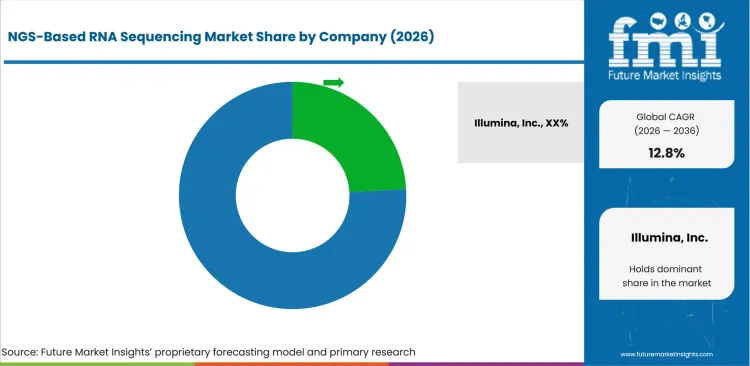
The competitive field combines short-read systems with long-read specialists and companies focused on preparation or analysis. Laboratories compare workflow breadth and transcript resolution across research and clinical oncology NGS purchasing programs. Entry depends on reproducible libraries and informatics that core facilities can validate across changing study designs.
- Illumina, Inc. and Thermo Fisher Scientific Inc. combine sequencing platforms with library preparation and informatics across broad laboratory workflows.
- Pacific Biosciences and Oxford Nanopore Technologies concentrate on long-read or native-RNA routes for isoform and modification analysis.
- BGI Genomics, QIAGEN N.V., Agilent Technologies and Takara Bio Inc. add services and specialized sample or library capabilities.
Competitive Benchmarking: NGS-Based RNA Sequencing Market
| Company | Workflow Breadth | Transcript Resolution Options | Analysis and Application Support | Geographic Reach |
|---|---|---|---|---|
| Illumina, Inc. | High | Medium | High | Global |
| Thermo Fisher Scientific Inc. | High | Low | High | Global |
| Pacific Biosciences | Medium | High | High | Global |
| Oxford Nanopore Technologies | High | High | High | Global |
| BGI Genomics | High | Medium | High | More than 100 countries |
| QIAGEN N.V. | High | Medium | High | Global |
| Agilent Technologies | Medium | Low | High | Global |
| Takara Bio Inc. | Medium | Medium | Medium | Japan, North America and Europe |
Key Developments in the NGS-Based RNA Sequencing Market
- In December 2025, QIAGEN completed its acquisition of Parse Biosciences and added scalable single-cell preparation to its sample technology portfolio. The transaction connects instrument-free barcoding with QIAGEN Digital Insights, giving laboratories a combined preparation and analysis route for large transcriptomics studies without requiring a dedicated cell-partitioning instrument or complex microfluidic workflow across varied sample types.
- In July 2025, Pacific Biosciences joined the 1000 Genomes Long Read Project to generate isoform data from approximately 1,000 cell lines. Each sample is expected to produce about 10 million full-length transcript reads using Kinnex RNA kits and Revio systems, building an open resource and scalable analysis pipelines for long-read transcriptomics research and reproducibility.
- In April 2025, Agilent Technologies introduced the SureSelect Cancer Pan Heme Assay for combined DNA and RNA interrogation in hematologic malignancy research. The assay links targeted enrichment with automated preparation and integrated analysis, giving laboratories a coordinated route for studies that require genomic and transcript evidence across one research workflow with consistent automated reporting requirements.
Key Players in the NGS-Based RNA Sequencing Market
Integrated short-read workflow providers
- Illumina, Inc.
- Thermo Fisher Scientific Inc.
- BGI Genomics
Long-read transcriptomics platforms
- Pacific Biosciences
- Oxford Nanopore Technologies
Sample preparation and analysis specialists
- QIAGEN N.V.
- Agilent Technologies
- Takara Bio Inc.
NGS-Based RNA Sequencing Market - Report Scope
| Coverage field | Report scope |
|---|---|
| Market breakdown | By product type, sequencing type, application, end user, workflow and region. |
| Quantitative Units | Revenue in USD billion and CAGR in %. |
| Market Definition | NGS-based RNA sequencing products and services used across research and governed laboratory workflows. |
| Regions Covered | North America, Latin America, Europe, East Asia, South Asia and Pacific, and Middle East and Africa. |
| Countries Covered | South Korea, USA, UK, Germany, Japan, and 20+ countries included in the full report. |
| Key Companies Profiled | Illumina, Inc., Thermo Fisher Scientific Inc., Pacific Biosciences, Oxford Nanopore Technologies, BGI Genomics, QIAGEN N.V., Agilent Technologies and Takara Bio Inc. |
| Forecast Period | 2026 to 2036. |
| Approach | Primary and secondary research with market triangulation. |
NGS-Based RNA Sequencing Market - Research Methodology
| Method | Approach |
|---|---|
| Primary Research | FMI analysts gathered input from manufacturers, service providers, technology developers, distributors, end users, procurement teams, and subject-matter experts. Interviews examined purchasing decisions, product or service evaluation, adoption barriers, approval requirements, pricing considerations, and expectations for technical or commercial support. Respondents were also asked what evidence is required before a trial, pilot, or initial order develops into regular purchasing. |
| Desk Research | Desk research covered government statistics, regulatory publications, trade data, industry associations, technical literature, standards, company filings, product information, and official corporate announcements. Sources were reviewed for relevance, publication date, geographic coverage, and consistency with the defined market scope. Claims relating to performance, applications, approvals, capacity, investment, and commercial activity were retained only when supported by credible public evidence. |
| Market Sizing and Forecasting | The market model combined the baseline value with historical performance, segment structure, pricing and volume indicators, adoption levels, company participation, and country-level demand conditions. Forecast assumptions considered economic activity, investment trends, regulatory developments, technology adoption, purchasing cycles, supply availability, and barriers to wider market use. Segment and regional estimates were reconciled before the final market total was calculated. |
| Data Validation | Estimates were checked against multiple independent indicators, including public data, company activity, trade patterns, industry developments, and findings from primary interviews. Validation also tested whether products, services, applications, and company revenues fell within the defined market boundaries. Adjacent categories, unsupported claims, overlapping revenues, and activities without direct market relevance were excluded to reduce double counting and maintain consistency across segments and countries. |
NGS-Based RNA Sequencing Market by Segments
NGS-Based RNA Sequencing Market segmented by product type:
- Consumables & Reagents
- Library Preparation Kits
- Sequencing Reagents
- Instruments
- Benchtop Sequencers
- High-Throughput Sequencers
- Software & Analytics
- Bioinformatics Software
- Cloud Analysis Platforms
- Services
- Sequencing Services
- Data Analysis Services
NGS-Based RNA Sequencing Market segmented by sequencing type:
- Bulk RNA Sequencing
- mRNA Sequencing
- Total RNA Sequencing
- Single-Cell RNA Sequencing
- Droplet-Based scRNA-Seq
- Plate-Based scRNA-Seq
- Small RNA Sequencing
- miRNA Sequencing
- siRNA Sequencing
- Others
- Spatial Transcriptomics
- Long-Read RNA Sequencing
NGS-Based RNA Sequencing Market segmented by application:
- Gene Expression Profiling
- Disease Research
- Functional Genomics
- Cancer Research
- Biomarker Discovery
- Precision Oncology
- Drug Discovery & Development
- Target Identification
- Preclinical Research
- Others
- Agrigenomics
- Clinical Diagnostics
NGS-Based RNA Sequencing Market segmented by end user:
- Academic & Research Institutes
- Universities
- Government Research Centers
- Pharmaceutical & Biotechnology Companies
- Drug Developers
- Biotechnology Firms
- Hospitals & Diagnostic Laboratories
- Clinical Laboratories
- Molecular Diagnostic Centers
- Others
- CROs
- Forensic Laboratories
NGS-Based RNA Sequencing Market segmented by workflow:
- Sample Preparation
- RNA Extraction
- Quality Assessment
- Library Preparation
- cDNA Synthesis
- Library Amplification
- Sequencing
- Short-Read Sequencing
- Long-Read Sequencing
- Data Analysis
- Alignment & Quantification
- Differential Expression Analysis
NGS-Based RNA Sequencing Market by Region:
- North America
- United States
- Canada
- Mexico
- Latin America
- Brazil
- Chile
- Rest of Latin America
- Western Europe
- Germany
- United Kingdom
- Italy
- Spain
- France
- Nordics
- Benelux
- Rest of Western Europe
- Eastern Europe
- Russia
- Poland
- Hungary
- Balkan and Baltic States
- Rest of Eastern Europe
- East Asia
- China
- Japan
- South Korea
- South Asia and Pacific
- India
- ASEAN
- Australia and New Zealand
- Rest of South Asia and Pacific
- Middle East and Africa
- Kingdom of Saudi Arabia
- Other GCC Countries
- Türkiye
- South Africa
- Other African Union Countries
- Rest of Middle East and Africa
Research Sources and Bibliography
- Illumina, Inc. (2025, February 21). Illumina and Broad Clinical Labs usher in new era of drug discovery with collaboration to rapidly scale single-cell solutions.
- Genomics England. (2026, January 27). Transcriptomics data.
- BGI Group. (2025, February 28). BGI-Research and partners decode the genetic blueprint of soybean organ development for precision molecular breeding.
- National Institutes of Health Common Fund. (2024, January 24). Refining our body image.
- BGI Group. (2025, August 22). BGI-Research and global partners unveil advanced single-cell technology and launch the 10 Billion Cells Alliance.
- Oxford Nanopore Technologies. (2026, May 20). Lonza and Oxford Nanopore Technologies launch direct RNA sequencing solution for GMP mRNA quality control.
- Korea National Institute of Health. (2025). National Biobank of Korea resource inventory.
- National Cancer Institute. (2024, April 18). NIH researchers develop AI tool with potential to more precisely match cancer drugs to patients.
- NIHR BioResource. (2025, February 28). Advancing rare disease research: Innovations in RNA and long read sequencing.
- Max Delbrück Center. (2026). Genomics Technology Platform.
- Japan Agency for Medical Research and Development. (2025, December 15). FY 2025 e-ASIA Joint Research Program - Joint Call for Health Research.
- Thermo Fisher Scientific Inc. (2026, February 26). Annual report 2025.
- Takara Bio Inc. (2025). Annual report 2025.
- QIAGEN N.V. (2026, January 12). QIAGEN sets 2026 priorities to drive growth across five pillars.
- PacBio. (2025, July 23). PacBio joins the 1000 Genomes Long Read Project to add isoform sequencing with Kinnex and Revio.
- Agilent Technologies, Inc. (2025, April 24). Agilent showcases solutions and partnerships transforming cancer research and therapeutics at AACR 2025.
This bibliography supports reader reference without replacing the complete source list and detailed citations provided in the full report.
This Report Answers
- How large is the NGS-based RNA sequencing market in 2026 and 2036?
- Which research conditions increase recurring RNA sequencing workflow demand?
- Why do consumables & reagents account for 49.0% of product type demand?
- How does bulk RNA sequencing support cohort transcriptome analysis?
- Why does gene expression profiling represent 38.0% of application demand?
- How do growth rates differ across the five profiled countries?
- Which companies compete across sequencing and transcript analysis?
- What limits reproducibility across larger multi-site sequencing projects?
Frequently Asked Questions
How big is the NGS-based RNA sequencing market in 2026?
USD 5.6 billion is the estimated 2026 value of the NGS-based RNA sequencing market. The NGS-based RNA sequencing market is projected to reach USD 18.7 billion by 2036 as larger transcriptome programs increase recurring demand across academic and biopharmaceutical research.
What is the CAGR of the NGS-based RNA sequencing market from 2026 to 2036?
A 12.8% CAGR is projected for the NGS-based RNA sequencing market from 2026 to 2036. The NGS-based RNA sequencing market benefits from larger expression studies and expanding single-cell workflows across research laboratories and shared institutional sequencing cores serving translational programs.
Which product type is projected to account for 49.0% of the NGS-based RNA sequencing market?
Consumables & reagents are projected to account for 49.0% of product type demand in the NGS-based RNA sequencing market during 2026. The NGS-based RNA sequencing market requires fresh extraction materials and run-specific reagents for every batch across recurring research programs.
How much incremental opportunity is projected for the NGS-based RNA sequencing market through 2036?
USD 13.1 billion is the projected incremental opportunity for the NGS-based RNA sequencing market between 2026 and 2036. The NGS-based RNA sequencing market depends on laboratories converting larger programs into repeatable preparation and analysis workflows with dependable quality control.
Which companies are active in the NGS-based RNA sequencing market?
Eight companies are profiled in the NGS-based RNA sequencing market: Illumina, Thermo Fisher Scientific, Pacific Biosciences, Oxford Nanopore Technologies, BGI Genomics, QIAGEN, Agilent Technologies and Takara Bio. The NGS-based RNA sequencing market includes platform providers and preparation specialists across bulk, single-cell and long-read workflows.
Preview the report firsthand - request a free sample
Get SampleGet the brochure for pricing and purchase details.
Get PDFTable of Content
- Key Takeaways
- Market Size and CAGR
- Top Growth Driver
- Fastest Growing Segment
- Leading Region
- Key Companies
- Emerging Opportunities
- Executive Summary
- Global Market Outlook
- Demand-side Trends
- Supply-side Trends
- Technology Roadmap Analysis
- Analysis and Recommendations
- Analyst Perspective (What is happening? Why now? What should investors know?)
- Key Questions Answered
- How large is the market?
- What is the CAGR?
- What are key trends?
- Which region dominates?
- Who are the leaders?
- Market Overview
- Market Coverage / Taxonomy
- Market Definition / Scope / Limitations
- Research Methodology
- Chapter Orientation
- Analytical Lens and Working Hypotheses
- Market Structure, Signals, and Trend Drivers
- Benchmarking and Cross-market Comparability
- Market Sizing, Forecasting, and Opportunity Mapping
- Research Design and Evidence Framework
- Desk Research Programme (Secondary Evidence)
- Expert Input and Fieldwork (Primary Evidence)
- Tooling, Models, and Reference Databases
- Data Engineering and Model Build
- Quality Assurance and Audit Trail
- Market Background
- Market Dynamics (Drivers, Restraints, Opportunity, Trends)
- Scenario Forecast (Optimistic, Likely, Conservative)
- Impact Analysis
- AI Impact
- Sustainability Impact
- Regulatory Impact
- Technology Impact
- Consumer / Buyer Analysis
- Purchase Drivers
- Adoption Barriers
- Buyer Journey
- Opportunity Map Analysis
- Product Life Cycle Analysis
- Supply Chain Analysis
- Investment Feasibility Matrix
- Value Chain Analysis
- PESTLE and Porter's Analysis
- Regulatory Landscape
- Regional Parent Market Outlook
- Production and Consumption Statistics
- Import and Export Statistics
- Global Market Analysis and Forecast, 2021 to 2036
- Historical Market Size Value (USD Billion) Analysis, 2021 to 2025
- Current and Future Market Size Value (USD Billion) Projections, 2026 to 2036
- Y-o-Y Growth Trend Analysis
- Absolute $ Opportunity Analysis
- Global Market Pricing Analysis, 2021 to 2036
- Global Market Analysis and Forecast, By Product Type, 2021 to 2036
- Introduction / Key Findings
- Historical Market Size Value (USD Billion) Analysis By Product Type, 2021 to 2025
- Current and Future Market Size Value (USD Billion) Analysis and Forecast By Product Type, 2026 to 2036
- Consumables & Reagents
- Library Preparation Kits
- Sequencing Reagents
- Instruments
- Benchtop Sequencers
- High-Throughput Sequencers
- Software & Analytics
- Bioinformatics Software
- Cloud Analysis Platforms
- Services
- Sequencing Services
- Data Analysis Services
- Consumables & Reagents
- Y-o-Y Growth Trend Analysis By Product Type, 2021 to 2025
- Absolute $ Opportunity Analysis By Product Type, 2026 to 2036
- Global Market Analysis and Forecast, By Sequencing Type, 2021 to 2036
- Introduction / Key Findings
- Historical Market Size Value (USD Billion) Analysis By Sequencing Type, 2021 to 2025
- Current and Future Market Size Value (USD Billion) Analysis and Forecast By Sequencing Type, 2026 to 2036
- Bulk RNA Sequencing
- mRNA Sequencing
- Total RNA Sequencing
- Single-Cell RNA Sequencing
- Droplet-Based scRNA-Seq
- Plate-Based scRNA-Seq
- Small RNA Sequencing
- miRNA Sequencing
- siRNA Sequencing
- Others
- Spatial Transcriptomics
- Long-Read RNA Sequencing
- Bulk RNA Sequencing
- Y-o-Y Growth Trend Analysis By Sequencing Type, 2021 to 2025
- Absolute $ Opportunity Analysis By Sequencing Type, 2026 to 2036
- Global Market Analysis and Forecast, By Application, 2021 to 2036
- Introduction / Key Findings
- Historical Market Size Value (USD Billion) Analysis By Application, 2021 to 2025
- Current and Future Market Size Value (USD Billion) Analysis and Forecast By Application, 2026 to 2036
- Gene Expression Profiling
- Disease Research
- Functional Genomics
- Cancer Research
- Biomarker Discovery
- Precision Oncology
- Drug Discovery & Development
- Target Identification
- Preclinical Research
- Others
- Agrigenomics
- Clinical Diagnostics
- Gene Expression Profiling
- Y-o-Y Growth Trend Analysis By Application, 2021 to 2025
- Absolute $ Opportunity Analysis By Application, 2026 to 2036
- Global Market Analysis and Forecast, By End User, 2021 to 2036
- Introduction / Key Findings
- Historical Market Size Value (USD Billion) Analysis By End User, 2021 to 2025
- Current and Future Market Size Value (USD Billion) Analysis and Forecast By End User, 2026 to 2036
- Academic & Research Institutes
- Universities
- Government Research Centers
- Pharmaceutical & Biotechnology Companies
- Drug Developers
- Biotechnology Firms
- Hospitals & Diagnostic Laboratories
- Clinical Laboratories
- Molecular Diagnostic Centers
- Others
- CROs
- Forensic Laboratories
- Academic & Research Institutes
- Y-o-Y Growth Trend Analysis By End User, 2021 to 2025
- Absolute $ Opportunity Analysis By End User, 2026 to 2036
- Global Market Analysis and Forecast, By Workflow, 2021 to 2036
- Introduction / Key Findings
- Historical Market Size Value (USD Billion) Analysis By Workflow, 2021 to 2025
- Current and Future Market Size Value (USD Billion) Analysis and Forecast By Workflow, 2026 to 2036
- Sample Preparation
- RNA Extraction
- Quality Assessment
- Library Preparation
- cDNA Synthesis
- Library Amplification
- Sequencing
- Short-Read Sequencing
- Long-Read Sequencing
- Data Analysis
- Alignment & Quantification
- Differential Expression Analysis
- Sample Preparation
- Y-o-Y Growth Trend Analysis By Workflow, 2021 to 2025
- Absolute $ Opportunity Analysis By Workflow, 2026 to 2036
- Global Market Analysis and Forecast, By Region, 2021 to 2036
- Introduction
- Historical Market Size Value (USD Billion) Analysis By Region, 2021 to 2025
- Current Market Size Value (USD Billion) Analysis and Forecast By Region, 2026 to 2036
- North America
- Latin America
- Western Europe
- Eastern Europe
- East Asia
- South Asia and Pacific
- Middle East & Africa
- Market Attractiveness Analysis By Region
- North America Market Analysis and Forecast, By Country, 2021 to 2036
- Historical Market Size Value (USD Billion) Trend Analysis By Market Taxonomy, 2021 to 2025
- Market Size Value (USD Billion) Forecast By Market Taxonomy, 2026 to 2036
- By Country
- USA
- Canada
- By Product Type
- By Sequencing Type
- By Application
- By End User
- By Workflow
- By Country
- Market Attractiveness Analysis
- By Country
- By Product Type
- By Sequencing Type
- By Application
- By End User
- By Workflow
- Key Takeaways
- Latin America Market Analysis and Forecast, By Country
- Historical Market Size Value (USD Billion) Trend Analysis By Market Taxonomy, 2021 to 2025
- Market Size Value (USD Billion) Forecast By Market Taxonomy, 2026 to 2036
- By Country
- Brazil
- Mexico
- Chile
- Rest of Latin America
- By Product Type
- By Sequencing Type
- By Application
- By End User
- By Workflow
- By Country
- Market Attractiveness Analysis
- By Country
- By Product Type
- By Sequencing Type
- By Application
- By End User
- By Workflow
- Key Takeaways
- Western Europe Market Analysis and Forecast, By Country
- Historical Market Size Value (USD Billion) Trend Analysis By Market Taxonomy, 2021 to 2025
- Market Size Value (USD Billion) Forecast By Market Taxonomy, 2026 to 2036
- By Country
- Germany
- UK
- Italy
- Spain
- France
- Nordic
- BENELUX
- Rest of Western Europe
- By Product Type
- By Sequencing Type
- By Application
- By End User
- By Workflow
- By Country
- Market Attractiveness Analysis
- By Country
- By Product Type
- By Sequencing Type
- By Application
- By End User
- By Workflow
- Key Takeaways
- Eastern Europe Market Analysis and Forecast, By Country
- Historical Market Size Value (USD Billion) Trend Analysis By Market Taxonomy, 2021 to 2025
- Market Size Value (USD Billion) Forecast By Market Taxonomy, 2026 to 2036
- By Country
- Russia
- Poland
- Hungary
- Balkan & Baltic
- Rest of Eastern Europe
- By Product Type
- By Sequencing Type
- By Application
- By End User
- By Workflow
- By Country
- Market Attractiveness Analysis
- By Country
- By Product Type
- By Sequencing Type
- By Application
- By End User
- By Workflow
- Key Takeaways
- East Asia Market Analysis and Forecast, By Country
- Historical Market Size Value (USD Billion) Trend Analysis By Market Taxonomy, 2021 to 2025
- Market Size Value (USD Billion) Forecast By Market Taxonomy, 2026 to 2036
- By Country
- China
- Japan
- South Korea
- By Product Type
- By Sequencing Type
- By Application
- By End User
- By Workflow
- By Country
- Market Attractiveness Analysis
- By Country
- By Product Type
- By Sequencing Type
- By Application
- By End User
- By Workflow
- Key Takeaways
- South Asia and Pacific Market Analysis and Forecast, By Country
- Historical Market Size Value (USD Billion) Trend Analysis By Market Taxonomy, 2021 to 2025
- Market Size Value (USD Billion) Forecast By Market Taxonomy, 2026 to 2036
- By Country
- India
- ASEAN
- Australia & New Zealand
- Rest of South Asia and Pacific
- By Product Type
- By Sequencing Type
- By Application
- By End User
- By Workflow
- By Country
- Market Attractiveness Analysis
- By Country
- By Product Type
- By Sequencing Type
- By Application
- By End User
- By Workflow
- Key Takeaways
- Middle East & Africa Market Analysis and Forecast, By Country
- Historical Market Size Value (USD Billion) Trend Analysis By Market Taxonomy, 2021 to 2025
- Market Size Value (USD Billion) Forecast By Market Taxonomy, 2026 to 2036
- By Country
- Kingdom of Saudi Arabia
- Other GCC Countries
- Türkiye
- South Africa
- Other African Union
- Rest of Middle East & Africa
- By Product Type
- By Sequencing Type
- By Application
- By End User
- By Workflow
- By Country
- Market Attractiveness Analysis
- By Country
- By Product Type
- By Sequencing Type
- By Application
- By End User
- By Workflow
- Key Takeaways
- Key Countries Market Analysis
- USA
- Pricing Analysis
- Market Share Analysis, 2025
- By Product Type
- By Sequencing Type
- By Application
- By End User
- By Workflow
- Canada
- Pricing Analysis
- Market Share Analysis, 2025
- By Product Type
- By Sequencing Type
- By Application
- By End User
- By Workflow
- Mexico
- Pricing Analysis
- Market Share Analysis, 2025
- By Product Type
- By Sequencing Type
- By Application
- By End User
- By Workflow
- Brazil
- Pricing Analysis
- Market Share Analysis, 2025
- By Product Type
- By Sequencing Type
- By Application
- By End User
- By Workflow
- Chile
- Pricing Analysis
- Market Share Analysis, 2025
- By Product Type
- By Sequencing Type
- By Application
- By End User
- By Workflow
- Germany
- Pricing Analysis
- Market Share Analysis, 2025
- By Product Type
- By Sequencing Type
- By Application
- By End User
- By Workflow
- UK
- Pricing Analysis
- Market Share Analysis, 2025
- By Product Type
- By Sequencing Type
- By Application
- By End User
- By Workflow
- Italy
- Pricing Analysis
- Market Share Analysis, 2025
- By Product Type
- By Sequencing Type
- By Application
- By End User
- By Workflow
- Spain
- Pricing Analysis
- Market Share Analysis, 2025
- By Product Type
- By Sequencing Type
- By Application
- By End User
- By Workflow
- France
- Pricing Analysis
- Market Share Analysis, 2025
- By Product Type
- By Sequencing Type
- By Application
- By End User
- By Workflow
- India
- Pricing Analysis
- Market Share Analysis, 2025
- By Product Type
- By Sequencing Type
- By Application
- By End User
- By Workflow
- ASEAN
- Pricing Analysis
- Market Share Analysis, 2025
- By Product Type
- By Sequencing Type
- By Application
- By End User
- By Workflow
- Australia & New Zealand
- Pricing Analysis
- Market Share Analysis, 2025
- By Product Type
- By Sequencing Type
- By Application
- By End User
- By Workflow
- China
- Pricing Analysis
- Market Share Analysis, 2025
- By Product Type
- By Sequencing Type
- By Application
- By End User
- By Workflow
- Japan
- Pricing Analysis
- Market Share Analysis, 2025
- By Product Type
- By Sequencing Type
- By Application
- By End User
- By Workflow
- South Korea
- Pricing Analysis
- Market Share Analysis, 2025
- By Product Type
- By Sequencing Type
- By Application
- By End User
- By Workflow
- Russia
- Pricing Analysis
- Market Share Analysis, 2025
- By Product Type
- By Sequencing Type
- By Application
- By End User
- By Workflow
- Poland
- Pricing Analysis
- Market Share Analysis, 2025
- By Product Type
- By Sequencing Type
- By Application
- By End User
- By Workflow
- Hungary
- Pricing Analysis
- Market Share Analysis, 2025
- By Product Type
- By Sequencing Type
- By Application
- By End User
- By Workflow
- Kingdom of Saudi Arabia
- Pricing Analysis
- Market Share Analysis, 2025
- By Product Type
- By Sequencing Type
- By Application
- By End User
- By Workflow
- Türkiye
- Pricing Analysis
- Market Share Analysis, 2025
- By Product Type
- By Sequencing Type
- By Application
- By End User
- By Workflow
- South Africa
- Pricing Analysis
- Market Share Analysis, 2025
- By Product Type
- By Sequencing Type
- By Application
- By End User
- By Workflow
- USA
- Market Structure Analysis
- Competition Dashboard
- Competition Benchmarking
- Market Share Analysis of Top Players
- By Regional
- By Product Type
- By Sequencing Type
- By Application
- By End User
- By Workflow
- Emerging Startups
- Innovation Benchmarking
- Competition Analysis
- Competition Deep Dive
- Illumina, Inc.
- Overview
- Product Portfolio
- Profitability by Market Segments
- Sales Footprint
- Strategy Overview
- Marketing Strategy
- Product Strategy
- Channel Strategy
- Thermo Fisher Scientific Inc.
- Pacific Biosciences
- Oxford Nanopore Technologies
- BGI Genomics
- QIAGEN N.V.
- Agilent Technologies
- Roche Sequencing Solutions
- Takara Bio Inc.
- Azenta Life Sciences
- Others
- Illumina, Inc.
- Case Studies
- Success Stories
- Recent Developments
- Competition Deep Dive
- Assumptions & Acronyms Used


