

- Market Size (2026)
- USD 1268.4 Mn
- Forecast (2036)
- USD 6032.5 Mn
- CAGR (2026 to 2036)
- 16.9%
How big is Precision Medicine Genomics Market in 2026?
USD 1,268.4 million in 2026 and USD 6,032.5 million by 2036 at a 16.9% CAGR.
Demand for the precision medicine genomics market is forecast to expand at 16.9% CAGR between 2026 and 2036, increasing valuation from USD 1,268.4 million in 2026 to USD 6,032.5 million by 2036. Clinical laboratories create revenue through instruments and consumables alongside analysis software and testing services that connect molecular findings with treatment decisions. The FDA approved the Oncomine Dx Express Test in July 2025 for tumor profiling and companion diagnostic use through an integrated targeted NGS workflow. Commercial planning therefore reaches beyond sequencing capacity toward personalized medicine programs that define who receives testing and how results guide care. Laboratories also compare companion diagnostics coverage and reporting speed against quality controls and service response before expanding routine clinical capacity. A complete purchasing case therefore links analytical performance with a documented treatment pathway and accountable clinical interpretation.
United States laboratories operate through mixed reimbursement pathways, whereas England organizes genomic testing through a nationally commissioned service. A government review published in March 2026 reported that the NHS Genomic Medicine Service delivers more than 870,000 genomic tests each year. American laboratories can purchase approved systems and bill eligible tests through public or private coverage routes. England concentrates testing through seven genomic laboratory hubs and a national directory covering rare diseases and approximately 200 cancer indications. Suppliers entering either country must align molecular diagnostics products with local accreditation and reporting requirements rather than relying on one sales model. Investment decisions also depend on clinical NGS analysis support because hospitals need validated interpretation and secure data handling after sequencing. The country contrast makes service design and reimbursement navigation as important as instrument specifications during commercial expansion.
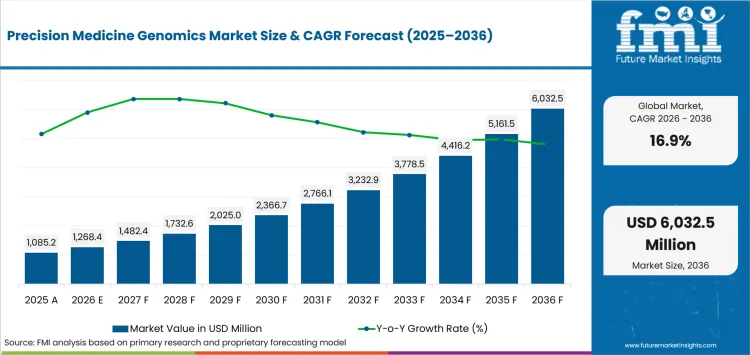
Key Takeaways
- Expansion in precision medicine genomics is tied to the growing use of molecular findings in diagnosis and treatment selection, particularly where validated tests connect genomic variants with clear clinical action.
- Next-generation sequencing is estimated to lead the technology category with 39.1% share in 2026, reflecting its ability to examine several genes through one validated testing workflow.
- Oncology is projected to account for 44.5% share in 2026, driven by established links between genomic biomarkers, targeted therapies, and companion diagnostic requirements.
- Hospitals and clinics are expected to hold 40.8% share in 2026, owing to their role in clinical ordering, pathology review, treatment decisions, and specialist interpretation.
- Consumables are forecast to represent 41.7% share in 2026, supported by recurring demand for extraction kits, sequencing reagents, library preparation materials, and other items used during every testing run.
- The United States is projected to record the fastest country growth at 20.7% CAGR, followed by South Korea at 17.9% CAGR and Japan at 16.7% CAGR, reflecting expanding clinical testing capacity and coordinated genomic programs.
- Uneven reimbursement, limited access to matched therapies, complex data-governance rules, and shortages of trained interpretation staff remain major barriers to routine adoption.
- Competition includes Illumina, Thermo Fisher Scientific, Roche, QIAGEN, Agilent Technologies, PacBio, BGI Genomics, and SOPHiA GENETICS, with companies differentiated through sequencing breadth, clinical assays, interpretation software, and laboratory support.
Analyst Perspective
“The commercial value of precision medicine genomics depends on whether test findings lead to a clear clinical decision within an affordable and well-controlled care pathway. Laboratories are expected to assess reportable findings separately from treatment-linked outcomes, since each measure reflects a different type of value. A phased test menu helps reduce validation work while showing which indications justify wider sequencing capacity. Service agreements also require defined turnaround times, data-security terms, and technical support duties across every participating site.”
— Anurag Sharma, Principal Analyst, Future Market Insights
How is the precision medicine genomics market segmented?
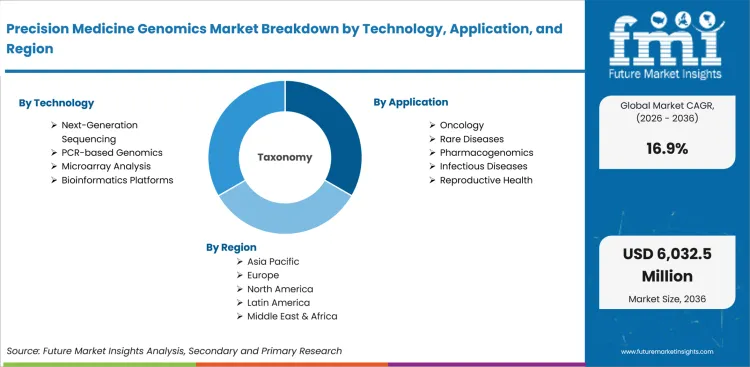
The precision medicine genomics industry is segmented by technology, application, end user, product and service, and region.
The segmentation framework separates analytical technology from clinical purpose and institutional purchasing responsibility across the precision medicine genomics market. Technology categories distinguish sequencing and amplification methods from microarray analysis and bioinformatics platforms used across testing workflows. Applications identify oncology and rare disease programs alongside pharmacogenomics and infectious disease or reproductive health testing. End-user categories separate hospitals and diagnostic laboratories from research institutes and life-science companies with different validation requirements. Product and service categories distinguish recurring consumables from capital instruments and software or outsourced sequencing services. Regional analysis then compares adoption routes across public health systems and private laboratory networks with different payment or data-governance conditions.
How does Next-Generation Sequencing shape the Technology category?
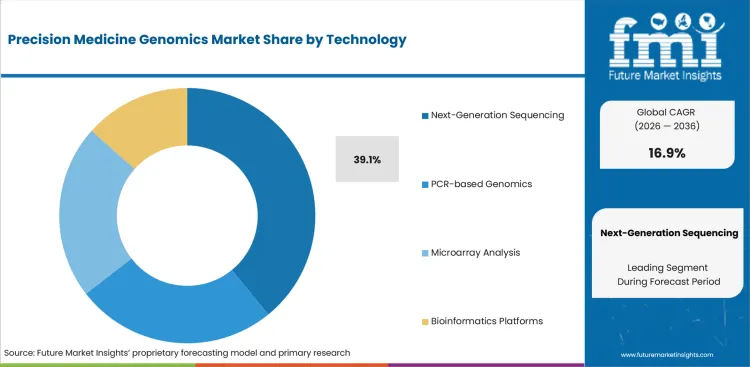
Clinical laboratories select sequencing platforms according to variant breadth and validated performance across difficult clinical specimens. The FDA expanded the TruSight Oncology Comprehensive indication in June 2026 for targeted analysis across 517 genes on the NextSeq 550Dx instrument. The approval also covers tumor mutational burden and microsatellite instability reporting within regulated companion diagnostic and profiling workflows. Laboratory directors therefore test NGS quality control procedures across library preparation and reporting before committing routine samples to one platform.
- Next-generation sequencing is estimated to hold 39.1% of the technology category in 2026, supported by its ability to examine many genes through one validated workflow. The share reflects platform consolidation across oncology and rare disease programs that require broad variant detection without separate single-gene processes.
- Hospital laboratories adopt next-generation sequencing through phased menus that begin with defined indications and trained interpretation teams. Broader use depends on sample controls and bioinformatics capacity plus service coverage that protects clinically significant testing during regular operations and peak demand periods.
How does Oncology shape the Application category?
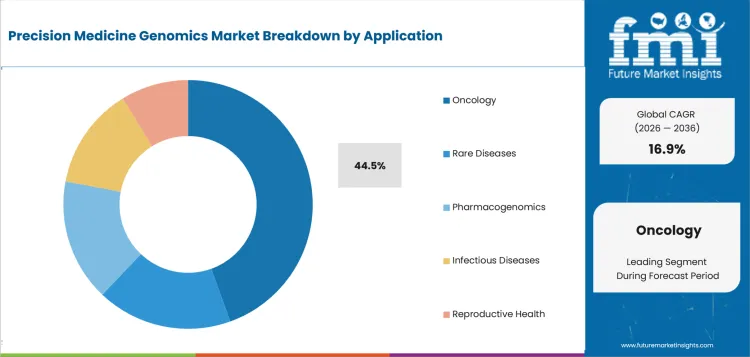
Oncology programs require genomic findings that can change treatment selection within a clinically useful turnaround period. The National Cancer Institute estimated 2,041,910 new cancer cases across the United States during 2025. The national cancer workload supports broad testing demand but does not establish genomic panel access for every eligible patient. Laboratories use clinical oncology sequencing pathways where actionable variants and therapy availability create a documented clinical decision.
- Oncology is projected to represent 44.5% of the application category in 2026, attributable to established links between molecular biomarkers and targeted treatment selection. The segment also benefits from recurring assay updates as new therapy labels expand the number of reportable companion diagnostic findings.
- Cancer centers expand genomic testing through tumor boards that combine pathology and oncology expertise with molecular interpretation. Adoption slows whenever tissue quality or treatment access prevents a detected alteration from becoming a practical therapeutic decision for an eligible patient within routine care.
How do Hospitals and Clinics shape the End User category?
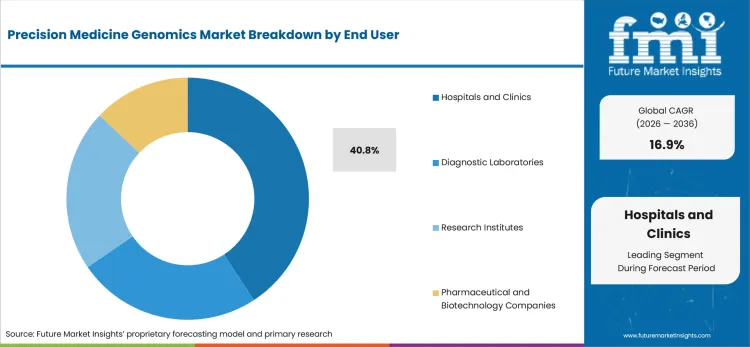
Hospital systems coordinate sample collection and pathology review with sequencing and medical interpretation across several departments. Genomics England awarded an accelerated extraction and whole-genome sequencing service contract in March 2025 for its Generation Study program. The contract demonstrates how institutional programs can outsource defined workflow stages while retaining clinical governance under public program oversight. Hospitals compare DNA sequencing services through turnaround commitments and data-transfer rules before distributing work outside their laboratories.
- Hospitals and clinics are estimated to hold 40.8% of the end-user category in 2026, reflecting their control over diagnosis and treatment decisions. Their share also captures testing performed through affiliated pathology departments or contracted reference laboratories under hospital clinical governance.
- Integrated health systems adopt genomic services where ordering rules and consent processes connect directly with patient records and specialist review. Implementation requires laboratory training and secure interfaces plus reimbursement processes that prevent complex results from remaining outside routine care pathways.
How do Consumables shape the Product & Service category?
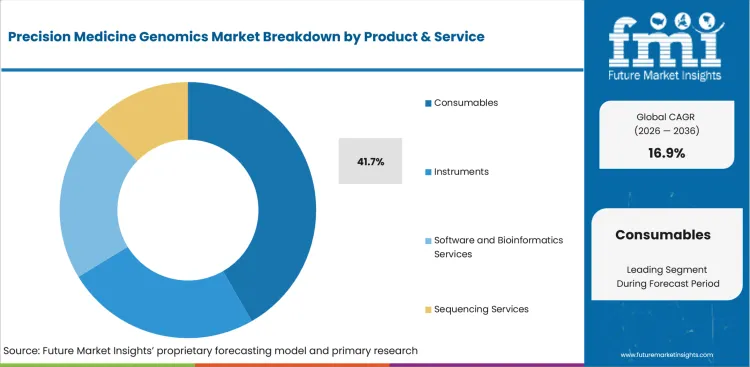
Clinical sequencing depends on recurring extraction and library preparation materials that perform consistently across validated specimen types. QIAGEN announced new QIAseq panels in April 2025 that cover more than 700 genes for comprehensive genomic profiling applications. The product launch illustrates how assay content and informatics integration can differentiate recurring laboratory purchasing decisions. Laboratory managers compare sequencing reagents through lot controls and workflow compatibility before changing a validated testing menu.
- Consumables are forecast to account for 41.7% of the product and service category in 2026, supported by repeat purchases across every sequencing run. Revenue follows sample volume because extraction kits and library materials must be replenished even where instruments remain in service for several years.
- Diagnostic laboratories favor consumables that reduce manual transfers and preserve performance across small clinical batches. Switching remains difficult after validation because new reagents can require comparison studies and revised procedures across the complete accredited workflow and quality management system for routine testing.
What are the drivers, restraints, and opportunities in the precision medicine genomics market?
Clinical demand rises as genomic testing connects molecular evidence with treatment decisions and governed data use across routine care.
- Driver: Large linked genomic datasets improve variant interpretation and strengthen evidence for clinical testing across diverse patient populations.
- Restraint: Actionable findings do not always translate into treatment access because coverage and clinical eligibility remain uneven across care pathways.
- Opportunity: Governed data platforms can support research and regulatory work through secure reuse of clinical and genomic information.
Large linked datasets support market growth by improving the evidence used to interpret uncommon variants across different populations. The National Institutes of Health reported in June 2026 that the All of Us program includes more than 535,000 whole-genome sequences linked with nearly 482,000 electronic health records. The linked dataset scale gives assay developers and clinical researchers a broader basis for evaluating genomic associations across diverse populations. Commercial demand increases where laboratories can translate stronger reference evidence into validated interpretation and more defensible clinical reports.
Treatment access remains a material restraint because analytical detection does not guarantee an available therapy or reimbursed clinical pathway. Japan’s National Cancer Center analyzed 54,185 panel-tested cases and reported in January 2026 that 8.0% received a new targeted treatment based on testing. The national analysis demonstrates a material gap between detecting potentially relevant alterations and delivering matched therapy through accessible care pathways. Laboratories face slower adoption where clinicians cannot connect test findings with approved medicines or accessible clinical trials.
Governed data exchange creates an opportunity for software and service companies that help institutions reuse genomic information under defined permissions. The European Health Data Space Regulation entered into force in March 2025 and establishes a common framework for electronic health data use across the European Union. Clinical programs can evaluate bioinformatics platforms that standardize analysis while preserving access controls and auditability. Commercial value depends on interoperability and transparent governance rather than data accumulation without a defined research or care purpose.
Which country CAGRs are profiled in the precision medicine genomics market?
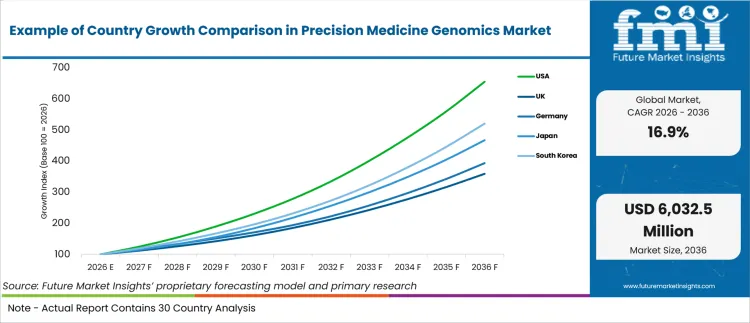
| Country | CAGR |
|---|---|
| USA | 20.7% |
| UK | 13.6% |
| Germany | 14.7% |
| Japan | 16.7% |
| South Korea | 17.9% |
How do country-level CAGRs compare in the precision medicine genomics market?
The country comparison spans 7.1 percentage points and reveals three defined growth groups across the precision medicine genomics market. The USA forms a distinct upper position through private laboratory scale and frequent additions to approved genomic test uses. South Korea and Japan create a closely aligned middle group with only 1.2 percentage points separating their forecasts. Germany and the UK form the lower group within a 1.1-point range. Countries with broader laboratory networks, coordinated genomic programs and clearer reimbursement routes generally demonstrate stronger market momentum.
-
The USA leads the comparison as independent laboratories and hospital systems expand authorized genomic testing across additional clinical uses.
-
South Korea remains 2.8 percentage points below the USA, supported by national bio-data infrastructure and participation from major tertiary hospitals.
-
Japan remains 1.2 percentage points below South Korea as insured cancer genomic testing expands across designated medical institutions.
-
Germany remains 2.0 percentage points below Japan, reflecting a statutory system that connects clinical care with governed national genome data.
-
The UK remains 1.1 percentage points below Germany as public commissioning and nationally organized laboratory capacity shape service expansion.
Comparable CAGRs can still produce different market-entry conditions. Differences in regulatory status, reimbursement access, public procurement, laboratory service coverage and data governance influence deployment schedules and commercial strategies. The full report provides country-level CAGR analysis across North America, Latin America, Europe, East Asia, South Asia, Oceania and the Middle East and Africa.
Country-wise Analysis
-
United States precision genomics purchasing combines hospital systems with independent laboratories that link FDA authorization to payer eligibility. The USA precision medicine genomics market is forecast to advance at 20.7% CAGR during the forecast period, supported by private laboratory scale and expanding test indications. The FDA broadened Guardant360 CDx in May 2026 with a companion diagnostic indication for ESR1 mutations in eligible breast cancer patients. The authorization supports laboratory testing and related services across clearly approved clinical uses. Manufacturers require local application training and field service across laboratory networks with different operating schedules. Variable payer policies and evidence requirements remain important commercial barriers beyond federal device authorization.
-
South Korea combines tertiary hospital capacity with national programs that connect genomic and clinical information for precision medicine research. The South Korea precision medicine genomics market is forecast to expand at 17.9% CAGR from 2026 to 2036, supported by coordinated data infrastructure and hospital participation. The Korea National Institute of Health reported in January 2025 that a national bio-big-data initiative began recruitment through 38 institutions and targets one million participants. Hospital involvement supports sample collection and specialist training for sequencing systems and governed data platforms. Local service groups remain important for uptime and application support. Consent management and staged researcher access continue to create governance challenges during commercial deployment.
-
Japan routes insured cancer genomic testing through designated hospitals and a national knowledge system that supports specialist treatment review. The Japan precision medicine genomics market is estimated to record 16.7% CAGR during the forecast period, driven by wider access to reimbursed panel testing. The National Cancer Center reported in May 2025 that C-CAT registrations reached 100,123 patients by the end of March. National insurance provides a direct route for panel testing and related interpretation services across approved institutions. Technology providers require Japanese regulatory status and local technical support. Treatment availability and limited specialist review capacity remain practical constraints after genomic findings are reported.
-
Germany combines statutory health insurance with university medical centers that coordinate complex genome sequencing and clinical interpretation. Germany’s precision medicine genomics market is projected to expand at 14.7% CAGR over the assessment period, supported by governed national genome programs. The Federal Ministry of Health states that the genomDE project began in July 2024 through a 14-member consortium and runs for at least five years. Statutory insurers cover eligible clinical care, while BfArM operates the central data platform. Accredited laboratories and local service partners provide a route for instruments and outsourced testing. Strict data protection and multi-institution coordination remain key implementation barriers.
-
England concentrates genomic purchasing through NHS laboratory hubs and commissioned service contracts instead of separate hospital budgets. The UK precision medicine genomics market is forecast to expand at 13.6% CAGR from 2026 to 2036, supported by public commissioning and nationally organized laboratory capacity. Genomics England reported in August 2025 that its fifth NHS Genomic Medicine Service release included 40,968 genomes from 38,728 participants. Technology companies may enter through procurement frameworks or subcontracted sequencing services linked to public contracts. National coordination supports validation across defined clinical pathways. Long tender cycles and uneven regional implementation capacity remain commercial barriers for smaller technology and service providers.
Who are the notable companies in the precision medicine genomics market?
Illumina, Thermo Fisher Scientific, Roche, QIAGEN, Agilent Technologies, PacBio, BGI Genomics, and SOPHiA GENETICS are notable companies in the precision medicine genomics market.
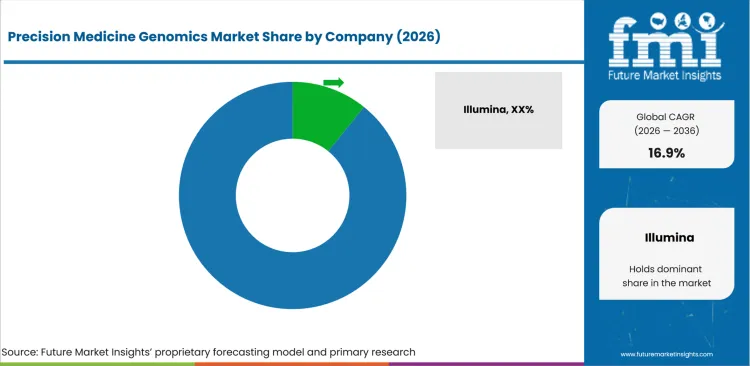
Competition spans sequencing systems and clinical assays alongside interpretation software and genomic services across the precision medicine genomics market. Official product documentation shows that Illumina and Thermo Fisher Scientific combine instruments with clinical oncology assays and analysis software. Roche and QIAGEN emphasize sample-to-report oncology workflows while Agilent supports target enrichment and variant interpretation. PacBio expands long-read sequencing and BGI Genomics combines laboratory services with bioinformatics across several geographies. SOPHiA GENETICS concentrates on cloud analysis and clinical interpretation workflows for oncology and inherited disorder applications. The field also intersects with liquid biopsy testing programs that require sensitive variant detection from limited circulating material. Hospitals therefore compare workflow ownership and technical service coverage rather than corporate size or broad parent-company reputation alone.
- Sequencing platform providers include Illumina and Thermo Fisher Scientific alongside PacBio and BGI Genomics across differentiated read technologies. Their commercial positions differ through read technology and assay breadth plus laboratory support and regulated availability.
- Clinical assay and interpretation providers include Roche and QIAGEN alongside Agilent Technologies across oncology and laboratory informatics workflows. The companies compete through oncology panels and sample preparation plus software that supports variant review and clinical report generation.
- SOPHiA GENETICS represents a cloud-centered model that connects technology-agnostic sequencing data with clinical interpretation across distributed institutions. Its position depends on compatible applications and institutional integration plus data-security support across customer laboratories.
Competitive Benchmarking: Precision Medicine Genomics Market
| Company | Sequencing and Assay Breadth | Clinical Interpretation | Deployment Support | Geographic Reach |
|---|---|---|---|---|
| Illumina | High | High | High | Global |
| Thermo Fisher Scientific | High | High | High | Global |
| Roche | High | High | High | Global |
| QIAGEN | Medium | High | High | Global |
| Agilent Technologies | Medium | High | Medium | Global |
| PacBio | High | Medium | Medium | North America, Europe and Asia |
| BGI Genomics | High | High | High | Global |
| SOPHiA GENETICS | Medium | High | High | Global |
Scoring basis: High sequencing and assay breadth requires an owned sequencing platform or several market-specific assay families across multiple clinical applications. Medium breadth requires validated assays or preparation workflows without a comparably broad owned sequencing portfolio across clinical applications. High clinical interpretation requires documented analysis and report support across several clinical genomic applications while Medium reflects narrower workflow coverage. High deployment support requires regulated products or extensive service infrastructure across multiple geographies while Medium indicates more limited or partner-dependent implementation. Geographic reach reflects documented commercial availability and service presence rather than parent-company revenue or reputation.
Source basis: Official product documentation, regulatory records, corporate filings, and first-party service descriptions reviewed through July 2026.
Key Developments in the Precision Medicine Genomics Market
- In April 2025, Illumina and Tempus announced a collaboration that combines Illumina genomic technologies with Tempus multimodal data for algorithm development and evidence generation. The partners stated that the work targets broader clinical use of molecular profiling and evidence development across several disease areas. The arrangement extends competition from instruments toward clinical evidence and data partnerships that can influence adoption decisions.
- In February 2025, Roche unveiled sequencing by expansion technology as part of its strategy to develop a new high-throughput sequencing platform. The company described an approach that converts DNA information into an expanded molecule for high-resolution optical reading across sequencing cycles. The development broadens Roche’s role from assays and interpretation toward owned sequencing technology within integrated genomic workflows.
- In June 2025, QIAGEN announced strategic partnerships with Tracer Biotechnologies and Foresight Diagnostics to expand minimal residual disease testing in oncology. The agreements connect QIAGEN sample technologies and digital insights with tumor-informed testing approaches for longitudinal oncology monitoring. The partners add specialized assay capabilities that extend QIAGEN beyond initial tumor profiling and into recurring disease monitoring workflows. The portfolio expansion strengthens QIAGEN's ability to support longitudinal cancer monitoring beside established genomic profiling and interpretation workflows.
- In March 2026, BGI Genomics announced SIROmics integration of local clinical NGS workflows through sequencing and bioinformatics capabilities. The company described support for regional laboratories that need locally operated clinical testing and governed genomic data analysis capabilities. The program transfers sequencing and interpretation components into regional laboratory operations with local technical and data-governance support. The initiative emphasizes service localization and workflow transfer rather than a centralized testing model for every customer.
Key Players in the Precision Medicine Genomics Market
Sequencing Platform and Workflow Providers
- Illumina
- Thermo Fisher Scientific
- PacBio
- BGI Genomics
Clinical Assay and Informatics Providers
- Roche
- QIAGEN
- Agilent Technologies
Cloud Interpretation and Data Platform Providers
- SOPHiA GENETICS
Precision Medicine Genomics Market Report Scope
| Coverage field | Report scope |
|---|---|
| Market breakdown | Technology, application, end user, product and service, and region. |
| Quantitative Units | USD Million |
| Market Definition | Commercially traded sequencing instruments, assays, consumables, bioinformatics platforms, and genomic testing services used to guide individualized prevention, diagnosis, or treatment. |
| Regions Covered | North America, Latin America, Western Europe, Eastern Europe, East Asia, South Asia and Pacific, and Middle East and Africa. |
| Countries Covered | USA, UK, Germany, Japan, South Korea and 30+ countries. |
| Key Companies Profiled | Illumina, Thermo Fisher Scientific, Roche, QIAGEN, Agilent Technologies, PacBio, BGI Genomics, and SOPHiA GENETICS. |
| Forecast Period | 2026 to 2036 |
| Approach | Market sizing and forecasting combine the historical market baseline with segment structure, company participation, country demand conditions, and verified public evidence. |
Research Methodology
| Method | Approach |
|---|---|
| Primary Research | FMI analysts gathered input from manufacturers, service providers, technology developers, distributors, end users, procurement teams, and subject-matter experts. Interviews examined purchasing decisions, product or service evaluation, adoption barriers, approval requirements, pricing considerations, and expectations for technical or commercial support. Respondents were also asked what evidence is required before a trial, pilot, or initial order develops into regular purchasing. |
| Desk Research | Desk research covered government statistics, regulatory publications, trade data, industry associations, technical literature, standards, company filings, product information, and official corporate announcements. Sources were reviewed for relevance, publication date, geographic coverage, and consistency with the defined market scope. Claims relating to performance, applications, approvals, capacity, investment, and commercial activity were retained only when supported by credible public evidence. |
| Market Sizing and Forecasting | The market model combined the baseline value with historical performance, segment structure, pricing and volume indicators, adoption levels, company participation, and country-level demand conditions. Forecast assumptions considered economic activity, investment trends, regulatory developments, technology adoption, purchasing cycles, supply availability, and barriers to wider market use. Segment and regional estimates were reconciled before the final market total was calculated. |
| Data Validation | Estimates were checked against multiple independent indicators, including public data, company activity, trade patterns, industry developments, and findings from primary interviews. Validation also tested whether products, services, applications, and company revenues fell within the defined market boundaries. Adjacent categories, unsupported claims, overlapping revenues, and activities without direct market relevance were excluded to reduce double counting and maintain consistency across segments and countries. |
Precision Medicine Genomics Market by Segments
Precision Medicine Genomics Market segmented by Technology:
- Next-Generation Sequencing
- PCR-based Genomics
- Microarray Analysis
- Bioinformatics Platforms
Precision Medicine Genomics Market segmented by Application:
- Oncology
- Rare Diseases
- Pharmacogenomics
- Infectious Diseases
- Reproductive Health
Precision Medicine Genomics Market segmented by End User:
- Hospitals and Clinics
- Diagnostic Laboratories
- Research Institutes
- Pharmaceutical and Biotechnology Companies
Precision Medicine Genomics Market segmented by Product & Service:
- Consumables
- Instruments
- Software and Bioinformatics Services
- Sequencing Services
Precision Medicine Genomics Market by Region:
- North America
- United States
- Canada
- Latin America
- Brazil
- Mexico
- Argentina
- Chile
- Western Europe
- Germany
- France
- United Kingdom
- Italy
- Spain
- Benelux
- Nordics
- Eastern Europe
- Poland
- Czech Republic
- Romania
- Hungary
- East Asia
- China
- Japan
- South Korea
- South Asia and Pacific
- India
- ASEAN
- Australia and New Zealand
- Middle East and Africa
- GCC Countries
- South Africa
- Türkiye
- Israel
Research Sources and Bibliography
- USA Food and Drug Administration. (2025, July 2). Premarket approval: Oncomine Dx Express Test (P240040).
- Department of Health and Social Care. (2026, March 5). Code on Genetic Testing and Insurance: 3-year review 2025.
- USA Food and Drug Administration. (2026, June 26). Premarket approval supplement: TruSight Oncology Comprehensive (P230011/S002).
- National Cancer Institute. (2025, May 7). Cancer statistics.
- Genomics England Limited. (2025, March 6). Combined Sample Extraction and Whole Genome Sequencing.
- QIAGEN N.V.. (2025, April 22). QIAGEN advances cancer genomic profiling with new products and partnership updates at AACR Annual Meeting 2025.
- National Institutes of Health. (2026, June 30). NIH's All of Us Research Program is now the largest integrated genomics and health database in the world.
- National Cancer Center Japan. (2026, January 8).[Clinical utility of cancer gene panel testing in routine care].
- European Commission. (2025, March 5). European Health Data Space Regulation (EHDS).
- USA Food and Drug Administration. (2026, May 1). Premarket approval supplement: Guardant360 CDx (P200010/S025).
- Genomics England. (2025, August 28). NHS genomic medicine service data release v5.
- Federal Ministry of Health. (2026, March 2). Die deutsche Genom-Initiative - genomDE [The German genome initiative - genomDE].
- National Cancer Center Japan. (2025, May 8)[Cancer gene panel registrations under national insurance exceed 100,000 cases].
- Korea National Institute of Health. (2025, January 6). [Launch of the National Integrated Bio Big Data Project].
- Illumina, Inc.. (2025, April 15). Illumina and Tempus partner to drive the future of precision medicine through genomic AI innovation.
- F. Hoffmann-La Roche Ltd. (2025, February 20). Roche unveils a new class of next-generation sequencing with its novel sequencing by expansion technology.
- QIAGEN N.V.. (2025, June 2). QIAGEN expands portfolio for minimal residual disease (MRD) testing in oncology with new strategic partnerships.
- BGI Genomics. (2026, March 30). BGI Genomics Launches SIROmics™ to Integrate Clinical NGS Workflows.
The bibliography lists every external source used for retained article claims and provides direct access through linked official titles. Proprietary forecasting inputs and primary research support market sizing and longer-range interpretation across the assessment period. Detailed segment and country evaluation remains aligned with the defined market boundary and published forecast structure.
This Report Answers
- How large is the Precision Medicine Genomics Market in 2026 and 2036?
- Which clinical and data conditions support investment across precision genomic workflows?
- Why does next-generation sequencing hold the principal technology share during 2026?
- How does oncology influence assay design and clinical interpretation requirements?
- Why do hospitals and clinics represent the main end-user position during 2026?
- How do country growth rates differ across the USA, UK, Germany, Japan, and South Korea?
- Which companies provide sequencing platforms and assays alongside software or genomic services?
- What limits translation from genomic findings into accessible and reimbursed treatment decisions?
- How can governed data systems support research and clinical development across genomic programs?
Frequently Asked Questions
What is driving growth in the Precision Medicine Genomics Market?
Clinical programs increasingly need genomic evidence that can guide treatment selection across complex diseases and varied patient populations. Growth depends on validated testing pathways that connect laboratory findings with specialist interpretation and accessible care options.
Who are the key players in the Precision Medicine Genomics Market?
Illumina and Thermo Fisher Scientific provide broad sequencing workflows alongside Roche and QIAGEN in clinical oncology. Agilent Technologies and PacBio support specialized workflow needs while BGI Genomics and SOPHiA GENETICS add services or interpretation.
What is a notable restraint in the Precision Medicine Genomics Market?
Actionable variants do not always lead to available treatment or reimbursed testing across every health system. Laboratories also face validation and data-governance requirements that can slow routine deployment across new clinical indications.
Why should executives track the Precision Medicine Genomics Market?
Genomic testing affects diagnostic pathways and therapy selection alongside laboratory infrastructure and recurring consumable spending. Executives should track reimbursement and regulatory changes because they alter addressable test volumes and service requirements materially.
What business problem does the Precision Medicine Genomics Market address?
The market addresses clinical decisions that cannot be resolved reliably through symptoms or conventional testing methods alone. Genomic workflows identify molecular variation and support individualized care through validated analysis and specialist interpretation.
What should healthcare organizations evaluate in the Precision Medicine Genomics Market?
Healthcare organizations should compare analytical coverage and turnaround time alongside interpretation quality and service response. They should also test consent and data-security controls before expanding genomic workflows across affiliated care sites nationwide.
What limits return on investment in the Precision Medicine Genomics Market?
Low sample volume and fragmented ordering can leave expensive sequencing platforms below efficient utilization levels across routine operations. Investment also weakens where reimbursement remains uncertain or detected findings rarely change treatment decisions for eligible patients.
What supports long-term confidence in the Precision Medicine Genomics Market?
Regulated assays and expanding reference datasets support long-term confidence across clearly defined and reimbursed clinical applications. Durable growth also requires trained specialists and interoperable data systems plus payment routes that sustain routine testing access.
Preview the report firsthand - request a free sample
Get SampleGet the brochure for pricing and purchase details.
Get PDFTable of Content
- Key Takeaways
- Market Size and CAGR
- Top Growth Driver
- Fastest Growing Segment
- Leading Region
- Key Companies
- Emerging Opportunities
- Executive Summary
- Global Market Outlook
- Demand-side Trends
- Supply-side Trends
- Technology Roadmap Analysis
- Analysis and Recommendations
- Analyst Perspective (What is happening? Why now? What should investors know?)
- Key Questions Answered
- How large is the market?
- What is the CAGR?
- What are key trends?
- Which region dominates?
- Who are the leaders?
- Market Overview
- Market Coverage / Taxonomy
- Market Definition / Scope / Limitations
- Research Methodology
- Chapter Orientation
- Analytical Lens and Working Hypotheses
- Market Structure, Signals, and Trend Drivers
- Benchmarking and Cross-market Comparability
- Market Sizing, Forecasting, and Opportunity Mapping
- Research Design and Evidence Framework
- Desk Research Programme (Secondary Evidence)
- Expert Input and Fieldwork (Primary Evidence)
- Tooling, Models, and Reference Databases
- Data Engineering and Model Build
- Quality Assurance and Audit Trail
- Market Background
- Market Dynamics (Drivers, Restraints, Opportunity, Trends)
- Scenario Forecast (Optimistic, Likely, Conservative)
- Impact Analysis
- AI Impact
- Sustainability Impact
- Regulatory Impact
- Technology Impact
- Consumer / Buyer Analysis
- Purchase Drivers
- Adoption Barriers
- Buyer Journey
- Opportunity Map Analysis
- Product Life Cycle Analysis
- Supply Chain Analysis
- Investment Feasibility Matrix
- Value Chain Analysis
- PESTLE and Porter's Analysis
- Regulatory Landscape
- Regional Parent Market Outlook
- Production and Consumption Statistics
- Import and Export Statistics
- Global Market Analysis and Forecast, 2021 to 2036
- Historical Market Size Value (USD Million) Analysis, 2021 to 2025
- Current and Future Market Size Value (USD Million) Projections, 2026 to 2036
- Y-o-Y Growth Trend Analysis
- Absolute $ Opportunity Analysis
- Global Market Pricing Analysis, 2021 to 2036
- Global Market Analysis and Forecast, By Technology, 2021 to 2036
- Introduction / Key Findings
- Historical Market Size Value (USD Million) Analysis By Technology, 2021 to 2025
- Current and Future Market Size Value (USD Million) Analysis and Forecast By Technology, 2026 to 2036
- Next-Generation Sequencing
- PCR-based Genomics
- Microarray Analysis
- Bioinformatics Platforms
- Next-Generation Sequencing
- Y-o-Y Growth Trend Analysis By Technology, 2021 to 2025
- Absolute $ Opportunity Analysis By Technology, 2026 to 2036
- Global Market Analysis and Forecast, By Application, 2021 to 2036
- Introduction / Key Findings
- Historical Market Size Value (USD Million) Analysis By Application, 2021 to 2025
- Current and Future Market Size Value (USD Million) Analysis and Forecast By Application, 2026 to 2036
- Oncology
- Rare Diseases
- Pharmacogenomics
- Infectious Diseases
- Reproductive Health
- Oncology
- Y-o-Y Growth Trend Analysis By Application, 2021 to 2025
- Absolute $ Opportunity Analysis By Application, 2026 to 2036
- Global Market Analysis and Forecast, By End User, 2021 to 2036
- Introduction / Key Findings
- Historical Market Size Value (USD Million) Analysis By End User, 2021 to 2025
- Current and Future Market Size Value (USD Million) Analysis and Forecast By End User, 2026 to 2036
- Hospitals and Clinics
- Diagnostic Laboratories
- Research Institutes
- Pharmaceutical and Biotechnology Companies
- Hospitals and Clinics
- Y-o-Y Growth Trend Analysis By End User, 2021 to 2025
- Absolute $ Opportunity Analysis By End User, 2026 to 2036
- Global Market Analysis and Forecast, By Product & Service, 2021 to 2036
- Introduction / Key Findings
- Historical Market Size Value (USD Million) Analysis By Product & Service, 2021 to 2025
- Current and Future Market Size Value (USD Million) Analysis and Forecast By Product & Service, 2026 to 2036
- Consumables
- Instruments
- Software and Bioinformatics Services
- Sequencing Services
- Consumables
- Y-o-Y Growth Trend Analysis By Product & Service, 2021 to 2025
- Absolute $ Opportunity Analysis By Product & Service, 2026 to 2036
- Global Market Analysis and Forecast, By Region, 2021 to 2036
- Introduction
- Historical Market Size Value (USD Million) Analysis By Region, 2021 to 2025
- Current Market Size Value (USD Million) Analysis and Forecast By Region, 2026 to 2036
- North America
- Latin America
- Western Europe
- Eastern Europe
- East Asia
- South Asia and Pacific
- Middle East & Africa
- Market Attractiveness Analysis By Region
- North America Market Analysis and Forecast, By Country, 2021 to 2036
- Historical Market Size Value (USD Million) Trend Analysis By Market Taxonomy, 2021 to 2025
- Market Size Value (USD Million) Forecast By Market Taxonomy, 2026 to 2036
- By Country
- USA
- Canada
- By Technology
- By Application
- By End User
- By Product & Service
- By Country
- Market Attractiveness Analysis
- By Country
- By Technology
- By Application
- By End User
- By Product & Service
- Key Takeaways
- Latin America Market Analysis and Forecast, By Country
- Historical Market Size Value (USD Million) Trend Analysis By Market Taxonomy, 2021 to 2025
- Market Size Value (USD Million) Forecast By Market Taxonomy, 2026 to 2036
- By Country
- Brazil
- Mexico
- Chile
- Rest of Latin America
- By Technology
- By Application
- By End User
- By Product & Service
- By Country
- Market Attractiveness Analysis
- By Country
- By Technology
- By Application
- By End User
- By Product & Service
- Key Takeaways
- Western Europe Market Analysis and Forecast, By Country
- Historical Market Size Value (USD Million) Trend Analysis By Market Taxonomy, 2021 to 2025
- Market Size Value (USD Million) Forecast By Market Taxonomy, 2026 to 2036
- By Country
- Germany
- UK
- Italy
- Spain
- France
- Nordic
- BENELUX
- Rest of Western Europe
- By Technology
- By Application
- By End User
- By Product & Service
- By Country
- Market Attractiveness Analysis
- By Country
- By Technology
- By Application
- By End User
- By Product & Service
- Key Takeaways
- Eastern Europe Market Analysis and Forecast, By Country
- Historical Market Size Value (USD Million) Trend Analysis By Market Taxonomy, 2021 to 2025
- Market Size Value (USD Million) Forecast By Market Taxonomy, 2026 to 2036
- By Country
- Russia
- Poland
- Hungary
- Balkan & Baltic
- Rest of Eastern Europe
- By Technology
- By Application
- By End User
- By Product & Service
- By Country
- Market Attractiveness Analysis
- By Country
- By Technology
- By Application
- By End User
- By Product & Service
- Key Takeaways
- East Asia Market Analysis and Forecast, By Country
- Historical Market Size Value (USD Million) Trend Analysis By Market Taxonomy, 2021 to 2025
- Market Size Value (USD Million) Forecast By Market Taxonomy, 2026 to 2036
- By Country
- China
- Japan
- South Korea
- By Technology
- By Application
- By End User
- By Product & Service
- By Country
- Market Attractiveness Analysis
- By Country
- By Technology
- By Application
- By End User
- By Product & Service
- Key Takeaways
- South Asia and Pacific Market Analysis and Forecast, By Country
- Historical Market Size Value (USD Million) Trend Analysis By Market Taxonomy, 2021 to 2025
- Market Size Value (USD Million) Forecast By Market Taxonomy, 2026 to 2036
- By Country
- India
- ASEAN
- Australia & New Zealand
- Rest of South Asia and Pacific
- By Technology
- By Application
- By End User
- By Product & Service
- By Country
- Market Attractiveness Analysis
- By Country
- By Technology
- By Application
- By End User
- By Product & Service
- Key Takeaways
- Middle East & Africa Market Analysis and Forecast, By Country
- Historical Market Size Value (USD Million) Trend Analysis By Market Taxonomy, 2021 to 2025
- Market Size Value (USD Million) Forecast By Market Taxonomy, 2026 to 2036
- By Country
- Kingdom of Saudi Arabia
- Other GCC Countries
- Türkiye
- South Africa
- Other African Union
- Rest of Middle East & Africa
- By Technology
- By Application
- By End User
- By Product & Service
- By Country
- Market Attractiveness Analysis
- By Country
- By Technology
- By Application
- By End User
- By Product & Service
- Key Takeaways
- Key Countries Market Analysis
- USA
- Pricing Analysis
- Market Share Analysis, 2025
- By Technology
- By Application
- By End User
- By Product & Service
- Canada
- Pricing Analysis
- Market Share Analysis, 2025
- By Technology
- By Application
- By End User
- By Product & Service
- Mexico
- Pricing Analysis
- Market Share Analysis, 2025
- By Technology
- By Application
- By End User
- By Product & Service
- Brazil
- Pricing Analysis
- Market Share Analysis, 2025
- By Technology
- By Application
- By End User
- By Product & Service
- Chile
- Pricing Analysis
- Market Share Analysis, 2025
- By Technology
- By Application
- By End User
- By Product & Service
- Germany
- Pricing Analysis
- Market Share Analysis, 2025
- By Technology
- By Application
- By End User
- By Product & Service
- UK
- Pricing Analysis
- Market Share Analysis, 2025
- By Technology
- By Application
- By End User
- By Product & Service
- Italy
- Pricing Analysis
- Market Share Analysis, 2025
- By Technology
- By Application
- By End User
- By Product & Service
- Spain
- Pricing Analysis
- Market Share Analysis, 2025
- By Technology
- By Application
- By End User
- By Product & Service
- France
- Pricing Analysis
- Market Share Analysis, 2025
- By Technology
- By Application
- By End User
- By Product & Service
- India
- Pricing Analysis
- Market Share Analysis, 2025
- By Technology
- By Application
- By End User
- By Product & Service
- ASEAN
- Pricing Analysis
- Market Share Analysis, 2025
- By Technology
- By Application
- By End User
- By Product & Service
- Australia & New Zealand
- Pricing Analysis
- Market Share Analysis, 2025
- By Technology
- By Application
- By End User
- By Product & Service
- China
- Pricing Analysis
- Market Share Analysis, 2025
- By Technology
- By Application
- By End User
- By Product & Service
- Japan
- Pricing Analysis
- Market Share Analysis, 2025
- By Technology
- By Application
- By End User
- By Product & Service
- South Korea
- Pricing Analysis
- Market Share Analysis, 2025
- By Technology
- By Application
- By End User
- By Product & Service
- Russia
- Pricing Analysis
- Market Share Analysis, 2025
- By Technology
- By Application
- By End User
- By Product & Service
- Poland
- Pricing Analysis
- Market Share Analysis, 2025
- By Technology
- By Application
- By End User
- By Product & Service
- Hungary
- Pricing Analysis
- Market Share Analysis, 2025
- By Technology
- By Application
- By End User
- By Product & Service
- Kingdom of Saudi Arabia
- Pricing Analysis
- Market Share Analysis, 2025
- By Technology
- By Application
- By End User
- By Product & Service
- Türkiye
- Pricing Analysis
- Market Share Analysis, 2025
- By Technology
- By Application
- By End User
- By Product & Service
- South Africa
- Pricing Analysis
- Market Share Analysis, 2025
- By Technology
- By Application
- By End User
- By Product & Service
- USA
- Market Structure Analysis
- Competition Dashboard
- Competition Benchmarking
- Market Share Analysis of Top Players
- By Regional
- By Technology
- By Application
- By End User
- By Product & Service
- Emerging Startups
- Innovation Benchmarking
- Competition Analysis
- Competition Deep Dive
- Illumina
- Overview
- Product Portfolio
- Profitability by Market Segments
- Sales Footprint
- Strategy Overview
- Marketing Strategy
- Product Strategy
- Channel Strategy
- Thermo Fisher Scientific
- Roche
- QIAGEN
- Agilent Technologies
- PacBio
- BGI Genomics
- Exact Sciences
- Guardant Health
- Sophia Genetics
- Illumina
- Case Studies
- Success Stories
- Recent Developments
- Competition Deep Dive
- Assumptions & Acronyms Used


