

- Market Size (2026)
- USD 1.9 Bn
- Forecast (2036)
- USD 6.9 Bn
- CAGR (2026 to 2036)
- 13.7%
How big is the Novel Plant Protein (Borage & Emerging Crops) Market in 2026?
USD 1.9 billion in 2026 and USD 6.9 billion by 2036 at a 13.7% CAGR.
Sales of novel plant protein from borage and emerging crops are projected to expand at 13.7% CAGR from 2026 to 2036. Industry valuation is forecast to rise from USD 1.9 billion in 2026 to USD 6.9 billion by 2036. Food and feed manufacturers look for stable protein performance after oil extraction, milling and storage. Repeat orders are expected to depend on how well each ingredient holds texture and taste during normal production.
The plant-based protein comparison gives processors a useful frame for this market. Borage and other emerging crops still require clearer crop records and stronger application data than established soy or pea systems. Regulation remains a second commercial test. Borage-derived materials require contaminant checks and lupin-based products require label planning before a food company approves routine use.
-market-value-analysis.webp "Novel Plant Protein (borage & Emerging Crops) Market Value Analysis")
Summary of the Novel Plant Protein (Borage & Emerging Crops) Market
Source: FMI's proprietary forecasting model and primary research
How is the Novel Plant Protein (Borage & Emerging Crops) Market segmented?
The novel plant protein (borage & emerging crops) market industry is segmented by source, application, product, and region.
The segmentation framework separates crop source from application and product form. Source coverage includes borage, faba, lupin, hemp and emerging oilseeds. Application analysis separates food from feed so the approval route remains clear. Product analysis compares protein and oil because processors often recover value from more than one crop stream.
What supports borage within the source category?
-market-analysis-by-source.webp "Novel Plant Protein (borage & Emerging Crops) Market Analysis By Source")
Borage is reviewed as a source because its seed supports oil and residual protein streams. Commercial use depends on process control after pressing and protein recovery. Manufacturers look for evidence that the remaining press cake delivers consistent protein quality. The commercial case improves when borage material works in the customer’s normal heat and storage conditions.
- Borage is expected to hold 45.7% share in 2026 due to its position as the leading source in the defined scope. Ingredient companies defend the share when each batch meets oil and protein specifications.
- Food and feed processors are likely to approve borage-derived ingredients after extraction yield and contaminant records are documented. Clear specifications reduce rework when trials become repeat orders.
How does food lead within the application category?
Food applications account for the largest share because formulation approval creates the clearest revenue path. A food processor requires acceptable taste and texture before a new protein is written into a recipe. The format has to work in real processing and not only in sample trials. Failure at this stage delays launch and increases reformulation cost.
- Food is forecast to capture 53.3% share in 2026 as recipes for bakery, beverages and meat alternatives require protein inputs with stable sensory performance.
- Application teams compare emerging crop performance with established formats in plant-based protein beverages. The comparison is useful when taste masking or dispersibility decides whether a product reaches retail scale.
Why does protein lead within the product category?
Protein leads the product view because manufacturers buy it for a direct formulation job. It adds nutrition claims and texture when the ingredient has stable solubility. Oil remains useful but its value route is different. Protein approval often carries more testing because it affects taste and labelling in the finished product.
- Protein is estimated to account for 60.1% share in 2026 because food and feed formulas purchase protein for a measurable function.
- Processors benchmark emerging crop inputs against protein ingredients that already have defined application data. The approval path becomes easier when test results cover heat, mixing and storage.
What are the drivers, restraints, and opportunities in the Novel Plant Protein (Borage & Emerging Crops) Market?
Demand is shaped by protein-source diversification and by the cost of proving that emerging crop ingredients work in routine food and feed production.
- Driver: Crop-diverse protein sourcing is expected to increase demand where manufacturers seek alternatives beyond established soy and pea systems.
- Restraint: Allergen labelling and pyrrolizidine alkaloid controls slow approval for lupin and borage-derived ingredients.
- Opportunity: Formulation support helps emerging crop proteins enter beverages and high-protein foods with fewer taste problems.
Demand is expected to rise as manufacturers look beyond soy and pea without accepting uneven ingredient performance. Crop diversity helps procurement teams manage sourcing risk. The Government Chemist reported in June 2025 that its review covered plant-based meat substitutes and novel protein sources within four alternative protein categories. The figure shows food companies a public technical base for comparing emerging ingredients. Purchases expand when a borage or lupin input adds measurable protein value without raising reformulation work.
The main restraint is documentation cost. The European Commission stated in February 2026 that 14 allergens are required to be clearly indicated when used as ingredients in food products sold in the EU. Lupin is included in that list. EUR-Lex lists pyrrolizidine alkaloid maximum levels for borage leaves under Regulation (EU) 2023/915. Food processors are expected to delay approval when source records or contaminant testing is incomplete.
Which country CAGRs are profiled in the Novel Plant Protein (Borage & Emerging Crops) Market?
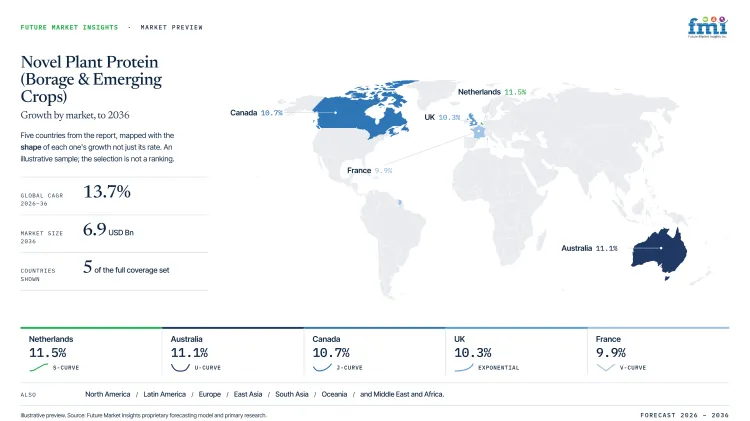
| Country | CAGR |
|---|---|
| UK | 10.3% |
| Netherlands | 11.5% |
| Canada | 10.7% |
| France | 9.9% |
| Australia | 11.1% |
How do country-level CAGRs compare in the Novel Plant Protein (Borage & Emerging Crops) Market?
The country comparison shows a narrow spread across five markets. Netherlands leads at 11.5% CAGR and Australia follows at 11.1%. Canada records 10.7% while the UK is close at 10.3%. France is forecast at 9.9%. The 1.6-point spread points to different approval speeds and crop-processing conditions.
- Netherlands leads the comparison and reflects a policy-backed protein transition with active food-science networks.
- Australia follows closely because pulse and oilseed availability supports local ingredient trials.
- Canada remains near the upper group given its pulse crop scale and export-oriented processing base.
- The UK and France advance more slowly due to approval work and smaller local processing pathways.
- The pattern shows a gradual slope instead of a sharp divide between fast and slow adoption.
- Markets with similar CAGRs still present different entry conditions. Companies are expected to compare crop supply, documentation cost and processors able to approve repeat volumes before setting country priorities.
The full report provides country-level analysis across North America, Latin America, Europe, East Asia, South Asia, Oceania and the Middle East and Africa.
Country-wise Analysis
- The United Kingdom has a defined pulse base and active review work on alternative proteins. Sales in the UK are forecast to rise at 10.3% CAGR from 2026 to 2036. The Food Standards Agency gives the local operating context for allergen declarations that affect lupin and blended formulas. Investment plans work best when they include contaminant testing and application trials because crop availability creates limited value when finished protein performance is uncertain.
- The Netherlands combines public protein-transition goals with strong food-science networks. Demand in the Netherlands is projected to expand at 11.5% CAGR through 2036. Wageningen University & Research reported in March 2026 that the Dutch diet was 39% plant-based protein and 61% animal protein in 2025. The ratio shows that food companies still have room to test ingredients that improve taste and nutrition. Statistics Netherlands provides consumer meal context where vegetarian meals already form part of ordinary eating patterns. Qualification plans work best when they cover flavour and clean-label expectations before wider retail use.
- Canada combines large pulse production with ingredient export channels. Sales are estimated to advance at 10.7% CAGR by 2036. Statistics Canada reported in February 2026 that dry pea production reached 3.9 million tonnes in 2025. The crop scale gives ingredient companies a stronger base for protein concentrates and blends. Agriculture and Agri-Food Canada provides the export context for pulses that can enter food and feed supply. Commercial plans work better when they account for crop price swings because ingredient economics often change before customers finish qualification.
- France links protein-sovereignty funding with regional legume processing projects. Demand in France is forecast to rise at 9.9% CAGR through 2036. The agriculture ministry reported in July 2025 that ten territorial legume projects were selected with EUR 11.7 million in planned support. The funding is expected to improve collection and transformation capacity for inputs used in emerging plant protein systems. Insee provides the broader farm-economy context for domestic sourcing. Companies are expected to keep allergen and pyrrolizidine alkaloid records ready because documentation often decides whether technical trials become food orders.
- Australia has strong pulse and oilseed capacity for emerging crop protein work. Sales are anticipated to grow at 11.1% CAGR from 2026 to 2036. The Australian Bureau of Statistics provides the broadacre crop context for harvest volumes sold into ingredient chains. Process choices work best when they allow quality variation because state-level crop conditions often change supply and protein performance.
Who are the notable companies in the Novel Plant Protein (Borage & Emerging Crops) Market?
ADM, Roquette Frères, Cargill, Incorporated, Emsland Group, AGT Food and Ingredients Inc., and Cosucra Groupe Warcoing SA are the notable companies shaping this market.
-market-analysis-by-company.webp "Novel Plant Protein (borage & Emerging Crops) Market Analysis By Company")
The competitive outlook combines global ingredient groups with processors that understand pulse and oilseed proteins. Customers are expected to favour companies that provide crop traceability and application data in the same approval package. Larger companies support multi-region formula work. Specialty processors remain important when a defined process improves taste or texture in a narrow product format.
- ADM and Roquette compete through broad protein portfolios and application centers. Their commercial test is whether a new crop protein matches customer expectations for taste and repeatable processing.
- Emsland Group supports formulation work where flavour masking and texture decide approval. Their role is strongest when emerging proteins require help in beverages or prepared foods.
- Cosucra and AGT Food and Ingredients bring pulse processing knowledge to ingredient development. Cargill gives customers established pea and soy systems for benchmarking early borage and hemp trials.
Competitive Benchmarking: Novel Plant Protein (Borage & Emerging Crops) Market
| Company | Crop and Ingredient Sourcing | Protein Processing | Application Support | Geographic Reach |
|---|---|---|---|---|
| ADM | High | High | High | Global |
| Roquette Frères | Medium | High | High | Global |
| Cargill, Incorporated | High | Medium | High | Global |
| Emsland Group | Medium | High | Medium | Europe and North America |
| AGT Food and Ingredients Inc. | High | Medium | Medium | North America and export markets |
| Cosucra Groupe Warcoing SA | Medium | High | High | Europe and global specialty channels |
Key Developments in the Novel Plant Protein (Borage & Emerging Crops) Market
- In May 2026, ADM: ADM launched eight new protein products in North America and Europe. The company described the additions as part of its wider protein innovation work.
- In December 2025, Cosucra Groupe Warcoing SA: Cosucra highlighted PISANE P960 pea protein with lower powder cohesion and faster wettability than its standard pea protein. The update points to processing traits that matter when companies evaluate emerging protein ingredients.
- In September 2025, Emsland Group: Emsland Group presented a vegan bolognese sauce concept using Empure starches and Empro E 86 HV pea protein isolate. The concept shows how texture support helps plant proteins enter prepared food applications.
Key Players in the Novel Plant Protein (Borage & Emerging Crops) Market
Global Ingredient and Application Groups
- ADM
- Roquette Frères
- Cargill, Incorporated
Specialty Processing and Formulation Groups
- Emsland Group
- Cosucra Groupe Warcoing SA
Pulse Supply and Commercialization Specialists
- AGT Food and Ingredients Inc.
Novel Plant Protein (Borage & Emerging Crops) Market - Report Scope
| Coverage field | Report scope |
|---|---|
| Market breakdown | Source, application, product, and region. |
| Quantitative Units | Revenue in USD Million, CAGR in %. |
| Market Definition | Novel plant proteins and co-products made from borage and other emerging crops for food and feed ingredient use. The scope includes protein concentrates, isolates, hydrolysates and oils where revenue is tied to the defined crop and ingredient route. |
| Regions Covered | North America, Latin America, Europe, East Asia, South Asia, Oceania, and Middle East and Africa. |
| Countries Covered | UK, Netherlands, Canada, France and Australia, with 30+ countries covered in the full report. |
| Key Companies Profiled | ADM, Roquette Frères, Cargill, Incorporated, Emsland Group, AGT Food and Ingredients Inc., and Cosucra Groupe Warcoing SA. |
| Forecast Period | 2026 to 2036. |
| Approach | Hybrid bottom-up and top-down market sizing supported by primary interviews and official desk research. |
Novel Plant Protein (Borage & Emerging Crops) Market - Research Methodology
| Method | Approach |
|---|---|
| Primary Research | FMI analysts gathered input from manufacturers, service providers, technology developers, distributors, end users, procurement teams, and subject-matter experts. Interviews examined purchasing decisions, product or service evaluation, adoption barriers, approval requirements, pricing considerations, and expectations for technical or commercial support. Respondents were also asked what evidence is required before a trial, pilot, or initial order develops into regular purchasing. |
| Desk Research | Desk research covered government statistics, regulatory publications, trade data, industry associations, technical literature, standards, company filings, product information, and official corporate announcements. Sources were reviewed for relevance, publication date, geographic coverage, and consistency with the defined market scope. Claims relating to performance, applications, approvals, capacity, investment, and commercial activity were retained only when supported by credible public evidence. |
| Market Sizing and Forecasting | The market model combined the baseline value with historical performance, segment structure, pricing and volume indicators, adoption levels, company participation, and country-level demand conditions. Forecast assumptions considered economic activity, investment trends, regulatory developments, technology adoption, purchasing cycles, supply availability, and barriers to wider market use. Segment and regional estimates were reconciled before the final market total was calculated. |
| Data Validation | Estimates were checked against multiple independent indicators, including public data, company activity, trade patterns, industry developments, and findings from primary interviews. Validation also tested whether products, services, applications, and company revenues fell within the defined market boundaries. Adjacent categories, unsupported claims, overlapping revenues, and activities without direct market relevance were excluded to reduce double counting and maintain consistency across segments and countries. |
Novel Plant Protein (Borage & Emerging Crops) Market by Segments
Novel Plant Protein (Borage & Emerging Crops) Market segmented by Source:
- Borage
- Faba
- Lupin
- Hemp
- Emerging Oilseeds
Novel Plant Protein (Borage & Emerging Crops) Market segmented by Application:
- Food
- Feed
Novel Plant Protein (Borage & Emerging Crops) Market segmented by Product:
- Protein
- Oil
Novel Plant Protein (Borage & Emerging Crops) Market by Region:
- North America
- United States
- Canada
- Latin America
- Brazil
- Mexico
- Argentina
- Chile
- Western Europe
- Germany
- France
- United Kingdom
- Italy
- Spain
- Benelux
- Nordics
- Eastern Europe
- Poland
- Czech Republic
- Romania
- Hungary
- East Asia
- China
- Japan
- South Korea
- South Asia and Pacific
- India
- ASEAN
- Australia and New Zealand
- Middle East and Africa
- GCC Countries
- South Africa
- Türkiye
- Israel
Research Sources and Bibliography
- ADM. (2026, May 20). ADM Advances Protein Innovation with New Ingredient Solutions.
- Agriculture and Agri-Food Canada. (2026, June 19). Canada: Outlook for Principal Field Crops, 2026-06-19.
- Australian Bureau of Agricultural and Resource Economics and Sciences. (2026, June). Australian Crop Report June 2026.
- Australian Bureau of Statistics. (2026, March 2). Winter crops recover with 20% rise in value for 2024-25.
- Emsland Group. (2025, September 30). Emsland Group Presents Vegan Bolognese Sauce Concept With Excellent Texture.
- Insee. (2026, July). Le compte provisoire de l’agriculture en 2025.
- Ministère de l’Agriculture et de la Souveraineté alimentaire. (2025, July 2). Planification écologique: 11,7 millions d’euros d’aides en faveur de la souveraineté protéique en France.
- Statistics Canada. (2026, February 4). Canada’s multi-billion-dollar bean business.
- Statistics Netherlands. (2024, March 5). A quarter of main meals eaten in the Netherlands are vegetarian.
- Wageningen University & Research. (2026, March). Protein transition stalls - or does it?
This bibliography is provided for reader reference and is not exhaustive. The full report contains the complete reference list and detailed citations.
This Report Answers
- How large is the novel plant protein (borage & emerging crops) market in 2026 and 2036?
- Which sourcing and formulation pressures support investment in borage and emerging crop proteins?
- Why does Borage lead the Source category in 2026?
- How do food applications shape product approval and repeat purchasing?
- Which countries show the highest forecast CAGRs through 2036?
- Which companies are most relevant to novel plant protein and adjacent crop protein systems?
Frequently Asked Questions
How big is the Novel Plant Protein (Borage and Emerging Crops) Market in 2026?
The novel plant protein (borage and emerging crops) market is valued at USD 1.9 billion in 2026 and is forecast to reach USD 6.9 billion by 2036, reflecting growing demand from food and feed manufacturers seeking crop-diverse protein sources that deliver consistent formulation performance beyond established soy and pea systems.
What is the CAGR of the Novel Plant Protein (Borage and Emerging Crops) Market from 2026 to 2036?
The novel plant protein (borage and emerging crops) market is projected to grow at a CAGR of 13.7% between 2026 and 2036, supported by processor demand for alternative protein sources with dependable extraction yield, texture, and storage stability across bakery, beverage, and meat-alternative applications.
Which product leads the Novel Plant Protein (Borage and Emerging Crops) Market?
Protein accounts for 60.1% of the novel plant protein (borage and emerging crops) market by product in 2026, driven by its direct role in nutrition claims, texture development, and formulation systems where food and feed manufacturers require measurable solubility and processing performance before approving routine supply.
Why should executives track the novel plant protein (borage & emerging crops) market?
The novel plant protein (borage and emerging crops) market in the Netherlands is projected to expand at a CAGR of 11.5% through 2036, ahead of Australia at 11.1%, Canada at 10.7%, the UK at 10.3%, and France at 9.9%, reflecting policy-backed protein transition goals and active food-science networks supporting ingredient qualification and formulation trials.
Who are the leading companies in the Novel Plant Protein (Borage and Emerging Crops) Market?
Leading companies in the novel plant protein (borage and emerging crops) market include ADM, Roquette Frères, Cargill Incorporated, Emsland Group, AGT Food and Ingredients Inc., and Cosucra Groupe Warcoing SA, spanning global protein portfolios and application centers, specialty pulse processing, and formulation support for food and feed manufacturers across emerging crop ingredient systems.
Preview the report firsthand - request a free sample
Get SampleGet the brochure for pricing and purchase details.
Get PDFTable of Content
- Key Takeaways
- Market Size and CAGR
- Top Growth Driver
- Fastest Growing Segment
- Leading Region
- Key Companies
- Emerging Opportunities
- Executive Summary
- Global Market Outlook
- Demand-side Trends
- Supply-side Trends
- Technology Roadmap Analysis
- Analysis and Recommendations
- Analyst Perspective (What is happening? Why now? What should investors know?)
- Key Questions Answered
- How large is the market?
- What is the CAGR?
- What are key trends?
- Which region dominates?
- Who are the leaders?
- Market Overview
- Market Coverage / Taxonomy
- Market Definition / Scope / Limitations
- Research Methodology
- Chapter Orientation
- Analytical Lens and Working Hypotheses
- Market Structure, Signals, and Trend Drivers
- Benchmarking and Cross-market Comparability
- Market Sizing, Forecasting, and Opportunity Mapping
- Research Design and Evidence Framework
- Desk Research Programme (Secondary Evidence)
- Expert Input and Fieldwork (Primary Evidence)
- Tooling, Models, and Reference Databases
- Data Engineering and Model Build
- Quality Assurance and Audit Trail
- Market Background
- Market Dynamics (Drivers, Restraints, Opportunity, Trends)
- Scenario Forecast (Optimistic, Likely, Conservative)
- Impact Analysis
- AI Impact
- Sustainability Impact
- Regulatory Impact
- Technology Impact
- Consumer / Buyer Analysis
- Purchase Drivers
- Adoption Barriers
- Buyer Journey
- Opportunity Map Analysis
- Product Life Cycle Analysis
- Supply Chain Analysis
- Investment Feasibility Matrix
- Value Chain Analysis
- PESTLE and Porter's Analysis
- Regulatory Landscape
- Regional Parent Market Outlook
- Production and Consumption Statistics
- Import and Export Statistics
- Global Market Analysis and Forecast, 2021 to 2036
- Historical Market Size Value (USD Million) Analysis, 2021 to 2025
- Current and Future Market Size Value (USD Million) Projections, 2026 to 2036
- Y-o-Y Growth Trend Analysis
- Absolute $ Opportunity Analysis
- Global Market Pricing Analysis, 2021 to 2036
- Global Market Analysis and Forecast, By Source, 2021 to 2036
- Introduction / Key Findings
- Historical Market Size Value (USD Million) Analysis By Source, 2021 to 2025
- Current and Future Market Size Value (USD Million) Analysis and Forecast By Source, 2026 to 2036
- Borage
- Faba
- Lupin
- Hemp
- Emerging Oilseeds
- Borage
- Y-o-Y Growth Trend Analysis By Source, 2021 to 2025
- Absolute $ Opportunity Analysis By Source, 2026 to 2036
- Global Market Analysis and Forecast, By Application, 2021 to 2036
- Introduction / Key Findings
- Historical Market Size Value (USD Million) Analysis By Application, 2021 to 2025
- Current and Future Market Size Value (USD Million) Analysis and Forecast By Application, 2026 to 2036
- Food
- Feed
- Food
- Y-o-Y Growth Trend Analysis By Application, 2021 to 2025
- Absolute $ Opportunity Analysis By Application, 2026 to 2036
- Global Market Analysis and Forecast, By Product, 2021 to 2036
- Introduction / Key Findings
- Historical Market Size Value (USD Million) Analysis By Product, 2021 to 2025
- Current and Future Market Size Value (USD Million) Analysis and Forecast By Product, 2026 to 2036
- Protein
- Oil
- Protein
- Y-o-Y Growth Trend Analysis By Product, 2021 to 2025
- Absolute $ Opportunity Analysis By Product, 2026 to 2036
- Global Market Analysis and Forecast, By Region, 2021 to 2036
- Introduction
- Historical Market Size Value (USD Million) Analysis By Region, 2021 to 2025
- Current Market Size Value (USD Million) Analysis and Forecast By Region, 2026 to 2036
- North America
- Latin America
- Western Europe
- Eastern Europe
- East Asia
- South Asia and Pacific
- Middle East & Africa
- Market Attractiveness Analysis By Region
- North America Market Analysis and Forecast, By Country, 2021 to 2036
- Historical Market Size Value (USD Million) Trend Analysis By Market Taxonomy, 2021 to 2025
- Market Size Value (USD Million) Forecast By Market Taxonomy, 2026 to 2036
- By Country
- USA
- Canada
- By Source
- By Application
- By Product
- By Country
- Market Attractiveness Analysis
- By Country
- By Source
- By Application
- By Product
- Key Takeaways
- Latin America Market Analysis and Forecast, By Country
- Historical Market Size Value (USD Million) Trend Analysis By Market Taxonomy, 2021 to 2025
- Market Size Value (USD Million) Forecast By Market Taxonomy, 2026 to 2036
- By Country
- Brazil
- Mexico
- Chile
- Rest of Latin America
- By Source
- By Application
- By Product
- By Country
- Market Attractiveness Analysis
- By Country
- By Source
- By Application
- By Product
- Key Takeaways
- Western Europe Market Analysis and Forecast, By Country
- Historical Market Size Value (USD Million) Trend Analysis By Market Taxonomy, 2021 to 2025
- Market Size Value (USD Million) Forecast By Market Taxonomy, 2026 to 2036
- By Country
- Germany
- UK
- Italy
- Spain
- France
- Nordic
- BENELUX
- Rest of Western Europe
- By Source
- By Application
- By Product
- By Country
- Market Attractiveness Analysis
- By Country
- By Source
- By Application
- By Product
- Key Takeaways
- Eastern Europe Market Analysis and Forecast, By Country
- Historical Market Size Value (USD Million) Trend Analysis By Market Taxonomy, 2021 to 2025
- Market Size Value (USD Million) Forecast By Market Taxonomy, 2026 to 2036
- By Country
- Russia
- Poland
- Hungary
- Balkan & Baltic
- Rest of Eastern Europe
- By Source
- By Application
- By Product
- By Country
- Market Attractiveness Analysis
- By Country
- By Source
- By Application
- By Product
- Key Takeaways
- East Asia Market Analysis and Forecast, By Country
- Historical Market Size Value (USD Million) Trend Analysis By Market Taxonomy, 2021 to 2025
- Market Size Value (USD Million) Forecast By Market Taxonomy, 2026 to 2036
- By Country
- China
- Japan
- South Korea
- By Source
- By Application
- By Product
- By Country
- Market Attractiveness Analysis
- By Country
- By Source
- By Application
- By Product
- Key Takeaways
- South Asia and Pacific Market Analysis and Forecast, By Country
- Historical Market Size Value (USD Million) Trend Analysis By Market Taxonomy, 2021 to 2025
- Market Size Value (USD Million) Forecast By Market Taxonomy, 2026 to 2036
- By Country
- India
- ASEAN
- Australia & New Zealand
- Rest of South Asia and Pacific
- By Source
- By Application
- By Product
- By Country
- Market Attractiveness Analysis
- By Country
- By Source
- By Application
- By Product
- Key Takeaways
- Middle East & Africa Market Analysis and Forecast, By Country
- Historical Market Size Value (USD Million) Trend Analysis By Market Taxonomy, 2021 to 2025
- Market Size Value (USD Million) Forecast By Market Taxonomy, 2026 to 2036
- By Country
- Kingdom of Saudi Arabia
- Other GCC Countries
- Türkiye
- South Africa
- Other African Union
- Rest of Middle East & Africa
- By Source
- By Application
- By Product
- By Country
- Market Attractiveness Analysis
- By Country
- By Source
- By Application
- By Product
- Key Takeaways
- Key Countries Market Analysis
- USA
- Pricing Analysis
- Market Share Analysis, 2025
- By Source
- By Application
- By Product
- Canada
- Pricing Analysis
- Market Share Analysis, 2025
- By Source
- By Application
- By Product
- Mexico
- Pricing Analysis
- Market Share Analysis, 2025
- By Source
- By Application
- By Product
- Brazil
- Pricing Analysis
- Market Share Analysis, 2025
- By Source
- By Application
- By Product
- Chile
- Pricing Analysis
- Market Share Analysis, 2025
- By Source
- By Application
- By Product
- Germany
- Pricing Analysis
- Market Share Analysis, 2025
- By Source
- By Application
- By Product
- UK
- Pricing Analysis
- Market Share Analysis, 2025
- By Source
- By Application
- By Product
- Italy
- Pricing Analysis
- Market Share Analysis, 2025
- By Source
- By Application
- By Product
- Spain
- Pricing Analysis
- Market Share Analysis, 2025
- By Source
- By Application
- By Product
- France
- Pricing Analysis
- Market Share Analysis, 2025
- By Source
- By Application
- By Product
- India
- Pricing Analysis
- Market Share Analysis, 2025
- By Source
- By Application
- By Product
- ASEAN
- Pricing Analysis
- Market Share Analysis, 2025
- By Source
- By Application
- By Product
- Australia & New Zealand
- Pricing Analysis
- Market Share Analysis, 2025
- By Source
- By Application
- By Product
- China
- Pricing Analysis
- Market Share Analysis, 2025
- By Source
- By Application
- By Product
- Japan
- Pricing Analysis
- Market Share Analysis, 2025
- By Source
- By Application
- By Product
- South Korea
- Pricing Analysis
- Market Share Analysis, 2025
- By Source
- By Application
- By Product
- Russia
- Pricing Analysis
- Market Share Analysis, 2025
- By Source
- By Application
- By Product
- Poland
- Pricing Analysis
- Market Share Analysis, 2025
- By Source
- By Application
- By Product
- Hungary
- Pricing Analysis
- Market Share Analysis, 2025
- By Source
- By Application
- By Product
- Kingdom of Saudi Arabia
- Pricing Analysis
- Market Share Analysis, 2025
- By Source
- By Application
- By Product
- Türkiye
- Pricing Analysis
- Market Share Analysis, 2025
- By Source
- By Application
- By Product
- South Africa
- Pricing Analysis
- Market Share Analysis, 2025
- By Source
- By Application
- By Product
- USA
- Market Structure Analysis
- Competition Dashboard
- Competition Benchmarking
- Market Share Analysis of Top Players
- By Regional
- By Source
- By Application
- By Product
- Emerging Startups
- Innovation Benchmarking
- Competition Analysis
- Competition Deep Dive
- ADM
- Overview
- Product Portfolio
- Profitability by Market Segments
- Sales Footprint
- Strategy Overview
- Marketing Strategy
- Product Strategy
- Channel Strategy
- Roquette
- Cargill
- DSM
- Emsland
- AGT Foods
- Cosucra
- ADM
- Case Studies
- Success Stories
- Recent Developments
- Competition Deep Dive
- Assumptions & Acronyms Used


