

- Industry Size (2026)
- USD 1336.2 Mn
- Forecast (2036)
- USD 2604.0 Mn
- CAGR (2026 to 2036)
- 6.9%
Operating Tables Accessories Market Forecast and Outlook 2026 to 2036
The operating tables accessories market is expected to reach USD 1,336.2 million in 2026 and expand to USD 2,604.0 million by 2036, registering a CAGR of 6.9%. Growth reflects steady procedural volume expansion rather than operating room infrastructure growth. Revenue formation is supported by recurring replacement demand, increasing accessory intensity per surgery, and rising procedural complexity across orthopedic, neurosurgical, and minimally invasive interventions. Value expansion remains anchored in modular accessory adoption that enhances table functionality without requiring full capital equipment replacement.
Demand dynamics are governed by positioning precision requirements, operating room efficiency targets, and infection control protocols. Utilization increases where surgical teams require rapid reconfiguration, imaging compatibility, and pressure injury mitigation during prolonged procedures. Compatibility fragmentation across table platforms, durability expectations under repeated sterilization, and cost prioritization toward core equipment moderate scalability. Purchasing behavior favors standardized accessory sets aligned with installed tables and bundled procurement strategies. Market expansion remains utilization-led, driven by procedural diversification and workflow optimization, rather than episodic surgical capacity additions.
Quick Stats for Operating Tables Accessories Market
- Operating Tables Accessories Market Value (2026): USD 1,336.2 million
- Operating Tables Accessories Market Forecast Value (2036): USD 2,604.0 million
- Operating Tables Accessories Market Forecast CAGR 2026 to 2036: 6.9%
- Leading Accessory Type by Demand Share: Positioning pads & cushions
- Fastest-Growing Countries: India, Brazil, China, USA, Germany
- Top Players in Global Demand: Getinge, Stryker, Hillrom (Baxter), Trumpf Medical, Mizuho OSI
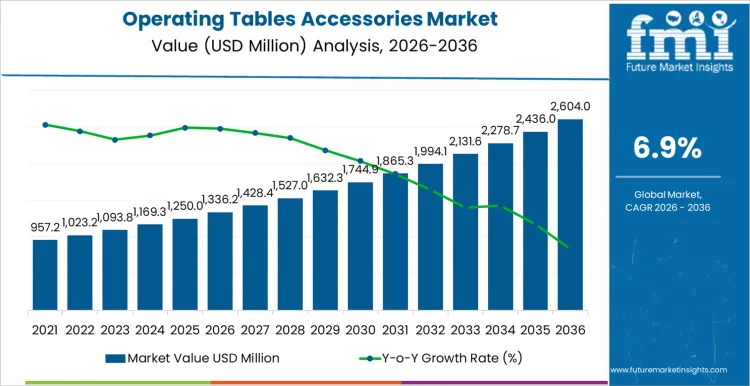
Operating Tables Accessories Market Key Takeaways
| Metric | Value |
|---|---|
| Market Value (2026) | USD 1,336.2 million |
| Market Forecast Value (2036) | USD 2,604.0 million |
| Forecast CAGR 2026 to 2036 | 6.9% |
Why is the Demand for Operating Tables Accessories Growing?
Demand for operating table accessories is increasing as surgical teams and healthcare facilities prioritize flexibility, patient positioning accuracy, and procedural efficiency across a broadening range of surgical specialties. Accessories such as arm boards, leg supports, extension pieces, and radiolucent attachments enable customization of the operating surface to accommodate diverse procedures in orthopedics, neurosurgery, obstetrics and gynecology, and minimally invasive interventions. Surgeons and perioperative nurses specify accessories that support precise positioning while maintaining patient safety, pressure dispersion, and sterile field integrity because optimal access and stability directly influence procedural outcomes and team workflow. Procurement teams evaluate compatibility with existing table platforms, material quality, ease of disinfection, and regulatory compliance to ensure that selected accessories meet infection prevention protocols and integrate with various surgical environments without extensive modification. Many buyers evaluate these items within broader operating room equipment standardization programs to reduce vendor fragmentation across surgical suites.
Growth in complex surgical volumes and adoption of advanced techniques such as laparoscopic and robotic-assisted procedures reinforces uptake of accessories that enhance table functionality and reduce intraoperative adjustments. Where navigation is used, the accessory set is often chosen to preserve line-of-sight and tracker stability for the surgical navigation system. Facilities with high turnover rates and multi-specialty operating suites invest in modular accessory portfolios that minimize changeover time between cases and support ergonomic configurations for surgical staff. Upgrades to operating room ceilings and overhead utilities also influence which accessories can be used without obstructing lights, imaging arcs, or anesthesia reach. In high-throughput suites, standard kits are increasingly built around a patient positioning system approach rather than ad hoc accessory picking. Technical improvements in attachment mechanisms, radiolucency, and weight capacity extend application to imaging-assisted workflows and patient populations with varied anthropometric requirements. In hybrid rooms, compatibility planning often links table accessories with surgical booms layout so imaging clearance and staff movement remain consistent. Training for surgical teams on accessory selection and safe use enhances confidence in positioning strategies and supports consistent procedural quality. These clinical, operational, and integration-focused drivers are contributing to sustained demand growth in the operating tables accessories market. The operating tables accessories market outlook also reflects replacement demand from wear, sterilization cycles, and higher accessory intensity per procedure.
How Is the Operating Tables Accessories Industry Segmented by Accessory Type, Surgical Application, and End User?
Demand for operating table accessories is influenced by procedure complexity, patient safety requirements, and operating room efficiency goals. Surgical teams prioritize ergonomic positioning, pressure injury prevention, and imaging compatibility across diverse specialties. Utilization reflects increasing surgical volumes, growth of minimally invasive techniques, and need for adaptable operating environments. Purchasing decisions emphasize compatibility with table platforms, infection control protocols, and ease of reconfiguration. Segmentation explains how accessory categories, procedural focus, and care settings determine adoption patterns within surgical infrastructure.
Which Accessory Type Holds the Largest Share in Operating Table Configurations?
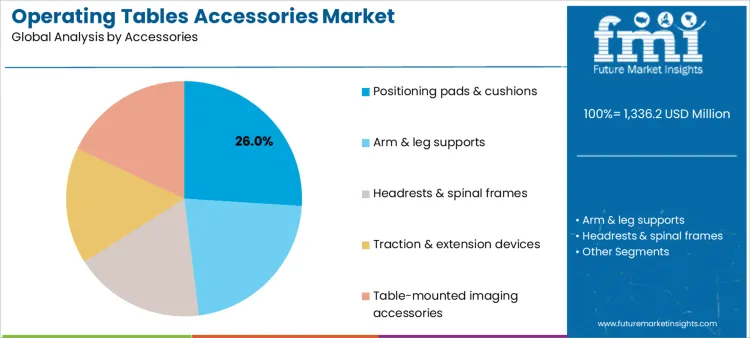
Positioning pads and cushions account for 26.0%, reflecting their essential role in patient stabilization and pressure distribution during prolonged procedures. These accessories support comfort while reducing risk of nerve injury and pressure ulcers. Arm and leg supports at 22.0% enable precise limb positioning required for orthopedic and general surgeries. Headrests and spinal frames at 18.0% address alignment needs in neurosurgical and spine procedures. Table-mounted imaging accessories at 18.0% facilitate intraoperative visualization and workflow efficiency. Traction and extension devices at 16.0% support fracture management and joint access. Accessory segmentation highlights emphasis on patient positioning and procedural precision.
Key Points
- Positioning pads support safety during long procedures.
- Limb supports enable controlled surgical access.
- Imaging accessories integrate visualization with positioning.
How Do Surgical Applications Shape Demand for Operating Table Accessories?
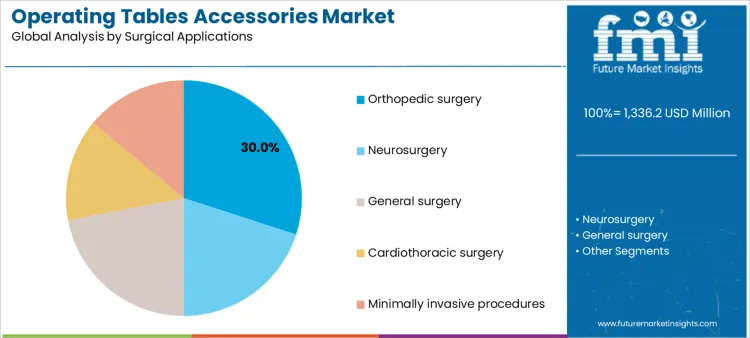
Orthopedic surgery represents 30.0%, driven by frequent need for traction, limb supports, and robust positioning systems. General surgery at 22.0% applies versatile accessories adaptable across varied procedures. Neurosurgery at 20.0% relies on headrests and spinal frames for precise alignment and stability. Cardiothoracic surgery at 14.0% uses accessories supporting thoracic access and patient immobilization. Minimally invasive procedures at 14.0% emphasize compact supports compatible with imaging and instrument navigation. Application-based segmentation reflects higher accessory utilization where precision positioning and prolonged operative times are common.
Key Points
- Orthopedics requires specialized positioning and traction tools.
- Neurosurgery depends on alignment-focused accessories.
- Minimally invasive cases demand imaging-compatible supports.
Which End User Settings Drive Utilization of Operating Table Accessories?
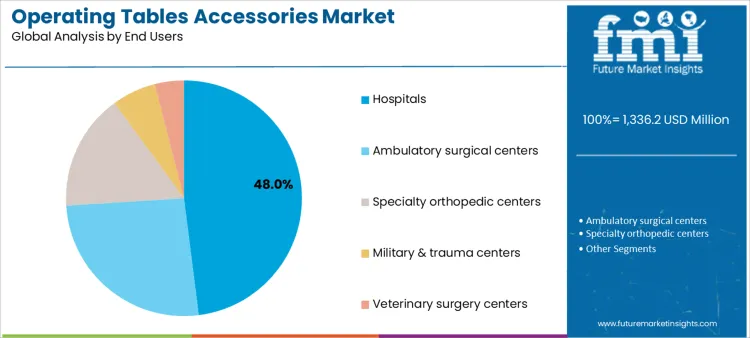
Hospitals account for 48.0%, reflecting broad surgical case mix and high procedure volumes requiring diverse accessory inventories. Ambulatory surgical centers at 26.0% prioritize modular and quick-change accessories supporting rapid turnover. Specialty orthopedic centers at 16.0% concentrate demand on limb positioning and traction systems. Military and trauma centers at 6.0% maintain accessories suited for emergency and complex injury management. Veterinary surgery centers at 4.0% apply scaled accessories for animal procedures. End-user segmentation shows concentration where procedural diversity, throughput, and specialization shape purchasing behavior.
Key Points
- Hospitals maintain comprehensive accessory inventories.
- ASCs emphasize efficiency and modularity.
- Specialty centers focus on procedure-specific supports.
What are the Key Dynamics in the Operating Tables Accessories Market?
Demand for operating table accessories reflects procedural positioning, patient safety, and workflow optimization requirements in surgical environments. Adoption concentrates in hospitals, ambulatory surgery centers, and specialty surgical clinics. Global scope aligns with rising surgical volume and procedure complexity across disciplines. Usage centers on modular accessories including headrests, arm supports, leg holders, extension plates, clamps, and positioning aids designed to integrate with existing operating tables.
How do procedure-specific positioning needs and surgical efficiency requirements shape adoption?
Surgical outcomes depend on precise patient positioning that maintains access, visibility, and physiological stability throughout procedures. Demand increases where minimally invasive, orthopedic, neurosurgical, and bariatric cases require specialized supports beyond standard table configurations. Accessories enable rapid reconfiguration between cases, reducing turnover time and improving operating room utilization. Adjustable components support surgeon ergonomics and reduce staff strain during long procedures. Radiolucent accessories facilitate imaging without repositioning, supporting hybrid operating rooms. Compatibility with multiple table models influences purchasing decisions in multi-vendor environments. Infection control considerations favor accessories with smooth surfaces and easy cleaning. Adoption reflects operational need to adapt operating tables to diverse procedures without replacing core capital equipment.
How do compatibility constraints, durability requirements, and cost pressure influence market scalability?
Accessory fit depends on table interface standards, limiting interchangeability across manufacturers. Demand sensitivity rises where hospitals operate mixed fleets requiring duplicate inventories. Repeated sterilization and mechanical loading affect accessory lifespan, increasing replacement cost. Storage and handling requirements add logistical complexity in space-constrained operating rooms. Capital budgeting prioritizes core equipment over accessories, delaying upgrades. Training is required to ensure correct attachment and safe use, increasing onboarding effort. Regulatory compliance and documentation add procurement steps. Scalability remains constrained by compatibility fragmentation, durability expectations under intensive use, and cost justification within operating room capital planning frameworks.
How Is Demand for Operating Table Accessories Evolving Globally?
Demand for operating table accessories is expanding globally as surgical volumes rise and procedure complexity increases. Hospitals prioritize modular positioning systems, imaging-compatible attachments, and patient safety accessories to support diverse surgical specialties. Growth of minimally invasive and hybrid operating rooms increases reliance on adaptable accessories rather than fixed tables alone. Procurement decisions emphasize compatibility, infection control, and workflow efficiency. Growth rates in India at 9.4%, Brazil at 8.9%, China at 8.5%, the USA at 5.3%, and Germany at 5.2% indicate sustained expansion driven by operating room modernization, procedural diversification, and utilization intensity rather than expansion of surgical facilities alone.
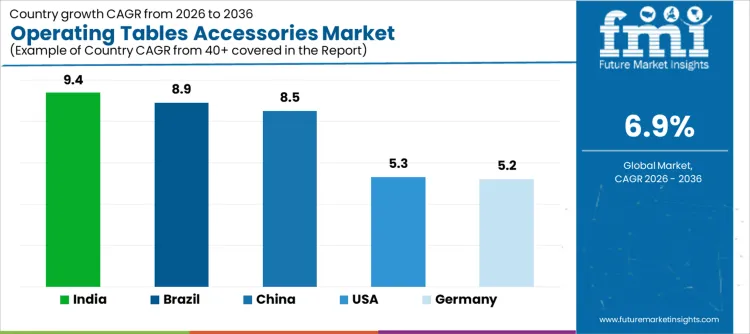
| Country | CAGR (%) |
|---|---|
| India | 9.4% |
| Brazil | 8.9% |
| China | 8.5% |
| USA | 5.3% |
| Germany | 5.2% |
What Is Driving Expansion of Operating Table Accessory Demand in India?
Demand for operating table accessories in India is growing at a CAGR of 9.4%, supported by rising surgical throughput across public and private hospitals. Expansion of multispecialty hospitals increases need for interchangeable positioning attachments. Growth of orthopedic, neurosurgical, and minimally invasive procedures elevates accessory utilization per case. Infection control protocols favor detachable and easy-to-sterilize components. Private hospital chains standardize operating room equipment across networks. Growth reflects surgical service expansion, procedural diversity, and standardization priorities rather than replacement of core operating tables.
- Rising multispecialty surgical volumes
- Increased use of procedure-specific positioning accessories
- Emphasis on detachable, sterilizable components
- Standardization across private hospital networks
Why Is Brazil Experiencing Strong Uptake of Operating Table Accessories?
Operating table accessory demand in Brazil is expanding at a CAGR of 8.9%, driven by modernization of surgical departments and public hospital upgrades. Orthopedic and trauma surgery volumes increased use of limb supports and traction devices. Public procurement programs support accessory replacement and upgrades. Regional hospitals improve surgical capability outside major cities. Training initiatives reinforce correct positioning practices. Growth reflects institutional upgrades and procedural safety focus rather than growth in operating room numbers.
- Public hospital surgical infrastructure upgrades
- Growth in orthopedic and trauma procedures
- Regional expansion of surgical services
- Training-driven adoption of positioning accessories
How Is China Sustaining Growth in Operating Table Accessory Utilization?
Demand for operating table accessories in China is growing at a CAGR of 8.5%, aligned with large hospital networks and high surgical throughput. Tertiary hospitals perform diverse procedures requiring modular positioning systems. Hybrid operating rooms increase demand for imaging-compatible accessories. Domestic manufacturers supply accessories tailored to local table models. Centralized procurement supports standardized accessory adoption. Growth reflects scale-driven utilization, technology integration, and compatibility requirements rather than expansion of surgical infrastructure.
- High surgical throughput at tertiary hospitals
- Growth of hybrid and image-guided operating rooms
- Availability of domestically manufactured accessories
- Centralized procurement and standardization
What Factors Are Supporting Operating Table Accessory Demand in United States?
Operating table accessory demand in the United States is expanding at a CAGR of 5.3%, supported by mature surgical services and procedural specialization. High per-case accessory usage reflects complex orthopedic, cardiovascular, and minimally invasive surgeries. Replacement demand sustains steady purchasing as accessories undergo wear. Strong emphasis on patient safety and ergonomics influences selection. Group purchasing organizations guide standardization across hospital systems. Growth reflects utilization intensity and replacement cycles rather than expansion of surgical capacity.
- High accessory usage per complex surgical case
- Replacement-driven purchasing patterns
- Emphasis on patient safety and ergonomics
- Group purchasing-led standardization
Why Is Germany Showing Measured Growth in Operating Table Accessories?
Operating table accessory demand in Germany is growing at a CAGR of 5.2%, shaped by disciplined healthcare investment and procedural efficiency. Certified surgical centers use accessories within standardized protocols. Emphasis on quality, durability, and compatibility governs procurement. Incremental upgrades support evolving surgical techniques. Cost containment policies moderate volume expansion. Growth remains measured, reflecting optimization of existing operating rooms and compliance with safety standards rather than rapid expansion of surgical services.
- Standardized accessory use in certified centers
- Emphasis on quality and long service life
- Incremental upgrades for new techniques
- Cost-controlled procurement frameworks
What is the competitive landscape of demand for the operating tables accessories market globally?
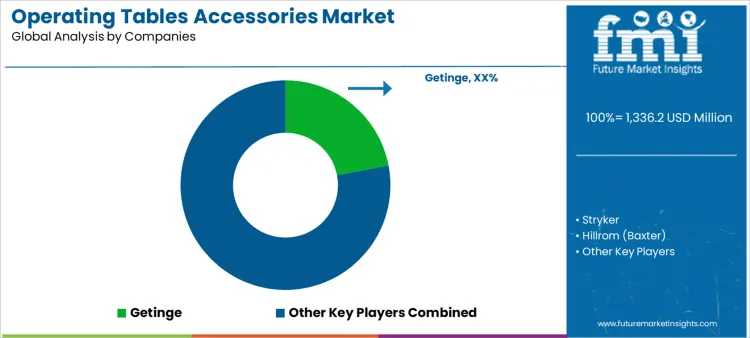
Demand for operating table accessories is driven by rising surgical procedure volumes, specialization of operating rooms, and ergonomics-focused clinical workflows. Surgeons and operating room managers evaluate accessory stability, patient positioning precision, radiolucency, infection control compatibility, and ease of adjustment during procedures. Buyer assessment includes interoperability with installed operating tables, setup time reduction, durability under repeated sterilization, and staff handling safety. Procurement behavior reflects capital equipment alignment, bundled purchasing with tables, and preference for standardized accessory platforms. Trend in the operating tables accessories market shows increasing demand for procedure-specific positioning solutions supporting minimally invasive and complex surgeries.
Getinge leads competitive positioning through a comprehensive accessory portfolio engineered to integrate seamlessly with its operating table systems. Stryker competes by offering modular accessories emphasizing ergonomic design and rapid configuration across surgical disciplines. Hillrom Baxter supports demand with accessories aligned to hybrid operating rooms and standardized hospital infrastructure. Trumpf Medical maintains relevance by supplying precision-engineered positioning components designed for advanced surgical environments. Mizuho OSI participates by focusing on specialty positioning accessories supporting orthopedic, spine, and neurosurgical procedures. Competitive differentiation centers on compatibility breadth, positioning accuracy, sterilization resilience, and alignment with evolving surgical techniques.
Key Players in the Operating Tables Accessories Market
- Getinge
- Stryker
- Hillrom (Baxter)
- Trumpf Medical
- Mizuho OSI
- Others
Scope of the Report
| Items | Values |
|---|---|
| Quantitative Units | USD million |
| Accessories | Positioning pads & cushions; Arm & leg supports; Headrests & spinal frames; Traction & extension devices; Table-mounted imaging accessories |
| Surgical Applications | Orthopedic surgery; Neurosurgery; General surgery; Cardiothoracic surgery; Minimally invasive procedures |
| End Users | Hospitals; Ambulatory surgical centers; Specialty orthopedic centers; Military & trauma centers; Veterinary surgery centers |
| Regions Covered | Asia Pacific, Europe, North America, Latin America, Middle East & Africa |
| Countries Covered | India, Brazil, China, USA, Germany, and 40+ countries |
| Key Companies Profiled | Getinge; Stryker; Hillrom (Baxter); Trumpf Medical; Mizuho OSI; Others |
| Additional Attributes | Dollar sales by accessory type, surgical application, and end user; ergonomic performance and pressure redistribution characteristics of positioning pads and supports; compatibility with imaging, traction, and minimally invasive workflows; sterilization durability and material resilience across repeated surgical cycles; role in improving surgical access, patient safety, and operating room efficiency; procurement dynamics driven by hospital capital equipment ecosystems, ASC procedure volumes, and specialty orthopedic demand. |
Operating Tables Accessories Market by Segment
Accessories:
- Positioning pads & cushions
- Arm & leg supports
- Headrests & spinal frames
- Traction & extension devices
- Table-mounted imaging accessories
Surgical Applications:
- Orthopedic surgery
- Neurosurgery
- General surgery
- Cardiothoracic surgery
- Minimally invasive procedures
End Users:
- Hospitals
- Ambulatory surgical centers
- Specialty orthopedic centers
- Military & trauma centers
- Veterinary surgery centers
Region:
- Asia Pacific
- China
- Japan
- South Korea
- India
- Australia & New Zealand
- ASEAN
- Rest of Asia Pacific
- Europe
- Germany
- United Kingdom
- France
- Italy
- Spain
- Nordic
- BENELUX
- Rest of Europe
- North America
- United States
- Canada
- Mexico
- Latin America
- Brazil
- Chile
- Rest of Latin America
- Middle East & Africa
- Kingdom of Saudi Arabia
- Other GCC Countries
- Turkey
- South Africa
- Other African Union
- Rest of Middle East & Africa
Bibliography
- World Health Organization. (2023). Global guidelines for safe surgery: Surgical positioning, patient safety, and operating room practices (Updated edition). World Health Organization.
- U.S. Food and Drug Administration. (2023). Medical device accessories: Regulatory classification, safety considerations, and performance requirements (Guidance for Industry). U.S. Department of Health and Human Services.
- European Commission. (2023). Medical Device Regulation (EU) 2017/745: Consolidated text with amendments applicable to surgical tables and accessories. Publications Office of the European Union.
Frequently Asked Questions
How big is the operating tables accessories market in 2026?
The global operating tables accessories market is estimated to be valued at USD 1,336.2 million in 2026.
What will be the size of operating tables accessories market in 2036?
The market size for the operating tables accessories market is projected to reach USD 2,604.0 million by 2036.
How much will be the operating tables accessories market growth between 2026 and 2036?
The operating tables accessories market is expected to grow at a 6.9% CAGR between 2026 and 2036.
What are the key product types in the operating tables accessories market?
The key product types in operating tables accessories market are positioning pads & cushions, arm & leg supports, headrests & spinal frames, traction & extension devices and table-mounted imaging accessories.
Which surgical applications segment to contribute significant share in the operating tables accessories market in 2026?
In terms of surgical applications, orthopedic surgery segment to command 30.0% share in the operating tables accessories market in 2026.
Preview the report firsthand - request a free sample
Get SampleGet the brochure for pricing and purchase details.
Get PDFTable of Content
- Executive Summary
- Global Market Outlook
- Demand-side Trends
- Supply-side Trends
- Technology Roadmap Analysis
- Analysis and Recommendations
- Market Overview
- Market Coverage / Taxonomy
- Market Definition / Scope / Limitations
- Market Background
- Market Dynamics
- Drivers
- Restraints
- Opportunity
- Trends
- Scenario Forecast
- Demand in Optimistic Scenario
- Demand in Likely Scenario
- Demand in Conservative Scenario
- Opportunity Map Analysis
- Product Life Cycle Analysis
- Supply Chain Analysis
- Investment Feasibility Matrix
- Value Chain Analysis
- PESTLE and Porter’s Analysis
- Regulatory Landscape
- Regional Parent Market Outlook
- Production and Consumption Statistics
- Import and Export Statistics
- Market Dynamics
- Global Market Analysis 2021 to 2025 and Forecast, 2026 to 2036
- Historical Market Size Value (USD Million) Analysis, 2021 to 2025
- Current and Future Market Size Value (USD Million) Projections, 2026 to 2036
- Y-o-Y Growth Trend Analysis
- Absolute $ Opportunity Analysis
- Global Market Pricing Analysis 2021 to 2025 and Forecast 2026 to 2036
- Global Market Analysis 2021 to 2025 and Forecast 2026 to 2036, By Accessories
- Introduction / Key Findings
- Historical Market Size Value (USD Million) Analysis By Accessories , 2021 to 2025
- Current and Future Market Size Value (USD Million) Analysis and Forecast By Accessories , 2026 to 2036
- Positioning pads & cushions
- Arm & leg supports
- Headrests & spinal frames
- Traction & extension devices
- Table-mounted imaging accessories
- Positioning pads & cushions
- Y-o-Y Growth Trend Analysis By Accessories , 2021 to 2025
- Absolute $ Opportunity Analysis By Accessories , 2026 to 2036
- Global Market Analysis 2021 to 2025 and Forecast 2026 to 2036, By Surgical Applications
- Introduction / Key Findings
- Historical Market Size Value (USD Million) Analysis By Surgical Applications, 2021 to 2025
- Current and Future Market Size Value (USD Million) Analysis and Forecast By Surgical Applications, 2026 to 2036
- Orthopedic surgery
- Neurosurgery
- General surgery
- Cardiothoracic surgery
- Minimally invasive procedures
- Orthopedic surgery
- Y-o-Y Growth Trend Analysis By Surgical Applications, 2021 to 2025
- Absolute $ Opportunity Analysis By Surgical Applications, 2026 to 2036
- Global Market Analysis 2021 to 2025 and Forecast 2026 to 2036, By End Users
- Introduction / Key Findings
- Historical Market Size Value (USD Million) Analysis By End Users, 2021 to 2025
- Current and Future Market Size Value (USD Million) Analysis and Forecast By End Users, 2026 to 2036
- Hospitals
- Ambulatory surgical centers
- Specialty orthopedic centers
- Military & trauma centers
- Veterinary surgery centers
- Hospitals
- Y-o-Y Growth Trend Analysis By End Users, 2021 to 2025
- Absolute $ Opportunity Analysis By End Users, 2026 to 2036
- Global Market Analysis 2021 to 2025 and Forecast 2026 to 2036, By Region
- Introduction
- Historical Market Size Value (USD Million) Analysis By Region, 2021 to 2025
- Current Market Size Value (USD Million) Analysis and Forecast By Region, 2026 to 2036
- North America
- Latin America
- Western Europe
- Eastern Europe
- East Asia
- South Asia and Pacific
- Middle East & Africa
- Market Attractiveness Analysis By Region
- North America Market Analysis 2021 to 2025 and Forecast 2026 to 2036, By Country
- Historical Market Size Value (USD Million) Trend Analysis By Market Taxonomy, 2021 to 2025
- Market Size Value (USD Million) Forecast By Market Taxonomy, 2026 to 2036
- By Country
- USA
- Canada
- Mexico
- By Accessories
- By Surgical Applications
- By End Users
- By Country
- Market Attractiveness Analysis
- By Country
- By Accessories
- By Surgical Applications
- By End Users
- Key Takeaways
- Latin America Market Analysis 2021 to 2025 and Forecast 2026 to 2036, By Country
- Historical Market Size Value (USD Million) Trend Analysis By Market Taxonomy, 2021 to 2025
- Market Size Value (USD Million) Forecast By Market Taxonomy, 2026 to 2036
- By Country
- Brazil
- Chile
- Rest of Latin America
- By Accessories
- By Surgical Applications
- By End Users
- By Country
- Market Attractiveness Analysis
- By Country
- By Accessories
- By Surgical Applications
- By End Users
- Key Takeaways
- Western Europe Market Analysis 2021 to 2025 and Forecast 2026 to 2036, By Country
- Historical Market Size Value (USD Million) Trend Analysis By Market Taxonomy, 2021 to 2025
- Market Size Value (USD Million) Forecast By Market Taxonomy, 2026 to 2036
- By Country
- Germany
- UK
- Italy
- Spain
- France
- Nordic
- BENELUX
- Rest of Western Europe
- By Accessories
- By Surgical Applications
- By End Users
- By Country
- Market Attractiveness Analysis
- By Country
- By Accessories
- By Surgical Applications
- By End Users
- Key Takeaways
- Eastern Europe Market Analysis 2021 to 2025 and Forecast 2026 to 2036, By Country
- Historical Market Size Value (USD Million) Trend Analysis By Market Taxonomy, 2021 to 2025
- Market Size Value (USD Million) Forecast By Market Taxonomy, 2026 to 2036
- By Country
- Russia
- Poland
- Hungary
- Balkan & Baltic
- Rest of Eastern Europe
- By Accessories
- By Surgical Applications
- By End Users
- By Country
- Market Attractiveness Analysis
- By Country
- By Accessories
- By Surgical Applications
- By End Users
- Key Takeaways
- East Asia Market Analysis 2021 to 2025 and Forecast 2026 to 2036, By Country
- Historical Market Size Value (USD Million) Trend Analysis By Market Taxonomy, 2021 to 2025
- Market Size Value (USD Million) Forecast By Market Taxonomy, 2026 to 2036
- By Country
- China
- Japan
- South Korea
- By Accessories
- By Surgical Applications
- By End Users
- By Country
- Market Attractiveness Analysis
- By Country
- By Accessories
- By Surgical Applications
- By End Users
- Key Takeaways
- South Asia and Pacific Market Analysis 2021 to 2025 and Forecast 2026 to 2036, By Country
- Historical Market Size Value (USD Million) Trend Analysis By Market Taxonomy, 2021 to 2025
- Market Size Value (USD Million) Forecast By Market Taxonomy, 2026 to 2036
- By Country
- India
- ASEAN
- Australia & New Zealand
- Rest of South Asia and Pacific
- By Accessories
- By Surgical Applications
- By End Users
- By Country
- Market Attractiveness Analysis
- By Country
- By Accessories
- By Surgical Applications
- By End Users
- Key Takeaways
- Middle East & Africa Market Analysis 2021 to 2025 and Forecast 2026 to 2036, By Country
- Historical Market Size Value (USD Million) Trend Analysis By Market Taxonomy, 2021 to 2025
- Market Size Value (USD Million) Forecast By Market Taxonomy, 2026 to 2036
- By Country
- Kingdom of Saudi Arabia
- Other GCC Countries
- Turkiye
- South Africa
- Other African Union
- Rest of Middle East & Africa
- By Accessories
- By Surgical Applications
- By End Users
- By Country
- Market Attractiveness Analysis
- By Country
- By Accessories
- By Surgical Applications
- By End Users
- Key Takeaways
- Key Countries Market Analysis
- USA
- Pricing Analysis
- Market Share Analysis, 2025
- By Accessories
- By Surgical Applications
- By End Users
- Canada
- Pricing Analysis
- Market Share Analysis, 2025
- By Accessories
- By Surgical Applications
- By End Users
- Mexico
- Pricing Analysis
- Market Share Analysis, 2025
- By Accessories
- By Surgical Applications
- By End Users
- Brazil
- Pricing Analysis
- Market Share Analysis, 2025
- By Accessories
- By Surgical Applications
- By End Users
- Chile
- Pricing Analysis
- Market Share Analysis, 2025
- By Accessories
- By Surgical Applications
- By End Users
- Germany
- Pricing Analysis
- Market Share Analysis, 2025
- By Accessories
- By Surgical Applications
- By End Users
- UK
- Pricing Analysis
- Market Share Analysis, 2025
- By Accessories
- By Surgical Applications
- By End Users
- Italy
- Pricing Analysis
- Market Share Analysis, 2025
- By Accessories
- By Surgical Applications
- By End Users
- Spain
- Pricing Analysis
- Market Share Analysis, 2025
- By Accessories
- By Surgical Applications
- By End Users
- France
- Pricing Analysis
- Market Share Analysis, 2025
- By Accessories
- By Surgical Applications
- By End Users
- India
- Pricing Analysis
- Market Share Analysis, 2025
- By Accessories
- By Surgical Applications
- By End Users
- ASEAN
- Pricing Analysis
- Market Share Analysis, 2025
- By Accessories
- By Surgical Applications
- By End Users
- Australia & New Zealand
- Pricing Analysis
- Market Share Analysis, 2025
- By Accessories
- By Surgical Applications
- By End Users
- China
- Pricing Analysis
- Market Share Analysis, 2025
- By Accessories
- By Surgical Applications
- By End Users
- Japan
- Pricing Analysis
- Market Share Analysis, 2025
- By Accessories
- By Surgical Applications
- By End Users
- South Korea
- Pricing Analysis
- Market Share Analysis, 2025
- By Accessories
- By Surgical Applications
- By End Users
- Russia
- Pricing Analysis
- Market Share Analysis, 2025
- By Accessories
- By Surgical Applications
- By End Users
- Poland
- Pricing Analysis
- Market Share Analysis, 2025
- By Accessories
- By Surgical Applications
- By End Users
- Hungary
- Pricing Analysis
- Market Share Analysis, 2025
- By Accessories
- By Surgical Applications
- By End Users
- Kingdom of Saudi Arabia
- Pricing Analysis
- Market Share Analysis, 2025
- By Accessories
- By Surgical Applications
- By End Users
- Turkiye
- Pricing Analysis
- Market Share Analysis, 2025
- By Accessories
- By Surgical Applications
- By End Users
- South Africa
- Pricing Analysis
- Market Share Analysis, 2025
- By Accessories
- By Surgical Applications
- By End Users
- USA
- Market Structure Analysis
- Competition Dashboard
- Competition Benchmarking
- Market Share Analysis of Top Players
- By Regional
- By Accessories
- By Surgical Applications
- By End Users
- Competition Analysis
- Competition Deep Dive
- Getinge
- Overview
- Product Portfolio
- Profitability by Market Segments (Product/Age /Sales Channel/Region)
- Sales Footprint
- Strategy Overview
- Marketing Strategy
- Product Strategy
- Channel Strategy
- Stryker
- Hillrom (Baxter)
- Trumpf Medical
- Mizuho OSI
- Others
- Getinge
- Competition Deep Dive
- Assumptions & Acronyms Used
- Research Methodology


