

- Market Size (2026)
- USD 1.1 Bn
- Forecast (2036)
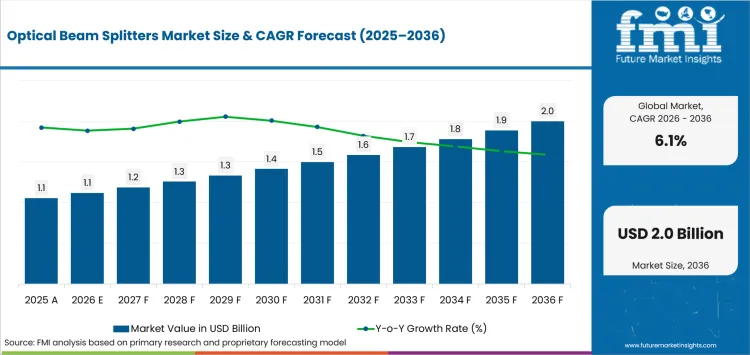
- USD 2.0 Bn
- CAGR (2026 to 2036)
- 6.1%
How big is Optical Beam Splitters Market in 2026?
USD 1.1 billion in 2026 and USD 2.0 billion by 2036 at a 6.1% CAGR.
Demand for optical beam splitters is projected to expand at a 6.1% CAGR between 2026 and 2036 from USD 1.1 billion in 2026 to USD 2.0 billion by 2036. Semiconductor inspection and fluorescence instruments require controlled light division. CEA-Leti reported in June 2026 that Wooptix had installed its first Phemet wafer-scale metrology system in Grenoble on May 4. Repeated calibration makes beam balance and wavefront stability part of metrology.
Country demand diverges with semiconductor fabrication density and local optical engineering. The German Federal Government stated in October 2025 that Germany held about 30% of European wafer capacity. The installed base supports inspection-tool and OEM activity. Research-led countries can generate difficult prototypes without comparable volume. Service reach then weighs more heavily in component-maker selection.
Key Takeaways
- Semiconductor metrology and fluorescence instruments require stable optical routing at defined wavelengths and polarization states.
- Based on splitter type, plate beam splitters are projected to account for 25.0% in 2026 due to flexible apertures and relatively simple mechanical integration.
- In 2026, life sciences are expected to lead end use with 26.0% share because fluorescence instruments require controlled separation of excitation and emitted light.
- By sales channel, optics OEM direct is forecast to represent 37.0% in 2026 driven by OEM qualification of custom drawings and coating tolerances.
- OEM switching can stall after design-in if an altered split ratio or wavefront forces optical revalidation.
- Some of the key players in this market include Edmund Optics, Thorlabs, Newport / MKS, CVI Laser Optics, OptoSigma, Jenoptik, Schott, EKSMA Optics, Knight Optical, and Lambda Research Optics.
Analyst Perspective
"Beam splitter economics are set during qualification rather than at purchase. A low-cost substitute loses its advantage if a changed split ratio or wavefront forces system revalidation."
- Sudip saha, Principal Consultant, Future Market Insights
How is the optical beam splitters market segmented?
The optical beam splitters market is segmented by splitter type, coating, wavelength, end use, sales channel and region.
Splitter type includes plate, cube, polarizing, non-polarizing and dichroic beam splitters. Coating covers metallic, dielectric, broadband, laser-line and custom AR designs. Wavelength includes UV, visible, NIR, IR and broadband. End use covers life sciences, laser systems, semiconductor inspection, defense - aerospace and research labs. Sales channel includes optics OEM direct, scientific distributors, custom optics projects and catalog - e-commerce.
What makes plate beam splitters central to the splitter type category?
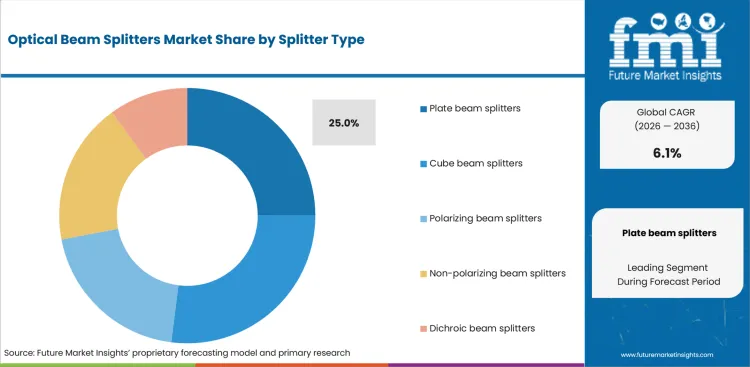
Plate formats suit systems that need a thin optic or large clear aperture without cube mass. Transmission shifts laterally so designers must control thickness and mounting angle. Varied optical coatings also support sampling and polarization-sensitive work.
- By splitter type, plate beam splitters are estimated to hold 25.0% in 2026 owing to configurable apertures and familiar mounting practice.
- ISO published ISO 14999-4:2026 in May 2026 for interpreting surface-form and wavefront-deformation measurements on optical elements. Plate splitter qualification can use those measurements to catch substrate or mounting errors before an optic enters an OEM drawing.
Why does metallic coating lead the coating category?
Metallic coatings suit instruments that value broadband response more than peak transmission. Absorption becomes more important in higher-power laser systems. ISO published ISO 11551:2026 in August 2026 so engineers can compare absorptance on optical laser components during coating-stack selection.
- The metallic coating segment is likely to capture 18.0% share in 2026 attributable to broad spectral utility in moderate-power optical paths.
- Coating selection therefore depends on measured absorptance and spectral flatness staying inside the laser system’s thermal and optical limits.
How does UV hold the leading position in the wavelength category?
UV beam splitting places tight limits on substrate transmission and coating defects. Small losses affect spectroscopy and semiconductor inspection. Fused silica and fluoride materials are common starting points for short-wavelength designs.
- In 2026, UV is expected to lead the wavelength category with an 11.0% share because inspection and laser applications need short-wavelength optical control.
- EKSMA Optics announced in July 2026 that its UVQuanT deep-UV optics and coating work received European Commission Innovation Radar recognition. The cited work covers high-durability deep-UV optics for demanding operating conditions.
What supports life sciences leadership in the end use category?
Life-science instruments use beam splitters to separate excitation light from weaker emitted signals. ZEISS launched Lightfield 4D in March 2025 for high-speed fluorescence imaging on its LSM 910 and LSM 990 platforms. The system uses high-bandwidth beampath technology and broad wavelength coverage so coating repeatability becomes part of signal control in series instruments.
- Life sciences are set to lead the end use category with 26.0% share in 2026 due to recurring beam-routing requirements in fluorescence imaging and optical analysis.
- Microscopy and flow cytometry need repeatable spectral routing so excitation energy reaches the sample without overwhelming the weaker emission channel.
What drives optics OEM direct leadership in the sales channel category?
Direct supply becomes more valuable once an OEM freezes substrate and coating behavior into a system drawing. The component manufacturer can hold first-article records and production tolerances under one technical relationship.
- Optics OEM direct is set to lead the sales channel with 37.0% share in 2026 due to OEM qualification of custom specifications with the component manufacturer.
- Edmund Optics added ASE Optics Europe and Photonics Precision Engineering to its Trusted Optical Partnerships program in May 2025. Its announcement linked design and prototype support with first articles and high-volume photonics production for OEM programs.
What are the drivers, restraints and opportunities in the Optical Beam Splitters Market?
Tighter measurement requirements raise demand, qualification testing slows component substitutions and custom OEM programs extend revenue beyond catalog pricing.
- Driver: Semiconductor and scientific instruments need controlled light paths as measurement targets become harder to resolve.
- Restraint: Coating loss and laser-damage performance must be validated before a substitute can enter a qualified optical path.
- Opportunity: Custom fabrication and first-article support can turn prototype demand into repeat OEM production.
Precision Metrology Raises the Value of Stable Beam Routing
Advanced semiconductor process control requires tighter semiconductor metrology as device structures become harder to measure. NIST published its 2024 IRDS metrology roadmap in July 2025 and identified measurement challenges created by new devices and materials. Beam splitters inside inspection tools must preserve illumination balance and detector paths through repeated process measurements. Split-ratio drift therefore consumes part of the tool’s repeatability margin.
Qualification Testing Makes Component Changes Expensive
Laser-facing optics cannot be approved on split ratio alone. A coating can fail under energy density that a low-power bench test never reaches. ISO published ISO 21254-1:2025 in August 2025 to define general principles for laser-induced damage threshold testing. OEMs need comparable damage evidence before replacing an optic in a qualified laser path. Retesting extends engineering time and can delay replacement approval.
Prototype Programs Can Convert into Repeat OEM Revenue
A prototype program becomes commercially useful once one optical firm can carry a qualified design into manufacturing. AIM Photonics said in January 2025 that its Photonics West program would show how design enablement and multi-project wafer fabrication feed manufacturing-ready prototypes. The program also covered electronic-photonic test and packaging. Photonic integrated circuits still need metrology during that transfer. Custom optics firms can win repeat work by holding the qualified optical prescription through pilot and volume stages.
Which country CAGRs are profiled in the Optical Beam Splitters Market?
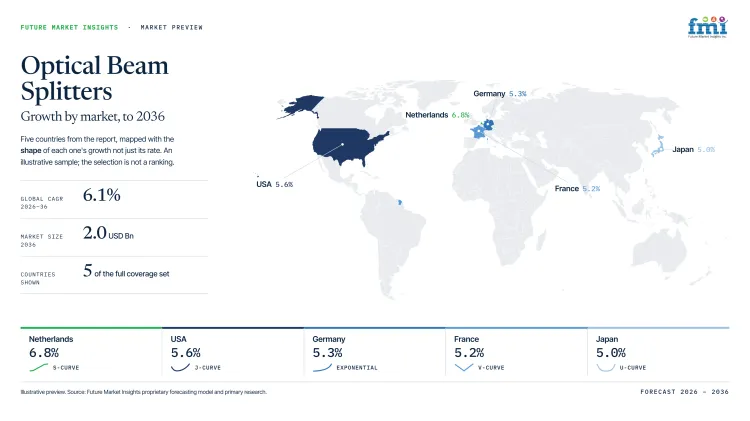
| Country | CAGR |
|---|---|
| Netherlands | 6.8% |
| South Korea | 5.9% |
| USA | 5.6% |
| Canada | 5.4% |
| Germany | 5.3% |
| France | 5.2% |
| Japan | 5.0% |
How do country-level CAGRs compare in the Optical Beam Splitters Market?
The 1.8 percentage-point range between the Netherlands and Japan separates a Dutch lead from a compact middle group. South Korea follows at 5.9% with the USA and Canada next. The spacing reflects different photonics concentrations and semiconductor-equipment exposure rather than a uniform shift in beam-splitter use.
- Dutch tool design keeps qualification close to equipment engineers.
- Large fabs pull coating support into serial inspection.
- Research instruments keep US demand spread among many OEMs.
- Research commercialization carries more weight than local equipment scale.
- Mature equipment bases lengthen replacement cycles.
- Pilot research delays serial optical orders.
- Long qualification cycles temper vendor turnover.
Comparable rates can still reflect different qualification environments. The full report provides country-level CAGR analysis across North America, Latin America, Western Europe, Eastern Europe, East Asia, South Asia and Pacific, and Middle East and Africa.
Country-wise Analysis
- Dutch optical purchasing concentrates near Eindhoven beside photonics developers and semiconductor-equipment engineering teams. Demand for optical beam splitters in the Netherlands is forecast to rise at 6.8% CAGR over the forecast period supported by rapid prototype-to-equipment transfer. In June 2025, the Dutch government said PIXEurope would build pilot-line facilities in Eindhoven and Enschede with partners from 11 EU member states. The pilot line gives coating firms direct access to process engineers. Larger lots raise the risk that custom spectral response drifts outside tolerance. Engineering proximity gives Dutch suppliers an advantage during demanding optical qualification cycles. Installed equipment scale is smaller than in larger markets, so local technical support carries extra weight.
- South Korean orders are shaped by large semiconductor groups and local equipment chains that expect rapid technical response. The South Korean optical beam splitters sector is projected to record 5.9% CAGR during the assessment period shaped by domestic semiconductor development and tighter inspection needs. MSIT stated in January 2026 that its implementation plan added a next-generation optical computing semiconductor project and expanded MoaFab participation from six to fourteen organizations. The plan deepens optical-semiconductor research and development near established domestic equipment supply chains. Local technical coverage shortens engineering response times during equipment and specification changes. Series equipment leaves little room for coating-lot changes once the optical prescription is frozen. South Korea therefore rewards scale-ready support more than research-led prototype access.
- US demand spans semiconductor clusters and a broad base of scientific instrument manufacturers with different qualification routines. NIST announced in January 2025 that the National Semiconductor Technology Center would operate as a long-term institution intended to reduce prototype time and cost. Adoption of optical beam splitters in the USA is projected to expand at 5.6% CAGR through 2036 owing to continued prototyping and measurement activity. Shared research infrastructure increases supplier access to early-stage semiconductor equipment development programs. Laboratories and OEMs still use different acceptance records for precision optics. Companies that support stock design-in parts plus controlled custom releases fit this fragmented purchasing pattern better than a catalog-only model.
- Canadian photonics work is concentrated in smaller research and semiconductor centers where specialized fabrication access carries more weight than national scale. The National Research Council stated in May 2026 that its Canadian Photonics Fabrication Centre spans 40,000 square feet. Canada's optical beam splitters outlook is anticipated to advance at 5.4% CAGR over the assessment period, reinforced by compound-semiconductor and optical sensor development. Shared fabrication infrastructure lowers the barrier to completing specialized prototype production runs. Distance between engineering centers can extend corrective cycles for imported optics. Regional inventory and remote engineering support therefore carry more weight in Canada than in denser European photonics clusters.
- German purchasing is anchored by optical manufacturing in Jena and a dense semiconductor-equipment base in Saxony. Germany's Federal Government reported the opening of Infineon's Smart Power Fab in Dresden in July 2026 and linked the site to stronger European semiconductor production. Optical beam splitter sales in Germany are forecast to expand at 5.3% CAGR by 2036 shaped by production equipment and long-cycle OEM programs. Nearby precision-optics capacity supports demanding semiconductor metrology and inspection equipment programs. Qualification timelines can stretch once equipment makers freeze detailed optical performance prescriptions. German programs therefore reward lot-to-lot coating stability and engineering continuity more than rapid catalog substitution during serial equipment qualification.
- French optical demand is strongly influenced by Grenoble research programs that transfer process concepts into pilot manufacturing. By 2036, France is projected to grow at 5.2% CAGR aided by semiconductor R&D and optical measuring systems used during process transfer. CEA-Leti opened a new cleanroom in January 2026 with about 80 specialized semiconductor tools. Pilot infrastructure gives optical firms repeated access to nonstandard measurement setups. Research configurations often change during the path to a stable OEM drawing. Short-run customization fits this research-intensive manufacturing environment particularly well for suppliers. Commercial value depends on transferring the successful coating prescription into repeatable production for later series manufacturing at OEM scale.
- Japanese optical purchasing places strong weight on repeatability for precision manufacturing and long-lived instrument designs. Rapidus said in April 2025 that its 2 nm pilot line would start with 300 mm manufacturing equipment and an early-customer prototyping environment. In Japan, optical beam splitter demand is predicted to advance at 5.0% CAGR through 2036 influenced by next-generation semiconductor work and molecular spectroscopy. The pilot line expands inspection activity without relaxing local record requirements. Component changes can trigger fresh optical checks even after initial qualification is completed. Japanese programs therefore reward firms that document coating repeatability and maintain local engineering response.
Who are the notable companies in the Optical Beam Splitters Market?
Edmund Optics, Thorlabs, Newport / MKS, CVI Laser Optics, OptoSigma, Jenoptik, Schott, EKSMA Optics, Knight Optical, and Lambda Research Optics are notable companies serving this market.
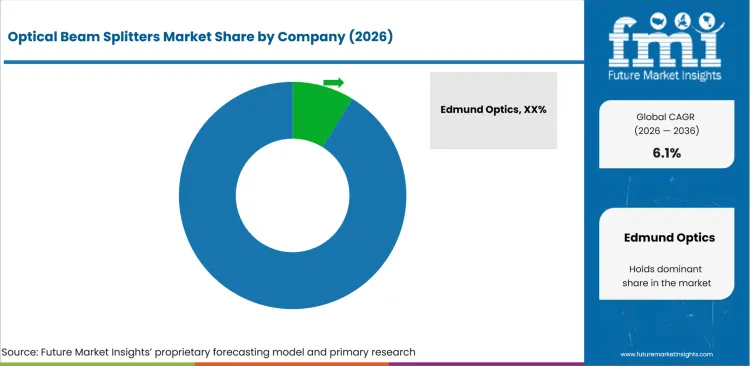
Competition separates by catalog access and coating control more than company scale. Edmund Optics and Thorlabs simplify design-in sourcing. Newport / MKS and CVI Laser Optics bring deeper laser expertise. Jenoptik and Schott focus on precision OEM manufacturing.
- Edmund Optics and Thorlabs cover broad research channels. Newport / MKS and OptoSigma also serve OEM programs.
- CVI Laser Optics and EKSMA Optics focus on laser-heavy custom work. Lambda Research Optics fabricates and coats optics in-house.
- Jenoptik and Schott support precision OEM manufacturing. Knight Optical serves custom instrument and defense programs.
Competitive Benchmarking: Optical Beam Splitters Market
| Company | In-House Coating Control | OEM Manufacturing Integration | Laser / Semiconductor Application Depth | Geographic Reach |
|---|---|---|---|---|
| Edmund Optics | High | High | High | North America, Europe, and Asia-Pacific |
| Thorlabs | High | High | High | North America, Europe, and Asia-Pacific |
| Newport / MKS | High | High | High | North America, Europe, and Asia-Pacific |
| CVI Laser Optics | High | High | High | North America with international distribution |
| OptoSigma | High | Medium | Medium | North America, Europe, and Asia-Pacific |
| Jenoptik | High | High | High | Europe, North America, and Asia |
| Schott | High | High | Medium | Global manufacturing and customer coverage |
| EKSMA Optics | High | Medium | High | Europe with international distribution |
| Knight Optical | Medium | High | Medium | United Kingdom, United States, and international customers |
| Lambda Research Optics | High | High | High | United States with international OEM coverage |
High coating control requires documented in-house deposition and optical metrology. Medium marks verified coating access with narrower in-house evidence. High OEM integration requires prototype support through volume production. High application depth requires documented laser or semiconductor work plus precision optics. Medium marks one route. Low marks a verified narrow role and never missing evidence.
Key Developments in the Optical Beam Splitters Market
- In June 2025, MKS introduced Newport ODiate fluorescence filter sets with emitter and exciter filters plus a dichroic element. The launch extends standardized wavelength routing for multi-channel life-science imaging.
- In May 2025, Jenoptik introduced its Modular Beam Splitting System for parallel laser structuring in solar-cell production. The ready-to-install module splits and shapes the laser beam for stable multi-spot processing.
- In January 2025, Edmund Optics acquired son-x and added ultrasonic-assisted diamond turning for complex optical surfaces. The acquisition extends custom substrate fabrication for coated beam-routing components.
Key Players in the Optical Beam Splitters Market
Broad Catalog and Research Platforms
- Edmund Optics
- Thorlabs
- Newport / MKS
- OptoSigma
Laser and Coating-Focused Specialists
- CVI Laser Optics
- EKSMA Optics
- Lambda Research Optics
Precision OEM and Custom Manufacturing Partners
- Jenoptik
- Schott
- Knight Optical
Optical Beam Splitters Market - Report Scope
| Coverage field | Report scope |
|---|---|
| Market breakdown | By splitter type, coating, wavelength, end use, sales channel and region. |
| Quantitative Units | USD billion. |
| Market Definition | Revenue from standalone and OEM-supplied optical beam splitters sold as components. Scope includes intensity, polarization and wavelength splitting. Complete instruments, integrated photonic circuits and fiber couplers are excluded unless beam-splitter revenue is separately attributable. |
| Regions Covered | North America; Latin America; Western Europe; Eastern Europe; East Asia; South Asia and Pacific; Middle East and Africa. |
| Countries Covered | Netherlands, South Korea, USA, Canada, Germany, France, Japan, and 20+ countries included in the full report. |
| Key Companies Profiled | Edmund Optics, Thorlabs, Newport / MKS, CVI Laser Optics, OptoSigma, Jenoptik, Schott, EKSMA Optics, Knight Optical, Lambda Research Optics. |
| Forecast Period | 2026 to 2036. |
| Approach | Primary and secondary research with market triangulation. |
Optical Beam Splitters Market - Research Methodology
| Method | Approach |
|---|---|
| Primary Research | FMI analysts gathered input from manufacturers, service providers, technology developers, distributors, end users, procurement teams, and subject-matter experts. Interviews examined purchasing decisions, product or service evaluation, adoption barriers, approval requirements, pricing considerations, and expectations for technical or commercial support. Respondents were also asked what evidence is required before a trial, pilot, or initial order develops into regular purchasing. |
| Desk Research | Desk research covered government statistics, regulatory publications, trade data, industry associations, technical literature, standards, company filings, product information, and official corporate announcements. Sources were reviewed for relevance, publication date, geographic coverage, and consistency with the defined market scope. Claims relating to performance, applications, approvals, capacity, investment, and commercial activity were retained only when supported by credible public evidence. |
| Market Sizing and Forecasting | The market model combined the baseline value with historical performance, segment structure, pricing and volume indicators, adoption levels, company participation, and country-level demand conditions. Forecast assumptions considered economic activity, investment trends, regulatory developments, technology adoption, purchasing cycles, supply availability, and barriers to wider market use. Segment and regional estimates were reconciled before the final market total was calculated. |
| Data Validation | Estimates were checked against multiple independent indicators, including public data, company activity, trade patterns, industry developments, and findings from primary interviews. Validation also tested whether products, services, applications, and company revenues fell within the defined market boundaries. Adjacent categories, unsupported claims, overlapping revenues, and activities without direct market relevance were excluded to reduce double counting and maintain consistency across segments and countries. |
Optical Beam Splitters Market by Segments
Optical Beam Splitters Market segmented by Splitter Type:
- Plate beam splitters
- Cube beam splitters
- Polarizing beam splitters
- Non-polarizing beam splitters
- Dichroic beam splitters
Optical Beam Splitters Market segmented by Coating:
- Metallic coating
- Dielectric coating
- Broadband coating
- Laser-line coating
- Custom AR coating
Optical Beam Splitters Market segmented by Wavelength:
- UV
- Visible
- NIR
- IR
- Broadband
Optical Beam Splitters Market segmented by End Use:
- Life sciences
- Laser systems
- Semiconductor inspection
- Defense - aerospace
- Research labs
Optical Beam Splitters Market segmented by Sales Channel:
- Optics OEM direct
- Scientific distributors
- Custom optics projects
- Catalog - e-commerce
Optical Beam Splitters Market by Region:
- North America
- United States
- Canada
- Latin America
- Brazil
- Mexico
- Argentina
- Chile
- Western Europe
- Germany
- France
- United Kingdom
- Italy
- Spain
- Benelux
- Nordics
- Eastern Europe
- Poland
- Czech Republic
- Romania
- Hungary
- East Asia
- China
- Japan
- South Korea
- South Asia and Pacific
- India
- ASEAN
- Australia and New Zealand
- Middle East and Africa
- GCC Countries
- South Africa
- Türkiye
- Israel
Research Sources and Bibliography
- The Federal Government of Germany. (2025, October 15). Strengthening the business location for microelectronics.
- International Organization for Standardization. (2026, May). ISO 14999-4:2026 Optics and photonics - Measurement of optical elements and optical systems - Part 4: Interpretation and evaluation of surface form and wavefront deformation tolerances specified in ISO 10110.
- International Organization for Standardization. (2026, August 20). ISO 11551:2026 Optics and photonics - Lasers and laser-related equipment - Test method for absorptance of optical laser components.
- EKSMA Optics. (2026, July 14). Eksma Optics Innovation Recognized by the European Commission’s Innovation Radar.
- ZEISS. (2025, March 5). ZEISS Lightfield 4D for instant volumetric high-speed imaging.
- Edmund Optics. (2025, May 6). ASE Optics Europe and Photonics Precision Engineering Join the Edmund Optics® Trusted Optical Partnerships Program.
- National Institute of Standards and Technology. (2025, July 9). INTERNATIONAL ROADMAP FOR DEVICES AND SYSTEMS TM 2024 METROLOGY.
- International Organization for Standardization. (2025, August). ISO 21254-1:2025 Lasers and laser-related equipment - Test methods for laser-induced damage threshold - Part 1: Definitions and general principles.
- AIM Photonics. (2025, January 23). AIM Photonics to Present New Advancements in Integrated Photonics Technology at Photonics West 2025.
- Government of the Netherlands. (2025, June 11). Bouw Nederlandse proefproductielijn fotonische chips nog dit jaar van start.
- Ministry of Science and ICT, Republic of Korea. (2026, January 14). Semiconductor⸱Dispaly⸱Battery South Korea Invests KRW 235.1 Billion to Secure Core Source Technologies.
- National Institute of Standards and Technology. (2025, January 16). Department of Commerce Finalizes Long-Term Partnership with Natcast to Operate the National Semiconductor Technology Center.
- National Research Council Canada. (2026, May 4). Future spin-off of the NRC’s Canadian Photonics Fabrication Centre.
- The Federal Government of Germany. (2026, July 2). Rede von Bundeskanzler Merz anlässlich der Eröffnung der Smart Power Fab von Infineon in Dresden am 2. Juli 2026.
- CEA-Leti. (2026, January 30). A new era for European semiconductors begins in Grenoble.
- Rapidus Corporation. (2025, April 1). NEDO Approves Rapidus’ FY2025 Plan and Budget for 2nm Semiconductor Projects.
- Edmund Optics. (2025, January 17). Edmund Optics Acquires son-x to Expand Manufacturing Capabilities and Strengthen Global Leadership in Providing Innovative Customer Solutions.
- JENOPTIK AG. (2025, May 19). Jenoptik presents new optical system for more efficient laser-based solar cell processing.
- MKS Inc. (2025, June 17). MKS Announces Next Generation of Newport™ ODiate® Fluorescence Filter Sets, Precision Multi-band Optical Filters for Fluorescent Imaging Systems.
- Edmund Optics. (n.d.; retrieved 2026, September). Manufacturer of Precision Optics.
- Thorlabs. (2026). End-to-End Optics Manufacturing and Custom OEM Optics.
- MKS Inc. (2026, February 24). Annual report on Form 10-K for the year ended December 31, 2025.
- IDEX Optical Technologies. (n.d.; retrieved 2026, September). About Us > CVI Laser Optics.
- OptoSigma. (n.d.; retrieved 2026, September). About us.
- JENOPTIK AG. (2026, March 25). Annual Report 2025.
- SCHOTT. (2026, April 15). SCHOTT Introduces Assembled Protective Windows Manufactured in the USA
- EKSMA Optics. (2026, June 15). Eksma Optics Showcases European Optical Manufacturing Capabilities at Eurosatory 2026.
- Knight Optical. (2025, October 27). Certificate of Registration: ISO 9001:2015.
- Lambda Research Optics. (n.d.; retrieved 2026, September). About Us.
- MKS Inc. (2026, July 21). MKS launches European Laser Applications Lab to Help Accelerate Development Time.
- Edmund Optics. (2025, July 14). High-Performance HOLO/OR Beam Shaping Optics Now Available Off-the-Shelf from Edmund Optics.
- Knight Optical. (2026, June 17). Knight Optical Passes ISO 14001 Surveillance Audit.
- Edmund Optics. (2026, July 2). Edmund Optics® Simplifies Sourcing of Optical Windows for UV, VIS, and IR Applications.
- SCHOTT. (2026, March 11). New ultra-large optical MEMS lids enable next-generation optical circuit switching (OCS) and sensing.
- Edmund Optics. (2026, August 5). Edmund Optics® Simplifies Waveplate Sourcing with One of the Industry’s Broadest Off-the-Shelf Portfolios.
- MKS Inc. (2026, February 23). MKS Announces Ophir® BeamWatch® AM-3 Additive Manufacturing Beam Analyzer for Detection of Focal Shifts, Power, and Characterization Down to 35 µm.
- JENOPTIK AG. (2025, September 9). Jenoptik invests in expanded optics manufacturing in Jena, Germany.
- Thorlabs Lens Systems. (2023, January). Thorlabs acquires JML Optical.
- IDEX Corporation. (2025, July 30). IDEX Acquires Micro-LAM, Adding Laser-Assisted Machining to Expertise in Optical Technologies.
- OptoSigma Corporation. (2024, November 6). OptoSigma Corporation Relocates to New Facility to Expand Manufacturing Capabilities.
This bibliography is provided for reader reference and is not exhaustive. The full report contains the complete reference list and detailed citations.
This Report Answers
- How large is the optical beam splitters market in 2026 and 2036?
- Which instrument requirements support optical beam splitter demand?
- Why do plate beam splitters lead splitter type?
- Why does metallic coating lead coating demand?
- Why does UV lead the wavelength category?
- How do the seven country growth rates differ?
- Which companies serve catalog and custom programs?
- What limits component switching after design-in?
Frequently Asked Questions
How big is the optical beam splitters market in 2026?
The optical beam splitters market is valued at USD 1.1 billion in 2026 and is projected to reach USD 2.0 billion by 2036. Growth is driven by tighter optical-routing requirements in semiconductor inspection and fluorescence instruments.
What is the CAGR of the optical beam splitters market from 2026 to 2036?
The optical beam splitters market is projected to grow at a CAGR of 6.1% between 2026 and 2036. Expansion comes from semiconductor metrology and life-science imaging that require stable wavelength and polarization control.
Which splitter type leads the optical beam splitters market?
The plate beam splitters segment is expected to hold 25.0% of the optical beam splitters market in 2026, supported by flexible apertures and familiar mounting practice. Plate formats also support varied coating specifications for custom optical paths.
Which sales channel leads the optical beam splitters market?
Optics OEM direct is expected to account for 37.0% of sales channel demand in 2026, led by direct qualification of custom drawings and coating tolerances. The channel keeps first-article review and production release under one technical relationship.
Which countries are projected to record the highest growth in the optical beam splitters market?
The Netherlands is projected to grow at 6.8% CAGR followed by South Korea at 5.9% and the USA at 5.6% through 2036. Their rates reflect different concentrations of photonics development and semiconductor equipment activity.
Which companies are active in the optical beam splitters market?
Key companies operating in the market include Edmund Optics, Thorlabs, Newport / MKS, CVI Laser Optics, OptoSigma, Jenoptik, Schott, EKSMA Optics, Knight Optical, and Lambda Research Optics. They compete through coating control and OEM manufacturing support in laser or semiconductor applications.
Preview the report firsthand - request a free sample
Get SampleGet the brochure for pricing and purchase details.
Get PDFTable of Content
- Key Takeaways
- Market Size and CAGR
- Top Growth Driver
- Fastest Growing Segment
- Leading Region
- Key Companies
- Emerging Opportunities
- Executive Summary
- Global Market Outlook
- Demand-side Trends
- Supply-side Trends
- Technology Roadmap Analysis
- Analysis and Recommendations
- Analyst Perspective (What is happening? Why now? What should investors know?)
- Key Questions Answered
- How large is the market?
- What is the CAGR?
- What are key trends?
- Which region dominates?
- Who are the leaders?
- Market Overview
- Market Coverage / Taxonomy
- Market Definition / Scope / Limitations
- Research Methodology
- Chapter Orientation
- Analytical Lens and Working Hypotheses
- Market Structure, Signals, and Trend Drivers
- Benchmarking and Cross-market Comparability
- Market Sizing, Forecasting, and Opportunity Mapping
- Research Design and Evidence Framework
- Desk Research Programme (Secondary Evidence)
- Expert Input and Fieldwork (Primary Evidence)
- Tooling, Models, and Reference Databases
- Data Engineering and Model Build
- Quality Assurance and Audit Trail
- Market Background
- Market Dynamics (Drivers, Restraints, Opportunity, Trends)
- Scenario Forecast (Optimistic, Likely, Conservative)
- Impact Analysis
- AI Impact
- Sustainability Impact
- Regulatory Impact
- Technology Impact
- Consumer / Buyer Analysis
- Purchase Drivers
- Adoption Barriers
- Buyer Journey
- Opportunity Map Analysis
- Product Life Cycle Analysis
- Supply Chain Analysis
- Investment Feasibility Matrix
- Value Chain Analysis
- PESTLE and Porter's Analysis
- Regulatory Landscape
- Regional Parent Market Outlook
- Production and Consumption Statistics
- Import and Export Statistics
- Global Market Analysis and Forecast, 2021 to 2036
- Historical Market Size Value (USD Billion) Analysis, 2021 to 2025
- Current and Future Market Size Value (USD Billion) Projections, 2026 to 2036
- Y-o-Y Growth Trend Analysis
- Absolute $ Opportunity Analysis
- Global Market Pricing Analysis, 2021 to 2036
- Global Market Analysis and Forecast, By Splitter Type, 2021 to 2036
- Introduction / Key Findings
- Historical Market Size Value (USD Billion) Analysis By Splitter Type, 2021 to 2025
- Current and Future Market Size Value (USD Billion) Analysis and Forecast By Splitter Type, 2026 to 2036
- Plate beam splitters
- Cube beam splitters
- Polarizing beam splitters
- Non-polarizing beam splitters
- Dichroic beam splitters
- Plate beam splitters
- Y-o-Y Growth Trend Analysis By Splitter Type, 2021 to 2025
- Absolute $ Opportunity Analysis By Splitter Type, 2026 to 2036
- Global Market Analysis and Forecast, By Coating, 2021 to 2036
- Introduction / Key Findings
- Historical Market Size Value (USD Billion) Analysis By Coating, 2021 to 2025
- Current and Future Market Size Value (USD Billion) Analysis and Forecast By Coating, 2026 to 2036
- Metallic coating
- Dielectric coating
- Broadband coating
- Laser-line coating
- Custom AR coating
- Metallic coating
- Y-o-Y Growth Trend Analysis By Coating, 2021 to 2025
- Absolute $ Opportunity Analysis By Coating, 2026 to 2036
- Global Market Analysis and Forecast, By Wavelength, 2021 to 2036
- Introduction / Key Findings
- Historical Market Size Value (USD Billion) Analysis By Wavelength, 2021 to 2025
- Current and Future Market Size Value (USD Billion) Analysis and Forecast By Wavelength, 2026 to 2036
- UV
- Visible
- NIR
- IR
- Broadband
- UV
- Y-o-Y Growth Trend Analysis By Wavelength, 2021 to 2025
- Absolute $ Opportunity Analysis By Wavelength, 2026 to 2036
- Global Market Analysis and Forecast, By End Use, 2021 to 2036
- Introduction / Key Findings
- Historical Market Size Value (USD Billion) Analysis By End Use, 2021 to 2025
- Current and Future Market Size Value (USD Billion) Analysis and Forecast By End Use, 2026 to 2036
- Life sciences
- Laser systems
- Semiconductor inspection
- Defense/aerospace
- Research labs
- Life sciences
- Y-o-Y Growth Trend Analysis By End Use, 2021 to 2025
- Absolute $ Opportunity Analysis By End Use, 2026 to 2036
- Global Market Analysis and Forecast, By Sales Channel, 2021 to 2036
- Introduction / Key Findings
- Historical Market Size Value (USD Billion) Analysis By Sales Channel, 2021 to 2025
- Current and Future Market Size Value (USD Billion) Analysis and Forecast By Sales Channel, 2026 to 2036
- Optics OEM direct
- Scientific distributors
- Custom optics projects
- Catalog/e-commerce
- Optics OEM direct
- Y-o-Y Growth Trend Analysis By Sales Channel, 2021 to 2025
- Absolute $ Opportunity Analysis By Sales Channel, 2026 to 2036
- Global Market Analysis and Forecast, By Region, 2021 to 2036
- Introduction
- Historical Market Size Value (USD Billion) Analysis By Region, 2021 to 2025
- Current Market Size Value (USD Billion) Analysis and Forecast By Region, 2026 to 2036
- North America
- Latin America
- Western Europe
- Eastern Europe
- East Asia
- South Asia and Pacific
- Middle East & Africa
- Market Attractiveness Analysis By Region
- North America Market Analysis and Forecast, By Country, 2021 to 2036
- Historical Market Size Value (USD Billion) Trend Analysis By Market Taxonomy, 2021 to 2025
- Market Size Value (USD Billion) Forecast By Market Taxonomy, 2026 to 2036
- By Country
- USA
- Canada
- By Splitter Type
- By Coating
- By Wavelength
- By End Use
- By Sales Channel
- By Country
- Market Attractiveness Analysis
- By Country
- By Splitter Type
- By Coating
- By Wavelength
- By End Use
- By Sales Channel
- Key Takeaways
- Latin America Market Analysis and Forecast, By Country
- Historical Market Size Value (USD Billion) Trend Analysis By Market Taxonomy, 2021 to 2025
- Market Size Value (USD Billion) Forecast By Market Taxonomy, 2026 to 2036
- By Country
- Brazil
- Mexico
- Chile
- Rest of Latin America
- By Splitter Type
- By Coating
- By Wavelength
- By End Use
- By Sales Channel
- By Country
- Market Attractiveness Analysis
- By Country
- By Splitter Type
- By Coating
- By Wavelength
- By End Use
- By Sales Channel
- Key Takeaways
- Western Europe Market Analysis and Forecast, By Country
- Historical Market Size Value (USD Billion) Trend Analysis By Market Taxonomy, 2021 to 2025
- Market Size Value (USD Billion) Forecast By Market Taxonomy, 2026 to 2036
- By Country
- Germany
- UK
- Italy
- Spain
- France
- Nordic
- BENELUX
- Rest of Western Europe
- By Splitter Type
- By Coating
- By Wavelength
- By End Use
- By Sales Channel
- By Country
- Market Attractiveness Analysis
- By Country
- By Splitter Type
- By Coating
- By Wavelength
- By End Use
- By Sales Channel
- Key Takeaways
- Eastern Europe Market Analysis and Forecast, By Country
- Historical Market Size Value (USD Billion) Trend Analysis By Market Taxonomy, 2021 to 2025
- Market Size Value (USD Billion) Forecast By Market Taxonomy, 2026 to 2036
- By Country
- Russia
- Poland
- Hungary
- Balkan & Baltic
- Rest of Eastern Europe
- By Splitter Type
- By Coating
- By Wavelength
- By End Use
- By Sales Channel
- By Country
- Market Attractiveness Analysis
- By Country
- By Splitter Type
- By Coating
- By Wavelength
- By End Use
- By Sales Channel
- Key Takeaways
- East Asia Market Analysis and Forecast, By Country
- Historical Market Size Value (USD Billion) Trend Analysis By Market Taxonomy, 2021 to 2025
- Market Size Value (USD Billion) Forecast By Market Taxonomy, 2026 to 2036
- By Country
- China
- Japan
- South Korea
- By Splitter Type
- By Coating
- By Wavelength
- By End Use
- By Sales Channel
- By Country
- Market Attractiveness Analysis
- By Country
- By Splitter Type
- By Coating
- By Wavelength
- By End Use
- By Sales Channel
- Key Takeaways
- South Asia and Pacific Market Analysis and Forecast, By Country
- Historical Market Size Value (USD Billion) Trend Analysis By Market Taxonomy, 2021 to 2025
- Market Size Value (USD Billion) Forecast By Market Taxonomy, 2026 to 2036
- By Country
- India
- ASEAN
- Australia & New Zealand
- Rest of South Asia and Pacific
- By Splitter Type
- By Coating
- By Wavelength
- By End Use
- By Sales Channel
- By Country
- Market Attractiveness Analysis
- By Country
- By Splitter Type
- By Coating
- By Wavelength
- By End Use
- By Sales Channel
- Key Takeaways
- Middle East & Africa Market Analysis and Forecast, By Country
- Historical Market Size Value (USD Billion) Trend Analysis By Market Taxonomy, 2021 to 2025
- Market Size Value (USD Billion) Forecast By Market Taxonomy, 2026 to 2036
- By Country
- Kingdom of Saudi Arabia
- Other GCC Countries
- Türkiye
- South Africa
- Other African Union
- Rest of Middle East & Africa
- By Splitter Type
- By Coating
- By Wavelength
- By End Use
- By Sales Channel
- By Country
- Market Attractiveness Analysis
- By Country
- By Splitter Type
- By Coating
- By Wavelength
- By End Use
- By Sales Channel
- Key Takeaways
- Key Countries Market Analysis
- USA
- Pricing Analysis
- Market Share Analysis, 2025
- By Splitter Type
- By Coating
- By Wavelength
- By End Use
- By Sales Channel
- Canada
- Pricing Analysis
- Market Share Analysis, 2025
- By Splitter Type
- By Coating
- By Wavelength
- By End Use
- By Sales Channel
- Mexico
- Pricing Analysis
- Market Share Analysis, 2025
- By Splitter Type
- By Coating
- By Wavelength
- By End Use
- By Sales Channel
- Brazil
- Pricing Analysis
- Market Share Analysis, 2025
- By Splitter Type
- By Coating
- By Wavelength
- By End Use
- By Sales Channel
- Chile
- Pricing Analysis
- Market Share Analysis, 2025
- By Splitter Type
- By Coating
- By Wavelength
- By End Use
- By Sales Channel
- Germany
- Pricing Analysis
- Market Share Analysis, 2025
- By Splitter Type
- By Coating
- By Wavelength
- By End Use
- By Sales Channel
- UK
- Pricing Analysis
- Market Share Analysis, 2025
- By Splitter Type
- By Coating
- By Wavelength
- By End Use
- By Sales Channel
- Italy
- Pricing Analysis
- Market Share Analysis, 2025
- By Splitter Type
- By Coating
- By Wavelength
- By End Use
- By Sales Channel
- Spain
- Pricing Analysis
- Market Share Analysis, 2025
- By Splitter Type
- By Coating
- By Wavelength
- By End Use
- By Sales Channel
- France
- Pricing Analysis
- Market Share Analysis, 2025
- By Splitter Type
- By Coating
- By Wavelength
- By End Use
- By Sales Channel
- India
- Pricing Analysis
- Market Share Analysis, 2025
- By Splitter Type
- By Coating
- By Wavelength
- By End Use
- By Sales Channel
- ASEAN
- Pricing Analysis
- Market Share Analysis, 2025
- By Splitter Type
- By Coating
- By Wavelength
- By End Use
- By Sales Channel
- Australia & New Zealand
- Pricing Analysis
- Market Share Analysis, 2025
- By Splitter Type
- By Coating
- By Wavelength
- By End Use
- By Sales Channel
- China
- Pricing Analysis
- Market Share Analysis, 2025
- By Splitter Type
- By Coating
- By Wavelength
- By End Use
- By Sales Channel
- Japan
- Pricing Analysis
- Market Share Analysis, 2025
- By Splitter Type
- By Coating
- By Wavelength
- By End Use
- By Sales Channel
- South Korea
- Pricing Analysis
- Market Share Analysis, 2025
- By Splitter Type
- By Coating
- By Wavelength
- By End Use
- By Sales Channel
- Russia
- Pricing Analysis
- Market Share Analysis, 2025
- By Splitter Type
- By Coating
- By Wavelength
- By End Use
- By Sales Channel
- Poland
- Pricing Analysis
- Market Share Analysis, 2025
- By Splitter Type
- By Coating
- By Wavelength
- By End Use
- By Sales Channel
- Hungary
- Pricing Analysis
- Market Share Analysis, 2025
- By Splitter Type
- By Coating
- By Wavelength
- By End Use
- By Sales Channel
- Kingdom of Saudi Arabia
- Pricing Analysis
- Market Share Analysis, 2025
- By Splitter Type
- By Coating
- By Wavelength
- By End Use
- By Sales Channel
- Türkiye
- Pricing Analysis
- Market Share Analysis, 2025
- By Splitter Type
- By Coating
- By Wavelength
- By End Use
- By Sales Channel
- South Africa
- Pricing Analysis
- Market Share Analysis, 2025
- By Splitter Type
- By Coating
- By Wavelength
- By End Use
- By Sales Channel
- USA
- Market Structure Analysis
- Competition Dashboard
- Competition Benchmarking
- Market Share Analysis of Top Players
- By Regional
- By Splitter Type
- By Coating
- By Wavelength
- By End Use
- By Sales Channel
- Emerging Startups
- Innovation Benchmarking
- Competition Analysis
- Competition Deep Dive
- Edmund Optics
- Overview
- Product Portfolio
- Profitability by Market Segments
- Sales Footprint
- Strategy Overview
- Marketing Strategy
- Product Strategy
- Channel Strategy
- Thorlabs
- Newport / MKS
- CVI Laser Optics
- OptoSigma
- Jenoptik
- Schott
- EKSMA Optics
- Knight Optical
- Lambda Research Optics
- Edmund Optics
- Case Studies
- Success Stories
- Recent Developments
- Competition Deep Dive
- Assumptions & Acronyms Used


