

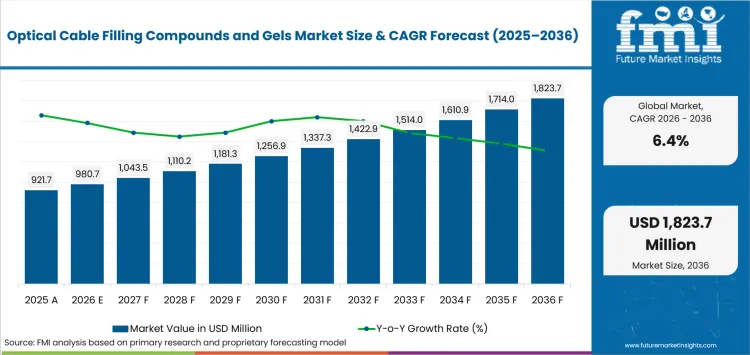
- Market Size (2026)
- USD 980.7 Mn
- Forecast (2036)
- USD 1823.7 Mn
- CAGR (2026 to 2036)
- 6.4%
How big is Optical Cable Filling Compounds and Gels Market in 2026?
USD 980.7 million in 2026 and USD 1,823.7 million by 2036 at a 6.4% CAGR.
The optical cable filling compounds and gels market is projected to expand at 6.4% CAGR between 2026 and 2036. Valuation is expected to rise from USD 980.7 million in 2026 to USD 1,823.7 million by 2036. Cable makers purchase gels after a design retains wet filling and material passes plant qualification. European optical fiber deployment activity keeps those production routes active across access and backbone projects. Fibre Council Europe reported in March 2026 that FTTH/B networks passed about 295 million EU39 homes after adding roughly 23 million premises within one year. That network scale broadens the cable orders where qualified tube-filling and flooding formulations can compete.
Country demand diverges as mature fiber networks shift cable orders toward replacement and capacity upgrades instead of first-time coverage. OECD reported in May 2025 that fiber represented 44.6% of fixed broadband connections across members and 90% in Korea. Mature fiber optics infrastructure makes material consistency and requalification more important across recurring replacement programs. Less mature networks produce more new-route cable demand although each project becomes gel revenue only if wet filling remains specified. Compound purchases therefore depend on OEM approval for rheology and polymer compatibility rather than connection counts alone.
Key Takeaways of Optical Cable Filling Compounds and Gels Market
- Outdoor fiber construction and network replacement increase qualified gel purchases whenever cable makers retain wet-filled or flooded architectures for exposed routes.
- By compound type, petroleum jelly gels are estimated to hold 27.0% in 2026 owing to familiar hydrophobic chemistry and manageable processing cost.
- In 2026, loose tube fiber cables are expected to lead cable type with 34.0% share because internal voids require controlled tube filling.
- The function category is forecast to be led by water ingress blocking at 32.0% share in 2026 due to persistent moisture-protection requirements.
- Gel removal during splicing and competing dry-block designs can reduce wet-filled cable adoption in projects that prioritize faster field preparation.
- Unigel Group plc, H&R Group, Info-Gel LLC, ITCO Industries Limited, Makesworth Industries Limited, BLS Polymers Limited, Shanghai Honghui Optics Communication TECH.CORP. and Wuxi Kreno Industry Co., Ltd. form the verified company set.
Analyst Perspective
"Cable makers should test filling compounds at production shear and service temperature ahead of any price comparison. Batch repeatability and polymer compatibility carry commercial value by reducing line adjustments and repeat qualification caused by unstable gel behavior."
- Nikhil Kaitwade, Principal Consultant, Future Market Insights
How is the Optical Cable Filling Compounds and Gels Market segmented?
The market is segmented by compound type, cable type, function, end use, sales channel and region.
Compound type covers petroleum jelly gels, synthetic hydrocarbon gels, thixotropic filling compounds, flooding compounds and low-temperature gels. Cable type includes loose tube fiber cables, ribbon fiber cables, submarine optical cables, outdoor duct cables and aerial optical cables. Function covers water ingress blocking, fiber cushioning, tube filling, sheath flooding and temperature stability. End use includes telecom networks, FTTx deployment, data centers, utilities / power networks and submarine systems. Sales channel covers cable OEM direct, specialty compound distributors and telecom project supply across regions.
Why do petroleum jelly gels lead demand within the compound type category?
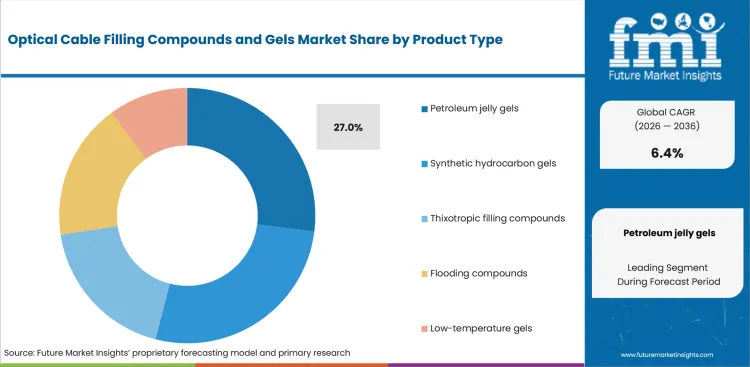
Petroleum jelly formulations give cable plants a familiar hydrophobic base that pumps across qualified filling lines. H&R Group published its 2025 annual report in March 2026 and identified telecommunications cable fillers within an international network that also produces petroleum jellies.
- By compound type, petroleum jelly gels are estimated to hold 27.0% in 2026 owing to economical moisture protection and familiar line behavior.
- Cable plants retain petroleum jelly gels when viscosity and polymer compatibility remain stable during production. Qualified specialty oils help formulators control low-temperature flow and batch repeatability across specified cable service conditions.
Why do loose tube fiber cables lead demand within the cable type category?
Loose tube construction leaves optical fibers with controlled movement inside polymer tubes and creates voids that filling compounds can occupy without loading the fibers.
- Loose tube fiber cables are set to lead the cable type with 34.0% share in 2026 due to their direct tube-filling requirement.
- Planned fiber-to-the-home expansion sustains outside-plant cable output for qualified loose-tube designs. Ofcom reported in May 2025 that UK full-fibre availability reached 22.5 million homes in January and could reach 28.8 million by January 2028. Single-mode fiber routes add volume for OEM designs that retain gel-filled tubes.
How does water ingress blocking lead demand within the function category?
Water ingress blocking limits longitudinal moisture movement inside damaged outdoor cables and protects fibers across cable service life. The November 2025 ITU-T L.110 recommendation permits filling compounds for water protection and requires no leakage after a 24-hour penetration test.
- The function category is forecast to be led by water ingress blocking at 32.0% share in 2026 due to persistent moisture-protection requirements.
- Cable engineers retain wet filling if the hydrophobic barrier passes water testing without weakening handling or polymer compatibility. Broader optical fiber connectivity programs become gel orders for cable architectures that retain internal filling.
Why do telecom networks lead demand within the end use category?
Telecom networks use optical cable across access and backbone routes that require distinct moisture-control designs. Data center cabling often uses indoor constructions with less exposure to water ingress.
- The telecom networks segment is likely to capture 33.0% share in 2026 attributable to broad access and transport cable deployment.
- Access programs keep outside-plant cable production active across feeder and distribution routes. Ofcom reported in May 2026 that full fibre reached 24.9 million UK residential premises and added 1.2 million homes within six months. Recurring fiber-to-the-x programs widen outdoor cable projects that retain qualified wet-filled designs.
What are the drivers, restraints and opportunities in the Optical Cable Filling Compounds and Gels Market?
Outdoor fiber deployment sustains qualified compound demand, while gel-free designs constrain wet filling and process-stable formulations improve requalification prospects.
- Driver: Optical-cable capacity expansion increases qualified gel orders on production lines that retain wet-filled loose-tube or flooded construction.
- Restraint: Gel-free cable designs reduce preparation labor and can displace filling compounds in routes that meet water blocking without internal gel.
- Opportunity: Process-stable gels can win requalification work as cable plants add capacity while preserving existing pumps and established line settings.
Optical-Cable Capacity Sustains Qualified Compound Orders
Optical-cable capacity expansion matters to gel demand at commercial cable plants that retain wet-filled constructions. HFCL reported in July 2025 that its board approved an IBR expansion lifting total optical-fiber-cable capacity to 42.36 million fiber-kilometers annually. Added capacity becomes addressable for gel formulators on wet-filled wire and cable production lines during commercial production. Cable-OEM qualification determines which formulation converts that production increase into recurring material orders at each plant.
Gel-Free Designs Pressure Wet-Filled Architectures
Residual gel adds field preparation at splice points as technicians must clean fibers thoroughly for reliable fusion splicing. Corning reported in May 2025 that its RPX long-span ribbon cables use a gel-free design intended to reduce cable-preparation labor and time. Dry water blocking therefore competes on installation labor and can displace wet filling in cable designs that meet water tests without internal hydrophobic gel.
Formulation Performance Improves Requalification Prospects
Replacement qualification becomes easier if a new formulation fits existing filling equipment and cable polymers without major line changes. Regional supply makes that technical fit more valuable during rapid production ramps across multiple cable plants. Unigel reported in August 2025 that it invested in capacity growth and new product introduction as production ramped at its Malaysian partner plant. Gel formulators that reproduce viscosity and polymer compatibility across plants can reduce repeat testing for cable makers evaluating an alternate source.
Which country CAGRs are profiled in the Optical Cable Filling Compounds and Gels Market?
| Country | CAGR |
|---|---|
| South Korea | 6.1% |
| USA | 5.7% |
| France | 5.3% |
| Japan | 5.2% |
| Germany | 5.0% |
How do country-level CAGRs compare in the Optical Cable Filling Compounds and Gels Market?
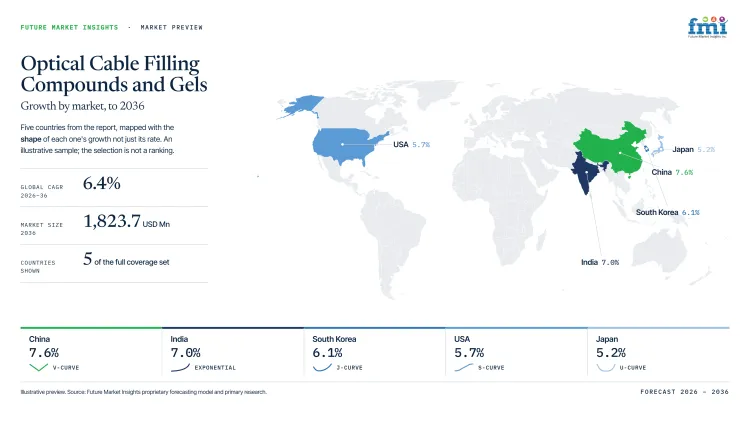
The 1.1 percentage-point spread forms a narrow growth band rather than a sharp divide across the five profiled countries. South Korea combines mature coverage with capacity upgrades while the USA depends more on public-project timing. France, Japan and Germany cluster near 5% as final-area buildout and replacement work gain weight.
- South Korea channels cable demand toward replacement programs across KT’s dense fiber network.
- USA order timing depends on which approved BEAD projects retain fiber construction.
- France concentrates new cable work in harder final areas as FttH coverage matures.
- Japan shifts purchasing toward manufacturing consistency across a mature FTTH subscriber base.
- Germany converts rising fiber availability into orders as connected premises become active lines.
The narrow range masks production triggers and qualification priorities among cable makers.
The full report provides country-level CAGR analysis across North America, Latin America, Europe, East Asia, South Asia, Oceania and the Middle East and Africa.
Country-wise Analysis
- KT operates a dense domestic fiber transmission network that makes replacement quality and capacity upgrades more important than first-time household coverage for local cable plants. The South Korean optical cable filling compounds and gels market is projected to record 6.1% CAGR during the assessment period, reinforced by recurring backbone and subscriber upgrades. KT reported in April 2026 that its fiber-optic cable network measured 968,465 kilometers at year-end 2025 across backbone and subscriber routes. Mature penetration limits greenfield volume and raises the threshold for repeatable rheology during material qualification, while local technical response shortens requalification across recurring domestic cable production schedules.
- US cable purchasing follows state broadband awards and national manufacturing schedules that release optical-cable demand in uneven project batches. Technology-neutral BEAD selections remain a material friction because wireless or satellite routes do not require filled optical cable. Demand for optical cable filling compounds and gels in the USA is forecast to rise at 5.7% CAGR over the forecast period, shaped by fiber projects that reach cable production. NTIA reported in February 2026 that 50 of 56 BEAD final proposals were approved nationally. Manufacturers with qualified OEM formulations and regional inventory can respond faster as awarded fiber routes enter production schedules.
- French cable demand now concentrates on final-area completion and maintenance as national FttH rollout approaches broad metropolitan coverage in harder low-density districts. Adoption of optical cable filling compounds and gels in France is estimated to expand at 5.3% CAGR through 2036, aided by targeted extension and replacement work for outdoor cable routes. Arcep reported in June 2026 that 42.8 million of 45.1 million metropolitan premises had FttH coverage while 2.3 million remained. Slower rollout limits broad wet-filled volume gains and shifts competition toward dependable batches for harder low-density projects, making established OEM approvals more valuable across repeated maintenance and extension work.
- Japanese cable plants work inside a mature fiber environment that gives defect control and long-term material stability greater purchasing weight. The Statistics Bureau released the Japan Statistical Yearbook 2026 in December 2025 and recorded 40.995 million FTTH subscriptions at fiscal year-end 2024. Optical cable filling compounds and gels sales in Japan are forecast to expand at 5.2% CAGR by 2036, influenced by recurring replacement demand across a large installed network. Limited first-time connection growth raises qualification pressure during routine replacement and upgrade work at established domestic cable plants. Formulations with stable viscosity and documented polymer compatibility reduce requalification risk across established domestic cable processes.
- German fiber deployment continues expanding as operators convert passed homes and buildings into active FTTH or FTTB connections across regional networks for local operators. Germany is estimated to post 5.0% CAGR over the forecast period, supported by recurring rollout batches and replacement work. Bundesnetzagentur reported in June 2026 that active FTTH and FTTB connections increased from 5.3 million to 6.4 million during 2025, giving cable plants a larger operating base for phased production. Staged customer conversion can delay cable orders across regional production cycles, so compound manufacturers need European OEM approvals and dependable local delivery for repeated batch schedules each quarter.
Who are the notable companies in the Optical Cable Filling Compounds and Gels Market?
Unigel Group plc, H&R Group, Info-Gel LLC, ITCO Industries Limited, Makesworth Industries Limited, BLS Polymers Limited, Shanghai Honghui Optics Communication TECH.CORP., and Wuxi Kreno Industry Co., Ltd. are the notable companies serving this market.
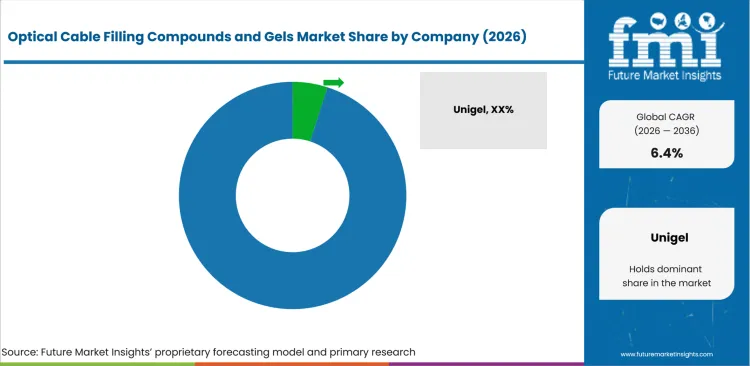
Competition remains fragmented between dedicated gel formulators and cable-material manufacturers that sell broader component portfolios. Cable-OEM qualification compares rheology and polymer compatibility against material behavior during sustained high-speed production runs. New entrants therefore need repeatable batches and practical production support alongside a formulation that meets the written cable specification.
- Unigel Group plc, H&R Group and Info-Gel LLC compete as focused gel formulators with documented optical-cable applications and technical support.
- ITCO Industries Limited, Makesworth Industries Limited and Shanghai Honghui Optics Communication TECH.CORP. combine cable gels with broader cable-material portfolios.
- BLS Polymers Limited and Wuxi Kreno Industry Co., Ltd. participate through cable compounds or optical-cable materials within the defined revenue boundary.
Competitive Benchmarking: Optical Cable Filling Compounds and Gels Market
| Company | Optical-Cable Gel Portfolio | Manufacturing / Supply Footprint | Cable-OEM Technical Support | Geographic Reach |
|---|---|---|---|---|
| Unigel Group plc | High | High | High | Europe, North America and Asia |
| H&R Group | High | High | High | Europe, Asia and Africa with international sales offices |
| Info-Gel LLC | High | Medium | High | North America with international cable-industry sales |
| ITCO Industries Limited | High | High | High | India with exports to 35+ countries |
| Makesworth Industries Limited | High | Low | Medium | India with international cable-compound sales |
| BLS Polymers Limited | Medium | Medium | Medium | India with overseas customer access |
| Shanghai Honghui Optics Communication TECH.CORP. | High | Medium | Medium | China and Malaysia |
| Wuxi Kreno Industry Co., Ltd. | Medium | Low | Medium | China with international cable-material sales |
Key Developments in the Optical Cable Filling Compounds and Gels Market
- In July 2026, Prysmian announced a ten-year Molex agreement alongside plans to more than double United States fiber capacity and expand optical-cable production. The added output enlarges the production base available to gel manufacturers on optical-cable constructions that retain wet filling.
- In March 2026, Corning and Meta started construction on a major optical-cable manufacturing capacity expansion. The Hickory facility targets AI data-center cable demand, so upstream gel demand depends on exact cable architectures qualified at the plant and does not extend to the full announced capacity.
- In August 2025, Belden launched gel-free loose tube optical-fiber cables for EMEA applications and positioned the design around easier preparation without gel cleanup. The launch increases direct substitution pressure on wet-filled designs in projects that meet moisture requirements with dry water blocking.
Key Players in the Optical Cable Filling Compounds and Gels Market
Focused Cable-Gel Formulators
- Unigel Group plc
- H&R Group
- Info-Gel LLC
Integrated Cable-Material Manufacturers
- ITCO Industries Limited
- Makesworth Industries Limited
- Shanghai Honghui Optics Communication TECH.CORP.
Broader Compound and Optical-Material Participants
- BLS Polymers Limited
- Wuxi Kreno Industry Co., Ltd.
Optical Cable Filling Compounds and Gels Market - Report Scope
| Coverage field | Report scope |
|---|---|
| Market breakdown | By compound type, cable type, function, end use, sales channel and region. |
| Quantitative Units | Revenue in USD million and CAGR in %. |
| Market Definition | Revenue includes optical-cable filling and flooding compounds or gels sold within the stated segmentation universe. Finished optical-cable revenue, dry water-blocking substitutes, connector adhesives and unrelated specialty-fluid revenue are excluded. |
| Regions Covered | North America, Latin America, Europe, East Asia, South Asia and Pacific and Middle East and Africa. |
| Countries Covered | South Korea, USA, France, Japan, Germany, and 20+ countries included in the full report. |
| Key Companies Profiled | Unigel Group plc, H&R Group, Info-Gel LLC, ITCO Industries Limited, Makesworth Industries Limited, BLS Polymers Limited, Shanghai Honghui Optics Communication TECH.CORP., Wuxi Kreno Industry Co., Ltd. |
| Forecast Period | 2026 to 2036. |
| Approach | Primary and secondary research with market triangulation. |
Optical Cable Filling Compounds and Gels Market - Research Methodology
| Method | Approach |
|---|---|
| Primary Research | FMI analysts gathered input from manufacturers, service providers, technology developers, distributors, end users, procurement teams, and subject-matter experts. Interviews examined purchasing decisions, product or service evaluation, adoption barriers, approval requirements, pricing considerations, and expectations for technical or commercial support. Respondents were also asked what evidence is required before a trial, pilot, or initial order develops into regular purchasing. |
| Desk Research | Desk research covered government statistics, regulatory publications, trade data, industry associations, technical literature, standards, company filings, product information, and official corporate announcements. Sources were reviewed for relevance, publication date, geographic coverage, and consistency with the defined market scope. Claims relating to performance, applications, approvals, capacity, investment, and commercial activity were retained only when supported by credible public evidence. |
| Market Sizing and Forecasting | The market model combined the baseline value with historical performance, segment structure, pricing and volume indicators, adoption levels, company participation, and country-level demand conditions. Forecast assumptions considered economic activity, investment trends, regulatory developments, technology adoption, purchasing cycles, supply availability, and barriers to wider market use. Segment and regional estimates were reconciled before the final market total was calculated. |
| Data Validation | Estimates were checked against multiple independent indicators, including public data, company activity, trade patterns, industry developments, and findings from primary interviews. Validation also tested whether products, services, applications, and company revenues fell within the defined market boundaries. Adjacent categories, unsupported claims, overlapping revenues, and activities without direct market relevance were excluded to reduce double counting and maintain consistency across segments and countries. |
Optical Cable Filling Compounds and Gels Market by Segments
Optical Cable Filling Compounds and Gels Market segmented by Compound Type:
- Petroleum jelly gels
- Synthetic hydrocarbon gels
- Thixotropic filling compounds
- Flooding compounds
- Low-temperature gels
Optical Cable Filling Compounds and Gels Market segmented by Cable Type:
- Loose tube fiber cables
- Ribbon fiber cables
- Submarine optical cables
- Outdoor duct cables
- Aerial optical cables
Optical Cable Filling Compounds and Gels Market segmented by Function:
- Water ingress blocking
- Fiber cushioning
- Tube filling
- Sheath flooding
- Temperature stability
Optical Cable Filling Compounds and Gels Market segmented by End Use:
- Telecom networks
- FTTx deployment
- Data centers
- Utilities / power networks
- Submarine systems
Optical Cable Filling Compounds and Gels Market segmented by Sales Channel:
- Cable OEM direct
- Specialty compound distributors
- Telecom project supply
Optical Cable Filling Compounds and Gels Market by Region:
- North America
- United States
- Canada
- Latin America
- Brazil
- Mexico
- Chile
- Rest of Latin America
- Western Europe
- Germany
- United Kingdom
- Italy
- Spain
- France
- Nordics
- Benelux
- Rest of Western Europe
- Eastern Europe
- Russia
- Poland
- Hungary
- Balkan and Baltic States
- Rest of Eastern Europe
- East Asia
- China
- Japan
- South Korea
- South Asia and Pacific
- India
- ASEAN
- Australia and New Zealand
- Rest of South Asia and Pacific
- Middle East and Africa
- Kingdom of Saudi Arabia
- Other GCC Countries
- Türkiye
- South Africa
- Other African Union Countries
- Rest of Middle East and Africa
Research Sources and Bibliography
- Fibre Council Europe. (2026, March 17). European FTTH/B Market Panorama 2026.
- Organisation for Economic Co-operation and Development. (2025, May 13). Fibre and 5G continue to expand their footprint, while fixed wireless access gains ground in OECD countries.
- H&R Group. (2026, March 31). Annual Report 2025.
- Ofcom. (2025, May 8). Connected Nations - Planned Network Deployments 2025.
- International Telecommunication Union. (2025, November). Recommendation ITU-T L.110: Optical fibre cables for direct surface application.
- Ofcom. (2026, May 13). Connected Nations update: Spring 2026.
- HFCL Limited. (2025, July 25). Press Release on UFR Q1FY2025-26, both on Standalone and Consolidated basis.
- Corning Incorporated. (2025, May 28). Corning Showcases Transformative Fiber Broadband Solutions at Fiber Connect 2025.
- Unigel Group plc. (2025, August 22). Unigel Group PLC - Half-year Report.
- KT Corporation. (2026, April 29). Form 20-F for the fiscal year ended December 31, 2025.
- National Telecommunications and Information Administration. (2026, February 9). Assistant Secretary Arielle Roth Announces 50 BEAD Final Proposals Approved.
- Arcep. (2026, June 11). Fixed Broadband and Superfast Broadband Market.
- Statistics Bureau of Japan. (2025, December 25). Japan Statistical Yearbook 2026 - Chapter 12 Information and Communication.
- Bundesnetzagentur. (2026, June 5). Telecoms Annual Report 2025.
- Info-Gel, LLC. (n.d.). About us. Retrieved August 11, 2026.
- ITCO Industries Limited. (n.d.). About. Retrieved August 11, 2026.
- Makesworth Industries Limited. (n.d.). Makesworth Industries Limited. Retrieved August 11, 2026.
- BLS Polymers Limited. (n.d.). About BLS. Retrieved August 11, 2026.
- Shanghai Honghui Optics Communication TECH.CORP.. (n.d.). Shanghai Honghui Optics Communication TECH.CORP.. Retrieved August 11, 2026.
- Wuxi Kreno Industry Co., Ltd.. (n.d.). KRENO - Optical Fiber Cable Materials & Equipments. Retrieved August 11, 2026.
- Prysmian. (2026, July 20). Prysmian to accelerate data center growth in Digital Solutions.
- Corning Incorporated. (2026, March 31). Corning and Meta Celebrate Start of Construction on Cable Manufacturing Expansion in North Carolina to Support AI Buildout.
- Belden Inc.. (2025, August 28). Belden launches next-gen connectivity and cybersecurity products for critical applications.
This bibliography is provided for reader reference and is not exhaustive. The full report contains the complete reference list and detailed citations.
This Report Answers
- How large is the optical cable filling compounds and gels market in 2026 and what value is forecast for 2036?
- Which network conditions convert fiber deployment into qualified cable-filling compound demand?
- Why do petroleum jelly gels account for 27.0% of compound-type demand in 2026?
- How do loose tube fiber cables create a recurring requirement for filling compounds?
- Why does water ingress blocking represent 32.0% of function demand in 2026?
- How do growth conditions differ across South Korea, USA, France, Japan and Germany?
- Which companies supply direct cable gels or broader optical-cable material portfolios?
- How do gel-free designs and splicing cleanup constrain wet-filled cable adoption?
- What qualification criteria should cable OEMs compare before approving a filling compound?
Frequently Asked Questions
How big is the Optical Cable Filling Compounds and Gels Market in 2026?
The optical cable filling compounds and gels market is valued at USD 980.7 million in 2026 and is projected to reach USD 1823.7 million by 2036. Fiber network deployment supports demand for moisture protection in outdoor cable applications.
What is the CAGR of the Optical Cable Filling Compounds and Gels Market from 2026 to 2036?
The optical cable filling compounds and gels market is projected to grow at a CAGR of 6.4% between 2026 and 2036. Network upgrades and wet-filled cable designs support continuing demand for qualified gels.
Which compound type leads the Optical Cable Filling Compounds and Gels Market?
Petroleum jelly gels are projected to account for 27.0% of the market in 2026. Their established moisture protection and cable-process compatibility support ongoing use in production.
Which cable type holds the largest share of the Optical Cable Filling Compounds and Gels Market?
Loose tube fiber cables are projected to account for 34.0% of the market in 2026. Controlled tube filling helps protect optical fibers in outdoor network installations.
Which function leads the Optical Cable Filling Compounds and Gels Market?
Water ingress blocking is projected to account for 32.0% of the market in 2026. It addresses the need to limit moisture penetration and protect long-term cable reliability.
Which companies are active in the Optical Cable Filling Compounds and Gels Market?
Key companies include Unigel Group Limited, H&R Group, Info-Gel LLC, ITCO Industries Limited, Makesworth Industries Limited, BLS Polymers Limited, Shanghai Honghui Optics Communication TECH.CORP., and Wuxi Kreno Industry Co., Ltd. They compete through gel formulation, cable-material expertise and technical support.
Preview the report firsthand - request a free sample
Get SampleGet the brochure for pricing and purchase details.
Get PDFTable of Content
- Key Takeaways
- Market Size and CAGR
- Top Growth Driver
- Fastest Growing Segment
- Leading Region
- Key Companies
- Emerging Opportunities
- Executive Summary
- Global Market Outlook
- Demand-side Trends
- Supply-side Trends
- Technology Roadmap Analysis
- Analysis and Recommendations
- Analyst Perspective (What is happening? Why now? What should investors know?)
- Key Questions Answered
- How large is the market?
- What is the CAGR?
- What are key trends?
- Which region dominates?
- Who are the leaders?
- Market Overview
- Market Coverage / Taxonomy
- Market Definition / Scope / Limitations
- Research Methodology
- Chapter Orientation
- Analytical Lens and Working Hypotheses
- Market Structure, Signals, and Trend Drivers
- Benchmarking and Cross-market Comparability
- Market Sizing, Forecasting, and Opportunity Mapping
- Research Design and Evidence Framework
- Desk Research Programme (Secondary Evidence)
- Expert Input and Fieldwork (Primary Evidence)
- Tooling, Models, and Reference Databases
- Data Engineering and Model Build
- Quality Assurance and Audit Trail
- Market Background
- Market Dynamics (Drivers, Restraints, Opportunity, Trends)
- Scenario Forecast (Optimistic, Likely, Conservative)
- Impact Analysis
- AI Impact
- Sustainability Impact
- Regulatory Impact
- Technology Impact
- Consumer / Buyer Analysis
- Purchase Drivers
- Adoption Barriers
- Buyer Journey
- Opportunity Map Analysis
- Product Life Cycle Analysis
- Supply Chain Analysis
- Investment Feasibility Matrix
- Value Chain Analysis
- PESTLE and Porter's Analysis
- Regulatory Landscape
- Regional Parent Market Outlook
- Production and Consumption Statistics
- Import and Export Statistics
- Global Market Analysis and Forecast, 2021 to 2036
- Historical Market Size Value (USD Million) Analysis, 2021 to 2025
- Current and Future Market Size Value (USD Million) Projections, 2026 to 2036
- Y-o-Y Growth Trend Analysis
- Absolute $ Opportunity Analysis
- Global Market Pricing Analysis, 2021 to 2036
- Global Market Analysis and Forecast, By Product Type, 2021 to 2036
- Introduction / Key Findings
- Historical Market Size Value (USD Million) Analysis By Product Type, 2021 to 2025
- Current and Future Market Size Value (USD Million) Analysis and Forecast By Product Type, 2026 to 2036
- Petroleum jelly gels
- Synthetic hydrocarbon gels
- Thixotropic filling compounds
- Flooding compounds
- Low-temperature gels
- Petroleum jelly gels
- Y-o-Y Growth Trend Analysis By Product Type, 2021 to 2025
- Absolute $ Opportunity Analysis By Product Type, 2026 to 2036
- Global Market Analysis and Forecast, By Cable Type, 2021 to 2036
- Introduction / Key Findings
- Historical Market Size Value (USD Million) Analysis By Cable Type, 2021 to 2025
- Current and Future Market Size Value (USD Million) Analysis and Forecast By Cable Type, 2026 to 2036
- Loose tube fiber cables
- Ribbon fiber cables
- Submarine optical cables
- Outdoor duct cables
- Aerial optical cables
- Loose tube fiber cables
- Y-o-Y Growth Trend Analysis By Cable Type, 2021 to 2025
- Absolute $ Opportunity Analysis By Cable Type, 2026 to 2036
- Global Market Analysis and Forecast, By Function, 2021 to 2036
- Introduction / Key Findings
- Historical Market Size Value (USD Million) Analysis By Function, 2021 to 2025
- Current and Future Market Size Value (USD Million) Analysis and Forecast By Function, 2026 to 2036
- Water ingress blocking
- Fiber cushioning
- Tube filling
- Sheath flooding
- Temperature stability
- Water ingress blocking
- Y-o-Y Growth Trend Analysis By Function, 2021 to 2025
- Absolute $ Opportunity Analysis By Function, 2026 to 2036
- Global Market Analysis and Forecast, By End Use, 2021 to 2036
- Introduction / Key Findings
- Historical Market Size Value (USD Million) Analysis By End Use, 2021 to 2025
- Current and Future Market Size Value (USD Million) Analysis and Forecast By End Use, 2026 to 2036
- Telecom networks
- FTTx deployment
- Data centers
- Utilities or power networks
- Submarine systems
- Telecom networks
- Y-o-Y Growth Trend Analysis By End Use, 2021 to 2025
- Absolute $ Opportunity Analysis By End Use, 2026 to 2036
- Global Market Analysis and Forecast, By Sales Channel, 2021 to 2036
- Introduction / Key Findings
- Historical Market Size Value (USD Million) Analysis By Sales Channel, 2021 to 2025
- Current and Future Market Size Value (USD Million) Analysis and Forecast By Sales Channel, 2026 to 2036
- Cable OEM direct
- Specialty compound distributors
- Telecom project supply
- Cable OEM direct
- Y-o-Y Growth Trend Analysis By Sales Channel, 2021 to 2025
- Absolute $ Opportunity Analysis By Sales Channel, 2026 to 2036
- Global Market Analysis and Forecast, By Region, 2021 to 2036
- Introduction
- Historical Market Size Value (USD Million) Analysis By Region, 2021 to 2025
- Current Market Size Value (USD Million) Analysis and Forecast By Region, 2026 to 2036
- North America
- Latin America
- Western Europe
- Eastern Europe
- East Asia
- South Asia and Pacific
- Middle East & Africa
- Market Attractiveness Analysis By Region
- North America Market Analysis and Forecast, By Country, 2021 to 2036
- Historical Market Size Value (USD Million) Trend Analysis By Market Taxonomy, 2021 to 2025
- Market Size Value (USD Million) Forecast By Market Taxonomy, 2026 to 2036
- By Country
- USA
- Canada
- By Product Type
- By Cable Type
- By Function
- By End Use
- By Sales Channel
- By Country
- Market Attractiveness Analysis
- By Country
- By Product Type
- By Cable Type
- By Function
- By End Use
- By Sales Channel
- Key Takeaways
- Latin America Market Analysis and Forecast, By Country
- Historical Market Size Value (USD Million) Trend Analysis By Market Taxonomy, 2021 to 2025
- Market Size Value (USD Million) Forecast By Market Taxonomy, 2026 to 2036
- By Country
- Brazil
- Mexico
- Chile
- Rest of Latin America
- By Product Type
- By Cable Type
- By Function
- By End Use
- By Sales Channel
- By Country
- Market Attractiveness Analysis
- By Country
- By Product Type
- By Cable Type
- By Function
- By End Use
- By Sales Channel
- Key Takeaways
- Western Europe Market Analysis and Forecast, By Country
- Historical Market Size Value (USD Million) Trend Analysis By Market Taxonomy, 2021 to 2025
- Market Size Value (USD Million) Forecast By Market Taxonomy, 2026 to 2036
- By Country
- Germany
- UK
- Italy
- Spain
- France
- Nordic
- BENELUX
- Rest of Western Europe
- By Product Type
- By Cable Type
- By Function
- By End Use
- By Sales Channel
- By Country
- Market Attractiveness Analysis
- By Country
- By Product Type
- By Cable Type
- By Function
- By End Use
- By Sales Channel
- Key Takeaways
- Eastern Europe Market Analysis and Forecast, By Country
- Historical Market Size Value (USD Million) Trend Analysis By Market Taxonomy, 2021 to 2025
- Market Size Value (USD Million) Forecast By Market Taxonomy, 2026 to 2036
- By Country
- Russia
- Poland
- Hungary
- Balkan & Baltic
- Rest of Eastern Europe
- By Product Type
- By Cable Type
- By Function
- By End Use
- By Sales Channel
- By Country
- Market Attractiveness Analysis
- By Country
- By Product Type
- By Cable Type
- By Function
- By End Use
- By Sales Channel
- Key Takeaways
- East Asia Market Analysis and Forecast, By Country
- Historical Market Size Value (USD Million) Trend Analysis By Market Taxonomy, 2021 to 2025
- Market Size Value (USD Million) Forecast By Market Taxonomy, 2026 to 2036
- By Country
- China
- Japan
- South Korea
- By Product Type
- By Cable Type
- By Function
- By End Use
- By Sales Channel
- By Country
- Market Attractiveness Analysis
- By Country
- By Product Type
- By Cable Type
- By Function
- By End Use
- By Sales Channel
- Key Takeaways
- South Asia and Pacific Market Analysis and Forecast, By Country
- Historical Market Size Value (USD Million) Trend Analysis By Market Taxonomy, 2021 to 2025
- Market Size Value (USD Million) Forecast By Market Taxonomy, 2026 to 2036
- By Country
- India
- ASEAN
- Australia & New Zealand
- Rest of South Asia and Pacific
- By Product Type
- By Cable Type
- By Function
- By End Use
- By Sales Channel
- By Country
- Market Attractiveness Analysis
- By Country
- By Product Type
- By Cable Type
- By Function
- By End Use
- By Sales Channel
- Key Takeaways
- Middle East & Africa Market Analysis and Forecast, By Country
- Historical Market Size Value (USD Million) Trend Analysis By Market Taxonomy, 2021 to 2025
- Market Size Value (USD Million) Forecast By Market Taxonomy, 2026 to 2036
- By Country
- Kingdom of Saudi Arabia
- Other GCC Countries
- Türkiye
- South Africa
- Other African Union
- Rest of Middle East & Africa
- By Product Type
- By Cable Type
- By Function
- By End Use
- By Sales Channel
- By Country
- Market Attractiveness Analysis
- By Country
- By Product Type
- By Cable Type
- By Function
- By End Use
- By Sales Channel
- Key Takeaways
- Key Countries Market Analysis
- USA
- Pricing Analysis
- Market Share Analysis, 2025
- By Product Type
- By Cable Type
- By Function
- By End Use
- By Sales Channel
- Canada
- Pricing Analysis
- Market Share Analysis, 2025
- By Product Type
- By Cable Type
- By Function
- By End Use
- By Sales Channel
- Mexico
- Pricing Analysis
- Market Share Analysis, 2025
- By Product Type
- By Cable Type
- By Function
- By End Use
- By Sales Channel
- Brazil
- Pricing Analysis
- Market Share Analysis, 2025
- By Product Type
- By Cable Type
- By Function
- By End Use
- By Sales Channel
- Chile
- Pricing Analysis
- Market Share Analysis, 2025
- By Product Type
- By Cable Type
- By Function
- By End Use
- By Sales Channel
- Germany
- Pricing Analysis
- Market Share Analysis, 2025
- By Product Type
- By Cable Type
- By Function
- By End Use
- By Sales Channel
- UK
- Pricing Analysis
- Market Share Analysis, 2025
- By Product Type
- By Cable Type
- By Function
- By End Use
- By Sales Channel
- Italy
- Pricing Analysis
- Market Share Analysis, 2025
- By Product Type
- By Cable Type
- By Function
- By End Use
- By Sales Channel
- Spain
- Pricing Analysis
- Market Share Analysis, 2025
- By Product Type
- By Cable Type
- By Function
- By End Use
- By Sales Channel
- France
- Pricing Analysis
- Market Share Analysis, 2025
- By Product Type
- By Cable Type
- By Function
- By End Use
- By Sales Channel
- India
- Pricing Analysis
- Market Share Analysis, 2025
- By Product Type
- By Cable Type
- By Function
- By End Use
- By Sales Channel
- ASEAN
- Pricing Analysis
- Market Share Analysis, 2025
- By Product Type
- By Cable Type
- By Function
- By End Use
- By Sales Channel
- Australia & New Zealand
- Pricing Analysis
- Market Share Analysis, 2025
- By Product Type
- By Cable Type
- By Function
- By End Use
- By Sales Channel
- China
- Pricing Analysis
- Market Share Analysis, 2025
- By Product Type
- By Cable Type
- By Function
- By End Use
- By Sales Channel
- Japan
- Pricing Analysis
- Market Share Analysis, 2025
- By Product Type
- By Cable Type
- By Function
- By End Use
- By Sales Channel
- South Korea
- Pricing Analysis
- Market Share Analysis, 2025
- By Product Type
- By Cable Type
- By Function
- By End Use
- By Sales Channel
- Russia
- Pricing Analysis
- Market Share Analysis, 2025
- By Product Type
- By Cable Type
- By Function
- By End Use
- By Sales Channel
- Poland
- Pricing Analysis
- Market Share Analysis, 2025
- By Product Type
- By Cable Type
- By Function
- By End Use
- By Sales Channel
- Hungary
- Pricing Analysis
- Market Share Analysis, 2025
- By Product Type
- By Cable Type
- By Function
- By End Use
- By Sales Channel
- Kingdom of Saudi Arabia
- Pricing Analysis
- Market Share Analysis, 2025
- By Product Type
- By Cable Type
- By Function
- By End Use
- By Sales Channel
- Türkiye
- Pricing Analysis
- Market Share Analysis, 2025
- By Product Type
- By Cable Type
- By Function
- By End Use
- By Sales Channel
- South Africa
- Pricing Analysis
- Market Share Analysis, 2025
- By Product Type
- By Cable Type
- By Function
- By End Use
- By Sales Channel
- USA
- Market Structure Analysis
- Competition Dashboard
- Competition Benchmarking
- Market Share Analysis of Top Players
- By Regional
- By Product Type
- By Cable Type
- By Function
- By End Use
- By Sales Channel
- Emerging Startups
- Innovation Benchmarking
- Competition Analysis
- Competition Deep Dive
- Unigel
- Overview
- Product Portfolio
- Profitability by Market Segments
- Sales Footprint
- Strategy Overview
- Marketing Strategy
- Product Strategy
- Channel Strategy
- H&R Group
- Sonneborn
- NYNAS
- TotalEnergies
- BP Lubricants
- Cimteq
- Master Bond
- Duslo
- Jelly Cable Compounds
- Unigel
- Case Studies
- Success Stories
- Recent Developments
- Competition Deep Dive
- Assumptions & Acronyms Used


