

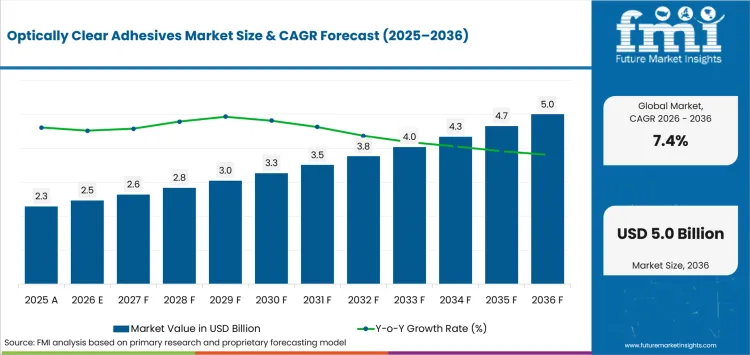
- Market Size (2026)
- USD 2.5 Bn
- Forecast (2036)
- USD 5.0 Bn
- CAGR (2026 to 2036)
- 7.4%
How big is Optically Clear Adhesives Market in 2026?
USD 2.3 billion in 2025, USD 2.5 billion in 2026 and USD 5.0 billion by 2036 at a 7.4% CAGR.
Demand for optically clear adhesives is projected to expand from USD 2.5 billion in 2026 to USD 5.0 billion by 2036 at a 7.4% CAGR. Growth follows wider use of bonded display stacks where the adhesive becomes part of the optical path rather than a simple attachment layer. 3M offers OCA variants for rigid and flexible display interfaces across electronics and automotive applications. That range shows how the same material class can serve both high-volume electronics and longer-life automotive interfaces.
Regional conditions shape how the same adhesive technology is used and supported. South Korea and Taiwan sit close to dense display manufacturing networks. Finland contributes more research-led specification activity through photonics programs. Germany has longer automotive validation cycles and Malaysia often manufactures within specifications set across multinational supply chains. These differences affect where local converting capacity and technical support matter most.
Key Takeaways
- Optical bonding demand expands as device makers replace air gaps with clear adhesive layers that improve optical continuity and mechanical coupling.
- In 2026, acrylic OCA is projected to account for 34.0% of adhesive-type demand through established pressure-sensitive converting methods.
- Film is expected to hold 42.0% of form demand in 2026 because pre-metered thickness supports controlled lamination at scale.
- Display bonding represents 34.0% of application demand in 2026 and consumer electronics accounts for 39.0% of end-use demand.
- Finland records the fastest assessed CAGR at 8.1% and Germany the slowest at 5.8% through 2036.
- 3M, Nitto Denko and tesa compete through broad film-based OCA portfolios used across several display applications. Henkel and Dexerials add liquid optical-bonding systems for automotive displays that need controlled dispensing and curing.
Analyst Perspective
"Optically clear adhesives earn their place inside the display stack through clarity and process stability. A material that performs well in isolation can fail after lamination or long-term heat exposure. The practical advantage comes from maintaining optical quality across the actual device geometry and assembly process."
- Nikhil Kaitwade, Principal Consultant, Future Market Insights
How is the optically clear adhesives market segmented?
The optically clear adhesives market is segmented by adhesive type, form, application, end use, sales channel and region.
Adhesive type distinguishes chemistries that affect optical stability and pressure-sensitive or cure behavior during production. Form separates pre-metered films and tapes from liquids or gels that need dispensing and curing. Application shows where the adhesive sits inside the optical stack and which performance issue matters most. End use reflects differences in device lifetime and redesign frequency across consumer electronics or longer-life applications. Sales channel shows whether material selection happens through panel makers or OEMs and where converting takes place. These dimensions overlap in real programs but each describes a different part of how OCA is used.
Why does acrylic OCA lead demand within the adhesive type category?
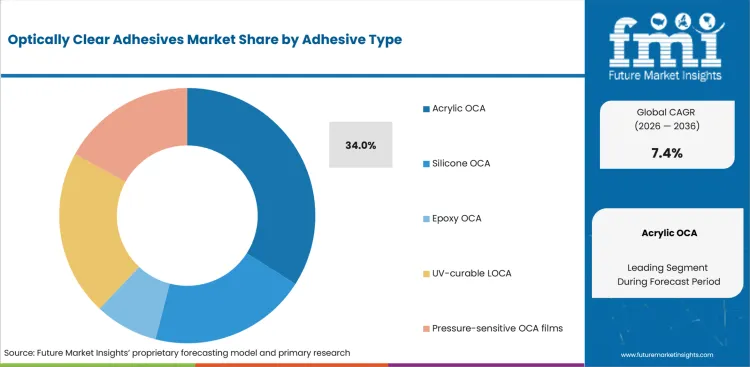
Acrylic OCA suits flat display assemblies that need a dry bond line with high transparency. The pressure-sensitive format supports die-cutting and lamination without adding a separate liquid dispensing step. Its use depends on controlling bubbles and yellowing across the intended substrate stack.
- By adhesive type, acrylic OCA is estimated to account for 34.0% in 2026 through established dry-film converting and display lamination workflows.
- OCA production uses coating and handling methods that are familiar from acrylic adhesives and electronics adhesives. That familiarity lets converters work with established pressure-sensitive processes before adding the optical tests required for display use. 3M lists acrylic OCA products for consumer and automotive displays across several bonding configurations.
Why does film lead demand within the form category?
Pre-metered film gives lamination teams a fixed bond-line thickness before final assembly. Converters can slit or die-cut the supplied web and then align the prepared adhesive to the display stack. This route reduces dispensing variation but places greater emphasis on surface cleanliness and lamination control.
- Film is expected to hold 42.0% of form demand in 2026 through thickness control and repeatable handling in high-volume display assembly.
- Roll-based converting allows OCA film to be slit or die-cut before final display assembly. Pressure-sensitive adhesives and related adhesive tapes already use liner-release and die-cut workflows that are familiar to converting teams. Nitto supplies LUCIACS as a transparent adhesive tape for bonding optical films and display cover layers.
Why does display bonding lead demand within the application category?
Display designers treat the bond line as part of the viewed optical path rather than a peripheral attachment. Filling the air gap can reduce reflection and maintain mechanical coupling between the cover material and display module. Visible bubbles or local stress can reject the finished assembly and make process stability especially important.
- Display bonding is projected to represent 34.0% of application demand in 2026 because the adhesive directly affects optical-stack performance.
- Display bonding becomes more demanding once the same material moves into vehicle cabins or flexible devices. Automotive display units add heat and UV exposure that place more emphasis on long-term optical stability. Flexible displays introduce bending and geometry changes that narrow the usable process range. Dexerials describes SVR as a liquid optical resin placed between display top plates and LCD modules in smartphones and automotive displays.
Why does consumer electronics lead demand within the end use category?
Consumer electronics combines large display volumes with frequent design changes. New cover materials and panel geometries can alter thickness or optical requirements from one device generation to the next. That cycle keeps OCA development active across smartphones and tablets before each platform reaches mass production.
- Consumer electronics is likely to capture 39.0% of end-use demand in 2026 through high-volume display assembly and frequent design changes.
- 3M lists OCA products for smartphones and notebooks across its electronics portfolio. The same portfolio covers tablets and smartwatches through several rigid or flexible bonding routes.
Why does the display panel supply chain lead demand within the sales channel category?
Panel makers influence adhesive selection before finished-device assembly because the bond is already defined within the display module. Module specialists and converters prepare roll or bulk adhesive in the format required for lamination. Once a material works across a panel family the same process can carry into several downstream devices.
- Display panel supply chain is expected to hold 38.0% of sales-channel demand in 2026 through early material selection and module-level validation.
- LINTEC places adhesive products for in-vehicle displays inside its Optical Products Operations expansion plan in the 2025 integrated report. This places OCA development close to display manufacturers that define material and converting requirements before final vehicle assembly.
What are the drivers, restraints and opportunities in the Optically Clear Adhesives Market?
Optical bonding expands as more display interfaces lose the air gap, stack-level testing can slow approval and complex geometry increases the need for wider process ranges.
- Driver: More display interfaces move from air-gap construction to optical bonding as manufacturers seek better visibility and stronger mechanical integration.
- Restraint: Stack-specific durability and yield tests can delay approval when bubbles or shrinkage appear during lamination or curing.
- Opportunity: Curved and larger displays increase the need for OCA or LOCA systems that can fill complex geometry without visible distortion.
Optical Bonding Expands as Air Gaps Disappear
Engineers use OCA or optical resin to fill the air gap between transparent display layers. Dexerials states that SVR sits between the display top plate and LCD module where it reduces reflection and diffusion of image light. The same approach is used in smartphones and automotive displays. Wider use of full optical bonding increases the number of display interfaces that require a clear adhesive layer.
Stack-Level Testing Can Delay Approval
The main restraint appears after the adhesive enters the assembled stack. Bubbles or visible stress can turn a clear material into a display defect. 3M documents OCA variants designed to resist bubbles under elevated temperature and humidity on moisture-containing substrates. Henkel describes automotive optical bonding around substrate choice and controlled UV or visible-light curing. These requirements extend validation because the adhesive must perform with the real materials and curing conditions used in the display.
Complex Geometry Broadens the Role of Film and Liquid Systems
Curved and larger automotive displays can exceed the conformability of a single film thickness. Henkel describes LOCA routes for free-formed and curved displays that use controlled dispensing on irregular surfaces. Dow offers a flowable optical-bonding material for automotive LCD and OLED modules with self-leveling behavior. tesa also documents OCA tapes for curved automotive displays and bubble control against plastic outgassing. This broadens the role of both film and liquid systems rather than favoring one format across every geometry.
Which country CAGRs are profiled in the Optically Clear Adhesives Market?
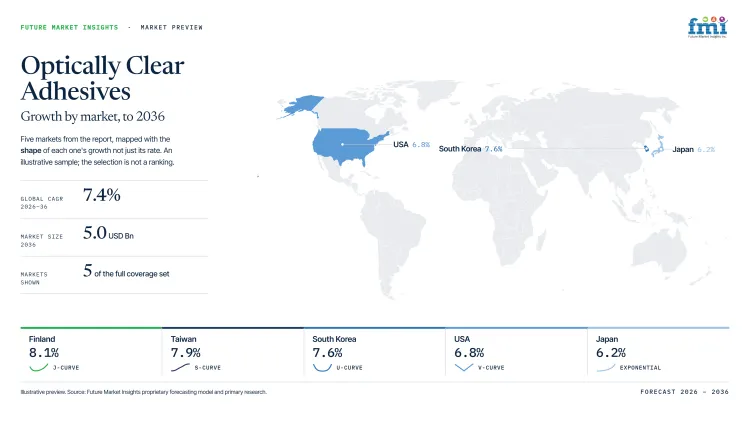
| Country | CAGR |
|---|---|
| Finland | 8.1% |
| USA | 6.8% |
| Japan | 6.2% |
| South Korea | 7.6% |
| Taiwan | 7.9% |
| Germany | 5.8% |
| Malaysia | 6.9% |
How do country-level CAGRs compare in the Optically Clear Adhesives Market?
The country forecasts span 2.3 percentage points from Finland at 8.1% to Germany at 5.8%. Taiwan follows Finland at 7.9% and South Korea reaches 7.6% through 2036. Malaysia and the USA sit close together at 6.9% and 6.8%. Japan records 6.2% and Germany 5.8% over the forecast period. The spread reflects different mixes of display manufacturing and automotive electronics rather than a simple ranking of market size.
- Finland’s strong photonics research ecosystem creates early demand for optical materials, device testing, and next-generation display technologies.
- Greenfield investments across the USA are expanding electronics and computer manufacturing capacity, supporting broader adoption of advanced display materials.
- Japan’s established electronics industry continues to generate demand through its extensive production of electronic components and ICT equipment.
- South Korea’s position as a leading ICT exporter, supported by its OLED display industry, sustains demand for advanced display materials and technologies.
- Government-backed initiatives in Taiwan are accelerating development across automotive displays and advanced display-material applications.
- Germany’s strength in electronic, optical, and automotive manufacturing supports continued demand for display-related materials and components.
- Malaysia’s export-oriented electronics sector is driving material demand as electrical and electronics investments expand manufacturing activity.
Similar CAGRs can describe very different market structures. Finland is more research-led and South Korea is more closely tied to display manufacturing. Germany has greater automotive exposure and Malaysia operates inside export-oriented electronics supply chains. The growth rates show pace but not where OCA is designed or used within each country.
Country-wise Analysis
- The Finland optically clear adhesives industry is forecast to expand at a CAGR of 8.1% through 2036, driven by growing photonics research activities that create early opportunities for optical material specification. Business Finland places photonics alongside microelectronics and quantum technology within its national Chips Campaign through 2026. The country does not possess the display assembly scale of larger Asian manufacturing hubs, making growth more closely linked to research initiatives and specialized device development. Small-batch testing and optical validation become increasingly important as these projects transition from prototype stages to commercial production.
- Adoption of optically clear adhesives in the USA is expected to witness a CAGR of 6.8% during the forecast period, owing to the country's broad electronics and automotive engineering ecosystem. The Bureau of Economic Analysis reported USD 2.0 billion in greenfield investment in computer and electronics products manufacturing during 2025. Such investments are expanding domestic manufacturing capabilities where display materials can be evaluated and integrated. The market remains distributed across multiple engineering and production centers rather than a single concentrated display manufacturing cluster.
- Sales of optically clear adhesives in Japan are projected to increase at a CAGR of 6.2% over the assessment period, supported by the nation’s established electronics manufacturing infrastructure. METI reported an industrial production index of 103.0 in May 2026 and continued monitoring electronic components through its forward manufacturing survey. The data reflects ongoing activity across production segments utilizing display and optical components. OCA consumption depends on maintaining stable lamination and curing conditions throughout controlled manufacturing environments.
- The South Korea optically clear adhesives sector is anticipated to register a CAGR of 7.6% by 2036, fueled by strong OLED production and its close association with national ICT exports. The Ministry of Trade, Industry and Resources reported in August 2026 that display exports increased by 0.5% in July, supported by higher OLED panel shipments. The country's extensive OLED manufacturing base keeps OCA demand aligned with ongoing mobile device and display product upgrades. Even minor imperfections such as bubbles or optical stress can influence panel yield at large production volumes.
- Consumption of optically clear adhesives in Taiwan is likely to grow at a CAGR of 7.9% throughout the study period, attributable to expanding display research activities across automotive and advanced materials applications. Taiwan's Ministry of Economic Affairs reported in April 2025 that 27 R&D outcomes were associated with automotive displays and advanced display materials among four strategic technology themes. The combination of active panel production and display innovation creates opportunities for next-generation OCA formulations. These materials must also maintain reliable performance at high manufacturing speeds while minimizing visible defects.
- Revenue generated by the optically clear adhesives market in Germany is forecast to rise at a CAGR of 5.8% across the forecast, bolstered by continued demand from automotive HMI applications and electronics manufacturing. Destatis reported in November 2025 that order stocks increased by 1.8% in computer, electronic, and optical product manufacturing, while automotive manufacturing order stocks rose by 0.7%. The market remains relatively mature, and automotive development programs often retain validated materials throughout extended product development cycles.
- Demand for optically clear adhesives in Malaysia is expected to record a CAGR of 6.9% over the projected period, aided by the country's export-oriented electronics manufacturing sector. MIDA reported in August 2026 that electrical and electronics activities accounted for the largest share of approved manufacturing investments during the first half of 2026. This trend keeps OCA requirements closely linked to electronics production volumes, even when material qualification decisions are made elsewhere within regional supply chains. Local quality support services and regional inventory availability can help shorten the period between material approval and production deployment.
Who are the notable companies in the Optically Clear Adhesives Market?
3M, Nitto Denko, tesa, Henkel, Dexerials, Mitsubishi Chemical, LINTEC, Avery Dennison, Dow, and Toray Advanced Materials Korea are notable companies serving this market.
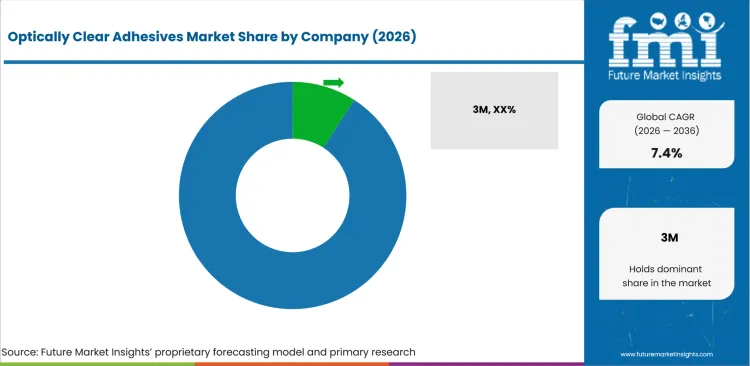
Competition is divided mainly by material form and display application. Film suppliers compete on coating and converting capability. Liquid systems are differentiated more by dispensing behavior and curing control across complex display geometry.
- 3M, Nitto Denko and tesa offer broad OCA film portfolios with direct applications in displays and automotive interfaces.
- Henkel, Dexerials and Dow compete through liquid optical-bonding systems designed for free-form or automotive display requirements.
- Mitsubishi Chemical and LINTEC broaden competition through optical adhesive sheets and display-focused converting capabilities. Avery Dennison and Toray Advanced Materials Korea add specialty formulation or coating routes for transparent bonding applications.
Competitive Benchmarking: Optically Clear Adhesives Market
| Company | Display OCA / LOCA Breadth | Automotive Optical-Bonding Readiness | Complex-Geometry Process Support | Geographic Reach |
|---|---|---|---|---|
| 3M | High | High | High | North America, Europe and Asia-Pacific |
| Nitto Denko | High | High | Medium | North America, Europe, Japan, Taiwan and Southeast Asia |
| tesa | High | High | High | Europe, North America, China and broader Asia-Pacific |
| Henkel | Medium | High | High | Global commercial network |
| Dexerials | High | High | High | Japan, North America, Europe and Asia |
| Mitsubishi Chemical | Medium | Medium | Medium | Japan, North America, Europe and Asia |
| LINTEC | High | High | Medium | Japan, North America, Europe and Asia |
| Avery Dennison | High | Low | Low | North America, Europe and Asia |
| Dow | Low | High | Medium | Global commercial network |
| Toray Advanced Materials Korea | Medium | High | Medium | South Korea |
Scoring basis: High product breadth indicates at least three directly documented OCA or LOCA routes. Medium indicates two documented routes. High automotive readiness requires a dedicated vehicle-display product or stated strategy. Medium reflects automotive application evidence with narrower public detail. High geometry support requires explicit curved or free-form capability. Medium requires one documented thickness or flow mechanism. Low indicates direct OCA participation without enough public evidence for the specialty criterion.
Key Developments in the Optically Clear Adhesives Market
- In July 2026, Dexerials reported that SVR held 54.3% of the global optical clear resin category in the display research cited by the company. SVR is used in smartphones and automotive displays where liquid resin fills the optical gap inside the viewed stack.
- In 2025, LINTEC stated in its Integrated Report 2025 that Optical Products Operations would expand proprietary adhesive products for in-vehicle displays. Its plan covers new product development and sales expansion for automotive OCA across display applications.
- In January 2026, Toray Advanced Materials Korea published PCT application WO2026023825A1 covering an acrylic adhesive film designed to reduce bubbles and lifting. The filing also describes improved durability and vehicle displays as a target application with demanding environmental reliability requirements.
Key Players in the Optically Clear Adhesives Market
Film and Sheet OCA Platforms
- 3M
- Nitto Denko
- tesa
- Mitsubishi Chemical
- LINTEC
- Toray Advanced Materials Korea
Liquid Optical-Bonding Systems
- Henkel
- Dexerials
- Dow
Specialty Polymer and Coating Support
- Avery Dennison
Optically Clear Adhesives Market - Report Scope
| Coverage field | Report scope |
|---|---|
| Market breakdown | By adhesive type, form, application, end use, sales channel and region. |
| Quantitative Units | USD billion. |
| Market Definition | Commercial optically clear adhesive films, tapes, sheets, liquids and gels sold for transparent optical bonding and lamination. Finished devices, non-optically-clear structural adhesives, standalone optical coatings and adjacent substitute products are excluded. |
| Regions Covered | North America, Latin America, Western Europe, Eastern Europe, East Asia, South Asia and Pacific and Middle East and Africa. |
| Countries Covered | Finland, USA, Japan, South Korea, Taiwan, Germany and Malaysia, with 30+ countries covered in the full report. |
| Key Companies Profiled | 3M, Nitto Denko, tesa, Henkel, Dexerials, Mitsubishi Chemical, LINTEC, Avery Dennison, Dow and Toray Advanced Materials Korea. |
| Forecast Period | 2026 to 2036. |
| Approach | Primary and secondary research with market triangulation. |
Optically Clear Adhesives Market - Research Methodology
| Method | Approach |
|---|---|
| Primary Research | FMI analysts gathered input from adhesive manufacturers, converters, display supply-chain participants, electronics distributors, OEM materials teams and end users. Interviews examined material qualification, purchase criteria, channel behavior, process-yield constraints and technical-support requirements. |
| Desk Research | Desk research covered government statistics, official company publications, technical documents, product literature and recognized industry records. Sources were reviewed for publication date, geographic coverage, exact-market fit and consistency with the defined product boundary. |
| Market Sizing and Forecasting | The model reconciled the reported baseline with segment structure, application use, adhesive form mix, channel economics and country demand conditions. Forecast assumptions considered display integration, automotive HMI design, qualification cycles, material yield and substitution between film and liquid systems. |
| Data Validation | Estimates were checked against independent indicators and direct supplier evidence. Downstream device value, duplicate revenue, unsupported claims and adjacent non-optical adhesive categories were excluded from the defined market total. |
Optically Clear Adhesives Market by Segments
Optically Clear Adhesives Market segmented by Adhesive Type:
- Acrylic OCA
- Silicone OCA
- Epoxy OCA
- UV-curable LOCA
- Pressure-sensitive OCA films
Optically Clear Adhesives Market segmented by Form:
- Film
- Liquid
- Tape
- Dispensable gel
Optically Clear Adhesives Market segmented by Application:
- Display bonding
- Touch panels
- Camera modules
- Automotive displays
- Wearables - AR devices
Optically Clear Adhesives Market segmented by End Use:
- Consumer electronics
- Automotive electronics
- Medical devices
- Industrial displays
- Optical devices
Optically Clear Adhesives Market segmented by Sales Channel:
- Display panel supply chain
- Electronics distributors
- Direct OEM supply
- Converter - laminator channel
Optically Clear Adhesives Market by Region:
- North America
- United States
- Canada
- Latin America
- Brazil
- Mexico
- Argentina
- Chile
- Western Europe
- Germany
- France
- United Kingdom
- Italy
- Spain
- Benelux
- Nordics
- Eastern Europe
- Poland
- Czech Republic
- Romania
- Hungary
- East Asia
- China
- Japan
- South Korea
- South Asia and Pacific
- India
- ASEAN
- Australia and New Zealand
- Middle East and Africa
- GCC Countries
- South Africa
- Türkiye
- Israel
Research Sources and Bibliography
- 3M. (n.d.). 3M Optically Clear Adhesives. Retrieved September 11, 2026.
- Nitto Denko Corporation. (n.d.). Optically Clear Adhesive Tape LUCIACS™ CS986 Series. Retrieved September 11, 2026.
- Nitto Denko Corporation. (2025). Nitto Group Integrated Report 2025.
- tesa SE. (2026, June 24). Optically clear adhesives: improve display performance.
- Henkel AG & Co. KGaA. (n.d.). Optical bonding for automotive displays. Retrieved September 11, 2026.
- Dexerials Corporation. (2026, July 29). Creating Next-Generation Solutions for AI Advancement and Autonomous Driving: Three Core Products Supporting the World’s Display Industry, Have the Largest Share of Their Global Markets for Seven Consecutive Years.
- Dexerials Corporation. (2026, May 21). Dexerials to Participate in Automotive Engineering Exposition 2026 NAGOYA, as an Exhibitor.
- LINTEC Corporation. (2025, October 31). LINTEC Integrated Report 2025.
- Mitsubishi Chemical Corporation. (n.d.). Optical clear adhesive sheet CLEARFIT™. Retrieved September 11, 2026.
- Avery Dennison Performance Polymers. (n.d.). Optically Clear Adhesive Solutions. Retrieved September 11, 2026.
- Dow Inc. (n.d.). DOWSIL™ VE-6001 UV_T Optical Bonding. Retrieved September 11, 2026.
- Toray Advanced Materials Korea Inc. (2026, January 29). WO2026023825A1 - Adhesive composition and adhesive film comprising same.
- Toray Industries, Inc. (n.d.). Toray Advanced Materials Korea Inc. [TAK]. Retrieved September 11, 2026.
- Business Finland. (2025, October 20). The Chips Campaign.
- USA Bureau of Economic Analysis. (2026, June 10). New Foreign Direct Investment in the United States, 2025.
- Ministry of Economy, Trade and Industry, Japan. (2026, June 30). Preliminary Report for May 2026: Indices of Industrial Production.
- Ministry of Trade, Industry and Resources, Republic of Korea. (2026, August 14). Korea’s ICT Exports Reach Record $53.36 Billion for July.
- Department of Industrial Technology, Ministry of Economic Affairs, Taiwan. (2025, April 16). MOEA and Display Industry Join Forces to Showcase 27 Innovative Technologies.
- Federal Statistical Office of Germany (Destatis). (2025, November 19). Stock of orders in manufacturing in September 2025: +0.6% on the previous month.
- Malaysian Investment Development Authority. (2026, August 28). Malaysia Secures RM218.5 Billion in Approved Investments In 1H 2026, With Domestic Investment in Manufacturing Up 23%.
This bibliography is provided for reader reference and is not exhaustive because the full report contains the complete source list and detailed citations.
This Report Answers
- How large is the optically clear adhesives market in 2026 and 2036?
- Which display and electronics conditions support demand for optically clear adhesives?
- Why does acrylic OCA hold the leading position within adhesive type?
- How does film influence display lamination and downstream process control?
- Why does display bonding hold the leading position within application?
- How do growth rates differ across Finland, USA, Japan, South Korea, Taiwan, Germany and Malaysia?
- How do the ten named suppliers differ by OCA route and automotive readiness?
- Which qualification constraints and geometry requirements affect OCA adoption across display applications?
Frequently Asked Questions
How big is the Optically Clear Adhesives Market in 2026?
The optically clear adhesives market is estimated at USD 2.5 billion in 2026 and is forecast to reach USD 5.0 billion by 2036. Growth reflects wider use of bonded display interfaces across electronics and automotive applications.
What is the CAGR of the Optically Clear Adhesives Market from 2026 to 2036?
The optically clear adhesives market is projected to grow at a 7.4% CAGR between 2026 and 2036. Display integration and automotive HMI programs increase the number of transparent interfaces that require optical bonding.
Which adhesive type segment leads the Optically Clear Adhesives Market?
Acrylic OCA is estimated to account for 34.0% of adhesive-type demand in 2026. Its dry-film pressure-sensitive format fits established converting and lamination workflows across high-volume display programs.
How much value will the Optically Clear Adhesives Market add between 2026 and 2036?
The forecast adds USD 2.5 billion between the reported 2026 and 2036 market values. The increase reflects broader use of optically bonded interfaces across electronics and automotive display systems.
Which companies are active in the Optically Clear Adhesives Market?
Active suppliers include 3M, Nitto Denko and tesa alongside Henkel and Dexerials. Mitsubishi Chemical, LINTEC and Avery Dennison are also active together with Dow and Toray Advanced Materials Korea.
Preview the report firsthand - request a free sample
Get SampleGet the brochure for pricing and purchase details.
Get PDFTable of Content
- Key Takeaways
- Market Size and CAGR
- Top Growth Driver
- Fastest Growing Segment
- Leading Region
- Key Companies
- Emerging Opportunities
- Executive Summary
- Global Market Outlook
- Demand-side Trends
- Supply-side Trends
- Technology Roadmap Analysis
- Analysis and Recommendations
- Analyst Perspective (What is happening? Why now? What should investors know?)
- Key Questions Answered
- How large is the market?
- What is the CAGR?
- What are key trends?
- Which region dominates?
- Who are the leaders?
- Market Overview
- Market Coverage / Taxonomy
- Market Definition / Scope / Limitations
- Research Methodology
- Chapter Orientation
- Analytical Lens and Working Hypotheses
- Market Structure, Signals, and Trend Drivers
- Benchmarking and Cross-market Comparability
- Market Sizing, Forecasting, and Opportunity Mapping
- Research Design and Evidence Framework
- Desk Research Programme (Secondary Evidence)
- Expert Input and Fieldwork (Primary Evidence)
- Tooling, Models, and Reference Databases
- Data Engineering and Model Build
- Quality Assurance and Audit Trail
- Market Background
- Market Dynamics (Drivers, Restraints, Opportunity, Trends)
- Scenario Forecast (Optimistic, Likely, Conservative)
- Impact Analysis
- AI Impact
- Sustainability Impact
- Regulatory Impact
- Technology Impact
- Consumer / Buyer Analysis
- Purchase Drivers
- Adoption Barriers
- Buyer Journey
- Opportunity Map Analysis
- Product Life Cycle Analysis
- Supply Chain Analysis
- Investment Feasibility Matrix
- Value Chain Analysis
- PESTLE and Porter's Analysis
- Regulatory Landscape
- Regional Parent Market Outlook
- Production and Consumption Statistics
- Import and Export Statistics
- Global Market Analysis and Forecast, 2021 to 2036
- Historical Market Size Value (USD Billion) Analysis, 2021 to 2025
- Current and Future Market Size Value (USD Billion) Projections, 2026 to 2036
- Y-o-Y Growth Trend Analysis
- Absolute $ Opportunity Analysis
- Global Market Pricing Analysis, 2021 to 2036
- Global Market Analysis and Forecast, By Adhesive Type, 2021 to 2036
- Introduction / Key Findings
- Historical Market Size Value (USD Billion) Analysis By Adhesive Type, 2021 to 2025
- Current and Future Market Size Value (USD Billion) Analysis and Forecast By Adhesive Type, 2026 to 2036
- Acrylic OCA
- Silicone OCA
- Epoxy OCA
- UV-curable LOCA
- Pressure-sensitive OCA films
- Acrylic OCA
- Y-o-Y Growth Trend Analysis By Adhesive Type, 2021 to 2025
- Absolute $ Opportunity Analysis By Adhesive Type, 2026 to 2036
- Global Market Analysis and Forecast, By Form, 2021 to 2036
- Introduction / Key Findings
- Historical Market Size Value (USD Billion) Analysis By Form, 2021 to 2025
- Current and Future Market Size Value (USD Billion) Analysis and Forecast By Form, 2026 to 2036
- Film
- Liquid
- Tape
- Dispensable gel
- Film
- Y-o-Y Growth Trend Analysis By Form, 2021 to 2025
- Absolute $ Opportunity Analysis By Form, 2026 to 2036
- Global Market Analysis and Forecast, By Application, 2021 to 2036
- Introduction / Key Findings
- Historical Market Size Value (USD Billion) Analysis By Application, 2021 to 2025
- Current and Future Market Size Value (USD Billion) Analysis and Forecast By Application, 2026 to 2036
- Display bonding
- Touch panels
- Camera modules
- Automotive displays
- Wearables / AR devices
- Display bonding
- Y-o-Y Growth Trend Analysis By Application, 2021 to 2025
- Absolute $ Opportunity Analysis By Application, 2026 to 2036
- Global Market Analysis and Forecast, By End Use, 2021 to 2036
- Introduction / Key Findings
- Historical Market Size Value (USD Billion) Analysis By End Use, 2021 to 2025
- Current and Future Market Size Value (USD Billion) Analysis and Forecast By End Use, 2026 to 2036
- Consumer electronics
- Automotive electronics
- Medical devices
- Industrial displays
- Optical devices
- Consumer electronics
- Y-o-Y Growth Trend Analysis By End Use, 2021 to 2025
- Absolute $ Opportunity Analysis By End Use, 2026 to 2036
- Global Market Analysis and Forecast, By Sales Channel, 2021 to 2036
- Introduction / Key Findings
- Historical Market Size Value (USD Billion) Analysis By Sales Channel, 2021 to 2025
- Current and Future Market Size Value (USD Billion) Analysis and Forecast By Sales Channel, 2026 to 2036
- Display panel supply chain
- Electronics distributors
- Direct OEM supply
- Converter / laminator channel
- Display panel supply chain
- Y-o-Y Growth Trend Analysis By Sales Channel, 2021 to 2025
- Absolute $ Opportunity Analysis By Sales Channel, 2026 to 2036
- Global Market Analysis and Forecast, By Region, 2021 to 2036
- Introduction
- Historical Market Size Value (USD Billion) Analysis By Region, 2021 to 2025
- Current Market Size Value (USD Billion) Analysis and Forecast By Region, 2026 to 2036
- North America
- Latin America
- Western Europe
- Eastern Europe
- East Asia
- South Asia and Pacific
- Middle East & Africa
- Market Attractiveness Analysis By Region
- North America Market Analysis and Forecast, By Country, 2021 to 2036
- Historical Market Size Value (USD Billion) Trend Analysis By Market Taxonomy, 2021 to 2025
- Market Size Value (USD Billion) Forecast By Market Taxonomy, 2026 to 2036
- By Country
- USA
- Canada
- By Adhesive Type
- By Form
- By Application
- By End Use
- By Sales Channel
- By Country
- Market Attractiveness Analysis
- By Country
- By Adhesive Type
- By Form
- By Application
- By End Use
- By Sales Channel
- Key Takeaways
- Latin America Market Analysis and Forecast, By Country
- Historical Market Size Value (USD Billion) Trend Analysis By Market Taxonomy, 2021 to 2025
- Market Size Value (USD Billion) Forecast By Market Taxonomy, 2026 to 2036
- By Country
- Brazil
- Mexico
- Chile
- Rest of Latin America
- By Adhesive Type
- By Form
- By Application
- By End Use
- By Sales Channel
- By Country
- Market Attractiveness Analysis
- By Country
- By Adhesive Type
- By Form
- By Application
- By End Use
- By Sales Channel
- Key Takeaways
- Western Europe Market Analysis and Forecast, By Country
- Historical Market Size Value (USD Billion) Trend Analysis By Market Taxonomy, 2021 to 2025
- Market Size Value (USD Billion) Forecast By Market Taxonomy, 2026 to 2036
- By Country
- Germany
- UK
- Italy
- Spain
- France
- Nordic
- BENELUX
- Rest of Western Europe
- By Adhesive Type
- By Form
- By Application
- By End Use
- By Sales Channel
- By Country
- Market Attractiveness Analysis
- By Country
- By Adhesive Type
- By Form
- By Application
- By End Use
- By Sales Channel
- Key Takeaways
- Eastern Europe Market Analysis and Forecast, By Country
- Historical Market Size Value (USD Billion) Trend Analysis By Market Taxonomy, 2021 to 2025
- Market Size Value (USD Billion) Forecast By Market Taxonomy, 2026 to 2036
- By Country
- Russia
- Poland
- Hungary
- Balkan & Baltic
- Rest of Eastern Europe
- By Adhesive Type
- By Form
- By Application
- By End Use
- By Sales Channel
- By Country
- Market Attractiveness Analysis
- By Country
- By Adhesive Type
- By Form
- By Application
- By End Use
- By Sales Channel
- Key Takeaways
- East Asia Market Analysis and Forecast, By Country
- Historical Market Size Value (USD Billion) Trend Analysis By Market Taxonomy, 2021 to 2025
- Market Size Value (USD Billion) Forecast By Market Taxonomy, 2026 to 2036
- By Country
- China
- Japan
- South Korea
- By Adhesive Type
- By Form
- By Application
- By End Use
- By Sales Channel
- By Country
- Market Attractiveness Analysis
- By Country
- By Adhesive Type
- By Form
- By Application
- By End Use
- By Sales Channel
- Key Takeaways
- South Asia and Pacific Market Analysis and Forecast, By Country
- Historical Market Size Value (USD Billion) Trend Analysis By Market Taxonomy, 2021 to 2025
- Market Size Value (USD Billion) Forecast By Market Taxonomy, 2026 to 2036
- By Country
- India
- ASEAN
- Australia & New Zealand
- Rest of South Asia and Pacific
- By Adhesive Type
- By Form
- By Application
- By End Use
- By Sales Channel
- By Country
- Market Attractiveness Analysis
- By Country
- By Adhesive Type
- By Form
- By Application
- By End Use
- By Sales Channel
- Key Takeaways
- Middle East & Africa Market Analysis and Forecast, By Country
- Historical Market Size Value (USD Billion) Trend Analysis By Market Taxonomy, 2021 to 2025
- Market Size Value (USD Billion) Forecast By Market Taxonomy, 2026 to 2036
- By Country
- Kingdom of Saudi Arabia
- Other GCC Countries
- Türkiye
- South Africa
- Other African Union
- Rest of Middle East & Africa
- By Adhesive Type
- By Form
- By Application
- By End Use
- By Sales Channel
- By Country
- Market Attractiveness Analysis
- By Country
- By Adhesive Type
- By Form
- By Application
- By End Use
- By Sales Channel
- Key Takeaways
- Key Countries Market Analysis
- USA
- Pricing Analysis
- Market Share Analysis, 2025
- By Adhesive Type
- By Form
- By Application
- By End Use
- By Sales Channel
- Canada
- Pricing Analysis
- Market Share Analysis, 2025
- By Adhesive Type
- By Form
- By Application
- By End Use
- By Sales Channel
- Mexico
- Pricing Analysis
- Market Share Analysis, 2025
- By Adhesive Type
- By Form
- By Application
- By End Use
- By Sales Channel
- Brazil
- Pricing Analysis
- Market Share Analysis, 2025
- By Adhesive Type
- By Form
- By Application
- By End Use
- By Sales Channel
- Chile
- Pricing Analysis
- Market Share Analysis, 2025
- By Adhesive Type
- By Form
- By Application
- By End Use
- By Sales Channel
- Germany
- Pricing Analysis
- Market Share Analysis, 2025
- By Adhesive Type
- By Form
- By Application
- By End Use
- By Sales Channel
- UK
- Pricing Analysis
- Market Share Analysis, 2025
- By Adhesive Type
- By Form
- By Application
- By End Use
- By Sales Channel
- Italy
- Pricing Analysis
- Market Share Analysis, 2025
- By Adhesive Type
- By Form
- By Application
- By End Use
- By Sales Channel
- Spain
- Pricing Analysis
- Market Share Analysis, 2025
- By Adhesive Type
- By Form
- By Application
- By End Use
- By Sales Channel
- France
- Pricing Analysis
- Market Share Analysis, 2025
- By Adhesive Type
- By Form
- By Application
- By End Use
- By Sales Channel
- India
- Pricing Analysis
- Market Share Analysis, 2025
- By Adhesive Type
- By Form
- By Application
- By End Use
- By Sales Channel
- ASEAN
- Pricing Analysis
- Market Share Analysis, 2025
- By Adhesive Type
- By Form
- By Application
- By End Use
- By Sales Channel
- Australia & New Zealand
- Pricing Analysis
- Market Share Analysis, 2025
- By Adhesive Type
- By Form
- By Application
- By End Use
- By Sales Channel
- China
- Pricing Analysis
- Market Share Analysis, 2025
- By Adhesive Type
- By Form
- By Application
- By End Use
- By Sales Channel
- Japan
- Pricing Analysis
- Market Share Analysis, 2025
- By Adhesive Type
- By Form
- By Application
- By End Use
- By Sales Channel
- South Korea
- Pricing Analysis
- Market Share Analysis, 2025
- By Adhesive Type
- By Form
- By Application
- By End Use
- By Sales Channel
- Russia
- Pricing Analysis
- Market Share Analysis, 2025
- By Adhesive Type
- By Form
- By Application
- By End Use
- By Sales Channel
- Poland
- Pricing Analysis
- Market Share Analysis, 2025
- By Adhesive Type
- By Form
- By Application
- By End Use
- By Sales Channel
- Hungary
- Pricing Analysis
- Market Share Analysis, 2025
- By Adhesive Type
- By Form
- By Application
- By End Use
- By Sales Channel
- Kingdom of Saudi Arabia
- Pricing Analysis
- Market Share Analysis, 2025
- By Adhesive Type
- By Form
- By Application
- By End Use
- By Sales Channel
- Türkiye
- Pricing Analysis
- Market Share Analysis, 2025
- By Adhesive Type
- By Form
- By Application
- By End Use
- By Sales Channel
- South Africa
- Pricing Analysis
- Market Share Analysis, 2025
- By Adhesive Type
- By Form
- By Application
- By End Use
- By Sales Channel
- USA
- Market Structure Analysis
- Competition Dashboard
- Competition Benchmarking
- Market Share Analysis of Top Players
- By Regional
- By Adhesive Type
- By Form
- By Application
- By End Use
- By Sales Channel
- Emerging Startups
- Innovation Benchmarking
- Competition Analysis
- Competition Deep Dive
- 3M
- Overview
- Product Portfolio
- Profitability by Market Segments
- Sales Footprint
- Strategy Overview
- Marketing Strategy
- Product Strategy
- Channel Strategy
- Nitto Denko
- Tesa
- Henkel
- Dexerials
- Mitsubishi Chemical
- Lintec
- Avery Dennison
- Dow
- Toray
- 3M
- Case Studies
- Success Stories
- Recent Developments
- Competition Deep Dive
- Assumptions & Acronyms Used


