

- Industry Size (2026)
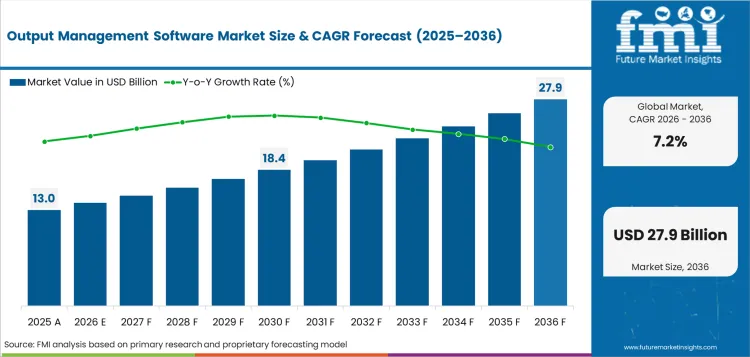
- USD 13.0 Bn
- Forecast (2036)
- USD 26.05 Bn
- CAGR (2026 to 2036)
- 7.2%
Output Management Software Market Size, Market Forecast and Outlook By FMI
Summary of the Output Management Software Market
- Demand and Growth Drivers
- Large enterprises are projected to represent 56.9% share in 2026 as complex document environments need shared governance.
- India is forecast above the global pace at 8.9% CAGR through 2036 due to digital public services and enterprise automation.
- China is expected to grow at 7.8% CAGR through 2036 as large enterprise systems and regulated communication needs expand.
- BFSI is estimated to account for 31.0% share in 2026 with statements and notices anchoring high-volume document output.
- Product and Segment View
- Output management software leads the Solution segment with 75.8% share as enterprises prefer repeatable platform licensing.
- Large enterprise leads the Enterprise Size segment with 56.9% share given higher transaction volume and stronger control needs.
- Cloud leads the Deployment segment with 62.0% share as distributed teams need shared routing and lower infrastructure burden.
- Document delivery leads the Function segment with 44.0% share as buyers prioritize secure routing across print and digital channels.
- Geography and Competitive Outlook
- India and China are forecast above the global CAGR as enterprise digitization and high transaction volumes support faster adoption.
- South Korea is projected to record 7.0% CAGR through 2036 with digital public services and automation culture supporting uptake.
- OpenText and Ricoh hold strong positions through enterprise information management and document service depth.
- Tungsten Automation and Quadient compete around workflow automation and regulated customer communication use cases.
- Analyst Opinion
- Sudip saha, Principal Consultant at FMI says, "Output management software is evolving from basic print administration into a broader enterprise communications control layer. One of the significant source of demand is regulated document delivery, as banks and insurers require proof that statements and notices reached the correct channel. Vendors gain a competitive advantage when they can integrate document composition and archival controls without forcing customers into a full platform overhaul. As a result, buyers should prioritize integration depth and migration risk over feature checklists."
- Output Management Software Market Value Analysis
- Output management software leads solution demand as enterprises value repeatable license and SaaS control layers.
- Large enterprises stay central to adoption since their document flows cross business units and regulated customer channels.
- Cloud delivery shapes new buying as IT teams reduce local server upkeep and standardize routing rules.
- Price sensitivity appears in mid-market buyers that compare subscription cost with support and integration workload.
Key Takeaways
| Metric | Value |
|---|---|
| Market Size (2025) | USD 12.13 Billion |
| Market Size (2036) | USD 26.05 Billion |
| Fastest-Growing Segment | With A |
| With A CAGR | 7.2% |
| Incremental Opportunity (2026–2036) | USD 13.05 Billion |
| Leading Solution (2026) | Output Management Software |
| Output Management Software Share (2026) | 75.8% |
| Fastest-Growing Country | India |
| India CAGR | 8.9% |
| Leading End User (2026) | Large Enterprises |
| Large Enterprises Share (2026) | 56.9% |
| Leading Deployment (2026) | Cloud Deployment |
| Cloud Deployment Share (2026) | 62.0% |
Output management software is moving from print routing into compliance-led document control. The European Accessibility Act applies from 28 June 2025 and raises pressure on customer-facing documents. OpenText’s accessible PDF/UA and WCAG conversion capability shows how legacy print streams are being repositioned for digital delivery. Cloud control is another practical driver because LRS supports serverless user printing and pull printing. PaperCut’s September 2025 secure release guidance adds the security layer through device authentication before printing. For buyers in banking, insurance and public services, the value sits in one controlled workflow for digital output and audit-ready delivery.
Output Management Software Market Definition
The output management software market covers software platforms and related services used to create, format, route, deliver, monitor, and archive business documents. Included products manage print output, digital delivery, secure release, template control, and audit logs across enterprise systems. The scope excludes basic office print drivers, standalone desktop publishing tools, and customer communication tools that do not manage enterprise output control.
Output Management Software Market Inclusions
The scope includes output management software, implementation services, cloud and on-premises platforms, print control tools, document delivery engines, workflow routing, archive control, analytics, and enterprise demand across major industries and regions.
Output Management Software Market Exclusions
The scope excludes general office printers, unmanaged print drivers, hardware-only managed print services, standalone scanning tools, consumer document apps, and content creation software without output routing or governance capability.
Output Management Software Market Research Methodology
- Primary Research: FMI analysts reviewed input from software vendors, system integrators, enterprise IT leaders, and document operations teams. Discussions focused on output volume, integration needs, compliance controls, and cloud migration behavior.
- Desk Research: Desk research combined public digital government data, e-invoicing policy signals, tax filing statistics, company releases, and enterprise software disclosures. The addressable pool was defined around controlled document output and delivery workflows.
- Market Sizing and Forecasting: The model combined enterprise software spending patterns, output-heavy industry demand, solution share, and country adoption rates. Country growth was adjusted for digital transaction intensity and regulatory document control needs.
- Data Validation: Forecasts were checked against public digital transaction indicators, cloud workflow activity, company portfolio shifts, and FMI published market anchors. The team compared values with adjacent enterprise software categories and document automation use cases.
Why is the Output Management Software Market Growing?
- Enterprises are replacing scattered print servers with central output platforms that apply shared routing and control rules.
- Regulated industries need proof of document delivery and access history for statements, claims, invoices, and notices.
- Cloud workflows reduce local infrastructure load while supporting shared templates across branch offices and remote teams.
- E-invoicing and digital tax rules expand the need for structured document creation and controlled delivery records.
Enterprise output is no longer limited to print queues and office documents. The United States tax system shows how large regulated workflows now depend on electronic delivery, with the Internal Revenue Service reporting more than 219.9 million returns and other forms filed electronically in fiscal year 2024. That scale explains why audit logs and format control are becoming normal requirements. Suppliers that link routing and archive proof can compete beyond basic print management.
Public and private digital workflows are raising the baseline for document control. India recorded over 18,000 crore digital payment transactions in 2024 to 2025 according to the Ministry of Finance. This transaction density increases the volume of statements, notices, and confirmation records that organizations must create and deliver. The result is a stronger case for centralized platforms that connect business systems with governed output channels.
Market Segmentation Analysis
- Output management software is projected to account for 75.8% share in 2026 as buyers prefer configurable platforms over project services.
- With an estimated 56.9% share in 2026, large enterprises are expected to lead Enterprise Size demand through complex document governance needs.
- Cloud deployment is projected to account for 62.0% of Deployment demand in 2026 due to shared access and lower server upkeep.
- BFSI is expected to hold 31.0% of Industry demand in 2026 with statement and notice workflows anchoring use.
- Document delivery is anticipated to direct 44.0% of Function demand in 2026 as enterprises control print and digital channels together.
Segment demand is shaped by document volume and the way buyers connect output systems to core applications. Software carries the lead because enterprises want reusable platforms with templates and routing rules. Services remain important during migration, but they follow the main software decision. This means vendors compete on integration depth and audit-ready workflows more than standalone print features.
Insights into the Output Management Software Solution Segment
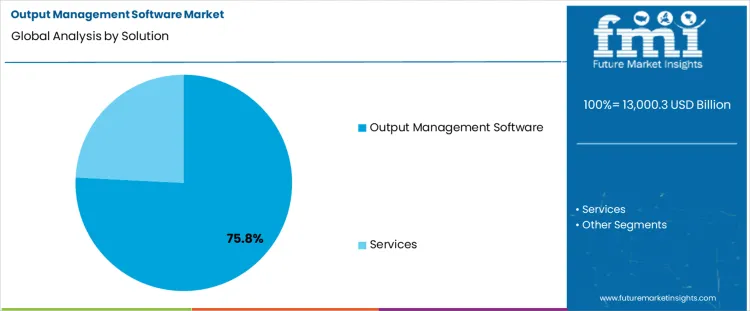
- Output management software is projected to account for 75.8% in 2026 as document-heavy enterprises prefer direct platform control.
- Template control and secure routing affect buying in this segment, so IT teams compare integration depth before replacing legacy output tools.
Insights into the Large Enterprise Size Segment
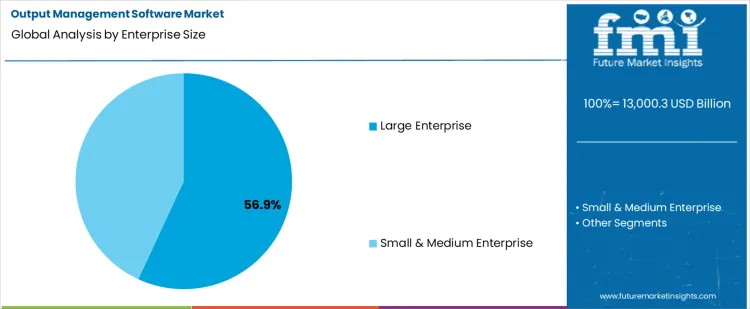
- Large enterprises are estimated to hold 56.9% in 2026 as high document volume creates stronger audit and delivery needs.
- Complex operating units often need shared policies for statements and notices, which makes centralized output control more useful than local tools.
Insights into the Cloud Deployment Segment
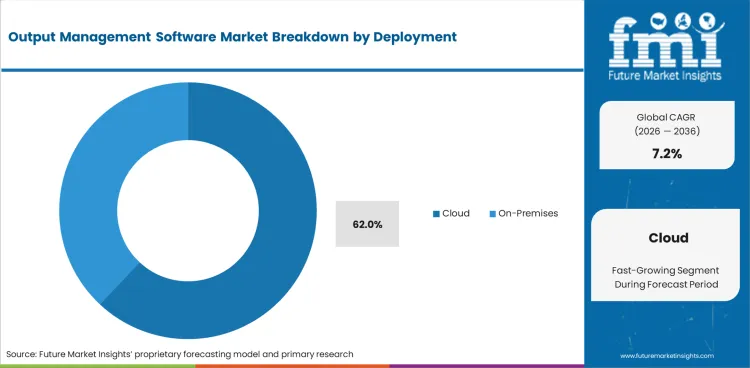
- Cloud deployment is anticipated to represent 62.0% in 2026 as distributed offices prefer shared rules and lower server upkeep.
- Software teams value cloud systems when they connect with ERP and content platforms without adding branch-level infrastructure.
Insights into the BFSI Industry Segment
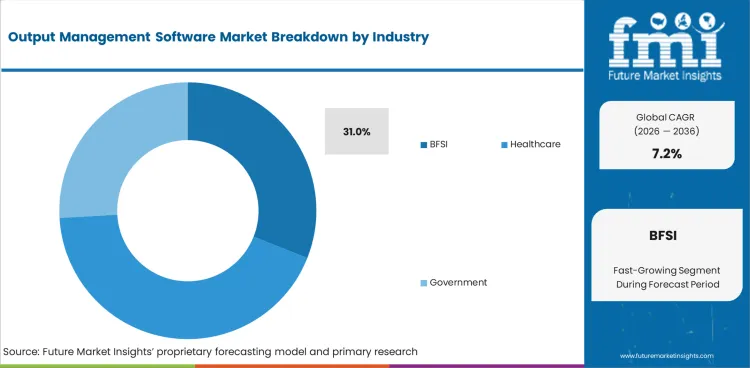
- BFSI is expected to represent 31.0% of Industry demand in 2026 as banks and insurers send high volumes of regulated communications.
- Account statements and policy notices require delivery proof, which increases the value of logged output paths and archival controls.
Insights into the Document Delivery Function Segment
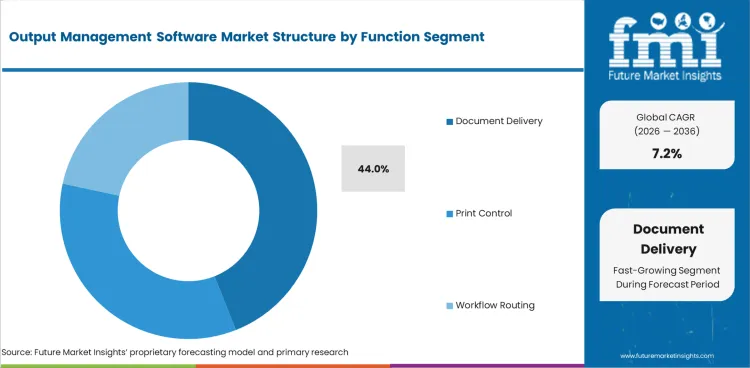
- Document delivery is estimated to account for 44.0% in 2026 as buyers manage print and digital channels in one flow.
- Routing rules matter in this segment since delivery errors can create service costs and compliance exposure.
Output Management Software Market Drivers, Restraints, and Opportunities
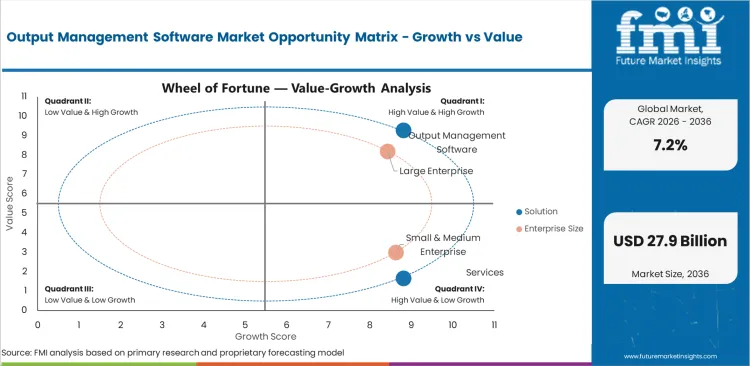
- Audit-ready document delivery drives orders where regulated notices must show controlled creation and delivery logs.
- Legacy integration can restrain adoption when output streams are tied to old ERP and mainframe systems.
- Cloud output platforms create an opportunity for enterprises that want fewer local print servers and cleaner rule control.
- Data sovereignty affects global rollouts as firms must align output archives with country-level privacy requirements.
Audit-ready document control
Regulated industries are the clearest demand trigger for output management software. Electronic filing and digital service data show that public agencies and enterprises now process documents at very high scale. Output systems reduce risk by enforcing templates, delivery rules, and access records. Vendors with strong logging and archive controls are better placed in banking, insurance, healthcare, and government accounts.
Cloud workflow consolidation
Cloud output management is gaining share as enterprises reduce local infrastructure and standardize delivery rules. OpenText released Cloud Editions 24.4 in November 2024 with secure data connectivity and workflow features across multi-cloud environments. This product direction matches buyer needs for connected document flows. It also increases pressure on smaller vendors to show secure integration with major enterprise systems.
Legacy system migration risk
Migration remains a practical restraint for large enterprises. Many output streams come from older ERP, claims, billing, or mainframe systems that cannot be replaced quickly. Buyers therefore phase projects by document type or business unit. This slows revenue conversion but favors suppliers that can handle hybrid environments without breaking existing delivery rules.
Analysis of Output Management Software Market By Key Countries
.webp "Top Country Growth Comparison Output Management Software Market Cagr (2026 2036)")
| Country | CAGR |
|---|---|
| India | 8.9% |
| China | 7.8% |
| South Korea | 7.0% |
| United States | 6.2% |
| United Kingdom | 5.7% |
| Germany | 5.4% |
| France | 5.2% |
Source: FMI analysis based on primary research and proprietary forecasting model.
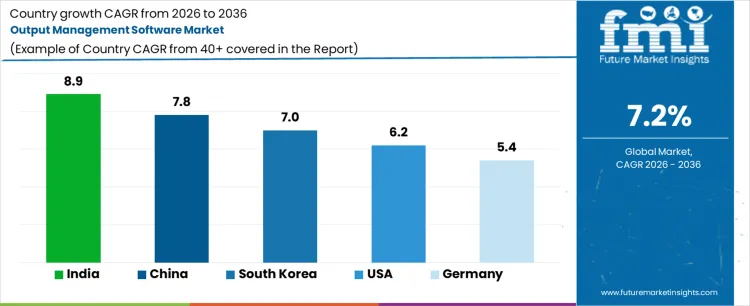
Output Management Software Market CAGR Analysis By Country
- India is projected to record an 8.9% CAGR through 2036 as digital transactions and enterprise service centers increase output volume.
- China is expected to expand at 7.8% CAGR through 2036 since large software industry growth supports enterprise system upgrades.
- South Korea is forecast to grow at 7.0% CAGR through 2036 as digital government and automation culture shape buying behavior.
- United States is expected to advance at 6.2% CAGR through 2036 given the scale of e-filing and regulated customer communications.
- United Kingdom is projected to rise at 5.7% CAGR through 2036 as cloud workflow modernization supports replacement demand.
- Germany is forecast at 5.4% CAGR through 2036 as data protection discipline keeps document control spending steady.
The global average of 7.2% hides a split between fast digitizing and mature enterprise software markets. India, China, and South Korea are forecast above the global pace due to transaction scale and IT modernization. The United States, Germany, the United Kingdom, and France track below the global average as they represent upgrade and compliance-led replacement demand.
Demand Outlook for Output Management Software in India
India’s output management software outlook is shaped by high digital transaction volume and expanding enterprise service centers. The Ministry of Finance reported over 18,000 crore digital payment transactions during 2024 to 2025. This scale creates continuous statements, receipts, and service notices across banks and public platforms. India is projected to record 8.9% CAGR through 2036 as organizations centralize document generation and delivery control. A slower cloud migration cycle would delay some mid-market projects without changing the long-term need.
- Banks and insurers use output tools to manage statements and policy notices across high-volume channels.
- Government digital services create recurring document flows that need format control and delivery proof.
- Shared service centers prefer centralized templates so that multiple clients follow the same output rules.
Sales Analysis of Output Management Software in China
China’s market is observing stable enterprise system scale and local software investment. China’s software industry revenue reached more than 15.48 trillion yuan in 2025 according to official government data. This sector scale supports deeper spending on workflow, storage, and delivery systems. China is expected to expand at 7.8% CAGR through 2036 as banking, logistics, and public administration modernize document output. Domestic software policy will keep vendor selection more local than in some Western markets.
- Large banks and public bodies create document volumes that support platform-level output control.
- Domestic software providers compete through local compliance fit and language support.
- Manufacturers use output systems for invoices and service documents tied to ERP systems.
Demand Analysis of Output Management Software in South Korea
South Korea has a mature digital public sector and strong enterprise automation habits. The OECD reported in October 2025 that Korea ranks first among OECD countries in government data and open-data maturity. That position reflects a digital operating culture that supports structured document exchange. South Korea is forecast to grow at 7.0% CAGR through 2036 as financial services and telecom firms refine customer communication workflows.
- Financial services and telecom companies need secure notices across mobile and portal channels.
- Public-sector digital maturity increases expectations for auditable and structured document handling.
- Vendors can win with analytics features that track output errors and delivery performance.
Future Outlook for Output Management Software in the United States
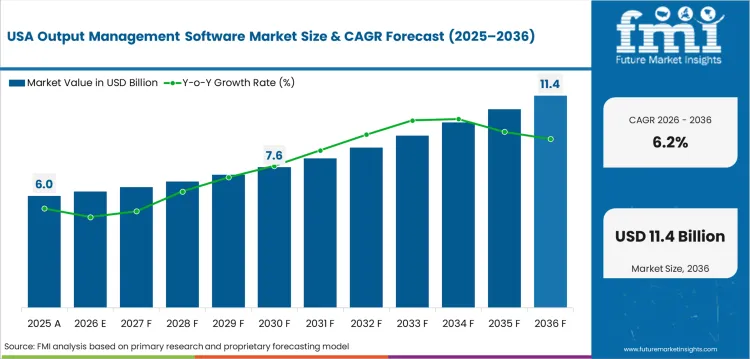
United States industry is mature and witnessing growth due to regulated filing and customer communication workflows. The Internal Revenue Service reported that 93.3% of individual tax returns were filed electronically in fiscal year 2024. This level of digital document handling shapes buyer expectations across finance, healthcare, utilities, and government. The United States is expected to advance at 6.2% CAGR through 2036 where enterprises replace legacy print output with hybrid delivery platforms.
- Healthcare and financial firms use output control for notices with privacy and retention rules.
- Utilities and insurers value delivery logs when customer communications carry legal effect.
- Cloud migration opens replacement demand as firms retire local print servers and older routing tools.
Demand Outlook for Output Management Software in the United Kingdom
United Kingdom demand is shaped by cloud migration and regulated service communications. The country has a large financial services sector with recurring statements, policy notices, and customer letters. This supports replacement of older print management setups with multi-channel output control. United Kingdom is projected to rise at 5.7% CAGR through 2036 as enterprises reduce local infrastructure and standardize document delivery. Adoption will move faster in regulated accounts than in smaller commercial firms.
- Banks and insurers remain the clearest buyers due to customer notice volume and audit needs.
- Public service digitization creates demand for document templates and secure digital delivery.
- Cloud-first IT planning supports SaaS output tools that reduce branch-level infrastructure.
Demand Outlook for Output Management Software in Germany
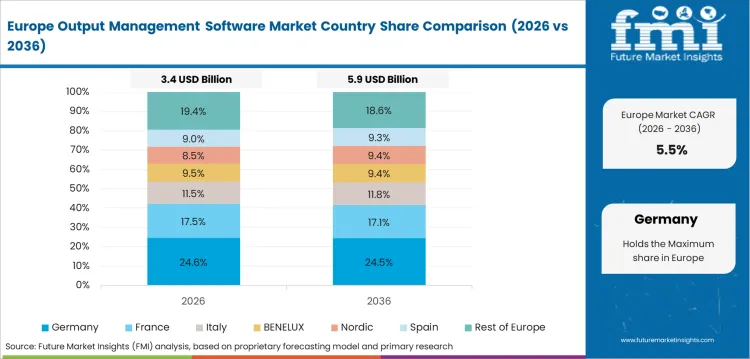
Germany represents a mature software market where data protection and process documentation guide buying. Enterprises are cautious with system changes but place high value on reliability. Germany is forecast at 5.4% CAGR through 2036 as firms upgrade existing output systems for cloud and compliance needs. Manufacturing and financial services sustain the main demand pool. New projects often need strong integration proof before buyers approve migration from established systems.
- Manufacturers use output workflows for invoices, shipping documents, and service records.
- Financial firms emphasize delivery proof and retention controls due to strict compliance expectations.
- Buyers often prefer phased migration so business-critical document streams continue without disruption.
In-depth Analysis of Output Management Software in France
France demand is guided by structured document exchange and e-invoicing reform. The French tax administration has continued preparing a phased electronic invoicing framework for domestic B2B transactions. This creates a direct need for controlled formats and reliable transmission records. France is expected to post 5.2% CAGR through 2036 as enterprises adjust billing and customer communication workflows. Implementation timing will shape near-term buying waves among mid-sized firms.
- B2B e-invoicing preparation raises interest in structured output and transmission control.
- Large enterprises need delivery records across invoices, statements, and customer notices.
- Service providers gain ground when they combine workflow setup with local compliance support.
Competitive Landscape and Strategic Positioning
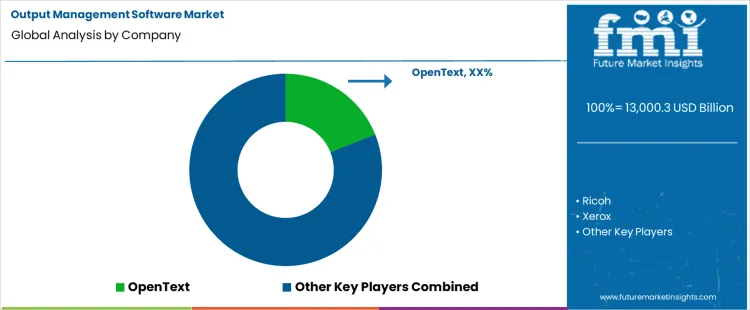
- The market is moderately concentrated with enterprise software vendors and document technology firms competing across different buying paths.
- Large suppliers win on ERP integration, audit logging, and support for both print and digital delivery.
- Specialist firms compete through high-volume composition tools and stronger migration support for legacy output streams.
- Entry barriers include enterprise security approval, document stream migration skill, and proof of reliable delivery at scale.
Competition in the output management software market is focused on output governance capabilities. Leading vendors are expanding functionality across secure connectivity, workflow orchestration, and hybrid cloud environments to strengthen their role within enterprise information architectures. Product developments such as OpenText’s Cloud Editions 24.4 illustrate this shift, reinforcing the expectation that output management platforms integrate tightly with broader content and workflow stacks rather than operate as isolated tools.
Print and workflow vendors are reshaping their portfolios around hybrid work and document services. Xerox announced its Lexmark acquisition in December 2024 for USD 1.5 billion and completed the transaction in July 2025. The deal broadens its print and managed services footprint. It also strengthens access to customers that need output software tied to device fleets and service contracts.
Specialist automation vendors remain relevant where document capture and workflow routing connect with outbound communication. Kofax became Tungsten Automation in January 2024 as the company repositioned around AI-powered workflow automation. Ricoh has also used DocuWare and related document workflow assets to support paperless operations. Buyers in this market usually compare platform fit and integration risk before brand scale alone.
Key Companies in the Output Management Software Market
Competition includes enterprise information vendors, document technology groups, and specialist workflow automation firms.
- Global Leaders: OpenText, Ricoh, and Xerox compete with broad enterprise customer access and document control portfolios. Their strength lies in platform depth, managed service links, and support across hybrid print and digital output environments.
- Workflow Specialists: Tungsten Automation, Quadient, and Crawford Technologies compete around document automation and high-volume output workflow use cases. Their position depends on integration skill and domain depth in regulated communications.
- Device-linked Players: Canon and selected print technology vendors compete where output control is tied to device fleets and office infrastructure. Their advantage comes from channel reach and existing hardware service relationships.
Competitive Benchmarking: Output Management Software Market
| Company | Output Workflow Depth | Enterprise Integration Fit | Audit Control Strength | Geographic Footprint |
|---|---|---|---|---|
| OpenText | High | High | High | Global |
| Ricoh | High | Strong | Medium | Global |
| Xerox | Medium | Strong | Medium | Global |
| Tungsten Automation | High | Strong | Strong | Global |
| Quadient | High | Medium | Strong | Global |
| Crawford Technologies | High | Medium | Strong | North America and Europe |
| Canon | Medium | Medium | Medium | Global |
Source: Future Market Insights competitive analysis, 2026. Ratings reflect relative positioning based on workflow depth, integration fit, and audit control strength.
Key Developments in Output Management Software Market
- In December 2024, Xerox announced the acquisition of Lexmark for USD 1.5 billion. The transaction strengthens print and document service reach for hybrid workplace customers.
- In July 2025, Xerox completed the Lexmark acquisition and combined two major print technology portfolios. This raises its ability to link device fleets with output management services.
- In April 2026, Ricoh introduced a cloud-ready intelligent MFP platform for workplace print. The launch supports document workflows that connect print devices with cloud services.
Key Players in the Output Management Software Market
Global Leaders
- OpenText
- Ricoh
- Xerox
Workflow Specialists
- Tungsten Automation
- Quadient
- Crawford Technologies
- Canon
Report Scope and Coverage
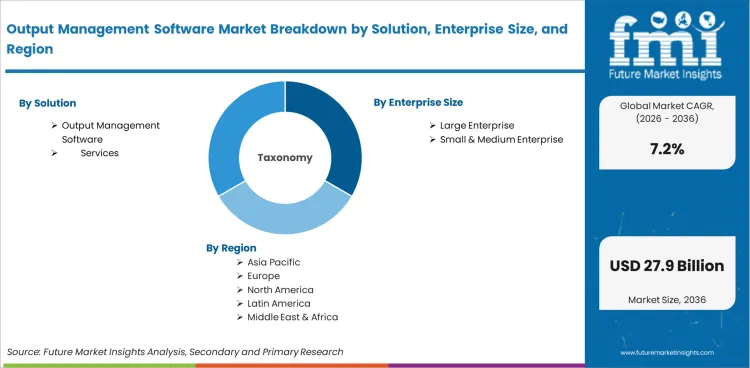
| Item | Value |
|---|---|
| Quantitative Units | USD 13.00 billion in 2026 to USD 26.05 billion in 2036, at a CAGR of 7.2% |
| Market Definition | Software platforms and services that create, format, route, deliver, monitor, and archive business documents |
| Solution | Output Management Software, Services |
| Enterprise Size | Large Enterprise, Small & Medium Enterprise |
| Deployment | Cloud, On-Premises |
| Industry | BFSI, Healthcare, Manufacturing, Government, Transportation, Education, Others |
| Function | Document Delivery, Print Control, Workflow Routing, Archive Control, Analytics |
| Regions Covered | North America, Latin America, Europe, East Asia, South Asia and Pacific, Middle East and Africa |
| Countries Covered | India, China, South Korea, United States, United Kingdom, Germany, France, 30+ countries |
| Key Companies Profiled | OpenText, Ricoh, Xerox, Tungsten Automation, Quadient, Crawford Technologies, Canon |
| Forecast Period | 2026 to 2036 |
| Approach | Hybrid bottom-up and top-down methodology starting with verified transaction data and projected adoption velocity |
Output Management Software Market by Segments
Output Management Software Market Segmented by Solution:
- Output Management Software
- Services
Output Management Software Market Segmented by Enterprise Size:
- Large Enterprise
- Small & Medium Enterprise
Output Management Software Market Segmented by Deployment:
- Cloud
- On-Premises
Output Management Software Market Segmented by Industry:
- BFSI
- Healthcare
- Manufacturing
- Government
- Transportation
- Education
- Others
Output Management Software Market Segmented by Function:
- Document Delivery
- Print Control
- Workflow Routing
- Archive Control
- Analytics
Output Management Software Market by Region:
- North America
- United States
- Canada
- Mexico
- Latin America
- Brazil
- Chile
- Rest of Latin America
- Western Europe
- Germany
- UK
- Italy
- Spain
- France
- Nordic
- BENELUX
- Rest of Western Europe
- Eastern Europe
- Poland
- Hungary
- Balkan & Baltic
- Rest of Eastern Europe
- East Asia
- China
- Japan
- South Korea
- South Asia and Pacific
- India
- ASEAN
- Australia & New Zealand
- Rest of South Asia and Pacific
- Middle East & Africa
- Kingdom of Saudi Arabia
- Other GCC Countries
- Turkiye
- South Africa
- Other African Union
- Rest of Middle East & Africa
Research Sources and Bibliography
- Internal Revenue Service. (2025). Returns filed, taxes collected and refunds issued.
- Ministry of Finance, Government of India. (2025). Digital payment transactions surge with over 18,000 crore transactions in 2024-25.
- The State Council of the People's Republic of China. (2026). China's software industry revenues surge 13.2 pct in 2025.
- OECD. (2025). Digital Government Review of Korea. OECD Publishing.
- OECD. (2025). Government at a Glance 2025. OECD Publishing.
- OpenText. (2024). OpenText makes multi-cloud work with Cloud Editions 24.4.
- Tungsten Automation. (2024). A new chapter begins: Kofax is now Tungsten Automation.
- Xerox. (2024). Xerox to acquire Lexmark.
- Xerox. (2025). Xerox completes the acquisition of Lexmark.
- Ricoh USA. (2026). Ricoh redefines the future of workplace print with its latest cloud-ready intelligent MFP platform.
The bibliography is provided for reader reference and uses primary government, official company, and institutional sources.
This Report Answers
- What is the current and future size of the Output Management Software Market between 2026 and 2036?
- What CAGR is projected for the Output Management Software Market during the forecast period?
- Which solution segment is expected to lead the Output Management Software Market in 2026?
- Which enterprise size segment is expected to account for the largest share in 2026?
- What factors are driving adoption of output management software across regulated industries?
- How do cloud migration and compliance needs shape output management software buying?
- Which countries are forecast to grow fastest in the Output Management Software Market?
- Which companies are profiled in the Output Management Software Market competitive landscape?
- How is the Output Management Software Market defined for this forecast?
- Which methodology supports the Output Management Software Market forecast and segmentation analysis?
Frequently Asked Questions
How big is the Output Management Software Market in 2026?
The Output Management Software Market is estimated to be valued at USD 13.00 billion in 2026 after converting the published USD million figure.
What will be the size of the Output Management Software Market in 2036?
The Output Management Software Market is projected to reach USD 26.05 billion by 2036 under the 2026 to 2036 forecast period.
How much will the Output Management Software Market expand between 2026 and 2036?
The Output Management Software Market is expected to expand at a 7.2% CAGR between 2026 and 2036.
Which solution leads the Output Management Software Market in 2026?
Output management software is projected to lead the solution segment with 75.8% share in 2026 as platform licensing dominates demand.
Which enterprise size leads the Output Management Software Market in 2026?
Large enterprise is estimated to hold 56.9% share in 2026 due to complex document flows and stronger audit requirements.
How does output management software work for enterprises?
Output management software takes documents from business systems and applies shared rules for format, routing, delivery proof, and archive control.
Why do companies buy output management software instead of basic print tools?
Companies buy output management software when they need governed document delivery across print, email, portals, and archive systems.
What affects the payback of output management software?
Payback depends on document volume, legacy system complexity, print savings, compliance risk reduction, and the cost of migration services.
How long does output management software remain useful after rollout?
Output management software can stay useful for many years when templates, connectors, and security controls are updated with business systems.
Preview the report firsthand - request a free sample
Get SampleGet the brochure for pricing and purchase details.
Get PDFTable of Content
- Key Takeaways
- Market Size and CAGR
- Top Growth Driver
- Fastest Growing Segment
- Leading Region
- Key Companies
- Emerging Opportunities
- Executive Summary
- Global Market Outlook
- Demand-side Trends
- Supply-side Trends
- Technology Roadmap Analysis
- Analysis and Recommendations
- Analyst Perspective (What is happening? Why now? What should investors know?)
- Key Questions Answered
- How large is the market?
- What is the CAGR?
- What are key trends?
- Which region dominates?
- Who are the leaders?
- Market Overview
- Market Coverage / Taxonomy
- Market Definition / Scope / Limitations
- Research Methodology
- Chapter Orientation
- Analytical Lens and Working Hypotheses
- Market Structure, Signals, and Trend Drivers
- Benchmarking and Cross-market Comparability
- Market Sizing, Forecasting, and Opportunity Mapping
- Research Design and Evidence Framework
- Desk Research Programme (Secondary Evidence)
- Expert Input and Fieldwork (Primary Evidence)
- Tooling, Models, and Reference Databases
- Data Engineering and Model Build
- Quality Assurance and Audit Trail
- Market Background
- Market Dynamics (Drivers, Restraints, Opportunity, Trends)
- Scenario Forecast (Optimistic, Likely, Conservative)
- Impact Analysis
- AI Impact
- Sustainability Impact
- Regulatory Impact
- Technology Impact
- Consumer / Buyer Analysis
- Purchase Drivers
- Adoption Barriers
- Buyer Journey
- Opportunity Map Analysis
- Product Life Cycle Analysis
- Supply Chain Analysis
- Investment Feasibility Matrix
- Value Chain Analysis
- PESTLE and Porter's Analysis
- Regulatory Landscape
- Regional Parent Market Outlook
- Production and Consumption Statistics
- Import and Export Statistics
- Global Market Analysis and Forecast, 2021 to 2036
- Historical Market Size Value (USD Billion) Analysis, 2021 to 2025
- Current and Future Market Size Value (USD Billion) Projections, 2026 to 2036
- Y-o-Y Growth Trend Analysis
- Absolute $ Opportunity Analysis
- Global Market Pricing Analysis, 2021 to 2036
- Global Market Analysis and Forecast, By Solution, 2021 to 2036
- Introduction / Key Findings
- Historical Market Size Value (USD Billion) Analysis By Solution, 2021 to 2025
- Current and Future Market Size Value (USD Billion) Analysis and Forecast By Solution, 2026 to 2036
- Output Management Software
- Services
- Output Management Software
- Y-o-Y Growth Trend Analysis By Solution, 2021 to 2025
- Absolute $ Opportunity Analysis By Solution, 2026 to 2036
- Global Market Analysis and Forecast, By Enterprise Size, 2021 to 2036
- Introduction / Key Findings
- Historical Market Size Value (USD Billion) Analysis By Enterprise Size, 2021 to 2025
- Current and Future Market Size Value (USD Billion) Analysis and Forecast By Enterprise Size, 2026 to 2036
- Large Enterprise
- Small & Medium Enterprise
- Large Enterprise
- Y-o-Y Growth Trend Analysis By Enterprise Size, 2021 to 2025
- Absolute $ Opportunity Analysis By Enterprise Size, 2026 to 2036
- Global Market Analysis and Forecast, By Deployment, 2021 to 2036
- Introduction / Key Findings
- Historical Market Size Value (USD Billion) Analysis By Deployment, 2021 to 2025
- Current and Future Market Size Value (USD Billion) Analysis and Forecast By Deployment, 2026 to 2036
- Cloud
- On-Premises
- Cloud
- Y-o-Y Growth Trend Analysis By Deployment, 2021 to 2025
- Absolute $ Opportunity Analysis By Deployment, 2026 to 2036
- Global Market Analysis and Forecast, By Industry, 2021 to 2036
- Introduction / Key Findings
- Historical Market Size Value (USD Billion) Analysis By Industry, 2021 to 2025
- Current and Future Market Size Value (USD Billion) Analysis and Forecast By Industry, 2026 to 2036
- BFSI
- Healthcare
- Manufacturing
- Government
- Transportation
- Education
- Others
- BFSI
- Y-o-Y Growth Trend Analysis By Industry, 2021 to 2025
- Absolute $ Opportunity Analysis By Industry, 2026 to 2036
- Global Market Analysis and Forecast, By Function, 2021 to 2036
- Introduction / Key Findings
- Historical Market Size Value (USD Billion) Analysis By Function, 2021 to 2025
- Current and Future Market Size Value (USD Billion) Analysis and Forecast By Function, 2026 to 2036
- Document Delivery
- Print Control
- Workflow Routing
- Archive Control
- Analytics
- Document Delivery
- Y-o-Y Growth Trend Analysis By Function, 2021 to 2025
- Absolute $ Opportunity Analysis By Function, 2026 to 2036
- Global Market Analysis and Forecast, By Region, 2021 to 2036
- Introduction
- Historical Market Size Value (USD Billion) Analysis By Region, 2021 to 2025
- Current Market Size Value (USD Billion) Analysis and Forecast By Region, 2026 to 2036
- North America
- Latin America
- Western Europe
- Eastern Europe
- East Asia
- South Asia and Pacific
- Middle East & Africa
- Market Attractiveness Analysis By Region
- North America Market Analysis and Forecast, By Country, 2021 to 2036
- Historical Market Size Value (USD Billion) Trend Analysis By Market Taxonomy, 2021 to 2025
- Market Size Value (USD Billion) Forecast By Market Taxonomy, 2026 to 2036
- By Country
- USA
- Canada
- By Solution
- By Enterprise Size
- By Deployment
- By Industry
- By Function
- By Country
- Market Attractiveness Analysis
- By Country
- By Solution
- By Enterprise Size
- By Deployment
- By Industry
- By Function
- Key Takeaways
- Latin America Market Analysis and Forecast, By Country
- Historical Market Size Value (USD Billion) Trend Analysis By Market Taxonomy, 2021 to 2025
- Market Size Value (USD Billion) Forecast By Market Taxonomy, 2026 to 2036
- By Country
- Brazil
- Mexico
- Chile
- Rest of Latin America
- By Solution
- By Enterprise Size
- By Deployment
- By Industry
- By Function
- By Country
- Market Attractiveness Analysis
- By Country
- By Solution
- By Enterprise Size
- By Deployment
- By Industry
- By Function
- Key Takeaways
- Western Europe Market Analysis and Forecast, By Country
- Historical Market Size Value (USD Billion) Trend Analysis By Market Taxonomy, 2021 to 2025
- Market Size Value (USD Billion) Forecast By Market Taxonomy, 2026 to 2036
- By Country
- Germany
- UK
- Italy
- Spain
- France
- Nordic
- BENELUX
- Rest of Western Europe
- By Solution
- By Enterprise Size
- By Deployment
- By Industry
- By Function
- By Country
- Market Attractiveness Analysis
- By Country
- By Solution
- By Enterprise Size
- By Deployment
- By Industry
- By Function
- Key Takeaways
- Eastern Europe Market Analysis and Forecast, By Country
- Historical Market Size Value (USD Billion) Trend Analysis By Market Taxonomy, 2021 to 2025
- Market Size Value (USD Billion) Forecast By Market Taxonomy, 2026 to 2036
- By Country
- Russia
- Poland
- Hungary
- Balkan & Baltic
- Rest of Eastern Europe
- By Solution
- By Enterprise Size
- By Deployment
- By Industry
- By Function
- By Country
- Market Attractiveness Analysis
- By Country
- By Solution
- By Enterprise Size
- By Deployment
- By Industry
- By Function
- Key Takeaways
- East Asia Market Analysis and Forecast, By Country
- Historical Market Size Value (USD Billion) Trend Analysis By Market Taxonomy, 2021 to 2025
- Market Size Value (USD Billion) Forecast By Market Taxonomy, 2026 to 2036
- By Country
- China
- Japan
- South Korea
- By Solution
- By Enterprise Size
- By Deployment
- By Industry
- By Function
- By Country
- Market Attractiveness Analysis
- By Country
- By Solution
- By Enterprise Size
- By Deployment
- By Industry
- By Function
- Key Takeaways
- South Asia and Pacific Market Analysis and Forecast, By Country
- Historical Market Size Value (USD Billion) Trend Analysis By Market Taxonomy, 2021 to 2025
- Market Size Value (USD Billion) Forecast By Market Taxonomy, 2026 to 2036
- By Country
- India
- ASEAN
- Australia & New Zealand
- Rest of South Asia and Pacific
- By Solution
- By Enterprise Size
- By Deployment
- By Industry
- By Function
- By Country
- Market Attractiveness Analysis
- By Country
- By Solution
- By Enterprise Size
- By Deployment
- By Industry
- By Function
- Key Takeaways
- Middle East & Africa Market Analysis and Forecast, By Country
- Historical Market Size Value (USD Billion) Trend Analysis By Market Taxonomy, 2021 to 2025
- Market Size Value (USD Billion) Forecast By Market Taxonomy, 2026 to 2036
- By Country
- Kingdom of Saudi Arabia
- Other GCC Countries
- Türkiye
- South Africa
- Other African Union
- Rest of Middle East & Africa
- By Solution
- By Enterprise Size
- By Deployment
- By Industry
- By Function
- By Country
- Market Attractiveness Analysis
- By Country
- By Solution
- By Enterprise Size
- By Deployment
- By Industry
- By Function
- Key Takeaways
- Key Countries Market Analysis
- USA
- Pricing Analysis
- Market Share Analysis, 2025
- By Solution
- By Enterprise Size
- By Deployment
- By Industry
- By Function
- Canada
- Pricing Analysis
- Market Share Analysis, 2025
- By Solution
- By Enterprise Size
- By Deployment
- By Industry
- By Function
- Mexico
- Pricing Analysis
- Market Share Analysis, 2025
- By Solution
- By Enterprise Size
- By Deployment
- By Industry
- By Function
- Brazil
- Pricing Analysis
- Market Share Analysis, 2025
- By Solution
- By Enterprise Size
- By Deployment
- By Industry
- By Function
- Chile
- Pricing Analysis
- Market Share Analysis, 2025
- By Solution
- By Enterprise Size
- By Deployment
- By Industry
- By Function
- Germany
- Pricing Analysis
- Market Share Analysis, 2025
- By Solution
- By Enterprise Size
- By Deployment
- By Industry
- By Function
- UK
- Pricing Analysis
- Market Share Analysis, 2025
- By Solution
- By Enterprise Size
- By Deployment
- By Industry
- By Function
- Italy
- Pricing Analysis
- Market Share Analysis, 2025
- By Solution
- By Enterprise Size
- By Deployment
- By Industry
- By Function
- Spain
- Pricing Analysis
- Market Share Analysis, 2025
- By Solution
- By Enterprise Size
- By Deployment
- By Industry
- By Function
- France
- Pricing Analysis
- Market Share Analysis, 2025
- By Solution
- By Enterprise Size
- By Deployment
- By Industry
- By Function
- India
- Pricing Analysis
- Market Share Analysis, 2025
- By Solution
- By Enterprise Size
- By Deployment
- By Industry
- By Function
- ASEAN
- Pricing Analysis
- Market Share Analysis, 2025
- By Solution
- By Enterprise Size
- By Deployment
- By Industry
- By Function
- Australia & New Zealand
- Pricing Analysis
- Market Share Analysis, 2025
- By Solution
- By Enterprise Size
- By Deployment
- By Industry
- By Function
- China
- Pricing Analysis
- Market Share Analysis, 2025
- By Solution
- By Enterprise Size
- By Deployment
- By Industry
- By Function
- Japan
- Pricing Analysis
- Market Share Analysis, 2025
- By Solution
- By Enterprise Size
- By Deployment
- By Industry
- By Function
- South Korea
- Pricing Analysis
- Market Share Analysis, 2025
- By Solution
- By Enterprise Size
- By Deployment
- By Industry
- By Function
- Russia
- Pricing Analysis
- Market Share Analysis, 2025
- By Solution
- By Enterprise Size
- By Deployment
- By Industry
- By Function
- Poland
- Pricing Analysis
- Market Share Analysis, 2025
- By Solution
- By Enterprise Size
- By Deployment
- By Industry
- By Function
- Hungary
- Pricing Analysis
- Market Share Analysis, 2025
- By Solution
- By Enterprise Size
- By Deployment
- By Industry
- By Function
- Kingdom of Saudi Arabia
- Pricing Analysis
- Market Share Analysis, 2025
- By Solution
- By Enterprise Size
- By Deployment
- By Industry
- By Function
- Türkiye
- Pricing Analysis
- Market Share Analysis, 2025
- By Solution
- By Enterprise Size
- By Deployment
- By Industry
- By Function
- South Africa
- Pricing Analysis
- Market Share Analysis, 2025
- By Solution
- By Enterprise Size
- By Deployment
- By Industry
- By Function
- USA
- Market Structure Analysis
- Competition Dashboard
- Competition Benchmarking
- Market Share Analysis of Top Players
- By Regional
- By Solution
- By Enterprise Size
- By Deployment
- By Industry
- By Function
- Emerging Startups
- Innovation Benchmarking
- Competition Analysis
- Competition Deep Dive
- OpenText
- Overview
- Product Portfolio
- Profitability by Market Segments
- Sales Footprint
- Strategy Overview
- Marketing Strategy
- Product Strategy
- Channel Strategy
- Ricoh
- Xerox
- Tungsten Automation
- Quadient
- Crawford Technologies
- Canon
- OpenText
- Case Studies
- Success Stories
- Recent Developments
- Competition Deep Dive
- Assumptions & Acronyms Used


