

- Market Size (2026)
- USD 680.6 Mn
- Forecast (2036)
- USD 1242.0 Mn
- CAGR (2026 to 2036)
- 6.2%
How big is Oxygen Releasing Compounds Market in 2026?
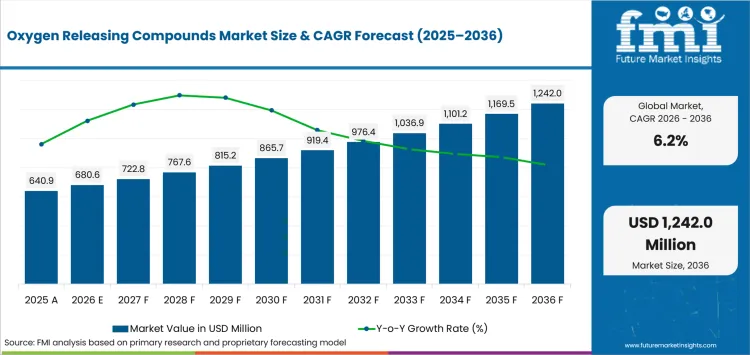
USD 680.6 million in 2026 and USD 1242.0 million by 2036 at a 6.2% CAGR.
Demand for oxygen releasing compounds is projected to expand at 6.2% CAGR between 2026 and 2036, increasing valuation from USD 680.6 million in 2026 to USD 1242.0 million by 2036. Commercial use is anchored in applications where dissolved oxygen must be delivered into soil, groundwater or treatment water without relying only on mechanical aeration.
USA Environmental Protection Agency guidance for in situ bioremediation identifies calcium peroxide, magnesium peroxide and hydrogen peroxide among chemicals used to introduce oxygen during aerobic treatment. This operating logic keeps solid peroxide products relevant where treatment teams need oxygen below ground over a defined interval, while liquid peroxide remains useful where dosing can be actively controlled.
Key Takeaways of Oxygen Releasing Compounds Market
- Controlled oxygen delivery connects remediation demand with wastewater and aquaculture use where dissolved oxygen must be introduced at the treatment point.
- Calcium peroxide is projected at 36.0% of chemistry demand in 2026, while Granules account for 34.0% of form demand.
- Soil remediation is estimated at 29.0% of application demand in 2026, with Environmental remediation at 31.0% of end-use demand.
- Environmental contractors are projected at 37.0% of sales-channel demand in 2026 because dosing and placement are usually tied to site-specific work plans.
- Release rate, local pH and oxidizer handling can limit use when a formulation is poorly matched to site moisture or treatment biology.
- Evonik Industries AG, Solvay, Arkema, Nouryon, Kemira Oyj, OCI Peroxygens LLC, Carus LLC, Geo-Cleanse International, Inc., REGENESIS and USP Technologies participate through peroxide production, oxygen-release formulations, water treatment or remediation services.
Analyst Perspective
"Oxygen-releasing chemistry earns value when the release profile matches the treatment zone. Buyers should compare oxygen yield with placement method and site chemistry, then verify whether the product can be applied safely at the interval required by the remediation or water-treatment plan."
- Nikhil Kaitwade, Principal Consultant, Future Market Insights
How is the Oxygen Releasing Compounds Market segmented?
The oxygen releasing compounds market is segmented by chemistry, form, application, end use, sales channel and region.
Chemistry covers Calcium peroxide, Magnesium peroxide, Sodium percarbonate, Hydrogen peroxide adducts and Oxygen release blends. Form includes Granules, Powder, Tablets and Slurries / suspensions. Application spans Soil remediation, Groundwater treatment, Aquaculture, Wastewater odor control and Emergency oxygenation. End Use covers Environmental remediation, Aquaculture farms, Municipal wastewater, Industrial treatment and Pond management. Sales Channel includes Environmental contractors, Chemical distributors, Aquaculture dealers and Direct project supply.
Why does calcium peroxide lead the chemistry category?
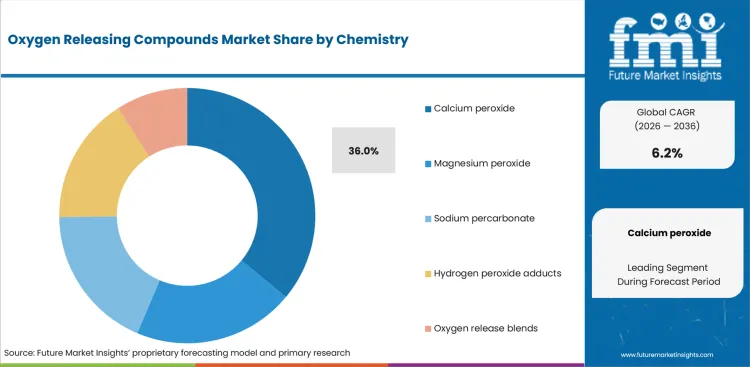
Calcium peroxide is a solid oxygen donor that releases oxygen as it reacts with water, allowing treatment teams to place oxygen-generating chemistry inside soil or groundwater zones. EPA guidance lists calcium peroxide among common oxygen-releasing chemicals used to support aerobic bioremediation.
- Based on chemistry, Calcium peroxide is projected to account for 36.0% in 2026 because solid peroxide can be placed in subsurface treatment zones where gradual oxygen delivery is required.
- EPA guidance notes that calcium and magnesium peroxides release oxygen as they break down in water, giving remediation practitioners a chemical route to support aerobic biodegradation below ground.
Why do granules lead the form category?
Granular forms give contractors a solid material that can be measured, placed and distributed through excavations, trenches or other subsurface delivery routes without maintaining a continuously operating aeration system. The format is particularly relevant where a project needs localized placement rather than a large surface dosing installation.
- In 2026, Granules are expected to account for 34.0% of form demand as project teams use solid oxygen-release materials where handling and placement must be controlled at the treatment zone.
- Commercial remediation products are available in granular or pelletized forms for enhanced aerobic bioremediation, while field application can also use slurries when injection is more suitable for site access and geology.
Why does soil remediation lead the application category?
Soil remediation uses oxygen-releasing chemistry where aerobic microorganisms can degrade petroleum hydrocarbons or where oxygen availability limits treatment. The value of the chemistry depends on how well the formulation reaches contaminated soil and maintains usable oxygen around the biological treatment zone.
- The Soil remediation segment is projected at 29.0% share in 2026 as oxygen donors are used within site-specific cleanup plans for contaminated soil and related subsurface zones.
- EPA remediation guidance treats bioremediation as a defined cleanup approach for contaminated soil and groundwater, supporting the technical basis for oxygen-release amendments when aerobic conditions are required.
Why does environmental remediation lead the end-use category?
Environmental remediation converts oxygen-release chemistry into a project input within site assessment, cleanup and monitoring programs. Public contaminated-site frameworks in Canada, Germany, Japan and other markets keep treatment selection tied to documented site conditions rather than routine chemical consumption.
- Environmental remediation is estimated at 31.0% of end-use demand in 2026 because oxygen-releasing compounds can be specified as part of soil or groundwater treatment where aerobic biodegradation is suitable.
- Government cleanup programs continue to fund or regulate contaminated-site work, creating a recurring project base for contractors that evaluate chemical amendments alongside other remediation technologies.
Why do environmental contractors lead the sales channel category?
Environmental contractors translate chemistry into field dosage, placement and monitoring. A remediation project normally begins with site characterization and a treatment design, after which the contractor chooses injection, excavation, trench placement or another delivery method suited to the contaminant and hydrogeology.
- Environmental contractors are projected to account for 37.0% of sales-channel demand in 2026 because purchasing is often attached to a defined site plan rather than a standard replenishment order.
- Commercial remediation providers document calculated peroxide charges, injection equipment and site-specific application designs, reinforcing the contractor role between chemical supplier and contaminated-site owner.
What are the drivers, restraints and opportunities in the Oxygen Releasing Compounds Market?
Contaminated-site cleanup and oxygen-limited treatment systems support demand, while release control and oxidizer handling constrain use as project-specific dosing creates room for controlled-release formulations.
- Driver: Remediation programs create recurring demand for oxygen donors where aerobic biodegradation is selected for soil or groundwater treatment.
- Restraint: Release rate and local chemistry can make dosing uneven, while peroxide handling requirements increase the need for trained application and monitoring.
- Opportunity: Wastewater and aquaculture applications can use controlled oxygen delivery for defined low-dissolved-oxygen events when treatment teams need a chemical oxygen source.
Contaminated-site programs create a project pipeline in which oxygen-releasing compounds can be considered alongside extraction, oxidation and other biological treatment methods. Canada is funding Phase V of its Federal Contaminated Sites Action Plan from 2025 to 2030, while Germany continues to frame site remediation around investigation, risk assessment, cleanup and follow-up monitoring.
Performance is site dependent. EPA technical guidance notes that oxygen-releasing amendments differ in solubility and release duration, so a formulation selected for prolonged subsurface release may not suit a treatment system that needs rapid oxygen delivery. Handling controls also matter because peroxide materials are oxidizers and field application can involve concentrated products.
Adjacent water applications broaden the commercial route beyond contaminated land. A 2025 Aquacultural Engineering study evaluated coated calcium peroxide tablets for sustained dissolved-oxygen release in fish tanks, while commercial wastewater programs use hydrogen peroxide to supplement dissolved oxygen when biological treatment becomes oxygen limited.
Which country CAGRs are profiled in the Oxygen Releasing Compounds Market?
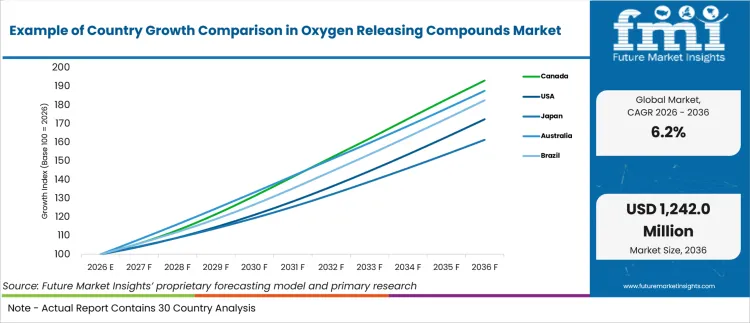
| Country | CAGR |
|---|---|
| Canada | 6.8% |
| USA | 5.6% |
| Japan | 4.9% |
| Australia | 6.5% |
| Brazil | 6.2% |
| Germany | 5.2% |
| South Korea | 5.9% |
How do country-level CAGRs compare in the Oxygen Releasing Compounds Market?
The seven profiled CAGRs range from 4.9% to 6.8%, a 1.9 percentage-point spread. The gap is narrow enough that country conditions matter more than a simple growth-rate ranking: regulated contaminated-site work, wastewater investment and contractor access determine where oxygen-releasing products can be qualified and repeatedly used.
- Canada is set to grow at 6.8% CAGR as Phase V of the federal contaminated-sites program keeps remediation funding active through 2030.
- USA is projected to grow at 5.6% CAGR, supported by a mature remediation ecosystem and established guidance for oxygen-enhanced aerobic treatment.
- Japan is forecast to expand at 4.9% CAGR as statutory soil-contamination investigations continue to feed site-specific remediation decisions.
- Australia is likely to grow at 6.5% CAGR as nationally coordinated contamination guidance supports structured site assessment and cleanup planning.
- Brazil is anticipated to expand at 6.2% CAGR as regulated remediation products and long-term wastewater infrastructure targets broaden the project base.
- Germany is expected to grow at 5.2% CAGR as soil and groundwater cleanup remains embedded in the contaminated-site regulatory framework.
- South Korea is projected to expand at 5.9% CAGR as groundwater monitoring coverage increases around industrial estates and other major pollution sources.
Comparable growth rates can produce different market entry conditions. The full report provides country-level CAGR analysis across North America, Latin America, Europe, East Asia, South Asia and Pacific, and the Middle East and Africa.
Country-wise Analysis
- Canada’s contaminated-site pipeline gives environmental contractors a multi-year project base rather than a single construction cycle. Environment and Climate Change Canada states that Phase V of the Federal Contaminated Sites Action Plan runs from 2025 to 2030 and that remediation has been carried out at about 3,000 sites since 2005. Canada is projected to record 6.8% CAGR through 2036, supported by continuing site assessment and remediation work where oxygen-release chemistry can be considered within approved treatment plans.
- USA demand is tied to a mature remediation ecosystem with established guidance for aerobic in situ treatment. EPA identifies calcium peroxide, magnesium peroxide and hydrogen peroxide among common oxygen-releasing chemicals used to raise oxygen availability in groundwater bioremediation. USA is estimated to expand at 5.6% CAGR through 2036 as contractors apply site-specific chemistry under federal and state cleanup requirements.
- Japan’s Soil Contamination Countermeasures Act creates a steady investigation and designation process that feeds remediation decisions. The Ministry of the Environment reported in April 2026 that 1,680 soil contamination investigations were reported for fiscal 2024 and 661 cases exceeded designation criteria, taking the cumulative designated count to 7,599 since April 2010. Japan is forecast to advance at 4.9% CAGR through 2036, with product selection shaped by site conditions and documented cleanup measures.
- Australia applies a nationally coordinated framework for selected contaminated-site risks while implementation remains with regulators and project owners. The Department of Climate Change, Energy, the Environment and Water lists PFAS NEMP 3.1 as the current national guide for PFAS contamination management in 2026, reinforcing structured assessment and remediation planning even though oxygen-releasing compounds are not a universal PFAS remedy. Australia is projected to grow at 6.5% CAGR through 2036 as remediation and water-management activity creates qualified use cases for oxygen-based treatment.
- Brazil combines contaminated-area regulation with a long wastewater infrastructure agenda. Ibama requires registration for specified remediation products used in soil, groundwater or effluent treatment, while ANA’s sanitation framework targets 90% sewage collection and treatment coverage by the end of 2033. Brazil is estimated to post 6.2% CAGR through 2036 as treatment-system expansion and regulated environmental remediation broaden the project pool for peroxide-based oxygen delivery.
- Germany’s contaminated-site framework places treatment selection inside investigation, risk assessment and follow-up monitoring. The German Environment Agency updated its site-remediation guidance in February 2026 and describes soil and groundwater cleanup through physical, chemical and biological approaches chosen for the site. Germany is projected to expand at 5.2% CAGR through 2036, with compliance documentation and site-specific performance testing shaping product qualification.
- South Korea is extending national groundwater monitoring alongside soil-remediation functions managed by Korea Environment Corporation. K-eco states that its groundwater contamination monitoring network is planned to rise from 182 sites in 2023 to 430 by 2030. South Korea is estimated to record 5.9% CAGR through 2036 as monitoring coverage expands the evidence base for remediation decisions and follow-up treatment.
Who are the notable companies in the Oxygen Releasing Compounds Market?
Evonik Industries AG, Solvay, Arkema, Nouryon, Kemira Oyj, OCI Peroxygens LLC, Carus LLC, Geo-Cleanse International, Inc., REGENESIS and USP Technologies are the notable companies serving the oxygen releasing compounds market.
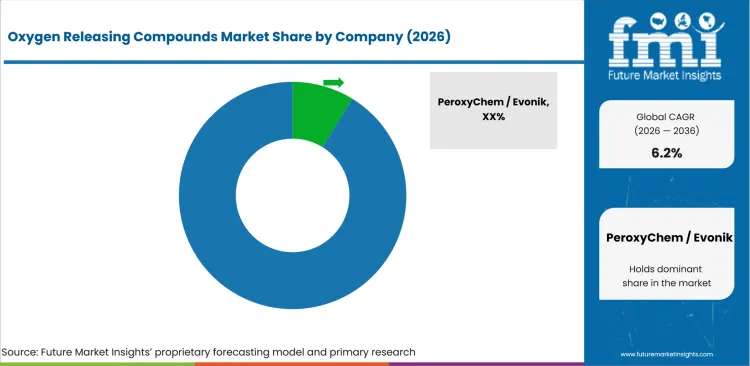
Competition spans peroxide producers, sodium percarbonate suppliers and remediation specialists. Producers compete on product grade, logistics and safe handling, while field-oriented firms differentiate through dosage design, subsurface placement and monitoring support. The market therefore links chemical supply with project execution rather than treating oxygen release as a standalone material specification.
- Evonik Industries AG, Solvay, Arkema, Nouryon and Kemira Oyj supply hydrogen peroxide or broader peroxide chemistry used across environmental and industrial treatment routes.
- OCI Peroxygens LLC supplies sodium percarbonate, while REGENESIS and Carus LLC provide oxygen-release or bioremediation products for soil and groundwater applications.
- Geo-Cleanse International, Inc. and USP Technologies connect peroxide chemistry with field remediation or wastewater dosing.
Competitive Benchmarking: Oxygen Releasing Compounds Market
| Company | Oxygen-release chemistry portfolio | Remediation or water-treatment relevance | Field application support | Geographic Reach |
|---|---|---|---|---|
| Evonik Industries AG | High | High | Medium | Global |
| Solvay | High | High | Medium | Global |
| Arkema | High | High | Medium | Europe, North America and Asia |
| Nouryon | High | High | Medium | Europe and North America |
| Kemira Oyj | Medium | High | Medium | Global |
| OCI Peroxygens LLC | Medium | Medium | Low | North America; international supply |
| Carus LLC | Medium | High | High | North America and Europe |
| Geo-Cleanse International, Inc. | Medium | High | High | United States, Canada and Europe |
| REGENESIS | High | High | High | North America, Europe and Asia-Pacific |
| USP Technologies | Medium | High | High | North America |
Key Developments in the Oxygen Releasing Compounds Market
- In June 2026, a Fuhua-operated hydrogen peroxide plant using Evonik technology began production in Leshan, China, with 200 kilotons of annual industrial-grade hydrogen peroxide capacity.
- In October 2025, Peróxidos do Brasil, part of Solvay’s Peroxides business, announced a 25,000-tonne-per-year myH2O2 satellite plant for Arauco’s Sucuriú project in Brazil.
- In March 2025, Nouryon introduced Eka HP Puroxide hydrogen peroxide in Sweden for pulp and paper, mining and water-treatment applications.
Key Players in the Oxygen Releasing Compounds Market
Peroxide and Oxygen-Release Chemistry Producers
- Evonik Industries AG
- Solvay
- Arkema
- Nouryon
- OCI Peroxygens LLC
Environmental Remediation Specialists
- Carus LLC
- Geo-Cleanse International, Inc.
- REGENESIS
Water Treatment and Industrial Chemical Suppliers
- USP Technologies
- Kemira Oyj
Oxygen Releasing Compounds Market - Report Scope
| Coverage field | Report scope |
|---|---|
| Market breakdown | By chemistry, form, application, end use, sales channel and region. |
| Quantitative Units | Revenue in USD million and CAGR in %. |
| Market Definition | Peroxide-based compounds and formulations that release or generate oxygen in soil, groundwater or treatment water for environmental and operational applications. |
| Regions Covered | North America, Latin America, Europe, East Asia, South Asia and Pacific, and Middle East and Africa. |
| Countries Covered | Canada, USA, Japan, Australia, Brazil, Germany, South Korea, and 20+ countries included in the full report. |
| Key Companies Profiled | Evonik Industries AG, Solvay, Arkema, Nouryon, Kemira Oyj, OCI Peroxygens LLC, Carus LLC, Geo-Cleanse International, Inc., REGENESIS and USP Technologies. |
| Forecast Period | 2026 to 2036. |
| Approach | Primary and secondary research with market triangulation. |
Oxygen Releasing Compounds Market - Research Methodology
| Method | Approach |
|---|---|
| Primary Research | FMI analysts gathered input from peroxide producers, formulators, environmental contractors, chemical distributors, aquaculture suppliers, municipal treatment teams, industrial users and subject-matter experts. Interviews examined purchasing decisions, product evaluation, adoption barriers, project approval requirements, pricing considerations and expectations for technical support. Respondents were also asked what evidence is required before a trial or site application develops into regular purchasing. |
| Desk Research | Desk research covered government environmental programs, remediation guidance, regulatory publications, peer-reviewed technical literature, company filings, product information and official corporate announcements. Sources were reviewed for relevance, publication date, geographic coverage and consistency with the defined market scope. Claims relating to product chemistry, applications, approvals, capacity, investment and commercial activity were retained only when supported by credible public evidence. |
| Market Sizing and Forecasting | The market model combined the baseline value with historical performance, segment structure, pricing and volume indicators, adoption levels, company participation and country-level demand conditions. Forecast assumptions considered contaminated-site programs, water-treatment investment, regulatory requirements, purchasing cycles, supply availability and barriers to wider market use. Segment and regional estimates were reconciled before the final market total was calculated. |
| Data Validation | Estimates were checked against multiple independent indicators, including public program activity, company actions, treatment practices and findings from primary interviews. Validation also tested whether products, applications and company revenues fell within the defined market boundaries. Adjacent oxidizers without direct oxygen-release relevance, unsupported claims and overlapping revenues were excluded to reduce double counting and maintain consistency across segments and countries. |
Oxygen Releasing Compounds Market by Segments
Oxygen Releasing Compounds Market segmented by Chemistry:
- Calcium peroxide
- Magnesium peroxide
- Sodium percarbonate
- Hydrogen peroxide adducts
- Oxygen release blends
Oxygen Releasing Compounds Market segmented by Form:
- Granules
- Powder
- Tablets
- Slurries / suspensions
Oxygen Releasing Compounds Market segmented by Application:
- Soil remediation
- Groundwater treatment
- Aquaculture
- Wastewater odor control
- Emergency oxygenation
Oxygen Releasing Compounds Market segmented by End Use:
- Environmental remediation
- Aquaculture farms
- Municipal wastewater
- Industrial treatment
- Pond management
Oxygen Releasing Compounds Market segmented by Sales Channel:
- Environmental contractors
- Chemical distributors
- Aquaculture dealers
- Direct project supply
Oxygen Releasing Compounds Market by Region:
- North America
- United States
- Canada
- Latin America
- Brazil
- Chile
- Mexico
- Rest of Latin America
- Western Europe
- Germany
- United Kingdom
- Italy
- Spain
- France
- Nordics
- Benelux
- Rest of Western Europe
- Eastern Europe
- Russia
- Poland
- Hungary
- Balkan and Baltic States
- Rest of Eastern Europe
- East Asia
- China
- Japan
- South Korea
- South Asia and Pacific
- India
- ASEAN
- Australia and New Zealand
- Rest of South Asia and Pacific
- Middle East and Africa
- Kingdom of Saudi Arabia
- Other GCC Countries
- Türkiye
- South Africa
- Other African Union Countries
- Rest of Middle East and Africa
Research Sources and Bibliography
- USA Environmental Protection Agency. (2013). Introduction to In Situ Bioremediation of Groundwater.
- USA Environmental Protection Agency. (2026). Guidance for Cleaning Up Groundwater, Soil and Air at Hazardous Waste Cleanup Facilities.
- Environment and Climate Change Canada. (2026, May 29). Action Plan for Contaminated Sites.
- Environment and Climate Change Canada. (2026, May 29). History of Federal Contaminated Sites.
- Ministry of the Environment, Japan. (2026, April 23). FY2024 Survey Results on Implementation of the Soil Contamination Countermeasures Act and Soil Contamination Investigation and Measures.
- Australian Department of Climate Change, Energy, the Environment and Water. (2026). PFAS National Environmental Management Plan 3.1.
- Instituto Brasileiro do Meio Ambiente e dos Recursos Naturais Renováveis. (2022-2026). Contaminated Areas and Registration of Remediation Products.
- Agência Nacional de Águas e Saneamento Básico. (2024). Reference Standard on Universalization of Water Supply and Sewage Services.
- German Environment Agency. (2026, February 3). Site Remediation.
- German Environment Agency. (2026, February 4). Remediation Technology.
- Korea Environment Corporation. (2026). Groundwater Quality Monitoring Network.
- Das, A., Sun, Y., Sarkar, D. J., Kumar, V. S., & Das, B. K. (2025). Biopolymer-encapsulated calcium peroxide tablets for slow sustained release of dissolved oxygen in fish tank. Aquacultural Engineering, 110, 102524.
- Evonik Industries AG. (2020, February 3). Evonik Successfully Closes Acquisition of PeroxyChem.
- Evonik Industries AG. (2026, July 30). Evonik-Licensed Hydrogen Peroxide Plant Starts Operations in Leshan, China.
- Solvay. (2025, October 7). Peróxidos do Brasil to Supply Hydrogen Peroxide to Arauco’s Sucuriú Project in Brazil.
- Nouryon. (2025, March 18). Low-Carbon Footprint Hydrogen Peroxide Launch.
- Arkema. (2026). Albone Hydrogen Peroxide for Industrial and Environmental Applications.
- REGENESIS. (2026). ORC Advanced Controlled-Release Oxygen Technology.
- Carus LLC. (2026). Environmental Remediation Solutions.
- Geo-Cleanse International, Inc. (2026). The Geo-Cleanse Process.
- USP Technologies. (2026). Supplemental Dissolved Oxygen with Hydrogen Peroxide.
- OCI Peroxygens LLC. (2026). Sodium Percarbonate.
- Kemira Oyj. (2026). Hydrogen Peroxide and Water Treatment Product Information.
This bibliography is provided for reader reference and is not exhaustive. The full report contains the complete reference list and detailed citations.
This Report Answers
- How large is the Oxygen Releasing Compounds Market in 2026 and 2036?
- Which operating conditions support recurring demand for oxygen-release chemistry?
- Which chemistry category accounts for the principal approved 2026 share?
- How does product form affect field handling and placement?
- Which application and end-use settings support recurring demand?
- How does the sales channel shape project-based purchasing?
- How do profiled country growth rates affect commercial entry conditions?
- Which companies serve peroxide supply, remediation and water-treatment applications?
Frequently Asked Questions
How big is the Oxygen Releasing Compounds Market in 2026?
USD 680.6 million represents the oxygen releasing compounds market value in 2026 across remediation, water-treatment and oxygenation applications. Site-specific demand is projected to take the market to USD 1,242.0 million by 2036 as contractors and treatment operators use solid and liquid oxygen-donor chemistry in defined applications.
What is the CAGR of the Oxygen Releasing Compounds Market from 2026 to 2036?
A 6.2% CAGR is projected for the oxygen releasing compounds market between 2026 and 2036. Contaminated-site cleanup, wastewater treatment and controlled oxygen delivery support expansion, while release behavior and oxidizer handling keep product selection tied to each treatment system.
Which chemistry segment is projected to account for 36.0% of the Oxygen Releasing Compounds Market?
Calcium peroxide is projected to account for 36.0% of chemistry demand within the oxygen releasing compounds market in 2026. Its solid form supports controlled oxygen release in soil and groundwater applications where treatment teams need oxygen near the subsurface treatment zone.
How much will the Oxygen Releasing Compounds Market add between 2026 and 2036?
USD 561.4 million is expected to be added to the oxygen releasing compounds market between 2026 and 2036. The increase is linked to remediation programs and water-treatment use cases that require chemical oxygen delivery under controlled project conditions.
Which companies are active in the Oxygen Releasing Compounds Market?
Ten companies active in the oxygen releasing compounds market include Evonik Industries AG, Solvay, Arkema, Nouryon, Kemira Oyj, OCI Peroxygens LLC, Carus LLC, Geo-Cleanse International, Inc., REGENESIS and USP Technologies. The group covers peroxide production, sodium percarbonate, controlled-release oxygen products, soil and groundwater remediation, and wastewater treatment services.
Preview the report firsthand - request a free sample
Get SampleGet the brochure for pricing and purchase details.
Get PDFTable of Content
- Key Takeaways
- Market Size and CAGR
- Top Growth Driver
- Fastest Growing Segment
- Leading Region
- Key Companies
- Emerging Opportunities
- Executive Summary
- Global Market Outlook
- Demand-side Trends
- Supply-side Trends
- Technology Roadmap Analysis
- Analysis and Recommendations
- Analyst Perspective (What is happening? Why now? What should investors know?)
- Key Questions Answered
- How large is the market?
- What is the CAGR?
- What are key trends?
- Which region dominates?
- Who are the leaders?
- Market Overview
- Market Coverage / Taxonomy
- Market Definition / Scope / Limitations
- Research Methodology
- Chapter Orientation
- Analytical Lens and Working Hypotheses
- Market Structure, Signals, and Trend Drivers
- Benchmarking and Cross-market Comparability
- Market Sizing, Forecasting, and Opportunity Mapping
- Research Design and Evidence Framework
- Desk Research Programme (Secondary Evidence)
- Expert Input and Fieldwork (Primary Evidence)
- Tooling, Models, and Reference Databases
- Data Engineering and Model Build
- Quality Assurance and Audit Trail
- Market Background
- Market Dynamics (Drivers, Restraints, Opportunity, Trends)
- Scenario Forecast (Optimistic, Likely, Conservative)
- Impact Analysis
- AI Impact
- Sustainability Impact
- Regulatory Impact
- Technology Impact
- Consumer / Buyer Analysis
- Purchase Drivers
- Adoption Barriers
- Buyer Journey
- Opportunity Map Analysis
- Product Life Cycle Analysis
- Supply Chain Analysis
- Investment Feasibility Matrix
- Value Chain Analysis
- PESTLE and Porter's Analysis
- Regulatory Landscape
- Regional Parent Market Outlook
- Production and Consumption Statistics
- Import and Export Statistics
- Global Market Analysis and Forecast, 2021 to 2036
- Historical Market Size Value (USD Million) Analysis, 2021 to 2025
- Current and Future Market Size Value (USD Million) Projections, 2026 to 2036
- Y-o-Y Growth Trend Analysis
- Absolute $ Opportunity Analysis
- Global Market Pricing Analysis, 2021 to 2036
- Global Market Analysis and Forecast, By Chemistry, 2021 to 2036
- Introduction / Key Findings
- Historical Market Size Value (USD Million) Analysis By Chemistry, 2021 to 2025
- Current and Future Market Size Value (USD Million) Analysis and Forecast By Chemistry, 2026 to 2036
- Calcium peroxide
- Magnesium peroxide
- Sodium percarbonate
- Hydrogen peroxide adducts
- Oxygen release blends
- Calcium peroxide
- Y-o-Y Growth Trend Analysis By Chemistry, 2021 to 2025
- Absolute $ Opportunity Analysis By Chemistry, 2026 to 2036
- Global Market Analysis and Forecast, By Form, 2021 to 2036
- Introduction / Key Findings
- Historical Market Size Value (USD Million) Analysis By Form, 2021 to 2025
- Current and Future Market Size Value (USD Million) Analysis and Forecast By Form, 2026 to 2036
- Granules
- Powder
- Tablets
- Slurries / suspensions
- Granules
- Y-o-Y Growth Trend Analysis By Form, 2021 to 2025
- Absolute $ Opportunity Analysis By Form, 2026 to 2036
- Global Market Analysis and Forecast, By Application, 2021 to 2036
- Introduction / Key Findings
- Historical Market Size Value (USD Million) Analysis By Application, 2021 to 2025
- Current and Future Market Size Value (USD Million) Analysis and Forecast By Application, 2026 to 2036
- Soil remediation
- Groundwater treatment
- Aquaculture
- Wastewater odor control
- Emergency oxygenation
- Soil remediation
- Y-o-Y Growth Trend Analysis By Application, 2021 to 2025
- Absolute $ Opportunity Analysis By Application, 2026 to 2036
- Global Market Analysis and Forecast, By End Use, 2021 to 2036
- Introduction / Key Findings
- Historical Market Size Value (USD Million) Analysis By End Use, 2021 to 2025
- Current and Future Market Size Value (USD Million) Analysis and Forecast By End Use, 2026 to 2036
- Environmental remediation
- Aquaculture farms
- Municipal wastewater
- Industrial treatment
- Pond management
- Environmental remediation
- Y-o-Y Growth Trend Analysis By End Use, 2021 to 2025
- Absolute $ Opportunity Analysis By End Use, 2026 to 2036
- Global Market Analysis and Forecast, By Sales Channel, 2021 to 2036
- Introduction / Key Findings
- Historical Market Size Value (USD Million) Analysis By Sales Channel, 2021 to 2025
- Current and Future Market Size Value (USD Million) Analysis and Forecast By Sales Channel, 2026 to 2036
- Environmental contractors
- Chemical distributors
- Aquaculture dealers
- Direct project supply
- Environmental contractors
- Y-o-Y Growth Trend Analysis By Sales Channel, 2021 to 2025
- Absolute $ Opportunity Analysis By Sales Channel, 2026 to 2036
- Global Market Analysis and Forecast, By Region, 2021 to 2036
- Introduction
- Historical Market Size Value (USD Million) Analysis By Region, 2021 to 2025
- Current Market Size Value (USD Million) Analysis and Forecast By Region, 2026 to 2036
- North America
- Latin America
- Western Europe
- Eastern Europe
- East Asia
- South Asia and Pacific
- Middle East & Africa
- Market Attractiveness Analysis By Region
- North America Market Analysis and Forecast, By Country, 2021 to 2036
- Historical Market Size Value (USD Million) Trend Analysis By Market Taxonomy, 2021 to 2025
- Market Size Value (USD Million) Forecast By Market Taxonomy, 2026 to 2036
- By Country
- USA
- Canada
- By Chemistry
- By Form
- By Application
- By End Use
- By Sales Channel
- By Country
- Market Attractiveness Analysis
- By Country
- By Chemistry
- By Form
- By Application
- By End Use
- By Sales Channel
- Key Takeaways
- Latin America Market Analysis and Forecast, By Country
- Historical Market Size Value (USD Million) Trend Analysis By Market Taxonomy, 2021 to 2025
- Market Size Value (USD Million) Forecast By Market Taxonomy, 2026 to 2036
- By Country
- Brazil
- Mexico
- Chile
- Rest of Latin America
- By Chemistry
- By Form
- By Application
- By End Use
- By Sales Channel
- By Country
- Market Attractiveness Analysis
- By Country
- By Chemistry
- By Form
- By Application
- By End Use
- By Sales Channel
- Key Takeaways
- Western Europe Market Analysis and Forecast, By Country
- Historical Market Size Value (USD Million) Trend Analysis By Market Taxonomy, 2021 to 2025
- Market Size Value (USD Million) Forecast By Market Taxonomy, 2026 to 2036
- By Country
- Germany
- UK
- Italy
- Spain
- France
- Nordic
- BENELUX
- Rest of Western Europe
- By Chemistry
- By Form
- By Application
- By End Use
- By Sales Channel
- By Country
- Market Attractiveness Analysis
- By Country
- By Chemistry
- By Form
- By Application
- By End Use
- By Sales Channel
- Key Takeaways
- Eastern Europe Market Analysis and Forecast, By Country
- Historical Market Size Value (USD Million) Trend Analysis By Market Taxonomy, 2021 to 2025
- Market Size Value (USD Million) Forecast By Market Taxonomy, 2026 to 2036
- By Country
- Russia
- Poland
- Hungary
- Balkan & Baltic
- Rest of Eastern Europe
- By Chemistry
- By Form
- By Application
- By End Use
- By Sales Channel
- By Country
- Market Attractiveness Analysis
- By Country
- By Chemistry
- By Form
- By Application
- By End Use
- By Sales Channel
- Key Takeaways
- East Asia Market Analysis and Forecast, By Country
- Historical Market Size Value (USD Million) Trend Analysis By Market Taxonomy, 2021 to 2025
- Market Size Value (USD Million) Forecast By Market Taxonomy, 2026 to 2036
- By Country
- China
- Japan
- South Korea
- By Chemistry
- By Form
- By Application
- By End Use
- By Sales Channel
- By Country
- Market Attractiveness Analysis
- By Country
- By Chemistry
- By Form
- By Application
- By End Use
- By Sales Channel
- Key Takeaways
- South Asia and Pacific Market Analysis and Forecast, By Country
- Historical Market Size Value (USD Million) Trend Analysis By Market Taxonomy, 2021 to 2025
- Market Size Value (USD Million) Forecast By Market Taxonomy, 2026 to 2036
- By Country
- India
- ASEAN
- Australia & New Zealand
- Rest of South Asia and Pacific
- By Chemistry
- By Form
- By Application
- By End Use
- By Sales Channel
- By Country
- Market Attractiveness Analysis
- By Country
- By Chemistry
- By Form
- By Application
- By End Use
- By Sales Channel
- Key Takeaways
- Middle East & Africa Market Analysis and Forecast, By Country
- Historical Market Size Value (USD Million) Trend Analysis By Market Taxonomy, 2021 to 2025
- Market Size Value (USD Million) Forecast By Market Taxonomy, 2026 to 2036
- By Country
- Kingdom of Saudi Arabia
- Other GCC Countries
- Türkiye
- South Africa
- Other African Union
- Rest of Middle East & Africa
- By Chemistry
- By Form
- By Application
- By End Use
- By Sales Channel
- By Country
- Market Attractiveness Analysis
- By Country
- By Chemistry
- By Form
- By Application
- By End Use
- By Sales Channel
- Key Takeaways
- Key Countries Market Analysis
- USA
- Pricing Analysis
- Market Share Analysis, 2025
- By Chemistry
- By Form
- By Application
- By End Use
- By Sales Channel
- Canada
- Pricing Analysis
- Market Share Analysis, 2025
- By Chemistry
- By Form
- By Application
- By End Use
- By Sales Channel
- Mexico
- Pricing Analysis
- Market Share Analysis, 2025
- By Chemistry
- By Form
- By Application
- By End Use
- By Sales Channel
- Brazil
- Pricing Analysis
- Market Share Analysis, 2025
- By Chemistry
- By Form
- By Application
- By End Use
- By Sales Channel
- Chile
- Pricing Analysis
- Market Share Analysis, 2025
- By Chemistry
- By Form
- By Application
- By End Use
- By Sales Channel
- Germany
- Pricing Analysis
- Market Share Analysis, 2025
- By Chemistry
- By Form
- By Application
- By End Use
- By Sales Channel
- UK
- Pricing Analysis
- Market Share Analysis, 2025
- By Chemistry
- By Form
- By Application
- By End Use
- By Sales Channel
- Italy
- Pricing Analysis
- Market Share Analysis, 2025
- By Chemistry
- By Form
- By Application
- By End Use
- By Sales Channel
- Spain
- Pricing Analysis
- Market Share Analysis, 2025
- By Chemistry
- By Form
- By Application
- By End Use
- By Sales Channel
- France
- Pricing Analysis
- Market Share Analysis, 2025
- By Chemistry
- By Form
- By Application
- By End Use
- By Sales Channel
- India
- Pricing Analysis
- Market Share Analysis, 2025
- By Chemistry
- By Form
- By Application
- By End Use
- By Sales Channel
- ASEAN
- Pricing Analysis
- Market Share Analysis, 2025
- By Chemistry
- By Form
- By Application
- By End Use
- By Sales Channel
- Australia & New Zealand
- Pricing Analysis
- Market Share Analysis, 2025
- By Chemistry
- By Form
- By Application
- By End Use
- By Sales Channel
- China
- Pricing Analysis
- Market Share Analysis, 2025
- By Chemistry
- By Form
- By Application
- By End Use
- By Sales Channel
- Japan
- Pricing Analysis
- Market Share Analysis, 2025
- By Chemistry
- By Form
- By Application
- By End Use
- By Sales Channel
- South Korea
- Pricing Analysis
- Market Share Analysis, 2025
- By Chemistry
- By Form
- By Application
- By End Use
- By Sales Channel
- Russia
- Pricing Analysis
- Market Share Analysis, 2025
- By Chemistry
- By Form
- By Application
- By End Use
- By Sales Channel
- Poland
- Pricing Analysis
- Market Share Analysis, 2025
- By Chemistry
- By Form
- By Application
- By End Use
- By Sales Channel
- Hungary
- Pricing Analysis
- Market Share Analysis, 2025
- By Chemistry
- By Form
- By Application
- By End Use
- By Sales Channel
- Kingdom of Saudi Arabia
- Pricing Analysis
- Market Share Analysis, 2025
- By Chemistry
- By Form
- By Application
- By End Use
- By Sales Channel
- Türkiye
- Pricing Analysis
- Market Share Analysis, 2025
- By Chemistry
- By Form
- By Application
- By End Use
- By Sales Channel
- South Africa
- Pricing Analysis
- Market Share Analysis, 2025
- By Chemistry
- By Form
- By Application
- By End Use
- By Sales Channel
- USA
- Market Structure Analysis
- Competition Dashboard
- Competition Benchmarking
- Market Share Analysis of Top Players
- By Regional
- By Chemistry
- By Form
- By Application
- By End Use
- By Sales Channel
- Emerging Startups
- Innovation Benchmarking
- Competition Analysis
- Competition Deep Dive
- PeroxyChem / Evonik
- Overview
- Product Portfolio
- Profitability by Market Segments
- Sales Footprint
- Strategy Overview
- Marketing Strategy
- Product Strategy
- Channel Strategy
- Solvay
- Arkema
- Nouryon
- BASF
- OCI Peroxygens
- Carus Chemical
- Geo-Cleanse
- Regenesis
- USP Technologies
- PeroxyChem / Evonik
- Case Studies
- Success Stories
- Recent Developments
- Competition Deep Dive
- Assumptions & Acronyms Used


