

- Market Size (2026)
- USD 1.6 Bn
- Forecast (2036)
- USD 6.3 Bn
- CAGR (2026 to 2036)
- 14.4%
How Big is the Packaged Muffins Market in 2026?
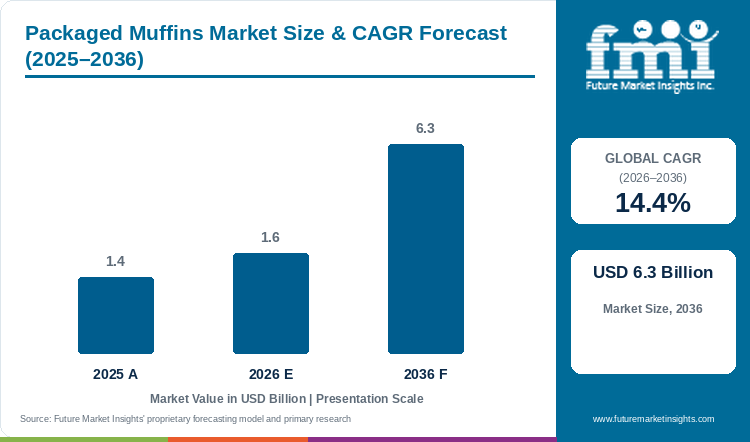
The packaged muffins market is valued at USD 1.6 Billion in 2026, against USD 1.4 Billion in 2025.
The global packaged muffins market is forecast to reach USD 6.3 Billion by 2036, representing a 14.4% CAGR. Muffins serve breakfast and snack purchases when buyers need a portable sweet bakery product. USDA Economic Research Service reported that U.S. food-away-from-home spending reached USD 1.41 trillion in 2025 [1]. Retail multipacks and foodservice cases give suppliers two distinct ways to serve that demand.
Dubai recorded 19.59 million overnight visitors in 2025 [7]. Hotels and travel-food outlets therefore matter in the UAE. England restricts promotion and placement of qualifying less-healthy muffins in larger retail settings [3]. South Korea has a strong digital food channel [8]. These conditions change the value of frozen handling and protective single-serve packs.
Key Takeaways
- The packaged muffins market is valued at USD 1.6 Billion in 2026 and is forecast to grow at a 14.4% CAGR through 2036.
- Portable muffins suit breakfast and snack occasions across retail and foodservice when pack and handling requirements are met.
- Blueberry & fruit leads product type at 32.0% in 2026 because familiar fruit cues work across breakfast, snack and mixed-flavor assortments without requiring a specialist use case.
- Conventional leads claim / nature at 55.0% in 2026 because mainstream price points and familiar formulas remain the easiest fit for high-volume retail and foodservice programs.
- Fresh leads format at 34.0% in 2026 because visible freshness and soft texture support bakery merchandising. Frozen and ambient formats compete where labor or shelf-life control matters more.
- The principal purchasing friction is the trade-off among indulgent formulation, shelf life, pack cost and nutrition-related merchandising restrictions.
- The ten profiled companies include direct muffin suppliers and broader sweet-bakery businesses. Rich Products and Sara Lee Frozen Bakery illustrate the range of channel models.
Analyst Perspective
“Soft texture and dependable shelf life will decide repeat purchases. Retailers need packs that protect margins while foodservice buyers need muffins that keep their quality after storage and handling.”
- Nandini Roy Choudhury, Principal Consultant, Future Market Insights
How is the Packaged Muffins Market Segmented?
FMI segments the packaged muffins market by product type, claim / nature, format, packaging format, sales channel and region.
Product type includes Blueberry & fruit, Chocolate chip, Bran & breakfast and Mini & protein muffins. Claim / nature includes Conventional, Clean label, Organic, Gluten-free and High-protein / fortified. Format covers Fresh, Frozen, Ambient packaged, Chilled and Par-baked / thaw-and-serve. Packaging format includes Multipack, Single-serve, Family / loaf pack and Bulk foodservice. Sales channel covers Supermarkets & hypermarkets, Artisan & specialty bakeries, Convenience & forecourt, Online & DTC and Foodservice distributors. Region covers North America, Latin America, Western Europe, Eastern Europe, East Asia, South Asia and Pacific, and Middle East and Africa. Adjacent baked goods such as those covered in the English muffins market sit outside this boundary.
Why Does Blueberry & Fruit Lead the Product Type Category?
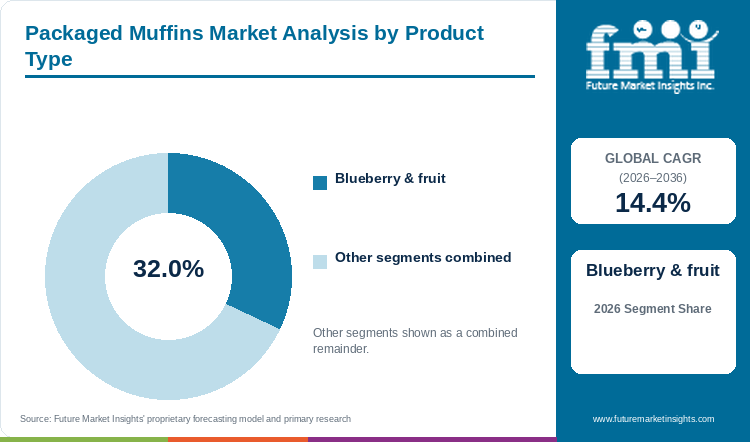
Blueberry & fruit is expected to hold 32.0% of product type market share in 2026.
Blueberry & fruit tastes familiar at breakfast and works in full-size and mini muffins. Producers can use the same flavor across single packs and variety assortments. Chocolate chip serves a more indulgent occasion. Bran and protein-led recipes address narrower nutrition needs and compete for a morning occasion that breakfast cereals also serve.
- Blueberry & fruit holds 32.0% of product type revenue in 2026. Its breadth across breakfast and snack occasions supports repeat placement in both branded and private-label assortments.
- Little Debbie lists blueberry and chocolate chip mini muffins in family packs [28] [29]. The two flavors give retailers recognizable choices for repeat snack purchases.
Why Does Conventional Lead the Claim / Nature Category?
Conventional is expected to account for 55.0% of claim / nature market share in 2026.
Conventional recipes give producers more room to balance sweetness and moisture at a mainstream price. Organic and clean-label lines need tighter ingredient choices. Gluten-free bakery premixes can help with formulation but the finished muffin still has to keep its texture and earn its shelf price.
- Conventional holds 55.0% of claim / nature revenue in 2026. The position reflects its fit with mainstream pricing and the technical flexibility needed for high-volume production.
- Premier Foods has described lower-sugar and higher-fiber Mr Kipling products [26]. Such recipes offer an alternative for buyers who want a nutrition cue while conventional muffins retain the widest pricing and formulation range.
What Supports Fresh in the Format Category?
Fresh is expected to hold 34.0% of format market share in 2026.
Fresh muffins win where stores can sell them quickly and shoppers can judge softness at the point of sale. Frozen bakery products give operators longer inventory windows but the thawed muffin still needs a fresh eating quality. Ambient packs hold longer on the shelf and need reliable moisture protection.
- Fresh accounts for 34.0% of format revenue in 2026. It benefits from immediate sensory cues while other formats compete on labor, storage and availability.
- In February 2026, Finsbury Food Group’s out-of-home breakfast analysis emphasized ready-to-serve bakery solutions and mini formats for time-pressed operators [24]. The operating logic favors formats that reduce preparation while retaining a fresh-eating proposition.
Why Does Multipack Remain the Principal Packaging Format?
Multipack is expected to hold 32.0% of packaging format market share in 2026.
Multipacks give households several portions at a clear unit price. They work for lunchboxes and repeat snacks while letting retailers compare pack counts on the shelf. Single-serve packs suit immediate eating. Foodservice buyers focus on case yield and storage instead.
- Multipack holds 32.0% of packaging format revenue in 2026. The structure balances per-unit economics with portioned consumption and gives brands room to manage flavor assortment or count.
- In May 2026, Premier Foods moved selected Mr Kipling Whirls into four-pack formats as part of a wider packaged sweet bakery refresh [27]. The adjacent example shows pack count being used as a commercial lever in the aisle.
What Gives Supermarkets & Hypermarkets the Lead in the Sales Channel Category?
Supermarkets & hypermarkets are expected to hold 38.0% of sales channel market share in 2026.
Supermarkets and hypermarkets can sell fresh, frozen and ambient muffins in one shop. Their shelves also let households compare multipack count and price. Convenience stores depend more on single-serve turnover. Ready-to-finish bakery products offer foodservice buyers another route when labor and preparation time shape the order.
- Supermarkets & hypermarkets lead sales channel at 38.0% in 2026. Their advantage comes from assortment breadth and the ability to serve planned breakfast, snacking and take-home missions in one trip.
- USDA Economic Research Service reported that U.S. grocery stores generated USD 617 billion in inflation-adjusted food sales in 2025 while warehouse clubs and supercenters generated USD 289 billion [2]. The figures illustrate the scale of large-format food retail as a route to market.
What are the Drivers, Restraints, and Opportunities in the Packaged Muffins Market?
Portable breakfast and snacking occasions support demand while nutrition-related merchandising rules and input economics constrain execution. Portion-controlled and better-for-you formats create room for differentiated growth.
- Driver: More eating occasions are moving through food-away-from-home and portable formats, which increases the value of operator-ready and on-the-go muffins.
- Restraint: Retail promotion rules, formulation trade-offs and tight pack economics can limit visibility or slow reformulation decisions.
- Opportunity: Suppliers can create incremental revenue through portion control, functional nutrition and channel-specific packs that preserve acceptable texture.
Driver: More meals and snacks are bought away from home. USDA Economic Research Service measured U.S. food-away-from-home spending at USD 1.41 trillion in 2025 [1]. Muffins fit counters and grab-and-go shelves because they need little service time. Operators choose frozen or thaw-and-serve cases to manage labor. Retailers focus on shelf life and unit price. A supplier that meets both sets of requirements can sell the same core product through more outlets.
Restraint: England’s promotion rules limit how qualifying less-healthy American muffins can be displayed and sold in volume-price offers [3]. The volume-price restrictions began on October 1, 2025. A retailer may need a different pack or a revised recipe to support promotion. Reformulation adds testing costs and can change texture. The supplier must protect both eating quality and margin.
Opportunity: Sara Lee Frozen Bakery lists an individually wrapped muffin with 51% whole grain for institutional buyers [14]. The product combines a nutrition specification with thaw-and-serve handling. Bakery ingredients and mixes can support similar reformulation work but a finished muffin must stay soft after storage. Smaller packs and clear portion sizes offer another way to meet buyer requirements without a complex claim.
Which Country CAGRs are Profiled in the Packaged Muffins Market?
The eight profiled countries record CAGRs from 13.4% in Japan to 15.6% in the UAE between 2026 and 2036.
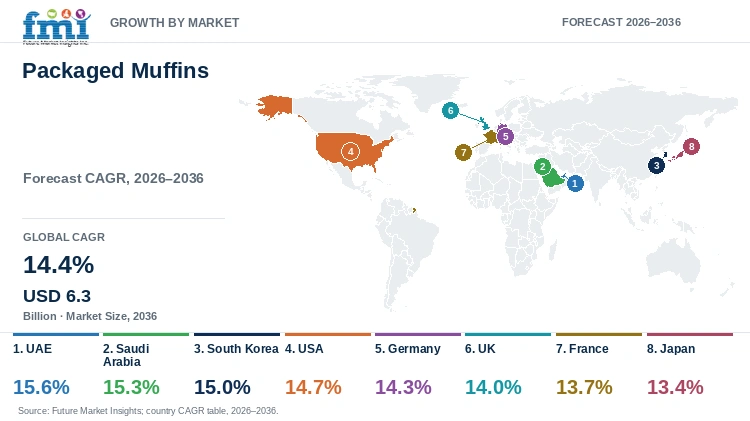
| Country | CAGR, 2026 to 2036 |
|---|---|
| UAE | 15.6% |
| Saudi Arabia | 15.3% |
| South Korea | 15.0% |
| USA | 14.7% |
| Germany | 14.3% |
| UK | 14.0% |
| France | 13.7% |
| Japan | 13.4% |
How do Country-Level CAGRs Compare in the Packaged Muffins Market?
The eight profiled countries fall within a 2.2 percentage point band, from 13.4% in Japan to 15.6% in the UAE through 2036.
The eight profiles fall within a relatively tight growth band. UAE is highest at 15.6% and Japan is lowest at 13.4%, a spread of 2.2 percentage points. Saudi Arabia and South Korea join the UAE above 15%. The USA and Germany form the next band while the UK, France and Japan stay close to the overall 14.4% trajectory. These are growth-rate comparisons rather than market-size rankings.
- UAE: Tourism and hotel demand expand the relevance of portable breakfast and foodservice bakery formats.
- Saudi Arabia: Rapid growth in licensed hospitality facilities enlarges the institutional and hotel buyer universe.
- South Korea: High mobile shopping penetration raises the importance of pack integrity and e-commerce-ready assortment design.
- USA: A large food-away-from-home economy creates room for both retail multipacks and operator-ready frozen or ambient formats.
- Germany: Established household spending on bread and cereal products supports a familiar bakery context with disciplined value expectations.
- UK: Promotion restrictions for qualifying less-healthy products make nutrition profile and merchandising strategy more consequential.
- France: Modest household consumption growth keeps value sensitivity important even as restaurant and accommodation spending remains above 2019 levels.
- Japan: Convenience-store growth supports single-portion availability but shelf competition makes velocity and freshness perception important.
Each country has different retail rules and buying channels. The rates in the table are forecasts for 2026 to 2036.
Country Outlook
Hospitality demand, online shopping, food-away-from-home spending and promotion rules shape the country outlook for packaged muffins.
- Sales of packaged muffins in the UAE will grow at a 15.6% CAGR through 2036. Dubai welcomed 19.59 million international overnight visitors in 2025, up 5% from 2024 [7]. Hotel breakfast and travel-food outlets need muffins that can be held and served without much preparation. Frozen and thaw-and-serve cases help operators cope with uneven occupancy. Retail multipacks serve resident households. Reliable temperature control remains important through delivery in the warm climate.
- Demand for packaged muffins in Saudi Arabia will rise at a 15.3% CAGR through 2036. GASTAT counted 5,622 licensed tourism hospitality facilities in Q3 2025 [6]. That was 40.6% more than a year earlier and included 2,667 hotels. More hotels mean more potential breakfast and meeting-service buyers. Frozen cases can support central purchasing. Suppliers still need pack sizes and delivery schedules that fit each operator’s turnover.
- The packaged muffins market in South Korea will expand at a 15.0% CAGR through 2036. Statistics Korea reported KRW 24.29 trillion in online shopping in December 2025 [8]. Food and beverage transactions rose 10.2% year over year and mobile accounted for 77.4% of total online value. Protective packs matter when shoppers order muffins by phone and expect them to arrive intact. Mini and single-serve formats can fit smaller orders. Suppliers also have to control breakage and moisture during delivery.
- Growth of packaged muffins in the USA will reach a 14.7% CAGR through 2036. USDA Economic Research Service reported USD 2.51 trillion in total food spending in 2025 [1]. Food-away-from-home made up 56.3% of that amount. This gives suppliers two clear outlets: retail multipacks for households and frozen or ambient cases for foodservice. Each channel has different price and handling requirements. A convenience-store single pack will not be bought in the same way as an institutional case.
- Demand for packaged muffins in Germany will rise at a 14.3% CAGR through 2036. Germany’s Federal Statistical Office reported in June 2026 that bread and cereal products made up 17% of household food expenditure in 2023 [5]. Muffins therefore compete for money already spent on familiar bakery foods. Fruit and chocolate flavors can lower trial risk. Premium claims need to justify a higher price against bread and other sweet baked goods. Shelf life and portion size matter to grocery buyers.
- Sales of packaged muffins in the UK will grow at a 14.0% CAGR through 2036. England’s promotion guidance includes qualifying less-healthy American muffins in the cakes and cupcakes category [3]. Volume-price restrictions began on October 1, 2025 for in-scope products. Retailers may therefore change pack promotions or ask suppliers to reformulate. A lower-sugar recipe must still deliver the softness shoppers expect or a compliance gain may not lead to repeat sales.
- Packaged muffins in France will grow at a 13.7% CAGR through 2036. INSEE reported that household consumption rose 0.4% in volume in 2025 while food prices rose 1.1% [4]. Restaurant and accommodation prices increased 2.4%. Spending volumes in those services remained more than 20% above 2019. Take-home and hospitality demand both matter for muffins. Premium fruit packs need visible quality to justify price. Foodservice buyers need consistent portions and easy handling.
- Adoption of packaged muffins in Japan will grow at a 13.4% CAGR through 2036. The Ministry of Economy, Trade and Industry reported a 3.4% rise in convenience-store sales in 2025 [9]. Processed foods and daily goods also increased. Single-serve muffins can fit breakfast and afternoon snack trips but they compete for limited shelf space. Retailers need a pack that sells quickly and protects the muffin’s softness through its stated shelf life.
Who are the Notable Companies in the Packaged Muffins Market?
Rich Products, Sara Lee Frozen Bakery, Dessert Holdings, Mademoiselle Desserts, Finsbury Food Group, Premier Foods, McKee Foods, Hostess Brands, Bauli and Dr. Oetker are the notable companies profiled in the packaged muffins market.
Competition depends on how each supplier makes and sells muffins. Sara Lee Frozen Bakery and Mademoiselle Desserts list direct muffin offers [13] [19]. Finsbury Food Group, McKee Foods and Hostess Brands also document muffin products [22] [28] [30]. Rich Products serves bakery and foodservice buyers. Dessert Holdings and Premier Foods bring broader sweet-bakery capability. Bauli and Dr. Oetker operate wider bakery portfolios. Buyers compare handling format and pack size alongside price.
- Direct Packaged Muffin Platforms: Rich Products, Sara Lee Frozen Bakery, Mademoiselle Desserts, Finsbury Food Group, McKee Foods and Hostess Brands.
- Broader Sweet Bakery and Dessert Platforms: Dessert Holdings and Premier Foods.
- International Sweet-Bakery Portfolios: Bauli and Dr. Oetker.
Competitive Benchmarking
Sara Lee Frozen Bakery scores High on all three capability criteria in the packaged muffins market benchmark.
| Company | Packaged Muffin Format Breadth | Retail and Foodservice Channel Coverage | Nutrition / Claim Capability | Geographic Reach |
|---|---|---|---|---|
| Rich Products | Medium | High | Medium | United States and international bakery or foodservice markets |
| Sara Lee Frozen Bakery | High | High | High | United States and Canada |
| Dessert Holdings | Low | High | Medium | North America |
| Mademoiselle Desserts | High | High | Low | Europe and international markets |
| Finsbury Food Group | High | High | Medium | United Kingdom and Europe |
| Premier Foods | Low | Medium | High | United Kingdom and selected international markets |
| McKee Foods | High | Medium | Low | United States |
| Hostess Brands | High | Medium | Medium | United States and Canada |
| Bauli | Low | Medium | Low | Italy and international markets |
| Dr. Oetker | Low | Medium | Low | Europe and international professional markets |
Scoring basis: Format Breadth compares documented portion sizes and handling options. Channel Coverage compares retail and foodservice activity. Nutrition / Claim Capability compares relevant product claims. High indicates a broad offer. Medium indicates a narrower offer. Low indicates limited capability within the metric shown. Geographic Reach records the markets named in company information.
Key Developments
Finsbury Food Group (April 2026), Premier Foods (May 2026) and Sara Lee Frozen Bakery (September 2026) made the dated moves FMI tracks in the packaged muffins market.
- In April 2026, Finsbury Food Group acquired Flower & White [25]. The business makes lighter sweet snacks and sells through direct-to-consumer, retail and foodservice channels. The addition gives Finsbury another route to households as it develops portioned bakery snacks.
- In May 2026, Premier Foods introduced five Mr Kipling products and moved selected Whirls into four-packs [27]. The smaller count gives shoppers a lower-commitment way to try new flavors and shows how pack design can refresh packaged sweet bakery shelves.
- In September 2026, Sara Lee Frozen Bakery added six single-serve cakes and cheesecakes to its Sweet Moments line [15]. The products widen its individually portioned frozen dessert range for operators serving quick indulgent snacks.
Key Players
Direct Packaged Muffin Platforms
- Rich Products
- Sara Lee Frozen Bakery
- Mademoiselle Desserts
- Finsbury Food Group
- McKee Foods
- Hostess Brands
Broader Sweet Bakery and Dessert Platforms
- Dessert Holdings
- Premier Foods
International Sweet-Bakery Portfolios
- Bauli
- Dr. Oetker
Report Scope and Methodology
| Coverage field | Report scope |
|---|---|
| Market breakdown | Product Type; Claim / Nature; Format; Packaging Format; Sales Channel; Region |
| Quantitative units | USD Billion |
| Market definition | Revenue includes packaged muffins sold as qualifying standalone products through the defined retail and foodservice channels across fresh, frozen, ambient, chilled and par-baked or thaw-and-serve formats. Muffin mixes, batters, ingredients, adjacent baked goods and downstream meal or service revenue are excluded. Distributor or operator markups beyond the qualifying muffin sale are excluded to avoid double counting. |
| Regions covered | North America; Latin America; Western Europe; Eastern Europe; East Asia; South Asia and Pacific; Middle East and Africa |
| Countries covered | USA; Germany; France; UK; Saudi Arabia; UAE; Japan; South Korea |
| Key companies profiled | Rich Products; Sara Lee Frozen Bakery; Dessert Holdings; Mademoiselle Desserts; Finsbury Food Group; Premier Foods; McKee Foods; Hostess Brands; Bauli; Dr. Oetker |
| Forecast period | 2026 to 2036 |
| Approach | Primary and secondary research with market triangulation. |
Research Methodology
FMI combines interviews with muffin manufacturers, bakery distributors, retailers and foodservice buyers with desk research and market triangulation to size the packaged muffins market.
| Method | Approach |
|---|---|
| Primary research | FMI analysts interviewed muffin manufacturers and bakery distributors. They also spoke to retailers and foodservice buyers. Discussions covered recipe and pack specifications plus handling requirements. Buyers were asked about shelf life and prices as well as repeat orders. |
| Desk research | Desk research covered food spending and retail data. It also covered hospitality statistics, promotion rules and company product pages. Dated corporate announcements were checked for relevance to packaged muffins. |
| Market sizing and forecasting | The forecast combines market size with product formats and sales channels. It also considers prices and country demand. Fresh, frozen and ambient sales were reconciled with the market definition to avoid overlap. |
| Data validation | FMI compared interview findings with public statistics and company evidence. Products were checked against the packaged muffin definition. Mixes, ingredients and unrelated sweet bakery sales were excluded from the market total. |
Packaged Muffins Market by Segments
Packaged Muffins Market Segmented by Product Type
- Blueberry & fruit
- Chocolate chip
- Bran & breakfast
- Mini & protein muffins
Packaged Muffins Market Segmented by Claim / Nature
- Conventional
- Clean label
- Organic
- Gluten-free
- High-protein / fortified
Packaged Muffins Market Segmented by Format
- Fresh
- Frozen
- Ambient packaged
- Chilled
- Par-baked / thaw-and-serve
Packaged Muffins Market Segmented by Packaging Format
- Multipack
- Single-serve
- Family / loaf pack
- Bulk foodservice
Packaged Muffins Market Segmented by Sales Channel
- Supermarkets & hypermarkets
- Artisan & specialty bakeries
- Convenience & forecourt
- Online & DTC
- Foodservice distributors
Packaged Muffins Market Segmented by Region
- North America
- United States
- Canada
- Latin America
- Brazil
- Mexico
- Argentina
- Chile
- Western Europe
- Germany
- France
- United Kingdom
- Italy
- Spain
- Benelux
- Nordics
- Eastern Europe
- Poland
- Czech Republic
- Romania
- Hungary
- East Asia
- China
- Japan
- South Korea
- South Asia and Pacific
- India
- ASEAN
- Australia and New Zealand
- Middle East and Africa
- GCC Countries
- South Africa
- Türkiye
- Israel
Research Sources and Bibliography
- [1]. USDA Economic Research Service (2026, June 11). Total U.S. food spending reached $2.51 trillion in 2025.
- [2]. USDA Economic Research Service (n.d.). Retailing & Wholesaling - Retail Trends.
- [3]. Department of Health and Social Care (2023, September 29). Restricting promotions of products high in fat, sugar or salt by location and by volume price: implementation guidance.
- [4]. INSEE (2026, June 16). Household Consumption in 2025.
- [5]. Federal Statistical Office of Germany (2026, June 16). Gut ein Fünftel der Nahrungsmittelausgaben entfallen auf Fleisch und Fisch.
- General Authority for Statistics, Saudi Arabia (2026, January 8). GASTAT: Publishes Tourism Establishments Statistics for Q3 of 2025.
- Dubai Department of Economy and Tourism (2026, January 7). Tourism Performance Report January - December 2025.
- Statistics Korea (2026, February 2). Online Shopping in December 2025.
- Japan’s Ministry of Economy, Trade and Industry (2026, April 14). 2025
- Rich Products (n.d.). Bakery.
- Rich Products (n.d.). Foodservice.
- Rich Products (2025, July 24). Introducing Rich’s Blueberry Cream Cheese & Chocolate Flips.
- Sara Lee Frozen Bakery (n.d.). Chef Pierre Individually Wrapped Muffin Variety Pack 24ct/4oz.
- Sara Lee Frozen Bakery (n.d.). Chef Pierre Individually Wrapped Muffin 51% Whole Grain Double Chocolate.
- Sara Lee Frozen Bakery (2026, September 8). Sara Lee® Expands Sweet Moments™ with Six New Single-Serve Desserts for Everyday Indulgence.
- Dessert Holdings (n.d.). Foodservice Solutions.
- Dessert Holdings (n.d.). Retail Solutions.
- Dessert Holdings (2025, July 14). Dessert Holdings Acquires Willamette Valley Pie Co.
- Mademoiselle Desserts (n.d.). Muffins.
- Mademoiselle Desserts (n.d.). Food To Go.
- Emmi Group (2024, October 4). Emmi completes acquisition of the Mademoiselle Desserts Group.
- Finsbury Food Group (n.d.). Fletchers.
- Finsbury Food Group (n.d.). Kara Foodservice.
- Finsbury Food Group (2026, February 10). The Evolution of the Out-of-Home Breakfast Market.
- Finsbury Food Group (2026, April 30). Finsbury Food Group Acquires Flower & White To Boost DTC And Healthy Snacking Growth.
- Premier Foods (2024, April 26). Mr Kipling’s range of healthier pies and cakes.
- Premier Foods (2026, May 29). Mr Kipling unveils exceedingly good innovation.
- McKee Foods (2024, January 10). McKee Foods and Little Debbie® Brand Unveils Big Pack Mini Muffins with Two Irresistible Varieties: Chocolate Chip and Blueberry.
- Little Debbie (n.d.). Family Pack Mini Muffins.
- Hostess (n.d.). Hostess Blueberry Flavored Mini Muffins.
- Hostess (n.d.). Mega Muffin Blueberry.
- The J.M. Smucker Co. (2023, November 7). The J.M. Smucker Co. Completes the Acquisition of Hostess Brands to Advance Strategy and Expand Family of Brands in Growing Categories.
- Bauli Group (n.d.). Bauli Group: tradition, innovation, and quality.
- Bauli Group (2025, May 15). Olivieri 1882 joins the Bauli Group.
- Dr. Oetker (n.d.). Our Products.
This bibliography is provided for reader reference and is not exhaustive. The full FMI report contains the complete reference list and detailed citations.
This Report Answers
- How large is the Packaged Muffins Market in 2026 and what value is forecast for 2036?
- Which industry pressures support demand for packaged muffins across retail and foodservice?
- Why does Blueberry & fruit hold the leading position within Product Type?
- Why does Conventional hold the leading position within Claim / Nature?
- How do the profiled country growth rates differ from 2026 to 2036?
- Which profiled companies supply direct muffin products or adjacent sweet-bakery capabilities?
- What limits adoption, retailer promotion or supplier switching in the packaged muffins market?
- What should buyers evaluate before selecting a packaged muffin supplier or format?
Frequently Asked Questions
How Big is the Packaged Muffins Market in 2026?
As per FMI, the packaged muffins market is valued at USD 1.6 Billion in 2026 and is forecast to reach USD 6.3 Billion by 2036. The 2025 value was USD 1.4 Billion. Portable breakfast and snack purchases through retail multipacks and foodservice cases support this growth.
What is the CAGR of the Packaged Muffins Market from 2026 to 2036?
The packaged muffins market is forecast to grow at a CAGR of 14.4% between 2026 and 2036. Growth depends on suppliers matching pack formats and handling needs to retail multipacks and foodservice cases while keeping the soft texture buyers expect after storage and distribution.
Which Product Type Leads the Packaged Muffins Market?
Blueberry & fruit accounts for 32.0% of the packaged muffins market by product type in 2026. Familiar fruit cues work across breakfast and snack occasions and mixed-flavor assortments without needing a specialist use case. This supports repeat placement in full-size and mini formats across branded and private-label ranges.
Which Claim / Nature Segment Leads the Packaged Muffins Market?
As per FMI, conventional muffins hold 55.0% of the packaged muffins market by claim and nature in 2026. Mainstream price points and familiar formulas remain the easiest fit for high-volume retail and foodservice programs. Clean-label and organic lines need tighter ingredient choices and a stronger price case to compete.
Which Profiled Countries Show Notable Growth in the Packaged Muffins Market?
The packaged muffins market is projected to grow at a CAGR of 15.6% in the UAE, 15.3% in Saudi Arabia and 15.0% in South Korea between 2026 and 2036. Tourism, hotel supply and mobile food shopping drive demand for frozen handling and protective single-serve packs in these markets.
Which Companies are Active in the Packaged Muffins Market?
The packaged muffins market profiles 10 companies, including Rich Products, Sara Lee Frozen Bakery and McKee Foods alongside Finsbury Food Group and Premier Foods. They span direct muffin suppliers and broader sweet-bakery businesses that compete on pack format and sales channel across retail and foodservice buyers.
Preview the report firsthand - request a free sample
Get SampleGet the brochure for pricing and purchase details.
Get PDFTable of Content
- Key Takeaways
- Market Size and CAGR
- Top Growth Driver
- Fastest Growing Segment
- Leading Region
- Key Companies
- Emerging Opportunities
- Executive Summary
- Global Market Outlook
- Demand-side Trends
- Supply-side Trends
- Technology Roadmap Analysis
- Analysis and Recommendations
- Analyst Perspective (What is happening? Why now? What should investors know?)
- Key Questions Answered
- How large is the market?
- What is the CAGR?
- What are key trends?
- Which region dominates?
- Who are the leaders?
- Market Overview
- Market Coverage / Taxonomy
- Market Definition / Scope / Limitations
- Research Methodology
- Chapter Orientation
- Analytical Lens and Working Hypotheses
- Market Structure, Signals, and Trend Drivers
- Benchmarking and Cross-market Comparability
- Market Sizing, Forecasting, and Opportunity Mapping
- Research Design and Evidence Framework
- Desk Research Programme (Secondary Evidence)
- Expert Input and Fieldwork (Primary Evidence)
- Tooling, Models, and Reference Databases
- Data Engineering and Model Build
- Quality Assurance and Audit Trail
- Market Background
- Market Dynamics (Drivers, Restraints, Opportunity, Trends)
- Scenario Forecast (Optimistic, Likely, Conservative)
- Impact Analysis
- AI Impact
- Sustainability Impact
- Regulatory Impact
- Technology Impact
- Consumer / Buyer Analysis
- Purchase Drivers
- Adoption Barriers
- Buyer Journey
- Opportunity Map Analysis
- Product Life Cycle Analysis
- Supply Chain Analysis
- Investment Feasibility Matrix
- Value Chain Analysis
- PESTLE and Porter's Analysis
- Regulatory Landscape
- Regional Parent Market Outlook
- Production and Consumption Statistics
- Import and Export Statistics
- Global Market Analysis and Forecast, 2021 to 2036
- Historical Market Size Value (USD Billion) Analysis, 2021 to 2025
- Current and Future Market Size Value (USD Billion) Projections, 2026 to 2036
- Y-o-Y Growth Trend Analysis
- Absolute $ Opportunity Analysis
- Global Market Pricing Analysis, 2021 to 2036
- Global Market Analysis and Forecast, By Product Type, 2021 to 2036
- Introduction / Key Findings
- Historical Market Size Value (USD Billion) Analysis By Product Type, 2021 to 2025
- Current and Future Market Size Value (USD Billion) Analysis and Forecast By Product Type, 2026 to 2036
- Blueberry & fruit
- Chocolate chip
- Bran & breakfast
- Mini & protein muffins
- Y-o-Y Growth Trend Analysis By Product Type, 2021 to 2025
- Absolute $ Opportunity Analysis By Product Type, 2026 to 2036
- Global Market Analysis and Forecast, By Claim / Nature, 2021 to 2036
- Introduction / Key Findings
- Historical Market Size Value (USD Billion) Analysis By Claim / Nature, 2021 to 2025
- Current and Future Market Size Value (USD Billion) Analysis and Forecast By Claim / Nature, 2026 to 2036
- Conventional
- Clean label
- Organic
- Gluten-free
- High-protein / fortified
- Y-o-Y Growth Trend Analysis By Claim / Nature, 2021 to 2025
- Absolute $ Opportunity Analysis By Claim / Nature, 2026 to 2036
- Global Market Analysis and Forecast, By Format, 2021 to 2036
- Introduction / Key Findings
- Historical Market Size Value (USD Billion) Analysis By Format, 2021 to 2025
- Current and Future Market Size Value (USD Billion) Analysis and Forecast By Format, 2026 to 2036
- Fresh
- Frozen
- Ambient packaged
- Chilled
- Par-baked / thaw-and-serve
- Y-o-Y Growth Trend Analysis By Format, 2021 to 2025
- Absolute $ Opportunity Analysis By Format, 2026 to 2036
- Global Market Analysis and Forecast, By Packaging Format, 2021 to 2036
- Introduction / Key Findings
- Historical Market Size Value (USD Billion) Analysis By Packaging Format, 2021 to 2025
- Current and Future Market Size Value (USD Billion) Analysis and Forecast By Packaging Format, 2026 to 2036
- Multipack
- Single-serve
- Family / loaf pack
- Bulk foodservice
- Y-o-Y Growth Trend Analysis By Packaging Format, 2021 to 2025
- Absolute $ Opportunity Analysis By Packaging Format, 2026 to 2036
- Global Market Analysis and Forecast, By Sales Channel, 2021 to 2036
- Introduction / Key Findings
- Historical Market Size Value (USD Billion) Analysis By Sales Channel, 2021 to 2025
- Current and Future Market Size Value (USD Billion) Analysis and Forecast By Sales Channel, 2026 to 2036
- Supermarkets & hypermarkets
- Artisan & specialty bakeries
- Convenience & forecourt
- Online & DTC
- Foodservice distributors
- Y-o-Y Growth Trend Analysis By Sales Channel, 2021 to 2025
- Absolute $ Opportunity Analysis By Sales Channel, 2026 to 2036
- Global Market Analysis and Forecast, By Region, 2021 to 2036
- Introduction
- Historical Market Size Value (USD Billion) Analysis By Region, 2021 to 2025
- Current Market Size Value (USD Billion) Analysis and Forecast By Region, 2026 to 2036
- North America
- Latin America
- Western Europe
- Eastern Europe
- East Asia
- South Asia and Pacific
- Middle East and Africa
- Market Attractiveness Analysis By Region
- North America Market Analysis and Forecast, By Country, 2021 to 2036
- Historical Market Size Value (USD Billion) Trend Analysis By Market Taxonomy, 2021 to 2025
- Market Size Value (USD Billion) Forecast By Market Taxonomy, 2026 to 2036
- By Country
- United States
- Canada
- By Product Type
- By Claim / Nature
- By Format
- By Packaging Format
- By Sales Channel
- By Country
- Market Attractiveness Analysis
- By Country
- By Product Type
- By Claim / Nature
- By Format
- By Packaging Format
- By Sales Channel
- Key Takeaways
- Latin America Market Analysis and Forecast, By Country
- Historical Market Size Value (USD Billion) Trend Analysis By Market Taxonomy, 2021 to 2025
- Market Size Value (USD Billion) Forecast By Market Taxonomy, 2026 to 2036
- By Country
- Brazil
- Mexico
- Argentina
- Chile
- By Product Type
- By Claim / Nature
- By Format
- By Packaging Format
- By Sales Channel
- By Country
- Market Attractiveness Analysis
- By Country
- By Product Type
- By Claim / Nature
- By Format
- By Packaging Format
- By Sales Channel
- Key Takeaways
- Western Europe Market Analysis and Forecast, By Country
- Historical Market Size Value (USD Billion) Trend Analysis By Market Taxonomy, 2021 to 2025
- Market Size Value (USD Billion) Forecast By Market Taxonomy, 2026 to 2036
- By Country
- Germany
- France
- United Kingdom
- Italy
- Spain
- Benelux
- Nordics
- By Product Type
- By Claim / Nature
- By Format
- By Packaging Format
- By Sales Channel
- By Country
- Market Attractiveness Analysis
- By Country
- By Product Type
- By Claim / Nature
- By Format
- By Packaging Format
- By Sales Channel
- Key Takeaways
- Eastern Europe Market Analysis and Forecast, By Country
- Historical Market Size Value (USD Billion) Trend Analysis By Market Taxonomy, 2021 to 2025
- Market Size Value (USD Billion) Forecast By Market Taxonomy, 2026 to 2036
- By Country
- Poland
- Czech Republic
- Romania
- Hungary
- By Product Type
- By Claim / Nature
- By Format
- By Packaging Format
- By Sales Channel
- By Country
- Market Attractiveness Analysis
- By Country
- By Product Type
- By Claim / Nature
- By Format
- By Packaging Format
- By Sales Channel
- Key Takeaways
- East Asia Market Analysis and Forecast, By Country
- Historical Market Size Value (USD Billion) Trend Analysis By Market Taxonomy, 2021 to 2025
- Market Size Value (USD Billion) Forecast By Market Taxonomy, 2026 to 2036
- By Country
- China
- Japan
- South Korea
- By Product Type
- By Claim / Nature
- By Format
- By Packaging Format
- By Sales Channel
- By Country
- Market Attractiveness Analysis
- By Country
- By Product Type
- By Claim / Nature
- By Format
- By Packaging Format
- By Sales Channel
- Key Takeaways
- South Asia and Pacific Market Analysis and Forecast, By Country
- Historical Market Size Value (USD Billion) Trend Analysis By Market Taxonomy, 2021 to 2025
- Market Size Value (USD Billion) Forecast By Market Taxonomy, 2026 to 2036
- By Country
- India
- ASEAN
- Australia and New Zealand
- By Product Type
- By Claim / Nature
- By Format
- By Packaging Format
- By Sales Channel
- By Country
- Market Attractiveness Analysis
- By Country
- By Product Type
- By Claim / Nature
- By Format
- By Packaging Format
- By Sales Channel
- Key Takeaways
- Middle East and Africa Market Analysis and Forecast, By Country
- Historical Market Size Value (USD Billion) Trend Analysis By Market Taxonomy, 2021 to 2025
- Market Size Value (USD Billion) Forecast By Market Taxonomy, 2026 to 2036
- By Country
- GCC Countries
- South Africa
- Türkiye
- Israel
- By Product Type
- By Claim / Nature
- By Format
- By Packaging Format
- By Sales Channel
- By Country
- Market Attractiveness Analysis
- By Country
- By Product Type
- By Claim / Nature
- By Format
- By Packaging Format
- By Sales Channel
- Key Takeaways
- Key Countries Market Analysis
- United States
- Pricing Analysis
- Market Share Analysis, 2025
- By Product Type
- By Claim / Nature
- By Format
- By Packaging Format
- By Sales Channel
- Canada
- Pricing Analysis
- Market Share Analysis, 2025
- By Product Type
- By Claim / Nature
- By Format
- By Packaging Format
- By Sales Channel
- Mexico
- Pricing Analysis
- Market Share Analysis, 2025
- By Product Type
- By Claim / Nature
- By Format
- By Packaging Format
- By Sales Channel
- Brazil
- Pricing Analysis
- Market Share Analysis, 2025
- By Product Type
- By Claim / Nature
- By Format
- By Packaging Format
- By Sales Channel
- Chile
- Pricing Analysis
- Market Share Analysis, 2025
- By Product Type
- By Claim / Nature
- By Format
- By Packaging Format
- By Sales Channel
- Germany
- Pricing Analysis
- Market Share Analysis, 2025
- By Product Type
- By Claim / Nature
- By Format
- By Packaging Format
- By Sales Channel
- United Kingdom
- Pricing Analysis
- Market Share Analysis, 2025
- By Product Type
- By Claim / Nature
- By Format
- By Packaging Format
- By Sales Channel
- Italy
- Pricing Analysis
- Market Share Analysis, 2025
- By Product Type
- By Claim / Nature
- By Format
- By Packaging Format
- By Sales Channel
- Spain
- Pricing Analysis
- Market Share Analysis, 2025
- By Product Type
- By Claim / Nature
- By Format
- By Packaging Format
- By Sales Channel
- France
- Pricing Analysis
- Market Share Analysis, 2025
- By Product Type
- By Claim / Nature
- By Format
- By Packaging Format
- By Sales Channel
- India
- Pricing Analysis
- Market Share Analysis, 2025
- By Product Type
- By Claim / Nature
- By Format
- By Packaging Format
- By Sales Channel
- ASEAN
- Pricing Analysis
- Market Share Analysis, 2025
- By Product Type
- By Claim / Nature
- By Format
- By Packaging Format
- By Sales Channel
- Australia and New Zealand
- Pricing Analysis
- Market Share Analysis, 2025
- By Product Type
- By Claim / Nature
- By Format
- By Packaging Format
- By Sales Channel
- China
- Pricing Analysis
- Market Share Analysis, 2025
- By Product Type
- By Claim / Nature
- By Format
- By Packaging Format
- By Sales Channel
- Japan
- Pricing Analysis
- Market Share Analysis, 2025
- By Product Type
- By Claim / Nature
- By Format
- By Packaging Format
- By Sales Channel
- South Korea
- Pricing Analysis
- Market Share Analysis, 2025
- By Product Type
- By Claim / Nature
- By Format
- By Packaging Format
- By Sales Channel
- Poland
- Pricing Analysis
- Market Share Analysis, 2025
- By Product Type
- By Claim / Nature
- By Format
- By Packaging Format
- By Sales Channel
- Hungary
- Pricing Analysis
- Market Share Analysis, 2025
- By Product Type
- By Claim / Nature
- By Format
- By Packaging Format
- By Sales Channel
- Türkiye
- Pricing Analysis
- Market Share Analysis, 2025
- By Product Type
- By Claim / Nature
- By Format
- By Packaging Format
- By Sales Channel
- South Africa
- Pricing Analysis
- Market Share Analysis, 2025
- By Product Type
- By Claim / Nature
- By Format
- By Packaging Format
- By Sales Channel
- UAE
- Pricing Analysis
- Market Share Analysis, 2025
- By Product Type
- By Claim / Nature
- By Format
- By Packaging Format
- By Sales Channel
- Saudi Arabia
- Pricing Analysis
- Market Share Analysis, 2025
- By Product Type
- By Claim / Nature
- By Format
- By Packaging Format
- By Sales Channel
- United States
- Market Structure Analysis
- Competition Dashboard
- Competition Benchmarking
- Market Share Analysis of Top Players
- By Regional
- By Product Type
- By Claim / Nature
- By Format
- By Packaging Format
- By Sales Channel
- Emerging Startups
- Innovation Benchmarking
- Competition Analysis
- Competition Deep Dive
- Rich Products
- Overview
- Product Portfolio
- Profitability by Market Segments
- Sales Footprint
- Strategy Overview
- Marketing Strategy
- Product Strategy
- Channel Strategy
- Sara Lee Frozen Bakery
- Dessert Holdings
- Mademoiselle Desserts
- Finsbury Food Group
- Premier Foods
- McKee Foods
- Hostess Brands
- Bauli
- Dr. Oetker
- Rich Products
- Case Studies
- Success Stories
- Recent Developments
- Competition Deep Dive
- Assumptions & Acronyms Used


