

- Market Size (2026)
- USD 691.8 Mn
- Forecast (2036)
- USD 1746.0 Mn
- CAGR (2026 to 2036)
- 9.7%
How big is English Muffins Market in 2026?
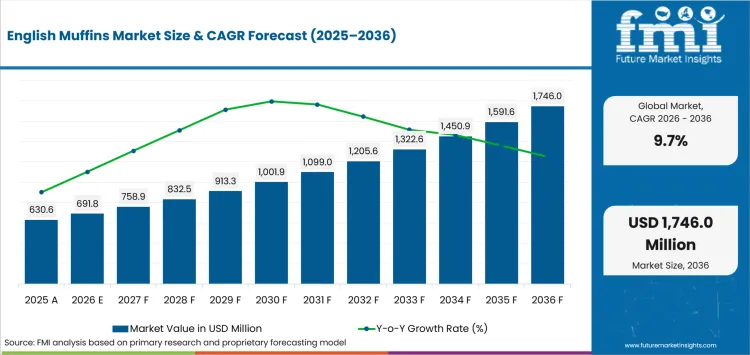
USD 691.8 million in 2026 and USD 1,746.0 million by 2036 at a 9.7% CAGR.
Sales of english muffins are projected to expand at a 9.7% CAGR between 2026 and 2036, taking the market from USD 691.8 million to USD 1,746.0 million. The format fits packaged bread routines: households toast it for breakfast and foodservice kitchens use the same split bread for filled sandwiches. Flowers Foods stated in November 2025 that Wonder English Muffins were moving from a West Coast launch into national distribution. The expansion gave an established bakery route a direct way to widen trial without changing the core preparation habit.
Channel access changes the economics of that expansion. The UK Office for National Statistics put online sales at 29.4% of total retail spending in June 2026, giving online grocery a meaningful role in replenishment and product discovery. Fresh packs suit dense delivery routes. Frozen or par-baked formats become more practical as service distance grows, making shelf life, toast texture, and local handling costs more important than flavor breadth alone.
Key Takeaways
- Demand rises because one toastable bread format can serve household breakfast, light meals, and prepared sandwich occasions without changing basic kitchen routines.
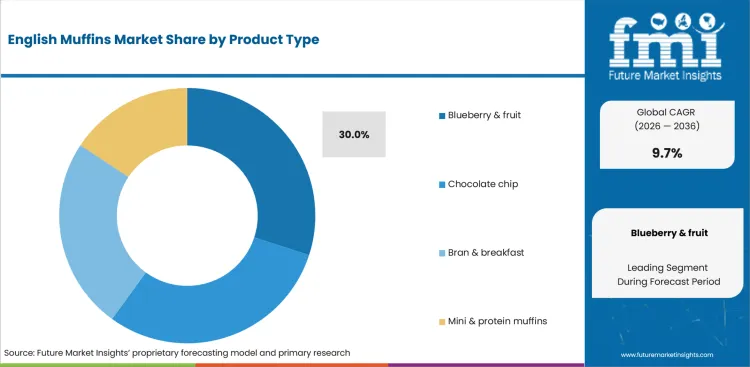
- By product type, blueberry & fruit is forecast to represent 30.0% in 2026 driven by familiar breakfast flavor cues that preserve the split-and-toast routine.
- The conventional segment is likely to capture 51.0% share in 2026 attributable to broad price flexibility and fewer claim-specific formulation constraints.
- Fresh is projected to hold 30.0% share in 2026 owing to familiar bakery placement and immediate-use texture on frequent replenishment routes.
- Short shelf life, recipe compliance, and weaker route economics can narrow the addressable area for fresh or highly specialized variants.
- Some of the key players in this market include Grupo Bimbo, Flowers Foods, ARYZTA, Lantmännen Unibake, Vandemoortele, Yamazaki Baking, Warburtons, and Europastry.
Analyst Perspective
"English muffins earn repeat orders once split quality and toast texture survive the route to shelf or breakfast service. Fresh retail packs need fast replenishment, whereas frozen foodservice cases must deliver consistent thawing and holding performance to justify extra flavor or nutrition claims."
- Nandini Roy Choudhury, Principal Consultant, Future Market Insights
How is the english muffins market segmented?
The english muffins market is segmented by product type, claim - nature, format, packaging format, sales channel, and region.
Product type includes blueberry & fruit, chocolate chip, bran & breakfast, and mini & protein muffins. Claim - nature covers conventional, clean label, organic, gluten-free, and high-protein / fortified products. Format includes fresh, frozen, ambient packaged, chilled, and par-baked / thaw-and-serve. Packaging covers multipack, single-serve, family / loaf pack, and bulk foodservice. Sales channels include supermarkets & hypermarkets, artisan & specialty bakeries, convenience & forecourt, online & DTC, and foodservice distributors.
What makes blueberry & fruit central to the product type category?
Fruit flavors give bakery products visible variation without changing how shoppers split, toast, or fill an english muffin. Grupo Bimbo stated in July 2025 that 99% of its daily-consumption portfolio, including english muffins, was free of artificial flavors and colorants. That fit lets bakery products extend flavor without changing the core breakfast format.
- Based on product type, blueberry & fruit is projected to account for 30.0% in 2026 due to familiar breakfast flavor cues that fit established use occasions.
- Formulation stability remains the commercial test: fruit pieces and sweetness must survive toasting, and declared ingredients must stay consistent through the stated pack life.
Why does conventional lead the claim - nature category?
Conventional products give grocers the widest room to manage price, flavor, and pack size without tying each SKU to a specialist claim. The USA Food and Drug Administration updated the voluntary "healthy" claim in 2025, requiring qualifying foods to meet food-group and nutrient limits. That added qualification work raises the bar for claim-led extensions and adjacent allergen-free food propositions.
- By claim - nature, conventional is estimated to hold 51.0% in 2026 owing to broad price flexibility and fewer claim-specific formulation constraints.
- Premium claims can justify higher price points, yet recipe control, label review, and texture testing must be completed ahead of wider line expansion.
How does fresh hold the lead in the format category?
Fresh english muffins match the soft interior and toasted exterior expected from the format, which keeps them close to routine bread replenishment. Insee reported in June 2026 that bakery-patisserie outlets represented 8.1% of French food retail value in 2025. The share confirms that packaged english muffins compete beside a meaningful fresh-bakery route.
- In 2026, fresh is expected to lead format with 30.0% share because routine bakery placement supports immediate-use texture in dense retail routes.
- Fresh listings need production and store replenishment schedules that keep sell-through ahead of softness loss, especially in markets with strong artisan bakery competition.
What keeps supermarkets & hypermarkets ahead in sales channel?
Large grocery stores let shoppers compare english-muffin flavors, claims, and pack sizes in one trip. Insee reported in June 2026 that large general food stores represented 58.6% of French food retail value in 2025. The figure makes supermarkets a direct discovery and replenishment route beside specialist bakeries and frozen bakery options.
- Supermarkets & hypermarkets are set to lead the sales channel with 28.0% share in 2026 due to repeat grocery traffic and structured national replenishment.
- Listings still depend on velocity. A national account can widen reach quickly, yet slow fresh movement turns extra facings into waste and weakens retailer support during routine category reviews.
What are the drivers, restraints and opportunities in the English Muffins Market?
Breakfast versatility widens use occasions, but freshness and formulation requirements constrain execution and nutrition-led renovation offers a route to premium growth.
- Driver: English muffins can move between household breakfast and prepared sandwich menus with the same basic toastable format.
- Restraint: Short fresh shelf life and market-specific flour or claim rules increase the cost of carrying too many variants.
- Opportunity: Reformulation, gluten-free lines, and higher-protein offers can lift value if texture and price remain credible.
Breakfast and Sandwich Use Share One Format
English muffins can serve retail breakfast and prepared sandwich menus without changing the core product geometry. USDA Economic Research Service calculated that food away from home represented 56.3% of USA food spending in 2025, giving bakeries two demand routes from related industrial bakery mixes. Packaged retail muffins and breakfast takeout programs still depend on consistent split quality, toast response, and holding performance after storage.
Freshness and Flour Rules Raise Launch Costs
Fresh formats lose margin quickly if delivery frequency cannot protect softness and sell-through. UK guidance updated in April 2025 confirms mandatory nutrients for non-wholemeal common wheat flour, with folic acid joining the requirement from 13 December 2026. A recipe change can require new specifications and sensory testing, so bread improvers and line adjustments become part of commercial qualification for manufacturers.
Nutrition-Led Renovation Can Support Premium Tiers
Nutrition-led extensions can raise value if the muffin still splits and toasts like the mainstream product. Grupo Bimbo stated in May 2026 that 98% of its daily-consumption portfolio, including english muffins, met its Positive Nutrition standard. Larger bakery platforms can apply that reformulation capacity to gluten-free food or protein extensions, although smaller brands face higher testing and distribution costs in launch planning.
Which country CAGRs are profiled in the English Muffins Market?
| Country | CAGR |
|---|---|
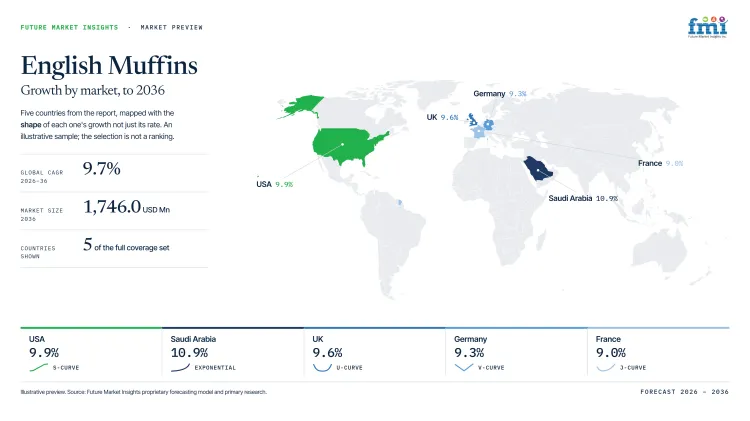
| Saudi Arabia | 10.9% |
| UAE | 10.6% |
| South Korea | 10.3% |
| USA | 9.9% |
| UK | 9.6% |
How do country-level CAGRs compare in the English Muffins Market?
The 1.3-point range separates Gulf hospitality markets from South Korea's mobile-grocery route and the mature USA-UK pair. Saudi Arabia and UAE gain from hotel demand. South Korea relies more on dense digital commerce and rapid replenishment. The USA-UK gap reflects mature grocery access with different local substitutes and service costs.
- Saudi Arabia hotel growth favors frozen cases beyond daily fresh-bread delivery zones.
- UAE hotel menus reward cold-chain consistency and locally held distributor inventory.
- South Korea mobile grocery rewards compact packs and rapid urban inventory rotation.
- USA store coverage makes route density central to fresh availability.
- UK crumpet and bagel competition rewards distinct toasted texture and pricing.
Comparable CAGRs produce different entry conditions because service costs and substitutes vary. The full report covers North America, Latin America, Western Europe, Eastern Europe, East Asia, South Asia and Pacific, and Middle East and Africa.
Country-wise Analysis
- Saudi demand is tied to a growing licensed hospitality base that buys standardized breakfast items through hotels and restaurants. Frozen and par-baked english muffins become useful beyond daily fresh-bread routes where major cities and high-traffic districts need reliable morning service. GASTAT counted 5,622 licensed tourism hospitality facilities in the third quarter of 2025. Saudi Arabia is projected to grow at 10.9% CAGR through 2036 as more breakfast-service sites seek consistent formats. Cold-chain reach and import lead times still complicate smaller-city coverage. Distributors with local inventory and hotel-ready case formats can protect service levels better than supermarket-led brands focused mainly on households.
- UAE demand is concentrated in hotels, cafés, airports and premium grocery outlets that serve international breakfast menus. These channels expose travelers and residents to english-muffin formats through buffets, café service and tourism-center operations. The Government of Dubai Media Office reported more than 32 million hotel guests in 2025. That audience expects stable frozen handling, reliable delivery timing and predictable case yields. English-muffin demand in the UAE is forecast to rise at 10.6% CAGR over the assessment period. Import lead times make local inventory buffers and disciplined distributor schedules important for keeping service consistent.
- South Korea benefits from mobile grocery platforms and dense urban delivery networks that can rotate compact breakfast packs quickly. Fresh bakery still faces a shorter usable selling window when fulfillment handling is heavy on high-volume city routes. Adoption of english muffins in South Korea is estimated to expand at 10.3% CAGR during the forecast period. Growth is shaped by digital discovery and short replenishment cycles. Ministry of Data and Statistics data published in August 2025 showed online food and beverage shopping 11.0% higher year over year in June. Imported brands need local-language merchandising, clear shelf-life information and disciplined inventory rotation to turn digital trial into repeat orders.
- The USA offers broad access through national supermarkets, mass merchants, convenience stores and foodservice networks. English muffins benefit from routine grocery trips and morning-service menus, but fresh routes absorb fuel, labor, promotion costs, stale returns and extra delivery work during promotional peaks. Census Bureau data released in August 2026 put July retail and food-services sales 5.0% above a year earlier. The figure confirms a large selling base where availability depends on disciplined route execution. The USA is likely to register 9.9% CAGR over the forecast period. Producers with both direct-store delivery and frozen foodservice capacity are better placed than single-channel brands.
- UK shoppers can choose close substitutes such as crumpets, bagels and retailer own-label bakery in the same breakfast aisle. English-muffin brands therefore need to win through toasted texture, pack price, shelf clarity and familiar home preparation. Demand in the UK is on track to deliver 9.6% CAGR through 2036. Food Standards Agency data showed that 69% of respondents bought food from a large supermarket at least weekly in 2025. Flour rules and retailer price pressure limit easy reformulation. Successful variants need a clear texture or flavor difference that still fits the familiar breakfast-bakery price position.
Who are the notable companies in the English Muffins Market?
Grupo Bimbo, Flowers Foods, ARYZTA, Lantmännen Unibake, Vandemoortele, Yamazaki Baking, Warburtons, and Europastry are the notable companies serving this market.
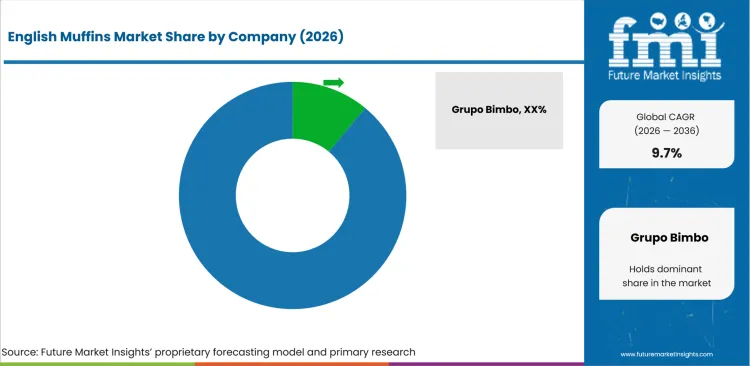
Competition is fragmented between direct english-muffin brands and larger bakery platforms supplying adjacent breakfast, frozen, or bake-off formats. Route density, fresh-return economics, retailer authorization, and texture after storage create entry barriers that corporate scale alone cannot remove.
- Grupo Bimbo, Flowers Foods, Yamazaki Baking, and Warburtons have the clearest direct or closely documented breakfast-bread routes into branded retail demand.
- ARYZTA, Lantmännen Unibake, Vandemoortele, and Europastry bring larger frozen, bake-off, or foodservice bakery platforms that can support sourdough, rolls, and adjacent sandwich carriers.
Competitive Benchmarking: English Muffins Market
| Company | Positioning | Verified Development |
|---|---|---|
| Grupo Bimbo | Global packaged-bread and QSR bakery group with direct english-muffin exposure through Thomas'. | In September 2025, received regulatory approval to acquire Wickbold in Brazil, extending packaged-bread reach in Latin America. |
| Flowers Foods | USA packaged-bakery producer with Wonder and Canyon Bakehouse english-muffin offers. | In May 2026, introduced Canyon Bakehouse gluten-free english muffins nationwide through the frozen aisle. |
| ARYZTA | International convenience-bakery producer serving retail and foodservice with frozen and bake-off products. | In January 2026, announced a new bun bakery in Portugal to expand convenience-bakery capacity. |
| Lantmännen Unibake | Large fresh and frozen bakery group supplying retail and foodservice in more than 60 markets. | In December 2025, signed an agreement to acquire Panificio San Francesco, an Italian frozen-bread producer serving retail. |
| Vandemoortele | European bakery-products group with frozen bread, pastry, and foodservice distribution. Direct english-muffin exposure is limited. | In August 2026, its USA business completed the final phase of the Banneton Bakery acquisition. |
| Yamazaki Baking | Japanese bread producer with a large store network. Documented english-muffin activity is concentrated in Japan and selected overseas markets. | In December 2025, announced a nationwide January 2026 renewal of its Royal Bread range with revised dough and fermentation. |
| Warburtons | UK fresh-bakery producer with direct breakfast-muffin exposure and dense daily store delivery. | In March 2026, began rolling out a unified packaging redesign through its 70-plus bakery-product portfolio to improve shelf navigation. |
| Europastry | Global frozen-bakery producer serving retail and foodservice in more than 90 countries. Its documented strength is adjacent frozen bakery and foodservice bread. | In June 2026, agreed to acquire Highland Baking Company, adding USA foodservice bread production in Illinois and South Carolina. |
Scoring basis: High product breadth requires direct english-muffin exposure plus several adjacent breakfast-bread forms. Medium requires a verified bread or bake-off platform with narrower exact-market evidence. High production control requires owned bakery capacity plus controlled distribution or logistics. Medium requires one of those capabilities. High channel coverage requires retail and foodservice access plus another route. Medium requires two documented channels, and Low identifies one.
Key Developments in the English Muffins Market
- In August 2026, ARYZTA officially opened its new Perth bakery, expanding regional bakery production capacity for Australian customers.
- In September 2025, Lantmännen Unibake acquired Boboli Benelux, adding a Netherlands bakery and deeper bake-off and chilled capability for retail and foodservice.
- In February 2025, Vandemoortele acquired Lizzi in Italy, adding four frozen-bakery plants serving large-scale retail and HoReCa channels.
Key Players in the English Muffins Market
Direct Branded Breakfast-Bread Platforms
- Grupo Bimbo
- Flowers Foods
- Yamazaki Baking
- Warburtons
Frozen and Bake-Off Bakery Platforms
- ARYZTA
- Lantmännen Unibake
- Vandemoortele
- Europastry
English Muffins Market - Report Scope
| Coverage field | Report scope |
|---|---|
| Market breakdown | By product type, claim - nature, format, packaging format, sales channel, and region. |
| Quantitative Units | USD million. |
| Market Definition | Packaged, fresh, frozen, chilled, ambient, and par-baked english muffins sold through retail, direct, and foodservice routes. |
| Regions Covered | North America, Latin America, Western Europe, Eastern Europe, East Asia, South Asia and Pacific, and Middle East and Africa. |
| Countries Covered | Saudi Arabia, UAE, South Korea, USA, UK, and 20+ countries included in the full report. |
| Key Companies Profiled | Grupo Bimbo, Flowers Foods, ARYZTA, Lantmännen Unibake, Vandemoortele, Yamazaki Baking, Warburtons, and Europastry. |
| Forecast Period | Base 2026 to 2036. |
| Approach | Primary and secondary research with market triangulation. |
English Muffins Market - Research Methodology
| Method | Approach |
|---|---|
| Primary Research | FMI analysts gathered input from manufacturers, service providers, technology developers, distributors, end users, procurement teams, and subject-matter experts. Interviews examined purchasing decisions, product or service evaluation, adoption barriers, approval requirements, pricing considerations, and expectations for technical or commercial support. Respondents were also asked what evidence is required before a trial, pilot, or initial order develops into regular purchasing. |
| Desk Research | Desk research covered government statistics, regulatory publications, trade data, industry associations, technical literature, standards, company filings, product information, and official corporate announcements. Sources were reviewed for relevance, publication date, geographic coverage, and consistency with the defined market scope. Claims relating to performance, applications, approvals, capacity, investment, and commercial activity were retained only when supported by credible public evidence. |
| Market Sizing and Forecasting | The market model combined the baseline value with historical performance, segment structure, pricing and volume indicators, adoption levels, company participation, and country-level demand conditions. Forecast assumptions considered economic activity, investment trends, regulatory developments, technology adoption, purchasing cycles, supply availability, and barriers to wider market use. Segment and regional estimates were reconciled before the final market total was calculated. |
| Data Validation | Estimates were checked against multiple independent indicators, including public data, company activity, trade patterns, industry developments, and findings from primary interviews. Validation also tested whether products, services, applications, and company revenues fell within the defined market boundaries. Adjacent categories, unsupported claims, overlapping revenues, and activities without direct market relevance were excluded to reduce double counting and maintain consistency across segments and countries. |
English Muffins Market by Segments
English Muffins Market segmented by Product Type:
- Blueberry & fruit
- Chocolate chip
- Bran & breakfast
- Mini & protein muffins
English Muffins Market segmented by Claim - nature:
- Conventional
- Clean label
- Organic
- Gluten-free
- High-protein / fortified
English Muffins Market segmented by Format:
- Fresh
- Frozen
- Ambient packaged
- Chilled
- Par-baked / thaw-and-serve
English Muffins Market segmented by Packaging Format:
- Multipack
- Single-serve
- Family / loaf pack
- Bulk foodservice
English Muffins Market segmented by Sales Channel:
- Supermarkets & hypermarkets
- Artisan & specialty bakeries
- Convenience & forecourt
- Online & DTC
- Foodservice distributors
English Muffins Market by Region:
- North America
- United States
- Canada
- Latin America
- Brazil
- Mexico
- Argentina
- Chile
- Western Europe
- Germany
- France
- United Kingdom
- Italy
- Spain
- Benelux
- Nordics
- Eastern Europe
- Poland
- Czech Republic
- Romania
- Hungary
- East Asia
- China
- Japan
- South Korea
- South Asia and Pacific
- India
- ASEAN
- Australia and New Zealand
- Middle East and Africa
- GCC Countries
- South Africa
- Türkiye
- Israel
Research Sources and Bibliography
- Flowers Foods. (2025, November 6). Third Quarter 2025 Earnings (Prepared Remarks).
- Office for National Statistics. (2026, July 24). Retail sales, Great Britain: June 2026.
- Grupo Bimbo. (2025, July 29). We are committed to removing artificial colorants from all our products by the end of 2026.
- USA Food and Drug Administration. (2025, April 28). FDA finalizes updated "healthy" nutrient content claim.
- Warburtons. (2026, March). Packaging redesign unveiled.
- Insee. (2026, June 18). Parts de marché du commerce de détail selon la forme de vente.
- USA Department of Agriculture, Economic Research Service. (2026, June 11). Total USA food spending reached $2.51 trillion in 2025.
- Department for Environment, Food & Rural Affairs and Food Standards Agency. (2025, April 23). Bread and flour: labelling and composition.
- Grupo Bimbo. (2026, May 12). We achieved Positive Nutrition across 98% of our daily consumption portfolio.
- General Authority for Statistics, Saudi Arabia. (2026, January 8). GASTAT publishes Tourism Establishments Statistics for Q3 of 2025.
- Government of Dubai Media Office. (2026, May 25). Mohammed bin Rashid reviews UAE tourism sector achievements for 2025.
- Ministry of Data and Statistics, Republic of Korea. (2025, August 1). Online shopping trends in June 2025 and Q2 overseas direct sales and purchases.
- USA Census Bureau. (2026, August 14). Monthly Retail Trade - Sales Report.
- Food Standards Agency. (2025, May 23). Food and You 2: Wave 9 - Chapter 4: Food shopping and labelling.
- Grupo Bimbo. (n.d.). About us - Investors.
- Flowers Foods. (n.d.). Operations.
- ARYZTA. (n.d.). Company profile and investor center.
- Lantmännen Unibake. (n.d.). We are Lantmännen Unibake.
- Vandemoortele. (2026, March 30). Annual Integrated Report 2025.
- Yamazaki Baking. (2026). Company profile.
- Warburtons. (n.d.). Operations at Warburtons.
- Europastry. (n.d.). Group.
This bibliography is provided for reader reference and is not exhaustive. The full report contains the complete reference list and detailed citations.
This Report Answers
- What is the size of the English Muffins Market in 2026 and what value is projected for 2036?
- Which breakfast and foodservice conditions support demand for english muffins?
- Why does blueberry & fruit hold the leading product type share?
- Why does conventional hold the leading claim - nature share?
- How does fresh format performance affect retail economics?
- Which five countries show the fastest profiled growth rates?
- How do shelf life and flour requirements limit product expansion?
- Which companies are active in branded, frozen, and bake-off english-muffin routes?
- What should retailers and foodservice operators test before expanding an english-muffin listing?
Frequently Asked Questions
How big is the English Muffins Market in 2026?
The english muffins market is valued at USD 691.8 million in 2026 and is projected to reach USD 1,746.0 million by 2036. Growth is supported by breakfast versatility and wider retail and foodservice distribution.
What is the CAGR of the English Muffins Market from 2026 to 2036?
The english muffins market is projected to grow at a CAGR of 9.7% between 2026 and 2036. Expansion follows wider breakfast usage, national bakery distribution, and formats that can serve household and prepared-sandwich demand.
Which product type leads the English Muffins Market?
The blueberry & fruit segment is expected to hold 30.0% of the english muffins market in 2026, attributable to familiar breakfast flavors that preserve the split-and-toast routine. Fruit-led renovation gives brands seasonal variety without changing the core preparation habit.
Which claim - nature segment leads the English Muffins Market?
The conventional segment is expected to hold 51.0% of the english muffins market in 2026, driven by broad price and flavor flexibility without claim-specific formulation work. Mainstream recipes also let grocers extend pack sizes and flavors within familiar price ladders.
Which companies are active in the English Muffins Market?
Key companies operating in the market include Grupo Bimbo, Flowers Foods, ARYZTA, Lantmännen Unibake, Vandemoortele, Yamazaki Baking, Warburtons, and Europastry. These companies compete through branded breakfast products, bakery capacity, distribution reach, and frozen or bake-off service.
Preview the report firsthand - request a free sample
Get SampleGet the brochure for pricing and purchase details.
Get PDFTable of Content
- Key Takeaways
- Market Size and CAGR
- Top Growth Driver
- Fastest Growing Segment
- Leading Region
- Key Companies
- Emerging Opportunities
- Executive Summary
- Global Market Outlook
- Demand-side Trends
- Supply-side Trends
- Technology Roadmap Analysis
- Analysis and Recommendations
- Analyst Perspective (What is happening? Why now? What should investors know?)
- Key Questions Answered
- How large is the market?
- What is the CAGR?
- What are key trends?
- Which region dominates?
- Who are the leaders?
- Market Overview
- Market Coverage / Taxonomy
- Market Definition / Scope / Limitations
- Research Methodology
- Chapter Orientation
- Analytical Lens and Working Hypotheses
- Market Structure, Signals, and Trend Drivers
- Benchmarking and Cross-market Comparability
- Market Sizing, Forecasting, and Opportunity Mapping
- Research Design and Evidence Framework
- Desk Research Programme (Secondary Evidence)
- Expert Input and Fieldwork (Primary Evidence)
- Tooling, Models, and Reference Databases
- Data Engineering and Model Build
- Quality Assurance and Audit Trail
- Market Background
- Market Dynamics (Drivers, Restraints, Opportunity, Trends)
- Scenario Forecast (Optimistic, Likely, Conservative)
- Impact Analysis
- AI Impact
- Sustainability Impact
- Regulatory Impact
- Technology Impact
- Consumer / Buyer Analysis
- Purchase Drivers
- Adoption Barriers
- Buyer Journey
- Opportunity Map Analysis
- Product Life Cycle Analysis
- Supply Chain Analysis
- Investment Feasibility Matrix
- Value Chain Analysis
- PESTLE and Porter's Analysis
- Regulatory Landscape
- Regional Parent Market Outlook
- Production and Consumption Statistics
- Import and Export Statistics
- Global Market Analysis and Forecast, 2021 to 2036
- Historical Market Size Value (USD Million) Analysis, 2021 to 2025
- Current and Future Market Size Value (USD Million) Projections, 2026 to 2036
- Y-o-Y Growth Trend Analysis
- Absolute $ Opportunity Analysis
- Global Market Pricing Analysis, 2021 to 2036
- Global Market Analysis and Forecast, By Product Type, 2021 to 2036
- Introduction / Key Findings
- Historical Market Size Value (USD Million) Analysis By Product Type, 2021 to 2025
- Current and Future Market Size Value (USD Million) Analysis and Forecast By Product Type, 2026 to 2036
- Blueberry & fruit
- Chocolate chip
- Bran & breakfast
- Mini & protein muffins
- Blueberry & fruit
- Y-o-Y Growth Trend Analysis By Product Type, 2021 to 2025
- Absolute $ Opportunity Analysis By Product Type, 2026 to 2036
- Global Market Analysis and Forecast, By Claim / Nature, 2021 to 2036
- Introduction / Key Findings
- Historical Market Size Value (USD Million) Analysis By Claim / Nature, 2021 to 2025
- Current and Future Market Size Value (USD Million) Analysis and Forecast By Claim / Nature, 2026 to 2036
- Conventional
- Clean label
- Organic
- Gluten-free
- High-protein / fortified
- Conventional
- Y-o-Y Growth Trend Analysis By Claim / Nature, 2021 to 2025
- Absolute $ Opportunity Analysis By Claim / Nature, 2026 to 2036
- Global Market Analysis and Forecast, By Format, 2021 to 2036
- Introduction / Key Findings
- Historical Market Size Value (USD Million) Analysis By Format, 2021 to 2025
- Current and Future Market Size Value (USD Million) Analysis and Forecast By Format, 2026 to 2036
- Fresh
- Frozen
- Ambient packaged
- Chilled
- Par-baked / thaw-and-serve
- Fresh
- Y-o-Y Growth Trend Analysis By Format, 2021 to 2025
- Absolute $ Opportunity Analysis By Format, 2026 to 2036
- Global Market Analysis and Forecast, By Packaging Format, 2021 to 2036
- Introduction / Key Findings
- Historical Market Size Value (USD Million) Analysis By Packaging Format, 2021 to 2025
- Current and Future Market Size Value (USD Million) Analysis and Forecast By Packaging Format, 2026 to 2036
- Multipack
- Single-serve
- Family / loaf pack
- Bulk foodservice
- Multipack
- Y-o-Y Growth Trend Analysis By Packaging Format, 2021 to 2025
- Absolute $ Opportunity Analysis By Packaging Format, 2026 to 2036
- Global Market Analysis and Forecast, By Sales Channel, 2021 to 2036
- Introduction / Key Findings
- Historical Market Size Value (USD Million) Analysis By Sales Channel, 2021 to 2025
- Current and Future Market Size Value (USD Million) Analysis and Forecast By Sales Channel, 2026 to 2036
- Supermarkets & hypermarkets
- Artisan & specialty bakeries
- Convenience & forecourt
- Online & DTC
- Foodservice distributors
- Supermarkets & hypermarkets
- Y-o-Y Growth Trend Analysis By Sales Channel, 2021 to 2025
- Absolute $ Opportunity Analysis By Sales Channel, 2026 to 2036
- Global Market Analysis and Forecast, By Region, 2021 to 2036
- Introduction
- Historical Market Size Value (USD Million) Analysis By Region, 2021 to 2025
- Current Market Size Value (USD Million) Analysis and Forecast By Region, 2026 to 2036
- North America
- Latin America
- Western Europe
- Eastern Europe
- East Asia
- South Asia and Pacific
- Middle East & Africa
- Market Attractiveness Analysis By Region
- North America Market Analysis and Forecast, By Country, 2021 to 2036
- Historical Market Size Value (USD Million) Trend Analysis By Market Taxonomy, 2021 to 2025
- Market Size Value (USD Million) Forecast By Market Taxonomy, 2026 to 2036
- By Country
- USA
- Canada
- By Product Type
- By Claim / Nature
- By Format
- By Packaging Format
- By Sales Channel
- By Country
- Market Attractiveness Analysis
- By Country
- By Product Type
- By Claim / Nature
- By Format
- By Packaging Format
- By Sales Channel
- Key Takeaways
- Latin America Market Analysis and Forecast, By Country
- Historical Market Size Value (USD Million) Trend Analysis By Market Taxonomy, 2021 to 2025
- Market Size Value (USD Million) Forecast By Market Taxonomy, 2026 to 2036
- By Country
- Brazil
- Mexico
- Chile
- Rest of Latin America
- By Product Type
- By Claim / Nature
- By Format
- By Packaging Format
- By Sales Channel
- By Country
- Market Attractiveness Analysis
- By Country
- By Product Type
- By Claim / Nature
- By Format
- By Packaging Format
- By Sales Channel
- Key Takeaways
- Western Europe Market Analysis and Forecast, By Country
- Historical Market Size Value (USD Million) Trend Analysis By Market Taxonomy, 2021 to 2025
- Market Size Value (USD Million) Forecast By Market Taxonomy, 2026 to 2036
- By Country
- Germany
- UK
- Italy
- Spain
- France
- Nordic
- BENELUX
- Rest of Western Europe
- By Product Type
- By Claim / Nature
- By Format
- By Packaging Format
- By Sales Channel
- By Country
- Market Attractiveness Analysis
- By Country
- By Product Type
- By Claim / Nature
- By Format
- By Packaging Format
- By Sales Channel
- Key Takeaways
- Eastern Europe Market Analysis and Forecast, By Country
- Historical Market Size Value (USD Million) Trend Analysis By Market Taxonomy, 2021 to 2025
- Market Size Value (USD Million) Forecast By Market Taxonomy, 2026 to 2036
- By Country
- Russia
- Poland
- Hungary
- Balkan & Baltic
- Rest of Eastern Europe
- By Product Type
- By Claim / Nature
- By Format
- By Packaging Format
- By Sales Channel
- By Country
- Market Attractiveness Analysis
- By Country
- By Product Type
- By Claim / Nature
- By Format
- By Packaging Format
- By Sales Channel
- Key Takeaways
- East Asia Market Analysis and Forecast, By Country
- Historical Market Size Value (USD Million) Trend Analysis By Market Taxonomy, 2021 to 2025
- Market Size Value (USD Million) Forecast By Market Taxonomy, 2026 to 2036
- By Country
- China
- Japan
- South Korea
- By Product Type
- By Claim / Nature
- By Format
- By Packaging Format
- By Sales Channel
- By Country
- Market Attractiveness Analysis
- By Country
- By Product Type
- By Claim / Nature
- By Format
- By Packaging Format
- By Sales Channel
- Key Takeaways
- South Asia and Pacific Market Analysis and Forecast, By Country
- Historical Market Size Value (USD Million) Trend Analysis By Market Taxonomy, 2021 to 2025
- Market Size Value (USD Million) Forecast By Market Taxonomy, 2026 to 2036
- By Country
- India
- ASEAN
- Australia & New Zealand
- Rest of South Asia and Pacific
- By Product Type
- By Claim / Nature
- By Format
- By Packaging Format
- By Sales Channel
- By Country
- Market Attractiveness Analysis
- By Country
- By Product Type
- By Claim / Nature
- By Format
- By Packaging Format
- By Sales Channel
- Key Takeaways
- Middle East & Africa Market Analysis and Forecast, By Country
- Historical Market Size Value (USD Million) Trend Analysis By Market Taxonomy, 2021 to 2025
- Market Size Value (USD Million) Forecast By Market Taxonomy, 2026 to 2036
- By Country
- Kingdom of Saudi Arabia
- Other GCC Countries
- Türkiye
- South Africa
- Other African Union
- Rest of Middle East & Africa
- By Product Type
- By Claim / Nature
- By Format
- By Packaging Format
- By Sales Channel
- By Country
- Market Attractiveness Analysis
- By Country
- By Product Type
- By Claim / Nature
- By Format
- By Packaging Format
- By Sales Channel
- Key Takeaways
- Key Countries Market Analysis
- USA
- Pricing Analysis
- Market Share Analysis, 2025
- By Product Type
- By Claim / Nature
- By Format
- By Packaging Format
- By Sales Channel
- Canada
- Pricing Analysis
- Market Share Analysis, 2025
- By Product Type
- By Claim / Nature
- By Format
- By Packaging Format
- By Sales Channel
- Mexico
- Pricing Analysis
- Market Share Analysis, 2025
- By Product Type
- By Claim / Nature
- By Format
- By Packaging Format
- By Sales Channel
- Brazil
- Pricing Analysis
- Market Share Analysis, 2025
- By Product Type
- By Claim / Nature
- By Format
- By Packaging Format
- By Sales Channel
- Chile
- Pricing Analysis
- Market Share Analysis, 2025
- By Product Type
- By Claim / Nature
- By Format
- By Packaging Format
- By Sales Channel
- Germany
- Pricing Analysis
- Market Share Analysis, 2025
- By Product Type
- By Claim / Nature
- By Format
- By Packaging Format
- By Sales Channel
- UK
- Pricing Analysis
- Market Share Analysis, 2025
- By Product Type
- By Claim / Nature
- By Format
- By Packaging Format
- By Sales Channel
- Italy
- Pricing Analysis
- Market Share Analysis, 2025
- By Product Type
- By Claim / Nature
- By Format
- By Packaging Format
- By Sales Channel
- Spain
- Pricing Analysis
- Market Share Analysis, 2025
- By Product Type
- By Claim / Nature
- By Format
- By Packaging Format
- By Sales Channel
- France
- Pricing Analysis
- Market Share Analysis, 2025
- By Product Type
- By Claim / Nature
- By Format
- By Packaging Format
- By Sales Channel
- India
- Pricing Analysis
- Market Share Analysis, 2025
- By Product Type
- By Claim / Nature
- By Format
- By Packaging Format
- By Sales Channel
- ASEAN
- Pricing Analysis
- Market Share Analysis, 2025
- By Product Type
- By Claim / Nature
- By Format
- By Packaging Format
- By Sales Channel
- Australia & New Zealand
- Pricing Analysis
- Market Share Analysis, 2025
- By Product Type
- By Claim / Nature
- By Format
- By Packaging Format
- By Sales Channel
- China
- Pricing Analysis
- Market Share Analysis, 2025
- By Product Type
- By Claim / Nature
- By Format
- By Packaging Format
- By Sales Channel
- Japan
- Pricing Analysis
- Market Share Analysis, 2025
- By Product Type
- By Claim / Nature
- By Format
- By Packaging Format
- By Sales Channel
- South Korea
- Pricing Analysis
- Market Share Analysis, 2025
- By Product Type
- By Claim / Nature
- By Format
- By Packaging Format
- By Sales Channel
- Russia
- Pricing Analysis
- Market Share Analysis, 2025
- By Product Type
- By Claim / Nature
- By Format
- By Packaging Format
- By Sales Channel
- Poland
- Pricing Analysis
- Market Share Analysis, 2025
- By Product Type
- By Claim / Nature
- By Format
- By Packaging Format
- By Sales Channel
- Hungary
- Pricing Analysis
- Market Share Analysis, 2025
- By Product Type
- By Claim / Nature
- By Format
- By Packaging Format
- By Sales Channel
- Kingdom of Saudi Arabia
- Pricing Analysis
- Market Share Analysis, 2025
- By Product Type
- By Claim / Nature
- By Format
- By Packaging Format
- By Sales Channel
- Türkiye
- Pricing Analysis
- Market Share Analysis, 2025
- By Product Type
- By Claim / Nature
- By Format
- By Packaging Format
- By Sales Channel
- South Africa
- Pricing Analysis
- Market Share Analysis, 2025
- By Product Type
- By Claim / Nature
- By Format
- By Packaging Format
- By Sales Channel
- USA
- Market Structure Analysis
- Competition Dashboard
- Competition Benchmarking
- Market Share Analysis of Top Players
- By Regional
- By Product Type
- By Claim / Nature
- By Format
- By Packaging Format
- By Sales Channel
- Emerging Startups
- Innovation Benchmarking
- Competition Analysis
- Competition Deep Dive
- Grupo Bimbo
- Overview
- Product Portfolio
- Profitability by Market Segments
- Sales Footprint
- Strategy Overview
- Marketing Strategy
- Product Strategy
- Channel Strategy
- Flowers Foods
- Aryzta
- Lantmannen Unibake
- Vandemoortele
- Yamazaki Baking
- Warburtons
- King's Hawaiian
- Europastry
- St Pierre Groupe
- Grupo Bimbo
- Case Studies
- Success Stories
- Recent Developments
- Competition Deep Dive
- Assumptions & Acronyms Used


