

- Market Size (2026)
- USD 180.5 Mn
- Forecast (2036)
- USD 427.3 Mn
- CAGR (2026 to 2036)
- 9.0%
How big is Amaretti Market in 2026?
USD 180.5 million in 2026 and USD 427.3 million by 2036 at a 9.0% CAGR.
Sales in the amaretti market are projected to rise from USD 180.5 million in 2026 to USD 427.3 million by 2036 at 9.0% CAGR. Exportable formats give recognized Italian recipes more shelf time inside bakery ingredients and premium biscuit assortments. Vicenzi Group stated in June 2025 that its products reached 97 countries after foreign sales rose 8% during 2024. That reach gives amaretti producers a proven route from regional specialty demand into repeat international replenishment.
Country execution differs because nutrition labeling and pack rules affect how the same recipe reaches a retail shelf. FDA proposed a front-of-package nutrition box for most packaged foods sold in the United States in January 2025. The proposal makes label space more valuable for imported sweets carrying allergen and nutrition information. Similar pressure appears in confectionery packaging decisions because pack design must preserve product identity without crowding mandatory information.
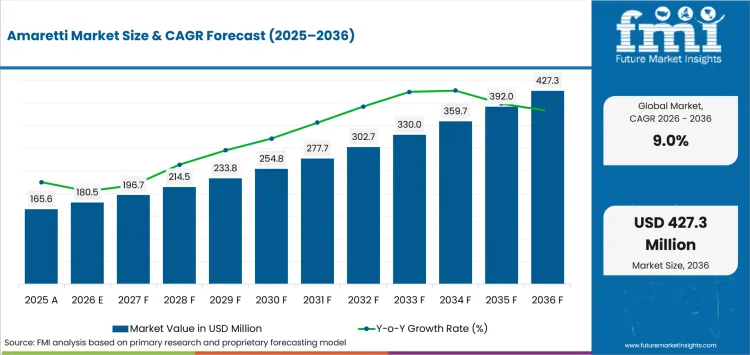
Key Takeaways of Amaretti Market
- International distribution gives amaretti more repeat retail exposure beyond seasonal Italian-food occasions and specialist gift purchases.
- In 2026, classic - original is expected to lead product type with 37.0% share because its bitter-sweet profile provides the clearest category cue.
- By claim - nature, conventional is estimated to hold 61.0% in 2026 owing to traditional recipes that differentiate amaretti without another dietary claim.
- The fresh segment is likely to capture 32.0% share in 2026 attributable to bakery presentation that makes aroma and texture visible before purchase.
- Allergen declarations and packaging obligations increase artwork control costs for brands serving several retail jurisdictions with one core recipe.
- Some of the key players in this market include Vicenzi S.p.A., Forno Bonomi S.p.A., D. Lazzaroni & C. S.p.A., Paolo Lazzaroni & Figli S.p.A., Amaretti Virginia s.r.l., Aziende Dolciarie Riunite S.p.A. (La Sassellese), Biscottificio Belli S.r.l., and Colussi S.p.A. (Sapori 1832).
Analyst Perspective
"A strong amaretti listing starts with the almond-led recipe cue shoppers recognize and shelf life that preserves texture after export transit. Retail economics improve when pack size and label control support repeat replenishment beyond short seasonal programs."
- Nandini Roy Choudhury, Principal Consultant, Future Market Insights
How is the Amaretti Market segmented?
The amaretti market is segmented by product type, claim - nature, format, packaging format, sales channel and region.
Product type covers classic - original through artisan variants, and claim - nature separates conventional from clean-label or diet-specific offers. Format distinguishes fresh, frozen, ambient packaged, chilled and thaw-and-serve products according to storage and service requirements. Packaging format and sales channel separate household portions from foodservice supply and keep finished amaretti distinct from adjacent almond products and home baking ingredients.
What makes Classic - original central to the Product type category?
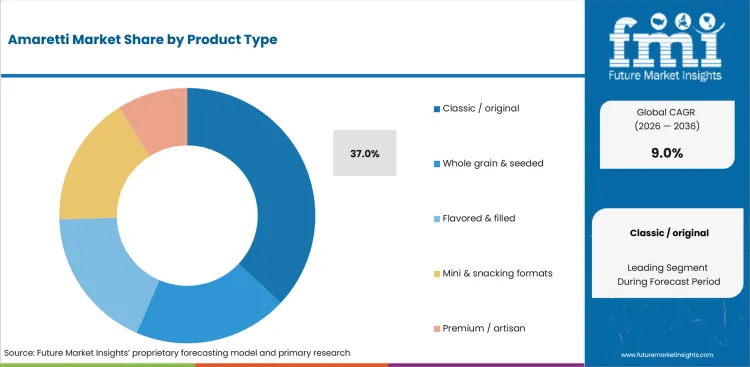
Classic - original gives importers a clear amaretti proposition because it keeps familiar almond-led taste and compact biscuit form. Adjacent almond ingredients broaden formulation choices for filled variants without replacing the reference flavor profile used to recognize classic amaretti. Vicenzi Group reported in August 2026 that its amaretti held 22% of the Italian segment and gained 1.4 percentage points from 2025.
- Based on product type, classic - original is projected to account for 37.0% in 2026 due to recognizable taste and appearance that shorten first-purchase explanation.
- The disclosed Vicenzi gain gives retailers a current proof point that classic amaretti can expand share without abandoning traditional product cues.
Why does Conventional lead the Claim - nature category?
Conventional amaretti already carry a clear identity through recipe and origin, so many retailers prioritize taste fidelity before adding a dietary claim. FDA issued Edition 5 of its food-allergen labeling guidance in January 2025 and addressed tree nuts plus eggs. Claim-led variants therefore need accurate base labeling before additional positioning can earn shelf space beside baking ingredients offers.
- By claim - nature, conventional is estimated to hold 61.0% in 2026 owing to traditional recipes that differentiate amaretti without another claim layer.
- Accurate allergen declarations keep the conventional assortment easier to manage before retailers test organic, gluten-free or fortified extensions.
What supports Multipack leadership in the Packaging format category?
Multipacks protect individual pieces and give supermarkets a clear household price point without forcing shoppers into large bulk formats. PackUK confirmed first-year extended producer responsibility base fees in June 2025 for organizations supplying or importing packaging. That change makes material choice and pack weight commercial inputs for multipack design beside adjacent confectionery packaging.
- In 2026, multipack is expected to lead packaging format with 38.0% share because separate portions protect texture and preserve a retail-friendly sharing proposition.
- Packaging teams that standardize inner-unit and outer-pack artwork reduce the risk that multiunit formats multiply compliance changes between countries.
What drives Supermarkets & hypermarkets in the Sales channel category?
Supermarkets give amaretti repeated visibility beside mainstream cookies and seasonal displays preserve room for gifting plus international-food discovery. Vicenzi stated during the June 2025 Summer Fancy Food Show that its USA business rose 22.5% in value with strong performance among ten national and regional retailers. That route places amaretti beside broader industrial bakery mixes only at the upstream production level instead of retail itself.
- Supermarkets & hypermarkets are set to lead sales channel with 35.0% share in 2026 due to repeat footfall sustaining scalable discovery.
- Retail listings convert more reliably once the front panel communicates amaretti identity quickly and case sizes match normal replenishment cycles.
What are the drivers, restraints and opportunities in the Amaretti Market?
International premium-biscuit distribution broadens repeat purchase, packaging and allergen rules raise execution costs, and smaller portions widen first-trial occasions.
- Driver: Export-oriented Italian pastry plants give amaretti enough production and distribution depth to move beyond specialist delicatessen channels.
- Restraint: Packaging rules and allergen controls increase the cost of maintaining separate compliant artwork for several importing markets.
- Opportunity: Smaller packs and clearer portion formats lower the first-purchase commitment without weakening the traditional amaretti taste proposition.
Export capacity gives amaretti producers a practical route into mainstream premium biscuit programs instead of limiting sales to seasonal import stores. Forno Bonomi stated in June 2025 that its distribution reached 110 countries and a new production line was scheduled to increase annual capacity by 6,500 tonnes. That scale strengthens the replenishment case for international industrial bakery channels without proving amaretti demand by itself.
Packaging compliance can erode the economics of small imported ranges before product demand becomes the binding constraint. Regulation (EU) 2025/40 entered into force on February 11, 2025, and extends packaging requirements from August 12, 2026. Retail packs therefore need materials and artwork that absorb regulatory revisions without repeated redesign beside flour improver systems and other bakery categories.
First-purchase economics improve if amaretti give shoppers a lower-commitment format without weakening the product identity that supports premium pricing. The Comune di Sassello scheduled its two-day Festa dell’Amaretto for September 20 and 21 2025 and published the program on September 10. The dedicated category occasion gives participating bakeries a controlled place for sampling and gift-led trial beside adjacent almond butter usage occasions.
Which country CAGRs are profiled in the Amaretti Market?
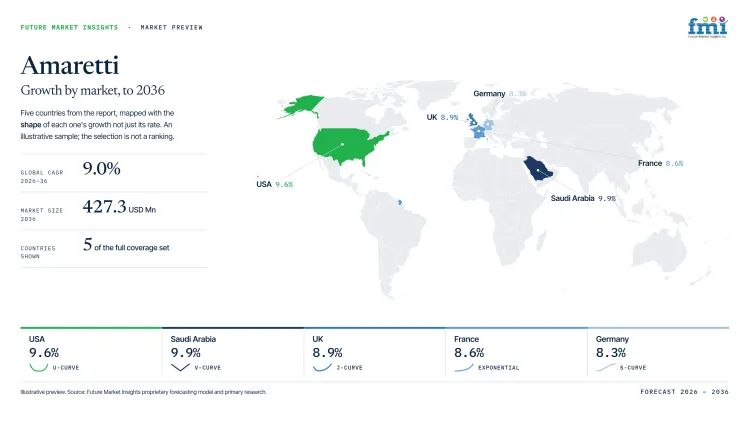
| Country | CAGR |
|---|---|
| Saudi Arabia | 9.9% |
| USA | 9.6% |
| UK | 8.9% |
| France | 8.6% |
| Germany | 8.3% |
How do country-level CAGRs compare in the Amaretti Market?
The five-country range spans 8.3% to 9.9% CAGR with a 1.6 percentage-point forecast gap. Saudi Arabia leads the group, followed by USA and UK, while France and Germany occupy the lower range. The spacing points to steady category momentum under different retail conditions.
- Saudi premium retail and gifting channels support imported biscuit formats year-round.
- USA gift baskets and specialty e-commerce sustain imported amaretti visibility across occasions.
- UK specialty grocers benefit from established Italian-food ranges and consumer familiarity.
- France pâtisseries and gourmet retailers support premium imported biscuit positioning.
- Germany specialty food stores and premium retailers support selective imported biscuit demand.
Similar CAGRs can produce different margins because local compliance costs and route-to-market access vary materially. The full report provides country-level CAGR analysis across North America, Latin America, Europe, East Asia, South Asia, Oceania and the Middle East and Africa.
Country-wise Analysis
- Saudi Arabia leads the listed markets at 9.9% CAGR, supported by premium imported-food demand, hotel gifting, and established seasonal purchasing around Ramadan. Active food-import controls make shipment records, product documentation, and compliance readiness important for premium confectionery distributors. Brands that resolve documentation requirements before major buying windows can reduce customs delays and support more consistent seasonal inventory.
- The USA follows at 9.6% CAGR, supported by supermarket penetration, specialty importers, premium gifting, and strong ingredient availability. California provides a major almond supply base for domestic amaretti production and co-packing decisions. The market also benefits from established premium-cookie retail channels, although allergen, nutrition, and labeling requirements can increase launch costs for imported brands seeking permanent retail listings.
- The UK amaretti market is projected to expand at 8.9% CAGR, supported by mature Italian-food retail, bakery, foodservice, and gifting channels. Demand benefits from established consumer familiarity with premium European confectionery. However, packaging responsibility and waste-separation requirements add operational considerations for imported seasonal ranges, making simple pack formats and efficient landed pricing increasingly important for sustained retail placement.
- France is forecast to record 8.6% CAGR, reflecting demand for premium European bakery products, specialty confectionery, and gifting-oriented formats. Amaretti can benefit from France's established bakery and patisserie culture, where almond-based products have strong category relevance. Growth opportunities are strongest for brands that combine premium positioning with convenient retail formats and packaging suited to specialty stores, gourmet retailers, and seasonal gifting.
- Germany records the lowest CAGR among the listed markets at 8.3%, but remains an attractive market because of its large grocery base, specialty-food retail network, and growing interest in premium imported confectionery. Amaretti brands can expand through gourmet stores, premium supermarkets, and online channels, while competitive pricing, clear product information, and efficient packaging remain important for gaining repeat distribution beyond seasonal promotions.
Who are the notable companies in the Amaretti Market?
Vicenzi S.p.A., Forno Bonomi S.p.A., D. Lazzaroni & C. S.p.A., Paolo Lazzaroni & Figli S.p.A., Amaretti Virginia s.r.l., Aziende Dolciarie Riunite S.p.A. (La Sassellese), Biscottificio Belli S.r.l., and Colussi S.p.A. (Sapori 1832) are the notable companies serving this market.
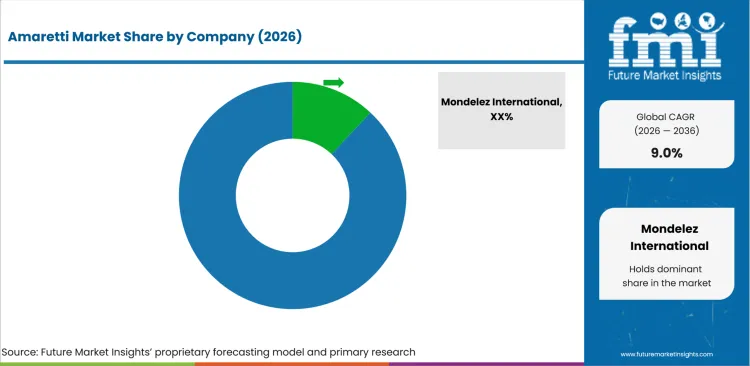
Competition is fragmented between industrial Italian pastry groups and specialist amaretti houses with different export reach. Entry barriers come from recipe recognition, shelf-life control, retailer access and the ability to maintain country-specific labeling without breaking production economics.
- Vicenzi S.p.A. and Forno Bonomi S.p.A. pair industrial bakery scale with international distribution that can support recurring retail programs.
- D. Lazzaroni & C. S.p.A., Paolo Lazzaroni & Figli S.p.A., Amaretti Virginia s.r.l. and La Sassellese concentrate more directly on heritage amaretti propositions and specialty packaging.
- Biscottificio Belli S.r.l. and Colussi S.p.A. (Sapori 1832) extend the field through dedicated Tuscan amarettini production and an established branded-food platform.
Competitive Benchmarking: Amaretti Market
| Company | Exact-Market Focus | International Trade Evidence | Quality / Channel Evidence | Geographic Reach |
|---|---|---|---|---|
| Vicenzi S.p.A. | Medium | High | High | Europe, North America and wider export markets |
| Forno Bonomi S.p.A. | Medium | High | High | 110-country bakery distribution |
| D. Lazzaroni & C. S.p.A. | High | Medium | Medium | Europe and international export markets |
| Paolo Lazzaroni & Figli S.p.A. | High | High | High | Europe and international specialty retail |
| Amaretti Virginia s.r.l. | High | High | High | 20+ countries in Europe, Middle East, Asia and Americas |
| Aziende Dolciarie Riunite S.p.A. (La Sassellese) | High | Medium | Medium | Italy and international export markets |
| Biscottificio Belli S.r.l. | Medium | Medium | Medium | Europe and selected international markets |
| Colussi S.p.A. (Sapori 1832) | Low | High | Medium | Europe and international branded-food markets |
Scoring basis: High exact-market focus requires amaretti to be a named core line with recent market activity. Medium covers a documented amaretti line inside a broader commercial pastry portfolio. Low identifies one current amaretti offer within a diversified commercial food group. High trade evidence requires documented multi-region distribution or repeated international trade participation. Medium requires current cross-border activity
Key Developments in the Amaretti Market
- In October 2025, Aziende Dolciarie Riunite S.p.A. presented La Sassellese at Anuga 2025 to international trade buyers seeking Italian specialty pastry.
- In May 2025, Vicenzi S.p.A. received BRCGS Food Safety certification at grade AA+ after an unannounced March audit covering industrial pastry and biscuits at Bovolone.
- In April 2025, Forno Bonomi S.p.A. launched its Gusto Italiano collaboration with Tognana and included Amaretti in a two-week recipe campaign.
Key Players in the Amaretti Market
Industrial Italian Pastry Platforms
- Vicenzi S.p.A.
- Forno Bonomi S.p.A.
Heritage Amaretti Specialists
- D. Lazzaroni & C. S.p.A.
- Paolo Lazzaroni & Figli S.p.A.
- Amaretti Virginia s.r.l.
- Aziende Dolciarie Riunite S.p.A. (La Sassellese)
Specialty Confectionery Producers
- Biscottificio Belli S.r.l.
- Colussi S.p.A. (Sapori 1832)
Amaretti Market - Report Scope
| Coverage field | Report scope |
| Market breakdown | By product type, claim - nature, format, packaging format, sales channel and region. |
| Quantitative Units | USD Million. |
| Market Definition | Commercial finished amaretti biscuits and pastries sold through retail, specialty, online and foodservice channels. |
| Regions Covered | North America, Latin America, Europe, East Asia, South Asia and Pacific and Middle East and Africa. |
| Countries Covered | UAE, Saudi Arabia, USA, South Korea, UK, and 20+ countries included in the full report. |
| Key Companies Profiled | Vicenzi S.p.A., Forno Bonomi S.p.A., D. Lazzaroni & C. S.p.A., Paolo Lazzaroni & Figli S.p.A., Amaretti Virginia s.r.l., Aziende Dolciarie Riunite S.p.A. (La Sassellese), Biscottificio Belli S.r.l., Colussi S.p.A. (Sapori 1832). |
| Forecast Period | 2026 to 2036. |
| Approach | Primary and secondary research with market triangulation. |
Amaretti Market - Research Methodology
| Method | Approach |
|---|---|
| Primary Research | FMI analysts gathered input from manufacturers, service providers, technology developers, distributors, end users, procurement teams, and subject-matter experts. Interviews examined purchasing decisions, product or service evaluation, adoption barriers, approval requirements, pricing considerations, and expectations for technical or commercial support. Respondents were also asked what evidence is required before a trial, pilot, or initial order develops into regular purchasing. |
| Desk Research | Desk research covered government statistics, regulatory publications, trade data, industry associations, technical literature, standards, company filings, product information, and official corporate announcements. Sources were reviewed for relevance, publication date, geographic coverage, and consistency with the defined market scope. Claims relating to performance, applications, approvals, capacity, investment, and commercial activity were retained only when supported by credible public evidence. |
| Market Sizing and Forecasting | The market model combined the baseline value with historical performance, segment structure, pricing and volume indicators, adoption levels, company participation, and country-level demand conditions. Forecast assumptions considered economic activity, investment trends, regulatory developments, technology adoption, purchasing cycles, supply availability, and barriers to wider market use. Segment and regional estimates were reconciled before the final market total was calculated. |
| Data Validation | Estimates were checked against multiple independent indicators, including public data, company activity, trade patterns, industry developments, and findings from primary interviews. Validation also tested whether products, services, applications, and company revenues fell within the defined market boundaries. Adjacent categories, unsupported claims, overlapping revenues, and activities without direct market relevance were excluded to reduce double counting and maintain consistency across segments and countries. |
Amaretti Market by Segments
Amaretti Market segmented by Product Type:
- Classic - original
- Whole grain & seeded
- Flavored & filled
- Mini & snacking formats
- Premium / artisan
Amaretti Market segmented by Claim - nature:
- Conventional
- Clean label
- Organic
- Gluten-free
- High-protein / fortified
Amaretti Market segmented by Format:
- Fresh
- Frozen
- Ambient packaged
- Chilled
- Par-baked / thaw-and-serve
Amaretti Market segmented by Packaging Format:
- Multipack
- Single-serve
- Family / loaf pack
- Bulk foodservice
Amaretti Market segmented by Sales Channel:
- Supermarkets & hypermarkets
- Artisan & specialty bakeries
- Convenience & forecourt
- Online & DTC
- Foodservice distributors
Amaretti Market by Region:
- North America
- United States
- Canada
- Latin America
- Brazil
- Mexico
- Chile
- Rest of Latin America
- Western Europe
- Germany
- United Kingdom
- Italy
- Spain
- France
- Nordics
- Benelux
- Rest of Western Europe
- Eastern Europe
- Russia
- Poland
- Hungary
- Balkan and Baltic States
- Rest of Eastern Europe
- East Asia
- China
- Japan
- South Korea
- South Asia and Pacific
- India
- ASEAN
- Australia and New Zealand
- Rest of South Asia and Pacific
- Middle East and Africa
- Kingdom of Saudi Arabia
- Other GCC Countries
- Türkiye
- South Africa
- Other African Union Countries
- Rest of Middle East and Africa
Research Sources and Bibliography
- USA Food and Drug Administration. (2025, January 14). FDA proposes requiring at-a-glance nutrition information on the front of packaged foods.
- Vicenzi Group. (2026, August 10). Il Gruppo Vicenzi terzo player in Italia della pasticceria.
- USA Food and Drug Administration. (2025, January). Questions and answers regarding food allergens, including food allergen labeling requirements of the Federal Food, Drug, and Cosmetic Act (Edition 5).
- Department for Environment, Food & Rural Affairs. (2025, June 27). Extended Producer Responsibility for Packaging: 2025 base fees.
- Vicenzi Group. (2025, June 27). Vicenzi Group, Italian fine pastry in New York, a Made in Italy excellence at the Summer Fancy Food Show.
- Forno Bonomi S.p.A. (2025, June 14). Una grande festa per i 175 anni di Forno Bonomi.
- European Commission. (2026). Packaging waste.
- Comune di Sassello. (2025, September 10). Festa dell’Amaretto: 20 e 21 settembre 2025.
- Abu Dhabi Quality and Conformity Council. (2025, March 1). The Abu Dhabi Quality and Conformity Council approves the Nutri-Mark label guideline.
- Saudi Food and Drug Authority. (2026, July 23). SFDA intercepts over 301 tons of non-compliant food products in Q2 2026.
- USA Department of Agriculture, National Agricultural Statistics Service. (2025, May 12). 2025 California Almond Forecast.
- Ministry of Food and Drug Safety. (2025, April 21).
- Department for Environment, Food & Rural Affairs. (2025, October 3). Simpler recycling: workplace recycling in England.
- D. Lazzaroni & C. S.p.A. (2026). History.
- Italian Trade Agency. (2026). Paolo Lazzaroni & Figli company profile.
- Amaretti Virginia s.r.l. (2026). Amaretti Virginia about us.
- Biscottificio Belli S.r.l. (2026). About us.
- Ministry of Health, Israel. (2025, December 11).
- DNV Business Assurance Italy S.r.l. (2025, May 15). CERTIFICATE.
- Forno Bonomi S.p.A. (2025, April 1). Gusto Italiano: la nuova campagna Forno Bonomi in collaborazione con Tognana, che porta la festa e il “Gusto italiano” in tavola.
- Koelnmesse GmbH. (2025, October). Anuga 2025 exhibitor listing for D. Lazzaroni & C. S.p.A.
- Vicenzi Group. (2026, February 10). Vicenzi Group strengthens its international positioning at ISM 2026.
- Forno Bonomi S.p.A. (2025, December 2). Forno Bonomi accende il Natale per Verona.
- Paolo Lazzaroni & Figli S.p.A. (2025, July 15). Il Punto Rosso è il nuovo concept della Paolo Lazzaroni & Figli di Saronno in collaborazione con i mastri pasticceri Morandin.
- Fiere di Parma S.p.A. (2026, May). TUTTOFOOD 2026 exhibitor catalogue.
This bibliography is provided for reader reference and is not exhaustive. The full report contains the complete reference list and detailed citations
This Report Answers
- How large is the amaretti market in 2026 and 2036?
- Which commercial conditions support repeat amaretti purchases beyond seasonal gifting?
- Why does classic - original hold 37.0% of product type in 2026?
- Why does conventional account for 61.0% of claim - nature in 2026?
- How do multipacks change packaging economics for retail amaretti programs?
- Which five countries record the highest profiled CAGRs through 2036?
- Which companies compete directly in finished amaretti and related specialty pastry?
- What limits international expansion through labeling and packaging compliance?
- How are companies differentiated by product breadth, packaging depth and export evidence?
Frequently Asked Questions
How big is the amaretti market in 2026?
The amaretti market is valued at USD 180.5 million in 2026 and is projected to reach USD 427.3 million by 2036. International retail distribution gives traditional Italian recipes more repeat purchase occasions beyond seasonal gifting and specialist holiday purchases in retail.
What is the CAGR of the amaretti market from 2026 to 2036?
The amaretti market is projected to grow at a CAGR of 9.0% between 2026 and 2036. Expansion is supported by premium biscuit distribution and export-ready packaging that can preserve texture through longer retail routes.
Which product type leads the amaretti market?
The classic - original segment is expected to hold 37.0% of the amaretti market in 2026, attributable to its recognizable almond-led taste. Familiar category cues reduce the explanation required before first purchase and support easier shelf recognition in retail.
Which claim - nature segment leads the amaretti market?
The conventional segment is expected to hold 61.0% of the amaretti market in 2026, supported by traditional recipes that already provide a distinct product identity. Retailers can test narrower claims after the base assortment gains repeat purchase and stable shelf turnover.
How much value will the amaretti market add between 2026 and 2036?
The amaretti market is expected to add USD 246.8 million in value between 2026 and 2036. The increase follows deeper international distribution and broader use of portioned retail formats for routine snacking.
Which countries are projected to record the highest growth in the amaretti market?
UAE is projected to grow at 10.2% CAGR, followed by Saudi Arabia at 9.9% and USA at 9.6% through 2036. Premium imported-food channels support demand, but local labeling and compliance requirements still shape retail conversion.
Which companies are active in the amaretti market?
Key companies operating in the market include Vicenzi S.p.A., Forno Bonomi S.p.A., D. Lazzaroni & C. S.p.A., Paolo Lazzaroni & Figli S.p.A., Amaretti Virginia s.r.l., Aziende Dolciarie Riunite S.p.A. (La Sassellese), Biscottificio Belli S.r.l., and Colussi S.p.A. (Sapori 1832). They compete through product identity and export reach.
Preview the report firsthand - request a free sample
Get SampleGet the brochure for pricing and purchase details.
Get PDFTable of Content
- Key Takeaways
- Market Size and CAGR
- Top Growth Driver
- Fastest Growing Segment
- Leading Region
- Key Companies
- Emerging Opportunities
- Executive Summary
- Global Market Outlook
- Demand-side Trends
- Supply-side Trends
- Technology Roadmap Analysis
- Analysis and Recommendations
- Analyst Perspective (What is happening? Why now? What should investors know?)
- Key Questions Answered
- How large is the market?
- What is the CAGR?
- What are key trends?
- Which region dominates?
- Who are the leaders?
- Market Overview
- Market Coverage / Taxonomy
- Market Definition / Scope / Limitations
- Research Methodology
- Chapter Orientation
- Analytical Lens and Working Hypotheses
- Market Structure, Signals, and Trend Drivers
- Benchmarking and Cross-market Comparability
- Market Sizing, Forecasting, and Opportunity Mapping
- Research Design and Evidence Framework
- Desk Research Programme (Secondary Evidence)
- Expert Input and Fieldwork (Primary Evidence)
- Tooling, Models, and Reference Databases
- Data Engineering and Model Build
- Quality Assurance and Audit Trail
- Market Background
- Market Dynamics (Drivers, Restraints, Opportunity, Trends)
- Scenario Forecast (Optimistic, Likely, Conservative)
- Impact Analysis
- AI Impact
- Sustainability Impact
- Regulatory Impact
- Technology Impact
- Consumer / Buyer Analysis
- Purchase Drivers
- Adoption Barriers
- Buyer Journey
- Opportunity Map Analysis
- Product Life Cycle Analysis
- Supply Chain Analysis
- Investment Feasibility Matrix
- Value Chain Analysis
- PESTLE and Porter's Analysis
- Regulatory Landscape
- Regional Parent Market Outlook
- Production and Consumption Statistics
- Import and Export Statistics
- Global Market Analysis and Forecast, 2021 to 2036
- Historical Market Size Value (USD Million) Analysis, 2021 to 2025
- Current and Future Market Size Value (USD Million) Projections, 2026 to 2036
- Y-o-Y Growth Trend Analysis
- Absolute $ Opportunity Analysis
- Global Market Pricing Analysis, 2021 to 2036
- Global Market Analysis and Forecast, By Product Type, 2021 to 2036
- Introduction / Key Findings
- Historical Market Size Value (USD Million) Analysis By Product Type, 2021 to 2025
- Current and Future Market Size Value (USD Million) Analysis and Forecast By Product Type, 2026 to 2036
- Classic / original
- Whole grain & seeded
- Flavored & filled
- Mini & snacking formats
- Premium / artisan
- Classic / original
- Y-o-Y Growth Trend Analysis By Product Type, 2021 to 2025
- Absolute $ Opportunity Analysis By Product Type, 2026 to 2036
- Global Market Analysis and Forecast, By Claim / Nature, 2021 to 2036
- Introduction / Key Findings
- Historical Market Size Value (USD Million) Analysis By Claim / Nature, 2021 to 2025
- Current and Future Market Size Value (USD Million) Analysis and Forecast By Claim / Nature, 2026 to 2036
- Conventional
- Clean label
- Organic
- Gluten-free
- High-protein / fortified
- Conventional
- Y-o-Y Growth Trend Analysis By Claim / Nature, 2021 to 2025
- Absolute $ Opportunity Analysis By Claim / Nature, 2026 to 2036
- Global Market Analysis and Forecast, By Format, 2021 to 2036
- Introduction / Key Findings
- Historical Market Size Value (USD Million) Analysis By Format, 2021 to 2025
- Current and Future Market Size Value (USD Million) Analysis and Forecast By Format, 2026 to 2036
- Fresh
- Frozen
- Ambient packaged
- Chilled
- Par-baked / thaw-and-serve
- Fresh
- Y-o-Y Growth Trend Analysis By Format, 2021 to 2025
- Absolute $ Opportunity Analysis By Format, 2026 to 2036
- Global Market Analysis and Forecast, By Packaging Format, 2021 to 2036
- Introduction / Key Findings
- Historical Market Size Value (USD Million) Analysis By Packaging Format, 2021 to 2025
- Current and Future Market Size Value (USD Million) Analysis and Forecast By Packaging Format, 2026 to 2036
- Multipack
- Single-serve
- Family / loaf pack
- Bulk foodservice
- Multipack
- Y-o-Y Growth Trend Analysis By Packaging Format, 2021 to 2025
- Absolute $ Opportunity Analysis By Packaging Format, 2026 to 2036
- Global Market Analysis and Forecast, By Sales Channel, 2021 to 2036
- Introduction / Key Findings
- Historical Market Size Value (USD Million) Analysis By Sales Channel, 2021 to 2025
- Current and Future Market Size Value (USD Million) Analysis and Forecast By Sales Channel, 2026 to 2036
- Supermarkets & hypermarkets
- Artisan & specialty bakeries
- Convenience & forecourt
- Online & DTC
- Foodservice distributors
- Supermarkets & hypermarkets
- Y-o-Y Growth Trend Analysis By Sales Channel, 2021 to 2025
- Absolute $ Opportunity Analysis By Sales Channel, 2026 to 2036
- Global Market Analysis and Forecast, By Region, 2021 to 2036
- Introduction
- Historical Market Size Value (USD Million) Analysis By Region, 2021 to 2025
- Current Market Size Value (USD Million) Analysis and Forecast By Region, 2026 to 2036
- North America
- Latin America
- Western Europe
- Eastern Europe
- East Asia
- South Asia and Pacific
- Middle East & Africa
- Market Attractiveness Analysis By Region
- North America Market Analysis and Forecast, By Country, 2021 to 2036
- Historical Market Size Value (USD Million) Trend Analysis By Market Taxonomy, 2021 to 2025
- Market Size Value (USD Million) Forecast By Market Taxonomy, 2026 to 2036
- By Country
- USA
- Canada
- By Product Type
- By Claim / Nature
- By Format
- By Packaging Format
- By Sales Channel
- By Country
- Market Attractiveness Analysis
- By Country
- By Product Type
- By Claim / Nature
- By Format
- By Packaging Format
- By Sales Channel
- Key Takeaways
- Latin America Market Analysis and Forecast, By Country
- Historical Market Size Value (USD Million) Trend Analysis By Market Taxonomy, 2021 to 2025
- Market Size Value (USD Million) Forecast By Market Taxonomy, 2026 to 2036
- By Country
- Brazil
- Mexico
- Chile
- Rest of Latin America
- By Product Type
- By Claim / Nature
- By Format
- By Packaging Format
- By Sales Channel
- By Country
- Market Attractiveness Analysis
- By Country
- By Product Type
- By Claim / Nature
- By Format
- By Packaging Format
- By Sales Channel
- Key Takeaways
- Western Europe Market Analysis and Forecast, By Country
- Historical Market Size Value (USD Million) Trend Analysis By Market Taxonomy, 2021 to 2025
- Market Size Value (USD Million) Forecast By Market Taxonomy, 2026 to 2036
- By Country
- Germany
- UK
- Italy
- Spain
- France
- Nordic
- BENELUX
- Rest of Western Europe
- By Product Type
- By Claim / Nature
- By Format
- By Packaging Format
- By Sales Channel
- By Country
- Market Attractiveness Analysis
- By Country
- By Product Type
- By Claim / Nature
- By Format
- By Packaging Format
- By Sales Channel
- Key Takeaways
- Eastern Europe Market Analysis and Forecast, By Country
- Historical Market Size Value (USD Million) Trend Analysis By Market Taxonomy, 2021 to 2025
- Market Size Value (USD Million) Forecast By Market Taxonomy, 2026 to 2036
- By Country
- Russia
- Poland
- Hungary
- Balkan & Baltic
- Rest of Eastern Europe
- By Product Type
- By Claim / Nature
- By Format
- By Packaging Format
- By Sales Channel
- By Country
- Market Attractiveness Analysis
- By Country
- By Product Type
- By Claim / Nature
- By Format
- By Packaging Format
- By Sales Channel
- Key Takeaways
- East Asia Market Analysis and Forecast, By Country
- Historical Market Size Value (USD Million) Trend Analysis By Market Taxonomy, 2021 to 2025
- Market Size Value (USD Million) Forecast By Market Taxonomy, 2026 to 2036
- By Country
- China
- Japan
- South Korea
- By Product Type
- By Claim / Nature
- By Format
- By Packaging Format
- By Sales Channel
- By Country
- Market Attractiveness Analysis
- By Country
- By Product Type
- By Claim / Nature
- By Format
- By Packaging Format
- By Sales Channel
- Key Takeaways
- South Asia and Pacific Market Analysis and Forecast, By Country
- Historical Market Size Value (USD Million) Trend Analysis By Market Taxonomy, 2021 to 2025
- Market Size Value (USD Million) Forecast By Market Taxonomy, 2026 to 2036
- By Country
- India
- ASEAN
- Australia & New Zealand
- Rest of South Asia and Pacific
- By Product Type
- By Claim / Nature
- By Format
- By Packaging Format
- By Sales Channel
- By Country
- Market Attractiveness Analysis
- By Country
- By Product Type
- By Claim / Nature
- By Format
- By Packaging Format
- By Sales Channel
- Key Takeaways
- Middle East & Africa Market Analysis and Forecast, By Country
- Historical Market Size Value (USD Million) Trend Analysis By Market Taxonomy, 2021 to 2025
- Market Size Value (USD Million) Forecast By Market Taxonomy, 2026 to 2036
- By Country
- Kingdom of Saudi Arabia
- Other GCC Countries
- Türkiye
- South Africa
- Other African Union
- Rest of Middle East & Africa
- By Product Type
- By Claim / Nature
- By Format
- By Packaging Format
- By Sales Channel
- By Country
- Market Attractiveness Analysis
- By Country
- By Product Type
- By Claim / Nature
- By Format
- By Packaging Format
- By Sales Channel
- Key Takeaways
- Key Countries Market Analysis
- USA
- Pricing Analysis
- Market Share Analysis, 2025
- By Product Type
- By Claim / Nature
- By Format
- By Packaging Format
- By Sales Channel
- Canada
- Pricing Analysis
- Market Share Analysis, 2025
- By Product Type
- By Claim / Nature
- By Format
- By Packaging Format
- By Sales Channel
- Mexico
- Pricing Analysis
- Market Share Analysis, 2025
- By Product Type
- By Claim / Nature
- By Format
- By Packaging Format
- By Sales Channel
- Brazil
- Pricing Analysis
- Market Share Analysis, 2025
- By Product Type
- By Claim / Nature
- By Format
- By Packaging Format
- By Sales Channel
- Chile
- Pricing Analysis
- Market Share Analysis, 2025
- By Product Type
- By Claim / Nature
- By Format
- By Packaging Format
- By Sales Channel
- Germany
- Pricing Analysis
- Market Share Analysis, 2025
- By Product Type
- By Claim / Nature
- By Format
- By Packaging Format
- By Sales Channel
- UK
- Pricing Analysis
- Market Share Analysis, 2025
- By Product Type
- By Claim / Nature
- By Format
- By Packaging Format
- By Sales Channel
- Italy
- Pricing Analysis
- Market Share Analysis, 2025
- By Product Type
- By Claim / Nature
- By Format
- By Packaging Format
- By Sales Channel
- Spain
- Pricing Analysis
- Market Share Analysis, 2025
- By Product Type
- By Claim / Nature
- By Format
- By Packaging Format
- By Sales Channel
- France
- Pricing Analysis
- Market Share Analysis, 2025
- By Product Type
- By Claim / Nature
- By Format
- By Packaging Format
- By Sales Channel
- India
- Pricing Analysis
- Market Share Analysis, 2025
- By Product Type
- By Claim / Nature
- By Format
- By Packaging Format
- By Sales Channel
- ASEAN
- Pricing Analysis
- Market Share Analysis, 2025
- By Product Type
- By Claim / Nature
- By Format
- By Packaging Format
- By Sales Channel
- Australia & New Zealand
- Pricing Analysis
- Market Share Analysis, 2025
- By Product Type
- By Claim / Nature
- By Format
- By Packaging Format
- By Sales Channel
- China
- Pricing Analysis
- Market Share Analysis, 2025
- By Product Type
- By Claim / Nature
- By Format
- By Packaging Format
- By Sales Channel
- Japan
- Pricing Analysis
- Market Share Analysis, 2025
- By Product Type
- By Claim / Nature
- By Format
- By Packaging Format
- By Sales Channel
- South Korea
- Pricing Analysis
- Market Share Analysis, 2025
- By Product Type
- By Claim / Nature
- By Format
- By Packaging Format
- By Sales Channel
- Russia
- Pricing Analysis
- Market Share Analysis, 2025
- By Product Type
- By Claim / Nature
- By Format
- By Packaging Format
- By Sales Channel
- Poland
- Pricing Analysis
- Market Share Analysis, 2025
- By Product Type
- By Claim / Nature
- By Format
- By Packaging Format
- By Sales Channel
- Hungary
- Pricing Analysis
- Market Share Analysis, 2025
- By Product Type
- By Claim / Nature
- By Format
- By Packaging Format
- By Sales Channel
- Kingdom of Saudi Arabia
- Pricing Analysis
- Market Share Analysis, 2025
- By Product Type
- By Claim / Nature
- By Format
- By Packaging Format
- By Sales Channel
- Türkiye
- Pricing Analysis
- Market Share Analysis, 2025
- By Product Type
- By Claim / Nature
- By Format
- By Packaging Format
- By Sales Channel
- South Africa
- Pricing Analysis
- Market Share Analysis, 2025
- By Product Type
- By Claim / Nature
- By Format
- By Packaging Format
- By Sales Channel
- USA
- Market Structure Analysis
- Competition Dashboard
- Competition Benchmarking
- Market Share Analysis of Top Players
- By Regional
- By Product Type
- By Claim / Nature
- By Format
- By Packaging Format
- By Sales Channel
- Emerging Startups
- Innovation Benchmarking
- Competition Analysis
- Competition Deep Dive
- Mondelez International
- Overview
- Product Portfolio
- Profitability by Market Segments
- Sales Footprint
- Strategy Overview
- Marketing Strategy
- Product Strategy
- Channel Strategy
- pladis
- Bahlsen
- Lotus Bakeries
- Walkers Shortbread
- Kellanova
- Arnott's
- Ferrero
- Grupo Bimbo
- Campbell Company
- Mondelez International
- Case Studies
- Success Stories
- Recent Developments
- Competition Deep Dive
- Assumptions & Acronyms Used


