

- Market Size (2026)
- USD 1.7 Bn
- Forecast (2036)
- USD 5.1 Bn
- CAGR (2026 to 2036)
- 11.6%
How big is Naan Market in 2026?
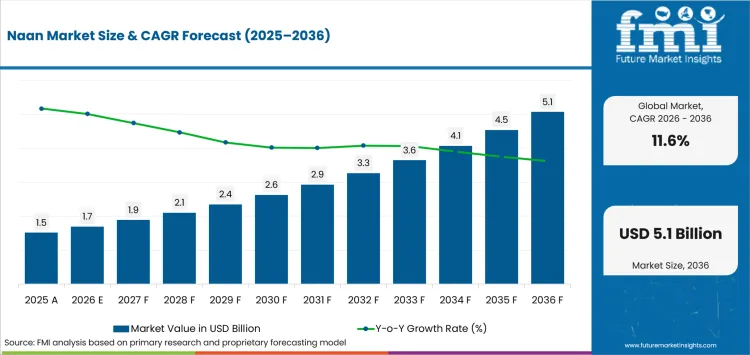
USD 1.7 billion in 2026 and USD 5.1 billion by 2036 at an 11.6% CAGR.
Demand for naan is projected to expand at 11.6% CAGR between 2026 and 2036, increasing valuation from USD 1.7 billion in 2026 to USD 5.1 billion by 2036. Familiarity gives large retailers a credible starting audience beyond specialist ethnic stores. The USA Census Bureau counted 5.6 million Asian Indian residents in 2024 in its April 2026 profile. That population does not measure naan sales, but it gives scaled bakery products a sizeable base for routine meal use and trial.
Channel mix determines how that familiarity turns into revenue. USDA Economic Research Service reported in June 2026 that food away from home represented 56.3% of USA food expenditures in 2025. For naan producers, the figure raises the value of case formats and reheating performance suited to foodservice demand. Grocery packs need different storage life and replenishment economics, so one format rarely serves both routes without compromise.
Key Takeaways
- Mainstream grocery and foodservice access extends naan beyond cuisine-specific purchases by placing a familiar flatbread beside routine meal components.
- Plain & butter naan is projected to hold 34.0% of product type demand in 2026 because neutral seasoning fits the widest range of meals.
- By claim / nature, conventional is estimated at 50.0% in 2026 because familiar recipes fit scaled dough handling and mainstream price points.
- Frozen is set to account for 30.0% of format demand in 2026 because longer storage separates production schedules from final consumption.
- Ingredient inflation, allergen controls and cold-chain requirements can narrow margin room before a wider assortment produces enough incremental volume.
- Some of the key players in this market include FGF Brands (Stonefire), Signature Flatbreads, Kontos Foods, Toufayan Bakeries, Kawan Food, ITC (Aashirvaad), ADF Foods (Truly Indian), and Mission Foods.
Analyst Perspective
"Unit price understates the real cost of naan if texture breaks during reheating or poor replenishment forces emergency inventory. Stronger offers match dough performance and pack size to the eating occasion, then earn value by reducing waste and preparation failures."
- Nandini Roy Choudhury, Principal Consultant, Future Market Insights
How is the naan market segmented?
The naan market is assessed by product type, claim / nature, format, packaging format, sales channel, and region.
Product type covers plain & butter, garlic, mini naan & dippers, and stuffed naan. Claim / nature includes conventional, clean label, organic, gluten-free, and high-protein / fortified. Format covers frozen, fresh, ambient packaged, chilled, and par-baked / thaw-and-serve. Packaging format includes multipack, single-serve, family / loaf pack, and bulk foodservice. Sales channel covers supermarkets & hypermarkets, artisan & specialty bakeries, convenience & forecourt, online & DTC, and foodservice distributors.
Why does conventional lead the claim / nature category?
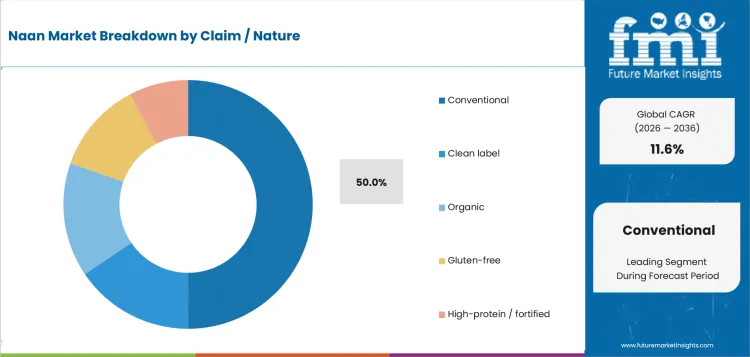
Conventional naan keeps the wheat structure, browning and soft chew that regular buyers recognize. Specialty claims widen choice, yet reformulation must protect those eating cues and keep ingredient costs within mainstream bakery price points.
- Conventional is forecast to represent 50.0% of claim / nature demand in 2026 because standard wheat recipes fit scaled dough handling and familiar pricing.
- USDA Economic Research Service estimated USA wheat flour use at 126.6 pounds per person in 2025 in an April 2026 update. That established wheat-use base favors conventional formulas, while claim-led variants must justify added ingredient and processing costs.
What makes plain & butter naan central to the product type category?
Plain & butter naan gives retailers one baseline SKU that works beside curries, grilled foods and dips without forcing a specific flavor choice. Its mild profile also lowers the trial barrier for households entering ethnic food categories through familiar flatbread meals.
- By product type, plain & butter naan is estimated to hold 34.0% in 2026 owing to broad meal pairing and uncomplicated repeat use.
- The American Bakers Association's 2025 Pizza and Flatbread Playbook found that 86% of Americans consumed pizza or flatbread in the prior year. That large flatbread occasion gives basic naan a familiar setting for trial without proving the modelled share itself.
What supports frozen as the leading format?
Frozen naan lets producers bake centrally and separate manufacturing time from final consumption. Retailers and kitchens can hold inventory until demand appears, reducing dependence on a short fresh window and extending frozen bakery distribution routes.
- Frozen holds 30.0% of format demand in 2026 because longer inventory windows and predictable portioning fit retail freezers and foodservice kitchens.
- ADF Foods stated in its 2024-25 annual report that it launched a frozen range under ADF Soul during the year and secured selected modern-trade placements. Frozen inventory separates production timing from retail replenishment, letting modern-trade accounts add range without same-day bakery output.
What drives supermarkets & hypermarkets as the leading sales channel?
Supermarkets place naan beside bread, international foods and convenient meal components during the same trip. That placement reduces dependence on specialist retail and lets branded and private-label packs compete on price, availability and visible texture cues.
- Supermarkets & hypermarkets are expected to hold 43.0% of sales-channel demand in 2026 because household reach makes convenience foods and naan part of routine grocery replenishment.
- ADF Foods disclosed in its 2024-25 annual report that Truly Indian gained new USA supermarket listings and reached more than 1,400 stores. Wider shelf access lets its frozen Indian-food range meet mainstream shoppers without depending only on ethnic-store traffic.
What are the drivers, restraints and opportunities in the Naan Market?
Diaspora familiarity and grocery access expand routine use, input and compliance costs pressure economics, and differentiated formats can open more meal and snack occasions.
- Driver: Familiar consumption lowers trial friction, while mainstream grocery and restaurant placement determines whether naan becomes a routine bread.
- Restraint: Bakery input inflation and cold handling can erode margin before a wider range produces enough additional volume.
- Opportunity: Mini and filled naan can serve snacks and quick meals if reheated texture stays close to the core product.
Familiarity reduces the work needed to secure a first purchase, but repeat volume depends on where naan is merchandised. American Bakers Association research published in 2026 found that 94% of consumers could be persuaded to spend more on baked goods or buy them on impulse. Ready-to-eat food merchandising can capture that behavior by placing naan beside quick meals and dips instead of isolating it in a narrow ethnic set.
Margin pressure reaches the bakery before consumers abandon the category. The USA Bureau of Labor Statistics reported in January 2026 that cereals and bakery product prices rose 1.5% from December 2024 to December 2025. Producers therefore need bread improvers and tighter process control to cut waste without making the recipe harder to qualify or price competitively.
The strongest expansion route is a new eating occasion that does not simply split sales among similar SKUs. ITC reported in May 2026 that Aashirvaad ready-to-cook chapati and frozen naans/parathas had accelerated growth as convenience demand strengthened. Mini or filled naan can build on that behavior if frozen dough performance protects softness after reheating and the pack earns incremental use.
Which country CAGRs are profiled in the Naan Market?
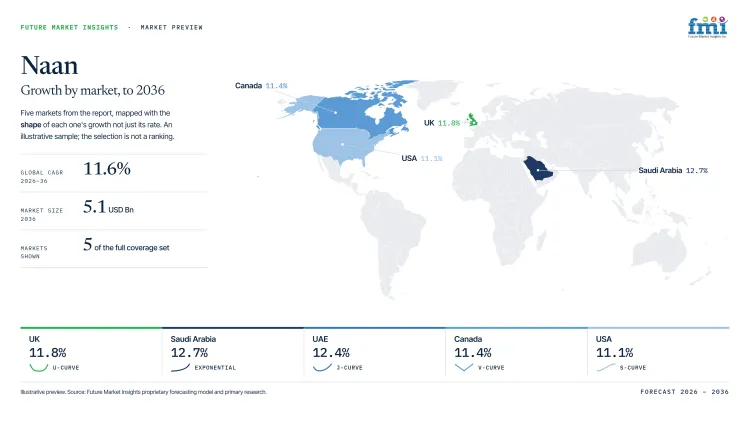
| Country | CAGR |
|---|---|
| Saudi Arabia | 12.7% |
| UAE | 12.4% |
| Singapore | 12.1% |
| UK | 11.8% |
| Canada | 11.4% |
| USA | 11.1% |
| Australia | 10.8% |
How do country-level CAGRs compare in the Naan Market?
Forecast ranges from 12.7% in Saudi Arabia to 10.8% in Australia, a spread of 1.9 percentage points. Saudi Arabia, UAE and Singapore form the upper band above 12.0%. The UK sits just below that group at 11.8%. Canada and USA occupy the next band at 11.4% and 11.1%. Australia remains a strong but more measured 10.8%.
- Saudi Arabia's restaurant expansion increases demand for larger case formats.
- UAE retailers pair compact delivery routes with intense promotional competition.
- Singapore's dense restaurant trade favors rapid small-drop replenishment.
- UK private label widens trial, while mature shelves demand stronger unit velocity.
- Canada favors family packs, though distance raises regional inventory costs.
- USA buyers operate across mass grocery and ethnic retail as well as club, foodservice and online channels.
- Australian buyers operate across large supermarket networks and a geographically dispersed foodservice base.
CAGR measures pace rather than revenue, so channel economics and service distance still determine the addressable route. The full report provides country-level CAGR analysis across North America, Latin America, Europe, East Asia, South Asia, Oceania and the Middle East and Africa.
Country-wise Analysis
- Foodservice distributors need halal-compliant documentation and predictable import timing before they add naan to restaurant case lists serving several cities from one Gulf warehouse. Naan demand in Saudi Arabia is predicted to advance at 12.7% CAGR through 2036 owing to strong familiarity with Indian flatbreads. The Embassy of India in Riyadh counted about 2.74 million Indian residents in the Kingdom in May 2026, which gives retailers a sizeable familiar audience. Price competition from pita and local breads limits range depth, so GCC inventory and dedicated halal food packs can reduce slow stock and replenish restaurant accounts faster for high-volume customers.
- Supermarket and catering accounts move high volumes within a compact import hub, yet frequent promotions and formal halal checks make the listing process more demanding than distance suggests. Embassy of India data published in 2025 place the resident Indian population at 4.3 million in 2024, giving naan a large familiar audience before brands spend heavily on category education. Naan demand in the UAE is forecast to rise at 12.4% CAGR through 2036 because dense urban consumption shortens replenishment cycles. Imported flatbreads crowd the same shelves, so entrants need pack economics and dependable local stock before promotional trial becomes repeat demand.
- Grocery buyers manage limited freezer and shelf space in a compact import market, so a naan SKU must earn its facing through repeat sales instead of range breadth alone. Adoption of naan in Singapore is estimated to expand at 12.1% CAGR through 2036 tied to concentrated urban demand and short distributor routes. Population in Brief 2025 recorded Indians at 7.6% of the citizen population in June 2025, giving retailers a useful familiarity base for trial. Wraps and local bakery products compete for the same space, so weak unit velocity can remove a variant quickly despite short delivery distances and efficient local logistics.
- Grocery buyers already manage broad world-bread assortments, putting naan brands into a mature shelf contest where reheated quality and unit velocity carry more weight than basic awareness. Office for National Statistics data released in July 2025 recorded 26,146 live births to India-born mothers during 2024 in England and Wales. That household continuity keeps Indian breads familiar in mainstream grocery and foodservice. The UK naan market is projected to record 11.8% CAGR during the assessment period helped by established category familiarity. Retailer-owned ranges and closely substitutable flatbreads leave little room for slow duplication, so branded entrants need a format or quality difference that survives promotion.
- National grocers can reach a large South Asian customer base, yet long distribution distances make frozen inventory placement a practical cost question outside major metros. Naan sales in Canada are forecast to expand at 11.4% CAGR by 2036 given demographic depth and national grocery access. Statistics Canada reported in December 2025 that 2.57 million people identified as South Asian in the 2021 Census, giving brands a broad familiarity base. Freight and stockholding costs favor disciplined regional assortments, so the winning national range may still need different pack depth by province as major stores balance local velocity against freezer space.
- USA buyers operate across mass grocery and ethnic retail as well as club, foodservice and online channels. Sales of naan in the USA are forecast to expand at 11.1% CAGR from 2026 to 2036. The US Census Bureau reported in September 2023 that the Asian Indian alone population reached 4,397,737 in 2020 after growing more than 50% from 2010. The market also carries strict allergen-label discipline for common naan ingredients such as wheat and sesame. Suppliers have to compete with pita, tortillas and other flatbreads for the same meal occasions. Winning offers therefore need broad use cues, compliant labeling and formats such as minis or multipacks that create reasons to buy beyond traditional curry meals.
- Australian buyers operate across large supermarket networks and a geographically dispersed foodservice base. Sales of naan in Australia are forecast to expand at 10.8% CAGR from 2026 to 2036. The Australian Bureau of Statistics recorded 673,352 India-born residents in the 2021 Census and 783,953 people reporting Indian ancestry. The main constraint is route density over long distances, alongside strong substitution from wraps and other flatbreads. GRUMA reported in April 2026 that its Asia-Oceania business expanded capacity in Australia during 2025. Suppliers that localize production or inventory can shorten replenishment cycles and use multipacks plus foodservice packs to serve distinct channels efficiently.
Who are the notable companies in the Naan Market?
FGF Brands (Stonefire), Signature Flatbreads, Kontos Foods, Toufayan Bakeries, Kawan Food, ITC (Aashirvaad), ADF Foods (Truly Indian), and Mission Foods are the notable companies profiled in this market.
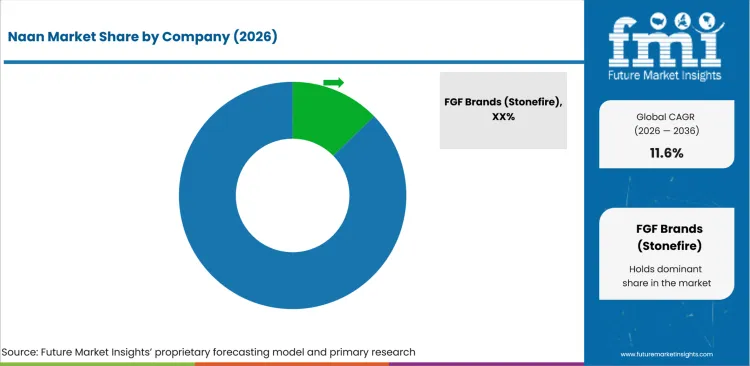
Competition depends on bakery scale, naan-specific assortment and route to market more than one global brand hierarchy. FGF Brands (Stonefire), Signature Flatbreads and Mission Foods can place naan through large retail or foodservice networks. Kontos Foods, Toufayan Bakeries, Kawan Food, ITC (Aashirvaad) and ADF Foods (Truly Indian) bring specialist flatbread or Indian-food depth. Entry barriers rise when food packaging, channel service and production consistency must pass a retailer or distributor review.
- Scaled bakery platforms: FGF Brands (Stonefire), Signature Flatbreads and Mission Foods pair high-volume production with retail and foodservice access.
- Specialist and Indian-food platforms: Kontos Foods, Toufayan Bakeries, Kawan Food, ITC (Aashirvaad) and ADF Foods (Truly Indian) compete on naan depth, Indian-food credibility or frozen distribution.
Competitive Benchmarking: Naan Market
| Company | Naan Portfolio Breadth | Multi-Channel Access | Format & Claim Flexibility | Geographic Reach |
|---|---|---|---|---|
| FGF Brands (Stonefire) | High | High | High | Canada and United States |
| Signature Flatbreads | High | High | High | United Kingdom, India and exports to 70+ countries |
| Kontos Foods | High | High | High | United States retail and foodservice |
| Toufayan Bakeries | Medium | High | Medium | United States retail, online and foodservice |
| Kawan Food | Medium | High | High | Malaysia base with exports to 40+ countries |
| ITC (Aashirvaad) | Medium | High | High | India retail, e-commerce and foodservice |
| ADF Foods (Truly Indian) | Medium | High | High | United States, Europe, Middle East and Asia-Pacific |
| Mission Foods | High | High | High | Australia, Asia, Europe and the Americas |
Scoring basis: High portfolio breadth requires at least three documented naan variants, Medium requires two, and Low identifies one. High multi-channel access requires retail and foodservice plus another documented route, Medium covers two routes, and Low covers one. High format and claim flexibility requires at least three documented options, Medium requires two, and Low identifies one. Geographic reach is descriptive and is not a score of company quality.
Key Developments in the Naan Market
- In February 2026, ADF Foods said Truly Indian had launched selected frozen products in Germany during the quarter, extending its frozen Indian-food route in mainstream European supermarkets.
- In May 2025, Kawan Food began commissioning new machinery and pre-operational work at Factory 2, activity that continued into July and expanded its frozen-food production base.
- In February 2025, ITC signed definitive agreements to acquire Prasuma, expanding a frozen and ready-to-cook platform that already includes Aashirvaad frozen naans and parathas.
Key Players in the Naan Market
Scaled Bakery and Flatbread Platforms
- FGF Brands (Stonefire)
- Signature Flatbreads
- Mission Foods
Specialist Naan and Indian-Food Brands
- Kontos Foods
- Toufayan Bakeries
- ITC (Aashirvaad)
Frozen Indian-Food Networks
- Kawan Food
- ADF Foods (Truly Indian)
Naan Market - Report Scope
| Coverage field | Report scope |
|---|---|
| Market breakdown | By product type, claim / nature, format, packaging format, sales channel and region. |
| Quantitative Units | USD billion. |
| Market Definition | Packaged naan sold as a standalone bread through retail and foodservice, including frozen, fresh, chilled, ambient and par-baked formats. |
| Regions Covered | North America, Latin America, Western Europe, Eastern Europe, East Asia, South Asia and Pacific, Middle East and Africa. |
| Countries Covered | Saudi Arabia, UAE, Singapore, UK, Canada, and 30+ countries included in the full report. |
| Key Companies Profiled | FGF Brands (Stonefire), Signature Flatbreads, Kontos Foods, Toufayan Bakeries, Kawan Food, ITC (Aashirvaad), ADF Foods (Truly Indian), Mission Foods. |
| Forecast Period | 2026 to 2036. |
| Approach | Primary and secondary research with market triangulation. |
Naan Market - Research Methodology
| Method | Approach |
|---|---|
| Primary Research | FMI analysts gathered input from manufacturers, service providers, technology developers, distributors, end users, procurement teams, and subject-matter experts. Interviews examined purchasing decisions, product or service evaluation, adoption barriers, approval requirements, pricing considerations, and expectations for technical or commercial support. Respondents were also asked what evidence is required before a trial, pilot, or initial order develops into regular purchasing. |
| Desk Research | Desk research covered government statistics, regulatory publications, trade data, industry associations, technical literature, standards, company filings, product information, and official corporate announcements. Sources were reviewed for relevance, publication date, geographic coverage, and consistency with the defined market scope. Claims relating to performance, applications, approvals, capacity, investment, and commercial activity were retained only when supported by credible public evidence. |
| Market Sizing and Forecasting | The market model combined the baseline value with historical performance, segment structure, pricing and volume indicators, adoption levels, company participation, and country-level demand conditions. Forecast assumptions considered economic activity, investment trends, regulatory developments, technology adoption, purchasing cycles, supply availability, and barriers to wider market use. Segment and regional estimates were reconciled before the final market total was calculated. |
| Data Validation | Estimates were checked against multiple independent indicators, including public data, company activity, trade patterns, industry developments, and findings from primary interviews. Validation also tested whether products, services, applications, and company revenues fell within the defined market boundaries. Adjacent categories, unsupported claims, overlapping revenues, and activities without direct market relevance were excluded to reduce double counting and maintain consistency across segments and countries. |
Naan Market by Segments
Naan Market segmented by Product Type:
- Plain & butter naan
- Garlic naan
- Mini naan & dippers
- Stuffed naan
Naan Market segmented by Claim / Nature:
- Conventional
- Clean label
- Organic
- Gluten-free
- High-protein / fortified
Naan Market segmented by Format:
- Frozen
- Fresh
- Ambient packaged
- Chilled
- Par-baked / thaw-and-serve
Naan Market segmented by Packaging Format:
- Multipack
- Single-serve
- Family / loaf pack
- Bulk foodservice
Naan Market segmented by Sales Channel:
- Supermarkets & hypermarkets
- Artisan & specialty bakeries
- Convenience & forecourt
- Online & DTC
- Foodservice distributors
Naan Market by Region:
- North America
- United States
- Canada
- Latin America
- Brazil
- Mexico
- Chile
- Rest of Latin America
- Western Europe
- Germany
- United Kingdom
- Italy
- Spain
- France
- Nordics
- Benelux
- Rest of Western Europe
- Eastern Europe
- Russia
- Poland
- Hungary
- Balkan and Baltic States
- Rest of Eastern Europe
- East Asia
- China
- Japan
- South Korea
- South Asia and Pacific
- India
- ASEAN
- Australia and New Zealand
- Rest of South Asia and Pacific
- Middle East and Africa
- Kingdom of Saudi Arabia
- Other GCC Countries
- Türkiye
- South Africa
- Other African Union Countries
- Rest of Middle East and Africa
Research Sources and Bibliography
- USA Census Bureau. (2026, April 29). Asian American and Pacific Islander Heritage Month: May 2026.
- USA Department of Agriculture, Economic Research Service. (2026, June 11). Total USA food spending reached $2.51 trillion in 2025.
- American Bakers Association. (2026). Consumer trends: Bakery Playbooks.
- USA Department of Agriculture, Economic Research Service. (2026, April 3). USA wheat flour per capita disappearance, 1989-2025.
- ADF Foods Limited. (2025, July). Annual report 2024-25.
- USA Bureau of Labor Statistics. (2026, January 13). Consumer Price Index - December 2025.
- ITC Limited. (2026, May). Media statement - Financial results for the quarter and year ended 31st March, 2026.
- Embassy of India, Abu Dhabi. (2025, September 18). Indian community in UAE.
- Embassy of India, Riyadh. (2026, May 31). India-Saudi bilateral relations.
- National Population and Talent Division, Singapore. (2025). Population in Brief 2025.
- Office for National Statistics. (2025, July 1). Births in England and Wales: 2024.
- Statistics Canada. (2025, December 8). Portrait of the South Asian Populations in Canada: Diversity and Socioeconomic Outcomes.
- ADF Foods Limited. (2026, February 5). Earnings call transcript, quarter ended December 2025.
- GRUMA, S.A.B. de C.V. (2026). Annual report 2025.
- ITC Limited. (2025, February 6). ITC to acquire Prasuma; building a full stack Frozen, Chilled and Ready to Cook Foods Portfolio.
- Kawan Food Berhad. (2026, May). Annual report 2025.
- Lantmannen Unibake. (2025, May 9). Pastridor expands range with mini and wholegrain Naanta Pocket Breads.
- Competition Commission of India. (2026, February 3). CCI approves the proposed acquisition of certain shareholding of Haldiram Snacks Food by L Catterton India Fund.
- FGF Brands. (2026, May 7). Report on Forced and Child Labour in the Supply Chain.
- ADF Foods Limited. (2026, March 28). Commencement of commercial production at the company's new greenfield manufacturing facility at Surat.
- Baked Earth Bakery. (2025, January 27). Love Bites in Aldi - Product Launch.
- Gruma Oceania Pty Ltd. (2025, June 20). Modern Slavery Statement 2025.
- Kontos Foods, Inc. (2025, June 17). IFANCA halal certificate, document 1275.13073.II250033.
- Signature Flatbreads. (2026). Our Company.
- Toufayan Bakeries. (2025, February 27). A Trusted USA-Based Flatbread & Naan Manufacturer.
- FGF Brands. (2026). Our Brands.
- Toufayan Bakeries. (2025, December 17). Introducing Seed Oil-Free Wraps.
This Report Answers
- What is the Naan Market size in 2026 and what value is forecast by 2036?
- What demand mechanisms support the 2026 to 2036 forecast?
- Why does plain & butter naan lead the product type category?
- Why does conventional lead claim / nature demand?
- What supports frozen as the leading format?
- Why do supermarkets & hypermarkets lead sales channels?
- How do the five profiled country CAGRs compare?
- Which companies are active in the Naan Market?
- What operating constraints can weaken margin or range expansion?
- What should retail and foodservice teams compare before approving a naan range?
Frequently Asked Questions
How big is the Naan Market in 2026?
The naan market is valued at USD 1.7 billion in 2026 and is projected to reach USD 5.1 billion by 2036. Growth is supported by familiar flatbread use moving into mainstream grocery and foodservice channels.
What is the CAGR of the Naan Market from 2026 to 2036?
The naan market is projected to grow at a CAGR of 11.6% between 2026 and 2036. Expansion depends on scalable baking, reliable replenishment and formats that protect texture from production to reheating.
Which product type leads the Naan Market?
The plain & butter naan segment is expected to hold 34.0% of the naan market in 2026, driven by broad meal pairing and a familiar core flavor. Its straightforward recipe also supports repeat purchase in retail and foodservice.
Which sales channel leads the Naan Market?
Supermarkets & hypermarkets are expected to hold 43.0% of the naan market in 2026, supported by household reach and routine grocery replenishment. The channel also accommodates branded and private-label packs in one shopping trip.
Which companies are active in the Naan Market?
Key companies operating in the naan market include FGF Brands (Stonefire), Signature Flatbreads, Kontos Foods, Toufayan Bakeries, Kawan Food, ITC (Aashirvaad), ADF Foods (Truly Indian), and Mission Foods. Their positions differ by naan assortment, production scale, channel access and geographic service coverage.
Preview the report firsthand - request a free sample
Get SampleGet the brochure for pricing and purchase details.
Get PDFTable of Content
- Key Takeaways
- Market Size and CAGR
- Top Growth Driver
- Fastest Growing Segment
- Leading Region
- Key Companies
- Emerging Opportunities
- Executive Summary
- Global Market Outlook
- Demand-side Trends
- Supply-side Trends
- Technology Roadmap Analysis
- Analysis and Recommendations
- Analyst Perspective (What is happening? Why now? What should investors know?)
- Key Questions Answered
- How large is the market?
- What is the CAGR?
- What are key trends?
- Which region dominates?
- Who are the leaders?
- Market Overview
- Market Coverage / Taxonomy
- Market Definition / Scope / Limitations
- Research Methodology
- Chapter Orientation
- Analytical Lens and Working Hypotheses
- Market Structure, Signals, and Trend Drivers
- Benchmarking and Cross-market Comparability
- Market Sizing, Forecasting, and Opportunity Mapping
- Research Design and Evidence Framework
- Desk Research Programme (Secondary Evidence)
- Expert Input and Fieldwork (Primary Evidence)
- Tooling, Models, and Reference Databases
- Data Engineering and Model Build
- Quality Assurance and Audit Trail
- Market Background
- Market Dynamics (Drivers, Restraints, Opportunity, Trends)
- Scenario Forecast (Optimistic, Likely, Conservative)
- Impact Analysis
- AI Impact
- Sustainability Impact
- Regulatory Impact
- Technology Impact
- Consumer / Buyer Analysis
- Purchase Drivers
- Adoption Barriers
- Buyer Journey
- Opportunity Map Analysis
- Product Life Cycle Analysis
- Supply Chain Analysis
- Investment Feasibility Matrix
- Value Chain Analysis
- PESTLE and Porter's Analysis
- Regulatory Landscape
- Regional Parent Market Outlook
- Production and Consumption Statistics
- Import and Export Statistics
- Global Market Analysis and Forecast, 2021 to 2036
- Historical Market Size Value (USD Billion) Analysis, 2021 to 2025
- Current and Future Market Size Value (USD Billion) Projections, 2026 to 2036
- Y-o-Y Growth Trend Analysis
- Absolute $ Opportunity Analysis
- Global Market Pricing Analysis, 2021 to 2036
- Global Market Analysis and Forecast, By Product Type, 2021 to 2036
- Introduction / Key Findings
- Historical Market Size Value (USD Billion) Analysis By Product Type, 2021 to 2025
- Current and Future Market Size Value (USD Billion) Analysis and Forecast By Product Type, 2026 to 2036
- Plain & butter naan
- Garlic naan
- Mini naan & dippers
- Stuffed naan
- Plain & butter naan
- Y-o-Y Growth Trend Analysis By Product Type, 2021 to 2025
- Absolute $ Opportunity Analysis By Product Type, 2026 to 2036
- Global Market Analysis and Forecast, By Claim / Nature, 2021 to 2036
- Introduction / Key Findings
- Historical Market Size Value (USD Billion) Analysis By Claim / Nature, 2021 to 2025
- Current and Future Market Size Value (USD Billion) Analysis and Forecast By Claim / Nature, 2026 to 2036
- Conventional
- Clean label
- Organic
- Gluten-free
- High-protein / fortified
- Conventional
- Y-o-Y Growth Trend Analysis By Claim / Nature, 2021 to 2025
- Absolute $ Opportunity Analysis By Claim / Nature, 2026 to 2036
- Global Market Analysis and Forecast, By Format, 2021 to 2036
- Introduction / Key Findings
- Historical Market Size Value (USD Billion) Analysis By Format, 2021 to 2025
- Current and Future Market Size Value (USD Billion) Analysis and Forecast By Format, 2026 to 2036
- Frozen
- Fresh
- Ambient packaged
- Chilled
- Par-baked / thaw-and-serve
- Frozen
- Y-o-Y Growth Trend Analysis By Format, 2021 to 2025
- Absolute $ Opportunity Analysis By Format, 2026 to 2036
- Global Market Analysis and Forecast, By Packaging Format, 2021 to 2036
- Introduction / Key Findings
- Historical Market Size Value (USD Billion) Analysis By Packaging Format, 2021 to 2025
- Current and Future Market Size Value (USD Billion) Analysis and Forecast By Packaging Format, 2026 to 2036
- Multipack
- Single-serve
- Family / loaf pack
- Bulk foodservice
- Multipack
- Y-o-Y Growth Trend Analysis By Packaging Format, 2021 to 2025
- Absolute $ Opportunity Analysis By Packaging Format, 2026 to 2036
- Global Market Analysis and Forecast, By Sales Channel, 2021 to 2036
- Introduction / Key Findings
- Historical Market Size Value (USD Billion) Analysis By Sales Channel, 2021 to 2025
- Current and Future Market Size Value (USD Billion) Analysis and Forecast By Sales Channel, 2026 to 2036
- Supermarkets & hypermarkets
- Artisan & specialty bakeries
- Convenience & forecourt
- Online & DTC
- Foodservice distributors
- Supermarkets & hypermarkets
- Y-o-Y Growth Trend Analysis By Sales Channel, 2021 to 2025
- Absolute $ Opportunity Analysis By Sales Channel, 2026 to 2036
- Global Market Analysis and Forecast, By Region, 2021 to 2036
- Introduction
- Historical Market Size Value (USD Billion) Analysis By Region, 2021 to 2025
- Current Market Size Value (USD Billion) Analysis and Forecast By Region, 2026 to 2036
- North America
- Latin America
- Western Europe
- Eastern Europe
- East Asia
- South Asia and Pacific
- Middle East & Africa
- Market Attractiveness Analysis By Region
- North America Market Analysis and Forecast, By Country, 2021 to 2036
- Historical Market Size Value (USD Billion) Trend Analysis By Market Taxonomy, 2021 to 2025
- Market Size Value (USD Billion) Forecast By Market Taxonomy, 2026 to 2036
- By Country
- USA
- Canada
- By Product Type
- By Claim / Nature
- By Format
- By Packaging Format
- By Sales Channel
- By Country
- Market Attractiveness Analysis
- By Country
- By Product Type
- By Claim / Nature
- By Format
- By Packaging Format
- By Sales Channel
- Key Takeaways
- Latin America Market Analysis and Forecast, By Country
- Historical Market Size Value (USD Billion) Trend Analysis By Market Taxonomy, 2021 to 2025
- Market Size Value (USD Billion) Forecast By Market Taxonomy, 2026 to 2036
- By Country
- Brazil
- Mexico
- Chile
- Rest of Latin America
- By Product Type
- By Claim / Nature
- By Format
- By Packaging Format
- By Sales Channel
- By Country
- Market Attractiveness Analysis
- By Country
- By Product Type
- By Claim / Nature
- By Format
- By Packaging Format
- By Sales Channel
- Key Takeaways
- Western Europe Market Analysis and Forecast, By Country
- Historical Market Size Value (USD Billion) Trend Analysis By Market Taxonomy, 2021 to 2025
- Market Size Value (USD Billion) Forecast By Market Taxonomy, 2026 to 2036
- By Country
- Germany
- UK
- Italy
- Spain
- France
- Nordic
- BENELUX
- Rest of Western Europe
- By Product Type
- By Claim / Nature
- By Format
- By Packaging Format
- By Sales Channel
- By Country
- Market Attractiveness Analysis
- By Country
- By Product Type
- By Claim / Nature
- By Format
- By Packaging Format
- By Sales Channel
- Key Takeaways
- Eastern Europe Market Analysis and Forecast, By Country
- Historical Market Size Value (USD Billion) Trend Analysis By Market Taxonomy, 2021 to 2025
- Market Size Value (USD Billion) Forecast By Market Taxonomy, 2026 to 2036
- By Country
- Russia
- Poland
- Hungary
- Balkan & Baltic
- Rest of Eastern Europe
- By Product Type
- By Claim / Nature
- By Format
- By Packaging Format
- By Sales Channel
- By Country
- Market Attractiveness Analysis
- By Country
- By Product Type
- By Claim / Nature
- By Format
- By Packaging Format
- By Sales Channel
- Key Takeaways
- East Asia Market Analysis and Forecast, By Country
- Historical Market Size Value (USD Billion) Trend Analysis By Market Taxonomy, 2021 to 2025
- Market Size Value (USD Billion) Forecast By Market Taxonomy, 2026 to 2036
- By Country
- China
- Japan
- South Korea
- By Product Type
- By Claim / Nature
- By Format
- By Packaging Format
- By Sales Channel
- By Country
- Market Attractiveness Analysis
- By Country
- By Product Type
- By Claim / Nature
- By Format
- By Packaging Format
- By Sales Channel
- Key Takeaways
- South Asia and Pacific Market Analysis and Forecast, By Country
- Historical Market Size Value (USD Billion) Trend Analysis By Market Taxonomy, 2021 to 2025
- Market Size Value (USD Billion) Forecast By Market Taxonomy, 2026 to 2036
- By Country
- India
- ASEAN
- Australia & New Zealand
- Rest of South Asia and Pacific
- By Product Type
- By Claim / Nature
- By Format
- By Packaging Format
- By Sales Channel
- By Country
- Market Attractiveness Analysis
- By Country
- By Product Type
- By Claim / Nature
- By Format
- By Packaging Format
- By Sales Channel
- Key Takeaways
- Middle East & Africa Market Analysis and Forecast, By Country
- Historical Market Size Value (USD Billion) Trend Analysis By Market Taxonomy, 2021 to 2025
- Market Size Value (USD Billion) Forecast By Market Taxonomy, 2026 to 2036
- By Country
- Kingdom of Saudi Arabia
- Other GCC Countries
- Türkiye
- South Africa
- Other African Union
- Rest of Middle East & Africa
- By Product Type
- By Claim / Nature
- By Format
- By Packaging Format
- By Sales Channel
- By Country
- Market Attractiveness Analysis
- By Country
- By Product Type
- By Claim / Nature
- By Format
- By Packaging Format
- By Sales Channel
- Key Takeaways
- Key Countries Market Analysis
- USA
- Pricing Analysis
- Market Share Analysis, 2025
- By Product Type
- By Claim / Nature
- By Format
- By Packaging Format
- By Sales Channel
- Canada
- Pricing Analysis
- Market Share Analysis, 2025
- By Product Type
- By Claim / Nature
- By Format
- By Packaging Format
- By Sales Channel
- Mexico
- Pricing Analysis
- Market Share Analysis, 2025
- By Product Type
- By Claim / Nature
- By Format
- By Packaging Format
- By Sales Channel
- Brazil
- Pricing Analysis
- Market Share Analysis, 2025
- By Product Type
- By Claim / Nature
- By Format
- By Packaging Format
- By Sales Channel
- Chile
- Pricing Analysis
- Market Share Analysis, 2025
- By Product Type
- By Claim / Nature
- By Format
- By Packaging Format
- By Sales Channel
- Germany
- Pricing Analysis
- Market Share Analysis, 2025
- By Product Type
- By Claim / Nature
- By Format
- By Packaging Format
- By Sales Channel
- UK
- Pricing Analysis
- Market Share Analysis, 2025
- By Product Type
- By Claim / Nature
- By Format
- By Packaging Format
- By Sales Channel
- Italy
- Pricing Analysis
- Market Share Analysis, 2025
- By Product Type
- By Claim / Nature
- By Format
- By Packaging Format
- By Sales Channel
- Spain
- Pricing Analysis
- Market Share Analysis, 2025
- By Product Type
- By Claim / Nature
- By Format
- By Packaging Format
- By Sales Channel
- France
- Pricing Analysis
- Market Share Analysis, 2025
- By Product Type
- By Claim / Nature
- By Format
- By Packaging Format
- By Sales Channel
- India
- Pricing Analysis
- Market Share Analysis, 2025
- By Product Type
- By Claim / Nature
- By Format
- By Packaging Format
- By Sales Channel
- ASEAN
- Pricing Analysis
- Market Share Analysis, 2025
- By Product Type
- By Claim / Nature
- By Format
- By Packaging Format
- By Sales Channel
- Australia & New Zealand
- Pricing Analysis
- Market Share Analysis, 2025
- By Product Type
- By Claim / Nature
- By Format
- By Packaging Format
- By Sales Channel
- China
- Pricing Analysis
- Market Share Analysis, 2025
- By Product Type
- By Claim / Nature
- By Format
- By Packaging Format
- By Sales Channel
- Japan
- Pricing Analysis
- Market Share Analysis, 2025
- By Product Type
- By Claim / Nature
- By Format
- By Packaging Format
- By Sales Channel
- South Korea
- Pricing Analysis
- Market Share Analysis, 2025
- By Product Type
- By Claim / Nature
- By Format
- By Packaging Format
- By Sales Channel
- Russia
- Pricing Analysis
- Market Share Analysis, 2025
- By Product Type
- By Claim / Nature
- By Format
- By Packaging Format
- By Sales Channel
- Poland
- Pricing Analysis
- Market Share Analysis, 2025
- By Product Type
- By Claim / Nature
- By Format
- By Packaging Format
- By Sales Channel
- Hungary
- Pricing Analysis
- Market Share Analysis, 2025
- By Product Type
- By Claim / Nature
- By Format
- By Packaging Format
- By Sales Channel
- Kingdom of Saudi Arabia
- Pricing Analysis
- Market Share Analysis, 2025
- By Product Type
- By Claim / Nature
- By Format
- By Packaging Format
- By Sales Channel
- Türkiye
- Pricing Analysis
- Market Share Analysis, 2025
- By Product Type
- By Claim / Nature
- By Format
- By Packaging Format
- By Sales Channel
- South Africa
- Pricing Analysis
- Market Share Analysis, 2025
- By Product Type
- By Claim / Nature
- By Format
- By Packaging Format
- By Sales Channel
- USA
- Market Structure Analysis
- Competition Dashboard
- Competition Benchmarking
- Market Share Analysis of Top Players
- By Regional
- By Product Type
- By Claim / Nature
- By Format
- By Packaging Format
- By Sales Channel
- Emerging Startups
- Innovation Benchmarking
- Competition Analysis
- Competition Deep Dive
- FGF Brands (Stonefire)
- Overview
- Product Portfolio
- Profitability by Market Segments
- Sales Footprint
- Strategy Overview
- Marketing Strategy
- Product Strategy
- Channel Strategy
- Signature Flatbreads
- Kontos Foods
- Toufayan Bakeries
- Kawan Food
- Deep Foods
- Haldiram's
- iD Fresh Food
- Mission Foods
- FGF Brands (Stonefire)
- Case Studies
- Success Stories
- Recent Developments
- Competition Deep Dive
- Assumptions & Acronyms Used


