

- Market Size (2026)
- USD 162.2 Mn
- Forecast (2036)
- USD 394.7 Mn
- CAGR (2026 to 2036)
- 9.3%
How big is Dried Rye Sours Market in 2026?
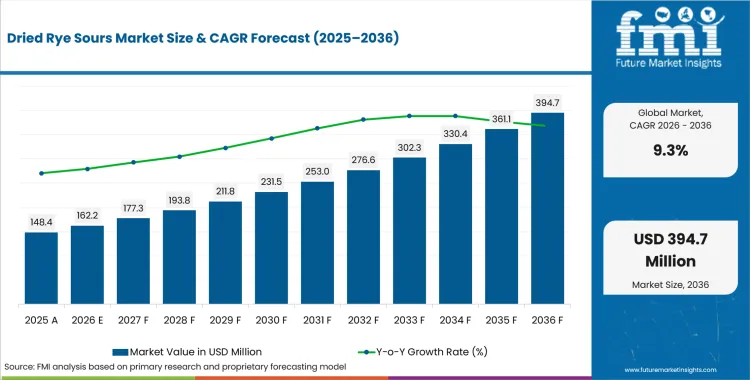
USD 162.2 million in 2026 and USD 394.7 million by 2036 at a 9.3% CAGR.
Demand for dried rye sours is projected to expand at 9.3% CAGR between 2026 and 2036, lifting valuation from USD 162.2 million to USD 394.7 million. Commercial adoption depends on consistent ingredient supply because industrial bakeries typically validate sourdough inputs against established production and quality-control parameters before wider use. Puratos announced in February 2025 that its Buckingham expansion would add local sourdough production, with the new lines scheduled to start in 2026. Local production shortens the supply route for UK industrial bakeries qualifying shelf-stable sourdough ingredients against existing mixing and quality routines.
Large bakery channels convert that demand into orders once dry sour systems fit existing ingredient handling and cost targets. USDA Foreign Agricultural Service forecast UAE wheat consumption to rise 3% in MY 2025/26 and imports to increase 2%, with no domestic grain production. Import-dependent processors therefore value bakery ingredients that can be stored, dosed, and reformulated without adding fermentation infrastructure, although staple-price controls keep cost-in-use under close scrutiny.
Key Takeaways
- Industrial bakeries use dried rye sours to reproduce fermented rye acidity and aroma without maintaining a live culture at every production site.
- Based on product type, standard grade is projected to account for 39.0% in 2026 due to its fit with routine industrial bread formulas.
- In 2026, powder - dry is expected to lead form with 44.0% share because shelf-stable storage fits existing dry-ingredient dosing systems.
- By application, bread & rolls are forecast to represent 32.0% in 2026 driven by established use of sour acidity in fermented bread.
- Flour variability can lengthen dosage trials. Acidity, dough behavior, and yeast performance must stay stable following a formula change.
- Some of the key players in this market include Lesaffre, Puratos, AB Mauri, IREKS, Lallemand, BÖCKER, GoodMills Innovation, and Bakels.
Analyst Perspective
"Industrial bakeries pay for a sour specification that keeps acidity, aroma, dough handling, and finished-bread performance inside acceptable limits after flour changes. A dried rye sour earns repeat business once application teams translate those limits into a dose range that survives plant trials without extra fermentation labor."
- Nandini Roy Choudhury, Principal Consultant, Future Market Insights
How is the dried rye sours market segmented?
The dried rye sours market is segmented by product type, form, application, claim, sales channel, and region.
Product type covers standard grade, premium / specialty grade, organic certified, and clean label grade. Form includes powder - dry, liquid, paste / semi-solid, and granules / pieces. Application covers bread & rolls, cakes & muffins, biscuits & cookies, viennoiserie & pastry, and other bakery & snacks. Claim includes conventional, clean label, organic, and non-GMO / identity preserved. Sales channel covers direct to industrial bakeries, ingredient distributors, foodservice & artisan supply, and online B2B.
What makes standard grade central to the product type category?
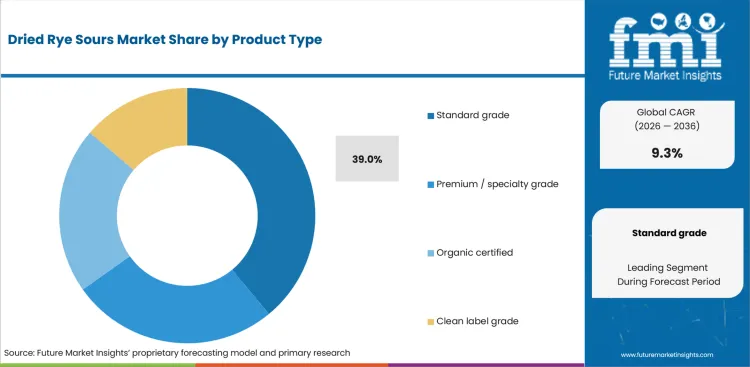
Standard grade gives industrial bakeries fermented rye character without sourcing restrictions attached to claim-led programs. Plant approval centers on repeatable acidity, aroma, and food-safety controls. In July 2026, Pakmaya said its Izmit factory completed unannounced BRCGS, Plant-Based, FSMA, and Costco audits with an AA+ score, reinforcing production discipline for fermented ingredients.
- By product type, standard grade is estimated to hold 39.0% in 2026 owing to broad compatibility with routine industrial bakery specifications.
- Large bakery programs qualify the grade against sensory targets and documented food-safety controls, with organic or specialty requirements applied to narrower programs.
Why does powder - dry lead the form category?
Powder - dry fits bakery mixes and other dry inputs already metered from bags or silos. It avoids tank cleaning and short-life constraints attached to liquid sour systems. In June 2025, TÜV NORD CERT issued BÖCKER an IFS Food certificate covering mixing and packaging of dried gluten-free sourdough products and bakery mixes at its Nordholzer Straße site.
- In 2026, powder - dry is expected to lead form with 44.0% share because shelf-stable storage fits established dry-ingredient dosing systems.
- Dry formats reduce handling changes during trials by letting plant teams meter the sour beside other weighed bakery ingredients.
How do bread & rolls shape the application category?
Bread & rolls place sour acidity and cereal aroma in a familiar fermentation format. Industrial teams can compare the sour with bread improvers through loaf volume, crumb, crust, and aroma tests. In June 2025, Puratos placed its Vitus starter into daily production at Boulangerie du Louvre, giving a current commercial reference for sourdough performance in bread.
- By application, bread & rolls are forecast to represent 32.0% in 2026 driven by the familiar role of sour acidity in fermented bread identity.
- Commercial trials compare loaf volume, crumb, and target aroma as part of the decision to change the formula.
What supports conventional leadership in the claim category?
Conventional grades give processors more room to manage cereal sourcing. clean-label ingredients carry tighter claim boundaries. Office for National Statistics data show the UK producer-price index for bread, fresh pastry goods, and cakes increased from 142.9 in January 2025 to 147.1 in December, keeping formulation economics visible during claim decisions.
- Conventional is set to lead the claim category with 55.0% share in 2026 due to wider sourcing flexibility in high-volume bakery programs.
- Clean-label and organic grades need a finished-product premium or retailer requirement strong enough to absorb extra sourcing and documentation work.
What are the drivers, restraints and opportunities in the Dried Rye Sours Market?
Repeatable sour character raises industrial use, flour variability lengthens qualification, and application-specific rye concentrates extend the addressable recipe set.
- Driver: Industrial bakeries want fermented rye character that can be specified and repeated without maintaining a live starter at every plant.
- Restraint: Flour protein, enzyme activity, water absorption, and moisture changes can alter dough behavior enough to require fresh dosage trials.
- Opportunity: Rye-sourdough concentrates can extend into rolls and mixed-cereal products provided the formulation arrives with practical plant guidance.
Industrial bakeries reorder dry sour once the ingredient reproduces flavor and dough behavior through raw-material changes. USDA National Agricultural Statistics Service reported 341,000 bushels of rye ground for flour and 153,000 hundredweight of rye flour output in the first quarter of 2025. That active milling base gives yeast technologies and sour systems a defined cereal channel in which repeatable dosing can convert trials into regular ingredient purchasing.
Flour variation can change water absorption, enzyme activity, and fermentation response enough to invalidate a previously approved sour dosage. Puratos opened its Flour Competence Center in June 2026 to test protein content, enzyme activity, water absorption, and moisture under controlled bakery conditions. Dried rye sour qualification therefore needs compatibility trials beside baking enzymes and the production formula as the final gate for industrial-site approval.
Rye sour reaches more formulas once the manufacturer packages the flavor system with a clear application route instead of selling an isolated powder. GoodMills Innovation introduced GOOD Roggenbrötchen in June 2025 as a concentrate containing rye sourdough for rustic rolls, with flour, water, and yeast added at the bakery. The format reduces recipe-development work and gives food premixes a practical route into repeat roll production.
Which country CAGRs are profiled in the Dried Rye Sours Market?
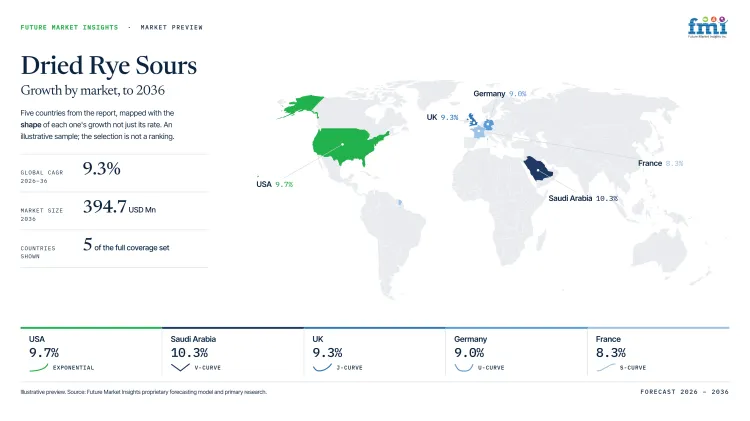
| Country | CAGR |
|---|---|
| UAE | 10.6% |
| Saudi Arabia | 10.3% |
| South Korea | 10.0% |
| USA | 9.7% |
| UK | 9.3% |
How do country-level CAGRs compare in the Dried Rye Sours Market?
The profiled CAGRs span 1.3 percentage points, with UAE and Saudi Arabia forming the upper Gulf group and South Korea close behind. USA and UK make a second band. The narrow spread hides different flour channels, processing scale, and price controls, so the rates describe pace instead of current market size.
- UAE couples import-dependent wheat supply with a high-volume hospitality channel.
- Saudi Arabia screens specialty ingredients through tightly structured flour pricing.
- South Korea's shift toward wheat-based foods widens the flavor opportunity.
- USA multi-site formulas raise the proof threshold for ingredient replacements.
- UK clean-label demand competes with persistent formulation cost pressure.
Similar growth rates therefore require different qualification, service, and pricing decisions. The full report provides country-level CAGR analysis across North America, Latin America, Western Europe, Eastern Europe, East Asia, South Asia and Pacific, and the Middle East and Africa.
Country-wise Analysis
- UAE food processors operate in an import-led wheat system, so ingredient availability depends on international grain flows and local conversion capacity serving retail and hospitality accounts. The UAE dried rye sours outlook is anticipated to advance at 10.6% CAGR over the assessment period, tied to a processing base that USDA Foreign Agricultural Service counted at more than 570 mainly small and medium-sized food and beverage processors in June 2025. Shelf-stable dry ingredients fit that processing base, although bread-price controls and imported raw-material exposure limit pricing freedom and make low-dose performance a practical condition for repeat industrial orders under regular distributor contracts.
- Inside Saudi Arabia’s concentrated flour system, large industrial bakeries can buy bulk flour directly and thousands of smaller bakeries depend on appointed distributors for routine ingredient access. USDA Foreign Agricultural Service documented more than 525 distributors serving about 11,700 establishments in March 2025, including 6,500 licensed bakeries and direct mill purchasing by large industrial users. Saudi Arabia is estimated to post 10.3% CAGR over the forecast period, attributable to that concentrated channel, but subsidized flour economics restrict the premium available to a sour system that cannot prove flavor or process gains at production scale with plant service included.
- Imported milling wheat sets the technical baseline for South Korean bakeries producing cakes, bread, noodles, and export foods, making flour-specific sensory work central to a rye sour trial. Dried rye sour demand in South Korea is forecast to rise at 10.0% CAGR during the forecast period, given USDA Foreign Agricultural Service projects MY 2025/26 milling-wheat imports to increase 3% as noodle and bakery exports expand. Imported wheat provides a stable formulation base, but rye-forward flavor is less familiar than in northern Europe, so broader adoption depends on localized acidity targets and trial support for Korean bread and snack profiles.
- Multi-site formula control is the main USA hurdle in a market already supplied by domestic rye flour and mature ingredient-distribution networks serving large national accounts. USDA National Agricultural Statistics Service recorded 329,000 bushels of rye ground for flour and 155,000 hundredweight of rye flour output in the second quarter of 2025, with daily rye-milling capacity at 9,365 hundredweight. USA could advance at 9.7% CAGR by 2036, supported by that milling base, while mature recipes raise replacement thresholds and reward companies that can document dose, flavor, and line performance on the customer’s exact production formula during annual reformulation cycles.
- Cost and label scrutiny shape UK bakery ingredient decisions as recipe changes move toward national production, even where technical teams want simpler fermentation inputs. The UK dried rye sours sector is projected to record 9.3% CAGR during the assessment period, helped by a processing base that Office for National Statistics said represented 22.9% of total UK manufacturers’ sales in 2025. Large food production widens account access, but high input sensitivity means clean-label or specialty positioning must earn its cost through repeatable finished-bread performance, leaving technical proof and pricing discipline as the main commercial filters for broader adoption among national bakery accounts.
Who are the notable companies in the Dried Rye Sours Market?
Lesaffre, Puratos, AB Mauri, IREKS, Lallemand, BÖCKER, GoodMills Innovation, and Bakels are the notable companies serving this market.
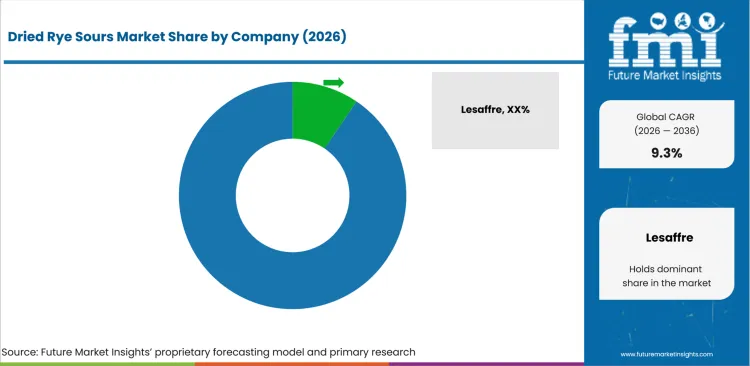
Competition divides between fermentation groups, broad bakery-ingredient platforms, and cereal or sourdough specialists. Entry barriers come from fermentation know-how, certified production, flour-specific application work, and the ability to test a sour on industrial bakery processing equipment during plant approval of a replacement formula.
- Lesaffre, Puratos, AB Mauri, and Lallemand have the widest international bakery-service reach and broad fermentation or ingredient portfolios.
- IREKS and BÖCKER bring more concentrated sourdough production evidence. GoodMills Innovation focuses on cereal-led bakery formulation.
- Bakels competes through bakery formulation support and a dedicated sour competence route within its wider ingredient network.
Competitive Benchmarking: Dried Rye Sours Market
| Company | Sourdough Evidence | Industrial Bakery Support | Qualification Evidence | Geographic Reach |
|---|---|---|---|---|
| Lesaffre | High | High | High | Global |
| Puratos | High | High | High | Global |
| AB Mauri | Medium | High | Medium | Global |
| IREKS | High | High | High | Europe and international |
| Lallemand | Medium | High | Medium | Global |
| BÖCKER | High | Medium | High | Europe and international |
| GoodMills Innovation | High | High | Medium | Europe and export |
| Bakels | High | High | Medium | Global |
Scoring basis: High sourdough evidence requires a direct sourdough portfolio or in-house sourdough production. Medium covers documented cereal ferments or sourdough-adjacent fermentation systems, and Low identifies only broader baking fermentation. High industrial support requires dedicated baking centers or broad application teams. Medium identifies narrower documented support, and Low indicates limited public application evidence. High qualification evidence requires current third-party certification tied to the relevant production scope. Medium identifies broader certified bakery production, and Low marks a smaller public qualification trail.
Key Developments in the Dried Rye Sours Market
- In December 2025, IREKS received an updated FSSC 22000 certificate covering production of bakery ingredients, sour dough, malt extracts, and malt at Kulmbach. The certificate strengthens qualification evidence for customers that require documented food-safety controls during approval of industrial sourdough ingredients.
- In June 2025, Lallemand completed the acquisition of AIT Ingredients, adding bakery, flour-milling, and pasta application expertise to Lallemand Baking Solutions. The acquisition broadens plant-level formulation support, though dried rye sour remains one application within a wider baking portfolio.
- In June 2025, Lesaffre and MicroBioGen signed an exclusive worldwide licensing and collaboration agreement covering yeast technology for baking, food, and biochemicals. The partnership expands fermentation research that can support bakery systems. Commercial relevance to dried rye sour still depends on application-specific product development.
Key Players in the Dried Rye Sours Market
Global Fermentation and Bakery Platforms
- Lesaffre
- Puratos
- AB Mauri
- Lallemand
Sourdough and Cereal Specialists
- IREKS
- BÖCKER
- GoodMills Innovation
Bakery Ingredient and Application Specialist
- Bakels
Dried Rye Sours Market - Report Scope
| Coverage field | Report scope |
|---|---|
| Market breakdown | By product type, form, application, claim, sales channel and region. |
| Quantitative Units | USD million. |
| Market Definition | Revenue from commercial dried rye sour ingredient products sold within the stated taxonomy. Finished baked goods and adjacent substitute ingredient revenue are excluded. |
| Regions Covered | North America, Latin America, Western Europe, Eastern Europe, East Asia, South Asia and Pacific, and Middle East and Africa. |
| Countries Covered | UAE, Saudi Arabia, South Korea, USA, UK, and 20+ countries included in the full report. |
| Key Companies Profiled | Lesaffre, Puratos, AB Mauri, IREKS, Lallemand, BÖCKER, GoodMills Innovation, Bakels. |
| Forecast Period | 2026 to 2036. |
| Approach | Primary and secondary research with market triangulation. |
Dried Rye Sours Market - Research Methodology
| Method | Approach |
|---|---|
| Primary Research | FMI analysts gathered input from manufacturers, service providers, technology developers, distributors, end users, procurement teams, and subject-matter experts. Interviews examined purchasing decisions, product or service evaluation, adoption barriers, approval requirements, pricing considerations, and expectations for technical or commercial support. Respondents were also asked what evidence is required before a trial, pilot, or initial order develops into regular purchasing. |
| Desk Research | Desk research covered government statistics, regulatory publications, trade data, industry associations, technical literature, standards, company filings, product information, and official corporate announcements. Sources were reviewed for relevance, publication date, geographic coverage, and consistency with the defined market scope. Claims relating to performance, applications, approvals, capacity, investment, and commercial activity were retained only when supported by credible public evidence. |
| Market Sizing and Forecasting | The market model combined the baseline value with historical performance, segment structure, pricing and volume indicators, adoption levels, company participation, and country-level demand conditions. Forecast assumptions considered economic activity, investment trends, regulatory developments, technology adoption, purchasing cycles, supply availability, and barriers to wider market use. Segment and regional estimates were reconciled before the final market total was calculated. |
| Data Validation | Estimates were checked against multiple independent indicators, including public data, company activity, trade patterns, industry developments, and findings from primary interviews. Validation also tested whether products, services, applications, and company revenues fell within the defined market boundaries. Adjacent categories, unsupported claims, overlapping revenues, and activities without direct market relevance were excluded to reduce double counting and maintain consistency across segments and countries. |
Dried Rye Sours Market by Segments
Dried Rye Sours Market segmented by Product Type:
- Standard grade
- Premium / specialty grade
- Organic certified
- Clean label grade
Dried Rye Sours Market segmented by Form:
- Powder - dry
- Liquid
- Paste / semi-solid
- Granules / pieces
Dried Rye Sours Market segmented by Application:
- Bread & rolls
- Cakes & muffins
- Biscuits & cookies
- Viennoiserie & pastry
- Other bakery & snacks
Dried Rye Sours Market segmented by Claim:
- Conventional
- Clean label
- Organic
- Non-GMO / identity preserved
Dried Rye Sours Market segmented by Sales Channel:
- Direct to industrial bakeries
- Ingredient distributors
- Foodservice & artisan supply
- Online B2B
Dried Rye Sours Market by Region:
- North America
- United States
- Canada
- Latin America
- Brazil
- Mexico
- Argentina
- Chile
- Western Europe
- Germany
- France
- United Kingdom
- Italy
- Spain
- Benelux
- Nordics
- Eastern Europe
- Poland
- Czech Republic
- Romania
- Hungary
- East Asia
- China
- Japan
- South Korea
- South Asia and Pacific
- India
- ASEAN
- Australia and New Zealand
- Middle East and Africa
- GCC Countries
- South Africa
- Türkiye
- Israel
Research Sources and Bibliography
- Puratos UK. (2025, February 24). Puratos UK to expand Buckingham site to produce fillings, patisserie glazes and sourdough.
- USA Department of Agriculture, Foreign Agricultural Service. (2025, April 18). United Arab Emirates: Grain and Feed Annual.
- Pakmaya. (2026, July 8). Our Izmit Factory Passed the Audit Success.
- TÜV NORD CERT. (2025, June 16). Certificate.
- Puratos. (2025, June 11). Puratos's Vitus Sourdough Unveiled as Signature Starter at New Louvre Museum Bakery.
- Office for National Statistics. (2026, June 17). PPI INDEX OUTPUT DOMESTIC - C1071 Bread; fresh pastry goods and cakes 2015=100.
- USA Department of Agriculture, National Agricultural Statistics Service. (2025, May 1). Flour Milling Products.
- Puratos. (2026, June 15). Puratos Opens Flour Competence Center to Address Flour Variability.
- GoodMills Innovation. (2025, June 24). GOOD Roggenbrötchen: Rustikaler Genuss, unkompliziert produziert.
- USA Department of Agriculture, Foreign Agricultural Service. (2025, June 9). United Arab Emirates: Food Processing Ingredients Annual.
- USA Department of Agriculture, Foreign Agricultural Service. (2025, March 20). Saudi Arabia: Grain and Feed Annual.
- USA Department of Agriculture, Foreign Agricultural Service. (2025, April 4). South Korea: Grain and Feed Annual.
- USA Department of Agriculture, National Agricultural Statistics Service. (2025, August 1). Flour Milling Products.
- Office for National Statistics. (2026, July 24). UK manufacturers' sales by product: 2025.
- USA Department of Agriculture, Foreign Agricultural Service. (2026, March 24). United Kingdom: Food Processing Ingredients Annual.
- TÜV SÜD Management Service GmbH. (2025, December 22). CERTIFICATE.
- Lallemand. (2025, July 4). Lallemand Acquires AIT Ingredients.
- Lesaffre. (2025, June 12). MicroBioGen and Lesaffre Establish Exclusive Global Partnership to Provide Innovative Yeast Solutions for the Global Baking, Food, and Biochemicals Markets.
- Associated British Foods plc. (2025, November 6). AB Mauri: Championing health and wellness in bakery.
- GoodMills Innovation. (2026, April 27). Stable processes, relaxed doughs: GOOD NatureRelax.
- Bakels. (2025, June). Bakels Worldwide Review 176.
- Puratos. (2025, August 25). Puratos Announces Two New Hubs for Food Innovation: Montreal and Costa Rica.
- Lesaffre. (2025, December 15). Lesaffre opens new Industrial Baking Center in Shanghai.
- Lallemand. (2025, July 17). Lallemand acquires enzyme specialist Solyve.
- Puratos. (2025, April 30). Puratos has opened its brand-new Innovation Center in Budapest.
- GoodMills Innovation. (2026, April 9). Lighter, finer, milder: wholemeal reimagined.
- Lesaffre. (2025, June 2). Lesaffre and Zilor enter a joint venture.
- Puratos. (2026, February 25). Puratos Establishes Direct Presence in Albania with the Launch of Puratos Albania.
- TÜV SÜD Management Service GmbH. (2025, December 10). CERTIFICATE.
- Deutsche Zöliakie-Gesellschaft e.V. (2025, October 7). ZERTIFIKAT.
- Lallemand Bio-Ingredients. (2026, March 3). Lallemand Bio-Ingredients Food Enzymes Announces Distribution Partnership with United Chemicals Inter Aneka (Member of Omya Group) in Indonesia.
This bibliography is provided for reader reference and is not exhaustive. The full report contains the complete reference list and detailed citations.
This Report Answers
- How large is the dried rye sours market in 2026 and 2036?
- Which industrial bakery conditions support demand for dried rye sours?
- Why does standard grade hold 39.0% of product type demand in 2026?
- How does powder - dry form influence storage and dosing in industrial bakeries?
- Why do bread & rolls account for 32.0% of application demand in 2026?
- How do the profiled country growth rates differ between UAE, Saudi Arabia, South Korea, USA, and UK?
- Which companies supply sourdough systems, cereal formulations, and bakery application support?
- What flour and qualification conditions can slow a dried rye sour specification change?
Frequently Asked Questions
How big is the dried rye sours market in 2026?
The dried rye sours market is valued at USD 162.2 million in 2026 and is projected to reach USD 394.7 million by 2036. Growth follows industrial demand for repeatable sour character and shelf-stable ingredient handling.
What is the CAGR of the dried rye sours market from 2026 to 2036?
The dried rye sours market is projected to grow at a CAGR of 9.3% between 2026 and 2036. Expansion is supported by repeatable sour character, dry ingredient handling, and application support during plant qualification.
Which product type leads the dried rye sours market?
The standard grade segment is expected to hold 39.0% of the dried rye sours market in 2026, driven by its fit with routine industrial bread formulas. Specialty claims narrow sourcing and documentation choices during plant qualification.
Which form leads the dried rye sours market?
The powder - dry segment is expected to hold 44.0% of the dried rye sours market in 2026, attributable to shelf-stable handling and controlled dosing. Dry formats also fit ingredient systems already used by many industrial bakery lines.
Which countries are projected to record the highest growth in the dried rye sours market?
UAE is projected to grow at 10.6% CAGR, followed by Saudi Arabia at 10.3% and South Korea at 10.0% through 2036. Growth is tied to concentrated processing channels, imported wheat systems, and expanding bakery demand.
Which companies are active in the dried rye sours market?
Key companies operating in the market include Lesaffre, Puratos, AB Mauri, IREKS, Lallemand, BÖCKER, GoodMills Innovation, and Bakels. They compete through sourdough production, bakery application service, cereal formulation, certification records, and geographic reach.
Preview the report firsthand - request a free sample
Get SampleGet the brochure for pricing and purchase details.
Get PDFTable of Content
- Key Takeaways
- Market Size and CAGR
- Top Growth Driver
- Fastest Growing Segment
- Leading Region
- Key Companies
- Emerging Opportunities
- Executive Summary
- Global Market Outlook
- Demand-side Trends
- Supply-side Trends
- Technology Roadmap Analysis
- Analysis and Recommendations
- Analyst Perspective (What is happening? Why now? What should investors know?)
- Key Questions Answered
- How large is the market?
- What is the CAGR?
- What are key trends?
- Which region dominates?
- Who are the leaders?
- Market Overview
- Market Coverage / Taxonomy
- Market Definition / Scope / Limitations
- Research Methodology
- Chapter Orientation
- Analytical Lens and Working Hypotheses
- Market Structure, Signals, and Trend Drivers
- Benchmarking and Cross-market Comparability
- Market Sizing, Forecasting, and Opportunity Mapping
- Research Design and Evidence Framework
- Desk Research Programme (Secondary Evidence)
- Expert Input and Fieldwork (Primary Evidence)
- Tooling, Models, and Reference Databases
- Data Engineering and Model Build
- Quality Assurance and Audit Trail
- Market Background
- Market Dynamics (Drivers, Restraints, Opportunity, Trends)
- Scenario Forecast (Optimistic, Likely, Conservative)
- Impact Analysis
- AI Impact
- Sustainability Impact
- Regulatory Impact
- Technology Impact
- Consumer / Buyer Analysis
- Purchase Drivers
- Adoption Barriers
- Buyer Journey
- Opportunity Map Analysis
- Product Life Cycle Analysis
- Supply Chain Analysis
- Investment Feasibility Matrix
- Value Chain Analysis
- PESTLE and Porter's Analysis
- Regulatory Landscape
- Regional Parent Market Outlook
- Production and Consumption Statistics
- Import and Export Statistics
- Global Market Analysis and Forecast, 2021 to 2036
- Historical Market Size Value (USD Million) Analysis, 2021 to 2025
- Current and Future Market Size Value (USD Million) Projections, 2026 to 2036
- Y-o-Y Growth Trend Analysis
- Absolute $ Opportunity Analysis
- Global Market Pricing Analysis, 2021 to 2036
- Global Market Analysis and Forecast, By Product Type, 2021 to 2036
- Introduction / Key Findings
- Historical Market Size Value (USD Million) Analysis By Product Type, 2021 to 2025
- Current and Future Market Size Value (USD Million) Analysis and Forecast By Product Type, 2026 to 2036
- Standard grade
- Premium / specialty grade
- Organic certified
- Clean label grade
- Standard grade
- Y-o-Y Growth Trend Analysis By Product Type, 2021 to 2025
- Absolute $ Opportunity Analysis By Product Type, 2026 to 2036
- Global Market Analysis and Forecast, By Form, 2021 to 2036
- Introduction / Key Findings
- Historical Market Size Value (USD Million) Analysis By Form, 2021 to 2025
- Current and Future Market Size Value (USD Million) Analysis and Forecast By Form, 2026 to 2036
- Powder / dry
- Liquid
- Paste / semi-solid
- Granules / pieces
- Powder / dry
- Y-o-Y Growth Trend Analysis By Form, 2021 to 2025
- Absolute $ Opportunity Analysis By Form, 2026 to 2036
- Global Market Analysis and Forecast, By Application, 2021 to 2036
- Introduction / Key Findings
- Historical Market Size Value (USD Million) Analysis By Application, 2021 to 2025
- Current and Future Market Size Value (USD Million) Analysis and Forecast By Application, 2026 to 2036
- Bread & rolls
- Cakes & muffins
- Biscuits & cookies
- Viennoiserie & pastry
- Other bakery & snacks
- Bread & rolls
- Y-o-Y Growth Trend Analysis By Application, 2021 to 2025
- Absolute $ Opportunity Analysis By Application, 2026 to 2036
- Global Market Analysis and Forecast, By Claim, 2021 to 2036
- Introduction / Key Findings
- Historical Market Size Value (USD Million) Analysis By Claim, 2021 to 2025
- Current and Future Market Size Value (USD Million) Analysis and Forecast By Claim, 2026 to 2036
- Conventional
- Clean label
- Organic
- Non-GMO / identity preserved
- Conventional
- Y-o-Y Growth Trend Analysis By Claim, 2021 to 2025
- Absolute $ Opportunity Analysis By Claim, 2026 to 2036
- Global Market Analysis and Forecast, By Sales Channel, 2021 to 2036
- Introduction / Key Findings
- Historical Market Size Value (USD Million) Analysis By Sales Channel, 2021 to 2025
- Current and Future Market Size Value (USD Million) Analysis and Forecast By Sales Channel, 2026 to 2036
- Direct to industrial bakeries
- Ingredient distributors
- Foodservice & artisan supply
- Online B2B
- Direct to industrial bakeries
- Y-o-Y Growth Trend Analysis By Sales Channel, 2021 to 2025
- Absolute $ Opportunity Analysis By Sales Channel, 2026 to 2036
- Global Market Analysis and Forecast, By Region, 2021 to 2036
- Introduction
- Historical Market Size Value (USD Million) Analysis By Region, 2021 to 2025
- Current Market Size Value (USD Million) Analysis and Forecast By Region, 2026 to 2036
- North America
- Latin America
- Western Europe
- Eastern Europe
- East Asia
- South Asia and Pacific
- Middle East & Africa
- Market Attractiveness Analysis By Region
- North America Market Analysis and Forecast, By Country, 2021 to 2036
- Historical Market Size Value (USD Million) Trend Analysis By Market Taxonomy, 2021 to 2025
- Market Size Value (USD Million) Forecast By Market Taxonomy, 2026 to 2036
- By Country
- USA
- Canada
- By Product Type
- By Form
- By Application
- By Claim
- By Sales Channel
- By Country
- Market Attractiveness Analysis
- By Country
- By Product Type
- By Form
- By Application
- By Claim
- By Sales Channel
- Key Takeaways
- Latin America Market Analysis and Forecast, By Country
- Historical Market Size Value (USD Million) Trend Analysis By Market Taxonomy, 2021 to 2025
- Market Size Value (USD Million) Forecast By Market Taxonomy, 2026 to 2036
- By Country
- Brazil
- Mexico
- Chile
- Rest of Latin America
- By Product Type
- By Form
- By Application
- By Claim
- By Sales Channel
- By Country
- Market Attractiveness Analysis
- By Country
- By Product Type
- By Form
- By Application
- By Claim
- By Sales Channel
- Key Takeaways
- Western Europe Market Analysis and Forecast, By Country
- Historical Market Size Value (USD Million) Trend Analysis By Market Taxonomy, 2021 to 2025
- Market Size Value (USD Million) Forecast By Market Taxonomy, 2026 to 2036
- By Country
- Germany
- UK
- Italy
- Spain
- France
- Nordic
- BENELUX
- Rest of Western Europe
- By Product Type
- By Form
- By Application
- By Claim
- By Sales Channel
- By Country
- Market Attractiveness Analysis
- By Country
- By Product Type
- By Form
- By Application
- By Claim
- By Sales Channel
- Key Takeaways
- Eastern Europe Market Analysis and Forecast, By Country
- Historical Market Size Value (USD Million) Trend Analysis By Market Taxonomy, 2021 to 2025
- Market Size Value (USD Million) Forecast By Market Taxonomy, 2026 to 2036
- By Country
- Russia
- Poland
- Hungary
- Balkan & Baltic
- Rest of Eastern Europe
- By Product Type
- By Form
- By Application
- By Claim
- By Sales Channel
- By Country
- Market Attractiveness Analysis
- By Country
- By Product Type
- By Form
- By Application
- By Claim
- By Sales Channel
- Key Takeaways
- East Asia Market Analysis and Forecast, By Country
- Historical Market Size Value (USD Million) Trend Analysis By Market Taxonomy, 2021 to 2025
- Market Size Value (USD Million) Forecast By Market Taxonomy, 2026 to 2036
- By Country
- China
- Japan
- South Korea
- By Product Type
- By Form
- By Application
- By Claim
- By Sales Channel
- By Country
- Market Attractiveness Analysis
- By Country
- By Product Type
- By Form
- By Application
- By Claim
- By Sales Channel
- Key Takeaways
- South Asia and Pacific Market Analysis and Forecast, By Country
- Historical Market Size Value (USD Million) Trend Analysis By Market Taxonomy, 2021 to 2025
- Market Size Value (USD Million) Forecast By Market Taxonomy, 2026 to 2036
- By Country
- India
- ASEAN
- Australia & New Zealand
- Rest of South Asia and Pacific
- By Product Type
- By Form
- By Application
- By Claim
- By Sales Channel
- By Country
- Market Attractiveness Analysis
- By Country
- By Product Type
- By Form
- By Application
- By Claim
- By Sales Channel
- Key Takeaways
- Middle East & Africa Market Analysis and Forecast, By Country
- Historical Market Size Value (USD Million) Trend Analysis By Market Taxonomy, 2021 to 2025
- Market Size Value (USD Million) Forecast By Market Taxonomy, 2026 to 2036
- By Country
- Kingdom of Saudi Arabia
- Other GCC Countries
- Türkiye
- South Africa
- Other African Union
- Rest of Middle East & Africa
- By Product Type
- By Form
- By Application
- By Claim
- By Sales Channel
- By Country
- Market Attractiveness Analysis
- By Country
- By Product Type
- By Form
- By Application
- By Claim
- By Sales Channel
- Key Takeaways
- Key Countries Market Analysis
- USA
- Pricing Analysis
- Market Share Analysis, 2025
- By Product Type
- By Form
- By Application
- By Claim
- By Sales Channel
- Canada
- Pricing Analysis
- Market Share Analysis, 2025
- By Product Type
- By Form
- By Application
- By Claim
- By Sales Channel
- Mexico
- Pricing Analysis
- Market Share Analysis, 2025
- By Product Type
- By Form
- By Application
- By Claim
- By Sales Channel
- Brazil
- Pricing Analysis
- Market Share Analysis, 2025
- By Product Type
- By Form
- By Application
- By Claim
- By Sales Channel
- Chile
- Pricing Analysis
- Market Share Analysis, 2025
- By Product Type
- By Form
- By Application
- By Claim
- By Sales Channel
- Germany
- Pricing Analysis
- Market Share Analysis, 2025
- By Product Type
- By Form
- By Application
- By Claim
- By Sales Channel
- UK
- Pricing Analysis
- Market Share Analysis, 2025
- By Product Type
- By Form
- By Application
- By Claim
- By Sales Channel
- Italy
- Pricing Analysis
- Market Share Analysis, 2025
- By Product Type
- By Form
- By Application
- By Claim
- By Sales Channel
- Spain
- Pricing Analysis
- Market Share Analysis, 2025
- By Product Type
- By Form
- By Application
- By Claim
- By Sales Channel
- France
- Pricing Analysis
- Market Share Analysis, 2025
- By Product Type
- By Form
- By Application
- By Claim
- By Sales Channel
- India
- Pricing Analysis
- Market Share Analysis, 2025
- By Product Type
- By Form
- By Application
- By Claim
- By Sales Channel
- ASEAN
- Pricing Analysis
- Market Share Analysis, 2025
- By Product Type
- By Form
- By Application
- By Claim
- By Sales Channel
- Australia & New Zealand
- Pricing Analysis
- Market Share Analysis, 2025
- By Product Type
- By Form
- By Application
- By Claim
- By Sales Channel
- China
- Pricing Analysis
- Market Share Analysis, 2025
- By Product Type
- By Form
- By Application
- By Claim
- By Sales Channel
- Japan
- Pricing Analysis
- Market Share Analysis, 2025
- By Product Type
- By Form
- By Application
- By Claim
- By Sales Channel
- South Korea
- Pricing Analysis
- Market Share Analysis, 2025
- By Product Type
- By Form
- By Application
- By Claim
- By Sales Channel
- Russia
- Pricing Analysis
- Market Share Analysis, 2025
- By Product Type
- By Form
- By Application
- By Claim
- By Sales Channel
- Poland
- Pricing Analysis
- Market Share Analysis, 2025
- By Product Type
- By Form
- By Application
- By Claim
- By Sales Channel
- Hungary
- Pricing Analysis
- Market Share Analysis, 2025
- By Product Type
- By Form
- By Application
- By Claim
- By Sales Channel
- Kingdom of Saudi Arabia
- Pricing Analysis
- Market Share Analysis, 2025
- By Product Type
- By Form
- By Application
- By Claim
- By Sales Channel
- Türkiye
- Pricing Analysis
- Market Share Analysis, 2025
- By Product Type
- By Form
- By Application
- By Claim
- By Sales Channel
- South Africa
- Pricing Analysis
- Market Share Analysis, 2025
- By Product Type
- By Form
- By Application
- By Claim
- By Sales Channel
- USA
- Market Structure Analysis
- Competition Dashboard
- Competition Benchmarking
- Market Share Analysis of Top Players
- By Regional
- By Product Type
- By Form
- By Application
- By Claim
- By Sales Channel
- Emerging Startups
- Innovation Benchmarking
- Competition Analysis
- Competition Deep Dive
- Lesaffre
- Overview
- Product Portfolio
- Profitability by Market Segments
- Sales Footprint
- Strategy Overview
- Marketing Strategy
- Product Strategy
- Channel Strategy
- AB Mauri
- Lallemand
- Oriental Yeast
- Pakmaya
- DSM-Firmenich
- ICL Food Specialties
- Budenheim
- Jungbunzlauer
- Kudos Blends
- Lesaffre
- Case Studies
- Success Stories
- Recent Developments
- Competition Deep Dive
- Assumptions & Acronyms Used


