

- Industry Size (2026)
- USD 2.08 Bn
- Forecast (2036)
- USD 5.44 Bn
- CAGR (2026 to 2036)
- 10.1%
Dried Tomato Lycopene-Rich Flake Ingredients Market Size, Market Forecast and Outlook By FMI
The Dried Tomato Lycopene-Rich Flake Ingredients market was valued at USD 1.89 billion in 2025. Valuation is projected to reach USD 2.08 billion in 2026 and USD 5.44 billion by 2036, reflecting a CAGR of 10.1% over 2026 to 2036. Growth is being supported by the wider use of concentrated tomato ingredients in sauces, seasonings, snacks, and prepared foods.
Summary of Dried Tomato Lycopene-Rich Flake Ingredients Market
- The market is forecast to reach USD 5.44 billion by 2036.
- The market is expected to grow at a CAGR of 10.1% from 2026 to 2036.
- The market was estimated at USD 1.89 billion in 2025.
- The forecast period represents an incremental opportunity of USD 3.36 billion.
- The market is driven by demand for shelf-stable, flavor-concentrated, and antioxidant-positioned tomato ingredients used across sauces, seasonings, snacks, and prepared foods.
- Global processing tomato output of around 45.8 million metric tons in 2024 provides a strong raw material base, though only a small share is converted into lycopene-rich flakes.
- Advancements in drying and recovery technologies are improving carotenoid retention and enhancing commercial viability.
- Sun-dried flakes are expected to lead with a 38.0% share in drying method, while conventional products hold 62.0% in the nature segment.
- Sauces dominate applications with a 31.0% share, food processors account for 44.0% of end users, and direct B2B leads with 58.0% of sales channels.
- India, South Korea, and China are the fastest-growing markets, while Germany and the United States provide stable high-value demand.
- Key competition factors include sourcing quality, dehydration control, color stability, and food-safety compliance, with BCFoods holding around 9.5% share in a fragmented market landscape.
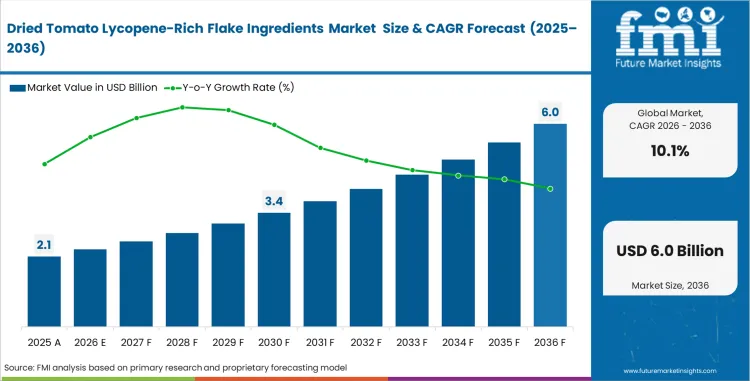
Dried Tomato Lycopene-Rich Flake Ingredients Market Key Takeaways
| Metric | Details |
|---|---|
| Industry Size (2026) | USD 2.08 billion |
| Industry Value (2036) | USD 5.44 billion |
| CAGR (2026-2036) | 10.1% |
Source: Future Market Insights (FMI) analysis, based on proprietary forecasting model and primary research
Pressure to replace synthetic red colorants is rising as additive scrutiny increases across major food markets. Heat stability remains a practical issue for formulators using tomato-derived color ingredients in high-temperature processing. Flake formats can offer an advantage here because the active compounds remain protected within the cellular structure until hydration, which makes them easier to handle in industrial food systems.
Commercial adoption also depends on keeping color performance consistent across seasonal crop variation. Once suppliers establish clearer processing standards and maintain minimum lycopene concentration targets, formulation teams can work these ingredients into recipes with fewer ratio adjustments. That reduces reformulation friction and supports wider use across packaged food portfolios.
India is projected to expand at a CAGR of 11.0% through 2036, supported by localized dehydration investment near cultivation zones. South Korea is expected to record 10.8% CAGR during the forecast period, where functional wellness positioning remains closely tied to convenience food innovation. China is likely to post 10.4% CAGR by 2036 as domestic extraction capacity for dehydrated vegetables continues to expand. Germany is forecast to register 10.0% CAGR in this market over the study period, supported by stricter natural-additive requirements across the European Union. United States adoption is anticipated to move ahead at a CAGR of 9.7% during the assessment period as clean-label snack reformulation remains on a positive trend. Japan is likely to post 9.2% CAGR through 2036, with antioxidant-led food positioning supported by aging consumer demographics. Italy is expected to record 9.0% CAGR during the assessment period as established supply chains continue upgrading traditional sun-drying methods to meet export-grade specifications.
Segmental Analysis
Dried Tomato Lycopene-Rich Flake Ingredients Market Analysis by Drying method
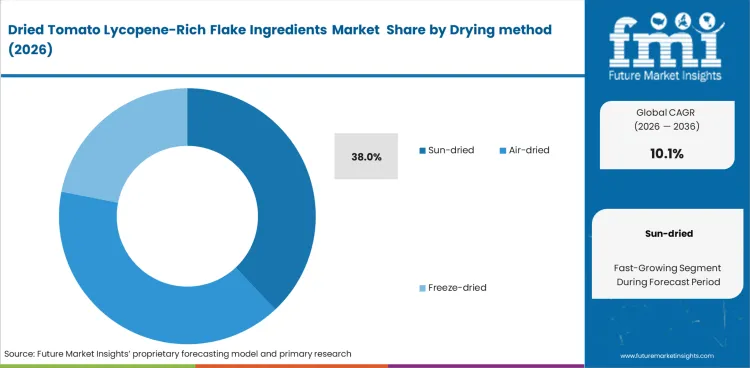
Drying economics continue to shape technology preference across this market because processors need a format that can scale without pushing ingredient costs too high. Sun-dried is projected to represent 38.0% share in 2026, supported by its low-capital processing model and suitability in regions with strong solar exposure. Output consistency is less controlled than in mechanized systems, especially on color and moisture, so manufacturers often need batch blending before final use. That extra handling can reduce part of the initial cost advantage when correction work becomes too frequent.
- Capital efficiency: Sun-based dehydration requires limited facility investment compared with mechanized thermal systems, which keeps baseline processing costs lower.
- Batch variability: Natural weather fluctuation can create uneven moisture levels and color intensity across harvest periods, which raises incoming inspection requirements.
- Blending overhead: Processors often need to combine separate lots to achieve a more uniform pigment profile before production, adding labor and handling time.
Dried Tomato Lycopene-Rich Flake Ingredients Market Analysis by Nature
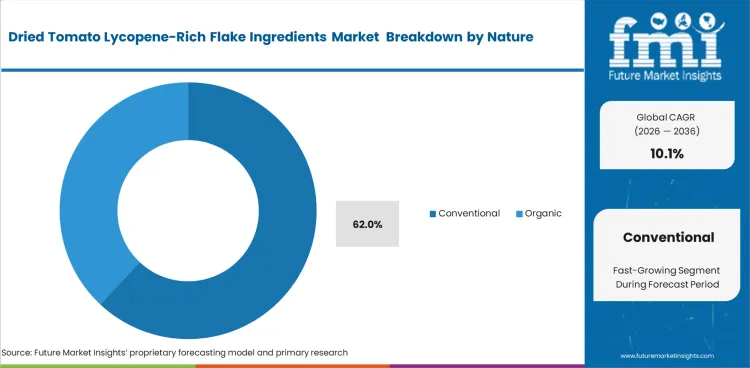
Cost control remains central when high-volume food products move away from synthetic ingredients and toward natural alternatives. Conventional product grades are expected to account for 62.0% share in 2026 because they allow manufacturers to manage ingredient replacement without sharply changing finished product economics. Organic options still carry a pricing burden that is harder to absorb in everyday grocery categories. Conventional supply also remains easier to source at scale, which keeps it in a stronger commercial position for broad reformulation programs.
- Cost fit: Conventional agricultural inputs are easier to work into mass-market food programs because unit economics remain more manageable.
- Supply reliability: Conventional supply is usually available in larger and more predictable volumes than organic supply, which supports large-scale procurement.
- Functional similarity: Both tiers can support similar drying and formulation performance, so the commercial difference is more about cost and availability than end-use suitability.
Dried Tomato Lycopene-Rich Flake Ingredients Market Analysis by Application
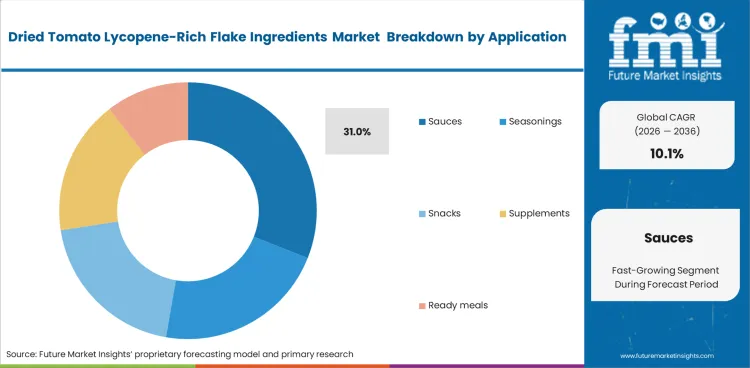
Application fit remains decisive because ingredient acceptance depends on how easily the format works inside the finished product. Sauces are likely to represent 31.0% of the market in 2026, largely because savory liquid systems can absorb residual vegetable notes more naturally than delicate categories. This makes commercial adoption easier and reduces formulation resistance during product development. Particle visibility and sedimentation still limit expansion into clearer or more texture-sensitive formats, which keeps sauces in the lead.
- Flavor fit: Savory liquid bases can absorb residual vegetable notes more easily than delicate categories, which makes formulation simpler.
- Suspension limits: Insoluble plant material can separate during storage in liquid systems, which limits use in beverages and other clarity-sensitive applications.
- Category fit: Sauces and savory condiments are a better fit because visible particulates are more acceptable in these products.
Dried Tomato Lycopene-Rich Flake Ingredients Market Analysis by End user
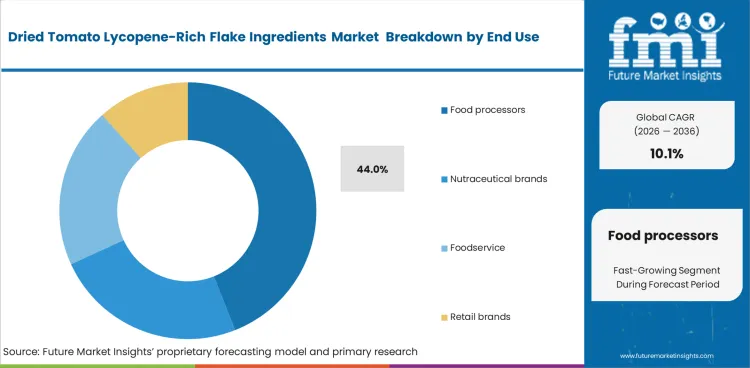
Scale remains the main factor shaping end-use concentration because larger processors can secure volume, define specifications, and plan supply over longer cycles. Food processors are anticipated to contribute 44.0% of total market share in 2026, reflecting their ability to commit to multi-season acquisition and absorb output across broad product portfolios. That operating scale gives them stronger control over moisture, pigment, and lot consistency than smaller participants usually achieve. Brands working without dedicated supply arrangements remain more exposed to price swings and uneven raw material access.
- Volume contracting: Large manufacturing networks can secure supply through pre-season purchasing agreements, which gives them better pricing and supply visibility.
- Specification control: Larger buyers can set tighter moisture and pigment requirements because their purchase volumes carry more negotiating weight.
- Spot exposure: Brands without long-term supply agreements remain more exposed to price swings and inconsistent raw material access.
Dried Tomato Lycopene-Rich Flake Ingredients Market Analysis by Sales channel
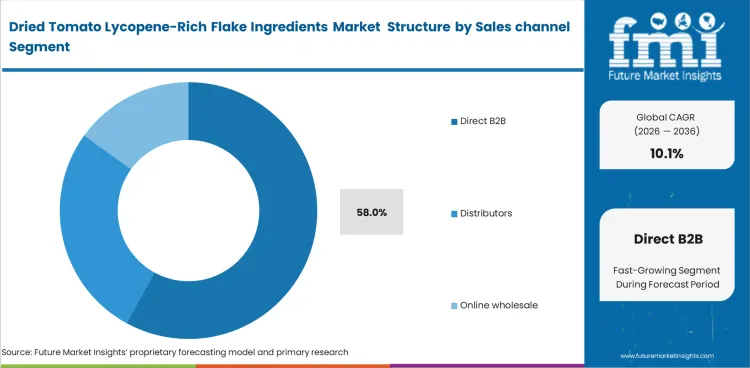
Direct purchasing remains the preferred route where documentation discipline and ingredient traceability carry commercial weight. Multinational manufacturers need uninterrupted chain-of-custody records to support clean-label verification, origin confirmation, and audit readiness across regulated retail channels. The Direct B2B segment is expected to account for 58.0% share in 2026. Dependence on intermediaries can weaken storage control, slow traceability, and complicate recall management, which makes third-party handling less attractive in premium ingredient programs.
- Custody verification: Direct purchasing agreements create a clearer documentation trail from harvest through dehydration, which supports audit compliance and smoother retailer qualification.
- Adulteration exposure: Third-party storage raises the risk of co-mingling and uneven handling conditions, which can compromise clean-label positioning and residue control.
- Recall velocity: Fewer intermediaries make it easier to isolate affected lots quickly during food safety events, helping manufacturers contain disruption and reduce financial exposure.
Dried Tomato Lycopene-Rich Flake Ingredients Market Drivers, Restraints, and Opportunities
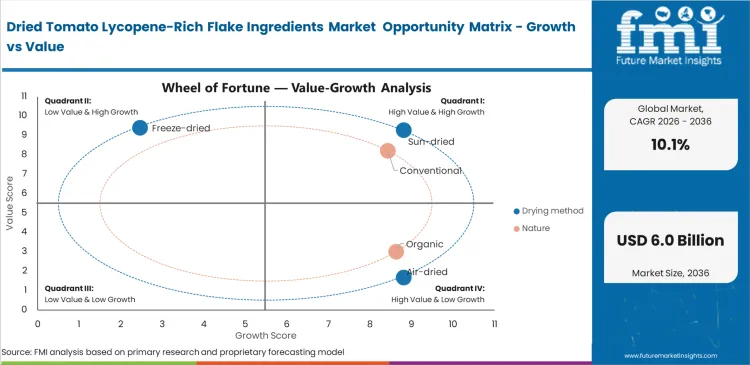
Regulatory pressure on artificial colorants is encouraging packaged food manufacturers to accelerate reformulation, especially in markets where clean-label positioning is gaining more weight. This is increasing interest in botanical alternatives, including tomato-derived ingredients, across applications that previously depended more heavily on synthetic red dyes.
Processing limits remain a clear restraint in savory snack applications. High-speed extrusion conditions can weaken red pigmentation once heat moves beyond the tolerance range of the ingredient structure. Encapsulation can improve stability, but it adds cost and can weaken the clean-label position, which leaves product teams balancing technical performance against formulation economics.
Opportunities in the Dried Tomato Lycopene-Rich Flake Ingredients Market
- Pet food integration: Premium animal nutrition brands could provide a secondary outlet for ingredient grades that fall short of human visual color standards.
- Beverage applications: Improved dispersion and suspension control could expand use in selected liquid applications, though this remains a more limited opportunity today.
- Localized dehydration: Establishing drying facilities closer to cultivation zones can reduce spoilage risk and improve raw material utilization before processing.
Regional Analysis
Based on regional analysis, the Dried Tomato Lycopene-Rich Flake Ingredients market is segmented into North America, Europe, Asia Pacific, Latin America, and Middle East & Africa, with country-level discussion focused on the key markets covered in this report.
.webp "Top Country Growth Comparison Dried Tomato Lycopene Rich Flake Ingredients Market Cagr (2026 2036)")
| Country | CAGR (2026 to 2036) |
|---|---|
| India | 11.0% |
| South Korea | 10.8% |
| China | 10.4% |
| Germany | 10.0% |
| United States | 9.7% |
| Japan | 9.2% |
| Italy | 9.0% |
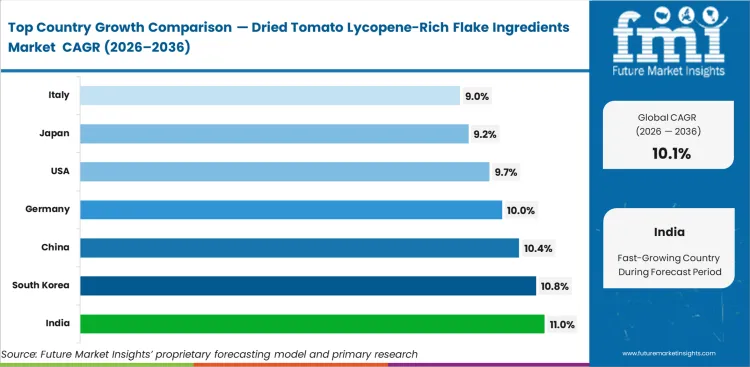
Source: Future Market Insights (FMI) analysis, based on proprietary forecasting model and primary research
Asia Pacific Dried Tomato Lycopene-Rich Flake Ingredients Market Analysis
Asia Pacific is gaining ground as processing capacity shifts closer to cultivation zones and export-oriented dehydration improves across major producing countries. Better control over moisture, consistency, and food-grade handling is helping suppliers move beyond bulk dried material into higher-value ingredient formats. Regional producers are also reducing dependence on European processing routes by shipping finished ingredients directly to food manufacturers. That change is putting more pricing pressure on established suppliers and widening Asia Pacific’s role in the global supply base.
- India: India is strengthening local dehydration capacity near major tomato-growing belts, which is improving supply reliability and lowering logistics costs for domestic manufacturers. Shorter sourcing cycles and better control over raw material availability are making local ingredient pipelines more dependable for processed food applications. The market in India is projected to expand at a CAGR of 11.0% through 2036. This operating advantage is helping Indian suppliers compete more effectively for contracts that previously leaned toward imported ingredient systems.
- South Korea: South Korea is expected to record a CAGR of 10.8% during the forecast period. Demand is being supported by strong interest in functional ingredients within convenience meals and processed foods. This keeps the market relevant for suppliers that can deliver stable color and antioxidant positioning in easy-to-use formats.
- China: China’s domestic processing and extraction capability is expanding in line with stronger packaged food demand and tighter interest in clean-label ingredients. Large buyers are locking in agricultural supply early to secure consistent input quality and avoid pressure from export competition. The market in China is projected to expand at a CAGR of 10.4% through 2036. Local operating scale gives Chinese processors an advantage when multinational brands need dependable factory supply within the country.
- Japan: The industry outlook in Japan points to a CAGR of 9.2% through 2036. Aging demographics and interest in preventative nutrition continue to support demand for functional food ingredients. This keeps antioxidant-led tomato ingredients relevant in selected snack and prepared-food formulations.
Europe Dried Tomato Lycopene-Rich Flake Ingredients Market Analysis
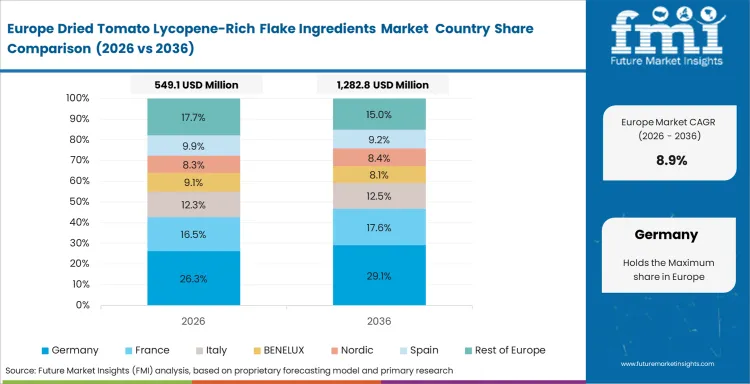
Europe remains a quality-setting region for this market because formulation standards, clean-label discipline, and processing consistency carry real weight across industrial food production. Demand for stable botanical ingredients continues to support the use of dried tomato flakes as manufacturers move away from synthetic color systems and tighten ingredient expectations. Technical documentation, batch uniformity, and export-grade compliance remain central to supplier acceptance across the region.
- Germany: Germany is forecast to register 10.0% CAGR in this market over the study period. Clean-label manufacturing standards remain high, so ingredient acceptance depends heavily on stability during industrial processing and reliable technical performance. Domestic formulators continue to work on ways to protect functional compounds through demanding production conditions, especially in heat-intensive applications. That emphasis supports steady use of suppliers that can meet strict specification and documentation needs.
- Italy: The country benefits from an established tomato supply chain, but processors still need tighter control over drying consistency and export-grade quality. Adoption in Italy is anticipated to move ahead at a CAGR of 9.0% during the assessment period. Facility upgrades aimed at reducing batch variability are becoming more important as buyers expect more uniform ingredient performance. That keeps Italy relevant in premium Mediterranean-linked ingredient supply, even as competition becomes broader.
North America Dried Tomato Lycopene-Rich Flake Ingredients Market Analysis
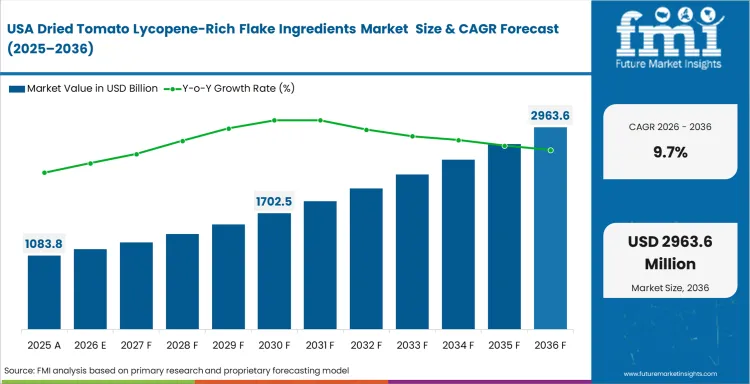
North America remains an important demand center as packaged food companies continue to reshape product portfolios around cleaner labels and stronger ingredient narratives. Tomato-based concentrates and flakes are becoming more relevant because manufacturers need flavor, color, and functional support without creating too much added formulation complexity on existing lines. Local processing capacity is also rising in importance as manufacturers work to reduce exposure to freight volatility and supply interruptions.
- United States: The United States market is set to advance at a CAGR of 9.7% through 2036. Large food companies are reformulating broad product ranges at scale, which raises the need for dependable domestic ingredient pipelines. Multi-year sourcing arrangements and closer links with agricultural suppliers help protect production schedules from external logistics pressure. This keeps locally available, specification-ready tomato ingredients in a strong commercial position.
FMI’s report includes Latin America and Middle East & Africa. These regions are still building dehydration capacity primarily to reduce post-harvest losses and improve raw material utilization. Export-grade functional ingredient capability is developing more gradually, so their role remains more limited than Asia Pacific, Europe, or North America at this stage.
Competitive Aligners for Market Players
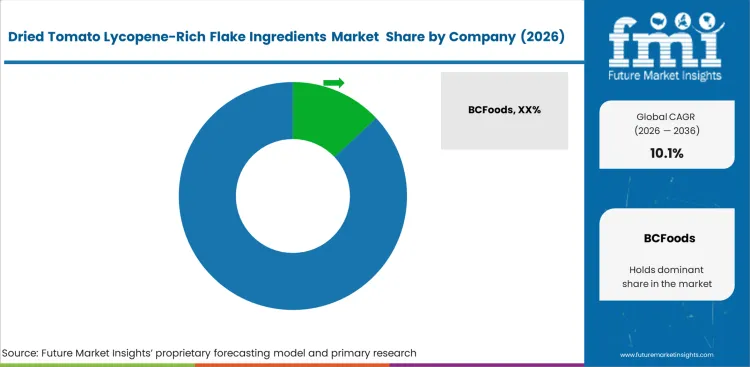
Established processors protect their position by securing long-term access to regional tomato supply through sourcing relationships with growers and cooperatives. BCFoods and Silva International remain well placed because consistent access to high-pigment crop varieties supports processing scale, color uniformity, and tighter output control. Batch consistency remains a decisive factor in this sector, especially where finished products must maintain uniform appearance across large production runs.
Competitive pressure is also rising from firms building stronger freeze-dried capability. Higher-spec drying systems can preserve antioxidant content more effectively and improve performance in applications exposed to heavier thermal stress. Capital intensity remains a real constraint here, since this route requires specialized equipment that sits well above the cost base of conventional drying operations.
Supplier diversification is becoming more common as large food manufacturers avoid overdependence on a narrow processor base. Lycored and regional companies such as Kapadiya Expo Company benefit from this pattern when manufacturers split contracts across multiple operating zones to reduce exposure to crop disruption and localized weather risk. Geographic spread also supports continuity in production planning when one sourcing region comes under pressure. Competitive standing therefore depends not only on ingredient quality, but also on supply resilience, processing discipline, and the ability to deliver stable specification across different crop conditions.
Key Players in Dried Tomato Lycopene-Rich Flake Ingredients Market
- BCFoods
- Lycored
- Silva International
- Kanegrade
- Givaudan
- Kapadiya Expo Company
- Harmony House Foods
Scope of the Report
| Metric | Value |
|---|---|
| Quantitative Units | USD 2.08 billion to USD 5.44 billion, at a CAGR of 10.1% |
| Market Definition | This market covers dried tomato flakes designed to deliver concentrated color, flavor, and lycopene content through controlled moisture removal for food and selective functional applications. |
| Segmentation | Drying method, Nature, Application, End user, Sales channel, Region |
| Regions Covered | North America, Europe, Asia Pacific, Latin America, Middle East & Africa |
| Countries Covered | India, South Korea, China, Germany, United States, Japan, Italy |
| Key Companies Profiled | BCFoods, Lycored, Silva International, Kanegrade, Givaudan, Kapadiya Expo Company, Harmony House Foods |
| Forecast Period | 2026 to 2036 |
| Approach | The market estimate is based on volume tracking, trade analysis, product benchmarking, and primary research across key consuming markets. |
Source: Future Market Insights (FMI) analysis, based on proprietary forecasting model and primary research
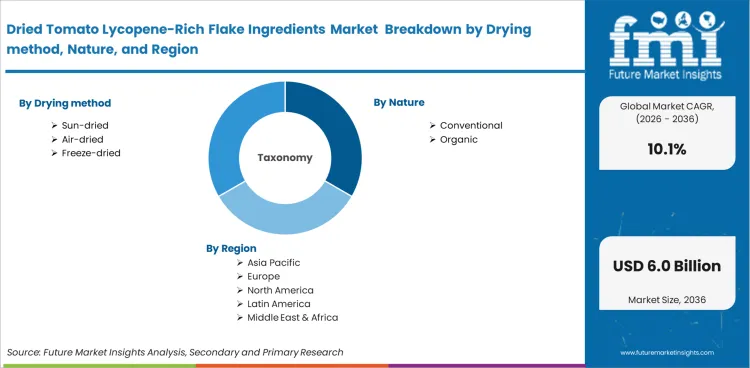
Dried Tomato Lycopene-Rich Flake Ingredients Market Analysis by Segments
Drying method
- Sun-dried
- Air-dried
- Freeze-dried
Nature
- Conventional
- Organic
Application
- Sauces
- Seasonings
- Snacks
- Supplements
- Ready meals
End user
- Food processors
- Nutraceutical brands
- Foodservice
- Retail brands
Sales channel
- Direct B2B
- Distributors
- Online wholesale
Region
- North America
- Europe
- Asia Pacific
- Latin America
- Middle East & Africa
Bibliography
- Food and Agriculture Organization of the United Nations. (2025, December 23). Trade of agrifood products - 2000-2024. FAO.
- Jiménez Bolaño, D. C., Insuasty, D., Rodríguez Macías, J. D., & Grande-Tovar, C. D. (2024, June 28). Potential Use of Tomato Peel, a Rich Source of Lycopene, for Cancer Treatment. Molecules, 29(13), 3079.
- Mavridis, K., et al. (2025, January 10). Lycopene and Other Bioactive Compounds' Extraction from Tomato Processing Waste Using Green Techniques. Horticulturae, 11(1), 71.
- Nandeshwar, K. A., Kodape, S., & Rathod, A. P. (2024, September 17). Techno-Economic Analysis of Lycopene Production from Tomato Waste Using the Pervaporation Process. Industrial & Engineering Chemistry Research.
- Pravitha, M., Agrahar-Murugkar, D. D., & Kumar, A. A. V. (2024, February 23). Recent developments in tomato drying techniques: A comprehensive review. Journal of Food Process Engineering, 47(2), e14550.
This bibliography is provided for reader reference. The full FMI report contains the complete reference list with primary source documentation.
This Report Addresses
- Thermal stability limits constraining functional natural pigment applications during high-speed commercial savory snack manufacturing.
- Regulatory pressures forcing multinational food corporations into immediate plant-based colorant reformulations across legacy product portfolios.
- Capital requirements distinguishing basic sun-drying operations from advanced freeze-drying extraction facilities processing high-value botanical compounds.
- Quality assurance protocols necessary for preventing unverified agricultural pesticide residues from entering clean-label international supply chains.
- Geographic sourcing strategies designed specifically to mitigate severe weather disruptions affecting sensitive high-yield crop cultivation regions.
- Discrepancies between ambient laboratory color stability testing and actual real-world high-temperature factory extrusion degradation rates.
- Margin compression risks facing secondary buyers relying heavily on volatile open-market agricultural spot purchasing channels.
- Technological advancements allowing raw cellular matrices to protect sensitive antioxidant molecules from oxidation during extended ambient warehouse storage.
Frequently Asked Questions
What is the market valuation in 2025?
The market is valued at USD 1.89 billion in 2025.
What is the forecast CAGR for the market?
The market is projected to expand at a CAGR of 10.1% over 2026 to 2036.
What valuation is projected for 2036?
The market is projected to reach USD 5.44 billion by 2036.
Why does the sun-dried method capture significant volume?
Commanding 38.0% share in 2026, low capital requirements allow processors to deliver acceptable compounds at competitive bulk prices.
What sustains conventional crop dominance?
Standard agricultural inputs hold 62.0% share because multinational brands demand strict margin parity when reformulating legacy lines.
Why do savory sauces dominate application testing?
Liquid condiments account for 31.0% share because dark bases effortlessly mask residual vegetable flavors from natural extracts.
Which commercial buyers execute the largest supply contracts?
Large food manufacturing facilities represent 44.0% of purchasing, allowing them to dictate exact moisture and color specifications.
What distribution model ensures clean-label compliance?
Direct agreements capture 58.0% share because eliminating third-party warehouses ensures unbroken documentation trails for strict retail audits.
Why is India projected to grow the fastest?
India is projected to grow the fastest because dehydration investment is increasing closer to cultivation zones, improving supply reliability and logistics efficiency.
How does South Korea integrate these functional compounds?
Urban demand for preventative nutrition yields a 10.8% trajectory as developers add antioxidants into premium convenience meals.
What capability determines success for challenger brands?
Innovative firms must engineer advanced vacuum environments to retain maximum antioxidant potency, creating a critical performance advantage.
How do large brands mitigate regional crop failures?
Sourcing directors split large purchase agreements across distinct geographic climate zones, preventing severe weather from halting production schedules.
What technical failure limits beverage application?
Insoluble plant material inevitably separates from liquid suspensions during storage, forcing quality managers to utilize artificial stabilizing chemicals.
Why do spot-market buyers face severe financial risk?
Corporate contracts absorb nearly all premium yields before harvest, leaving smaller brands exposed to sharp open-market price spikes.
What forces European facilities to pioneer extraction technology?
Rigid clean-label regulations eliminate synthetic chemicals, forcing processors to invent novel stabilization methods surviving destructive industrial heat treatments.
How does thermal extrusion affect raw ingredient selection?
High-temperature processing degrades sensitive natural pigments rapidly, forcing formulation scientists to select mechanically durable flake formats over liquids.
What advantage do established incumbent suppliers possess?
Legacy processors hold exclusive multi-year contracts with high-yield farming cooperatives, preventing new entrants from achieving necessary economies of scale.
Why does batch blending increase hidden operational costs?
Environmental fluctuations create inconsistent pigment levels, forcing factory managers to expend additional labor mixing harvests for uniform colors.
What prevents instant replacement of synthetic red dyes?
Matching exact hue profiles using botanical compounds requires complex formulation adjustments, as simple substitution ruins product texture.
How does particle size influence sensory acceptance?
Large vegetable particulates create gritty textures, requiring processing engineers to match extract milling specifications to the intended food application.
What commercial consequence follows failed retailer audits?
Incomplete pesticide tracking documentation blocks access to premium grocery shelves, causing complete product delisting from major retail networks.
Where will future processing capacity concentrate?
Extraction facilities will migrate directly to emerging agricultural production zones, minimizing transportation distances to dramatically improve active compound yields.
Preview the report firsthand - request a free sample
Get SampleGet the brochure for pricing and purchase details.
Get PDFTable of Content
- Executive Summary
- Global Market Outlook
- Demand-side Trends
- Supply-side Trends
- Technology Roadmap Analysis
- Analysis and Recommendations
- Market Overview
- Market Coverage / Taxonomy
- Market Definition / Scope / Limitations
- Research Methodology
- Chapter Orientation
- Analytical Lens and Working Hypotheses
- Market Structure, Signals, and Trend Drivers
- Benchmarking and Cross-market Comparability
- Market Sizing, Forecasting, and Opportunity Mapping
- Research Design and Evidence Framework
- Desk Research Programme (Secondary Evidence)
- Company Annual and Sustainability Reports
- Peer-reviewed Journals and Academic Literature
- Corporate Websites, Product Literature, and Technical Notes
- Earnings Decks and Investor Briefings
- Statutory Filings and Regulatory Disclosures
- Technical White Papers and Standards Notes
- Trade Journals, Industry Magazines, and Analyst Briefs
- Conference Proceedings, Webinars, and Seminar Materials
- Government Statistics Portals and Public Data Releases
- Press Releases and Reputable Media Coverage
- Specialist Newsletters and Curated Briefings
- Sector Databases and Reference Repositories
- FMI Internal Proprietary Databases and Historical Market Datasets
- Subscription Datasets and Paid Sources
- Social Channels, Communities, and Digital Listening Inputs
- Additional Desk Sources
- Expert Input and Fieldwork (Primary Evidence)
- Primary Modes
- Qualitative Interviews and Expert Elicitation
- Quantitative Surveys and Structured Data Capture
- Blended Approach
- Why Primary Evidence is Used
- Field Techniques
- Interviews
- Surveys
- Focus Groups
- Observational and In-context Research
- Social and Community Interactions
- Stakeholder Universe Engaged
- C-suite Leaders
- Board Members
- Presidents and Vice Presidents
- R&D and Innovation Heads
- Technical Specialists
- Domain Subject-matter Experts
- Scientists
- Physicians and Other Healthcare Professionals
- Governance, Ethics, and Data Stewardship
- Research Ethics
- Data Integrity and Handling
- Primary Modes
- Tooling, Models, and Reference Databases
- Desk Research Programme (Secondary Evidence)
- Data Engineering and Model Build
- Data Acquisition and Ingestion
- Cleaning, Normalisation, and Verification
- Synthesis, Triangulation, and Analysis
- Quality Assurance and Audit Trail
- Market Background
- Market Dynamics
- Drivers
- Restraints
- Opportunity
- Trends
- Scenario Forecast
- Demand in Optimistic Scenario
- Demand in Likely Scenario
- Demand in Conservative Scenario
- Opportunity Map Analysis
- Product Life Cycle Analysis
- Supply Chain Analysis
- Investment Feasibility Matrix
- Value Chain Analysis
- PESTLE and Porter’s Analysis
- Regulatory Landscape
- Regional Parent Market Outlook
- Production and Consumption Statistics
- Import and Export Statistics
- Market Dynamics
- Global Market Analysis 2021 to 2025 and Forecast, 2026 to 2036
- Historical Market Size Value (USD Million) Analysis, 2021 to 2025
- Current and Future Market Size Value (USD Million) Projections, 2026 to 2036
- Y-o-Y Growth Trend Analysis
- Absolute $ Opportunity Analysis
- Global Market Pricing Analysis 2021 to 2025 and Forecast 2026 to 2036
- Global Market Analysis 2021 to 2025 and Forecast 2026 to 2036, By Drying method
- Introduction / Key Findings
- Historical Market Size Value (USD Million) Analysis By Drying method , 2021 to 2025
- Current and Future Market Size Value (USD Million) Analysis and Forecast By Drying method , 2026 to 2036
- Sun-dried
- Air-dried
- Freeze-dried
- Sun-dried
- Y-o-Y Growth Trend Analysis By Drying method , 2021 to 2025
- Absolute $ Opportunity Analysis By Drying method , 2026 to 2036
- Global Market Analysis 2021 to 2025 and Forecast 2026 to 2036, By Nature
- Introduction / Key Findings
- Historical Market Size Value (USD Million) Analysis By Nature, 2021 to 2025
- Current and Future Market Size Value (USD Million) Analysis and Forecast By Nature, 2026 to 2036
- Conventional
- Organic
- Conventional
- Y-o-Y Growth Trend Analysis By Nature, 2021 to 2025
- Absolute $ Opportunity Analysis By Nature, 2026 to 2036
- Global Market Analysis 2021 to 2025 and Forecast 2026 to 2036, By Application
- Introduction / Key Findings
- Historical Market Size Value (USD Million) Analysis By Application, 2021 to 2025
- Current and Future Market Size Value (USD Million) Analysis and Forecast By Application, 2026 to 2036
- Sauces
- Seasonings
- Snacks
- Supplements
- Ready meals
- Sauces
- Y-o-Y Growth Trend Analysis By Application, 2021 to 2025
- Absolute $ Opportunity Analysis By Application, 2026 to 2036
- Global Market Analysis 2021 to 2025 and Forecast 2026 to 2036, By End Use
- Introduction / Key Findings
- Historical Market Size Value (USD Million) Analysis By End Use, 2021 to 2025
- Current and Future Market Size Value (USD Million) Analysis and Forecast By End Use, 2026 to 2036
- Food processors
- Nutraceutical brands
- Foodservice
- Retail brands
- Food processors
- Y-o-Y Growth Trend Analysis By End Use, 2021 to 2025
- Absolute $ Opportunity Analysis By End Use, 2026 to 2036
- Global Market Analysis 2021 to 2025 and Forecast 2026 to 2036, By Sales channel
- Introduction / Key Findings
- Historical Market Size Value (USD Million) Analysis By Sales channel, 2021 to 2025
- Current and Future Market Size Value (USD Million) Analysis and Forecast By Sales channel, 2026 to 2036
- Direct B2B
- Distributors
- Online wholesale
- Direct B2B
- Y-o-Y Growth Trend Analysis By Sales channel, 2021 to 2025
- Absolute $ Opportunity Analysis By Sales channel, 2026 to 2036
- Global Market Analysis 2021 to 2025 and Forecast 2026 to 2036, By Region
- Introduction
- Historical Market Size Value (USD Million) Analysis By Region, 2021 to 2025
- Current Market Size Value (USD Million) Analysis and Forecast By Region, 2026 to 2036
- North America
- Latin America
- Western Europe
- Eastern Europe
- East Asia
- South Asia and Pacific
- Middle East & Africa
- Market Attractiveness Analysis By Region
- North America Market Analysis 2021 to 2025 and Forecast 2026 to 2036, By Country
- Historical Market Size Value (USD Million) Trend Analysis By Market Taxonomy, 2021 to 2025
- Market Size Value (USD Million) Forecast By Market Taxonomy, 2026 to 2036
- By Country
- USA
- Canada
- Mexico
- By Drying method
- By Nature
- By Application
- By End Use
- By Sales channel
- By Country
- Market Attractiveness Analysis
- By Country
- By Drying method
- By Nature
- By Application
- By End Use
- By Sales channel
- Key Takeaways
- Latin America Market Analysis 2021 to 2025 and Forecast 2026 to 2036, By Country
- Historical Market Size Value (USD Million) Trend Analysis By Market Taxonomy, 2021 to 2025
- Market Size Value (USD Million) Forecast By Market Taxonomy, 2026 to 2036
- By Country
- Brazil
- Chile
- Rest of Latin America
- By Drying method
- By Nature
- By Application
- By End Use
- By Sales channel
- By Country
- Market Attractiveness Analysis
- By Country
- By Drying method
- By Nature
- By Application
- By End Use
- By Sales channel
- Key Takeaways
- Western Europe Market Analysis 2021 to 2025 and Forecast 2026 to 2036, By Country
- Historical Market Size Value (USD Million) Trend Analysis By Market Taxonomy, 2021 to 2025
- Market Size Value (USD Million) Forecast By Market Taxonomy, 2026 to 2036
- By Country
- Germany
- UK
- Italy
- Spain
- France
- Nordic
- BENELUX
- Rest of Western Europe
- By Drying method
- By Nature
- By Application
- By End Use
- By Sales channel
- By Country
- Market Attractiveness Analysis
- By Country
- By Drying method
- By Nature
- By Application
- By End Use
- By Sales channel
- Key Takeaways
- Eastern Europe Market Analysis 2021 to 2025 and Forecast 2026 to 2036, By Country
- Historical Market Size Value (USD Million) Trend Analysis By Market Taxonomy, 2021 to 2025
- Market Size Value (USD Million) Forecast By Market Taxonomy, 2026 to 2036
- By Country
- Russia
- Poland
- Hungary
- Balkan & Baltic
- Rest of Eastern Europe
- By Drying method
- By Nature
- By Application
- By End Use
- By Sales channel
- By Country
- Market Attractiveness Analysis
- By Country
- By Drying method
- By Nature
- By Application
- By End Use
- By Sales channel
- Key Takeaways
- East Asia Market Analysis 2021 to 2025 and Forecast 2026 to 2036, By Country
- Historical Market Size Value (USD Million) Trend Analysis By Market Taxonomy, 2021 to 2025
- Market Size Value (USD Million) Forecast By Market Taxonomy, 2026 to 2036
- By Country
- China
- Japan
- South Korea
- By Drying method
- By Nature
- By Application
- By End Use
- By Sales channel
- By Country
- Market Attractiveness Analysis
- By Country
- By Drying method
- By Nature
- By Application
- By End Use
- By Sales channel
- Key Takeaways
- South Asia and Pacific Market Analysis 2021 to 2025 and Forecast 2026 to 2036, By Country
- Historical Market Size Value (USD Million) Trend Analysis By Market Taxonomy, 2021 to 2025
- Market Size Value (USD Million) Forecast By Market Taxonomy, 2026 to 2036
- By Country
- India
- ASEAN
- Australia & New Zealand
- Rest of South Asia and Pacific
- By Drying method
- By Nature
- By Application
- By End Use
- By Sales channel
- By Country
- Market Attractiveness Analysis
- By Country
- By Drying method
- By Nature
- By Application
- By End Use
- By Sales channel
- Key Takeaways
- Middle East & Africa Market Analysis 2021 to 2025 and Forecast 2026 to 2036, By Country
- Historical Market Size Value (USD Million) Trend Analysis By Market Taxonomy, 2021 to 2025
- Market Size Value (USD Million) Forecast By Market Taxonomy, 2026 to 2036
- By Country
- Kingdom of Saudi Arabia
- Other GCC Countries
- Turkiye
- South Africa
- Other African Union
- Rest of Middle East & Africa
- By Drying method
- By Nature
- By Application
- By End Use
- By Sales channel
- By Country
- Market Attractiveness Analysis
- By Country
- By Drying method
- By Nature
- By Application
- By End Use
- By Sales channel
- Key Takeaways
- Key Countries Market Analysis
- USA
- Pricing Analysis
- Market Share Analysis, 2025
- By Drying method
- By Nature
- By Application
- By End Use
- By Sales channel
- Canada
- Pricing Analysis
- Market Share Analysis, 2025
- By Drying method
- By Nature
- By Application
- By End Use
- By Sales channel
- Mexico
- Pricing Analysis
- Market Share Analysis, 2025
- By Drying method
- By Nature
- By Application
- By End Use
- By Sales channel
- Brazil
- Pricing Analysis
- Market Share Analysis, 2025
- By Drying method
- By Nature
- By Application
- By End Use
- By Sales channel
- Chile
- Pricing Analysis
- Market Share Analysis, 2025
- By Drying method
- By Nature
- By Application
- By End Use
- By Sales channel
- Germany
- Pricing Analysis
- Market Share Analysis, 2025
- By Drying method
- By Nature
- By Application
- By End Use
- By Sales channel
- UK
- Pricing Analysis
- Market Share Analysis, 2025
- By Drying method
- By Nature
- By Application
- By End Use
- By Sales channel
- Italy
- Pricing Analysis
- Market Share Analysis, 2025
- By Drying method
- By Nature
- By Application
- By End Use
- By Sales channel
- Spain
- Pricing Analysis
- Market Share Analysis, 2025
- By Drying method
- By Nature
- By Application
- By End Use
- By Sales channel
- France
- Pricing Analysis
- Market Share Analysis, 2025
- By Drying method
- By Nature
- By Application
- By End Use
- By Sales channel
- India
- Pricing Analysis
- Market Share Analysis, 2025
- By Drying method
- By Nature
- By Application
- By End Use
- By Sales channel
- ASEAN
- Pricing Analysis
- Market Share Analysis, 2025
- By Drying method
- By Nature
- By Application
- By End Use
- By Sales channel
- Australia & New Zealand
- Pricing Analysis
- Market Share Analysis, 2025
- By Drying method
- By Nature
- By Application
- By End Use
- By Sales channel
- China
- Pricing Analysis
- Market Share Analysis, 2025
- By Drying method
- By Nature
- By Application
- By End Use
- By Sales channel
- Japan
- Pricing Analysis
- Market Share Analysis, 2025
- By Drying method
- By Nature
- By Application
- By End Use
- By Sales channel
- South Korea
- Pricing Analysis
- Market Share Analysis, 2025
- By Drying method
- By Nature
- By Application
- By End Use
- By Sales channel
- Russia
- Pricing Analysis
- Market Share Analysis, 2025
- By Drying method
- By Nature
- By Application
- By End Use
- By Sales channel
- Poland
- Pricing Analysis
- Market Share Analysis, 2025
- By Drying method
- By Nature
- By Application
- By End Use
- By Sales channel
- Hungary
- Pricing Analysis
- Market Share Analysis, 2025
- By Drying method
- By Nature
- By Application
- By End Use
- By Sales channel
- Kingdom of Saudi Arabia
- Pricing Analysis
- Market Share Analysis, 2025
- By Drying method
- By Nature
- By Application
- By End Use
- By Sales channel
- Turkiye
- Pricing Analysis
- Market Share Analysis, 2025
- By Drying method
- By Nature
- By Application
- By End Use
- By Sales channel
- South Africa
- Pricing Analysis
- Market Share Analysis, 2025
- By Drying method
- By Nature
- By Application
- By End Use
- By Sales channel
- USA
- Market Structure Analysis
- Competition Dashboard
- Competition Benchmarking
- Market Share Analysis of Top Players
- By Regional
- By Drying method
- By Nature
- By Application
- By End Use
- By Sales channel
- Competition Analysis
- Competition Deep Dive
- BCFoods
- Overview
- Product Portfolio
- Profitability by Market Segments (Product/Age /Sales Channel/Region)
- Sales Footprint
- Strategy Overview
- Marketing Strategy
- Product Strategy
- Channel Strategy
- Lycored
- Silva International
- Kanegrade
- Givaudan
- Kapadiya Expo Company
- Harmony House Foods
- BCFoods
- Competition Deep Dive
- Assumptions & Acronyms Used


