

- Market Size (2026)
- USD 65.1 Bn
- Forecast (2036)
- USD 110.1 Bn
- CAGR (2026 to 2036)
- 5.4%
Sun-Dried Tomato Umami Concentrate Systems Market Size, Market Forecast and Outlook By FMI
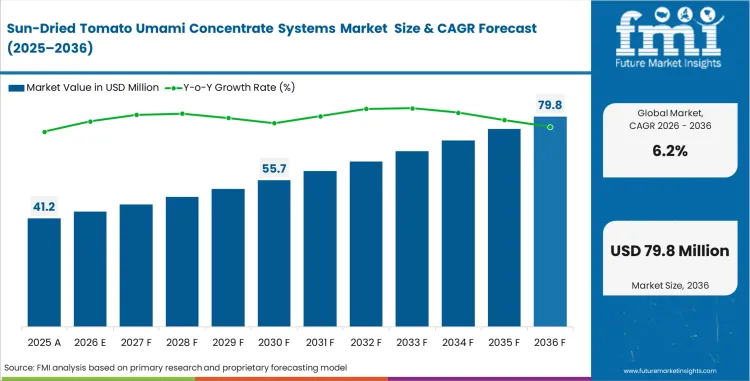
The Sun-Dried Tomato Umami Concentrate Systems Market was valued at USD 38.7 million in 2025. Valuation is projected to reach USD 41.2 million in 2026 and advance to USD 75.0 million by 2036, reflecting a CAGR of 6.20% during the forecast period. Growth is being supported by industrial formulators shifting away from yeast extracts toward more recognizable botanical enhancers.
Summary of Sun-Dried Tomato Umami Concentrate Systems Market
- The market is forecast to reach USD 75.0 million by 2036.
- The market is expected to grow at a CAGR of 6.2% from 2026 to 2036.
- The market was estimated at USD 38.7 million in 2025.
- The forecast period represents an incremental opportunity of USD 33.8 million.
- The market remains a niche B2B ingredient segment focused on tomato-derived powders, pastes, and concentrates for enhancing savory flavor and supporting clean-label formulations.
- Demand is increasing as manufacturers replace synthetic flavor enhancers with more label-friendly, plant-based ingredients.
- Tomato holds a strong base within the broader vegetable concentrate market, supporting adoption of tomato-led umami systems.
- India leads growth at 7.2%, followed by China, the United States, Germany, Italy, the United Kingdom, and Japan.
- Powder form dominates the segment with a 44.0% share due to ease of storage, dosing, and compatibility with seasoning systems.
- Soups and sauces lead the application segment with a 31.0% share, where tomato-based umami delivers strong functional and sensory benefits.
- Umami enhancement accounts for 39.0% of the function segment, reflecting primary use in savory flavor boosting.
- Clean-label positioning leads with a 58.0% share, driven by demand for recognizable ingredient declarations.
- Food manufacturers dominate the end-user segment with a 63.0% share, reflecting large-scale formulation demand.
- Lycored is a key participant with an estimated 11.0% share, while broader competition comes from flavor companies offering multi-ingredient savory solutions.
- The market remains moderately fragmented, with competitive advantage driven by formulation expertise, raw material quality, and consistency in flavor delivery.
Key Takeaways, Market Size, and Forecast
- Sun-Dried Tomato Umami Concentrate Systems Market is projected to grow from USD 41.2 million in 2026 to USD 75.0 million by 2036, at a CAGR of 6.2%.
- The sun-dried tomato umami concentrate systems market was valued at USD 38.7 million in 2025.
- By 2036, the Sun-Dried Tomato Umami Concentrate Systems Market is expected to be worth USD 75.0 million.
- From 2026 to 2036, the market is projected to expand at a CAGR of 6.2%.
- The market is projected to create an incremental opportunity of USD 33.8 million between 2026 and 2036.
- In 2026, Powder is expected to account for 44.0% of the form segment.
- India (7.2%) and China (6.8%) are two of the fastest growing markets.
Sun-Dried Tomato Umami Concentrate Systems Market Key Takeaways
| Metric | Details |
|---|---|
| Industry Size (2026) | USD 41.2 million |
| Industry Value (2036) | USD 75.0 million |
| CAGR (2026-2036) | 6.20% |
Source: Future Market Insights (FMI) analysis, based on proprietary forecasting model and primary research
Formulation teams are under steady pressure to simplify ingredient declarations without weakening savory performance. Removing hydrolyzed proteins often reduces flavor depth, which can make premium-positioned products harder to defend at retail. Tomato-based vegetable concentrates help close that gap because they deliver naturally occurring glutamates in a more acceptable format. Performance, though, still depends heavily on raw material quality, since free amino acid levels can vary meaningfully with harvest timing.
Powder formats are gaining traction across dry snack applications where moisture control and line efficiency carry real operating value. Once suppliers can maintain non-clumping performance in humid conditions, seasoning blending becomes easier to manage at scale. Stable powder flow also helps reduce unplanned stoppages and supports wider use of natural savory flavor modulators across production lines.
India is projected to expand at a 7.2% CAGR through 2036, supported by the rising scale of packaged spice blends. China is expected to record 6.8% CAGR as instant noodle flavoring requirements continue to widen. Plant-based meat reformulation keeps the United States market on a positive trend, with the sector likely to post 5.9% CAGR over the study period. Germany is forecast to register 5.6% CAGR as processors adjust traditional sausage recipes to cleaner labeling needs. Italy is set to advance at a 5.4% CAGR through 2036 as heritage sauce production becomes more automated. Ready-meal reformulation leaves the United Kingdom inclined toward 5.2% CAGR during the assessment period. Japan rounds out the profile at 4.8% CAGR as manufacturers adapt new umami systems within traditional broth formats. Asian industry expansion remains closely tied to high-throughput snack and convenience-food manufacturing, while Europe stays more focused on declaration simplicity and formulation compliance.
Segmental Analysis
Sun-Dried Tomato Umami Concentrate Systems Market Analysis by Form
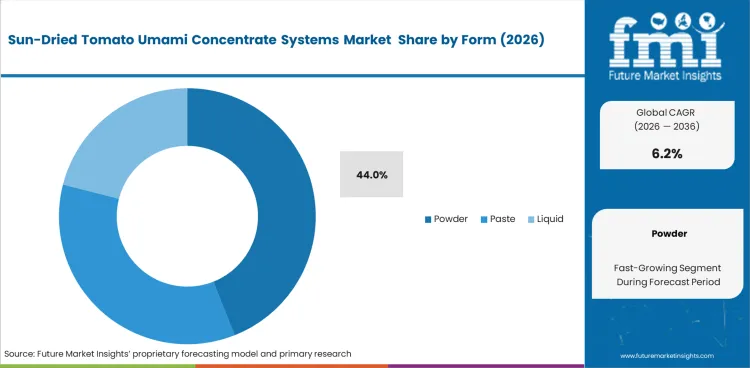
Powder remains the leading format because it fits industrial blending lines better than paste or liquid formats. It is projected to account for 44.0% share in 2026, supported by easier storage, dosing, and movement through high-speed hoppers. Performance still depends on powder engineering, as hygroscopic material can absorb ambient moisture and create blockages when climate control is weak. That keeps flowability, water activity, and non-clumping performance central to wider commercial use.
- Initial screening: R&D teams evaluate particle size distribution first. Uniform particles ensure consistent flavor dispersion across large batches.
- Scale-up validation: Production supervisors monitor hopper flow rates carefully. Any bridging issues halt continuous manufacturing runs entirely.
- Commercial renewal: Purchasing departments track yield consistency over multiple quarters. Batch-to-batch variation triggers immediate vendor reviews.
Sun-Dried Tomato Umami Concentrate Systems Market Analysis by Application
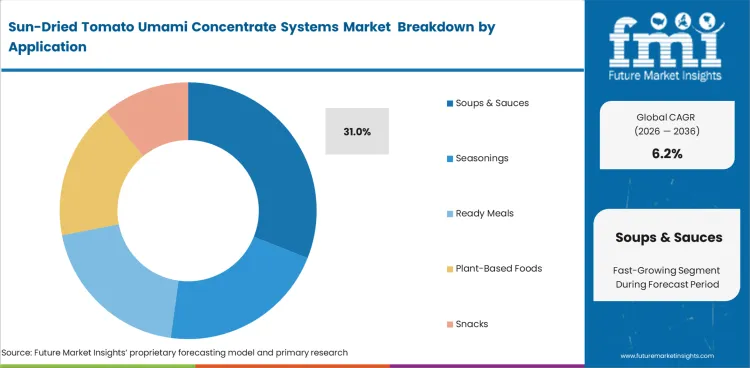
Soups & Sauces remain the leading application because wet processing systems favor ingredients that disperse cleanly and build flavor quickly. Tomato-derived extracts fit these formulations well, especially where manufacturers need stable integration across aqueous phases without creating sediment issues during storage. Soups & Sauces are projected to represent 31.0% share in 2026. Thermal stability still matters, since extended retort exposure can flatten flavor if processing conditions are not controlled carefully. In practice, flavor retention depends on tighter heating control rather than on ingredient choice alone.
- Sourcing savings: Sourcing managers negotiate bulk contracts based on standardized active compound minimums. High-concentration options lower total logistics expenses.
- Hidden operational expenses: Quality control departments spend considerable resources verifying amino acid profiles. Insufficient testing leads to rejected final product batches.
- Lifecycle comparison: Finance controllers evaluate total recipe costs against synthetic alternatives. Clean-label premiums frequently justify themselves through improved retail pricing power.
Sun-Dried Tomato Umami Concentrate Systems Market Analysis by Function
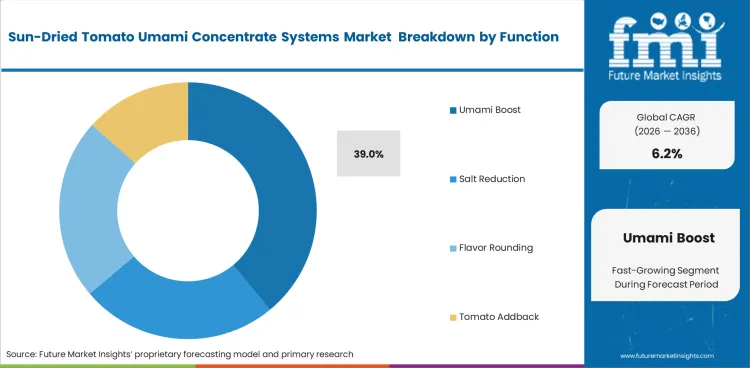
Umami Boost is forecast to represent 39.0% share in 2026 because buyers are mainly using these systems to strengthen savory perception without relying on artificial-sounding additives. The commercial value is clear in complex formulations where tomato-derived amino acids can improve depth and round out flavor. Performance still depends on matrix compatibility, since highly acidic concentrates can destabilize dairy-based emulsions or leave unwanted aftertaste when dosing is not controlled well. That makes pilot validation important before scale-up.
- Emulsion breakdown: Acidity levels destabilize sensitive protein structures unexpectedly. Food scientists must employ advanced buffering agents to prevent separation.
- Residual flavor masking: Incomplete integration leaves noticeable bitter aftertastes. Sensory panels reject formulations lacking proper sweet-acid balance.
- Optimal capture: Formulation engineers dial in exact dosing rates during pilot runs. Achieving perfect flavor harmony requires dozens of iterative trials.
Sun-Dried Tomato Umami Concentrate Systems Market Analysis by Label Positioning
Clean Label remains central to category positioning because recognizable ingredient declarations help brands protect premium shelf placement. Retail acceptance improves when formulations avoid chemical-sounding names and present ingredients in a more familiar format. Natural tomato-based extracts support that objective while allowing manufacturers to maintain product quality and market positioning. In 2026, Clean Label is expected to account for 58.0% share of the segment. That lead does not remove operational risk. Origin claims are exposed to scrutiny when traceability reviews uncover weak documentation or blended agricultural inputs that cannot be clearly verified. Reputational damage can follow quickly when those gaps surface in premium-positioned products. Long-term stability in this segment depends as much on vendor verification and source control as it does on label appeal.
- Raw material aggregation: Farming cooperatives supply baseline agricultural inputs. Consistent sun-drying conditions remain critical for optimal flavor development.
- Processing bottlenecks: Specialized extraction facilities operate near maximum capacity during peak harvests. Manufacturers must secure forward contracts to guarantee uninterrupted supply.
- Future supply: Agricultural planners anticipate shifting cultivation zones due to climate volatility. Cultivating resilient tomato varieties determines long-term sector stability.
Sun-Dried Tomato Umami Concentrate Systems Market Analysis by End User
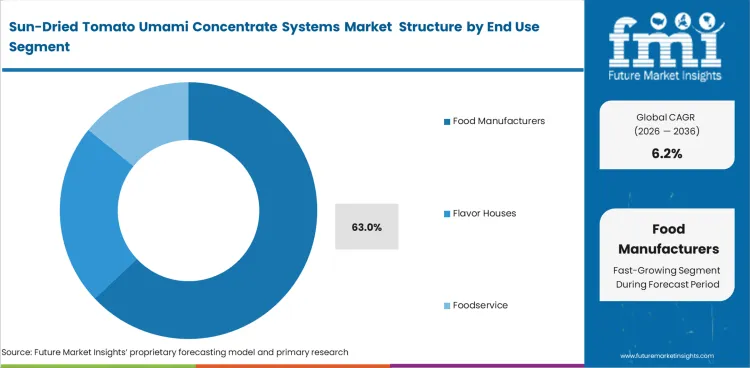
Food Manufacturers are expected to contribute 63.0% of total market share in 2026 because these systems are bought mainly for direct use in commercial formulations. Large processors prefer direct sourcing where it improves cost control, ingredient transparency, and specification management across high-volume production lines. Supplier approval remains demanding, however, because industrial buyers typically require documentation, audit readiness, and repeatable performance before qualification. That keeps the advantage with vendors that can meet both technical and commercial requirements consistently.
- Baseline acceptability: Quality assurance teams reject shipments displaying off-colors or burnt notes. Minimum amino acid concentrations define basic purchase eligibility.
- Edge condition failures: High-heat extrusion processes destroy delicate savory notes completely. Production supervisors must adjust addition points to protect flavor integrity.
- Peak optimization: Master flavorists combine these extracts with complementary yeast fractions. Achieving true culinary depth requires sophisticated blending expertise.
Sun-Dried Tomato Umami Concentrate Systems Market Drivers, Restraints, and Opportunities
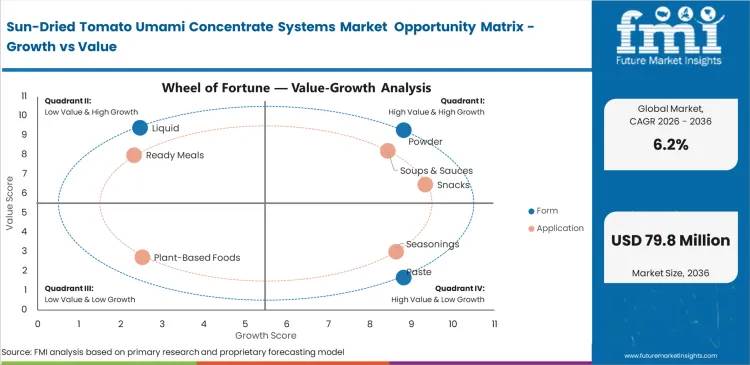
Demand is being supported by continued reformulation away from synthetic-sounding flavor enhancers. Formulation teams need botanical alternatives that can preserve familiar savory taste without creating label risk or retail friction. Concentrated tomato systems fit that requirement because they deliver naturally occurring amino acids in a format that is both recognizable and practical for industrial use. Early adoption matters because brands that move faster are often better placed in clean-label categories where reformulation timing can affect shelf position.
Raw material inconsistency remains a persistent operating challenge. Amino acid development in tomato inputs is closely tied to ripening conditions, and seasonal shifts in sunlight and temperature can change flavor performance from one crop cycle to the next. That makes standardization harder for processors working to keep finished taste profiles stable across batches. Controlled-environment agriculture offers some support, but it is still too expensive for bulk extraction use. Buffer stock and blending discipline therefore remain necessary to manage seasonal variation and protect formulation consistency.
Opportunities in the Sun-Dried Tomato Umami Concentrate Systems Market
- Plant-based formulation: Product developers are using tomato-based umami systems to help mask bitter off-notes in legume and protein-rich formulations while also adding savory depth.
- Sodium reduction mandates: Health ministries globally enforce strict salt limitations across packaged goods. Brands utilizing natural food flavors maintain consumer acceptability despite reduced sodium content.
- Premium snack seasoning: Snack developers seek unique flavor signatures to differentiate crowded product lines. Incorporating intense botanical umami allows companies to command higher retail price points.
Regional Analysis
Based on regional analysis, the Sun-Dried Tomato Umami Concentrate Systems Market is segmented into South Asia, East Asia, North America, and Europe, with country-level discussion focused on India, China, the United States, Germany, Italy, the United Kingdom, and Japan.
.webp "Top Country Growth Comparison Sun Dried Tomato Umami Concentrate Systems Market Cagr (2026 2036)")
| Country | CAGR (2026 to 2036) |
|---|---|
| India | 7.2% |
| China | 6.8% |
| United States | 5.9% |
| Germany | 5.6% |
| Italy | 5.4% |
| United Kingdom | 5.2% |
| Japan | 4.8% |
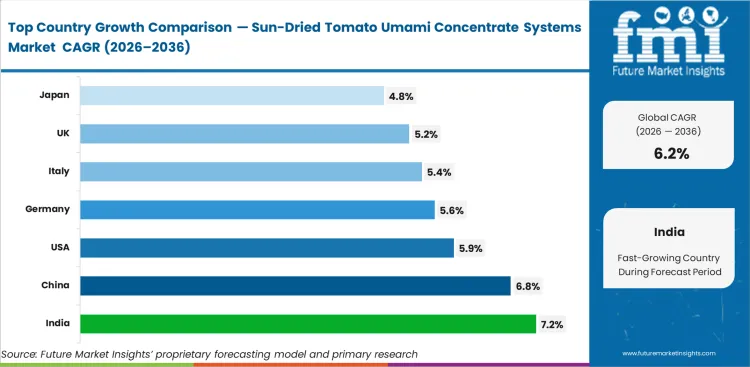
Source: Future Market Insights (FMI) analysis, based on proprietary forecasting model and primary research
South Asia Sun-Dried Tomato Umami Concentrate Systems Market Analysis
South Asia remains tied closely to the expansion of packaged convenience food as urban consumers spend less time on traditional meal preparation. Local processors are scaling instant noodles, seasoning blends, and ready-meal lines, which raises the need for stable savory ingredients that are easy to store, dose, and standardize. Cost control also matters in this region, so manufacturers are showing a clear preference for concentrated natural systems that can deliver flavor impact without adding formulation complexity. Competition among domestic spice blenders is pushing adoption toward vegetable-based umami concentrates that fit local taste preferences more closely.
- India: India benefits from a large packaged-snack and convenience-food base that keeps formulation activity high. Tomato-derived umami systems are being used to sharpen regional seasoning profiles and support product differentiation across crowded savory categories. Domestic manufacturing expansion is improving ingredient availability and reducing dependence on imported solutions. India is likely to post 7.2% CAGR by 2036, which keeps it ahead of the broader market set. Early suppliers that secure national food accounts are likely to retain an advantage as volumes build.
FMI’s report includes Bangladesh. Preference for bold savory profiles across these markets supports wider regional acceptance of concentrated tomato-based flavor systems.
East Asia Sun-Dried Tomato Umami Concentrate Systems Market Analysis
East Asia combines strong culinary tradition with large-scale food industrialization, which makes consistency a central buying criterion. Processors are translating broth-based and slow-cooked flavor profiles into modern packaged foods, and that requires ingredients that can reproduce depth with tight batch control. Buyers in this region are less tolerant of variation when products are produced at scale for retail and foodservice chains. They place more value on formulation reliability and repeatable taste delivery than on achieving the lowest input cost.
- China: China operates at a scale that gives it a central role in regional demand analysis. Restaurant chains, catering suppliers, and seasoning manufacturers need concentrated umami systems that can hold taste consistency across very large production runs. Expansion of quick-service networks beyond major cities is widening the commercial base for these ingredients. The market in China is projected to expand at a CAGR of 6.8% through 2036. That pace reflects both manufacturing scale and the operational need for dependable flavor standardization.
- Japan: Japan is forecast to register 4.8% CAGR in this market over the study period, supported by the rise of specialized meal delivery and controlled-dosing production systems. Efficiency gains in automated dispensing also strengthen the case for concentrated tomato-based inputs. Japan remains a more specialized market where product design is closely tied to sodium control, sensory balance, and precise formulation. Senior-oriented meal programs and convenience formats create steady demand for ingredients that preserve palatability without relying on harsher enhancer profiles.
FMI’s report includes South Korea and Taiwan. Premiumization in instant meals and noodle applications continues to support R&D activity across the wider East Asian market.
North America Sun-Dried Tomato Umami Concentrate Systems Market Analysis
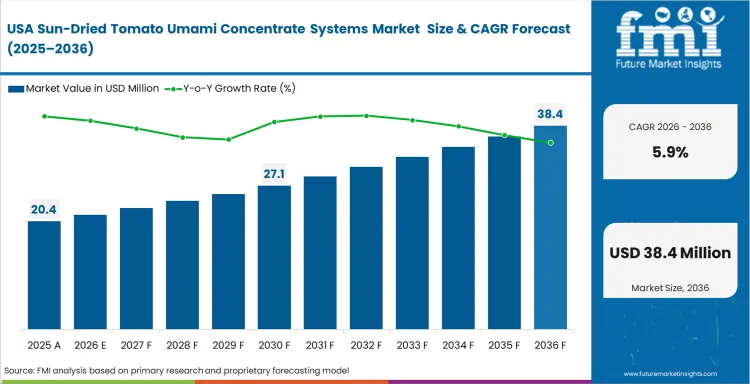
North America is shaped by reformulation pressure in packaged foods and by the fast product-development cycles common in plant-based and clean-label categories. Developers are looking for natural savory systems that can improve depth, reduce reliance on synthetic-sounding declarations, and help manage off-notes in protein-rich formulations. Buyers also face tighter retailer and consumer scrutiny around ingredient lists, which keeps attention on botanical alternatives with clearer label acceptance. That combination keeps the region commercially relevant even where input costs are higher.
- United States: The United States remains the core market in North America because large grocery, foodservice, and branded food channels continue to push ingredient-list simplification. Reformulation of established products is creating a steady replacement cycle for more transparent savory inputs, especially where shelf access depends on meeting retailer standards. The industry outlook in the United States points to 5.9% CAGR through 2036. Buyers that can align tomato-based umami systems with clean-label requirements are likely to benefit from longer qualification runs and repeat orders.
FMI’s report includes Canada. Cross-border supply alignment supports faster normalization of ingredient standards and helps regional manufacturers manage sourcing more efficiently.
Europe Sun-Dried Tomato Umami Concentrate Systems Market Analysis
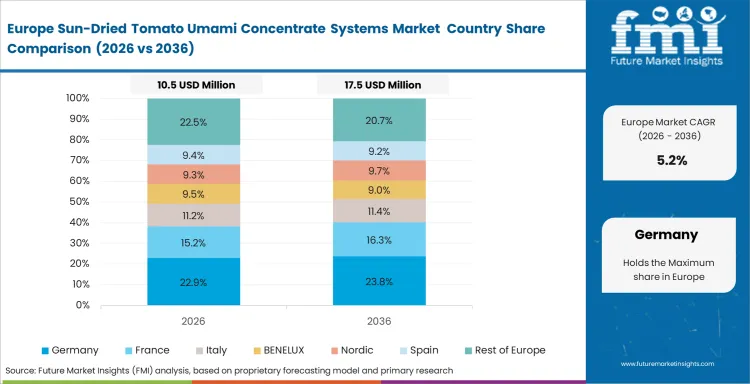
Europe remains a steady demand base because processors are under pressure to simplify ingredient declarations without weakening taste performance. Tomato-based umami systems are becoming more relevant where manufacturers need recognizable botanical extracts that can fit stricter labeling expectations. Adoption still depends on formulation control, especially in meat, ready-meal, and sauce applications where flavor consistency matters. This keeps technical support and application fit central to supplier selection across the region.
- Germany: Germany brings strong industrial food-processing capability and a large savory food base into this market. Meat and prepared-food manufacturers are under pressure to preserve familiar taste profiles while adapting formulations to cleaner ingredient expectations. Major plants are reworking product lines and upgrading equipment to handle more precise dosing and better batch control. Germany is expected to record 5.6% CAGR in the market during the forecast period. Those investments support more consistent use of concentrated tomato-based umami systems.
- Italy: Adoption in Italy is expected to move ahead at a CAGR of 5.4% during the assessment period. That outlook reflects both manufacturing discipline and proximity to Mediterranean tomato value chains. Italy plays a dual role as both a demand center and a supply-linked market with strong tomato-processing relevance. Export-oriented sauce and savory food producers need concentrated ingredients that help maintain flavor consistency across high-volume output. Automated production also raises the value of ingredients that can be dosed accurately with limited waste.
- United Kingdom: The United Kingdom remains closely tied to private-label food development, where cost, speed, and ingredient transparency all carry commercial weight. Ready-meal and savory product developers use concentrated botanical systems to improve taste delivery while staying within stricter retailer rules. Retail competition keeps reformulation activity active across mainstream packaged food categories. The market in the United Kingdom is projected to expand at a CAGR of 5.2% through 2036, with early compliance continuing to support shelf retention and new product rollout.
FMI’s report includes France and Spain. Mediterranean sourcing and regional processing links give European manufacturers a more stable raw material base than many import-dependent markets.
Competitive Aligners for Market Players
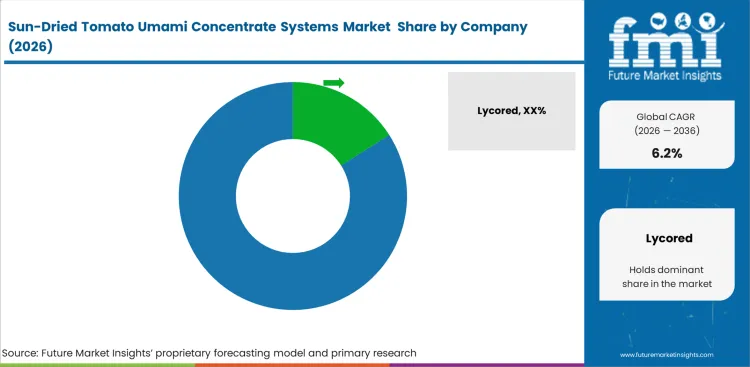
Agricultural sourcing remains fragmented, while formulation capability sits with a much smaller set of established participants. Advanced value in this market comes from extraction control, application reliability, and the ability to deliver consistent amino acid performance, whereas basic dehydration alone carries limited competitive weight. Lycored and Symrise retain stronger positions in specific niches because supply integration and formulation depth sit closer together in their operating model. Competitive standing is shaped less by broad savoury seasoning volume and more by how precisely a supplier can meet technical performance requirements.
Incumbent positions are also supported by long-developed validation work across multiple food applications. Extensive knowledge of savoury flavour blends behavior under thermal stress, matrix interaction, and shelf-life conditions gives established suppliers a practical advantage that cannot be closed quickly through equipment upgrades alone. Technical depth, rather than processing hardware by itself, continues to set the competitive threshold in this sector. That barrier remains meaningful as formulation requirements become more exact.
Market alignment is also influenced by risk management at the processor level, since supply exposure to crop variation discourages overreliance on any one vendor. Contract allocation is often spread across more than one supplier, yet specification tolerance remains tight, which keeps pricing pressure in place even when the industry outlook is on a positive trend. Differentiation is therefore shifting toward hybrid systems that combine tomato-derived functionality with fermentation-led performance. That direction is strengthening interest in demand for plant-based protein flavor maskers and enhancers without changing the market’s dependence on proven technical execution.
Key Players in Sun-Dried Tomato Umami Concentrate Systems Market
- Lycored
- Givaudan
- Kerry Group
- IFF
- Symrise
- Sensient Technologies
- Kanegrade
Scope of the Report
| Metric | Value |
|---|---|
| Quantitative Units | USD 41.2 million to USD 75.0 million, at a CAGR of 6.20% |
| Market Definition | Sun-Dried Tomato Umami Concentrate Systems act as concentrated flavor components derived from dehydrated tomatoes. Their primary purpose involves supplying naturally occurring glutamates to commercial food formulations. Buyers prioritize these items for their ability to deliver rich, meaty notes without requiring animal derivatives or synthetic chemical declarations. |
| Segmentation | Form, Application, Function, Label Positioning, End User, Region |
| Regions Covered | North America, Latin America, Europe, East Asia, South Asia, Oceania, Middle East & Africa |
| Countries Covered | India, China, United States, Germany, Italy, United Kingdom, Japan |
| Key Companies Profiled | Lycored, Givaudan, Kerry Group, IFF, Symrise, Sensient Technologies, Kanegrade |
| Forecast Period | 2026 to 2036 |
| Approach | Wholesale ingredient transaction volumes verified against industrial flavoring consumption metrics. |
Source: Future Market Insights (FMI) analysis, based on proprietary forecasting model and primary research
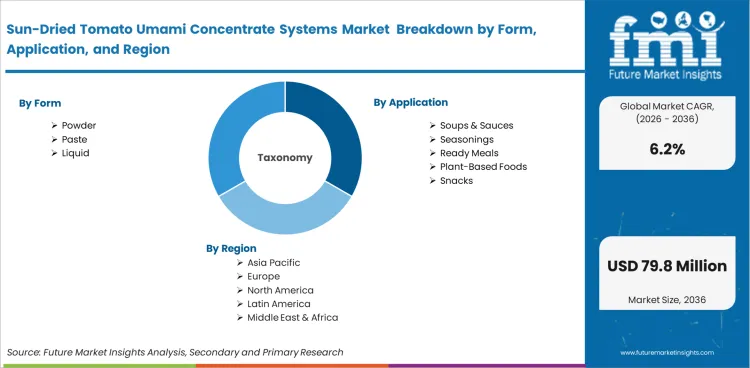
Sun-Dried Tomato Umami Concentrate Systems Market Analysis by Segments
Form
- Powder
- Paste
- Liquid
Application
- Soups & Sauces
- Seasonings
- Ready Meals
- Plant-Based Foods
- Snacks
Function
- Umami Boost
- Salt Reduction
- Flavor Rounding
- Tomato Addback
Label Positioning
- Clean Label
- Organic
- Conventional
End User
- Food Manufacturers
- Flavor Houses
- Foodservice
Region
- North America
- Latin America
- Europe
- East Asia
- South Asia
- Oceania
- Middle East & Africa
Bibliography
- Amaliah, N., Ambari, Y., Astuti, S. D., Hartanti, A. T., Wardhani, D. H., Arisasmita, J. H., Irfanto, A. N., Rosiana, N., Khasanah, L. U., Fibrianto, K., Herawati, D., Anjani, G., & Fibrianto, K. (2024). Trends in natural flavor enhancer: A review on umami compounds. BIO Web of Conferences, 95, 01013.
- Food and Agriculture Organization of the United Nations. (2025, December 31). Agricultural production statistics 2010-2024.
- Food and Agriculture Organization of the United Nations, & World Health Organization. (2024). Codex standards list. Codex Alimentarius.
- Hossain, M. J., Yeasmin, M., Kawsar, M. H., & Hossain, M. S. (2024). Umami characteristics and taste improvement mechanism of natural compounds in meat and meat products: A review. Foods, 13(10), Article 1570.
- International Trade Centre. (2025). Trade Map.
- Pravitha, M., & Sreerama, Y. N. (2024). Recent developments in tomato drying techniques: A review. Journal of Food Process Engineering, 47(2), e14550.
- World Bank. (2024). Dried vegetables, nes exports by country | 2024. World Integrated Trade Solution.
- World Bank. (2024). A roadmap to developing competitive advantage on strategic markets: Findings from the pilot strategic market segmentation for olive oil, medicinal and aromatic plants, and tomatoes in North-West Tunisia.
- World Processing Tomato Council. (2026). World Processing Tomato Council.
- United States Department of Agriculture, National Agricultural Statistics Service. (2025, May 29). 2025 California Processing Tomato Report.
This bibliography is provided for reader reference. The full FMI report contains the complete reference list with primary source documentation.
This Report Addresses
- Clean-label reformulation pressures affecting global snack manufacturing categories.
- Sodium reduction challenges facing major commercial soup producers.
- Plant-based meat formulation hurdles regarding bitter off-note masking.
- Agricultural variability risks threatening consistent botanical extract supplies.
- Hygroscopic powder handling constraints across high-speed seasoning lines.
- Thermal degradation issues impacting wet savory processing environments.
- Vendor qualification hurdles determining elite flavor house partnerships.
- Shifting cultivation zones affecting long-term sun-dried raw material availability.
Frequently Asked Questions
What triggers initial adoption among industrial snack manufacturers?
Extrusion engineers hit strict moisture limits using wet pastes. Switching to flowable powders resolves bridging issues immediately.
How do clean-label mandates influence procurement decisions?
Retail buyers reject synthetic flavor declarations actively. Sourcing directors must substitute artificial glutamates with natural botanical extracts quickly.
Why does India present such high compound growth?
Urbanizing middle classes consume packaged snacks rapidly. Local spice blenders require stable, high-intensity flavor concentrates to compete effectively.
What operational consequence follows poor powder engineering?
Hygroscopic materials absorb ambient factory moisture instantly. Uncontrolled humidity causes severe hopper blockages and halts continuous production entirely.
How do plant-based meat applications utilize these extracts?
Formulation scientists struggle masking bitter legume bases. Concentrated tomato umami neutralizes these off-notes while adding essential savory depth.
What limits broader commodity substitution?
Basic tomato powders lack standardized free amino acid levels. Achieving target flavor intensity using weak powders alters product texture unacceptably.
Why do thermal processing constraints matter during integration?
Extended heating cycles destroy delicate volatile savory compounds. Processors must map temperature curves precisely to prevent flat flavor outcomes.
How do flavor houses differentiate their offerings?
Elite suppliers provide proprietary stability data across diverse matrices. They combine specific tomato fractions with complementary yeast systems expertly.
What vulnerability exists within clean-label positioning?
Traceability audits frequently expose undocumented agricultural blending. Brands failing origin verification face severe consumer backlash and lost shelf space.
How do Chinese catering chains deploy these ingredients?
Massive restaurant networks require foolproof seasoning packets daily. Standardized umami extracts guarantee uniform taste profiles across thousands of franchised locations.
Why do food manufacturers bypass intermediate blenders?
Direct sourcing maximizes margin capture across massive production runs. Factory managers buy concentrated active ingredients to reduce total recipe costs.
What specific metric separates elite vendors from basic dehydrators?
Guaranteed minimum amino acid concentrations define basic purchase eligibility. Mere vegetable dehydration knowledge provides zero competitive advantage during rigorous audits.
How does agricultural volatility impact long-term planning?
Chemical profiles vary drastically depending on seasonal sunlight patterns. Quality assurance managers must maintain deep buffer inventories to blend out inconsistencies.
Why do Japanese nutritionists focus on senior-care applications?
Aging demographics face significantly diminished taste acuity. Natural botanical glutamates maintain meal palatability without exceeding strict senior sodium limits.
What happens when highly acidic concentrates meet dairy emulsions?
Unbalanced acidity destabilizes sensitive protein structures unexpectedly. Food scientists must employ advanced buffering agents to prevent catastrophic product separation.
How do sourcing teams mitigate climate-driven supply risks?
Purchasing departments split contracts among multiple geographically diverse vendors. This strategy prevents total production failure during localized agricultural disasters.
Why are soups and sauces naturally compatible with these extracts?
Liquid dispersion characteristics match wet processing environments perfectly. High solubility prevents undesirable sedimentation during extended jar storage.
What hidden operational expense burdens quality control teams?
Verifying complex amino acid profiles requires sophisticated laboratory equipment. Insufficient testing allows rejected batches to reach final packaging stages.
How do United States grocery chains influence ingredient sourcing?
Major retailers publish strict lists banning synthetic additives entirely. Brand managers urgently reformulate legacy products to avoid imminent store delisting.
What determines successful flavor rounding in complex recipes?
Master flavorists dial in exact dosing rates during pilot runs. Achieving perfect sweet-acid harmony requires dozens of iterative sensory evaluations.
Why does Germany advance rapidly within this sector?
Traditional sausage processors face intense modern clean-label pressures. Meat scientists utilize specific tomato fractions to replace artificial glutamates seamlessly.
What prevents challengers from overtaking established incumbents quickly?
Proprietary application knowledge forms an invisible barrier. Challengers cannot replicate decades of specialized stability research simply by purchasing better extraction equipment.
Preview the report firsthand - request a free sample
Get SampleGet the brochure for pricing and purchase details.
Get PDFTable of Content
- Executive Summary
- Global Market Outlook
- Demand-side Trends
- Supply-side Trends
- Technology Roadmap Analysis
- Analysis and Recommendations
- Market Overview
- Market Coverage / Taxonomy
- Market Definition / Scope / Limitations
- Research Methodology
- Chapter Orientation
- Analytical Lens and Working Hypotheses
- Market Structure, Signals, and Trend Drivers
- Benchmarking and Cross-market Comparability
- Market Sizing, Forecasting, and Opportunity Mapping
- Research Design and Evidence Framework
- Desk Research Programme (Secondary Evidence)
- Company Annual and Sustainability Reports
- Peer-reviewed Journals and Academic Literature
- Corporate Websites, Product Literature, and Technical Notes
- Earnings Decks and Investor Briefings
- Statutory Filings and Regulatory Disclosures
- Technical White Papers and Standards Notes
- Trade Journals, Industry Magazines, and Analyst Briefs
- Conference Proceedings, Webinars, and Seminar Materials
- Government Statistics Portals and Public Data Releases
- Press Releases and Reputable Media Coverage
- Specialist Newsletters and Curated Briefings
- Sector Databases and Reference Repositories
- FMI Internal Proprietary Databases and Historical Market Datasets
- Subscription Datasets and Paid Sources
- Social Channels, Communities, and Digital Listening Inputs
- Additional Desk Sources
- Expert Input and Fieldwork (Primary Evidence)
- Primary Modes
- Qualitative Interviews and Expert Elicitation
- Quantitative Surveys and Structured Data Capture
- Blended Approach
- Why Primary Evidence is Used
- Field Techniques
- Interviews
- Surveys
- Focus Groups
- Observational and In-context Research
- Social and Community Interactions
- Stakeholder Universe Engaged
- C-suite Leaders
- Board Members
- Presidents and Vice Presidents
- R&D and Innovation Heads
- Technical Specialists
- Domain Subject-matter Experts
- Scientists
- Physicians and Other Healthcare Professionals
- Governance, Ethics, and Data Stewardship
- Research Ethics
- Data Integrity and Handling
- Primary Modes
- Tooling, Models, and Reference Databases
- Desk Research Programme (Secondary Evidence)
- Data Engineering and Model Build
- Data Acquisition and Ingestion
- Cleaning, Normalisation, and Verification
- Synthesis, Triangulation, and Analysis
- Quality Assurance and Audit Trail
- Market Background
- Market Dynamics
- Drivers
- Restraints
- Opportunity
- Trends
- Scenario Forecast
- Demand in Optimistic Scenario
- Demand in Likely Scenario
- Demand in Conservative Scenario
- Opportunity Map Analysis
- Product Life Cycle Analysis
- Supply Chain Analysis
- Investment Feasibility Matrix
- Value Chain Analysis
- PESTLE and Porter’s Analysis
- Regulatory Landscape
- Regional Parent Market Outlook
- Production and Consumption Statistics
- Import and Export Statistics
- Market Dynamics
- Global Market Analysis 2021 to 2025 and Forecast, 2026 to 2036
- Historical Market Size Value (USD Million) Analysis, 2021 to 2025
- Current and Future Market Size Value (USD Million) Projections, 2026 to 2036
- Y-o-Y Growth Trend Analysis
- Absolute $ Opportunity Analysis
- Global Market Pricing Analysis 2021 to 2025 and Forecast 2026 to 2036
- Global Market Analysis 2021 to 2025 and Forecast 2026 to 2036, By Form
- Introduction / Key Findings
- Historical Market Size Value (USD Million) Analysis By Form , 2021 to 2025
- Current and Future Market Size Value (USD Million) Analysis and Forecast By Form , 2026 to 2036
- Powder
- Paste
- Liquid
- Powder
- Y-o-Y Growth Trend Analysis By Form , 2021 to 2025
- Absolute $ Opportunity Analysis By Form , 2026 to 2036
- Global Market Analysis 2021 to 2025 and Forecast 2026 to 2036, By Application
- Introduction / Key Findings
- Historical Market Size Value (USD Million) Analysis By Application, 2021 to 2025
- Current and Future Market Size Value (USD Million) Analysis and Forecast By Application, 2026 to 2036
- Soups & Sauces
- Seasonings
- Ready Meals
- Plant-Based Foods
- Snacks
- Soups & Sauces
- Y-o-Y Growth Trend Analysis By Application, 2021 to 2025
- Absolute $ Opportunity Analysis By Application, 2026 to 2036
- Global Market Analysis 2021 to 2025 and Forecast 2026 to 2036, By Function
- Introduction / Key Findings
- Historical Market Size Value (USD Million) Analysis By Function, 2021 to 2025
- Current and Future Market Size Value (USD Million) Analysis and Forecast By Function, 2026 to 2036
- Umami Boost
- Salt Reduction
- Flavor Rounding
- Tomato Addback
- Umami Boost
- Y-o-Y Growth Trend Analysis By Function, 2021 to 2025
- Absolute $ Opportunity Analysis By Function, 2026 to 2036
- Global Market Analysis 2021 to 2025 and Forecast 2026 to 2036, By Label Positioning
- Introduction / Key Findings
- Historical Market Size Value (USD Million) Analysis By Label Positioning, 2021 to 2025
- Current and Future Market Size Value (USD Million) Analysis and Forecast By Label Positioning, 2026 to 2036
- Clean Label
- Organic
- Conventional
- Clean Label
- Y-o-Y Growth Trend Analysis By Label Positioning, 2021 to 2025
- Absolute $ Opportunity Analysis By Label Positioning, 2026 to 2036
- Global Market Analysis 2021 to 2025 and Forecast 2026 to 2036, By End Use
- Introduction / Key Findings
- Historical Market Size Value (USD Million) Analysis By End Use, 2021 to 2025
- Current and Future Market Size Value (USD Million) Analysis and Forecast By End Use, 2026 to 2036
- Food Manufacturers
- Flavor Houses
- Foodservice
- Food Manufacturers
- Y-o-Y Growth Trend Analysis By End Use, 2021 to 2025
- Absolute $ Opportunity Analysis By End Use, 2026 to 2036
- Global Market Analysis 2021 to 2025 and Forecast 2026 to 2036, By Region
- Introduction
- Historical Market Size Value (USD Million) Analysis By Region, 2021 to 2025
- Current Market Size Value (USD Million) Analysis and Forecast By Region, 2026 to 2036
- North America
- Latin America
- Western Europe
- Eastern Europe
- East Asia
- South Asia and Pacific
- Middle East & Africa
- Market Attractiveness Analysis By Region
- North America Market Analysis 2021 to 2025 and Forecast 2026 to 2036, By Country
- Historical Market Size Value (USD Million) Trend Analysis By Market Taxonomy, 2021 to 2025
- Market Size Value (USD Million) Forecast By Market Taxonomy, 2026 to 2036
- By Country
- USA
- Canada
- Mexico
- By Form
- By Application
- By Function
- By Label Positioning
- By End Use
- By Country
- Market Attractiveness Analysis
- By Country
- By Form
- By Application
- By Function
- By Label Positioning
- By End Use
- Key Takeaways
- Latin America Market Analysis 2021 to 2025 and Forecast 2026 to 2036, By Country
- Historical Market Size Value (USD Million) Trend Analysis By Market Taxonomy, 2021 to 2025
- Market Size Value (USD Million) Forecast By Market Taxonomy, 2026 to 2036
- By Country
- Brazil
- Chile
- Rest of Latin America
- By Form
- By Application
- By Function
- By Label Positioning
- By End Use
- By Country
- Market Attractiveness Analysis
- By Country
- By Form
- By Application
- By Function
- By Label Positioning
- By End Use
- Key Takeaways
- Western Europe Market Analysis 2021 to 2025 and Forecast 2026 to 2036, By Country
- Historical Market Size Value (USD Million) Trend Analysis By Market Taxonomy, 2021 to 2025
- Market Size Value (USD Million) Forecast By Market Taxonomy, 2026 to 2036
- By Country
- Germany
- UK
- Italy
- Spain
- France
- Nordic
- BENELUX
- Rest of Western Europe
- By Form
- By Application
- By Function
- By Label Positioning
- By End Use
- By Country
- Market Attractiveness Analysis
- By Country
- By Form
- By Application
- By Function
- By Label Positioning
- By End Use
- Key Takeaways
- Eastern Europe Market Analysis 2021 to 2025 and Forecast 2026 to 2036, By Country
- Historical Market Size Value (USD Million) Trend Analysis By Market Taxonomy, 2021 to 2025
- Market Size Value (USD Million) Forecast By Market Taxonomy, 2026 to 2036
- By Country
- Russia
- Poland
- Hungary
- Balkan & Baltic
- Rest of Eastern Europe
- By Form
- By Application
- By Function
- By Label Positioning
- By End Use
- By Country
- Market Attractiveness Analysis
- By Country
- By Form
- By Application
- By Function
- By Label Positioning
- By End Use
- Key Takeaways
- East Asia Market Analysis 2021 to 2025 and Forecast 2026 to 2036, By Country
- Historical Market Size Value (USD Million) Trend Analysis By Market Taxonomy, 2021 to 2025
- Market Size Value (USD Million) Forecast By Market Taxonomy, 2026 to 2036
- By Country
- China
- Japan
- South Korea
- By Form
- By Application
- By Function
- By Label Positioning
- By End Use
- By Country
- Market Attractiveness Analysis
- By Country
- By Form
- By Application
- By Function
- By Label Positioning
- By End Use
- Key Takeaways
- South Asia and Pacific Market Analysis 2021 to 2025 and Forecast 2026 to 2036, By Country
- Historical Market Size Value (USD Million) Trend Analysis By Market Taxonomy, 2021 to 2025
- Market Size Value (USD Million) Forecast By Market Taxonomy, 2026 to 2036
- By Country
- India
- ASEAN
- Australia & New Zealand
- Rest of South Asia and Pacific
- By Form
- By Application
- By Function
- By Label Positioning
- By End Use
- By Country
- Market Attractiveness Analysis
- By Country
- By Form
- By Application
- By Function
- By Label Positioning
- By End Use
- Key Takeaways
- Middle East & Africa Market Analysis 2021 to 2025 and Forecast 2026 to 2036, By Country
- Historical Market Size Value (USD Million) Trend Analysis By Market Taxonomy, 2021 to 2025
- Market Size Value (USD Million) Forecast By Market Taxonomy, 2026 to 2036
- By Country
- Kingdom of Saudi Arabia
- Other GCC Countries
- Turkiye
- South Africa
- Other African Union
- Rest of Middle East & Africa
- By Form
- By Application
- By Function
- By Label Positioning
- By End Use
- By Country
- Market Attractiveness Analysis
- By Country
- By Form
- By Application
- By Function
- By Label Positioning
- By End Use
- Key Takeaways
- Key Countries Market Analysis
- USA
- Pricing Analysis
- Market Share Analysis, 2025
- By Form
- By Application
- By Function
- By Label Positioning
- By End Use
- Canada
- Pricing Analysis
- Market Share Analysis, 2025
- By Form
- By Application
- By Function
- By Label Positioning
- By End Use
- Mexico
- Pricing Analysis
- Market Share Analysis, 2025
- By Form
- By Application
- By Function
- By Label Positioning
- By End Use
- Brazil
- Pricing Analysis
- Market Share Analysis, 2025
- By Form
- By Application
- By Function
- By Label Positioning
- By End Use
- Chile
- Pricing Analysis
- Market Share Analysis, 2025
- By Form
- By Application
- By Function
- By Label Positioning
- By End Use
- Germany
- Pricing Analysis
- Market Share Analysis, 2025
- By Form
- By Application
- By Function
- By Label Positioning
- By End Use
- UK
- Pricing Analysis
- Market Share Analysis, 2025
- By Form
- By Application
- By Function
- By Label Positioning
- By End Use
- Italy
- Pricing Analysis
- Market Share Analysis, 2025
- By Form
- By Application
- By Function
- By Label Positioning
- By End Use
- Spain
- Pricing Analysis
- Market Share Analysis, 2025
- By Form
- By Application
- By Function
- By Label Positioning
- By End Use
- France
- Pricing Analysis
- Market Share Analysis, 2025
- By Form
- By Application
- By Function
- By Label Positioning
- By End Use
- India
- Pricing Analysis
- Market Share Analysis, 2025
- By Form
- By Application
- By Function
- By Label Positioning
- By End Use
- ASEAN
- Pricing Analysis
- Market Share Analysis, 2025
- By Form
- By Application
- By Function
- By Label Positioning
- By End Use
- Australia & New Zealand
- Pricing Analysis
- Market Share Analysis, 2025
- By Form
- By Application
- By Function
- By Label Positioning
- By End Use
- China
- Pricing Analysis
- Market Share Analysis, 2025
- By Form
- By Application
- By Function
- By Label Positioning
- By End Use
- Japan
- Pricing Analysis
- Market Share Analysis, 2025
- By Form
- By Application
- By Function
- By Label Positioning
- By End Use
- South Korea
- Pricing Analysis
- Market Share Analysis, 2025
- By Form
- By Application
- By Function
- By Label Positioning
- By End Use
- Russia
- Pricing Analysis
- Market Share Analysis, 2025
- By Form
- By Application
- By Function
- By Label Positioning
- By End Use
- Poland
- Pricing Analysis
- Market Share Analysis, 2025
- By Form
- By Application
- By Function
- By Label Positioning
- By End Use
- Hungary
- Pricing Analysis
- Market Share Analysis, 2025
- By Form
- By Application
- By Function
- By Label Positioning
- By End Use
- Kingdom of Saudi Arabia
- Pricing Analysis
- Market Share Analysis, 2025
- By Form
- By Application
- By Function
- By Label Positioning
- By End Use
- Turkiye
- Pricing Analysis
- Market Share Analysis, 2025
- By Form
- By Application
- By Function
- By Label Positioning
- By End Use
- South Africa
- Pricing Analysis
- Market Share Analysis, 2025
- By Form
- By Application
- By Function
- By Label Positioning
- By End Use
- USA
- Market Structure Analysis
- Competition Dashboard
- Competition Benchmarking
- Market Share Analysis of Top Players
- By Regional
- By Form
- By Application
- By Function
- By Label Positioning
- By End Use
- Competition Analysis
- Competition Deep Dive
- Lycored
- Overview
- Product Portfolio
- Profitability by Market Segments (Product/Age /Sales Channel/Region)
- Sales Footprint
- Strategy Overview
- Marketing Strategy
- Product Strategy
- Channel Strategy
- Givaudan
- Kerry Group
- IFF
- Symrise
- Sensient Technologies
- Kanegrade
- Lycored
- Competition Deep Dive
- Assumptions & Acronyms Used


