

- Market Size (2026)
- USD 566.1 Mn
- Forecast (2036)
- USD 1593.0 Mn
- CAGR (2026 to 2036)
- 10.9%
How big is Alfajores Market in 2026?
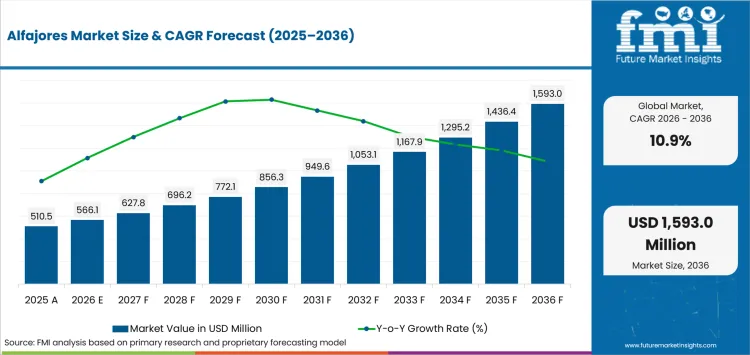
USD 566.1 million in 2026 and USD 1,593.0 million by 2036 at a 10.9% CAGR.
Sales in the alfajores market are projected to grow at 10.9% CAGR through 2036, driving valuation to USD 1,593.0 million by 2036 from USD 566.1 million in 2026. The product competes beside chocolate confectionery and bakery products in familiar snack occasions. Uruguay’s Ministry of Tourism documented more than 60 stands for the June 2025 International Alfajor Fair. The fair lets brands compare flavor, pack size, and price directly against specialist rivals.
International expansion depends on converting cultural familiarity into regular retail reorders outside core specialty channels. The USA Census Bureau counted 70.1 million Hispanic residents on July 1, 2025, equal to 21% of the national population. That audience can shorten first-trial education for alfajores sold in Latin specialty stores. Wider online grocery placement still depends on shelf life, replenishment, and competitive pricing.
Key Takeaways
- Demand rises as brands extend familiar dulce de leche and chocolate profiles into richer fillings, mini formats, and premium coatings that support more purchase occasions.
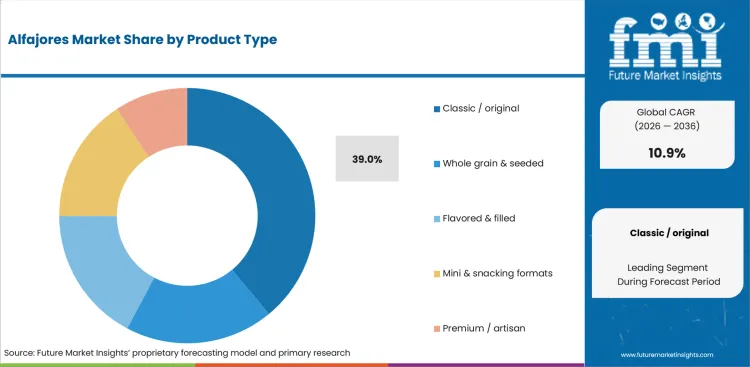
- Based on product type, classic - original is projected to account for 39.0% in 2026 due to familiar taste cues and broad price coverage.
- By claim - nature, conventional is estimated to hold 50.0% in 2026 owing to flexible recipes and mainstream manufacturing economics.
- In 2026, fresh is expected to lead format with 33.0% share because bakery and café occasions reward texture and recent preparation.
- Nutrition labels, limited shelf life, and imported-cost pressure can weaken distribution economics if richer recipes cannot sustain the intended retail price.
- Some of the key players in this market include Havanna, Arcor, Mondelez (Terrabusi), Cachafaz, El Rodeo, Celisano, Jorgito, and Fantoche.
Analyst Perspective
"Alfajores earn repeat space only if the recipe survives shelf-life, label, replenishment, and price tests in the chosen channel. Premium fillings can raise spend per unit, but durable brands protect an accessible core product while testing more indulgent or claim-led variants."
- Nandini Roy Choudhury, Principal Consultant, Future Market Insights
How is the alfajores market segmented?
The alfajores market is segmented by product type, claim - nature, format, packaging format, sales channel, and region.
Product type includes classic - original, whole grain & seeded, flavored & filled, mini & snacking formats, and premium / artisan. Claim - nature options cover conventional, clean label, organic, gluten-free, and high-protein / fortified products. Format options cover fresh, frozen, ambient packaged, chilled, and par-baked / thaw-and-serve products. Packaging options cover multipack, single-serve, family / loaf pack, and bulk foodservice formats. Sales channels include supermarkets & hypermarkets, specialty bakeries, convenience & forecourt, online & DTC, and foodservice distributors.
What supports classic - original within the product type category?
Classic - original gives retailers a reference point for taste and price before shoppers compare heavier fillings or larger formats. The biscuit-and-filling construction also places alfajores near biscuits and crackers without losing their dulce de leche identity.
- By product type, classic - original is forecast to represent 39.0% in 2026 driven by recognizable sensory cues and frequent impulse purchasing.
- Argentina’s February 2026 Feria GustAR included alfajores among regional foods sold by producers from several provinces. A familiar alfajor format lets regional recipes vary without forcing retailers to explain a new product form.
Why does conventional lead the claim - nature category?
Conventional recipes preserve the choice of biscuit, filling, sweetener, and coating inputs at price points. Alternatives tied to gluten-free products or allergen-free food need stronger records and tighter separation before they can use those claims in retail.
- The conventional segment is likely to capture 50.0% share in 2026 attributable to flexible recipes and manufacturing routes already used for mass-market sweet snacks.
- ANMAT prohibited a keto alfajor and other Mami Keto foods in October 2025 because the establishment and products lacked required sanitary registrations. Claim-led recipes therefore face a defined documentation gate before distribution can scale nationally.
Why does fresh lead the format category?
Fresh alfajores fit bakery and café occasions that reward texture and recent preparation. The route overlaps with food service operators that can replenish batches and sell the product beside coffee or dessert orders.
- Fresh is set to lead the format category with 33.0% share in 2026 due to immediate-consumption occasions that reward soft texture and recently prepared fillings.
- Argentina’s November 2025 Tandil food event gathered more than 20 proposals from traced local producers and included alfajores among the foods sold. Fresh formats benefit from that setting, though they require tighter replenishment than ambient packs.
Why do supermarkets & hypermarkets lead the sales channel category?
Supermarkets give branded alfajores shelf width for price ladders, multipacks, and flavor comparisons in one visit. They also let imported and domestic products compete beside regional confectionery ranges instead of relying only on specialty stores.
- Supermarkets & hypermarkets are projected to hold 32.0% share in 2026 owing to broad assortment, routine footfall, and the ability to compare single units with multipacks.
- SUBREI’s 2025 exporter profile states that Chile’s Dulcería Lili supplies 40,000 alfajores to Jumbo every 15 days. The 40,000-unit cadence turns a specialist product into scheduled supermarket replenishment.
What are the drivers, restraints and opportunities in the Alfajores Market?
Richer recipes widen the price ladder. Nutrition labeling and shelf economics constrain expansion. Hospitality and gifting provide additional routes beyond routine snack retail.
- Driver: Premium fillings and coatings give familiar alfajor formats more price points without removing the familiar dulce de leche-centered proposition.
- Restraint: Front-of-pack warnings and price sensitivity raise the cost of recipe, label, and portfolio decisions for indulgent products.
- Opportunity: Hotels, cafés, gifting programs, and travel retail can place alfajores in occasions where portioned premium products carry higher perceived value.
Growth comes from deeper choice inside a familiar product that already carries strong category recognition. The June 2026 International Alfajor Fair in Montevideo followed a 2025 edition that drew more than 15,000 people and planned more than 60 stands. Those events put specialist recipes beside premium chocolate alternatives and make repeat preference visible beyond a single launch. Producers still need a clear price ladder because extra filling and coating cost must convert into faster rotation or a higher ticket.
Nutrition labeling can alter an alfajor recipe before the product reaches a retail shelf. Uruguay’s January 2025 reformulation guide explains front warnings for excess sugars, fats, saturated fats, and sodium and addresses reformulation for smaller food companies. Alfajores with rich fillings may therefore face a visible nutrition trade-off during routine shelf comparison. A producer can retain indulgence, but recipe changes and pack communication need resolution before wider listings.
Premium hospitality gives alfajores a selling route beyond conventional grocery impulse traffic. Havanna used traditional alfajores in personalized welcome kits and VIP hotel baskets at ILTM Latin America in May 2026. The company also presented foodservice formats, which raises the value of portion control and gifting presentation for hospitality accounts. Hotel programs require reliable delivery and consistent product condition during each guest cycle.
Which country CAGRs are profiled in the Alfajores Market?
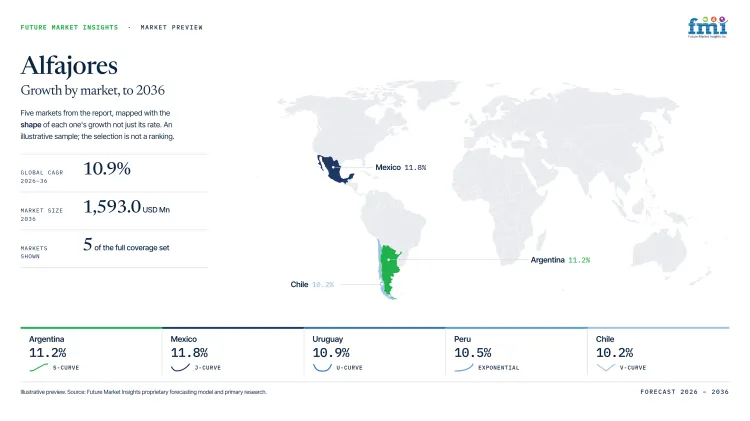
| Country | CAGR |
|---|---|
| USA | 12.1% |
| Mexico | 11.8% |
| Brazil | 11.5% |
| Argentina | 11.2% |
| Uruguay | 10.8% |
| Peru | 10.5% |
| Chile | 10.2% |
| Spain | 9.9% |
How do country-level CAGRs compare in the Alfajores Market?
The country forecasts form three groups within a 2.2-percentage-point spread overall. USA and Mexico make the upper band, Brazil and Argentina follow, and Uruguay through Spain grow more slowly. Route economics explain more than rank alone because a faster CAGR does not guarantee larger revenue or easier shelf conversion.
- USA metro distribution can widen reach before grocery listings.
- Mexican convenience stores favor single-serve impulse packs.
- Brazilian gifting can build trial before broad grocery coverage.
- Argentina’s category familiarity lowers education needs for new fillings.
- Uruguay’s tourism gives smaller brands repeated discovery occasions.
- Peruvian specialty counters can build recognition before mass retail.
- Chile’s export-minded producers sustain premium positioning.
- Spanish production shortens replenishment distances at scale.
Shelf conversion still depends on route economics and local execution. The full report provides country-level CAGR analysis across North America, Latin America, Europe, East Asia, South Asia, Oceania and the Middle East and Africa.
Country-wise Analysis
- USA grocery distribution gives alfajores a path beyond Latin specialty stores once brands prove rotation in mainstream snack aisles. USDA Economic Research Service data updated in August 2026 show traditional grocery retailers represented 56.2% of USA food-at-home sales during 2025, which keeps supermarket execution central to national scale. Alfajor sales in the USA are set to post 12.1% CAGR by 2036, tied to a large familiar consumer base and wider specialty-to-mainstream distribution. The friction is proving velocity outside core Hispanic markets, so pack size and distributor economics must support repeat replenishment without relying on novelty in national chains.
- Mexico’s front-of-pack rules make label review part of commercial preparation for imported or locally packed snacks. The alfajores market in Mexico is forecast to grow at 11.8% CAGR over the forecast period, given strong modern retail access and multiple convenience channels that can support trial. In July 2025, the Diario Oficial de la Federación extended the final phase for calculating added sugars under NOM-051, keeping nutrition-label implementation active for packaged foods. Category recognition is less automatic than in Argentina, so importers need simple pack communication and shelf pricing that explain the product before promotional spending becomes permanent during launch.
- Inside Brazil’s broad cookie and confectionery set, alfajores need local price architecture because heritage alone cannot secure national shelf rotation. IBGE published in February 2026 that retail sales for hypermarkets, supermarkets, food, beverages, and tobacco increased 0.8% during 2025. Packaged sweets therefore entered 2026 with modest positive growth in Brazil’s national retail channel. Brazil is likely to register 11.5% CAGR through 2036, supported by localized distribution and broader availability of Latin American confectionery. Import cost and regional scale complicate national coverage for brands serving distant Brazilian markets. Co-manufacturing or efficient domestic logistics offer a clearer route for mainstream volume beyond the largest urban markets and specialty districts.
- With alfajores embedded in everyday snacking in kiosks and supermarkets, Argentina competes on price tiers and the frequency of new indulgent formats. Argentina is projected to advance at 11.2% CAGR from 2026 to 2036 because strong category familiarity gives launches immediate comparison against familiar products. In April 2026, INDEC recorded a 3.7% year-over-year decline in supermarket sales at constant prices and a 0.8% monthly increase, showing uneven volume recovery. Affordability is the main local constraint because richer fillings raise the unit cost for everyday purchases. Brands must protect fast-moving core SKUs and reserve premium variants for selective trade-up during major national promotional periods and holidays.
- In Uruguay, short distribution distances reduce service complexity, but the small national market makes account productivity important for every mainstream listing. Alfajor demand is positioned to record 10.8% CAGR during the assessment period, aided by direct retail service and strong regional familiarity with the product. The Ministry of Economy’s August 2026 price report covered 749 establishments and 208 product brands, illustrating how closely packaged-food prices are monitored in formal retail. Frequent formal price comparison limits room for uncontrolled premium steps in Uruguay’s compact retail market. Producers need clear pack architecture and disciplined promotions that protect margin without weakening repeat purchase in a small national market.
- Peru’s modern food retail supports imported confectionery, yet warning-label execution can determine whether an indulgent product reaches shelves without rework. Indecopi disclosed in October 2025 that monitoring covered 116 stores from five supermarket chains and 501 unique products, with "high in sugar" the most frequently omitted observed octagon. Peru is anticipated to progress at 10.5% CAGR through 2036 attributable to broader formal retail and specialty discovery. That enforcement makes final label review a listing requirement for packaged alfajores entering formal retail. Compliance mistakes raise relabeling cost and retailer risk, so importers need final packaging approved before shipment and pricing that converts specialty trial into routine supermarket purchases.
- Using supermarkets and digital retail together gives Chilean alfajores reach plus discovery beyond stores with limited assortment. Chile is expected to maintain 10.2% CAGR between 2026 and 2036, propelled by modern retail coverage and online discovery. The National Statistics Institute reported in February 2026 that supermarket sales rose 2.0% year over year in January, and retail e-commerce increased 11.1%. Warning labels are already part of packaged-food merchandising, which limits health-oriented messaging for rich recipes. Brands that enter with accurate labels can focus commercial effort on flavor, portion and retailer rotation instead of compliance corrections during retailer onboarding.
- Spain provides European entry through Latin specialty retail and cafés, with broader grocery potential where suppliers can maintain regular replenishment. Alfajores demand in Spain is expected to rise at 9.9% CAGR through 2036, helped by a growing imported-food audience and greater retail exposure for Latin American confectionery. Spain’s INE reported in January 2026 that retail sales increased 4.3% in 2025 on a calendar-adjusted basis, supporting a generally positive channel backdrop without proving alfajor-specific demand. The moderate CAGR favors selective expansion in cities, so brands need repeat sales there before national listings justify wider distribution and added freshness control.
Who are the notable companies in the Alfajores Market?
Havanna, Arcor, Mondelez (Terrabusi), Cachafaz, El Rodeo, Celisano, Jorgito, and Fantoche are the notable companies profiled in this market.
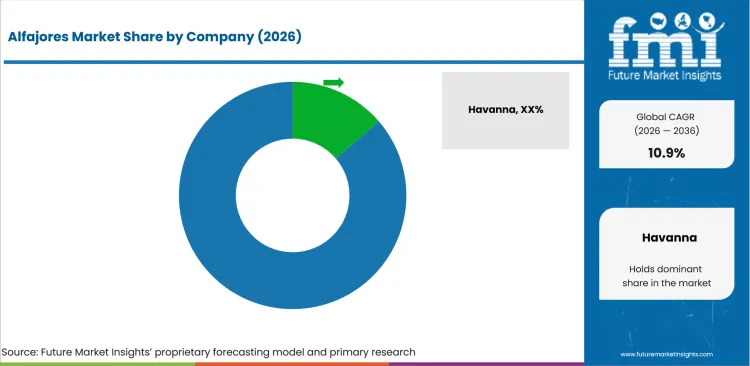
Competition spans packaged-food groups, café-led premium brands, and alfajor specialists with Arcor and Mondelez supplying grocery scale. Havanna pairs retail packs with cafés and gifting, while Cachafaz, Jorgito, Fantoche, El Rodeo, and Celisano rely more on focused product identity and distribution. Chocolate category economics influence coated-format pricing for products sold beside established confectionery brands.
- Broad retail platforms: Arcor and Mondelez (Terrabusi) can use large-scale manufacturing and national account relationships to place alfajores beside larger snack portfolios.
- Premium and specialist routes: Havanna and Cachafaz use gifting, specialty retail, cafés, and export channels to defend higher unit pricing.
- Focused producers: El Rodeo, Celisano, Jorgito, and Fantoche rely on category recognition, distributor execution, and repeat product quality rather than portfolio scale.
Competitive Benchmarking: Alfajores Market
| Company | Alfajor Portfolio Breadth | Route-to-Market Coverage | Production / Quality Control | Geographic Reach |
|---|---|---|---|---|
| Havanna | High | High | Medium | Argentina, Brazil, USA, Spain and other international markets |
| Arcor | High | High | High | Latin America and international markets |
| Mondelez (Terrabusi) | Medium | High | High | Argentina with global parent distribution |
| Cachafaz | High | High | Medium | Argentina and export markets |
| El Rodeo | Medium | Medium | High | Argentina with 17-province reach and export ambitions |
| Celisano | Medium | Medium | Medium | Uruguay with export-development activity |
| Jorgito | High | Medium | Medium | Argentina through wholesalers and distributors |
| Fantoche | High | High | Medium | Argentina and export markets |
Scoring basis: High portfolio breadth requires at least three documented alfajor formats, while Medium requires two documented formats. High route coverage requires several documented sales routes, while Medium requires two verified routes. High production / quality control requires formal quality or traceability programs plus operating evidence, while Medium requires an identified production base with current control evidence.
Key Developments in the Alfajores Market
- In May 2026, Arcor launched GOAT for the mass market with double chocolate coating and a bon o bon center, entering the extra-indulgent alfajor segment.
- In April 2026, Havanna launched the Pistache Dubai alfajor in Brazil after the line passed 320,000 units during its first month in Argentina. The launch extends Havanna’s premium pistachio offer for franchise stores serving Brazilian consumers.
- In May 2025, Cachafaz operating company SUTRA filed Argentine Class 30 marks covering a 72% cacao almond-based alfajor with dulce de leche, documenting continued activity in claim-led premium recipes.
Key Players in the Alfajores Market
Large packaged-food platforms
- Arcor
- Mondelez (Terrabusi)
Premium café and specialty brands
- Havanna
- Cachafaz
Focused alfajor producers
- El Rodeo
- Celisano
- Jorgito
- Fantoche
Alfajores Market - Report Scope
| Coverage field | Report scope |
|---|---|
| Market breakdown | Historical analysis of 2021 to 2025 and market forecast from 2026 to 2036. |
| Quantitative Units | USD million. |
| Market Definition | Commercial alfajores sold as filled biscuit or cake-style confectionery in fresh, frozen, chilled, or ambient packaged formats. |
| Regions Covered | North America, Latin America, Western Europe, Eastern Europe, East Asia, South Asia and Pacific, and Middle East and Africa. |
| Countries Covered | USA, Mexico, Brazil, Argentina, Uruguay, Peru, Chile, Spain, and 20+ countries included in the full report. |
| Key Companies Profiled | Havanna, Arcor, Mondelez (Terrabusi), Cachafaz, El Rodeo, Celisano, Jorgito, and Fantoche. |
| Forecast Period | 2026 to 2036. |
| Approach | Primary and secondary research with market triangulation. |
Alfajores Market - Research Methodology
| Method | Approach |
|---|---|
| Primary Research | FMI analysts gathered input from manufacturers, service providers, technology developers, distributors, end users, procurement teams, and subject-matter experts. Interviews examined purchasing decisions, product or service evaluation, adoption barriers, approval requirements, pricing considerations, and expectations for technical or commercial support. Respondents were also asked what evidence is required before a trial, pilot, or initial order develops into regular purchasing. |
| Desk Research | Desk research covered government statistics, regulatory publications, trade data, industry associations, technical literature, standards, company filings, product information, and official corporate announcements. Sources were reviewed for relevance, publication date, geographic coverage, and consistency with the defined market scope. Claims relating to performance, applications, approvals, capacity, investment, and commercial activity were retained only when supported by credible public evidence. |
| Market Sizing and Forecasting | The market model combined the baseline value with historical performance, segment structure, pricing and volume indicators, adoption levels, company participation, and country-level demand conditions. Forecast assumptions considered economic activity, investment trends, regulatory developments, technology adoption, purchasing cycles, supply availability, and barriers to wider market use. Segment and regional estimates were reconciled before the final market total was calculated. |
| Data Validation | Estimates were checked against multiple independent indicators, including public data, company activity, trade patterns, industry developments, and findings from primary interviews. Validation also tested whether products, services, applications, and company revenues fell within the defined market boundaries. Adjacent categories, unsupported claims, overlapping revenues, and activities without direct market relevance were excluded to reduce double counting and maintain consistency across segments and countries. |
Alfajores Market by Segments
Alfajores Market segmented by Product Type:
- Classic - original
- Whole grain & seeded
- Flavored & filled
- Mini & snacking formats
- Premium / artisan
Alfajores Market segmented by Claim - nature:
- Conventional
- Clean label
- Organic
- Gluten-free
- High-protein / fortified
Alfajores Market segmented by Format:
- Fresh
- Frozen
- Ambient packaged
- Chilled
- Par-baked / thaw-and-serve
Alfajores Market segmented by Packaging Format:
- Multipack
- Single-serve
- Family / loaf pack
- Bulk foodservice
Alfajores Market segmented by Sales Channel:
- Supermarkets & hypermarkets
- Artisan & specialty bakeries
- Convenience & forecourt
- Online & DTC
- Foodservice distributors
Alfajores Market by Region:
- North America
- United States
- Canada
- Latin America
- Brazil
- Mexico
- Argentina
- Chile
- Western Europe
- Germany
- France
- United Kingdom
- Italy
- Spain
- Benelux
- Nordics
- Eastern Europe
- Poland
- Czech Republic
- Romania
- Hungary
- East Asia
- China
- Japan
- South Korea
- South Asia and Pacific
- India
- ASEAN
- Australia and New Zealand
- Middle East and Africa
- GCC Countries
- South Africa
- Türkiye
- Israel
Research Sources and Bibliography
- Ministerio de Turismo de Uruguay. (2025, May 22). Llega la Feria Internacional del Alfajor Ministerio de Turismo, Oriental Republic of Uruguay.
- USA Census Bureau. (2026, August 25). Hispanic Heritage Month: 2026 USA Department of Commerce, United States.
- Argentina.gob.ar. (2026, February 11). La Feria GustAR reunirá productores de diversas provincias argentinas Argentine Republic.
- Administración Nacional de Medicamentos, Alimentos y Tecnología Médica. (2025, October 15). ANMAT prohíbe varios productos de la marca Mami Keto Argentine Republic.
- Argentina.gob.ar. (2025, November 18). Tandil: productores de alimentos participan de una nueva jornada de comercialización Argentine Republic.
- Subsecretaría de Relaciones Económicas Internacionales. (2025). Radiografía mujer exportadora 2025 Government of Chile.
- Ministerio de Turismo de Uruguay. (2026, May). Montevideo recibirá la cuarta edición de la Feria Internacional del Alfajor Ministerio de Turismo, Oriental Republic of Uruguay.
- Ministerio de Industria, Energía y Minería. (2025, January 29). Rotulado y reformulación de alimentos: guía para micro y pequeñas empresas Oriental Republic of Uruguay.
- Havanna. (2026, May). Havanna amplia parcerias com redes hoteleiras na ILTM Latin America 2026
- USA Department of Agriculture, Economic Research Service. (2026, August 17). Retail Trends United States.
- Diario Oficial de la Federación. (2025, July 31). Acuerdo por el que se da a conocer la extensión de la tercera fase de la NOM-051-SCFI/SSA1-2010 United Mexican States.
- Instituto Brasileiro de Geografia e Estatística. (2026, February 13). Vendas no varejo fecham 2025 com alta de 1,6% Federative Republic of Brazil.
- Instituto Nacional de Estadística y Censos. (2026, June 19). Encuesta de supermercados: abril de 2026 Argentine Republic.
- Ministerio de Economía y Finanzas. (2026, August 6). Reporte mensual del Sistema de Información de Precios al Consumidor: julio 2026 Oriental Republic of Uruguay.
- Instituto Nacional de Defensa de la Competencia y de la Protección de la Propiedad Intelectual. (2025, October 15). La advertencia “Alto en azúcar” es la más omitida entre los octógonos que deben llevar diversos productos alimenticios Republic of Peru.
- Instituto Nacional de Estadísticas. (2026, February 27). Índice de Actividad del Comercio aumentó 3,2% interanualmente en enero de 2026 Republic of Chile.
- Instituto Nacional de Estadística. (2026, January 29). Índices de Comercio al por Menor. Diciembre 2025 y año 2025 Kingdom of Spain.
- Grupo Arcor. (2026, May). Grupo Arcor presenta GOAT: el nuevo alfajor “extra indulgente” que combina dulce de leche con corazón de bon o bon
- Havanna. (2026, April). Havanna lança linha Pistache Dubai e festival nas cafeterias e heladerias
- Instituto Nacional de la Propiedad Industrial. (2025, July 2). Boletín de Marcas N° 10868 Argentine Republic.
- Grupo Arcor. (n.d.). Nuestros negocios: Galletas
- Mondelēz International. (n.d.). Argentina
- Cachafaz. (n.d.). Comercio exterior
- Alfajores Jorgito. (n.d.). Contacto
- Dielo S.A.. (n.d.). Institucional
- Dielo S.A.. (n.d.). Política de calidad
- Havanna. (2025, August). Primeira unidade híbrida da Havanna é inaugurada em Passo Fundo, no Rio Grande do Sul
- Ministerio de Industria, Energía y Minería. (2025, November 11). Resolución N° 50/025 Apoyo PIADE a Celisan SAS Oriental Republic of Uruguay.
- Instituto Nacional de la Propiedad Industrial. (2025, November 26). Boletín de Marcas N° 10952 Argentine Republic.
- Instituto Nacional de la Propiedad Industrial. (2025, August 13). Boletín de Marcas N° 10892 Argentine Republic.
- Instituto Nacional de la Propiedad Industrial. (2026, March 11). Boletín de Marcas N° 11004 Argentine Republic.
- Havanna. (2025, October). Heladeria Havanna é inaugurada em shopping de Santo André
- Instituto Nacional de la Propiedad Industrial. (2025, March 12). Boletín de Marcas N° 10805 Argentine Republic.
- Instituto Nacional de la Propiedad Industrial. (2026, January 14). Boletín de Marcas N° 10972 Argentine Republic.
- Instituto Nacional de la Propiedad Industrial. (2026, February 25). Boletín de Marcas N° 10996 Argentine Republic.
- Instituto Nacional de Tecnología Agropecuaria. (2025, November 7). De la investigación al territorio: Convenio con la fábrica de alfajores El Rodeo Argentine Republic.
- Uruguay XXI. (2025, May 9). Uruguay impulsa exportaciones de alimentos y bebidas en APAS Show Oriental Republic of Uruguay.
- Instituto Nacional de la Propiedad Industrial. (2025, June 25). Boletín de Marcas N° 10864 Argentine Republic.
- Instituto Nacional de la Propiedad Industrial. (2026, January 21). Boletín de Marcas N° 10976 Argentine Republic.
This bibliography is provided for reader reference and is not exhaustive. The full report contains the complete reference list and detailed citations
This Report Answers
- How large is the alfajores market in 2026 and 2036?
- What supports repeat alfajor purchases?
- Which product type holds 39.0% in 2026?
- Why does conventional lead claim - nature in 2026?
- How do fresh and ambient formats differ?
- Which countries post the highest CAGRs through 2036?
- What labeling and pricing frictions can slow distribution?
- Which companies use mass retail and specialty routes?
- Which recent actions show active competition?
Frequently Asked Questions
How big is the alfajores market in 2026?
The alfajores market is valued at USD 566.1 million in 2026 and is projected to reach USD 1,593.0 million by 2036. Growth comes from richer formats, wider distribution, and premium purchase occasions in established retail channels.
What is the CAGR of the alfajores market from 2026 to 2036?
The alfajores market is projected to grow at a CAGR of 10.9% between 2026 and 2036. Expansion depends on repeat rotation, new formats, and distribution that protects shelf life and margin.
Which product type leads the alfajores market?
The classic - original segment is expected to hold 39.0% of the alfajores market in 2026, driven by familiar flavor cues and broad price coverage. Its familiar format gives shoppers a reference point for evaluating higher-priced premium variants at shelf.
Which countries are projected to record the highest growth in the alfajores market?
USA is projected to grow at 12.1% CAGR, followed by Mexico at 11.8% and Brazil at 11.5% through 2036. Their routes differ because cultural familiarity, labeling rules, and distribution economics shape conversion.
Which companies are active in the alfajores market?
Key companies operating in the alfajores market include Havanna, Arcor, Mondelez (Terrabusi), Cachafaz, El Rodeo, Celisano, Jorgito, and Fantoche. They compete through product breadth, retailer access, café formats, distributor coverage, and documented quality controls.
Preview the report firsthand - request a free sample
Get SampleGet the brochure for pricing and purchase details.
Get PDFTable of Content
- Key Takeaways
- Market Size and CAGR
- Top Growth Driver
- Fastest Growing Segment
- Leading Region
- Key Companies
- Emerging Opportunities
- Executive Summary
- Global Market Outlook
- Demand-side Trends
- Supply-side Trends
- Technology Roadmap Analysis
- Analysis and Recommendations
- Analyst Perspective (What is happening? Why now? What should investors know?)
- Key Questions Answered
- How large is the market?
- What is the CAGR?
- What are key trends?
- Which region dominates?
- Who are the leaders?
- Market Overview
- Market Coverage / Taxonomy
- Market Definition / Scope / Limitations
- Research Methodology
- Chapter Orientation
- Analytical Lens and Working Hypotheses
- Market Structure, Signals, and Trend Drivers
- Benchmarking and Cross-market Comparability
- Market Sizing, Forecasting, and Opportunity Mapping
- Research Design and Evidence Framework
- Desk Research Programme (Secondary Evidence)
- Expert Input and Fieldwork (Primary Evidence)
- Tooling, Models, and Reference Databases
- Data Engineering and Model Build
- Quality Assurance and Audit Trail
- Market Background
- Market Dynamics (Drivers, Restraints, Opportunity, Trends)
- Scenario Forecast (Optimistic, Likely, Conservative)
- Impact Analysis
- AI Impact
- Sustainability Impact
- Regulatory Impact
- Technology Impact
- Consumer / Buyer Analysis
- Purchase Drivers
- Adoption Barriers
- Buyer Journey
- Opportunity Map Analysis
- Product Life Cycle Analysis
- Supply Chain Analysis
- Investment Feasibility Matrix
- Value Chain Analysis
- PESTLE and Porter's Analysis
- Regulatory Landscape
- Regional Parent Market Outlook
- Production and Consumption Statistics
- Import and Export Statistics
- Global Market Analysis and Forecast, 2021 to 2036
- Historical Market Size Value (USD Million) Analysis, 2021 to 2025
- Current and Future Market Size Value (USD Million) Projections, 2026 to 2036
- Y-o-Y Growth Trend Analysis
- Absolute $ Opportunity Analysis
- Global Market Pricing Analysis, 2021 to 2036
- Global Market Analysis and Forecast, By Product Type, 2021 to 2036
- Introduction / Key Findings
- Historical Market Size Value (USD Million) Analysis By Product Type, 2021 to 2025
- Current and Future Market Size Value (USD Million) Analysis and Forecast By Product Type, 2026 to 2036
- Classic / original
- Whole grain & seeded
- Flavored & filled
- Mini & snacking formats
- Premium / artisan
- Classic / original
- Y-o-Y Growth Trend Analysis By Product Type, 2021 to 2025
- Absolute $ Opportunity Analysis By Product Type, 2026 to 2036
- Global Market Analysis and Forecast, By Claim / Nature, 2021 to 2036
- Introduction / Key Findings
- Historical Market Size Value (USD Million) Analysis By Claim / Nature, 2021 to 2025
- Current and Future Market Size Value (USD Million) Analysis and Forecast By Claim / Nature, 2026 to 2036
- Conventional
- Clean label
- Organic
- Gluten-free
- High-protein / fortified
- Conventional
- Y-o-Y Growth Trend Analysis By Claim / Nature, 2021 to 2025
- Absolute $ Opportunity Analysis By Claim / Nature, 2026 to 2036
- Global Market Analysis and Forecast, By Format, 2021 to 2036
- Introduction / Key Findings
- Historical Market Size Value (USD Million) Analysis By Format, 2021 to 2025
- Current and Future Market Size Value (USD Million) Analysis and Forecast By Format, 2026 to 2036
- Fresh
- Frozen
- Ambient packaged
- Chilled
- Par-baked / thaw-and-serve
- Fresh
- Y-o-Y Growth Trend Analysis By Format, 2021 to 2025
- Absolute $ Opportunity Analysis By Format, 2026 to 2036
- Global Market Analysis and Forecast, By Packaging Format, 2021 to 2036
- Introduction / Key Findings
- Historical Market Size Value (USD Million) Analysis By Packaging Format, 2021 to 2025
- Current and Future Market Size Value (USD Million) Analysis and Forecast By Packaging Format, 2026 to 2036
- Multipack
- Single-serve
- Family / loaf pack
- Bulk foodservice
- Multipack
- Y-o-Y Growth Trend Analysis By Packaging Format, 2021 to 2025
- Absolute $ Opportunity Analysis By Packaging Format, 2026 to 2036
- Global Market Analysis and Forecast, By Sales Channel, 2021 to 2036
- Introduction / Key Findings
- Historical Market Size Value (USD Million) Analysis By Sales Channel, 2021 to 2025
- Current and Future Market Size Value (USD Million) Analysis and Forecast By Sales Channel, 2026 to 2036
- Supermarkets & hypermarkets
- Artisan & specialty bakeries
- Convenience & forecourt
- Online & DTC
- Foodservice distributors
- Supermarkets & hypermarkets
- Y-o-Y Growth Trend Analysis By Sales Channel, 2021 to 2025
- Absolute $ Opportunity Analysis By Sales Channel, 2026 to 2036
- Global Market Analysis and Forecast, By Region, 2021 to 2036
- Introduction
- Historical Market Size Value (USD Million) Analysis By Region, 2021 to 2025
- Current Market Size Value (USD Million) Analysis and Forecast By Region, 2026 to 2036
- North America
- Latin America
- Western Europe
- Eastern Europe
- East Asia
- South Asia and Pacific
- Middle East & Africa
- Market Attractiveness Analysis By Region
- North America Market Analysis and Forecast, By Country, 2021 to 2036
- Historical Market Size Value (USD Million) Trend Analysis By Market Taxonomy, 2021 to 2025
- Market Size Value (USD Million) Forecast By Market Taxonomy, 2026 to 2036
- By Country
- USA
- Canada
- By Product Type
- By Claim / Nature
- By Format
- By Packaging Format
- By Sales Channel
- By Country
- Market Attractiveness Analysis
- By Country
- By Product Type
- By Claim / Nature
- By Format
- By Packaging Format
- By Sales Channel
- Key Takeaways
- Latin America Market Analysis and Forecast, By Country
- Historical Market Size Value (USD Million) Trend Analysis By Market Taxonomy, 2021 to 2025
- Market Size Value (USD Million) Forecast By Market Taxonomy, 2026 to 2036
- By Country
- Brazil
- Mexico
- Chile
- Rest of Latin America
- By Product Type
- By Claim / Nature
- By Format
- By Packaging Format
- By Sales Channel
- By Country
- Market Attractiveness Analysis
- By Country
- By Product Type
- By Claim / Nature
- By Format
- By Packaging Format
- By Sales Channel
- Key Takeaways
- Western Europe Market Analysis and Forecast, By Country
- Historical Market Size Value (USD Million) Trend Analysis By Market Taxonomy, 2021 to 2025
- Market Size Value (USD Million) Forecast By Market Taxonomy, 2026 to 2036
- By Country
- Germany
- UK
- Italy
- Spain
- France
- Nordic
- BENELUX
- Rest of Western Europe
- By Product Type
- By Claim / Nature
- By Format
- By Packaging Format
- By Sales Channel
- By Country
- Market Attractiveness Analysis
- By Country
- By Product Type
- By Claim / Nature
- By Format
- By Packaging Format
- By Sales Channel
- Key Takeaways
- Eastern Europe Market Analysis and Forecast, By Country
- Historical Market Size Value (USD Million) Trend Analysis By Market Taxonomy, 2021 to 2025
- Market Size Value (USD Million) Forecast By Market Taxonomy, 2026 to 2036
- By Country
- Russia
- Poland
- Hungary
- Balkan & Baltic
- Rest of Eastern Europe
- By Product Type
- By Claim / Nature
- By Format
- By Packaging Format
- By Sales Channel
- By Country
- Market Attractiveness Analysis
- By Country
- By Product Type
- By Claim / Nature
- By Format
- By Packaging Format
- By Sales Channel
- Key Takeaways
- East Asia Market Analysis and Forecast, By Country
- Historical Market Size Value (USD Million) Trend Analysis By Market Taxonomy, 2021 to 2025
- Market Size Value (USD Million) Forecast By Market Taxonomy, 2026 to 2036
- By Country
- China
- Japan
- South Korea
- By Product Type
- By Claim / Nature
- By Format
- By Packaging Format
- By Sales Channel
- By Country
- Market Attractiveness Analysis
- By Country
- By Product Type
- By Claim / Nature
- By Format
- By Packaging Format
- By Sales Channel
- Key Takeaways
- South Asia and Pacific Market Analysis and Forecast, By Country
- Historical Market Size Value (USD Million) Trend Analysis By Market Taxonomy, 2021 to 2025
- Market Size Value (USD Million) Forecast By Market Taxonomy, 2026 to 2036
- By Country
- India
- ASEAN
- Australia & New Zealand
- Rest of South Asia and Pacific
- By Product Type
- By Claim / Nature
- By Format
- By Packaging Format
- By Sales Channel
- By Country
- Market Attractiveness Analysis
- By Country
- By Product Type
- By Claim / Nature
- By Format
- By Packaging Format
- By Sales Channel
- Key Takeaways
- Middle East & Africa Market Analysis and Forecast, By Country
- Historical Market Size Value (USD Million) Trend Analysis By Market Taxonomy, 2021 to 2025
- Market Size Value (USD Million) Forecast By Market Taxonomy, 2026 to 2036
- By Country
- Kingdom of Saudi Arabia
- Other GCC Countries
- Türkiye
- South Africa
- Other African Union
- Rest of Middle East & Africa
- By Product Type
- By Claim / Nature
- By Format
- By Packaging Format
- By Sales Channel
- By Country
- Market Attractiveness Analysis
- By Country
- By Product Type
- By Claim / Nature
- By Format
- By Packaging Format
- By Sales Channel
- Key Takeaways
- Key Countries Market Analysis
- USA
- Pricing Analysis
- Market Share Analysis, 2025
- By Product Type
- By Claim / Nature
- By Format
- By Packaging Format
- By Sales Channel
- Canada
- Pricing Analysis
- Market Share Analysis, 2025
- By Product Type
- By Claim / Nature
- By Format
- By Packaging Format
- By Sales Channel
- Mexico
- Pricing Analysis
- Market Share Analysis, 2025
- By Product Type
- By Claim / Nature
- By Format
- By Packaging Format
- By Sales Channel
- Brazil
- Pricing Analysis
- Market Share Analysis, 2025
- By Product Type
- By Claim / Nature
- By Format
- By Packaging Format
- By Sales Channel
- Chile
- Pricing Analysis
- Market Share Analysis, 2025
- By Product Type
- By Claim / Nature
- By Format
- By Packaging Format
- By Sales Channel
- Germany
- Pricing Analysis
- Market Share Analysis, 2025
- By Product Type
- By Claim / Nature
- By Format
- By Packaging Format
- By Sales Channel
- UK
- Pricing Analysis
- Market Share Analysis, 2025
- By Product Type
- By Claim / Nature
- By Format
- By Packaging Format
- By Sales Channel
- Italy
- Pricing Analysis
- Market Share Analysis, 2025
- By Product Type
- By Claim / Nature
- By Format
- By Packaging Format
- By Sales Channel
- Spain
- Pricing Analysis
- Market Share Analysis, 2025
- By Product Type
- By Claim / Nature
- By Format
- By Packaging Format
- By Sales Channel
- France
- Pricing Analysis
- Market Share Analysis, 2025
- By Product Type
- By Claim / Nature
- By Format
- By Packaging Format
- By Sales Channel
- India
- Pricing Analysis
- Market Share Analysis, 2025
- By Product Type
- By Claim / Nature
- By Format
- By Packaging Format
- By Sales Channel
- ASEAN
- Pricing Analysis
- Market Share Analysis, 2025
- By Product Type
- By Claim / Nature
- By Format
- By Packaging Format
- By Sales Channel
- Australia & New Zealand
- Pricing Analysis
- Market Share Analysis, 2025
- By Product Type
- By Claim / Nature
- By Format
- By Packaging Format
- By Sales Channel
- China
- Pricing Analysis
- Market Share Analysis, 2025
- By Product Type
- By Claim / Nature
- By Format
- By Packaging Format
- By Sales Channel
- Japan
- Pricing Analysis
- Market Share Analysis, 2025
- By Product Type
- By Claim / Nature
- By Format
- By Packaging Format
- By Sales Channel
- South Korea
- Pricing Analysis
- Market Share Analysis, 2025
- By Product Type
- By Claim / Nature
- By Format
- By Packaging Format
- By Sales Channel
- Russia
- Pricing Analysis
- Market Share Analysis, 2025
- By Product Type
- By Claim / Nature
- By Format
- By Packaging Format
- By Sales Channel
- Poland
- Pricing Analysis
- Market Share Analysis, 2025
- By Product Type
- By Claim / Nature
- By Format
- By Packaging Format
- By Sales Channel
- Hungary
- Pricing Analysis
- Market Share Analysis, 2025
- By Product Type
- By Claim / Nature
- By Format
- By Packaging Format
- By Sales Channel
- Kingdom of Saudi Arabia
- Pricing Analysis
- Market Share Analysis, 2025
- By Product Type
- By Claim / Nature
- By Format
- By Packaging Format
- By Sales Channel
- Türkiye
- Pricing Analysis
- Market Share Analysis, 2025
- By Product Type
- By Claim / Nature
- By Format
- By Packaging Format
- By Sales Channel
- South Africa
- Pricing Analysis
- Market Share Analysis, 2025
- By Product Type
- By Claim / Nature
- By Format
- By Packaging Format
- By Sales Channel
- USA
- Market Structure Analysis
- Competition Dashboard
- Competition Benchmarking
- Market Share Analysis of Top Players
- By Regional
- By Product Type
- By Claim / Nature
- By Format
- By Packaging Format
- By Sales Channel
- Emerging Startups
- Innovation Benchmarking
- Competition Analysis
- Competition Deep Dive
- Havanna
- Overview
- Product Portfolio
- Profitability by Market Segments
- Sales Footprint
- Strategy Overview
- Marketing Strategy
- Product Strategy
- Channel Strategy
- Arcor
- Bagley Latinoamerica
- Mondelez (Terrabusi)
- Georgalos
- Cachafaz
- Guaymallen
- Jorgito
- Fantoche
- Grupo Bimbo
- Havanna
- Case Studies
- Success Stories
- Recent Developments
- Competition Deep Dive
- Assumptions & Acronyms Used


