

- Market Size (2026)
- USD 338.9 Mn
- Forecast (2036)
- USD 936.6 Mn
- CAGR (2026 to 2036)
- 10.7%
How big is Japan Sweet Buns Market in 2026?
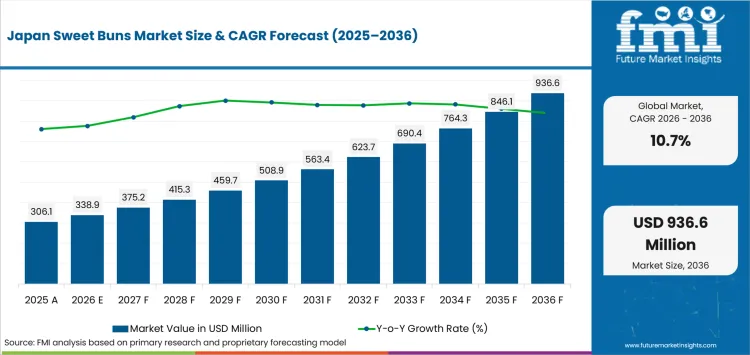
USD 338.9 million in 2026 and USD 936.6 million by 2036 at a 10.7% CAGR.
Demand for Japan sweet buns is projected to expand at 10.7% CAGR between 2026 and 2036, raising valuation from USD 338.9 million to USD 936.6 million. Growth depends on maintaining relevance as sweet buns compete with other bakery products basket during routine breakfast and snack purchasing decisions. Japan Chain Stores Association data published in January 2026 show food accounted for 70.6% of 2025 chain-store sales. The same grocery visits expose sweet buns beside packaged bread, making familiar eating quality more commercially useful for repeat sales than novelty alone.
Frozen bakery formats separate factory production from daily point-of-sale baking, which gives retailers more control over availability. In April 2026, the Japan Frozen Food Association reported 1,574,172 tonnes of domestic frozen-food production for 2025. The figure does not measure sweet buns directly but confirms a large national cold-chain base. The frozen baked goods category still needs acceptable texture after thawing to justify extra handling cost against fresh products.
Key Takeaways
- Sweet buns fit familiar breakfast and snack occasions, supporting demand without requiring shoppers to learn new preparation habits.
- Based on product type, classic - original is projected to account for 37.0% in 2026 due to familiar taste and low trial risk.
- By claim - nature, conventional is estimated to hold 55.0% in 2026 owing to mainstream pricing and flexible ingredient sourcing.
- In 2026, frozen is expected to lead format with 30.0% share because longer inventory life separates production timing from sale timing.
- Savings behavior and higher bakery input costs constrain premium pricing by encouraging shoppers to reduce item counts before abandoning the category.
- Some of the key players in this market include Yamazaki Baking, Fuji Baking, Kimuraya Sohonten, First Baking, Oisis, Nissin Foods, Andersen, and Trandor.
Analyst Perspective
"In Japan, sweet-bun economics depend on keeping softness and filling quality inside the price range shoppers already accept. Retailers should compare rate of sale against markdowns and handling cost before paying for premium fillings or frozen convenience."
- Nandini Roy Choudhury, Principal Consultant, Future Market Insights
How is the Japan Sweet Buns Market segmented?
The Japan sweet buns market is segmented by product type, claim - nature, format, packaging format and sales channel.
The Japan sweet buns market is segmented by product type, claim - nature, format, packaging format and sales channel. Product types are classic - original, whole grain & seeded, flavored & filled, mini & snacking formats and premium / artisan. Claim - nature includes conventional, clean label, organic, gluten-free and high-protein / fortified. Formats are frozen, fresh, ambient packaged, chilled and par-baked / thaw-and-serve. Packaging covers multipack, single-serve, family / loaf pack and bulk foodservice. Sales channels are supermarkets & hypermarkets, artisan & specialty bakeries, convenience & forecourt, online & DTC and foodservice distributors.
Why does Classic - Original lead the Product Type category?
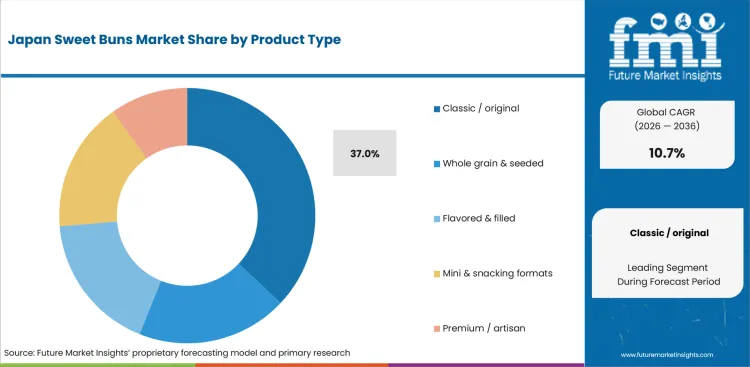
Familiar dough and fillings let retailers adjust price tiers without changing the classic - original category promise, which protects repeat purchase. Whole-grain foods widen assortment for health-led occasions, while classic buns carry less trial risk because shoppers already recognize their expected sweetness and texture.
- Based on product type, classic - original is projected to account for 37.0% in 2026 due to broad occasion fit and low explanation cost.
- Yamazaki Baking's May 2026 Investors Guide recorded 4.3% fiscal 2025 sweet-bun sales growth as mainstay and lower-price products gained. Mainstay growth gives retailers room to refresh assortment with seasonal flavors without replacing the core volume base.
Why does Conventional lead the Claim - Nature category?
Conventional recipes preserve the widest pricing room by letting manufacturers use familiar ingredients without building a claim-specific sourcing program. Specialized clean-label ingredients become more useful once retailers confirm that extra formulation work produces enough velocity to offset narrower appeal.
- By claim - nature, conventional is estimated to hold 55.0% in 2026 owing to mainstream pricing and broad ingredient flexibility.
- Fuji Baking renewed its long-running whipped anpan and launched a yomogi variant in May 2025. The company revised the base dough for a chewier texture and used yomogi in the seasonal version. The formula changes show why differentiated flavors require deliberate recipe work for wider retail rollout.
Why does Frozen lead the Format category?
Frozen sweet buns solve a scheduling problem for retailers and foodservice operators that cannot match local baking output to every demand peak. Frozen pastries and par-baked bread use the same timing advantage by moving final preparation closer to sale.
- In 2026, frozen is expected to lead format with 30.0% share because inventory control reduces the mismatch between production and outlet demand.
- Japan Frozen Food Association data published in April 2026 show commercial-use frozen-food production increased 1.9% in 2025. Sweet-bun operators therefore need thawing specifications that preserve softness and filling texture through storage and final preparation.
Why do Supermarkets & Hypermarkets lead the Sales Channel category?
Supermarkets merchandise classic sweet buns beside filled variants and multipacks within one bakery set, giving category managers room to rotate promotions between value and premium items. Routine grocery trips expose sweet buns beside other bakery items, reinforcing everyday merchandising for familiar formats.
- Supermarkets & hypermarkets are set to lead the sales channel with 32.0% share in 2026 due to broad food traffic and assortment depth.
- Japan Chain Stores Association's January 2026 annual release counted 9,479 member stores during 2025. National shelf coverage magnifies both rate-of-sale gains and slow-moving stock, so pack economics must work at store level for expansion to pay.
What are the drivers, restraints and opportunities in the Japan Sweet Buns Market?
Frequent short eating occasions support demand while household value pressure limits pricing flexibility and frozen formats widen retail or foodservice access.
- Driver: Familiar breakfast and snack occasions let manufacturers vary fillings and packs without asking shoppers to learn a new product type.
- Restraint: Higher input costs meet value-conscious shopping behavior, which limits automatic price pass-through and raises the risk of slower item turnover.
- Opportunity: Smaller packs and frozen formats can improve availability when their waste savings or handling benefits exceed the added operating cost.
Sweet buns fit frequent breakfast and snack occasions that retailers can serve through familiar dough formats with changing fillings. Japan Chain Stores Association data published in January 2026 show adjusted food sales increased 3.5% during 2025 even as shoppers bought fewer items. Retailers can therefore refresh flavors at clear price points without asking customers to adopt a new bakery format.
Input inflation is harder to pass through while Japanese households compare pack value more closely and trim discretionary purchases. Statistics Bureau data published in February 2026 show worker-household income fell 0.9% in real terms during 2025 despite nominal income growth. Manufacturers have less room to pass through higher bakery ingredients costs, so smaller packs and disciplined recipes protect margin without a full price reset.
Frozen and portion-controlled formats let manufacturers align production runs more closely with outlet traffic without changing the core sweet-bun proposition. Japan Frozen Food Association data published in April 2026 show household-use frozen-food production increased 2.8% during 2025. Frozen dough widens thaw-and-serve availability once texture testing proves that the extra handling step earns its cost. This route is most useful in outlets that need product availability without daily on-site baking.
Who are the notable companies in the Japan Sweet Buns Market?
Yamazaki Baking, Fuji Baking, Kimuraya Sohonten, First Baking, Oisis, Nissin Foods, Andersen, and Trandor are the notable companies serving this market.
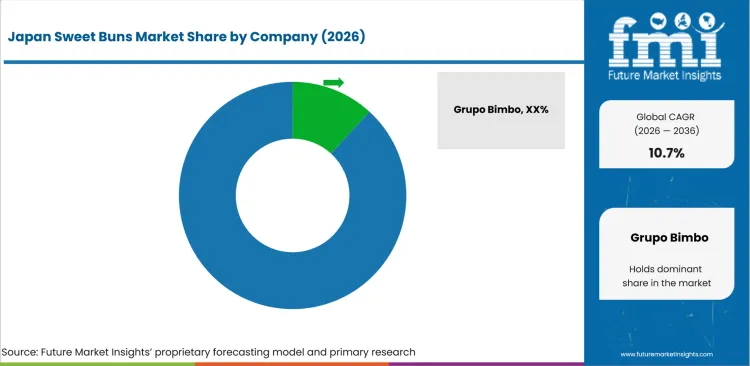
Japan's sweet-bun field is concentrated among manufacturers with domestic production and repeat access to major retail channels. Yamazaki Baking and Fuji Baking operate broad packaged-bakery networks, while Kimuraya Sohonten and First Baking maintain recognizable filled-bun ranges with current launches. Oisis and Andersen provide regional or retail-bakery routes, while Trandor serves a Kyushu station network. Nissin Foods participates through documented anpan co-development with Kimuraya Sohonten instead of standalone bakery manufacturing. Local distribution and formulation control raise the entry barrier for firms without domestic baking or channel access.
- National packaged-bakery platforms: Yamazaki Baking and Fuji Baking use broad distribution and frequent sweet-bun launches to sustain national packaged-bakery positions.
- Sweet-bun and regional bakery manufacturers: Kimuraya Sohonten, First Baking and Oisis maintain filled-bun activity through direct stores or regional grocery routes.
- Channel-specific participants: Nissin Foods and Andersen reach the category through nutrition collaboration or seasonal online bakery sales, while Trandor uses station-centered retail networks.
Competitive Benchmarking: Japan Sweet Buns Market
| Company | Sweet-Bun Portfolio Depth | Retail / Channel Breadth | Recent Product Activity | Geographic Reach |
|---|---|---|---|---|
| Yamazaki Baking | High | High | High | Japan nationwide except Hokkaido for cited launch |
| Fuji Baking | High | Medium | High | Japan multi-region |
| Kimuraya Sohonten | High | High | High | Tokyo and Kanto plus online |
| First Baking | High | Medium | High | East, central and west Japan |
| Oisis | Low | Low | Medium | Hyogo retail-bakery outlets |
| Nissin Foods | Low | Medium | High | Kanto and Koshinetsu plus online |
| Andersen | Low | Low | Medium | Hiroshima online bakery channel |
| Trandor | Low | Low | Medium | Kyushu railway-station bakery network |
Scoring basis: High sweet-bun portfolio depth requires at least two active series or distinct filled-bun formats sold in Japan. Medium identifies one series plus another filled-bread route and Low identifies one exact-market product or collaboration. High channel breadth requires at least three documented route types, Medium requires two and Low requires one. High recent product activity requires multiple dated exact-market actions or one launch plus a current category disclosure. Medium identifies one verified action, while Low identifies one regional or adjacent sweet-bread action supported by official company material. Geographic reach records locations supported by official company material and does not infer coverage from corporate scale alone.
Key Developments in the Japan Sweet Buns Market
- In August 2025, First Baking announced a September chestnut version of Kandou Anpan after cumulative series shipments passed 4.4 million units. The seasonal launch kept the high-filling format while changing the anko blend for autumn grocery merchandising.
- In March 2025, Kimuraya Sohonten announced an April 1 launch of Kochi-yuzu sakadane anpan for its direct-store network. The product used Kochi yuzu inside the company’s established sakadane anpan format for a limited spring selling period.
- In February 2025, Fuji Baking announced a March 1 launch for its roasted-kinako whipped anpan within a long-running seasonal series. The release extended the series with roasted kinako filling and milk whip for western Japanese retail channels.
Key Players in the Japan Sweet Buns Market
National Packaged Sweet-Bun Brands
- Yamazaki Baking
- Fuji Baking
Sweet-Bun and Regional Bakery Manufacturers
- Kimuraya Sohonten
- First Baking
- Oisis
Channel-Specific and Collaboration Participants
- Nissin Foods
- Andersen
- Trandor
Japan Sweet Buns Market - Report Scope
| Coverage field | Report scope |
|---|---|
| Market breakdown | By product type, claim - nature, format, packaging format and sales channel. |
| Quantitative Units | USD million. |
| Market Definition | Revenue attributable to sweet buns sold within Japan in the stated segmentation universe. Downstream meal revenue and adjacent or substitute bakery categories are excluded. |
| Regions Covered | North America, Latin America, Western Europe, Eastern Europe, East Asia, South Asia and Pacific and Middle East and Africa. |
| Countries Covered | Japan. |
| Key Companies Profiled | Yamazaki Baking, Fuji Baking, Kimuraya Sohonten, First Baking, Oisis, Nissin Foods, Andersen, and Trandor. |
| Forecast Period | 2026 to 2036. |
| Approach | Primary and secondary research with market triangulation. |
Japan Sweet Buns Market - Research Methodology
| Method | Approach |
|---|---|
| Primary Research | FMI analysts gathered input from manufacturers, service providers, technology developers, distributors, end users, procurement teams, and subject-matter experts. Interviews examined purchasing decisions, product or service evaluation, adoption barriers, approval requirements, pricing considerations, and expectations for technical or commercial support. Respondents were also asked what evidence is required before a trial, pilot, or initial order develops into regular purchasing. |
| Desk Research | Desk research covered government statistics, regulatory publications, trade data, industry associations, technical literature, standards, company filings, product information, and official corporate announcements. Sources were reviewed for relevance, publication date, geographic coverage, and consistency with the defined market scope. Claims relating to performance, applications, approvals, capacity, investment, and commercial activity were retained only when supported by credible public evidence. |
| Market Sizing and Forecasting | The market model combined the baseline value with historical performance, segment structure, pricing and volume indicators, adoption levels, company participation, and country-level demand conditions. Forecast assumptions considered economic activity, investment trends, regulatory developments, technology adoption, purchasing cycles, supply availability, and barriers to wider market use. Segment and regional estimates were reconciled before the final market total was calculated. |
| Data Validation | Estimates were checked against multiple independent indicators, including public data, company activity, trade patterns, industry developments, and findings from primary interviews. Validation also tested whether products, services, applications, and company revenues fell within the defined market boundaries. Adjacent categories, unsupported claims, overlapping revenues, and activities without direct market relevance were excluded to reduce double counting and maintain consistency across segments and countries. |
Japan Sweet Buns Market by Segments
Japan Sweet Buns Market segmented by Product Type:
- Classic - original
- Whole grain & seeded
- Flavored & filled
- Mini & snacking formats
- Premium / artisan
Japan Sweet Buns Market segmented by Claim - nature:
- Conventional
- Clean label
- Organic
- Gluten-free
- High-protein / fortified
Japan Sweet Buns Market segmented by Format:
- Frozen
- Fresh
- Ambient packaged
- Chilled
- Par-baked / thaw-and-serve
Japan Sweet Buns Market segmented by Packaging Format:
- Multipack
- Single-serve
- Family / loaf pack
- Bulk foodservice
Japan Sweet Buns Market segmented by Sales Channel:
- Supermarkets & hypermarkets
- Artisan & specialty bakeries
- Convenience & forecourt
- Online & DTC
- Foodservice distributors
Research Sources and Bibliography
- Japan Chain Stores Association. (2026, January 22). 2025
- Japan Frozen Food Association. (2026, April 16).
- Yamazaki Baking Co., Ltd. (2026, May 1). Investors Guide 2025.
- Fuji Baking Co., Ltd. (2025, April 22).
- Statistics Bureau of Japan. (2026, February 6). Family Income and Expenditure Survey: 2025 Yearly Average.
- Fuji Baking Co., Ltd. (2025, February 25).
- Kimuraya Sohonten Co., Ltd. (2025, March 24).
- First Baking Co., Ltd. (2025, August 26).
- Yamazaki Baking Co., Ltd. (2025, March 26).
- Fuji Baking Co., Ltd. (2025, July 29).
- Kimuraya Sohonten Co., Ltd. & Nissin Foods Co., Ltd. (2025, April 14).
- First Baking Co., Ltd. (2025, August 21).
- Oisis Corporation. (2025, March 1).
- Nissin Foods Co., Ltd. & Kimuraya Sohonten Co., Ltd. (2025, March 10).
- Hiroshima Andersen. (2025, March 10).
- Andersen Group. (2025, December 25).
This bibliography is provided for reader reference and is not exhaustive. The full report contains the complete reference list and detailed citations
This Report Answers
- How large is the Japan sweet buns market in 2026 and what value is projected for 2036?
- Which retail and household conditions support repeat purchasing of sweet buns in Japan?
- Why does classic - original hold the leading product type position in 2026?
- How does conventional positioning affect recipe flexibility and claim-led product development?
- Why does frozen hold the leading format position within the Japan sweet buns market?
- How does Japan’s 10.4% CAGR compare with the overall 10.7% market forecast?
- Which companies provide documented sweet-bun manufacturing or collaboration activity in Japan?
- How do value pressure and bakery input costs limit pricing flexibility for manufacturers?
- What should retailers compare before shifting sweet-bun volume toward frozen or premium formats?
Frequently Asked Questions
How big is the Japan Sweet Buns Market in 2026?
The Japan sweet buns market is valued at USD 338.9 million in 2026 and is projected to reach USD 936.6 million by 2036. Frequent breakfast and snack purchasing supports expansion as familiar sweet-bun formats fit routine retail occasions in grocery and convenience channels.
What is the CAGR of the Japan Sweet Buns Market from 2026 to 2036?
The Japan sweet buns market is projected to grow at a CAGR of 10.7% between 2026 and 2036. Repeat grocery purchasing and flexible fresh or frozen formats give retailers several ways to manage shelf life without changing the core product.
Which product type leads the Japan Sweet Buns Market?
The classic - original segment is expected to hold 37.0% of the Japan sweet buns market in 2026, driven by familiar taste and lower trial risk within product type. Its broad recognition gives retailers a dependable base for everyday pricing and seasonal filling changes.
Which format leads the Japan Sweet Buns Market?
The frozen segment is anticipated to hold 30.0% of the Japan sweet buns market by format in 2026, supported by longer inventory life and flexible final preparation. Retailers and foodservice operators gain control over production timing if thawed texture meets store and foodservice acceptance standards.
Which companies are active in the Japan Sweet Buns Market?
Key companies operating in the Japan sweet buns market include Yamazaki Baking, Fuji Baking, Kimuraya Sohonten, First Baking, Oisis, Nissin Foods, Andersen, and Trandor. Their documented roles cover national packaged bakery and specialist anpan while regional bakers and nutrition collaborations use different routes.
Preview the report firsthand - request a free sample
Get SampleGet the brochure for pricing and purchase details.
Get PDFTable of Content
- Key Takeaways
- Market Size and CAGR
- Top Growth Driver
- Fastest Growing Segment
- Leading Region
- Key Companies
- Emerging Opportunities
- Executive Summary
- Japan Market Outlook
- Demand-side Trends
- Supply-side Trends
- Technology Roadmap Analysis
- Analysis and Recommendations
- Analyst Perspective (What is happening? Why now? What should investors know?)
- Key Questions Answered
- How large is the market?
- What is the CAGR?
- What are key trends?
- Which region dominates?
- Who are the leaders?
- Market Overview
- Market Coverage / Taxonomy
- Market Definition / Scope / Limitations
- Research Methodology
- Chapter Orientation
- Analytical Lens and Working Hypotheses
- Market Structure, Signals, and Trend Drivers
- Benchmarking and Cross-market Comparability
- Market Sizing, Forecasting, and Opportunity Mapping
- Research Design and Evidence Framework
- Desk Research Programme (Secondary Evidence)
- Expert Input and Fieldwork (Primary Evidence)
- Tooling, Models, and Reference Databases
- Data Engineering and Model Build
- Quality Assurance and Audit Trail
- Market Background
- Market Dynamics (Drivers, Restraints, Opportunity, Trends)
- Scenario Forecast (Optimistic, Likely, Conservative)
- Impact Analysis
- AI Impact
- Sustainability Impact
- Regulatory Impact
- Technology Impact
- Consumer / Buyer Analysis
- Purchase Drivers
- Adoption Barriers
- Buyer Journey
- Opportunity Map Analysis
- Product Life Cycle Analysis
- Supply Chain Analysis
- Investment Feasibility Matrix
- Value Chain Analysis
- PESTLE and Porter's Analysis
- Regulatory Landscape
- Regional Parent Market Outlook
- Production and Consumption Statistics
- Import and Export Statistics
- Japan Market Analysis and Forecast, 2021 to 2036
- Historical Market Size Value (USD Million) Analysis, 2021 to 2025
- Current and Future Market Size Value (USD Million) Projections, 2026 to 2036
- Y-o-Y Growth Trend Analysis
- Absolute $ Opportunity Analysis
- Japan Market Pricing Analysis, 2021 to 2036
- Japan Market Analysis and Forecast, By Product Type, 2021 to 2036
- Introduction / Key Findings
- Historical Market Size Value (USD Million) Analysis By Product Type, 2021 to 2025
- Current and Future Market Size Value (USD Million) Analysis and Forecast By Product Type, 2026 to 2036
- Classic / original
- Whole grain & seeded
- Flavored & filled
- Mini & snacking formats
- Premium / artisan
- Classic / original
- Y-o-Y Growth Trend Analysis By Product Type, 2021 to 2025
- Absolute $ Opportunity Analysis By Product Type, 2026 to 2036
- Japan Market Analysis and Forecast, By Claim / Nature, 2021 to 2036
- Introduction / Key Findings
- Historical Market Size Value (USD Million) Analysis By Claim / Nature, 2021 to 2025
- Current and Future Market Size Value (USD Million) Analysis and Forecast By Claim / Nature, 2026 to 2036
- Conventional
- Clean label
- Organic
- Gluten-free
- High-protein / fortified
- Conventional
- Y-o-Y Growth Trend Analysis By Claim / Nature, 2021 to 2025
- Absolute $ Opportunity Analysis By Claim / Nature, 2026 to 2036
- Japan Market Analysis and Forecast, By Format, 2021 to 2036
- Introduction / Key Findings
- Historical Market Size Value (USD Million) Analysis By Format, 2021 to 2025
- Current and Future Market Size Value (USD Million) Analysis and Forecast By Format, 2026 to 2036
- Frozen
- Fresh
- Ambient packaged
- Chilled
- Par-baked / thaw-and-serve
- Frozen
- Y-o-Y Growth Trend Analysis By Format, 2021 to 2025
- Absolute $ Opportunity Analysis By Format, 2026 to 2036
- Japan Market Analysis and Forecast, By Packaging Format, 2021 to 2036
- Introduction / Key Findings
- Historical Market Size Value (USD Million) Analysis By Packaging Format, 2021 to 2025
- Current and Future Market Size Value (USD Million) Analysis and Forecast By Packaging Format, 2026 to 2036
- Multipack
- Single-serve
- Family / loaf pack
- Bulk foodservice
- Multipack
- Y-o-Y Growth Trend Analysis By Packaging Format, 2021 to 2025
- Absolute $ Opportunity Analysis By Packaging Format, 2026 to 2036
- Japan Market Analysis and Forecast, By Sales Channel, 2021 to 2036
- Introduction / Key Findings
- Historical Market Size Value (USD Million) Analysis By Sales Channel, 2021 to 2025
- Current and Future Market Size Value (USD Million) Analysis and Forecast By Sales Channel, 2026 to 2036
- Supermarkets & hypermarkets
- Artisan & specialty bakeries
- Convenience & forecourt
- Online & DTC
- Foodservice distributors
- Supermarkets & hypermarkets
- Y-o-Y Growth Trend Analysis By Sales Channel, 2021 to 2025
- Absolute $ Opportunity Analysis By Sales Channel, 2026 to 2036
- Japan Market Analysis and Forecast, By Region, 2021 to 2036
- Introduction
- Historical Market Size Value (USD Million) Analysis By Region, 2021 to 2025
- Current Market Size Value (USD Million) Analysis and Forecast By Region, 2026 to 2036
- Japan
- Market Attractiveness Analysis By Region
- Japan Market Analysis and Forecast, By Country, 2021 to 2036
- Historical Market Size Value (USD Million) Trend Analysis By Market Taxonomy, 2021 to 2025
- Market Size Value (USD Million) Forecast By Market Taxonomy, 2026 to 2036
- By Country
- By Product Type
- By Claim / Nature
- By Format
- By Packaging Format
- By Sales Channel
- By Country
- Market Attractiveness Analysis
- By Country
- By Product Type
- By Claim / Nature
- By Format
- By Packaging Format
- By Sales Channel
- Key Takeaways
- Key Countries Market Analysis
- Japan
- Pricing Analysis
- Market Share Analysis, 2025
- By Product Type
- By Claim / Nature
- By Format
- By Packaging Format
- By Sales Channel
- Japan
- Market Structure Analysis
- Competition Dashboard
- Competition Benchmarking
- Market Share Analysis of Top Players
- By Regional
- By Product Type
- By Claim / Nature
- By Format
- By Packaging Format
- By Sales Channel
- Emerging Startups
- Innovation Benchmarking
- Competition Analysis
- Competition Deep Dive
- Grupo Bimbo
- Overview
- Product Portfolio
- Profitability by Market Segments
- Sales Footprint
- Strategy Overview
- Marketing Strategy
- Product Strategy
- Channel Strategy
- Flowers Foods
- Aryzta
- Lantmannen Unibake
- Vandemoortele
- Yamazaki Baking
- Warburtons
- King's Hawaiian
- Europastry
- St Pierre Groupe
- Grupo Bimbo
- Case Studies
- Success Stories
- Recent Developments
- Competition Deep Dive
- Assumptions & Acronyms Used


