

- Market Size (2026)
- USD 1.6 Bn
- Forecast (2036)
- USD 6.3 Bn
- CAGR (2026 to 2036)
- 14.6%
How big is Japanese Milk Bread (Shokupan) Market in 2026?
USD 1.6 billion in 2026 and USD 6.3 billion by 2036 at a 14.6% CAGR.
Demand for Japanese milk bread (shokupan) is projected to expand at a 14.6% CAGR between 2026 and 2036, increasing market valuation from USD 1.6 billion to USD 6.3 billion. Commercial success depends on delivering a soft crumb and dependable replenishment across modern retail channels. Yamazaki Baking reported 3.7% growth in bread sales during fiscal 2025, demonstrating that premium sliced-bread formats can continue to gain traction even within mature bakery markets. The performance highlights the importance of quality and supply consistency in driving repeat purchases across packaged-bread categories.
Growth prospects vary according to consumer familiarity and the frequency with which shoppers encounter international bakery products. The UAE benefits from strong exposure to global food trends through retail, hospitality and tourism channels. Dubai welcomed 18.72 million international overnight visitors in 2024, according to the Department of Economy and Tourism. The large visitor base increases opportunities for hotels, cafés and retailers to introduce premium bakery formats to a broader audience. Markets with lower international exposure often rely more heavily on specialist bakeries and niche retail distribution to build awareness and trial demand.
-market-value-analysis.webp "Japanese Milk Bread (shokupan) Market Value Analysis")
Key Takeaways of Japanese Milk Bread (Shokupan) Market
- Retail expansion depends on turning the loaf’s thick-slice softness into a repeat breakfast or sandwich purchase without raising waste beyond normal bread-category limits.
- By product type, square (kaku) shokupan is estimated to hold 34.0% in 2026 owing to uniform slices that fit packaged-bread merchandising and household toast use.
- In 2026, conventional products are expected to lead claim - nature with 52.0% share because flexible recipes protect softness at mainstream price points.
- Fresh formats are projected to hold 32.0% share in 2026 attributable to immediate crumb softness that consumers associate with bakery-quality shokupan.
- Premium pricing and short freshness windows can reduce repeat purchase if shelf turnover does not cover waste and frequent replenishment costs.
- Some of the key players in this market include Grupo Bimbo, Flowers Foods, Inc., ARYZTA AG, Lantmännen Unibake, Vandemoortele, Yamazaki Baking Co., Ltd., Warburtons, and Europastry.
Analyst Perspective
"Shokupan should be judged on softness retention after slicing and distribution, because the premium disappears quickly if the crumb dries before the second household use. The stronger commercial offers pair that sensory standard with pack sizes and supply routes that keep retailer waste within ordinary bread-category economics."
- Nandini Roy Choudhury, Principal Consultant, Future Market Insights
How is the Japanese Milk Bread (shokupan) Market segmented?
The japanese milk bread (shokupan) market is segmented by product type, claim - nature, format, packaging format, sales channel and region.
Product type covers square (kaku) shokupan, round-top (yama) shokupan, premium ultra-soft and filled & flavored loaves. Claim - nature includes conventional, clean label, organic, gluten-free and high-protein / fortified products. Format covers fresh, frozen, ambient packaged, chilled and par-baked / thaw-and-serve routes. Packaging format includes multipack, single-serve, family / loaf pack and bulk foodservice. Sales channel includes supermarkets & hypermarkets, artisan & specialty bakeries, convenience & forecourt, online & DTC and foodservice distributors.
Why does Conventional lead the Claim - Nature category?
-market-analysis-by-claim-nature.webp "Japanese Milk Bread (shokupan) Market Analysis By Claim Nature")
Conventional recipes give bakers room to balance milk solids and fats while protecting softness at mainstream prices. Claim-led variants face tighter trade-offs because nutrition restrictions can alter crumb elasticity. That makes gluten-free food positioning useful only if the revised loaf still feels recognizably like shokupan.
- By claim - nature, conventional products are estimated to hold 52.0% in 2026 owing to broad formulation freedom and familiar retail price architecture.
- Grupo Bimbo stated in June 2026 that its daily-consumption portfolio had removed artificial colors and nearly all artificial flavors. The program shows how mainstream recipes absorb cleaner-label expectations without requiring every loaf to carry a specialist claim.
What supports Square (kaku) shokupan within the Product Type category?
Square loaves give commercial bakeries a lidded geometry that produces repeatable slice thickness and pack dimensions for packaged bread shelves. The form separates thick Japanese-style slices from irregular artisan loaves without changing familiar toaster and sandwich handling.
- Based on product type, square (kaku) shokupan is projected to account for 34.0% in 2026 due to its predictable slicing and stackable retail pack geometry.
- The Ministry of Education, Culture, Sports, Science and Technology retained square pan bread as a distinct food entry in its June 2026 database update. That classification supports consistent technical distinction between square and round-top loaf architectures during formulation and labeling work.
How does Fresh shape demand within the Format category?
Fresh shokupan sets the sensory reference because its moist crumb is most evident soon after baking. Longer routes favor frozen bakery or par-baked supply with final service nearer consumption. Retailers therefore compare freshness against waste instead of treating shelf life as a separate technical metric.
- Fresh is set to lead the format category with 32.0% share in 2026 due to immediate softness that supports premium bakery and grocery positioning.
- Yamazaki Baking’s February 2025 briefing showed Double Soft sales at 117.4% of the prior year following a quality improvement. The result shows softness upgrades can lift sliced-bread demand before distributors change the fresh-retail route.
What drives Supermarkets & Hypermarkets within the Sales Channel category?
Supermarkets place shokupan beside standard sandwich bread and premium bakery loaves, making price and texture comparison immediate. The channel can merchandise fresh and frozen options within one network. Large chains therefore give industrial bakery operators a route from specialist trial to scheduled replenishment.
- The sales channel category is forecast to be led by supermarkets & hypermarkets at 37.0% share in 2026 due to routine grocery traffic and repeat shelf exposure.
- Flowers Foods announced multiple national bread launches and expanded small-loaf selections in April 2025. The program illustrates how large grocery networks let bread manufacturers test pack sizes and differentiated recipes while maintaining broad household availability.
What are the drivers, restraints and opportunities in the Japanese Milk Bread (Shokupan) Market?
Multicultural bakery discovery broadens trial, short freshness economics limit conversion and format or formulation changes provide the clearest route to wider channels.
- Driver: Greater familiarity with Asian bakery formats gives retailers more consumers who already understand thick-sliced soft bread as an everyday food.
- Restraint: Premium white bread must defend both price and nutrition perception while short freshness windows raise write-off risk for slower stores.
- Opportunity: Frozen service formats and targeted nutrition claims let shokupan enter new occasions without abandoning its defining soft crumb.
Shoppers convert more efficiently once they recognize Japanese bakery cues and understand the loaf’s breakfast or sandwich role. USA Census Bureau estimates published in June 2025 showed the Asian population growing 4.2% between 2023 and 2024. That population shift does not prove product sales, yet it enlarges the audience likely to encounter bakery ingredients and Asian bread formats through retail and foodservice.
Premium white bread also competes against long-term dietary change and lower-priced sandwich loaves. DEFRA reported in November 2025 that British families consumed about 80% less white bread than in 1974. Shokupan producers therefore need texture and use occasions strong enough to justify a premium while baking enzymes and recipe changes protect softness during the intended shelf window on slower premium shelves.
The strongest expansion route solves a specific distribution or nutrition objection without changing the sensory promise. Yamazaki Baking relaunched Double Soft nationally in November 2025 after applying a new quality technology that improved softness and bite. That type of reformulation gives frozen baked goods and claim-led variants a practical benchmark: extend service flexibility while keeping softness recognizable after storage or reheating.
Which country CAGRs are profiled in the Japanese Milk Bread (Shokupan) Market?
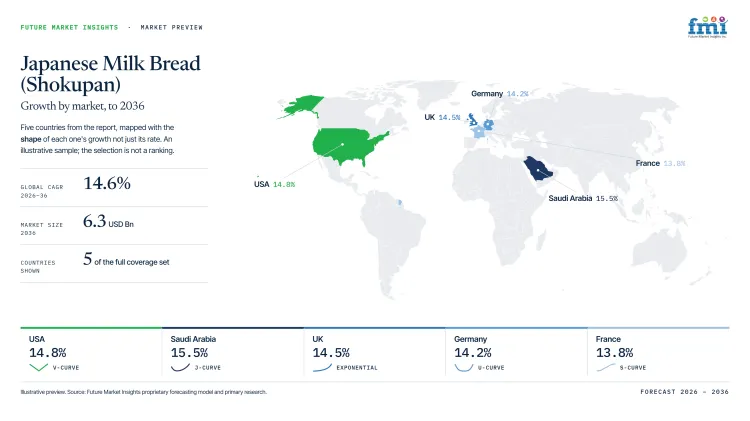
| Country | CAGR |
|---|---|
| Saudi Arabia | 15.5% |
| United States | 14.8% |
| United Kingdom | 14.5% |
| Germany | 14.2% |
| France | 13.8% |
How do country-level CAGRs compare in the Japanese Milk Bread (Shokupan) Market?
The five-country range spans 1.7 percentage points, with Saudi Arabia leading at 15.5%, followed by the United States at 14.8%, the United Kingdom at 14.5%, Germany at 14.2%, and France at 13.8%. The relatively narrow spread suggests that market-entry success depends not only on CAGR ranking but also on distribution efficiency, premium positioning, freshness management, and competitive intensity.
- United States specialty discovery usually precedes wider supermarket replenishment programs.
- Formal food-import handling makes distributor execution central to Saudi hospitality expansion.
- Germany benefits from an established bakery culture and demand for quality products, while strong domestic competition requires clear differentiation.
- France benefits from premium bakery consumption and established artisan traditions, although strong local preferences create competitive challenges.
- United Kingdom white-bread decline raises pressure on premium texture and differentiated claims.
Similar CAGRs therefore mask different waste, registration and shelf-competition conditions for commercial entry. The full report provides country-level CAGR analysis across North America, Latin America, Europe, East Asia, South Asia, Oceania and the Middle East and Africa.
Country-wise Analysis
- Metropolitan Asian bakeries and regional specialty grocers give USA consumers an entry point before shokupan earns space in conventional bread aisles. USDA’s May 2026 Wheat Outlook noted that first-quarter wheat milled for flour was 2% below the prior year, reinforcing cost discipline for bakers serving a mature flour market. The United States sector is projected to record 14.8% CAGR during the assessment period, tied to multicultural discovery and established USA bakery inputs. The harder step is repeat supermarket velocity, so manufacturers need recognizable slice geometry and pack sizes that keep unit pricing credible against national sandwich-bread brands.
- Saudi grocery and hotel operators depend heavily on formal import handling before unfamiliar bakery formats reach commercial shelves. GASTAT reported in May 2026 that international passenger traffic rose 9.4% during 2025, widening the visitor base for international foodservice concepts. Saudi Arabia is estimated to post 15.5% CAGR over the forecast period, aided by expanding hospitality demand and modern retail availability. Imported-food registration and longer inbound logistics raise the cost of carrying soft loaves. Local distributors gain an advantage after they clear registration and use frozen or par-baked formats beyond the densest retail corridors.
- Germany is expected to record a 14.2% CAGR over the forecast period, supported by established bakery consumption, premium product demand, and increasing interest in international bakery concepts. The country's strong domestic bakery sector creates a competitive environment in which Japanese milk bread must demonstrate clear differentiation. Soft texture, product quality, ingredient transparency, and distinctive formats can support premium positioning while helping entrants compete with established local bakery offerings.
- France is projected to expand at a 13.8% CAGR through 2036, benefiting from premium bakery consumption and growing consumer exposure to international bakery formats. At the same time, the country's established artisan and bakery culture creates high expectations for taste, texture, and product quality. Japanese milk bread brands can improve market acceptance by emphasizing its distinctive softness and premium eating experience while adapting flavors and formats to local preferences.
- Major UK supermarkets already offer dense bread choice, leaving little room for a premium soft white loaf without a clear use case. Health perception also matters since shoppers have shifted away from conventional white bread for decades. In June 2026 the Competition and Markets Authority cleared Associated British Foods’ Hovis acquisition following evidence of declining bread demand and stronger private-label pressure. Japanese milk bread sales in the United Kingdom are forecast to expand at 14.5% CAGR by 2036, helped by premium texture and international food discovery. Retailers can test smaller packs or differentiated claims before nationwide allocation. This approach establishes repeat demand before a broader listing.
Who are the notable companies in the Japanese Milk Bread (Shokupan) Market?
Grupo Bimbo, Flowers Foods, Inc., ARYZTA AG, Lantmännen Unibake, Vandemoortele, Yamazaki Baking Co., Ltd., Warburtons and Europastry are notable companies serving this market.
-market-analysis-by-company.webp "Japanese Milk Bread (shokupan) Market Analysis By Company")
Competition separates into daily-fresh packaged bread groups and bake-off bakery platforms rather than one global shokupan model. Grupo Bimbo, Flowers Foods, Yamazaki Baking and Warburtons have direct experience in sliced or soft bread. ARYZTA, Lantmännen Unibake, Vandemoortele and Europastry bring frozen or foodservice routes that extend service distance. The entry barrier is therefore the ability to preserve softness while matching each channel’s shelf-life and order economics, a capability also central to flour improver selection.
- Packaged soft-bread and daily-fresh networks include Grupo Bimbo, Flowers Foods, Inc., Yamazaki Baking Co., Ltd. and Warburtons.
- Frozen and bake-off bakery platforms include ARYZTA AG, Lantmännen Unibake, Vandemoortele and Europastry.
Competitive Benchmarking: Japanese Milk Bread (Shokupan) Market
| Company | Soft Loaf Relevance | Format Flexibility | Channel Coverage | Geographic Reach |
|---|---|---|---|---|
| Grupo Bimbo | High | Medium | High | Global |
| Flowers Foods, Inc. | High | High | High | United States |
| ARYZTA AG | Medium | High | High | Europe, Asia and Oceania |
| Lantmännen Unibake | Medium | High | High | Europe and international sales |
| Vandemoortele | Medium | High | High | Europe, United States and Asia |
| Yamazaki Baking Co., Ltd. | High | Medium | High | Japan and international markets |
| Warburtons | High | Low | Medium | United Kingdom |
| Europastry | Medium | High | High | Europe, Americas and selected Asia markets |
Scoring basis: High soft-loaf relevance requires a current sliced or enriched bread platform. Medium reflects adjacent bread and bun depth. Low identifies one narrow route. High format flexibility requires fresh plus frozen or bake-off capability. Medium requires two documented formats. Low identifies one format. High channel coverage requires retail and foodservice access in multiple operating markets. Medium reflects narrower dual-channel evidence. Low identifies one principal route.
Key Developments in the Japanese Milk Bread (Shokupan) Market
- In September 2025, Grupo Bimbo received regulatory approval to acquire Wickbold in Brazil, extending a large packaged-bread platform within a major Latin American market.
- In June 2025, Lantmännen Unibake announced a new 13,000-square-meter bread production facility in Örebro, with operations planned for 2027 to expand industrial bread capacity.
- In February 2025, Vandemoortele acquired Lizzi in Italy, adding four frozen-bakery production sites and a portfolio covering bread, pizza, focaccia and sweet or savory bakery products.
Key Players in the Japanese Milk Bread (Shokupan) Market
Large Packaged-Bread Platforms
- Grupo Bimbo
- Flowers Foods, Inc.
Frozen and Bake-Off Bakery Platforms
- ARYZTA AG
- Lantmännen Unibake
- Vandemoortele
Soft-Bread and International Bakery Specialists
- Yamazaki Baking Co., Ltd.
- Warburtons
- Europastry
Japanese Milk Bread (Shokupan) Market - Report Scope
| Coverage field | Report scope |
|---|---|
| Market breakdown | By product type, claim - nature, format, packaging format, sales channel and region. |
| Quantitative Units | USD Billion. |
| Market Definition | Revenue from bread expressly marketed as Japanese milk bread or shokupan within the stated product, claim, format, packaging and sales-channel universe. |
| Regions Covered | North America, Latin America, Europe, East Asia, South Asia and Pacific, and Middle East and Africa. |
| Countries Covered | UAE, Saudi Arabia, South Korea, United States, United Kingdom, and 20+ countries included in the full report. |
| Key Companies Profiled | Grupo Bimbo, Flowers Foods, Inc., ARYZTA AG, Lantmännen Unibake, Vandemoortele, Yamazaki Baking Co., Ltd., Warburtons, Europastry. |
| Forecast Period | 2026 to 2036. |
| Approach | Primary and secondary research with market triangulation. |
Japanese Milk Bread (Shokupan) Market - Research Methodology
| Method | Approach |
|---|---|
| Primary Research | FMI analysts gathered input from manufacturers, service providers, technology developers, distributors, end users, procurement teams, and subject-matter experts. Interviews examined purchasing decisions, product or service evaluation, adoption barriers, approval requirements, pricing considerations, and expectations for technical or commercial support. Respondents were also asked what evidence is required before a trial, pilot, or initial order develops into regular purchasing. |
| Desk Research | Desk research covered government statistics, regulatory publications, trade data, industry associations, technical literature, standards, company filings, product information, and official corporate announcements. Sources were reviewed for relevance, publication date, geographic coverage, and consistency with the defined market scope. Claims relating to performance, applications, approvals, capacity, investment, and commercial activity were retained only when supported by credible public evidence. |
| Market Sizing and Forecasting | The market model combined the baseline value with historical performance, segment structure, pricing and volume indicators, adoption levels, company participation, and country-level demand conditions. Forecast assumptions considered economic activity, investment trends, regulatory developments, technology adoption, purchasing cycles, supply availability, and barriers to wider market use. Segment and regional estimates were reconciled before the final market total was calculated. |
| Data Validation | Estimates were checked against multiple independent indicators, including public data, company activity, trade patterns, industry developments, and findings from primary interviews. Validation also tested whether products, services, applications, and company revenues fell within the defined market boundaries. Adjacent categories, unsupported claims, overlapping revenues, and activities without direct market relevance were excluded to reduce double counting and maintain consistency across segments and countries. |
Japanese Milk Bread (Shokupan) Market by Segments
Japanese Milk Bread (Shokupan) Market segmented by Product Type:
- Square (kaku) shokupan
- Round-top (yama) shokupan
- Premium ultra-soft
- Filled & flavored
Japanese Milk Bread (Shokupan) Market segmented by Claim - nature:
- Conventional
- Clean label
- Organic
- Gluten-free
- High-protein / fortified
Japanese Milk Bread (Shokupan) Market segmented by Format:
- Fresh
- Frozen
- Ambient packaged
- Chilled
- Par-baked / thaw-and-serve
Japanese Milk Bread (Shokupan) Market segmented by Packaging Format:
- Multipack
- Single-serve
- Family / loaf pack
- Bulk foodservice
Japanese Milk Bread (Shokupan) Market segmented by Sales Channel:
- Supermarkets & hypermarkets
- Artisan & specialty bakeries
- Convenience & forecourt
- Online & DTC
- Foodservice distributors
Japanese Milk Bread (Shokupan) Market by Region:
- North America
- United States
- Canada
- Latin America
- Brazil
- Mexico
- Chile
- Rest of Latin America
- Western Europe
- Germany
- United Kingdom
- Italy
- Spain
- France
- Nordics
- Benelux
- Rest of Western Europe
- Eastern Europe
- Russia
- Poland
- Hungary
- Balkan and Baltic States
- Rest of Eastern Europe
- East Asia
- China
- Japan
- South Korea
- South Asia and Pacific
- India
- ASEAN
- Australia and New Zealand
- Rest of South Asia and Pacific
- Middle East and Africa
- Kingdom of Saudi Arabia
- Other GCC Countries
- Türkiye
- South Africa
- Other African Union Countries
- Rest of Middle East and Africa
Research Sources and Bibliography
- Yamazaki Baking Co., Ltd.. (2026, February 12). Supplementary Material for the Consolidated Financial Results for the Fiscal Year Ended December 31, 2025
- Dubai Department of Economy and Tourism. (2025, February 9). City focuses on strategic approach to destination growth as upward trajectory continues
- Ministry of Education, Culture, Sports, Science and Technology, Japan. (2026, June 9). Food Composition Database
- Grupo Bimbo. (2026, June 10). Portfolio Free from Artificial Colors
- Yamazaki Baking Co., Ltd.. (2025, February 20). 2024 Fiscal Year Financial Results Briefing
- Flowers Foods, Inc.. (2025, April 16). Flowers Foods Launches New Products and Line Expansions to Meet Consumer Needs
- USA Census Bureau. (2025, June 26). Older Adults Outnumber Children in 11 States and Nearly Half of USA Counties
- Department for Environment, Food & Rural Affairs. (2025, November 13). From builder’s tea to oat coffee, how British family eating habits have changed since WW2
- Yamazaki Baking Co., Ltd.. (2025, October 30).
- Dubai Department of Economy and Tourism. (2026, February 9). Dubai welcomes 19.59 million visitors in third record year
- General Authority for Statistics, Saudi Arabia. (2026, May 18). “GASTAT”: Passenger traffic at the Kingdom’s airports increases to 140.9 million passengers during 2025
- Ministry of Agriculture, Food and Rural Affairs, Republic of Korea. (2025, April 2). Invigorating the Floury Rice Industry: a Win-Win Situation for Both Bakeries and Farmers
- USA Department of Agriculture, Economic Research Service. (2026, May 14). Wheat Outlook: May 2026
- Competition and Markets Authority. (2026, June 16). CMA clears ABF’s deal to buy bread maker Hovis
- Grupo Bimbo. (2025, September 17). GRUPO BIMBO Receives Regulatory Approval to Acquire Wickbold in Brazil
- Lantmännen Unibake. (2025, June 3). Lantmännen makes strategic and long-term investment in new production facility for bread
- Vandemoortele. (2025, February 14). Vandemoortele acquires Lizzi in Italy, a specialty player in frozen bakery
- Grupo Bimbo. (2026). Annual Report 2025
- Flowers Foods, Inc.. (2026). 2025 Annual Report
- ARYZTA AG. (2026). ARYZTA AG Annual Report 2025
- Lantmännen Unibake. (2025). Lantmännen Unibake 2025 News Archive
- Vandemoortele. (2026, March 30). Annual Integrated Report 2025
- Yamazaki Baking Co., Ltd.. (2026). Financial Results
- Warburtons. (2026, January). Section 172 and Governance Statement for the Year Ended 2025
- Europastry. (2025, October). Annual Report 2024
- Grupo Bimbo. (2026, May 5). Grupo Bimbo Announces Approximately US $1 Billion Investment in the United States Between 2026 and 2028
- Flowers Foods, Inc.. (2025, February 21). FLOWERS FOODS, INC. COMPLETES ACQUISITION OF SIMPLE MILLS
- ARYZTA AG. (2026, June 23). ARYZTA acquires French distribution business
- Lantmännen Unibake. (2025, September 1). Lantmännen Unibake expands in savoury with acquisition of Boboli Benelux B.V.
- Vandemoortele. (2026, March 30). Vandemoortele presents annual results 2025
- Grupo Bimbo. (2026, May 12). We achieved Positive Nutrition across 98% of our daily consumption portfolio
- Flowers Foods, Inc.. (2025, October 27). FLOWERS FOODS TAPS INTO HIGHER-PROTEIN AND SOURDOUGH TRENDS WITH NEW PRODUCTS
- ARYZTA AG. (2026, January 22). Full year 2025 targets achieved; Revenue growth & improved performance expected in 2026; New €40m bun bakery in Portugal
- Lantmännen Unibake. (2025, December 23). Lantmännen Unibake signs agreement to expand in Italy
- Vandemoortele. (2026, August 3). Vandemoortele USA completes final phase of acquisition of New Jersey-based Banneton Bakery
- Yamazaki Baking Co., Ltd.. (2025, December 25).
- Europastry. (2025, January). New Products
This bibliography is provided for reader reference and is not exhaustive. The full report contains the complete reference list and detailed citations
This Report Answers
- How large is the japanese milk bread (shokupan) market in 2026 and what value is projected for 2036?
- Which commercial conditions turn shokupan trial into repeat retail and foodservice purchasing?
- Why does square (kaku) shokupan hold the leading product type share in 2026?
- How do conventional formulations and fresh formats protect the category’s softness proposition?
- Why do supermarkets & hypermarkets provide the largest current sales-channel share?
- How do the five profiled country CAGRs differ and what local conditions explain the spread?
- Which companies compete through daily-fresh packaged bread and which rely on frozen or bake-off bakery routes?
- What freshness, price and nutrition perceptions can limit repeat purchase after initial product discovery?
- Which recent company actions are changing capacity, formulation and distribution within adjacent bread platforms?
Frequently Asked Questions
How big is the japanese milk bread (shokupan) market in 2026?
Valued at USD 1.6 billion in 2026, the japanese milk bread (shokupan) market is projected to reach USD 6.3 billion by 2036. Growth depends on converting premium softness and thick-slice use into repeat grocery and foodservice purchases.
What is the CAGR of the japanese milk bread (shokupan) market from 2026 to 2036?
Between 2026 and 2036, the japanese milk bread (shokupan) market is projected to grow at a CAGR of 14.6%. Broader Japanese bakery discovery and retail formats that preserve softness while controlling waste support expansion.
Which product type leads the japanese milk bread (shokupan) market?
The square (kaku) shokupan segment is expected to hold 34.0% of the japanese milk bread (shokupan) market in 2026, driven by uniform slicing and predictable pack geometry. Those attributes fit routine toast and sandwich use in mainstream bread aisles.
Which sales channel leads the japanese milk bread (shokupan) market?
The supermarkets & hypermarkets segment is expected to hold 37.0% of the japanese milk bread (shokupan) market in 2026, supported by repeat grocery traffic and direct shelf comparison. Large store networks also accommodate fresh and frozen formats under one retailer.
How much value will the japanese milk bread (shokupan) market add between 2026 and 2036?
The japanese milk bread (shokupan) market is expected to add USD 4.7 billion in value between 2026 and 2036. Wider channel access must not let premium pricing or freshness losses weaken repeat purchase.
Which countries are projected to record the highest growth in the japanese milk bread (shokupan) market?
UAE is projected to grow at 15.8% CAGR, followed by Saudi Arabia at 15.5% and South Korea at 15.1% through 2036. Growth is supported by hospitality exposure and bakery networks that give international soft-bread formats repeated trial opportunities.
Which companies are active in the japanese milk bread (shokupan) market?
Key companies operating in the market include Grupo Bimbo, Flowers Foods, Inc., ARYZTA AG, Lantmännen Unibake, Vandemoortele, Yamazaki Baking Co., Ltd., Warburtons, and Europastry. These companies compete through sliced-bread scale, bake-off distribution, formulation control and retail or foodservice access.
Preview the report firsthand - request a free sample
Get SampleGet the brochure for pricing and purchase details.
Get PDFTable of Content
- Key Takeaways
- Market Size and CAGR
- Top Growth Driver
- Fastest Growing Segment
- Leading Region
- Key Companies
- Emerging Opportunities
- Executive Summary
- Global Market Outlook
- Demand-side Trends
- Supply-side Trends
- Technology Roadmap Analysis
- Analysis and Recommendations
- Analyst Perspective (What is happening? Why now? What should investors know?)
- Key Questions Answered
- How large is the market?
- What is the CAGR?
- What are key trends?
- Which region dominates?
- Who are the leaders?
- Market Overview
- Market Coverage / Taxonomy
- Market Definition / Scope / Limitations
- Research Methodology
- Chapter Orientation
- Analytical Lens and Working Hypotheses
- Market Structure, Signals, and Trend Drivers
- Benchmarking and Cross-market Comparability
- Market Sizing, Forecasting, and Opportunity Mapping
- Research Design and Evidence Framework
- Desk Research Programme (Secondary Evidence)
- Expert Input and Fieldwork (Primary Evidence)
- Tooling, Models, and Reference Databases
- Data Engineering and Model Build
- Quality Assurance and Audit Trail
- Market Background
- Market Dynamics (Drivers, Restraints, Opportunity, Trends)
- Scenario Forecast (Optimistic, Likely, Conservative)
- Impact Analysis
- AI Impact
- Sustainability Impact
- Regulatory Impact
- Technology Impact
- Consumer / Buyer Analysis
- Purchase Drivers
- Adoption Barriers
- Buyer Journey
- Opportunity Map Analysis
- Product Life Cycle Analysis
- Supply Chain Analysis
- Investment Feasibility Matrix
- Value Chain Analysis
- PESTLE and Porter's Analysis
- Regulatory Landscape
- Regional Parent Market Outlook
- Production and Consumption Statistics
- Import and Export Statistics
- Global Market Analysis and Forecast, 2021 to 2036
- Historical Market Size Value (USD Billion) Analysis, 2021 to 2025
- Current and Future Market Size Value (USD Billion) Projections, 2026 to 2036
- Y-o-Y Growth Trend Analysis
- Absolute $ Opportunity Analysis
- Global Market Pricing Analysis, 2021 to 2036
- Global Market Analysis and Forecast, By Product Type, 2021 to 2036
- Introduction / Key Findings
- Historical Market Size Value (USD Billion) Analysis By Product Type, 2021 to 2025
- Current and Future Market Size Value (USD Billion) Analysis and Forecast By Product Type, 2026 to 2036
- Square (kaku) shokupan
- Round-top (yama) shokupan
- Premium ultra-soft
- Filled & flavored
- Square (kaku) shokupan
- Y-o-Y Growth Trend Analysis By Product Type, 2021 to 2025
- Absolute $ Opportunity Analysis By Product Type, 2026 to 2036
- Global Market Analysis and Forecast, By Claim / Nature, 2021 to 2036
- Introduction / Key Findings
- Historical Market Size Value (USD Billion) Analysis By Claim / Nature, 2021 to 2025
- Current and Future Market Size Value (USD Billion) Analysis and Forecast By Claim / Nature, 2026 to 2036
- Conventional
- Clean label
- Organic
- Gluten-free
- High-protein / fortified
- Conventional
- Y-o-Y Growth Trend Analysis By Claim / Nature, 2021 to 2025
- Absolute $ Opportunity Analysis By Claim / Nature, 2026 to 2036
- Global Market Analysis and Forecast, By Format, 2021 to 2036
- Introduction / Key Findings
- Historical Market Size Value (USD Billion) Analysis By Format, 2021 to 2025
- Current and Future Market Size Value (USD Billion) Analysis and Forecast By Format, 2026 to 2036
- Fresh
- Frozen
- Ambient packaged
- Chilled
- Par-baked / thaw-and-serve
- Fresh
- Y-o-Y Growth Trend Analysis By Format, 2021 to 2025
- Absolute $ Opportunity Analysis By Format, 2026 to 2036
- Global Market Analysis and Forecast, By Packaging Format, 2021 to 2036
- Introduction / Key Findings
- Historical Market Size Value (USD Billion) Analysis By Packaging Format, 2021 to 2025
- Current and Future Market Size Value (USD Billion) Analysis and Forecast By Packaging Format, 2026 to 2036
- Multipack
- Single-serve
- Family / loaf pack
- Bulk foodservice
- Multipack
- Y-o-Y Growth Trend Analysis By Packaging Format, 2021 to 2025
- Absolute $ Opportunity Analysis By Packaging Format, 2026 to 2036
- Global Market Analysis and Forecast, By Sales Channel, 2021 to 2036
- Introduction / Key Findings
- Historical Market Size Value (USD Billion) Analysis By Sales Channel, 2021 to 2025
- Current and Future Market Size Value (USD Billion) Analysis and Forecast By Sales Channel, 2026 to 2036
- Supermarkets & hypermarkets
- Artisan & specialty bakeries
- Convenience & forecourt
- Online & DTC
- Foodservice distributors
- Supermarkets & hypermarkets
- Y-o-Y Growth Trend Analysis By Sales Channel, 2021 to 2025
- Absolute $ Opportunity Analysis By Sales Channel, 2026 to 2036
- Global Market Analysis and Forecast, By Region, 2021 to 2036
- Introduction
- Historical Market Size Value (USD Billion) Analysis By Region, 2021 to 2025
- Current Market Size Value (USD Billion) Analysis and Forecast By Region, 2026 to 2036
- North America
- Latin America
- Western Europe
- Eastern Europe
- East Asia
- South Asia and Pacific
- Middle East & Africa
- Market Attractiveness Analysis By Region
- North America Market Analysis and Forecast, By Country, 2021 to 2036
- Historical Market Size Value (USD Billion) Trend Analysis By Market Taxonomy, 2021 to 2025
- Market Size Value (USD Billion) Forecast By Market Taxonomy, 2026 to 2036
- By Country
- USA
- Canada
- By Product Type
- By Claim / Nature
- By Format
- By Packaging Format
- By Sales Channel
- By Country
- Market Attractiveness Analysis
- By Country
- By Product Type
- By Claim / Nature
- By Format
- By Packaging Format
- By Sales Channel
- Key Takeaways
- Latin America Market Analysis and Forecast, By Country
- Historical Market Size Value (USD Billion) Trend Analysis By Market Taxonomy, 2021 to 2025
- Market Size Value (USD Billion) Forecast By Market Taxonomy, 2026 to 2036
- By Country
- Brazil
- Mexico
- Chile
- Rest of Latin America
- By Product Type
- By Claim / Nature
- By Format
- By Packaging Format
- By Sales Channel
- By Country
- Market Attractiveness Analysis
- By Country
- By Product Type
- By Claim / Nature
- By Format
- By Packaging Format
- By Sales Channel
- Key Takeaways
- Western Europe Market Analysis and Forecast, By Country
- Historical Market Size Value (USD Billion) Trend Analysis By Market Taxonomy, 2021 to 2025
- Market Size Value (USD Billion) Forecast By Market Taxonomy, 2026 to 2036
- By Country
- Germany
- UK
- Italy
- Spain
- France
- Nordic
- BENELUX
- Rest of Western Europe
- By Product Type
- By Claim / Nature
- By Format
- By Packaging Format
- By Sales Channel
- By Country
- Market Attractiveness Analysis
- By Country
- By Product Type
- By Claim / Nature
- By Format
- By Packaging Format
- By Sales Channel
- Key Takeaways
- Eastern Europe Market Analysis and Forecast, By Country
- Historical Market Size Value (USD Billion) Trend Analysis By Market Taxonomy, 2021 to 2025
- Market Size Value (USD Billion) Forecast By Market Taxonomy, 2026 to 2036
- By Country
- Russia
- Poland
- Hungary
- Balkan & Baltic
- Rest of Eastern Europe
- By Product Type
- By Claim / Nature
- By Format
- By Packaging Format
- By Sales Channel
- By Country
- Market Attractiveness Analysis
- By Country
- By Product Type
- By Claim / Nature
- By Format
- By Packaging Format
- By Sales Channel
- Key Takeaways
- East Asia Market Analysis and Forecast, By Country
- Historical Market Size Value (USD Billion) Trend Analysis By Market Taxonomy, 2021 to 2025
- Market Size Value (USD Billion) Forecast By Market Taxonomy, 2026 to 2036
- By Country
- China
- Japan
- South Korea
- By Product Type
- By Claim / Nature
- By Format
- By Packaging Format
- By Sales Channel
- By Country
- Market Attractiveness Analysis
- By Country
- By Product Type
- By Claim / Nature
- By Format
- By Packaging Format
- By Sales Channel
- Key Takeaways
- South Asia and Pacific Market Analysis and Forecast, By Country
- Historical Market Size Value (USD Billion) Trend Analysis By Market Taxonomy, 2021 to 2025
- Market Size Value (USD Billion) Forecast By Market Taxonomy, 2026 to 2036
- By Country
- India
- ASEAN
- Australia & New Zealand
- Rest of South Asia and Pacific
- By Product Type
- By Claim / Nature
- By Format
- By Packaging Format
- By Sales Channel
- By Country
- Market Attractiveness Analysis
- By Country
- By Product Type
- By Claim / Nature
- By Format
- By Packaging Format
- By Sales Channel
- Key Takeaways
- Middle East & Africa Market Analysis and Forecast, By Country
- Historical Market Size Value (USD Billion) Trend Analysis By Market Taxonomy, 2021 to 2025
- Market Size Value (USD Billion) Forecast By Market Taxonomy, 2026 to 2036
- By Country
- Kingdom of Saudi Arabia
- Other GCC Countries
- Türkiye
- South Africa
- Other African Union
- Rest of Middle East & Africa
- By Product Type
- By Claim / Nature
- By Format
- By Packaging Format
- By Sales Channel
- By Country
- Market Attractiveness Analysis
- By Country
- By Product Type
- By Claim / Nature
- By Format
- By Packaging Format
- By Sales Channel
- Key Takeaways
- Key Countries Market Analysis
- USA
- Pricing Analysis
- Market Share Analysis, 2025
- By Product Type
- By Claim / Nature
- By Format
- By Packaging Format
- By Sales Channel
- Canada
- Pricing Analysis
- Market Share Analysis, 2025
- By Product Type
- By Claim / Nature
- By Format
- By Packaging Format
- By Sales Channel
- Mexico
- Pricing Analysis
- Market Share Analysis, 2025
- By Product Type
- By Claim / Nature
- By Format
- By Packaging Format
- By Sales Channel
- Brazil
- Pricing Analysis
- Market Share Analysis, 2025
- By Product Type
- By Claim / Nature
- By Format
- By Packaging Format
- By Sales Channel
- Chile
- Pricing Analysis
- Market Share Analysis, 2025
- By Product Type
- By Claim / Nature
- By Format
- By Packaging Format
- By Sales Channel
- Germany
- Pricing Analysis
- Market Share Analysis, 2025
- By Product Type
- By Claim / Nature
- By Format
- By Packaging Format
- By Sales Channel
- UK
- Pricing Analysis
- Market Share Analysis, 2025
- By Product Type
- By Claim / Nature
- By Format
- By Packaging Format
- By Sales Channel
- Italy
- Pricing Analysis
- Market Share Analysis, 2025
- By Product Type
- By Claim / Nature
- By Format
- By Packaging Format
- By Sales Channel
- Spain
- Pricing Analysis
- Market Share Analysis, 2025
- By Product Type
- By Claim / Nature
- By Format
- By Packaging Format
- By Sales Channel
- France
- Pricing Analysis
- Market Share Analysis, 2025
- By Product Type
- By Claim / Nature
- By Format
- By Packaging Format
- By Sales Channel
- India
- Pricing Analysis
- Market Share Analysis, 2025
- By Product Type
- By Claim / Nature
- By Format
- By Packaging Format
- By Sales Channel
- ASEAN
- Pricing Analysis
- Market Share Analysis, 2025
- By Product Type
- By Claim / Nature
- By Format
- By Packaging Format
- By Sales Channel
- Australia & New Zealand
- Pricing Analysis
- Market Share Analysis, 2025
- By Product Type
- By Claim / Nature
- By Format
- By Packaging Format
- By Sales Channel
- China
- Pricing Analysis
- Market Share Analysis, 2025
- By Product Type
- By Claim / Nature
- By Format
- By Packaging Format
- By Sales Channel
- Japan
- Pricing Analysis
- Market Share Analysis, 2025
- By Product Type
- By Claim / Nature
- By Format
- By Packaging Format
- By Sales Channel
- South Korea
- Pricing Analysis
- Market Share Analysis, 2025
- By Product Type
- By Claim / Nature
- By Format
- By Packaging Format
- By Sales Channel
- Russia
- Pricing Analysis
- Market Share Analysis, 2025
- By Product Type
- By Claim / Nature
- By Format
- By Packaging Format
- By Sales Channel
- Poland
- Pricing Analysis
- Market Share Analysis, 2025
- By Product Type
- By Claim / Nature
- By Format
- By Packaging Format
- By Sales Channel
- Hungary
- Pricing Analysis
- Market Share Analysis, 2025
- By Product Type
- By Claim / Nature
- By Format
- By Packaging Format
- By Sales Channel
- Kingdom of Saudi Arabia
- Pricing Analysis
- Market Share Analysis, 2025
- By Product Type
- By Claim / Nature
- By Format
- By Packaging Format
- By Sales Channel
- Türkiye
- Pricing Analysis
- Market Share Analysis, 2025
- By Product Type
- By Claim / Nature
- By Format
- By Packaging Format
- By Sales Channel
- South Africa
- Pricing Analysis
- Market Share Analysis, 2025
- By Product Type
- By Claim / Nature
- By Format
- By Packaging Format
- By Sales Channel
- USA
- Market Structure Analysis
- Competition Dashboard
- Competition Benchmarking
- Market Share Analysis of Top Players
- By Regional
- By Product Type
- By Claim / Nature
- By Format
- By Packaging Format
- By Sales Channel
- Emerging Startups
- Innovation Benchmarking
- Competition Analysis
- Competition Deep Dive
- Grupo Bimbo
- Overview
- Product Portfolio
- Profitability by Market Segments
- Sales Footprint
- Strategy Overview
- Marketing Strategy
- Product Strategy
- Channel Strategy
- Flowers Foods
- Aryzta
- Lantmannen Unibake
- Vandemoortele
- Yamazaki Baking
- Warburtons
- King's Hawaiian
- Europastry
- St Pierre Groupe
- Grupo Bimbo
- Case Studies
- Success Stories
- Recent Developments
- Competition Deep Dive
- Assumptions & Acronyms Used


