

- Market Size (2026)
- USD 28.2 Bn
- Forecast (2036)
- USD 46.8 Bn
- CAGR (2026 to 2036)
- 5.2%
How big is Confectionery and Dessert Packaging Market in 2026?
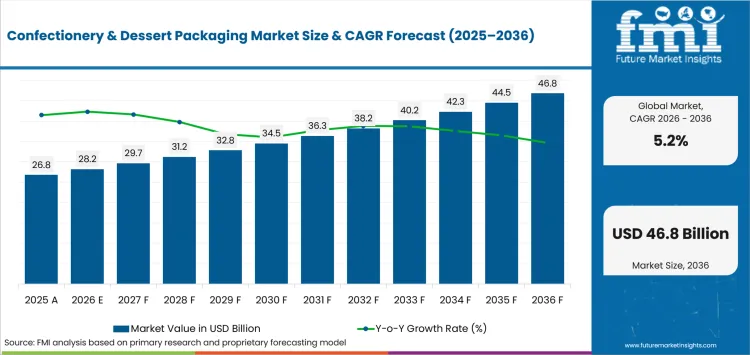
USD 28.2 billion in 2026 and USD 46.8 billion by 2036 at a 5.2% CAGR.
Sales of confectionery and dessert packaging are projected to rise from USD 28.2 billion in 2026 to USD 46.8 billion by 2036 at a 5.2% CAGR, due to recurring packaging demand across chocolate products and bakery desserts with chilled applications. Flexible packaging protects aroma and moisture-sensitive products through lightweight structures suited to high-volume wrapping and portion formats. Amcor reported in November 2024 that Cadbury sharing bars launched in the United Kingdom and Ireland with wrappers made from 80% certified recycled plastic. The project shows that material conversion requires certified sourcing and stable commercial performance across a high-volume chocolate format. Commercial qualification therefore depends on barrier packaging tests and food-contact evidence beside a credible recovery route for the finished pack.
United States confectionery companies manage concentrated seasonal programs; European operations carry broader material documentation across national recovery systems. The National Confectioners Association reported in March 2025 that United States confectionery sales exceeded USD 54 billion during 2024. United States confectionery sales support recurring food packaging orders across gifting programs and everyday portion formats without establishing dominant demand for any single material. European paper packaging producers must assess recovery claims through national collection systems alongside the common European packaging framework. Regional launches also require artwork approval and consistent printing across several pack sizes within fixed seasonal windows. Each material change must preserve grease resistance and sealing stability through the intended recipe and production line.
Key Takeaways of Confectionery and Dessert Packaging Market
- Seasonal campaigns and portioned consumption support recurring demand for packaging that protects confectionery products through distribution and repeated opening cycles.
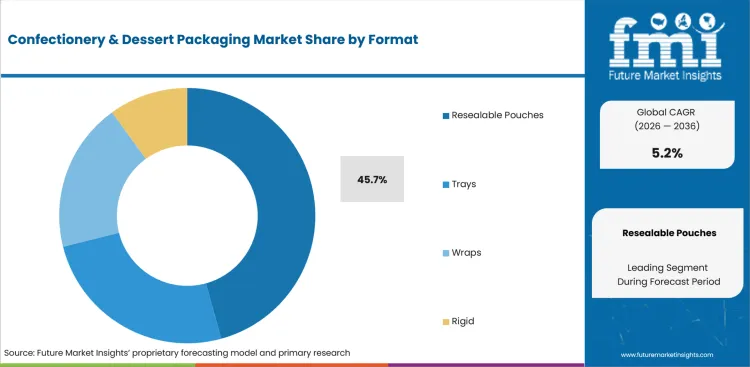
- Resealable pouches are projected to account for 45.7% share in 2026 through convenient storage and protection for multipack sweets.
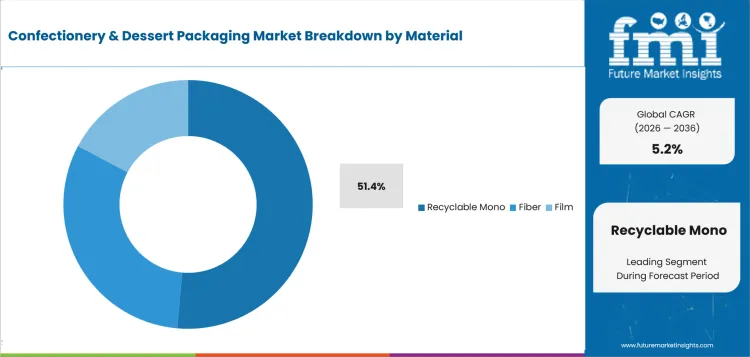
- Recyclable mono is estimated to represent 51.4% of material in 2026 through simpler structure identification and documented recovery design.
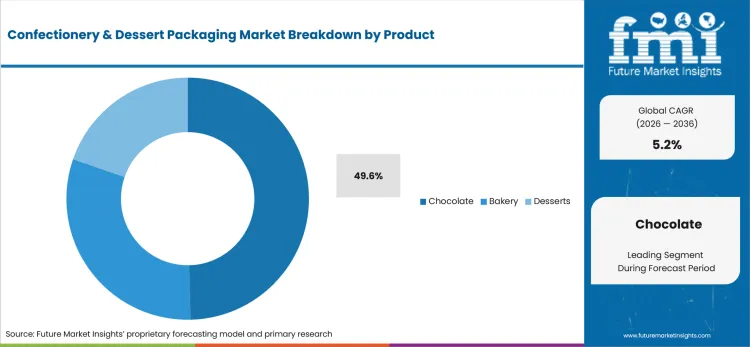
- Chocolate is anticipated to capture 49.6% of product in 2026 through broad retail distribution and demanding aroma or grease protection.
- Material substitution remains constrained by food-contact documentation and line trials that must confirm seal quality across sensitive recipes.
- Mondi and Amcor compete through broad flexible or fiber packaging routes for confectionery and dessert brands. Huhtamaki and ProAmpac add specialized formats; Constantia Flexibles and Sonoco expand pouch or rigid-paper choices across regional portfolios.
Analyst Perspective
"Confectionery packaging choices should begin with fat content and aroma sensitivity rather than a preferred material claim. Chocolate needs grease protection and stable seals through warm distribution; frozen desserts add low-temperature stiffness and condensation risks. Seasonal artwork also shortens trial windows across national campaigns and raises the cost of failed line changes. Strong programs connect recipe-specific shelf-life evidence with proven machine speed and a recovery route that remains valid in each intended country."
- Nandini Roy Choudhury, Principal Analyst, Future Market Insights
How is the Confectionery and Dessert Packaging Market segmented?
The confectionery and dessert packaging industry is segmented by format, material, product, and region.
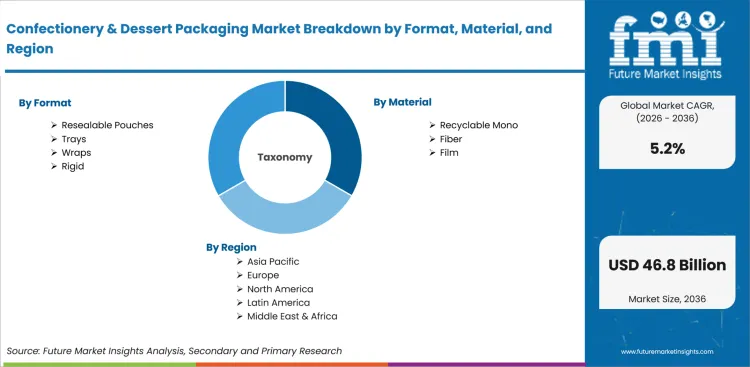
The confectionery and dessert packaging market is segmented by format, material, product, and region for commercial comparison. Format analysis comprises resealable pouches, trays, wraps, and rigid packs used across different opening or display requirements. Material analysis includes recyclable mono structures, fiber formats, and conventional film selected through barrier or recovery needs. Product coverage includes chocolate, bakery desserts, and other dessert products with distinct moisture or grease exposure. Regional analysis compares food-contact rules, recovery systems, local manufacturing capacity, and line-testing practices across major sales areas. Comparable food-grade packaging programs show why selection must follow fat content, moisture exposure, distribution temperature, and required opening behavior.
What makes resealable pouches central to the format category?
Multipack sweets need closures that protect unused portions without reducing filling speed or sealing consistency on commercial lines. Constantia Flexibles announced in August 2025 that its expanded food portfolio included advanced pouches and closure options following the completed Aluflexpack acquisition. This connects repeated-opening convenience with integrated pouch production and broader regional capacity for confectionery programs. Pouch packaging trials therefore need closure-cycle testing beside aroma and moisture measurements under the intended storage conditions.
- In 2026, resealable pouches are expected to lead format with 45.7% share through storage convenience across multipack sweets and gummies. Their position also reflects lower transport weight than many rigid packs and stronger shelf presentation than basic wraps. Commercial approval depends on consistent zipper alignment and seal pressure through every planned production speed.
- Confectionery brands use resealable formats for gummies and mixed sweets that consumers divide across several eating occasions. The closure supports portion control and protects opened products during household storage between several separate consumption occasions. Adoption slows through reduced barrier area or zipper distortion that creates leakage across irregular product deposits.
Why does recyclable mono lead the material category?
Recyclable mono structures simplify material identification but must preserve oxygen and moisture protection across confectionery or frozen-dessert applications. The material route gains commercial value through dependable sealing and recovery classification rather than a resin claim alone. Chocolate and chilled formats add grease exposure or temperature changes that can expose weak films. Comparable mono-material packaging programs need collection-route evidence and completed trials on the intended wrapping equipment during formal approval.
- Recyclable mono is projected to hold 51.4% share in 2026 owing to clearer structure classification and documented recycling design. ProAmpac announced multiple recyclable-technology patents in March 2025 covering mono-material films for dry and frozen foods across rollstock and pouch formats. The patents address heat resistance and barrier choices that support commercial processing on established production equipment.
- Packaging plants introduce mono structures first for dry sweets and secondary pouches that need moderate barrier protection. More sensitive chocolate and frozen desserts require deeper validation through grease contact or low-temperature tests. Adoption expands through structures that reproduce existing line output and match an available collection route across repeated commercial orders.
How does chocolate shape the product category?
Packaging for chocolate products must protect flavor and surface appearance during rapid seasonal changes in artwork and pack size. Relevant tests cover food-contact status and print durability beside commercial seal integrity through distribution temperature changes. Bars and boxed assortments also require different folding or barrier routes across the same brand portfolio. Commercial qualification therefore connects the recipe and distribution temperature with the chosen film or paper structure.
- Based on product, chocolate is projected to account for 49.6% in 2026 due to broad retail distribution and demanding aroma or grease protection. The segment also requires dependable protection against aroma loss and fat migration across bars or boxed assortments. Frequent artwork changes create recurring demand for printed structures that remain stable during campaign production.
- Amcor reported in September 2025 on Cadbury's cold-activated wrappers, launched from June 2025, using recycle-ready film and food-safe thermochromic printing. The launch shows how promotional design can use validated primary packaging rather than a separate decorative sleeve. Adoption rises through accurate color response and dependable seals across short seasonal production windows for national retail campaigns.
What are the drivers, restraints, and opportunities in the Confectionery and Dessert Packaging Market?
Seasonal production supports protective packaging demand; material validation slows redesigns; verified fiber structures create new commercial routes.
- Driver: Concentrated seasonal sales increase packaging changeovers and reward structures that preserve freshness through fixed retail programs.
- Restraint: Material changes can weaken grease barriers or machine performance without product-specific validation on commercial equipment.
- Opportunity: Fiber and mono-material formats can secure repeat orders through documented recovery routes and stable processing performance.
Seasonal selling periods create a direct growth driver through concentrated production and repeated artwork changes across national confectionery programs. The National Confectioners Association stated in March 2025 that four major candy seasons generated 62% of United States confectionery sales during 2024. Concentrated seasonal sales reward packaging plants that complete rapid changeovers without weakening seal quality or printed presentation during fixed retail windows. Reliable output supports recurring orders across national campaigns and smaller regional runs that use the same qualified structures.
Material substitution creates a practical restraint through performance differences between similar structures under grease contact and commercial sealing temperatures. Comparable flexible plastic packaging programs need line-specific evidence for barrier performance and recovery claims across chocolate and frozen-dessert production speeds. The European Union published Regulation (EU) 2025/40 in January 2025 with composition and recovery requirements that operate beside food-contact rules. Limited testing capacity can delay projects that must cover several recipes within fixed launch schedules.
Fiber-based formats create a commercial opening for desserts that need rigid presentation with lower plastic use. Molded fiber becomes useful through liners and lidding that protect shelf life rather than through fiber substitution alone. Packaging plants can trial the format on products that already use rigid trays or cups. Amcor and Metsä Group announced in May 2025 that molded fiber food packs would become commercially available in Europe later that year. The route can secure repeat orders through filling trials and local collection checks across intended sales regions.
Which country CAGRs are profiled in the Confectionery and Dessert Packaging Market?
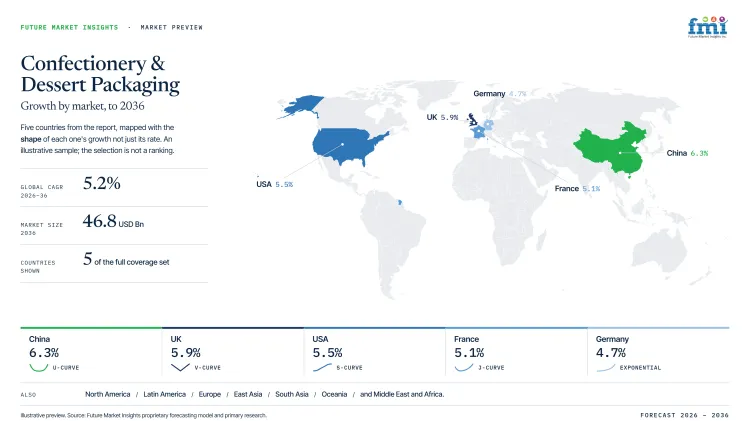
| Country | CAGR |
|---|---|
| USA | 5.5% |
| Germany | 4.7% |
| UK | 5.9% |
| China | 6.3% |
| France | 5.1% |
How do country-level CAGRs compare in the Confectionery and Dessert Packaging Market?
The country forecasts show a gradual progression across the confectionery and dessert packaging market, with China and the UK forming an upper group driven by expanding demand for packaged sweets, premium desserts and convenience-oriented product formats. The USA remains closely aligned with these markets and creates a limited gap between the higher-growth and lower-growth countries. France follows within the same overall range, while Germany records a more measured outlook without creating a significant break in the comparison. The overall spread of 1.6 percentage points suggests that packaging demand is advancing across all five countries, although the pace varies according to consumption patterns, product innovation and packaging sustainability initiatives. The comparison indicates that growth is being shaped by evolving packaging requirements rather than fundamental differences in confectionery and dessert consumption.
- China shows a notable position within the comparison as rising consumption of packaged confectionery and dessert products continues to support demand for flexible, paper-based and premium packaging formats.
- The UK remains closely aligned with China as manufacturers increasingly adopt packaging solutions that improve product presentation, portion control and sustainability performance.
- The USA benefits from steady demand across confectionery, bakery desserts and seasonal products, encouraging continued investment in innovative and convenience-focused packaging formats.
- France reflects ongoing market development through premium confectionery and dessert categories that require packaging capable of supporting product quality and brand differentiation.
- Germany maintains a meaningful position within the comparison as packaging manufacturers emphasize material efficiency, recyclability and improved shelf appeal across confectionery applications.
Comparable CAGRs do not create identical market conditions across countries. Differences in retail structures, packaging material preferences, sustainability regulations and consumer purchasing habits can influence packaging design and adoption decisions. The full report provides country-level CAGR analysis across North America, Latin America, Europe, East Asia, South Asia, Oceania and the Middle East and Africa.
Country-wise Analysis
- United States confectionery brands serve national retailers through concentrated seasonal programs that require rapid artwork changes and dependable wrapping capacity. The United States’ confectionery and dessert packaging outlook is anticipated to advance at 5.5% CAGR over the assessment period, supported by broad chocolate distribution and repeated holiday programs. The National Confectioners Association reported in March 2026 that confectionery sales reached USD 55 billion during 2025. National confectionery sales support recurring orders for printed wraps and presentation packs across major holiday programs. National production volume gives packaging teams enough recurring work to justify dedicated printing tools and repeated line trials. Missed artwork or sealing approvals can disrupt several plants and weaken the value of national production scale.
- German packaging producers must register obligations and assess recyclability through a formal national system ahead of broad retail distribution. The Central Agency Packaging Register published the 2025 minimum standard in August 2025 and described a 70% recyclability target for 2030. Confectionery and dessert packaging demand in Germany is predicted to advance at 4.7% CAGR through 2036, shaped by formal recyclability assessment and mature confectionery production. Formal assessment gives film and paper manufacturers a defined route for comparing redesigns; the shared method supports chocolate wraps beside presentation packs. Grease resistance and shelf-life requirements can extend approval cycles for mono structures across chocolate applications.
- United Kingdom packaging programs now combine PackUK fees with separate food-contact and material reporting requirements across national retail launches. The UK confectionery and dessert packaging sector is projected to record 5.9% CAGR during the assessment period, reinforced by national retail scale and direct fee signals for packaging redesign. The Department for Environment, Food & Rural Affairs published 2025 base fees in June 2025 and scheduled fee modulation for 2026. Clear fee categories give packaging teams a direct cost signal for redesigning pouches and presentation packs. National retailers can use the same fee categories to compare pouches and cartons across recurring product ranges. Changing fee modulation can complicate multi-year contracts through uncertain cost differences between material structures during redesign planning.
- Chinese food-packaging projects must match national material standards with high-volume production lines and diverse regional distribution conditions. Confectionery and dessert packaging sales in China are forecast to expand at 6.3% CAGR by 2036, enabled by large production runs and clearer coated-paper specifications. The Standardization Administration of China published GB/T 36392-2025 in June 2025 for coated paper and board used in food packaging. The standard became effective in January 2026 and gives paper-based dessert packs a defined material specification across large coating and printing networks. The standard addresses paper performance rather than collection outcomes, so national designs still require local recovery checks.
- French packaging programs must combine national producer-responsibility requirements with European food-contact and recovery rules across premium retail formats. The French Republic published Decree 2025-1081 in November 2025 and set the professional packaging responsibility system to begin in January 2026. Adoption of confectionery and dessert packaging in France is estimated to expand at 5.1% CAGR through 2036, influenced by premium presentation needs and expanded producer-responsibility requirements. The decree gives packaging manufacturers a clearer contribution route for professional packs and supports documented recovery planning. National retailers can compare cartons and flexible packs against one defined producer-responsibility route during contract planning. Grease protection can extend approval schedules for packs that must satisfy appearance and recovery requirements together.
Who are the notable companies in the Confectionery and Dessert Packaging Market?
Mondi, Amcor, Huhtamaki, ProAmpac, Constantia Flexibles, and Sonoco are the notable companies shaping this market.
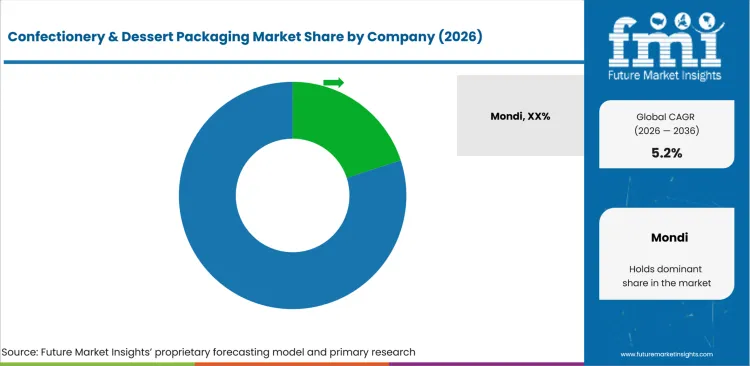
Flexible films and pouches compete with paperboard or rigid fiber formats across chocolate and dessert portfolios. Amcor announced in June 2025 that its expanded Ghent innovation center combines material science and package design at one European site. The center also operates eight filling lines and laboratories for performance or recyclability trials across food packaging structures. Mondi and Constantia Flexibles cover premade pouches and wraps that need tailored barriers or dependable closure performance. Huhtamaki adds chocolate wrappers and ice-cream formats across flexible or fiber structures for ambient and frozen distribution. ProAmpac supplies recyclable rollstock and pouches for dry confectionery applications across established high-speed packaging lines. Sonoco adds rigid paper containers for powdered chocolate products that need shaped presentation and stacking strength.
- Mondi and Constantia Flexibles compete through flexible films and pouches that serve dry sweets or chocolate products. Mondi combines paper and film development with broader board formats for retail display and transport protection. Constantia brings reclosure systems and tailored barrier laminates that support repeated opening or high-speed wrapping.
- Amcor and Huhtamaki cover printed wrappers and dessert formats through film or paperboard technologies across established food operations. Packaging programs can compare promotional print quality with food-contact performance and machine runnability during concentrated campaign production. Huhtamaki extends the choice into ice-cream cups and cone sleeves designed for demanding frozen distribution conditions.
- ProAmpac and Sonoco offer different routes for products that need barrier protection beyond basic flow wraps. ProAmpac supplies recyclable rollstock and pouches with reclosure options for dry sweets or snack applications. Sonoco adds rigid paper containers that protect powdered chocolate or confectionery products through shaped presentation and stronger stacking resistance.
Competitive Benchmarking: Confectionery & Dessert Packaging Market
| Company | Format Breadth | Recyclable Material Systems | Confectionery and Dessert Fit | Geographic Reach |
|---|---|---|---|---|
| Mondi | High | High | High | Global |
| Amcor | High | High | High | Global |
| Huhtamaki | High | High | High | Global |
| ProAmpac | High | High | Medium | Global |
| Constantia Flexibles | Medium | High | High | Global |
| Sonoco | Medium | Medium | Medium | Global |
Key Developments in the Confectionery and Dessert Packaging Market
- In November 2025, Mondi launched an expanded corrugated and solid-board food portfolio following the integration of Schumacher Packaging operations. The range added shelf-ready packs and trays for snacks or confectionery across regional retail programs. Additional hoods and multipacks extend presentation choices beside new wrap formats for transport or display. The development expands regional supply and gives brands access to food-safety laboratories for combined presentation and transport testing.
- In July 2025, Huhtamaki launched recyclable and compostable ice-cream cups made from certified paperboard with a bio-based coating. The company stated that plastic content remained below 10% across the new frozen-dessert format for commercial use. The development gives dessert brands another rigid route that retains barrier performance and branded presentation during cold distribution. Commercial trials must confirm filling compatibility and local recovery acceptance across every intended sales region.
- In March 2025, Mondelēz International adopted Sonoco's EnviroCan paper-bottom container for Cadbury Drinking Chocolate in Australia. The pack uses more than 60% recycled cardboard and enters the national curbside recycling stream. The development connects recognizable cylindrical presentation with a documented fiber recovery route for a confectionery product. Brand teams gain a tested paper option without abandoning familiar shelf shape or dry-product protection.
- In April 2025, Amcor and Riverside Natural Foods launched MadeGood Trail Mix bars in recyclable paper-based wrappers. Amcor reported a 77% reduction in virgin plastic without reduced production speed or graphic quality. The launch gives snack and bar producers direct evidence that fiber conversion can preserve performance on established wrapping equipment. Consumer testing also supported acceptance of the new paper format during regular product use among participants.
Key Players in the Confectionery and Dessert Packaging Market
Flexible Packaging and Pouch Providers
- Mondi
- Amcor
- ProAmpac
- Constantia Flexibles
Foodservice and Confectionery Packaging Providers
- Huhtamaki
- Amcor
- Constantia Flexibles
Rigid Fiber and Presentation Packaging Providers
- Sonoco
- Mondi
- Huhtamaki
Confectionery & Dessert Packaging Market - Report Scope
| Coverage field | Report scope |
|---|---|
| Market breakdown | Format, material, product, and region. |
| Quantitative Units | Revenue in USD Billion, CAGR in %. |
| Market Definition | Primary and secondary packaging used to protect, present, portion, and distribute chocolate, confectionery, bakery desserts, and chilled or frozen desserts. |
| Regions Covered | North America, Latin America, Europe, East Asia, South Asia, Oceania, and Middle East and Africa. |
| Countries Covered | USA, Germany, UK, China, and France, with additional countries assessed across the full regional framework. |
| Key Companies Profiled | Mondi, Amcor, Huhtamaki, ProAmpac, Constantia Flexibles, and Sonoco |
| Forecast Period | 2026 to 2036. |
| Approach | Hybrid bottom-up and top-down market sizing supported by interviews with confectionery packaging participants and official desk research. |
Confectionery & Dessert Packaging Market - Research Methodology
| Method | Approach |
|---|---|
| Primary Research | FMI analysts gathered input from manufacturers, service providers, technology developers, distributors, end users, sourcing teams, and subject-matter experts. Interviews examined purchasing decisions, product or service evaluation, adoption barriers, approval requirements, pricing considerations, and expectations for technical or commercial support. Respondents were also asked what evidence is required before a trial, pilot, or initial order develops into regular purchasing. |
| Desk Research | Desk research covered government statistics, regulatory publications, trade data, industry associations, technical literature, standards, company filings, product information, and official corporate announcements. Sources were reviewed for relevance, publication date, geographic coverage, and consistency with the defined market scope. Claims relating to performance, applications, approvals, capacity, investment, and commercial activity were retained only when supported by credible public evidence. |
| Market Sizing and Forecasting | The market model combined the baseline value with historical performance, segment structure, pricing and volume indicators, adoption levels, company participation, and country-level demand conditions. Forecast assumptions considered economic activity, investment trends, regulatory developments, technology adoption, purchasing cycles, supply availability, and barriers to wider market use. Segment and regional estimates were reconciled before the final market total was calculated. |
| Data Validation | Estimates were checked against multiple independent indicators, including public data, company activity, trade patterns, industry developments, and findings from primary interviews. Validation also tested whether products, services, applications, and company revenues fell within the defined market boundaries. Adjacent categories, unsupported claims, overlapping revenues, and activities without direct market relevance were excluded to reduce double counting and maintain consistency across segments and countries. |
Confectionery And Dessert Packaging Market by Segments
Confectionery and Dessert Packaging Market segmented by Format:
- Resealable Pouches
- Trays
- Wraps
- Rigid
Confectionery and Dessert Packaging Market segmented by Material:
- Recyclable Mono
- Fiber
- Film
Confectionery and Dessert Packaging Market segmented by Product:
- Chocolate
- Bakery
- Desserts
Confectionery and Dessert Packaging Market by Region:
- North America
- United States
- Canada
- Latin America
- Brazil
- Mexico
- Argentina
- Chile
- Western Europe
- Germany
- France
- United Kingdom
- Italy
- Spain
- Benelux
- Nordics
- Eastern Europe
- Poland
- Czech Republic
- Romania
- Hungary
- East Asia
- China
- Japan
- South Korea
- South Asia and Pacific
- India
- ASEAN
- Australia and New Zealand
- Middle East and Africa
- GCC Countries
- South Africa
- Türkiye
- Israel
Research Sources and Bibliography
- Amcor. (2025, June 25). How Collaboration Delivered Cadbury’s Highest Recycled Content Yet, with Mondelez International.
- National Confectioners Association. (2025, March 3). Confectionery Sales Break Records, Surpass $54 Billion in 2024.
- Constantia Flexibles. (2025, August 12). FACHPACK 2025: Constantia Flexibles invests over €100 million and expands product portfolio.
- ProAmpac. (2025, March 4). Bolstering Sustainable Packaging Leadership, ProAmpac Expands Intellectual Property Portfolio.
- Amcor. (2025, September 11). Not just a wrapper, a summer surprise: Discover Cadbury’s packaging with thermochromic ink.
- European Parliament and Council of the European Union. (2025, January 22). Regulation (EU) 2025/40 of the European Parliament and of the Council of 19 December 2024 on packaging and packaging waste, amending Regulation (EU) 2019/1020 and Directive (EU) 2019/904, and repealing Directive 94/62/EC.
- Amcor. (2025, May 12). Amcor and Metsä Group partner to develop molded fiber-based food packaging solutions.
- National Confectioners Association. (2026, March 9). Confectionery Sales Climb to $55 Billion in 2025.
- Central Agency Packaging Register. (2025, August 29). 2025 minimum standard published - initial touchstone for companies preparing for the EU Packaging and Packaging Waste Regulation (PPWR).
- Department for Environment, Food & Rural Affairs. (2025, June 30). Extended Producer Responsibility for Packaging: 2025 base fees.
- Standardization Administration of China. (2025, June 30). Coated paper and board for food packaging.
- République française. (2025, November 18). Décret n° 2025-1081 du 17 novembre 2025 relatif aux emballages ainsi qu'aux déchets d'emballages et instituant la filière de responsabilité élargie des producteurs d'emballages consommés ou utilisés par les professionnels.
- Amcor. (2025, June 18). Amcor Ghent celebrates packaging innovation powered by a century of expertise.
- Mondi. (2025, November 18). Mondi launches extended corrugated and solid board portfolio for the food packaging industry.
- Huhtamaki. (2025, July 16). Huhtamaki launches new compostable ice cream cups.
- Mondelēz International. (2025, March 11). Mondelēz International Adopts Sonoco’s EnviroCan® Paper Bottom Can for Cadbury Drinking Chocolate in Australia.
- Amcor. (2025, April 3). Amcor partners with Riverside Natural Foods to introduce MadeGood Trail Mix bars in AmFiber™ paper-based packaging.
This bibliography is provided for reader reference and is not exhaustive. The full report contains the complete reference list and detailed citations
This Report Answers
- How large is the confectionery and dessert packaging market in 2026 and 2036?
- Which product-protection requirements support investment in new confectionery packaging structures?
- Why do resealable pouches account for the leading format share in 2026?
- How does recyclable mono influence material selection and validation?
- Why does chocolate account for the leading product share in 2026?
- How do country growth rates differ across China, the UK, the USA, France, and Germany?
- Which companies provide flexible films, pouches, paperboard, or rigid fiber formats?
- What limits material substitution across chocolate and chilled dessert applications?
- How can packaging teams compare recyclability claims with line performance?
Frequently Asked Questions
How big is the Confectionery and Dessert Packaging Market in 2026?
The confectionery and dessert packaging market is valued at USD 28.2 billion in 2026 and is forecast to reach USD 46.8 billion by 2036.
What is the CAGR of the Confectionery and Dessert Packaging Market from 2026 to 2036?
The confectionery and dessert packaging market is projected to grow at a CAGR of 5.2% between 2026 and 2036, supported by concentrated seasonal sales programs driving recurring demand for protective packaging structures across chocolate and bakery dessert formats.
Which format segment leads the Confectionery and Dessert Packaging Market?
A3: Resealable pouches account for 45.7% of the confectionery and dessert packaging market by format in 2026, driven by storage convenience and portion control across multipack sweets and gummies that consumers divide across several eating occasions.
Which country is growing fastest in the Confectionery and Dessert Packaging Market?
China is the fastest-growing country in the confectionery and dessert packaging market, expanding at a 6.3% CAGR through 2036, ahead of the market average of 5.2%, supported by rising packaged confectionery consumption, large production runs, and clearer coated-paper specifications under national food-packaging standards.
Who are the leading companies in the Confectionery and Dessert Packaging Market?
Leading companies in the confectionery and dessert packaging market include Mondi, Amcor, Huhtamaki, ProAmpac, Constantia Flexibles, and Sonoco, spanning flexible films, resealable pouches, printed wrappers, and rigid fiber containers across global confectionery and dessert packaging programs.
Preview the report firsthand - request a free sample
Get SampleGet the brochure for pricing and purchase details.
Get PDFTable of Content
- Key Takeaways
- Market Size and CAGR
- Top Growth Driver
- Fastest Growing Segment
- Leading Region
- Key Companies
- Emerging Opportunities
- Executive Summary
- Global Market Outlook
- Demand-side Trends
- Supply-side Trends
- Technology Roadmap Analysis
- Analysis and Recommendations
- Analyst Perspective (What is happening? Why now? What should investors know?)
- Key Questions Answered
- How large is the market?
- What is the CAGR?
- What are key trends?
- Which region dominates?
- Who are the leaders?
- Market Overview
- Market Coverage / Taxonomy
- Market Definition / Scope / Limitations
- Research Methodology
- Chapter Orientation
- Analytical Lens and Working Hypotheses
- Market Structure, Signals, and Trend Drivers
- Benchmarking and Cross-market Comparability
- Market Sizing, Forecasting, and Opportunity Mapping
- Research Design and Evidence Framework
- Desk Research Programme (Secondary Evidence)
- Expert Input and Fieldwork (Primary Evidence)
- Tooling, Models, and Reference Databases
- Data Engineering and Model Build
- Quality Assurance and Audit Trail
- Market Background
- Market Dynamics (Drivers, Restraints, Opportunity, Trends)
- Scenario Forecast (Optimistic, Likely, Conservative)
- Impact Analysis
- AI Impact
- Sustainability Impact
- Regulatory Impact
- Technology Impact
- Consumer / Buyer Analysis
- Purchase Drivers
- Adoption Barriers
- Buyer Journey
- Opportunity Map Analysis
- Product Life Cycle Analysis
- Supply Chain Analysis
- Investment Feasibility Matrix
- Value Chain Analysis
- PESTLE and Porter's Analysis
- Regulatory Landscape
- Regional Parent Market Outlook
- Production and Consumption Statistics
- Import and Export Statistics
- Global Market Analysis and Forecast, 2021 to 2036
- Historical Market Size Value (USD Billion) Analysis, 2021 to 2025
- Current and Future Market Size Value (USD Billion) Projections, 2026 to 2036
- Y-o-Y Growth Trend Analysis
- Absolute $ Opportunity Analysis
- Global Market Pricing Analysis, 2021 to 2036
- Global Market Analysis and Forecast, By Format, 2021 to 2036
- Introduction / Key Findings
- Historical Market Size Value (USD Billion) Analysis By Format, 2021 to 2025
- Current and Future Market Size Value (USD Billion) Analysis and Forecast By Format, 2026 to 2036
- Resealable Pouches
- Trays
- Wraps
- Rigid
- Resealable Pouches
- Y-o-Y Growth Trend Analysis By Format, 2021 to 2025
- Absolute $ Opportunity Analysis By Format, 2026 to 2036
- Global Market Analysis and Forecast, By Material, 2021 to 2036
- Introduction / Key Findings
- Historical Market Size Value (USD Billion) Analysis By Material, 2021 to 2025
- Current and Future Market Size Value (USD Billion) Analysis and Forecast By Material, 2026 to 2036
- Recyclable Mono
- Fiber
- Film
- Recyclable Mono
- Y-o-Y Growth Trend Analysis By Material, 2021 to 2025
- Absolute $ Opportunity Analysis By Material, 2026 to 2036
- Global Market Analysis and Forecast, By Product, 2021 to 2036
- Introduction / Key Findings
- Historical Market Size Value (USD Billion) Analysis By Product, 2021 to 2025
- Current and Future Market Size Value (USD Billion) Analysis and Forecast By Product, 2026 to 2036
- Chocolate
- Bakery
- Desserts
- Chocolate
- Y-o-Y Growth Trend Analysis By Product, 2021 to 2025
- Absolute $ Opportunity Analysis By Product, 2026 to 2036
- Global Market Analysis and Forecast, By Region, 2021 to 2036
- Introduction
- Historical Market Size Value (USD Billion) Analysis By Region, 2021 to 2025
- Current Market Size Value (USD Billion) Analysis and Forecast By Region, 2026 to 2036
- North America
- Latin America
- Western Europe
- Eastern Europe
- East Asia
- South Asia and Pacific
- Middle East & Africa
- Market Attractiveness Analysis By Region
- North America Market Analysis and Forecast, By Country, 2021 to 2036
- Historical Market Size Value (USD Billion) Trend Analysis By Market Taxonomy, 2021 to 2025
- Market Size Value (USD Billion) Forecast By Market Taxonomy, 2026 to 2036
- By Country
- USA
- Canada
- By Format
- By Material
- By Product
- By Country
- Market Attractiveness Analysis
- By Country
- By Format
- By Material
- By Product
- Key Takeaways
- Latin America Market Analysis and Forecast, By Country
- Historical Market Size Value (USD Billion) Trend Analysis By Market Taxonomy, 2021 to 2025
- Market Size Value (USD Billion) Forecast By Market Taxonomy, 2026 to 2036
- By Country
- Brazil
- Mexico
- Chile
- Rest of Latin America
- By Format
- By Material
- By Product
- By Country
- Market Attractiveness Analysis
- By Country
- By Format
- By Material
- By Product
- Key Takeaways
- Western Europe Market Analysis and Forecast, By Country
- Historical Market Size Value (USD Billion) Trend Analysis By Market Taxonomy, 2021 to 2025
- Market Size Value (USD Billion) Forecast By Market Taxonomy, 2026 to 2036
- By Country
- Germany
- UK
- Italy
- Spain
- France
- Nordic
- BENELUX
- Rest of Western Europe
- By Format
- By Material
- By Product
- By Country
- Market Attractiveness Analysis
- By Country
- By Format
- By Material
- By Product
- Key Takeaways
- Eastern Europe Market Analysis and Forecast, By Country
- Historical Market Size Value (USD Billion) Trend Analysis By Market Taxonomy, 2021 to 2025
- Market Size Value (USD Billion) Forecast By Market Taxonomy, 2026 to 2036
- By Country
- Russia
- Poland
- Hungary
- Balkan & Baltic
- Rest of Eastern Europe
- By Format
- By Material
- By Product
- By Country
- Market Attractiveness Analysis
- By Country
- By Format
- By Material
- By Product
- Key Takeaways
- East Asia Market Analysis and Forecast, By Country
- Historical Market Size Value (USD Billion) Trend Analysis By Market Taxonomy, 2021 to 2025
- Market Size Value (USD Billion) Forecast By Market Taxonomy, 2026 to 2036
- By Country
- China
- Japan
- South Korea
- By Format
- By Material
- By Product
- By Country
- Market Attractiveness Analysis
- By Country
- By Format
- By Material
- By Product
- Key Takeaways
- South Asia and Pacific Market Analysis and Forecast, By Country
- Historical Market Size Value (USD Billion) Trend Analysis By Market Taxonomy, 2021 to 2025
- Market Size Value (USD Billion) Forecast By Market Taxonomy, 2026 to 2036
- By Country
- India
- ASEAN
- Australia & New Zealand
- Rest of South Asia and Pacific
- By Format
- By Material
- By Product
- By Country
- Market Attractiveness Analysis
- By Country
- By Format
- By Material
- By Product
- Key Takeaways
- Middle East & Africa Market Analysis and Forecast, By Country
- Historical Market Size Value (USD Billion) Trend Analysis By Market Taxonomy, 2021 to 2025
- Market Size Value (USD Billion) Forecast By Market Taxonomy, 2026 to 2036
- By Country
- Kingdom of Saudi Arabia
- Other GCC Countries
- Türkiye
- South Africa
- Other African Union
- Rest of Middle East & Africa
- By Format
- By Material
- By Product
- By Country
- Market Attractiveness Analysis
- By Country
- By Format
- By Material
- By Product
- Key Takeaways
- Key Countries Market Analysis
- USA
- Pricing Analysis
- Market Share Analysis, 2025
- By Format
- By Material
- By Product
- Canada
- Pricing Analysis
- Market Share Analysis, 2025
- By Format
- By Material
- By Product
- Mexico
- Pricing Analysis
- Market Share Analysis, 2025
- By Format
- By Material
- By Product
- Brazil
- Pricing Analysis
- Market Share Analysis, 2025
- By Format
- By Material
- By Product
- Chile
- Pricing Analysis
- Market Share Analysis, 2025
- By Format
- By Material
- By Product
- Germany
- Pricing Analysis
- Market Share Analysis, 2025
- By Format
- By Material
- By Product
- UK
- Pricing Analysis
- Market Share Analysis, 2025
- By Format
- By Material
- By Product
- Italy
- Pricing Analysis
- Market Share Analysis, 2025
- By Format
- By Material
- By Product
- Spain
- Pricing Analysis
- Market Share Analysis, 2025
- By Format
- By Material
- By Product
- France
- Pricing Analysis
- Market Share Analysis, 2025
- By Format
- By Material
- By Product
- India
- Pricing Analysis
- Market Share Analysis, 2025
- By Format
- By Material
- By Product
- ASEAN
- Pricing Analysis
- Market Share Analysis, 2025
- By Format
- By Material
- By Product
- Australia & New Zealand
- Pricing Analysis
- Market Share Analysis, 2025
- By Format
- By Material
- By Product
- China
- Pricing Analysis
- Market Share Analysis, 2025
- By Format
- By Material
- By Product
- Japan
- Pricing Analysis
- Market Share Analysis, 2025
- By Format
- By Material
- By Product
- South Korea
- Pricing Analysis
- Market Share Analysis, 2025
- By Format
- By Material
- By Product
- Russia
- Pricing Analysis
- Market Share Analysis, 2025
- By Format
- By Material
- By Product
- Poland
- Pricing Analysis
- Market Share Analysis, 2025
- By Format
- By Material
- By Product
- Hungary
- Pricing Analysis
- Market Share Analysis, 2025
- By Format
- By Material
- By Product
- Kingdom of Saudi Arabia
- Pricing Analysis
- Market Share Analysis, 2025
- By Format
- By Material
- By Product
- Türkiye
- Pricing Analysis
- Market Share Analysis, 2025
- By Format
- By Material
- By Product
- South Africa
- Pricing Analysis
- Market Share Analysis, 2025
- By Format
- By Material
- By Product
- USA
- Market Structure Analysis
- Competition Dashboard
- Competition Benchmarking
- Market Share Analysis of Top Players
- By Regional
- By Format
- By Material
- By Product
- Emerging Startups
- Innovation Benchmarking
- Competition Analysis
- Competition Deep Dive
- Mondi
- Overview
- Product Portfolio
- Profitability by Market Segments
- Sales Footprint
- Strategy Overview
- Marketing Strategy
- Product Strategy
- Channel Strategy
- Amcor
- Huhtamaki
- ProAmpac
- Constantia Flexibles
- Sonoco
- Mondi
- Case Studies
- Success Stories
- Recent Developments
- Competition Deep Dive
- Assumptions & Acronyms Used


