

- Market Size (2026)
- USD 9.0 Bn
- Forecast (2036)
- USD 16.3 Bn
- CAGR (2026 to 2036)
- 6.1%
How big is Pallet Pooling Market in 2026?
The 2026 to 2036 outlook projects a market value of USD 9.02 billion in 2026 and USD 16.30 billion by 2036, using a 6.1% annual growth forecast. The published 2025 baseline is USD 8.5 billion.
The global pallet pooling market covers shared pallet services spanning issue, use, recovery and preparation for further circulation across distribution networks. From a published value of USD 8.5 billion in 2025, the extended outlook projects USD 9.02 billion in 2026 and USD 16.30 billion by 2036, using a 6.1% forecast CAGR for 2026 to 2036. Block pallets are projected to account for 47.3% of structural-design demand in 2026, while plastic pallets are projected at 39.8% of the materials breakdown in the same year. Both categories support repeated movements through compatible handling systems.
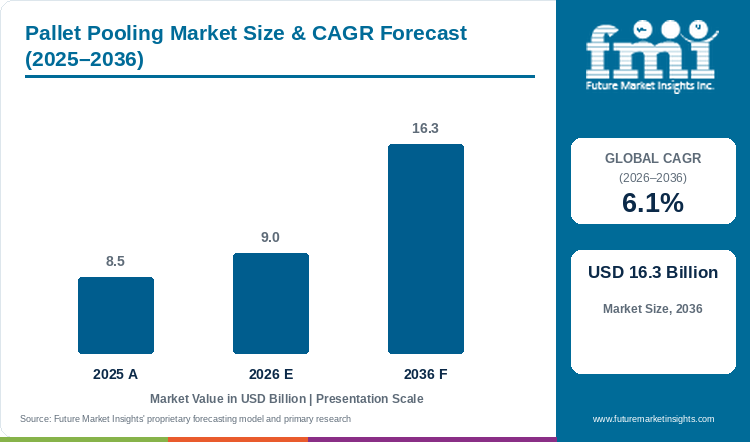
Demand follows shipment frequency and the ability to return empty pallets to useful locations. Collection coverage, inspection and movement records determine how much circulation a fleet can support. Packaging policy adds specific documentation requirements: UK guidance addresses hired or loaned packaging and the service provider's reporting role. [2] The European Commission's February 2026 exemption concerns specified pallet wrapping and straps, while APHIS's 2025 dashboard provides information on wood-packaging imports and compliance. [1][3] These developments make the asset, route and service responsibilities central to the pooling arrangement.
India has the highest projected country CAGR at 9.4%, followed by China at 6.7%, for 2026 to 2036. The United States and United Kingdom each stand at 4.7%, and Germany at 3.6% over that period. India's September 2025 logistics-policy update describes digital integration and multimodal planning, providing a wider setting for coordinating goods movements and reusable-asset circulation. [4]
Brambles, LOSCAM, Euro Pool Group, Faber Halbertsma Group and LPR are among the identified participants. Competition turns on availability along a customer's shipment lanes and on how reliably pallets are collected, checked and reissued. Providers can distinguish their services through practical return points, consistent condition at issue and clear reconciliation of dispatches and returns. Those capabilities connect network coverage with the circulation performance that sustains an ongoing customer account.
Key Market Trends & Insights
- Pooling proposals increasingly need to explain who records packaging supplied and returned; current UK guidance distinguishes the service provider from the organisation hiring its packaging [2].
- EU reuse policy treats packaging formats separately: a February 2026 exemption concerns pallet wrapping and straps, making it important to distinguish those components from pallets themselves [1].
- Shipment visibility is becoming a wider logistics priority. India’s September 2025 policy update describes digital integration and multimodal planning, providing context for more coordinated asset circulation [4].
Regional Highlights
- India and China have the highest projected country CAGRs in the comparison, at 9.4% and 6.7% respectively for 2026 to 2036.
- The United States and United Kingdom each have a projected 4.7% CAGR for 2026 to 2036, with different documentation and operating considerations for pallet users [2] [3].
- Germany’s projected 3.6% CAGR covers 2026 to 2036. EU packaging changes make the distinction between the pallet, wrapping and the wider reuse system relevant to procurement [1].
Market Size & Forecast
Table 1: Market Size and Forecast for Pallet Pooling Market (USD billion and percentage), 2025 to 2036
| Metric | Value |
|---|---|
| 2025 market value - published baseline | USD 8.5 billion |
| 2026 market value - projection | USD 9.02 billion |
| 2036 market value - projection | USD 16.30 billion |
| Forecast CAGR 2026 to 2036 | 6.1% |
| Revenue increase 2026 to 2036 - projection | USD 7.28 billion |
| Market expansion 2026 to 2036 - projection | 1.81 times |
| Published forecast reference for 2035 | USD 15.4 billion |
The 2026 to 2036 market outlook forecasts annual growth of 6.1%. The published 2035 reference value is USD 15.4 billion.
Pool revenue is influenced by the number of movements, the service charged and the time that assets spend away from a depot. More shipments can create demand for additional pallets, but better recovery may also release existing inventory for another trip. Demand should therefore be assessed through circulation and service requirements rather than pallet production alone.
Pallet pooling forms part of the wider circulation of reusable handling assets. The Returnable Transport Packaging Market provides related coverage of the containers and platforms that move through such systems.
Recovery records and packaging responsibilities shape pooling services
A useful pooling service connects the outward shipment with collection, inspection and the next issue of the pallet. Documentation matters across that cycle. UK guidance addresses hired and loaned packaging, while the United States has expanded public information on wood-packaging compliance through an APHIS dashboard [2] [3]. European policy also distinguishes packaging components, with a 2026 exemption for wrapping and straps from specified reuse requirements [1]. These developments create different information needs for a pool serving domestic distribution and one supporting international movements.
Table 2: Industry evidence relevant to the pallet pooling market
| Indicator | Data point or observation | Market relevance | Source |
|---|---|---|---|
| Packaging components | The European Commission announced a pallet-wrapping and straps exemption in February 2026. | A pallet offer must distinguish the reusable platform from other packaging used on the load. | [1] |
| Service-provider reporting | UK guidance expressly addresses hired and loaned packaging, including wooden pallets. | Contracts and records should make the packaging provider’s role clear. | [2] |
| Wood-packaging information | APHIS launched a dashboard covering wood-packaging imports, compliance and related inspection information in 2025. | Shippers have additional public information for assessing wood-packaging sourcing. | [3] |
Analyst Perspective
“Pallet pooling helps companies manage high pallet movement, asset loss and sustainability targets. Service quality depends on recovering and reissuing pallets after shipment, supported by suitable condition checks and an agreed record of responsibility between the shipper and provider.”
- Nikhil Kaitwade, Principal Consultant for Industrial Automation, Future Market Insights
How is the Pallet Pooling Market segmented?
The market is segmented by Structural Design, Materials, End Use Industry, and Region.
- Structural design describes the form that handling equipment encounters. Material affects weight, maintenance and the condition checks used in a pool, while end use describes the shipment environment. A plastic block pallet carrying food contributes to three different views of the same movement. The segment shares below are projected for 2026 within the 2026 to 2036 market outlook. Pallet suitability still depends on the specific load, handling route and receiving facility; a leading category is not a universal specification for every customer.
Why do Block pallets account for a projected 47.3% of structural design demand in 2026?
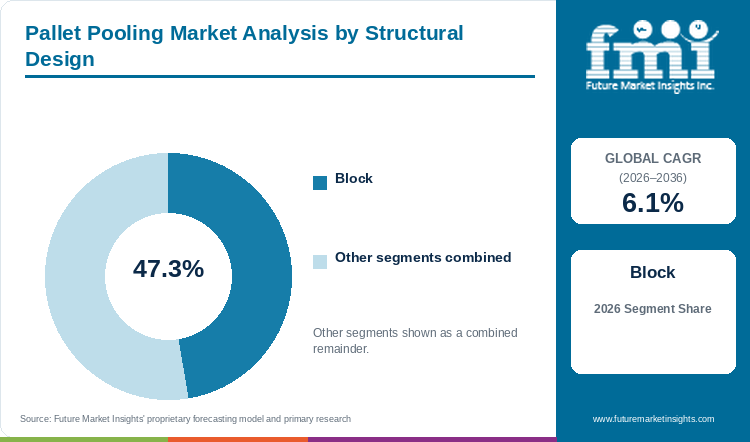
Block pallets are projected to account for 47.3% of structural design demand in 2026.
Table 3: Structural Design Share for Pallet Pooling Market (percentage share), 2026 (projected)
| Structural Design | Projected share (2026) |
|---|---|
| Block pallets | 47.3% |
| Other structural designs | 52.7% |
| Total | 100.0% |
Table 4: Segment Position and Market Growth for Pallet Pooling Market, 2026 to 2036
| Metric | Value |
|---|---|
| Global CAGR (2026 to 2036) | 6.1% |
| Profiled structural design segment | Block pallets |
- Block pallets are projected to account for 47.3% of the structural-design breakdown in 2026. Their commercial role follows the way goods move between loading, storage and unloading points. A shipper needs a format that the equipment at both ends can handle and that can remain useful through repeated trips. Standardisation can reduce the number of pallet variants a customer must manage, although the load and receiving-site requirements still determine suitability.
- In a pool, the return arrangement is also part of the design decision: pallets must be identifiable, collected and checked before another issue. Block pallets are projected to represent 47.3% of structural-design demand in 2026.
Structural Design Benchmark
The Block pallets segment is projected to account for 47.3% of structural design demand in 2026.
- Block pallets represent a projected 47.3% of structural-design demand in 2026; other designs together represent 52.7%.
- The buyer should confirm the load, handling access and receiving-site compatibility before agreeing a standard pallet format.
Why do Plastic pallets account for a projected 39.8% of materials demand in 2026?
Table 5: Materials Share for Pallet Pooling Market (percentage share), 2026 (projected)
| Materials | Projected share (2026) |
|---|---|
| Plastic pallets | 39.8% |
| Other materials | 60.2% |
| Total | 100.0% |
- Plastic pallets are projected to account for 39.8% of the materials breakdown in 2026. A pool selecting material must consider how the pallet will be handled, checked, cleaned where required and recovered after use. Consistent condition at issue is valuable to a shipper because a damaged or unsuitable platform can disrupt loading even when the goods are ready.
- Material choice also interacts with the collection model: losing an asset before it completes enough trips changes the economics of any reusable platform. Buyers therefore need to compare the material and the service supporting it together. Plastic is one option within that assessment, alongside wood, composite and metal categories; its projected share describes the 2026 material mix.
Materials Benchmark
The Plastic pallets segment is projected to account for 39.8% of materials demand in 2026.
- Plastic pallets account for a projected 39.8% of material demand in 2026; the other materials together account for 60.2%.
- Material selection should address handling conditions, inspection and cleaning responsibilities, as well as how empty pallets will return to the pool.
- A pool’s material choice affects the specification offered to the shipper. The Plastic Pallets Market examines the physical product category alongside the separate question of how a pooling service operates.
What are the drivers, restraints, and opportunities in the Pallet Pooling Market?
Repeated shipments support pooling demand; slow recovery and unclear responsibilities constrain fleet use; dependable collections and useful movement records create opportunities for providers.
Driver
Frequent goods movements create a practical reason to consider shared pallet services. A manufacturer or distributor can arrange access to a circulating fleet rather than organise every purchase, return and repair itself. The value depends on whether the service matches the actual shipment lanes and receiving arrangements. Logistics digitisation and better coordination can support this process; India’s 2025 policy update describes wider work on digital integration and multimodal planning [4]. That context supports analysis of circulation services without equating national logistics transactions with pallet-pooling revenue.
Restraint
An empty pallet at the wrong location is unavailable for the next customer even though it remains part of the fleet. Collection distances, delayed releases, damage and missing movement records can therefore weaken the economics of a pool. Customers and providers must agree who reports a movement, who releases the asset and which party handles exceptions. The UK’s distinction between packaging service providers and users makes the allocation of reporting responsibilities relevant to that discussion [2]. A rental price alone cannot resolve those operational dependencies.
Opportunity
Providers can improve an offer by showing how collections, condition checks and inventory availability will work on the customer’s actual routes. Movement records are useful when they support a timely recovery decision or reconcile a disputed balance. International shipments add a sourcing and documentation dimension: APHIS’s 2025 wood-packaging dashboard expands the public information available on that subject [3]. A commercially useful service brings those requirements into the account plan, allowing the customer to assess the complete circulation arrangement alongside the pallet specification.
The loading process must accept the pallet format issued by the pool. The Palletizing Systems Market provides related coverage of equipment that forms and handles pallet loads.
Which country CAGRs are profiled in the Pallet Pooling Market?
Table 6: Country CAGR Comparison for Pallet Pooling Market (CAGR percentage), 2026 to 2036
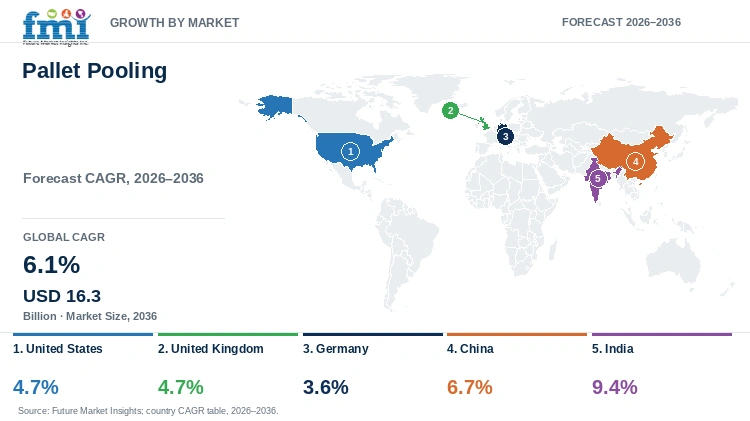
| Country | CAGR |
|---|---|
| United States | 4.7% |
| United Kingdom | 4.7% |
| Germany | 3.6% |
| China | 6.7% |
| India | 9.4% |
Country-wise Analysis
United States Pallet Pooling Market Outlook (2026 to 2036)
US shippers need a pooling arrangement that works across their own dispatch points and the facilities receiving their goods. The country growth rate is a forecast for 2026 to 2036. For businesses using wooden pallets in international movements, packaging sourcing also brings documentation questions. APHIS’s June 2025 dashboard announcement describes information on imports, compliance, inspections and treatment certifications [3]. A provider can help a customer assess these requirements while defining where empty pallets will be collected. The strength of the commercial offer therefore rests on the handling network and the clarity of its records, alongside the suitability of the physical pallet.
United Kingdom Pallet Pooling Market Outlook (2026 to 2036)
Reporting roles are a concrete consideration for UK pooling contracts. Current government guidance addresses service providers hiring or loaning unfilled packaging, including wooden pallets, and distinguishes them from organisations borrowing the packaging for their own use [2]. A shipper comparing services needs to understand what information the provider will retain and how movements will be reconciled when goods pass through several locations. Clear records can also support decisions about collecting empties and preparing the next delivery. This puts account administration and recovery operations in the same commercial discussion: both influence whether the customer can rely on an agreed quantity and condition of pallets at its loading point.
Germany Pallet Pooling Market Outlook (2026 to 2036)
For customers assessing the service, the relevant European policy context distinguishes the pallet from the wrapping and straps used on its load. The Commission’s February 2026 announcement exempts specified wrapping and straps from the 100% reuse requirement applying to those components in certain movements [1]. It does not establish a blanket exemption for the pallet itself. A pooling offer should consequently identify the asset and the responsibilities included in its circulation service. Beyond that documentation, the customer needs collection coverage that fits dispatch and receiving locations. A provider’s ability to recover and reissue a suitable pallet is more useful to that buyer than a broad sustainability claim detached from the actual route.
China Pallet Pooling Market Outlook (2026 to 2036)
The distance between a delivery point and the next useful pallet issue is central to assessing a pool in China. A service can have a large fleet while leaving a particular customer short of the format it needs at a particular depot. Buyers should therefore examine coverage along their own shipment lanes, including how empty assets will move back into circulation. The commercial opportunity lies in matching that demand with useful local availability, supported by an agreed account of dispatches, returns and exceptions. A proposal that makes those movements visible allows the customer to compare services on operational fit, rather than treating nationwide fleet size as proof of availability at every destination.
India Pallet Pooling Market Outlook (2026 to 2036)
Wider logistics planning provides a relevant demand setting: the government’s September 2025 policy update describes digital integration, multimodal logistics parks and sector-specific logistics work [4]. These initiatives concern the broader movement of goods; they do not measure pallet-pooling penetration. For a shipper considering a pool, the practical question is whether the provider can align pallet availability and collections with the customer’s dispatch and receiving arrangements. Coordination across a route can be especially important when several organisations handle the goods before empties are released. Providers can make their proposals more useful by defining that circulation process and the records needed to manage it, rather than relying only on the prospect of national logistics growth.
Who are the notable companies in the Pallet Pooling Market?
Brambles; LOSCAM; Euro Pool Group; Faber Halbertsma Group; LPR
Brambles, LOSCAM, Euro Pool Group, Faber Halbertsma Group and LPR are among the participants identified in the market coverage. Their proposals should be compared against the lanes and service responsibilities of the customer’s account. A shipper needs to know where pallets can be issued and returned, what condition is accepted and how exceptions are charged or resolved. The comparison table focuses on those purchasing questions rather than presenting fleet size as a guarantee of route-level availability.
Competitive Benchmarking: Pallet Pooling Market
Table 7: Competitive positioning for the pallet pooling market
| Company | Positioning | Buyer comparison focus |
|---|---|---|
| Brambles | Pallet pooling and related services | Compare the proposed rental, tracking, repair and recovery scope against the customer’s shipment lanes. |
| LOSCAM | Pallet and container pooling | Assess pallet/container availability and receiving-site compatibility within the proposed service network. |
| Euro Pool Group | Pooling participant | Clarify issue points, collection points and responsibilities for damaged or missing assets. |
| Faber Halbertsma Group | Pooling participant | Assess the recovery schedule, condition checks and inventory information included in the offer. |
| LPR | Pooling participant | Compare service coverage and the procedure for reconciling dispatch and return balances. |
Key Developments in the Pallet Pooling Market
- The European Commission announced a specified pallet-wrapping and straps reuse exemption in February 2026, reinforcing the need to distinguish packaging components [1].
- UK packaging guidance updated in August 2026 retains explicit treatment of hired or loaned packaging and service-provider reporting [2].
- APHIS announced its wood-packaging dashboard in June 2025, providing additional public information for sourcing and compliance assessment [3].
Key Players in the Pallet Pooling Market
Pallet pooling and related services
- Brambles
- Pallet and container pooling
- LOSCAM
- Pooling participant
- Euro Pool Group
- Faber Halbertsma Group
- LPR
Pallet Pooling Market Report Scope
Table 8: Report Scope for Pallet Pooling Market, 2026 to 2036
| Coverage field | Report scope |
|---|---|
| Market definition | Shared pallet services covering issue, use, recovery and preparation for further circulation. |
| Quantitative units | USD billion and percentage |
| Market reference years | 2025 market value; projected 2026 segment shares |
| Market projection period | 2026 to 2036 |
| Country forecast period | 2026 to 2036 |
| Market breakdown | Structural Design; Materials; End Use Industry |
| Country profiles | United States; United Kingdom; Germany; China; India |
| Regions covered | North America; Latin America; Western Europe; Eastern Europe; East Asia; South Asia and Pacific; Middle East and Africa |
| Representative companies | Brambles; LOSCAM; Euro Pool Group; Faber Halbertsma Group; LPR |
Pallet Pooling Market Research Methodology
Table 9: Research Methodology for Pallet Pooling Market, 2026 edition
| Method | Approach |
|---|---|
| Market definition | The analysis concerns pallet circulation services across dispatch, recovery and reissue. |
| Market projection | The market forecast covers 2026 to 2036 at a CAGR of 6.1%. |
| Segment benchmarks | Structural-design and material shares are projected for 2026. |
| Country comparison | Country CAGRs are forecasts for 2026 to 2036. |
| Secondary evidence | Public European, UK, US and Indian government sources inform operating and policy context. |
| Company assessment | Representative participants are compared through the service responsibilities a shipper needs to assess. |
Pallet Pooling Market by Segments
Pallet Pooling Market segmented by Structural Design:
- Block
- Stringer
- Customized
Pallet Pooling Market segmented by Materials:
- Wood
- Composite
- Plastic
- Steel
- Other metals
Pallet Pooling Market segmented by End Use Industry:
- FMCG industry
- Food and beverages
- Pharmaceuticals
- Electronics
- Chemicals
- Others
Pallet Pooling Market by Region
- North America
- United States
- Canada
- Latin America
- Brazil
- Mexico
- Western Europe
- Germany
- France
- United Kingdom
- Spain
- Italy
- Eastern Europe
- Poland
- Czech Republic
- Romania
- East Asia
- China
- Japan
- South Korea
- South Asia and Pacific
- India
- Bangladesh
- Australia
- New Zealand
- Middle East and Africa
- GCC countries
- South Africa
- Israel
Research Sources and Bibliography
- [1] European Commission, Directorate-General for Environment. 25 February 2026. Pallet wrapping and straps exempt from 100% reuse requirement under Packaging and Packaging Waste Regulation
- [2] Department for Environment, Food & Rural Affairs, Environment Agency and PackUK. Updated 19 August 2026. Check what to report for EPR for packaging as a large producer
- [3] US Department of Agriculture, Animal and Plant Health Inspection Service. 24 June 2025. APHIS Launches Dashboard for U.S. Data on Wood Packaging Material and Holds Instructional Webinar
- [4] Ministry of Commerce & Industry, Press Information Bureau. 16 September 2025. India Marks Three Years of National Logistics Policy: Transforming India’s Supply Chain Ecosystem
This Report Answers
- How big is the Pallet Pooling Market in the 2026 projection?
- What is the projected value in 2036?
- What year do the segment shares describe?
- Which country has the highest projected growth rate?
- What should a shipper compare across pooling proposals?
- Does the EU wrapping exemption apply to the pallet itself?
Frequently Asked Questions
What is the estimated market size in 2026?
The 2026 market value is projected at USD 9.02 billion. The published 2025 baseline is USD 8.5 billion, and the forecast CAGR for 2026 to 2036 is 6.1%.
What is the projected value in 2036?
The extended projection reaches USD 16.30 billion by 2036 at a 6.1% annual growth forecast. The published forecast reference is USD 15.4 billion for 2035.
What year do the segment shares describe?
The shares are projected for 2026: block pallets represent 47.3% of structural design and plastic pallets represent 39.8% of materials.
Which country has the highest projected growth rate?
India has the highest profiled rate at 9.4% for the 2026 to 2036 forecast period.
What should a shipper compare across pooling proposals?
The shipper should compare pallet availability, handling compatibility, issue and collection points, condition checks, reporting responsibilities and the treatment of exceptions.
Does the EU wrapping exemption apply to the pallet itself?
The Commission’s February 2026 announcement concerns specified wrapping and straps requirements; it should not be read as a blanket exemption for the pallet [1].
Preview the report firsthand - request a free sample
Get SampleGet the brochure for pricing and purchase details.
Get PDFTable of Content
- Key Takeaways
- Market Size and CAGR
- Top Growth Driver
- Fastest Growing Segment
- Leading Region
- Key Companies
- Emerging Opportunities
- Executive Summary
- Global Market Outlook
- Demand-side Trends
- Supply-side Trends
- Technology Roadmap Analysis
- Analysis and Recommendations
- Analyst Perspective (What is happening? Why now? What should investors know?)
- Key Questions Answered
- How large is the market?
- What is the CAGR?
- What are key trends?
- Which region dominates?
- Who are the leaders?
- Market Overview
- Market Coverage / Taxonomy
- Market Definition / Scope / Limitations
- Research Methodology
- Chapter Orientation
- Analytical Lens and Working Hypotheses
- Market Structure, Signals, and Trend Drivers
- Benchmarking and Cross-market Comparability
- Market Sizing, Forecasting, and Opportunity Mapping
- Research Design and Evidence Framework
- Desk Research Programme (Secondary Evidence)
- Expert Input and Fieldwork (Primary Evidence)
- Tooling, Models, and Reference Databases
- Data Engineering and Model Build
- Quality Assurance and Audit Trail
- Market Background
- Market Dynamics (Drivers, Restraints, Opportunity, Trends)
- Scenario Forecast (Optimistic, Likely, Conservative)
- Impact Analysis
- AI Impact
- Sustainability Impact
- Regulatory Impact
- Technology Impact
- Consumer / Buyer Analysis
- Purchase Drivers
- Adoption Barriers
- Buyer Journey
- Opportunity Map Analysis
- Product Life Cycle Analysis
- Supply Chain Analysis
- Investment Feasibility Matrix
- Value Chain Analysis
- PESTLE and Porter's Analysis
- Regulatory Landscape
- Regional Parent Market Outlook
- Production and Consumption Statistics
- Import and Export Statistics
- Global Market Analysis and Forecast, 2021 to 2036
- Historical Market Size Value (USD Billion) Analysis, 2021 to 2025
- Current and Future Market Size Value (USD Billion) Projections, 2026 to 2036
- Y-o-Y Growth Trend Analysis
- Absolute $ Opportunity Analysis
- Global Market Pricing Analysis, 2021 to 2036
- Global Market Analysis and Forecast, By Structural Design, 2021 to 2036
- Introduction / Key Findings
- Historical Market Size Value (USD Billion) Analysis By Structural Design, 2021 to 2025
- Current and Future Market Size Value (USD Billion) Analysis and Forecast By Structural Design, 2026 to 2036
- Block
- Stringer
- Customized
- Y-o-Y Growth Trend Analysis By Structural Design, 2021 to 2025
- Absolute $ Opportunity Analysis By Structural Design, 2026 to 2036
- Global Market Analysis and Forecast, By Materials, 2021 to 2036
- Introduction / Key Findings
- Historical Market Size Value (USD Billion) Analysis By Materials, 2021 to 2025
- Current and Future Market Size Value (USD Billion) Analysis and Forecast By Materials, 2026 to 2036
- Wood
- Composite
- Plastic
- Steel
- Other metals
- Y-o-Y Growth Trend Analysis By Materials, 2021 to 2025
- Absolute $ Opportunity Analysis By Materials, 2026 to 2036
- Global Market Analysis and Forecast, By End Use Industry, 2021 to 2036
- Introduction / Key Findings
- Historical Market Size Value (USD Billion) Analysis By End Use Industry, 2021 to 2025
- Current and Future Market Size Value (USD Billion) Analysis and Forecast By End Use Industry, 2026 to 2036
- FMCG industry
- Food and beverages
- Pharmaceuticals
- Electronics
- Chemicals
- Others
- Y-o-Y Growth Trend Analysis By End Use Industry, 2021 to 2025
- Absolute $ Opportunity Analysis By End Use Industry, 2026 to 2036
- Global Market Analysis and Forecast, By Region, 2021 to 2036
- Introduction
- Historical Market Size Value (USD Billion) Analysis By Region, 2021 to 2025
- Current Market Size Value (USD Billion) Analysis and Forecast By Region, 2026 to 2036
- North America
- Latin America
- Western Europe
- Eastern Europe
- East Asia
- South Asia and Pacific
- Middle East and Africa
- Market Attractiveness Analysis By Region
- North America Market Analysis and Forecast, By Country, 2021 to 2036
- Historical Market Size Value (USD Billion) Trend Analysis By Market Taxonomy, 2021 to 2025
- Market Size Value (USD Billion) Forecast By Market Taxonomy, 2026 to 2036
- By Country
- United States
- Canada
- By Structural Design
- By Materials
- By End Use Industry
- By Country
- Market Attractiveness Analysis
- By Country
- By Structural Design
- By Materials
- By End Use Industry
- Key Takeaways
- Latin America Market Analysis and Forecast, By Country
- Historical Market Size Value (USD Billion) Trend Analysis By Market Taxonomy, 2021 to 2025
- Market Size Value (USD Billion) Forecast By Market Taxonomy, 2026 to 2036
- By Country
- Brazil
- Mexico
- By Structural Design
- By Materials
- By End Use Industry
- By Country
- Market Attractiveness Analysis
- By Country
- By Structural Design
- By Materials
- By End Use Industry
- Key Takeaways
- Western Europe Market Analysis and Forecast, By Country
- Historical Market Size Value (USD Billion) Trend Analysis By Market Taxonomy, 2021 to 2025
- Market Size Value (USD Billion) Forecast By Market Taxonomy, 2026 to 2036
- By Country
- Germany
- France
- United Kingdom
- Spain
- Italy
- By Structural Design
- By Materials
- By End Use Industry
- By Country
- Market Attractiveness Analysis
- By Country
- By Structural Design
- By Materials
- By End Use Industry
- Key Takeaways
- Eastern Europe Market Analysis and Forecast, By Country
- Historical Market Size Value (USD Billion) Trend Analysis By Market Taxonomy, 2021 to 2025
- Market Size Value (USD Billion) Forecast By Market Taxonomy, 2026 to 2036
- By Country
- Poland
- Czech Republic
- Romania
- By Structural Design
- By Materials
- By End Use Industry
- By Country
- Market Attractiveness Analysis
- By Country
- By Structural Design
- By Materials
- By End Use Industry
- Key Takeaways
- East Asia Market Analysis and Forecast, By Country
- Historical Market Size Value (USD Billion) Trend Analysis By Market Taxonomy, 2021 to 2025
- Market Size Value (USD Billion) Forecast By Market Taxonomy, 2026 to 2036
- By Country
- China
- Japan
- South Korea
- By Structural Design
- By Materials
- By End Use Industry
- By Country
- Market Attractiveness Analysis
- By Country
- By Structural Design
- By Materials
- By End Use Industry
- Key Takeaways
- South Asia and Pacific Market Analysis and Forecast, By Country
- Historical Market Size Value (USD Billion) Trend Analysis By Market Taxonomy, 2021 to 2025
- Market Size Value (USD Billion) Forecast By Market Taxonomy, 2026 to 2036
- By Country
- India
- Bangladesh
- Australia
- New Zealand
- By Structural Design
- By Materials
- By End Use Industry
- By Country
- Market Attractiveness Analysis
- By Country
- By Structural Design
- By Materials
- By End Use Industry
- Key Takeaways
- Middle East and Africa Market Analysis and Forecast, By Country
- Historical Market Size Value (USD Billion) Trend Analysis By Market Taxonomy, 2021 to 2025
- Market Size Value (USD Billion) Forecast By Market Taxonomy, 2026 to 2036
- By Country
- GCC countries
- South Africa
- Israel
- By Structural Design
- By Materials
- By End Use Industry
- By Country
- Market Attractiveness Analysis
- By Country
- By Structural Design
- By Materials
- By End Use Industry
- Key Takeaways
- Key Countries Market Analysis
- United States
- Pricing Analysis
- Market Share Analysis, 2025
- By Structural Design
- By Materials
- By End Use Industry
- Canada
- Pricing Analysis
- Market Share Analysis, 2025
- By Structural Design
- By Materials
- By End Use Industry
- Mexico
- Pricing Analysis
- Market Share Analysis, 2025
- By Structural Design
- By Materials
- By End Use Industry
- Brazil
- Pricing Analysis
- Market Share Analysis, 2025
- By Structural Design
- By Materials
- By End Use Industry
- Germany
- Pricing Analysis
- Market Share Analysis, 2025
- By Structural Design
- By Materials
- By End Use Industry
- United Kingdom
- Pricing Analysis
- Market Share Analysis, 2025
- By Structural Design
- By Materials
- By End Use Industry
- Italy
- Pricing Analysis
- Market Share Analysis, 2025
- By Structural Design
- By Materials
- By End Use Industry
- Spain
- Pricing Analysis
- Market Share Analysis, 2025
- By Structural Design
- By Materials
- By End Use Industry
- France
- Pricing Analysis
- Market Share Analysis, 2025
- By Structural Design
- By Materials
- By End Use Industry
- India
- Pricing Analysis
- Market Share Analysis, 2025
- By Structural Design
- By Materials
- By End Use Industry
- China
- Pricing Analysis
- Market Share Analysis, 2025
- By Structural Design
- By Materials
- By End Use Industry
- Japan
- Pricing Analysis
- Market Share Analysis, 2025
- By Structural Design
- By Materials
- By End Use Industry
- South Korea
- Pricing Analysis
- Market Share Analysis, 2025
- By Structural Design
- By Materials
- By End Use Industry
- Poland
- Pricing Analysis
- Market Share Analysis, 2025
- By Structural Design
- By Materials
- By End Use Industry
- South Africa
- Pricing Analysis
- Market Share Analysis, 2025
- By Structural Design
- By Materials
- By End Use Industry
- United States
- Market Structure Analysis
- Competition Dashboard
- Competition Benchmarking
- Market Share Analysis of Top Players
- By Regional
- By Structural Design
- By Materials
- By End Use Industry
- Emerging Startups
- Innovation Benchmarking
- Competition Analysis
- Competition Deep Dive
- Brambles
- Overview
- Product Portfolio
- Profitability by Market Segments
- Sales Footprint
- Strategy Overview
- Marketing Strategy
- Product Strategy
- Channel Strategy
- LOSCAM
- Euro Pool Group
- Faber Halbertsma Group
- LPR
- Pallet and container pooling
- Pooling participant
- Brambles
- Case Studies
- Success Stories
- Recent Developments
- Competition Deep Dive
- Assumptions & Acronyms Used


