

- Market Size (2026)
- USD 730.0 Mn
- Forecast (2036)
- USD 1910.7 Mn
- CAGR (2026 to 2036)
- 10.1%
How big is Pie Crusts Market in 2026?
The market was valued at USD 663.0 Million in 2025 and is expected to reach USD 730.0 Million in 2026, with growth at a 10.1% CAGR from 2026 to 2036 taking its value to USD 1,910.7 Million by 2036.
Prepared crusts let a household or commercial kitchen choose its own filling while buying the dough-making and rolling work from a supplier. That component still has to perform in the customer’s recipe, making dimensions, handling and baking behavior central to the purchase. Cracking during lining or excessive shrinkage can cost more in rejected servings than the base saves in preparation time, so kitchens need to compare usable crusts per case as well as pack prices. Wet fruit and heavier savory mixtures place different demands on the dough and should be tested separately. A dependable base gives staff a repeatable process when pastry-making experience varies, while clear thawing and baking instructions help households achieve the intended result. Foodservice packs also need quantities suited to daily output and sizes that fit existing tins. Specialist dietary versions bring additional ingredient and cross-contact requirements, alongside the same need for an acceptable finished pie. The market includes separately sold unfilled crusts and pastry bases, with finished pies and unrelated pastry snacks outside its scope. [5]
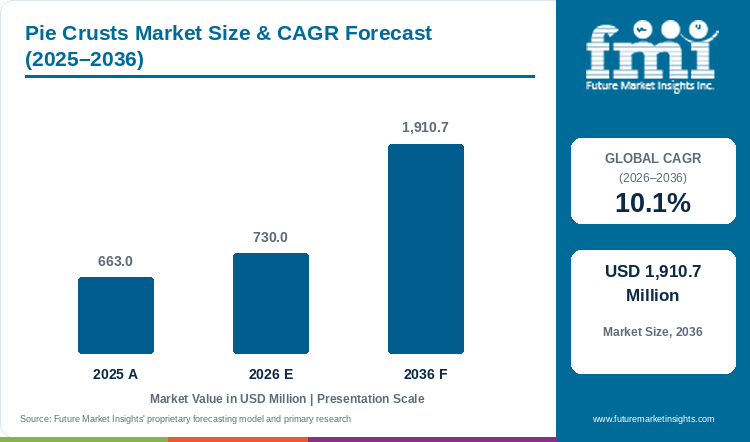
Key Market Trends & Insights
- Classic / original holds 35.0% of product type in 2026, giving kitchens a neutral base that can be tested with fruit, custard or savory fillings.
- Conventional holds 45.0% of claim / nature in 2026, with sourcing flexibility supporting dough handling while specialist claims require additional ingredient and production controls.
- Fresh holds 34.0% of format in 2026, while frozen bases permit longer stockholding with appropriate thawing and ambient formats need protection against drying.
- Multipack holds 32.0% of packaging format in 2026, allowing households and smaller kitchens to obtain consistent bases without preparing a separate dough batch.
Regional Highlights
- UAE has the highest profiled CAGR at 11.5% during 2026–2036.
- The next two profiled growth rates are Saudi Arabia at 11.2% and USA at 10.9% over the same period.
Market Size & Forecast
| Metric | Value |
|---|---|
| 2025 market value | USD 663.0 Million |
| 2026 market estimate | USD 730.0 Million |
| 2036 market forecast | USD 1,910.7 Million |
| Forecast CAGR, 2026–2036 | 10.1% |
The market covers separately sold, unfilled pie crusts, pastry shells and dough bases used to prepare pies and tarts. Finished filled pies, complete bakery meals and unrelated pastry snacks are excluded.
Pie crusts supply a component of bakery products, allowing the buyer to retain control of the filling while outsourcing dough preparation.
Bakery buying and handling
| Documented operating context | Source |
|---|---|
| USDA’s May 2026 analysis describes the agricultural supply base for popular pie ingredients. | [1] |
| Australian authorities reminded food importers about plain-English allergen labelling in October 2025. | [2] |
| AMF and Puratos announced a joint pilot bakery in June 2025 for commercial baking development. | [3] |
| FSANZ reviewed the first year of mandatory plain-English allergen labelling in March 2025. | [4] |
Analyst Perspective
Prepared crusts save useful kitchen time when they fit the buyer’s tins and produce dependable portions with the intended filling and oven. Consistent dimensions, handling guidance and control of cracking or shrinkage give a supplier a practical basis for repeat orders across retail and foodservice formats.
- Nandini Roy Choudhury, Principal Analyst at Future Market Insights
How is the pie crusts market segmented?
Product Type covers Classic / original, Whole grain & seeded, Flavored & filled, Mini & snacking formats and Premium / artisan. Claim / Nature covers Conventional, Clean label, Organic, Gluten-free and High-protein / fortified. Format covers Fresh, Frozen, Ambient packaged, Chilled and Par-baked / thaw-and-serve. Packaging Format covers Multipack, Single-serve, Family / loaf pack and Bulk foodservice. Sales Channel covers Supermarkets & hypermarkets, Artisan & specialty bakeries, Convenience & forecourt, Online & DTC and Foodservice distributors.
Kitchen demand linked to ready-to-eat food can support standardized crusts where time saved in preparation outweighs the cost of buying a component.
Why does Classic / original lead product type demand?
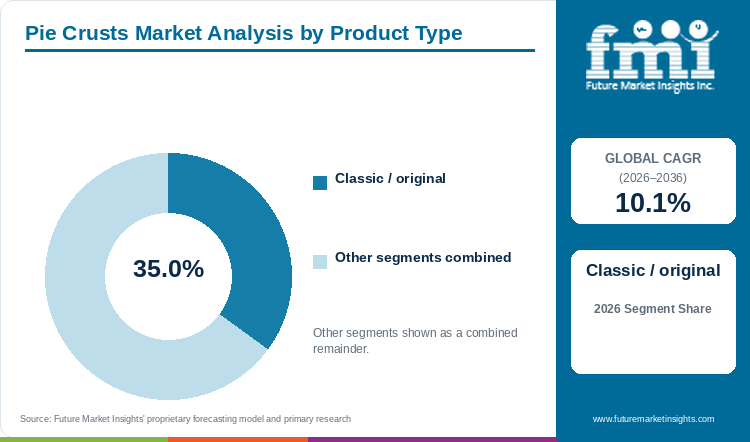
Classic / original: 35.0% of product type in 2026.
A plain crust gives kitchens a common base for fruit, custard and savory fillings, reducing the need to hold separate dough stocks for each recipe. Its usefulness depends on predictable dimensions, an edge that holds its shape and consistent browning as the filling changes. Whole-grain and seeded versions offer different textures, while miniature shells require other sizes and packaging. For the classic range, buyers can judge the reason to reorder through shrinkage and the number of usable portions after baking, rather than through seasoning or an elaborate recipe description.
- The Classic / original segment accounts for 35.0% of product type in 2026.
- A neutral crust lets kitchens vary the filling without maintaining a separate dough stock for every menu item.
Why does Conventional lead claim / nature demand?
Conventional: 45.0% of claim / nature in 2026.
Conventional crusts allow producers to balance flour strength and shortening for dough that bends into a tin without tearing and retains its shape during baking. Specialist formulations may justify a higher price, although they often need additional ingredient controls and trials to establish the same handling tolerance after storage and transport. Buyers first need an unfilled component that fits their existing preparation sequence, so a recipe change has commercial value when the base continues to work with the intended filling and equipment.
- The Conventional segment accounts for 45.0% of claim / nature in 2026.
- Consistent fat distribution and dough extensibility reduce the adjustments a kitchen must make during lining and baking.
What are the drivers, restraints, and opportunities in the pie crusts market?
Prepared crusts replace skilled dough work
Buying a prepared crust removes mixing and rolling from the kitchen’s schedule while leaving the filling in the customer’s hands. This is useful where pastry skills are limited or batch sizes vary. The saving disappears when staff have to repair cracked bases or change the recipe to accommodate an inconsistent shell. Clear handling instructions and a size that fits the intended tin make the purchased component easier to use. Kitchens can then plan production around a repeatable preparation step rather than the availability of a skilled dough maker.
Handling damage reduces usable yield
An acceptable taste test does not show whether a crust will survive distribution or work with a wet filling. Chilled and frozen handling can cause cracking or deformation before the kitchen opens the case. Bases also need enough strength to contain the recipe without becoming tough after baking. Buyers should agree tolerances for usable diameter and damage before placing regular orders. Appropriate thawing instructions help staff preserve that quality. Allergen and cross-contact controls remain necessary for specialist recipes as well as for conventional products.
Standardized sizes support foodservice adoption
Standard tin sizes and realistic batch quantities give crust suppliers a practical way to serve foodservice kitchens. A well-matched pack reduces offcuts and avoids leaving part of a dough case unused. Vandemoortele’s Banquet d’Or range includes separately sold frozen puff-pastry sheets that professionals can cut and line for their recipes. Similar component offers need clear handling information and tests with the intended filling and oven. Import-ready labeling matters for cross-border supply. The opportunity is to make the kitchen’s existing recipes easier to produce rather than require a different menu to accommodate the purchased base.
Experience in frozen baked goods is relevant to crust handling because cracking and deformation may appear during storage or thawing rather than during manufacture.
Which country and market CAGRs are profiled for pie crusts?
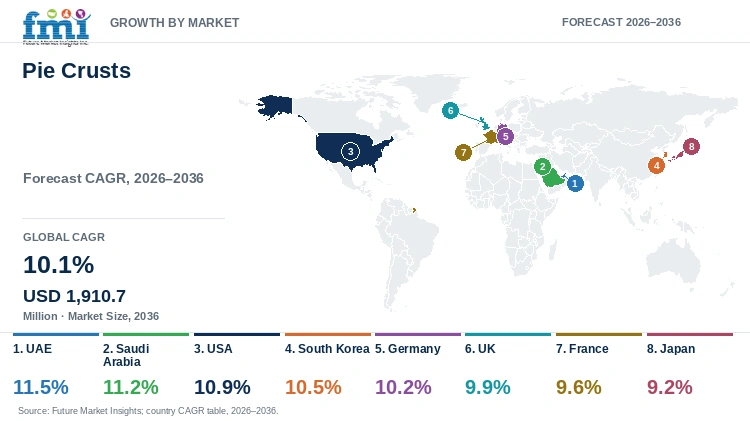
| Country | CAGR |
|---|---|
| UAE | 11.5% |
| Saudi Arabia | 11.2% |
| USA | 10.9% |
| South Korea | 10.5% |
| Germany | 10.2% |
| UK | 9.9% |
| France | 9.6% |
| Japan | 9.2% |
Country-wise Analysis
UAE
- Hospitality kitchens in the UAE can use frozen or par-baked shells to keep preparation consistent across properties. The market is forecast to grow at an 11.5% CAGR from 2026 to 2036. Cases must fit the kitchen’s storage space and reach it without damaged edges or distorted bases. Agreeing thickness and usable diameter gives both parties a clearer way to assess the delivered product. Buyers can then compare prices on the number of acceptable portions rather than discover shrinkage and breakage only after the shells have been filled.
Saudi Arabia
- A Saudi kitchen making pies in batches can buy the crust while retaining its own filling and finish, giving suppliers a practical starting offer that changes less of the customer’s menu. Saudi Arabia is forecast at an 11.2% CAGR over 2026 to 2036. Packaged-food requirements still govern entry to the market. Importers need to distinguish the information on the unfilled ingredient pack from the disclosures needed for the finished menu item. Regular orders depend on a base that continues to perform across those established recipes.
USA
- American supermarket orders may rise around seasonal baking occasions while caterers need a steadier supply of identical bases. The USA is expected to grow at a 10.9% CAGR from 2026 to 2036. Suppliers need case quantities that suit these different patterns. Buying dough saves little labor when excess units must repeatedly be thawed or discarded. Domestic cold storage also does not remove requirements for gluten labeling and cross-contact control. The most useful specification links the delivered crust size with the customer’s normal batch and expected finished yield.
South Korea
- Frozen grocery delivery can make prepared crusts accessible to South Korean home bakers, provided the pastry remains protected from partial thawing. South Korea is forecast at a 10.5% CAGR for 2026 to 2036. Small formats may suit modest baking occasions but individual packing raises insulation and delivery costs. Foodservice customers instead need shells that work with their filling and oven without repeated adjustments, which puts more emphasis on the finished result than on retail pack size. Trial baking should establish that result before a larger order is placed because dimensional consistency alone does not guarantee an acceptable finished pie.
Germany
- German bakeries compare the price of prepared crusts with usable yield and time saved, since breakage during separation or awkward storage can outweigh a low invoice price. The market is forecast to grow at a 10.2% CAGR from 2026 to 2036, with consistent dimensions and stacking helping the component fit existing work. Retail users need clear preparation guidance, while professional kitchens also need a dependable baking sequence with limited rework.
UK
- British caterers need to judge a crust after it has been filled and held for service. A shell that looks sound on opening may not perform with the customer’s menu or oven. UK forecast growth is 9.9% CAGR between 2026 and 2036. Suppliers can make the labor saving credible by reducing rejects and giving staff clear directions that remain usable when experience differs across shifts. Pastry quality and appropriate labeling remain essential; removing dough preparation should not create extra corrections or uncertainty later in the kitchen.
France
- A French pâtisserie can retain its own filling and finish while buying a standardized base, provided the purchased pastry preserves the intended texture and presentation. Within France’s 9.6% CAGR forecast for 2026 to 2036, ready-to-shape sheets may address constrained labor or seasonal output. Buyers comparing them with house-made pastry need practical guidance on thickness and shrinkage because those properties determine the result in their own recipe.
Japan
- Small and precisely sized shells offer Japanese buyers control over the finished serving. Japan shows a 9.2% CAGR for 2026 to 2036, the lowest rate in the profiled country group. Imported crusts need to fit local recipes and available storage rather than simply reproduce larger Western formats. Edges must survive transit and stacked units should separate without damage. Testing a few sizes with local users gives suppliers a firmer basis for expansion than offering many variants before their handling and availability are established.
Who are the notable companies in the pie crusts market?
General Mills; Wewalka; Wholly Wholesome; Dufour Pastry Kitchens; Jus-Rol
Pie-crust producers sell a preparation step that customers would otherwise perform themselves. Household packs need forgiving dough and straightforward directions. Professional buyers also need bases that fit their tins and can be handled consistently by different staff members.
Competitive Benchmarking: Pie Crusts Market
| Participant | Commercial focus | Buyer qualification priority |
|---|---|---|
| General Mills | Pillsbury refrigerated dough | Dough handling and shrinkage |
| Wewalka | Ready-to-use pastry dough | Rollout consistency and usable dimensions |
| Wholly Wholesome | Pie shells and rolled dough | Dietary specification and bake performance |
| Dufour Pastry Kitchens | Frozen pastry components | Laminate quality and filling compatibility |
| Jus-Rol | Prepared pastry formats | Storage requirements and application flexibility |
Key Developments in the Pie Crusts Market
- USDA’s May 2026 analysis describes the agricultural supply base for popular pie ingredients. [1]
- Australian authorities reminded food importers about plain-English allergen labelling in October 2025. [2]
Key Players in the Pie Crusts Market
- General Mills
- Wewalka
- Wholly Wholesome
- Dufour Pastry Kitchens
- Jus-Rol
Pie Crusts Market - Report Scope
| Coverage field | Report scope |
|---|---|
| Market breakdown | Product Type; Claim / Nature; Format; Packaging Format; Sales Channel; Region |
| Quantitative unit | USD Million |
| Market definition | The market covers separately sold, unfilled pie crusts, pastry shells and dough bases used to prepare pies and tarts. Finished filled pies, complete bakery meals and unrelated pastry snacks are excluded. |
| Regions covered | North America; Latin America; Western Europe; Eastern Europe; East Asia; South Asia and Pacific; Middle East and Africa |
| Countries / markets profiled | UAE; Saudi Arabia; USA; South Korea; Germany; UK; France; Japan |
| Key companies profiled | General Mills; Wewalka; Wholly Wholesome; Dufour Pastry Kitchens; Jus-Rol |
| Base year / forecast period | 2026 / 2026–2036 |
| Estimate coverage | 2025 and 2026 market estimates; 2036 forecast; segment shares and country / market CAGRs. |
Pie Crusts Market - Research Methodology
| Method | Application |
|---|---|
| Market definition | The analysis follows the stated product or service boundary and distinguishes direct category revenue from adjacent activities. |
| Secondary research | Official technical, regulatory, research and company publications provide the documented operating context and recent developments cited in this report. |
| Forecast and segmentation | Market estimates, segment shares and geographic forecasts are presented as analytical estimates within the stated commercial scope. |
| Competitive assessment | Participants are compared by their relevant products or services, commercial role and buyer qualification requirements. |
| Interpretation | The assessment considers purchasing conditions and the scope of the documented product, service or performance claim. |
Pie Crusts Market by Segments
Product Type
- Classic / original
- Whole grain & seeded
- Flavored & filled
- Mini & snacking formats
- Premium / artisan
Claim / Nature
- Conventional
- Clean label
- Organic
- Gluten-free
- High-protein / fortified
Format
- Fresh
- Frozen
- Ambient packaged
- Chilled
- Par-baked / thaw-and-serve
Packaging Format
- Multipack
- Single-serve
- Family / loaf pack
- Bulk foodservice
Sales Channel
- Supermarkets & hypermarkets
- Artisan & specialty bakeries
- Convenience & forecourt
- Online & DTC
- Foodservice distributors
Pie Crusts Market by Region
- North America
- United States
- Canada
- Latin America
- Brazil
- Mexico
- Argentina
- Chile
- Western Europe
- Germany
- France
- United Kingdom
- Italy
- Spain
- Benelux
- Nordics
- Eastern Europe
- Poland
- Czech Republic
- Romania
- Hungary
- East Asia
- China
- Japan
- South Korea
- South Asia and Pacific
- India
- ASEAN
- Australia and New Zealand
- Middle East and Africa
- GCC Countries
- South Africa
- Türkiye
- Israel
Research Sources and Bibliography
- [1] U.S. Department of Agriculture, Economic Research Service. (2026, May 21). U.S. production of popular pie ingredients.
- [2] Australian Government, Department of Agriculture, Fisheries and Forestry. (2025, October 14). Reminder for importers about plain English allergen labelling.
- [3] AMF Bakery Systems. (2025, June 9). AMF and Puratos launch joint pilot bakery facility to accelerate commercial baking innovation.
- [4] Food Standards Australia New Zealand. (2025, March 5). Plain English Allergen Labelling: One year of clearer, safer food labels.
- [5] Future Market Insights. (2026). Pie Crusts Market: Global industry analysis and opportunity assessment, 2026–2036.
This Report Answers
- How large is the pie crusts market in 2026?
- What value and CAGR are forecast through 2036?
- Which product type segment leads in 2026?
- Which claim / nature segment has the largest share?
- Which profiled country or market has the fastest forecast growth?
- Which participants are covered in the competitive assessment?
Frequently Asked Questions
How large is the pie crusts market in 2026?
The market was valued at USD 663.0 Million in 2025 and is expected to reach USD 730.0 Million in 2026.
What value and CAGR are forecast through 2036?
The market is projected to reach USD 1,910.7 Million by 2036, with a 10.1% CAGR during 2026–2036.
Which product type segment leads in 2026?
The Classic / original segment accounts for 35.0% of product type in 2026.
Which claim / nature segment has the largest share?
The Conventional segment accounts for 45.0% of claim / nature in 2026.
Which profiled country or market has the fastest forecast growth?
UAE has the highest profiled CAGR at 11.5% during 2026–2036.
Which participants are covered in the competitive assessment?
The assessment covers General Mills, Wewalka, Wholly Wholesome, Dufour Pastry Kitchens and Jus-Rol.
Preview the report firsthand - request a free sample
Get SampleGet the brochure for pricing and purchase details.
Get PDFTable of Content
- Key Takeaways
- Market Size and CAGR
- Top Growth Driver
- Fastest Growing Segment
- Leading Region
- Key Companies
- Emerging Opportunities
- Executive Summary
- Global Market Outlook
- Demand-side Trends
- Supply-side Trends
- Technology Roadmap Analysis
- Analysis and Recommendations
- Analyst Perspective (What is happening? Why now? What should investors know?)
- Key Questions Answered
- How large is the market?
- What is the CAGR?
- What are key trends?
- Which region dominates?
- Who are the leaders?
- Market Overview
- Market Coverage / Taxonomy
- Market Definition / Scope / Limitations
- Research Methodology
- Chapter Orientation
- Analytical Lens and Working Hypotheses
- Market Structure, Signals, and Trend Drivers
- Benchmarking and Cross-market Comparability
- Market Sizing, Forecasting, and Opportunity Mapping
- Research Design and Evidence Framework
- Desk Research Programme (Secondary Evidence)
- Expert Input and Fieldwork (Primary Evidence)
- Tooling, Models, and Reference Databases
- Data Engineering and Model Build
- Quality Assurance and Audit Trail
- Market Background
- Market Dynamics (Drivers, Restraints, Opportunity, Trends)
- Scenario Forecast (Optimistic, Likely, Conservative)
- Impact Analysis
- AI Impact
- Sustainability Impact
- Regulatory Impact
- Technology Impact
- Consumer / Buyer Analysis
- Purchase Drivers
- Adoption Barriers
- Buyer Journey
- Opportunity Map Analysis
- Product Life Cycle Analysis
- Supply Chain Analysis
- Investment Feasibility Matrix
- Value Chain Analysis
- PESTLE and Porter's Analysis
- Regulatory Landscape
- Regional Parent Market Outlook
- Production and Consumption Statistics
- Import and Export Statistics
- Global Market Analysis and Forecast, 2021 to 2036
- Historical Market Size Value (USD Million) Analysis, 2021 to 2025
- Current and Future Market Size Value (USD Million) Projections, 2026 to 2036
- Y-o-Y Growth Trend Analysis
- Absolute $ Opportunity Analysis
- Global Market Pricing Analysis, 2021 to 2036
- Global Market Analysis and Forecast, By Product Type, 2021 to 2036
- Introduction / Key Findings
- Historical Market Size Value (USD Million) Analysis By Product Type, 2021 to 2025
- Current and Future Market Size Value (USD Million) Analysis and Forecast By Product Type, 2026 to 2036
- Classic / original
- Whole grain & seeded
- Flavored & filled
- Mini & snacking formats
- Premium / artisan
- Y-o-Y Growth Trend Analysis By Product Type, 2021 to 2025
- Absolute $ Opportunity Analysis By Product Type, 2026 to 2036
- Global Market Analysis and Forecast, By Claim / Nature, 2021 to 2036
- Introduction / Key Findings
- Historical Market Size Value (USD Million) Analysis By Claim / Nature, 2021 to 2025
- Current and Future Market Size Value (USD Million) Analysis and Forecast By Claim / Nature, 2026 to 2036
- Conventional
- Clean label
- Organic
- Gluten-free
- High-protein / fortified
- Y-o-Y Growth Trend Analysis By Claim / Nature, 2021 to 2025
- Absolute $ Opportunity Analysis By Claim / Nature, 2026 to 2036
- Global Market Analysis and Forecast, By Format, 2021 to 2036
- Introduction / Key Findings
- Historical Market Size Value (USD Million) Analysis By Format, 2021 to 2025
- Current and Future Market Size Value (USD Million) Analysis and Forecast By Format, 2026 to 2036
- Fresh
- Frozen
- Ambient packaged
- Chilled
- Par-baked / thaw-and-serve
- Y-o-Y Growth Trend Analysis By Format, 2021 to 2025
- Absolute $ Opportunity Analysis By Format, 2026 to 2036
- Global Market Analysis and Forecast, By Packaging Format, 2021 to 2036
- Introduction / Key Findings
- Historical Market Size Value (USD Million) Analysis By Packaging Format, 2021 to 2025
- Current and Future Market Size Value (USD Million) Analysis and Forecast By Packaging Format, 2026 to 2036
- Multipack
- Single-serve
- Family / loaf pack
- Bulk foodservice
- Y-o-Y Growth Trend Analysis By Packaging Format, 2021 to 2025
- Absolute $ Opportunity Analysis By Packaging Format, 2026 to 2036
- Global Market Analysis and Forecast, By Sales Channel, 2021 to 2036
- Introduction / Key Findings
- Historical Market Size Value (USD Million) Analysis By Sales Channel, 2021 to 2025
- Current and Future Market Size Value (USD Million) Analysis and Forecast By Sales Channel, 2026 to 2036
- Supermarkets & hypermarkets
- Artisan & specialty bakeries
- Convenience & forecourt
- Online & DTC
- Foodservice distributors
- Y-o-Y Growth Trend Analysis By Sales Channel, 2021 to 2025
- Absolute $ Opportunity Analysis By Sales Channel, 2026 to 2036
- Global Market Analysis and Forecast, By Region, 2021 to 2036
- Introduction
- Historical Market Size Value (USD Million) Analysis By Region, 2021 to 2025
- Current Market Size Value (USD Million) Analysis and Forecast By Region, 2026 to 2036
- North America
- Latin America
- Western Europe
- Eastern Europe
- East Asia
- South Asia and Pacific
- Middle East and Africa
- Market Attractiveness Analysis By Region
- North America Market Analysis and Forecast, By Country, 2021 to 2036
- Historical Market Size Value (USD Million) Trend Analysis By Market Taxonomy, 2021 to 2025
- Market Size Value (USD Million) Forecast By Market Taxonomy, 2026 to 2036
- By Country
- United States
- Canada
- By Product Type
- By Claim / Nature
- By Format
- By Packaging Format
- By Sales Channel
- By Country
- Market Attractiveness Analysis
- By Country
- By Product Type
- By Claim / Nature
- By Format
- By Packaging Format
- By Sales Channel
- Key Takeaways
- Latin America Market Analysis and Forecast, By Country
- Historical Market Size Value (USD Million) Trend Analysis By Market Taxonomy, 2021 to 2025
- Market Size Value (USD Million) Forecast By Market Taxonomy, 2026 to 2036
- By Country
- Brazil
- Mexico
- Argentina
- Chile
- By Product Type
- By Claim / Nature
- By Format
- By Packaging Format
- By Sales Channel
- By Country
- Market Attractiveness Analysis
- By Country
- By Product Type
- By Claim / Nature
- By Format
- By Packaging Format
- By Sales Channel
- Key Takeaways
- Western Europe Market Analysis and Forecast, By Country
- Historical Market Size Value (USD Million) Trend Analysis By Market Taxonomy, 2021 to 2025
- Market Size Value (USD Million) Forecast By Market Taxonomy, 2026 to 2036
- By Country
- Germany
- France
- United Kingdom
- Italy
- Spain
- Benelux
- Nordics
- By Product Type
- By Claim / Nature
- By Format
- By Packaging Format
- By Sales Channel
- By Country
- Market Attractiveness Analysis
- By Country
- By Product Type
- By Claim / Nature
- By Format
- By Packaging Format
- By Sales Channel
- Key Takeaways
- Eastern Europe Market Analysis and Forecast, By Country
- Historical Market Size Value (USD Million) Trend Analysis By Market Taxonomy, 2021 to 2025
- Market Size Value (USD Million) Forecast By Market Taxonomy, 2026 to 2036
- By Country
- Poland
- Czech Republic
- Romania
- Hungary
- By Product Type
- By Claim / Nature
- By Format
- By Packaging Format
- By Sales Channel
- By Country
- Market Attractiveness Analysis
- By Country
- By Product Type
- By Claim / Nature
- By Format
- By Packaging Format
- By Sales Channel
- Key Takeaways
- East Asia Market Analysis and Forecast, By Country
- Historical Market Size Value (USD Million) Trend Analysis By Market Taxonomy, 2021 to 2025
- Market Size Value (USD Million) Forecast By Market Taxonomy, 2026 to 2036
- By Country
- China
- Japan
- South Korea
- By Product Type
- By Claim / Nature
- By Format
- By Packaging Format
- By Sales Channel
- By Country
- Market Attractiveness Analysis
- By Country
- By Product Type
- By Claim / Nature
- By Format
- By Packaging Format
- By Sales Channel
- Key Takeaways
- South Asia and Pacific Market Analysis and Forecast, By Country
- Historical Market Size Value (USD Million) Trend Analysis By Market Taxonomy, 2021 to 2025
- Market Size Value (USD Million) Forecast By Market Taxonomy, 2026 to 2036
- By Country
- India
- ASEAN
- Australia and New Zealand
- By Product Type
- By Claim / Nature
- By Format
- By Packaging Format
- By Sales Channel
- By Country
- Market Attractiveness Analysis
- By Country
- By Product Type
- By Claim / Nature
- By Format
- By Packaging Format
- By Sales Channel
- Key Takeaways
- Middle East and Africa Market Analysis and Forecast, By Country
- Historical Market Size Value (USD Million) Trend Analysis By Market Taxonomy, 2021 to 2025
- Market Size Value (USD Million) Forecast By Market Taxonomy, 2026 to 2036
- By Country
- GCC Countries
- South Africa
- Türkiye
- Israel
- By Product Type
- By Claim / Nature
- By Format
- By Packaging Format
- By Sales Channel
- By Country
- Market Attractiveness Analysis
- By Country
- By Product Type
- By Claim / Nature
- By Format
- By Packaging Format
- By Sales Channel
- Key Takeaways
- Key Countries Market Analysis
- United States
- Pricing Analysis
- Market Share Analysis, 2025
- By Product Type
- By Claim / Nature
- By Format
- By Packaging Format
- By Sales Channel
- Canada
- Pricing Analysis
- Market Share Analysis, 2025
- By Product Type
- By Claim / Nature
- By Format
- By Packaging Format
- By Sales Channel
- Mexico
- Pricing Analysis
- Market Share Analysis, 2025
- By Product Type
- By Claim / Nature
- By Format
- By Packaging Format
- By Sales Channel
- Brazil
- Pricing Analysis
- Market Share Analysis, 2025
- By Product Type
- By Claim / Nature
- By Format
- By Packaging Format
- By Sales Channel
- Chile
- Pricing Analysis
- Market Share Analysis, 2025
- By Product Type
- By Claim / Nature
- By Format
- By Packaging Format
- By Sales Channel
- Germany
- Pricing Analysis
- Market Share Analysis, 2025
- By Product Type
- By Claim / Nature
- By Format
- By Packaging Format
- By Sales Channel
- United Kingdom
- Pricing Analysis
- Market Share Analysis, 2025
- By Product Type
- By Claim / Nature
- By Format
- By Packaging Format
- By Sales Channel
- Italy
- Pricing Analysis
- Market Share Analysis, 2025
- By Product Type
- By Claim / Nature
- By Format
- By Packaging Format
- By Sales Channel
- Spain
- Pricing Analysis
- Market Share Analysis, 2025
- By Product Type
- By Claim / Nature
- By Format
- By Packaging Format
- By Sales Channel
- France
- Pricing Analysis
- Market Share Analysis, 2025
- By Product Type
- By Claim / Nature
- By Format
- By Packaging Format
- By Sales Channel
- India
- Pricing Analysis
- Market Share Analysis, 2025
- By Product Type
- By Claim / Nature
- By Format
- By Packaging Format
- By Sales Channel
- ASEAN
- Pricing Analysis
- Market Share Analysis, 2025
- By Product Type
- By Claim / Nature
- By Format
- By Packaging Format
- By Sales Channel
- Australia and New Zealand
- Pricing Analysis
- Market Share Analysis, 2025
- By Product Type
- By Claim / Nature
- By Format
- By Packaging Format
- By Sales Channel
- China
- Pricing Analysis
- Market Share Analysis, 2025
- By Product Type
- By Claim / Nature
- By Format
- By Packaging Format
- By Sales Channel
- Japan
- Pricing Analysis
- Market Share Analysis, 2025
- By Product Type
- By Claim / Nature
- By Format
- By Packaging Format
- By Sales Channel
- South Korea
- Pricing Analysis
- Market Share Analysis, 2025
- By Product Type
- By Claim / Nature
- By Format
- By Packaging Format
- By Sales Channel
- Poland
- Pricing Analysis
- Market Share Analysis, 2025
- By Product Type
- By Claim / Nature
- By Format
- By Packaging Format
- By Sales Channel
- Hungary
- Pricing Analysis
- Market Share Analysis, 2025
- By Product Type
- By Claim / Nature
- By Format
- By Packaging Format
- By Sales Channel
- Türkiye
- Pricing Analysis
- Market Share Analysis, 2025
- By Product Type
- By Claim / Nature
- By Format
- By Packaging Format
- By Sales Channel
- South Africa
- Pricing Analysis
- Market Share Analysis, 2025
- By Product Type
- By Claim / Nature
- By Format
- By Packaging Format
- By Sales Channel
- UAE
- Pricing Analysis
- Market Share Analysis, 2025
- By Product Type
- By Claim / Nature
- By Format
- By Packaging Format
- By Sales Channel
- Saudi Arabia
- Pricing Analysis
- Market Share Analysis, 2025
- By Product Type
- By Claim / Nature
- By Format
- By Packaging Format
- By Sales Channel
- United States
- Market Structure Analysis
- Competition Dashboard
- Competition Benchmarking
- Market Share Analysis of Top Players
- By Regional
- By Product Type
- By Claim / Nature
- By Format
- By Packaging Format
- By Sales Channel
- Emerging Startups
- Innovation Benchmarking
- Competition Analysis
- Competition Deep Dive
- General Mills
- Overview
- Product Portfolio
- Profitability by Market Segments
- Sales Footprint
- Strategy Overview
- Marketing Strategy
- Product Strategy
- Channel Strategy
- Wewalka
- Wholly Wholesome
- Dufour Pastry Kitchens
- Jus-Rol
- General Mills
- Case Studies
- Success Stories
- Recent Developments
- Competition Deep Dive
- Assumptions & Acronyms Used


