

- Market Size (2026)
- USD 434.6 Mn
- Forecast (2036)
- USD 1245.2 Mn
- CAGR (2026 to 2036)
- 11.1%
How big is Mince Pies Market in 2026?
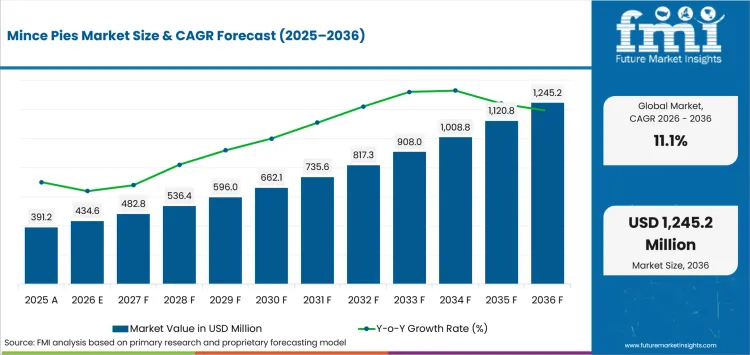
USD 434.6 million in 2026 and USD 1,245.2 million by 2036 at an 11.1% CAGR.
Sales of mince pies are projected to expand at an 11.1% CAGR from 2026 to 2036 as valuation rises from USD 434.6 million to USD 1,245.2 million. Earlier seasonal ranging gives grocers more selling weeks and makes weekly sell-through more important than one late-December stock-up. Premier Foods reported in January 2026 that Mr Kipling Signature Mince Pies again outperformed the category during the festive period.
North American specialty demand develops differently because imported mince pies compete with a much larger domestic pie and bakery set. The USA Bureau of Labor Statistics recorded a 2.1% annual price decline for frozen and refrigerated bakery products in August 2026. Since that category includes pies and tarts, specialty British brands need controlled trial packs instead of relying on general bakery inflation to support pricing.
Key Takeaways
- Earlier seasonal ranging and premium pastry variants extend the selling window beyond a single Christmas stock-up.
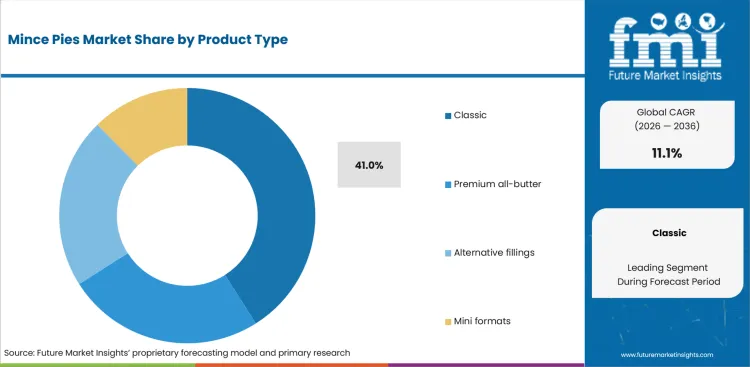
- Classic is projected to hold 41.0% of product type in 2026 because traditional fruit-filled pies remain the standard seasonal reference.
- By claim - nature, conventional is estimated to hold 64.0% in 2026 because mainstream recipes serve the broadest price and channel range.
- Fresh is set to lead format with 39.0% share in 2026 owing to immediate consumption and frequent replenishment.
- Short Christmas windows expose retailers to markdown risk because unsold seasonal stock loses relevance immediately after the holiday.
- Key players in the mince pies market include Premier Foods (Mr Kipling), Walkers Shortbread, Greggs, Tesco PLC, J Sainsbury plc, Asda, Morrisons, Lidl GB, Marks & Spencer, and Aldi UK.
Analyst Perspective
"Retailers should judge mince-pie ranges by sell-through discipline and shelf-life fit before extending premium space. Commercial value comes from matching pack size to household mission, then phasing stock to reduce post-Christmas waste."
- Nandini Roy Choudhury, Principal Consultant, Future Market Insights
How is the mince pies market segmented?
The mince pies market is segmented by product type, claim - nature, format, packaging format, sales channel, and region.
Five commercial dimensions define the mince pies market by product type, claim - nature, format, packaging format, and sales channel. Product type covers classic, premium all-butter, alternative fillings, and mini formats while claim - nature includes conventional, clean label, organic, gluten-free, and high-protein - fortified. Format includes fresh, frozen, ambient packaged, chilled, and par-baked - thaw-and-serve while packaging includes multipack, single-serve, family - loaf pack, and bulk foodservice. Sales channels cover supermarkets & hypermarkets, artisan & specialty bakeries, convenience & forecourt, online & DTC, and foodservice distributors.
How does classic shape demand within the product type category?
Classic mince pies give retailers the reference taste used to judge premium or alternative extensions during seasonal ranging. Marks & Spencer said in December 2025 that its classic mince pie is benchmarked a year ahead using blind tasting. Familiarity still anchors the category even as brands test butter-rich pastry and alternative fillings for premium households.
- Classic is projected to account for 41.0% of product type in 2026 because seasonal recognition supports repeat household purchasing.
- Retailers can compare classic lines with adjacent bakery products when assessing price points and shelf productivity without changing the core festive proposition.
What supports demand for conventional within the claim - nature category?
Conventional recipes give retailers room to balance pastry richness and price without specialist bakery ingredients. Finsbury Food Group documented in December 2025 that free-from bakery demand requires dedicated formulation choices. Mainstream ranges keep conventional products broad while specialist claims serve narrower dietary missions for grocery retailers.
- Conventional is estimated to hold 64.0% of claim - nature in 2026 because familiar recipes suit mainstream grocery assortments.
- Specialist shoppers compare these lines with gluten-free food where ingredient controls and texture expectations change repeat-purchase behavior more sharply.
How do retailers evaluate fresh within the format category?
Fresh mince pies reward retailers that can replenish frequently because aroma and pastry texture are strongest close to the bake. Morrisons reported in November 2025 that its Market Street bakers produce more than 20 million mince pies each year for Christmas demand. The scale makes daily bake planning and local sell-through central to the fresh format instead of optional store disciplines.
- Fresh is expected to hold 39.0% of format in 2026 because frequent replenishment suits immediate-consumption bakery channels.
- Operators that cannot support short holding times can use frozen bakery formats to separate production timing from final service without copying fresh-store economics.
What drives multipack within the packaging format category?
Multipacks convert Christmas familiarity into planned household stock-up where unit economics matter more than single-serve convenience. Tesco reported in its 2025 Christmas Trends Report that it sold 57 million mince pies during the previous Christmas period. Grocery packs therefore need enough volume for repeat consumption without creating excessive leftover stock.
- Multipack is forecast to represent 29.0% of packaging format in 2026 because household sharing improves unit economics for repeat seasonal purchases.
- Grocers already managing packaged bread understand similar shelf-life and pack-size trade-offs, although mince pies compress those decisions into a shorter festive window.
How does supermarket and hypermarket access influence the sales channel category?
Supermarkets place mince pies beside broader Christmas bakery and can test several formats within one seasonal aisle. Lidl GB reported in January 2026 that shoppers bought more than 30 million mince pies from September through Christmas 2025. Early category volume gives national grocers several weeks to adjust space and replenishment before the final December peak.
- Supermarkets & hypermarkets are projected to hold 34.0% of sales channel revenue in 2026 because broad household reach supports seasonal merchandising.
- Category teams that already manage ready-to-eat food can apply similar impulse-placement discipline while adjusting for the much shorter Christmas demand cycle.
What are the drivers, restraints and opportunities in the Mince Pies Market?
Earlier seasonal ranging and snackable formats widen purchase occasions, while short selling windows raise stock risk and smaller premium packs give retailers a controlled route into trade-up demand.
- Driver: Retailers are extending Christmas bakery earlier and using smaller formats to create more purchase occasions before the final festive week.
- Restraint: Short shelf life and a fixed post-Christmas demand drop can turn excessive seasonal stock into markdowns or food waste.
- Opportunity: Premium two-packs and alternative formats let retailers test higher-value propositions without committing to large household packs.
Convenience-led Christmas bakery now competes for occasions once reserved for full-size family packs in stores. Finsbury Food Group noted in January 2026 that mini mince pies and snackable sweet bakes fit gifting and gatherings. Manufacturers need flexible industrial bakery mixes because short seasonal runs still require repeatable pastry performance.
Short Christmas selling periods turn fresh bakery leftovers into an operating problem once seasonal traffic falls away. Tesco opened a dedicated facility in April 2026 to process surplus bakery after redistribution routes were exhausted. Retailers can shift part of the range toward frozen baked goods to reduce daily carryover before seasonal relevance ends.
Premium trial works when smaller formats reduce the cost of trying unfamiliar flavors before households commit to larger packs. Tesco launched new cakes and filled cookies across more than 320 Cafés in March 2026. Suppliers can qualify differentiated baking ingredients in limited runs before grocers commit to broad seasonal distribution.
Which country CAGRs are profiled in the Mince Pies Market?
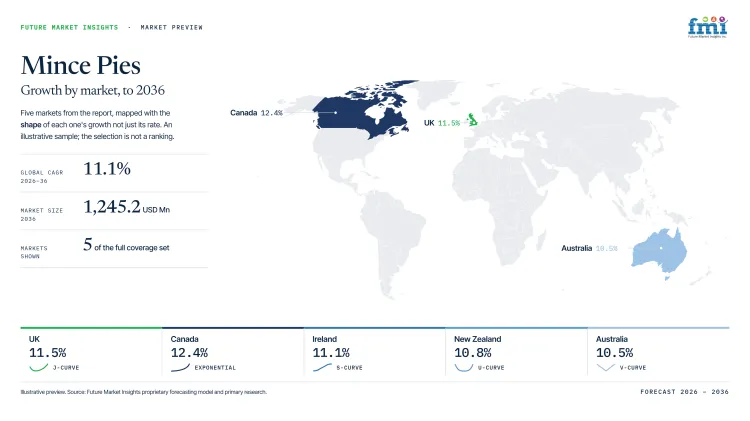
| Country | CAGR |
|---|---|
| Canada | 12.4% |
| USA | 12.1% |
| Germany | 11.8% |
| UK | 11.5% |
| Ireland | 11.1% |
| New Zealand | 10.8% |
| Australia | 10.5% |
| South Africa | 10.2% |
How do country-level CAGRs compare in the Mince Pies Market?
The 2.2-point CAGR spread separates North American specialty expansion from countries where Christmas bakery already has stronger local substitutes. Canada and the USA need more product discovery, whereas Germany and the UK compete inside familiar festive bakery occasions.
- Canada supports shelf-stable trial listings because imported festive lines must travel farther before reaching dispersed grocery accounts nationwide.
- USA specialty retailers need compact trial packs because established holiday cookies and pies already absorb substantial seasonal shopper attention.
- German grocers use British provenance to distinguish mince pies beside entrenched stollen traditions during the same Christmas selling period.
- UK retailers compete on weekly range productivity because shoppers already understand mince pies and compare premium formats directly.
- Irish grocers face higher overstock sensitivity in smaller store networks where festive bakery familiarity is already strong.
- New Zealand grocers favor concentrated seasonal assortments because dispersed stores cannot support many near-identical festive bakery lines.
- Australian summer entertaining changes serving occasions and gives smaller ambient formats a practical route into seasonal merchandising.
- South African festive planning begins earlier because year-end promotions shift substantial grocery attention into the November shopping period.
Comparable CAGRs still produce different stocking decisions because category familiarity and channel economics vary by country. The full report covers North America plus Latin America and both Western and Eastern Europe. It also covers East Asia plus South Asia and Pacific and the Middle East and Africa.
Country-wise Analysis
- Canadian grocers place mince pies inside imported British or premium holiday bakery because the product is not a universal Christmas staple. Canada is projected to expand at 12.4% CAGR through 2036 as specialty grocery channels introduce seasonal products without mass-market familiarity. Agriculture and Agri-Food Canada recorded 101 cakes, pastries and sweet-goods launches during 2025 as shelf-stable formats dominated the national analysis. Imported mince pies therefore need compact trial listings and longer holding life before broad distribution becomes economical.
- USA retailers position mince pies inside specialty British assortments because domestic holiday cookies and pies already occupy seasonal shelf space. Mince-pie demand is forecast to grow at 12.1% CAGR over the assessment period owing to specialty retail and direct shipping. The USDA Economic Research Service reported in April 2026 that cereal and bakery prices increased 1.0% during 2025. Modest family-category inflation keeps recognition and trial format important, so smaller packs let stores test demand without broad seasonal space.
- German grocers sell mince pies beside a Christmas bakery culture where familiar local products already claim premium occasions. Germany is projected to expand at 11.8% CAGR over the forecast period owing to specialty imports and British festive foods. Lebensmittelverband Deutschland described Christstollen as an enduring national Christmas tradition in its December 2025 publication. Imported mince pies therefore need clear British provenance and compact formats that earn shelf space beside established festive bakery.
- UK grocery teams treat mince pies as a routine Christmas bakery line, so assortment depth depends more on sell-through than category explanation. UK demand is forecast to grow at 11.5% CAGR over the assessment period because early ranging expands the selling window. Circana data cited by Premier Foods in September 2025 showed GB mince-pie sales value had risen 34% over five years. Five-year sales growth raises the cost of slow-moving variants while dependable classic lines provide the base for premium expansion.
- Irish grocers work with strong festive bakery familiarity inside a smaller store base where seasonal case-depth errors become expensive quickly. Ireland is anticipated to record 11.1% CAGR over the assessment period because mainstream supermarkets provide broad grocery access. Central Statistics Office data showed bread and bakery product prices increased 0.5% year over year in August 2026. Stable family-category pricing keeps assortment quality and local sell-through more important than inflation during Christmas ranging.
- New Zealand grocers manage festive bakery across a dispersed store network where unit volumes fall outside the main urban centers. Demand is predicted to expand at 10.8% CAGR through 2036 because British-style festive foods retain recognition in premium grocery channels. Stats NZ classifies cakes and biscuits within bread and cereals in its national food price index. The July 2026 release continued that series, while longer-life formats and phased shipments reduce residual stock for lower-throughput stores.
- Australian retailers sell Christmas bakery during summer, which changes serving cues and pastry handling compared with the colder British season. Australia is projected to expand at 10.5% CAGR through 2036 owing to premium grocery channels and British heritage positioning. The Australian Bureau of Statistics recorded a 1.5% annual rise in bread and cereal product prices in May 2026. Moderate family-category inflation keeps differentiation more important than price escalation while smaller ambient formats suit summer entertaining.
- South African festive planning begins before December because retailers build year-end promotions around a long November-to-Christmas selling period. Mince-pie sales are forecast to grow at 10.2% CAGR by 2036 owing to earlier promotions and value-conscious festive purchasing. Statistics South Africa recorded cereal product prices 3.8% higher year over year in June 2026. The bakery-family price movement keeps value architecture important while durable ambient formats give stores more time to sell seasonal inventory.
Who are the notable companies in the Mince Pies Market?
Premier Foods (Mr Kipling), Walkers Shortbread, Greggs, Tesco PLC, J Sainsbury plc, Asda, Morrisons, Lidl GB, Marks & Spencer, Aldi UK
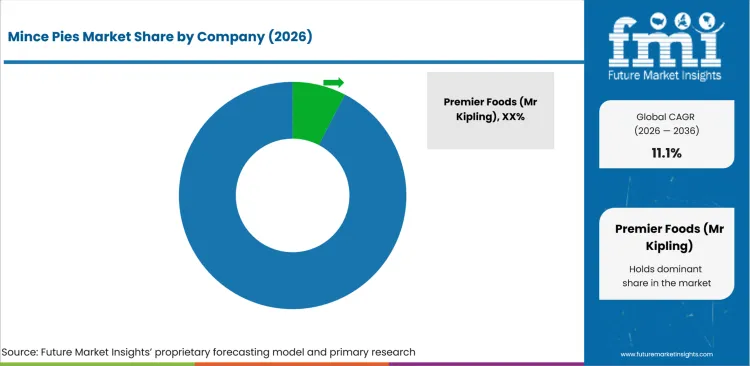
Competition now separates branded seasonal bakers from national grocers because brand recognition and direct shelf control shape different routes to household demand.
- Premier Foods (Mr Kipling) and Walkers Shortbread sell branded festive bakery while Greggs reaches shoppers via its national bakery-shop network.
- Tesco PLC and J Sainsbury plc control national grocery access with own-label festive ranges. Asda and Morrisons use broad store networks to reach the same seasonal shopper base.
- Lidl GB, Marks & Spencer and Aldi UK use seasonal confectionery mixes alongside differentiated bakery ranges to compete for Christmas trade-up occasions.
Competitive Benchmarking: Mince Pies Market
| Company | Mince-Pie Evidence | Channel Access | Recipe Flexibility | Geographic Reach |
|---|---|---|---|---|
| Premier Foods (Mr Kipling) | High | High | High | UK, North America and European grocery channels |
| Walkers Shortbread | High | Medium | Medium | UK and international export channels |
| Greggs | High | High | Low | UK |
| Tesco PLC | High | High | High | UK, Ireland and Central Europe |
| J Sainsbury plc | High | High | Medium | UK |
| Asda | High | High | High | UK |
| Morrisons | High | High | High | UK |
| Lidl GB | High | High | Medium | Great Britain |
| Marks & Spencer | High | High | High | UK and international partner markets |
| Aldi UK | High | High | High | UK |
Scoring basis: High mince-pie evidence requires a direct corporate record showing finished mince-pie sales or range activity. High channel access requires national grocery or shop coverage, while Medium records narrower specialist or export-led access. High recipe flexibility requires at least three documented mince-pie variants while Medium requires two verified variants and Low records one. Geographic reach records operating or export coverage without converting that evidence into a score.
Key Developments in the Mince Pies Market
- In September 2026, Morrisons revealed a Christmas range approaching 700 festive products with 290 new own-brand launches and expanded Market Street participation.
- In May 2026, Premier Foods introduced five Mr Kipling launches spanning Whirls plus cake slices and tarts to broaden finished sweet-bakery formats for grocery retailers.
- In June 2026, Marks & Spencer opened a larger Tottenham Court Road store with a new in-store bakery and coffee counter serving bread and pastries.
Key Players in the Mince Pies Market
Branded seasonal and direct-retail bakery
- Premier Foods (Mr Kipling)
- Walkers Shortbread
- Greggs
National grocery retailers
- Tesco PLC
- J Sainsbury plc
- Asda
- Morrisons
Discount and premium grocery retailers
- Lidl GB
- Marks & Spencer
Value-focused grocery retailer
- Aldi UK
Mince Pies Market - Report Scope
| Coverage field | Report scope |
|---|---|
| Market breakdown | product type; claim - nature; format; packaging format; sales channel |
| Quantitative Units | USD million |
| Market Definition | Revenue includes finished mince pies sold within the defined product, claim, format, packaging, and sales-channel universe. It excludes separately sold fillings or ingredients, adjacent festive bakery products, and downstream foodservice markups beyond the finished pie sale. |
| Regions Covered | North America; Latin America; Western Europe; Eastern Europe; East Asia; South Asia and Pacific; Middle East and Africa |
| Countries Covered | Canada; USA; Germany; UK; Ireland; New Zealand; Australia; South Africa; more than twenty-five additional countries in the full report |
| Key Companies Profiled | Premier Foods (Mr Kipling), Walkers Shortbread, Greggs, Tesco PLC, J Sainsbury plc, Asda, Morrisons, Lidl GB, Marks & Spencer, Aldi UK |
| Forecast Period | 2026 to 2036 |
| Approach | Primary and secondary research with market triangulation. |
Mince Pies Market - Research Methodology
| Method | Approach |
|---|---|
| Primary Research | FMI analysts gathered input from manufacturers, service providers, technology developers, distributors, end users, procurement teams, and subject-matter experts. Interviews examined purchasing decisions, product or service evaluation, adoption barriers, approval requirements, pricing considerations, and expectations for technical or commercial support. Respondents were also asked what evidence is required before a trial, pilot, or initial order develops into regular purchasing. |
| Desk Research | Desk research covered government statistics, regulatory publications, trade data, industry associations, technical literature, standards, company filings, product information, and official corporate announcements. Sources were reviewed for relevance, publication date, geographic coverage, and consistency with the defined market scope. Claims relating to performance, applications, approvals, capacity, investment, and commercial activity were retained only when supported by credible public evidence. |
| Market Sizing and Forecasting | The market model combined the baseline value with historical performance, segment structure, pricing and volume indicators, adoption levels, company participation, and country-level demand conditions. Forecast assumptions considered economic activity, investment trends, regulatory developments, technology adoption, purchasing cycles, supply availability, and barriers to wider market use. Segment and regional estimates were reconciled before the final market total was calculated. |
| Data Validation | Estimates were checked against multiple independent indicators, including public data, company activity, trade patterns, industry developments, and findings from primary interviews. Validation also tested whether products, services, applications, and company revenues fell within the defined market boundaries. Adjacent categories, unsupported claims, overlapping revenues, and activities without direct market relevance were excluded to reduce double counting and maintain consistency across segments and countries. |
Mince Pies Market by Segments
Mince Pies Market segmented by Product Type:
- Classic
- Premium all-butter
- Alternative fillings
- Mini formats
Mince Pies Market segmented by Claim - Nature:
- Conventional
- Clean label
- Organic
- Gluten-free
- High-protein - fortified
Mince Pies Market segmented by Format:
- Fresh
- Frozen
- Ambient packaged
- Chilled
- Par-baked - thaw-and-serve
Mince Pies Market segmented by Packaging Format:
- Multipack
- Single-serve
- Family - loaf pack
- Bulk foodservice
Mince Pies Market segmented by Sales Channel:
- Supermarkets & hypermarkets
- Artisan & specialty bakeries
- Convenience & forecourt
- Online & DTC
- Foodservice distributors
Mince Pies Market by Region:
- North America
- United States
- Canada
- Latin America
- Brazil
- Mexico
- Argentina
- Chile
- Western Europe
- Germany
- France
- United Kingdom
- Italy
- Spain
- Benelux
- Nordics
- Eastern Europe
- Poland
- Czech Republic
- Romania
- Hungary
- East Asia
- China
- Japan
- South Korea
- South Asia and Pacific
- India
- ASEAN
- Australia and New Zealand
- Middle East and Africa
- GCC Countries
- South Africa
- Türkiye
- Israel
Research Sources and Bibliography
- Premier Foods. (2026, January 21). Quarter 3 trading update for Premier Foods for the 13 weeks ended 27 December 2025.
- USA Bureau of Labor Statistics. (2026, September 11). Consumer Price Index - August 2026.
- Marks & Spencer. (2025, December 23). The Secret Behind M&S Quality - Mince Pies.
- Finsbury Food Group. (2025, December 15). Healthy & Free From Bakery Options - Meeting Modern Dietary Needs.
- Morrisons. (2025, November 17). Morrisons celebrates first ever 'National Mince Pie Day' with thousands of free bakes for Brits.
- Tesco PLC. (2025). Christmas Trends Report 2025.
- Lidl GB. (2026, January 2). Unbeatable festive value, innovative products and a commitment to British sourcing sees Lidl GB celebrate a record-breaking Christmas.
- Finsbury Food Group. (2026, January 8). Biscuits & Cakes in Convenience: Trends and Opportunities.
- Tesco PLC. (2026, April 9). New Tesco food surplus feed site set to drive circularity in the UK food system.
- Tesco PLC. (2026, March 23). Tesco unveils its new Spring menu at The Café.
- Agriculture and Agri-Food Canada. (2026, August 26). Sector Trend Analysis - Bakery trends in Canada.
- USDA Economic Research Service. (2026, April 30). USA food-at-home prices increased 2.3 percent in 2025, compared with 2024.
- Lebensmittelverband Deutschland. (2025, December 17). Prof. Gunther Hirschfelder im Podcast über Weihnachtsbräuche: Was wir an Weihnachten essen, ist mehr als Nahrung.
- Premier Foods. (2025, September 12). Mr Kipling brings early Christmas joy to shoppers with new launches and returning favourites.
- Central Statistics Office Ireland. (2026, September 10). Consumer Price Index August 2026.
- Stats NZ. (2026, July 17). Selected price indexes: June 2026.
- Australian Bureau of Statistics. (2026, June 24). Consumer Price Index, Australia, May 2026.
- Statistics South Africa. (2026, July 22). Consumer Price Index, June 2026.
- Lidl GB. (2026, March 9). Lidl GB announces new target and trials for food waste reduction.
- J Sainsbury plc. (2025). Mince pies make a difference: Help Sainsbury's donate over five million meals to families experiencing food poverty.
- Asda. (2025, October 13). Eyes on the pies! Asda launches first-to-market mince pies with a chilling twist for Christmas 2025.
- Aldi UK. (2025, September 18). Is it too early? Mince pies arrive at Aldi featuring new pistachio and whisky flavours.
- Greggs. (2025, November). Sleigh your sweet treat cravings.
- Walker's Shortbread. (n.d.). New From Walker's. Retrieved September 14, 2026.
- Morrisons. (2026, September 9). Morrisons unveils 2026 Christmas range packed with irresistible choices, Market Street craftsmanship and brand-new launches.
- Premier Foods. (2026, May 29). Mr Kipling unveils exceedingly good innovation.
- Marks & Spencer. (2026, June 10). M&S unveils bigger Tottenham Court Road store with brand-new bakery & coffee counter.
- Greggs. (2026, May). Greggs trials new Greggs Express concept.
- Lidl GB. (2026, May 13). Lidl GB and Neighbourly maximise food sharing in communities with new Olio partnership.
- Morrisons. (2026, March 31). When one bun isn't enough: Morrisons launches a giant Hot Cross Bun Loaf for Easter.
- Aldi UK. (2026, March 11). Aldi unveils its 2026 Hot Cross Bun range including new Mighty Cheesy Hot Cross Buns.
- Lidl GB. (2026, August 6). Lidl GB and Neighbourly accelerate Olio partnership to almost 200 communities.
- Premier Foods. (2026, July 16). Quarter 1 Trading Update for Premier Foods for the 13 weeks ending 27 June 2026.
- Larder Magazine. (2026, September 11). Walkers Shortbread unveils festive range for Christmas 2026.
- Greggs. (2026, June 19). New Bitesize Greggs opens in London Bridge Station.
- J Sainsbury plc. (2026, April 23). Preliminary Results for the 52 weeks ended 28 February 2026.
- Asda. (2026, May 19). Asda unveils new ranges, lower prices and a renewed in-store experience.
- Morrisons. (2026, March 2). Chunky steak pie tops the Pie-mier League as Morrisons kicks off British Pie Week.
- Marks & Spencer. (2026, July 16). M&S opens its biggest ever standalone Food store in Godalming as it invests in bigger, better stores for the family weekly shop.
- Tesco PLC. (2026, June 4). Tesco Launches New Potato Burger Buns Made With Real Mashed Potato.
- J Sainsbury plc. (2026, May 7). Costa Coffee and Sainsbury's celebrate 50th in-store opening together with new Leicester location.
This bibliography is provided for reader reference and is not exhaustive. The full report contains the complete reference list and detailed citations.
This Report Answers
- How do the 2026 and 2036 values define the forecast path?
- Which retail conditions extend mince-pie selling before Christmas?
- Why does classic retain its product-type share?
- How do fresh formats differ from frozen and ambient options?
- Which conditions separate North American and European growth routes?
- How do shelf life and markdowns change stocking decisions?
- How do company roles differ between branding, direct bakery retail, full-line grocery and value-focused seasonal ranges?
- What should grocers compare before expanding premium mince-pie ranges?
Frequently Asked Questions
How big is the mince pies market in 2026?
The mince pies market is valued at USD 434.6 million in 2026 and is projected to reach USD 1,245.2 million by 2036. Earlier seasonal ranging gives retailers more weeks to sell classic and premium formats before Christmas.
What is the CAGR of the mince pies market from 2026 to 2036?
The mince pies market is projected to grow at 11.1% CAGR between 2026 and 2036. Premium trade-up and earlier seasonal distribution support expansion while retailers manage post-Christmas inventory exposure.
Which product type leads the mince pies market?
The classic segment is expected to hold 41.0% of product type in 2026 because familiar fruit-filled recipes support repeat seasonal purchasing. Retailers use classic lines as the reference before adding premium pastry or alternative fillings.
Which format leads the mince pies market?
The fresh segment is expected to hold 39.0% of format in 2026 because bakery-led channels replenish frequently. Fresh lines fit immediate consumption where retailers can manage shorter holding periods during seasonal trading.
Which companies are active in the mince pies market?
Key companies operating in the mince pies market include Premier Foods (Mr Kipling), Walkers Shortbread, Greggs, Tesco PLC, J Sainsbury plc, Asda, Morrisons, Lidl GB, Marks & Spencer, and Aldi UK. Their roles span branded seasonal bakery, direct bakery retail and national grocery own-label ranges.
Preview the report firsthand - request a free sample
Get SampleGet the brochure for pricing and purchase details.
Get PDFTable of Content
- Key Takeaways
- Market Size and CAGR
- Top Growth Driver
- Fastest Growing Segment
- Leading Region
- Key Companies
- Emerging Opportunities
- Executive Summary
- Global Market Outlook
- Demand-side Trends
- Supply-side Trends
- Technology Roadmap Analysis
- Analysis and Recommendations
- Analyst Perspective (What is happening? Why now? What should investors know?)
- Key Questions Answered
- How large is the market?
- What is the CAGR?
- What are key trends?
- Which region dominates?
- Who are the leaders?
- Market Overview
- Market Coverage / Taxonomy
- Market Definition / Scope / Limitations
- Research Methodology
- Chapter Orientation
- Analytical Lens and Working Hypotheses
- Market Structure, Signals, and Trend Drivers
- Benchmarking and Cross-market Comparability
- Market Sizing, Forecasting, and Opportunity Mapping
- Research Design and Evidence Framework
- Desk Research Programme (Secondary Evidence)
- Expert Input and Fieldwork (Primary Evidence)
- Tooling, Models, and Reference Databases
- Data Engineering and Model Build
- Quality Assurance and Audit Trail
- Market Background
- Market Dynamics (Drivers, Restraints, Opportunity, Trends)
- Scenario Forecast (Optimistic, Likely, Conservative)
- Impact Analysis
- AI Impact
- Sustainability Impact
- Regulatory Impact
- Technology Impact
- Consumer / Buyer Analysis
- Purchase Drivers
- Adoption Barriers
- Buyer Journey
- Opportunity Map Analysis
- Product Life Cycle Analysis
- Supply Chain Analysis
- Investment Feasibility Matrix
- Value Chain Analysis
- PESTLE and Porter's Analysis
- Regulatory Landscape
- Regional Parent Market Outlook
- Production and Consumption Statistics
- Import and Export Statistics
- Global Market Analysis and Forecast, 2021 to 2036
- Historical Market Size Value (USD Million) Analysis, 2021 to 2025
- Current and Future Market Size Value (USD Million) Projections, 2026 to 2036
- Y-o-Y Growth Trend Analysis
- Absolute $ Opportunity Analysis
- Global Market Pricing Analysis, 2021 to 2036
- Global Market Analysis and Forecast, By Product Type, 2021 to 2036
- Introduction / Key Findings
- Historical Market Size Value (USD Million) Analysis By Product Type, 2021 to 2025
- Current and Future Market Size Value (USD Million) Analysis and Forecast By Product Type, 2026 to 2036
- Classic
- Premium all-butter
- Alternative fillings
- Mini formats
- Classic
- Y-o-Y Growth Trend Analysis By Product Type, 2021 to 2025
- Absolute $ Opportunity Analysis By Product Type, 2026 to 2036
- Global Market Analysis and Forecast, By Claim / Nature, 2021 to 2036
- Introduction / Key Findings
- Historical Market Size Value (USD Million) Analysis By Claim / Nature, 2021 to 2025
- Current and Future Market Size Value (USD Million) Analysis and Forecast By Claim / Nature, 2026 to 2036
- Conventional
- Clean label
- Organic
- Gluten-free
- High-protein / fortified
- Conventional
- Y-o-Y Growth Trend Analysis By Claim / Nature, 2021 to 2025
- Absolute $ Opportunity Analysis By Claim / Nature, 2026 to 2036
- Global Market Analysis and Forecast, By Format, 2021 to 2036
- Introduction / Key Findings
- Historical Market Size Value (USD Million) Analysis By Format, 2021 to 2025
- Current and Future Market Size Value (USD Million) Analysis and Forecast By Format, 2026 to 2036
- Fresh
- Frozen
- Ambient packaged
- Chilled
- Par-baked / thaw-and-serve
- Fresh
- Y-o-Y Growth Trend Analysis By Format, 2021 to 2025
- Absolute $ Opportunity Analysis By Format, 2026 to 2036
- Global Market Analysis and Forecast, By Packaging Format, 2021 to 2036
- Introduction / Key Findings
- Historical Market Size Value (USD Million) Analysis By Packaging Format, 2021 to 2025
- Current and Future Market Size Value (USD Million) Analysis and Forecast By Packaging Format, 2026 to 2036
- Multipack
- Single-serve
- Family / loaf pack
- Bulk foodservice
- Multipack
- Y-o-Y Growth Trend Analysis By Packaging Format, 2021 to 2025
- Absolute $ Opportunity Analysis By Packaging Format, 2026 to 2036
- Global Market Analysis and Forecast, By Sales Channel, 2021 to 2036
- Introduction / Key Findings
- Historical Market Size Value (USD Million) Analysis By Sales Channel, 2021 to 2025
- Current and Future Market Size Value (USD Million) Analysis and Forecast By Sales Channel, 2026 to 2036
- Supermarkets & hypermarkets
- Artisan & specialty bakeries
- Convenience & forecourt
- Online & DTC
- Foodservice distributors
- Supermarkets & hypermarkets
- Y-o-Y Growth Trend Analysis By Sales Channel, 2021 to 2025
- Absolute $ Opportunity Analysis By Sales Channel, 2026 to 2036
- Global Market Analysis and Forecast, By Region, 2021 to 2036
- Introduction
- Historical Market Size Value (USD Million) Analysis By Region, 2021 to 2025
- Current Market Size Value (USD Million) Analysis and Forecast By Region, 2026 to 2036
- North America
- Latin America
- Western Europe
- Eastern Europe
- East Asia
- South Asia and Pacific
- Middle East & Africa
- Market Attractiveness Analysis By Region
- North America Market Analysis and Forecast, By Country, 2021 to 2036
- Historical Market Size Value (USD Million) Trend Analysis By Market Taxonomy, 2021 to 2025
- Market Size Value (USD Million) Forecast By Market Taxonomy, 2026 to 2036
- By Country
- USA
- Canada
- By Product Type
- By Claim / Nature
- By Format
- By Packaging Format
- By Sales Channel
- By Country
- Market Attractiveness Analysis
- By Country
- By Product Type
- By Claim / Nature
- By Format
- By Packaging Format
- By Sales Channel
- Key Takeaways
- Latin America Market Analysis and Forecast, By Country
- Historical Market Size Value (USD Million) Trend Analysis By Market Taxonomy, 2021 to 2025
- Market Size Value (USD Million) Forecast By Market Taxonomy, 2026 to 2036
- By Country
- Brazil
- Mexico
- Chile
- Rest of Latin America
- By Product Type
- By Claim / Nature
- By Format
- By Packaging Format
- By Sales Channel
- By Country
- Market Attractiveness Analysis
- By Country
- By Product Type
- By Claim / Nature
- By Format
- By Packaging Format
- By Sales Channel
- Key Takeaways
- Western Europe Market Analysis and Forecast, By Country
- Historical Market Size Value (USD Million) Trend Analysis By Market Taxonomy, 2021 to 2025
- Market Size Value (USD Million) Forecast By Market Taxonomy, 2026 to 2036
- By Country
- Germany
- UK
- Italy
- Spain
- France
- Nordic
- BENELUX
- Rest of Western Europe
- By Product Type
- By Claim / Nature
- By Format
- By Packaging Format
- By Sales Channel
- By Country
- Market Attractiveness Analysis
- By Country
- By Product Type
- By Claim / Nature
- By Format
- By Packaging Format
- By Sales Channel
- Key Takeaways
- Eastern Europe Market Analysis and Forecast, By Country
- Historical Market Size Value (USD Million) Trend Analysis By Market Taxonomy, 2021 to 2025
- Market Size Value (USD Million) Forecast By Market Taxonomy, 2026 to 2036
- By Country
- Russia
- Poland
- Hungary
- Balkan & Baltic
- Rest of Eastern Europe
- By Product Type
- By Claim / Nature
- By Format
- By Packaging Format
- By Sales Channel
- By Country
- Market Attractiveness Analysis
- By Country
- By Product Type
- By Claim / Nature
- By Format
- By Packaging Format
- By Sales Channel
- Key Takeaways
- East Asia Market Analysis and Forecast, By Country
- Historical Market Size Value (USD Million) Trend Analysis By Market Taxonomy, 2021 to 2025
- Market Size Value (USD Million) Forecast By Market Taxonomy, 2026 to 2036
- By Country
- China
- Japan
- South Korea
- By Product Type
- By Claim / Nature
- By Format
- By Packaging Format
- By Sales Channel
- By Country
- Market Attractiveness Analysis
- By Country
- By Product Type
- By Claim / Nature
- By Format
- By Packaging Format
- By Sales Channel
- Key Takeaways
- South Asia and Pacific Market Analysis and Forecast, By Country
- Historical Market Size Value (USD Million) Trend Analysis By Market Taxonomy, 2021 to 2025
- Market Size Value (USD Million) Forecast By Market Taxonomy, 2026 to 2036
- By Country
- India
- ASEAN
- Australia & New Zealand
- Rest of South Asia and Pacific
- By Product Type
- By Claim / Nature
- By Format
- By Packaging Format
- By Sales Channel
- By Country
- Market Attractiveness Analysis
- By Country
- By Product Type
- By Claim / Nature
- By Format
- By Packaging Format
- By Sales Channel
- Key Takeaways
- Middle East & Africa Market Analysis and Forecast, By Country
- Historical Market Size Value (USD Million) Trend Analysis By Market Taxonomy, 2021 to 2025
- Market Size Value (USD Million) Forecast By Market Taxonomy, 2026 to 2036
- By Country
- Kingdom of Saudi Arabia
- Other GCC Countries
- Türkiye
- South Africa
- Other African Union
- Rest of Middle East & Africa
- By Product Type
- By Claim / Nature
- By Format
- By Packaging Format
- By Sales Channel
- By Country
- Market Attractiveness Analysis
- By Country
- By Product Type
- By Claim / Nature
- By Format
- By Packaging Format
- By Sales Channel
- Key Takeaways
- Key Countries Market Analysis
- USA
- Pricing Analysis
- Market Share Analysis, 2025
- By Product Type
- By Claim / Nature
- By Format
- By Packaging Format
- By Sales Channel
- Canada
- Pricing Analysis
- Market Share Analysis, 2025
- By Product Type
- By Claim / Nature
- By Format
- By Packaging Format
- By Sales Channel
- Mexico
- Pricing Analysis
- Market Share Analysis, 2025
- By Product Type
- By Claim / Nature
- By Format
- By Packaging Format
- By Sales Channel
- Brazil
- Pricing Analysis
- Market Share Analysis, 2025
- By Product Type
- By Claim / Nature
- By Format
- By Packaging Format
- By Sales Channel
- Chile
- Pricing Analysis
- Market Share Analysis, 2025
- By Product Type
- By Claim / Nature
- By Format
- By Packaging Format
- By Sales Channel
- Germany
- Pricing Analysis
- Market Share Analysis, 2025
- By Product Type
- By Claim / Nature
- By Format
- By Packaging Format
- By Sales Channel
- UK
- Pricing Analysis
- Market Share Analysis, 2025
- By Product Type
- By Claim / Nature
- By Format
- By Packaging Format
- By Sales Channel
- Italy
- Pricing Analysis
- Market Share Analysis, 2025
- By Product Type
- By Claim / Nature
- By Format
- By Packaging Format
- By Sales Channel
- Spain
- Pricing Analysis
- Market Share Analysis, 2025
- By Product Type
- By Claim / Nature
- By Format
- By Packaging Format
- By Sales Channel
- France
- Pricing Analysis
- Market Share Analysis, 2025
- By Product Type
- By Claim / Nature
- By Format
- By Packaging Format
- By Sales Channel
- India
- Pricing Analysis
- Market Share Analysis, 2025
- By Product Type
- By Claim / Nature
- By Format
- By Packaging Format
- By Sales Channel
- ASEAN
- Pricing Analysis
- Market Share Analysis, 2025
- By Product Type
- By Claim / Nature
- By Format
- By Packaging Format
- By Sales Channel
- Australia & New Zealand
- Pricing Analysis
- Market Share Analysis, 2025
- By Product Type
- By Claim / Nature
- By Format
- By Packaging Format
- By Sales Channel
- China
- Pricing Analysis
- Market Share Analysis, 2025
- By Product Type
- By Claim / Nature
- By Format
- By Packaging Format
- By Sales Channel
- Japan
- Pricing Analysis
- Market Share Analysis, 2025
- By Product Type
- By Claim / Nature
- By Format
- By Packaging Format
- By Sales Channel
- South Korea
- Pricing Analysis
- Market Share Analysis, 2025
- By Product Type
- By Claim / Nature
- By Format
- By Packaging Format
- By Sales Channel
- Russia
- Pricing Analysis
- Market Share Analysis, 2025
- By Product Type
- By Claim / Nature
- By Format
- By Packaging Format
- By Sales Channel
- Poland
- Pricing Analysis
- Market Share Analysis, 2025
- By Product Type
- By Claim / Nature
- By Format
- By Packaging Format
- By Sales Channel
- Hungary
- Pricing Analysis
- Market Share Analysis, 2025
- By Product Type
- By Claim / Nature
- By Format
- By Packaging Format
- By Sales Channel
- Kingdom of Saudi Arabia
- Pricing Analysis
- Market Share Analysis, 2025
- By Product Type
- By Claim / Nature
- By Format
- By Packaging Format
- By Sales Channel
- Türkiye
- Pricing Analysis
- Market Share Analysis, 2025
- By Product Type
- By Claim / Nature
- By Format
- By Packaging Format
- By Sales Channel
- South Africa
- Pricing Analysis
- Market Share Analysis, 2025
- By Product Type
- By Claim / Nature
- By Format
- By Packaging Format
- By Sales Channel
- USA
- Market Structure Analysis
- Competition Dashboard
- Competition Benchmarking
- Market Share Analysis of Top Players
- By Regional
- By Product Type
- By Claim / Nature
- By Format
- By Packaging Format
- By Sales Channel
- Emerging Startups
- Innovation Benchmarking
- Competition Analysis
- Competition Deep Dive
- Premier Foods (Mr Kipling)
- Overview
- Product Portfolio
- Profitability by Market Segments
- Sales Footprint
- Strategy Overview
- Marketing Strategy
- Product Strategy
- Channel Strategy
- Walkers Shortbread
- Greggs
- Finsbury Food Group
- Bakkavor
- Samworth Brothers
- The Compleat Food Group
- Mademoiselle Desserts
- pladis (McVitie's)
- Premier Foods (Mr Kipling)
- Case Studies
- Success Stories
- Recent Developments
- Competition Deep Dive
- Assumptions & Acronyms Used


